LP_468x60
on-the-record-468x60-white

Mia Schem spoke at a Toronto event on July 28, 2026 that was organized by Tribe of Nova Canada. She described how she was taken hostage by Hamas during the October 7 terror attack.

Mia Schem became one of the most recognizable faces of the October 7 hostage crisis after she was the first hostage shown in a Hamas video that received international attention. During the 2023 terror attack on Israel, the then 21-year-old Schem, and her friend Elia Toledano, had hurriedly driven away from the Nova music festival when the “red alert” sirens rang out, as rockets from Gaza flew above. They thought driving away would keep them from harm.

For Schem, a French-Israeli tattoo artist, the morning of terror remains agonizingly present.

After twenty minutes on the road, they came upon an ambush. “Bullets were flying over our heads,” she told attendees at a Toronto event on July 28 that was organized by Tribe of Nova Canada.

“Then they shot at us. The car lost control, flipped over and stopped. The doors were locked. We realized we couldn’t get out, so we got out from the windows. The moment I landed on the ground, I was shot at point blank range.”

She painted the vivid picture of the scene: of pieces of her right hand “flying into the air,” of burning cars, scattered bodies, parts of bodies, and the split-second decision that forced her to “walk toward the terrorists,” because she believed it was her only chance to survive. “I was dragged by my hair into a truck with seven Hamas monsters,” she said at the talk.

Schem was initially held in a Gaza home, and later moved into Hamas’s tunnel system and kept in a small cage. She recalled, “they treated me like an animal. They didn’t give me any medicine, any treatment, nothing.” She was held for 55 days, and released Nov. 30, 2023. Toledano’s body returned to Israel Dec. 15, 2023.

In November 2024, when there were still about a hundred hostages held in Gaza, she addressed the United Nations Security Council, telling them that Nova was “a bloodbath,” where “hundreds of young men and women were shot, dismembered, and brutally kidnapped.”

She asked: “What good are your resolutions, your debates, your empty promises, if the sick, elderly, mothers and their children are left to rot in the terror tunnels?” Since her return home, and multiple surgeries, Schem has said that her story is “a story about choosing to find light, even in the darkest moments,” she told the Toronto crowd. “I choose gratitude. Gratitude for the simple things. For waking up every morning. For breathing. For being able to hug my family. To be with my family.”

Dave Gordon spoke to Schem exclusively for National Post. This interview has been edited and condensed for clarity and length.

What feels most important for people to understand about your experience?

The most important thing I want people to understand is captivity didn’t end the day I came home. My body came back, but part of my heart and soul is still there. Every day I make the choice to get up and keep going, to live. I don’t want people to remember me only as a hostage. I want them to remember me as a woman who chose life after everything I went through.

What has helped you most in your recovery?

My family and friends have been my biggest source of support, but my faith has also given me strength during captivity. Hope kept me alive, and it still does today. Sharing my story around the world gives meaning and purpose to my pain. If my testimony can touch even one person, then I know it matters.

What do you wish people asked you more often?

I wish people would ask me how I was before October 7. Many people know me, know my story, but they don’t really know me. I was a young woman with dreams. I loved living a normal life. I want people to see me, not just what happened to me.

What gives you hope now?

People give me hope. I meet so many kind people around the world who support us, pray for us, and have not forgotten the hostages. They remind me that there is still so much good in the world. I also believe that no matter how dark life gets, you can always choose life.

You sang a Jewish song during your captivity. How did captivity change the way you think about God or Israel?

During captivity, I had nothing to hold on to except my faith. Every day, I sang Shir Lamaalot (A Song of Ascents) out, and reminded myself that I was not alone; that one day I would come home. Since returning, my connection to God and to Israel became much stronger. I realized how precious our lives are, for us, and how important it is for us to stay united, even when we disagree.

What has been the hardest part of returning to your ordinary life?

The hardest part is realizing that life goes on, but I am not the same person that I was before. Trauma does not disappear overnight. I’m still learning how to live again, how to feel joy without guilt, and how to build the future for myself.

What message do you hope non-Jews take from your experience?

I hope people understand what my story is. That my story is not only an Israeli story or Jewish story. It is a human story. Terrorism doesn’t choose a religion, and nationality, or skin colour. When we stay silent in the face of hatred and violence, everyone loses. I hope people will choose the trust, choose compassion, and the courage to stand with innocent people, and most of all, I want them to remember that there is always hope, even in the darkest place. You can choose light and choose life.


WestJet says it will take “several days” to restore operation. More than 600 flights were in limbo and some 250,000 travellers were affected, according to Canada's second-largest airlines.

WestJet has reached an agreement with the union representing more than 4,000 flight attendants and cabin crew to end a strike that disrupted flights over the long weekend.

The deal ends a work stoppage that had threatened to derail summer travel for thousands of travellers.

The tentative agreement will be presented to its members for a ratification vote, Canadian Union of Public Employees (CUPE) said in a press release Monday morning. In the meantime, flight attendants would return to work.

“This tentative agreement represents meaningful progress. It evolves the flight credit system by recognizing more of the work cabin crew are required to perform and with general increases to compensation for that work,” Alia Hussain, president of CUPE local 8125, said in a statement. “Most importantly, this agreement was achieved through collective bargaining at the negotiating table.”

Details of the agreement have not been disclosed; the union began its strike early Sunday morning due to a dispute over the lack of compensation for work flight attendants do on the ground, such as boarding passengers and managing delays.

On Sunday, WestJet had said it had offered a 13 per cent pay increase retroactive to Jan. 1, 2026 and a 2.5 per cent annual wage increase until 2029. The offer also included a new “duty pay premium,” defined as “additional pay for all hours worked designed to solve the union’s claim of unpaid work.” This would amount to another 12 per cent increase in salary, according to the airlines.

Additionally, benefit concessions included increased health-care spending and a maternity leave top-up as well as changes to the scheduling and compensation schemes, National Post previously reported.

Meanwhile, WestJet says it will take “several days” to restore operation. More than 600 flights were in limbo and some 250,000 travellers were affected, the Calgary-based carrier had said.

“We are pleased to have reached a tentative agreement that reflects the hard work and professionalism our cabin crew,” Alexis von Hoensbroech, the chief executive officer of WestJet, said in a statement.

Patty Hajdu, the federal minister of jobs and families, said she was involved “throughout” negotiations and thanked both parties and the Federal Mediation and Conciliation Service for their work.

Passengers whose flights have been affected are asked to check their flight status and watch their emails and text messages for alerts.

Our website is the place for the latest breaking news, exclusive scoops, longreads and provocative commentary. Please bookmark nationalpost.com and sign up for our daily newsletter, Posted, here.


StatCan data revealed that job vacancies held steady in May 2026.

Canadians are earning 3.4 per cent more than they were last year, and the region with the largest average earnings sees its residents make almost $700 a week more than those in the lowest-earning province.

That’s according to new Statistics Canada data , which reveal how much Canadians earn on average per week, along with average earnings across each province and territory.

The findings, which use data from the Survey of Employment, Payrolls and Hours (SEPH), show that the average weekly earnings in Canada reached $1,337.77 in May this year, compared to $1,293.19 in the same month in 2025.

This figure is little changed from April this year, when average weekly earnings were recorded at $1,343.52, which had marked a 3.7 per cent year-over-year increase.

StatCan notes that “in general, growth in average weekly earnings can reflect a range of factors, including changes in wages, composition of employment, hours worked and base-year effects.”

In May this year, average weekly hours worked stood at 33.4 hours and were little changed on a month-over-month and year-over-year basis, the data reveals.

This latest report also broke down average weekly earnings in Canada for each province and territory.

At the top of the list is Nunavut, where residents earned an average of $1,862.20 per week in May — compared to $1,747.62 in the same month in 2025.

This is followed by Northwest Territories ($1,765.69), Yukon ($1,505.43), Alberta ($1,378.85), Ontario ($1,377.49), British Columbia ($1,354.67), Saskatchewan (1,298.13), Quebec ($1,293.11), Newfoundland and Labrador ($1,266.10), New Brunswick ($1,228.55), Manitoba ($1,218.31) and Nova Scotia ($1,217.66).

At the bottom of the list is Prince Edward Island, where residents earned an average of $1,189.61 per week in May 2026. This was an increase on the $1,138.65 earned per week in May 2025, but nearly $700 less than Nunavut’s current average.

And, despite the year-over-year increase in average wages, Canadians are continuing to feel their budgets squeezed. A recent TD survey found that more than 1 in 3 Canadians (35 per cent) planned to spend less this summer, with 62 per cent of those who are cutting back redirecting spending towards everyday needs, such as groceries, fuel and housing.

This comes as recent StatCan data revealed that grocery price inflation increased more than overall inflation for the 17th consecutive month in June .

Driven by lower gasoline prices at the pumps, the overall inflation rate eased to 2.8 per cent in June after a 3.2 per cent increase in May. And though the cost of food purchased from stores grew at a slower pace (+3.9 per cent) than in May (+4.3 per cent), categories that experienced double-digit price increases in June included tomatoes (+31.7 per cent), lettuce (+19.3 per cent), carrots (+16.6 per cent), fresh or frozen beef (+13.8 per cent) and bananas (+11.5 per cent).

Elsewhere, recent StatCan data revealed that job vacancies held steady overall at 495,700 in May 2026, marking the fifth consecutive month of little variation in job vacancies in Canada. Year-over-year job vacancies were also little changed.

In four sectors, job vacancies were up in May: construction (+18.4 per cent), professional, scientific and technical services (+13.8 per cent), finance and insurance (+10.7 per cent) and real estate and rental and leasing (25 per cent).

Meanwhile, job vacancies were down in health care and social assistance (-11.6 per cent) and information and cultural industries (-39 per cent). The decrease in job vacancies in health care and social assistance was the first significant monthly decrease for this sector since December 2024, and the lowest since March 2020.

Ontario was the only province to record a significant monthly variation in job vacancies in May, with an increase of 5.6 per cent.

Our website is the place for the latest breaking news, exclusive scoops, longreads and provocative commentary. Please bookmark nationalpost.com and sign up for our daily newsletter, Posted, here.


Poland is investing billions in a major military build-up to deter Russia, strengthen NATO and bolster European security.

Poland, with an imminent high-priced military ramp-up, is betting that the cost of peace is cheaper than the price of war with Russia.

In a watershed defence spend, coming from a European Union loan, Warsaw is pouring nearly 44 billion euros ($71 billion) into stepping up its military infrastructure. Why now? That’s obvious for anyone following Moscow’s unyielding provocations.

Jets scrambling to intercept Russian aircraft over the Baltic, cyberattacks on Polish railways and hospitals, and drones and missiles straying across its borders have all convinced Poland’s political class that deterrence can’t be put off for an indeterminate future budget cycle.

With the new loan, Poland’s the largest single beneficiary of Security Action for Europe’s (SAFE) 150‑billion-euro defence budget. The loans are earmarked for modernizing the military, expanding the domestic arms sector, and rewarding Polish firms that collaborate with defence manufacturers. Government plans plot roughly 4.8 per cent of the nation’s GDP going to defence.

“This is a watershed moment in the history of both Poland and the European Union,” Prime Minister Donald Tusk said May 8 in Warsaw, at a ceremony for the signing of the agreement, AFP reported . “Poland will be safer in these difficult and highly risky times.”

 Poland’s Prime Minister Donald Tusk arrives for a dinner of the Coalition of the Willing to support Ukraine at the French presidential palace in Paris in July.

According to Dominic Roszak, president of the Canadian Polish Congress, and Stakeholder Relations Lead for the 2023 Warsaw Security Forum, “Poland has long warned the rest of Europe of Russia’s expansionist ambitions, even when other EU leaders weren’t always willing to listen.”

He continued: “Poland sees itself as a guarantor of regional security along the EU and NATO’s eastern frontier, including the more vulnerable Baltic states. I share the view that a strong and effective military is the only way to deter Russia from a direct confrontation with NATO.”

Poland’s history with Nazi and Communist occupations has made his countrymen “wary of being caught unprepared for foreign aggression,” he said.

Even though there were “public political disputes” over where the loan should come from — be it domestic financing or SAFE — he insists now there is “a broad consensus across government institutions and the mainstream political spectrum that, whatever the mechanism, a rapid defence build-up is necessary.”

The Polish military industry upgrade has won admirers here in Canada. According to Breaking Defense, Ottawa is poised to purchase Polish drones. A statement from the Canadian Department of National Defence said the two countries intended to pursue “joint projects involving emerging technologies.” Moreover, Poland was the featured country at CANSEC (Canada’s Global Defence & Security Trade Show) in Ottawa this spring, and Canada will be the lead nation at the MSPO defence expo in Kielce this September.

“With both countries (Canada and Poland) now participating in SAFE and deepening their strategic bilateral cooperation, this stops being a purely national spending story, and has the potential to become a shared industrial base. For defence manufacturers on both sides of the Atlantic, that is the opportunity of the decade,” Roszak said.

 A Polish soldier launches an interception drone of the American MEROPS counter-drone system during tests at the Nowa Deba military training ground, south-eastern Poland, on November 18, 2025.

There are a few potential downsides to Warsaw’s new plan – none of which are, in Roszak’s view, qualitatively or quantitatively much to worry about.

“The risk I would actually put at the top of the list is procurement delay. Poland’s planning anticipates the possibility of a confrontation with Russia within even the next five years, and there are still capability gaps to fill. Poland is determined to close them quickly, and has supercharged its procurement efforts, creating a dedicated role to drive the effort.” By the end of May, he added, Poland’s defence minister had already confirmed the signing of 50 contracts under SAFE, with a value close to 120 billion zloty, or over half of Poland’s total allocation.

There is a risk, he conceded, of Russia pre-emptively moving towards escalation, ahead of Poland’s military readiness. But he also said: “NATO’s resolve is the single biggest deterrent to a westward expansion of the current conflict. Poland led the way at the start of the full-scale (Russian) invasion of Ukraine by supplying weaponry to the Ukrainians, that some said would lead to ‘escalation.’”

A key indicator of the program’s success “will be a strong and sovereign Ukraine, because stability to Poland’s east is inseparable from Poland’s own.”

Katarzyna Lesperance, a native-born Pole and owner of the Starka distillery in Szczecin, Poland, comes from a family of military — first her father, and then her brother, a former senior-level official in the ministry of defence.
“People are afraid,” she said, of a potential conflagration.

Katarzyna, who studied naval academics at the Heroes of Westerplatte Polish Naval Academy in Gdynia, said that “most people are for the military” build-up. Russia, she added, “would be so crazy to invade right now,” but continues “a lot of provocation.”

Katarzyna lives with her husband David Lesperance, of Lesperance & Associates, and 12-year-old twins, in Gdynia, a port city on the Baltic, where intense early fighting of the Second World War began. Their apartment overlooks the port where naval vessels come out, and container ships bring in military hardware. There’s a military airfield in the city, with frequent flybys.

Their apartment’s about two-and-a-half hours from the Belarusian border, and Kaliningrad, Russian territory, Lesperance said.

Poles today “are conscious of bad things happening. It’s a part of Polish history…. So they are attuned to kind of, better be prepared, and prepare for the worst, hope for the best, and work for the best,” he said. His sense is that “reliance on America for monies and/or sophisticated systems, which need constant replacement and upgrading” is believed to be precarious and unpredictable, “with (U.S. President) Donald Trump being Donald Trump.”

A former diplomat echoed that Poland’s military surge is meant to avoid a far costlier, bloodier war.

“For us, safety — or I would say lack of safety — is a very present topic. It started long before the full state invasion of Russia to Ukraine,” said Natalia Walsh Iwaszko, formerly vice consul economic affairs, at the Consulate General of the Republic of Poland in Toronto. “Russia has been always a threat for centuries…. And we know that there is not much needed for Russia to be encouraged to attack again, either us or Baltic states.”

Born and raised in Poland, she is currently residing in Vancouver for a brief time, and writes for Defence24, Polish-based defence and security news.

To the argument that perceived brinkmanship might spur Moscow to fire first, before Poland has its full defensive walls up, she said such talk is “mostly created by Russian propaganda.”

Minister Bartosz Grodecki, head of the National Security Bureau of the Republic of Poland told the Post that in the nearly 30 years in NATO, his country has “transformed from a recipient of security to a creator of it” and that it has a “clear understanding of the goals and strategy of our main adversary — Russia — which is why, both domestically and internationally, we emphasize the importance of being able to defend against its imperialist ambitions.”

He added that the country is aware that in “the event of an attack, the costs of a defensive operation and the consequences of wartime destruction will be far greater than those incurred in building a resilient defence system.”

Our website is the place for the latest breaking news, exclusive scoops, longreads and provocative commentary. Please bookmark nationalpost.com and sign up for our daily newsletter, Posted, here.


Two children look at the damage done to Nöam restaurant on Décarie Blvd. in Montreal in a suspected arson attack, on Saturday, Aug. 1, 2026. As police investigate to determine a motive, U.S. officials are urging Canada to do more to combat antisemitism.

Some U.S. officials are condemning the apparent arson that destroyed a popular kosher restaurant in Montreal, with some characterizing the incident as part of a broader pattern of antisemitic attacks.

Illinois Congressman Paul Schneider, co-chair of the Congressional Jewish Congress, said he and his colleagues “are disgusted and outraged” by what he described as “yet another heinous attack on Jewish-owned business.”

“As antisemitism is increasingly normalized, violence and other attacks against Jews and Jewish institutions continue to escalate around the world,” he wrote on X. “This is a moment of crisis that requires all people of good conscience to speak up and condemn hate.”

Liberal MP Anthony Housefather, who on Saturday said “the matter must be investigated as a hate crime ,” thanked Schneider and his colleagues for reaching out to “express solidarity with the restaurant and building owners” and the community at large.

First responders were called to Nöam Restaurant in the Côte-des-Neiges neighbourhood around 3:15 a.m. Saturday, when they found the building ablaze, the Montreal Gazette reported . The two-storey building sustained extensive damage despite the efforts of some 80 firefighters.

Nobody was injured.

A police spokesperson said the investigation was handed over to the arson squad because a person was seen leaving the building shortly before the fire broke out.

The owner of the garage and car wash that sit on either side of the restaurant told the Gazette his security camera captured a lone person, likely a young man in his early 20s.

 The aftermath of an apparent arson that destroyed a popular kosher restaurant in Montreal.

Police have yet to establish a motive.

“While the investigation proceeds, Canada’s leaders should actively work to protect and bolster the Jewish community,” U.S. Ambassador to Canada Pete Hoekstra posted on X.

Ambassador Rabbi Yehuda Kaploun, special envoy to monitor and combat antisemitism at the U.S. Department of State, said this incident, on the heels of Jewish-owned bakeries in Toronto hit by gunfire last weekend, shows that “the time for action is now.”

“As I told officials during my visit to Ottawa last week, Canada’s government must do far more to combat antisemitism, protect Jewish citizens, and hold the perpetrators of attacks fully accountable,” he shared on X.

Iddo Moed, Israel’s Ambassador to Canada, called out the attack and reports that an Israeli-born MLS player was met with chants of “Death to Israel” during a match against host CF Montreal at Stade Saputo.

According to The Times of Israel , fans in one section taunted New England Revolution striker Dor Turgeman, who responded by putting his team up 2-0 in the first half. (It ended in a 2-2 draw.)

“The hate must be stopped before it transforms into something lethal,” Moed posted on X.

Our website is the place for the latest breaking news, exclusive scoops, longreads and provocative commentary. Please bookmark nationalpost.com and sign up for our newsletters here.



WestJet flight attendants who walked off the job Sunday say an offer of a 13 per cent pay increase and a 'duty pay premium' are not enough.

A WestJet flight attendant strike is officially underway after the airline and the union failed to reach an agreement early Sunday morning, both sides announced, leaving untold thousands of travellers scrambling to adjust their plans.

CEO Alexis von Hoensbroech said the airline was “disappointed” with the outcome and said it remains available to negotiate with CUPE 8125, the local which represents approximately 4,400 WestJet cabin crew.

“We presented a proposal that would have set a new standard for cabin crew in Canada, making WestJet the only airline to offer an hourly rate covering all time before and after flights, plus a double-digit wage increase in year one among other priorities the union raised,” von Hoensbroech said in a statement.

In a separate statement, the carrier said it offered a 13 per cent pay increase effective Oct. 1 and retroactive to Jan. 1, 2026, and 2.5 per cent annual increases through January 2029. Per diems would increase by the same amount on the same schedule.

It also proposed a new “duty pay premium — a payment for all duty hours (additional pay for all hours worked designed to solve the union’s claim of unpaid work), equivalent to another 12 per cent of salary increase.”

Other details of the proposal include a healthcare spending account of $300 annually, a 17-week maternity leave top-up, a new flexible part-time program, improved scheduling and res provisions, premium pay for certain flight reassignments, reduced maximum duty days on more demanding schedules and compensation for delays in accessing hotel rooms during layovers.

“It’s important to be clear about what was offered, what was not accepted, and what is leading to 250,000 guests whose August long weekend travel is cancelled, with further flights to follow, depending on the duration of the work stoppage,” the airline explained, noting inanother news release that 309 flights had been cancelled as late Saturday night.

WestJet has said impacted passengers will berefunded or reaccommodated “as applicable.”

CUPE 8125 president Alia Hussain said the offer “did not go far enough” and that flight attendants took labour action because they “deserve better.”

“Unpaid work is a big piece of our priorities, but we are bargaining a comprehensive contract,” she said in a statement, noting the strike could have been avoided had the airline taken “concerns seriously for almost 11 months of bargaining.”

National Post has contacted the union for more information on a media availability with Hussain scheduled for Sunday morning in Calgary, where talks had been ongoing.

Hussain also reiterated the union’s plea that the federal government refrain from involving itself.

When some 10,000 Air Canada flight attendants hit the picket line last summer, the federal Jobs Minister Patty Hajdu invoked section 107 of the Canada Labour Code to impose binding arbitration.

The Canada Industrial Relations Board then declared the strike unlawful and issued a return-to-work order that flight attendants defied for three days until an agreement was reached. Air Canada now pays for flight attendants for some ground duties.

“This is a disappointing development,” Hajdu wrote in a statement shared to X.

“A strike or lockout does not mean an agreement can’t be reached; the expectation is that parties can and should come to an agreement at the bargaining table.”

Meanwhile, Pascal Chan, vice-president of strategic policy and supply chains with the Canadian Chamber of Commerce, called on Ottawa to “use every tool at its disposal to bring this dispute to a swift and fair resolution that will allow air service to resume.

“Canadians are contending with yet another shutdown of critical transportation infrastructure that we cannot afford to watch drag on,” he wrote in a statement.

Our website is the place for the latest breaking news, exclusive scoops, longreads and provocative commentary. Please bookmark nationalpost.com and sign up for our daily newsletter, Posted, here.


How often should you re-apply sunscreen and how much should you use? Experts say there's no magic formula.

Sunscreen is key to protecting yourself from sunburns, skin cancer and visible skin aging, but it isn’t a one-and-done process.

Health Canada advises using a broad-spectrum sunscreen with a minimum SPF (sun protection factor) of 30 at least 15 minutes before going outside and reapplying every two hours during sun exposure. While that’s a good general rule of thumb, there are other factors to take into consideration.

So, how often should you be reapplying throughout the day? Maybe not as much as you think.

“There have been papers that show that if you’re sitting under a tree and not doing much — not sweating, not playing tennis, not swimming — you probably don’t need to reapply that often,” said Dr. Cheryl Rosen, head of the division of dermatology at Toronto Western Hospital and University Health Network.

In addition to outdoor activities, Rosen noted that the time of year can also impact how often and where on the body sunscreen should be applied.

“If you’re skiing in the winter, truly you only need to put it on your face because that’s the part that’s going to get the wind and the sun,” she said. “In the summer, you need to reapply if you’re swimming, if you’re water skiing. If you’re out in the sun sweating a lot, yes, reapply.

“I think people just need to be aware. It’s not a bad idea to, for instance, if you’re swimming, wear a UV shirt so you don’t have to bother putting sunscreen on your back and your arms. … Wearing a hat is a good idea to protect your neck and your ears. I think it makes sense to sort of be aware of your surroundings and reapply — I mean, the government says every two hours, but you may not need to do it that often depending on your activities.”

Another thing to be mindful of when applying and reapplying sunscreen is how much of the product is being used. Health Canada recommends that adults use one teaspoon for every body part exposed to the sun — including ears, scalp and the backs of your hands — though people may need more or less of that amount depending on various factors, says Lisa Heggie, founder and owner of Canadian sunscreen brand KINeSYS.

“The teaspoon is a useful guide, but there isn’t a magic amount that works for every person or situation,” said Heggie. “How much skin is exposed, body size and whether you’re wearing sun-protective clothing all make a difference. Some people may need more than one teaspoon; some may need less. The bigger issue is that people tend to under-apply and, more importantly, don’t reapply often enough.”

To ensure the right amount of sunscreen is distributed onto exposed skin, Heggie recommends opting for a lotion over aerosol sprays.

“With aerosol sprays, it can be harder to get enough product evenly onto the skin, particularly outdoors or in windy conditions. Without adequate, even coverage, you won’t get the level of SPF protection shown on the label,” she said. “Lotion allows you to see where you’re applying it, while a pump spray gives you a more targeted application.

“Whichever format you use, I recommend swiping it over the skin. Personally, I like two lighter coats. Just like painting, it helps give more even coverage and catch spots you may have missed.”

Our website is the place for the latest breaking news, exclusive scoops, longreads and provocative commentary. Please bookmark nationalpost.com and sign up for our newsletters here.


A flag of the Iran-backed Kata’ib Hezbollah group flies near an amusement park in Baghdad, Iraq, on March 21, 2026.

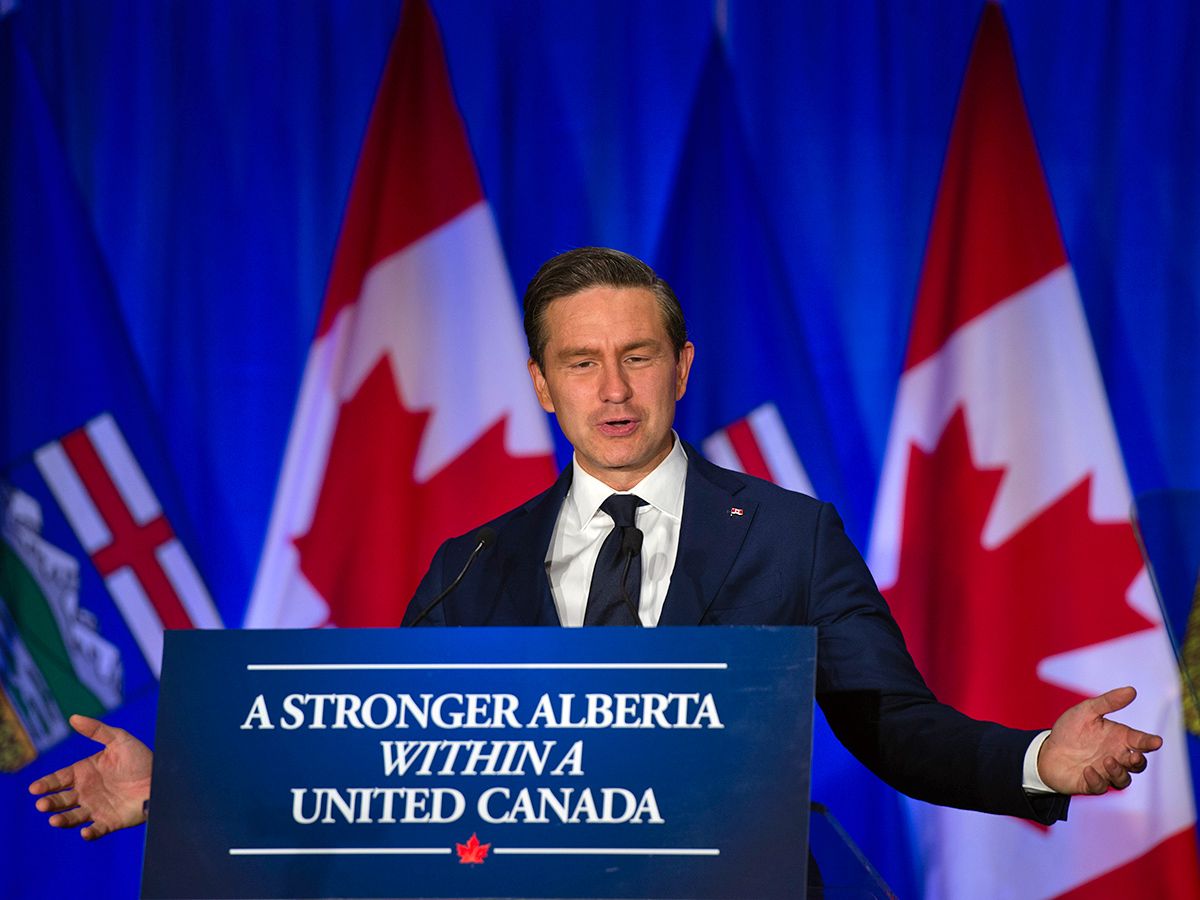
OTTAWA – Conservative Leader Pierre Poilievre is calling on the federal government to list Kata’ib Hezbollah, a paramilitary group linked to the Islamic Revolutionary Guard Corps (IRGC), as a terrorist entity under the Criminal Code.

In a letter addressed to Public Safety Minister Gary Anandasangaree on Sunday, Poilievre said U.S. authorities recently arrested Mohammad Baqer Saad Dawood Al-Saadi, an alleged senior commander of Kata’ib Hezbollah, who is accused of coordinating 20 attempted and completed terrorist attacks in Europe and North America.

“Those allegations include two attacks here in Canada: the March 10 shooting at the United States consulate in Toronto and an attack against a Canadian synagogue,” wrote Poilievre.

“He also allegedly said he was running multiple teams and sought help carrying out further attacks against Jewish and other targets in Canada and the United States,” he added.

Kata’ib Hezbollah was founded in 2007 and has approximately 7,000 to 10,000 members, according to the office of the U.S. Director of National Intelligence. In 2009, the U.S. State Department listed the group as a terrorist organization. The group primarily operates in Iraq, but also possibly in Bahrain, Iran, Lebanon and Saudi Arabia.

Poilievre said, “there is no justification for the delay.”

“Jewish Canadians have watched their synagogues, schools and businesses targeted by shootings, vandalism, firebombings and threats,” he wrote. “Iranian Canadians who escaped the brutality of the Islamic Republic have faced surveillance, harassment and intimidation from the same regime on Canadian soil.”

The letter also called on Anandasangaree to investigate whether the group’s members have established networks in Canada, investigate any linkages between Iranian terrorist proxies and organized crime and disclose how many individuals connected to the Iranian regime and its proxies have been identified, denied entry, investigated, detained or removed.

During testimony in front of a House of Commons committee in March, Anandasangaree was pressed by the opposition why the government had only deported one Iranian official. The minister cited the need to follow due process as the reason for the delay and said there are 24 individuals who have been identified as former IRGC officials. The minister said his government was in the process of removing them.

National Post

Our website is the place for the latest breaking news, exclusive scoops, longreads and provocative commentary. Please bookmark nationalpost.com and sign up for our newsletters here.

The Montreal police arson squad are investigating an apparent attack on a popular kosher restaurant in the city on Friday night.

A Montreal kosher restaurant has been destroyed in what a local MP calls an apparent arson attack.
MP Anthony Housefather says the fire at Nöam Restaurant “must be investigated as a hate crime.”
Housefather told National Post that the arson is “a horrific tragedy” for the owners who had invested heavily in the restaurant, as well as the local community and everyone who were regular patrons.
Police spokesperson Raphaël Bergeron told the Montreal Gazette that someone was seen leaving the premises shortly after the fire began and the case has been transferred to the arson squad.

Firefighters were called to the blaze around 3:15 a.m., according to Bergeron. The building, which housed Nöam, which was a kosher restaurant serving Mediterranean, Italian and international dishes, sustained major damage before firefighters brought it under control.

Bergeron said investigators have yet to establish a motive.
 The aftermath of an apparent arson that destroyed a popular kosher restaurant in Montreal.
The fire was captured in video posted to X by Montreal resident and senior fellow at the Tel Aviv Institute, Hen Mazzig. He wrote that police “are investigating a possible suspect seen walking away from the scene. We can’t say for sure the motive was antisemitic yet, but the signs certainly suggest it.”

Earlier Saturday, Montreal newspaper columnist and city councillor Mike Cohen reported on X “(w)hat can only be described as a major hate crime” at the popular Montreal kosher restaurant. It has “been burnt the ground,” Cohen said.

His report was reposted on X by Montreal MP and p arliamentary secretary to the Minister of Emergency Management, Anthony Housefather.

Housefather wrote in a Saturday morning X post that he is “a bsolutely disgusted to see what appears to be an arson attack on a local kosher restaurant overnight. This attack on a Jewish own business must be investigated as a hate crime & those involved in this criminal act must be caught & prosecuted to the fullest extent of the law.”

Cohen also posted his report on Instagram .

“Arson is a crime. Antisemitism is a hate crime,” Montreal city councillor Leslie Roberts posted on X Saturday morning.

The restaurant is open every night except Friday and on Sunday for brunch, according to The Montrealer . “There are only 60 seats and reservations are strongly recommended,” it said in a recent report.

 The Montreal police arson squad are investigating a fire that destroyed a popular kosher restaurant in the city.

This Israeli consulate in Montreal wrote in a Saturday post on X that it is “ following with a great concern the events of last night and the arson of a Kosher restaurant in Côte-des-Neiges. A direct attack on a Jewish owned business. We call the authorities for a quick and serious investigation, and prosecution of those responsible.”

Quebec Senator Leo Housakos wrote on X early Saturday afternoon about the arson as “deeply disturbing. While the investigation is ongoing, it’s no wonder so many Jews feel increasingly unsafe in the very city they helped build. Antisemitism has indeed found a home in Canada.”

Federal minister of Canadian Identity and Culture and Official Languages, Marc Miller also called for “this disgraceful act will be properly investigated as a hate crime” in an X post on Saturday afternoon.

National Post has reached out to Montreal Police for further details.

Our website is the place for the latest breaking news, exclusive scoops, longreads and provocative commentary. Please bookmark nationalpost.com and sign up for our daily newsletter, Posted, here.


The decommissioned Ticonderoga-class guided-missile cruiser USS Mobile Bay, viewed through the periscope of Royal Canadian Navy Victoria-class long-range patrol submarine HMCS Corner Brook, sinks into the Pacific Ocean after being torpedoed during Exercise Rim of the Pacific 2026, July 12, 2026.

The skipper of Canada’s lone operational submarine is hoping HMCS Corner Brook’s recent sinking of a decommissioned U.S. warship off Hawaii will help attract more young people to the life subaquatic.

Canada is negotiating with Thyssenkrupp Marine Systems as the preferred supplier for up to 12 submarines to replace our aging Victoria-Class fleet. But the new German subs require a crew of 28 people and, as of this past June, this country only had 193 qualified submariners working within the Canadian Submarine Force, just over half the people required to operate the new subs.

The July 12 sinking of USS Mobile Bay — a SINKEX in military parlance — was part of the U.S. Navy-led Rim of the Pacific 2026 exercise, a 30-nation, month-long set of war games that included five submarines, 30 ships, 15 national land forces, more than 190 aircraft and more than 30,000 personnel.

“One of the things that I thought was so great about the SINKEX was the ability to demonstrate in an open way what we can bring, what we can do, and to be able to push that message to Canadians, especially at a time now when we’re a hot topic and being able to show, this is what we do,” Lt.-Cmdr. Clark Hubbard said.

He doesn’t know how Corner Brook was chosen to deliver the coup de grace.

“It wasn’t on the bucket list. It was a very happy surprise,” Hubbard said Thursday in a telephone interview from Ford Island, an islet in the centre of Pearl Harbor, Oahu.

Hubbard’s crew had to wait out some rough weather on the day they started tracking the retired warship.

Corner Brook — among other allied vessels and aircraft shooting at Mobile Bay — launched a Mark 48 heavyweight torpedo at the warship from about a mile away. She sank in waters 15,000 feet deep, more than 50 nautical miles off the northern coast of Kauai.

“It was mostly missiles and gunfire throughout the day, and missiles and gunfire do a lot of damage. But the most reliable sinking weapon that was fired that day was obviously the torpedo at the end,” said Hubbard, who had never fired a live torpedo before.

Hubbard’s operations officer hit the button to send the weapon on its way. “I got to say ‘shoot,’ though,” he said.

Hubbard has been in the navy for 17 years. He started his career in Halifax on surface ships and switched to submarines 11 years ago.

“To me it just seemed like such a fascinating capability. No one talks about it very much and the more I asked my colleagues about what was going on, what was a submarine doing … no one knew, and that just intrigued me,” said Hubbard, who has been Corner Brook’s commanding officer for about a year.

His crew of 59 left Esquimalt, B.C., for Hawaii around the same time Prime Minister Mark Carney made the announcement about buying as many as a dozen new submarines.

“Everyone’s very excited,” Hubbard said. “The people who came down to submarines did so because they really believed in the capability, and seeing a commitment to carry on and expand that capability has got everyone in a really good mood.”

He doesn’t know how adding a dozen new subs to a predominantly surface-oriented organization is going to change the culture of the navy.

“That’s a fascinating question, and I have no good answer for you,” Hubbard said. “We talk about it ourselves and, hopefully, it’s a good change.”

They’re eager to start training for the new subs, he said.

“Every time we go to sea, we have some pretty in-depth discussions so we can optimize whatever we’re doing there to balance between our different training objectives,” Hubbard said. “Obviously we have to train people who are brand new, and we have to train people who are more advanced. And the training for those types of things can be different. So, we try to tailor the people we bring on each trip to meet the demands of the sail that we’re going on, and then by the end of the operating year we hope to have produced as many people at the different levels of production required as we can so that we can move forward with the force.”

He’s confident the navy can ratchet up the number of serving submariners to crew as many as 12 new subs. “I absolutely think we can do that.”

Hubbard’s best elevator pitch for joining the sub service goes like this: “It’s meaningful work. It’s hard work, but there’s lots of personal challenges, lots of personal accountability…. It’s a small crew size and it’s going to get even smaller. So, you know that whatever position that you’re in, you are the person who will be looked at to excel in that position.”

Corner Brook is one of four diesel-electric subs the Royal Canadian Navy acquired from Britain in the late 1990s to replace its Oberon-class submarines. The Victoria-class subs are expected to remain operational into the mid-to-late 2030s.

The first four new submarines are slated to be delivered in 2034.

Hubbard, 38, doesn’t know if he’ll still be a submarine captain by then.

“Depending on the timeline, I might want a desk by that point,” he said. “My back might be begging for it.”

But Hubbard didn’t discount the possibility that he might command one of the new subs. “There’s a lot of flexibility. It’s a small force, and we all know what it takes to move things forward and if I need to come back and do something out of sequence or out of the ordinary to make it happen, that’s what I’ll do.”

While the submarine force is expected to grow, Nick Drescher Brown, who speaks for National Defence, couldn’t say by how much. Nor could he put a number on the amount of support staff the subs will require in shore roles.

“The exact personnel needs will be determined as engagement with the preferred supplier continues, and as the Government of Canada progresses toward a final contract,” Brown said. “The RCN will develop a recruitment and training plan to address these personnel needs as the new submarines are delivered.”

 Royal Canadian Navy Victoria-class long-range patrol submarine HMCS Corner Brook departs Joint Base Pearl Harbor-Hickam, Hawaii, on July 7, 2026 to beginthe sea phase of the U.S. navy-led Rim of the Pacific 2026 exercise. Thirty nations participated in war games around the Hawaiian Islands.

It’s tough to put a number on how many submariners Canada will need in the future, said Paul Mitchell, a professor at the Canadian Forces College who is writing a book on the Victoria-class subs this country now operates.

“All I would add is that the submarine enterprise is much larger than simply the (Canadian Submarine Force) and includes personnel working in (the assistant deputy minister of materiel’s) Maritime Equipment Programme Management (Submarines) cell, the Fleet Maintenance Facilities on each coast, the Naval Experiment and Testing Establishment, the Canadian Forces Maritime Experimental and Test Range, and other fleet establishments like schools, liaison teams, or operational HQs,” Mitchell said.

“On top of those basic numbers are any number of slush to ensure availability and readiness and avoid pier-head jumps — the practice of assigning a sailor in one ship to another due to personnel shortages. This is complicated by the distance between our two naval bases and the family effects of moving people from one coast to the other at short notice.”

He pointed out that it can be difficult to find trained submariners to fill “niche areas like Pharmacists Mates and Galley Cooks which often limit readiness. While each trade is employed navy wide, only some are submarine qualified.”

And submarine sonar operators “require higher levels of skill than surface ship operators,” he said.

Generating qualified people to fill those jobs “is often a lengthy process made worse by the fact that some of this takes place mid-career,” Mitchell said, “meaning personnel require extensive experience before they can begin professional development. Of these, submarine captains are perhaps the most onerous in terms of generation.”

Hubbard pointed out that Canada only has four qualified submarine commanders right now. “One of them’s an admiral, so I don’t think he’s going to come back.”

Submariners with “low amounts of sea time pose hard limits on force generation and have led in the past to accusations of false dolphins, referring to the badge submariners wear on their uniform,” Mitchell said. “This reflects that getting qualified during the Oberon era meant far more time at sea than presently. There has been consistent worry about skill fade during the Victoria class. Some of this surfaced during the inquiry into the Corner Brook grounding (off Vancouver Island in 2011), and also in some potential captains failing Perisher in recent years.”

The Perisher is the informal name for the British Royal Navy’s notoriously difficult Submarine Command Course which readies naval officers to command a submarine. Other countries including Germany, The Netherlands and Norway, also run their own Perisher.

“While the navy will push to keep the Victorias as operationally ready as possible, obsolescent technology may pose hard limits to the amount of sea time they can generate,” Mitchell said. “Some of this can be ameliorated by working with allied submarines, but that too comes with a risk as those sailors may be poached by allied navies also struggling to generate their own capabilities.”

If Canada wants “to have decent bench strength once we get the TKMS boats, we can’t do all of that crew training and force generation just off exchanges with the Norwegians and Germans,” said David Perry, who heads the Canadian Global Affairs Institute.

“We need to have some of our own ability to keep a roster of people with submarine expertise, both operational from the training point of view and the maintenance point of view, in the country.”

By the time the new subs are delivered, “we’re going to have one of the largest conventional submarine forces on the planet,” Perry said.

 HMCS Corner Brook, one of four diesel-electric subs the Royal Canadian Navy acquired from Britain in the late 1990s.

Canada should consider borrowing one of the German submarines for training purposes, said Ken Hansen, a defence analyst and retired naval commander.

“The (Victoria-class) submarines currently are old and they’re going to be really old in another twelve years,” Hansen said.

There is no loan agreement with Germany at this time, Brown said. “However, training is top of mind as the Government of Canada continues the negotiation process. As we are still in negotiation, it is too early to discuss training arrangements for this platform.”

The navy is going to have to come up with more people willing to train as submariners, Hansen said.

“They’ll be siphoning people off to do the first bit of training and familiarization in Germany, likely, or Norway. But they’ll have to come up with people. People is the big vulnerability point right now,” Hansen said.

Canadian submariners “will be training alongside both German and Norwegian submarine forces as part of our regular Navy-to-Navy business on the international level, where we conduct training related and experiential exchange programs with allied and partner navies on a consistent basis, across the globe,” Brown said.

“Submarine training is conducted on a continuous basis to meet the demands of new submariners and to maintain the training standard for those currently serving. This requires that the Canadian Submarine Force continually re-evaluate training requirements to meet the need of current and potential future fleets.”

Mitchell said it’s unlikely the Germans would lend Canada a sub for training purposes.

“But what I do think is likely is that we’re going to see submariners going over and working with the Germans on their boats,” Mitchell said.

“We will be sending sailors over to Germany or to Norway to do training on board those boats before they show up in Canada.”

That will contribute to the additional numbers of people the navy’s going to have to generate between now and 2034, he said.

“People are the number one problem with this,” Mitchell said.

“And they’re having a hard time hanging on to the people.”

Canada’s submariners “are aging out and they’re not being replaced quickly enough,” Mitchell said.

“And then on top of that, you have industry, you know, all the companies that are going to be contributing to this.”

They’re all likely to be stealing qualified engineers from the navy, Mitchell said. “There’s three or four that I know of specifically that have just retired from the RCN and gone out to Babcock Canada (which maintains the Victoria-class subs). So, you know, you lose the talent from the navy or the fleet maintenance yards and they go into industry and they get paid more.”

It takes “a long, long time to generate all of these people, and they’re only coming from very small numbers of sources,” Mitchell said. “So, this is a problem for Canadian universities and colleges as well, you know, in terms of generating all this talent.”

The pressing need to generate more submariners is a “gigantic problem,” he said. “It’s probably going to take a decade or more to do this.”

The “enormous amount of automation” aboard the new submarines Canada’s buying will make them “an even more complex system to maintain” than the Victoria-class subs, Mitchell said.

“Keeping it at sea and making sure that you have all the resources to keep it at sea, that’s going to be the really hard one.”

There are “huge backlogs” in the U.S. now for submarine maintenance, Mitchell said. “A lot of boats just sitting around waiting to be maintained because they don’t have enough workers, they don’t have enough dry docks, they don’t have enough spare parts.”

It’s not just a Canadian problem, he said. “This isn’t just because we’re feckless Canadians who haven’t invested in their navy,” Mitchell said. “It stems from the fact that submarines are among the most complex pieces of technology that humans operate. Spaceships and F1 cars, probably the only other equivalents.”

As for Corner Brook, the sub is slated to sail the Pacific for months to come, said Hubbard.

“I’m not going to see a lot of my family for a while,” he said. “The Pacific’s a big ocean; I’ve got a lot of steaming ahead of me.”

Our website is the place for the latest breaking news, exclusive scoops, longreads and provocative commentary. Please bookmark nationalpost.com and sign up for our daily newsletter, Posted, here.