LP_468x60
on-the-record-468x60-white

The price of regular gasoline at the Petro Canada gas station in the Lachine borough of Montreal on April 20, 2026.

Almost two-thirds of Canadians disapprove of a federal plan to raise taxes on gasoline next month, according to a Leger poll shared by the Canadian Taxpayers Federation (CTF).

The planned hike in taxes comes from an initiative by the federal government in April to temporarily suspend the federal fuel excise tax on gasoline, diesel fuel and aviation fuels by setting their rates to 0 cents per litre. It took effect April 20 with a planned end date of Labour Day, Sept. 7, 2026.

“This measure is intended to address fuel price pressures caused by global oil disruptions related to the Middle East conflict,” the federal government said in a backgrounder at the time, adding: “It is estimated this will provide over $2.4 billion in total tax relief that will ease the pressure of high fuel prices on Canadians in 2026.”

However, the reintroduction of the tax will add 10 cents per litre of gas and four cents per litre of diesel as of Sept. 8.

The Leger poll asked Canadians if they support or oppose the government increasing fuel taxes in September. Results of the poll show that 43 per cent strongly oppose the tax increase, while another 20 per cent somewhat oppose it, for a total of 63 per cent.

On the other side, 17 per cent somewhat support the tax increase and eight per cent strongly support it, for a total of 25 per cent. A further 11 per cent said they didn’t know.

Leaving aside the “didn’t know” group, of those with a definite opinion, 71 per cent were against and just 29 per cent in favour of the increase.

Breaking down the numbers by gender, age and province found that opposition to the tax hike was highest among women, people over 55 and prairie dwellers. However, opposition remained broad regardless.

“The poll shows Canadians in every demographic oppose Prime Minister Mark Carney’s plan to crank federal gas taxes back up next month,” said Franco Terrazzano, CTF’s federal director. “Carney needs to listen to Canadians and confirm that he will not be hiking gas taxes in September.”

The CTF separately published its Gas Tax Honesty Report last month, pointing out the provincial components of gas taxes, and comparing prices and levies across the country.

It found that parts of British Columbia have the most consistently high gas prices, averaging $1.90 per litre in Vancouver and a few cents cheaper in Victoria. (The rest of the province averaged a relatively cheap $1.68 per litre.) Alberta had the lowest provincial average, just $1.55 per litre.

However, Montreal was found have the highest gas taxes in the country at 61 cents per litre, or 35 per cent of the price of gasoline. Drivers in Montreal pay a transit tax when fuelling up in the city, in addition to provincial and federal levies. The rest of Quebec had gas taxes amounting to 33 per cent of the total price.

Similarly, drivers in Vancouver and Victoria also pay transit taxes at the pumps, and had total taxes of 28 and 25 per cent, respectively. Manitobans pay just 17 per cent tax on their gas, with Alberta and Saskatchewan at 18 per cent.

Under the heading “Gas Changes Since Last Year,” the report noted that the planned September tax increase would add about $7 to the cost of filling than tank of a minivan, and $11 on the price of a fillup for a pickup truck.

It also pointed out that the Newfoundland and Labrador government, which cut its provincial gas tax by 8.05 cents per litre in June 2022, made that decrease permanent in March. This means drivers will save $5.15 on every 64-litre fill up there.

The Leger poll reached out to 1,516 adult Canadians between July 24 and July 27, and has a margin of error no greater than plus or minus 2.5 per cent, 19 times out of 20.

Our website is the place for the latest breaking news, exclusive scoops, longreads and provocative commentary. Please bookmark nationalpost.com and sign up for our daily newsletter, Posted, here.


Jack Jedwab. President and CEO of the Association for Canadian Studies speaks during a press conference hosted by the Network of Engaged Canadian Academics to discuss the first of two Campus Antisemitism and Student Experiences (CASE) reports, commissioned by Canadian Heritage in Ottawa on Wednesday, Aug. 5, 2026.

OTTAWA — Open hostility toward Jewish students has become a “normalized and systemic feature of campus life” at Canadian postsecondary institutions, according to a new report commissioned by Heritage Canada.

The Campus Antisemitism and Student Experiences (CASE) report, released on Wednesday, finds that more than nine in 10 Jewish students have experienced or seen antisemitism on campus over the past year.

The report draws from a survey of 900 Jewish students, and 755 students from the broader campus population, at more than two dozen colleges and universities across Canada.

“(Our) findings indicate that many Jewish students experience widespread and persistent antisemitism on Canadian campuses as a defining feature of postsecondary life that shapes their behaviour, their ability to fully participate in campus life, their safety, and their wellbeing,” write co-authors Jack Jedwab and Paul Holley, both with the Association for Canadian Studies and the Metropolis Institute .

Jedwab and Holley write that the CASE report “provides the most comprehensive national evidence to date on antisemitism in Canadian postsecondary institutions.”

Seventy-one per cent of Jewish students reported seeing antisemitic graffiti on campus. More than one in five said they witnessed physical violence targeting Jews. Students also reported targeted incidents like mezuzahs being torn from the doors of Jewish dorm rooms in residence halls.

Jedwab told National Post that the report’s findings underscore a systemic crisis of antisemitism on Canadian postsecondary campuses.

“My sense is that, when you see such a high level of reporting of antisemitic incidents, the only way to describe it is systemic,” said Jedwab.

One of the report’s key insights is that Jewish students aren’t just facing antisemitism from classmates, but also from professors and other university employees.

Seven in 10 Jewish respondents said their institution does not take antisemitism seriously. Faculty were cited in 18 per cent of antisemitic incidents reported in the survey. A further 14 per cent of incidents involved either teaching assistants or non-teaching staff.

Thirty-six per cent said they’d encountered antisemitic or biased course content or classroom discussion, while 34 per cent said a professor brought up Jews, Judaism, Israel, or Zionism when unrelated to the course subject.

More than three in 10 said they’d considered dropping a course or leaving their program because of antisemitism from professors or other students.

Jay Solomon, a senior executive with Jewish student network Hillel Ontario, said the study confirms much of what he’s been hearing from students at the nine Ontario universities he works with.

“What this study has confirmed is that Jewish students are being targeted simply for being Jews, and that is completely and utterly unacceptable,” said Solomon.

Solomon said he hoped the findings would be a “wake-up call” for college and university administrators across Canada.

The Centre for Israel and Jewish Affairs, B’nai Brith Canada, and the Friends of Simon Wiesenthal Center echoed this sentiment in a joint statement.

“At a time when synagogues, Jewish schools, and Jewish-owned businesses are being shot at and firebombed, and when Jews are disproportionately the victims of hate crimes, this report makes clear that antisemitism has also taken root in our public institutions—including our universities,” reads the statement.

Federal Heritage Minister Marc Miller called the report’s findings “alarming” in a written statement.

“(The findings) echo what we are seeing across Canada. Statistics Canada’s most recent data shows that 71 per cent of all police-reported religion motivated hate crimes targeted Jewish Canadians,” said Miller.

The Jewish student survey used by the study was fielded from Nov. 19 to Dec. 19, 2025, using an unweighted sample of 900 students recruited through Jewish student organizations, community networks, and related channels.

National Post
rmohamed@postmedia.com

Our website is the place for the latest breaking news, exclusive scoops, longreads and provocative commentary. Please bookmark nationalpost.com and sign up for our daily newsletter, Posted, here.


Kaitlyn Tracey was charged with endangering the welfare of a child, simple assault, harassment and obstruction.

A Canadian woman who slapped a teenager wearing Trump-branded clothing will be deported to Canada after she entered a guilty plea on an assault charge.

Kaitlyn Tracey, 33, was living in the U.S. on an expired visa when she was recorded confronting a group of four teenage girls on the Point Pleasant Beach boardwalk in New Jersey on July 3. Two of the girls were reportedly wearing sweatpants bearing the words “Trump” and “ICE.”

On Tuesday, a Texas immigration judge ordered that Tracey return to Canada. She was also sentenced to one day behind bars but was granted time served because she was in jail in Ocean County last month, according to the New York Post .

The outlet added that Tracey’s defence lawyer, Francis Hodgson, described her as a “productive member of society.”

“She arrived here on a passport some years ago. She met her husband and didn’t leave, but while she was (here), she maintained employment and was a productive member of society,” he said.

He added that Tracey had “taken responsibility for her role” in the incident, and “that is consistent with other similar-type matters that happen every day during the summer on this boardwalk.”

Tracey was initially charged with simple assault, endangering the welfare of a child, harassment and obstruction. It later emerged that she had been detained by ICE.

The U.S. Department of Homeland Security wrote in a post on social media on July 15 that Tracey “entered the United States on April 14, 2024, on a visa set to expire on September 6, 2024. In violation of our nation’s laws, she overstayed her visa and failed to depart.”

Tracey’s husband, who is reportedly an American man named Matthew Geroni, took to social media after the incident, posting a since-deleted video in which he said: “Yesterday, July 13, my wife was detained by ICE and brought to Delaney Hall in Newark, New Jersey.”

Delaney Hall is a detention facility run by ICE. After a court hearing on July 13, Hodgson told Asbury Park Press that Tracey was released from the Ocean County Jail where she had initially been held. However, because ICE had a detainer on her, she was released to ICE custody.

“My wife is a Canadian citizen and I’m an American citizen,” Geroni added. “We’ve been married for a little over three years, and I’m just doing anything I can to get her story heard and bring any help and attention to her situation so that I can get her released, even if that means back to Canada.”

A news release from the Point Beach Police Department says that on the evening of the incident “officers responded to and began investigating an alleged assault of a female juvenile by an adult female suspect on the boardwalk.”

It continues: “The female suspect began yelling at the female juvenile over patriotic colored sweatpants with political wording. The female suspect was then seen on video striking the juvenile female, once to the body and once to the face, with an open hand. The female suspect then left the scene without being identified.”

Police said they later identified her as Kaitlyn Tracey of Allenhurst, N.J.

The New York Post reports that a parent of the girl Tracey slapped attended Tuesday’s hearing virtually, but with no video or audio.

Judge Ryan summarized the family’s impact statement aloud in the courtroom, saying: “Thank goodness for cameras and cell phones to have documented this incident.” He added that the relatives belong to immigrant families and are “proud of their country and celebrated its independence.”

He concluded that the victim and her parents “look forward to justice being served, and they thank all the agencies involved.”

How and when Tracey will be deported to Canada wasn’t immediately clear. As for whether she will be allowed to return to the U.S., Judge Ryan said during her sentencing that her banishment is expected to last “for a very long time.”

Our website is the place for the latest breaking news, exclusive scoops, longreads and provocative commentary. Please bookmark nationalpost.com and sign up for our newsletters here.



Douglas Smerek, 64, of Calgary, went through revision surgery to remove a metal-on-metal device in his right hip.

Tony Kinney thought the metal device implanted in his hip by a surgeon in 2006 would relieve his pain. But instead, he says, it left him living in anguish and unable to work.

“I can’t do anything. I’ve lost everything I own, house and possessions,” he says.

Metal-on-metal hip devices, like the kind Kinney received, have been the subject of concern — and even lawsuits — for more than 15 years. The devices have been known to cause pain, potential metal poisoning and the need for additional surgeries in some patients. The devices are no longer used at all for total hip replacements in Canada because of those complications.

But they continue to be used — though in shrinking numbers — for hip resurfacing: a bone-preserving alternative that reshapes the ball, called the femoral head, at the top of the thighbone and caps it with a prosthesis. The surgery is considered most suitable for younger men who want to maintain movement and athletic ability.

In 2012, Health Canada issued a notice to surgeons about the risks of metal-on-metal hip implants, especially for women, saying they were known to cause “pain, implant loosening and significant soft tissue reactions thought to be the result of increased levels of metal (cobalt and chromium) ions in the surrounding joint tissue.”

Even so, since then there have been at least 5,215 hip resurfacings reported in Canada, according to data provided to the Investigative Journalism Bureau by the Canadian Institute for Health Information (CIHI).

CIHI’s data does not indicate the implant material, but all hip resurfacing devices licensed in the country were metal-on-metal until last month, Health Canada spokesperson Karine LeBlanc said in an email. In late July, a ceramic hip resurfacing system was approved.

At least 492 Canadians had hip resurfacing surgery in the 2012-13 fiscal year — the same year the notice was sent out. Fifty-three of them were women, despite being identified by Health Canada as a group with increased risk for metal hip implants.

The number of resurfacings overall didn’t dip below 400 until 2019.

 An X-ray image shows a patient who has had a hip resurfacing (left) and a hip replacement (right).

So far, in 2025-26, at least 280 Canadians have had the surgery. (The data excludes Quebec, which requires special authorization to release such information to CIHI.)

“I can make an argument that every hip resurfacing that’s metal-on-metal is failed from day one,” said Dr. Stephen Tower, an orthopedic surgeon based in Alaska, who was implanted with a metal device himself during hip replacement surgery.

The devices expose nearly anyone implanted “to toxic levels of cobalt in blood and urine,” he said, adding elevated levels are associated with neurologic and cardiovascular issues.

Why hasn’t Health Canada acted? “It is not within Health Canada’s mandate to oversee patient management or the delivery of clinical care,” said LeBlanc.

Debate over hip resurfacing

Kinney’s arthritis and hip pain hindered him from being able to work long shifts as an aircraft engineer in Nova Scotia. He was told resurfacing was the solution.

Today, 20 years after his surgery, he is part of a national class action lawsuit, yet to be certified, alleging the implants he and others received are “inherently defective.”

The suit targets Wright Medical Technology, an American company that sold its orthopedics parts business to MicroPort Scientific Corporation in 2014. MicroPort, founded in Shanghai, China, is also named in another class action suit proceeding at the same time with similar allegations.

The law firms representing MicroPort and Wright, respectively, declined to comment on the lawsuits. Both have filed a notice of intent to defend their actions in Ontario.

There is debate within the North American medical community about the role of metal-on-metal hip resurfacings.

Some orthopedic surgeons interviewed by the IJB called them a vestige of the past.

Dr. Amit Atrey, an orthopedic surgeon based in Toronto and spokesperson for Arthritis Society Canada, said there’s been a shift away from metal-on-metal resurfacings because of the risks and because total “hip replacements now work so well.”

Others disagreed, saying metal resurfacings can be the best option for carefully selected patients. They allow for a higher range of motion than a total replacement and have lower dislocation rates.

Metal-on-metal is not “inherently bad,” said Dr. Prem Ramkumar, an orthopedic surgeon based in California. “It’s fine if used for the right indication, with the appropriate metallurgy, and positioned correctly during surgery.”

Dr. John Antoniou, a Montreal orthopedic surgeon who does resurfacing surgeries, agreed. “Registry data indicates that metal-on-metal resurfacing should be done on men with good bone stock who are very active,” he said.

There are only a few surgeons in Canada who do such surgeries because of the steep learning curve and volume required to maintain one’s skill, he said.

A 2025 study , published in the AME Surgical Journal, looked at online joint registry data between 2010 to 2024. Its authors concluded that resurfacing is a “safe and effective alternative to (replacement) for appropriately selected patients when performed by experienced surgeons at specialised centres.” It also called increased levels of metal ions “a significant problem.”

Metal particles released into the circulatory system when metal components rub together can eat away at tissue and cause damage in the area. According to Health Canada, it can cause pain in the groin, hip or leg, swelling at or near the hip joint, a limp and limited range of motion.

‘Missed out on life’

A year after his resurfacing, Kinney had surgery to remove the metal implant and replace it with a non-metal device. But the pain continued.

In 2016, Kinney sold his home, unable to survive on long-term disability benefits. He left Nova Scotia — rent was too high — and moved to New Brunswick, farther from his grown children. His time is spent managing pain.

“Missed out on life, pretty much,” he said.

He isn’t alone.

Doug Smerek, a Calgary karate instructor, was implanted with two metal-on-metal devices, one in each hip, in 2017 and 2022 respectively.

Both of Smerek’s surgeries came after the Health Canada warning, which he says his doctors never flagged.

 Douglas Smerek shows the scar on his hip from follow-up surgery.

He’s been “living a nightmare,” he told the IJB. The implants have caused him pain, cramping in his calves, and difficulty lifting the front part of his foot. He says he has anxiety attacks at night.

One of the metal devices implanted in Smerek, made by MicroPort, was also recalled in 2016 — a year before it was put into his body. The recall was issued due to an increasing trend of follow-up surgeries since 2009 and a “specific hazard/harm for suspected tissue reaction to metal debris,” according to the Health Canada recall notice.

The recall applied to the parts if used for hip replacement, not if used for resurfacing. But Smerek says he is still concerned.

“Health Canada recognizes that these experiences can be difficult for patients and families,” LeBlanc told the IJB. “Patients who have concerns about their devices should contact their healthcare provider.”

It’s up to the provinces and territories to deliver services, including the procurement and use of devices in their public health systems, said LeBlanc.

Health Canada can take regulatory action when warranted, “based on emerging evidence such as new scientific literature, reports of medical device problems, and information shared by international regulators,” she said.

The federal department supposedly keeps track of hip resurfacing devices as part of its “standard ongoing post-market monitoring.” But since the 2012 warning, there have been no updates or additional notices.

Health Canada initiated a review of metal-containing hip implants in 2019. But resources had to be reallocated due to the COVID pandemic and the assessment was postponed indefinitely, said LeBlanc.

Not every province or territory is mandated to report to CIHI, which manages the national medical device registry. The IJB reached out to provincial health authorities across Canada with questions about the current use of metal-on-metal hips devices. The responses reveal a patchwork of policies.

In British Columbia, Fraser Health and Vancouver Coastal Health said their facilities do not use metal-on-metal for resurfacings. Acute Care Alberta said the same.

Metal-on-metal is only used for hip resurfacings in “very rare circumstances,” Nova Scotia Health told the IJB.

Santé Quebec said implant use varies depending on the institution and surgeon. Saskatchewan Health Authority said the decision on the type of implant used “is made by the physicians in consultation with their patient” and “is not at the direction” of the agency.

Ontario Health did not respond to the IJB’s request for comment.

Lawsuits launched

Several previous class action lawsuits in Canada were launched against metal hip device manufacturers starting around 2010, resulting in recalls and settlements from major companies such as Johnson and Johnson, Stryker and Zimmer.

In September, a certification hearing will be held for the class action that includes Kinney and Smerek as plaintiffs. Certification means a judge must decide if the case can proceed as a class action.

“There’s no place for these products in the marketplace at all,” said Joel Rochon, a partner at Rochon Genoa, the law firm handling the class action suit.

“Health Canada and the regulators need to step up and do their part to ensure that these allegedly defective devices are no longer available.”

***

Tower, the Alaskan surgeon, had a metal-on-metal hip replacement in 2006. He says he suffered a slew of symptoms including tinnitus, mild deafness, spatial disorientation and sleep apnea. The symptoms, he said, stemmed from cobalt toxicity, also referred to as metallosis, a kind of metal poisoning.

The symptoms disappeared when the implant was removed, he says.

“If Canadian patients can still get a hip resurfacing through the public system, those responsible for quality assurance at Medicare and those at the FDA following adverse medical device events are either wilfully blind or asleep at the switch,” he told the IJB.

Patients can become quite sick, said Tower. “They’re very frustrated because nobody knows what to do with them, and a lot of times they’re dismissed.”

Smerek agrees. After being ignored by Canadian doctors, he said, he found a surgeon in the U.S. who specializes in revisions. He has undergone revision surgery for one of his hips but is awaiting a second surgery to remove the last metal device still in his body.

“I’m deteriorating slowly,” he said. “I can’t wait.”

The Investigative Journalism Bureau (IJB) at the University of Toronto’s Dalla Lana School of Public Health is a collaborative investigative newsroom supported by Postmedia that partners with academics, researchers and journalists while training the next generation of investigative reporters.

Our website is the place for the latest breaking news, exclusive scoops, longreads and provocative commentary. Please bookmark nationalpost.com and sign up for our newsletters here.


Images from a video released by Toronto police show suspects entering and leaving an LCBO outlet.

Targeting what the Retail Council of Canada calls “repeat and prolific offenders,” Toronto police say their Organized Retail Crime Unit has led to hundreds of arrests and thousands of charges against criminals who, video evidence shows, sometimes walk out of stores laden with goods and facing little to no resistance.

In a press conference on Wednesday morning, Police Chief Myron Demkiw outlined the creation almost two years ago of a dedicated unit operating out of 23 Division in the city’s west end.

Its aim is to centralize investigations, strengthen partnerships with retailers and enhance enforcement efforts, and Demkiw said it has borne real fruit. To date, the unit has resulted in 546 arrests, 4,033 charges laid, and more than $1.6 million in stolen merchandise linked to investigations.

Police superintendent Ron Taverner noted that two investigations each involved four suspects but resulted in more than 100 charges in each case. A third resulted in the arrest of 20 individuals with more than 400 charges laid against them. (Due to ongoing court proceedings, specific identifiers on the accused and the charges couldn’t be disclosed.)

Rui Rodrigues of the Retail Council of Canada was also at the press conference. “We’re confronting one of the most rapidly evolving public safety challenges that affects workers, retailers and our communities at large,” he said, adding: “Retail crime is not simple shoplifting and it is absolutely not victimless.”

 A screenshot from a video released by police shows a suspect using pepper spray on security and passersby before driving away.

He spoke of the need for multiple organizations to work together to combat this crime, which he and police argue is being used to fund further organized crime.

“Retailers cannot solve this alone and police cannot solve this alone,” he said. “Prosecutors and government cannot solve this alone. We need to work together as a community. Real progress requires all of us doing this together … treating organized retail crime with the seriousness that it demands.”

Rodrigues lauded the recent passage of Bill C-14, noting that it has led to “things like reverse onus being utilized, aggregated charges being applied, sentencing guidelines changing so retail criminals see severe charges,” and bail reform.

He added: “What Canada needs now is consistency; consistent enforcement, consistent prosecution, which is critical, and consistent use of our criminal code, tools that are already available to meaningfully disrupt organized retail crime networks.”

He also bristled at the term “shoplifters,” noting: “We’re talking the organized, the prolific, the 15 per cent that causes 90 per cent of the issues.”

“Ontario needs to move beyond individual, jurisdiction-led responses,” Rodrigues said, and called for “a provincially funded joint force operation dedicated to retail crime.”

Police also shared security camera video of several retail thefts, noting that in each case arrests had been made.

One shows several suspects entering an LCBO outlet with bags and even a large suitcase, and leaving with store shopping carts full of liquor. They are so laden down that several bottles are dropped, with the final suspect hustling out with numerous bottles cradled in his arms.

A second video showed suspects using pepper spray on store security and passersby who tried to prevent them from driving off.

Our website is the place for the latest breaking news, exclusive scoops, longreads and provocative commentary. Please bookmark nationalpost.com and sign up for our newsletters here.


Mount Sinai Hospital in Toronto, Ontario on Wednesday, May 27, 2026.

Antisemitism in healthcare education and practice has risen sharply since Hamas’ Oct. 7, 2023 attack, affecting Jewish medical professionals in Canada as well as the U.S., U.K. and Australia, according to a narrative review published in the Rambam Maimonides Medical Journal last month.

The review brings together existing research from the four countries on antisemitism in healthcare professions, including medicine, psychology, nursing, and social work.

Among the studies cited is a 2024 survey of 1,000 Jewish medical professionals in Canada . It found that only one per cent of respondents felt antisemitism was a severe problem in the medical field before Oct. 7, compared to 98 per cent after.

The same survey revealed that 31 per cent had considered leaving Canada because of increased antisemitism in medical institutions and schools.

The review comes shortly after Dr. Emmanuel Moss, chief of cardiac surgery at the Jewish General Hospital in Montreal, tendered his resignation in June , citing rising antisemitism in the city as one of the reasons behind his decision to relocate to the U.S.

In a letter published in The Montreal Gazette , Dr. Moss wrote that he had “watched with growing alarm as (antisemitic) incidents have multiplied and the response from authorities has fallen short.”

“What has been most troubling is not only the rise in hateful acts, but the normalization of rhetoric and behaviour that would have been broadly condemned only a few years ago,” he added. “When a community starts to feel unsafe in a city it has helped build, something has gone seriously wrong.”

 Dr. Emmanuel Moss, chief of cardiac surgery at the Jewish General Hospital, plans to move to Atlanta in September. (Source: Institut de cardiologie de Montréal)

Outside of Canada, the review highlights more recent studies that have documented rising levels of antisemitism experienced by healthcare professionals.

Surveys of Jewish medical students and physicians in the U.S. found that 88 per cent had experienced antisemitism since Oct. 7, compared to 40 per cent before that date.

More than 35 per cent reported personally directed antisemitic incidents, and over 30 per cent reported face-to-face antisemitic encounters. Nearly half reported exposure to antisemitism on social media, and 21 per cent reported exposure in classes or seminars.

Despite those findings, fewer than two percent said their institutions had incorporated antisemitism education into anti-discrimination training.

Meanwhile, in Australia, a survey of Jewish healthcare students and professionals in Victoria revealed that half felt the need to hide Jewish identity, while around two-thirds knew someone else who felt the same. One-third reported experiencing antisemitism in the workplace, and about two-thirds reported feeling unsafe or uncomfortable.

 Mourners attend the memorial held for the victims of a shooting at Bondi Beach in Sydney, Australia, on Dec. 21, 2025.

And in a U.K.-based study, 95 per cent of Jewish healthcare professionals surveyed reported an increase in antisemitism in their daily lives since Oct. 7, 2023. Among respondents who reported an antisemitic incident at work, only 15 per cent believed it had been managed appropriately. Meanwhile, 44 per cent had modified or were considering modifying their professional activities because of increased antisemitism.

The narrative review notes that a search of the scientific literature database PubMed returned 61 records on antisemitism, compared to 732 for diversity, equity and inclusion (DEI) and 3,824 for racism. This, the authors write, suggests that antisemitism was studied 12 times less than DEI and 63 times less than racism since the Oct. 7 attack, despite antisemitic incidents reaching their deadliest level in more than thirty years , according to the J7 Annual Report on Antisemitism.

The authors conclude that the review “illustrates the moral imperative for education, engagement, empathy, and enforcement” regarding Judaism, Jewish identity, the origins and persistence of antisemitism, and the history of health professions’ complicity in the Holocaust.

 Toronto police attend the scene after the Jewish-owned bakery Kiva’s Bagel Bar on St. Clair Ave. W. was shot at on July 26, 2026.

They also call for mandatory inclusion of these topics in DEI training, along with further research into best practices and assessment of outcomes “to properly address and counter this scourge.”

The review was published shortly before Statistics Canada released data showing that Jews were targeted in 71 per cent of religious hate crimes in Canada last year . While this represented a 16 per cent decline from the previous year, it remained 50 per cent higher than in 2022.

Later in July, the J7 report documented more than 23,000 antisemitic incidents across its member regions, including Canada, which together comprise more than nine-tenths of the global Jewish diaspora.

“Canada remains one intelligence failure away from a mass casualty event, and that is something the Jewish community is keenly aware of,” said the Centre for Israel and Jewish Affairs in the Canadian portion of the 52-page report.

Last week, two Jewish-owned businesses in Toronto were attacked — one location of Kiva’s Bagel Bar was sprayed with gunfire and another had a window broken — while Nöam restaurant in Montreal burned to the ground on the weekend in a suspected case of arson.

Our website is the place for the latest breaking news, exclusive scoops, longreads and provocative commentary. Please bookmark nationalpost.com and sign up for our newsletters here.


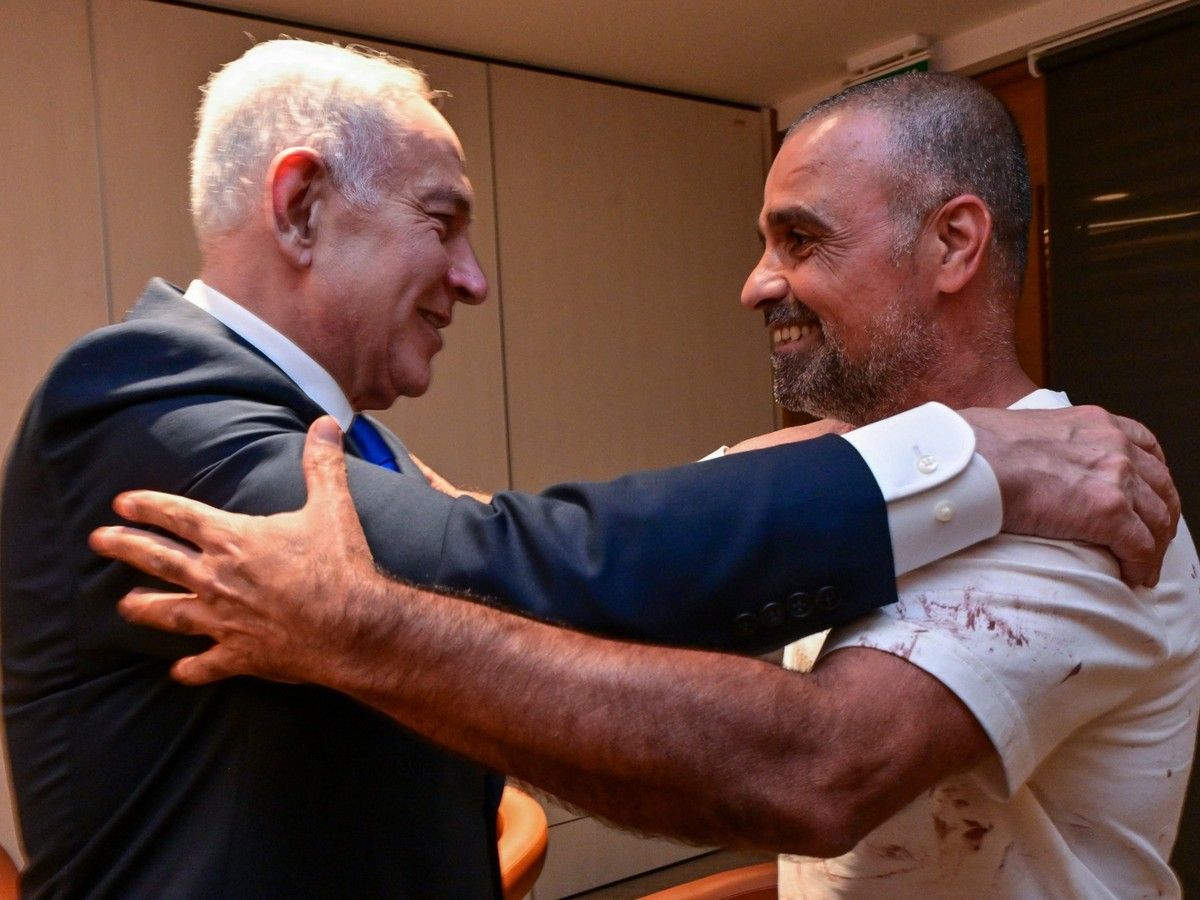
Prime Minister Benjamin Netanyahu said Israel would not pull the IDF from Gaza until after Hamas is completely disarmed.

Israel will not pull back from its current positions in the Gaza Strip until the Hamas terrorist organization is completely disarmed, Israeli Prime Minister Benjamin Netanyahu reiterated on Tuesday.

“I am standing firm on our security interests — we will not withdraw from our current lines until Hamas is completely disarmed,” Netanyahu said in a Hebrew-language video posted to his Facebook page.

He added that Israel Defence Forces soldiers had been instructed “to do everything necessary to defend themselves, to defend our territory, to defend our citizens.”

U.S. President Donald Trump and his team believe they can persuade Hamas to demilitarize the Gaza Strip, he said, adding, “We are examining that.”

The Trump administration presented Israel with a draft agreement that Jerusalem rejected, according to Netanyahu. “This is not our draft,” he stressed, adding that Israel had conveyed its own comments to the White House.

“We are standing firm on our interests,” the prime minister concluded.

In a podcast interview with Israeli historian and media personality Gadi Taub aired on Monday, Netanyahu expressed skepticism regarding Hamas’s willingness to lay down its weapons as required by the Board of Peace’s 15-point Roadmap for peace in Gaza.

“I don’t think Hamas is going to turn into a kitten—this predator,” Netanyahu said.

The 15 points were published last week, followed by concerns in Israel that they stipulate the withdrawal of the IDF from the Gaza Strip before the terrorist group fully disarms.

When asked if Israel had missed the opportunity to eradicate Hamas in Gaza, the prime minister replied, “It’s not missed—it’s not completed. There’s still work to do … Hamas must be disarmed and Gaza demilitarized, and only then (Gaza) can start reconstruction, including rehabilitating its fanaticism.”

Earlier this week, Nickolay Mladenov, the Board of Peace’s high representative for Gaza tasked with overseeing the ceasefire with Hamas, said after talks with Netanyahu in Jerusalem that implementation of Trump’s Gaza plan had entered the “ hard phase .”

“Long day in Jerusalem, sitting down with Prime Minister Netanyahu and his team,” Mladenov wrote on X on Monday. “This is the start of the hard phase and I have never pretended otherwise. Not much of what we do now is dramatic. It is slow, grinding and technical work.”

Earlier on Monday, the Board of Peace stated that it and Israel “share a common understanding of the ultimate objectives. Contrary to inaccurate reports, we note that the withdrawal of the IDF beyond the Yellow Line will take place only once decommissioning (of weapons) is complete, as Hamas committed to the mediators.”

Our website is the place for the latest breaking news, exclusive scoops, longreads and provocative commentary. Please bookmark nationalpost.com and sign up for our newsletters here.


Canadian provincial politicians are vastly overpaid compared to their U.S. counterparts, but their electors have little to show for it, according to a new report released by the Canadian Taxpayers Federation (CTF).

The Subnational Politician Pay Report looks at average salaries for provincial and state politicians across Canada and the United States.

It found that Canada’s provincial politicians are paid significantly more than their American counterparts; almost twice as much in fact. The average wage for a provincial politician last year was $115,378, while state legislators made just $58,241 on average. (All figures are in Canadian dollars.) Only 18 per cent of American representatives make over $100,000, while 70 per cent of Canada’s provincial politicians do so.

The list of salaries is topped by New York, California, and Pennsylvania, all among the top five U.S. states in terms of population. California’s roughly 40 million inhabitants is almost on par with all of Canada.

Next in the list were the provinces of Ontario and Quebec, combined home to about 60 per cent of Canadians. They were followed by Illinois, Alberta, Alaska and British Columbia.

Next up in tenth place was Massachusetts, followed by Nova Scotia, Manitoba and Saskatchewan. The provinces of Newfoundland and Labrador, New Brunswick and Prince Edward Island were not far behind, in 17th, 18th and 22nd place, respectively.

“Politicians often argue they should give themselves bigger salaries to attract talented people to run for political office,” the report notes. “If it’s true, jurisdictions with high-paid politicians should perform better. In reality, there is little correlation between jurisdictions that pay politicians handsomely and better outcomes for taxpayers.”

For instance, Texas, with a state representative salary of just $10,331, came sixth last on the list.

“Despite this, Texas is wealthier on a per-person basis than any Canadian province, with a GDP per capita of $88,517,” the report found. North Dakota was also low on the list of salaries, paying just $10,193, while also outperforming every Canadian province in GDP per capita.

“Of the 19 American states with a higher GDP per capita than all Canadian provinces, 13 of those states pay their representatives less than any Canadian province,” the report said. “New Mexico, the only subnational jurisdiction across Canada and the United States that doesn’t pay its representatives, is wealthier than eight of 10 Canadian provinces.”

While politicians’ salaries seemed to have little correlation with their constituents’ wealth, there was a link between higher pay and higher taxes. A list of the combined top marginal tax rates was topped by eight Canadian provinces, all with rates of more than 50 per cent. California came next, with Alberta and Saskatchewan not far behind in 11th and 14th place, respectively.

“States with low salaries for politicians take disproportionately less money from taxpayers,” the report found. “Among the 10 American states with a top marginal tax rate lower than 40 per cent, only one state (Alaska) pays their politicians more than $50,000 a year. The average politician salary among these states is $30,892.”

The CTF had particularly harsh words for Albertaand B.C. , given their combination of low population, high MLA salaries and low GDP per capita.

“Alberta MLAs are getting paid more than most politicians, but taxpayers aren’t getting top-notch results,” said Kris Sims, CTF’s Alberta Director. “Giving bigger paycheques to politicians doesn’t lead to better outcomes for taxpayers.”

She added: ““In Colorado, which is almost the same size as Alberta, state politicians are paid about $66,000 and people in that state are richer than they are here.” Indeed, Colorado salaries placed it at roughly the middle of the pack, but its GDP per capita put it in 10th place. Alberta was the top Canadian province in that list, at 20th.

Alberta MLAs got paid $123,838, in 2025, the third highest among Canada’s provincial politicians and the seventh highest salary of subnational politicians across Canada and the United States.

Meanwhile, B.C. placed ninth for MLA salaries, 15th last in GDP per capita, and fourth highest in top marginal tax rate. Yet the credit rating agency S&P Global this year downgraded the province to “A” from “A+” and noted: “B.C.’s budgetary performance will be the weakest of peers, both domestic and international.”

“MLAs in Victoria are some of the highest paid while charging some of the highest taxes in North America,” said Carson Binda, CTF’s B.C. Director. “We’re paying premium prices for bargain-bin results from the government benches.”

He noted that B.C. MLAs also gave themselves a pay raise this year, bringing their base salaries to $122,000.

“The last thing MLAs should be doing is lining their pockets with more taxpayer cash,” Binda said. “British Columbians are facing big costs from the province and deserve politicians focused on lowering their bills, not padding their own paycheques.”

Our website is the place for the latest breaking news, exclusive scoops, longreads and provocative commentary. Please bookmark nationalpost.com and sign up for our newsletters here.


The Court of Appeal building in Calgary, Alberta Thursday, August 16, 2012.

A refugee who pleaded guilty to trafficking large amounts of methamphetamine and fentanyl and committing sexual assault has convinced an Alberta judge to give him more time to appeal his convictions by arguing he was misled into believing he would not get deported for serious criminality.

Mahir Yahya Sharif, who has served three years for his drug and sex crimes, is facing deportation to Somalia after the Department of Immigration declared him a danger to Canada.

Alberta Court of Appeal Justice Kevin Feth has granted Sharif more time, ruling that to deny him the chance to appeal “means he will suffer the ‘unduly punitive effect’ of removal from Canada based on guilty pleas that would not have been entered had he been properly informed, and deportation to a dangerous country he does not know and that does not want him.”

Sharif was a permanent resident at the time of his convictions in 2022, having been admitted into Canada through the refugee settlement program in 2019 at the age of 19.

“He and his family were declared Convention refugees by the United Nations in 2013 based on race-based attacks in Somalia, where his parents were born,” Feth noted in a July 27 decision out of Calgary. At the time, Sharif and his family were living in a refugee camp in Egypt.

Sharif was born in Saudi Arabia in 1999, after his parents fled there from Somalia. His first language is Arabic. He does not speak Somali.

He has a history of schizophrenia, aggravated by substance use that apparently started after coming to Canada, the judge said in his decision.

“Immigration proceedings leading to deportation were initiated against the applicant in 2024 because of his convictions, and he has since been found inadmissible to remain in Canada on grounds of serious criminality.”

After Sharif breached his parole conditions, he was “returned to custody in late 2024 and ultimately placed in the Regional Psychiatric Centre in Saskatchewan,” said Feth’s decision.

“In early 2025, he was visited by an immigration officer twice and provided with voluminous immigration documents, all in English, but ‘did not understand what the immigration proceedings were.’ He was told to respond by April 2025,” Feth said.

In May 2025, a delegate of Immigration Minister Lena Diab determined Sharif was inadmissible in Canada. “Mr. Sharif’s criminal activities were both serious and dangerous to the public, in addition to the lack of evidence of rehabilitation and the difficulty following rules, I have reasonable ground to believe that Mr. Sharif represents a present and future danger to the Canadian public, whose presence in Canada poses an unacceptable risk,” said the delegate in a report.

The delegate “found a ‘less than reasonable chance’ that the applicant would be at risk if returned to Somalia, and that any humanitarian and compassionate considerations for his continued residency in Canada were outweighed by the danger he posed to the public.”

Sharif lost his residency and was transferred to Ontario into the custody of Canada Border Services to await deportation on June 30, 2025. He was told that Somalia had informed Canadian officials that he would not be accepted into the country, so he was to be deported to Nairobi, Kenya, where he would be left to make his own way to Somalia, Feth said.

This past May, the Federal Court dismissed Sharif’s application for a judicial review of the ministerial delegate’s report that led to his removal order.

“At the same time, the applicant filed a complaint with the United Nations Human Rights Committee which requested that Canada suspend his removal pending consideration of the complaint.”

When Diab refused, Sharif applied for a judicial review of her decision, but a judge dismissed his application.

Last month, the Ontario Court of Appeal dismissed Sharif’s appeal of that decision.

Meanwhile Sharif applied to the Alberta Court of Appeal asking for more time to appeal his convictions.

“The primary argument is that at time of his guilty pleas, the applicant did not understand the collateral consequences of those pleas, including that his convictions and sentence would make him inadmissible in Canada and lead to his deportation with no ability to appeal,” said Feth.

Sharif said his lawyer had told him that if he didn’t plead guilty and tried to defend himself, he would spend more time behind bars.

“My lawyer also told me that I likely would not be deported after pleading guilty because the charges were not serious.”

“When I pled guilty to the charges, I did not know that a conviction for sexual assault or a sentence of more than six months would make me inadmissible in Canada and subject to deportation. I also did not know that if I was ordered removed by immigration officials, I would not be able to appeal that decision because I was a permanent resident and not a citizen.”

Sharif argued he wouldn’t have pleaded guilty if he knew that could lead to deportation. “At the time I pled guilty, I was terrified of being sent to Somalia. I believed I would be imprisoned in Somalia because I am unable to speak Somali and have no connections in that country. I believed I would be killed in Somalia due to my clan. I still believe this is the case.”

Feth heard that Sharif’s convictions involved serious offences, including trafficking large amounts of methamphetamine and fentanyl to undercover police officers.

“The sexual assault involved digital penetration of the complainant’s vagina for a period of 10 minutes, while both the applicant and the complainant were patients in a psychiatric care facility,” Feth said in his ruling.

Sharif also pleaded guilty at the same time to taxi fraud, theft under $5,000 and mischief.

The Immigration Department delegate who determined he posed a danger didn’t address “the seriousness of Mr. Sharif’s mental health condition and how those with mental health issues are treated in Somalia,” Feth said.

The delegate also didn’t explore “whether Somalia would allow his re-entry as (Canada Border Services Agency) internal notes indicate that Somalia does not allow for the return of anyone with a diagnosed mental health issue.”

Diab’s delegate failed to touch on “Somalia’s corresponding refusal to issue him travel documents … the CBSA’s decision not to accompany him to Somalia, contrary to CBSA policy, and … evidence about Al-Shabaab posing a significant and growing security risk in Mogadishu contrary to the author’s conclusion that the group has not had a presence in Mogadishu in over a decade and poses minimal risk.”

The delegate also didn’t consider that Sharif failed to respond to the Danger Opinion because he “was involuntarily held in a mental health institution, had no legal counsel, and did not speak English well enough to respond.”

Even though it dismissed his appeal, “the Ontario Court of Appeal remained concerned about the applicant’s deportation,” said Feth, who noted Sharif plans to apply for leave to appeal the outcome of that case to the Supreme Court of Canada.

“The decision to remove Mr. Sharif given his mental health condition and concomitant needs is harsh,” Feth said.

“There is no dispute that Mr. Sharif was an involuntary patient in a mental hospital at the time he committed the index (sexual assault) offence. No evidence was proffered as to the circumstances surrounding his decision to plead guilty. Moreover, he is seriously ill and will require significant long-term care.”

Somalia has refused to issue him travel documents, Feth said.

“The CBSA will not accompany him to Somalia, contrary to CBSA policy, and there is some evidence that the Al-Shabaab militia has considered that people deported from Western countries may be spies and sometimes execute them based on this suspicion. His removal may well result in serious risks to his safety,” said the judge.

Our website is the place for the latest breaking news, exclusive scoops, longreads and provocative commentary. Please bookmark nationalpost.com and sign up for our daily newsletter, Posted, here.


U.S. Customs and Border Protection (CBP) launched a new Consolidated Administration and Processing of Entries (CAPE) system to handle the refund process.

WASHINGTON, D.C. — The United States raked in over $160 billion in gross revenue from tariffs imposed under the International Emergency Economic Powers Act (IEEPA) before the U.S. Supreme Court deemed them illegal in February. Given recent headlines about all the tariffs flying around the globe — Section 122, 301, and 338 tariffs — it’s easy to lose sight of where the court-ordered refunds now stand, but Canadian exporters want their roughly $10 billion back.

U.S. Customs and Border Protection (CBP) launched a new Consolidated Administration and Processing of Entries (CAPE) system to handle the refund process, and it has been a few months now since this took effect, so National Post thought now would be a good time to speak with Carrie Owens, a lawyer specializing in international trade from Washington-based firm Kelley Drye — and a former director at U.S. Customs and Border Protection — to learn where things stand with refunds.

How are the refunds going thus far? Are exporters getting their money back?

Carrie Owens: Yes, they are being refunded. CAPE is up and running for the vast majority of entries, including regular consumption entries, and phase two has included warehouse withdrawal entries. Any U.S. importer of record is entitled to file for a refund.

When an order goes into a bonded warehouse, importers don’t pay customs duties until they’re withdrawn from the warehouse and enter the US Customs territory. When that withdrawal entry is filed, one can then get their refund in CAPE.

More recent import transactions are eligible for refunds, but older ones — the finally liquidated entries — are still tied up in liquidation.

I’ve been impressed with how quickly CBP was able to get the system up and running.

What do you mean by liquidation, and what happens after an entry liquidates?

Liquidation is like paying your bill at a restaurant. Where the restaurant says, ‘This is what you owe.’ You say, ‘Great, I’ll pay my bill,’ and then you leave.”

CBP generally sets the import transactions to liquidate by day 314, and that means that’s the final assessment of duties, when they say, ‘This is what we think you owe.’”

Once liquidation occurs, a critical split-timeline starts. For the first 80 days post-liquidation, CBP allows you to claim your tariff refund through their automated CAPE portal. Once you hit day 81, however, the CAPE portal locks you out.

If you disagree with the owed amount, you can then file a protest. The importer has until 180 days after liquidation to file a protest, at which point the entry becomes finally liquidated.

You see a lot of discussion of finally liquidated entries — entries that have gone more than 180 days without a valid protest being filed. That’s where we are in the litigation right now.

Where does the litigation stand?

CBP’s CAPE system is handling the administrative refunds first, including unliquidated entries and recently liquidated entries that still fall within the agency’s processing window. The harder question is what happens to finally liquidated entries, which are no longer eligible for routine CAPE processing and are now at the centre of the government’s appeal to the Federal Circuit.

The litigation now focuses on those finally liquidated entries. The Court of International Trade ordered CBP to refund the duties, but the government says that order cannot automatically extend to every importer; in its view, only the parties before the court are entitled to that relief. In other words, every importer would have to file a lawsuit to get their money back.

The plaintiffs disagree, and the CIT rejected CBP’s narrower reading. The result is an appeal to the Federal Circuit, which is being asked to decide whether the CIT can issue a refund order with broader effect.

Meanwhile, the CIT is still moving forward on related refund cases, including efforts to revive class-action claims that could help similarly situated importers whose entries fall outside CAPE’s refund window.

Does this account for the majority of refunds sought?

No. The Supreme Court issued its decision so quickly, and CBP got the CAPE system up and running quickly… so a lot of the entries were within that first 314 days plus the 80 day period. So they were eligible for the automated CAPE refunds.

How is CBP handling refunds day to day?

They’re doing them in batches. And what you’ll see is that a whole batch will have a liquidation date… That’s part of the CAPE process. That’s actually a good sign.

Once a batch moves, importers should see the money appear into their account probably within about two weeks.

What’s the biggest administrative headache for companies?

The biggest challenge that I’ve seen right now with companies is that they don’t have access to their own ACE portal. This matters because if you have multiple brokers, each broker can only file for a refund for the entries it filed for that importer.

Companies need to make sure they have access to their ACE portal. Then they can file on their own, and it’s fairly straightforward.

If an importer, for some reason, puts entries in there that aren’t qualifying, all that happens is those entries are rejected. All the other entries are accepted.

Have there been delays or any surprises?

Yes, the major complaint I get is people saying that it’s taking a while. CBP is batching them according to how close they are to entering beyond that day 90 after liquidation, when, in the government’s view, they no longer have authority to rule on them, to act on them.

As for surprises, there are some unusual results where taxes that are owed are being subtracted from the refund.

Also, importers need to make sure entries are accurate before filing in CAPE because they won’t be able to file a post summary correction after that. Instead, after the entries liquidate in the CAPE process, importers would have to file a protest within 180 days of liquidation in order to correct errors.

National Post

Our website is the place for the latest breaking news, exclusive scoops, longreads and provocative commentary. Please bookmark nationalpost.com and sign up for our newsletters here.