LP_468x60
on-the-record-468x60-white

Pierre Poilievre, and his wife Anaida, before a campaign event disrupted by a man pressing the Conservative Party of Canada Leader on statements about antisemitic riots in Canada.

A man interrupted a question-and-answer session with Pierre Poilievre on Monday, pressing the Conservative leader to provide specific examples of antisemitic riots in Canada. The man added that he knows of none since 1933.

During a campaign event at the Canadian Association of Retired Persons’ Toronto headquarters, Poilievre promised to “put an end to these raging, antisemitic riots in our streets.” He also reiterated an earlier campaign promise to deport any foreigners in Canada on temporary visas who “terrorize our Jewish community.”

In the follow-up Q&A with audience members

, a man in the third row stood and requested to ask a question and host Marissa Lennox of ZoomerMedia asked him to wait.

A couple of questions later, the man stood up again. After being told the event is following a pre-determined list of people, he asked Poilievre directly if he could pose a question.

“I don’t control that,” the Conservative leader replied, motioning to someone not shown.

“You don’t control? Oh, I see. So, when would I be able to ask the question?” asked the elderly man.

He is told “three more,” and sits down again.

After Poilievre answered another question, the man arose once more and spoke to Poilievre again, asking firmly, “You have no control over who asks questions, right? No ability?”

Anaida Poilievre, seated in the front row next to Moses Znaimer, CARP chairman and president of the board, turned and smiled at the man as her husband said he was “happy to take questions from anyone.”

Lennox, off-camera, approached the man and said, “stop being disruptive, we are giving you the opportunity to ask a question now. Go ahead.”

Once handed a microphone, he asked Poilievre about his antisemitic riot statement, stating that he couldn’t recall any other than the

1933 Christie Riots in Toronto.

“Do you remember the places or the dates or times when these antisemitic riots that you mentioned took place?” he asked.

Poilievre said he was “happy to” and quickly mentioned an incident in downtown Vancouver where a “miniature riot” occurred outside a coffee shop where he was speaking because he’s “a defender of the Jewish people.”

“It happened in downtown Toronto. In Montreal, in late fall, there was an absolutely monstrous mob going around smashing windows, lighting fires and doing Heil Hitler symbols,” he said, citing the

anti-NATO and anti-Israel protests that turned violent in November.

As Poilievre continued, the man interrupted him and asked why none of those incidents had been covered by newspapers. While the Montreal incident was presented mostly as anti-NATO and anti-Israel demonstrations, publications such as the

Montreal Gazette

,

Toronto Star

, and

the Globe and Mail

covered it extensively, as did mainstream media outlets like

CBC

,

Global

, and

CTV

and others.

In an email to National Post, a CPC spokesperson did not provide specific sources for “riots” in Toronto or Vancouver, but did highlight several news articles about recent antisemitic crimes across Canada. Among them were two shootings at Jewish schools in

Montreal

and

Toronto,

and the firebombing of a Montreal synagogue, the latter two occurring last year.

Earlier this year, Statistics Canada

reported that the majority of hate crimes targeting a religion reported by police in 2023 were directed at the Jewish community (70 per cent). Since 2019, hate crimes directed at Jews have grown by 198 per cent, with 900 recorded in 2023.

After being told to sit down because he was blocking cameras, Anaida turned around abruptly in her seat and spoke to the man directly as her husband responded. It’s not clear what she said.

“I don’t control the newspapers, sir, and I don’t intend to. I don’t want to live in a country where politicians control newspapers. I believe in freedom of speech,” he said to applause.

“My mission is, when I become prime minister, to ensure there are no antisemitic riots for the newspapers to write about.”

After more applause, Lennox took to the stage and ended the event without any further questions.

Our website is the place for the latest breaking news, exclusive scoops, longreads and provocative commentary. Please bookmark nationalpost.com and sign up for our daily newsletter, Posted, here.


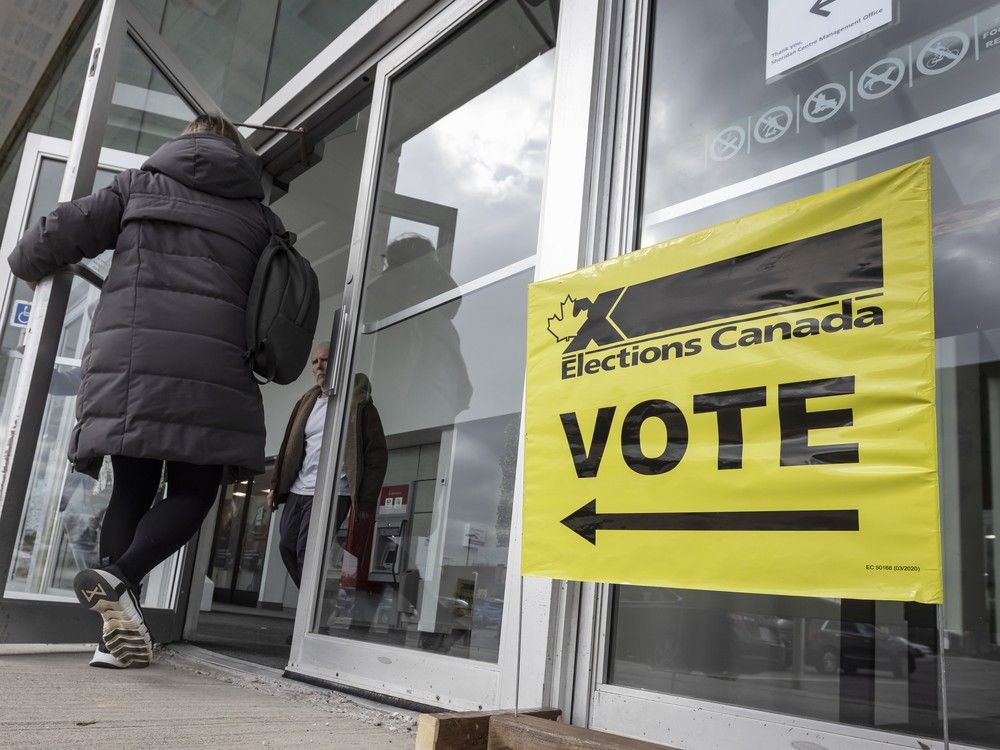
A person walks past Elections Canada Vote signage during the federal election campaign In Mississauga, Ontario, Monday April 7, 2025.

OTTAWA — The Easter long weekend saw a record 7.3 million Canadians vote in advance polls, according to preliminary data from Elections Canada.

That is a 25 per cent increase from the 5.8 million voters who voted early in the 2021 general election, said the agency responsible for handling elections. The new number is, however, only an estimate, as some polls may not have been reported yet, it said.

Advance polls were open Friday to Monday, from 9 a.m. to 9 p.m, coinciding with most Canadians having at least a three-day weekend.

Elections Canada had previously reported a record turnout of more than two million Canadians voting on Friday alone, which was an increase of 36 per cent over the corresponding figures for the first day of advance polls in the 2021 election.

Reacting to the news, NDP Leader Jagmeet Singh said it is “really exciting” that more people are voting early and said he wants to see an even bigger turnout on election day.

Singh made a pitch to voters in British Columbia — where he has spent the last few days in an attempt to save half his incumbent seats — to send more NDP MPs to Ottawa.

He also reiterated his call to hold the balance of power to a re-elected Liberal government.

“You have the power to determine whether (Liberal Leader) Mark Carney will have all the power, or whether there’ll be New Democrats who are there in strong numbers to fight, to defend what you care about,” Singh said during a press conference in Vancouver.

Bloc Québécois Leader Yves-François Blanchet said those early voters either already knew which party they wanted to vote for or wanted to vote to get it “out of the way.”

“It may be a bit of both with a ratio that we cannot define,” he said while in Quebec City.

Given the record turnout, Blanchet said it might be worth taking note in future elections that voters like to have the option to cast their ballot over a period of several days.

Elections Canada is set to publish a breakdown of the estimated number of people who voted at the advance polls for all 343 electoral districts by the end of the week.

The federal election will take place Monday, April 28.

National Post

calevesque@postmedia.com


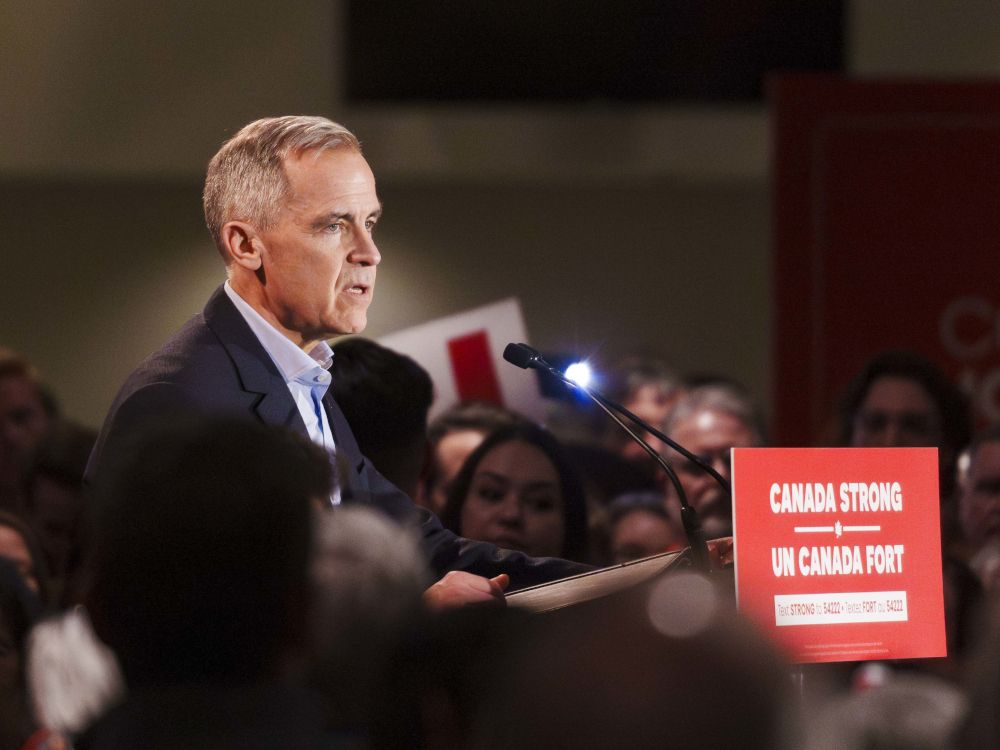
Liberal Leader Mark Carney

Mark Carney

gave a heck of a performance

at a Monday press conference in Fredericton. Political newbie he may be, but when it comes to casual Liberal hypocrisy and entitlement, he might as well have been born in a manger in Shawinigan.

First, Carney lavished praise on the late Pope Francis. Which is fine! I am as atheist as they come, and very fond of capitalism as a general concept — as is Carney, apparently — but I have quite a lot of time for

Francis’s washing-the-peasants’-feet

vision of Christianity

, and his skepticism of the dominant global economic system. The world has enough energetic and well-connected capitalists to survive an alternative spiritual vision being offered them on a Sunday morning, should they choose to hear it.

It’s just that, well, not so long ago, Carney

said the articles of his Catholic faith were purely a private matter

. He suggested — as faithful Liberals often do, when asked — that those beliefs were firewalled off from his political views, specifically (having been asked by a reporter) vis-à-vis abortion. The recently deceased so-called

”Cool Pope” certainly wasn’t cool enough to be cool with

abortion.

Now look at Carney’s fulsome tribute to the late pontiff in New Brunswick on Monday: “Pope Francis was a voice of moral clarity, spiritual courage and boundless compassion. He was in many respects the world’s conscience, never hesitating to challenge the powerful on behalf of the vulnerable,” he averred.

Carney used an anecdote about meeting Pope Francis that he has deployed before, including in

his 2021 book Value(s): Building a Better World for All

. The occasion was a 2014 summit of various business, academic and policy-making bigwigs

held at the Vatican, titled

“The Global Common Good: Towards a More Inclusive Economy.” (Carney was there representing the

Swiss-based Financial Stability Board

, of which he was then chair.)

“Pope Francis surprised us by joining (us for) lunch,” Carney wrote in the book. “(Francis) observed that: Our meal will be accompanied by wine. Now, wine is many things. It has a bouquet, colour and richness of taste that all complement the food. It has alcohol that can enliven the mind. Wine enriches all our senses.

“At the end of our feast, we will have grappa. Grappa is one thing: alcohol. Grappa is wine distilled,” Carney recalled Francis saying. “Humanity is many things — passionate, curious, rational, altruistic, creative, self-interested. But the market is one thing: self-interested. The market is humanity distilled.”

“(Francis) called on us to reintegrate human values into our economic lives,” Carney said in Fredericton. “He reminded us that markets don’t have values — people do, and it’s our responsibility to close that gap and turn that grappa in to wine.” Carney “committed” himself to “meeting that challenge.”

If I didn’t know better, I would think these were the words of a prime minister who is quite serious about his Catholicism, and whose faith very much impacts the way he thinks about politics and public life.

And that would be fine too, if he hadn’t essentially disavowed the notion before.

“My faith is private” is the standard to which religiously observant Liberal and Tory ministers have been allowed to hew for most of my lifetime, though in more recent years Conservatives have not been afforded that courtesy. (

Readers may recall a ludicrous episode in 2022

, in which several high-profile morons took offence at Poilievre’s bog-standard Easter greeting in a newspaper ad: “He is risen.” They actually thought he was referring to himself.)

That has always been a clumsy, facile demarcation. No politician would argue that their

non

-religious philosophical convictions have no effect on their day-to-day decision-making — that they’re guided by nothing but day-to-day political expediency. Why would they, when their convictions are divinely inspired?

In any event, later in the press conference, a reporter from La Presse asked Carney why he had earlier accused Poilievre of intending to use the notwithstanding clause to override abortion rights, when Poilievre has in fact totally forsworn any government legislation on abortion whatsoever.

“It’s not an accusation, it’s a fact,” Carney responded, astonishingly. His reasoning: Because Poilievre has indicated a willingness to use the notwithstanding clause to keep violent people in prison for longer, there’s no telling where he would stop.

It was a bizarre, stupid argument that certainly did not turn any grappa into any wine. Presumably Poilievre would “stop” wherever he wanted to “stop,” right? It’s like saying “if we let the government make one law, there’s no telling what other crazy laws they might make.” No one accuses

Quebec’s notwithstanding clause-loving politicians

of plotting against abortion rights, because that would be idiotic.

The irony,

as University of Ottawa law professor Stéphane Sérafin noted in National Post last week

, is that under existing case law, Poilievre wouldn’t

need

the notwithstanding clause to outlaw abortion. It’s Liberal dogma that the Supreme Court has definitively adopted abortion-on-demand as the only acceptable policy, constitutionally, but that never actually happened. As on many issues, neophyte though he may be, Carney seems to have had decades of self-serving Liberal cant and tactics downloaded directly into his brain.

National Post

cselley@postmedia.com

Get more deep-dive National Post political coverage and analysis in your inbox with the Political Hack newsletter, where Ottawa bureau chief Stuart Thomson and political analyst Tasha

Kheiriddin

get at what’s really going on behind the scenes on Parliament Hill every Wednesday and Friday, exclusively for subscribers. Sign up here.


A United Airlines jetliner heads in for a landing at Denver International Airport after a winter storm swept through the region Tuesday, Jan. 16, 2024, in Denver.

A United Airlines plane bound for Edmonton, Alberta was forced to make an emergency landing after a rabbit was sucked into the engine earlier this month, according to audio recording of the flight.

“Every once in a while, a little burst of flame’s coming out the right engine,” said a crew member in a recording posted by LiveATC.net, a website that provides

live feeds of air traffic control

. The plane took off, leaving the Denver International Airport on April 13 just after 7 p.m.,

per flight tracker FlightAware

. However, the aircraft didn’t make it to its destination. Instead, one of the pilots declared that there was an emergency on United Airlines flight 2325.

“We think we lost our right motor,” said the pilot.

The crew was told a rabbit had gone through the engine just as the plane was leaving the runway,

ABC News reported

.

The pilot replied: “Rabbit through the number two, that’ll do it.”

Per ABC News, there were 153 passengers and six crew members on the flight.

One video shared by Edmonton-based social media account YEGWAVE on Instagram showed the inside of the plane during the incident. Passengers could be heard shouting “fire” as flashes of yellow lit up the cabin.

One passenger

Scott Wolff told Good Morning America

he heard “a loud bang” and there was “a significant vibration in the plane.”

“Every few moments there was a backfire coming from the engine, a giant fireball behind it,” said Wolff. “Everyone in the plane then started to panic.”

Although the flames continued, Wolff said the plane continued to climb. The Boeing 737-800 ended up returning to the Denver airport “after the crew reported striking an animal while departing,” the

Federal Aviation Administration (FAA) said

. Per FlightAware, the plane landed around 8:20 p.m. — less than an hour and a half after takeoff.

One person, Wyatt McCurry, saw the engine fire from the airport. He told Good Morning America his stomach dropped.

“I just thought, ‘I’m going to see a plane go down,’” he said.

“Our flight from Denver to Edmonton (UA2325) returned safely to Denver to address a possible wildlife strike,” said United Airlines in a statement to ABC News. A

spokesperson for the airline told People Magazine

that after the aircraft returned to the gate, the airline “lined up a new aircraft to get our customers on their way.” FlightAware shows that another plane

departed the Denver airport

just after 10:10 p.m. the same evening, and arrived in Edmonton at 1 a.m. on April 14.

According to the FAA

, wildlife strikes with planes are increasing in the United States and elsewhere. “About 291,600 wildlife strikes with civil aircraft were reported in USA between 1990 and 2023,” the administration said, with about 19,400 strikes at 713 U.S. airports in 2023 alone.

“Expanding wildlife populations, increases in number of aircraft movements, a trend toward faster and quieter aircraft, and outreach to the aviation community all have contributed to the observed increase in reported wildlife strikes,” the FAA said.

There have been around 75 incidents involving rabbits between 1992 and 2024, according to the FAA’s wildlife strike database. In 2024, there were only four such incidents.

The FAA is investigating the incident.

Our website is the place for the latest breaking news, exclusive scoops, longreads and provocative commentary. Please bookmark nationalpost.com and sign up for our daily newsletter, Posted, here.


Wrights Front Range Lighthouse in Prince Edward Island, which is deemed to be a rural area for the purposes of the Canada Carbon Rebate.

This month, the Canada Revenue Agency is sending out its final Canada Carbon Rebate payments to eligible Canadians. But the CRA has also announced that it may have overpaid some individuals, and it wants that money back.

In the “what has changed” section of its website, it notes: “The CCR rural supplement was paid out to some people who were not entitled to get it. To maintain a fair and equitable tax system, the CRA is required to recover any overpayments or payments made in error.”

The site says affected taxpayers will receive an official notification starting April 15.

The CRA defines the rural supplement as a 20 per cent top-up for residents of small and rural communities. The agency’s website includes maps of municipal areas so people can

determine if they’re eligible

for it or not.

Prince Edward Island is considered one rural community, but the rest of the provinces where the CCR is paid — Alberta, Saskatchewan, Manitoba, Ontario, Newfoundland and Labrador, New Brunswick and Nova Scotia — are divided.

The rural supplement can be claimed by ticking a box on page two of your income tax forms. National Post has reached out to CRA to determine if errors in self-reporting are the reason for the overpayment, and also how many people are affected.

The amount of the rural supplement varies from province to province, ranging from $22 for an individual in Nova Scotia to $45.60 in Alberta. Spouses and dependants receive a smaller portion of that amount.

The final CCR payments are due to go out on April 22, but that could be delayed for anyone who has not yet filed their 2024 taxes. Individuals who file later will receive their final payment once their 2024 return is assessed.

When Mark Carney became prime minister in March, he signed an order-in-council that ended the consumer carbon tax and, with it, the CCR payment. April 1 marked the end of the tax, and the current payment will be the final one.

Robin Boadway, Emeritus Professor at Queens University, has pointed out that this last payment will actually be for taxes that will never be collected.

“The issue is pretty straightforward,” he told National Post. “The carbon tax rebate was paid in advance of carbon tax revenues being collected. When the carbon tax was terminated, no more revenues were coming in, so there was no longer a basis for continuing the rebate.

“In effect, the upcoming rebate will be for carbon taxes that will not be collected, so the revenues to finance it will have to come from federal government general revenues. So, those persons who are eligible for the rebate will be getting a transfer that is not really a rebate for carbon tax revenues.”

He estimated the cost at between $2.7 billion and $3 billion.

Our website is the place for the latest breaking news, exclusive scoops, longreads and provocative commentary. Please bookmark nationalpost.com and sign up for our daily newsletter, Posted, here.


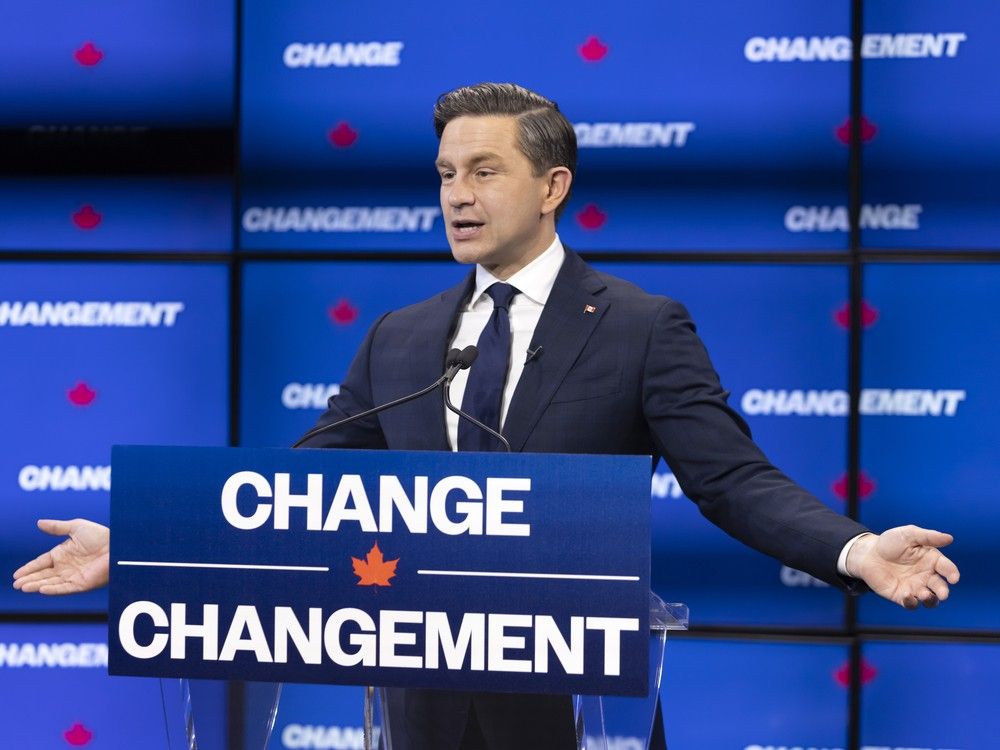
Conservative Leader Pierre Poilievre speaks to members of the Canadian Association of Retired Persons, CARP, during a campaign stop in Toronto on April 21, 2025.

OTTAWA — Pierre Poilievre’s Conservatives will run $100 billion in deficits over four years thanks in part to a bevy of tax cuts, according to their costed platform released on Tuesday morning, hours after millions of Canadians have already cast their vote.

The document reprises all of Poilievre’s commitments made during the campaign, including sweeping criminal justice reforms, repealing a collection of Liberal environmental and energy laws and regulations as well as tax cuts to boost home construction.

Over four years, a Polievre government would incur a roughly $31 billion annual deficit in 2025-2026 and 2026-2027, $23 billion in 2027-2028 and nearly $15 billion in 2028-2029.

Overall, the plan promises to cut the federal government’s program spending by roughly $23 billion and boost revenue by $17.8 billion over four years. But the vast majority of the increased revenues come from a projected $20 billion in tariffs collected this year from Canada’s response to the trade war launched by the United States.

Poilievre has frequently promised

that any counter-tariff revenue would go back to Canadians in the form of direct support or tax cuts and that “not one penny will go to other government spending.” But it was not immediately clear in the platform how that $20 billion was being redistributed as proposed tax cuts in 2025-2026 appeared to amount to roughly $11 billion.

The Conservatives are not committing to balance the budget within Poilievre’s first four years in office. They promise to run $100 billion in budgets during a first full term, which is roughly $40 billion less than currently projected by the Parliamentary Budget Officer.

The platform includes new promises or additional details to previous commitments by the Conservatives over the election campaign.

The party is proposing to “streamline” the public service by replacing two out of three public servants who quit the bureaucracy. It is also committing to reducing government spending on consultants — which grew near exponentially under the Liberals — to 2015 levels.

Within 100 days of the election, a Conservative government would also identify 15 per cent of federal buildings and lands to sell in order to create more housing.

The document also makes further criminal justice proposals, such as barring convicted murders from seeking parole if a victim’s body is not found.

“Convicted murderers should never be given parole when they are withholding information or evidence that grieving families can use to get closure,” reads the document.

More to come.

National Post

cnardi@postmedia.com


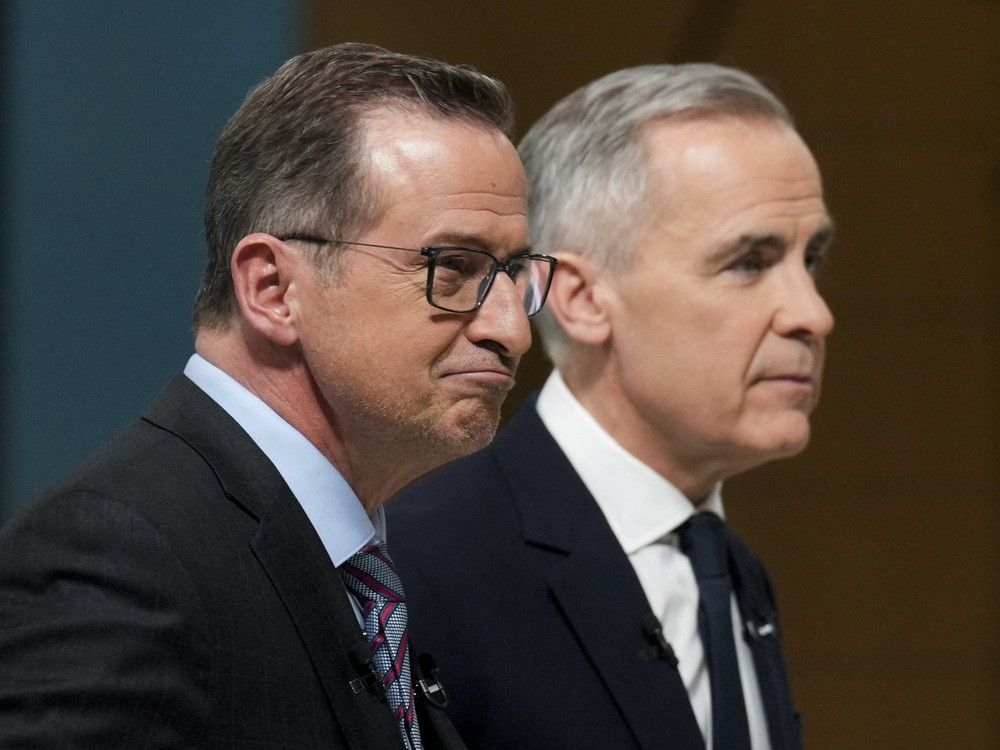
Bloc Quebecois Leader Yves-Francois Blanchet (L) and Canadian Prime Minister and Liberal Party chief Mark Carney leave the stage following the English Federal Leaders Debate broadcast at CBC-Radio-Canada, in Montreal, Canada, on April 17, 2025.

BAIE-SAINT-PAUL, QUE — The Bloc Québécois seems to be climbing back in the polls with a week to go before election day.

And leader Yves-François Blanchet, who is a lifelong fan of the now-defunct Quebec Nordiques, bought what would have been unexpected not so long ago: a Montreal Canadiens jersey, predominantly red, white, and blue, in a Quebec City store.

“It’s like collaborating with Ottawa while awaiting independence,” Blanchet said on Monday morning.

A few hours later, he joined two dozen fans in Charlevoix to cheer on the Habs as they opened their playoff series against the Washington Capitals. At the restaurant, Blanchet proudly, it seemed, wore his new jersey and declared it was a “compromise.”

Because for a Bloc leader, red isn’t exactly a favourite colour. But Blanchet now openly admits that “no matter how many Bloc Québécois MPs there are, Mr. Carney will be Prime Minister.”

And that doesn’t seem to bother him.

Blanchet, who asked Mr. Carney to commit to better collaboration with the opposition parties during last week’s English-language debate, told reporters he exchanged cell phone numbers with the Liberal leader after the debate. He said he was pleased with Carney’s gesture, knowing that he never received Prime Minister Justin Trudeau’s phone number.

“I am reasonably optimistic that we will be able to collaborate in the direction of the converging interests of Quebec and Canada,” he said.

Blanchet is now seeking to rally traditional French-speaking nationalist voters to his party. Since the beginning of the campaign, many questions have been raised about the need for a strong Bloc representation in Ottawa.

Many separatist voters told National Post that this time, they would vote for a federalist party because of Donald Trump’s threats of tariffs and annexation.

The Liberals know this. The Bloc, which held 33 seats when Parliament was dissolved,

could lose

five, ten, or even a dozen seats next Monday, mainly to the Liberals.

Mark Carney’s plane landed in Quebec City on Monday evening before campaigning in the province on Tuesday. It means both leaders will be in the Quebec’s Old Capital the same day.

For the better part of the campaign, the Bloc was trailing the Liberals by about 20 points in Quebec. Though, according to

Abacus Data

, it seems Blanchet was able to win support and shift the perception in the French debate.

It now appears that the party has managed to gain a few points here and there, according to several polls.

Blanchet is trying to convince Quebecers to grant him the balance of power.

“It can work… Canada is choosing Mark Carney with a level of certainty that allows Quebecers, if they wish so, to return to the Bloc,” he said Sunday night.

He argues that in a democracy, people are elected to sit in a Parliament and get along to operate the territory for which they are responsible.

On Monday morning, at a press conference in front of Quebec’s National Assembly, Blanchet was hammering the immigration issue, asking for Ottawa to give Quebec “all the powers” in this file.

His goal is to replicate the results of the 2019 and 2021 elections, when the Bloc lagged in the polls and then prevented a Liberal majority in the final days after the debates.

At a subsequent press conference in Charlevoix, with the St. Lawrence River in the background, Blanchet said the coming days would be dedicated to meeting with Quebecers from across the province.

“We’re going to go to many, many places. We’re going to be very, very mobile,” he said. “We’re going to bring back topics rather than bring new ones. It’s about involving as many people as possible in the shortest possible time.”

In a pig farm a few kilometres away, some workers told reporters that they were afraid of Trump, but that they would likely end up voting for the Bloc because it’s a known commodity and one that defends Quebec’s identity.

Blanchet argued that his party could play a role of watchdog and benevolent supervision to ensure the protection of Quebec’s interests throughout the mandate. This is the objective of his campaign, particularly during his final week.

National Post
atrepanier@postmedia.com

Get more deep-dive National Post political coverage and analysis in your inbox with the Political Hack newsletter, where Ottawa bureau chief Stuart Thomson and political analyst Tasha Kheiriddin get at what’s really going on behind the scenes on Parliament Hill every Wednesday and Friday, exclusively for subscribers. Sign up here.

Our website is the place for the latest breaking news, exclusive scoops, longreads and provocative commentary. Please bookmark nationalpost.com and sign up for our newsletters here.


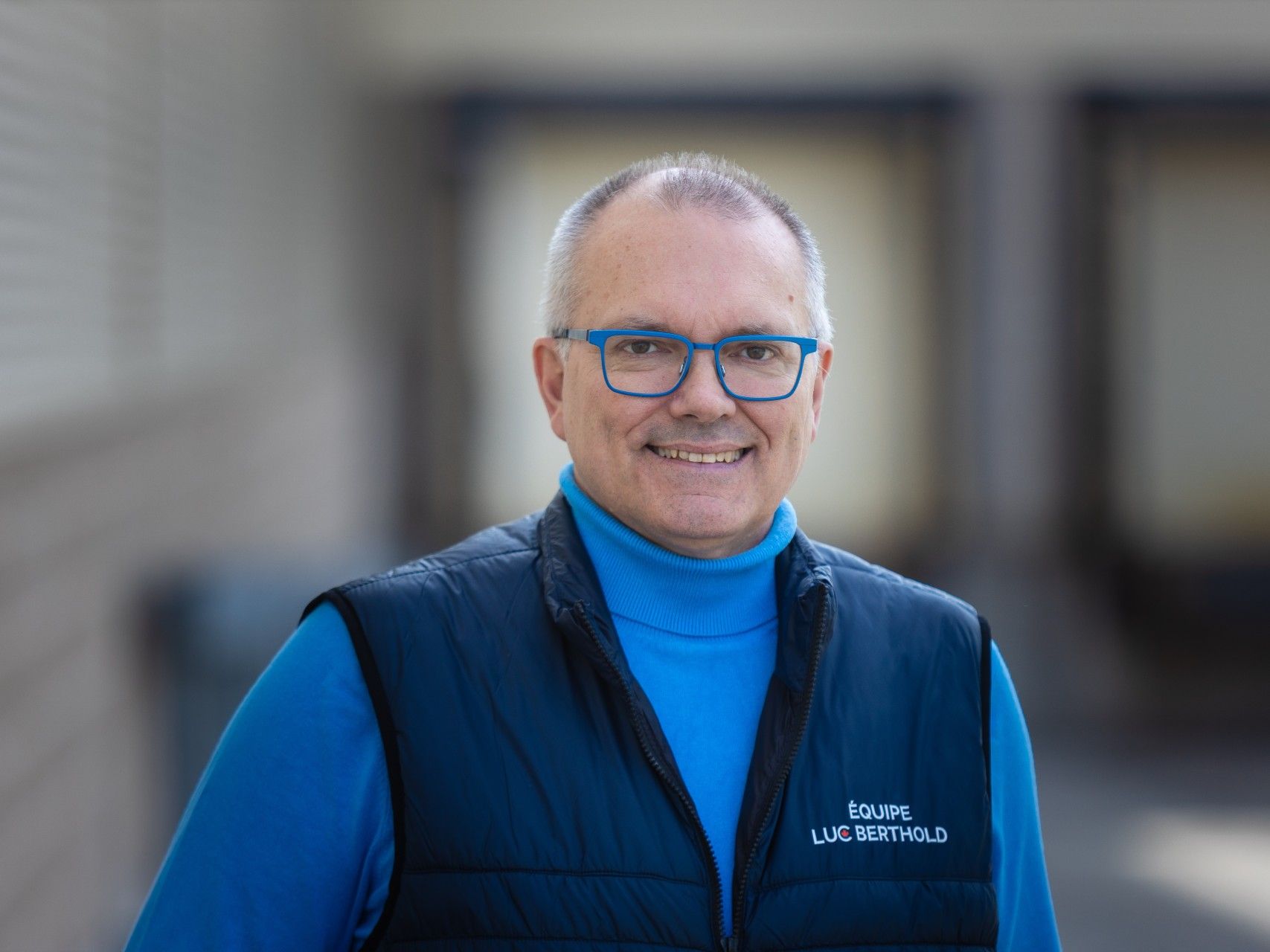
Luc Berthold, Conservative MP and candidate for the riding of Mégantic—L'Érable, poses in Thetford Mines, Quebec, on April 18, 2025. Berthold is campaigning despite battling cancer.

SAINT-LAMBERT, QUE — Alexandra Mendès didn’t know she had cancer when she was trying to oust former prime minister Justin Trudeau.

The bleeding started early last summer. She wasn’t really bothered with it. It didn’t hurt, she felt fine, she thought it was normal women stuff.

At the time, dozens, if not hundreds, of the Quebec Liberal MP’s constituents in Brossard—Saint-Lambert wanted her boss out. Personally, she didn’t want Trudeau to leave. But she had a mission: to convince someone to leave who wanted to stay.

“It was a total collapse,” she said of her party and her prime minister. “So, I was part of all the meetings, all the efforts, including the famous letter that we read to the prime minister (to ask him to leave).”

And yet, she had blood in her urine. As the days went by, she didn’t worry about it. The caucus revolt was in full swing, and she was in the front row.

On Parliament Hill, chaos reigned in a tumultuous fall session. The NDP withdrew its support for the Liberals. Americans elected Donald Trump as U.S. president. The Conservatives called for an election. The Bloc Québécois threatened to join the Conservatives, and the Liberal caucus was desperate.

Then the real drama occurred on Dec. 16, when finance minister

Chrystia Freeland resigned

, blaming Justin Trudeau and his “costly political gimmicks” for her decision.

Meanwhile, Mendès’s bleeding wouldn’t stop. She drove back home after the Freeland bombshell and when she went to the bathroom, she couldn’t pee. When she finally did, there were blood clots.

Four days later, she underwent surgery to stop the bleeding, and a biopsy was performed.

“I didn’t have a very difficult recovery. Not difficult at all. On (Dec. 23), I cooked all day,” she said in a long interview at her campaign headquarters in Saint-Lambert.

There was a tumour in her bladder. Was it cancer?

Four weeks after her surgery, she hadn’t heard anything, so she tracked down the doctor who told her the diagnosis: it was bladder cancer.

“I was surprised. I was very surprised,” she said, rubbing her face with a tissue.

 Liberal MP Alexandra Mendès for Brossard—Saint-Lambert is running for re-election in the 2025 federal election. She was diagnosed with bladder cancer in January and is undergoing treatment while campaigning. (Credit: Liberal Party)

At almost the same time, three other members of Parliament from Quebec were getting almost the same devastating diagnosis. Conservative MPs Jacques Gourde and Luc Berthold were both diagnosed with prostate cancer, and Bloc Québécois MP René Villemure with kidney cancer.

All of them are running to keep their seats in the

2025 federal election

on April 28, mere weeks or months after their diagnoses. They are not the first candidates to run in a federal election with cancer. NDP leader Jack Layton did so in 2011, although most Canadians were not aware until

he succumbed to the disease

weeks after his party had its most successful election in history. And these Quebec candidates certainly won’t be the last, at least statistically. According to the

Canadian Cancer Society

, 675 people are diagnosed with cancer every day in Canada.

Running in a six-week federal election campaign is a sprint that can feel like a marathon. But these four brave MPs are also fighting for their lives, literally, undergoing exhausting chemotherapy, radiation treatment and surgery.

Not one of them considered abandoning their race.

The diagnosis

In December, Villemure was with colleagues in Montreal for a training session. He was tired, it had been a busy time in Ottawa. But that morning he was so exhausted he fell on the ground. He thought he had pneumonia and went to see his doctor. After a series of tests, he was told on the phone that he had kidney cancer.

That was in February. He faced imminent surgery to remove a kidney.

“It’s like a shovel hits you in the face,” said Villemure, who is running for re-election in Trois-Rivières. “When you see the word ‘cancer,’ you see death. It’s as simple as that.”

Luc Berthold, 59, knows that feeling well. The MP for Mégantic—L’Érable—Lotbinière

is a prominent member of the Conservative Party, appointed deputy leader in 2022 (a role now held by Melissa Lantsman and Tim Uppal), and formerly served as shadow minister of health. Berthold learned he had prostate cancer after regular medical monitoring and some additional screening. His oncologist recommended surgery.

“Prostate cancer is an invisible cancer. I was not sick and I just kept going … But you always have (the diagnosis) on your mind. You’re always wondering when they’re going to remove it, and if the cancer has spread,” said Berthold.

According to the Canadian Cancer Society, surgery for prostate cancer may have side-effects such as swelling in the genital area, urinary incontinence and erectile dysfunction.

“What would have been more difficult was to have continued living with cancer. I didn’t even question the consequences for a moment. Let’s go!” Berthold said in an interview with National Post.

On Feb. 10, as Berthold was preparing for surgery scheduled for two days later, he received the worst news of his life: his son had committed suicide. “I asked to postpone the operation,” he said. But after discussing it with his wife, Caro, they decided to go ahead with the procedure.

“Since then, my emotions have been mixed. I haven’t been able to cope with the cancer, even though I live with the consequences of the operation every day,” he said in an emotional phone conversation in the early days of the election campaign that officially began on March 23.

“It’s very difficult to combine the pain of losing a son with all that,” he added.

What he does know is that if he hadn’t seen a doctor last year and had all those tests, he would not have learned he had cancer. The disease was detected early and the risk of spread reduced.

 Luc Berthold, a Conservative MP running for re-election in Mégantic—L’Érable—Lotbinière, with Dr. Thierry Dujardin (Urology) at L’Hôtel-Dieu de Québec, after his cancer surgery in February.

His Conservative colleague, Jacques Gourde, 61, from the riding of Lévis—Lotbinière, is in the same boat. Last year, he finally went to see his family doctor for a battery of tests. “I’ve been a little neglectful about my health. Political life means we work for others, but we often forget ourselves,” said Gourde.

First elected in 2006, Gourde is well known in Ottawa for his frequent, colourful and intense speeches in the House of Commons. In February 2022, during the Freedom Convoy protests in Ottawa, as tensions were on the rise in Parliament, Gourde took the floor to ask then-employment minister Carla Qualtrough about the 1,610 people with addresses outside Canada who had received the Canada Emergency Response Benefit during the pandemic, at a cost of $11.9 million.

“Is there a vaccine for Liberal incompetence?”

Gourde screamed

in French. Everyone in the House laughed, including Qualtrough. That’s who Gourde is — a passionate man with a sense of humour who loves his work.

His cancer diagnosis came in early January. He’s glad he took those screening tests, which led to further examinations and the diagnosis.

What would voters think?

All four of these candidates with cancer struggled with how to tell their constituents. How many details would they divulge? Would they even be able to run for office again?

“You have to keep it very close because you can’t have people start speculating. And you need to be able to keep that message tightly controlled so that it doesn’t spin in a bad way,” said Karl Bélanger, who was press secretary for former NPD leader Jack Layton.

Bélanger was one of Layton’s closest advisers during his 2011 election campaign. Layton had prostate cancer and died in August of that year. Bélanger recalls the difficulty when his boss had to break the news.

“It’s a very personal (matter), and each individual deals with this differently … Sometimes they go on a sick leave and then they come back. So, you know, timing is also part of the equation. You don’t choose when you get sick,” Bélanger said.

The four Quebec candidates said they did not want to hide their news from their voters.

 Bloc Quebecois MP Rene Villemure rises during Question Period in the House of Commons on Parliament Hill in Ottawa in June, 2024. Villemure had surgery to remove a kidney on April 4, but is running for re-election in 2025.

While Mendès posted a video announcement on social media, Villemure decided on a written statement. They revealed they had cancer, that they would have to undergo treatment, and that they would still run for re-election. Their illness doesn’t prevent them from working, they said.

In Villemure’s case, rehabilitation from kidney surgery would take weeks, even months. But he knew he had to tell the public and his colleagues.

“The population has a certain right to know,” said Villemure, who is an ethicist by profession.

After a speech at a winter caucus retreat, Bloc Leader Yves-François Blanchet told his colleagues: “René has something to tell you.”

Villemure explained his cancer to them. There was an immense wave of love and support. “There, I shed a tear,” he said at his Trois-Rivières constituency office.

The other MPs received similar reactions. The Conservative party assured Gourde and Berthold they would help them every step of the way. The Liberals did the same with Mendès. Colleagues even offered to campaign for them. A few Bloc candidates, including the leader’s caravan, did exactly that for Villemure.

 Conservative MP Jacques Gourde during question period in the House of Commons on Parliament Hill in Ottawa on Friday, Dec. 6, 2024. He was diagnosed with prostrate cancer shortly afterward. CREDIT: THE CANADIAN PRESS/Sean Kilpatrick.

All of them say they received hundreds, if not thousands, of messages, calls and kind words in the street. The outpouring of support helped with their decision to stay in politics.

They have been reassured by their doctors that their lives are not in danger. The cancer risk is omnipresent, yet they swear they can represent their constituents.

“Was I afraid of dying? Yes. Less so today, but I don’t like it,” said Villemure.

“I love what I do. I’ve always loved this riding and this job,” said Mendès. “I tell myself that staying home, staring at my four walls and thinking about death would probably be the worst thing I could do.”

Berthold said he would have liked the election to have been called earlier. “If it had been in the fall as requested, I would have been so happy,” he said with a laugh. Back then, he hadn’t yet received his diagnosis, the Conservatives were leading by a wide margin in the polls and were expected to form a majority government.

But here they are, on the eve of the election, running to win.

“Nobody’s running for office thinking they’re going to die,” said Bélanger. That wasn’t what Jack Layton was thinking, he said, and it came as a shock to everyone when things took a turn for the worse after the election. “Not only for the people working with (Jack), obviously, but for all Canadians.”

Campaigning with cancer

 Luc Berthold chats with people at a restaurant in Thetford Mines, Quebec, on April 18. Berthold is campaigning but says he’s taking more time to rest.

Each weekday of the campaign, Gourde sets aside two hours for his radiation therapy treatment. He has 28 sessions in total. “Every day, I go to Lévis to have my radiology treatment. It lasts three minutes. My last day is on May 1, so even on election day, (April) 28, I have to go for my treatment,” he said.

Gourde was present at Pierre Poilievre’s rally in Quebec City early in the campaign, where the Conservative leader announced his Quebec platform. Gourde looked tired. The treatment had clearly been draining.

He has changed his strategy for this campaign. The candidate has had the same team since 2006, and they know the riding inside out. The real race is for second place.

But he’s still campaigning. He’s doing less door-to-door canvassing than usual and is focusing on larger events.

Mendès is tired, too. Her first oncologist told her that her cancer was so aggressive she would have to undergo three months of intensive chemotherapy, have her bladder removed and wear a urinary bag for life.

She got a second opinion. She is currently participating in a clinical trial combining immunotherapy and chemotherapy. Mendès has her treatments every Friday, with a break every three weeks. This treatment plan will last six months.

About two days after treatment, she said she feels better. “My brain is still there,” she said.

In late March at her campaign headquarters in Brossard, across the St. Lawrence River from Montreal, Mendès had forgotten her mask and couldn’t shake hands. Her doctor advised her to limit contact and to frequently wash her hands.

Around her, volunteers were everywhere, looking for tie wraps to install campaign signs. At the entrance sits five chairs — two of them are green Adirondack chairs — and a small table to put your coffee.

“This is where I meet voters. I invite them to come over here,” she said. Mendès doesn’t canvass herself, and she cannot be in a crowd.

“I am someone who hugs a lot of people and shakes a lot of hands. So, it’s interesting,” she said with a smile.

 Quebec Liberal candidate Alexandra Mendès’ doctor advised her to limit contact during her re-election campaign in the 2025 federal election.

Berthold is often on television to debate other candidates, but is taking more time to rest.

For these candidates with cancer, schedules are based on doctors’ recommendations. Villemure’s doctor has advised him to avoid stress — of any kind. An election campaign is stressful, even for people like him who aren’t usually stressed.

He isn’t personally campaigning — he had a kidney removed on April 4. Villemure’s team is campaigning in Trois-Rivières, where the race is too close to call between the Bloc, the Liberals and the Conservatives.

He’s shot a few videos and is active on social media. But there won’t be any debates. And he won’t be at his election night party.

Mendès’s doctor assured her she could do another two or three mandates. But she knows this election is probably her last. “I’m 61 years old,” she said with a laugh. “I don’t intend on seeking two or three other mandates.”

First, she must get re-elected. “By talking about it, I wanted to reassure, but at the same time be frank. To put that on the table and tell voters that if you are going to choose me again, you will do so knowing that I have this Damocles sword hanging over my head.”

Yet even when she was sick, she fought for her constituents and carried out her political responsibilities. Moreover, she helped achieve what most Canadians wanted: to get rid of Justin Trudeau.



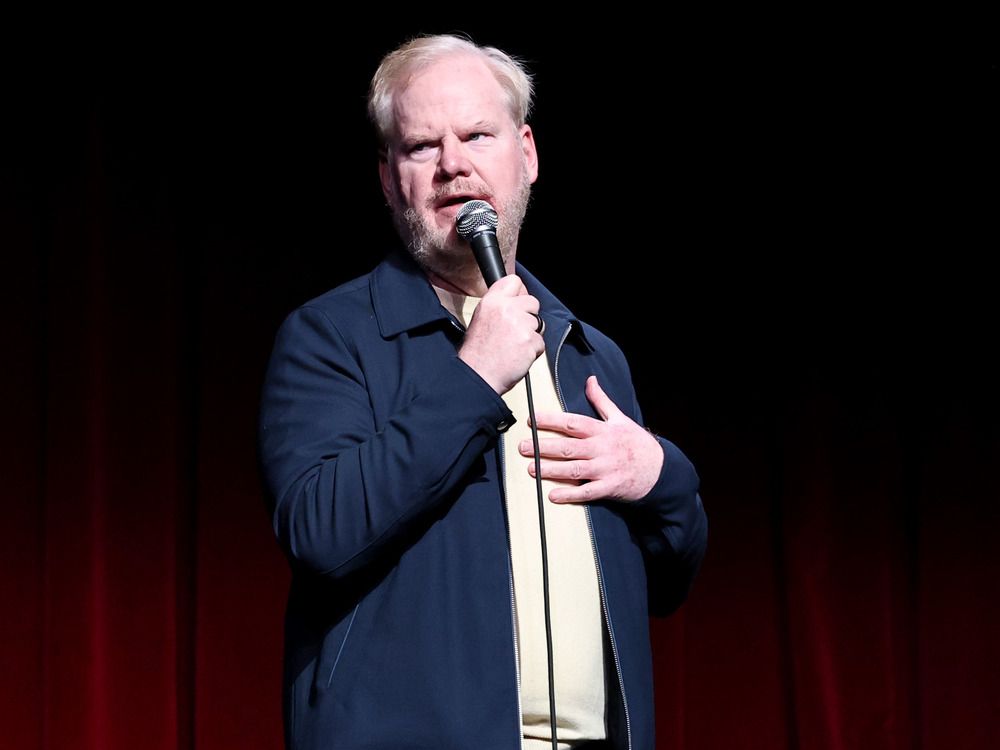
Jim Gaffigan performs onstage during the 2025 Night of Too Many Stars benefiting NEXT for AUTISM on March 31, 2025 in New York City.

Actor and stand-up comedian Jim Gaffigan was more than a little surprised at the anti-American vitriol he noticed during a recent performance in Vancouver. What’s worse, he couldn’t even drown his sorrow in a glass of Kentucky bourbon at the bar, since American booze has been pulled from most shelves amid the ongoing trade war between the two countries.

His comments came during an appearance on the 

We Might Be Drunk

podcast, which is hosted by comedians Mark Normand and Sam Morril. Gaffigan mentioned that he had recently done four shows in Vancouver, remarking: “And by the way those audiences in Vancouver were amazing. Amazing audiences!”

He then talked about a joke in which he imagines that a dog tells him to shoot the U.S. president. “And every time I do it there’s some audiences that don’t get the fact that it’s a serial killer reference and they think it’s me proposing to shoot Trump, and they go bananas. In Canada—”

Morril finished for him: “They hand you the gun?”

Gaffigan went on to say that he’s become used to international audiences sometimes taking umbrage with U.S. foreign policy. “When we went through the Gulf War … there was a moment when we lost the Irish. And I was like ‘Oh my god I can’t believe the Irish.’ And as an Irish American I was like, ‘That’s kind of sad.’ But the Canadians were always like: Yeah, you know, it’s not you, it’s your government doing this foreign policy.”

He continued: “I would bring that up, that the Canadians were always there. And now the Canadians are like, ‘We hate you.’”

His hosts suggested that Canada has replaced Mexico as the angry neighbour. They also compared watching the Canada-U.S. trade war to children witnessing their parents’ divorce and asking: “Is it our dad’s fault?”

But Gaffigan’s Canadian troubles continued after the show, when he found a local whiskey bar. “It had an Irish name but it’s whiskeys from around the world.”

He continued: “And I don’t like scotch. You know, I’ll try Canadian whiskey if I’m in Canada. If I’m in Ireland I’ll drink Irish whiskey. But I like bourbon. And so I’m like: ‘All right, I’m going to get a bourbon.’”

He paused. “No bourbon. I go, ‘This is a world whiskey bar.’ And they’re like, ‘No, we’re not selling any American whiskey.’ And I go, ‘So did you get rid of it?’ And they’re like, ‘Oh, it’s back there. We’re just not selling it.’”

Morril chimed back in: “They’re holding it hostage!”

But Gaffigan got the last laugh, and the last drop. “So it was like OK, I get it. And then we went back to our hotel, that was owned by an American company, and I got a bourbon.”

Gaffigan’s previous trips north were a little less political. He recently posted a clip

from an earlier show

in which he told the audience: “I’ve been to British Columbia. It’s not very British or Columbian. Vancouver was like a rainy Seattle. I spent a week in Vancouver. Somehow it rained for two weeks.”

Our website is the place for the latest breaking news, exclusive scoops, longreads and provocative commentary. Please bookmark nationalpost.com and sign up for our daily newsletter, Posted, here.


Vandalism on the Bagg St. Synagogue in Montreal in March 2023, months before the number of antisemitic incidents in Canada skyrocketed following the Oct. 7 terrorist attack on Israel by Hamas.

April is Genocide Remembrance, Condemnation, and Prevention Month — a time for solemn reflection on humanity’s darkest chapters. For the Jewish community, this month holds even deeper meaning, as it bridges the end of Passover and the commemoration of Yom HaShoah, Holocaust Remembrance Day. But this year, remembrance alone is not enough. As we mark 80 years since

liberation

, we must confront an alarming reality: antisemitism is once again on the rise, and it’s being supercharged by the unchecked spread of hate and misinformation online.

In February, Kanye West, a global celebrity,

wore a swastika-emblazoned shirt

and

praised Hitler

. Millions watched, shared, debated or scrolled past in silence. For many Jews, this wasn’t just offensive — it was terrifying. The images and rhetoric mirrored the early propaganda tactics found in newspapers and other media channels that laid the foundation for the Holocaust. Today, social media platforms don’t just echo this hatred — they

amplify it at unprecedented speeds

. Designed to reward engagement, these platforms push the most provocative, outrageous content to the forefront, often targeting the youngest and most impressionable users.

A recent

study

commissioned by the Toronto Holocaust Museum underscores this problem. Sixty-one percent of Torontonians rely on social media for news; among Gen Z, that number climbs to 80 per cent. Yet 82 per cent admit they don’t always verify what they read. This creates a dangerous pipeline for misinformation and hate, especially when 76 per cent of respondents believe social media spreads antisemitism — and when

antisemitic hate crimes in Toronto

 had surged by

69 per cent

a year after Hamas’s October 7 attack on Israel.

The effects that social media have on society aren’t just theoretical or statistical, they’re deeply personal. We, as Jews, look over our shoulders. We hesitate before identifying ourselves. We debate removing jewelry with symbols that represent our religious pride. We wonder if a job rejection, a thanks-but-no-thanks to a business proposal, a lost opportunity, a teacher’s unexplained disapproval is just what it seems — or if it’s something more. That uncertainty isn’t paranoia; it’s the byproduct of centuries of history repeating itself in quieter, modern tones. And today, that repetition has grown even louder because of these platforms that have become megaphones for hate.

Misinformation. Propaganda. Fake news. Call it what you will — the effect is the same. Lies repeated often enough, especially in emotionally charged ways, begin to feel like truth. In an age of instant sharing and fleeting attention, our best defense is not silence or outrage — it’s education. That’s why we must empower the next generation to think critically, especially about what they see online.

So, how do we start?

It begins with conversation. At the Toronto Holocaust Museum, we teach visitors — especially students — to ask the right questions when faced with questionable content. While many of us inherently know we should be checking the source and determining if the information is factual, we’re quick to reshare our aunt’s Facebook post or an influencer’s TikTok rant without checking if the original information came from a reputable organization that has fact-checking procedures in place.

In addition to checking facts, we also need to check our emotions at the door. Fear and outrage can cloud our reasoning, bypass our critical thinking and polarize our judgments. Finally, we must confront our own biases and seek out diverse perspectives to avoid echo chambers.

While these steps may sound like common sense, in a world built for speed and dopamine hits, our society’s greatest challenge is slowing down. Critical thinking takes time — and that’s exactly what social media discourages. At the Museum, we’ve seen first-hand the power of taking a pause and making room for discussion. More than 30,000 students have visited since opening in 2023, and with each visit we witness the transformation that happens when young people are given the space and time to question, reflect, and learn. This gives me hope. The more we reach people — of all ages — the more we can build a generation of informed digital citizens who know how to spot misinformation and stop it before it spreads.

So, as we approach Yom HaShoah, my takeaway is not just to reflect — but to slow down. Slowing down is how we become less susceptible to the rapid consumption that comes with social media. It’s how we give ourselves the time to think deeply, question what we see, and challenge what doesn’t feel right. It’s how we break the endless cycle of hate.

Dara Solomon is the executive director of the Toronto Holocaust Museum.

National Post

Our website is the place for the latest breaking news, exclusive scoops, longreads and provocative commentary. Please bookmark nationalpost.com and sign up for our daily newsletter, Posted, here.