LP_468x60
on-the-record-468x60-white

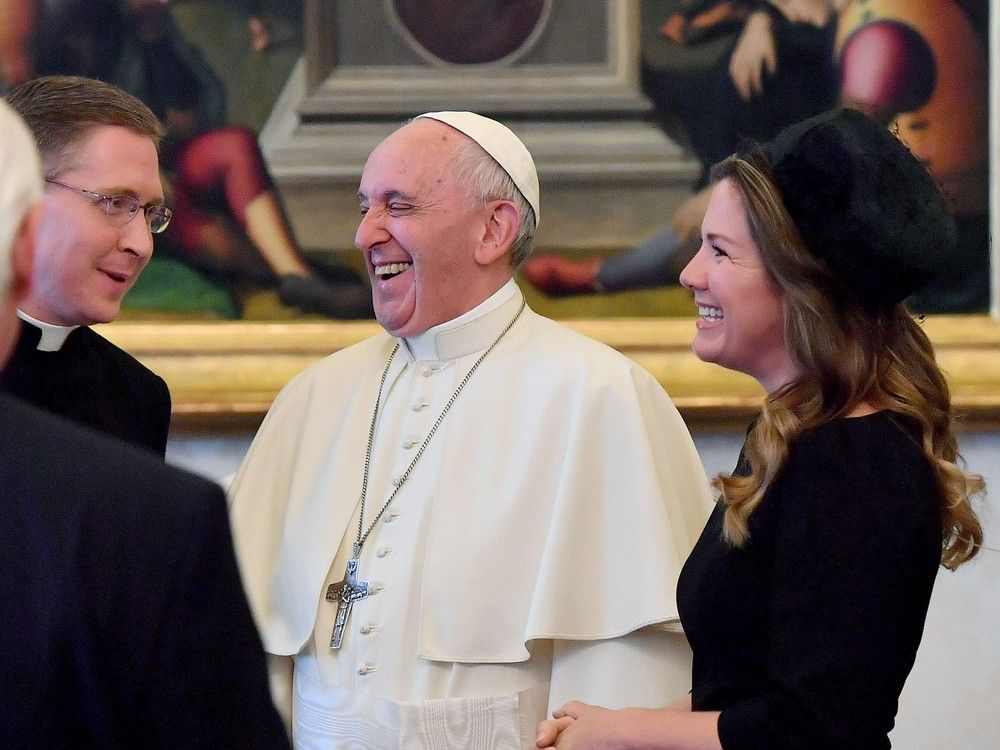
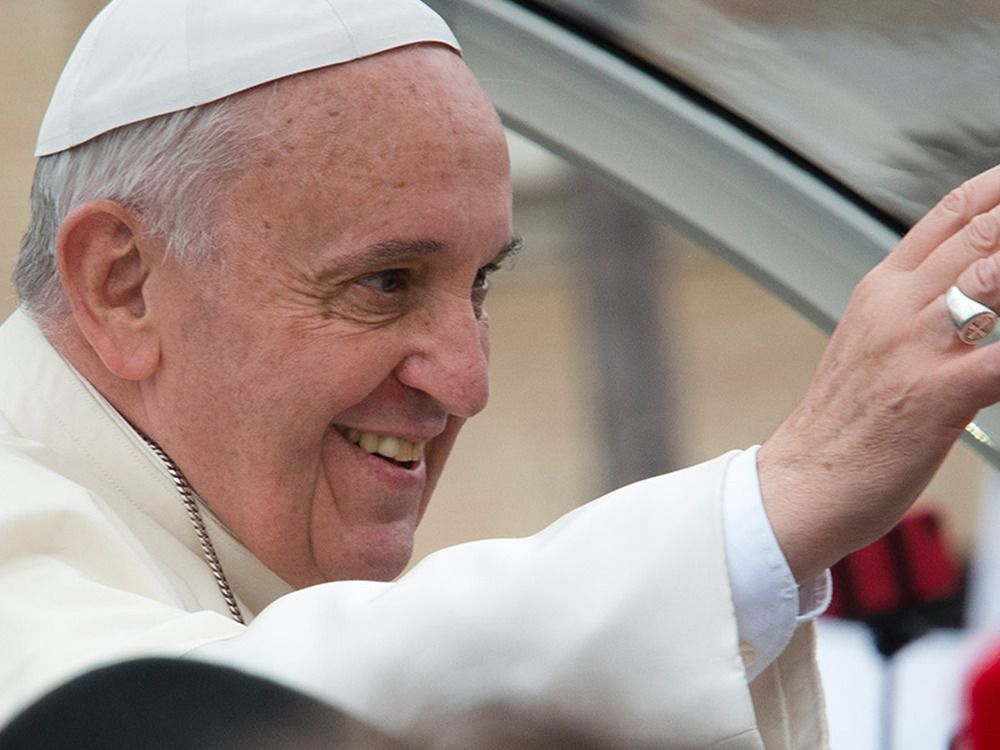
Pope Francis smiles as he talks with Sophie Gregoire Trudeau at the end of a private audience at the Vatican on May 29, 2017.

After the death of Pope Francis on Monday, Sophie Grégoire Trudeau posted about an interaction she had with the leader of the Catholic Church.

In 2017, she accompanied her then-husband and former prime minister Justin Trudeau to Italy.

They met Pope Francis

for the first time at the Vatican. Grégoire Trudeau revealed what their brief exchange was about in an Instagram post on Tuesday.

What happens now that Pope Francis has died?

She included a photo of her next to Pope Francis with a caption that began: “When do you ever have the Pope’s ear?”

She said in the “rare moment” she leaned in to whisper to the pope, “I hear you have a vice?”

“He looked at me with the wide, curious eyes of a child. I added: ‘Maple syrup.’ He burst into laughter,” Grégoire Trudeau continued. “But what stayed with me most was what he said at the end. He looked at me intently and asked, ‘Please pray for me.’”

In the Instagram caption, she goes on to explain that she is “deeply spiritual” but “not religious.” She said that she does “pray that we human beings continue to see our truth and our capacity to learn, to forgive, and to evolve.”

“I will always devote myself to gathering, nourishing, and amplifying the better angels of our nature. Rest in peace Pope Francis,” she ended the post.

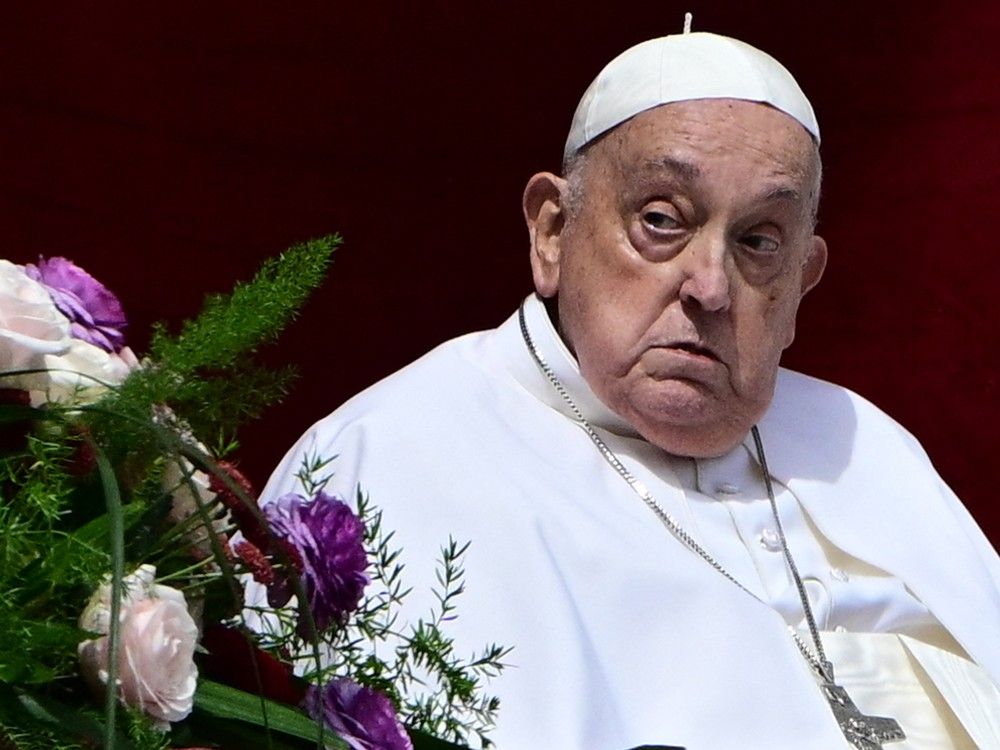
 Pope Francis on the main balcony of St. Peter’s basilica during the Urbi et Orbi message and blessing to the city and the world as part of Easter celebrations on April 20, 2025.

Grégoire Trudeau also wrote about meeting Pope Francis in

a Facebook post in 2017

.

At the time, she said: “What an enriching experience it was to meet with Pope Francis. I cherish our common belief that people of all faiths and backgrounds must stand united for peace.”

Although the pope has not publicly proclaimed his love for maple syrup, he did seem enthused when it was gifted to him by a young boy from Winnipeg in 2016. The boy, identified as Ryan, was selected to meet Pope Francis after he contributed to a children’s book by the Catholic leader,

CBC News reported

.

Ryan travelled with his father to the Vatican, where he gifted the pope with a bottle of maple syrup. Pope Francis laughed and responded: “This is good.”

In 2015, B.C. couple Joseph and Marion San Jose gifted the pope with a custom Vancouver Canucks hockey jersey while they were honeymooning in Rome,

per CBC News

. Their gift, they said, was meant to differentiate themselves from other Canadians, including some of Joseph’s co-workers who had previously given the pope maple syrup.

“We started thinking what we should give the Pope that’s just as Canadian, but isn’t maple syrup…Because we feel like he gets a lot of maple syrup from Canadians,” he said.

Our website is the place for the latest breaking news, exclusive scoops, longreads and provocative commentary. Please bookmark nationalpost.com and sign up for our daily newsletter, Posted, here.


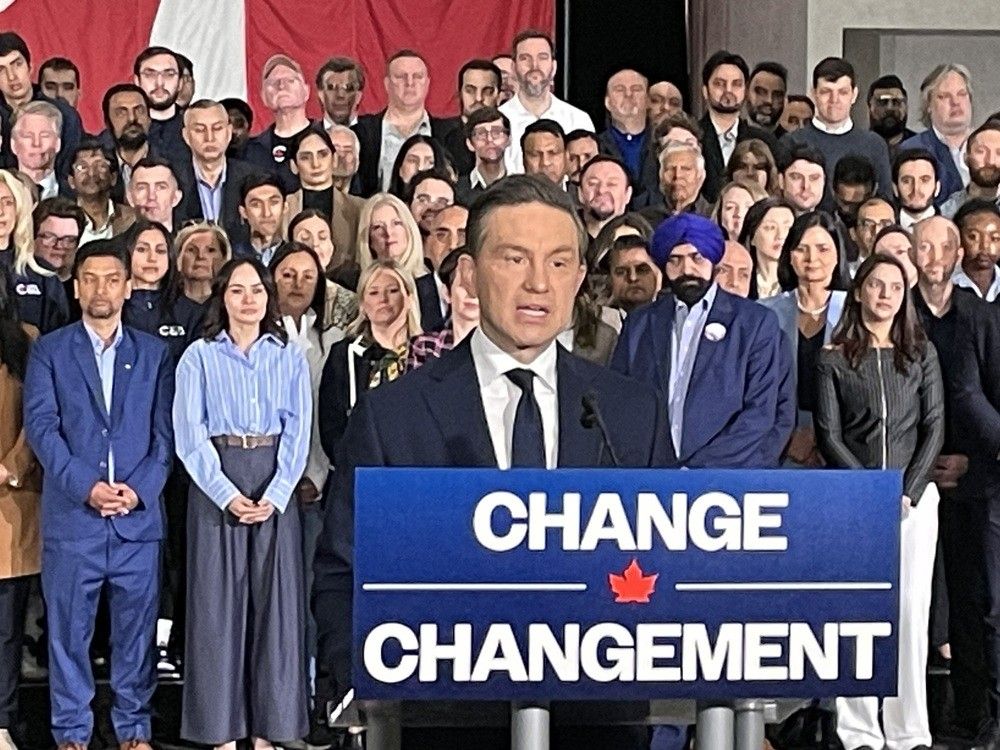
Conservative leader Pierre Poilievre during a rally in Woodbridge on Tuesday April 22, 2025.

VAUGHAN, ONT.

— When she takes the stage, Anna Roberts does so to deliver a direct message to Conservatives. 

“We have to stop Mark Carney and the Liberals from winning a fourth mandate,” she tells the crowd at a rally in Vaughan, a city of nearly 339,000 that makes up part of the must-win Greater Toronto Area.

With only days left in the federal election, Conservative Leader Pierre Poilievre is here for two reasons.

He wants to hold what he can, which in this case would be Roberts’ seat in King—Vaughan that the Conservatives won by a little more than a 1,000 votes during the last election.

He also wants make gains in the riding next door, Vaughan—Woodbridge, which the Liberals currently hold.

Poilievre must do both if he hopes to win government on April 28, but not just here, across the region.

It is an outcome other federal party leaders are now openly saying will not happen, after weeks of successive public opinion polls suggesting the Liberals are leading in the crucial battleground of Ontario.

Before Poilievre takes the stage, NDP Leader Jagmeet Singh made his

own plea to voters

 to elect as many New Democrats as they can to stop Liberal Leader Mark Carney from forming a “

super majority,” saying voters were only turning to Carney to reject the Conservatives. 

That’s what the NDP candidate in Vaughan—Woodbridge is dealing with, too.

Ali Bahman estimates that

one out of four doors he knocks on, he is informed by those inside that they plan to vote Liberal, even if it’s someone who likes what the NDP has to say. 

“This is something that is very, very, very common,” he says. “Like 25 per cent of the doors that I knock on.”

Diana Dugo could have been on the other side of one of those doors.

Leaving one of the riding’s advanced polling stations, Dugo says she wants the Liberals to win because she wants to keep the Conservatives out.

Her reason?

“Poilievre is too much like Trump,” she said. “That’s why I’m voting Liberal.”

While she was considering voting NDP, her decision came down to strategy. “They will not win and I don’t want the votes to be split.”

While New Democrats have never come anywhere close to victory in Vaughan, not even cracking double digits, losing support to the Liberals could give Carney’s candidates an advantage over Poilievre’s Conservatives, should they not be able to pull in enough of their own support, particularly in tight races.

It is a scenario that worries Tories.

Despite concerns Conservatives are struggling with older demographics, rally-goers like Joseph Gravina has confidence the younger generation he belongs to will turn out.

“Young people are going crazy for Pierre,” said Gravina, who is from Barrie, Ont.

Back on the rally stage, Roberts calls on the crowd to help by volunteering and voting, emphasizing that every person is needed.

“Please,” she says.

While Roberts is thinking about votes, the Liberal challenger in her riding is focused on knocking on doors.

Mubarak Ahmed is running what he calls a “baby campaign,” referring to how he was only nominated as a candidate several days after the federal election was called, meaning his race will be slightly shorter.

He is also not naïve about the challenge ahead. This marks Roberts’ third race after she was unsuccessful in the 2019 federal election.

Her campaign declined a request for an interview.

Ahmed’s focus is on building “door-to-door alliances.” Speaking to one household also opens the door to word of mouth spreading, he says.

“They’re calling their brother, they’re calling their sister, they’re calling their cousins.”

While he may be playing catch up, Ahmed has an advantage of being able to speak upwards of six languages, including Arabic, Pashto and Punjabi, which he credits to his international experience working in telecom.

His ability to connect with voters in their own language is a plus in a riding that is home to an ever-diversifying population, which is true for seats across Toronto’s suburbs.

“You go to every second or third door, there is a different language,” Mubarak says. Win or lose the election, he has set a goal for himself of wanting to be able to have a conversation in Italian.

“I’m meeting so many nonnas (grandmothers) and they are so kind,” he said.

Italians make up the largest ethnic demographic in Vaughan, followed by those who are Chinese, Jewish, Russian and Indian.

Earlier in the day, Poilievre and his wife, Anaida, visited an exhibit documenting the Oct. 7 attacks in Israel.

Inside his rally, Poilievre gives a shoutout to Italians in the crowd and tells a story from when he spent his Sunday evenings dining with a friend whose grandfather immigrated from southern Italy and spoke no English.

“The old classic Italian family,” he said to cheers.

That evening, Mubarak’s campaign was set to host a meet-and-greet billed as “cannoli (and) conversations.” His team knows it is a sensitive time for the community, given the recent death of Pope Francis and how almost 40 per cent of the city’s population identifies as Roman Catholic.

Still, the campaign carries on.

Out on the doorstep, the diversity of the riding is unmistakable. As Mubarak’s volunteers walk along streets in the neighbourhood of Maple, at least two people who open the door say they cannot vote as they are still permanent residents.

At another household, visitors are greeted with a Turkish greeting placed on the front door. One of the volunteers also switches from English when they encounter a woman with a list of largely municipal concerns she wants fixed.

Anna Gerrard has called Vaughan home for the past 12 years and has been visited by both Mubarak’s and Roberts’ campaigns in the past two days.

After a polite conversation with Mubarak’s volunteers, whom she tells that she considers herself a “Liberal at heart,” Gerrard acknowledges afterwards that she hasn’t fully made up her mind.

She remains a fan of former prime minister Justin Trudeau and was pleased to see Singh work with the Liberals to pass policies.

Earlier that day she also saw Poilievre release his platform and thought to herself, “Oh, OK sounds interesting.”

“They’re offering the best that they can, just like Mr. Carney is offering the best that he can,” Gerrard said.

“We’ll see how things go.”

Correction:

An earlier version of this article described Ali Bahman as the Conservative candidate in Vaughan—Woodbridge. He is the NDP candidate.

National Post

staylor@postmedia.com

Get more deep-dive National Post political coverage and analysis in your inbox with the Political Hack newsletter, where Ottawa bureau chief Stuart Thomson and political analyst Tasha Kheiriddin get at what’s really going on behind the scenes on Parliament Hill every Wednesday and Friday, exclusively for subscribers. Sign up here.


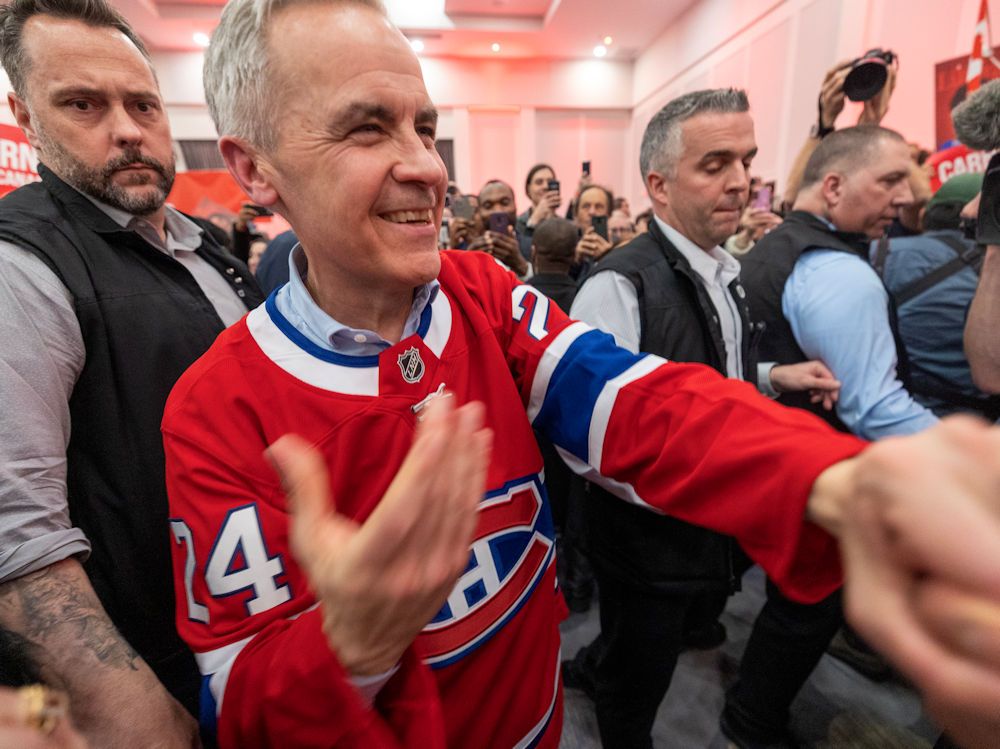
Liberal Leader Mark Carney shakes hands with supporters while wearing a Montreal Canadiens jersey.

First Reading is a Canadian politics newsletter that throughout the 2025 election will be a daily digest of campaign goings-on, all curated by the National Post’s own Tristin Hopper. To get an early version sent directly to your inbox, sign up here.

TOP STORY

With the release of the Liberals’ costed platform, the party is not just prescribing a huge increase to the deficits already planned under Justin Trudeau, it’s prescribing a peacetime debt splurge like few seen in Canadian history.

Over the next four years, the Liberal platform proposes to rack up $224.8 billion in new debt; an average of $56.9 billion per year.

Or, an average of $4 in new debt per day, per Canadian, for four consecutive years. It’s also roughly $100 billion higher than what had been previously tallied in forecasts set out by the prior Trudeau government.

Even when adjusting for inflation, that’s a rate of structural peacetime debt accumulation that’s really only been matched by two prior Canadian prime ministers: Pierre Trudeau and Brian Mulroney.

And in that case, the sustained 1980s Trudeau/Mulroney spending spree would directly precipitate Canada’s 1990s sovereign debt crisis.

Although Carney’s predecessor presided over the largest spike in net sovereign debt in Canadian history (Justin Trudeau effectively doubled the debt in 10 years), much of that can be attributed to the overwhelming expense of the COVID-19 pandemic. In 2021 alone, Canada posted a $381.6-billion deficit.

While Trudeau’s non-COVID debt accumulation still reached generational highs, it fell far short of what is now being proposed by the Liberals under Carney.

In the Trudeau government’s last full year before the COVID-19 pandemic, the deficit of $25.3 billion was high enough that Statistics Canada cited it as the “largest deficit in seven years.”

Just a few months ago, it was considered scandalously high that Trudeau’s government had forecast an unexpected deficit of $48.3 billion for the current fiscal year.

The spending overrun was so controversial, in fact, that it would ultimately precipitate Trudeau’s January resignation. His then deputy prime minister, Chrystia Freeland, resigned in December citing the government’s inability to keep its “fiscal powder dry” in the face of economic threats from the United States.

Freeland’s departure would set events in motion for Trudeau to be pushed out in favour of Carney.

But with Carney laying out average deficits of $56.9 billion, he is proposing to rack up a level of non-emergency debt that will not have been matched since Mulroney’s second term, which ran from 1988 to 1993.

In the four final budgets tabled by the Mulroney government, Canadian debt swelled by the inflation-adjusted equivalent of $280 billion.

Aside from that, there’s really only two other prime ministerial terms with that level of new structural debt: Mulroney’s first term (1984 to 1988) and the final term of Pierre Trudeau (1980 to 1984).

Mulroney’s first term, which ran from 1984 to 1988, racked up deficits equivalent to about $300 billion in 2025 dollars. Pierre Trudeau’s final term broke all spending records before and since by amassing the 2025 equivalent of $377 billion.

What’s different with the proposed Carney budgets is that Canada has a larger economy and more people, meaning that the burden is more widely shared.

However, Canada is also sitting atop an existing debt burden far higher than anything that existed in the 1980s. Sovereign debt has now peaked at about $1 trillion for the first time, with interest charges now costing Canadians $53.7 billion per year as of last count.

Canada continues to rank relatively low in international rankings of overall federal debt, but this measure often omits the fact that Canada’s subnational provincial governments are also carrying massive debt burdens.

When countries are ranked by “general government debt,” Canada emerges as one of the most indebted countries on earth. According to 2023 figures published by the International Monetary Fund, the total debt carried by Canadian governments is equivalent to 107.5 per cent of GDP.

The only countries with higher overall debt burdens are Japan, Italy, the United States, Venezuela, Greece and France.

The Conservative budget proposals put out this week also forecast four consecutive years of deficits, but at an expected total of $100 billion — about 40 per cent of what Carney is proposing.

ECONOMIST FIGHT

The University of Calgary’s Trevor Tombe has published probably the most detailed critique of Liberal spending plans. In a column for The Hub, Tombe wrote that “the entire fiscal trajectory of the federal government is now pointed in a potentially unsustainable direction.”

Tombe noted that the Liberal platform abandons two benchmarks that were previously used to set spending levels under the Trudeau government: Keeping deficits below one per cent of GDP, and ensuring that debt would continue to decline as a share of GDP. “Higher debt means higher interest costs — an estimated $2.3 billion more by 2028,” he wrote.

Liberal Leader Mark Carney is also an economist, which he mentioned immediately upon being challenged with the Tombe report at a press conference. “I have more experience than he does and it’s important to state that,” he said.

WE’RE ALL GOING TO DIE

There’s an obscure federal agency called Policy Horizons Canada whose entire job is to try to imagine the future. Their most recent forecast, profiled by Postmedia’s Bryan Passifiume, predicts a chilling dystopia in which social mobility becomes so shattered that an underclass of propertyless Canadians are forced to forage for food. “People may start to hunt, fish, and forage on public lands and waterways without reference to regulations,” it reads.

It also warns that by 2040, Canadians may see “inheritance as the only reliable way to get ahead.” Thus will begin a kind of neo-feudalism of strict class barriers, with “algorithmic dating apps” used to prevent intra-breeding.  

The report came up on the campaign trail, with Conservative Leader Pierre Poilievre reading out whole sections of it at a press conference.

Get all of these insights and more into your inbox by signing up for the First Reading newsletter here.


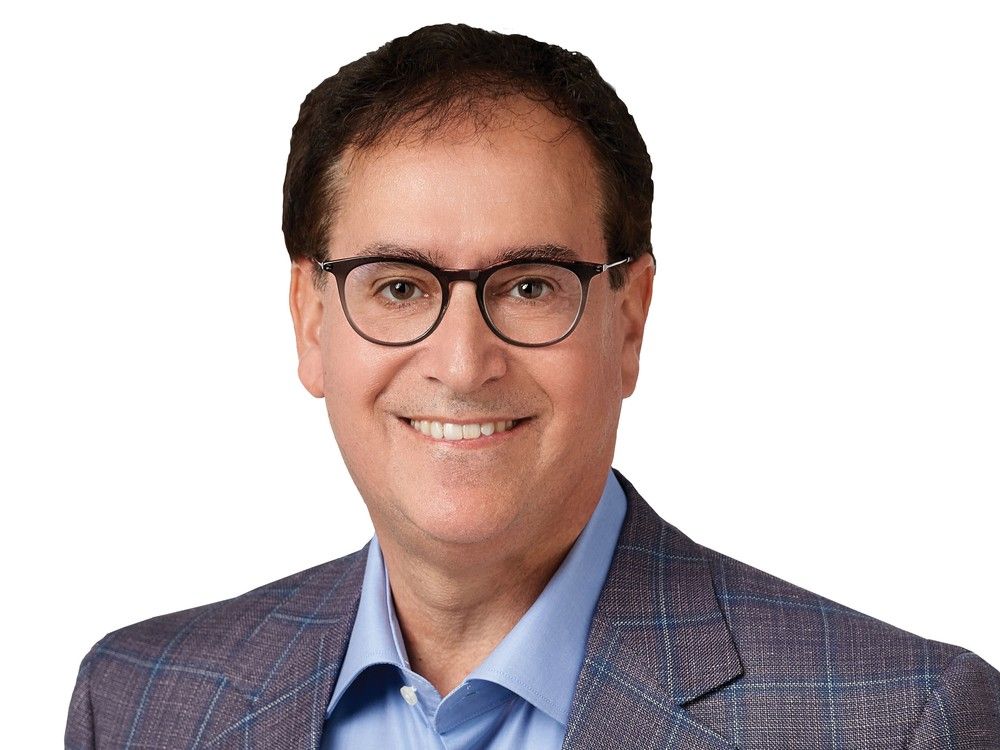
Marty Morantz believes vandalism on his signs in a largely Jewish-occupied part of Winnipeg are examples of antisemitism.

A Jewish Conservative candidate in Winnipeg said he won’t be intimidated after several of his election signs were defaced in what he considers a targeted antisemitic crime.

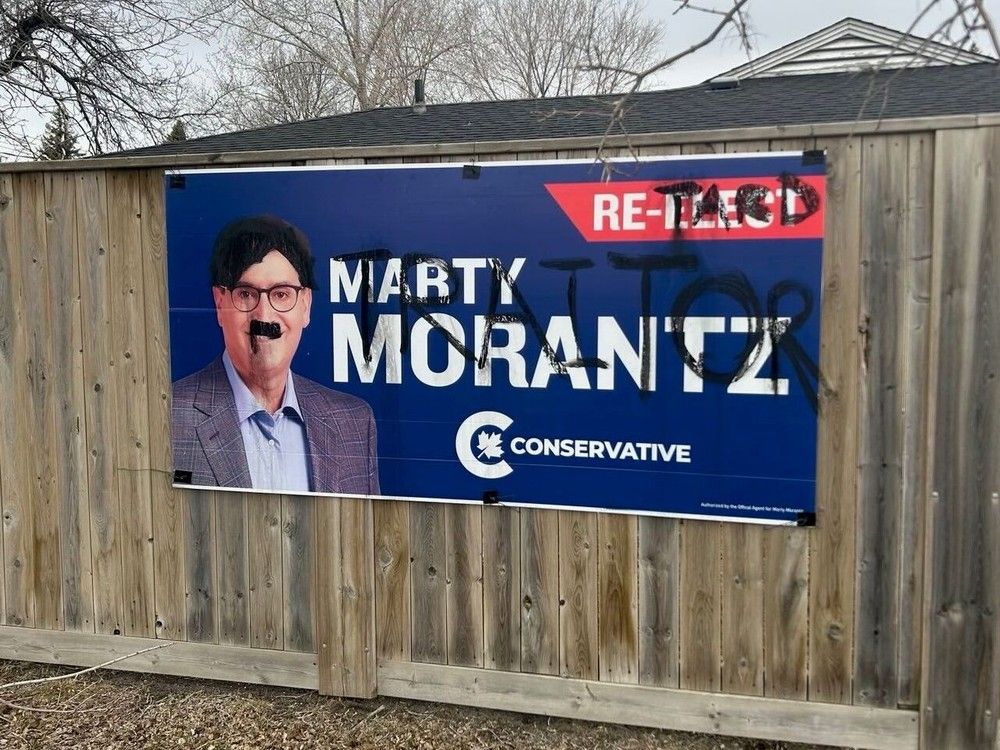
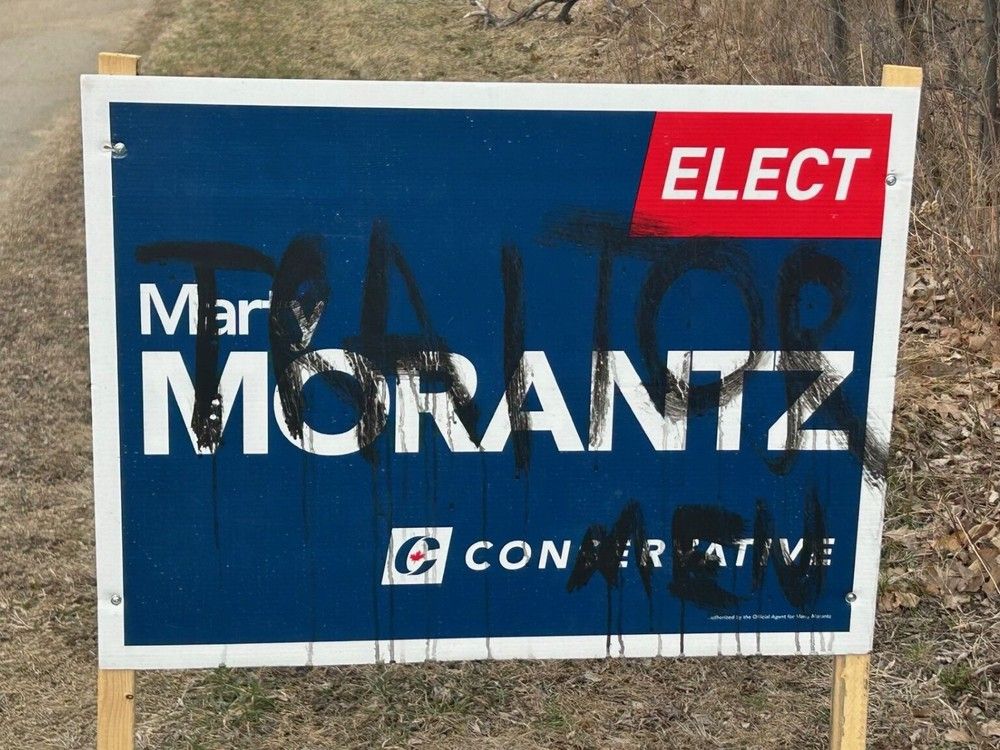
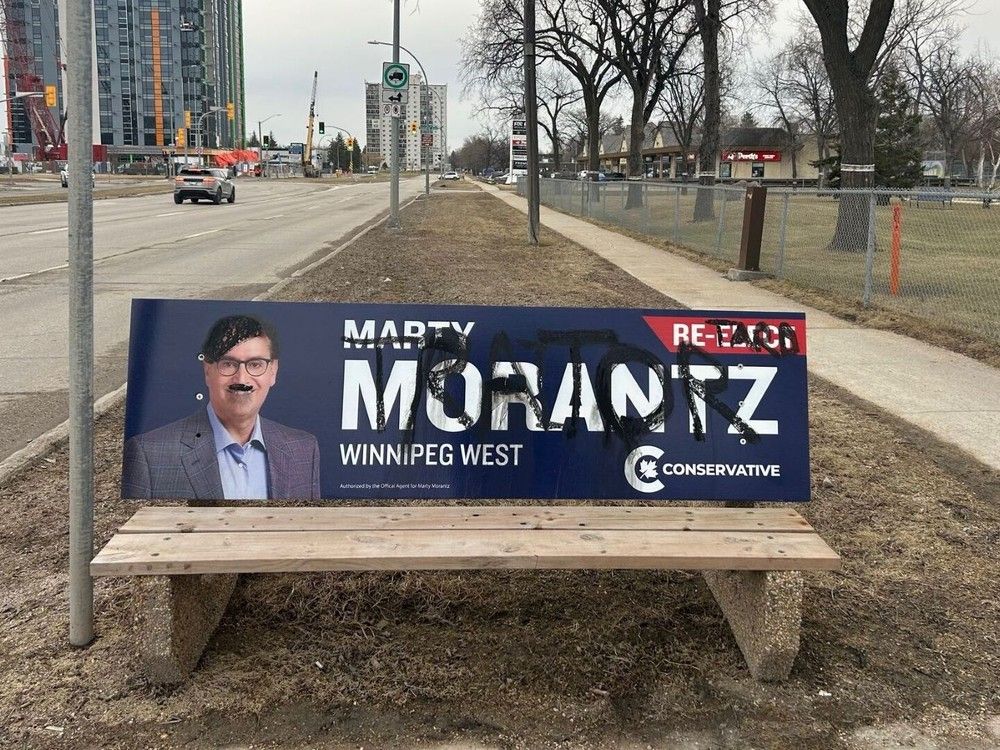
Seven or eight of Winnipeg West incumbent Marty Morantz’s signs on private property — some belonging to Jewish constituents — and two bus bench placards in the Tuxedo neighbourhood were vandalized with graffiti conveying hateful and offensive messages. One of the signs was within blocks of the Asper Jewish Community Campus.

“Traitor” was painted in black across his name and “men” over Conservative to create “Con men.” They also create a slur for individuals with intellectual disabilities. Larger signs showing Morantz’ face were marred with black hair and a moustache reminiscent of Nazi leader Adolf Hitler.

The Winnipeg Police Service has already

opened an investigation

into the incidents that are believed to have occurred on Sunday evening, but has not explicitly labelled it as a hate crime.

 Marty Morantz said he won’t be intimidated by vandalism.

“The riding is massive,” Morantz told the National Post. “This didn’t happen in the parts of the riding where there’s no substantive Jewish community. This happened in the part of the riding where a large portion of the Winnipeg Jewish community lives.

“It was clearly an attempt to attack and intimidate the Jewish community, and I won’t be intimidated by people who traffic in hate.”

He explains that “traitor” is meant to imply that Jewish people are somehow not loyal to Canada.

“Traitor” has also been used on other federal candidates’ signs this election, including

NDP Leader Jagmeet Singh

and the

Liberals’ Brian May.

Refusing to be “rattled” by the indecency, Morantz has continued to show up on doorsteps in the neighbourhood — one where he also resides — and said people have expressed to him how upsetting the news was.

All the signs have since been replaced.

Morantz said he and Melissa Lantsman, the only other Jewish Conservative MP, have been fighting back against a rising tide of antisemitism in Canada since the Hamas terrorist attack on Israel on Oct. 7, 2023, and the vandalism during a federal election campaign is the latest example of it manifesting in Canadian neighbourhoods.

“Historically, when antisemitism was on the rise, it was really the canary in the coal mine for society’s breakdown,” Morantz said.

 Marty Morantz is seeking re-election in Winnipeg West, formerly Charleswood—St. James—Assiniboia—Headingley.

Of the 1,284 incidents of hate crimes related to religion reported to police in 2023, 900 involved Jewish people,

per Statistics Canada

. Meanwhile, A

Toronto Police Service report

on hate crimes for 2023 shows 36 per cent were labelled “anti-Jewish” and that they were most frequently the victims of mischief to property occurrences.

“Silence is complicity when it comes to these kinds of things,” said Morantz.

“We just have to speak out against it. We have to stand up for the community and not be intimidated.”

Liberal opponent Doug Eyolfson denounced the crime in

a statement

, saying antisemitism “has no place in Canada, full stop.”

“This cannot be how we conduct ourselves when we disagree with a candidate’s platform,” he wrote.

“There is no room for hate in politics, I know Winnipeg West is better than this.”

 One of two bus bench placards vandalized to make Morantz resemble Nazi leader Adolf Hitler.

Meanwhile in the Quebec riding of Mount Royal, Conservative candidate Neil Oberman took matters into his own hands when both he and his Liberal opponent’s signs were vandalized.

In

a video posted to X

, Oberman, standing next to a pole where his and incumbent Anthony Housefather’s signs are attached, holds a spray bottle and calls it “all-purpose hate cleaner.”

He’s not there to remove the Liberal sign, he says, but to “strengthen democracy” for both parties.

“Sometimes it takes a lot to get hate off, but we’re working on it,” he says as he sprays and scrubs his own placard, which is spray-painted with the words “PRO BABY KILLERS” and “IDF.”

He does the same for Housefather’s sign, which is plastered with “PRO-GENOCIDE.”

“Here’s a message to all my friends: it doesn’t matter what hate tries to do. Hate will not be successful as long as we stand up and we’re heard. Today, we’re being heard,” Oberman says.

A spokesperson for Winnipeg police told National Post in an email that “taking or damaging election signs” is against the law and can lead to charges such as property damage or theft.

When sentencing convicted parties, police said the court “may also take into account things like whether the act was motivated by hate.”

Our website is the place for the latest breaking news, exclusive scoops, longreads and provocative commentary. Please bookmark nationalpost.com and sign up for our daily newsletter, Posted, here.


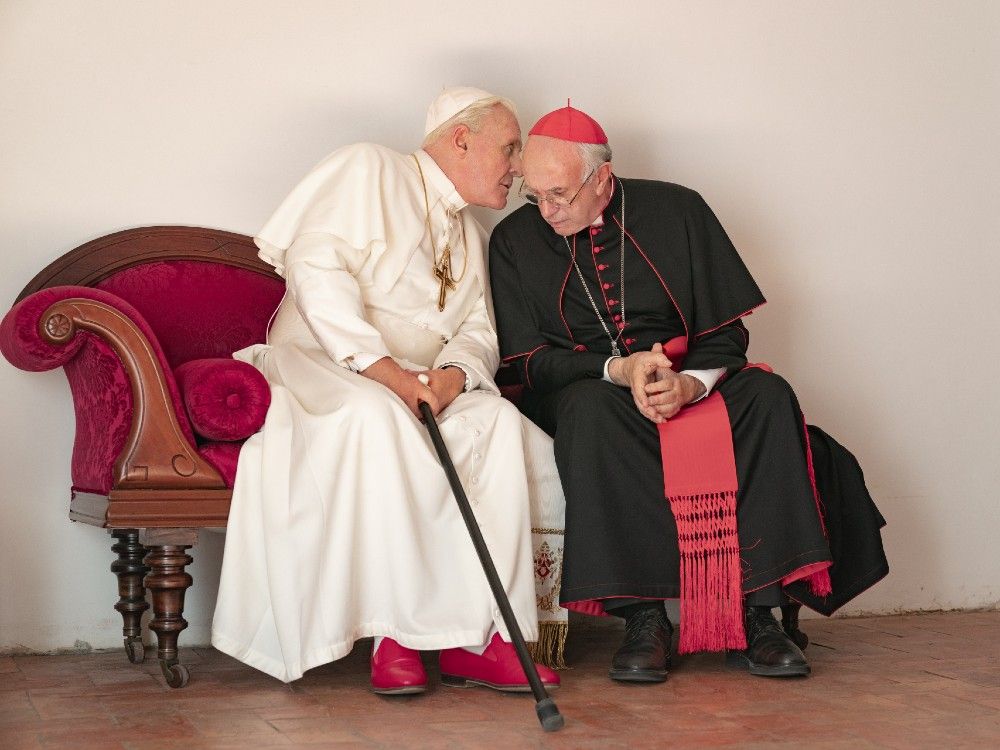
Anthony Hopkins and Jonathan Pryce in The Two Popes (2019).

Even before his first day as leader of the Catholic Church, Pope Francis was a notable pontiff. He was the first pope from the Americas, and the first in almost 600 years to succeed a pope who stepped down (rather than die), as Benedict XVI did in 2013.

That unusual transfer of power became the subject of a 2019 movie, The Two Popes, starring Anthony Hopkins as Benedict XVI, and Jonathan Pryce as the future Francis; his pre-papal name was Jorge Mario Bergoglio.

It’s a drama (and fictionalized), but not without its moments of levity, crafting an “Odd Couple” vibe by contrasting the grumpy and elderly Benedict with the relatively spry and jovial Jorge. Both actors were Oscar-nominated for their roles, as was Anthony McCarten for best adapted screenplay.

But it’s not the only movie to have been inspired by the most recent pope. Here are five others.

 Director Wim Wenders poses on May 13, 2018, during a photocall for the film Pope Francis: A Man of His Word at the 71st edition of the Cannes Film Festival in France.

Pope Francis: A Man of His Word

That title was echoed this week by former national chief of the Assembly of First Nations Phil Fontaine as he recalled Pope Francis. But Wim Wenders made his documentary about the Pope back in 2018.

A year before its release he told National Post he had been approached by the Vatican to make it.

“The Vatican in the form of its minster of communications wrote to me and said ‘We are making a film with the Pope’ — not on the Pope, with the Pope — ‘and we’re looking at our options and we figured you should do it.’ And I said: ‘Thank you.’”

Wenders was raised Catholic, converted to Protestantism, and holds an honorary doctorate in theology from the University of Fribourg in Switzerland.

“I’m neither Catholic nor Protestant,” he said. “I try to be both. I figure, I’m Christian and I go into any church that I want and I have friends on all sides.”

Later, discussing the finished film, he said: “I was nervous the first time (I met Francis). The first shoot, we were ready for hours. We had prepared everything the day before. I told my team: Never will we ask him to do something again. He is not an actor.”

But when the Pope arrived, he did so alone; no entourage, no bodyguards. And the first thing he did was to shake everyone’s hand.

“He greeted every electrician,” said Wenders. “He greeted every assistant. He made it clear we’re all equal. Everybody who worked on this had a right to look him in the eye, to ask him a question, to talk to him. He made the idea of equality very clear, and we very quickly lost this shyness — wow, this is the Pope, a superstar. No; he came very modestly and humbly, and made contact with everybody.”

Wenders had met enough celebrities and heads of state (and actors) to know when such behaviour is genuine. “He’s not pretending to be cordial. He’s not acting. That’s him. He’s a genuine person who likes people genuinely,” he said.

 A scene from Pope Francis: A Man of His Word.

Francesco

This 2020 documentary by Israeli-American director Evgeny Afineevsky looks at Pope Francis’s reactions to the ongoing pandemic as well issues around immigration and the environment. It also shows him meeting with victims of abuse by clergy and asking for forgiveness. It’s a theme that would repeat itself in 2022, when Francis visited Canada and apologized for the “evil committed by so many Christians” in residential schools.

The Letter: A Message for Our Earth

In a 2015 encyclical (papal letter) entitled Laudato Si (Italian for “Praise Be to You”), Pope Francis levelled criticism at those who put profits over people, and noted the “grave implications” of climate change, including environmental, social, economic and political impacts. Director Nicolas Brown, whose speciality is nature documentaries, met with activists from around the world — including the Amazon, Senegal and Hawaii — as they prepared to meet with the Pope and discuss their concerns for this 2022 doc.

In Viaggio: The Travels of Pope Francis

Pope John Paul II is considered to have been the most travelled pope, with more than 100 foreign trips and a million kilometres in his 26 and a half years as pontiff. But Francis was no slouch, with 47 trips outside of Italy covering some 465,000 kilometres in roughly half that time. Director Gianfranco Rosi’s 2022 documentary covers the first nine years of his papacy, illustrating not just the Pope’s many travels but he unceasing desire to get close to and communicate with real people everywhere he went.

 From left, Ralph Fiennes and Stanley Tucci in Conclave.

Conclave

Though not specifically about Pope Francis, this recent thriller deals with the death of a pope and the election of a new one. Strip away some of its wild plot twists — it was based on a novel by Robert Harris — and it’s an excellent primer on the process and some of the machinations behind the secretive election of a new pontiff. Nominated for eight Oscars including best picture, it’s an engrossing peek behind the curtains of the Vatican. Just don’t believe everything it says.


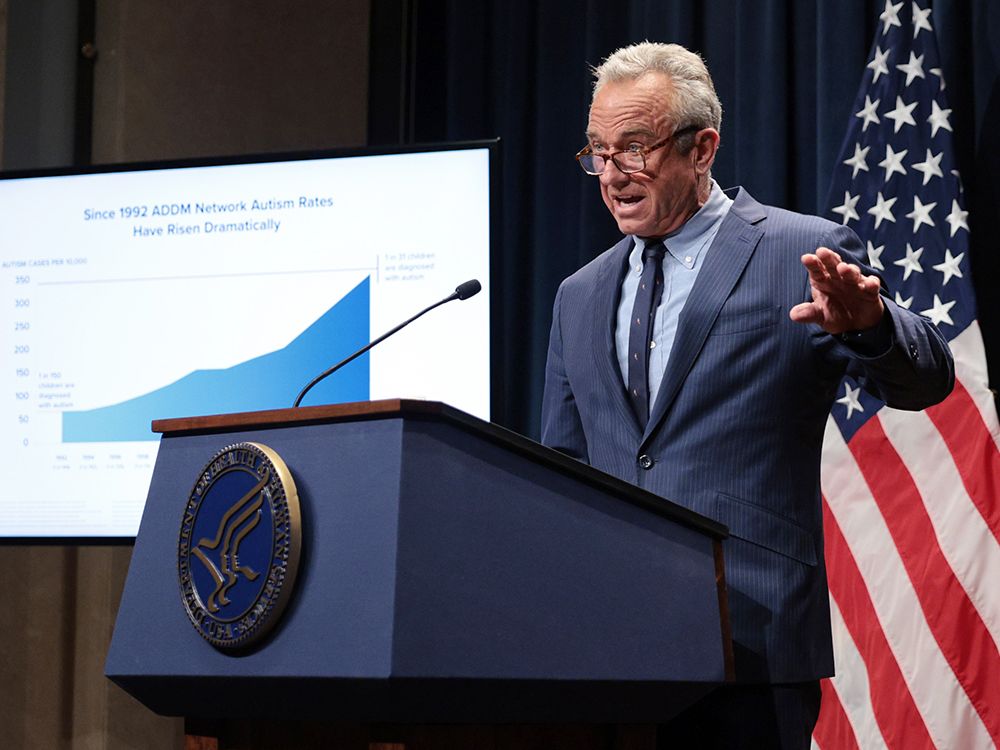
Robert F. Kennedy Jr., America’s top health official under U.S. President Donald Trump, has vowed to solve what he calls an “autism epidemic,” but the rising number of diagnoses is largely due to a loosening of what counts as autism, according to an eminent psychiatrist who led the task force that expanded the criteria 30 years ago.

Before then, classic autism “always presented itself by age three with incapacitating cognitive, interpersonal, emotional and behavioural symptoms,” Dr. Allen Frances, a professor emeritus and former chair of the department of psychiatry at Duke University in North Carolina, wrote in an email to National Post.

“Current ‘Autism Spectrum’ includes many very highly functioning people who are just socially awkward and a bit eccentric,” he said.

Frances is among leading scientists accusing Kennedy, the U.S. health and human services secretary, of pushing harmful conspiracy theories about the causes of autism.

In a recent series of news conferences, interviews and

social media posts,

Kennedy has, to the outrage of many in the autism community, portrayed children with autism as kids who “will never pay taxes, never hold a job” and has described autism as a “preventable disease” caused by one or more environmental toxins.

Kennedy has also accused “epidemic deniers” of  buying into “this industry canard, this mythology” that rising rates of autism are due to better recognition and shifting diagnostic criteria. Most recently, he said families of those “injured” by environmental exposures should be compensated.

“Bottom line, the more than 25 per cent of people who have severe autism will never go on a date, write a poem, live independently, or have a job,” Kennedy said in a

post on X

, clarifying that, in earlier comments, he was speaking specifically about children with profound autism.

“We need to identify the exposures that are causing this epidemic and compensate the families of the injured.”

Kennedy has promised to come up with “some answers” behind rising reported rates of autism by September, walking back an earlier pledge that his agency will “know what has caused the autism epidemic” by fall.

In a

radio interview Easter Sunday,

Kennedy said autism “dwarfs the COVID epidemic and the impacts on our country because COVID killed old people.”

“Autism affects children and affects them at the beginning of their lives, the beginning of their productivity,” Kennedy said.

He accused American government scientists of “blocking all studies” into possible environmental triggers and said his agency will deploy 15 teams to look at possible exposures, such as mould, food additives, pesticides, vaccines and the age of the parents, as well as the most commonly prescribed anti-depressants, a class known as selective serotonin re-uptake inhibitors, or SSRIs.

In an earlier interview with

Fox News on Friday

, Kennedy said the “non-verbal, non-toilet trained … head-banging, biting, toe walking” population of children with autism is growing “higher and higher. It’s become a larger percentage, so were seeing many more cases that are now linked to severe intellectual disabilities.”

However,

one study of more than 4,600 eight-year-olds

identified with autism spectrum disorder (ASD) in the New York-New Jersey metropolitan area between 2000 and 2016 reported a 500 per cent increase in the prevalence of kids with ASD without an intellectual disability over the study period, compared to a 200 per cent increase in kids with ASD with intellectual impairment.

Most children with autism spectrum disorder “have intellectual ability in the non-disabled range,” the team reported, a trend they said is likely explained by better recognition of autism among kids with average intellectual ability.

Kennedy “has spread dangerous lies about the causes of autism,” said Frances. “It has already been definitively proven that vaccines do not cause autism and it is not yet known whether environmental toxins play any role.

“His promotion of vaccine denial conspiracy theories is a great threat to public health.”

Autism is a neurodevelopmental condition impacting brain development. “The result is that most individuals experience communication problems, difficulty with social interactions and a tendency to repeat specific patterns of behaviour,”

Autism Canada’s website explains.

Autism can’t be cured. However, children, teens and adults with autism “vary widely in their needs, skills and abilities,” there’s no “typical” person with autism spectrum disorder and the objective is to increase people’s quality of life and happiness, the group said.

While researchers are still working to understand potential causes, autism is not contagious, not caused by vaccination and not caused by parenting style, according to the

Public Health Agency of Canada.

One long since abandoned, discredited and harmful theory blamed emotionally distant mothers for autism.

According to 2019 data

, one in 50, or two per cent of Canadian children and youth aged one to 17 were diagnosed with autism spectrum disorder. Rates varied widely, from 0.8 per cent in Saskatchewan to 4.1 per cent in New Brunswick.

Boys were diagnosed about four times more frequently than girls.

There’s no biological marker, like a blood test, to confirm autism. Rather, a diagnosis is based on whether a person fits criteria from the Diagnostic and Statistical Manual of Mental Disorders, or DSM, criteria that have changed with the manual’s evolution.

Autism was included for the first time in the DSM’s third edition, in 1980. Asperger’s syndrome, a much milder form of autism, was added in the fourth edition, DSM-IV, in 1994. Field trials then suggested merging Asperger with autism would increase the rate of autism three-fold. Instead, it increased 50-fold.

Frances led the DSM-IV task force. “My biggest DSM-IV regret: Our broadening the autism definition that has led to such massive, careless over-diagnosis,”

he once posted on X.

The fifth and current edition collapsed autism and Asperger’s further into a “spectrum” that merged other subtypes, such as childhood disintegrative disorder.

The

latest data from the U.S. Centers for Disease Control and Prevention

found about one in 31 U.S. children aged eight had been identified with autism in 2022 across 16 sites, up from one in 36 in 2020, and one in 150 in 2000, the year the agency began monitoring trends in diagnoses.

Like Canada, rates varied widely, but there is no evidence that living in certain communities puts children at greater risk for developing autism, the CDC said. The differences might be down to differences in the availability of services for early detections, evaluations and “diagnostic practices,” the agency said.

Kennedy “says things that uniformed people used to say about autism 25 year ago,” after an infamous and since retracted paper falsely linked the MMR (measles, mumps and rubella) vaccine with autism, said Dr. Laurent Mottron, a professor at the Université de Montréal’s department of psychiatry and an international leader in autism research.

Mottron has been called so often by American media lately that he’s prepared what he described as a “general fact sheet” about autism. “The most important error is the idea that autism has a cause,” Mottron said. “Because the most demonstrated neuroscience finding on autism over the last 20 years is the fact (people have) a familial predisposition,” meaning autism has a tendency to run in families, likely through genetics.

In identical twins that have exactly the same genes, about 30 per cent have “discordant” handedness, meaning one twin is right handed and the other a lefty. Their brains are organized differently, even with the same genetic background, Mottron said. In a similar way, “extremely subtle differences can result in somebody” developing autism, he said, differences that are “probably nearly random and not really with a cause.”

Mottron’s fact sheet also states the the “spectrum” criteria are “vague and trivial” —

one study

found only 47 per cent of of 232 children and teens with a diagnosis of autism spectrum disorder met criteria for ASD after an extensive re-evaluation — some parents and schools may “push toward an autism diagnosis for services,” and, while it’s not clear why boys are diagnosed at a higher rate, “boys are more vulnerable to neurodevelopmental conditions.”

National Post

Our website is the place for the latest breaking news, exclusive scoops, longreads and provocative commentary. Please bookmark nationalpost.com and sign up for our newsletters here.


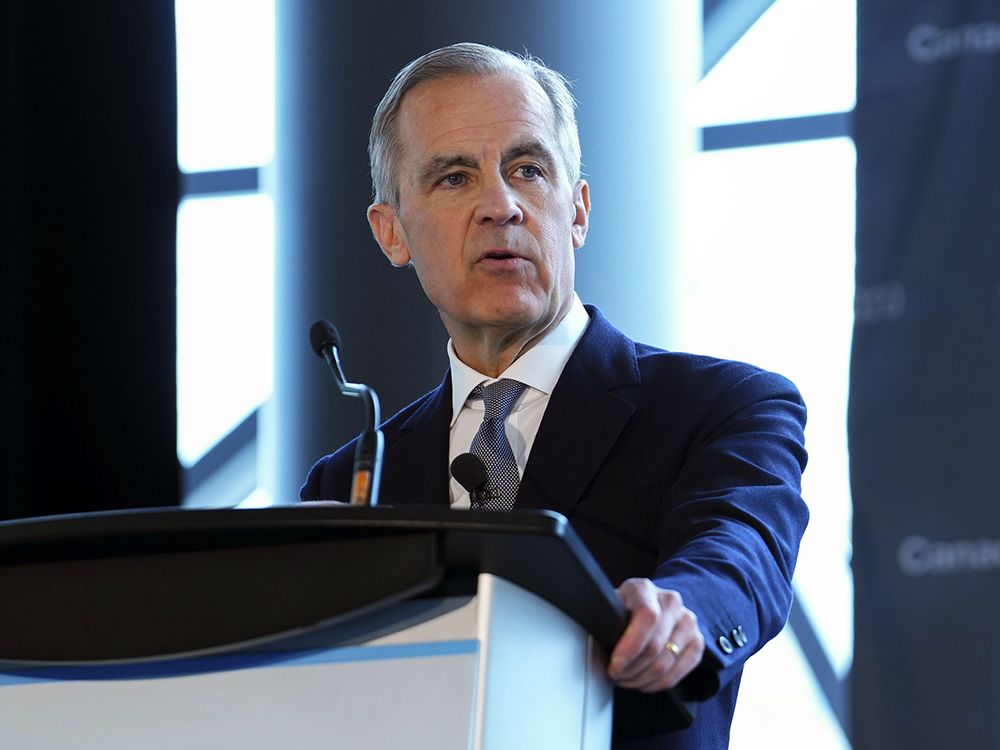
Mark Carney speaks at the Canada 2020 Net-Zero Leadership Summit in Ottawa in April 2023 — a few months before he joined the board at Bloomberg LP.

OTTAWA — A year-and-a-half before he became leader of the Liberal party, Mark Carney took on a daunting job. In August 2023, he

was appointed chairman

of a revamped board of directors at Bloomberg LP, a U.S. financial information and media company.

In a memo to staff, Michael Bloomberg, the co-founder and majority owner of the eponymous company, said he had previously worked with Carney on “climate finance initiatives” and

described the new team

as “the best and brightest.” Carney had finished his term as governor of the Bank of England three years earlier and had also taken on a role with the United Nations to promote climate initiatives.

But Carney was joining Bloomberg LP at a time of significant controversy.

Since the mid-1990s, the New York City-based company had faced a bevy of lawsuits alleging discrimination and harassment, some of which would later overlap with Carney’s time as chair. Sexism scandals had initially burst into the public eye during Michael Bloomberg’s run for the presidency in 2020.

Media reports show almost all of the lawsuits —

some reports found 40 cases involving up to 60 women

— recounted incidents that allegedly happened before Carney was appointed board chair. But one employee, who alleges in court documents she alerted her bosses about gender-based pay discrimination, says she was fired and marched out of the building nearly a year into Carney’s tenure.

“There’s no scenario where, as the chair of the board, Mark Carney wouldn’t have been briefed on ongoing litigation. He would have been aware, and he certainly would have been aware of some of the (alleged) systemic cultural issues at Bloomberg LP, specifically around the systemic pay and equity issues and sexism,” said Kathryn Marshall, a human rights and employment lawyer.

In fact, four employment lawyers National Post spoke to argued it’s a board chair’s job to set the direction of the company, and that a company’s culture can only be dictated from the top.

“If you’re going to take a job and there’s already a public scandal, as there was here, you either refuse to take it, or you take it on a condition that you’re allowed to deal with the scandal and end it. That’s clearly not what happened here,” said Howard Levitt, a senior partner at Levitt LLP, which specializes in employment and labour law, and who writes a regular column for Financial Post.

Carney is currently leading the Liberal party in an election he called shortly after being elected party leader to replace the unpopular Justin Trudeau.

National Post asked his campaign team whether he had made any effort to change the culture at Bloomberg LP or whether the company’s alleged problems raised any red flags before he took the job. His campaign staff pointed to his track before accepting the position.

“Mr. Carney brings a long track record of pushing for stronger women’s representation in business and finance and has consistently championed the benefits of diversity and inclusion,” said Mohammad Hussain, a spokesperson for Carney’s campaign.

“As prime minister, he will continue to lead with a strong commitment to respectful, safe, and empowering workspaces.”

Labour lawyer Annamaria Enenajor, a partner at Ruby Shiller Enenajor, said Carney’s role as chairman amid the allegations against Bloomberg LP is worth examining.

“I think the culture of an organization does start at the top. So to the extent that he saw and knew and understood the problem, what steps did he take to transform the culture? I think that’s a fair question,” said Enenajor.

But Enenajor also said it would have been extremely difficult for Carney to make any impact on the corporate culture in the short time he was there.

“These companies are such big beasts, so to expect a change within two years is challenging, unless he was brought in for that specific purpose,” she said.

In 2020, Michael Bloomberg, entrepreneur and former New York City mayor, endured a bruising

and costly run for the Democratic

presidential nomination as the press and his rivals criticized him for the culture at his company,

which was described

in press reports

as a degrading and hostile environment

.

One former salesperson had sued the company for workplace discrimination, alleging

Michael Bloomberg, then the CEO, had said she should “kill it,”

when he found out she was pregnant. Bloomberg denied the allegation and later reached a confidential settlement with the woman.

Bloomberg LP’s pattern of reaching these confidential settlements — enforced by non-disclosure clauses — was raised by Michael Bloomberg’s opponent Elizabeth Warren at a Democratic nominees’ debate and the

exchange was widely seen

as putting in a nail in the coffin of Bloomberg’s bid for the presidency.

In 2020, Michael Bloomberg acknowledged that non-disclosure agreements (NDAs) can create unfairness for women complainants. “I recognize that NDAs, particularly when they are used in the context of sexual harassment and sexual assault, promote a culture of silence in the workplace and contribute to a culture of women not feeling safe or supported,” he said. He offered to free three complainants from their NDAs.

Over the years, even after the revelations in the Democratic primary, Carney

has lavished praise on Michael Bloomberg

for

his “great leadership,”

philanthropic activities and because he “has improved the lives of countless people (in) the United States and across the world.”

Before long, that mutual admiration would result in Carney joining Bloomberg LP as its new chairman in 2023, while the company was still battling several harassment and discrimination lawsuits. Because Bloomberg is a privately held company, Carney’s compensation was not publicly disclosed.

A few months before Carney assumed his chair position, one senior employee had said she revealed information to her bosses that the company was underpaying women.

Su Keenan, a veteran news anchor, alleges in court documents she had discovered shocking disparities in pay between men and women at the company.

One example she showed

her boss in 2023 was a male colleague, 20 years younger than her and in the same role, allegedly making more than US$100,000 more per year and getting nearly double her annual bonus.

Keenan said she showed this information to her bosses in mid-2023, just before Carney was appointed chairman. After complaining about what she saw as discrimination, Keenan alleges she was moved to a desk in “a vacant lower floor on the far side” of the building.

She was later fired in February 2024, and the 25-year veteran of the company says she was escorted out of the Bloomberg LP building by security guards. Carney had been chairman for six months by then, although there is no indication of his role, if any, in the decision.

In June 2024, Keenan sued the company, alleging she was fired because she had complained about discrimination and gender pay discrepancies at the network.

Keenan’s lawsuit alleges the company used “discriminatory job codes” to hide the pay gap between male and female TV journalists in company systems. The lawsuit argues women in on-air TV roles were sometimes classified with codes that normally were reserved for off-air producers. Bloomberg LP had sought to have the case dismissed as invalid, but its motion

was denied last month by the New York State Supreme Court

.

Asked specifically about allegations of gender pay discrimination at Bloomberg LP, and more broadly in the corporate world, Carney’s team responded with the statement that he has “a long track record of pushing for stronger women’s representation” in the business world.

Indeed, Carney

made speeches when he was governor of the Bank of England

complaining that progress on gender equality in the workplace has been slow.

“For too long the representation of women in middle and senior tiers of management has lagged that in other leading sectors. For too long, results have fallen short of good intentions,” said Carney.

Carney’s team didn’t respond to a question from National Post about whether, when given the chance at Bloomberg LP to put his good intentions into action, he followed through with it.

Another gender discrimination case continues to

work its way through the American courts

. A former national security reporter at Bloomberg, Nafeesa Syeed,

alleged in a lawsuit filed in 2020

(before Carney’s time) that she was “demeaned” because of her Southeast Asian heritage and that the workplace was toxic.

The lawsuit alleges that Syeed was often mistaken for another Southeast Asian woman in the office and that, when she was rejected for a promotion, she was told it was because the job wasn’t a “diversity slot.” Bloomberg has sought to have the case dismissed and argued that it had no record of any complaint from Syeed while she worked there.

According to Business Insider

, it’s just one of nearly 40 civil suits against Bloomberg LP since 1996, brought by more than 60 women. Bloomberg LP has publicly denied systemic issues of pay inequity and sexism and a few of the cases have been settled out of court or dismissed.

Bloomberg LLP has denied allegations that it has a sexist corporate culture. The company told Business Insider it “strongly supports a culture that treats all employees with dignity and respect, and enforces that culture through clear policies and practices. Our diversity and inclusion efforts are designed to foster a culture where thousands of people are proud to work every day. It’s also why Bloomberg is consistently ranked at the top of surveys about inclusive workplaces, and why we’ve been rated the top company for career growth opportunities in the US.”

Carney’s campaign team, asked whether he was concerned about the culture of the company he joined in 2023, or whether he did anything to correct any problems, did not directly speak to the question.

“Mr. Carney became Chair of the Board of Bloomberg in August 2023. The company is best positioned to respond to the specific incidents you identify, the majority of which were reported years before his appointment,” said Carney’s spokesperson.

Lawyers that spoke to National Post said, at the very least, Carney should have made it a priority to get to the bottom of the problems.

Shalini Konanur, executive director and a senior lawyer at the South Asian Legal Clinic of Ontario, said she couldn’t comment directly on Carney’s time at Bloomberg LP, but said that, in her experience, “the culture and tone is set from the top.”

“Those positions actually have weight in setting the tone and boards have weight in setting the priorities. And their employee is the CEO,” said Konanur. “There are things you can do in organizations, once you collect data, there are very concrete things you can do in an organization to deal with those issues.”

Another Bloomberg LP reporter joined Syeed’s lawsuit in 2020, alleging now-familiar complaints about pay discrepancies between male and female employees. The lawsuits would later be separated while Syeed’s claim was held up by jurisdictional wrangling.

Naula Ndugga, a producer at Bloomberg LP, alleged she had been paid less than her male counterparts since starting at the company as an intern. She argued male interns were paid $10,000 more than her when being hired out of the internship program.

Ndugga also alleges in the lawsuit she suffered racially insensitive treatment at the hands of her bosses and was depicted as an “angry Black woman” by a male supervisor.

The court documents contain an exchange about a subpoena issued to Ndugga’s therapist at the time, because Bloomberg LP lawyers argued the therapist’s notes weren’t sufficient to assess whether Ndugga genuinely experienced emotional distress. Bloomberg LP has sought to have the case dismissed on legal grounds.

Marshall said she has seen companies that use similar legal tactics that can make people not want to come forward.

“(A) defence strategy, which is very popular in the U.S., is just to go full scorched earth, and do whatever you can to make the victim regret the day they ever sued,” said Marshall.

National Post

Get more deep-dive National Post political coverage and analysis in your inbox with the Political Hack newsletter, where Ottawa bureau chief Stuart Thomson and political analyst Tasha Kheiriddin get at what’s really going on behind the scenes on Parliament Hill every Wednesday and Friday, exclusively for subscribers. Sign up here.



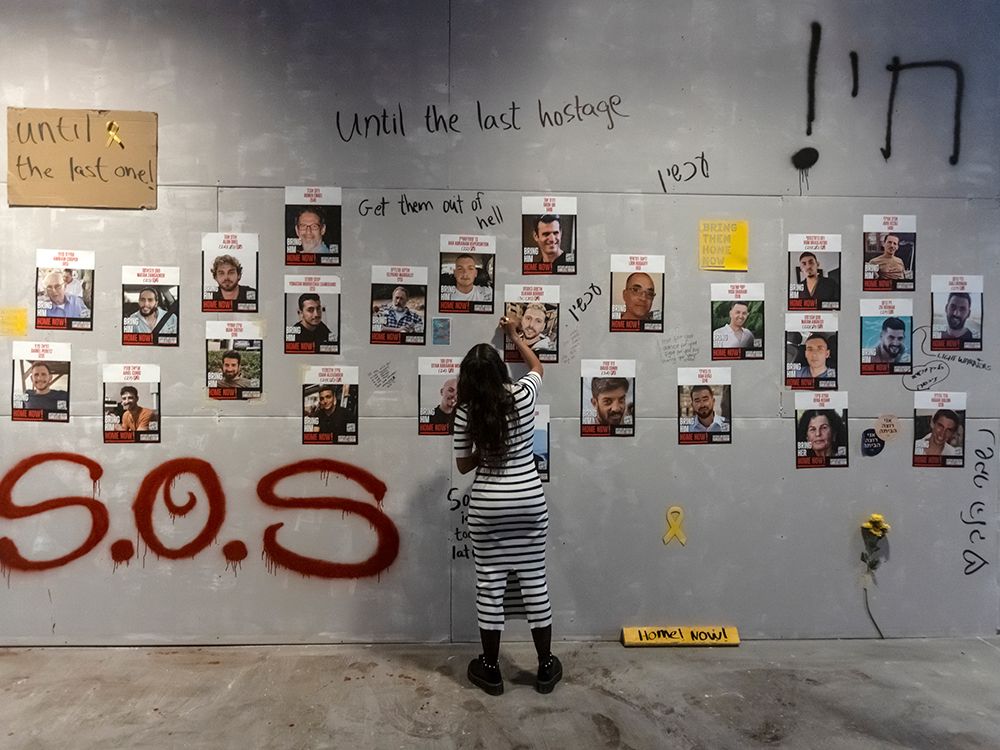
Conservative Party of Canada Leader Pierre Poilievre, centre, and his wife Anaida, left, are escorted through the Nova Music Festival Exhibition in Toronto, Tuesday April 22, 2025.

A six-week installation honouring the victims and survivors of the Nova Music Festival attack in Israel will open to the public in Toronto on Wednesday.

The Nova Music Festival Exhibition at 1381 Castlefield Ave. recreates the scene of a music concert held in southern Israel that was attacked by Hamas terrorists on Oct. 7, 2023. Of the roughly 3,000 attendants,

nearly 400

were killed and 44 were abducted.

The exhibition was launched last year in Tel Aviv to raise awareness about what the organizers refer to as “the largest massacre in music history.”

“This may be one of the most unique exhibits and experiences that you might find,” Evan Zelikovitz, a Canadian representative with the installation, said ahead of a media tour on Tuesday. “The Nova Music Festival was the tip of the spear on October 7. Peace-loving people who came to dance from many nationalities, from many religions. It was not about being Jewish. It was not about the country of Israel.”

The installation features items from the Nova Music Festival, including hammocks, shoes, water bottles, phone cases cigarettes and other personal belongings of participants that were left behind after the attack. Throughout the installation screens replay defining moments of the October 7 atrocities, including the kidnapping of Noa Argamani and the parading of Shani Louk’s body through Gaza.

 Nova Music Festival survivor Michal Ohana signs a wall and photo of her friend and hostage Elkana Bohbot at the Nova Music Festival Exhibition in Toronto, Tuesday April 22, 2025.

The space is intentionally darkened, adding to the weight of the tragedy, while incense and dry ice add to the atmosphere.

“This is a journey from the light to the darkness and then light again,” Shani Ivgi, a festival survivor and representative of the bereaved families delegation, said before entering the installation.

“You can touch things. Everything that you’ll see inside is real, from the toilets to the tents to the signs and the bar. People (were) murdered literally inside. It’s a very important thing that the world must know that this cannot happen again,” Ivgi said. “As we say, ‘We will dance again.’ It’s not just a sentence or a slogan. It’s our way of life.”

Ivgi was an employee at the festival when rocket sirens rang out in the early morning hours of October 7, warning of incoming rocket fire. She fled to a nearby bomb shelter, but her fear of tight spaces and a sense of impending danger led her to leave minutes before Hamas terrorists slaughtered people inside. Ivgi eventually managed to get back to her car and sped back home to central Israel. On her drive back, her car was hit by a barrage of rifle fire from Palestinian militants.

She attended previous installations of the exhibition in Miami, Los Angeles and Buenos Aires, and said the lesson she took away from the experience was that “we are light.”

“We are not just a tragic story,” she continued. “ I have a lot of friends who were murdered. I have one family member who was murdered, and still, life is stronger. I know that we’ve been through so much darkness and we saw so much darkness in our eyes…. Only light can win the darkness. And this is our values.”

Michal Ohana, another Nova Festival survivor, echoed Ivgi’s sentiment and said that the installation mirrors the difficult emotions of that fateful day. “The exhibit starts from the light to the darkness and to the light again,” she said. “We are here to show the healing. This is my healing; to share my story, my way.”

Ohana was living in Portugal at the time and was invited by her friends in Israel to attend the Nova Music Festival. “It was the best festival that I was at,” she remembers of her time partying throughout the night before Hamas attacked. Ohana told the Post she ended up hiding beneath an Israeli tank for several hours following the terrorist attack, during which she was spotted and shot in the leg.

“I (am) just waiting there. Bleeding. I called my mom and said, ‘I love you, but I think I’m going to die,’” she said. Ohana was eventually rescued by Israeli soldiers and brought to a hospital where her older sister was giving birth at the same time. “For me, this day is like two miracles. I stayed alive, and I have a new nephew.”

Conservative Leader Pierre Poilievre and his wife Anaida Poilievre also attended the advanced screening of the exhibition on Tuesday.

The installation will be open until June 8.

 Personal items left by victims of the Hamas attack on display at the Nova Music Festival Exhibition in Toronto, Tuesday April 22, 2025.

 A timer keeps track of how long Israeli hostages have been held by Hamas, as part of the Nova Music Festival Exhibition in Toronto, Tuesday April 22, 2025.

Our website is the place for the latest breaking news, exclusive scoops, longreads and provocative commentary. Please bookmark nationalpost.com and sign up for our newsletters here.


A scene from the latest Conservative commercial, where aging golf buddies agree that they can't trust the Liberals.

Welcome to National Post’s campaign Power Meter, where we will track the shifting tides of the election. As the race unfolds, we’ll rank parties, candidates and other characters based on momentum, performance, and public perception. Who’s gaining ground? Who’s losing steam? Keep checking in as we measure the moments that could shape the outcome.

BATTLE OF ONTARIO:

Hockey’s “Battle of Ontario” got off to a one-sided start on Sunday when the Toronto Maple Leafs spanked the Ottawa Senators 6-2 on home ice. And the battle for Ontario’s 122 federal seats looks to be trending in a similarly lopsided direction with less than a week to go until election day.

Poll aggregator 338Canada

had the Liberals ahead in 82 Ontario districts and competitive in as many as 95 districts on Tuesday. The Liberals haven’t flirted

with the 100-seat mark

in Canada’s largest province since the early 2000s. The Conservatives, meanwhile, could tumble as low as the mid-20s in their Ontario seat count after winning 40 seats there in the last federal election in 2021.

POWER METER RATING: POTENTIAL KINGMAKER 

EARLY VOTING:

Easter long weekend was anything but restful for election workers as 7.3 million Canadians

flocked to the polls

over four days of advanced voting, shattering the old record of 5.8 million, set during the last federal election in 2021. Wait times of well over an hour were reported at multiple precincts, with some voting stations

even running out of ballots

. Some political scientists predicted at the start of the campaign that

the election’s high stakes

, driven by U.S. President Donald Trump’s threats to both the economy and national sovereignty, would drive up turnout to levels not seen in decades. The robust early turnout numbers so far back that up.

POWER METER RATING: YUGE!

Targeted ads:

The Conservative Party created quite the buzz with

a 30-second spot

depicting two seniors talking politics at the driving range. The ad caught a number of eyeballs over the long weekend when it was slotted into the

heavily watched first round

of the NHL playoffs. Just in case there was any ambiguity over the target audience,

a casting call dug up

by journalist Stephen Maher shows directors were looking for “two non-union White male performers aged 65-75.” And while the ad contained familiar Conservative blue branding, some viewers

couldn’t help but notice

its generous borrowing of well-worn tropes from ads for

a little blue pill

.

POWER METER RATING: SENIOR STIMULATING

National Post

Get more deep-dive National Post political coverage and analysis in your inbox with the Political Hack newsletter, where Ottawa bureau chief Stuart Thomson and political analyst Tasha Kheiriddin get at what’s really going on behind the scenes on Parliament Hill every Wednesday and Friday, exclusively for subscribers. Sign up here.
Our website is the place for the latest breaking news, exclusive scoops, longreads and provocative commentary. Please bookmark nationalpost.com and sign up for our daily newsletter, Posted, here.


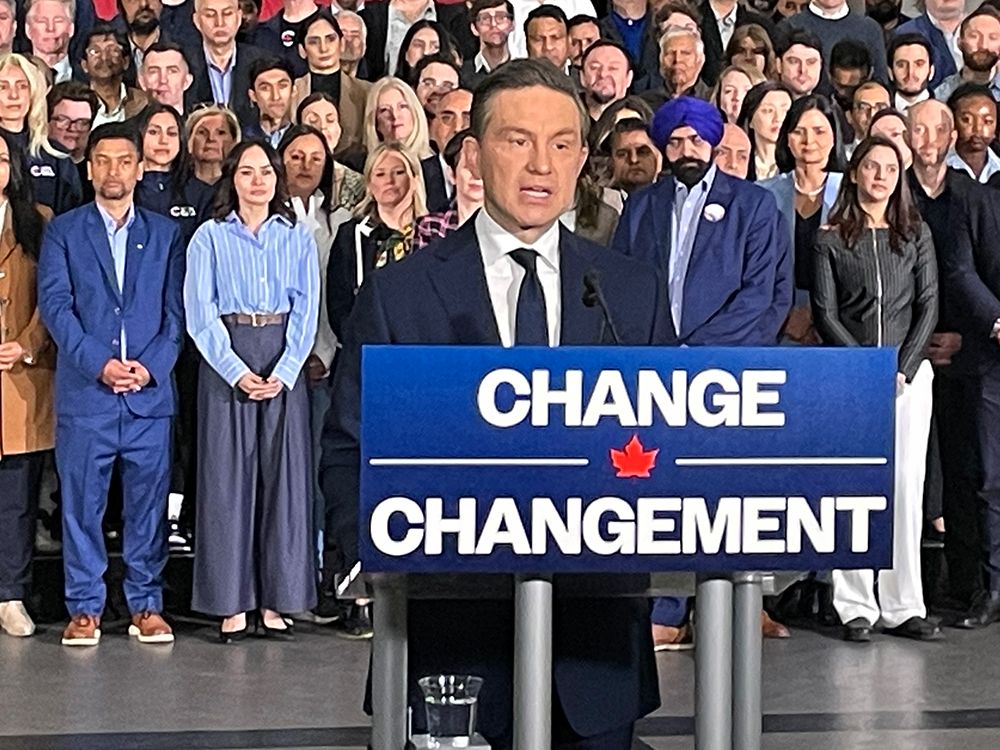
Conservative Party Leader Pierre Poilievre speaks during a Toronto-area rally on Tuesday April 22, 2025.

TROIS-RIVIÈRES, QUE. – Every election, American newspaperman Henry Louis Mencken once said, is an advanced auction in the sale of stolen goods.

Mencken suggested voters should have a healthy distrust for the promises politicians make to the electorate before trying to harvest their votes.

The Liberals were in a bit of a fix, having released a platform on Saturday that pledged $129 billion in new measures (tax cuts and new spending).

The eye-popping nature of the numbers mean Mark Carney’s Liberals are projecting cumulative deficits of $225 billion over the next four years.

University of Calgary economist Trevor Tombe noted that

the plan abandons the previous Liberal government’s fiscal anchor

of deficits that would not exceed one per cent of GDP (in fact they are closer to two per cent under Carney) and that higher interest rate payments mean 15 cents of every dollar in tax will go to servicing the debt by 2028.

“The fiscal trajectory of the federal government is now posted in a potentially unsustainable direction,” he wrote in The Hub.

The revenue assumptions were fluffed by booking $28 billion in “increased productivity gains,” a flight of fancy that should not be taken literally or seriously.

But the Conservatives seem to have looked covetously at the Liberal costing platform and said: “Hold my beer.”

Any hopes they had of profiting from the prodigal nature of the Liberal platform disappeared when they released their own costing document.

It contains $109 billion in new measures: $74.8 billion over four years in foregone revenue and $34.5 billion in new spending (which, because Conservative Leader Pierre Poilievre has promised a dollar in savings for every dollar in spending, commits the Conservatives to an equivalent value in cuts).

But there are so many curiosities in the plan, it is a wonder they decided it was a good idea to release it at all.

For one thing, when they announced their major income-tax cut, they promised $7 billion in cuts in year one, rising to $14 billion a year when fully implemented in year four.

In the platform, the cut amounts to $1 billion in year one and $5.4 billion in year two, less than the Liberals are promising in the first two years ($4.2 billion in 2025/26 and $5.7 billion in 2026/27).

Then there are the dubious assumptions on revenue, such as the billions of dollars booked on increased oil and gas activity as a result of legislative measures like abolishing the emissions cap. It is a good bet that such a measure would be welcomed in the oilpatch but how could anyone say with certainty that it will be worth $5 billion over four years? The answer is, they can’t.

The document balances the revenue lost by cancelling the capital gains tax hike ($12.5 billion over four years) with an assumed increase in revenue from capital gains tax because of increased investment ($12.1 billion over four years). The Liberals record an $8.1-billion loss of revenue over four years but do not book any revenue from economic growth.

This exercise in wishful thinking is repeated time and again in the Conservative platform to bolster the revenue number.

Carney was at a manufacturing plant in Trois-Rivières, Que., and was asked about Tombe’s assessment that the Liberal platform is potentially unsustainable. But he was able to roll out from under the barrage of reporters’ questions by pointing to the Conservative platform. He said the Conservatives will “cut what Canadians need.”

“This is based on phantom growth that comes from the sky. There is a ‘bring it home tax cut’ that never comes home — it doesn’t arrive until years four and five. The numbers are a joke, but we are not in a joke,” he said. “This is a real crisis, a real situation, and the question is: In a week’s time, who is going to be negotiating with President Trump and who is going to be managing the finances in this country?”

He said if the Liberals had made the same assumptions in their platform that the Conservatives appear to have made, the budget would be balanced within four years.

“It’s realistic to expect that if we are given a mandate to execute on this plan, which we will, we can see a surplus by the end of this period. But you don’t make those assumptions at this point,” he said.

Where does all this leave conflicted voters?

Carney said he has presented “a clear directional plan.”

Both major parties have offered voters plenty of information to suggest their broad orientation. Canadians should choose the leader and policy direction that best corresponds to their view of Canada.

But when it comes to trusting the fiscal details in party platforms, they should park their credulity and embrace their skepticism.

jivison@criffel.ca

Twitter.com/IvisonJ

Get more deep-dive National Post political coverage and analysis in your inbox with the Political Hack newsletter, where Ottawa bureau chief Stuart Thomson and political analyst Tasha Kheiriddin get at what’s really going on behind the scenes on Parliament Hill every Wednesday and Friday, exclusively for subscribers. Sign up here.