LP_468x60
on-the-record-468x60-white

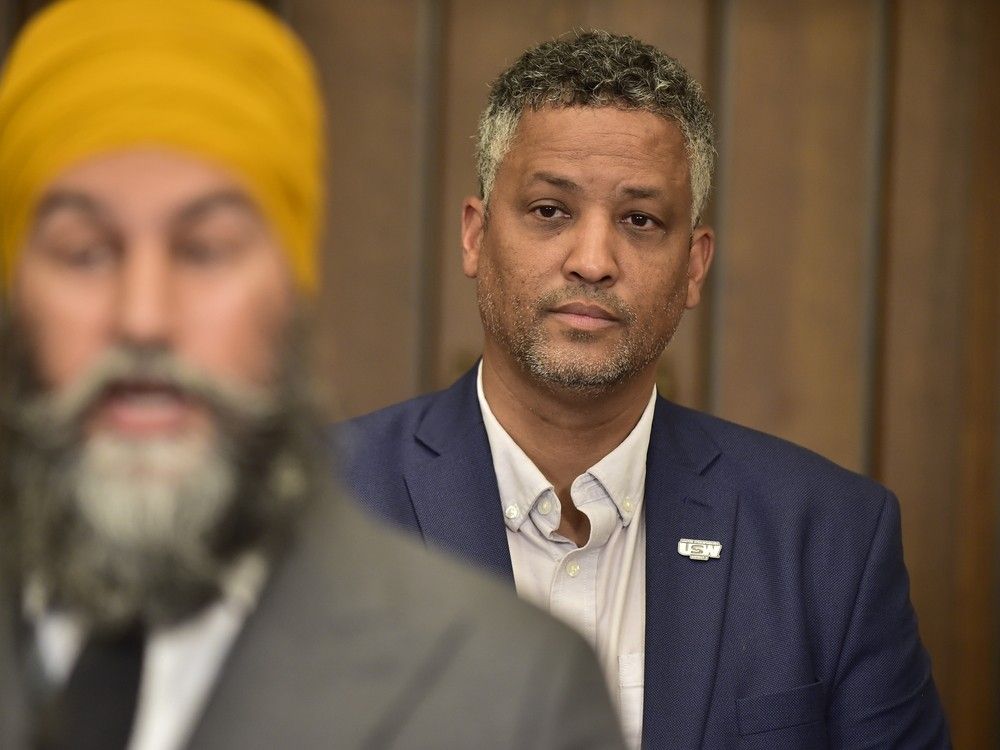
NDP MP Matthew Green attending a press conference on Parliament Hill in Ottawa on Monday, Sept. 16 2024.

HAMILTON, ONT. — An incumbent New Democrat says he hopes his party will begin the process of “soul searching” from within about “who who are” once the federal election ends.

“In elections, results matter,” said Matthew Green, seated in his Hamilton campaign office.

“At a time when we could have been capturing the public’s attention about what a more caring, compelling future of the country was, we didn’t.”

The incumbent for Hamilton Centre says he’s not interested in assigning blame, and projects confidence that the New Democrats, which went into the campaign with 24 seats, will retain party status, despite public opinion polls suggesting otherwise.

Those same surveys show Liberal Leader Mark Carney could be headed for a majority — a dramatic reversal of fortunes for a party that had spent the past 18-months trailing the Conservatives, dragged down by the unpopularity of former prime minister Justin Trudeau.

Carney’s arrival, which coincided with U.S. President Trump launching a trade war with Canada and aspiring to annex the country, has led to a Liberal resurgence, including across NDP-held ridings like Green’s in Hamilton Centre.

With mere days to go until the election concludes next Monday, Green sat down for a wide-ranging interview with National Post about his own re-election bid, as well as what the day after the election may bring for New Democrats.

“What I’m hoping for is, you know, some soul searching within our party about who we are,” Green said.

For him, what that means is NDP members getting down to the work of defining the party’s values, principles and identity, separate from the question of who leads them.

Jagmeet Singh has been at the helm since 2017. This race marks his third federal election.

His first, in 2019, saw the party lose 15 seats.

Green said he supports Singh and knows him to be a man of integrity, which he said he demonstrated throughout the campaign. The “spark” he showed during last week’s English and French-language debates also earned him some respect, Green added.

At the same time, he says his message to New Democrats has been to stop waiting for some “superhero” to come and save them.

While the Conservatives poured millions into targeting Singh for entering into a supply-and-confidence agreement with the Liberals, Green describes staying in that deal as an “ethical decision,” both to prevent Poilievre from winning what then looked to be a super-majority by not triggering an election, as well as delivering national dental care, which the Liberals agreed to introduce as part of the New Democrats’ terms.

But getting this message across to voters is “impossible,” he said. “People don’t get it.”

Asked what risk New Democrats run, should they fail to do the inner work he believes is required post-election, Green paused for a moment.

“It feels like a funny question, given where we’re at now,” he says. “I’m not sure how much worse things can get for us in the moment, right?”

Green, who grew up in Hamilton, was first elected to the solidly NDP riding back in 2019. It has been orange since 2004, reflecting the city’s deep roots within the labour movement and steel manufacturing, earing it the reputation of a gritty city marked with factories, embodied by the nickname “Steeltown.”

But Hamilton is changing. More people from Toronto now call the city home, pushed out of the provincial capital by skyrocketing home prices, which are on the rise in Hamilton, too.

Building back the NDP’s connection to the working class is a must, says Green.

“The risk of not pivoting and soul-searching would, in my estimation, be absolutely the beginning to the end of the party. We cannot continue on this path, recognizing where we’re at right now,” he said.

“So no matter what happens on the 28th, we need to rebuild a membership-driven, internally democratic, grassroots coalition, labour-centred party for the working class in order to recapture people who we’ve lost to right-wing populism or to political estrangement, or the absolute despair of having to vote, hold their nose and vote Liberal, one more time.”

The latter is Green’s biggest challenge at the moment.

Polling aggregator 338canada.com suggests him to be locked in a near dead-heat against his Liberal rival, Aslam Rana, who became the party’s candidate back in February.

Rana’s campaign declined an interview request.

Strategic voting has long been a problem for New Democrats, who are preparing to watch as their supporters and other progressives migrate to the Liberals in order to keep the Conservatives out.

Green blames the Liberals for stoking fear about wasting left-leaning votes, and he is not necessarily wrong.

Carney is spending his final days campaigning by asking voters who have supported other parties in the past to rally behind the Liberals, to deliver what he calls a “strong mandate” needed to face Trump.

Back in his campaign office, Green talks to a group of about 15 volunteers about to go door knocking. He walks them through what to say if voters want to talk about strategic voting.

It’s a conversation, he acknowledges afterwards, that he is having more of than he would like.

Green’s advice to volunteers is for them to tell voters that strategic voting only matters in races where Conservative support is strong, which is not the case in Hamilton Centre.

“We’re going to win this on the ground game,” he tells the group. He says their job today is to find supporters and speak to those who are still undecided.

He reminds them that it is a local campaign and to take their time at the doors.

For one young man assembled in the office, he sees another reason to hope.

“People believe in the Leafs. They can believe in us.”

National Post

staylor@postmedia.com

Get more deep-dive National Post political coverage and analysis in your inbox with the Political Hack newsletter, where Ottawa bureau chief Stuart Thomson and political analyst Tasha Kheiriddin get at what’s really going on behind the scenes on Parliament Hill every Wednesday and Friday, exclusively for subscribers. Sign up here.
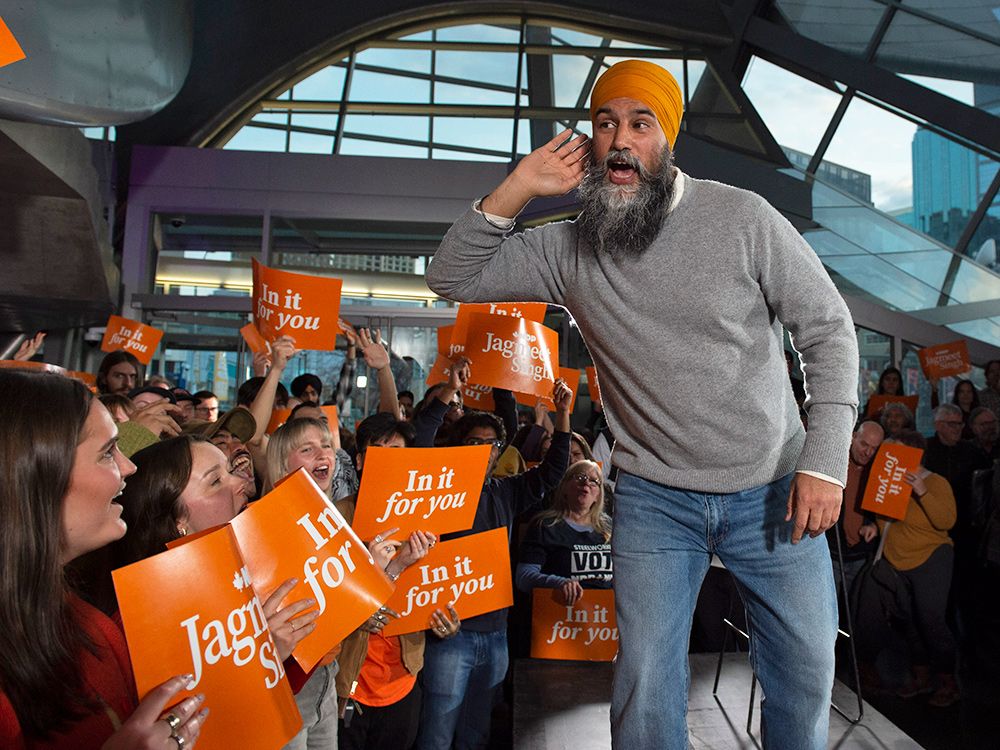
Jagmeet Singh's NDP is seen as having only a small chance to meet the threshold to be recognized as an official party after next week's federal election.

OTTAWA — As Canada’s two largest political parties spend the final few days of the federal election campaign fighting for power, Canada’s smaller parties enter the race’s final leg with arguably even more on the line — survival.

According

to recent opinion polls

, the Liberals and Conservatives are poised to dominate in this election to a degree not seen in almost 70 years.

Polls in recent weeks have been consistent and unequivocal in showing that the Liberals and Conservatives are expected to combine to easily win about 83 per cent of the votes cast. That’s a chunky increase over the 2021 federal election, when they combined for 66.3 per cent of all votes.

These gains have come at the expense of their smaller rivals — the New Democratic Party, the Bloc Québécois, the People’s Party of Canada, the Green Party and others. All of the parties, other than the big two, combined to win about one-third of the votes in the 2021 election, almost exactly double what they’re on course to win this time and almost identical to where they collectively were in the polls as recently as mid-January.

“It looks like it will be catastrophic,” André Lecours, a political science professor at the University of Ottawa, said about the struggling smaller parties’ fates in this election.

With less than a week before Canadians cast their ballots, the Liberals are leading the most recent polls with about 44 per cent of the vote, ahead of the Conservatives by about 5 percentage points. Barring a significant last-minute change, the two main parties should eclipse the 80 per cent mark. That hasn’t happened since 1958.

The danger for the small parties, beyond the short-term failure, is that a party needs to win at least 12 seats to be recognized as an official party in the House of Commons. If a party falls below that threshold, it isn’t allowed to ask questions in the House as often and is granted less money for research. There’s also a sense that smaller parties and their positions on issues just don’t matter as much.

While opinion polls are quite effective at measuring popular vote, anticipating the number of seats that a party might win is much more difficult. Of the parties other than the Liberals and Conservatives, the Bloc is seen as likely to just get over the 12-seat hurdle, based on the polls, while the NDP has only a small chance.

But the bigger question for these smaller parties is whether this election is likely to be a one-time blip, triggered by the tariff threats from U.S. President Donald Trump, or a long-term restructuring of Canada’s political landscape. Specifically, could tariff-focussed Canadian voters, essentially kill off some of the smaller parties, leading Canada to return to what is effectively a two-party system, similar to the United States and many other countries?

Academics say that it’s unlikely that this election will lead to a long-term realignment where the Liberals and Conservatives dominate to this degree, or the way they used to.

Lecours says the circumstances of this election are “exceptional” in that Canadians are viewing the leadership candidates and their parties largely through a single issue: the U.S. tariffs.

That single, overriding issue isn’t likely to top the political agenda in future years, academics say, which means that Canadians will likely revert back to focusing on a variety of issues and supporting more parties and voices.

Sanjay Jeram, a political scientist at Simon Fraser University in Vancouver, said there are four main divisions that most influence Canadian voting patterns — region, language, culture and ideology — and that the importance of those differences will re-emerge in future elections.

“This is a point in time,” Jeram said, “but it won’t last.”

And following the 1958 election, a massive landslide by Prime Minister John Diefenbaker and his Conservatives, it didn’t then either.

In that election, the Tories won the largest majority government in Canadian history and the second-highest percentage (53.7 per cent) of the popular vote. (Only Conservative Prime Minister Robert Borden’s 1917 win, with almost 57 per cent of the vote, was greater).

Although the Liberals were crushed in that election with just 33.8 per cent of the votes, the two main parties combined to win a historic 87.5 of all ballots cast. It was the third consecutive election that those two parties had combined to top 80 per cent.

But the two-party dominance couldn’t maintain that level, just as academics expect this time around too.

In the next federal election, 1962, the combined Liberal-Conservative vote fell to 74.7 per cent of the popular vote, as challengers on both the left and right of the two main parties made gains.

The NDP, in its first election after morphing from the Co-operative Commonwealth Federation (CCF), jumped to 13.4 per cent of the vote, up from the CCF’s 9.5 per cent in 1958. Social Credit, seen as more conservative than the Conservatives, jumped to 11.7 per cent of the popular vote, up from 2.6 per cent in 1958.

The two main parties’ combined totals remained in a range between 71.9 per cent (1965) and 78.6 per cent (1974) for the next 35 years.

But in 1993, there was a major restructuring on the Canadian political landscape with the emergence of the Reform and Bloc Quebecois parties. The Progressive Conservatives placed third in the popular vote (16 per cent) but split the right-of-centre vote with Reform and won only two seats. Efforts to unite the two right-of-centre parties began shortly thereafter, eventually leading to the 2003 formation of the Conservative Party of Canada.

So what would it mean for Canada if the Liberals and Conservatives dominated the electoral landscape in the coming years, as they did in the 1950s?

Lecours says the Liberals would be the big winners because it would mean a consolidation of the progressive vote in both English and French-speaking Canada. The Conservatives, by contrast, are challenged on the right only by the People’s Party of Canada, which won 4.9 per cent of the vote in the 2021 election but are tracking at about one per cent this time.

National Post

Get more deep-dive National Post political coverage and analysis in your inbox with the Political Hack newsletter, where Ottawa bureau chief Stuart Thomson and political analyst Tasha Kheiriddin get at what’s really going on behind the scenes on Parliament Hill every Wednesday and Friday, exclusively for subscribers. Sign up here.

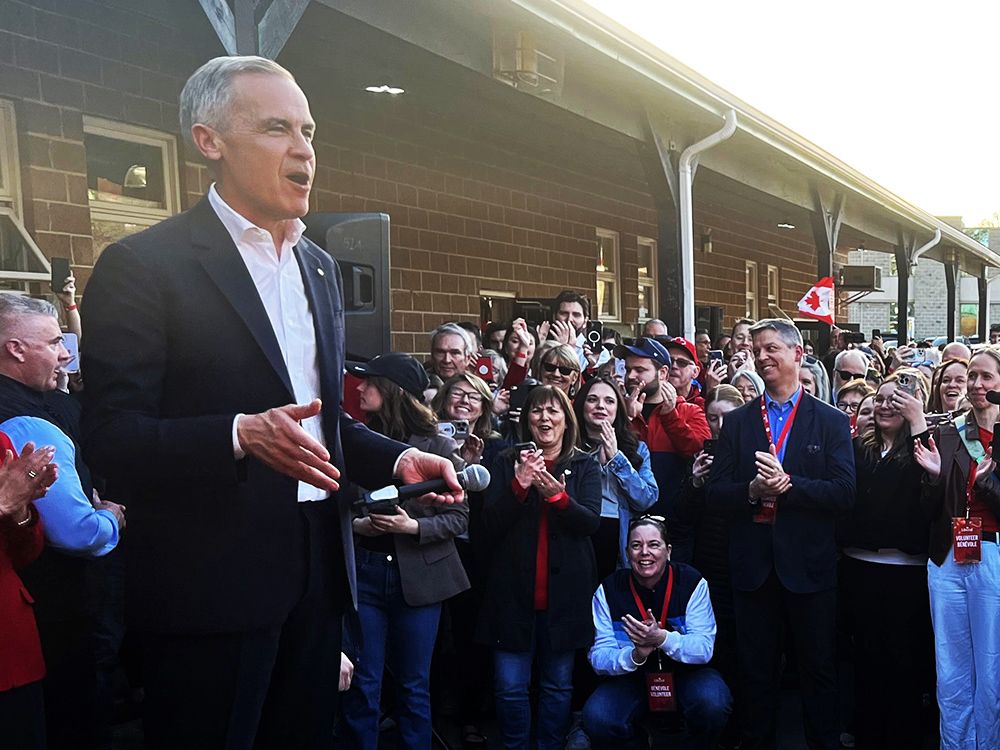
Liberal Leader Mark Carney speaks at a campaign stop in Fredericton, New Brunswick, on April 21, 2025.

VICTORIA — “Friends, pinkos and separatists, lend me your votes.”

Mark Carney wasn’t quite as churlish as to insult his left-of-centre rivals but his pitch from the upper deck of Victoria’s Empress Hotel, overlooking the harbour, was to appeal to progressive voters to “vote with me, for positive reasons, regardless of which party you supported in the past.”

“We need to come together to fight Donald Trump together,” he said.

The only certainty in politics is that nothing is certain. But all the available evidence suggests that the Liberals are on course for an election victory on Monday.

Everything is coming up roses for Carney right now. On Wednesday, Ontario’s Progressive Conservative government issued an open letter saying that the current child-care deal with the federal government comes to an end next April and the province wants Ottawa to step up with “stable and adequate funding” to extend the program. Premier Doug Ford might just as well have stuck a “Vote Carney” sign on his front lawn. The Liberal leader’s response was unequivocal in Victoria. “No problem. I’m absolutely standing behind $10-a-day child care in Canada.”

If victory looks likely, what’s less clear is whether it would be a majority or minority government.

This is a high-wire act for Carney. He has to appear confident, but he can’t appear too confident; to give the impression of momentum but not too much momentum; to veer leftward but not so far left that he alienates centrist voters.

The Liberal leader professed common cause with the NDP, but make no mistake, he is back in Victoria because he wants to bury, not praise, the New Democrats, who hold all but one of the seven seats on Vancouver Island.

NDP Leader

Jagmeet Singh has attacked the $28 billion

in “undefined spending cuts” he says are in the Liberal platform. But until now, Carney seems not to have mentioned the New Democrats once during this whole campaign.

He was finally persuaded to, in answer to a reporter’s question, saying that when he thinks of what the NDP calls “progressive policies,” he thinks of “the policies and institutions that are at the heart of this country.”

The collapse of the NDP vote means that ridings they won comfortably in 2021 are now in play, the Liberals say, including that of veteran B.C. MP Peter Julian in New Westminster—Burnaby—Maillardville.

There are no rumblings of adrift New Democrats “coming home” back to the party, despite Singh’s appeal to do so.

The story in Quebec is less clear cut. In 2021, the Liberals won 33 seats and the Bloc 32. President Donald Trump’s threats initially drove many traditional Bloc supporters into the arms of the Liberals, conscious that Quebec culture would be swamped if Trump’s most expansive ambitions were fulfilled. The 338Canada.com poll aggregator currently projects 43 Liberal seats, 22 Bloc and 12 Conservatives in Quebec.

But as Trump’s threats have receded, and Carney’s victory has grown more assured, there are signs that Bloc supporters are less ardent about sticking with the Liberals.

As

my colleague Antoine Trépanier noted Wednesday

, the Liberal majority runs through Quebec but party sources suggest the prospect is slipping away.

BQ Leader Yves-François Blanchet is telling Quebecers that Carney’s victory is a certainty and that the Bloc is now “on the offence.”

Marc Miller, the former Liberal immigration minister who is running again in Montreal, said that he is not seeing a Bloc rebound. “If it’s happening, it’s recent and they (those Bloc voters) probably weren’t coming over anyway,” he said.

When asked why he needs a majority, Carney said the country is in the process of joining together. “It is important we have a strong government to face President Trump,” he said.

Quebec will be the kingmaker, and its voters will likely decide precisely how strong that government is.

jivison@criffel.ca

Twitter.com/IvisonJ

Get more deep-dive National Post political coverage and analysis in your inbox with the Political Hack newsletter, where Ottawa bureau chief Stuart Thomson and political analyst Tasha Kheiriddin get at what’s really going on behind the scenes on Parliament Hill every Wednesday and Friday, exclusively for subscribers. Sign up here.

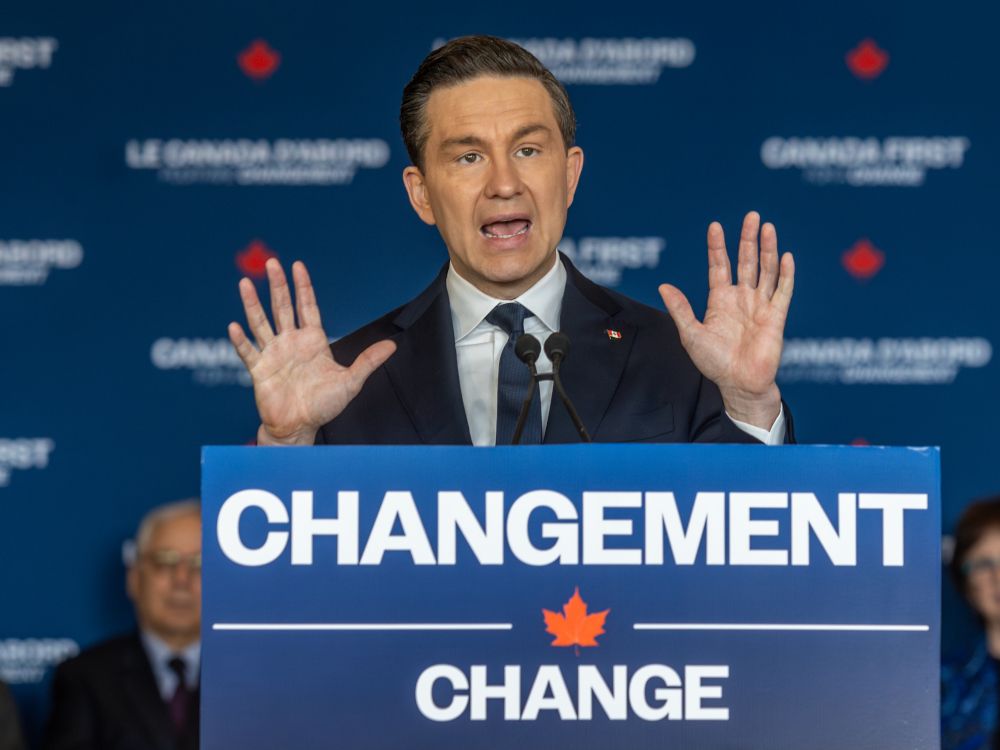
Conservative Leader Pierre Poilievre.

During a Tuesday press conference to unveil the Conservative election platform, Pierre Poilievre took a departure from the topic du jour, analyzing a report from an obscure government department that warned of the potential that many Canadians may “face the very real possibility of downward social mobility” by 2040.

“The report paints a terrifying picture of a spiral of economic depression and cost inflation,” Poilievre said.

Written by Policy Horizons, the report suggests various hypothetical situations Canada could face in 2040, including a world where young Canadians are moving abroad, and some may even turn to foraging and hunting to meet basic food needs.

“Thinking about future scenarios helps decision-makers understand some of the forces already influencing their policy environment,” the report says. “It can also help them test the future readiness of assumptions built into today’s policies and programs. Finally, it helps identify opportunities to take decisions today that may benefit Canada in the future.”

Here’s what you need to know about the government department and its report.

What is Policy Horizons?

It is a government office that was founded in 1996 that does strategic foresight

In a statement, Maja Stefanovska, a spokesperson with Employment and Social Development Canada, said that Policy Horizons analyzes the “emerging policy landscape, the challenges that lie ahead, the opportunities opening up,” in addition to “building foresight literacy and capacity in the public service,”

These sort of society-oriented wargames explore the ways the future could unfold, no matter how outlandish, so as to inform current government priorities. Strategic foresight is a common practice in the business world, and Policy Horizons says it follows the methodologies of other national governments and the private sector.

Are these predictions?

Not really. The report makes several suggestions about what the future could hold. In the past, Policy Horizons has

gamed out the potential for various scenarios

, including the outbreak of world war, an information realm dominated by misinformation and antibiotic resistance.

Stefanovska said the report is “not a forecast nor a commentary on current or future policies.”

Rather, it concocts hypothetical futures as an exercise to help government prepare for all possible futures.

What does it say about work in the hypothetical future?

In that world, post-secondary education is no longer a path towards social mobility; rather, it is too expensive for anyone but the rich and programs on offer are too inflexible to prepare students for the demands of work. Instead of being a path to a better job, post-secondary education has become a social marker than one has joined the “elite.” The advances of artificial intelligence also limit the labour market, especially in creative fields, meaning people need to rely on gig work to pay the bills.

What does it say about housing?

If this scenario comes to pass, Canadians are unable to afford housing. Rather, intergenerational mortgages have become the norm and several generations of family live together under one roof, or people get mortgages with friends, while landlords who oppose rent freezes or increased housing supply scoop up large portions of the housing market.

“Inequality between those who rent and those who own has become a key driver of social, economic, and political conflict,” the report says.

Compared to some of the situation analysis Policy Horizons has done in the past — such as considering a future in which the United States is embroiled in a civil war — this one seems altogether too likely.

Housing costs are one of the defining issues of the 2025 election.

Ipsos polling from April 2024

found that 80 per cent of Canadians already believe that owning a home is only for the wealthy and 72 per cent say they have given up on ever owning a home. Despite this, though,

home ownership has been reasonably

stable in Canada: in 2021, 66.5 per cent of Canadians owned their home; in 2011, 69 per cent did — but that was a record high, according to Statistics Canada.

What about wealth?

The hypothetical Canada of 2040 is a society that “increasingly resembles an aristocracy,” and one of the only ways to get ahead will be through inheritance. Interestingly, Canada is expected to see $1 trillion in

intergenerational wealth passed

along over the next few years, in the largest wealth transfer in history, as Baby Boomers and the silent generation pass their wealth on to millennials and Gen X.

This society also sees less interaction between socio-economic classes; it predicts dating apps that select via income, for example. This has already happened, to some extent, with exclusive dating apps such as Raya and the League, compared to more egalitarian apps such as Tinder or Hinge (although on Hinge, a person can select on the basis of education and political views.)

“Social relations no longer offer pathways to connections or opportunities that enable upward mobility,” the report says.

What does it say about the economy?

In short, it suggests that a hypothetical Canada in 2040 could have a less predictable economy, with wealth highly concentrated, an upwards spiral of housing costs and a depressed consumer economy, as people spend less money.

It also suggests that migrants may choose countries other than Canada and that younger Canadians may move abroad. This could imperil social services that older Canadians rely upon.

Does it have any positives?

That depends on your definition of positives.

It predicts the growth of trade unions as a way to resist the impoverishment of Canadian workers. Union membership

has already dropped in Canada

, from a high of 37.6 per cent in 1981 to a low of 30.4 per cent in 2023.

However, while some may see increased union membership as a good thing, the report warns, “Job actions and strikes may disrupt economic development.”

With costs rising and incomes decreasing, Canadians may also turn to alternative structures to get the support they need. For example, they may turn to co-operatives for housing, food, childcare, and health care. While this may meet basic needs and decrease the demands on public services, it could also pose challenges for “market-based businesses.”

“People could rethink what ‘prosperity’ means, or ‘fulfilment.’ They may reject conspicuous consumption. They may focus on policies that promote human flourishing. This could include health care, housing, the environment, and education for its own sake,” the report says.

What else?

The report suggests various alternative methods of exchanging goods and services and acquiring goods. It suggests that trading goods and services could reduce tax revenues or impair consumer safety. It also says foraging and hunting and small-scale agriculture could become more common.

As it stands, about three per cent of

Canadian households hunt

, nine per cent have gone fishing and, while the report does not specify what it means by small-scale agriculture, 61 per cent of Canadian

households already grow fruit

, vegetables, herbs or flowers for themselves.

All of this could mean that Canadians blame others, or various systems, for their problems. The report warns that Canadians could blame immigrants or the rich or demand tighter regulations from government.

“They may attack policies believed to favour older cohorts, who benefited from the era of social mobility,” the report says. “In extreme cases, people could reject the state’s legitimacy, leading to higher rates of tax evasion or other forms of civil disobedience.”

Does the report say this is good? Is this also the view of the government?

No to both. The authors write that the described scenario of stunted social mobility is “neither desired nor preferred,” but that it is plausible.

A disclaimer on the report says: “The content of this document does not necessarily represent the views of the Government of Canada, or participating departments and agencies.”


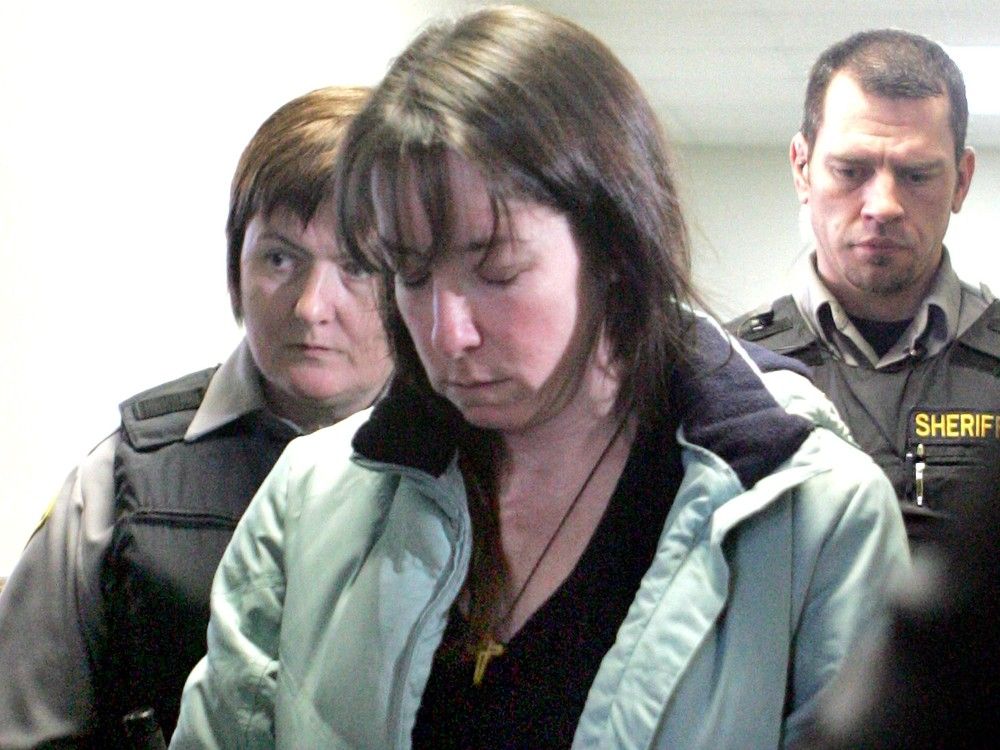
Penny Boudreau, who strangled her twelve year old daughter, could soon be able to apply for unescorted temporary absences from prison.

The Nova Scotia woman serving a life sentence for strangling her own daughter to death could soon be applying for unescorted temporary absences from prison.

In a recent decision granting Penny Patricia Boudreau escorted temporary absences, the Parole Board of Canada notes “it would appear” that Correctional Service Canada “is looking towards June 2025 as a possible hearing date for a more liberal release, such as (unescorted temporary absences). Naturally, any movement in that regard will invite media scrutiny and a community response. That scrutiny is inevitable.”

Boudreau murdered her 12-year-old daughter Karissa on Jan. 27, 2008, later claiming it was to save her relationship with her boyfriend. The following year, Boudreau pleaded guilty to second-degree murder. A judge sentenced her to life in prison with no chance of parole for 20 years.

“Holding a position of trust, you strangled the young victim and disposed of the body in the snow (beside the LaHave River) with hopes it would not be discovered,” said her most recent parole decision, released Wednesday.

“Moreover, you concocted a story that she might have been abducted and made public pleas for her return. An exhaustive police investigation involving undercover agents led to your arrest. It was your position that your decisions were taken to save your intimate relationship with your partner.”

In making its recent decision, dated March 28, the parole board considered “numerous victim impact statements” and “a host of letters sent directly to the board. Collectively, they speak to a deep sense of loss and grief, be it family members, friends and/or the community at large. That grief and opposition to your release continues to this day.”

Boudreau, now 51, has “completed numerous” escorted temporary absences since they were first approved for her in 2018.

“Completion of some was interrupted due to pandemic restrictions as well as the heightened level of media interest and push back from certain communities,” said her parole decision.

“Those most recently approved from 2024 … are soon to expire.”

In this most recent decision, the parole board handed Boudreau 18 more escorted temporary absences “to participate in church services and/or church related activities, including but not limited to special community events, bible study, meetings with the pastor and/or congregation, for up to six hours each including travel time.”

It also granted her four escorted absences of up to seven hours each to see family.

“One of your parents has ceased contact with you due to the negative media attention surrounding your current offence,” said the decision.

A psychological risk assessment completed last fall noted her “overall risk within the community on unescorted temporary absences and/or day parole was generally low while (Boudreau’s) global risk for future recidivism, whether violent or general, was estimated in the very low range.”

Boudreau, a minimum-security offender, visited a halfway house last December for a tour.

“Over the past several years, ongoing (escorted temporary absences) have facilitated interaction with members of the public through a church environment and to visit the home of a close personal support,” said her parole decision. “That support continues today. There have been no security concerns.”

Boudreau doesn’t pose an “undue risk to society,” said the parole decision.

“Despite recent threats made to your personal safety, which police investigated, (Correctional Service Canada) believes your (escorted temporary absences) can be effectively managed, and any media attention and/or safety risks will be closely monitored prior to the release on these (escorted temporary absences) and appropriate and necessary measures will be taken if deemed necessary.”

The parole board decision, which came out of Atlantic Canada, doesn’t indicate where Boudreau is serving her sentence.

“Police in the church’s community remain supportive while police in the community of your other proposed (escorted temporary absences) continue to strongly oppose any type of release,” said the decision. “It is their opinion that you were issued a life sentence with no parole before 20 years served which needs to be followed.”


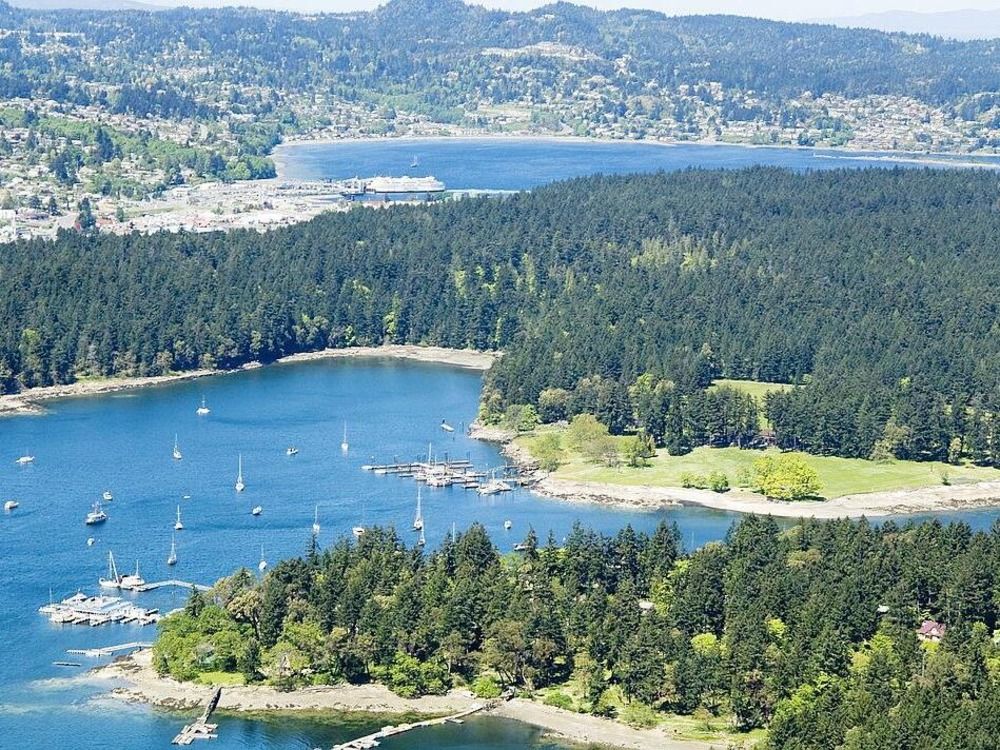
An aerial view of Protection Island in Nanaimo.

What began as a simple video has become a boon for Nanaimo, a city on Vancouver Island with a population of 106,000.

Tod Maffin, a digital marketer, journalist and social media influencer living in Nanaimo, never imagined his

TikTok video

would spark a friendly American invasion of the city.

“I was bored on a Friday night waiting for an Xbox game to install, and so I made a stupid little video that said, ‘Hey, if you Americans who support Canada really want to put money where your mouth is, come on up to Canada, come to my hometown, and spend your money,’” said Maffin.

That post marked the beginning of “Nanaimo Infusion,” a weekend from April 25 to 27, where Americans are invited to visit.

Maffin set up a forum asking people to indicate if they were planning to attend. More than 2,000 people registered. The response was overwhelming. “I’m not an event planner,” Maffin said.

He eventually took the forum down and opened a Discord channel where Americans could confirm their attendance after booking accommodations. As of writing, more than 175 people have confirmed that they booked a trip.

One person attending is Andrew Kantor. He and his wife are coming from New York. Kantor first heard about “Nanaimo Infusion” through CKLR-FM, a radio station in Courtenay, B.C., that he started listening to because he was tired of American news. After watching Maffin’s TikTok, he joined the Discord and made new friends. He and his wife decided to visit Nanaimo to meet those friends and show solidarity with Canadians.

“We really just want to be part of something that’s showing Canada that most Americans are on their side. Most Americans don’t like what’s going on. And this is one way we can do a little bit to help,” said Kantor.

As part of the “Nanaimo Infusion” weekend, Maffin, whose birthday falls on April 26, worked with the city to organize a “family photo event” at 10 a.m. PT that day in Maffeo Sutton Park. Visitors are invited to gather for a group photo, and Nanaimo’s mayor, Leonard Krog, is expected to be in attendance.

Many local businesses are embracing the weekend’s excitement by organizing a variety of activities. These include a welcome gathering for queer American visitors at White Sails Brewery on April 25 and a nanaimo bar-making demo at Island-ish Lifestyle Boutique on April 26, with several other events planned throughout the weekend.

“The community has turned up for this,” Maffin said.

Mayor Krog is optimistic about the economic benefits this influx of tourists could bring. “If a few hundred people show up, it will have several hundred thousand dollars of economic impact in a very positive way at a time of economic uncertainty and concern,” he said. “And of course, the Americans will discover, if they haven’t before, that their dollar goes a lot further in Canada than it does back home. This will encourage longer-term tourism as well.”

Hotels might be in short supply for the weekend, but Krog remains confident the region can handle the influx of visitors. “I think we’ll be able to accommodate those who will choose to come.”

The mayor also sees the weekend as an opportunity to strengthen the bond between Canadians and Americans. “They will discover that their best friends are north of the border, and they would be very wise to work on that friendship instead of allowing, as I say, the mad king in the White House to destroy that long-standing relationship.”

It’s a message that resonates with many Americans planning to make the trip.

“I honestly think most Americans love Canada. You are our best friend. You’ve been our best friend for centuries, and this is awful, and we hate it. And we’re trying to show a little solidarity,” said Kantor.

Maffin believes the “Nanaimo Infusion” is already a success, even though the weekend hasn’t officially begun. “I genuinely believe that this has put Vancouver Island on the radar of people that had no idea it existed before.”

Our website is the place for the latest breaking news, exclusive scoops, longreads and provocative commentary. Please bookmark nationalpost.com and sign up for our daily newsletter, Posted, here.


The good news for grocery shoppers is that the price of olive oil

has dropped substantially

 over the last year. The bad news is that almost anything you cook with it is going to be more expensive. That’s one of the takeaways from the latest

food inflation report

released by Loblaw Companies Limited.

The retailer operates more than 2,400 stores

across Canada

, including Loblaws, No Frills, Shoppers Drug Mart and Real Canadian Superstore. Its April food inflation report comes on the heels of Statistics Canada’s

latest monthly bulletin

, which reported that the Consumer Price Index — a measure of inflation calculated by the price of regular household purchases — was up 2.3 per cent year over year in March. StatCan also reported that the price of

food purchased in stores

was up even more, at 3.2 per cent year over year in March, up from 2.8 year over year the month before.

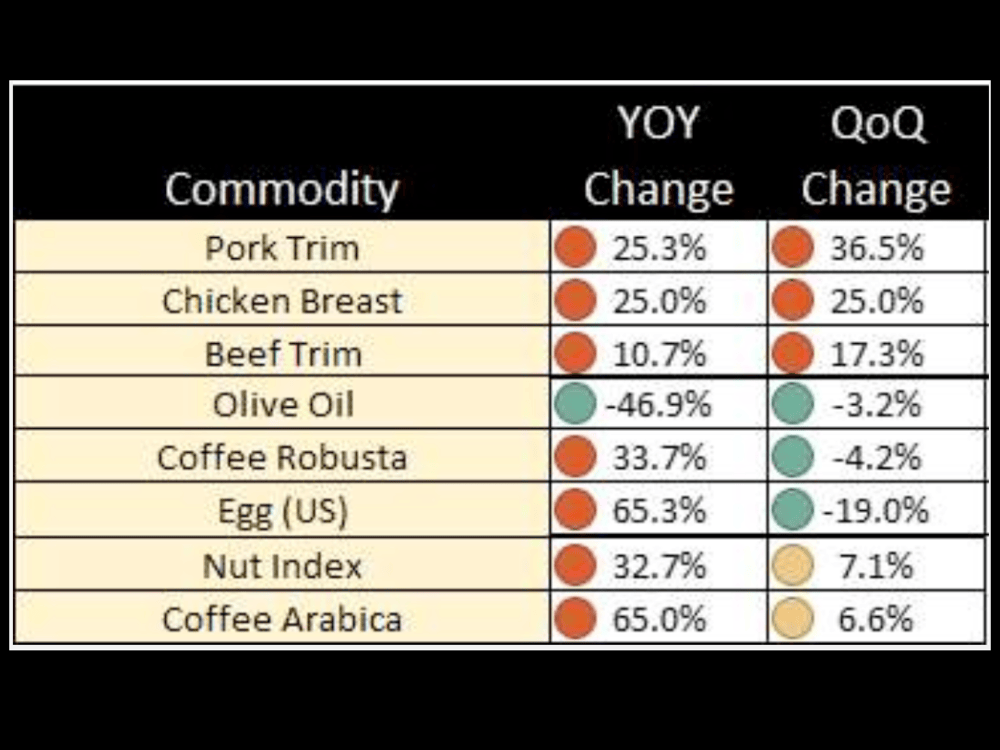
The Loblaw bulletin for the month of April lists a number of grocery staples, including chicken breasts, pork and beef trim, coffee and eggs. In each case (except olive oil) the price is higher than it was a year ago, although some of the items have decreased somewhat in the last quarter.

Topping the list are U.S. eggs, still up 65.3 per cent from a year ago, though they have come down 19 per cent in the last quarter. Loblaw notes that while Canadian eggs have remained much more stable in price, “Canada is a net importer of liquid eggs from the U.S., and that cost has increased substantially.”

It adds: “Aside from liquid eggs in the egg aisle, the biggest impact will be seen in baked goods, like muffins, cakes and cookies.”

Also high on the list is coffee. Coffee arabica prices are up 65 per cent from a year ago, and 6.6 per cent in the last quarter, while coffee robusta has gone up 33.7 per cent over the past year, but down 4.2 per cent in the last quarter.

“Tight supplies from the 2024 harvest means continued volatility for coffee prices.” the report notes. “Recent U.S. tariffs on coffee growing countries led to a minor sell off, then rebound when tariffs paused.”

The brief report mentions the word “tariff” a dozen times, and includes an explanation of how “stacking tariffs” could send some prices even higher.

On the subject of coffee, it notes that Vietnam is the second largest producer of coffee beans after Brazil, and that many American coffee producers buy their beans from there. However, a possible 46 per cent tariff on Vietnamese imports could raise costs, as could a further 25 per cent tariff on goods entering Canada from the U.S.

“As a result,” it notes, “every $1 spent on coffee previously could conceptually cost as much as $1.82 after tariffs.”

loblaw chart
The chart from Loblaw shows year over year (YOY) and quarter over quarter (QOQ) price changes for various goods.

More generally, it says, “tariffs continue to impact inflation, challenging key sectors and lowering consumer confidence. While the impact of Canada’s counter tariffs was minimal on food prices in March, as retailers sell through existing inventories higher prices will begin appearing on shelf.”

Things are not great in the meat aisle either. “Pork prices have been rising with demand over the past few months,” the report states, adding: “Chicken remains high after ongoing supply challenges, and the beef herd is the smallest since the 1970s due to drought conditions and rising feed prices.”

As a result, beef prices have risen 17.3 per cent in the last quarter, while chicken breasts are up 25 per cent, and pork trim 36.5 per cent.

The one item of good news is on the olive oil front, where Loblaw reports that prices are down by almost half (46.9 per cent) from a year ago, with a drop of 3.2 per cent in the last quarter.

The so-called “liquid gold” had

hit record highs

and even spurred a crime wave last year thanks to two years of bad weather and poor harvests in Europe. With the most recent crop in better shape, prices have dropped again.

Our website is the place for the latest breaking news, exclusive scoops, longreads and provocative commentary. Please bookmark nationalpost.com and sign up for our daily newsletter, Posted, here.


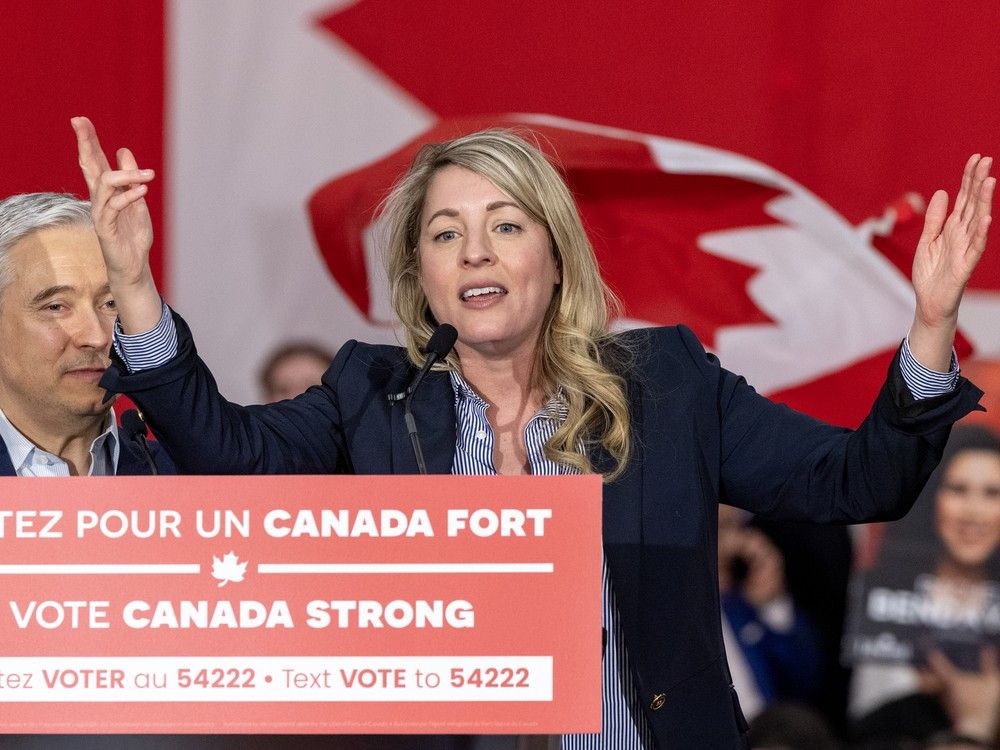
Liberal MPs Francois-Phiippe Champagne and Mélanie Joly warm up the crowd prior to Leader Mark Carney's appearance at a campaign rally in Laval, north of Montreal Tuesday April 22, 2025.

OTTAWA — Liberal Leader Mark Carney has been careful in choosing his words in

calling for a “strong” mandate

, but his foreign affairs minister and incumbent MP Melanie Joly finally said out loud what every Liberal is thinking: a majority government is in reach.

Speaking to Liberal supporters at a rally in in Laval on Tuesday evening, Joly referenced Liberal hopes for a majority government not once but twice when she took the podium next to Liberal candidate and fellow minister François-Philippe Champagne.

“We know we’re able to have a majority government because Quebecers will answer present because we need a strong mandate, a strong mandate to negotiate with (U.S.) President (Donald) Trump, to build the strongest economy in the G7,” she said in French.

Joly went on to tell supporters how much she knows how hard they have been working especially during the final stretch of the campaign, knocking on doors and calling voters.

“So together… let’s make sure to give ourselves a Liberal majority government!”

Other speakers who took the stage at the Laval rally did not go nearly as far as Joly did.

Marjorie Michel, who served as former prime minister Justin Trudeau’s deputy chief of staff and is now running in his vacated Montreal riding of Papineau, also addressed the crowd and offered words of cautious optimism days away from election day.

“We are not arrogant,” she said.” We work hard. We keep our head down, but we will win big… We will fight and win for Canada strong,” she added, referencing the party’s slogan.

Annie Koutrakis, an incumbent MP in the Laval riding where the rally was held, had the task of introducing Carney on stage. She said of the Liberal team “that we all firmly wish (he) will be elected by Canadians to serve a full-term as their prime minister.”

Carney arrived on stage wearing a Montreal Canadiens hockey jersey with his last name on the back and the number “24” which is a reference to the fact that he became the 24th prime minister weeks ago. He said it was a gift from former minister Marc Miller.

As he has been doing for the past few days, Carney compared the final stretch of the campaign to the last five minutes of the third period of a hockey game. And given that the Habs are in the playoffs, he emphasized it was like the seventh game for the Stanley Cup.

“It’s time to give everything,” he said in a speech where he spoke mostly in French. “You need to knock on even more doors, you need to make even more calls, you need to talk to even more friends, family and neighbours, and above all, you need to vote Liberal.”

Polls have been placing the Liberals a few points ahead of the Conservatives nationally, with wider gaps in Atlantic Canada, Ontario and Quebec. But Quebec might decide if the Liberals form a minority or a majority government, say observers.

Philippe J. Fournier, creator of the poll aggregator 338Canada, recently told the National Post that Liberals need to win more ridings like the ones in Laval to form a majority.

“If the Liberals let (these ridings) slip, it could cost them their majority,” he said.

Bloc Québécois Leader Yves-François Blanchet has also been telling Quebecers that the Liberals are assured to form the next government — an attempt to convince Bloc voters to come back home and

keep the Liberals to a minority

like in the past two elections.

Blanchet’s strategy seems to be paying off, to the point where the Bloc has been

slowly climbing back in the polls

and he could aspire to save a few more of his seats.

Carney has pushed back against Blanchet’s suggestion, arguing that Quebecers in particular need a strong voice at the negotiating table to push back against Trump.

“I made clear from (the start of my campaign) that we would never have supply management on the table, that we would never have the French language on the table,” he said. “It’s the person at the table who will make those determinations and decisions.”

“So, the issue is having as strong a mandate as possible,” he added on Tuesday. “Only the federal government can make those protections in these negotiations.”

Many Canadians have already made their choice, as Elections Canada reported that 7.3 million Canadians voted in advance polls.

The election is on April 28.

National Post

calevesque@postmedia.com

Get more deep-dive National Post political coverage and analysis in your inbox with the Political Hack newsletter, where Ottawa bureau chief Stuart Thomson and political analyst Tasha Kheiriddin get at what’s really going on behind the scenes on Parliament Hill every Wednesday and Friday, exclusively for subscribers. Sign up here.

Our website is the place for the latest breaking news, exclusive scoops, longreads and provocative commentary. Please bookmark nationalpost.com and sign up for our politics newsletter, First Reading, here.


Bloc Quebecois Leader Yves-Francois Blanchet walks in a news conference in La Malbaie, Que., Tuesday, April 22, 2025.

YAMACHICHE, QUE — Liberals thought they were riding a wave toward a majority government, largely thanks to Quebec. That’s no longer the case. Sources within the party sense the grass is slipping from under their feet.

The Bloc, whose poll numbers plummeted following the resignation of Prime Minister Justin Trudeau and the inauguration of U.S. President Donald Trump, sees an opportunity.

The party is working feverishly to regain support in the ridings it holds.

Bloc Leader Yves-François Blanchet said he is very much “on the offence” and that he’s trying to save seats and flip a couple more in the greater Montreal area, while the Liberals “are worried that Isaac Newton may have been right after all and it has stopped going up.”

According to sources, the Liberals’ internal numbers are not as shiny as the polls suggest, and a majority result is fragile.

“Everything is extremely volatile in an unprecedented campaign. Everything could still be decided in the coming days. That seems to be true for the Liberals, and it’s true for us,” said Blanchet on Wednesday. “It’s going to be an extraordinarily interesting five days.”

Meanwhile, the latest

Leger poll

puts the Liberals 16 points ahead of the Bloc in Quebec.

The Bloc hasn’t recovered to the same level as the last election, according to Philippe J. Fournier, who runs the polling aggregator 338Canada, but the party is no longer on the floor with only 20 per cent.

“It looks like they’re back at 25 or 26, and that could make a difference for the Bloc. The Bloc will probably save the day if they can get out the vote,” Philippe J. Fournier told National Post.

The Liberals believe that 40 of the province’s 78 seats would help them in their quest for a majority government. And they’re not afraid to ask Quebecers directly for help.

“We know that in Quebec, we have a strong voice to be heard! We know that we are capable of having a majority government because Quebecers will respond,” Liberal candidate and Minister of Foreign Affairs Mélanie Joly chanted in the microphone at a party event Tuesday night.

She was introducing her boss, Mark Carney, at the end of a long day of campaigning in La Belle Province.

“Together, let’s make sure we have a Liberal majority government,” Joly added.

If the Bloc continues to climb in the polls and reaches 30 per cent, this majority would be “compromised,” according to Fournier.

In 2021, the Liberals won 33 ridings in the province and the Bloc 32. However, last September, the Bloc won a byelection in Montreal, creating a major upset. The Bloc was particularly strong among Francophone voters, while the Liberals dominated in Montreal and among the multicultural electorate.

“The aggregation sites predict a close fight, but that’s not what we feel on the ground,” Bloc Québécois candidate in Berthier-Maskinongé Yves Perron said.

Perron seems to have 

the edge in a tight race with NDP Ruth Ellen Brosseau,

and the Liberal candidate is not too far behind.

“I don’t really feel any surge (in the Liberal vote),” he said. “People come and argue with me sometimes, saying ‘well, we’ve always voted for the Bloc, but now we’re a little scared.’ It takes a few minutes to explain that if we’re not there, no one speaks for Quebec, and then people understand that very quickly,” he added.

Bloc candidates constantly repeat that polls don’t tell the whole story. That groundwork remains the key to success.

That’s exactly what Team Carney and Team Blanchet did on Tuesday.

Both the red and light blue caravans added kilometres to their odometers throughout Tuesday.

The Bloc leader started the day in Charlevoix, where he is trying to save a seat

from a Conservative surge

.

“We are trying to reach as many people as possible during five weeks, four of which are gone. There’s one left, and more the people hear about us and what we have to say, the best support we get,” Blanchet told reporters.

Meanwhile, the Liberal leader met with Quebec City Mayor Bruno Marchand in the Old Capital and took pictures in front of the Château Frontenac.

Blanchet then went to Quebec City, while Carney was making an announcement on the protection of Quebec’s identity and economy

in the battleground of Trois-Rivières

.

“We (will) always protect Canadian culture, Quebec culture, and we are clear. But it’s the person at the table who will make those determinations and decisions,” said Carney, implying that the Bloc will never be at the table because it can’t mathematically form the government.

A new stop was added to Blanchet’s itinerary: a metal factory in Yamachiche, not far from Trois-Rivières, to visit a company affected by the U.S. tariffs.

It seemed as if the two campaigns had exchanged narratives.

Carney served poutine at the Ben La Bédaine canteen in Granby, then travelled to Saint-Bruno-de-Montarville. Both ridings are held by the Bloc.

Meanwhile, Blanchet enjoyed a quiet dinner with his team in Repentigny, a stronghold where the Liberals harbour ambitions.

Carney ended his day in Laval, where hundreds of Liberals were present. Like Joly, he called for a strong and positive mandate. He wore a Montreal Canadiens jersey, just as Blanchet had done the day before in Charlevoix.

While Blanchet is a Quebec Nordiques fan and Carney is an Edmonton Oilers fan, both are ready to hold their noses and wear the Habs jersey. Because at this stage of the campaign, it might well be a necessity to win this province.

National Post
atrepanier@postmedia.com

Get more deep-dive National Post political coverage and analysis in your inbox with the Political Hack newsletter, where Ottawa bureau chief Stuart Thomson and political analyst Tasha Kheiriddin get at what’s really going on behind the scenes on Parliament Hill every Wednesday and Friday, exclusively for subscribers. Sign up here.
Our website is the place for the latest breaking news, exclusive scoops, longreads and provocative commentary. Please bookmark nationalpost.com and sign up for our daily newsletter, Posted, here.


Owners of Chez Ben, left, in Granby, Que., invited Mark Carney, second from right, and local Liberal candidate Felix Dionne behind the counter to serve poutine on Tuesday.

Mark Carney and the Liberals have spent a lot of campaign time telling voters they’re best equipped to deal with U.S. President Donald Trump. But on Tuesday, the Liberal leader off-handedly compared himself to the contentious American head of state.

The Liberal campaign bus rolled into Bloc Québécois-held Granby, Que., for a brief photo op with local candidate Felix Dionne at Cantine Chez Ben, a third-generation family-owned restaurant which bills itself as offering the best poutine.

As seen in a video posted by CPAC, after posing for some photos out front, the former Bank of Canada governor gestured to an election sign featuring his image.

“What a handsome person,” he said. “Let’s do a little comparison.”

“Before the campaign. Now.” he remarked, motioning first to the image, then to himself.


Carney was quickly shuffled inside with Dionne and through a small throng of supporters, stopping to shake hands and sign autographs and then meeting with some customers enjoying a meal.

At the counter, the two owners invited him to try his hand behind the counter, but told him he needed a hat first. While a staffer was sent to fetch some headwear, Carney turned to the cameras.


“It’s just like Trump at McDonald’s,” Carney said. “Not really.”

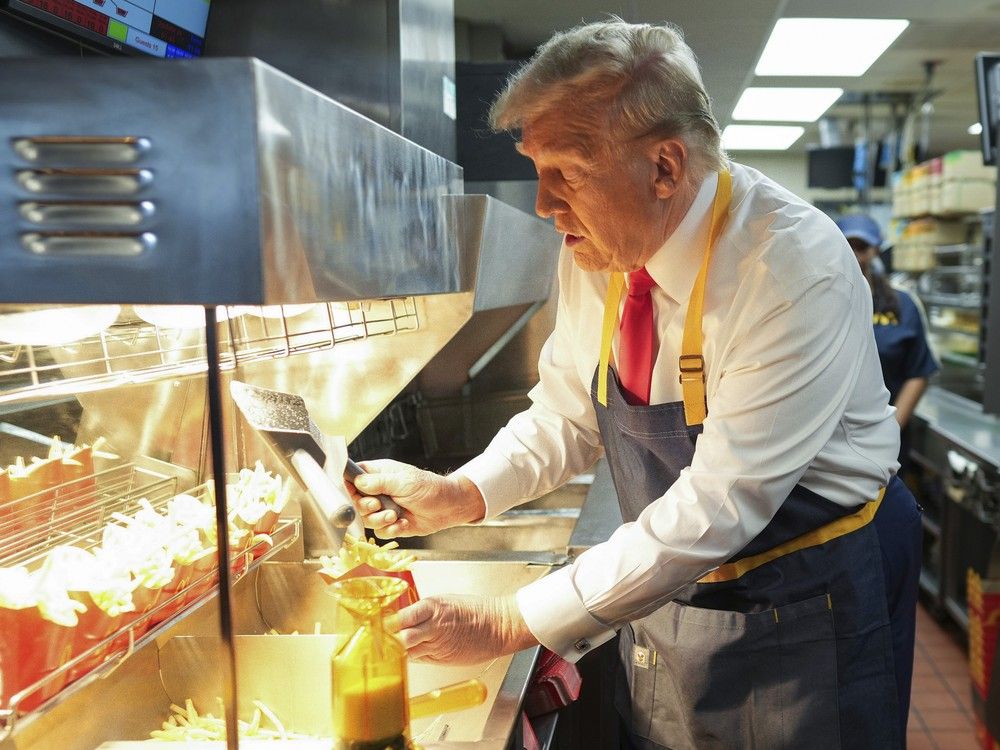
In the final weeks of the 2024 U.S. election, Republican nominee Donald Trump showed up at a McDonald’s franchise outside Philadelphia, where he wore an apron, made fries and worked the drive-thru window. He did so, he said, because he’d always wanted to and to prove that Democratic nominee Kamala Harris never worked there, despite her claims.

 Then-Republican presidential nominee Donald Trump serves fries during a visit to a McDonald’s in Feasterville-Trevose, Pa., in October.

“There’s no one with a hat?” Carney then asked, still waiting.

When a Chez Ben hat is handed to him, he adjusts it, noting, “I have a big head.”

Behind the counter, as Carney is prepping an order of poutine, a reporter at the canteen window outside asks him what the cheese sounds like. “Squish, squish,” he replied.

“It’s tiring,” he said, while doing a mock brow wipe after serving up one dish.

After a quick chat with one of the owners while Dionne makes a plate, Carney starts making another.

“I’m a bit like Trump. Trump at McDonald’s,” he said again, speaking to someone through the canteen window.

After chopping a few potatoes and having a private conversation with Dionne and the owners, Carney was out the door with a takeout plate in hand.

“I’m keeping this,” he said of the hat.

A few more photos and autographs, and the Liberal leader was off to his next stop.

Our website is the place for the latest breaking news, exclusive scoops, longreads and provocative commentary. Please bookmark nationalpost.com and sign up for our daily newsletter, Posted, here.