LP_468x60
on-the-record-468x60-white

This year, the CBC’s Vote Compass for the federal election has no questions about issues such as housing, defence spending or the CBC’s future.

CBC’s Vote Compass is back for the federal election, promising to “help you explore how your views compare with those of the parties,” and

it’s just as silly

as in its many previous iterations

. More than 1.2 million people have taken the survey, the website claims, and I’m sorry to say none will have emerged any better informed than when they started — which some might argue goes against the public broadcaster’s basic news mandate. It’s not so much torqued toward one party or another as it is incoherent.

My favourite question this time around asks Canadians whether they believe “the federal budget deficit should be reduced, even if it leads to fewer public services.” Strongly agree? Strongly disagree? Somewhere in between?

If you’re thinking you’ve never heard a mainstream politician support fewer public services, you are correct. The designers of this survey have simply inferred that cuts to the federal budget

would

lead to fewer public services. This is evidenced by the documentation provided to justify where the Vote Compass, a CBC co-production with Toronto’s Vox Pop Labs, places each party on the agree-or-disagree spectrum.

“A new Conservative government will bring common sense back to the budget. We’ll end waste, cap spending, and review all government spending to demand real results for every tax dollar,” the

Conservative platform promises

. “We will shrink the Liberal deficits and eliminate waste by enacting a one-for-one spending law. Any new spending must be offset by reduced or new revenues.”

You will notice that there’s nothing in there about social services. Nevertheless, to Vote Compass, that counts as a “strongly agree” to the question of cutting budgets even if it impacts social services.

Perhaps even more absurdly, the Liberals get a “somewhat agree” to the same question based on the following passage from their party platform: “A Mark Carney-led government will balance the operating budget in three years, ensuring responsible financial management while making wise, long-term investments to build for Canada’s prosperity and future. … We will also adopt a fiscal rule to ensure that government dept-to-GDP declines over the budget horizon.”

See how that

also

doesn’t say anything about social services? Yeah.

When pollsters ask questions like these, we call them “push polls” — questions designed to elicit a certain result, often by compromising relatively simple questions with poison pills like “even if it leads to fewer public services.” The public broadcaster should be trying to clarify that, not add to it.

Two of the 30 questions the compass asks Canadians pertain to transgender rights, which are not even remotely an issue in this election campaign, and which are scarcely mentioned in the two leading parties’ platforms.

CBC Vote Compass asks: Should “transgender women … be able to compete in women’s sporting leagues”?

The Conservatives score a “strongly disagree” because

17 months ago, Poilievre opined

that “female sports, female change rooms (and) female bathrooms should be for females, not for biological males.” But he also said, correctly, that “a lot of the spaces … are provincially and municipally controlled, so it is unclear … what reach federal legislation would have to change them.”

And he didn’t propose any such legislation.

The compass’s other question is about whether to prohibit gender-dysphoric children from being prescribed puberty blockers. Again, 17 months ago,

Poilievre said he was opposed

. So he gets a “strongly agree.”

The Liberals, meanwhile, score a “strongly disagree” because, also 17 months ago, the previous Liberal leader, Justin Trudeau, said the following: “The fact that … Pierre Poilievre want(s) government to take away the option for parents and their vulnerable youth — in consultation with their doctors — to make the right decisions for them is anchored in ideology and is not about protecting the most vulnerable.”

Trudeau is no longer part of this government, except in spirit. Why would his personal views, or even those of his government at the time, be probative in the Carney era?

Vote Compass’s lonely defenders often point to the fact that political parties are invited to answer all these questions themselves, and their answers are then considered in the compass bearings. But that actually makes it worse: It allows parties to position themselves on an issue without offering anything substantial. They have more than enough opportunities to do that, surely, in every day’s news cycle.

There was nothing about housing in this year’s federal Vote Compass. Nothing about defence spending. Nothing about health care except the question of how much private-sector involvement there should be in it. (On that question, the Liberals and Conservatives both rated “about the same as now.” Sometimes even a demagnetized compass gives the right reading.)

Another thing it didn’t ask about: CBC’s future. I’m on the fence on that question, but Vote Compass is at the very least a powerful data point in the push for a wholesale, soup-to-nuts, no-sacred-cows mandate review.

National Post

cselley@postmedia.com

Get more deep-dive National Post political coverage and analysis in your inbox with the Political Hack newsletter, where Ottawa bureau chief Stuart Thomson and political analyst Tasha

Kheiriddin

get at what’s really going on behind the scenes on Parliament Hill every Wednesday and Friday, exclusively for subscribers. Sign up here.


John Ivison has been on the road with the federal leaders’ election campaign tours for his eighth go-round, and offers a behind the scenes look at life with the boys and girls on the bus. Watch the video or read the transcript.

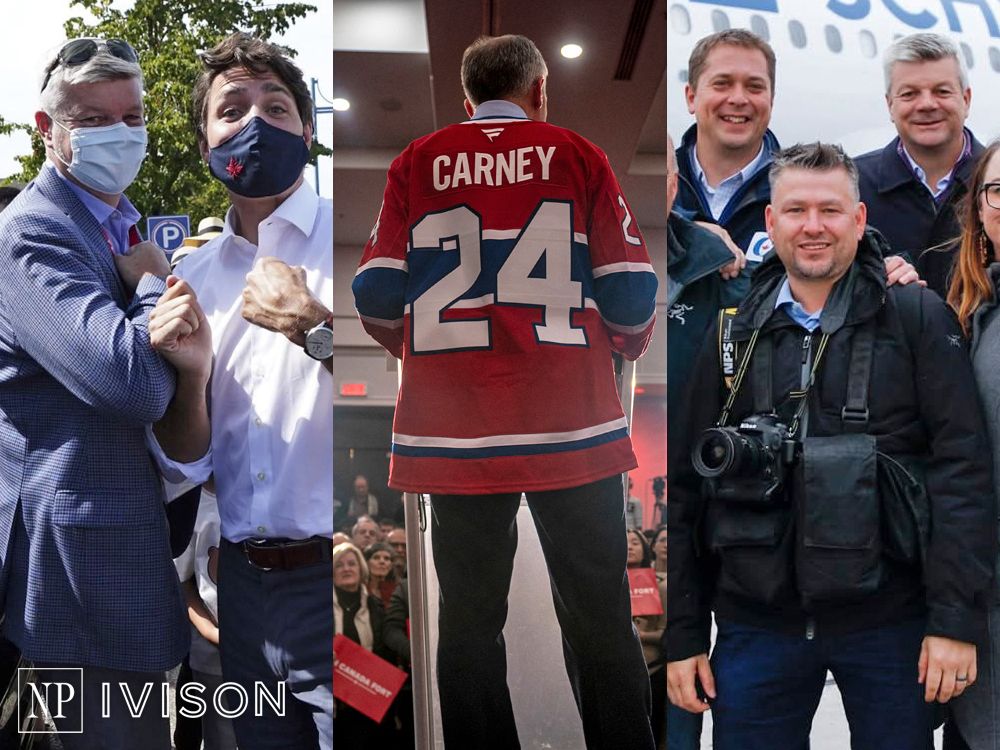
Every election campaign brings me back to Timothy Crouse’s classic account of the George McGovern U.S. presidential bid in 1972, The Boys on the Bus.

Crouse said that what reporters know best, is not the voters but the tiny community of the press bus and plane, “a totally abnormal world that combines the incestuousness of New England hamlet, with the giddiness of a mid-ocean gala and the physical rigour of the Long March”.

This is my eighth general election and it’s an accurate description.

The past week on the Carney Express has involved a lot of hurry up and wait; being shepherded onto buses and planes: arriving like thieves in the night at some unremarkable hotel and leaving as the sun is coming up.

“Did you enjoy your stay,” I was asked when checking out in Montreal. It was hard to say. We’d only been there for eight hours, six of them asleep.

The days are a blur. On Sunday, after a rally in Nepean, we flew to Prince Edward Island, landing in the teeth of a cyclone. It was a huge relief not to end up as the eighth paragraph of a PM plane crash story.

Next morning, we flew to Nova Scotia, New Brunswick and fell asleep in Quebec City.

Once a day, we get a chance to question the candidate for 15 minutes, which forms the basis for the day’s news. Not everyone gets a question, so reporters huddle – not so much a conspiracy as colleagues cooperating to ensure everyone’s questions are covered.

Most days, the candidate will take part in a ludicrous photo op requiring him to risk losing a digit on a saw at some factory or other.

I bumped into Carney while he was having breakfast and he told me as Bank of England governor, he once had to drive a simulator around a racetrack at the Jaguar car factory. “Has anyone ever made it round,” he asked. “Lewis Hamilton almost did,” came the reply. The headline of the Governor crashing the economy into a wall wrote itself.

Carney was much more comfortable playing road hockey with a bunch of 10 year olds, his only concern being that he might take out one of the kids. Elbows were down for the day.

The rule on tour is never turn down the chance to eat, drink or visit a bathroom that isn’t moving.

Exposure to normal voters and fresh air is strictly circumscribed. Access to too much alcohol and fried chicken is unbounded.

The reporters seem younger and more respectful than the old school like my friend Richard “the Badger” Brennan, who was apt to climb on the bus and inquire: “Is that the smell of fresh brewed coffee or Liberal arrogance?”

I’ve travelled on three campaigns covering Justin Trudeau, four with Stephen Harper; I was in the Rockies with Andrew Scheer and watched Jagmeet Singh longboat on the tarmac in Halifax and found quiet time to write a column on a bench in Kelowna.

At the end of the 2004 campaign, I woke up in the Maritimes with the Paul Martin campaign. We travelled to Chester, NS, where Martin dipped his toe in the Atlantic. We were heading to Vancouver, with stops in Gatineau, Toronto and Winnipeg. We had our end of tour dinner at 2am on the West Coast, while Martin dipped his toes in the Pacific, and then we all hopped back on the plane to fly to Montreal. Reporters were left trying to figure out whether they could claim overtime for a 25-hour day.

So why do we do it?

There really is no substitute for watching the pretenders for the job of prime minister up close as they deal with the slings and arrows of a campaign.

 Liberal Leader Mark Carney puts his fingers at risk for a photo-op as tries his hand at woodworking during a campaign stop on March 31.

The leaders’ tour is still the focus for election campaigns and polling numbers tend to rise when the leader comes to town.

Carney has shown remarkable energy for a 60-year-old. But then, he was up in the gym at 4.45 on the day we left Quebec City. This is the culmination of his life’s work and the adrenaline is flowing.

That’s not always the case. Watching Stéphane Dion and Michael Ignatieff campaign as Liberal leaders in 2008 and 2011, it was obvious that it just wasn’t them and that they were living in bubbles of their own self-narrative. One Liberal told me that Ignatieff collapsed exhausted in the green room, after working a room full of supporters, only to be told by Justin Trudeau that he had to feed off the energy of the crowd, rather than be drained by it. Trudeau is a natural at the performative side of politics but it did not come easily to Ignatieff.

Carney does not have the muscle memory of a seasoned campaigner, particularly in French. His speech in Laval on Tuesday was flat and people started to wander out long before the end.

He needs to have a rousing closing rally in the GTA on Saturday, asking the question about who is best prepared to negotiate with Donald Trump next week, if he is going to seal the deal and win a majority.

But there is a weightlessness to the Liberal campaign at the moment.

It’s not scientific but there’s a whiff of pheromones around winning campaigns; they tend to strut like stray cats. The Liberals are trying their hardest not to strut.

I’ll be back with a campaign post-mortem next week. Until then, thanks for watching.

Get more deep-dive National Post political coverage and analysis in your inbox with the Political Hack newsletter, where Ottawa bureau chief Stuart Thomson and political analyst Tasha Kheiriddin get at what’s really going on behind the scenes on Parliament Hill every Wednesday and Friday, exclusively for subscribers. Sign up here.


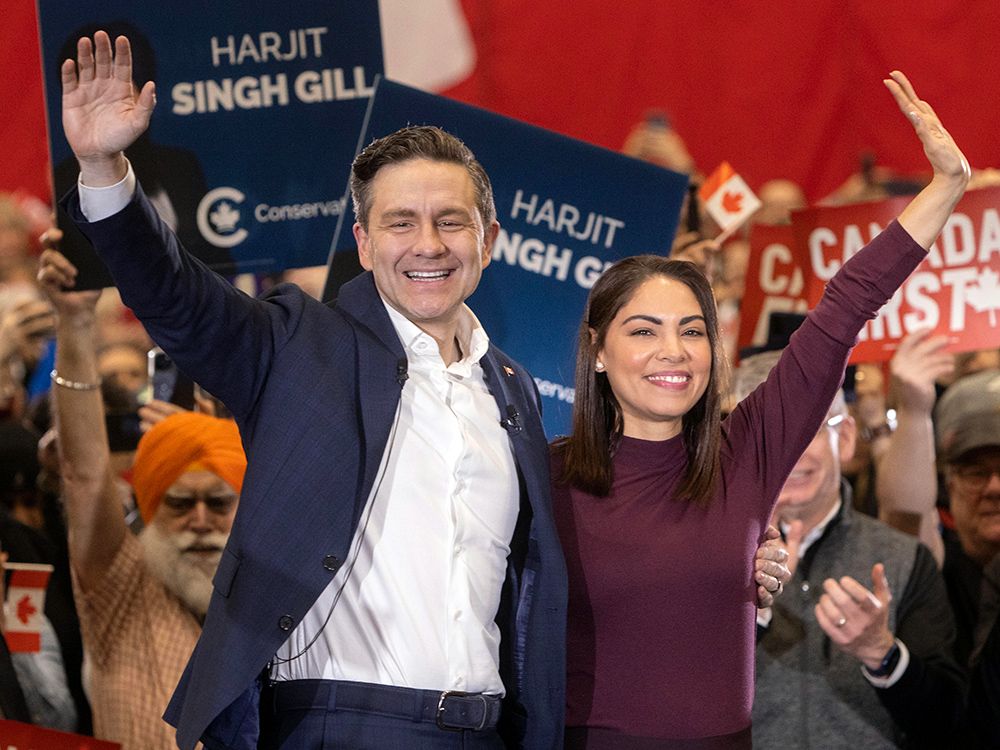
Conservative Party Leader Pierre Poilievre with his wife Anaida during a campaign rally in Surrey, BC, March 27, 2025.

Third in a series of profiles of the major party leaders.

For a second, Mark Carney didn’t know where to look.

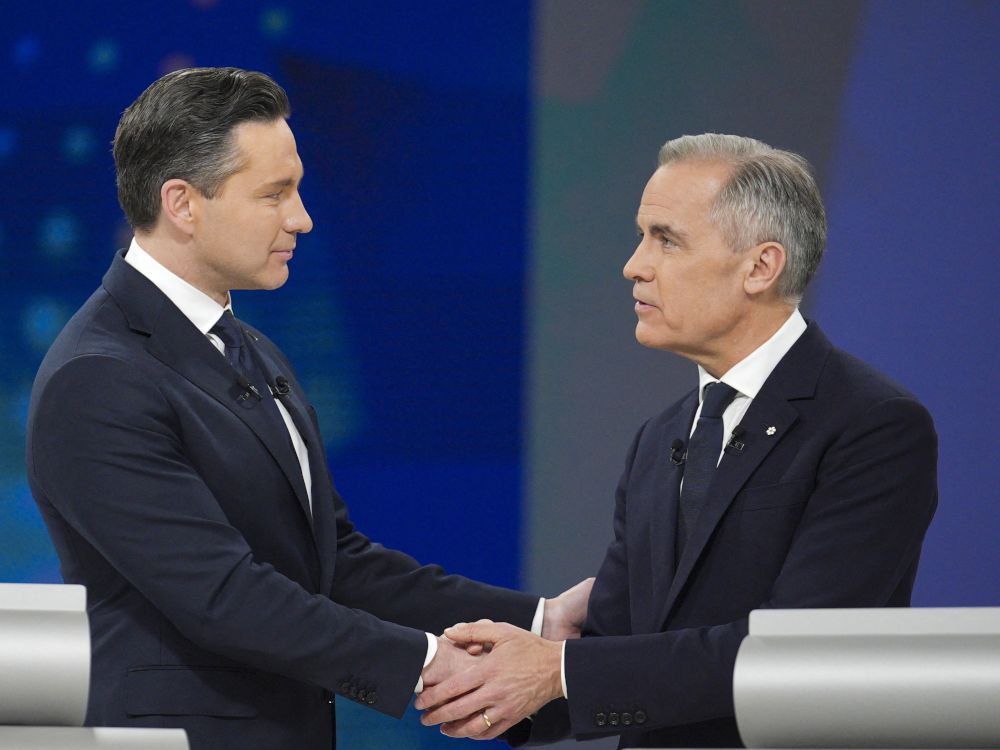
The English language debate had just ended. Carney had to look somewhere, he couldn’t just keep shuffling his papers. To his left, host Steve Paikin was walking toward Yves-François Blanchet to say happy birthday. If Carney turned that way, the final image of the leaders all together before this tight election would be him shaking hands with NDP Leader Jagmeet Singh.

From Carney’s right came a friendly voice. His head swivelled like a bird looking for food. It made for a striking moment, this little formality, and Pierre Poilievre seemed the more natural for initiating it. Carney leapt at the opportunity, leaning in with a smile to talk in his ear, patting him warmly.

It was funny to imagine Poilievre and Justin Trudeau looking like that, after such a long animosity. Trudeau especially would look like he was faking nice, as no doubt he would be.

Other moments like this have humanized Poilievre in the eyes of voters. He has shown off his family and told personal stories, talking about being adopted from a teenaged mother, and about his own young daughter who has special needs. But to emotionally familiarize the man behind the politician never seemed like core strategy for the Conservative Party of Canada.

 Conservative Leader Pierre Poilievre, left, and Liberal Leader Mark Carney shake hands following the English federal leaders debate, in Montreal on April 17.

People don’t swoon over Poilievre. That’s the point. Many Canadians are frankly embarrassed about having once liked Trudeau so much, whose life they had known since his childhood.

So it seemed fine just to be the guy who identifies big problems and proposes workable solutions, a slightly prickly but detail oriented policy obsessive who isn’t in it for the personal affection. It’s an election, not a date. This seemed to be the Conservative attitude, and for a while, it looked to be a winner. Odds are you’re never having that beer with the prime minister anyway, so who cares whether you’d have fun or not. On the other hand, if you elect him, you’ll definitely pay his taxes. This was to be an election about economic priorities and common sense.

If Poilievre ever turned out to be charming, it would be like Stephen Harper’s surprise appearance at a charity gala singing the Beatles on piano in 2009. It would happen after he won, and it would look like a kind of retrospective proof that he was the right choice all along, that he didn’t just catch a wave of popularity and surf it into the ground.

Some people wouldn’t need that proof. Some Canadians naturally warm to an abrasive career politician famous for his parliamentary belligerence, who quotes Margaret Thatcher as much as Winston Churchill, and who prides himself on lifelong ideological consistency as a disciple of Milton Friedman.

But those Canadians were already going to vote Conservative. It’s the rest who are Poilievre’s problem, those to whom the debate’s final moment likely appealed, the ones who were looking at Carney.

“This is not the election (Poilievre) wanted,” said Tamara Small, professor of political science at the University of Guelph.

Conservatives spent time and money establishing what they thought was the ballot question: affordability. They were out in communities, talking “Justinflation,” winning support. Their foil was a washed up, tired out Liberal Party under an unpopular leader, who was weak in his own caucus and irked Canadians in general for diverse reasons, much of it boiling down to an arrogant self-confidence that had gone stale.

Polling showed Conservatives were establishing themselves as a government in waiting. They had a convincing message and an established leader who was credibly selling his policy competence.

“His introduction was that ‘I’m going to fix all these problems,’ and people were like, ‘Good!’” Small said. The Conservatives “had everything.”

That included some remarkably good timing in global politics. Two winds blew favourably for Poilievre and his party. One was a rising right-wing populism, fuelled by the anti-woke backlash, inspired by the sense that the progressive left had overreached and was overdue for a reckoning.

The other was an anti-incumbency sentiment. After the pandemic, many Western democracies were ready for something new, whether small parties rising to first ever influence, or parties as grand as the British Labour Party sweeping out the Conservatives to take a historic majority.

Poilievre was looking like he would be the blue version of British Labour Prime Minister Kier Starmer. Canada’s Liberals were going the way of America’s Democrats, directionless, playing the tired old hits for a bored audience of blinkered partisans, losing core voters and gaining none.

People might eventually sour on Poilievre, as they have lately on Starmer, but first he was set to win big, the first Canadian Conservative majority since 2011.

Today, both those winds have died down, and now neither seems to be as much help to Poilievre. Now voters are taking a new look at him, and he is not to everyone’s taste.

Donald Trump’s economic hostility to Canada and the world has changed the ballot question, and Poilievre has arguably been slow to respond. There has been a “reset” that has shown, as Small puts it, “the F–k Trudeau stuff isn’t F–k Liberals.”

Poilievre’s key message that “Canada is broken” is “a hard message to pivot from,” Small said, especially when the mood tilts toward rallying around the flag. Voters might actually have an appetite for an attack dog politician right now, but the general sense is that he should be attacking the enemy without, not within.

“People want an adult in the room against Trump. Even Poilievre’s combative nature doesn’t help him on this,” Small said. “This is why it’s frustrating for Poilievre. Because the shift in opinion is not about him. People are not moving away from Poilievre because his ideas are bad. They just have another option.”

One of Poilievre’s closer friendships and political alliances is with the lawyer and author Adam Daifallah, who co-wrote Rescuing Canada’s Right: Blueprint for a Conservative Revolution (2005) and Gritlock: Are the Liberals in Forever? (2001).

“Pierre is above all else an ideas person. Ideas have always excited him,” Daifallah said. “He’s a problem solver. He’s averse to the status quo and is always thinking up better ways to do things in line with his principles.”

Poilievre is a “true believer,” Daifallah said. “You’ll never agree with him 100 per cent of the time, what you see is what you get.”

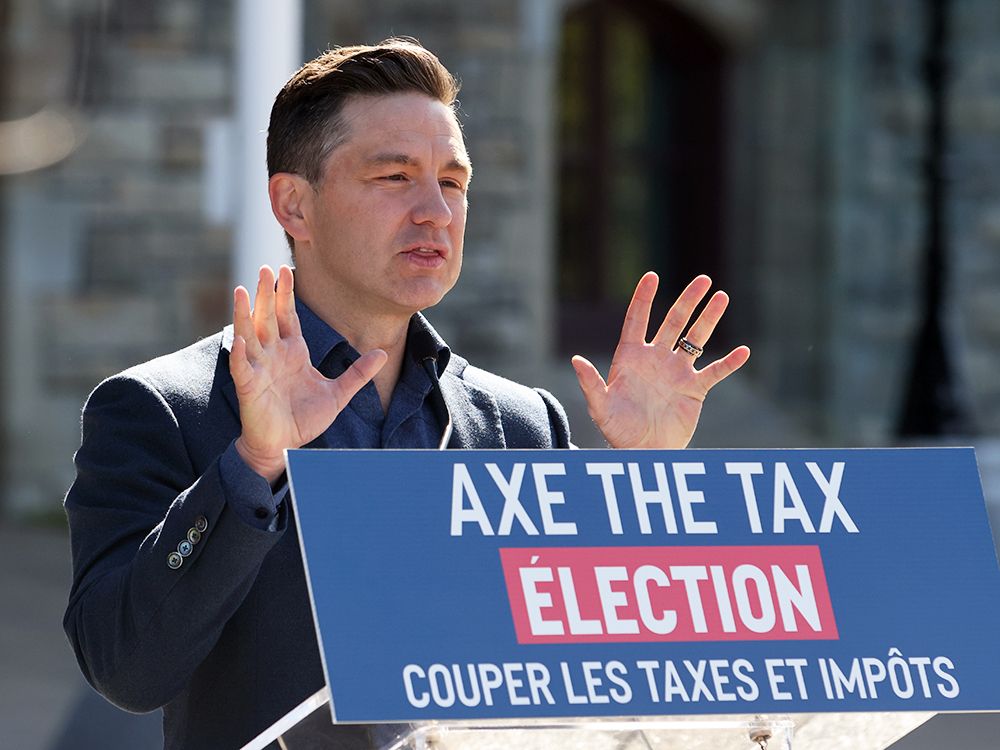
 Conservative Party Leader Pierre Poilievre speaks at a news conference in August 2024. Even then, the Conservatives were prepared to centre an eventual election campaign on the affordability issue.

It is notable, for example, that Poilievre has rarely been accused of having anything like a “hidden agenda,” which was the Canadian left’s favourite dig at Harper. The left also dislikes Poilievre, but for reasons that are out in the open. Nothing seems hidden.

“He’s truly authentic and genuine in that sense,” Daifallah said. “He’s not one to change views for the sake of expediency.”

This pride in intellectual consistency is a contrast with Harper, said Jim Farney, professor of political studies at the University of Regina, director of its graduate school for public policy, and an expert in the politics of Canadian social conservatism.

He recalled the passage in Harper’s memoirs about the 2008 financial crisis, and the difficult choice between conservative principles and the lives of real working people in, for example, Ontario auto manufacturing.

“Harper was aware and landed on the side of being a centre-right pragmatist,” Farney said. “It was the experience of governing that did that…. There was a definite evolution there. I don’t think we’ve seen that with Poilievre.”

Poilievre has a steelier ideological spine. One common view is that this makes it tricky to pivot to a tone of prime ministerial magnanimity, even compromise, in order to attract the widest possible support. Farney doesn’t think this is quite right.

“I think it was fine three months ago,” Farney said. Poilievre has been “brilliant” at understanding the questions that motivate voters and expressing them, especially in videos. Passports shouldn’t take forever, the Canada Revenue Agency should be efficient, gas should be affordable.

“I think he really captured that disconnect,” Farney said, particularly with men under 35. “In the environment we had, with a tired, unpopular prime minister, being the guy who could connect with your problems makes you a good opposition leader. It doesn’t make for a great prime minister.”

But Poilievre’s doctrinaire side looks more like a liability if the ballot question has fully flipped from affordability to sovereignty.

“He’s struggling to hit that,” Farney said a few weeks into the campaign. The answer to a sovereignty problem is state power, and this does not align well with Conservative attitudes. “It’s a different way of thinking about what government can do and how it should behave toward people. It’s a difficult adjustment.”

“They’re hearing on the doorstep that their answers are not to the questions people are asking,” Farney said. On the other hand, “it may be that things don’t look as bad to them as to folks on the outside.”

Farney described an idea advocated by Harper-era Tory advisor Tom Flanagan, that Conservatives should aim for the minimum necessary coalition, rather than try to appeal to the widest spectrum through magnanimity and compromise.

“If they go too big and win like Mulroney in 1988, caucus is unmanageable,” Farney said. If the primary goal is governing, the theory goes, Conservatives should aim for the smallest possible majority. “That can be coherent and you can have two terms.”

Trudeau’s resignation on its own was not enough to change that calculus, but Trump was, Farney said. Had it been Chrystia Freeland and Kamala Harris in office today, Poilievre would probably be cruising to victory, and Liberals fighting for survival.

“One thing that has been confusing is why the Conservatives have hammered so hard on Singh and the supply and confidence agreement, because when the NDP is strong, that’s good for Conservatives,” said Elizabeth Goodyear-Grant, professor of political studies at Queen’s University and director of the Canadian Opinion Research Archive.

The “Sellout Singh” line the Conservatives pushed when the NDP declined to bring down the government in a confidence vote was “a dumb move,” Goodyear-Grant said, because the longer the NDP is popular, the worse the Liberals fare in elections. With Liberals and NDP effectively tied, as they were, Conservatives had a clear path to a majority. But now the centre-left is uniting behind the Liberals, with Liberal majority a plausible outcome according to polls.

If the Conservatives had hoped to shoplift some seats from the NDP on their way to power, especially in B.C., that possibility now seems remote, unless things break late for the Tories.

“I don’t know where he goes politically from here,” Goodyear-Grant said.

In his 2006 book Right Side Up, on the success of Harper’s Conservatives, the journalist Paul Wells quotes Poilievre saying that everyone wrongly thinks Harper “seduced” the centre when actually he “tamed” the right.

Goodyear-Grant thinks this assessment is more or less correct, but the right has since changed and become, for Poilievre, “less tameable.”

Harper had a managerial talent that could rally diverse factions to a common cause. But this is a new world, and the Conservative coalition has become more difficult to keep united in a way that appeals to a winning proportion of Canadian voters.

“It is a tent that is fraying,” Goodyear-Grant said. One proven solution is the pragmatism of Ontario Premier Doug Ford, who recently took a third Progressive Conservative majority with a nationalistic campaign message that “Canada is not for sale,” and who often seems more friendly with federal Liberals than with Poilievre’s Tories. What Poilievre does to unify and embolden his party, on the other hand, often seems to exclude the very voters he needs to flip.

Poilievre is famously hostile to news reporters. On this campaign, some are invited from friendly alternative and fringe media to ask softball questions. Others in the mainstream are treated as patsies for social media content, such as when Poilievre took a question from Globe and Mail political reporter Laura Stone, then did the Columbo “oh, just one more thing” bit with an unctuous smile, asking her how big she thought his rally was last night.

Some people like to see Poilievre handle reporters with smug condescension. But those people are already voting for him. Their enthusiasm is strategically wasted.

That’s what happened in an Okanagan orchard in the fall of 2023 when Poilievre was asked on camera by a local journalist about his “populist” strategy of “appealing to people’s more emotional levels” and using “strong ideological language.”

Poilievre interrogated him in return, asking who exactly was saying all these things, as he munched a fresh apple, chewing as he waited his turn to toy with the poorly prepared journalist, and to swat his weak questions like flies.

It wouldn’t have worked with a peach or a handful of blueberries. No other fruit evokes Eve and the serpent, worms, “American as apple pie,” Johnny Appleseed, Isaac Newton, William Tell, Snow White, and Matt Damon in Good Will Hunting saying “How do you like them apples?”

It was the richest metaphor possible, under the circumstances, and many people loved it. This was Poilievre’s first round of major American attention, and it got good play on Republican media, which did not at the time seem like the liability it does today.

Rather, it looked liked two simpatico movements on the road to power. They would see eye to eye, Conservative Canada to Republican America. They’d get rid of woke and fake news and then get along.

Times change. There was a metaphor in common circulation a few months ago, after Trump was elected but before Trudeau resigned. People started talking about politics like a “pendulum.”

The idea was that the political left had crested on a wave of righteous indignance about the great scandals of identity politics, but now the wokesters were finding out what it’s like for a political movement to run out of momentum.

Canadian voters were moving right. The pendulum had stopped for an instant, and now was swinging back. Historical time might go in only one direction, forward. But politics oscillates. This electoral physics was once the great opportunity for Poilievre and his Conservative party. Now though, at crunch time, it has become the big problem.

Some of the polls are tightening. Whether that will be enough for Poilievre, Canadians will know on Monday night.

Read Jagmeet Singh’s profile and Mark Carney’s.


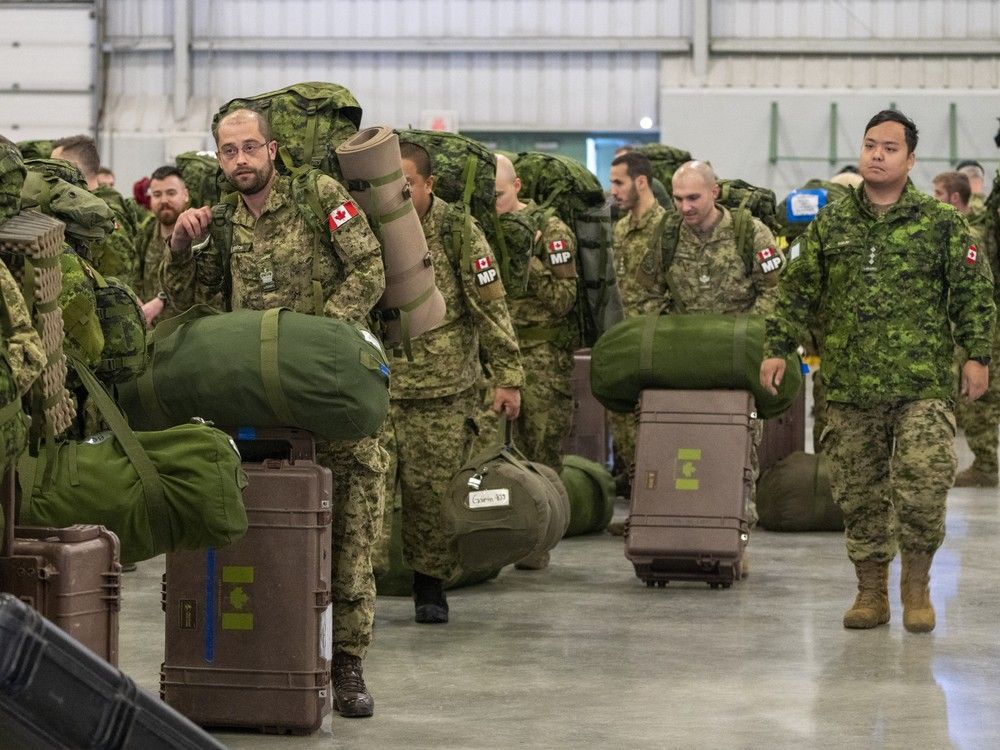
Canadian soldiers line up to load their bags in a truck as they prepare to depart with Op REASSURANCE Battle Group en route to Latvia.

Canada’s military recruiters have their work cut out for them.

A survey of more than 24,000 post-secondary students from across the country shows less than one per cent of them (188) ranked the Canadian Forces as their No. 1 preferred employer after graduation, and just over three per cent (829) identified the organization as among their top three to five choices.

“It’s not the first choice for every student and, from that perspective, they do have their work cut out for them,” said Jay Kipps, founder & CEO of Flint & Steel, an employer branding outfit.

“The talent that is selecting the Canadian Forces among their top five are less likely to be active on LinkedIn. So, your standard approach might not fit this candidate if you’re using a one-size-fits-all strategy.”

The survey of 24,730 students was conducted online between May and July of 2024 by Brainstorm Strategy Group Inc. in partnership with Flint & Steel Inc. Students from 200 different post-secondary institutions, including universities, colleges and institutes of technology each took about 20 minutes to complete it in either English or French.

The results come at a time when Canada’s military needs more recruits.

At the end of 2024, the Canadian Armed Forces had 64,461 regular force members and about 23,177 reservists. It hopes to reach targets for the regular force (71,500) and the reserves (30,000) by 2032 to erase the current shortfall of about 13,862 people.

“What the data would tell us is there is an opportunity here,” Kipps said. “They’ve got wins when it comes to security and stability. This is a talent sector that’s more interested in ethics and being selfless than their own personal success. So, from that perspective, they are sort of service minded.”

When asked if they wanted to find an organization where they could spend their whole career, the military-aligned students were more likely to say yes (60 per cent) than the overall group (53 per cent).

“The military has a natural fit for this talent’s propensity towards security and stability,” Kipps said.

They were also slightly more likely to say they wanted to start their careers in Canada (90 per cent) versus 88 per cent for the overall group.

When folks interested in military careers were asked what attributes they most associate with, their top choices were professional training and development, as well as secure employment (tied at 64 per cent), followed by good benefits (61 per cent), interesting work (59 per cent), good opportunities for advancement (53 per cent) and good prospects for high future earnings (42 per cent).

Those interested in donning military uniforms were slightly more optimistic about their future careers, with 16 per cent indicating they strongly disagree that the current economy makes them worry about their job prospects versus 12 per cent in the overall group.

They were also less concerned about whether artificial intelligence would affect their future careers, with 32 per cent strongly disagreeing it would, versus 28 per cent in the overall group.

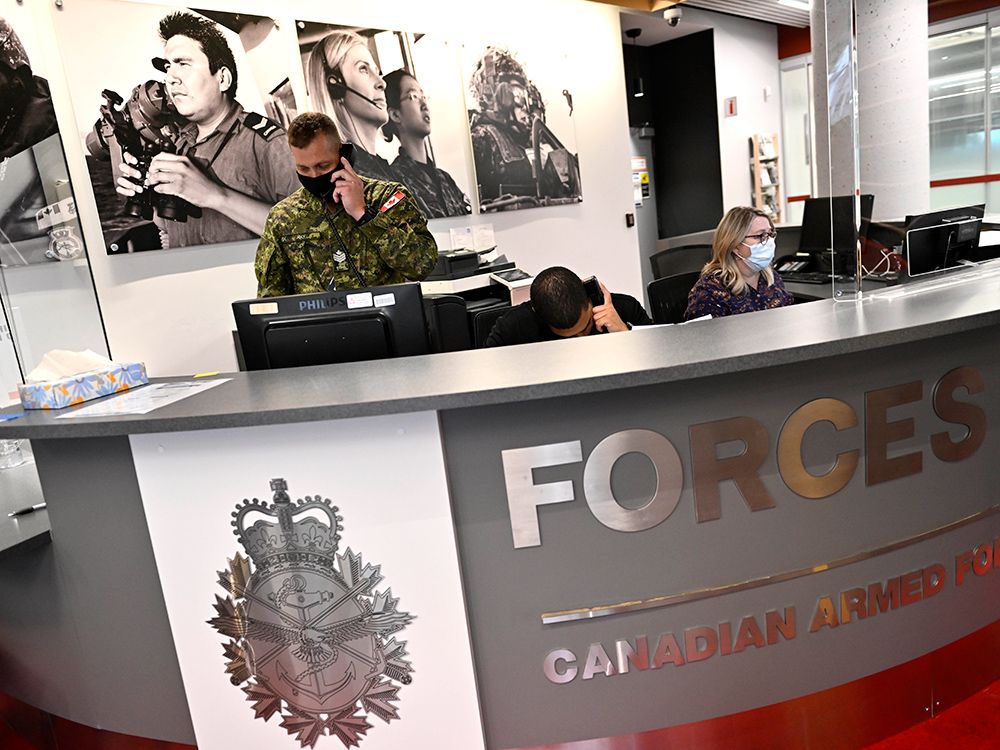
 Staff work at a Canadian Armed Forces recruitment centre in Ottawa in September 2022.

Less of the military-aligned group had created a resume (62 per cent versus 66 per cent of the larger group), but they were more likely to have worked in their field of interest (52 per cent versus 46 per cent of the overall sample).

Only 40 per cent of them had set up a LinkedIn profile, versus 52 per cent of all the students surveyed.

Fifty-seven per cent indicated their biggest stressor was finances, versus 53 per cent in the overall group.

Just over half (51 per cent) said it was important that future employers have informative websites, versus 29 per cent in the larger sample.

Just under half (49 per cent) indicated campus career fairs were important to them, with 40 per cent of the overall group saying the same thing.

They were also more likely to participate in networking events (40 per cent) than the larger group (34 per cent).

They were less likely to support diversity, equity and inclusion issues, with 45 per cent saying it was the most important aspect of an employer’s social responsibility, versus 50 per cent in the overall sample. In a similar vein, they were also less likely to choose advancing women in the workplace as their top issue (27 per cent versus 31 per cent in the overall group).

Kipps cautioned that recruiters shouldn’t just target those who express interest in joining the military.

“There’s still also an important effort that has to be made to reach talent that aren’t currently identifying Canadian Armed Forces as their top choice,” he said. “Catering your decisions too much to reaching the talent that’s already drinking the Kool-Aid might be a little bit limiting.”

Our website is the place for the latest breaking news, exclusive scoops, longreads and provocative commentary. Please bookmark nationalpost.com and sign up for our daily newsletter, Posted, here.


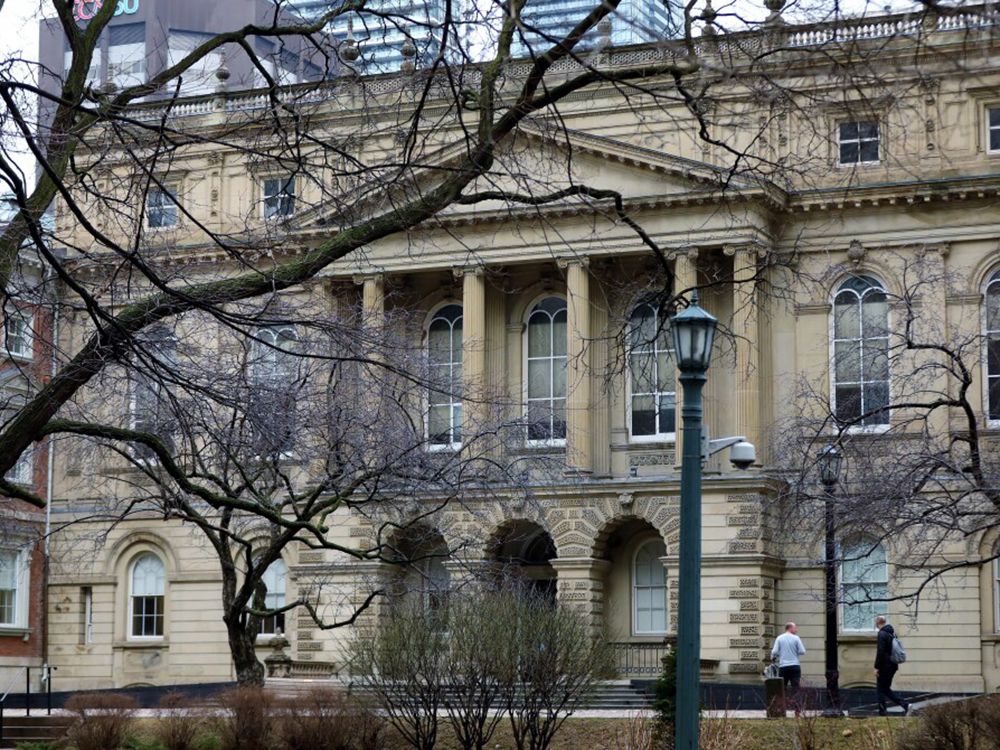
The Ontario Court of Appeal is seen in Toronto in 2019.

Ontario’s top court has ruled the province must cover the cost of an out-of-country, penis-sparing vaginoplasty for a “transgender and non-binary resident” who wishes to have both female and male genitalia.

In a unanimous decision released this week, a three-judge panel of the Ontario Court of Appeal confirmed a lower court’s ruling ordering the Ontario Health Insurance Plan to pay for the patient, identified as K.S. in court records, to undergo the novel phallus-sparing surgery at a Texas clinic.

The latest ruling is the third unanimous decision in K.S.’s favour.

“K.S. is pleased with the Court of Appeal’s decision, which is now the third unanimous ruling confirming that her gender affirming surgery is covered under Ontario’s Health Insurance Act and its regulation,” K.S.’s lawyer, John McIntyre, said in an email to National Post.

The legal battle between K.S., whose sex at birth was male, dates to 2022, when the Ontario Health Insurance Plan (OHIP) refused a funding request for surgery to construct a vagina while sparing the penis, a procedure this is not available in Ontario, or anywhere else in Canada.

OHIP argued that, because the vaginoplasty would not be accompanied by a penectomy, the procedure isn’t one specifically listed in OHIP’s Schedule of Benefits and therefore shouldn’t be publicly funded. OHIP also argued that the requested surgery is considered experimental in Ontario and, thus, also ineligible for coverage.

K.S. appealed to the Health Services Appeal and Review Board, which overturned OHIP’s refusal, arguing that “vaginoplasty” should be covered, whether a penectomy, a separate procedure included on the list of publicly funded sex-reassignment surgeries, is performed or not.

OHIP appealed that decision to the Divisional Court but lost again after the panel dismissed the province’s appeal and declared the surgery, which leaves intact a functioning penis, an insured service.

The province’s latest appeal was heard on Nov. 26. The three-judge appeal court panel rejected OHIP’s arguments that the proposed surgery isn’t an insured service because it won’t be accompanied by removal of the penis — a penectomy “neither recommended by K.S.’s health professionals nor desired by K.S.,” according to the court’s written decision.

K.S., who is in her early 30s, “has experienced significant gender dysphoria since her teenage years, as well as physical, mental and economic hardships to transition her gender expression to align with her gender identity,” the court said.

K.S.’s doctor submitted a request to OHIP for prior funding approval for the surgical creation of a vaginal cavity and external vulva. The request made it clear that K.S. wasn’t seeking a penectomy.

In a letter accompanying the request, her doctor said that because K.S. is “not completely on the ‘feminine’ end of the spectrum” it was important for her to have a vagina while maintaining her penis, adding that the Crane Center for Transgender Surgery in Austin, Tx.,”has an excellent reputation” for gender-affirming surgery, “and especially with these more complicated procedures.”

The appeal court ruled that the divisional court did not err in holding that the requested vaginoplasty is listed in the Schedule of Benefits, with or without an accompanying penectomy.

“The existence of different techniques to perform a vaginoplasty does not affect this conclusion,” the appeal court’s written decision reads. “It was open to the drafters of the Schedule of Benefits to describe each specifically listed service in broad or narrow terms.

“Here the description chosen, ‘vaginoplasty,’ is broad enough to encompass different techniques,” the court said.

“As the (Health Services Appeal and Review) Board put it, a vaginoplasty without a penectomy is an insured service because it is still a vaginoplasty, a specifically listed service.”

The World Professional Association for Transgender Health’s standards of care, the appeal court added, also “expressly refers to ‘penile preserving vaginoplasty’ as a surgical option for some non-binary people and also note that vaginoplasty ‘may include retention of penis and/or testicle.’”

Ontario has until June 23, 2025, to seek leave to the Supreme Court of Canada. 


“As this matter is within the appeal period, it would be inappropriate to comment further,” said a spokesperson for Ontario’s Ministry of the Attorney General.

In dismissing OHIP’s appeal, the court ordered Ontario to pay K.S. $23,250 in costs.

Gender-affirming surgeries at the Texas clinic range from US$10,000 to $70,000, depending on the procedures performed.

National Post


Our website is the place for the latest breaking news, exclusive scoops, longreads and provocative commentary. Please bookmark nationalpost.com and sign up for our daily newsletter, Posted, here.


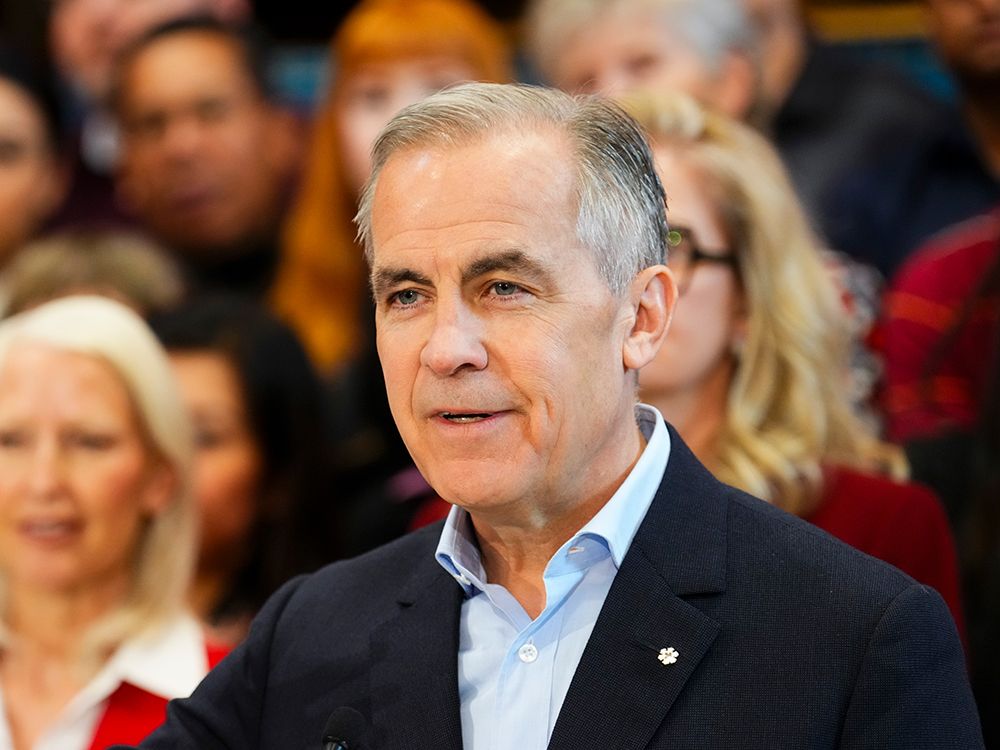
Liberal Leader Mark Carney speaks to reporters during a campaign stop at AMPCO Manufacturers in Coquitlam, B.C., on Thursday, April 24, 2025.

COQUITLAM, B.C. – Mark Carney has led a charmed life since entering politics.

Even the latest mini-scandal that broke on Thursday works in his favour, given it concerns a subject he is desperate to talk about.

Radio-Canada reported that in Carney’s call with Donald Trump on March 28, the president brought up the issue of Canada becoming the 51st state of the United States. At the time, Carney said Trump had respected Canada sovereignty and had parked his expansionist language.

Carney

admitted on Thursday that Trump did raise the 51st state issue

. “I said he did,” he said — which he didn’t. “I was clear with everyone.”

The issue of whether the Liberal leader misled people speaks to his character, and whether he is prone to elide certain, inconvenient facts.

But more pertinent to the vote on Monday, he was able to quickly turn the situation to his advantage.

Carney was speaking at the AMPCO auto manufacturing plant in the B.C. riding of Port Moody—Coquitlam. He referred to the comments made by Trump in the Oval Office on Wednesday, when the president said he does not want Canada to play any part in the North American auto industry. “I will be equally clear. This is Canada and we decide what happens here,” Carney said.

The Conservative campaign must have felt like taking to the window ledges when the feed came out of the White House Wednesday of

Trump musing again about Canada becoming the 51st state

. If Conservative Leader Pierre Poilievre fell into a bucket of lollipops, he’d come out sucking his thumb, such is his luck at the moment.

When pressed by reporters in Coquitlam, Carney said Trump “has these things in his mind — it’s not new.”

But he said the more important question is: what’s going to be done?

“This has to be a serious discussion between sovereign nations. That’s what he and I agreed. It’s not a photo op, it’s not a visit to Mar-a-Lago.”

He has repeatedly contrasted his resumé with Poilievre’s, when it comes to international crises. “A crisis is a time for experience, not experiments,” he said at the rally in Cloverdale, B.C., on Wednesday evening.

Any conversation that ends with Carney reciting his mantra: “The president wants to break us so he can own us,” is a good day for the Liberals, regardless of the preamble.

It underscores the unusual nature of this general election.

Anyone who has worked on previous tilts usually resorts to the cliché that “campaigns matter.” It is a cliché for a reason: they usually do.

But this one has not — at least, not so far.

Carney became Liberal leader on March 9. It was after that victory that the polls flipped, and the Conservative party’s dominance of public opinion ended. There have been 153 polls since then and the Conservatives have only been ahead in seven (three from the same pollster). The gap between the two leading parties has barely shifted during the April campaign, despite all the mud that has been slung.

The lead has remained constant throughout the campaign, regardless of debates, phantom numbers in the platform and the leader forgetting key facts, like the president disrespecting Canadian sovereignty on their phone call.

It is all the more unusual since, though the Liberal leader exudes confidence and has a plausible manner, there is no Carney-mania. At rallies in Laval and the lower mainland of B.C. this week there was a tangible enthusiasm gap. The leader’s speeches undulate and meander, rarely reaching the crescendo the crowd is desperately awaiting. He is hesitant in French and halting in English, apparently still learning to use the teleprompter.

None of this has mattered to this point.

A plurality of Canadians decided in mid-March that Trump’s musings about taking over Canada were so alarming they required an experienced leader with a plan to fight back, and that all other concerns were subsidiary.

Into this breach, with providential timing, stepped Carney.

He would probably argue that his good fortune is the consequence of opportunity meeting preparation — and there is some truth to this. He didn’t just start saying: “Build, baby, build” six weeks ago.

But his timing has been uncanny,

Wrap all of that in

a parable combining hockey and Canadian exceptionalism

— “Canadians are always ready when someone else drops the gloves” — and you have a powerful narrative to peddle to voters. With just four days until polling day, it may be enough, no matter how clumsily it is delivered.

National Post

jivison@criffel.ca

Get more deep-dive National Post political coverage and analysis in your inbox with the Political Hack newsletter, where Ottawa bureau chief Stuart Thomson and political analyst Tasha Kheiriddin get at what’s really going on behind the scenes on Parliament Hill every Wednesday and Friday, exclusively for subscribers. Sign up here.


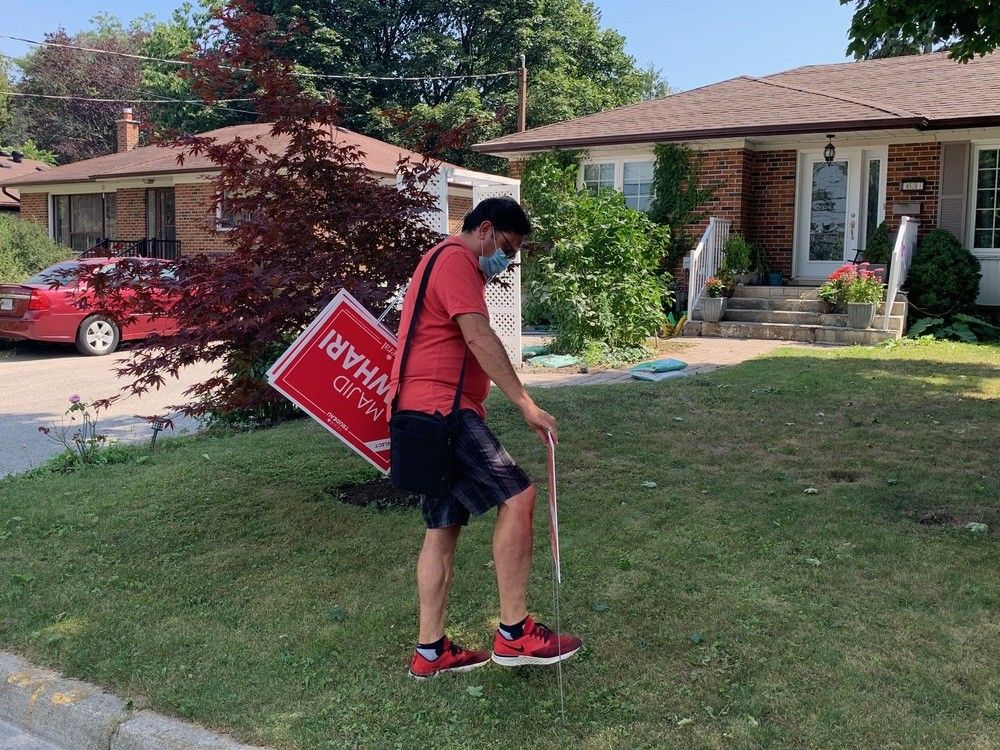
Liberal candidate Majid Jowhari puts a lawn sign into the ground of a supporter in Richmond Hill in 2021.

MISSISSAUGA, ONT.

Days after Liberal Leader Mark Carney named China as Canada’s biggest security threat, a video published by a Chinese-language media outlet shows one of his Liberal candidates calling China one of its “like-minded allies.”

In the recently-filmed video posted on Sunday, Majid Jowhari, the Liberal incumbent in the Greater Toronto Area riding of Richmond Hill South, also argued that Canada needs to deepen its trade ties with China amid the trade war with the United States.

His comments are notable because they appear to contrast starkly with Carney’s view on China expressed during the English-language debate last week.

“I think the biggest security threat to Canada is China,” Carney said when asked to name the most significant threat facing the country.

Jowhari’s was first elected in 2015 in Richmond Hill, a riding where 32.6 per cent of residents are of Chinese descent,

according to 2021 census data

. Conservative candidate and corporate lawyer Vincent Ho is challenging him for the seat.

In the roughly two-minute video, Jowhari outlines his role as co-chair of Parliament’s Canada-China legislative association and calls himself an advocate for the local Chinese-Canadian community.

“In the time of growing uncertainty and Trump’s tariffs threatening our economy and our sovereignty, it’s more important (than) ever to protect and strengthen partnership with key trading partners such as Europe and China,” Jowhari says in the video,

published on Sunday

on the

North American Canadian Voice Cultural Media’s website. 

Jowhari also discusses his work on Parliament Hill advocating against anti-Asian racism and says he has visited China “many times.”

“The blend of tradition and innovation is something that I admire. Deepening our partnership with like-minded allies such as China present opportunities for shared prosperity and supports Canadians’ role as a constructive and engaged player in the global economy.”

He ends the video by saying the “Chinese community needs a strong voice to fight for them.”

“The Liberal party needs a voice to help strengthen the partnership between Canada, Chinese-Canadians and China. I am Majid Jowhari and I can be that voice. Please vote for Majid Jowhari on April 28. Thank you.”

Reached for comment, Jowhari’s campaign declined to respond. National Post has also sought comment from the Liberal party campaign.

The outlet that published his video describes itself as being “rooted” in Toronto and says it uses its website and WeChat to publish “stories of Chinese people living abroad.” 

For years, Canadian national security agencies have considered China to be the most serious and sophisticated threat actor against Canada.

Twice already this campaign, the federal election monitoring task force has warned that the People’s Republic of China (PRC) was likely behind influence campaigns in Canada.

On Monday, members of the Security and Intelligence Threats to Elections (SITE) task force said the PRC appeared to be behind a transnational repression operation to undermine Joe Tay, a Toronto-area Conservative candidate and vocal critic of the Chinese regime.

SITE members said they suspected the PRC was pushing a mock “wanted” poster of Tay online and boosting disparaging stories about the Hong Kong democracy activist while suppressing searches of his name on China-based social media platforms.

“A Liberal candidate calls China a ‘like-minded ally. CSIS (Canadian Security Intelligence Service) says China is the most serious threat actor. SITE is tracking China’s (disinformation) ops. Yet the Liberals keep sidling up,” Conservative incumbent Michael Chong posted to X.

“It’s time to treat national security seriously. Vote Conservative.”

Two weeks ago,

the electoral interference watchdog said

the PRC was behind an information manipulation campaign on China’s largest social media network WeChat to influence opinion of Carney.

The Liberals have also come under fire for their candidates’ perceived proximity to individuals suspected of ties with the Chinese government.

Last week, National Post reported that a Montreal-area Liberal candidate

invited the head of two organizations

suspected by the RCMP of operating a secret Chinese police station to a campaign event.

The previous week, this newspaper reported

on new evidence of friendly ties between the Chinese government and another Toronto-area Liberal candidate who attended a massive military parade and show of martial strength in Beijing a decade ago.

Peter Yuen, the Liberal candidate in Markham—Unionville, attended the event on the invitation of a Chinese agency dedicated to influencing ethnic Chinese in other countries.

Yuen replaced former Liberal incumbent Paul Chiang after he stepped aside following the RCMP confirming it was looking into comments that Chiang had previously made to Chinese media about Tay, the Conservatives’ candidate who first vied for the nomination in his riding.

Chiang had told the crowd they could turn Tay over to Chinese authorities to cash in on a

HK$1 million bounty (CAN$184,000) placed on him. Before he stepped aside, Chiang apologized. 

In a report published in January

, Foreign Interference inquiry head Marie-Josée Hogue said the People’s Republic of China was the “main perpetrator” of clandestine and illegal influence operations in the country.

“The PRC uses a range of tools, including Canada-based proxies. These tools include the monitoring of diaspora communities and transnational repression; activities meant to impact the outcome of Canadian democratic processes (including providing financial support to preferred candidates); and clandestinely shaping narratives in support of PRC strategic interests,” read the report.

The Chinese government also exerts significant control on the Chinese-language traditional and social media platforms and uses the influence to promote “pro-PRC narratives, spread disinformation, and suppress anti-China content,” Hogue noted.

More recently, China’s ambassador to China suggested that China and Canada could partner to push back against U.S. Donald Trump’s tariffs.

Chinese Ambassador Wang Di

told The Canadian Press

that “China is Canada’s opportunity, not Canada’s threat.”

National Post,

with additional reporting from The Canadian Press

staylor@postmedia.com

cnardi@postmedia.com

Get more deep-dive National Post political coverage and analysis in your inbox with the Political Hack newsletter, where Ottawa bureau chief Stuart Thomson and political analyst Tasha Kheiriddin get at what’s really going on behind the scenes on Parliament Hill every Wednesday and Friday, exclusively for subscribers. Sign up here.

Our website is the place for the latest breaking news, exclusive scoops, longreads and provocative commentary. Please bookmark nationalpost.com and sign up for our politics newsletter, First Reading, here.


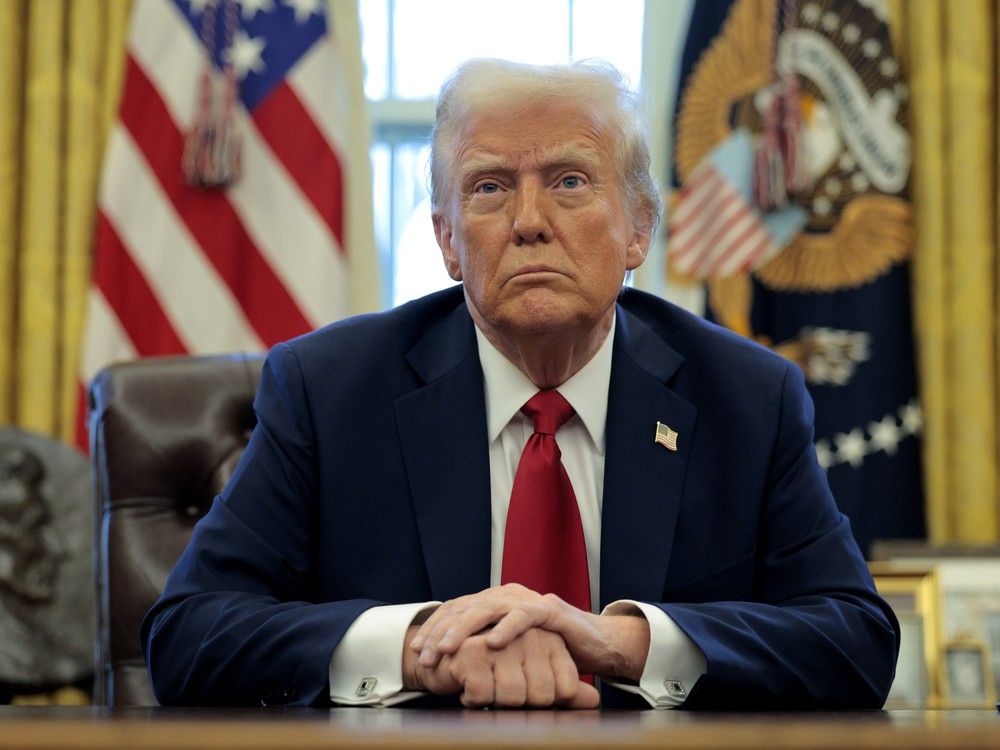
President Donald Trump talks to reporters in the Oval Office.

U.S. President Donald Trump downplayed the steep drop in international tourists to the U.S. during a scrum with reporters in the Oval Office on Wednesday.

“It’s not a big deal,” he responded to a reporter in an exchange shared by

CBS News on X

.

She had remarked that “there are fewer people suddenly that want to travel to the United States.”

He suggested citizens from other countries were probably displaying national pride. “There is a little nationalism there, I guess, perhaps.”

Then he shifted to

other topics

such as the impact of China and Japan keeping their currencies low relative to the U.S. dollar, making it hard to see American tractors there.

But the reporter persisted and asked whether incidents of international travellers being detained at U.S. entry points might be deterring tourists.

Trump continued to downplay the issue: “No, we treat our tourists great. We are the tourism capital of the world. There’s no place like this and there may be a little bit of nationalism, but I doubt it.”


The steep decline in visitors to the U.S. has been attributed to a

combination of factors

, including Trump’s tariffs, confrontational rhetoric, travel advisories issued by other countries, and — as noted in the Oval Office exchange — high-profile detentions of foreign visitors.

Canadians cancelling trips to U.S. amid fear of difficulty at U.S. border

Several countries, including

Canada

, Germany, France and the U.K., have updated their travel advisories, warning citizens about potential difficulties when visiting the U.S.

The recent shift is pronounced among travellers from

Canada and Western Europe

, historically the largest sources of foreign visitors to the U.S. For instance, there were

17 per cent fewer land border crossings

by Canadians in March (nearly 900,000 fewer travellers), with 31.9 per cent fewer returning visitors by land and 13.5 per cent

fewer by air

.

Drop in visitors to U.S. is worldwide

In March 2025, there was an

11.6 per cent year-over-year decrease

in overseas visitors to the U.S.,

contributing to a projected 

5.5 per cent annual decline

for 2025, according to Tourism Economics.

 This follows a 

3.3 per cent global visitor drop

(air, sea and land) in early 2025 compared to 2024

.

Travel to the U.S. from almost everywhere is falling under Trump,” wrote the

WWU Center for Economic and Business Research in an April 20

post to X

that included a chart showing declines from many parts of the world.


Tourism is a crucial economic sector for U.S.

But tourism is a

vital sector of the U.S. economy

, supporting millions of American jobs and contributing significantly to tax revenues and local economies. Even a 10 per cent drop in Canadian tourism could result in a $2.1-billion loss in spending and put

140,000 jobs in the U.S. hospitality sector at risk.

So, despite Trump’s response, industry experts and economic analysts have warned that the decline in tourism could have substantial economic repercussions, with estimates of up to

$90 billion in lost revenue

for the U.S. economy this year.

Tourism industry groups and economic analysts have sounded the alarm, warning that the combination of trade hostilities and a hostile travel environment could destabilize the entire U.S. tourism economy. The

United States Tour Operators Association

has specifically cautioned that continued tariff hikes and political tensions could cost the industry up to $64 billion this year, with a projected 9.4 per cent decline in international visitors for 2025.

The anticipated decline in tourism has already prompted airlines, such as

Air Canada

, to cut flights to U.S. destinations due to decreased demand, further compounding economic losses in affected regions.

Our website is the place for the latest breaking news, exclusive scoops, longreads and provocative commentary. Please bookmark nationalpost.com and sign up for our daily newsletter, Posted, here.


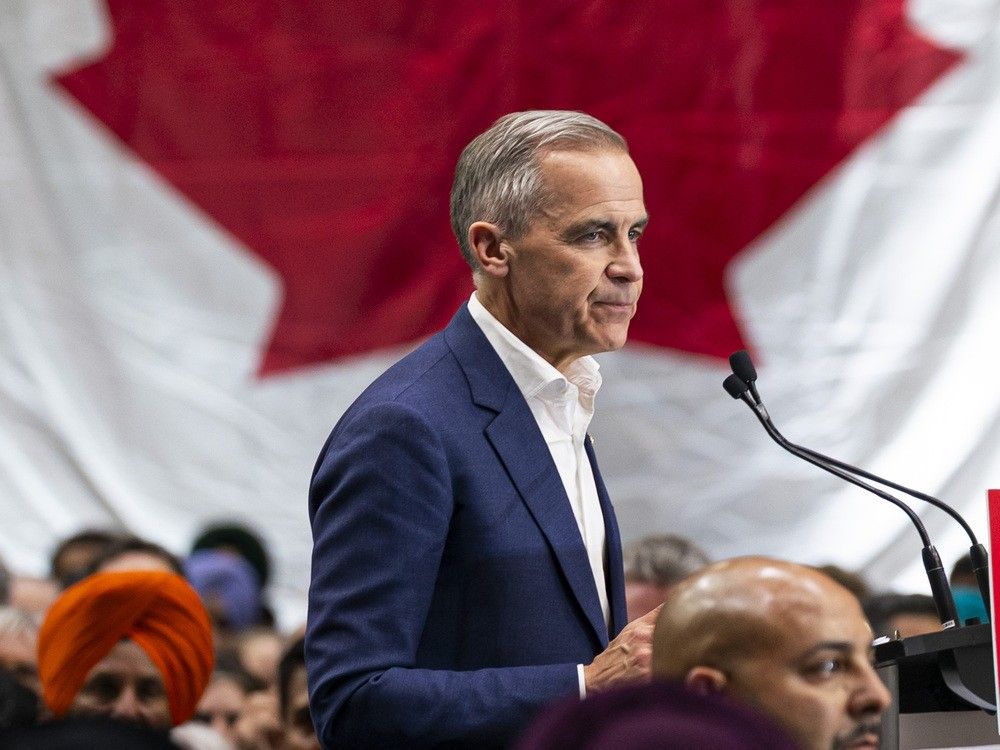
Liberal Party Leader Mark Carney speaks to supporters during a rally on April 23, 2025 in Surrey, Canada. Carney leads in recent polls leading up to Canada's April 28 parliamentary election.

OTTAWA — Liberal Leader Mark Carney is admitting that U.S. President Donald Trump reiterated his threat to annex Canada to the United States during their call on March 28 despite claiming publicly at the time that Trump “respected Canada’s sovereignty.”

Carney first made the admission on Thursday after Radio-Canada reported that

Trump brought up the idea of making Canada the 51st state

during their exchange last month.

It seemingly contradicted what Carney stated publicly at the time, which was that Trump “respected Canada’s sovereignty” in his public and private comments. That was widely reported and seen as a first step in repairing the relationship between both countries.

“To be clear, as I’ve said to anyone who’s raised this issue in private or in public, including the President, it will never happen,” said Carney in Coquitlam, British Columbia, about Trump’s threat to annex Canada by economic force.

Carney reiterated they had a “constructive” discussion and said they both agreed to begin comprehensive negotiations about a new economic and security relationship between Canada and the U.S. “as sovereign nations” immediately following the federal election.

During the media availability, Carney seemed irritated by the reporters’ repeated questions on why he never mentioned Trump’s mention of the 51st state after his call with him.

“Look, the president says lots of things, but the essence of the discussion and where we moved the conversation to was exactly what I said,” he said.

“We talked about lots of things, okay? And what’s important is the conclusions of the call, the results of the call, and those are exactly the same on the American side and the Canadian side… And those were that it was very constructive,” he added.

Trump had indeed struck a seemingly more respectful tone in his read-out of his call with Carney last month and dialed back his talk of Canada becoming the 51st state. He has also not called Carney the “governor” of Canada, as he usually did with Justin Trudeau.

Last week, White House press secretary Karoline Leavitt denied there was a change of stance on the annexation of Canada and said Trump still “believes that Canadians would benefit greatly from becoming the 51st state of the United States of America.”

On Wednesday, Trump

inserted himself into Canada’s federal election

during a signing ceremony inside the Oval Office, saying Canada “would cease to exist as a country” if the U.S. stopped buying its goods and that Canada “as a state, it works great.”

“He has these things in his mind. This is not news,” said Carney. “He raises it all the time. But then the question is, what’s going to be done with it? And does he understand where we stand? More particularly, where do I stand? He is under no illusions.”

Other party leaders chastised Carney for not being entirely truthful on March 28.

“I think what we’ve learned from this phone call with Donald Trump is that Mr. Carney was not being straight up with Canadians,” said NDP Leader Jagmeet Singh.

Singh wondered what else Carney would not disclose if he were elected at the head of a majority government: “If he’s not going to tell us about a phone call, what about the details of the negotiations? And what about what he’s willing to trade away?”

Bloc Québécois Leader Yves-François Blanchet accused Carney of “manipulating” the truth with “little precaution” to give the impression that he is a strong negotiator.

Blanchet was asked if it may have been a deliberate strategy to remind Canadians of Trump’s threat at a time where

Liberal sources are claiming polls might be tighter than anticipated

in key battlegrounds like in Quebec which could cost them their majority.

“I’m not their strategist, I’m not imagining wild conspiracies, but I can imagine that it serves them,” said Blanchet.

“Liberals are (juggling) between pretending that Mr. Carney has extinguished the threat (of Trump annexing Canada) and regularly resurrecting that threat because fear has been their main argument at the start of the Liberal campaign,” he added.

Conservative Leader Pierre Poilievre opted to remain prudent in his comments about the call.

“I wasn’t there. But what’s clear is that we will stand up for our sovereignty, we will never be an American state, and we will focus on what we can control, which is to reverse the disastrous Liberal economic policies that Mark Carney advised Justin Trudeau to take.”

Carney said that Trump reiterating his threat of annexation is underscoring in his opinion just how important the choice facing Canadians on Monday.

“Who can stand up to President Trump, who can build Canada strong, who has the experience in order to do that? That’s the crucial choice that Canadians need to make.”

With files from the Associated Press. 

National Post

calevesque@postmedia.com

Get more deep-dive National Post political coverage and analysis in your inbox with the Political Hack newsletter, where Ottawa bureau chief Stuart Thomson and political analyst Tasha Kheiriddin get at what’s really going on behind the scenes on Parliament Hill every Wednesday and Friday, exclusively for subscribers. Sign up here.


Harsimrat Randhawa is seen in a photo from Hamilton Police Service.

The 21-year-old international student who was killed by a stray bullet last week at a bus stop in Hamilton, Ont., had “zero capability of avoiding” it, police said as they continued their investigation into the shooting.

Harsimrat Randhawa, a 21-year-old student from India, had recently been at a gym in the upper area of Hamilton, police said. She had taken public transit to get there, and had been waiting to cross the street by the bus stop near Upper James Street and South Bend Road when the shooting occurred.

Speaking to reporters

on Wednesday, Acting Detective Sergeant Daryl Reid of the Hamilton Police Service said he had watched CCTV video captured at the time of the shooting.

“I know from watching the video that it happened very quickly,” he said. “Harsimrat had zero capability of avoiding what was about to unfold in front of her. She had just stepped off a city bus (and) was waiting to cross the street from my understanding, and everything unfolded so quickly she had no time at all to react.”

The incident occurred at a busy street corner, he said, and there may be witnesses who have not yet spoken to police.

“It was at 7:30 at night, there was a significant amount of traffic travelling up and down the roadway,” Reid said. “We know from watching that video that there were numerous cars that just passed through at that very moment.”

He added: “Many of those people have come forward, and I thank those people for coming forward to assist us, but we know there are more people out there that might have even the smallest piece of information that could help us, and putting all of those little pieces together is what we need to do, so we continue and encourage those people to come forward.”

Also on Wednesday, people gathered at Mohawk College, where Randhawa had been studying, to remember her.

“I’m truly at a loss for words. I don’t know what to say after the senseless tragedy,” said Katie Burrows, vice president of students and international,

per the CBC

.

“I’m sure that you all shared the heartbreak that I feel — a heartbreak for Harsimrat, who came to Canada to train for a career in helping others, and who I’m sure was looking forward to what her life would look like after she finished her program.”

Randhawa was going into her second year studying occupational physiotherapy at the college.

Micheline Lancia, one of her professors, remembered her as “a very kind soul” who was taken too soon.

“It’s very, very overwhelming to see a student who was doing so well, gentle, respectful, a little bit timid, she would have been a beautiful health-care worker. So, it’s a loss to everybody,” Lancia told the CBC.

“She was just very respectful of her presence. With health care, we are constantly handling patients, so you have to ask for permission and let them know that you will be touching them so they understand the process. And she was so respectful of that entire aspect of clinical skills and working with patients.”

Police said the shots were fired from a black Mercedes SUV targeting a white Hyundai Elantra. Reid said

both vehicles had since been recovered

.

“With the assistance of the Toronto Police Service, the white Hyundai Elantra was recovered on April 20th in a residential area in northwestern Toronto,” he said. “That vehicle has since been towed back to Hamilton for forensic examination.”

The following day, Hamilton police executed a search warrant at a residence in central Hamilton where they recovered the Mercedes.

“That vehicle has also been brought back to our police station for forensic examination,” Reid said. “Investigators have been narrowing down the pool of people who are associated to these two vehicles.”

He added: “We will leave no stone unturned until we find you. We encourage those involved in the April 17th incident to contact their lawyer and turn themselves into … police and speak to us.”

Reid said he did not believe the vehicles were stolen, but said the ongoing nature of the investigation prevented him from discussing their owners.

“There’s various things that we are going to do to try to figure out who had the vehicles at the time,” he said. “Knowing an owner is one thing but knowing who’s operating the vehicle and who’s shooting the gun at the time that it’s being used is a different part.”

Randhawas cousin, Balraj Singh,

told the Canadian Press

that her parents in India are devastated by the news.

“They will not be able to come here because they are in very bad condition now,” he said. “They are not even able to eat and sleep.”

Singh said Randhawa worked at a local McDonald’s, usually on weekends. He described her as a quiet and introverted person who was “brilliant” in her studies.

“She was absolutely happy in Canada,” he said, adding that her body would be repatriated to India this week.

Our website is the place for the latest breaking news, exclusive scoops, longreads and provocative commentary. Please bookmark nationalpost.com and sign up for our newsletters here.