LP_468x60
on-the-record-468x60-white

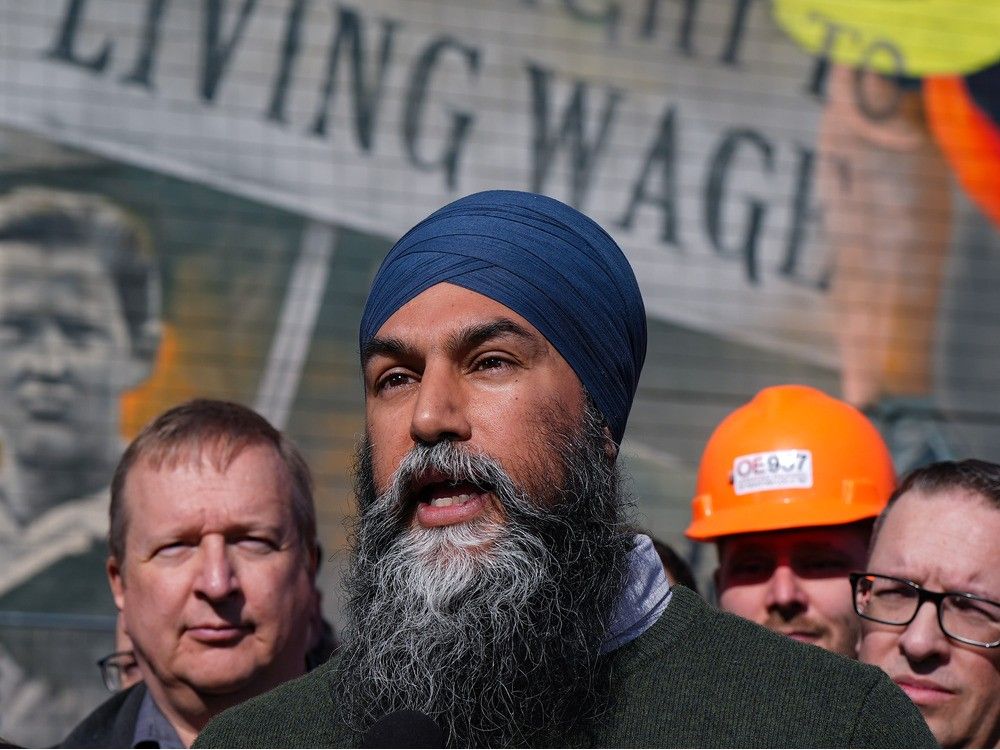
NDP Leader Jagmeet Singh speaks during a campaign stop in front of a mural commemorating the Manitoba labour movement on the side of the Union Centre building, in Winnipeg, Thursday, April 24, 2025.

TORONTO — Before NDP Leader Jagmeet Singh even arrived, some people were thinking about his exit.

Several dozen NDP supporters gathered in a park on Thursday, waiting for Singh to arrive in what will be one of his last campaign stops in Toronto.

In the heart of Canada’s largest city, voters here elect progressives.

But the group standing around tonight knows that on Monday, voters will not be choosing NDP.

“We’re all worried,” says Greg Paget, who works on a local campaign. “I would be very disappointed if it lost its party status.” He adds he is “not very” hopeful.

Ryan Anderson has been voting NDP for as long as he has been able to vote. The lifelong Toronto resident stumbled on the event walking his dog, spotting lights and people gathering.

“There’s no way that Jagmeet can stay on in my opinion,” Ryan Anderson he says. “He’s had the time that he’s going to have to get the party and the voters excited and it unfortunately hasn’t happened … I’m sad about it.”

With only days left in the campaign, Singh is trying to win what he can.

After arriving at the downtown Toronto park last Thursday evening to music pumping, he delivers an energetic speech, talking up the NDP’s fight for universal healthcare, Tommy Douglas’s legacy as well as its latest big accomplishment: Leveraging its 25 seats to push the minority Liberals to introduce a national dental care program.

That’s why, Singh told the crowd, they need to get as many New Democrats elected as possible

— a message he shifted to midway through the campaign after the party felt a Liberal win was inevitable, seeing many of their own flock to Liberal Leader Mark Carney, a former two-time central banker,

Near the end of his speech, Singh uses a slip of the tongue to nod to the fact he would rather things were different.

“So people have rejected the Liberals,” he says, stopping himself.

“Or,” he says, pausing again, before realizing his words.

“Or I hope they reject the Liberals more,” he says calmly, with a slight smile, as several around him let out a laugh.

“They rejected the Conservatives and it looks like Mark Carney might be the one that’s prime minister, but don’t let him have all the power.”

Ian Martin likes that message.

“It’s realistic,” says the longtime supporter says. “I think a lot of progressive people are on board with a majority or a minority Carney government — anything to stop Poilievre, basically.”

Should Singh’s B.C. seat fall — which successive public opinion suggest may be the case — Martin believes that would

signal that it’s time for new leadership. 

“I think the NDP will have to find someone to at least compete with Singh,” Martin said. “Or if he doesn’t win his seat, replace him.”

Nicole Best said that if Singh leaves, she sees no obvious successor.

“I would want him to stay on, but I know that that might not be realistic because he has not been successful in a few elections now.”

For his part, Singh has declined to weigh in on questions about his future leadership of the party, citing the ongoing campaign.

While names like Manitoba Premier Wab Kinew and Ontario provincial Opposition NDP Leader Marit Styles emerged as figures supporters told National Post they believe could be good for the role.

Another name kept coming up: Jack Layton.

“Nobody can compare to Jack Layton,” Martin said.

Layton, who is sometimes referred to as the prime minister Canada never had, led the New Democrats to its best election victory in 2011, when it became the Official Opposition.

From 2004 until his death from cancer in 2011, Layton represented Toronto-Danforth, the riding Singh found himself campaigning in last Thursday.

While Layton led the party through an orange wave, Singh could now see its collapse.

Last week, Matthew Green, the NDP incumbent in Hamilton Centre

told National Post

that when he speaks to party members, he reiterates how they need to stop waiting around for someone to save the party, but believes some soul-searching is needed post-election.

Green also told National Post the current party is in an entirely different reality than it was when the orange wave swept Canada more than a decade earlier.

The Liberals are not at historic lows as they were back in 2011 under former leader Michael Ignatieff and neither is the Bloc Quebecois. Quebec is where Layton rose to historic heights and captured most of its seats.

“The kind of the echoes of Jack Layton, that is a different time,” Green said last week.

“If there are people waiting for some charismatic leader to come and save us from ourselves, then we’re going to be waiting another four years.”

For Connie Langille, who danced as Singh finished his speech, she is not worried about the election’s outcome.

If the NDP loses party status, then it does, she said.

“We’ve been there before.”

“People laughed about voting for the NDP. People laughed about the image of them having any kind of power and here we are today.”

National Post

staylor@postmedia.com

Get more deep-dive National Post political coverage and analysis in your inbox with the Political Hack newsletter, where Ottawa bureau chief Stuart Thomson and political analyst Tasha Kheiriddin get at what’s really going on behind the scenes on Parliament Hill every Wednesday and Friday, exclusively for subscribers. Sign up here.
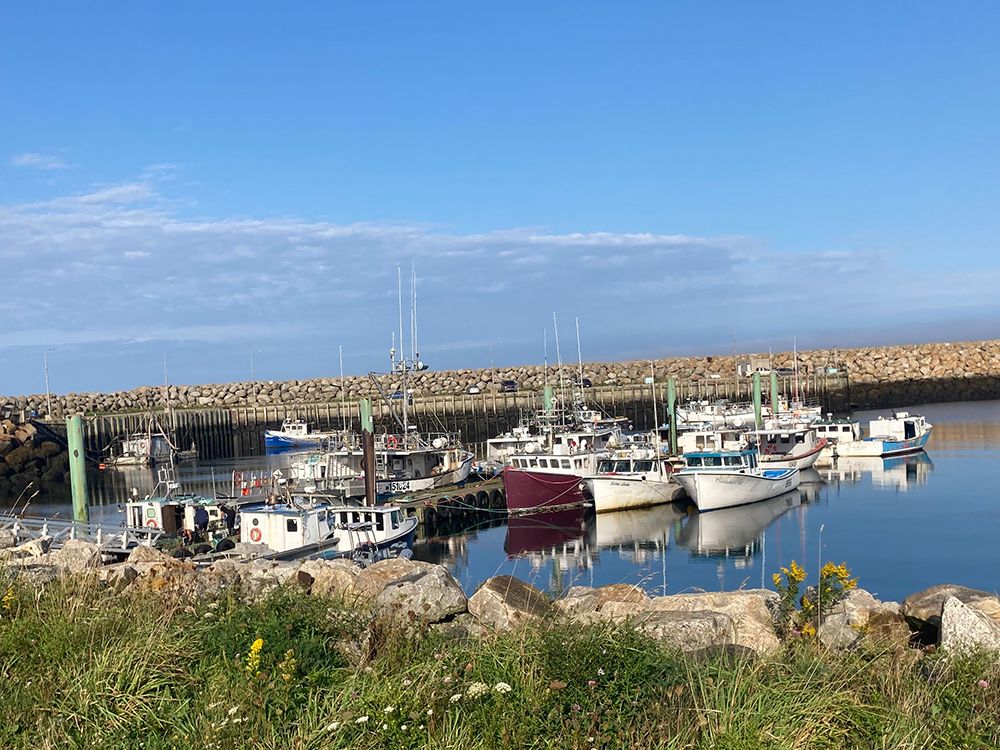

Reporter Aaron Beswick of the Halifax Chronicle Herald was honoured with two National Newspaper Awards for his coverage of lawlessness in Nova Scotia’s lobster and eel fisheries.

Postmedia Network journalist Aaron Beswick, a reporter at the Chronicle Herald in Halifax, has been named journalist of the year by the prestigious National Newspaper Awards, one of two Postmedia winners at a gala ceremony Friday night.

Beswick, who was also the winner of the E. Cora Hind Award for Local Reporting, was honoured for his coverage of lawlessness in Nova Scotia’s lobster and eel fisheries.

“He shed light on a topic that is important to the industry, Canadians nationwide and internationally,” the award judges said.

That award is meant to recognize such extraordinary journalism that it deserves further recognition. Judges selected Beswick’s work as a stand-out among the 16 winning works submitted by one or two journalists.

“Some stories are simply unforgettable, some journalists beyond exceptional,” the National Newspaper Awards says in its explanation of the award.

Beswick was joined as an award winner by Postmedia journalist Brandon Harder of the Regina Leader-Post, for his intensive telling of the story where police went undercover to get Joe Thauberger to confess to the murder of his brother. Harder won the William Southam Award for Long Feature.

“Our strength has always been rooted in our deep connection to communities across the country, with our organization being almost entirely focused on local reporting, so I’m gratified to see the recognition for Brandon Harder of the Regina Leader-Post and Aaron Beswick of The Chronicle Herald in Halifax,” said Duncan Clark, Postmedia’s chief content officer.

“Aaron being chosen as Journalist of the Year is also a wonderful representation of the commitment from all our teams in Atlantic Canada that made our recent acquisition there so important.”

Michael de Adder, a freelance cartoonist whose nomination included work for the Chronicle Herald, received the editorial cartooning award.

Multiple other Postmedia journalists received nominations for their work.

“We are immensely proud of all our nominees and congratulate our deserving winners tonight,” said Clark. “It’s no mistake that the common thread in all the nominations from Postmedia’s products is how they speak to our mission to bring Canadians together through informed, meaningful journalism.

The Calgary Herald and Calgary Sun jointly received three nominations. The Financial Post, Vancouver Sun/The Province, Ottawa Citizen/Ottawa Sun and Saskatoon StarPhoenix also all received nominations.

Naimul Karim, of the Financial Post, was nominated in the business reporting category for his coverage of Canada’s changing immigration laws and the way they are affecting thousands of foreign workers.

At the Calgary Herald, cartoonist Patrick LaMontagne was nominated for his editorial cartoons. Jim Wells, a long-time Calgary photographer, was nominated for best news photo for his stunning shot of people trying to rescue a deer that had fallen through the ice of the Bow River.

The Calgary Herald/Calgary Sun was also nominated for the John Honderich Award for Project of the Year for its “Squeezed” series, which looked at the rising cost of living and how it’s affected Calgarians.

Kim Bolan, a veteran crime reporter at the Vancouver Sun/The Province, was nominated for the Norman Webster Award for International Reporting. Bolan reported from Australia, New Zealand, Fiji and Southeast Asia, detailing the reach of B.C.’s criminal organizations.

In the local reporting category, which Beswick won, Julia Peterson at the Saskatoon StarPhoenix had also been nominated, for her extensive coverage of the two inquests into the James Smith Cree Nation mass killings.

And in the sports reporting category, Ken Warren and Tony Caldwell at the Ottawa Citizen/Ottawa Sun were nominated for their feature about an Ottawa man who cuts a hole through the ice so he can hop in for a daily swim.

The awards were announced at a gala Friday evening in Montreal.

The NNAs received 864 entries from 82 publications across Canada for the 2024 iteration of its awards.

Our website is the place for the latest breaking news, exclusive scoops, longreads and provocative commentary. Please bookmark nationalpost.com and sign up for our daily newsletter, Posted, here.


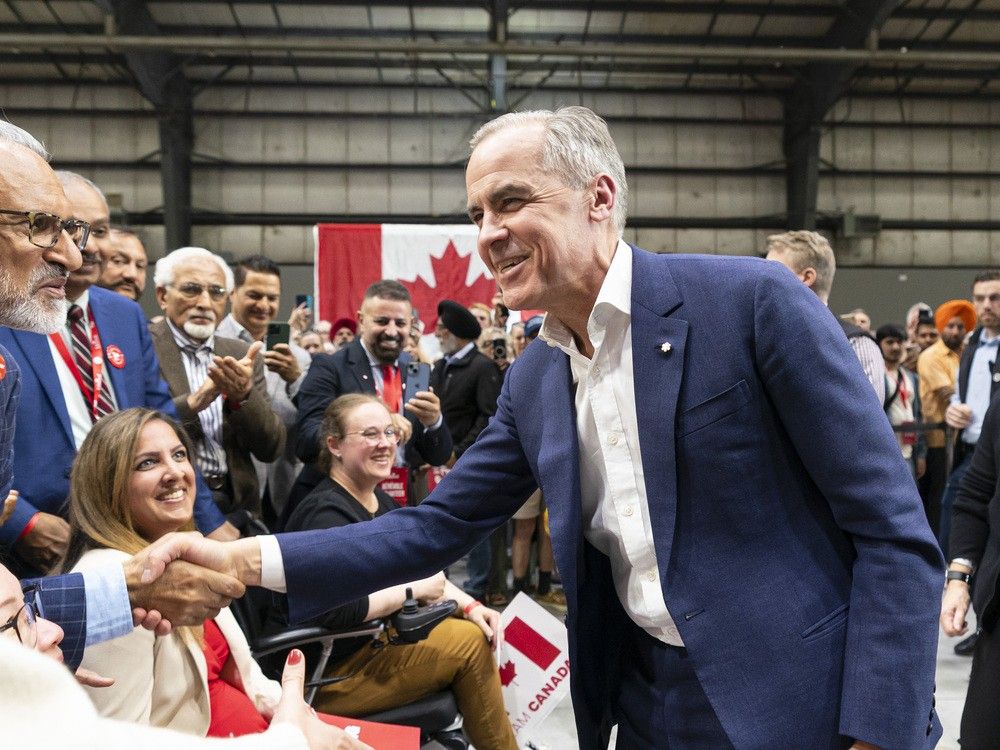
Liberal Party Leader Mark Carney thanks supporters after speaking at a rally on April 23, 2025 in Surrey, Canada.

OTTAWA — Liberal Leader Mark Carney said on Friday he is “open” to revisiting electoral reform but that it’s not a priority in the current political climate. And if he were to follow that route, he would not look to “tip the scales” like his predecessor Justin Trudeau.

Speaking in Sault Ste. Marie, Carney would not directly commit to changing the current electoral system and said that commitment is absent from his party’s platform. Trudeau abandoned the idea in his first term in office and

recently said it was one of his biggest regrets

.

“Government is about making priorities and given the scale of the economic crisis that we’re facing, the security crisis we’re facing, our commitment to supporting Canadians through a range of social programs… Candidly, it is not in the platform,” Carney said.

Carney offered his personal view on the issue. “I think… a prime minister should be neutral on these issues, so that a process — if a process is developed — that they are objective and not to be seen to tip the scales in one direction or another,” he said.

“I think that… looking back on what happened previously, that probably is part of what stalled progress on it,” he added.

Trudeau famously promised that the 2015 election would be the last time Canadians elect their federal government under the first-past-the-post system — where the person which gets the most votes in each constituency becomes the member of Parliament.

An all-party committee released a report in December 2016 recommending that a referendum be held to switch to proportional representation, but it became clear that there was no emerging consensus from all parties — especially from the governing Liberals.

While the report had the sign-off from the Conservatives and the Bloc Québécois, the NDP and Greens agreed with the overall conclusion of the report but questioned the necessity to hold a referendum.

Liberals released their own supplementary report which suggested that their prime minister’s self-imposed deadline to approve of a new system by 2019 was too “rushed.”

Trudeau opted to abandon his election promise a few months later. In a mandate letter to his newly appointed Minister of Democratic Institutions, in February 2017, he wrote that a “clear preference for a new electoral system, let alone a consensus, has not emerged.”

Trudeau had made it clear by that point that he was not as interested in changing the system by which his party won power.

And while at the time Trudeau did not openly push for a ranked ballot — which allows voters to rank candidates in order of preference and eliminates the least popular option until a candidate has more than 50 per cent support — it was clearly his preferred option.

In 2021, he admitted that

he “never flinched in (his) desire for ranked ballots”

and said he would not favour proportional representation because it would help fringe parties.

When Trudeau announced his resignation as prime minister in early January, he said that not moving forward on electoral reform was one of his “many regrets.”

“I do wish that we’d been able to change the way we elect our governments in this country so that people could choose a second choice or a third choice on the same ballot,” he said.

“Parties would spend more time trying to be people’s second or third choices and people would be looking for things they have in common rather than trying to polarize and divide Canadians against each other.”

Carney said there “may be a point” where a re-elected Liberal government may have advanced on “other immediate, pressing priorities” like Canada’s relationship with the U.S. and that “those more structural issues in our democracy could be addressed.”

In French, he said he is “open” to the idea but that now is not the moment to engage in the process.

National Post

calevesque@postmedia.com

Get more deep-dive National Post political coverage and analysis in your inbox with the Political Hack newsletter, where Ottawa bureau chief Stuart Thomson and political analyst Tasha Kheiriddin get at what’s really going on behind the scenes on Parliament Hill every Wednesday and Friday, exclusively for subscribers. Sign up here.
Our website is the place for the latest breaking news, exclusive scoops, longreads and provocative commentary. Please bookmark nationalpost.com and sign up for our newsletters here.


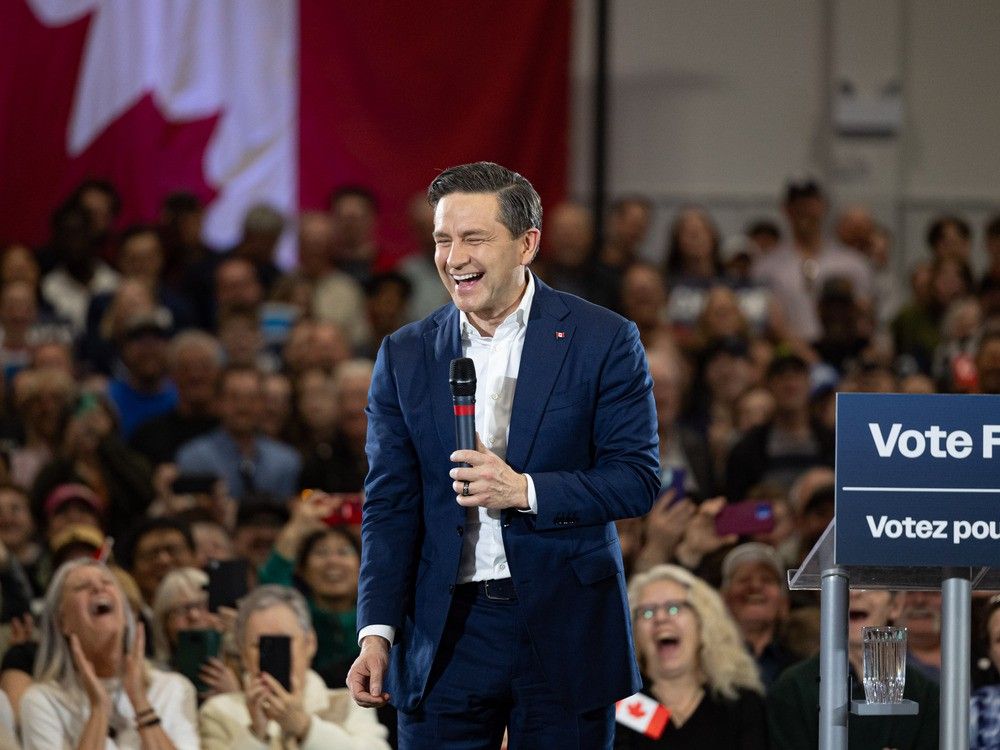
Conservative Leader Pierre Poilievre speaks to supporters at his Rally for Change campaign stop in Saskatoon at a warehouse in the Bizhub Industrial Park.

OTTAWA — MPs can say goodbye to their summer plans if Conservative Leader Pierre Poilievre becomes prime minister on Monday.

Poilievre is promising to implement fast change in the first 100 days if his party ends up forming government. That means passing three bills in priority — on affordability, on crime and on the economy — to reverse many of the Liberals’ decisions in the last decade.

“We need a new Conservative government that will get busy on day one,” pledged Poilievre during his announcement in Saskatoon on Friday. “So, I have some good news and bad news. The good news is Canadians can elect a government that will bring change. The bad news for the politicians is your summer vacation is cancelled.”

“We are going to keep Parliament open all summer long to pass three laws to bring change,” he added.

The first piece of legislation — called The Affordability–For a Change Act — would seek to implement many of his key platform promises, including cutting income taxes by 15 per cent, axing the federal sales tax on new homes up to $1.3 million, repealing the entire carbon tax law including the industrial levy, and scrapping the single-use plastics ban.

“We cannot afford more expensive food to meet radical Liberal eco-fanaticism,” said Poilievre. “Our priority is affordable food for Canadians.”

The second bill — The Safe Streets–For a Change Act — would introduce a “three strikes, you’re out” rule that would see offenders face a mandatory minimum 10-year prison sentence after three serious offences and restore consecutive sentences for multiple murderers, which would see the Conservatives use the notwithstanding clause.

Poilievre promised his crime bill — which he described as the “biggest crackdown on crime in Canadian history” — would also extend to auto theft, tent cities and drugs.

“We’ll crack down on organized crime, auto theft, extortion, arson, fraud, with tough new laws that make no more excuses, that ensure that people stay behind bars. We will give the police the power to shut down tent cities and get people real help, so our children don’t have to step on dirty needles and crack pipes,” he said.

Finally, The Bring Home Jobs–For a Change Act would repeal C-69 and C-48, which the Tories have tagged as anti-resource development laws, and introduce a “one-stop-shop” to approve resource projects within one year. It would also bring in a Canada First Reinvestment Tax Cut, which would allow capital gains tax deferral when proceeds are reinvested in Canada.

“Until these laws are passed, Parliament will not shut down for summer vacation. We need change. Change can’t wait, but the politicians’ vacations will have to wait,” said Poilievre.

At a whistle stop in Calgary later in the day, Poilievre doubled down on his message to MPs: “You can go sell golf clubs on eBay, get rid of your little cottage, your cabin — you’re not going to be using it this summer. You can rent it out to a deserving family who needs a break,” he said.

In reality, MPs do not have a three-month vacation during the summer. While the House of Commons is set to rise mid-June and come back mid-September, most of that time is used for constituency work and events in their respective ridings.

As part of his 100-day sprint, the Conservative leader is also promising to call U.S. President Donald Trump to end the tariffs on Canadian goods in exchange for an earlier negotiation to replace CUSMA with a new deal on trade and security. And he intends to get Phase 2 of LNG Canada built to double the project’s natural gas production.

Poilievre has been doubling down on his message of “change” — a word he repeated dozens of times on Friday — in the final days of the campaign. With most polls showing Liberals could be re-elected for a fourth mandate and even aspire to a majority, Poilievre is attempting to mark a clear contrast by focusing on the party’s record over the last 10 years.

He said a fourth Liberal term would mean “skyrocketing costs and crime,” more difficulties in accessing home ownership and Liberals shutting down key industries such as oil and gas, which he said would weaken Canada’s economy with the threats from abroad.

“This Liberal path not only means more poverty and hunger and helplessness and homelessness, but it also means more divisions in our country. After the Lost liberal decade of rising costs, crime and division, we can’t afford a fourth Liberal term,” he said.

“We need a change, a change that will bring home an affordable, safe life and a united and strong Canada,” he added. “That’s the change we’re running on, and that is the change we’re going to deliver in the first 100 days.”

Poilievre was expected to travel to Alberta and British Columbia before heading back to Ontario this weekend. He is set to hold an event in his Ottawa-area riding of Carleton Sunday evening.

National Post

calevesque@postmedia.com

Get more deep-dive National Post political coverage and analysis in your inbox with the Political Hack newsletter, where Ottawa bureau chief Stuart Thomson and political analyst Tasha Kheiriddin get at what’s really going on behind the scenes on Parliament Hill every Wednesday and Friday, exclusively for subscribers. Sign up here.

Our website is the place for the latest breaking news, exclusive scoops, longreads and provocative commentary. Please bookmark nationalpost.com and sign up for our newsletters here.


Donald Trump speaks in the Oval Office of the White House in Washington, DC, on April 24, 2025.

It may seem as though Canada’s leaders have few points on which they agree with the U.S. president. But recent remarks by Donald Trump and Ontario Premier Doug Ford suggest one common opinion: Neither thinks the president is bluffing in his remarks about Canada.

On Tuesday, Trump sat down for an interview with TIME magazine’s senior political correspondent Eric Cortellessa and editor-in-chief Sam Jacobs.

The “100 Days” interview

, which was published Friday, touched on a wide range of issues, including tariffs, the economy, immigration, presidential power, and the situations in Ukraine and the Middle East.

At one point, the questions turned to Canada.

“You’ve talked about acquiring Greenland, taking control of  the Panama Canal, making Canada the 51st state,” Cortellessa said. “Maybe you’re trolling a little bit on that one. I don’t know.”

Trump’s answer was short: “Actually, no, I’m not.”

Cortellessa then followed up by asking: “Well, do you want to grow the American empire?”

Trump’s answer to that was longer, with most of it focused on Canada.

“I think Canada, what you said that, ‘Well, that one, I might be trolling.’ But I’m really not trolling,” he said.

“Canada is an interesting case. We lose $200 to $250 billion a year supporting Canada. And I asked a man who I called Governor Trudeau. I said: Why? Why do you think we’re losing so much money supporting you? Do you think that’s right? Do you think that’s appropriate for another country to make it possible, for a country to sustain, and he was unable to give me an answer, but it costs us over $200 billion a year to take care of Canada?”

Trump added: “We’re taking care of their military. We’re taking care of every aspect of their lives, and we don’t need them to make cars for us … We want to make our own cars. We don’t need their lumber. We don’t need their energy. We don’t need anything from Canada. And I say the only way this thing really works is for Canada to become a state.”

In a

separate fact-checking article

, the magazine noted: “It’s possible (Trump) was referring to the U.S. trade deficit with Canada, which in 2024, amounted to $63 billion for goods. But that number still is far short of $200 billion.”

On the subject of “taking care of their military,” the magazine noted that the U.S. Department of Defense requested a budget of $849 billion for the 2025 fiscal year, but pointed out that it does not break down spending by region. It added that the U.S. is responsible for 60 per cent of the cost of the radar system of the North American Aerospace Defense Command (NORAD), although that costs just $20 billion.

The topic of Canada was dropped after Steven Cheung, the White House communications director, told the interviewers they had only about 10 minutes left.

“OK, we’ll move quickly then,” Cortellessa said. “Last note: Do you want to be remembered as a president who expanded American territory?”

Trump’s response: “Wouldn’t mind.”

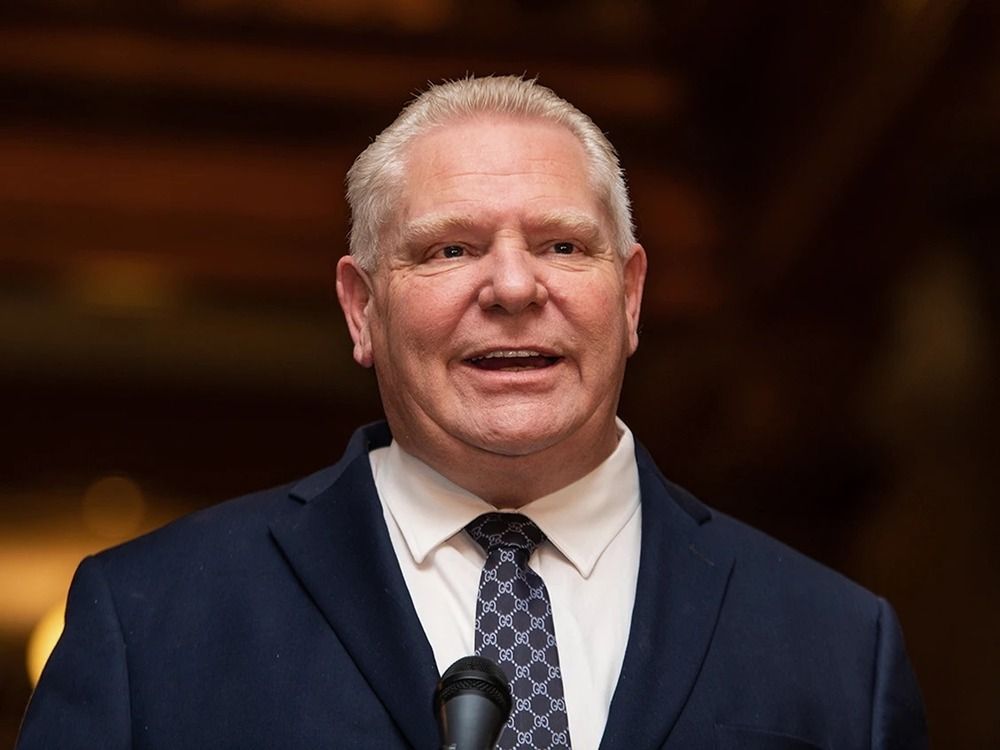
 Ontario Premier Doug Ford speaks to media at Queen’s Park in Toronto, on Thursday, April 3, 2025.

Meanwhile, Ontario Premier Doug Ford offered direct warnings about Trump during a speech at at the

Public Policy Forum’s 2025 Canada Growth Summit

in Toronto on Thursday.

“We can no longer afford to have our economic success depend on such an unreliable partner,” he told the crowd, adding that he wasn’t referring to Americans in general.

“There’s one person and that person is called President Trump,” he said. “He’s openly taking aim at Ontario’s economy, threatening tariffs, disrupting supply chains, putting all of us at risk.”

Later in his remarks he said of Trump: “He actually wants to destroy our economy. It’s not just words. He wants to do it. He wants to destroy our auto sector. He wants to destroy our manufacturing sector. He wants to try to take over Canada, and I can tell you: Canada is not for sale. We will never ever be the 51st state.” He had to pause for applause at this point.

Later, in a question-and-answer session, Ford was asked how well he thought his message was being received by the White House.

Ford replied: “Sometimes I think the cheese slips off the cracker with this guy. He wakes up in the morning … and even his people around him are not too sure what he’s going to do or what he’s going to say. And it’s pretty scary that, you know, one sentence out of the most powerful person in the world can change markets.”

He added: “It’s about certainty. And he’s created uncertainty around the world.”

Our website is the place for the latest breaking news, exclusive scoops, longreads and provocative commentary. Please bookmark nationalpost.com and sign up for our newsletters here.


Liberal Leader Mark Carney at Algoma Steel on Friday, April 25, 2025 in Sault Ste. Marie, Ont.

Sault Ste. Marie, Ont. — Mark Carney has a winking problem.

He winked at the camera at Rideau Hall on the day he became prime minister.

He winked at a senator when he appeared before a committee last May.

In 2014, the Daily Telegraph remarked on how he tipped the BBC’s then-economic editor Robert Peston the wink during a press conference when he was governor of the Bank of England. The Telegraph interpreted this as Carney letting the recipient of the wink know: “Yeah, we both know this is theatre.”

If all the world’s a stage, then politicians are its key players.

The revelation that the Liberal leader told the truth, but not the whole truth, about his March 28th call with Donald Trump plays into the idea that he is playing to different audiences. On Thursday, Carney confirmed that Trump spoke about Canada becoming the 51st state — which was not the impression he left after the call when he maintained that the president had respected Canada’s sovereignty.

A senior source with knowledge of the call has told the National Post that the perception created by the Canadian read-out after the call is at odds with what actually happened. The Canadian read-out said the call was “a very constructive conversation about the relationship between the two countries.”

The official release said the leaders agreed to begin comprehensive negotiations about a new economic and security relationship and that Carney told Trump that his government would implement retaliatory tariffs to protect Canadian workers after April 2nd.

Since then, the central plank of Carney’s campaign is that he is taking a tougher line with Trump than other international leaders, and is best positioned to negotiate a new deal with the president.

But the source said the read-out did not include the fact that Carney flagged for the president that he would need to talk tough about America and Trump during the election.

Carney is also said to have called Trump “a transformative” president that he’d like to work with.

A spokesperson for the Prime Minister’s Office said Carney did not tell President Trump that he would have to criticize him during the campaign.

Readers can make their own minds up what they believe. I would only note that the Prime Minister’s Office denied details in the Radio-Canada story on Trump and Carney’s call, before the Liberal leader confirmed its central premise.

It is important because Carney’s whole campaign revolves around his assertion that Trump “betrayed us” and that he will take a hard line in future negotiations.

“The president’s latest comments are more proof, as if we needed any, that the old relationship with the United States is over,” he said in a press conference at Algoma Steel on Friday morning. “We will stand with every single Canadian worker targeted by President Trump’s attacks on our country. We will stand with you.”

But it sounds like the reality on March 28th was hardly elbows up.

Is that a bad thing? Not necessarily. Trump is a narcissist, so flattering him is the quickest way to his heart. Carney has already committed to securing a new deal on trade and security, which would buy time, even if there would be no guarantees that the president would stick to its terms.

But if the prime minister tipped the president the wink in his call, tacitly urging him to ignore anything said during the campaign, it calls into question Carney’s authenticity on the stump.

During his press conference, he was asked about the need for new ethics and transparency laws in government.

Carney said he would distinguish between rules and conduct. “If there were specific proposals, obviously we would look at them. But what’s important is bringing that spirit of honesty, the highest integrity, and my track record is consistent with that, but also that commitment that goes with it to transparency,” he said.

The Liberal Party has a history of hubris and quickly becoming too comfortable in power.

Treating voters like the audience of a conjuring trick would be an inauspicious end to this campaign.

jivison@criffel.ca

Twitter.com/IvisonJ

Our website is the place for the latest breaking news, exclusive scoops, longreads and provocative commentary. Please bookmark nationalpost.com and sign up for our newsletters here.


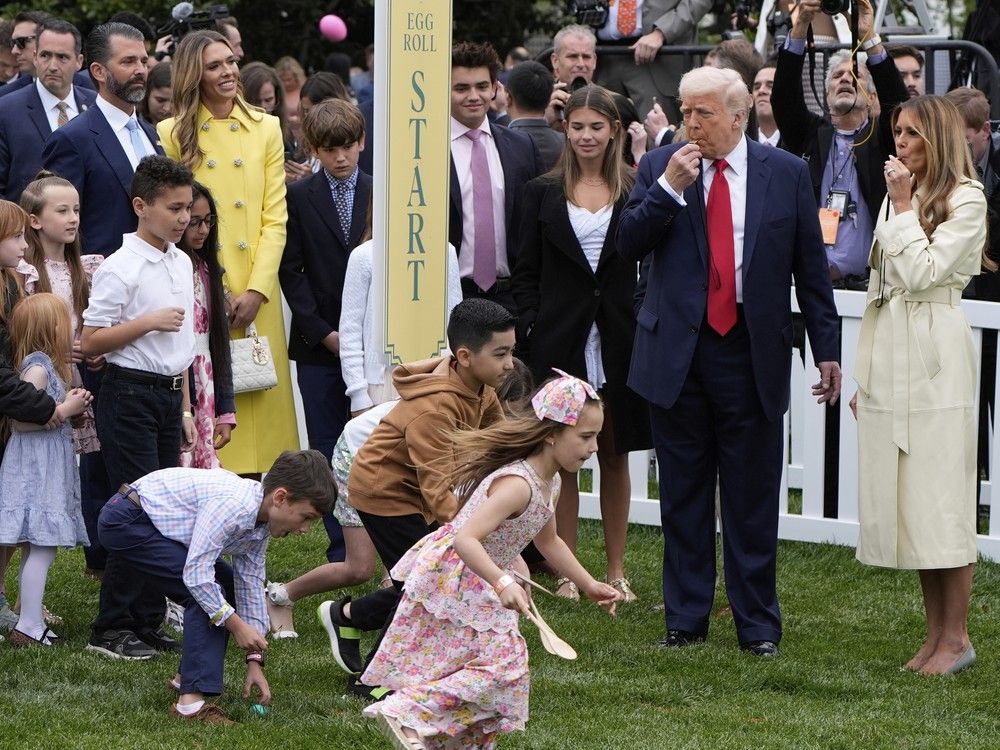
U.S. President Donald Trump, and first lady Melania Trump walking to the White House Egg Roll on the South Lawn of the White House on April 21, 2025 in Washington, DC.

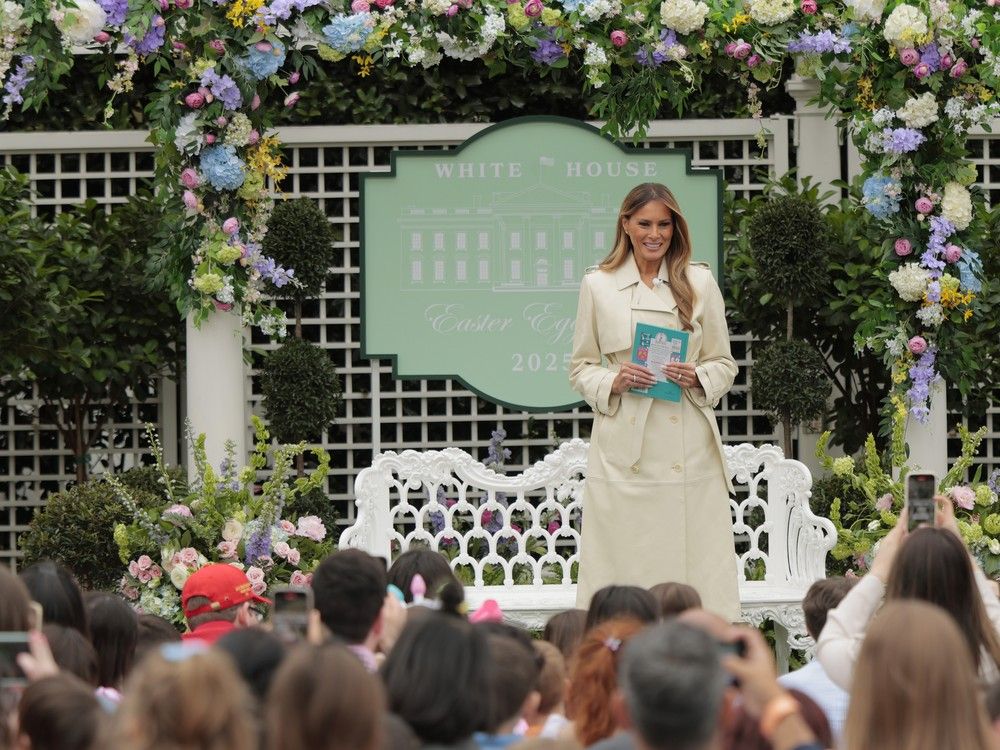
Melania Trump attended the 2025 White House Easter Egg Roll this week wearing a notably subdued and minimalist ensemble that drew attention for its Canadian connection.

The highlight was an off-white, double-breasted trench coat by Canadian luxury design house,

Mackage

, specifically the “

GAEL-V Maxi Leather Trench Coat

.” The coat featured a storm flap and was belted at the waist, creating a structured silhouette.

This Canadian brand is also 

favoured by Meghan Markle

, who has stepped out in Mackage designs on more than one occasion.

Mackage, was founded in Quebec in 1999, then sold to the American private equity group Lee Equity in 2017, but remains headquartered in Montreal.

Melania also showcased a French luxury pump of gray patent leather pumps from Roger Vivier, a classic and understated choice that complemented the muted palette of her outfit, according to

Footwear News

.

 President Donald Trump and first lady Melania Trump blow whistles during the White House Easter Egg Roll on the South Lawn of the White House, Monday, April 21, 2025, in Washington.

The fashion press noted that her choices stood out for their lack of festivity. The look was described as “muted” and “subdued” by

Vogue

, a contrast to the pastel and festive attire typically associated with Easter.

During Donald Trump’s first term, the first lady wore more

traditional Easter attire

for the annual egg roll. In 2017, she opted for a pale pink dress from Hervé Pierre; the following year, she wore a pale blue cashmere jacket from Burberry; and in 2019, she wore a blue dress by Michael Kors.

During the event,

Melania participated

by reading to children in attendance. She was acknowledged by President Trump for her efforts in organizing the festivities.

 First Lady Melania Trump reads to children during the White House Egg Roll on the South Lawn of the White House on April 21, 2025 in Washington, DC.

The subdued look was interpreted as

reflecting a more somber or restrained mood

at the event, especially in light of the news that day of the passing of Pope Francis, which was acknowledged during the festivities.

Her choices are not “necessarily political,” wrote the

New York Times

. After all, Melania, “long ago rejected the idea that, when it came to clothes, she would have to play by anyone’s rules other than her own.”

Our website is the place for the latest breaking news, exclusive scoops, longreads and provocative commentary. Please bookmark nationalpost.com and sign up for our daily newsletter, Posted, here.


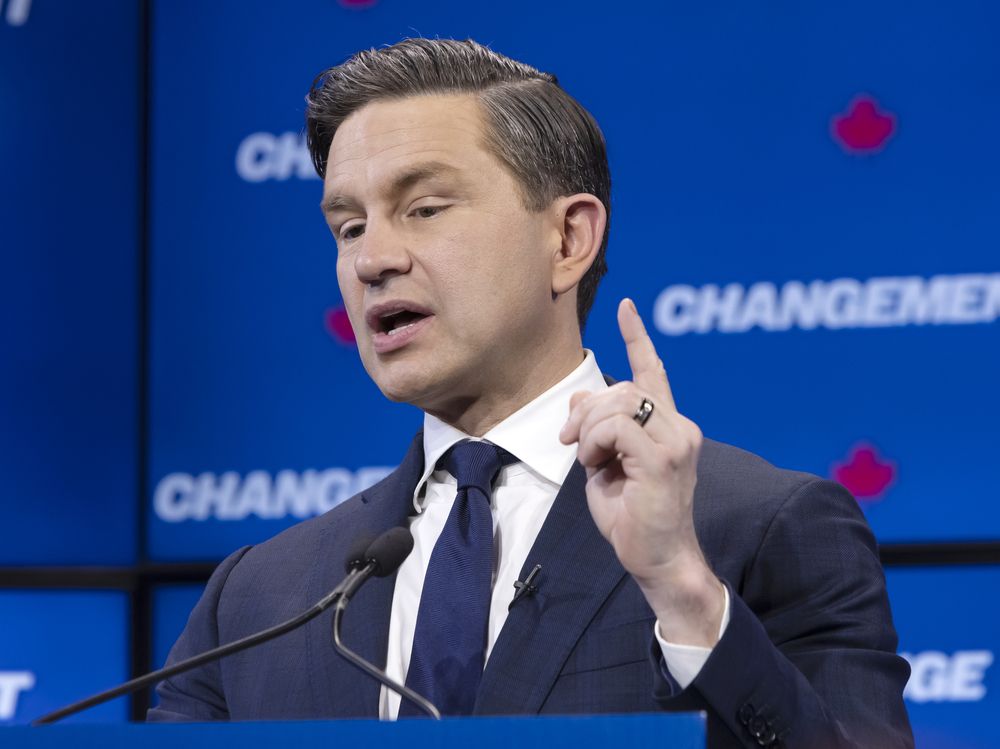
Conservative Party Leader Pierre Poilievre speaks to members of the Canadian Association of Retired Persons, CARP, during a federal election 2025 campaign stop in Toronto, Monday April 21, 2025.

OTTAWA — Conservative Leader Pierre Poilievre’s riding of Carleton saw the highest early voting turnout in Canada, as 43,394 residents flocked to advance polls over Easter long weekend, according to preliminary

data from Elections Canada

.

This total, making up

45 per cent of registered voters

in the Ottawa-area riding, was 5,926 votes higher than the second-highest turnout, in Green party Elizabeth May’s riding of Saanich—Gulf Islands.

The eye-catching early-voting tally comes amidst speculation that Poilievre, who has held the riding for two decades, may be in a

tight race

to be re-elected on Monday.

Bruce Fanjoy, Poilievre’s Liberal challenger, told National Post he sees the Carleton race as a referendum on the Conservative leader’s combative style of politics.

“Carleton, because of circumstance, has a remarkable opportunity to make a statement on the type of politics and direction that we want Canada to go in,” said Fanjoy.

“Although it’s technically just one of 343 ridings in the election, this one carries extra significance.”

Fanjoy said more than 500 volunteers signed up to help him in the first week of the campaign, coming from as far away as New York City.

The Conservative war room

has also reportedly been

sending additional manpower into Carleton in anticipation of a close result.

Poll aggregator 338Canada

listed Carleton as “CPC Likely”

as of Friday, with Poilievre 10 points ahead of Fanjoy in the projected vote.

Poilievre will be closing out the campaign with a final rally in his home riding on Monday evening.

Three-quarters of eligible voter

turned out to vote

in Carleton in the last federal election in 2021, with Poilievre winning easily.

Liberal Leader Mark Carney’s riding of Nepean was also in the top five nationally for early voting, with 32,689 residents turning out to the advance polls.

Across Canada, 7,280,975 early ballots were cast, up a quarter from the then-record early turnout numbers in the last federal election in 2021.

National Post
rmohamed@postmedia.com

Get more deep-dive National Post political coverage and analysis in your inbox with the Political Hack newsletter, where Ottawa bureau chief Stuart Thomson and political analyst Tasha Kheiriddin get at what’s really going on behind the scenes on Parliament Hill every Wednesday and Friday, exclusively for subscribers. Sign up here.

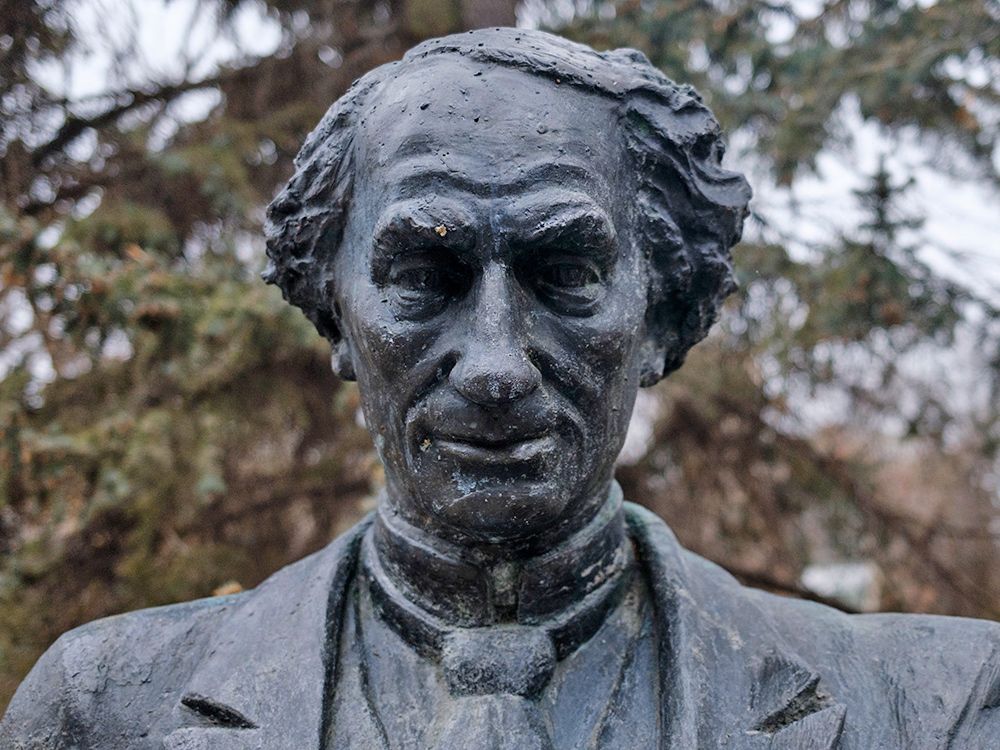
A statue of John A. Macdonald that was removed from downtown Regina park in 2021. Across Canada, various statues of the country's first prime minister have been vandalized, toppled or put in storage over the last few years.

Across Canada, statues are coming down, buildings and streets are being renamed, and historical figures are being reevaluated as institutions grapple with reconciling the past with changing values.

While proponents argue these changes address potential historical injustices, they have also sparked heated debates. Some argue that removing monuments and altering historical names erases, misunderstands or even misrepresents history, while others see it as necessary for a more accurate and inclusive understanding of Canada’s past.

In response to the ongoing debate, the Canadian Institute for Historical Education (CIHE) launched the “

Context Matters

” campaign on April 16. The campaign aims to give people a deeper and more balanced perspective on the country’s past by encouraging them to examine historical figures within the complexity of their time rather than judging them by modern standards.

“In an era of rapid social change and political polarization, it’s more important than ever to understand where we’ve come from,” said James Cowan, an advisory council member of CIHE,

in a press release

. “This campaign reminds Canadians that history is not a tool for division, but a foundation for unity.”

One of the historical figures often up for debate is Sir John A. Macdonald, Canada’s first prime minister, who was once widely celebrated as a nation-builder.

Many cities have removed statues of Macdonald, and places bearing his name have been renamed. One notable example is the renaming of the Sir John A. Macdonald Parkway in Ottawa to Kichi Zibi Mikan in 2023, a decision driven by criticism of his Indigenous policies, including his key role in the creation and expansion of the residential school system.

But this conversation isn’t just about one man. It’s about how Canada teaches, remembers, and understands its history.

The campaign warns that Canadians’ lack of a shared understanding of their history is dangerous.

“The removal of statues and renaming of institutions may feel symbolic, but these actions have profound implications for how future generations understand their country,” said Cowan. “This campaign isn’t about erasing history — it’s about reclaiming it with depth, context, and respect.”

As part of the campaign, the CIHE is commissioning new historical research to explore the past of figures like Macdonald. The CIHE is also hosting expert-led events, producing educational content to counter misinformation, and working with educators and policymakers to teach children and teens more about Confederation and civic literacy in schools.

“We shouldn’t just be judging historical figures by the values of our age. We have to understand the context in which they lived,” said Stephan Azzi, a professor of political management, history, and political science at Carleton University and a member of the Historic Sites and Monuments Board of Canada.

The debate around how we see historical figures is divisive for Canadians at a time when we need to be united, said Azzi.

“People don’t like it when history changes. My mother is upset right now because the street that she grew up on has changed its name, and she feels like her history is being erased,” said Azzi.

Azzi believes the decision to remove or preserve a statue requires thoughtful consideration. “There has to be a balanced assessment of a statue to determine whether it should stay up or not,” he said. “History isn’t black and white; people are complicated.”

Mahatma Gandhi, a key leader in India’s non-violent fight for independence from British colonial rule, expressed racist views toward Black Africans. Frederick Douglass, a former slave who became an important voice in the abolitionist movement in the U.S, made some offensive remarks about Indigenous peoples. Just because they held problematic views doesn’t mean we should ignore all the good they did, said Azzi.

A potential solution is to give more context to monuments and historical sites by adding plaques with explanatory text, said Azzi. “You include some text. You include a plaque that tells us a bit more about the individual, both the good and the bad. The more of the picture that we can provide, the better.”

“I think historic sites and monuments are vitally important to understanding ourselves. We can’t understand Canada without understanding where it came from. We can’t understand our province or our community without understanding how it got here,” said Azzi.

Our website is the place for the latest breaking news, exclusive scoops, longreads and provocative commentary. Please bookmark nationalpost.com and sign up for our daily newsletter, Posted, here.


The Canadian loonie.

First Reading is a Canadian politics newsletter that throughout the 2025 election will be a daily digest of campaign goings-on, all curated by the National Post’s own Tristin Hopper. To get an early version sent directly to your inbox, sign up here.

TOP STORY

If the Conservatives win the April 28 election, expect an immediate surge in the value of the Canadian dollar, according to a

new foreign exchange analysis by the Dutch financial firm ING

.

However, the report concludes that such a thing is unlikely, and that world financial markets are already planning for the lower Canadian dollar that would be yielded under another four-year Liberal term.

“A Conservative win would be a surprise for markets, and we think (the Canadian dollar) would rally on the view that (U.S. President Donald) Trump may be more lenient in trade negotiations towards another conservative leader,” reads the report, published Tuesday by a team of ING analysts based in London and New York City.

The report notes that both the Conservatives and the Liberals have similar strategies for dealing with Trump, writing “all Canadian parties are firmly condemning U.S. tariffs: Trump is a deeply unpopular figure in Canada.”

Nevertheless, they still conclude that a Conservative win, however unlikely, would be greeted positively by investors as a signal for an “earlier de-escalation in Canada-U.S. trade tensions.”

Although the report briefly touches on the two parties’ differing approaches to taxes, deficit spending and military preparedness, it highlights the U.S. trade war as the most immediate threat to Canada’s economic situation, as “even a modest drop in exports to the U.S.” could plunge the country into recession.

“Whoever wins the elections, the challenges ahead for the Canadian economy are huge,” it reads. Layoffs are poised to increase, and given Canada’s

extremely high rates of personal debt

, they write that this “could exacerbate the pain and lead to an even steeper slowdown in spending.”

The Canadian dollar is currently trading at 72 cents of a U.S. dollar; one of the lowest it’s been over the last 20 years. As recently as 2021, a Canadian dollar could buy 82 U.S. cents. In 2013, the currencies were briefly at par.

Prior to Trump’s election, the long-term assumption among investors was that Canada’s next government would be Conservative. But based on aggregated polls and bookmakers’ odds, ING is now citing an “85-95 per cent probability of Liberals winning.”

“We can safely assume the market’s baseline scenario is a majority win by the Liberals,” reads the ING report.

ING was not the only foreign financial analyst this week to weigh in on the likely impact of the Canadian election.

A Thursday report by the U.K.-based AXA Investment Managers also concluded that a Liberal win was most likely, but that “the direction of fiscal policy looks set to be relatively similar regardless of which of the main parties enter government.”

And whoever wins, AXA said that the next government is set to face “a deteriorating economic environment.”

Not only is Canada poised to suffer from the fiscal uncertainty imposed by the U.S. trade war, but the U.S. is itself

lurching towards recession

as a result of Trump’s tariff policies, with knock-on effects for Canada.

Wrote AXA, “we see a direct hit of around 1 per cent to Canadian GDP and a further 0.5 per cent hit from weaker U.S. growth.”

One of AXA’s only positive notes was that Canada’s debt burden isn’t quite as bad as everyone else’s — at least at the federal level.

When you tally up combined provincial and federal debt, Canada’s “general government” debt ratio is among the h

ighest in the developed world

at 107 per cent of GDP.

However, the $1.4 trillion in federal debt currently held by the Government of Canada works out

to about 42 per cent

of GDP, well below the G7 average. “The Canadian government starts from a place of relative stability enabling it to borrow more without spooking capital markets,” AXA wrote.


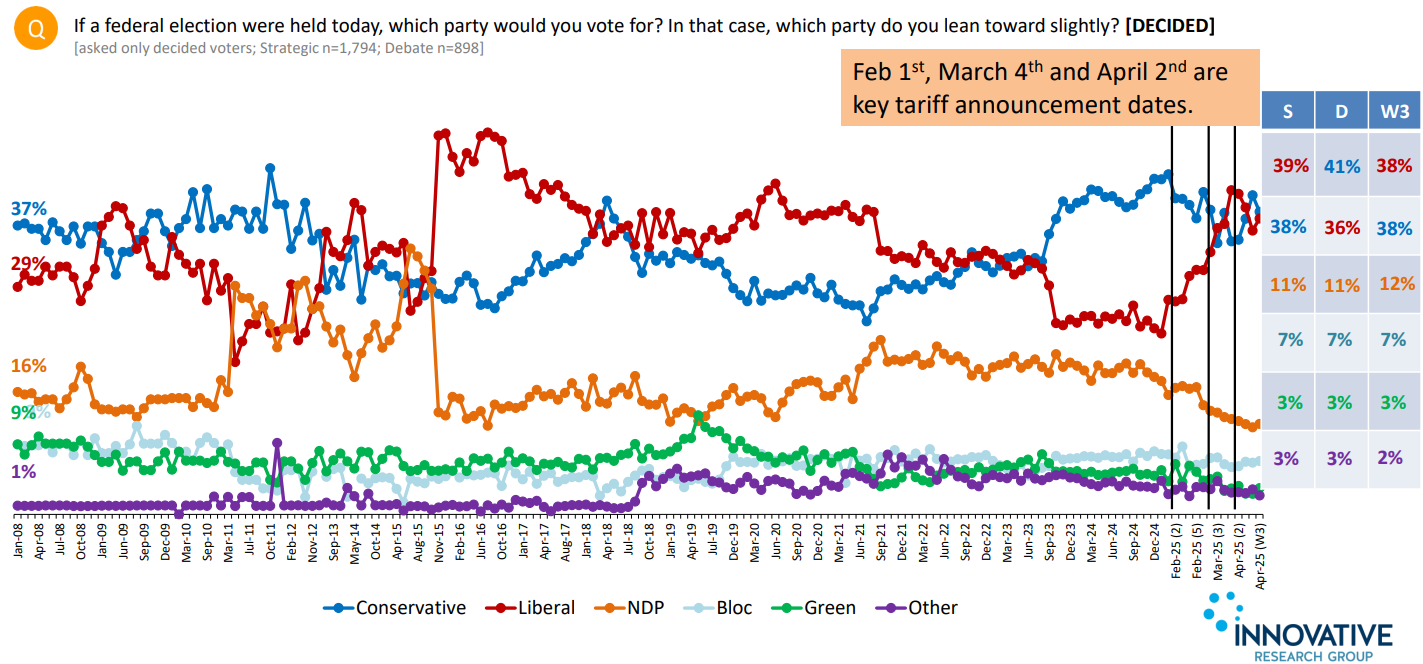
 Polling has been bananas throughout this entire election, but the above, from Innovative Research, is the most favourable to the Conservatives heading into the final week of the election. Their final election poll had a 38/38 tie between the Liberals and Conservatives. All the other pollsters were charting a three to five per cent Liberal lead.

LAST APPEARANCES

Conservative Leader Pierre Poilievre has conspicuously avoided sitdown interviews with mainstream outlets throughout the campaign, preferring independent outlets. On Wednesday, Poilievre and his wife Ana were

interviewed by conservative YouTuber Jasmin Laine

, and it was heavier than usual on Poilievre’s central philosophy that he wants to stay out of people’s business. “If I was starting a political party from scratch I would call it the ‘mind your own damn business party’ … I don’t want to run your life, I want to run a government,” he said.

Meanwhile, Liberal Leader Mark Carney served poutine at a Quebec fast food outlet, where he compared the appearance to a McDonalds campaign stop made by U.S. President Donald Trump last year. “I’m a bit like Trump. Trump at McDonald’s,” said Carney. When a reporter asked him what sound the cheese made, he said “squish, squish” … which is the wrong answer. Cheese curds are supposed to squeak.

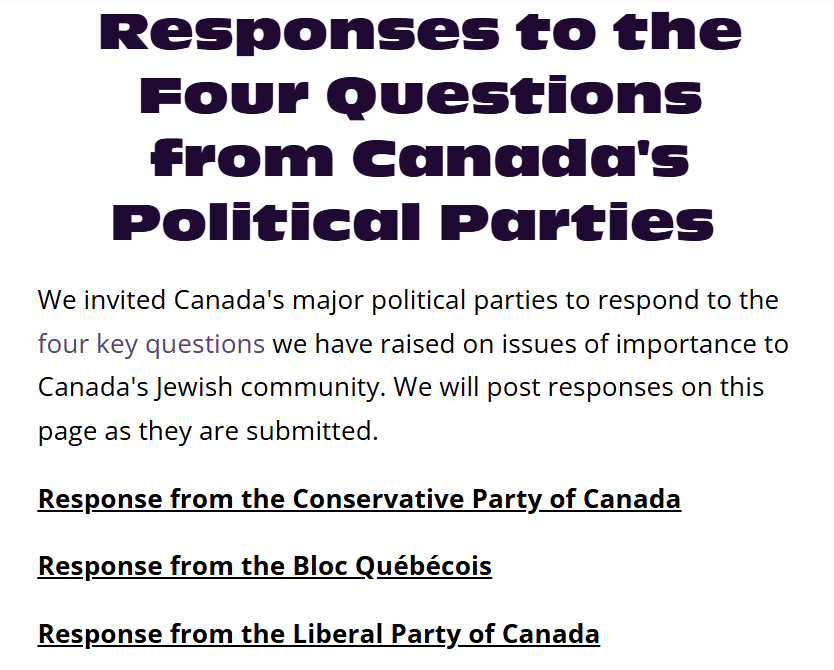
 Above is from a website run by the Centre for Israel and Jewish Affairs (CIJA) where they asked all the major parties four questions related to Judaism, mostly on what they would do about the skyrocketing rates of attacks against Canadian Jewish sites. The NDP has answered CIJA questionnaires in prior elections, but not this time. What the NDP did have time for was for hundreds of their candidates to endorse a platform sent around by Palestinian Youth Movement, a group that is repeatedly on record as celebrating Palestinian terrorism.

Get all of these insights and more into your inbox by signing up for the First Reading newsletter here.