LP_468x60
on-the-record-468x60-white

Albertans believe most strongly, at 52 per cent, that Prime Minister Mark Carney's Liberal government will not improve national unity, the poll found.

As Alberta lurches towards a potential referendum on seceding from Canada, a majority of Canadians think the threat of separation should be taken seriously.

A new Leger poll for the Association for Canadian Studies shows that 52 per cent of Canadians believe the threats should be taken seriously — a view that’s held most strongly in Alberta itself.

“A lot more Canadians than I might have expected are taking the threat of Alberta separation — think we should take it — very seriously,” said Jack Jedwab, president and CEO of the Association for Canadian Studies. “And what is interesting with that is that they actually think that we should take the threat of Alberta separation more seriously than the threat of Quebec separation.”

While 52 per cent of Canadians think Alberta separation should be taken seriously, 42 per cent think Quebec separation should be taken seriously.

In recent months, Alberta Premier Danielle Smith has warned that the continuation of federal policy deemed unfriendly towards her province would precipitate an “unprecedented national unity crisis.” And, while a referendum on secession hasn’t happened in any province since Quebec’s last attempt in 1995, Smith has promised that if enough Albertans put their signatures on a petition, her government will facilitate it.

In Alberta itself, 63 per cent say the threat of secession should be taken seriously.

The concern level, however, is lower in the rest of the country. Fifty-one per cent of those in British Columbia agree, as do 54 per cent of those in Ontario, Manitoba and Saskatchewan. Quebecers are the least concerned: 46 per cent think it’s a serious threat. Half of Atlantic Canadians believe it’s a serious threat.

The view that Quebec separation should be taken seriously is held most strongly in Quebec at 47 per cent, followed by Ontario at 45 per cent. Thirty-eight per cent of those in British Columbia, Manitoba and Saskatchewan agree it’s a serious threat, while just 31 per cent of Albertans and 32 per cent of Atlantic Canadians think it’s serious.

“Quebecers, they feel the threat of Quebec separation is much more serious than the threat of separation from Alberta, and Alberta is the contrary. Albertans think their threat of separation is more serious than the threat of separation from Quebec,” said Jedwab.

Broadly speaking, a plurality of Canadians believe that the re-election of Prime Minister Mark Carney’s Liberal government will not lead to more national unity. Just 34 per cent believe that it will, compared to the 37 per cent that say it will not. However, a large minority of Canadians — 29 per cent — are undecided on what impact the Liberals will have on national unity.

Albertans believe most strongly, at 52 per cent, that the Liberals will not improve national unity, followed by Manitoba and Saskatchewan at 39 per cent, Quebec at 38 per cent, B.C. at 35 per cent, Atlantic Canada at 34 per cent and Ontario at 33 per cent. In every province, between roughly one-quarter and one-third of poll respondents believe the Liberals will improve national unity.

“It was a polarizing election, whether one likes it or not,” said Jedwab. “And given the regional dynamics of the Conservative party, I think that is giving rise to the view that there’s some challenges going forward with respect to unity, but we’ll have to see.”

These dire views of national unity are held most strongly by those who voted for Pierre Poilievre’s Conservative Party of Canada. Just 17 per cent of Conservative voters believe Carney will improve national unity. Quebecers who voted for the Bloc Québécois are similarly skeptical, with 21 per cent saying national unity will be improved. However, New Democrats (41 per cent) and Liberals (56 per cent) believe the new government will do good things on the national unity question.

Conservative voters are also far more likely to be concerned about Alberta separatism, with almost 64 per cent saying it should be taken seriously. But Liberal voters (48 per cent) and NDP voters (47 per cent) are also concerned, while Bloc voters, at roughly 32 per cent, are the least worried.

“We’ll have to see what the political implications are of that, because some of this is going to be seen as leveraging this type of sentiment to shift political power or political influence in the country,” said Jedwab.

There is a similar partisan divide when it comes to concerns about Quebec separation. Bloc voters, at almost 51 per cent, believe most strongly that it’s a serious threat. Conservative voters are the most sanguine, at 36 per cent, while 44 per cent of New Democrats and 45 per cent of Liberal voters think it should be taken seriously.

The majority of voters do not think there is a legitimate reason for either Quebec or Alberta to separate. Unsurprisingly, Alberta has the highest number of poll respondents (52 per cent) who think that Alberta has good reasons to go. But that view drops off sharply to 37 per cent in Manitoba and Saskatchewan, 34 per cent in Quebec, 32 per cent in Ontario and B.C., and 28 per cent in Atlantic Canada.

Again, support varies widely by partisan affiliation. Fifty-eight per cent of Conservatives think Alberta has legitimate reasons to leave, while 33 per cent of Bloc voters think there are good reasons. Among progressive voters, support is lower: 19 per cent of Liberals see legitimate grievances, as do 18 per cent of New Democrats.

The dynamics are similar with Quebec. Fifty-one per cent of those in La belle province think there are good reasons to leave Canada, but, again, support is limited elsewhere. Just 20 per cent of Atlantic Canadians think Quebec has legitimate reasons, as do 23 per cent of those in Manitoba and Saskatchewan, and 25 per cent of those in B.C. Support is slightly higher in Ontario (30 per cent) and Alberta (32 per cent).

Seventy-nine per cent of Bloc voters say the grievances are valid, compared to 34 per cent of Conservative voters and NDP voters, and 27 per cent of Liberals.

The online survey of 1,626 Canadians was conducted between May 1 and 3. A margin of error cannot be associated with a non-probability sample in a panel survey for comparison purposes. A probability sample of 1,626 respondents would have a margin of error of plus or minus 2.5 per cent, 19 times out of 20. ​

Our website is the place for the latest breaking news, exclusive scoops, longreads and provocative commentary. Please bookmark nationalpost.com and sign up for our daily newsletter, Posted, here.


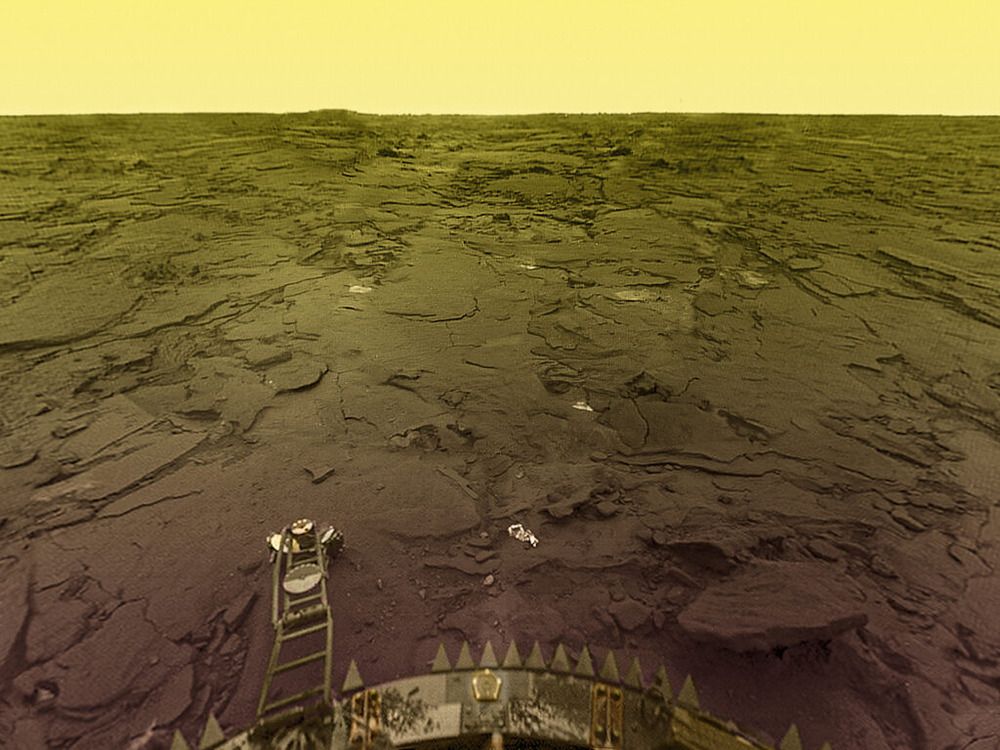
A view of the surface of Venus on March 5, 1982, from the Venera-14 lander. Its sister ship never made it that far.

Look up. A Soviet space probe that has been trying to get to Venus for the past 53 years is about to give up and plummet back to Earth any day now. There’s no telling where it could land.

Kosmos 482, to give the careening craft its official name, was launched from the Soviet Union on March 31, 1972, bound for Venus. Despite the current craze for missions to Mars, Venus was once a popular destination for space probes, although Earth’s track record was not stellar.

Between 1961 and 1989, 37 attempts were made but only 22 were successful (less than 60 per cent). Failures included the first 11 tries by the Soviet Union, and the first attempt by the United States, which on its second shot in 1962 pulled off the first successful flyby of another world.

Of the failed Soviet launches, 11 of them never escaped Earth orbit, and all of those fell back to Earth within a year. Only one — Kosmos 482 — stayed up longer. A lot longer.

Or rather, most of it did. The spacecraft broke into several pieces, with the would-be Venusian lander kicked into a high-Earth orbit that would take decades to decay. Two other pieces re-entered the atmosphere and, thanks to their titanium construction, managed to strike Earth without burning up.

They landed near Ashburton

, a town about 85 kms southwest of Christchurch on New Zealand’s south island, where they were dubbed

“space balls,”

long before Mel Brooks’ satirical science-fiction comedy of the same name.

They were regarded as objects of curiosity, until someone pointed out that they might also be radioactive, which led to at least

one being “jailed” briefly

for safety’s sake.

The objects turned out to be harmless — at least, now that they were no longer falling from the sky — and ended up in a local museum after the Soviets denied all knowledge of them. But the threat of radioactivity was not unwarranted.

In 1978, a Soviet reconnaissance satellite dubbed Kosmos 954 re-entered the Earth’s atmosphere and exploded over northern Canada. Radioactive debris landed in Alberta, Saskatchewan, the Northwest Territories and what is now Nunavut, prompting a joint Canada-U.S. team to spend the better part of a year searching a vast area of the Far North in a recovery effort known as Operation Morning Light.

Canada presented the Soviet Union with a

bill for just over $6 million

for the cleanup. In 1981, the Soviets paid just $3 million and considered the matter closed. In 2022, the CBC

created a podcast

to explore this little known episode in Canadian-Soviet relations and space history.

Kosmos 482 is not radioactive, but it was designed to plunge through the thick, acrid, hot atmosphere of Venus, so there’s a good chance that when its orbit finally decays — possibly within the next few days — at least part of it will reach the ground.

Scientists have calculated

that it could come down anywhere on the planet between 52 degrees north latitude and 52 degrees south. That (fortunately) encompasses a whole lot of ocean, but much land as well.

New Zealand could get another serving of space balls, or the probe could land in Canada — not the Far North, but Newfoundland, the Maritimes and most of the more populated regions of the country are potentially in the path of the debris. (Edmonton is safe, being north of 52 degrees and so — just — is Saskatoon.)

It could also land near

Venus, Texas

. Not to wish any harm on the small town, but that’s sort of where it was headed all those years ago.

Our website is the place for the latest breaking news, exclusive scoops, longreads and provocative commentary. Please bookmark nationalpost.com and sign up for our newsletters here.


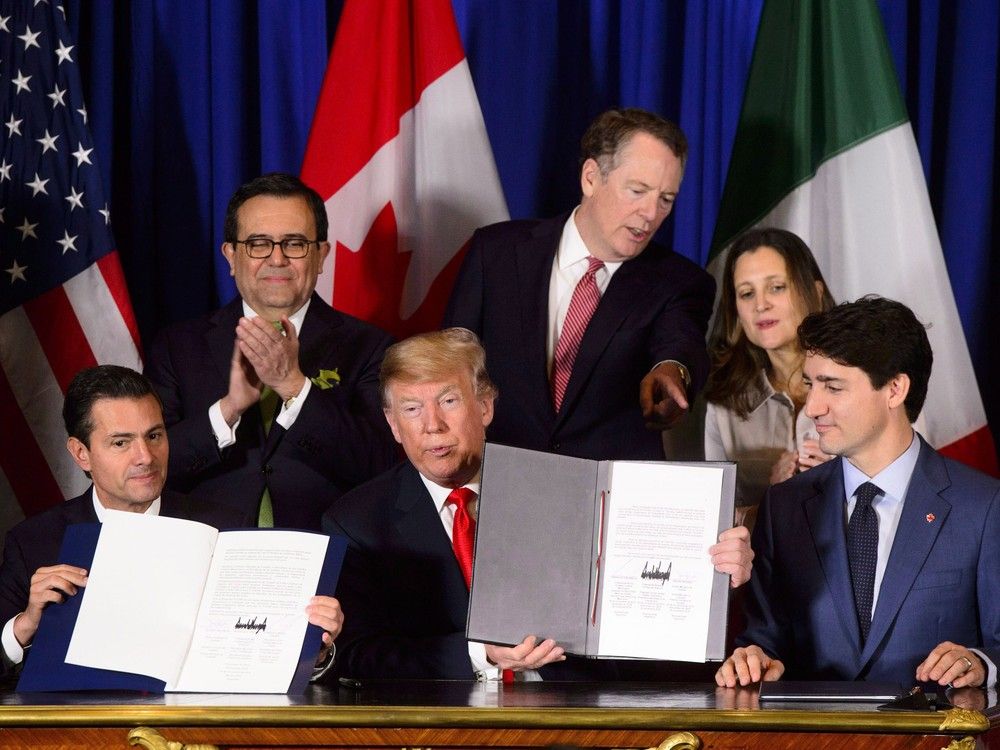
Prime Minister Justin Trudeau, right to left, Foreign Affairs Minister Chrystia Freeland, United States Trade Representative Robert Lighthizer, President of the United States Donald Trump, Mexico's Secretary of Economy Ildefonso Guajardo Villarreal, and President of Mexico Enrique Pena Nieto participate in a signing ceremony for the new United States-Mexico-Canada Agreement in Buenos Aires, Argentina, Nov. 30, 2018.

One of the challenges Prime Minister Mark Carney faced in the Oval Office on Tuesday was stickhandling around President Donald Trump’s insults of other politicians, including Canada’s minister of transport and internal trade, Chrystia Freeland.

Despite Trump saying the Canada-U.S.-Mexico free trade agreement is still a good deal, Trump levelled an insult aimed at Freeland.

As Canada former federal minister of international trade, Freeland was Canada’s lead negotiator for the 2018 treaty. Without mentioning her by name, he called her a “terrible person” on Tuesday, a comment he made

during the negotiations

too.

There was no reaction from the Canadians, or other Americans, in the room.

“Trump seems to have an attitude that many of us have experienced when working with an abusive employer,” says University of Toronto political science professor, Ryan Hurl. “The boss expects his subordinates to take everything he says in stride, even the worst insults and provocations. if you respond to the provocations, the boss will not only be angry but insulted.”

Hurl assumes Trump found “Freeland’s lack of deference” unsettling, he said in an email to National Post.

Over time, Trump has repeatedly expressed negative opinions about Freeland. He has publicly called her “terrible,” a source of

“ill will for Canada,”

and

“whack”

— particularly criticizing her role in trade negotiations and her approach to Canada-U.S. relations.

During the CUSMA negotiations, he said,

“We don’t like their representative very much,”

referring to Freeland.

After Freeland resigned as Canada’s finance minister in late 2024, Trump posted that her “behavior was totally toxic, and not at all conducive to making deals which are good for the very unhappy citizens of Canada.

She will not be missed

!!!”

Jeni Armstrong, who teaches political communication at Carleton University, said she finds it curious that Trump would continue to harp on Freeland.

“I think a lot of Canadians — women in particular — are asking themselves that question,” she wrote in an email to National Post. “It’s pretty well documented that the president takes issue with strong and effective women who don’t share his political leanings (Hillary Clinton, Kamala Harris, Nancy Pelosi, Alexandria Ocasio Cortez … it’s a long list).”

Rob Danisch, professor of communications at the University of Waterloo, shares that view. In an email to National Post, Danisch says that Trump is “not really capable of viewing any woman as anything other than an object. Hence, Freeland is caught in this … rhetorical pattern.”

Trump was likely “looking to Carney, as another man, to confirm his view of women as objects.”

Freeland has responded

with her own theory about Trump’s insults. In early 2025, she posted on X that the reason both Trump and Vladimir Putin have complained about her is: “I don’t back down – and Trump and Putin know it.”

Regarding Carney’s lack of reaction to Trump’s insult of Freeland on Tuesday, Armstrong says: “There was zero upside for Prime Minister Carney to engage on it, so I’m not surprised that he didn’t.”

“I’m struck by how needy he is for others’ complicity, says Rob Goodman, politics and public administration professor at Toronto Metropolitan University. “He’s aware that he’s breaking some sort of rule (otherwise he’d simply mention Freeland by name), and he wants everyone else in the room to get their hands dirty with him by acknowledging that they

 
do

know who he is talking about,” he wrote in an email to National Post.

He thinks Carney “did a good job of not taking the bait. But I think we saw a glimpse of what makes Trump an effective demagogue — his instinct for inviting others to participate in his abuse.”

He also points to a worldview that he thinks is inherent in Trump’s comments as well as the direction of U.S. trade policy: “So while it is tempting to write off comments like these as the product of one man’s animosity or sexism, they matter because the American side in yesterday’s negotiation has fully bought into the worldview they represent. When Trump and the members of his administration talk about trade, they talk about “manly” manufacturing jobs, “weak” European beef, and spoiled girls who have too many dolls.”

Armstrong doesn’t think there is any implication in the Trump’s Freeland comments for the future trade negotiations.

“I don’t think we can or should make a connection between these specific comments about Freeland and the future of trade negotiations … We don’t know if she is going to have a meaningful role in whatever negotiations take place.” Carney seems to be taking a pragmatic approach to Trump and trade, Armstrong says, “so it’s possible that if she stays in cabinet, he may elect to assign her a role that’s not obviously related to the trade file.”

Danisch agrees: “I think given that Freeland is not likely to be a major part in future trade negotiations that this will not be relevant, or relevant to the extent that Trump will be more willing to work with a man because he sees men as having agency and being important decision-makers, a role a woman cannot have in his worldview.”

In noting the difference in Trump’s overall demeanour yesterday, Hurl points out that Freeland and Trudeau took Trump’s 51st state rhetoric seriously and literally, but says Carney was more strategic. “Carney has reacted in a way that Trump has more respect – ignore the jokes and simply get down to negotiation.”

Our website is the place for the latest breaking news, exclusive scoops, longreads and provocative commentary. Please bookmark nationalpost.com and sign up for our daily newsletter, Posted, here.


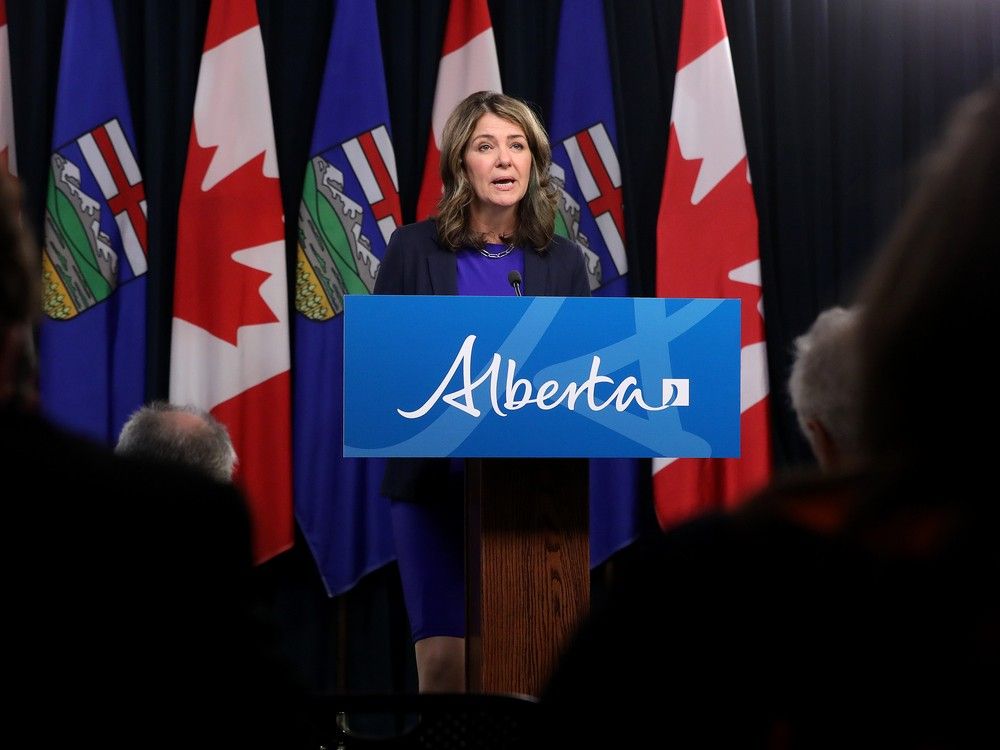
Premier Danielle Smith speaks to reporters during a press conference at the Alberta Legislature, in Edmonton Tuesday May 6, 2025.

OTTAWA — Prime Minister Mark Carney could soon be facing a national unity crisis after Alberta Premier Danielle Smith lowered the bar for a referendum on the province’s independence in 2026.

Liberal insiders with ties to Alberta say this is a threat that Carney shouldn’t take lightly. And Ontario Premier Doug Ford told reporters on Wednesday that he agrees.

“About two in 10 Albertans say routinely that they want to see the province separate from Canada,” says Dan Arnold, an ex-Alberta Liberal organizer who’s now an executive with

Pollara Strategic Insights

.

“These people are in the minority, to be clear, but they’re too numerous to be written off as a radical fringe.”

Arnold points to the grim numbers from Pollara’s latest

Western Identity Report, released in February

. The report

found that 55 per cent of Albertans

feel that their province is being treated unfairly by the federal government.

Albertans were also

the least pessimistic group

anywhere in Canada about their province’s prospects outside of confederation and the least opposed to joining the United States.

Arnold said the silver lining for Carney is that most Albertans have a gripe with Ottawa, not with Canada as a whole.

“Albertans still identify strongly as Canadians,” said Arnold. “Alberta separatism isn’t identity-based in the same way as Quebec separatism.”

Arnold also said that now is a good time for Carney to “sell Canada” to disaffected Albertans, with national pride rising in the face of tariffs and annexation threats from U.S. President Donald Trump.

He noted that next month’s G7 summit in Kananaskis, Alta., will give Carney a great opportunity to send a message of national unity to Albertans.

Carney reportedly gave Trump a hat and golf gear bearing the logo of

the Kananaskis Country Golf Course

 as a gift during his visit to Washington, D.C. on Tuesday.

Ford said Wednesday that he’s personally told Carney to take a less confrontational approach to Alberta and the other western provinces than his Liberal predecessor Justin Trudeau.

“I said it’s time that your government starts showing some love to Saskatchewan and Alberta (because) the last prime minister showed no love,” Ford told reporters in Toronto.

Ford said that the two Prairie provinces, both major oil producers, had been “treated terribly” under Trudeau.

He added he was a “big believer” in pipelines and scrapping the Liberals’ Bill 69, which critics have called the

“no-new-pipelines” law

.

Calgary-based Liberal strategist Sabrina Grover said that Carney’s outreach to Alberta can start with the

more than 600,000 Albertans

who marked “Liberal” on their ballot in last week’s federal election.

“The Liberals had their best showing in Alberta in years, if you look at the number of votes they won,” said Grover.

“That tells me that Carney already has hundreds of thousands of Albertans behind him… and those are the kinds of people that you want to mobilize and bring on your team.”

Provincewide, the Liberals won 28 per cent of the popular vote, a double-digit improvement over the 15.5 per cent they won in the last federal election in 2021.

Grover said that Carney can build even more goodwill with Albertans by listening attentively to their concerns, especially surrounding natural resource development.

“You’ve had that with (Carney’s) scrapping of the carbon tax already… and I think there will be some give-and-take on things like the federal emissions cap and clean electricity regs,” said Grover.

Grover added that Intergovernmental Affairs Minister Dominic LeBlanc could be a huge asset for Carney on the national unity file, assuming he stays in the portfolio when Parliament resumes.

“Dominic LeBlanc has decades of intergovernmental experience and will be a great voice to be engaging with Alberta and the other provinces,” said Grover.

LeBlanc’s office didn’t immediately respond to a request for comment on the story.

Carney, who grew up in Edmonton, launched his campaign for the Liberal leadership near his childhood home in the

city’s Laurier Heights neighbourhood

.

He brought up his upbringing in the province when asked on Tuesday about the possibility of an Alberta referendum.

“Canada is stronger when we work together,” Carney told reporters in Washington.

“As an Albertan, I firmly believe that.”

National Post

rmohamed@postmedia.com

Get more deep-dive National Post political coverage and analysis in your inbox with the Political Hack newsletter, where Ottawa bureau chief Stuart Thomson and political analyst Tasha Kheiriddin get at what’s really going on behind the scenes on Parliament Hill every Wednesday and Friday, exclusively for subscribers. Sign up here.

Our website is the place for the latest breaking news, exclusive scoops, longreads and provocative commentary. Please bookmark nationalpost.com and sign up for our daily newsletter, Posted, here.


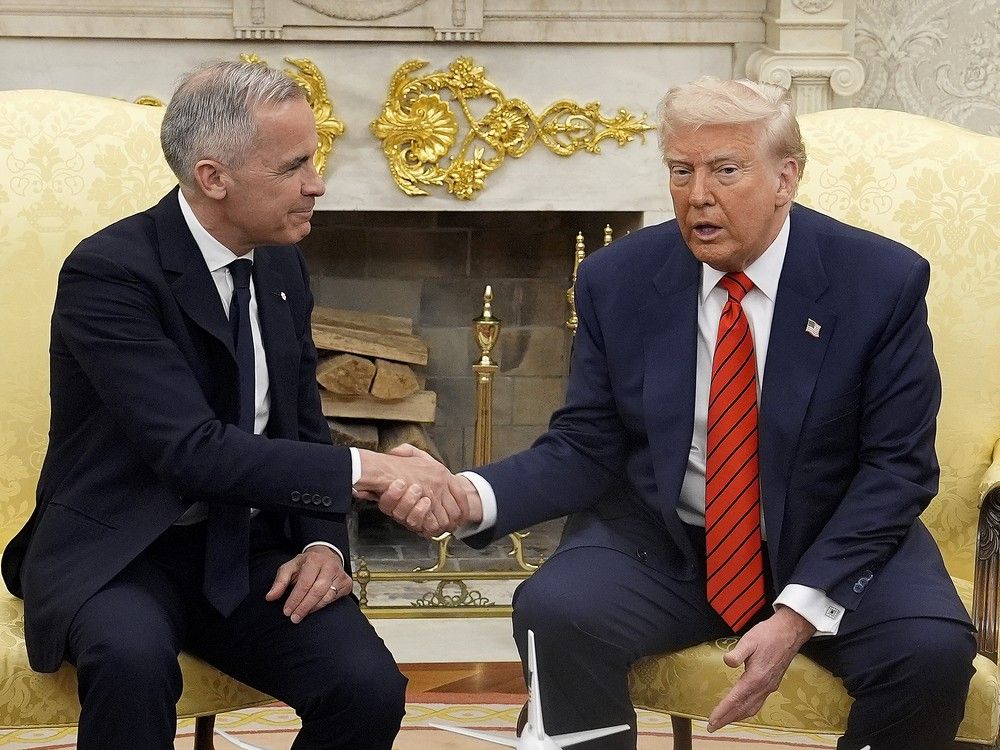
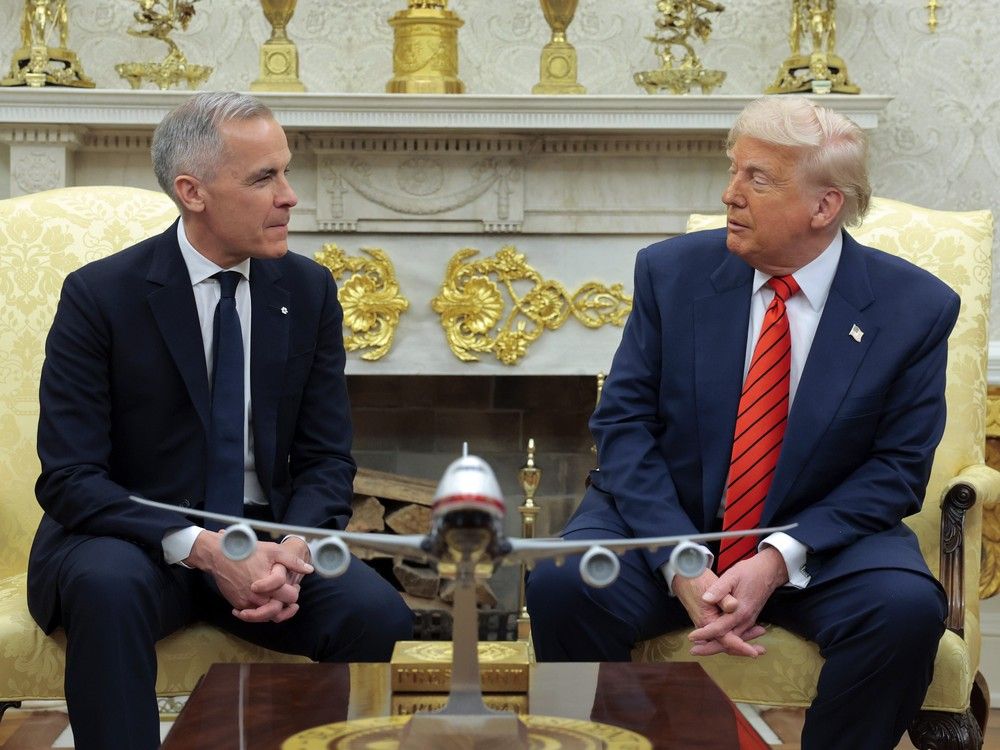
Prime Minister Mark Carney and U.S. President Donald Trump engage in a meeting at the White House in Washington, D.C., Tuesday, May 6, 2025.

OTTAWA — As Prime Minister Mark Carney left his meeting with U.S. President Donald Trump, officials left behind gifts seen as fit for a president with whom Canada is trying to forge better relations.

They also spoke to the president’s favourite sport: golf.

For his visit to Washington, Carney and the rest of the Canadian delegation — which included several of his ministers, senior advisors and top bureaucrats — gave the president a photograph taken by a Canadian military photographer of a

football game

known as the “Tea Bowl,” which was played between Canadian and American soldiers before a wartime crowd in London during the Second World War, several months before D-Day, in 1944.

The photograph captures a moment shared between each team’s captain and speaks to a sense of coming together in the midst of global turmoil — something Canadians are hoping to restore with their U.S. neighbours.

Carney’s delegation also gifted Trump a hat and golf gear from the Kananaskis Country Golf Course.

Kananaskis is where the leaders are next set to meet, when Canada plays host to the G7 in June. Trump also provided Carney with a gift, which has yet to be disclosed on the registry for office holders.

Gift-giving is customary among world leaders during official visits.

French President Emmanuel Macron gifted Carney a bottle of Martell Cordon Bleu Cognac and a bottle of Chateau Lynch-Bages 2014, which would each set the average consumer back several hundred dollars.

The French also gifted him a Hermès Tie, which would cost roughly the same.

U.K. Prime Minister Keir Starmer, whom Carney also visited on his trip to Europe back in March, gave him a crystal bowl with a laser engraving of 10 Downing Street’s door.

But as Carney turns his mind to that next month’s meeting, he does so with the issue of U.S. tariffs on steel and aluminum still being unresolved. He is also under pressure from business leaders to forge a path to ensuring the extension of the free trade agreement between the U.S., Canada and Mexico, which is due for review next year.

After leaving Washington, it appears he can now tackle that to-do list in better standing with the president than his predecessor.

“Everybody felt, that I’ve spoken to, from ambassadors to people who were in the room, to secretaries that I’ve spoken with who’ve gotten briefs and debriefs, everybody felt that there was a total reset that took place here between the relationship between the prime minister of Canada and the president of the United States of America,” said Business Council of Canada CEO Goldy Hyder, in an interview from Washington.

“That was critically important,” he says, “that there was a relationship being established there, that even on the sensitive issues that were provocative on 51st state and so forth, they threw their jabs the way they’re supposed to, but they didn’t let it dominate the rest of the discussions that took place privately.”

Some of those travelling back with Carney felt the same, noting how productive they felt the discussions were and how direct the president was behind closed-doors.

Going into the visit, Carney had tried to lower expectations of what he would be able to accomplish through one day of meetings.

Trump himself told reporters there was

nothing the prime minister could say to convince him to lift the tariffs

on Canada, but nonetheless emphasized he wanted to have a friendly visit.

The president was also effusive in his praise of Carney, saying he has a great deal of respect for him.

Trump made it clear that he likes Carney much more than his predecessor, former prime minister Justin Trudeau, as well as Chrystia Freeland, who served as foreign affairs minister during Trudeau’s first term in office when Canada, the U.S. and Mexico negotiated the free trade deal that replaced the North American Free Trade Agreement.

For Hyder, who spoke with Carney when the prime minister attended a business event he hosted in Washington the day before meeting with Trump, he believes Trudeau’s exit plays a factor in the president’s openness towards Carney, but is not the only reason.

“I don’t think we should underestimate that it probably has a lot to do with who Prime Minister (Mark) Carney is, in the eyes of the president,” he says.

“Someone who respects global stature, someone who respects global achievement, someone who respects people who have prominent friends in different parts of the world. I think he respects that,” Hyder said of the president.

Carney successfully ran an election campaign on the promise that his time spent as the governor of central banks in Canada and the United Kingdom during the 2008 recession and Brexit, respectively, made him the best leader to go toe-to-toe with Trump.

A senior government official, speaking on the condition of anonymity, said that behind closed-doors, the president and Carney discussed foreign policy, with Trump asking for his perspective on issues from Iran and China, to Russia’s invasion of Ukraine, which the official took as an encouraging sign.

Matt Holmes, the executive vice-president and chief of public policy at the Canadian Chamber of Commerce, said the visit signalled the best restart of the Canada-U.S. relationship they could have hoped for, particularly because of the time senior members from both countries’ governments spent out of public view, where talks about trade and negotiation should happen.

However, he cautioned that despite a positive first meeting, the times ahead will still be difficult.

“It’s important that we don’t create any false urgency or false timelines, here. This is not going to be an easy process.”

In terms of next steps, Holmes said significant milestones will come when Canada plays host to the G7 in June and then attends the NATO Leaders’ Summit right after.

That requires Canada to become a serious player when it comes to national security, he says. “National security is economic security.”

Hyder believes the government ought to take a “minimalist” approach and focus its immediate attention on next year’s scheduled review of the free trade agreement between Canada, the U.S. and Mexico.

In fact, he believes Carney should invite Mexican President Claudia Sheinbaum to next month’s G7 meeting and set aside some time to talk about the deal with Trump.

National Post

staylor@postmedia.com

Get more deep-dive National Post political coverage and analysis in your inbox with the Political Hack newsletter, where Ottawa bureau chief Stuart Thomson and political analyst Tasha Kheiriddin get at what’s really going on behind the scenes on Parliament Hill every Wednesday and Friday, exclusively for subscribers. Sign up here.

Our website is the place for the latest breaking news, exclusive scoops, longreads and provocative commentary. Please bookmark nationalpost.com and sign up for our politics newsletter, First Reading, here.


Quebec has introduced legislation that suggested tip amounts are calculated using the subtotal, not the price after taxes.

Quebec became the first Canadian province to enact legislation stipulating that recommended tip amounts on payment terminals must be calculated using the subtotal — the price before the GST (five per cent) and the province’s sales tax (9.975 per cent) are applied.

In most Canadian retail and service settings, when a consumer is presented with a digital debit machine displaying suggested tip percentages, that figure is calculated using the post-tax total. It should be common knowledge, but it’s not, and it often results in people paying an added gratuity on money ultimately paid to government.

As of Wednesday, suggestions on a $100 tab at a Quebec brasserie, for example, will be determined by that number, not the current $114.98 after tax sum. That means an 18 per cent gratuity works out to be $18, not $20.70.

The province introduced the measures to return to the halcyon days when patrons, particularly those at bars and restaurants, were given a bill that displayed the tax breakdown, allowing them to determine how much to tip before the server returned to collect payment.

While promoting the changes last fall, Simon Jolin-Barrette, Quebec’s minister responsible for consumer protection, cited

a January 2024 Canadian survey

that found 62 per cent of people went overboard on tips because of percentages presented or by doing the math themselves based on the after-tax total.

“We shouldn’t feel pressured when someone hands us the terminal at the time of payment,”

Simon Jolin-Barrette told the National Assembly

when Bill 72 was passed in November.

The new rules also state that the tipping options must be “presented in a uniform manner.” On many debit machines, choices are sometimes accompanied by praise for the employee, like “good,” “great,” or “amazing.”

“There should no longer be undue pressure with exclamation points, comments, smiley faces, depending on the level of satisfaction linked to the level of the tip,”

Québec solidaire member Guillaume Cliche-Rivard

said in support of the measures last fall.

 A survey in February revealed 94 per cent of Canadians are annoyed by card payment machines prompting tip options for services for which tips or gratuities weren’t previously expected.

Quebec is the only remaining province where a lower minimum wage is paid to those who regularly receive tips — they make $12.90 hourly compared to the $16.10 everyone else earns. Ontario eliminated its reduced wage in 2022, and Alberta abandoned its in 2019.

“We really do depend on the tips to make a living, so with it being less, it’ll just affect my yearly income and everyday life,” Montreal waiter Tyler Muehleisen told City News this week.

When passed last fall, Montreal barista Sophia Cooke told

The Link

she worried skewing tipping culture toward the consumer rather than the worker could create more competition for the most sought-after positions in an already competitive market.

As for consumers,

a recent survey by H&R Block

suggests Canadians are growing weary of tipping expectations and being asked to tip for services that traditionally wouldn’t warrant one.

“A colossal 94 per cent of Canadians say they’re annoyed by card payment machines prompting tip options for services that tips or gratuities weren’t previously expected,” the survey of 1,790 people in February found.

Regardless, 57 per cent who tip only do so because they feel uncomfortable not choosing a tip option.

As for how much they tend to leave, more than half (53 per cent) choose the lowest option or only tip for exceptional service, while 39 per cent consider themselves generous tippers.

While respondents were divided on whether the tip money is actually making it to the worker or being pocketed by their employer, the vast majority (88 per cent) agreed that tipping culture allows the employer to pay lower wages.

Another survey, conducted by Lightspeed Commerce in 2024 and featuring 1,500 Canadian respondents, found nearly half (47 per cent)

tip between 10 and 15 per cent

. About a quarter will tack on 16 to 20 per cent.

Additionally, more than three-quarters (77 per cent) are opposed to auto-tipping prompts like those now more tightly regulated in Quebec.

Our website is the place for the latest breaking news, exclusive scoops, longreads and provocative commentary. Please bookmark nationalpost.com and sign up for our daily newsletter, Posted, here.


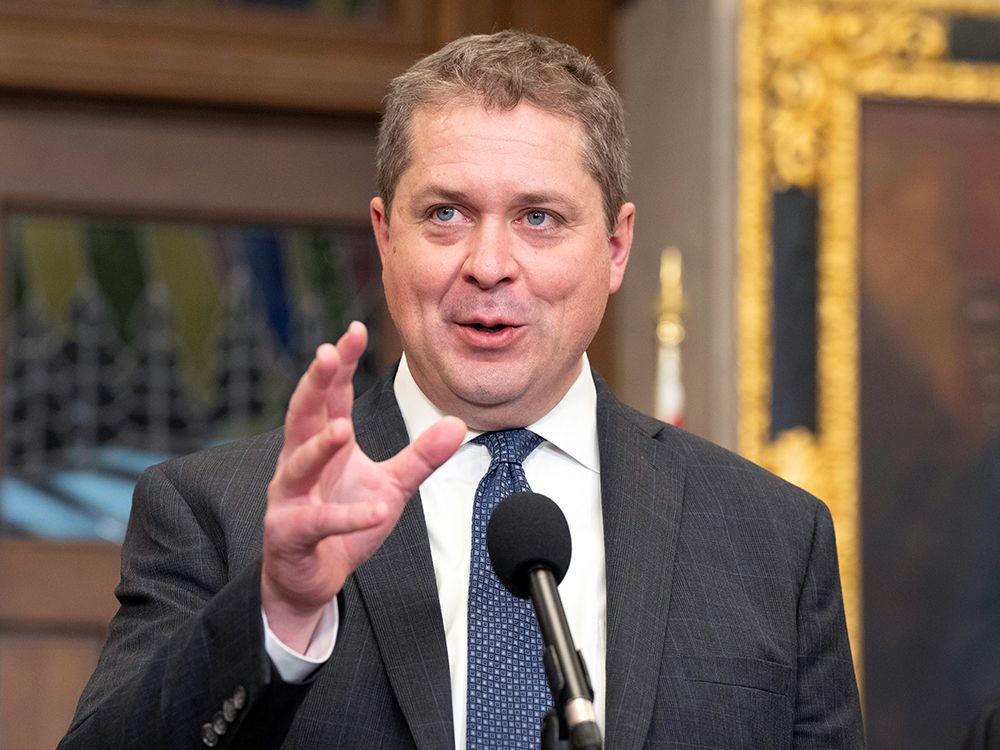
Andrew Scheer speaks with reporters in the foyer of the House of Commons in Ottawa, Tuesday, Jan. 7, 2025.

The federal election has done more than just choose a prime minister. Several party leaders failed to secure a seat in the House of Commons, leading to a shakeup at the parties’ top levels.

Jonathan Pedneault stepped down as Green Party co-leader after losing the riding of Outremont to Liberal candidate Rachel Bendayan; Elizabeth May remains the party leader. And this week the New Democratic Party appointed

Don Davies as interim leader

after Jagmeet Singh lost his seat and stepped down. The NDP also lost official party status with just seven seats in the House.

Now it’s the Conservatives’ turn. On Tuesday it was announced that Andrew Scheer will replace Pierre Poilievre as interim opposition leader until Poilievre, who lost his seat in Ottawa’s Carleton riding on election night, can rejoin the House. The plan is for Poilievre to run in Alberta, where MP Damien Kurek has offered to resign his seat in Battle River–Crowfoot to trigger a byelection.

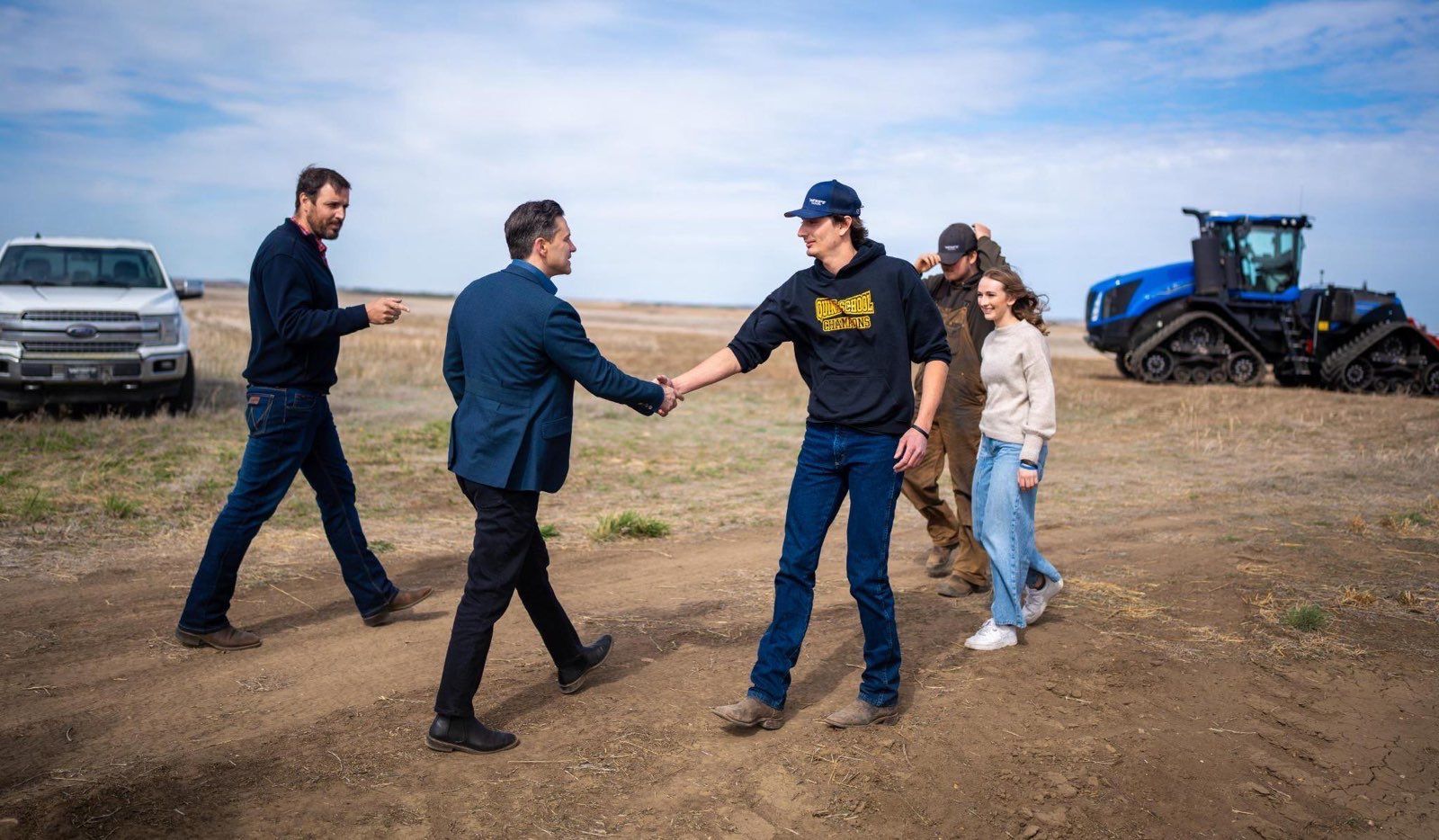
 Conservative Leader Pierre Poilievre spent the weekend touring around Battle River—Crowfoot, the Alberta riding he intends to win in a byelection.

Who is Andrew Scheer?

Conservative Andrew James Scheer was born in Ottawa in 1979, and has a Bachelor of Arts in criminology, political science and history from the University of Ottawa. During his time at school he worked on the Unite the Right campaign to merge the Progressive Conservative and Reform parties under Preston Manning.

Scheer was first elected to the

House of Commons

in 2004 in the Saskatchewan riding of Regina–Qu’Appelle, and has held that riding in every election since then. (His wife, Jill Ryan, is from Regina.)

Scheer holds dual Canadian-American citizenship because his father was born in the U.S. In 2019 he said he was in the process of

renouncing his U.S. citizenship,

but the following year said he would

no longer do so

as he did not have a chance of becoming prime minister.

What’s his history as Conservative leader?

In 2011, Scheer became House speaker under the ruling Conservatives at the age of 32, the

youngest person in history

to hold that position.

After the Conservatives lost power in 2015, he ran for leadership of the party. In 2017 he was

elected to that position

, narrowly defeating Maxime Bernier, who would go on to found and lead the People’s Party of Canada.

Scheer would be leader of the opposition from 2017 through 2020. After the Conservative loss in the 2019 election he announced he would step down as leader. He was replaced by Erin O’Toole, who subsequently named him Opposition Critic for Infrastructure & Communities in his shadow cabinet.

Scheer endorsed Poilievre’s campaign to become leader of the Conservative Party in 2022, and Poilievre later named him Opposition House Leader.

How long will it be before Poilievre can regain his leadership?

Canadian law prohibits MPs from resigning until

at least 30 days

after their election result is published in the Canada Gazette, the federal government’s official publication. This itself can take about a month, meaning it could be late June before Kurek can step down.

The byelection is then called by the Governor General on the advice of the prime minister and cabinet, between 11 and 180 days after an MP resigns. However, Prime Minister Mark Carney told reporters last Friday: “I will ensure that it happens as soon as possible. No games, nothing.”

Under that timeline, Poilievre could be back in the saddle by the start of the

fall sitting of Parliament on Sept. 15

. Scheer would step down and return to being a regular MP.

 Conservative Party Leader Pierre Poilievre speaks to supporters alongside his wife, Anaida Poilievre, after losing the federal election, in Ottawa on April 29, 2025.

Our website is the place for the latest breaking news, exclusive scoops, longreads and provocative commentary. Please bookmark nationalpost.com and sign up for our daily newsletter, Posted, here.


William Shatner appeared in a Fox News interview after Prime Minister Mark Carney and President Donald Trump had their first meeting on May 6, 2025.

Canadian actor and comedian William Shatner had a counter-offer to President Donald Trump’s suggestion of turning Canada into the 51st state.

Shatner

spoke to host Jesse Watters on Fox News

after Prime Minister Mark Carney met with the American leader at the White House on Tuesday. In the interview, Shatner joked about what he thought could be a good solution for Carney to turn the tables on Trump.

“I’ve dealt a little in real estate and I’m going to say to Carney, ‘Do a real estate deal. Make a counter offer.’ Let’s offer … to the United States to be the 11th province,” he said. “Think of the joy… It’s the best thing.”

Carney ‘let Trump be the star’: Analyzing the Oval Office meeting, from pleasantries to insults

He added: “Here (in Canada) you have a friendly group of people saying come on over. It’s cleaner. There’s plenty of power. Some lovely people who want to work with you.”

Tensions between Canada and the United States have been heightened since Trump took office. This is largely due to the president’s rhetoric about making Canada the 51st state, as well as an ongoing trade war and

stricter travel policies

. Canadians have been resolute in trying to

buy local goods

and have even been opting to travel within in the country,

rather than vacationing in the U.S.

Shatner said that everyone was acting “so serious about what is an unserious offer” from Trump.

He also brought up Canada’s history, highlighting the country’s role in the Second World War.

“Canada’s been around for 150 years more and they’ve had a noble service… Vimy Ridge, Juno Beach, Dieppe. Tens of thousands of Canadian soldiers have died in the fight for freedom and making the world playable for all of us. You can’t denigrate that. You can’t deny that,” said Shatner.

 U.S. President Donald Trump meets with Canadian Prime Minister Mark Carney in the Oval Office at the White House on May 6, 2025 in Washington, DC.

Watters brought up the fact that by persisting, Trump may eventually get what he wants.

“At a certain point, persistence becomes insulting,” said Shatner.

At Tuesday’s

meeting in the Oval Office

, Trump and Carney addressed talk of the 51st state.

“As you know from real estate, there are some places that are never for sale,” said Carney.

Trump responded: “Time will tell. It’s only time. But I say never say never.”

Shatner said that he wasn’t sure “what all the fuss is about,” saying that Canada and the U.S. are “two noble countries side by side.”

Our website is the place for the latest breaking news, exclusive scoops, longreads and provocative commentary. Please bookmark nationalpost.com and sign up for our daily newsletter, Posted, here.


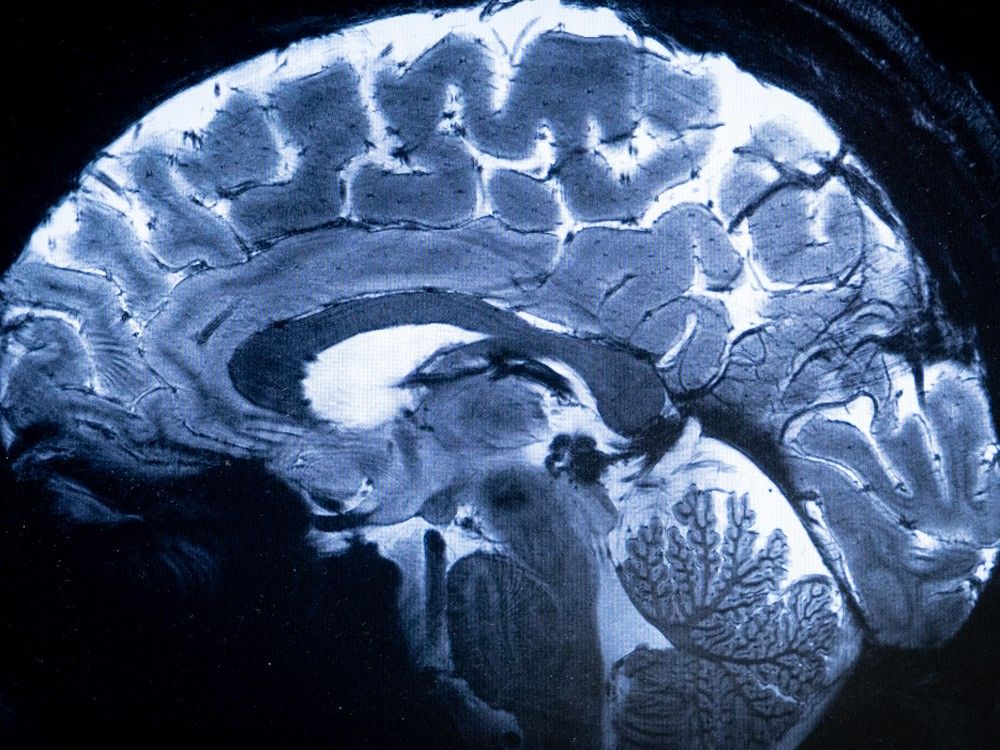
A new study published in JAMA Neurology debunks “an alleged ‘mystery’ neurological illness” that emerged in New Brunswick six years ago.

A new study is debunking “an alleged ‘mystery’ neurological illness” that emerged in New Brunswick six years ago.

The research,

published Wednesday in JAMA Neurology

, took another careful look at 25 cases of people previously diagnosed with what’s dubbed a neurological syndrome of unknown cause (NSUC), 11 of whom have since died.

“There was no evidence supporting a diagnosis of NSUC in this cohort,” the study concludes.

Instead, well-known conditions were identified in all 25 cases, including common neurodegenerative diseases, functional neurological disorder, traumatic brain injury and metastatic cancer.

“Based on the 11 autopsy cases, a new disease was extremely unlikely, with a probability less than .001,” said the study.

New Brunswick neurologist Dr. Alier Marrero has said he’s seen hundreds of patients in recent years

including some from neighbouring Nova Scotia

who are experiencing inexplicable symptoms of neurological decline. Those include anxieties and difficulty sleeping, as well as more acute symptoms including limb pain and trouble balancing, teeth chattering, violent muscle spasms, vision problems and hallucinations. Many of them were under the age of 45.

Last November, New Brunswick Premier Susan Holt said she wanted the Public Health Agency of Canada to investigate.

An oversight committee appointed by Progressive Conservative Blaine Higgs’ former government rejected the idea that the cases are linked. It indicated that most of the patients in the cluster were misdiagnosed.

“Despite these findings, the number of cases reported in the media has grown to more than 500 patients with more than 50 deaths, although (Public Health New Brunswick) has received only 222 verified submissions,” said the new study. “Speculations regarding the underlying cause have included an unknown prion disease, toxins from cyanobacteria, glyphosate, glufosinate, and heavy metals. However, despite extensive media attention, no clinical or pathological case descriptions have been published in the medical literature to our knowledge.”

The sample of 25 cases was drawn from a cohort of 222 people who received an initial NSUC diagnosis.

“Eligible patients were offered a second opinion; four families of deceased patients provided consent for reporting autopsies and waivers of consent were obtained for seven,” said the study.

The research was conducted at Horizon Health Network in New Brunswick and University Health Network in Ontario.

“Complex neurological disorders benefit from a second, independent and/or subspecialist evaluation and require multidisciplinary support throughout the diagnostic journey,” said the study that collected data between November 2023 and this past March.

“Clinical and neuropathological evaluations demonstrated that all 25 cases were attributable to well characterized neurological disorders,” it said. “The final primary diagnoses, and in some cases secondary diagnoses, included Alzheimer disease, Parkinson disease, progressive supranuclear palsy, other neurodegenerative conditions, functional neurological disorder, traumatic brain injury or persisting post concussion symptoms, and others.”

The independent assessment of 25 patients “provides no support for an undiagnosed mystery disease in New Brunswick,” said the study.

“The gold standard, neuropathological assessments with second, blinded independent evaluations, revealed well-defined diagnoses for 11 deceased patients.”

When all 25 cases were included in the mix, “100 per cent of patients in this sample did not have a new disease and with 95 per cent confidence, the probability of no new disease is between 87 per cent and 100 per cent,” said the study.

“The lower bound of 87 per cent reflects a conservative estimate based on the data and statistical methods accounting for uncertainty in the sample, including the possibility of diagnostic error or unmeasured variability. However, practical knowledge and clinical reasoning suggest that the actual probability of no new disease is much closer to the upper bound of 100 per cent.”

The new study said “it is crucial to highlight the factors that fuel persistent public concern of a mystery disease despite the provincial investigation rejecting this possibility. Public trust in health institutions has decreased since the COVID-19 pandemic, while trust in individual healthcare professionals remains high, which can make vulnerable people susceptible to claims that the institutional oversight processes are flawed, especially if originating from trusted physicians.”

The new research comes with a caution.

Misinformation regarding the New Brunswick “cluster has proliferated in both traditional and social media, from not only the predictable and easily identifiable groups coopting the crisis to suit their agenda, such as antivaccine advocates, but also those who are unknowingly amplifying an incorrect diagnosis from their physician,” said the study.

“In this way, misdiagnosis and misinformation become inextricably entwined and amplify patient harm exponentially: to the best of our knowledge, only 14 patients sought independent reevaluation by another neurologist when offered, and 52 refused a second opinion, choosing instead to remain with the one neurologist who originally made and continues to promote the diagnosis of a mystery disease. Not only do our data indicate that affected patients likely have other diagnosable neurological conditions that could benefit from multidisciplinary treatment and other resources, but the low uptake also impedes the rigorous scientific evaluations necessary to counter the claims raised in the first place.”

For his part, Marrero, the New Brunswick neurologist who made the original diagnoses, said in an email Wednesday that he’s “appalled that a parallel investigation with a small number of patients, has apparently been conducted for a long time, without our knowledge or our patients and families’ knowledge.”

Marrero said he is “in profound disagreement with the study conclusions and (has) many questions regarding the methods and the content, including cases never evaluated by us or that might have not been part of this cluster.”

Marrero is “also surprised that a publication about such a potential impact, happening in parallel to an ongoing public health investigation, and that include data until March 2025, was published so speedily in a matter of weeks. I am sure that our patients, families and communities share the same very serious concerns.”

The Moncton neurologist said he has “evaluated more than 500 patients in this cluster, and provided a significant amount of unequivocal, sometimes critical environmental exposure evidence, as well as rare autoimmune markers in many of them. As such, I trust that the current process of independent multidisciplinary scientific investigation, and extensive files analysis that is underway by our public health authorities, could provide appropriate answers to our communities.”

Marrero is “hopeful that this process would include not only comprehensive additional (patient) testing, but also testing for water, food, soil and air samples in the affected areas, as well as additional patient support and effective prevention and treatments measures.”

Our website is the place for the latest breaking news, exclusive scoops, longreads and provocative commentary. Please bookmark nationalpost.com and sign up for our daily newsletter, Posted, here.


Aerial view of Trans-Canada Highway during a vibrant sunny summer day. Taken near Calgary, Alberta, Canada.

Set for release on May 13 with Sutherland House Books, Canada’s Main Street: The Epic Story of the Trans-Canada Highway by Craig Baird finally gives this nation-shaping infrastructure project its due. In this excerpt, Baird introduces the ambitious, messy and overlooked saga of the coast-to-coast highway that is the true spine of modern Canada.

The Trans-Canada Highway. We live by it. We drive on it. We depend on it for the goods we use. And yet, we barely think about it. Why?

Is it because, for most of us, the Trans-Canada Highway has always just been there? Something we take for granted and don’t think about? With success has come invisibility.

Maybe it is because the Trans-Canada feels like history that is too recent. Maybe it needs another century, like the

Canadian Pacific Railway

(CPR), to give it historical context.

What a contrast when we think about the CPR — the other cross-country, nation-building transportation system. In 1970,

Pierre Berton

released his magnum opus, The National Dream. The book told the story of the planning and inception of the CPR, covering the years 1871 to 1881. The following year, he followed up with The Last Spike, which covered the years 1881 to 1885. Those years saw the construction and completion of the CPR.

The books galvanized the public. They presented history in a way that was not dryly academic, but something any regular Canadian, even one who thought they weren’t interested in history, could enjoy. They both became instant best-sellers and inspired the CBC’s TV docuseries,

The National Dream

, which attracted a record three million viewers at a time when Canada’s population was only 22 million. Both books were also critically well-received, with The Last Spike winning the 1971 Governor General’s Award for English-language non-fiction.

It seems fitting somehow that the definitive work on the CPR was released at the same time the Trans-Canada Highway was (finally) being finished.

The construction of the CPR was an amazing project that changed the history of Canada forever. It was a tale of scandals, greed, needless death and amazing triumphs. It easily overshadows the significance of the Trans-Canada Highway in the eyes of Canadians. There have been no big productions for television or film about the Trans-Canada Highway. Very few books have been written about it and most focused on what you could see travelling it, rather than on how the road was built. Back in 1967,

Gordon Lightfoot

wrote a song about the CPR, “The Canadian Railroad Trilogy,” one of his greatest works. Has anyone ever written about the Trans-Canada Highway? Maybe the closest we have is “Life Is a Highway,” by Tom Cochrane.

To those who created it, however, building the Trans-Canada was every bit as important as the CPR. The construction took longer than the CPR, cost more, and involved negotiations with the provinces that resembled nothing so much as cat herding. It took a year just to get some of the provinces to sign the agreement on the highway and start selecting their routes. Several didn’t sign right away, and Quebec held off for a full decade. The building of the CPR was no easy task politically. There was no single, large company, like the CPR, to oversee the construction of the entire Trans-Canada from coast to coast — just premiers in each province, all wanting to use the highway for their own political ends. Maybe that is why we don’t see the highway for the engineering marvel that it is. It doesn’t even seem much in comparison to the story of the

Alaska Highway

, built in only months during a time of war. Yet, it was built — far behind schedule and well over budget, but it got done.

To those who use the highway, it has been enormously consequential. People say that the United States is a country built by the automobile, but Canada can make that claim as well. We are much larger, and much more sparsely populated, and the highways we build truly connect all of us, and none more so than the Trans-Canada. It tied the country together as the automobile overtook the railroad as the dominant form of travel during the highway’s construction. As we’ll see, the highway may have altered the country even more than the railway did.

When the agreement to build the highway was signed in 1949, Gordie Howe was three years into his legendary career. Bobby Orr was a toddler. When the highway was finally finished, Howe had retired (at least temporarily), and Orr was the greatest NHL star the world had known and a Stanley Cup champion.

Medicare

, a

new Canadian flag

, the

Trans-Canada Pipeline

, and the

St. Lawrence Seaway

— none of these things existed when work on the highway began.

The highway was supposed to be completed in 1957, but only Saskatchewan met that deadline. Most provinces finished in the 1960s, while others completed it in the early 1970s. At times, it must have felt as if it was never going to be finished.

In a half-true act of political showmanship, Prime Minister

John Diefenbaker

tamped down asphalt at the Rogers Pass in September 1962 to announce the highway officially completed. In fact, it was still under construction in places such as Nova Scotia and Newfoundland. In the latter, the majority of the road was still gravel, and it would be another three years before someone could drive clear across the province along the highway.

Once all the pieces were built and paved, the Trans-Canada ran coast to coast, covering 7,821 kilometres. For much of its history, it was a two-lane system. Even today, much of the highway remains two-lane. The longest stretch of divided highway runs from the Manitoba-Ontario border to the Rocky Mountains, covering a distance of over 1,500 kilometres.

Knowing just how many people use the Trans-Canada Highway today is difficult. In places like Calgary and Vancouver, it runs directly into the city and is used by tens of thousands of people every day to go to and from work, shopping, hockey games, and a multitude of other events. Each year, four million people visit Banff, only accessible from the east and west along the Trans-Canada Highway. According to Statistics Canada in 2021, 77 per cent of goods moved in Canada were transported by truck. Not every truck will take the Trans-Canada Highway, especially through northern Alberta and Saskatchewan, where the

Yellowhead Highway

is the main route. But almost all goods that arrive in Canada at any of our main ports, excepting Prince Rupert, British Columbia, are going to be on the Trans-Canada at least part of their journey. It doesn’t matter if it is apples and oranges or computers and cars, if a truck is hauling it, it is touching that highway at some point. Of the 15 largest cities in Canada, seven are along the Trans-Canada Highway route. All of that started with the signing of a piece of paper decades ago.

Statistics aside, almost every Canadian you meet will have indelible memories of the Trans-Canada. There is likely barely a Canadian alive, famous or not-so-famous, who has not driven along at least part of it. Certainly, far more of us have been on that road than have taken the railway anywhere in Canada. It is the highway on which millions of us have enjoyed family vacations and ambitious road trips, or driven to university for the first time, or moved for a new job. It is the highway that many took to see

Expo 67

in Montreal, Expo 86 in Vancouver two decades later, the 1988 Olympics in Calgary, and the 2010 Olympics in Vancouver. It is the road that

Terry Fox

ran on his Marathon of Hope. It is the path Rick Hansen took on his

Man in Motion Tour

. At rest stops, rock outcrops, and roadside attractions, the Trans-Canada provides memories to those on their own voyages of discovery. It has seen joy and sadness, death and, likely, a few births.

The highway touches two oceans and repasses through many cultures, and even more towns. And as the CPR did in the 19th century, it affirms the idea of a united country. Long gone are the days when a Canadian had to drive through the United States to cover the distance from one Canadian coast to another.

I have travelled stretches of the highway more times than I can count, but only once all the way from west to east in a single great journey. Along the way, I saw towns that passed in the blink of an eye, took pictures at the oddest roadside attractions, and drove through some of the most important cities in the country. I have always been fascinated with every aspect of the Trans-Canada, from the pioneers who drove across the country along the highway’s route (or parts of it) before it was built to its crucial role as the main economic and cultural artery of our nation today.

This is the story of the highway that changed Canada forever.

What does the highway mean?

Regardless of whether you consider the Trans-Canada Highway to have been finished in 1962, when it was officially opened, or in 1971 when Newfoundland and B.C. finally finished their last pieces of construction, it was then the longest highway in the world at 7,476 kilometres. That title has long since passed to other roads. The Trans-Canada sits 17th in the world today, having been eclipsed by highways in Africa, Eurasia, China, Russia and Australia. The Pan-American Highway, stretching from Alaska to Argentina, is 30,000 kilometres long, if you ignore the impassible 160-kilometre Darien Gap between Panama and Columbia. Australia’s Highway 1 is almost double the length of Canada’s Highway 1, although it is a system of highways rather than a single road. The Trans-Canada remains the longest single highway in one country in the world and, of course, it is also the longest highway in Canada.

Since those early years, the Trans-Canada Highway network has expanded. Today it is much more than one road across the country. Where once there was a single route along the St. Lawrence River in Quebec, now you have a choice of three routes to take you into Ontario: You can drive the northern route through Ontario; pass through Toronto and the other larger cities of Southern Ontario; or visit the nation’s capital. Only one route goes into Manitoba, but in the province, the highway splits into the Yellowhead and main Trans-Canada Highway route that will take you across the prairies and onto the coast of British Columbia.

Additionally, the Trans-Canada has been undergoing almost constant improvements since its initial completion. It has been twinned and divided in many high-traffic areas. It has been realigned in some places and bypasses have been built around cities along the route, including Calgary, Winnipeg and Thunder Bay. Safety pullouts and rest areas have been constructed. There are new avalanche controls and snow fences, especially in the Rogers Pass region. Signage has improved. Wildlife fences, overpasses and underpasses have been constructed to minimize the environmental impact of the highway.

All these statistics and facts are important to an understanding of the Trans-Canada achievement, but they don’t answer a bigger question: What does the highway mean?

Why doesn’t the highway elicit the same wonder in our history as the trans-continental railway? Why isn’t the image of John Diefenbaker tamping down the last bit of highway in the Rogers Pass on the same level as the Sir Donald Smith driving in the last spike on the highway?

Some may say it comes down to nation-building. The CPR is seen as something that linked the entire country for the first time. It spurred the movement of people into Western Canada, at the expense of the First Nations, who were pushed to reserves. The railroad literally created communities on the prairies and made it possible to travel across the country in days, rather than weeks or months.

Yet the Trans-Canada Highway has done its share of nation-building. It has changed the shape of Canada, stimulating growth in communities and helping them prosper, while dooming others to disappear because they did not sit along its route. The Canso Causeway section of the highway connected Cape Breton Island to mainland Nova Scotia for the first time.

Confederation Bridge

provided the first fixed link between Prince Edward Island and the rest of Canada — something that would not have happened without the Trans-Canada network. Highway 1 through Northern Ontario brought communities such as Wawa out of the wilderness, and the Rogers Pass section of the Trans-Canada made it easy to pass from B.C. to eastern parts of Canada.

The highway changed how Canadians travel, and how they experience the country and its scattered communities.

There may have been ferries or railways or rudimentary roads and trails that crossed these same parts before the Trans-Canada, but it brought the whole of Canada within reach of anyone with a vehicle or a bus ticket. It gave people the freedom to go where they wanted. They were no longer bound by a single track between towns. They could branch off and explore. The highway has been vital for remote and rural communities, connecting them to larger economic centres. Areas that were once isolated gained better access to health care, education and improved quality of life.

The Trans-Canada has been critical for trade, connecting Canada’s major ports, cities and rural areas, enabling the efficient movement of goods across regions. It has provided a sturdier foundation for national and regional economies, supporting sectors like trucking, agriculture and manufacturing by reducing travel times and costs. It also facilitated resource development in areas rich in natural resources, allowing for economic growth in previously inaccessible regions.

The highway has made Canadian landmarks, national parks and natural attractions more accessible, encouraging Canadians to explore their own country and drawing international tourists. It has enabled people from different parts of Canada to experience the unique cultures, landscapes and histories within their own borders, fostering a shared national heritage. There were no roadside attractions in the days of the railroad. Today, you can hit hundreds of them along the highway. Some, such as the

Wawa Goose

or

Mac the Moose

, are massive; others, including

the world’s largest Coca-Cola

, are strange. All have their fans.

The country needed a universal road that would allow someone from Newfoundland to drive straight to British Columbia without leaving the country, and vice versa. It was needed as much psychologically as it was economically. The Trans-Canada Highway became a symbol of the country’s progress during a transformative time. When work started, Canada was only five years out of a world war, and already diving into a war in Korea. During its construction, Canadians saw the dawn of the television age. Quebec went through a rapid transformation, spurred on by opening itself to the world through Expo 67. That memorable fair was visited by millions of Canadians and for many, it was the Trans-Canada Highway that made it possible.

Canada was coming into its own as the highway’s work was finishing. In 1967, as the country finally celebrated itself for possibly the first time in its history, people wanted to learn about their country. And in a move, we can be sure no one planning the highway ever foresaw, that centennial year was full of people who were ready to explore the country by walking along the highway.

Hank Gallant

, a 24-year-old living in British Columbia, had spent the previous few years working in mines, learning to weld and operate heavy equipment. With the centennial year beckoning, he decided he wanted to do something to celebrate it. He chose a relatively easy task. He was going to walk across Canada.

On Feb. 6, 1967, Gallant dipped his toe in the Pacific Ocean, turned to the east and started putting one foot in front of the other. He told his friends about his plan, and they told him he’d never make it. When he asked local businesses for support, they didn’t take him seriously. Eventually, Gallant stopped telling anyone, but he kept walking toward where the sun rose over Canada. He had some food and some clothes in a backpack and a Gibson guitar covered by a flap of canvas to keep it dry. His pack had a hand-lettered sign saying, “Victoria to Bonavista, Centennial 67 Walker. No Rides Please.”

Right from the very beginning, Gallant experienced the kindness of strangers. He pulled a ligament in his leg even before getting out of British Columbia. A rancher treated it for him. Near Creston, a couple gave him a homecooked spaghetti dinner. When he reached the outskirts of Cranbrook, 40 people welcomed him. It snowed from there all the way to Alberta, which he reached on March 9.

The mountains were far from an easy stroll for Gallant, but he refused to give up. He swore to himself he would complete the journey or die trying. To keep his mind occupied, he wrote songs in his head as he walked.

By early April, he had reached Moose Jaw, Saskatchewan, and newspapers were starting to take notice of his journey. By Oak Lake, Manitoba, the principal of the local school cancelled all classes so students could greet Gallant as he walked into the community. On May 1, he arrived in Winnipeg and endured his ninth blizzard since leaving Vancouver. He told the Winnipeg Free Press, “I can’t offer any centennial project a thousand bucks. This is what I have to offer as an individual centennial project. It proves to the outside world that Canadians themselves are doing something about centennial, not only governments, with their libraries and statues.”

After a few days of working at a meat packing plant in Winnipeg to put some cash in his wallet, he set off again toward the east coast. As he made his way through Northern Ontario along Lake Superior, drivers would go to the next town and buy him a meal at a restaurant to enjoy upon his arrival.

When he stepped foot in Montreal, he was given a special tour of the Expo 67 grounds.

In late September, he reached New Brunswick, took a ferry to Prince Edward Island, then another to Nova Scotia. On Nov. 13, his 25th birthday, he walked into St. John’s, Newfoundland, and finished his journey after 280 days of walking. “I went to the harbour,” he said. “I took off my boots and my socks and did what I had done on the Pacific Coast at Beacon Hill Park. I dipped my toe in the Atlantic.”

Gallant was far from the only person to take a journey across the country that Centennial Year. Filip Moen walked from Halifax to Vancouver with his German Shepard, Bruno. That journey took only 131 days. Stan Guignard took his family in a 1915 Model T from North Bay, Ontario, to Montreal, a distance of 550 kilometres.

Kurt Johnson, a 24-year-old gold mine surveyor from Timmins decided 1967 was the best year to see the country. On June 20, in Vancouver, with a scroll that brought greetings from Timmins’ City Council and 1,000 business cards to thank drivers for rides, he stuck out his thumb and got ready to hitchhike across the country.

Scarcely a year went by without someone trying to make it across Canada without a vehicle. Far more, of course, made the trip in a car or truck. It is estimated that the highway supports more than 20 million vehicle trips annually.

No human being has ever been more closely identified with the Trans-Canada, however, than Terry Fox, a Canadian athlete, humanitarian, and cancer research activist who became a national hero for his remarkable attempt to run the full length of the Trans-Canada Highway on one leg to raise money and awareness for cancer research. Born in 1958 in Winnipeg, Manitoba, and raised in British Columbia, Fox lost his right leg to osteosarcoma in 1977. In 1980, he embarked on the “Marathon of Hope,” aiming to run from St. John’s, Newfoundland, to the Pacific Ocean in Victoria. Fox ran nearly a marathon (26 miles) a day for 143 days, covering 5,373 kilometres, before his cancer returned, forcing him to stop near Thunder Bay, Ont. Although he could not complete his journey and passed away in 1981, his legacy endures, with millions raised annually worldwide for cancer research through the Terry Fox Foundation and annual Terry Fox Runs held in his honour.

Terry Fox was the one man who truly linked the highway together from start to finish with his dream of raising money for cancer. The image of him shuffle-hopping along the highway is firmly entrenched in the minds of Canadians. Today, a statue marks the start of his journey in St. John’s, and another marks his destination, the terminus of the Trans-Canada in Victoria, B.C., and a third overlooks the highway near Thunder Bay where the Marathon of Hope came to an end.

Fox inspired many people, including British Columbia Paralympian Rick Hansen. He not only completed Fox’s journey down the Trans-Canada in a wheelchair but went on to wheel over 40,000 kilometres through 34 countries between 1985 and 1987, raising money for spinal cord research and accessibility programs. The last leg of his journey saw him wheel across Canada again, this time east to west, culminating in a grand finish in Vancouver.

Something special

For me, the highway has always been something special. I was born near it in the Foothills Hospital in Calgary. I’ve lived along it in various places during my life.

In the early 2010s, I lived in a community called Gull Lake, Sask. It sits right along the Trans-Canada Highway. I remember hearing from seniors in the community how the highway was once just two lanes of gravel, so many years ago. By my time, it was a double-lane highway, with cars driving toward Swift Current in one direction, or Medicine Hat in the other. I would stand out in my front yard at night and look at that highway. When I saw the lights moving along the road, it always felt comforting. It was something to tell me that everything was OK — that as long as that highway existed and people drove along it, the world was OK.

I don’t live along the highway anymore, but it is still an important part of my life. Not a year goes by that I don’t make a journey somewhere in Canada along it. And as I drive along, I know that for hundreds and thousands of kilometres in each direction, there are many others doing the same as me. Some drive along the Trans-Canada for work. Some are driving home. And some are just driving the highway to see what the country has to offer.

That is the great legacy of the Trans-Canada Highway. It is more than the sum of the political wrangling and the impressive engineering feats that built the road and connected the country. Its legacy is that it allows Canadians to drive from one ocean to another, to see at close range Canada’s scale and beauty, to learn more of its diversity and its people, and maybe, I hope, to feel less divided and remote from those who live over the next hill, around the next bend, or far over the horizon.