LP_468x60
on-the-record-468x60-white

The newly elected Pontiff, Pope Leo XIV is seen for the first time from the Vatican balcony on May 8, 2025 in Vatican City, Vatican.

In his first address, the newly elected Robert Francis Prevost, who will now be known as Pope Leo XIV, appeared before a crowd on the balcony of St. Peter’s Basilica at the Vatican on Thursday. His speech has been translated to English from Italian. Here’s what he said. 

Peace be with you!

Dearest brothers and sisters, this was the first greeting of the risen Christ, the good shepherd who gave His life for the flock of God. I, too, would like this greeting of peace to enter your hearts, to reach your families and all people, wherever they are; and all the peoples, and all the earth: Peace be with you.

This is the peace of the Risen Christ, a disarming and humble and preserving peace. It comes from God. God, who loves all of us, without any limits or conditions. Let us keep in our ears the weak but always brave voice of Pope Francis, who blessed Rome – the Pope who blessed Rome and the world that day on the morning of Easter.

Allow me to continue that same blessing. God loves us, all of us, evil will not prevail. We are all in the hands of God. Without fear, united, hand in hand with God and among ourselves, we will go forward. We are disciples of Christ, Christ goes before us, and the world needs His light. Humanity needs Him like a bridge to reach God and His love. You help us to build bridges with dialogue and encounter so we can all be one people always in peace.

Thank you Pope Francis!

Thank you to my Cardinal brothers who chose me to be the Successor of Peter and to walk together with you as a united Church searching all together for peace and justice, working together as women and men, faithful to Jesus Christ without fear, proclaiming Christ, to be missionaries, faithful to the gospel.

I am a son of Saint Augustine, an Augustinian. He said, “With you I am a Christian, for you a bishop.” So may we all walk together towards that homeland that God has prepared for us.

To the Church of Rome, a special greeting:

We have to look together how to be a missionary Church, building bridges, dialogue, always open to receiving with open arms for everyone, like this square, open to all, to all who need our charity, our presence, dialogue, love.

(In Spanish): Hello to all and especially to those of my diocese of Chiclayo in Peru, a loyal, faithful people accompanying the bishop and helping the bishop.

To all you brothers and sisters of Rome, Italy, of all the world, we want to be a synodal church, walking and always seeking peace, charity, closeness, especially to those who are suffering.

Today is the day of the Supplication (Plea) to Our Lady of Pompei.

Our blessed mother Mary always wants to walk with us, be close to us, she always wants to help us with her intercession and her love. So let us pray together for this mission, and for all of the Church, and for peace in the world.

We ask for this special grace from Mary, our Mother.

Hail Mary, full of grace. You are blessed amongst all women and blessed be the fruit of your womb. Holy Mary, pray for us sinners and be present at the hour of our death. Amen.

Our website is the place for the latest breaking news, exclusive scoops, longreads and provocative commentary. Please bookmark nationalpost.com and sign up for our daily newsletter, Posted, here.



New Democratic Party Leader Jagmeet Singh addresses supporters at his campaign headquarters on election night, in Burnaby, B.C., Monday, April 28, 2025.

OTTAWA — The federal NDP will not be able to rely on hefty campaign reimbursements from Elections Canada to fill its party coffers after its worst-ever election result.

Only 46 NDP candidates out of 342 received 10 per cent or more of the votes that would make them eligible for a partial reimbursement of paid election expenses such as travel, salaries, accessibility expenses and other costs associated with the campaign.

This suggests that the party will receive possibly millions less in electoral expense refunds than in the previous two elections, where over 230 candidates met the threshold for reimbursements.

It will likely add to the party’s financial woes after a devastating election result.

The NDP did not have a full slate of 343 candidates on election day, as their candidate in the Nova Scotia riding of South Shore—St. Margarets

dropped out of the race in early April.

The NDP managed to get seven MPs elected: Don Davies (now interim leader), Jenny Kwan, Gord Johns, Heather McPherson, Leah Gazan, Lori Idlout and Alexandre Boulerice.

Incumbent NDP MPs who lost also managed to get a higher vote-share, with most near or above 30 per cent —  with exceptions being former leader Jagmeet Singh and Lisa Marie Barron, who finished with a little more than 18 per cent, and Bonita Zarrillo, who ended up with 15 per cent.

Star candidates who campaigned with Singh — such as former MPP Bhutila Karpoche in Toronto, former MLA Lisa Roberts in Halifax or former MP Ruth Ellen Brosseau in Quebec — also got more than 10 per cent and are eligible to get their expenses reimbursed.

But the majority of NDP candidates across the country ended with single-digit results. In some ridings in the Greater Toronto Area, the party was almost wiped out.

The party’s representatives in the ridings of Brampton East, South and West each ended up with 1.7 per cent of the vote, whereas the party got 1.6 per cent in Eglinton—Lawrence, 1.2 per cent in Thornhill and the party’s smallest result, 1.1 per cent, in King—Vaughan.

At the national level, the party ended with 6.3 per cent of the vote.

Elections Canada typically remits millions of dollars to the main parties and candidates who qualify once they have submitted their paperwork in the months following the election.

The NDP can expect to receive a fraction of the candidate rebates. Since before the 2019 election the party has chosen to keep the money instead of distributing it to candidates and electoral district associations, and that policy is expected to remain.

“It’s going to hurt the party. There’s absolutely zero doubt about it,” said Cam Holmstrom, NDP strategist and founder and principal of public relations firm Niipaawi Strategies. “It’s going to be a big, big kick in the teeth when it comes to the party financially.

“And it worries me, because this, to me, is the worst-case scenario on that end of things.”

The agency reimburses up to 60 per cent of election expenses for candidates, and up to 50 per cent for parties. Accessibility expenses are reimbursed almost in full, at 90 per cent.

In the 2021 federal election, New Democrats had 237 candidates who were either elected or received 10 per cent or more of the votes. The party received a reimbursement of $12,095,431.94 whereas candidates received a total of $3,713,227.92.

In 2019, the party had 235 candidates who satisfied the criteria, and they were reimbursed a total of $3,855,478.27. The party, for its part, received $5,155,345.89 in election rebates.

Holmstrom said the party rebate depends on the amount the national campaign spent.

“If they spent more, it should be a larger rebate. But for the ridings, it’ll definitely be lower… because now they’ve got a bunch of ridings where they’d be getting nothing,” he said.

A spokesperson for Elections Canada could not offer an estimate of the amount the NDP could hope to get back in this most recent election based on its results.

“The actual amounts of the expenses are based on the expenses incurred by parties and candidates eligible for reimbursement, which we won’t know until the election financial returns are submitted,” said Matthew McKenna in an email.

He said candidates have until Aug. 28 to submit their financial returns, whereas the parties’ returns are due Dec. 29.

The New Democrats’ financial troubles are nothing new. Ahead of the 2019 election, the NDP mortgaged its national headquarters in Ottawa, Jack Layton Building, for $12 million to pay for Singh’s byelection and the upcoming federal campaign amid a drop in donations.

The party remained in the red until last year, when

CBC reported it had paid off its debt

from the 2021 general election.

In March, former NDP campaign director Jennifer Howard said the party’s fundraising numbers were up, that candidates were “smashing expectations” in terms of raising money, and the NDP could spend the maximum allowed under Elections Canada’s limits.

“This election, we will be on an even playing field with the Liberals and Conservatives,” said Howard.

Instead, the party has been reduced to seven seats and will be returning to the House of Commons later this month without official party status.

One NDP official described the party’s current financial situation as “not great” but said the party always finds a way to bounce back in time for the following election.

“We always figure it out.”

National Post,

with files from Christopher Nardi

calevesque@postmedia.com

Get more deep-dive National Post political coverage and analysis in your inbox with the Political Hack newsletter, where Ottawa bureau chief Stuart Thomson and political analyst Tasha Kheiriddin get at what’s really going on behind the scenes on Parliament Hill every Wednesday and Friday, exclusively for subscribers. Sign up here.

Our website is the place for the latest breaking news, exclusive scoops, longreads and provocative commentary. Please bookmark nationalpost.com and sign up for our politics newsletter, First Reading, here.


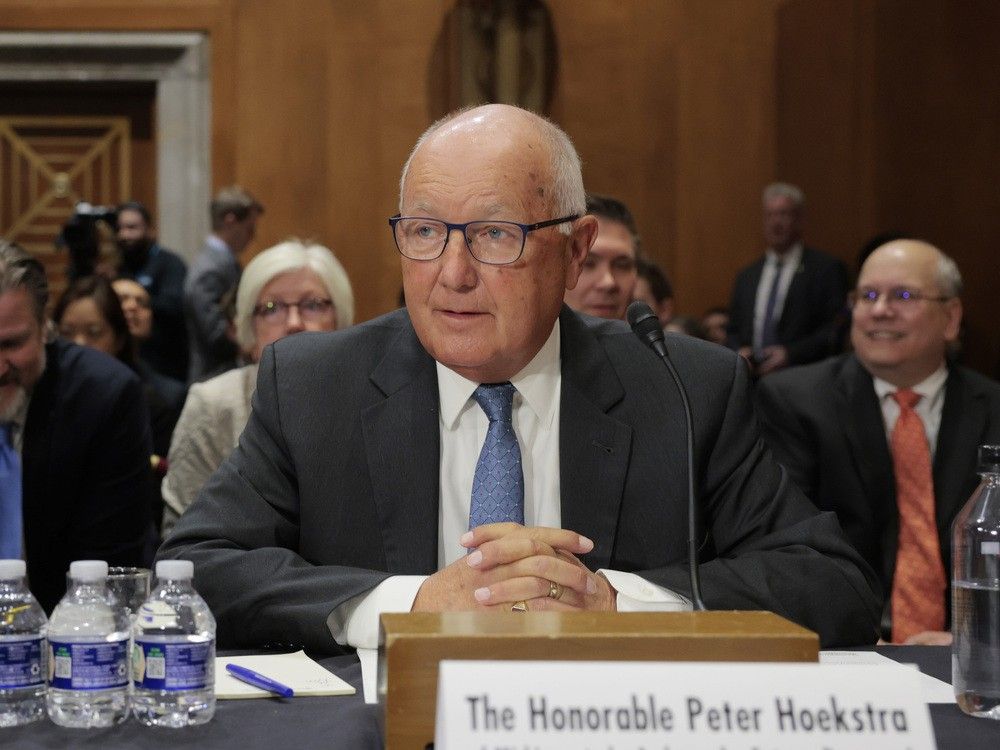
Peter Hoekstra, U.S. President Donald Trump's nominee to be U.S ambassador to Canada, attends a Senate Foreign Relations committee nomination hearing in the Dirksen Senate Office Building on March 13, 2025 in Washington, DC.

OTTAWA

— U.S. Ambassador to Canada Pete Hoekstra says the president has put the issue of Canada becoming a state “behind us.”

Hoekstra says the meeting U.S. President Donald Trump held with Prime Minister Mark Carney at the White House earlier this week allowed both sides to move past some of the issues that have coloured the U.S.-Canada relationship over the past 90 days. 

One of those has been Trump’s repeated comments that he would like Canada to become part of the U.S., referring to the country as the “51st state.”

“It’s done,”

the ambassador told National Post in his first-wide ranging interview in Canada since he was confirmed to the role last month. 

“From my standpoint, from the president’s standpoint, 51st state’s not coming back,” he said.

“The president may bring it up every once in a while, but he recognizes it’s not going to happen unless the prime minister engages with the president.”

During their Oval Office meeting, Trump told reporters that discussions about Canada becoming a state were not on the agenda.

He nonetheless repeated his desire for Canada to become a state when the issue was raised by press in the room. Trump, who referred to his background as a real estate developer, called the Canada-U.S. boundary an “artificially drawn line.”

Carney responded by citing Trump’s understanding of real estate to say “there are some places that are never for sale.” Carney also pointed to the recent federal election campaign, where he met with thousands of voters, whom the prime minister called the “owners of Canada.”

“It’s not for sale. Won’t be for sale ever.”

Trump also said “never say never.”

After the meetings between the two leaders, which included a private working lunch with senior members from both of their governments, Carney was also asked by reporters whether he had requested the president to stop making those comments.

He answered “yes,” adding he has been consistent both in his public and private comments.

On Thursday, Hoekstra pointed to the president’s remarks in the Oval Office to demonstrate how he believes the issue has been put to rest. 

“The president clearly acknowledged it takes two to tango. That’s behind us. It was never a barrier to discussing these other issues,” the ambassador says. 

“Now begins the framework.”

While Canadian political and business leaders have celebrated this week’s meeting as a reset of the Canada-U.S. relationship, which grew strained under former prime minister Justin Trudeau,

Hoekstra, a former Michigan congressman and past chair of the House Intelligence Committee disagreed, saying there is a strong foundation that binds both countries. 

“We are great friends. We have been great friends for such a long period of time. You’re not going to change those personal relationships.

“Is it a little bit of: ‘OK, let’s get over what’s happened in the last 90 days?’ Yeah, we did that. But the relationship, from my perspective, and I think from the president’s perspective, was never in jeopardy.”

With U.S. tariffs remaining in place on Canadian steel and aluminum as well as goods and auto parts not compliant with the free trade agreement between the U.S., Canada and Mexico,

Hoekstra acknowledged the countries’ economic relationship remains rocky. 

He defended Trump’s approach as fulfilling campaign promises he made when he was re-elected last November and that when it comes to changing the U.S.’s relationship to trade, he took a global approach.

Trump and his advisers have long argued tariffs were the way to attract more manufacturing to the U.S.

Industry and business leaders across the U.S., as well as in Canada, have said this approach is flawed and pointed to how Trump’s tariffs have threatened jobs, caused stock markets to fall and unleashed global uncertainty that has chilled investments.

“When you take a global approach, yes, Canada falls within that,”

Hoekstra said.

“Some of the people … have not liked that approach, but it is what the president campaigned on, and he’s doing exactly what he said he was going to do.”

National Post
staylor@postmedia.com
Get more deep-dive National Post political coverage and analysis in your inbox with the Political Hack newsletter, where Ottawa bureau chief Stuart Thomson and political analyst Tasha Kheiriddin get at what’s really going on behind the scenes on Parliament Hill every Wednesday and Friday, exclusively for subscribers. Sign up here.

Our website is the place for the latest breaking news, exclusive scoops, longreads and provocative commentary. Please bookmark nationalpost.com and sign up for our politics newsletter, First Reading, here.


A Canadian flag flies next to the American one at the Lewiston-Queenston border crossing bridge in Niagara Falls, Ont., on Feb. 4, 2025.

Amid heightened tensions and stricter travel policies between the U.S. and Canada, a new bill would extend the amount of time Canadians can spend in the United States.

The

Canadian Snowbird Visa Act

, which was introduced on April 29, would allow Canadian citizens who own or lease a residence in the U.S. to stay for 240 days annually. That is nearly two months longer than the current policy, which permits Canadians to be in the U.S. for 182 days a year.

“The

Canadian Snowbird Association (CSA)

has been working closely with members of the United States Congress in an effort to have the Canadian Snowbird Visa Act enacted into law. We are pleased to see it re-introduced in the current session of Congress,” the association said in an emailed statement to National Post on Thursday.

“Canada is the largest international tourism market in the United States, with annual spending in excess of US$20 billion. This policy is a step in right direction as it recognizes the pivotal impact Canadian snowbirds have on the U.S. sunbelt. If this bill becomes law, it will allow Canadian snowbirds, who frequent the United States, greater flexibility in their travel plans.”

CSA is a nonprofit organization with 100,000 members that advocates on behalf of Canadian travellers and works to improve their rights and privileges.

Majority of Canadians feel unwelcome and unsafe travelling to United States: new poll

Congressman Ken Calvert, who represents part of the Coachella Valley in California, cosponsored the act. He said it will “provide an important boost to the economic engine of the Coachella Valley, which is fuelled by visitors from Canada and all over the world,” in

a news release

on May 1.

He said it would ultimately lead to more jobs being created and would expand economic growth in the region.

“Canadians own an estimated seven per cent of all homes in the Coachella Valley. Even more lease a residence during the winter. The Canadian Snowbird Visa Act would allow them to spend more time here and make an even bigger contribution to our local economy,” he said on

a post on X

on Wednesday.

In April, California Governor Gavin Newsom

launched a campaign

to attract Canadian travellers. Last year, 1.8 million Canadians visited the state and spent US$3.72 billion. The governor wanted to make it clear that “California is a grateful partner.”

Another state where Canadians spend much of their time, especially in winter months, is Florida. Congresswoman Laurel Lee is a Florida representative who also cosponsored the bill.

“Canadian residents contribute billions of dollars each year to our small businesses, real estate markets, and local economies — especially here in Florida,” she said in

a statement to Desert Sun

. “By extending the time Canadian visitors who own or lease homes can spend here, we’re supporting job growth, strengthening our bond with our closest neighbours, and helping local communities thrive.”

In March, Florida Governor Ron DeSantis boasted that

3.3 million Canadians visited the state in 2024

. However, reports from local news outlets in Florida revealed that its communities could feel the effect of Canadians leaving after it was

announced in February

that all foreign nationals would have to register to stay longer than 30 days.

“It’s not only having a negative impact on the tourism market, but business as a whole,” Cole Peacock, the owner of Seed and Bean market in Fort Myers,

told Gulf Coast News

.

One Canadian with a home in the Fort Myers area told the publication she’d be leaving on April 2. The registration policy came into effect on April 11. Another family told Gulf Coast News they would not return to the area next year.

New York Congresswoman Elise Stefanik said in

a news release

that Canada provides “more visits to the United States than any other country,” adding that Canadians “are critically important to North Country tourism and industry.”

According to tourism organization New York City Tourism + Conventions, roughly

one million Canadians

visited New York last year.

“Providing Canadians who own homes and property in the United States with extra time to visit and boost our economy will help revive Canadian tourism to the United States,” she said.

Per the news release, the bill still has safeguards in place. It prohibits Canadian snowbirds from working for U.S. employers or accessing public assistance programs, and clarifies that they will retain their nonresident tax status.

“This bipartisan bill reflects a shared commitment to supporting local economies, rebuilding cross-border tourism, and strengthening the U.S.-Canada relationship through smart, targeted immigration policy,” the news release said.

Our website is the place for the latest breaking news, exclusive scoops, longreads and provocative commentary. Please bookmark nationalpost.com and sign up for our daily newsletter, Posted, here.


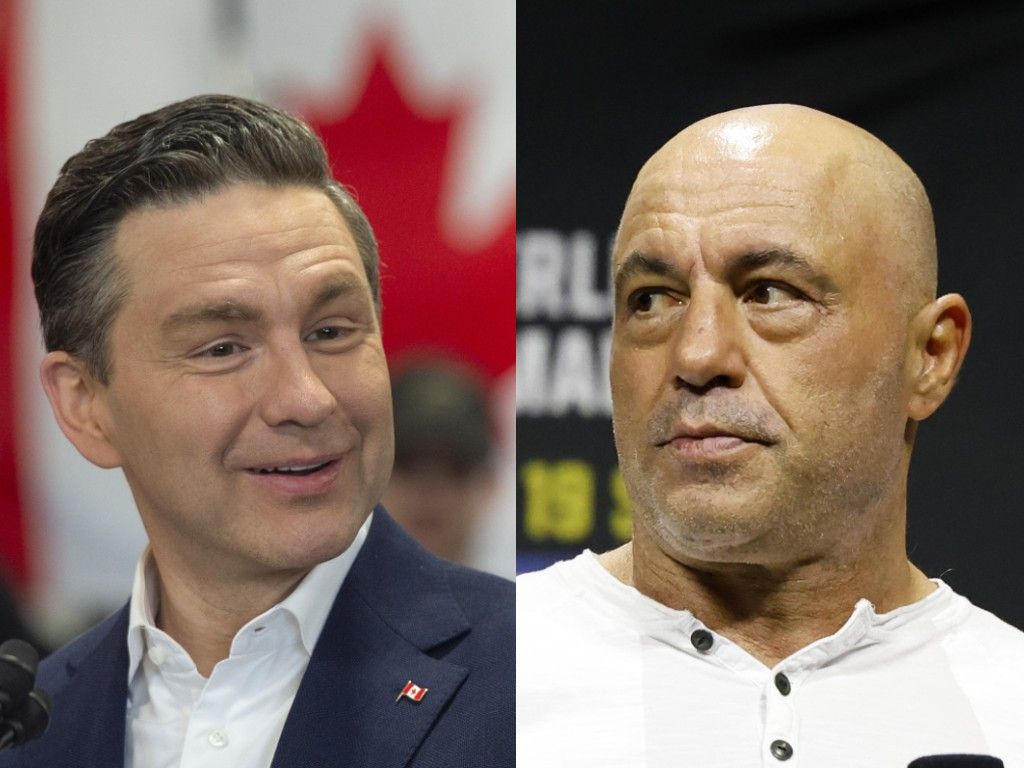
Joe Rogan, right, said Pierre Poilievre turned down an invite to be a guest on his podcast.

Joe Rogan can’t pronounce Pierre Poilievre’s surname, but the podcaster said this week that he’d invited the then-Conservative Party of Canada leader to be a guest on his show.

However, the immensely influential and sometimes polarizing media personality said Poilievre turned him down.

“Wouldn’t do it, thought it was too problematic or whatever,” Rogan told his guest, bow hunter and endurance athlete, Cameron Hanes, in

Tuesday’s episode.

The Joe Rogan Experience sits atop YouTube’s podcast chart with almost 20 million subscribers according to

Rephonic

, almost the same number of followers as his personal Instagram. The podcast also tops Spotify’s chart with 14.5 million monthly listeners.

Poilievre spoke to the mainstream media sparingly throughout the federal election campaign, usually taking only a handful of questions at the conclusion of campaign stop speeches. He did, however, partake in at least two long-form podcast interviews —

The Knowledge Project with Shane Parrish

and

The C Suite with Camila Gonzalez

Like his offer to interview Democratic Party candidate Kamala Harris during the 2024 U.S. election, Rogan said he doesn’t seek out conflict with guests, nor is he interested in being the “gotcha guy.”

“Sometimes you have to be able to disagree in a way that’s forceful, but I’m never insulting or attacking people. Especially this Pierre ‘Polivette’ guy,” Rogan attested, admitting he doesn’t know how to pronounce Poilievre.

“How do you say it? It’s a weird way of saying it.”

Without delving into specific topics, Rogan said the conversation would be about “real simple stuff.”

“I would just ask him questions like ‘What’s wrong with Canada. How did this happen, and why did it go this way? What can be done to reverse some of these things that have been put into place? How did you feel about this? What would you have done differently?

“I don’t know anything about Canada’s politics, right? It would have been fun,” he added.

Eight minutes later, following a discussion about his recent interview with British neoconservative political commentator Douglas Murray, who insisted Rogan he needed to visit Gaza to understand the effects of conflict there, the host said he doesn’t even go to Canada, repeating a statement he’s made at least twice before on his show.

In March, Rogan said he wouldn’t be attending this weekend’s UFC 315 in Montreal, nor would he return to the country any time soon.

“I don’t go to Canada anymore. I don’t. Nor should you,”

he advised guest Brendan Schaub.

Last summer, Rogan said he wouldn’t come back due to former prime minister

Justin Trudeau and “ridiculous free speech laws.”

Our website is the place for the latest breaking news, exclusive scoops, longreads and provocative commentary. Please bookmark nationalpost.com and sign up for our daily newsletter, Posted, here.
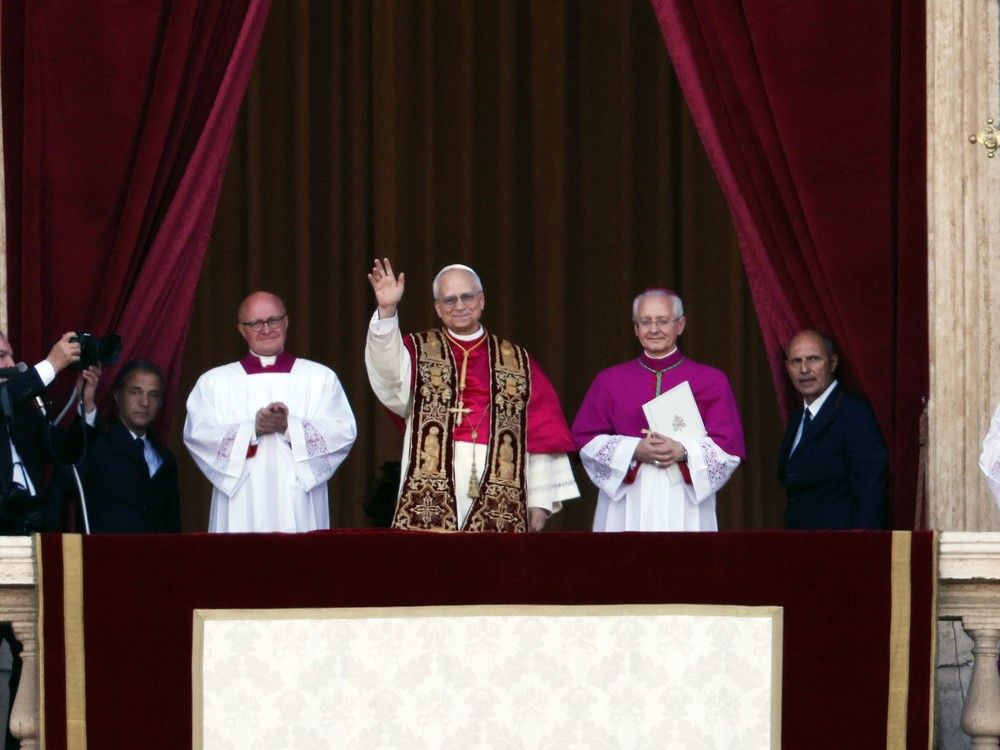

Newly elected Pope Leo XIV, Robert Prevost arrives on the main central loggia balcony of the St Peter's Basilica for the first time, after the cardinals ended the conclave, in The Vatican, on May 8, 2025.

A cardinal appeared at the St. Peter’s Basilica balcony about 7:15 Roman time to announce the newest Pope. It is the first American pope, Robert Francis Prevost, 69, of Chicago.

He will be known as Pope Leo XIV. The last Pope Leo

was elected in 1878 and served until his death in 1903.

He was made a cardinal by Francis in 2023. He was the former leader of the Augustinian order and also appointed by Francis to the powerful Dicastery for Bishops, which oversees the selection of new bishops from around the world.

He has significant missionary experience in Peru, serving as bishop of the northern city of Chiclayo.

 Newly elected Pope Robert Francis Prevost arrives on the main central loggia balcony of the St Peter’s Basilica for the first time, after the cardinals ended the conclave, in The Vatican, on May 8, 2025.

White smoke billowed from the Sistine Chapel chimney about an hour prior to the announcement, alerting the crowd of faithful Catholics gathered in St. Peter’s Square that the College of Cardinals have elected a new Pope.

The sign came on the second day of voting and the fourth vote. The Cardinals reached the two-third majority required to elevate one of their ranks to be head of the church.

The gathered crowd cheered in elation as the smoke rose on a beautiful Thursday evening in Rome. Flags from all over the world were evident among them, including Canada’s.

For much of the past century, the conclave has needed between three and 14 ballots to find a pope. John Paul I — the pope who reigned for 33 days in 1978 — was elected on the fourth ballot. His successor, John Paul II, needed eight. Francis was elected on the fifth in 2013.

 French cardinal proto-deacon Dominique Mamberti arrives to announce the name of the new pope from the main central loggia balcony of the St Peter’s Basilica, after the cardinals successfully ended the conclave voting, in The Vatican, on May 8, 2025.

Our website is the place for the latest breaking news, exclusive scoops, longreads and provocative commentary. Please bookmark nationalpost.com and sign up for our daily newsletter, Posted, here.


People use check-in kiosks for Air Canada flights at Toronto Pearson Airport Terminal 1, Friday August 30, 2024.

Health officials in Ontario’s Peel Region are investigating a new case of measles, warning that some people who were at Toronto Pearson Airport over the weekend could have been exposed to the highly contagious disease.

Officials said the exposure would have occurred on May 3 after an Air Canada flight AC540 from Seattle to Toronto landed, according to

a news release

by Peel Public Health on Wednesday. People who were in the vicinity of Terminal 1 between 7:28 p.m. ET and 10 p.m. ET could have come into contact with measles.

“The measles virus spreads from an infected person through infectious respiratory particles through the air but it may also spread through direct contact infected nasal or throat secretions,”

according to Infection Prevention and Control Canada

.

If possible, health officials try to contact anyone who was at the site of exposure. However, officials said that anyone who believes they were at Pearson at that time or thinks they have been exposed to measles should check their immunization record to confirm that they have up-to-date vaccinations.

Anyone with symptoms should contact their health care provider or Peel Public Health.

“Those concerned about symptoms should call their health care provider before going to see them to inform them they may have been in contact with someone who has measles,” per Peel Public Health’s news release. “Do not attend work or school.”

Measles can spread easily to people who are not immunized or to people who have not been vaccinated. Those who are most at risk of complications are babies under one year of age, pregnant women who have not been immunized, and people with weakened immune systems.

Symptoms can arise between seven and 21 days after a person has been infected. Symptoms include high fever, cough, runny nose, red, watery eyes (including conjunctivitis), sensitivity to light, and red rash lasting four to seven days.

Last year, the Peel Region had three confirmed cases of measles. This year, there have already been six confirmed cases in the region.

Ontario has reported the highest number of measles cases across the country. As of April 19, there have been 993 cases, according to

data from the federal government

. Other provinces have also reported cases, including British Columbia, Alberta, Saskatchewan, Manitoba and Quebec.

In Canada, there have been 1,019 confirmed cases of measles so far this year.

Our website is the place for the latest breaking news, exclusive scoops, longreads and provocative commentary. Please bookmark nationalpost.com and sign up for our daily newsletter, Posted, here.

Black smoke is seen from the chimney of the Sistine Chapel meaning a new pope is not yet elected and voting will continue on May 7, 2025 in Vatican City.

The significance of a papal name lies in its symbolic power and the message it sends about a new pope’s intentions, priorities, and the direction he hopes to set for the Catholic Church.

When a new pope is elected, one of his first acts is to

choose a new name

. It’s a tradition dating back to the early Middle Ages. This name is not required by doctrine but has become a deeply rooted custom.

The chosen name often honours a saint, a previous pope, or a particular legacy the new pontiff wishes to emulate.

How do popes choose a papal name?

Pope Francis selected his name to

honour St. Francis of Assisi,

signalling a focus on humility, care for the poor, and environmental stewardship. Similarly, Pope John Paul I

combined the names of his two immediate predecessors

to signal continuity and commitment to their reforms.

Ultimately, the papal name serves as a

public declaration of the new pope’s vision

and the values he intends to emphasize during his papacy.

It is closely watched as an early indicator of whether the new leader will

continue the work of his predecessors or chart a new course

for the Church.

Do popes ever choose names that have never been used?

Popes

rarely choose a name that has never been used before

. In fact, before Pope Francis in 2013, it had been over 1,000 years since a pope — Pope Lando in 914 — selected a completely new name.

Most popes opt for names with

historical or spiritual significance

. There are, however, several unique papal names from the early centuries that have never been repeated, such as Lando, Romanus, and Formosus.

How might a pope’s cultural background affect his choice?

Different cultures have influenced the choice of papal names in several ways, especially as the Church became more global. In the early centuries, popes from outside Italy — especially from France and Germany — often adopted more traditional or Italian-sounding names to align themselves with their Roman predecessors and the local culture of the papacy. This practice helped foster unity and continuity within the Church.

In modern times, as the

College of Cardinals has become more international

, there is increased potential for popes to choose names that reflect their own cultural backgrounds or honour saints and historical figures important in their home regions.

A pope from Africa or Latin America might select a name associated with early non-Italian pontiffs or saints from those regions to highlight the Church’s diversity and global reach.

Pope Francis, from Argentina, chose a name never before used, making a break from European tradition and emphasizing humility and care for the marginalized, values resonant across cultures.

Overall, while

no formal rules

require popes to choose names based on cultural background, their choices often reflect a desire to reflect their heritage, inclusivity or connect with the broader global Church.

Could a papal name influence the Catholic Church’s relations with other faith traditions?

The connotations of a papal name can significantly

shape the new pope’s relationship with other religious leaders

by pointing to his intended approach to interfaith dialogue, reform, tradition, or reconciliation.

If a pope chooses a name associated with openness, peace, or past efforts at unity, it can foster goodwill and foreshadow a willingness to engage with leaders of other faiths.

Conversely, names linked to periods of conflict or rigid doctrine, like “Pius,” may be

interpreted as a sign of traditionalism or caution

, potentially making interreligious collaboration more challenging.

Have some papal names caused controversy?

Some papal names have been considered

controversial

due to their associations with problematic historical figures or events.

The name “John XXIII” was controversial because it had previously been used by a 15th-century antipope, leading to confusion and debate when Cardinal Angelo Roncalli chose it in 1958.

No pope has ever chosen the name “Peter II,” likely out of respect for Saint Peter, the first pope, and to avoid controversy or the appearance of rivalry with such a foundational figure. However, some antipopes have used the name “Peter II,” which further adds to its contentious nature.

Certain names, like Benedict, have been used by both legitimate popes and antipopes, sometimes creating confusion and controversy in papal history.

Some papal names are avoided due to their association with

notorious or scandalous popes

, such as Alexander VI or Boniface VIII, whose papacies were marked by corruption or conflict.

Our website is the place for the latest breaking news, exclusive scoops, longreads and provocative commentary. Please bookmark nationalpost.com and sign up for our daily newsletter, Posted, here.

Canada hasn't seen close to the current measles numbers since the 752 cases recorded during a Quebec outbreak in 2011.

Public confidence in vaccines has dipped since COVID’s first surges, the proportion of parents “really against” routine childhood immunizations has grown and one third of Canadians believe the discredited claim that the measles vaccine causes autism, surveys show.

That percolating pushback is contributing to gaps in immunization coverage: only seven out of 10 kids aged seven in Ontario were reported to be fully immunized against measles in the 2023-24 school year. Rates plummeted below 50 per cent in some health units, despite catch-up programs to deal with a backlog of children who missed shots during COVID disruptions.

The gaps threaten to widen and feed a resurgence of vaccine-preventable diseases like the ongoing outbreak of measles, say those who study the phenomenon.

But vaccine hesitancy goes beyond autism. The motives of parents opting out are “often far more complex and nuanced than the pro-side would like to admit,” according to the authors of a recently-published

paper

on English-speaking Canada’s growing anti-vaccine movement.

It may make for a quicker and easier narrative to say it’s all about misinformation and a notoriously flawed study that was eventually withdrawn, “and convince people that it was a mistake and that there is nothing to be concerned about,” said co-author and University of Guelph historian Catherine Carstairs.

However, “it’s become much grittier and more complicated, and maybe requires different kinds of interventions,” she said.

Growing vaccine hesitancy, and outright refusal, is also symbolic of a broader issue, said the University of Alberta’s Timothy Caulfield — “the rise of an anti-science ethos that is impacting society.”

The controversies and polarizations surrounding the COVID vaccines also had an ideological spillover effect on vaccines more generally, Caulfield said. In the U.S., political liberals became more positive towards non-COVID shots like MMR (measles, mumps and rubella), influenza and chickenpox while

conservatives became more negative

.

Ontario has now claimed more measles cases since last fall than all of the United States. So far, the majority have been concentrated in specific health units, but measles is so highly infectious it can easily leak out to vulnerable pockets with less-than-optimal vaccination rates.

As criticism of Ontario’s handling of the outbreak intensifies, Premier Doug Ford Wednesday said getting children vaccinated against measles is a “no-brainer” and that the province has sufficient supplies of vaccines available. “I encourage anyone and everyone,” Ford told reporters. “You need to get your kids vaccinated, because if not it just starts spreading.”

Cases in Ontario reached 1,383 this week, Dr. Kieran Moore, Ontario’s chief medical officer of health, told

Radio-Canada,

an increase of 140 over the previous week. Moore anticipates the province will see 100 to 150 new cases a week until summer.

“I’m happy that (local public health units) are able to keep the numbers to 100 to 150 Ontarians that are getting infected on a weekly basis. To me that’s tremendous, hard and difficult work,” he told Radio-Canada.

At least 84 outbreak cases in Ontario have required hospitalization; eight were admitted to intensive care. Among those hospitalized, 80 were unvaccinated, including 63 children.

Alberta, meanwhile, is ramping up measles vaccination clinics in south and central zones where most of the

265 cases reported as of Monday

are located.

Canada’s outbreak has been traced to a large gathering with guests from Mennonite communities in New Brunswick last October and has continued to spread in Ontario, with related cases reported in Alberta, Manitoba, Prince Edward Island and Quebec. A single case was reported in Halifax, N.S., this week, in an adult who had travelled to the U.S.

Measles has been eliminated in Canada since 1998; endemic transmission, meaning a disease is constantly circulating, “no longer happens in Canada,”

according to the federal government’s measles monitoring report

, though sporadic cases can occur, usually due to travel to regions where measles is circulating. However, Canada hasn’t seen close to the current numbers since the 752 cases recorded during a Quebec outbreak in 2011.

The vast majority of cases today are among unvaccinated children and youth. Most (90 per cent) were exposed in Canada.

The bulk of cases — 84 per cent — are in Ontario, where only seven in 10 (70.4 per cent) of seven-year-olds were said to be fully immunized against measles in the

2023-2024 school year

, a dramatic drop compared to pre-Covid years. In 2019-2020, 86 per cent of Ontario kids aged seven were fully immunized against measles.

In the 2013-2014 school year, 94 per cent were.

Measles is considered one of the most, if not the most, transmissible, airborne viruses affecting humans. An infected person can pass the virus on to 15 to 18 others who haven’t been vaccinated or who aren’t immune due to past exposure to the virus.

There are no specific anti-virals against measles. In serious cases, the virus can attack the fatty protective sheath that wraps around the nerves in the brain and spinal cord. One in 1,000 children infected can develop post-infectious encephalomyelitis, or swelling of the brain, that can lead to permanent neurological deficits like deafness, paralysis or difficulty thinking or speaking.

Two doses of vaccine are considered about 97 per cent effective against infection. But vaccine coverage is falling below 95 per cent, the threshold needed for herd immunity to prevent infections.

Why are more parents rejecting routine childhood shots?

A 2024 Angus Reid pol

l found that one in six (17 per cent) parents of kids under 18 reported they are “really against vaccinating” their own children, up from four per cent in 2019.

Last fall, three in 10 Canadians told

Research Co.

they still believe a connection exists between the MMR vaccine and autism, the lingering legacy of a fraudulent 1998 paper by British scientist Andrew Wakefield.

“Wakefield’s ascent to the pinnacle of despicableness all started with one small and staggeringly shoddy study,” Caulfield, a U of Alberta professor of law and health policy, wrote in his new book, The Certainty Illusion: What You Don’t Know and Why It Matters.

While Wakefield’s data-distorted study was eventually retracted, “the Wakefield zombie marches on,” Caulfield wrote. “Those pushing a particular agenda keep the study in the public eye,” he said, and the retraction, paradoxically, makes the study seem even more legitimate, because “it fits into the broader anti-vaccine idea, that Wakefield was persecuted for bravely speaking the truth.

“The fake science imparts science-y credibility, while the retraction feeds a fake narrative. Zombies are hard to kill,” Caulfield wrote.

Vaccine skepticism didn’t originate with Wakefield, he and others said. “Vaccine hesitancy and resistance has a long history in Canada,” Carstairs and her co-author, master’s student Kathryn Hughes, wrote in their paper published in Canadian Historical Review. A national anti-vaccine league formed in 1900 in opposition to compulsory smallpox shots. The modern-day anti-vax movement began in the 1980s, Carstairs and Hughes wrote, led by a “small number of people with alternative understandings of health and medicine, and by parents who believe their children were harmed by vaccination.”

“A lot of parental concern is really about the number of overall vaccines that children are receiving these days,” said Carstairs, who grew up in the 70s and 80s. The number of vaccines since “has really escalated, which, as a pro-vaccination person, I think is great,” she said in an interview with National Post.

“But I can see why for many parents they sort of feel, ‘Wow, is this getting to be too much?’ Especially when diseases like chicken pox are seen as something they might have had as children themselves, or their parents had, and don’t seem particularly serious, not thinking about the long-term consequences of shingles” or other complications, she said.

“Until recently, there wasn’t much reason for parents to be concerned about their kids getting the measles. It was declared eradicated in Canada.”

Today’s intense parenting style, which focuses on nurturing the “individuality” of each child, also “feeds against the idea that I think we should be looking at,” Carstairs said. “Which is, ‘This isn’t about your child. This is about protecting the entire population. That’s why you need to get vaccinated.’”

Many parents opposed to vaccination also harbour a sense “that maybe we’ve gone too far along a technological path, and maybe that there’s better, more natural ways of coping with illness,” Carstairs said.

Caulfield, who considers the word natural “the mother of all health halos,” said vaccine hesitancy — “a trend that is costing lives” —  is being partly energized by the rise of the wellness industry and its framing of vaccines as unnatural.

“There has been this middle-ground fallacy playing out where completely absurd things about vaccines are now taken as not as absurd,” Caulfield added. “They’ve been normalized.”

The phenomenon is also being fuelled by opposition to “Big Pharma,” “big science” and “big health care,” Caulfield said.

“Science communicators have to be nimble and respond to how the public is talking about these issues,” he said. “Public institutions, researchers, clinicians and public health officials always need to listen. They need to recognize missteps. They need to look at evidence and improve. Always.

“But any misstep has now been weaponized as a justification of full-scale distrust. The reality is misinformation has created distrust.”

National Post with a file from Canadian Press

Our website is the place for the latest breaking news, exclusive scoops, longreads and provocative commentary. Please bookmark nationalpost.com and sign up for our daily newsletter, Posted, here.

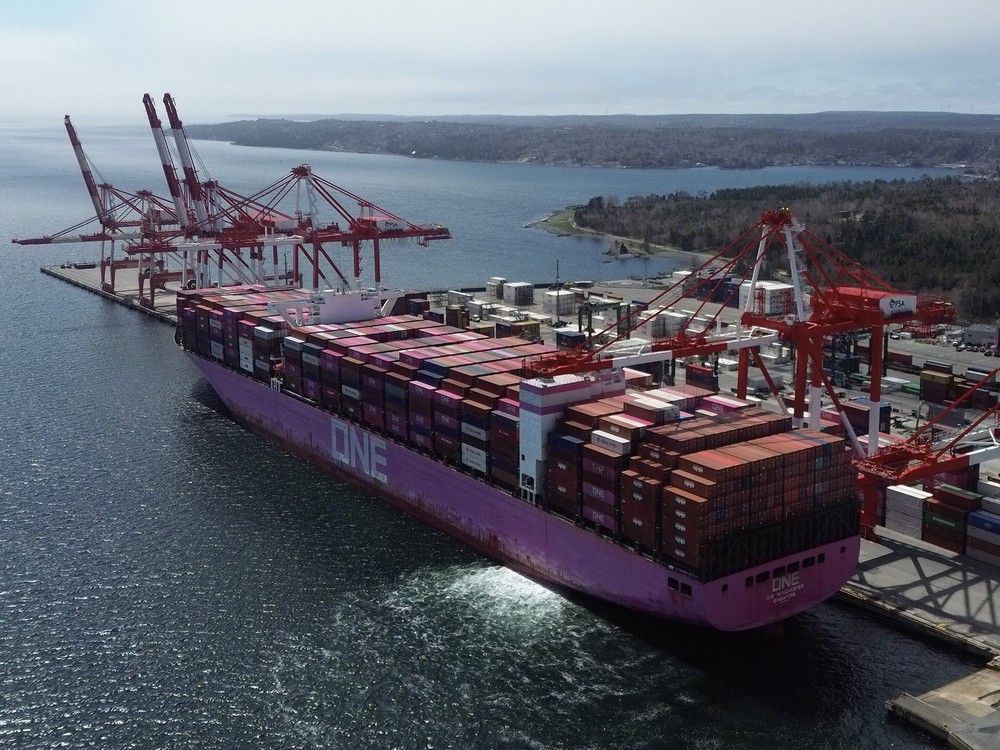
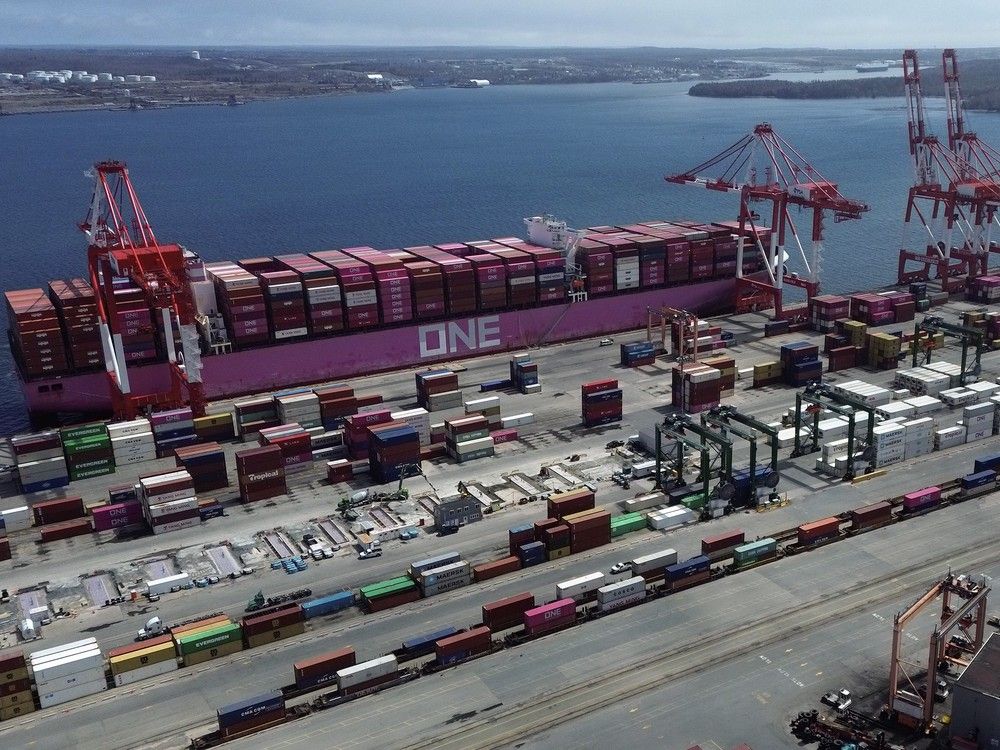
The One Manchester is unloaded at PSA Halifax Atlantic Hub in Halifax, NS Tuesday April 29, 2025. TIM KROCHAK PHOTO

U.S. President Donald Trump’s trade war is already having an impact on Canada’s most crucial ports, but navigating the on-again, off-again nature of Trump’s words and deeds when it comes to tariffs will likely prove difficult.

Halifax’s container traffic was down 10 per cent last month, while Vancouver was greeting a near record number of oil tankers.

“We’re in uncharted territory,” said Trevor Heaver, professor emeritus of transportation studies at the University of British Columbia.

Like much of the Canadian economy, ports on both sides of the country are bracing themselves for a world in a trade war.

After implementing sweeping 25 per cent tariffs on all goods imported from Canada and Mexico in early March, with a lesser 10 per cent tariff on Canadian energy products, Trump turned around the next day and granted a one-month exemption for automobiles and parts imported from Canada and Mexico that are covered under the Canada-United States-Mexico Agreement (CUSMA). The day after that, Trump broadened the exemption to include all products covered under CUSMA.

There have been plenty of ins and outs since, with Trump slapping 25 per cent tariffs on Canadian steel and aluminum imports and issuing executive orders stipulating that exemptions will continue for goods from Canada and Mexico that are compliant under CUSMA as part of his bigger April 2 “Liberation Day” announcement with that long list of country-specific tariffs.

But last month, after stock and bond markets tumbled, Trump pressed pause for 90 days on tariffs for all countries, except China, resetting the tariff rate to 10 per cent across the board.

Here’s how those involved see the state of play and what may come next.

Can we expect to see less ships calling on Canadian ports due to Trump’s tariffs?

For Heaver, an expert in international shipping and port economics, the answer is a resounding yes. “And it will be dramatic,” he said.

How will that play out?

Heaver predicts the number of what are dubbed “blank sailings” will rise as Trump’s tariffs begin to bite. Those are trips that are scheduled, but then cancelled for want of demand.

Which Canadian coast will this trade war hurt most?

“The worst affected group by the tariff situation is the Trans-Pacific trade,” Heaver said.

“The consequences are that port employment is going to be down, truck employment is going to be down, warehouse employment is going to be down, store shelves are going to start to be more empty, where they’ve been selling Chinese products. So, the drop off in container vessel arrivals is the first visible sign of the tariff threat. Of course, if that threat comes into reality, the recession will take off.”

Which West Coast port will be hit the hardest?

U.S. tariffs will hurt Prince Rupert, Heaver predicted.

“On the Great Circle Route from Asia to North America, it’s the shortest route. So, if you want to import into Chicago, for example, routing through Prince Rupert gives a significant time advantage,” Heaver said. “So, the Port of Prince Rupert will be most affected. The Port of Vancouver less so.”

If fewer ships visit Canuck ports, will they be carrying more or less cargo?

Heaver is forecasting fewer sailings into Vancouver due to the trade war. “But those ships, likely, will each be carrying more cargo for Canada than they would normally,” he said.

What do the folks at the Port of Prince Rupert have to say?

“In April, there were two blank sailings at the Port of Prince Rupert, however those were not attributed to tariffs, but rather the number of vessels operating on an intermodal service string,” said Olivia Mowatt, who speaks for the Port of Prince Rupert.

She said first quarter volumes at Prince Rupert’s Fairview terminal “remained steady,” with a one per cent traffic increase in the first quarter. But officials do expect a downturn.

“Looking ahead, we anticipate decreased container bookings on eastbound transpacific vessels calling on West Coast ports in Canada and the U.S., including potential for blank sailings in Prince Rupert,” Mowatt said.

Do all Canadian ports do a lot of cargo business with our southern neighbours?

More than 80 per cent of the international trade that moves through the Port of Vancouver’s terminals every year is Canadian trade with countries other than the U.S., said Alex Munro, who speaks for the port.

“For example almost 132 million metric tonnes of international trade moved through the port last year, about three-quarters of which was trade with Indo-Pacific countries like China (35 per cent), Japan (14 per cent), Korea (14 per cent), India (five per cent), Indonesia (three per cent), Taiwan (two per cent) and Vietnam (two per cent),” Munro said. “The U.S. represented eight per cent.”

What do ships carry from Vancouver to the States?

Most Canada-U.S. trade through Vancouver is crude oil exports, Munro said.

How are those doing?

Shipments of crude oil, carried from Alberta to B.C. via the Trans Mountain pipeline, did not drop in April, according to retired Simon Fraser University physics professor David Huntley, who has kept tabs for the last 15 years on tanker arrivals at the city’s Westridge terminal.

He counted a record 30 tankers in March that arrived in Vancouver to take Alberta oil to the U.S. and China.

“April tanker traffic was essentially the same as March when you allow that April has one fewer days,” Huntley said.

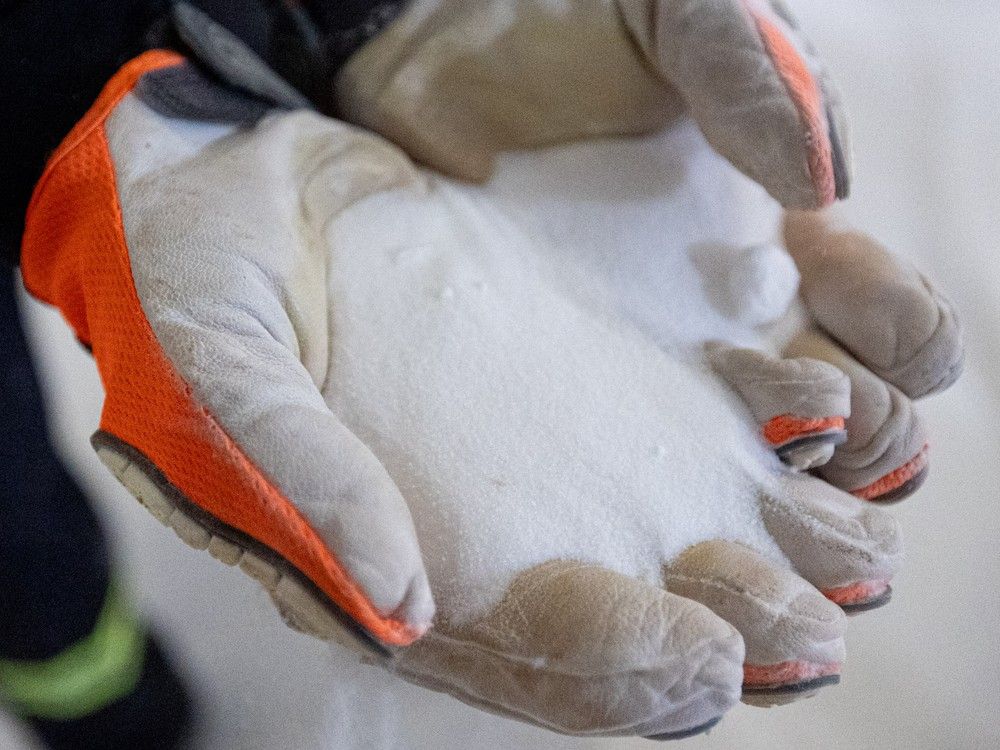
 Canada is the world’s biggest producer, exporter and holder of the largest reserve of Potash at 1.1 billion tonnes and almost all of it is in Saskatchewan.

Do Canadian potash producers need to worry about this trade war?

“The U.S. is one of the world’s largest consumers of potash, but due to a lack of resources in the country, it relies on imports for over 90 per cent of its needs,” said Michael Wudonig, who speaks for K+S Group, one of the world’s largest producers of the fertilizer.

He pointed to Trump’s executive order early last month that exempted potash from U.S. tariffs.

“Deliveries from Canada and the EU are therefore not affected by tariffs,” Wudonig said. “We therefore assess the risk of a change in the exemption for our fertilizer products as low and currently do not foresee any impact on our business.”

How does the Port of Montreal factor into all this?

“Difficult winter conditions challenged most of the North East’s supply chains in January and February, and the Port of Montreal’s cargo was directly and indirectly affected by these conditions,” said Renée Larouche, who speaks for the Port of Montreal.

“March surged back with a very strong showing due to a combination of more normal weather conditions as well as some Midwest businesses looking to stock up ahead of the imminent application of the tariffs announced. We’re carefully optimistic about the next few months and will be ready to support Canadian and American supply chains as they adapt to the new economic realities.”

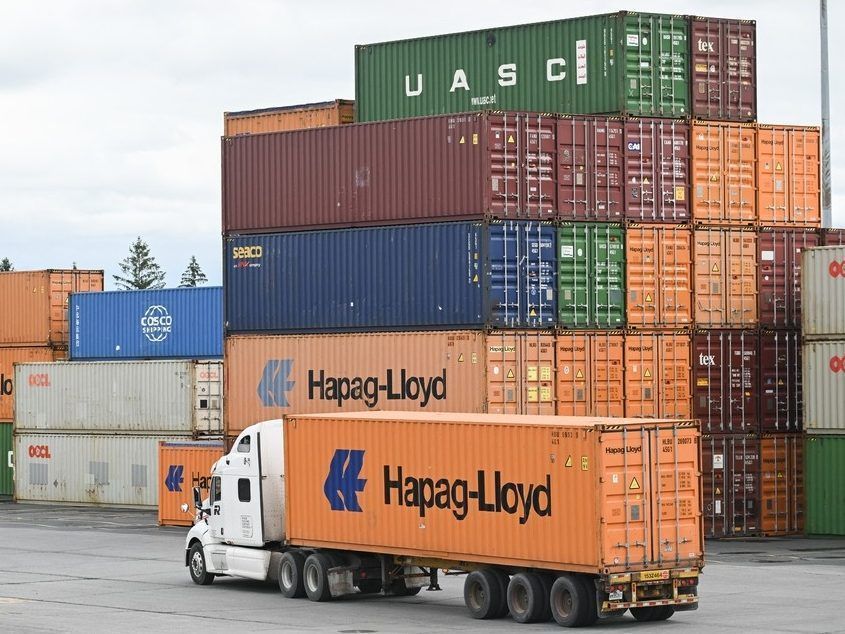
 Shipping containers at the Port of Montreal, in Montreal, Quebec on June 10, 2024.

How is the trade war playing out in Halifax?

Cargo volumes at Halifax’s two container terminals dropped by between eight and 10 per cent in April compared to the previous month, says the company that owns them.

But Trump’s tariff turbulence isn’t all to blame, according to Jonathan Chia, deputy managing director of PSA Halifax.

“I wouldn’t say it’s directly related,” Chia said.

A lot of vessels that stop in Halifax also call on ports along the U.S. Eastern Seaboard, he said, noting those ships have limited space to carry containers.

“They’re actually prioritizing more U.S. cargo rather than imports into Canada,” Chia said.

He saw a reduction last month in the amount of cargo offloaded in Halifax that was bound for Chicago and Detroit by rail. Much of it is heavy machinery and automotive parts including tires and bumpers.

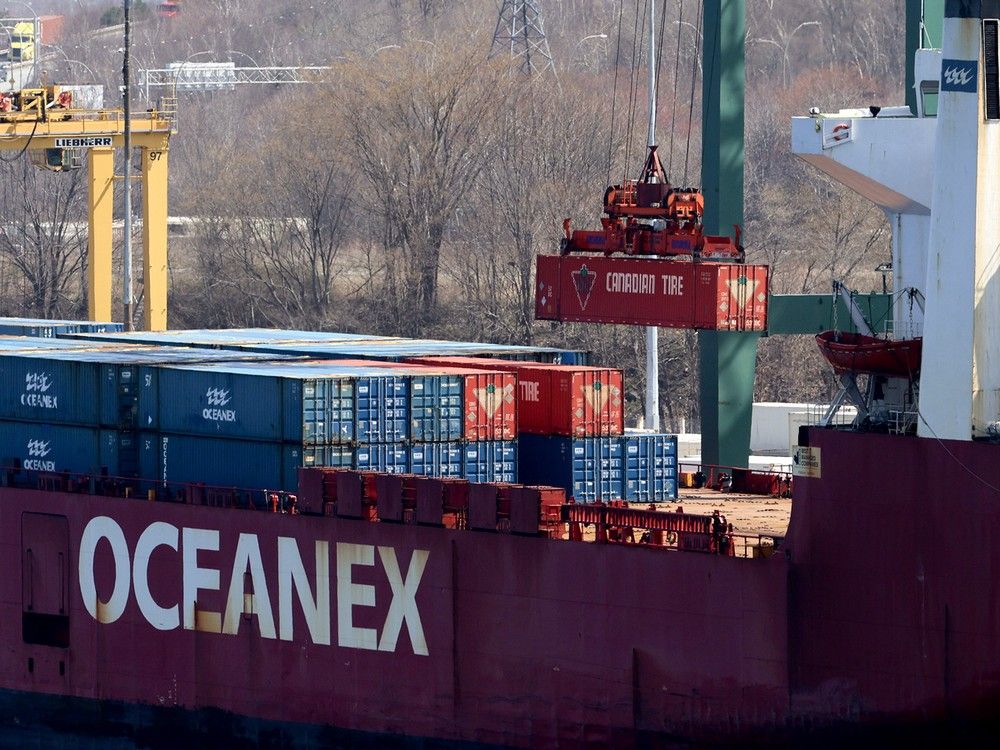
 The Oceanex Sanderling is unloaded at PSA Halifax Fairview Cove terminal in Halifax Wednesday April 30, 2025. TIM KROCHAK PHOTO

Will things get worse for the Port of Halifax as this wears on?

Chia doesn’t believe Trump’s tariffs are going to make the situation much worse for Halifax than the dip he saw last month.

“I wouldn’t anticipate a significant decrease,” he said, “unlike Prince Rupert, for example, where a big portion of their cargo goes to the U.S.”

How much cargo flows from Halifax into the U.S. by rail?

Between 15 and 20 per cent of the containers that come into Halifax by ship move on to inland destinations in the States, Chia said.

Due to bluster from south of the border, he predicted PSA Halifax could lose much of that traffic.

Why move goods from a ship to a train in Canada if they’re heading to the U.S.?

“The reason they run Midwest cargo through Canada, generally, is it’s generally faster than dealing with the bigger ports in the U.S.,” said Kevin Piper, president of the Halifax Longshoremen’s Association.

“New York is an extremely busy port. So, they come to Halifax for time-sensitive cargo. Because generally cargo can be discharged in Halifax, on the rail and on its way to its destination before the ship ever gets to New York.”

Are Halifax’s 700 longshoremen worried for their livelihoods?

“It’s a wait-and-see-game here,” Piper said.

“We don’t want to stir the pot.”

Where do most of the goods shipped into Halifax go?

Canadian cities like Toronto and Montreal, Chia said.

“We might lose some of the U.S. Midwest volumes, but … we don’t move them that much to begin with.”

Does the state of the economy make him anxious about the country’s future?

“I do see Canada moving toward a recessionary situation and when you go into a recession it basically means people are producing less and people are consuming less,” Chia said.

That means a drop in cargo volumes, he said. “That’s my bigger fear rather than just a trade war. It’s triggering a bigger global economic impact,” Chia said. “Jobs will be lost and consumption will drop … we’re probably heading in that direction.”

As tariff talk changes almost daily, “people are not committing to ordering,” he said. “They’re being more cautious in their buying patterns and manufacturing and production. This definitely will cause the economy to slow down. Unless there’s certainty in what’s going to happen in the next 12 months, generally people will become more cautious. That’s my bigger fear — it’s the uncertainty that kills the demand.”

What advantages to shipping goods through Canada are vanishing?

Chia pointed out that Trump recently closed a loophole where goods landed in Canada and transported by rail into the States didn’t have to pay a harbour maintenance tax of 0.125 per cent.

“They actually extended this tax on to any U.S. cargo coming through Canadian ports,” Chia said.

Does he see any bright spots for Canadian ports on the distant horizon?

“With the U.S. being more reclusive, it’s forcing Canada to trade with other partners, whether it’s Europe or Asia. But … supply chains don’t switch overnight,” Chia said.

“I do see in the medium- to longer run a more robust Canadian supply chain sourcing from more alternative locations instead of just the U.S.”

 The One Manchester is unloaded at PSA Halifax Atlantic Hub in Halifax, NS Tuesday April 29, 2025. TIM KROCHAK PHOTO

How is this playing out in the U.S.?

Bonded warehouses on the U.S. West Coast where goods can be stored without paying tariffs “maxed out very, very quickly, within like a week or two in anticipation of all of this,” said Ken Adamo, a shipping analyst with DAT Freight & Analytics in Akron, Ohio.

Could vessels destined for the U.S. head to Canada instead?

While some ships that call on the U.S. West Coast could instead steam to Canada, their goods would still face tariffs if shippers tried to get them into the States by train or truck, Adamo said.

“There’s a pretty big wrinkle that was introduced” last week, he said. “An executive order came down around English language proficiency for truck drivers operating in America. The problem with that being … that a lot of the Canadian cross-border truck drivers (come from a) largely immigrant-fed pipeline of drivers.”

English proficiency could prove difficult to test “in a standardized way that would hold muster in a court of law,” he said, noting truckers who fail can be put out-of-service on the roadside.

How is this affecting the mindset of those in the business of getting your goods to market?

“This administration has made it very difficult to find any sort of continuity or consistency,” Adamo said. “Shippers and trucking companies alike are very confused and, frankly, very, very anxious on how to approach the shifting landscape of regulation and global trade policy.”

 A U.S. shipping expert predicts the back-to-school shopping season could bring pressure to bear to end the trade war.

Is there any potential end in sight to the trade war?

Adamo sees a “hard terminus for a lot of this” in the U.S. back-to-school season.

“I know it sounds crazy because the kids are still in school right now. But in logistics, we’re thinking way upstream of all the school supplies and this year’s school clothes and kids’ shoes. All of that stuff is going to probably land May, June and July to be on the store shelves when people do all their back-to-school shopping.”

Americans looking for deals on pencils and lunch boxes might end up dictating U.S. trade policy, he said. “I don’t think the American consumer is going to tolerate empty shelves for back-to-school.”

What’s Trump’s endgame here?

Adamo had to read Trump’s book, The Art of the Deal, in business school. “The tactic is you start with a completely outlandish and overexaggerated position and then help negotiate your opponent back to centre,” he said. “So, my guess is I think most Asian trading partners will get deals done.”

Our website is the place for the latest breaking news, exclusive scoops, longreads and provocative commentary. Please bookmark nationalpost.com and sign up for our daily newsletter, Posted, here.