LP_468x60
on-the-record-468x60-white

Travellers wait in line for security screening at Seattle-Tacoma International Airport, one of the locations visited by a Canadian resident with measles.

The local public health office in Seattle is warning residents there of a confirmed case of measles in a Canadian resident who spent time in the region two weeks ago.

The notice from

Public Health — Seattle and King County

says the person spent time in King and Snohomish counties between April 30 and May 3 while infectious, and adds that their vaccine status is unknown.  (The Seattle metropolitan area overlaps with three counties — King, Snohomish and Pierce.)

“In addition to traveling through Seattle-Tacoma International Airport, the person visited multiple public locations in Renton, Bellevue, Seattle, Everett and Woodinville while contagious with measles, but before being diagnosed with measles,” the notice says.

The notice then

lists 16 locations

alongside dates and times, including a winery, two fitness centres and a local hotel as “locations of potential exposure.”

“These times include the estimated period when the individual was at the location and two hours after,” the notice says. “Measles virus can remain in the air for up to two hours after someone infectious with measles leaves the area. Anyone who was at the … locations during the times listed could have been exposed to measles.”

The health authority says the case is not connected to any previous local measles cases. Public Health — Seattle and King County says it has responded to two other measles cases this year among people who traveled through King County but were not Washington state residents, adding there have been five cases of measles in Washington state residents this year.

Measles was declared

eliminated in Canada

in 1998, and in

the United States

two years later. However, falling vaccination rates have caused

outbreaks to occur

in Canada, Mexico, and the U.S., with cross-border transmission as well.

Last month, the New York State Department of Health went so far as to issue a travel advisory for those who may be crossing the border, especially anyone travelling to Ontario.

“Measles is only a car ride away!”

says the advisory, published on April 2. “Around 90 per cent of people who are exposed to a person with measles will become infected if they are not vaccinated. Because measles is so contagious, it easily crosses borders.”

Our website is the place for the latest breaking news, exclusive scoops, longreads and provocative commentary. Please bookmark nationalpost.com and sign up for our daily newsletter, Posted, here.



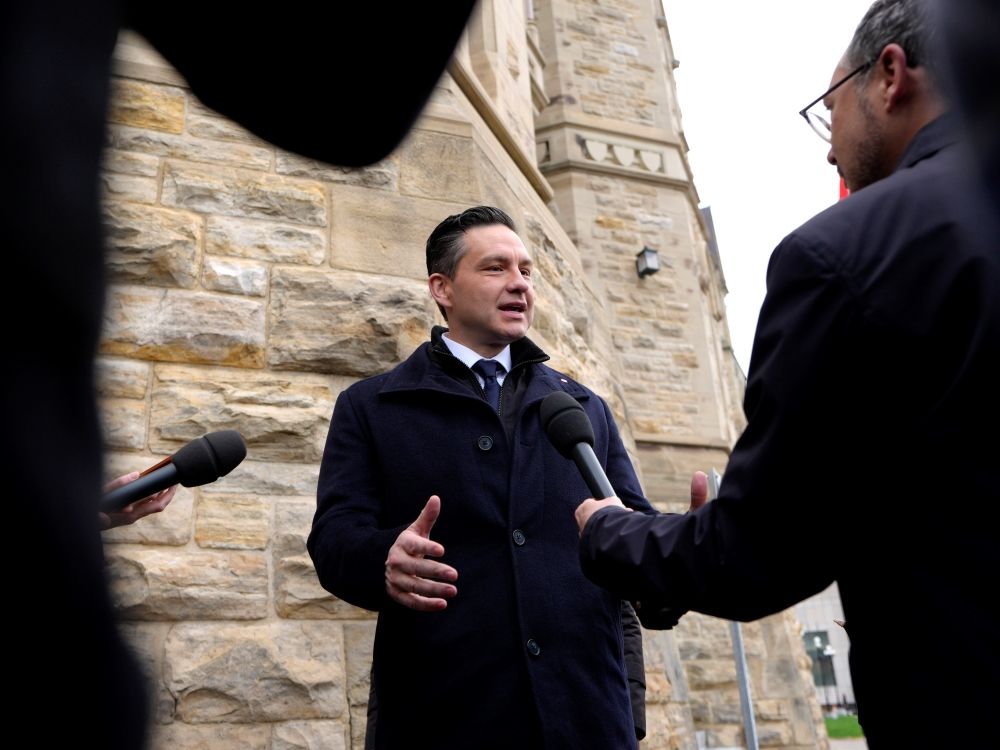
Conservative Leader Pierre Poilievre speaks to journalists as he arrives on Parliament Hill for a meeting of the Conservative caucus following the federal election, in Ottawa, on Tuesday, May 6, 2025.

OTTAWA — Conservative Leader Pierre Poilievre said Thursday that Liberal cabinet minister Steven Guilbeault posed an imminent danger to Confederation, one day after Guilbeault’s off-the-cuff comments on pipelines set off a firestorm in Alberta.

“Yes he is, absolutely,” Poilievre said when asked by reporters if Guilbeault was a threat to national unity in his current role as Minister of Canadian Identity and Quebec Lieutenant.

“I just find it astonishing that (Prime Minister Mark) Carney would appoint a man who says that we don’t need any pipelines built,” said Poilievre.

“(Guilbeault) wants

to block road construction

, he’s against nuclear power, he’s against all forms of economic development… for the entire country.”

Guilbeault said on Wednesday that Canada should maximize the use of existing pipelines before building new ones, asserting incorrectly that the recently operational Trans Mountain Expansion Project (TMX) was only at “about 40 per cent capacity.”

TMX has been consistently running between 76 per cent and 86 per cent capacity since it opened in May 2024, according to the latest available data

from Canada’s Energy Regulator

.

Guilbeault also said that he thought that demand for oil would peak within the next few years, both in Canada and globally.

Poilievre said that Guilbeault’s pipeline comments fit a pattern of “antagon(ism) to… resource producing provinces like Saskatchewan and Alberta, who rightly feel like they have been mistreated by (the Liberals).”

Poilievre, who grew up in Calgary, will be running in an upcoming byelection in the rural Alberta riding of Battle River—Crowfoot after losing his Ottawa-area seat in last month’s federal election.

Guilbeault was appointed by Carney as Minister of Canadian Identity and Quebec Lieutenant in March, after serving as environment minister for three years under Justin Trudeau.

He stayed in this role after a post-election cabinet shuffle earlier this week.

Guilbeault was easily re-elected in his Montreal-area riding, beating

NDP challenger Nimâ Machouf

by a 33-point margin.

Alberta Premier Danielle Smith was one of many in her province who were miffed by Guilbeault’s off-script pipeline comments.

“This is just another example of how misleading and destructive this former environment minister was to Alberta’s and Canada’s economy and investment climate,”

wrote Smith on social media

.

Carney says he’s willing to approve the construction of a new pipeline if a national consensus emerges for one.

rmohamed@postmedia.com

Get more deep-dive National Post political coverage and analysis in your inbox with the Political Hack newsletter, where Ottawa bureau chief Stuart Thomson and political analyst Tasha Kheiriddin get at what’s really going on behind the scenes on Parliament Hill every Wednesday and Friday, exclusively for subscribers. Sign up here.

Our website is the place for the latest breaking news, exclusive scoops, longreads and provocative commentary. Please bookmark nationalpost.com and sign up for our daily newsletter, Posted, here.


An Alberta separatist rally at the Alberta Legislature on May 3, 2025. About 29 per cent of respondents in a poll of Albertans said they would support the province going it alone.

With dedicated groups of Albertans pushing for the western province to secede from Canada, new polling shows that most of those living in the province reject this idea, while just over one-third support some form of independence from Canada.

The Postmedia-Leger poll

also found that 44 per cent of Albertans identify as “primarily Canadian,” while only 21 per cent identify as primarily Albertan. A further 32 per cent say they identify as both equally.

Sixty per cent of those who oppose separation say they identify as primarily Canadian; even among those who wish to see an independent Alberta, 23 per cent say they identify as primarily Canadian, while 45 per cent say they are primarily Albertan.

When it comes to a future scenario involving an independent Alberta, the most popular idea, which received the support of 35 per cent of Albertans, would be an independent western bloc, from Manitoba to the Pacific Ocean. Thirty per cent support just Alberta and Saskatchewan breaking away and forming their own country, while 29 per cent would support Alberta going it alone.

Just 17 per cent of Albertans are interested in joining the United States.

“I don’t really see this as something that’s been really steamrolling and gaining a ton of momentum. I think it’s … probably been festering for a bit,” said Andrew Enns, Leger’s executive vice-president, central Canada. “Probably the re-election of the Liberals didn’t help to diminish anything. But I wouldn’t suggest also that it’s actually added a bunch of fuel to the fire.”

Alberta Premier Danielle Smith has been a frequent critic of the federal government’s approach to Alberta. When she met with Prime Minister Mark Carney prior to the election, she made a list of nine demands, many of them involving the energy sector, that she said she expected to see met within six months, or there could be an “unprecedented national unity crisis.”

The majority of Albertans (53 per cent) support Smith’s approach on those demands, while 34 per cent disagree. Eighty-three per cent of those who support separation also support Smith’s approach, compared to 34 per cent of those who do not support separation.

“What she’s doing is not completely offside with her voters and the electorate. I mean, her job is to represent Alberta and Albertans, and not necessarily do things that are going to make (Ontario) Premier (Doug) Ford happy,” said Enns.

The polling also sheds light on Albertans’ motivations for believing the province ought to leave Canada.

Among those who believe that Alberta should separate, 54 per cent said it’s because of a combination of economic, political and cultural reasons.

The single largest individual motivation is economic, largely to do with resource management and taxation. Almost one third (30 per cent) of Albertans give economic factors as their primary reason, compared to eight per cent who identify political reasons — such as political underrepresentation — as their main motivation and five per cent who give cultural reasons, such as regional identity or values.

“This isn’t some sort of cultural thing that — somehow Albertans have, maybe, this cowboy culture,” said Enns. “This is about the economy.”

Economic motivations are strongest among 18 to 34 year olds, with 42 per cent listing those issues as their primary motivation for supporting separation.

Carney might have some reasons to feel that the tensions can be tamped down. The polling found that 58 per cent of  respondents said the actions of the federal government could influence their support for separation, both for and against, while only 23 per cent said their support is baked in already.

Still, 62 per cent of Albertans say people outside the province don’t understand their grievances. Even among the 29 per cent who think Alberta’s grievances are understood, only six per cent think they’re understood well.

Almost half of all Albertans are still willing to take a wait-and-see approach to Carney, particularly on energy. Forty-four per cent believe that Carney will deliver on his energy promises, which include positioning Canada as an energy superpower. However, just as many don’t believe Carney will deliver. Of those who oppose separation, 60 per cent are confident that Carney will deliver, while 66 per cent who support separation are not confident.

“If we’re talking about economic opportunity and economic growth and economic freedom, those are some things that from a federal government perspective, they have the ability to pull a few levers,” said Enns.

The polling was done via an online survey of 1,000 Alberta adults between May 9 and 12. The results were weighted according to age, gender, mother tongue, region, education and presence of children in the household in order to ensure a representative sample of the Canadian population. For comparison purposes, a probability sample of this size yields a margin of error no greater than plus or minus 3.1 per cent.

Our website is the place for the latest breaking news, exclusive scoops, longreads and provocative commentary. Please bookmark nationalpost.com and sign up for our newsletters here.


Members of the Public Service Alliance of Canada (PSAC) stand at a picket line outside Place du Portage in Gatineau, Que., on Friday, April 28, 2023.

OTTAWA – Prime Minister Mark Carney should “take a page from the Chrétien government’s 1994 program review” and cut tens of thousands of bureaucrat jobs, argued the Montreal Economic Institute (MEI) in a new paper published on Thursday.

The economic think tank found that a program review like the one from 30 years ago would result in the elimination of about 64,000 federal government jobs. This would lead to a return to the pre-Justin Trudeau government per capita size of the bureaucracy and a permanent reduction in public spending of nearly $10 billion a year by 2029, MEI experts say.

“The size of the Canadian public service once again requires attention. Despite the government belatedly acknowledging the need to restrain the growth of the federal bureaucracy, more decisive action is required,” said Conrad Eder, the associate Researcher at the MEI that produced the viewpoint.

During the federal election, Liberal Leader Mark Carney promised to cap the size of the federal workforce and to “not cut public service employment.”

“As part of our review of spending we will ensure that the size of the federal public service meets the needs of Canadians,” reads the Liberal platform.

The Liberals also promised to launch a “comprehensive review of government spending” focused on productivity. The review, it was said, would focus on “clear targets by departments and Crown Corporations with an iterative process that deploys best approaches across the public sector.”

For instance, the government wants to amalgamate service delivery, consolidate grants and contributions that serve similar purposes and reduce reliance on external consultants.

Following this review, Ottawa wants to put in place a permanent process to “link spending and outcomes across departments and continuous improvement in spending control.”

“Prime minister Carney’s promises to review federal spending give us cause for optimism, but the lack of details surrounding how it will be conducted brings us caution,” wrote Renaud Brossard, vice president of communications at the MEI, in an email exchange with National Post.

In 2023, then

prime minister Justin Trudeau gave a mandate to his then President of the Treasury Board

Anita Anand to find $15 billion in savings across the government by 2028, and then $4 billion annually after that.

Yet, from 2015 to 2025, the number of federal public servants increased by more than 110,000, a 43 per cent increase according to the MEI. There are 367,772 federal employees, or nine per 1,000 residents, compared to 7.2 when Trudeau took office.

By comparison, the United Kingdom has 7.4 federal employees per 1,000 residents and Germany 6.2 employees per 1,000 residents.

Last year, the MEI noted that federal personnel costs were on track to exceed $70 billion, compared to $40 billion in 2016-2017, the first fiscal year of Trudeau’s first mandate. According to the MEI, this represents one in seven dollars spent by the government.

The MEI maintains that a large portion of this spending is financed by large deficits. In 2024, the federal government posted a deficit of $61.9 billion, far exceeding its promise to keep it below $40.1 billion.

“Given the size of our deficit and the speed at which the bureaucracy has grown over the last decade, a federal spending review needs to be just as ambitious as the one undertaken under the Chrétien government in the 1990s,” Brossard said.

The 1994 program review has become an example of good fiscal practice in Canadian economic circles. When Jean Chrétien was elected prime minister in 1993, Canada was grappling with persistent deficits, an unsustainable national debt and a ballooning public service.

Chrétien then asked his finance minister Paul Martin to put “the house in order”.

The program review evaluated federal programs based on public need and fiscal capacity. The government then restructured programs and eliminated jobs in the public service. In fact, the size of the bureaucracy shrunk by over 42,000 employees, or 17.4 per cent, at the time they were done in 1999.

“Chrétien’s reforms worked because they were targeted and pragmatic,” explained Brossard. “His government proved that it is possible to provide essential services while tackling overspending.”

National Post

atrepanier@postmedia.com

Get more deep-dive National Post political coverage and analysis in your inbox with the Political Hack newsletter, where Ottawa bureau chief Stuart Thomson and political analyst Tasha Kheiriddin get at what’s really going on behind the scenes on Parliament Hill every Wednesday and Friday, exclusively for subscribers. Sign up here.

Our website is the place for the latest breaking news, exclusive scoops, longreads and provocative commentary. Please bookmark nationalpost.com and sign up for our daily newsletter, Posted, here.


The Canadian Broadcasting Corporation (CBC) Toronto headquarters. National Post

OTTAWA — CBC/Radio-Canada says it will stop paying its executives and employees millions of dollars in controversial “performance pay” bonuses but will compensate by increasing their salaries instead.

The public broadcaster made the announcement

in an unattributed statement

Wednesday alongside a four-page memo summarizing a compensation review report conducted by a human resources consulting firm.

“The Board of Directors, with the advice and concurrence of the President and CEO, has decided to discontinue individual performance pay as part of the overall compensation earned by eligible employees of CBC/Radio-Canada,” read the statement.

“In order to keep overall compensation at the current median level, salaries of those affected will be adjusted to reflect the elimination of individual performance pay.”

The public broadcaster offered the bonuses as performance incentives to executives and over 1,000 non-unionized employees yearly.

CBC/Radio-Canada spokesperson Leon Mar would not say if the salaries of employees who were previously eligible for bonuses would be increased by the exact same amount as the lost performance pay.

In an email to National Post, he only stated that salaries would be “adjusted” to remain in the 50th percentile

of compensation “for employees in our peer group of media, private, and public sector organizations.”

CBC/Radio-Canada will continue to set individual and corporate objectives and measure performance,” Marr noted, but did not detail what measures the public broadcaster will use to incentivize employees to hit their performance targets

The public broadcaster has repeatedly come under fire from critics, opposition parties and even the Liberal government for doling out millions of dollars in bonuses to executives all the while laying off staff.

Last year, the CBC paid out $18.4 million in bonuses to 1,194 employees — including $3.3 million to 45 executives — after eliminating hundreds of positions,

The Canadian Press reported

.

At the time, Conservatives said the bonuses were “beyond insulting and frankly sickening” and that the public broadcaster was at the “height of smugness” for paying them at a time of growing affordability issues.

But a memo summarizing a compensation review by HR consulting firm Mercer and published by CBC/Radio-Canada say that the Crown corporations’ compensation structure has “faced scrutiny”. But overall, it describes “performance pay” as a “widely adopted strategy” and considered “best practice” within government and Crown corporations.

It also said that overall compensation, including bonuses, offered by the public broadcaster are at the “midpoint” of the market.

Thus, removing the performance pay incentives risked dropping overall compensation below market value and putting CBC/Radio-Canada at a hiring disadvantage against other private and public sector organizations (not just in media).

“While CBC/Radio-Canada’s incentive targets are generally conservative relative to market, removing incentives altogether would position CBC/Radio-Canada’s compensation below market,” reads the memo.

“CBC/Radio-Canada should be mindful of not falling below market if it wants to retain and recruit the expertise and talent it needs to deliver on the organization’s national mandate.”

If the Crown corporation eliminated bonuses, Mercer suggested that it find other ways to compensate the lost remuneration and implement other ways to “drive and manage performance.”

The memo also argued that the public broadcaster’s executives are underpaid, but other non-unionized employees’ salaries are aligned with the market. It also says the public broadcasters’ defined benefit pension is a “key tool” for attracting and retaining employees.

“When all elements of compensation are considered, all non-unionized employee groups at CBC/Radio-Canada are currently aligned with market,” Mercer wrote in the memo.

Last fall, incoming CBC President Marie-Philippe Bouchard listed

compensation as one of her first priorities when she assumed the five-year post on Jan. 3.

“I’m going to be working on making sure that we have a system that’s transparent and that people can trust in our administration and management of public funds, especially in the context of compensation,” she told MPs during a Commons committee meeting in November.

“I’m not tone deaf,” she later added.

National Post

cnardi@postmedia.com

Get more deep-dive National Post political coverage and analysis in your inbox with the Political Hack newsletter, where Ottawa bureau chief Stuart Thomson and political analyst Tasha Kheiriddin get at what’s really going on behind the scenes on Parliament Hill every Wednesday and Friday, exclusively for subscribers. Sign up here.

Our website is the place for the latest breaking news, exclusive scoops, longreads and provocative commentary. Please bookmark nationalpost.com and sign up for our politics newsletter, First Reading, here.


As well as a jail sentence, Soegiono Liem Swie was handed a year of probation and ordered to repay $64,732 to Staples.

An Indonesian computer expert who processed 222 “bogus returns” at the New Brunswick Staples where he worked to get store gift cards that he exchanged for pre-paid, untraceable credit cards has been sentenced to 15 months behind bars, despite his lawyer’s argument that more than six months in jail will get him deported.

Soegiono Liem Swie, who has permanent resident status in Canada, raked in between $89,732 and $93,338 as a result of his “repeated acts of dishonesty,” according to a Fredericton provincial court judge.

“Mr. Swie’s large scale employee fraud took on considerable proportions,” Judge Scott Brittain wrote in a recent decision.

“The aggravating factors are many and significant while the mitigating factors are, at best, muted.”

Swie’s lawyer, Sabrina Winters, argued her client should get a conditional sentence of 18 months of house arrest and a year of probation. She also recommended her client be ordered to pay Staples back.

“Laid bare, the thrust of Ms. Winters’ sentencing submission is that this otherwise weak case for exceptionality becomes a strong one due to the spectre of ‘collateral immigration consequences’ that looms for her client,” the judge said in his decision dated May 8.

“I respectfully disagree and reject this suggestion in view of the circumstances of this offence and offender. While the period of incarceration I shall impose on Mr. Swie resides within the temporal range available for a conditional sentence, proportionality, parity, denunciation and deterrence each require that Mr. Swie serve a significant jail term for this offence.”

Winters argued that if the judge sentenced Swie to more than six months in jail for the fraud over $5,000, “his right to appeal a removal order made under the (Immigration and Refugee Protection Act) will be lost and the certain outcome will be deportation.”

Brittain “was unable to find any decisions of the Court of Appeal of New Brunswick where ‘collateral immigration consequences’ have been considered in the sentencing (or any other) context.”

The judge acknowledged “that the prospect of deportation invites potentially grave consequences for Mr. Swie and his family given that Mr. Swie’s wife and two sons are Canadian citizens. In effect, it could ultimately lead to a separation or divide not unlike what they experienced as a family between 2016 and 2018 when Mr. Swie resided in Indonesia while his wife and two sons lived in Toronto.”

Crown attorney Darlene Blunston recommended that Swie get a jail term of 12 to 18 months and a year of probation, and be ordered to pay Staples back.

“I substantially agree with the sentencing submissions of the Crown and quite strenuously part company with those put forward on Mr. Swie’s behalf,” said the judge.

“In my view, a sentence in the community … even of the longest possible duration with the strictest of conditions, would constitute an unfit sentence because it would be disproportionate to the gravity of the offence and the degree of responsibility of the offender. This is consistently borne out by the sentencing authority from this province for employer theft and fraud.”

Brittain pointed out that his “survey of the broader Canadian sentencing landscape reveals very few decisions where an offender facing ‘collateral immigration consequences’ has received a conditional sentence for large scale employee fraud.”

Court heard Swie, 51, “has an extensive background in computers. After studying computer engineering at the university level in his native Indonesia for three years, Mr. Swie spent the next 21 years working in the computer sales and service field. Of those 21 years, 16 were spent founding, running and growing his own business. At its height, Mr. Swie’s enterprise employed 25 people.”

Swie wound up his business in 2017 and joined his family in Canada the following year.

He was a sales support supervisor at the Fredericton Staples

one of four management positions at the store

until he resigned Nov. 27, 2022.

“Mr. Swie leveraged the enhanced level of access, responsibility and trust which accompanied his management position to process dozens of fraudulent return and refund transactions,” said the judge.

“His serial misappropriations went undetected for some time and only became known when a customer attempted to return a gaming chair purchased from Fredericton Staples only to have that transaction declined because records reflected her item had been returned and refunded several months before. The customer pressed the issue further because the gaming chair remained in her possession and no refund had ever been made to her. The matter escalated beyond Fredericton Staples to Staples Canada and ultimately triggered an internal investigation which took on increasingly extensive proportions as the layers of dishonesty and deceit associated with Mr. Swie’s carefully planned, deliberate and calculated scheme were uncovered.”

Authorities were able to recover $25,000 once Swie’s fraud was discovered. “It should be noted the recovery of the aforementioned sum was achieved by having the third-party company which manages the pre-paid gift cards place a stop payment on any unused balances,” Brittain said.

Swie “identified and took advantage of gaps in Fredericton Staples (surveillance) camera coverage of the store to travel undetected between the cash register area at the front of the store and the locked electrical room at the rear of the store” where he turned the cameras off “for periods ranging from a few minutes to several hours.”

Once the cameras were off, Swie returned to the cash register area “where he processed the fraudulent return and refund transactions,” said the judge.

“To close the loop of deception, Mr. Swie routinely manipulated the inventory data he was chiefly responsible for managing and overseeing as the sales support supervisor to further hide his fraud.”

Swie’s fraud took place between Dec. 8, 2021, and Nov. 27, 2022.

Brittain noted that “the frequency and magnitude of these bogus transactions increased over the event date range and sharply intensified in the final few months” Swie worked at the store.

His “fraud was prolific, far-reaching, long-lasting and meticulously planned and executed with the benefit of the elevated authority and access that accompanied his management position,” said the judge.

On top of the jail sentence, Brittain handed Swie a year of probation and ordered him to repay Staples $64,732.

Our website is the place for the latest breaking news, exclusive scoops, longreads and provocative commentary. Please bookmark nationalpost.com and sign up for our daily newsletter, Posted, here.


From left, Shafqat Ali, Maninder Sidhu and Ruby Sahota.

The

newly appointed cabinet

of Prime Minister Mark Carney contains 28 ministers and 10 secretaries of state. Three of those 38 hail from ridings in Brampton. As Conservative writer and political campaigner Stephen Taylor has pointed out, that’s more than the numbers from

Saskatchewan and Alberta combined

. Here’s what to know about them.

Who are the three Brampton appointees?

Shafqat Ali has been named President of the Treasury Board, his first cabinet post since being elected in Brampton Centre (now Brampton-Chinguacousy Park) in 2021. His

website

describes him as “a successful immigrant entrepreneur.”

Maninder Sidhu, the newly appointed Minister of International Trade, has held the riding of Brampton East since 2019. He has held parliamentary secretary positions for the ministers of foreign affairs, international development and international trade and economic development. He has

lived in Brampton

since he was a child.

Ruby Sahota, Secretary of State (Combatting Crime), is the Brampton North–Caledon (formerly Brampton North) representative, having first been elected in 2015. She served as the Chief Government Whip from January to December of 2024, and was briefly Minister of Democratic Institutions and Minister Responsible for the Federal Economic Development Agency for Southern Ontario.

How did the Liberals fare in Brampton?

Brampton’s six ridings were mostly Liberal strongholds. In addition to the three appointees, the new government also contains Liberal MPs from Brampton South (Sonia Sidhu) and Brampton Centre (Amandeep Sodhi). Only Brampton West chose another party’s candidate, with Conservative nominee Amarjeet Gill unseating Liberal incumbent Kamal Khera by just under a thousand votes.

How does that compare to the previous election?

The Liberals took all of Brampton’s five ridings in the 2021 federal election. However, the 2022

redistribution of electoral districts

redrew the boundaries of the ridings and added a sixth

How meaningful is it to have three appointees from Brampton?

Nelson Wiseman

, professor emeritus in the department of political science at the University of Toronto, cautioned against reading too much into these appointments and of looking at the results “with a microscope,” as he put it.

“I don’t think it’s terribly significant,” he told National Post. “You have to get a certain number of people from the GTA, and Brampton is part of that. It’s not as if you had all of a sudden seven cabinet ministers from Nova Scotia.”

There are in fact two appointees from Nova Scotia, two from New Brunswick, and one each from Prince Edward Island, Newfoundland, Manitoba, Saskatchewan, Alberta and the Territories. The rest are split between British Columbia (five), Quebec (nine) and Ontario (14). Carney even boasted about the makeup of cabinet,

telling reporters

: “We’re governing for all Canadians, all regions.”

“Do I think Carney took that into account?” Wiseman said of the Brampton contingent. “No, I doubt it. He didn’t use a microscope; he used a telescope. So he probably had a rough number in his head of how many they could have in Ontario, having to take into account that you’re going to have to appoint people from these other regions.”

He also noted that two of the three Brampton MPs have relatively minor roles. “Secretary of State for crime doesn’t mean a thing,” he said bluntly. “That person doesn’t get a department. That person doesn’t get staff. That person doesn’t get budget. I don’t think they’ll get a driver either. They might.”

And while minister for international trade might seem like a plum post, Wiseman pointed out: “Over 75 per cent of Canada’s international trade is with the United States and — hey! We’ve got a minister that’s handling that.” (Dominic LeBlanc has been named Minister Responsible for Canada-U.S. Trade, Intergovernmental Affairs and One Canadian Economy.)

That leaves the President of the Treasury Board, which Wiseman noted is a full cabinet position and the only of the three to go back to Confederation and be constitutionally required. That said, “It’s significant but it’s not a senior cabinet position … like Justice or Foreign Affairs or Transport or Immigration. Because it’s not so much a policy area, it’s more of an administrative basket.”

Do the Brampton appointments mirror the region’s population?

Not really. In fact, provincial appointments may have been chosen at the expense of population centres. Brampton’s three ridings with appointees are home to just 340,000 people. But Alberta and Saskatchewan, with just one minister and one secretary of state, have a combined population of some 6.2 million.

Meanwhile, many of the larger population centres have been shut out entirely, with no jobs given to MPs from Winnipeg or Calgary. Eleanor Olszewski, Minister of Emergency Management and Community Resilience and Minister responsible for Prairies Economic Development Canada, is MP in

Edmonton Centre.

Our website is the place for the latest breaking news, exclusive scoops, longreads and provocative commentary. Please bookmark nationalpost.com and sign up for our politics newsletter, First Reading, here.


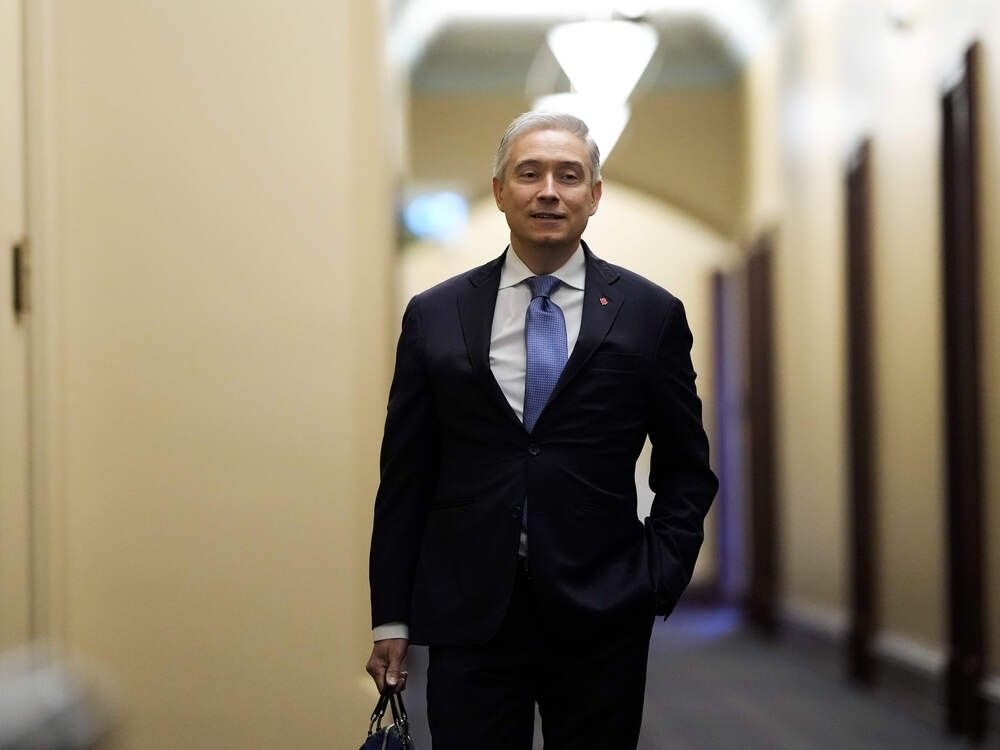
Minister of Finance and National Revenue Francois-Philippe Champagne arrives for a meeting of the federal cabinet in West Block on Parliament Hill in Ottawa on Wednesday, May 14, 2025.

OTTAWA — Finance Minister François-Philippe Champagne signalled Wednesday there will be no spring budget and only a fall economic statement, despite his predecessor announcing pre-budget consultations earlier this year.

Asked by reporters about the date of the next budget, Champagne said his first three orders of business are tabling a motion to cut the bottom income tax bracket by one per cent, presenting a speech to the throne on May 27 and then publishing an economic update in the fall.

He made no mention of a budget, nor did he respond to repeated questions as to why the government would not be tabling a spring budget.

“The middle-class tax cut, that’s step one. Step two, you’re going to have a throne speech which will outline the Canadian government’s priorities, and there will be a fall economic statement to follow,” Champagne said after the first cabinet meeting since the shuffle Tuesday.

Conservative Leader Pierre Poilievre said the decision not to table a budget is a sign that Carney is failing to deliver on his election campaign promises to Canadians.

“Parliament has already been shut down for nearly half a year. Now, in the face of serious economic threats, the Liberals don’t intend to present a budget this year. There is no roadmap forward, no economic vision, and no willingness to lead,” said Poilievre, in a written statement. “This is not the leadership Mark Carney promised—it’s abandonment.”

Champagne’s signalling that there will be no spring budget is notable because his predecessor, Dominic LeBlanc,

announced pre-budget consultations in February

. At the time, Justin Trudeau was still prime minister while the Liberal party was in the midst of a leadership race that ultimately crowned Mark Carney.

“Through Budget 2025, the government will remain focused on responding to the current Canada-U.S. context, making life more affordable for all Canadians, continuing to strengthen economic security, and unlocking growth by boosting our competitiveness and productivity,” read the release by Finance Canada announcing the consultation.

In December, the Commons Finance committee also tabled a

330-page report on the fruit

s of its 2025 budget consultations.

Champagne also clarified that Prime Minister Mark Carney’s election promise to cut the lowest income tax bracket rate by one per cent will be introduced through a ways and means motion within the first sitting days of the House of Commons, which reopens on May 26.

In a ceremony reminiscent of an U.S. presidential signing of an executive order, the

prime minister opened the cabinet room to TV cameras and photographers on Wednesday to film him publicly signing an order

directing his government to prepare a motion to deliver the promised tax cut.

“Canadians sent a clear message: they need to see improvements in their affordability,” Carney said. “We’re acting today on that so that on July 1, as promised, that middle class tax cut… will take into effect.”

Champagne said he expects opposition MPs to “obviously” support the government’s motion.

“This is about Canadians. You know, we are in a situation, it’s a dire situation,” Champagne said. “This is a way for all parliamentarian to show up and say, ‘Yes, we support Canadians at the time when they need a break’.”

The last time the government did not table a spring budget was 2020 at the onset of the COVID-19 pandemic in March. At the time, the sudden shutdown of the Canadian economy laid waste to the Liberal government’s original spending plans.

Instead, the Trudeau-led Liberals tabled a “mini-budget” fall economic statement.

National Post

cnardi@postmedia.com

Get more deep-dive National Post political coverage and analysis in your inbox with the Political Hack newsletter, where Ottawa bureau chief Stuart Thomson and political analyst Tasha Kheiriddin get at what’s really going on behind the scenes on Parliament Hill every Wednesday and Friday, exclusively for subscribers. Sign up here.

Our website is the place for the latest breaking news, exclusive scoops, longreads and provocative commentary. Please bookmark nationalpost.com and sign up for our politics newsletter, First Reading, here.


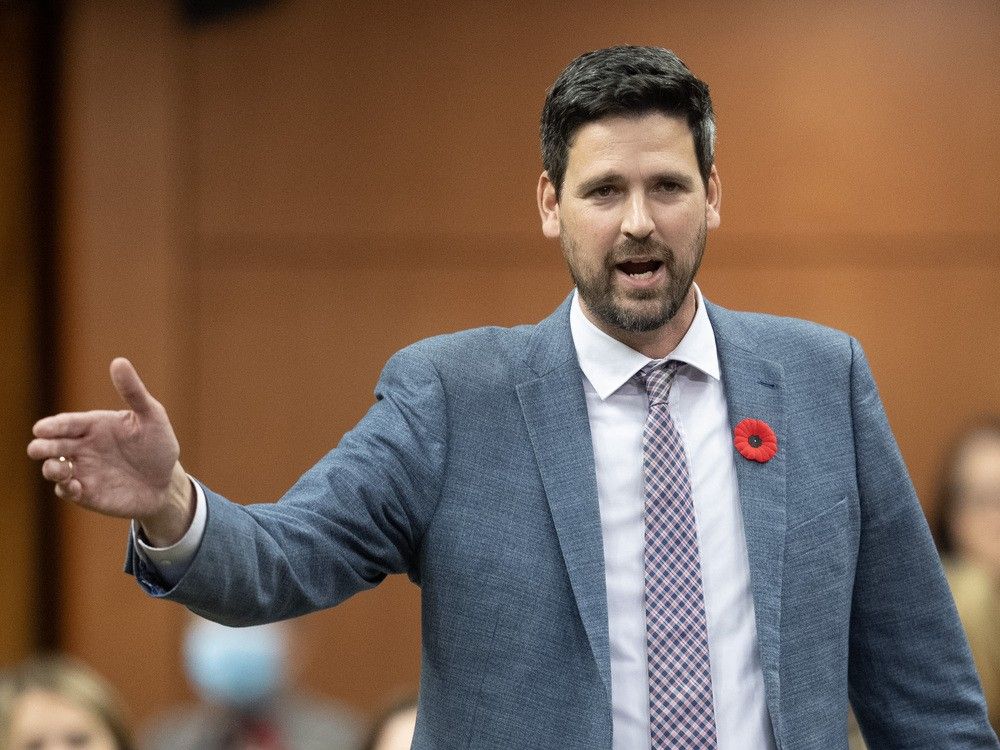
Sean Fraser rises during Question Period, in Ottawa, Tuesday, Oct. 29, 2024.

OTTAWA

— Justice Minister Sean Fraser says he is not interested “in slinging mud” at his opponents after Conservative Leader Pierre Poilievre said he failed upward into his latest appointment. 

Fraser nonetheless said he was surprised by the Conservative leader’s comments, coming off an election loss where voters took issue with Poilievre’s tone.

“It’s surprising to see that the Conservatives, after having been handed a defeat, going into an election with one of the largest polling leads in the history of Canadian politics, and Mr. Poilievre, in fact, himself losing his seat, hasn’t made a change in his approach,” he told reporters on his way into Wednesday’s cabinet meeting.

“I’m not going to sit here and sling mud at my Opposition.”

Poilievre took aim at Prime Minister Mark Carney’s picks for cabinet, which were unveiled on Tuesday, pointing out that many of the ministers served under his Liberal predecessor, former prime minister Justin Trudeau. Carney himself has said half the cabinet is new and represents “big change.”

The Conservative leader took particular note of Fraser, who first entered Trudeau’s cabinet in 2021, first as immigration minister and then later as housing minister.

Both issues have dogged the Liberal government, with Trudeau announcing dramatic cuts to Canada’s immigration levels last year and announcing billions in spending to get more homes built to deal with the country’s housing crisis.

Poilievre has laid the blame for high housing costs and a population that grew faster than cities and health-care could absorb at Fraser’s feet, telling reporters on Tuesday that he is now “the minister responsible for addressing the Liberal crime crisis.”

“It seems like he is the master at failing upward,” Poilievre said of Carney’s pick for justice minister.

Speaking to reporters on Wednesday, Fraser, who was asked about the Conservative leader’s comments, defended his record on housing, pointing to how he himself acknowledged the country “

had been through” a housing crisis, with the government embarking on a suite of reforms. 

He also said that over course of the most recent election campaign, people in his riding “very openly said” they did not want to see Poilievre become the prime minister because they saw him as someone who spent a career “slinging mud against his opponents” rather than proposing solutions.

A request for a response from the Conservative party has not yet been returned.

During the campaign, Conservative candidates told National Post that Poilievre’s tone was an issue that came up among voters, particularly among older women.

Poilievre’s style was also an issue because voters noted similarities between him and U.S. President Donald Trump, whose tariffs and comments about wanting Canada to become a state became the central campaign issue for many voters, while the Conservatives ran a campaign focused on affordability.

Despite the Conservative leader’s efforts to wear more smiles along the campaign trail and roll out meatier policies to boost Canada’s economic strength in the face of Trump, the party still came up short.

Poilievre, who is preparing to run for a seat in the rural Alberta riding of Battle River—Crowfoot after one of his MPs stepped aside, has said while Conservatives are right to be disappointed in the election results, the party still has much to celebrate.

He and other Conservatives point out that the party picked up more than 20 new seats, including in battlegrounds like the Greater Toronto Area, southern Ontario and British Columbia, and grew its appeal among young people and working-class voters.

The party gained 41.3 per cent of the vote, which was a historic high for the Conservatives, but was still behind the Liberals’ 43.7 per cent.

With Parliament set to resume on May 26, Poilievre has said the Conservatives were prepared to support the minority Liberals when it felt the government does a “good job,” such as on the issue of negotiating with the U.S.

Poilievre himself will not be able to take a seat in the House of Commons until he regains one, with former party leader and Saskatchewan MP, Andrew Scheer, acting as the party’s Opposition leader in the House.

The Conservative leader has invited Carney to “steal my ideas,” saying the party has been leading on issues from the carbon tax to housing prices, inflation and crime.

Addressing crime was one of Poilievre’s biggest focuses during the recent campaign, promising tougher laws and more technologies to address issues like car thefts.

In laying out his government’s priorities, Carney has vowed to strengthen bail laws for those accused of car thefts, home invasions, human trafficking and smuggling.

The Liberals also campaigned on targeting repeat offenders and also increasing funding to the Public Prosecution Services of Canada to prosecute more drug trafficking crimes, as well as crack down on illegal guns being smuggled into Canada.

Fraser said on Wednesday the government wants to move “swiftly.” He said it planned to move forward on “some” of its campaign commitments this spring, but “not necessarily all.”

“I think you’re going to see some some work that we’re going to do in cooperation with the United States along the border very quickly,” the minister said.

National Post
staylor@postmedia.com
Get more deep-dive National Post political coverage and analysis in your inbox with the Political Hack newsletter, where Ottawa bureau chief Stuart Thomson and political analyst Tasha Kheiriddin get at what’s really going on behind the scenes on Parliament Hill every Wednesday and Friday, exclusively for subscribers. Sign up here.

Our website is the place for the latest breaking news, exclusive scoops, longreads and provocative commentary. Please bookmark nationalpost.com and sign up for our politics newsletter, First Reading, here.


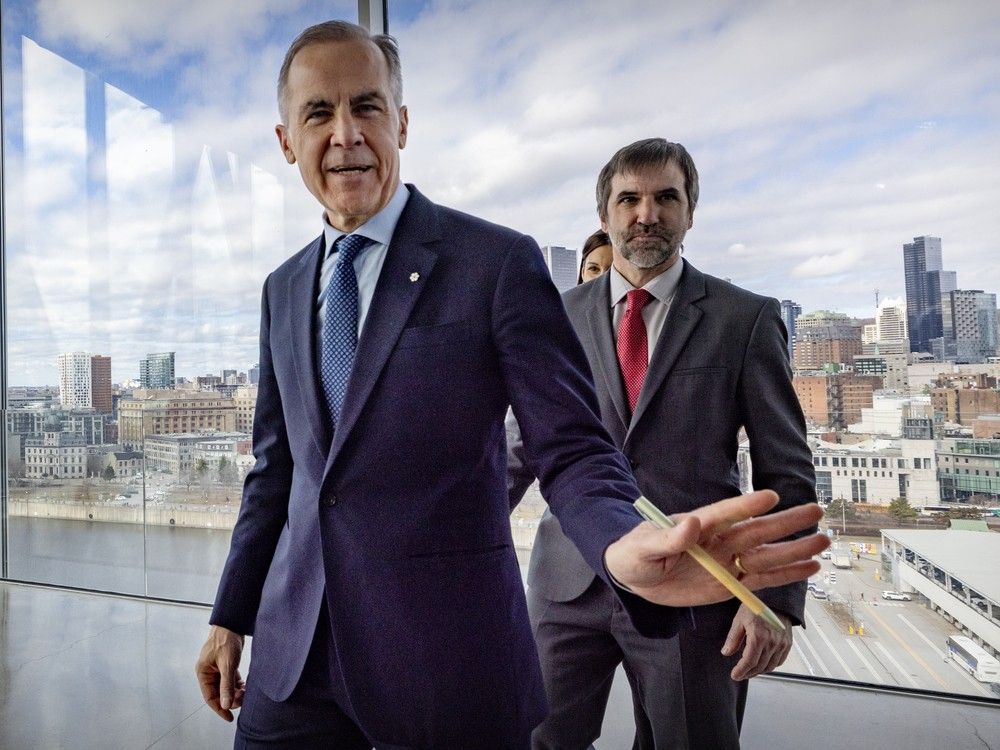
Mark Carney waves to a photographer followed by his Quebec lieutenant Steven Guilbeault  following an announcement in Montreal on April 4, 2025.

OTTAWA — Minister of Canadian Identity Steven Guilbeault said Wednesday that Ottawa’s stalled progress on oil and gas pipelines isn’t a threat to national unity because demand for pipelines is petering out on its own.

“The Canadian energy regulator, as well as the International Energy Agency, are telling us that probably by 2028, 2029, demand for oil will peak globally and it will also peak in Canada,” Guilbeault told reporters in Ottawa, when asked about whether pipelines will continue to be a source of friction between Alberta and the federal government.

Estimates of when

global demand for oil

will peak vary widely, from later in the 2020s to after 2050.

“So… before we start talking about building an entirely new pipeline, maybe we should maximize the use of existing infrastructure,” said Guilbeault.

Guilbeault claimed that the Liberal government-bankrolled Trans Mountain Expansion Project (TMX) was currently operating at “about 40 per cent capacity,” a figure that was quickly disputed

by energy analysts online

.

TMX’s total utilization for the last eight months of 2024 was

77 per cent of capacity

, according to company documents.

Kent Fellows, an economist at the University of Calgary, said that running pipelines at full capacity shouldn’t be an objective for policymakers.

“There’s no reason to desire any Canadian pipeline run at 100 per cent capacity all the time. A pipeline that is consistently full is like a road that is consistently gridlocked,” said Fellows.

“Minister Guilbeault’s characterization of the current system misrepresents … the economic value of excess capacity that allows for optionality.”

Guilbeault’s comments

were also panned by

Joseph Mancinelli, Canadian Director of the Labourers International Union of North America (LiUNA).

“It is a shame to see (Guilbeault) remain in cabinet with the same old rhetoric that is counterproductive, especially at a time where Canada must show strong leadership and invest in our energy potential,” wrote Mancinelli on social media.

Alberta Premier Danielle Smith said on Tuesday

that she was disappointed

by the inclusion of both Guilbeault and his former undersecretary Julie Debrusin in the Liberals’ post-election cabinet, calling both “anti-oil and gas.”

Guilbeault, a longtime environmental activist, spent more than three years as environment minister before being reassigned in March.

He’s often

been a lightning rod

for Albertan frustrations over Liberal net-zero policies targeting the province’s oil and gas sector.

Prime Minister Mark Carney, Guilbeault’s boss, said in an interview Tuesday that

he’s willing to green light

a new oil and gas pipeline if an interprovincial consensus exists for one.

He also said that he’s willing to make changes to key Liberal climate policies, such as Bill C-69 and the federal emissions cap, to get the ball rolling on oil and gas development.

Carney has promised to make Canada a clean and conventional energy superpower.

Newly minted Energy Minister Tim Hodgson said Wednesday that he was excited to start working toward this objective.

“We look forward to building, and I look forward to digging in,” Hodgson told reporters in Ottawa on his way to a cabinet meeting.

Hodgson said he’d be travelling to Western Canada “very soon.”

National Post

rmohamed@postmedia.com

Get more deep-dive National Post political coverage and analysis in your inbox with the Political Hack newsletter, where Ottawa bureau chief Stuart Thomson and political analyst Tasha Kheiriddin get at what’s really going on behind the scenes on Parliament Hill every Wednesday and Friday, exclusively for subscribers. Sign up here.

Our website is the place for the latest breaking news, exclusive scoops, longreads and provocative commentary. Please bookmark nationalpost.com and sign up for our daily newsletter, Posted, here.