


LP_468x60
on-the-record-468x60-white

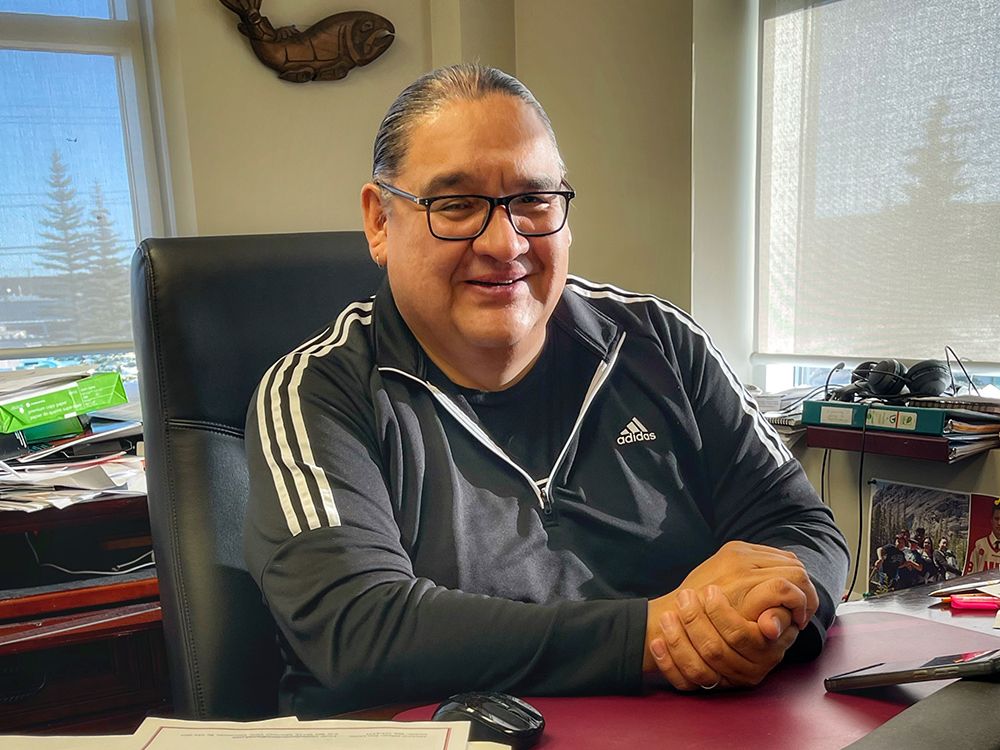
Indian Resource Council CEO Stephen Buffalo: “There’s not a city in Canada, you go downtown and you don’t see a lot of our people that have gone through struggles.”

Stephen Buffalo is a very constructive guy. He’s a man who seeks solutions, and he’s open to Prime Minister Mark Carney’s ambitious nation-building campaign. He also wants Carney and all Canadians to understand, though: Indigenous consent to these projects has a price tag.

“Give us a chance to make our own wealth,” says Stephen, long-time advocate for First Nations’ economic development and member of the Samson Cree Nation from Maskwacis, Alta.

“To be part of the mainstream and part of the economy and at the end of the day, everyone benefits: the proponent benefits, the government benefits, and we benefit, you know, First Nations that are participating.”

The “new” Liberal government has pledged — in the recently tabled “One Canadian Economy Act” — to speed up approvals for major energy and infrastructure projects that strengthen Canada’s autonomy, resilience and security, have undeniable national benefits, are likely to be successfully executed, drive Canada’s clean grown potential and reflect priorities of Indigenous leaders.

Carney assured that fast-tracking major projects won’t shortcut meaningful consultation with Indigenous peoples whose Charter or treaty rights may be affected. A Major Projects Office, created to assist project proponents through the assessment and consultation process, will lean on an Indigenous advisory council for advice.

And in an effort to reinforce Indigenous voice in governance, Carney’s cabinet includes three Indigenous ministers: Rebecca Chartrand, as minister of northern and Arctic affairs; Mandy Gull-Masty, as minister of Indigenous services; and Buckley Belanger, as secretary of state for rural development.

I ask Stephen: Do Carney’s announcements signal real change in the federal government’s paternalistic relationship with Indigenous communities? After watching the undermining of Jody Wilson-Raybould’s leadership by the previous Liberal administration, I’m wary.

He restates my question. “Can we take this as a reset?”

He grins, and answers: “I’m trying to.”

This isn’t the first time I’ve sat down with Stephen for a no-holds-barred conversation about how Indigenous leaders perceive what’s going on in the world. As CEO of the Indian Resource Council, Stephen speaks on behalf of 130 First Nations across Canada that have oil and gas production on their land, or the potential for production. He also speaks forcefully — as a 53-year-old father who wants to see his kids have the opportunity to thrive in mainstream society.

When we met 18 months ago, he was lobbying to have the Indian Act repealed because it was getting in the way of First Nations’ full participation in resource development. “We cannot live in soft communism,” he chided, “where bureaucrats tell us how to live, what to do.”

Today, we meet for coffee at Grey Eagle casino in Calgary, and while he’s fairly upbeat about the potential for change, his sense of urgency is more palpable. Managing poverty and addressing social issues, every day, is challenging for his leaders, he reports; it takes them away from other important stuff.

Canada’s Indigenous communities are captives of welfare. “Socialism right now is ruling the day,” he laments.

“It saddens me,” he shares, “some of our people are stuck in the dark, that troubled life. There’s not a city in Canada, you go downtown and you don’t see a lot of our people that have gone through struggles.” And, he adds, “Funding we get under the federal government is heavily scrutinized and has a lot of red tape. The option is to come to the major centre and try to make it. It doesn’t quite work out for everybody.”

He endorses government-backed loan guarantees to enable Indigenous ownership in projects. For eight years, Stephen’s been on the board of Alberta Indigenous Opportunities Corporation, a provincial Crown corporation, and now we have a national loan guarantee program.

“Not too many Nations can dig in the pocketbook and say, ‘OK, I’ll put down $100 million.’ Not too many Nations can do that,” he chuckles.

Last month, he explains, Canada Indigenous Loan Guarantee Corporation’s inaugural guarantee made possible the purchase of a 12.5 per cent ownership interest in Enbridge’s Westcoast natural gas pipeline system by 36 First Nations in B.C.  On June 1, Carney doubled the federal Indigenous loan guarantee program from $5 billion to $10 billion — and opened it to sectors outside of energy and natural resources.

“But,” Stephen redirects the conversation, “back to the commodity that’s going through the pipe: What does it do for the (First) Nation, the province and the proponent?” It’s not enough, for Stephen, that Indigenous communities can invest in infrastructure; he wants them to be able to own an interest in the resource upside too.

“You know,” he says, “there’s fear-mongering in and around everything — be it coal mining, uranium mining, Ring of Fire. We are doing environmental disruption, no matter what we do. But at the end of the day … this thing called FPIC — consent — now has a price tag.”

FPIC is the acronym for free, prior and informed consent under the UN Declaration of the Rights of Indigenous Peoples. Stephen’s convinced there’s an opportunity for Indigenous communities to change the narrative, and to participate in resource sharing. “That’s consent with a price tag on it,” he reiterates.

Some Canadians, I suggest, will find Stephen’s conclusion cynical. And yet, quite honestly, I find his candour refreshing and arguably constructive. All that back-and-forth emotional blather between federal Justice Minister Sean Fraser and Assembly of First Nations Chief Cindy Woodhouse Nepinak — Fraser’s apology for potentially eroding a precarious trust by even discussing FPIC in terms of veto power — feels disingenuous.

The truth is, many Indigenous peoples in Canada are not anti-development but yes, their consent does have a price tag.

Right now, there are Indigenous naysayers who warn against the fast-tracking of nation-building projects. Some predict expedited approval processes will trigger litigation and projects will be hung up by court proceedings.

Protesters went to Queen’s Park to denounce Ontario Premier Doug Ford’s government passing of Bill 5 — giving the province sweeping powers to speed up mining or development projects including those in the remote Ring of Fire region of Northern Ontario —  and warned of protests and blockades akin to those seen during the Idle No More movement.

But, Stephen and I agree, that’s old thinking that risks holding us all back. Many of the tough questions have previously been referred to the Supreme Court of Canada, Stephen suggests; we have precedent. Carney could decide to exercise federal powers to move a project forward for the greater good, something I find tempting. Yet I don’t disagree with Stephen’s expectation that leaders sit down with people, to understand the true reasons for dissent, including the possibility of foreign interference.

Manitoba Premier Wab Kinew’s style of leadership, Stephen adds, is particularly compelling.

“He’s an NDP,” Stephen chuckles, “and he’s saying, we can’t deal with social issues without a strong economy.”

Our website is the place for the latest breaking news, exclusive scoops, longreads and provocative commentary. Please bookmark nationalpost.com and sign up for our newsletters here.

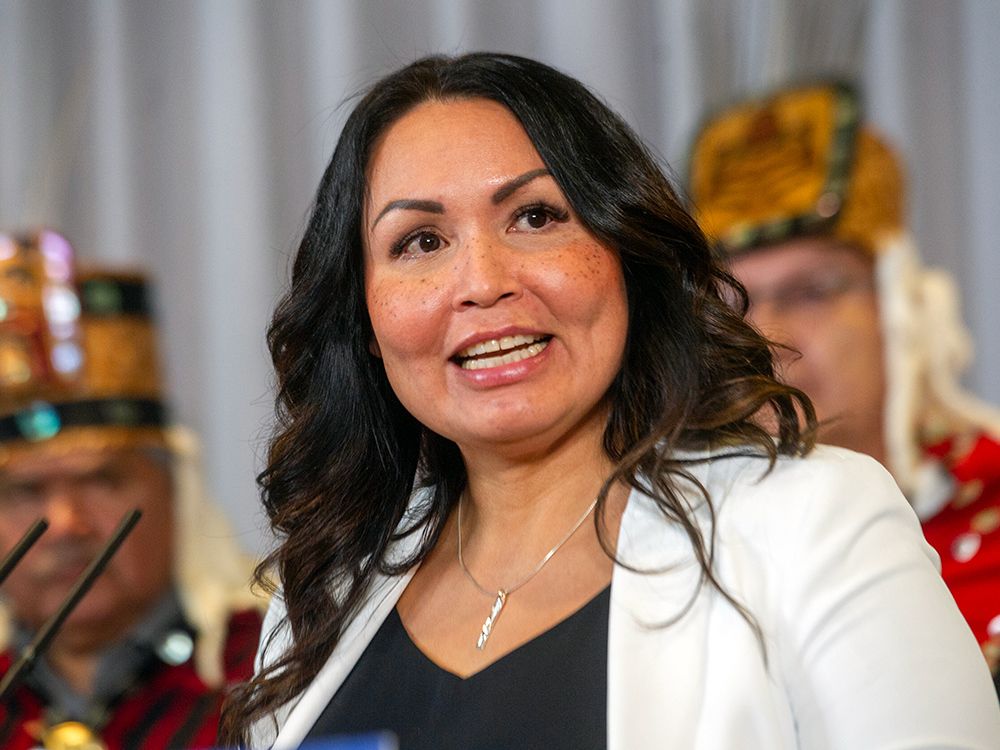
Haisla Nation Chief Councillor Crystal Smith.

Chief Crystal Smith has been at the forefront of the Haisla Nation’s transformation into a driving force in Canada’s LNG sector. The First Nation, which is governed from Kitamaat Village in the northern coastal area of British Columbia, believes “careful and appropriate economic development will bring our people necessary self-sufficiency,” according to their website. They have partnered with natural gas companies and now own a majority stake in Cedar LNG, a floating liquefied natural gas export facility that is being built off the North Coast. It will accept natural gas coming from the main Coastal GasLink pipeline and liquefy approximately 3.3 million tonnes per year for export to Asia. Smith spoke with National Post about what economic self-determination means, how the First Nation balances growth with cultural preservation, and what others can learn from their experience. This interview has been edited and condensed for clarity and length.

Can you share the Haisla Nation’s vision for economic self-determination and how that has evolved over the years?

Our involvement in economic development started with a desire to no longer sit on the sidelines. Historically, major projects like aluminum smelters, pulp mills, and methanol facilities were built in our territory without our say — or benefit. We watched as others gained generational wealth while our people lived in poverty.

Thanks to leadership like Ellis Ross, we began learning everything about Aboriginal rights and title to leverage that knowledge. When I joined leadership in 2013, we focused on identifying acceptable projects. LNG emerged as the most vital opportunity, and our partnership with LNG Canada and Coastal GasLink was the beginning of something meaningful. It evolved into our own project — Cedar LNG — giving us not just participation but ownership.

What does “success” mean to you and your community — economically, socially, and culturally?

Success is having a strong, independent nation with people who are mentally and spiritually strong — and who have opportunity. Since 2015, revenues from industry have helped us invest in healing from generational trauma and, perhaps most importantly, in revitalizing our culture and language.

What were the key factors that allowed the Haisla Nation to become a leader in LNG development?

One of the biggest was our use of Aboriginal rights and title case law. It gave us the legal grounding to protect our rights and assert our place in decision-making. We also built strong partnerships — not just with companies, but internally, by involving our own people with the technical expertise to evaluate projects on our terms.

What were some of the biggest concerns going into these ventures, and how did you address them?

Our people are always thinking seven generations ahead. Environmental concerns were top of mind. We hosted countless information sessions and brought in third-party experts — but what really mattered was having our own Haisla people, like Candice Wilson with a Masters in Environmental Sciences, review and explain the information in a way our members could trust.

How have revenues from LNG and other projects been reinvested back into the community?

In many ways. One of our proudest achievements is investing $5 million of our own-source revenue into a cultural and language department — the first of its kind for us. It employs 20 people who document and teach our culture. My twin sister is one of them, and hearing her sing in our language to our grandsons makes this work worth it.

We’ve also built a 23-unit apartment complex for affordable housing, opened our first proper youth centre, and created fully funded elder programs — all without having to follow external government rules that don’t reflect our people’s needs.

What were some of the toughest moments or obstacles in pursuing this economic path, and how did the Haisla Nation navigate them?

One of the most difficult times was during the Coastal GasLink protests in 2019. There was a widespread perception that all Indigenous communities opposed the project. As one of the nations that supported it, we faced heavy criticism. I was personally targeted, and our community was labelled as “sellouts” or “colonized” for supporting economic development.

That backlash was deeply felt, especially during events like our basketball tournament, where we invite surrounding communities to come out and play. Our members encountered tension from other communities, but it brought us closer together. We leaned on each other, stayed focused on our long-term vision, and reminded ourselves — and others — that this was about our people, our culture, and our future.

How did you maintain unity and direction amid that pushback?

Communication. We kept information flowing, held open discussions, and ensured people understood this wasn’t just about jobs at LNG plants. It was about choice. Revenues that gave us the freedom to support all kinds of aspirations — whether someone wants to be a tradesperson, a teacher, or a yoga instructor.

What lessons do you think other First Nations — and Canadians in general — can learn from the Haisla Nation’s experience?

When Indigenous communities are included in economic development, the whole region prospers. What we’ve done here in Kitimat has created jobs not just for our people, but for everyone. I often get calls from non-Indigenous residents thanking us for the work we’ve done in LNG. When our people succeed, everyone benefits.

In your view, what role should Indigenous-led economic development play in Canada’s overall future?

Indigenous communities know their land, their people, and their priorities. When we lead, we ensure projects are done responsibly, and with long-term vision. Respect our ability to lead. Too often, policies treat us like we need to be managed. Give us the room to shape our future on our own terms — because we’re doing it, and it’s working.

This is the latest in a National Post series on How Canada Wins. Read earlier instalments here.

Our website is the place for the latest breaking news, exclusive scoops, longreads and provocative commentary. Please bookmark nationalpost.com and sign up for our daily newsletter, Posted, here.


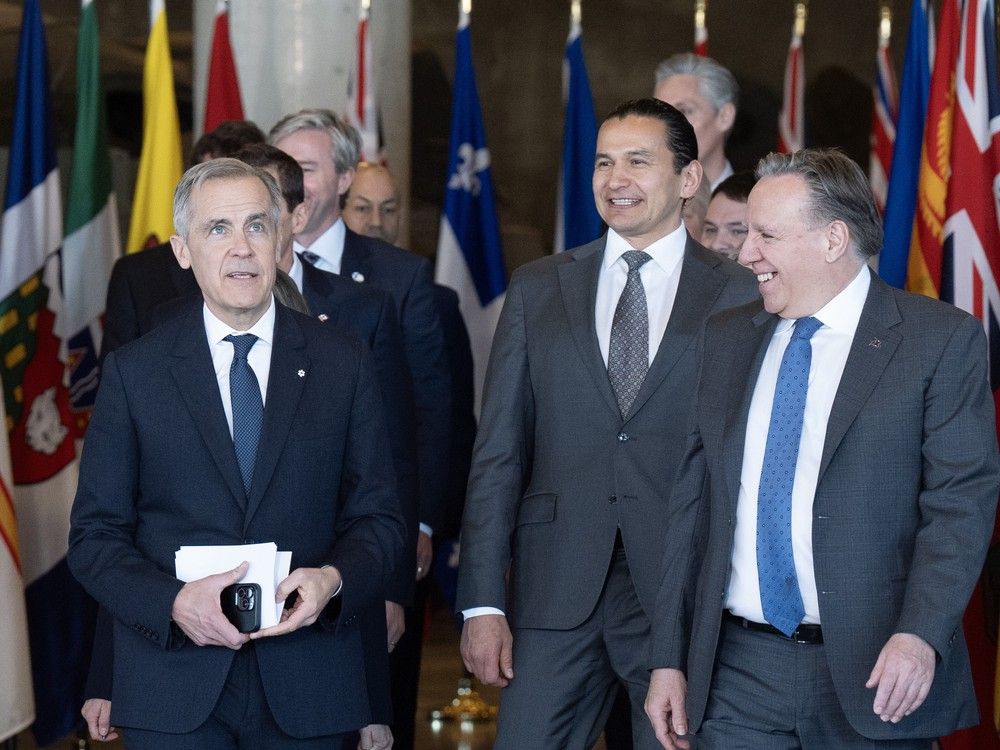
Prime Minister Mark Carney, front left, walks alongside Quebec Premier François Legault, right, as they are joined by first ministers as they arrives to take part in the First Minister Meeting at the National War Museum in Ottawa on Friday, March 21, 2025.

OTTAWA — Quebec Premier François Legault was on fire last weekend.

The man who is clearly and unequivocally the most unpopular premier in Canada, according to the

latest Angus Reid poll

, stood before the future of his party, the members of the youth wing of the Coalition Avenir Québec, smiling and ready to fight.

“I want to fight more than ever! For a third term, to finish the job!” he roared. “I need you to continue building Quebec for future generations,” he added.

But the polls suggest that the fight seems lost for Legault, known for years as the country’s most beloved premier. And for the man who has made a punching bag of the federal Liberal government, it’s a cruel twist of fate that Prime Minister Mark Carney may be the only person who can save the Quebec premier.

With nearly a year to go until the election, the man who won one of the largest majorities in Quebec’s history, with 90 out of 125 seats, is facing a massacre. According to the latest Angus Reid report, only a quarter of Quebecers approve of his performance. In March 2020, at the start of the pandemic, his approval rating was 77 per cent.

“Honestly, I wouldn’t be surprised if the CAQ wins zero seat in next year’s election,” said a CAQ insider that was granted anonymity to speak more freely out of fear of repercussions.

The man behind

the poll aggregator Qc125.com

, Philippe J. Fournier, is almost convinced that if there were an election today, the CAQ would not have party status.

“Currently, Mr. Legault is in a situation that is similar or even perhaps a little worse than (then prime minister) Justin Trudeau in December,” he told National Post.

His government has faced numerous controversies over the past two and a half years. Right now, he is being hit on all fronts for his government mismanagement in the health, energy, transport and finances files.

The public, it seems, has simply had enough of this government and no longer trusts it.

Legault sees things differently and presents himself as the nationalist and economic candidate. But the road ahead isn’t smooth.

On the one hand, the separatist Parti Québécois has comfortably taken the lead and is garnering all the attention with a leader who remains perfectly clear about his intentions during the first mandate of a PQ government. Yes, this is a referendum on Quebec independence.

With a popular leader leading the way among francophones, with a similar margin to that of federal Conservative Leader Pierre Poilievre a year ago, the PQ has now brought the separatists back home after a decade of desertion.

On the other hand, Legault will have to deal with a new leader of the Quebec Liberal Party starting Saturday, when the party chooses its candidate to become Quebec’s next premier.

The QLP has been in dormancy since the 2022 election debacle and is dreaming of a massive comeback with a new leader. “If the next election is about a possible PQ referendum, it becomes clear that we are the alternative. Nobody believes that Legault is a federalist,” said a Liberal source.

In April, interim leader Marc Tanguay dropped a bombshell by publicly declaring that he had information that preparations for a CAQ leadership convention were underway.

Last week, he claimed his information was still accurate. But Legault insisted he would seek a third term.

After all, he doesn’t have what Trudeau had a few months ago: Carney as a successor.

And Carney may be the only person who can save Legault.

For weeks now, the premier has been unusually nice to the federal Liberals, a party that he wanted defeated last fall when he asked the Parti Québécois leader to tell his “comrade” at the Bloc Québécois to overthrow the Trudeau government.

Now, Legault tells his own members that Quebec “must work hand in hand with the federal government.”

According to him, there is “an exceptional opportunity” with Carney in Ottawa because he is a prime minister “laser focused” on the economy. But also, because Carney’s entourage is prominently from Quebec. François-Philippe Champagne is finance minister­, Mélanie Joly is the minister of industry, Marc-André Blanchard will be Carney’s chief of staff and now Michael Sabia, who was Legault’s pick as CEO of Hydro-Québec, is the next clerk of the Privy Council.

“It’s as if the stars were aligned… So, now is the time to take advantage of it,” Legault said in his speech.

The PQ is now calling the Carney-Legault relationship a “love story.”

“If he can seek economic opportunities at the federal level and then take credit for them, of course he will do so, so that is called a political opportunity,” said Emilie Foster, a former CAQ MNA and professor at Carleton University.

During her term as a backbencher for Charlevoix–Côte-de-Beaupré in the National Assembly from 2018 to 2022, Foster said she never heard her premier utter the words “military” and “defence.”

This week, as Carney announced massive military spending to meet NATO’s two per cent target, Legault quickly announced millions of dollars to support Quebec’s defence industry and visited three companies.

In Ottawa, this sudden affection from Quebec City is more than welcome. Many Quebec Liberal MPs were all smiles this week.

None of them were the most popular politician in Quebec. No, the most popular “by far” noted Fournier, is Mark Carney.

Now, Legault wants a piece of it and wants to show the electorate his record of economic success next year. So far, he’s boasted of outperforming Ontario and Canada in per capita economic growth, wage growth and disposable income growth.

Legault wants major projects. Like the Newfoundland-Quebec power line, with the help of Carney, who has introduced a bill to fast track major projects.

It’s his only chance of survival, according to Foster. Over the past few decades, he’s pledged to be an “economic man,” just like Carney. Yet the province has recorded the largest deficits in its history.

But Legault is making the case that the PQ won’t try to achieve success with the federal government because it wants to demonstrate that Canada isn’t working.

“So this is not the time to have the PQ in power, this must be very clear, and it must be explained to Quebecers,” Legault said.

He simply hopes that Quebecers will give the PQ the same treatment that Canadians gave the Conservatives.

National Post

atrepanier@postmedia.com

Get more deep-dive National Post political coverage and analysis in your inbox with the Political Hack newsletter, where Ottawa bureau chief Stuart Thomson and political analyst Tasha Kheiriddin get at what’s really going on behind the scenes on Parliament Hill every Wednesday and Friday, exclusively for subscribers Sign up here.

Our website is the place for the latest breaking news, exclusive scoops, longreads and provocative commentary. Please bookmark nationalpost.com and sign up for our daily newsletter, Posted, here.


The long-range Iranian missile

Israel’s strikes targeting Iran’s nuclear and military infrastructure are a watershed moment in the region’s history. Reports indicate that the Jewish state has killed several senior leaders of Iran’s military and scientific establishment, and damaged airfields, weapons depots and nuclear sites.

Iran retaliated by unleashing scores of ballistic missiles on Israel late Friday.

The attacks come as nuclear negotiations between Iranian and American representatives were set to be held in Oman this Sunday. A previous deal, the Joint Comprehensive Plan of Action (JCPOA), was signed in 2015 by then-president Barack Obama, which Donald Trump

withdrew

from three years later, calling it “a horrible one-sided deal that should have never, ever been made.”

Iran’s nuclear ambitions trace back to the post-Second World War era, a moment when the country boasted strong ties with America and Europe, especially under the leadership of Mohammad Reza Shah Pahlavi. After Pahlavi was deposed during the 1979 Iranian Revolution, Ayatollah Ruhollah Khomeini ascended to power, remaking the relatively liberal country into a religious stronghold.

The following is a timeline of the major milestones in Iran’s nuclear history.

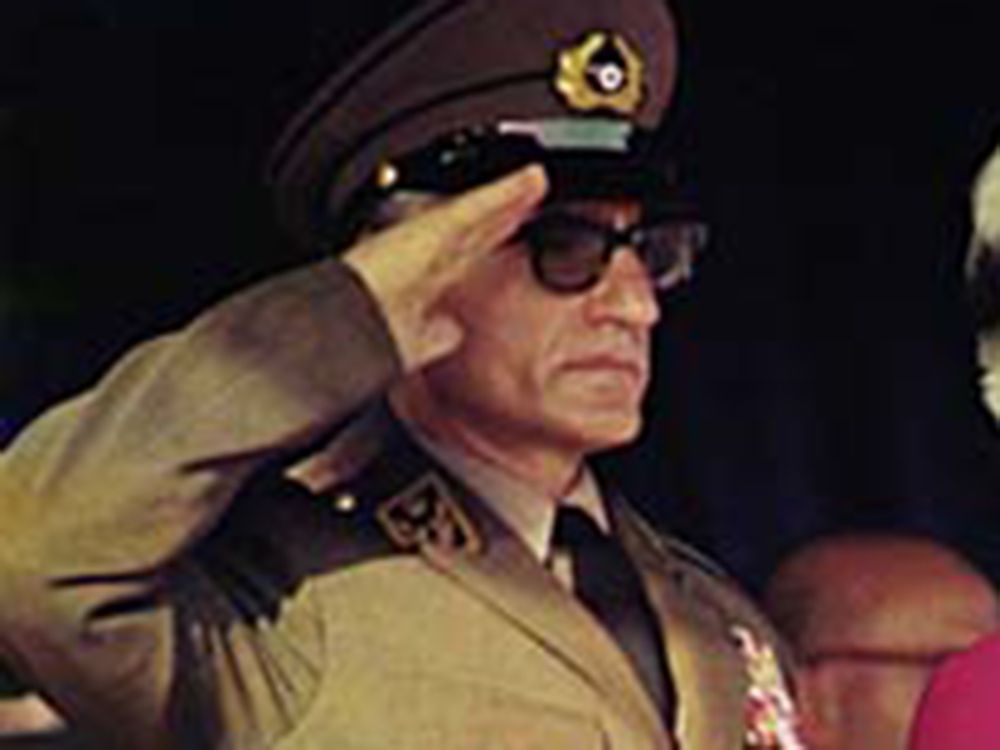
 Mohammad Reza Shah Pahlavi.

The Shah Years

1957

– President Dwight Eisenhower and Pahlavi sign a civil nuclear cooperation deal.

1958

– Iran joins nuclear regulatory body, the International Atomic Energy Agency (IAEA).

1967

– The Tehran Nuclear Research Centre, a 5 Megawatt reactor powered by enriched uranium, is established as part of the United State’s “Atoms for Peace Program” for civil nuclear use.

1968

– Iran joins dozens of countries in signing the Nuclear Non-Proliferation Treaty (NPT), aimed at stopping the spread of nuclear weapons.

1974

– Pahlavi creates the Atomic Energy Organization of Iran, outlining the ambitious goal of creating nearly two dozen nuclear power plants across the country over two decades.

1975

– Pahlavi pledges Iran has “no intention of acquiring nuclear weapons,” though warns “if small states began building them, Iran might have to reconsider its policy.”

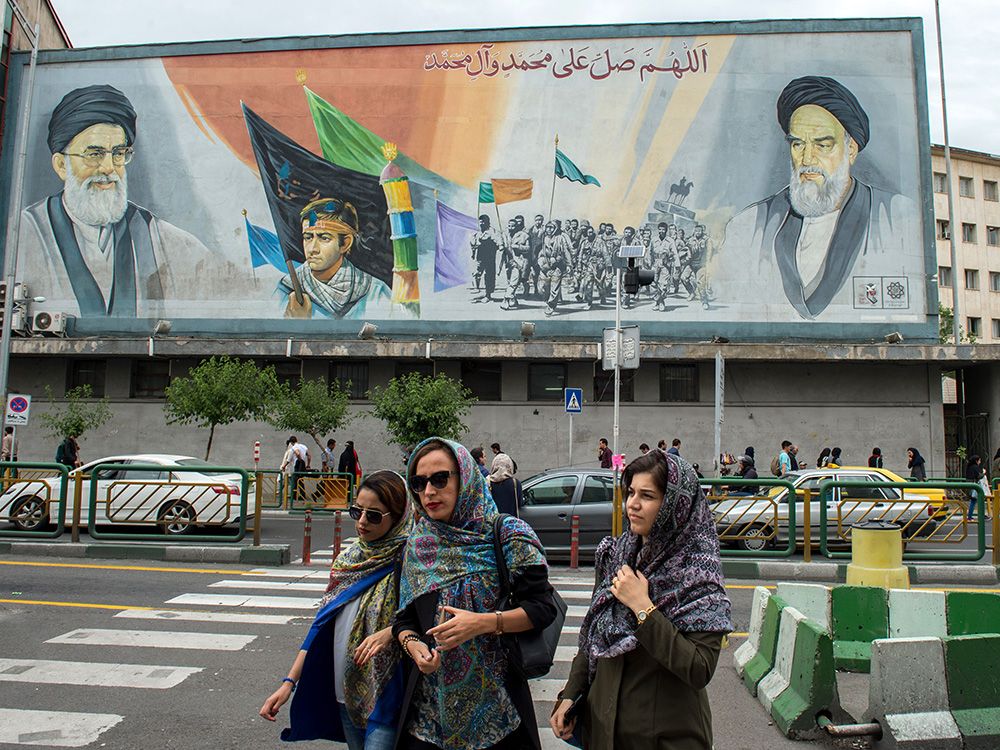
 A mural depicts Ayatollah Ali Khamenei, Iran’s supreme leader, left, and Ruhollah Khomeini, founder of the Islamic republic of Iran, in Tehran.

Iranian Revolution and tensions with America

1979

– Pahlavi is deposed, Khomeini assumes power and America imposes a series of orders banning Iranian oil, freezing assets of the new regime.

1980-1988

– The Iran-Iraq War leads to the deaths of hundreds of thousands.

1984

– The American State Department designates Iran a state sponsor of terrorism.

1987

– Iran signs nuclear cooperation deal with Pakistan.

1989

– Khomeini dies and is succeeded by Ali Khamenei.

1990

– Nuclear cooperation pact signed with China.

1992

– Bilateral nuclear deal with Russia signed.

1993

– Collaboration between North Korea and Iran begins, the Islamic Republic gains possession of Shahab-3 ballistic missiles and nuclear expertise from the hermit kingdom.

1995

– Iran signs deal with Russia to build nuclear power plant in Bushehr.

1998

– America warns Iran could be on a path to weaponizing its nuclear program.

2000

– United States imposes first nuclear-related sanctions on the Islamic Republic.

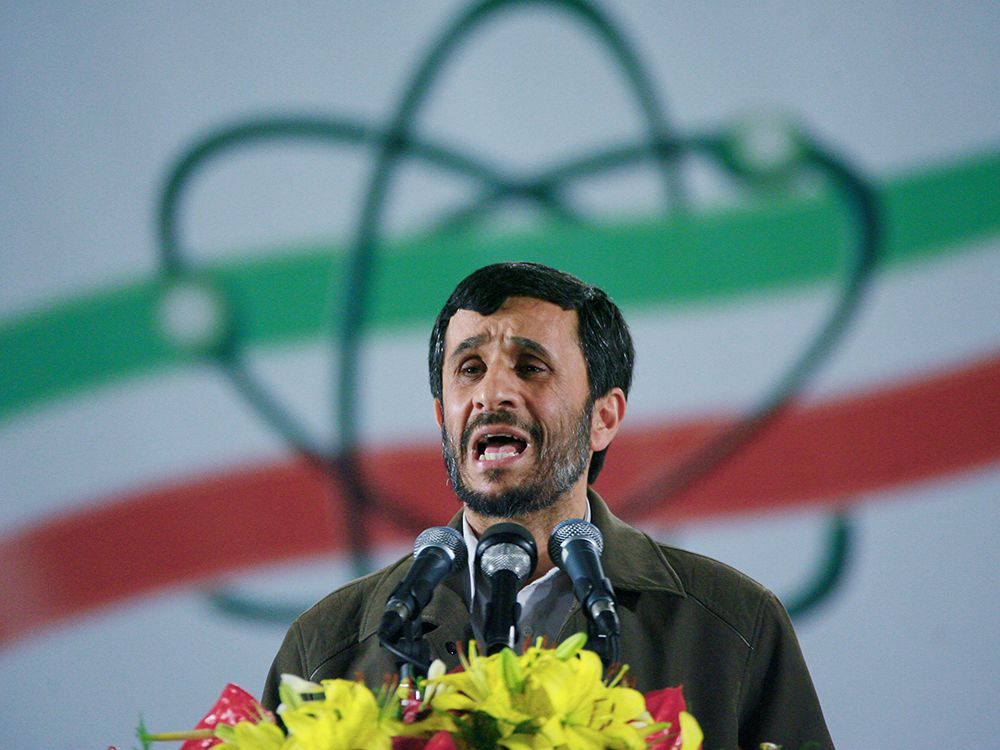
 Iranian President Mahmoud Ahmadinejad speaks at a ceremony at the Natanz nuclear enrichment facility, on April 9, 2007.

International Negotiations, Sanctions, Threats to Destroy Israel

2002

– Iranian group opposed to Islamic regime publicizes uranium enrichment activity at Natanz and heavy water facility in Arak.

2003

– IAEA passes resolution demanding Iran disclose aspects of its nuclear program and suspend enrichment efforts. The international body

discovers

traces of high enrichment at Natanz nuclear plant.

2004

– Iran agrees to temporarily freeze enrichment as talks unfold in Paris among European powers (known as the “Paris Agreement”); America discovers Iran is

modifying

existing ballistic missile capabilities to carry nuclear warheads.

2005

– Iranian President Mahmoud Ahmadinejad declares “Israel must be wiped off the map.” President George W. Bush

imposes

sanctions on Iran due to continued pursuit of nuclear program.

2006

– United Nations Security Council imposes sanctions on Iran for continued pursuit of enrichment.

2008 – Barack Obama elected president of United States.

2009


“Green Movement”

protests ripple

across Iran as public grows frustrated with political corruption; America joins Iran negotiation efforts alongside United Kingdom, France, China and Russia to form “P5+1”

2011

– European powers and the U.S. sanction Iranian banking sector and access to international financial markets

2012

– Israeli Prime Minister Benjamin Netanyahu

calls

Iranian nuclear weapons a “red line.”

2015

– JCPOA deal signed providing sanctions relief to Iran in exchange for restricting nuclear advancements, but critics say so-called “

sunset provisions,

” which only temporarily restrict uranium stockpiles and the number of centrifuges, are problematic. Iranian Supreme Leader Khamenei vows Israel will not exist in “25 years” during speech in Tehran.

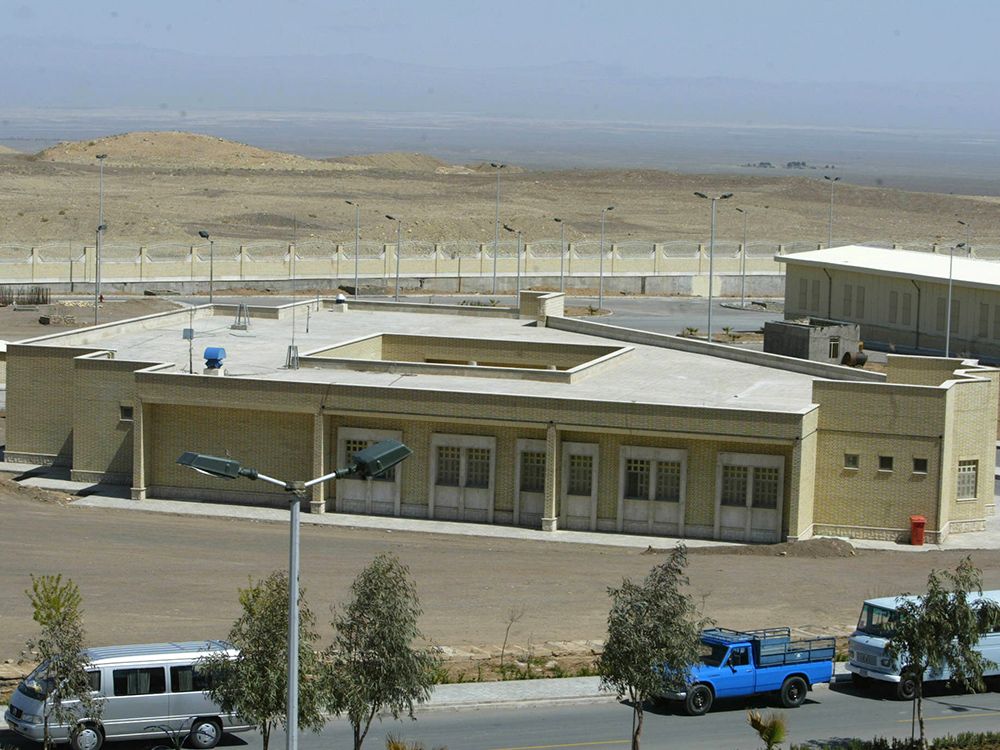
 The Iranian nuclear power plant of Natanz, 270 kms south of Tehran, in 2005.

Trump Years and Latest Escalation

2016 – Donald Trump defeats Hillary Clinton in presidential race; Congress passes

extension

of the Iran Sanctions Act.

2017

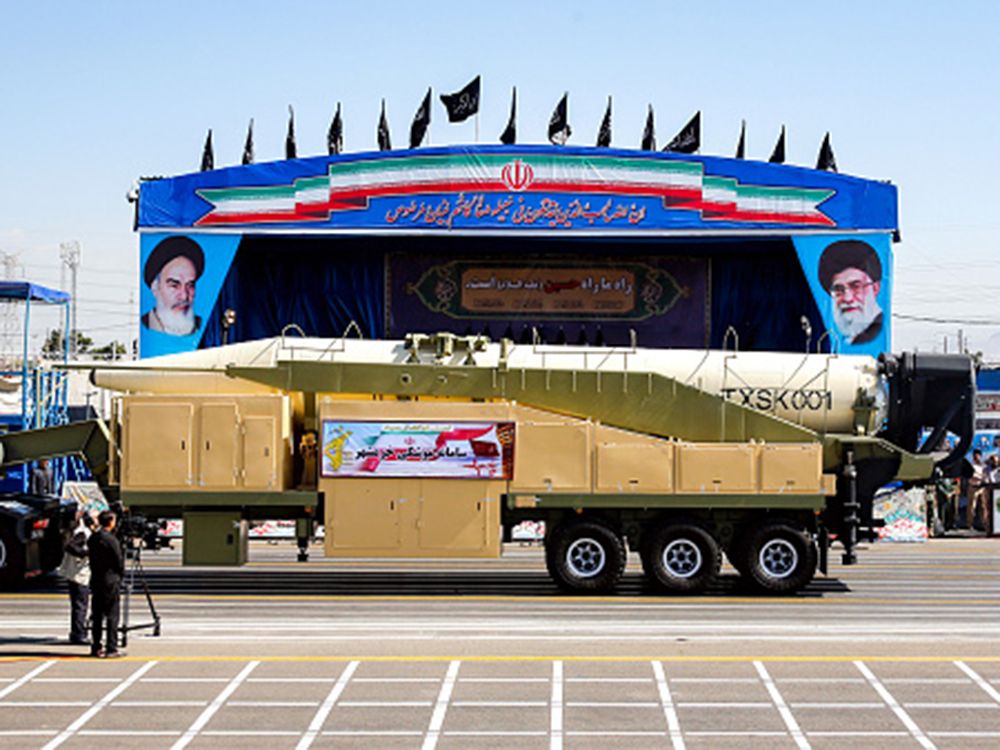
– Iran conducts ballistic missile test in violation of United Nations resolution and displays a new weapon,

the Khoramshahr

, during a public military parade.

2018

– Trump unilaterally withdraws America from JCPOA, denounces it as “worst deal ever” and begins reimposing sanctions on Iranian economy.

2019

– Iran vows to walk away from JCPOA unless remaining parties pledge compensation. Islamic Republic activates sophisticated centrifuges outlawed in 2015 deal; Trump imposes

sanctions

on Khamenei and other leaders, designates Iranian Revolutionary Guard Corps (IRGC) a terror group.

2020

– IRGC leader Qasem Soleimani is killed in an American drone strike. Iran targets U.S. military bases throughout the region and

downs

a Ukrainian civilian plane carrying nearly 200 passengers. Iran announces intention to no longer uphold JCPOA as European nations seek resolution to ongoing violations. Trump loses presidential election to Joe Biden.

2021

– Iran begins enriching uranium to 20 per cent level at Fordow facility, the

threshold

beyond which civilian use is limited; Ayatollah Khameini threatens weapons-grade enrichment levels as high as 60 per cent; Biden administration announces willingness to rejoin JCPOA if Iran meets obligations.

2022

– Iran and United States meet indirectly for ongoing talks in Doha. Nuclear talks in Vienna

break down.

Biden maintains military option to prevent a nuclear Iran as a “last resort”

2023

– Iran acknowledges it has reached enrichment level of 84 per cent. Hamas invades Israel on October 7. Iranian proxies, including the Yemen-based Houthis rebels and Hezbollah, attack Jewish state following the terrorist attack.

2024

– Israel believed to be behind targeting of Iranian consular building in Syria, which killed generals and Hezbollah militants. Iran responds with hundreds of missiles and drone strikes at Israel. IAEA notes Iran is

ramping up

centrifuge production.

2025

– Trump administration restarts talks with Iran, begins holding negotiations in Oman. IAEA reports widespread Iranian non-compliance, warns country has capacity to make several nuclear bombs. Israel carries out hundreds of air strikes targeting Iranian nuclear infrastructure.

National Post, with additional reporting from The Associated Press

Our website is the place for the latest breaking news, exclusive scoops, longreads and provocative commentary. Please bookmark nationalpost.com and sign up for our newsletters here.

DoorDash and Uber Eats have come under fire in separate legal actions for alleged

The practice known as “drip pricing” is front and centre again in an action by the federal Competition Bureau against DoorDash and in a proposed class-action lawsuit brought by a Toronto law firm against Uber Eats.

Drip pricing generally involves enticing customers by advertising low prices, but charging extra mandatory fees, usually when they are checking out.

It continues to come under fire because “disclosure around pricing and fees in various consumer transactions is, at times, less than thorough and transparent,” says Mike Robb, partner with London, Ontario-based law firm, Siskinds.

The

Competition Bureau says

w

hen “the represented price is inaccurate, it makes it more difficult for consumers to comparison shop and result(s) in unfair outcomes for honest competitors.”  

Why is DoorDash under scrutiny?

Canada’s competition watchdog is hauling DoorDash Inc. and its Canadian subsidiary before the Competition Tribunal, accusing them of portraying the online cost of delivery as lower than the price consumers ultimately pay.

The Competition Bureau says it investigated and is

alleging DoorDash customers

paid more, due to mandatory fees, added during checkout.

The extra fees, the bureau says, include charges such as extra amounts for delivering items a further distance and for placing smaller orders. The bureau alleges the discretionary charges were sometimes framed as taxes.

The bureau alleges DoorDash may have used drip pricing for close to a decade to make nearly $1 billion from mandatory fees, according to the Canadian Press.

What remedy is the Competition Bureau asking for against DoorDash?

The bureau is asking the Competition Tribunal to order the company to stop the practice, cease portraying fees as taxes, pay a penalty and issue restitution to affected consumers.

However, DoorDash is pushing back. “This application is a misguided and excessive attempt to target one of Canada’s leading local commerce platforms,” DoorDash spokesperson Trent Hodson told

CP

. “It unfairly singles out DoorDash, and we intend to vigorously defend ourselves against these claims.”

Still, the bureau is standing its ground. “Our litigation against DoorDash is another example of our efforts to ensure consumers are not misled and can trust the prices they see online. We urge all businesses to review their pricing practices and make sure they comply with the law,” said Matthew Boswell, commissioner of competition in

a press release

.

The Competition Bureau has been more aggressive of late in battling drip pricing.

Last fall, the bureau won a

deceptive marketing case against Cineplex Inc.

, noted Robb.

It had been adding a mandatory $1.50 online booking fee. The company was ordered to pay a financial penalty of almost $39 million.

Last summer, says Robb, the bureau reached an agreement with

SiriusXM Canada

. In that case, the company was ordered to pay a $3.3 million penalty over adding a fee on subscription plans that increased the monthly cost.

Why a class-action against drip pricing?

Meanwhile, legal action against drip pricing is not exclusive to public regulators. Law firms that navigate class actions are getting in on the act too.

Toronto firm,

Koskie Minsky filed a statement of claim

against Uber Eats with the Ontario Superior Court Justice last month. It alleges Uber Eats has been hiding an additional service fee within its overall delivery costs.

The proposed class action alleges that Uber misrepresented the true cost of delivery by not disclosing the service fee until the final stage of the transaction, “often obscured under a “Taxes & Other Fees” line item, a practice known as drip pricing,” says the law firm on its website.

The action has been brought on behalf of Canadian residents who on or after May 16, 2023, placed a delivery order using Uber Eats and paid a service fee.

Further, the lawsuit alleges Uber One members, who are supposed to enjoy benefits such as no delivery fees on eligible orders, have been paying the service fee.

It’s “really a delivery fee as it only applies to delivery orders” and it “constitutes a breach of contract and negates the advertised benefit of the subscription.”

Is there an advantage in a lawsuit over a regulator crackdown?

Robb says “the existence of parallel proceedings in these cases is not necessarily surprising or unusual.”

He explains that the Competition Bureau has a statutory mandate to protect Canadian consumers and businesses from allegedly unfair business practices. In its

case against DoorDash

, it is asking the Competition Tribunal to provide restitution to consumers, though that’s somewhat unusual, he says. “It may or may not be equipped to negotiate and deliver remedies to consumers.”

However, he points out that class actions always focus on recovery for consumers, “even when the amounts are individually minimal. It is common in our cases that when they resolve, an administration mechanism is established to facilitate an accessible distribution of modest amount to individual consumers.”

A recent example would be a

payout website

established for the bread-fixing class-action settlement.

Our website is the place for the latest breaking news, exclusive scoops, longreads and provocative commentary. Please bookmark nationalpost.com and sign up for our daily newsletter, Posted, here.


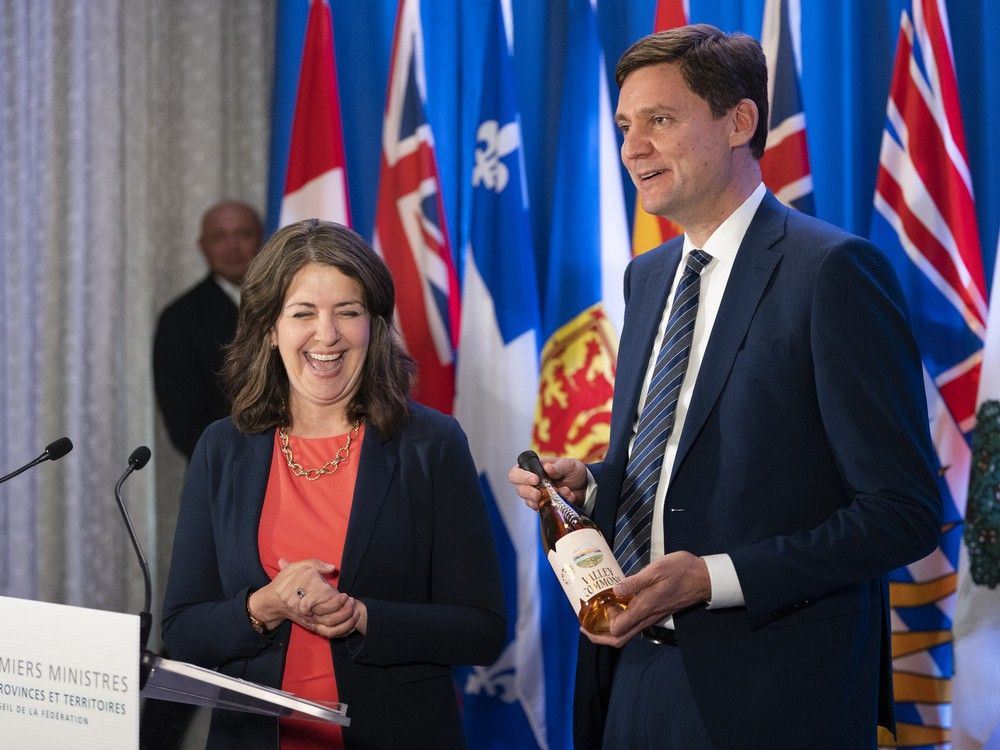
British Columbia Premier David Eby, right, gifts a bottle of B.C. wine to Alberta Premier Danielle Smith while speaking to reporters at the Council of the Federation meetings in Halifax on Tuesday, July 16, 2024.

OTTAWA — The mayor of northern British Columbia’s

busiest port city

says he’s following Premier David Eby’s lead in taking

a wait-and-see approach

to rebooting the cancelled Northern Gateway Pipeline project.

Prince Rupert Mayor Herb Pond told the National Post on Friday that he’s reserving judgment until he sees a new proposal on the table.

“I’m a little bit (more) with Premier Eby… Until there’s a project and a proponent, we’re not going to spend much time on it,” said Pond.

“It’s so hard to have a discussion about an imaginary project.”

Alberta Premier Danielle Smith has pushed heavily for a

revival of the shelved pipeline

, which would have shipped up to

525,000 barrels of Alberta oil

per day through nearby Kitimat, B.C., and ultimately to markets in the Asia-Pacific region via tanker.

Smith has said that

the revamped North Coast pipeline should end at the Port of Prince Rupert, citing its close proximity to potential buyers in markets like Japan and South Korea.

She’s also said that shipping Alberta oil through northern B.C. is one of the best things Canada can do to reduce its economic dependency on top trading partner the United States.

But Eby says that Smith is getting ahead of herself with no entity, public or private, coming forward yet to lead the project.

“There’s no proponent, there’s no money, there’s no project right now,”

Eby said this week

during a trade visit Seoul, South Korea.

Pond says he agrees with Smith that Prince Rupert is the most logical destination for a new pipeline carrying Alberta oil to the Pacific Ocean.

“If (technical dimensions) were the only thing you were scoring it on… Rupert would score the highest,” said Pond.

“Prince Rupert is a very deep natural harbour, doesn’t need to be dredged (and) we’re not moving through a congested traffic area (like) Vancouver.”

But he added that a new oil pipeline wouldn’t make or break Prince Rupert economically, and may not be worth the risk of an oil spill in the sensitive marine ecosystem.

Pond said that, like Eby, he supports the federal moratorium

on oil tanker traffic

along B.C.’s northern coast.

“There are values around

the Great Bear Rainforest

and the environment on the North Coast being as pristine as it is,” said Pond.

Residents of Kitimat

voted against Northern Gateway

by a margin of 58.4 per cent to 41.6 per cent in a non-binding 2014 plebiscite.

Pond says he’d support any new oil pipeline project being put to the people of Prince Rupert in a similar manner.

“When you get to that place, a plebiscite may be one of the things that we want to consider in terms of gauging the community’s voice,” said Pond.

Pond

said earlier this week

that B.C. “owes” Alberta a fair hearing on the question of a new West Coast heavy oil pipeline.

“I think we owe it… to our neighbours, our fellow Canadians, to at least examine it very, very seriously.”

National Post

rmohamed@postmedia.com

Get more deep-dive National Post political coverage and analysis in your inbox with the Political Hack newsletter, where Ottawa bureau chief Stuart Thomson and political analyst Tasha Kheiriddin get at what’s really going on behind the scenes on Parliament Hill every Wednesday and Friday, exclusively for subscribers. Sign up here.

Our website is the place for the latest breaking news, exclusive scoops, longreads and provocative commentary. Please bookmark nationalpost.com and sign up for our daily newsletter, Posted, here.


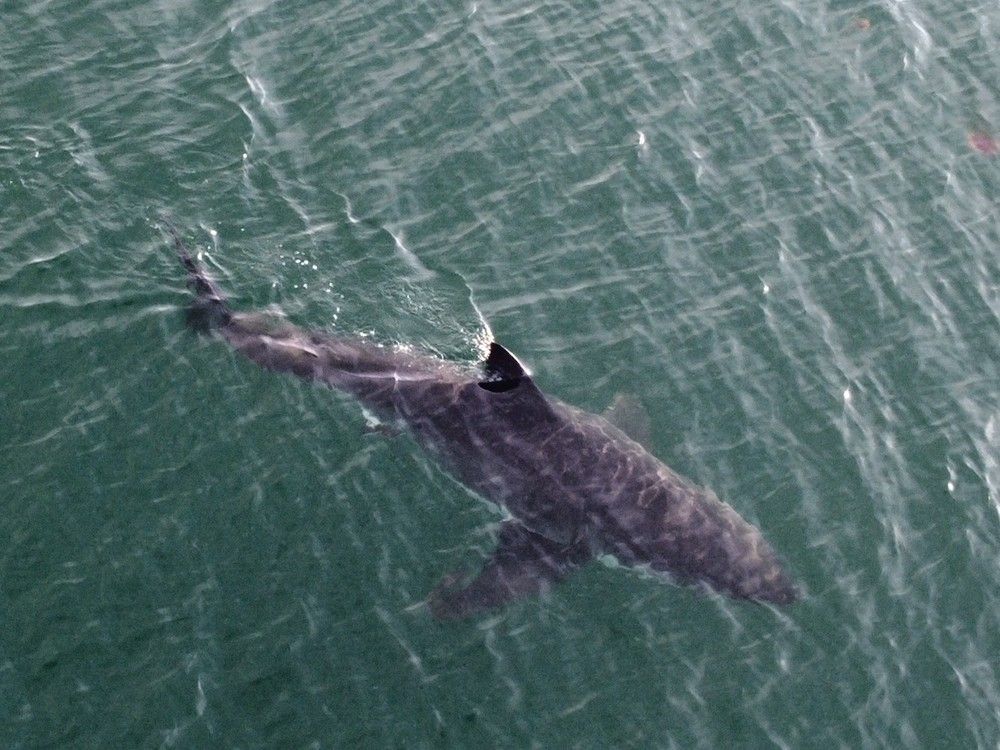
A drone shot of a great white shark shot by Halifax eye surgeon Alex de Saint Sardos at his cottage in Green Bay, N.S.

Amid signs that the North Atlantic’s great white shark population is growing, popular Cape Cod beaches are using technology to warn swimmers and surfers when it’s time to get out of the water.

And while Nova Scotia is only 265 nautical miles away from Boston, as the shark swims, beachgoers in Canada’s ocean playground have no such protections.

“We are able to detect tagged sharks — sharks that are carrying acoustic transmitters — and those transmitters are emitting a very high frequency sound that’s detected by an array of acoustic receivers that we have set up around some of the more popular swimming beaches,” said Greg Skomal, a senior fisheries biologist with the Massachusetts division of marine fisheries and director of the state’s shark research program.

“Any time one of those tagged sharks is detected by one of those receivers, it issues a notification through cell phone to the respective public safety officials for that beach.”

Lifeguards get immediate warnings about the shark’s nearby presence, he said. They could then put up flags, close the beach for an hour, or use other methods to pull people out of the water, Skomal said, noting anyone using Cape Cod’s beaches can get the same white shark warnings sent straight to their phone through the free app called sharktivity.

“We think it’s a great warning system, but more so, really, an educational system for the public safety officials because we have to fully acknowledge that not all the sharks are tagged,” Skomal said in an interview from Tortola, in the British Virgin Islands, where he has been tagging sharks in recent weeks.

“We don’t want people to have this false sense of security if they’re not getting a notification.”

Cape Cod — where scientists see a high density of white sharks — has seen three incidents of sharks biting humans since 2012, one of which was fatal in September 2018.

“We’ve (also) had a couple of incidents where a paddle board or a kayak was bitten, but the individual was not,” Skomal said.

Nova Scotia saw a white shark bite a young woman who jumped off a boat near Cape Breton’s Margaree Island in August of 2021. A duck hunter also lost his dog to a shark bite off Port Medway in 2023.

“Nova Scotia is interesting; it has lots of white sharks visiting,” said Skomal, who has tagged sharks in waters around the province.

“We just published a paper that shows the increase in the number of white sharks visiting Nova Scotia and Canada over the last ten years,” he said. “It’s at least a two-fold increase.”

Scientists believe the white shark population is rebounding due to conservation measures that reduced the number of them killed as bycatch in other fisheries, and an abundance of grey seals — their favourite prey — now that people no longer hunt them.

There are acoustic receivers throughout Canadian waters, including “the entire Bay of Fundy” and all the way up to the Gulf of St. Lawrence and Newfoundland, Skomal said.

The organization Ocearch has a free tracking app that shows users where white sharks have surfaced recently. But that doesn’t offer real-time warnings.

“If people are worried about a particular beach, just do a little homework,” Skomal said. “See if there’s been white shark detections in the area. Know your own strengths and weaknesses in the water. Look for seals — that’s a sign of white shark activity — or could be.”

Should Nova Scotia be following suit and setting up shark warning systems that could deliver immediate notice of a tagged shark’s presence, like the ones on Cape Cod?

“It’s certainly something to consider,” Skomal said. “You guys need to understand where those hotspots are.”

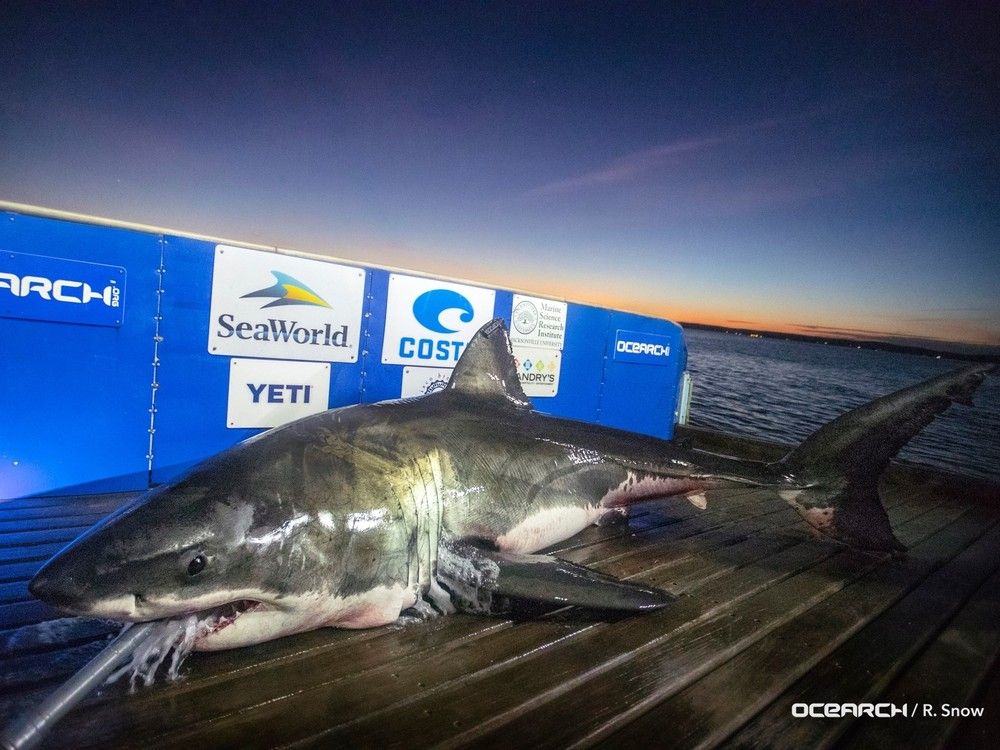
 Luna, short for Lunenburg, is a 15-foot, 2,137-pound great white shark tagged by Ocearch in 2018 off the coast of Nova Scotia.

But Fred Whoriskey, an adjunct marine biology professor at Dalhousie University and the former head of Canada’s Ocean Tracking Network, doesn’t think Nova Scotia’s beaches need real-time shark warning systems.

“We haven’t perceived a need yet,” Whoriskey said in a telephone interview from Traverse City, Michigan, where he’s attending a conference on fish telemetry.

“We have no indication the sharks are concentrating around the beaches in the same way that they do in Cape Cod. The big difference that you have down there is on Cape Cod you have a colony of better than 10,000 seals that have set themselves up in the prime beach areas — the swimming areas for the tourists — and that’s what’s attracted the sharks into those particular zones.”

While seals occasionally make their way to Nova Scotia beaches, they tend to prefer isolated offshore islands, he said.

“If they haven’t got food, the sharks don’t concentrate there,” Whoriskey said.

About 800 white sharks have cruised through the Cape Cod area over the past four years, he said.

“We know that we’ve been detecting at least 100 tagged white sharks crossing through Nova Scotia waters on kind of an annual basis,” Whoriskey said. “We’re assuming that there are probably more than that out there, but how many more, it’s purely speculative at this point in time.”

The live detection systems that listen for tagged sharks are expensive, Whoriskey said. “It’s $10,000-20,000 a year per live buoy to maintain it,” he said, noting one can detect tagged sharks a kilometre away.

Nova Scotia should consider live shark monitoring for its beaches, said Nigel Hussey, an associate professor of biology at the University of Windsor.

There’s “a very small chance” someone will get bitten by a shark at one of the province’s beaches, Hussey said in a telephone interview from Big Tancook Island, in Nova Scotia’s Mahone Bay, where he’s in the process of setting up a shark research station.

Live shark warnings would minimize the potential for “that very tiny risk of a human-shark conflict,” he said.

“Often the nature of public spending and government spending is they don’t react until something happens,” Hussey said.

“But perhaps what happened in Cape Cod sets a good example where they learned that lesson that Nova Scotia could take on board…. We should be proactive in terms of what we’re doing.”

Nova Scotia installed shark warning signs at about a dozen beaches last summer.

“There really has never been a shark attack on any of our beaches,” said Paul D’Eon, who heads the Nova Scotia Lifeguard Service.

Still, he’s interested in learning more about real-time shark warnings.

“Is it going to save lives?” D’Eon said. “Certainly, we would look at that.”

However, he stressed the likelihood of a shark attack at one of the province’s 23 guarded ocean beaches is unlikely. “Way more people are killed on their way driving to the beach than while at the beach,” D’Eon said. “The numbers are extremely remote as to the risk of being attacked by a shark in Nova Scotia at this point.”

His first summer as a lifeguard was 1975, the year Jaws came out.

“I experienced first-hand the paranoia,” D’Eon said. “People wouldn’t go up to their knees (in the ocean) for fear of being attacked by sharks. And it’s ongoing — every summer in mid-swimming season, what comes on (the Discovery Channel)? Shark Week — and people get more terrified.”

Our website is the place for the latest breaking news, exclusive scoops, longreads and provocative commentary. Please bookmark nationalpost.com and sign up for our daily newsletter, Posted, here.


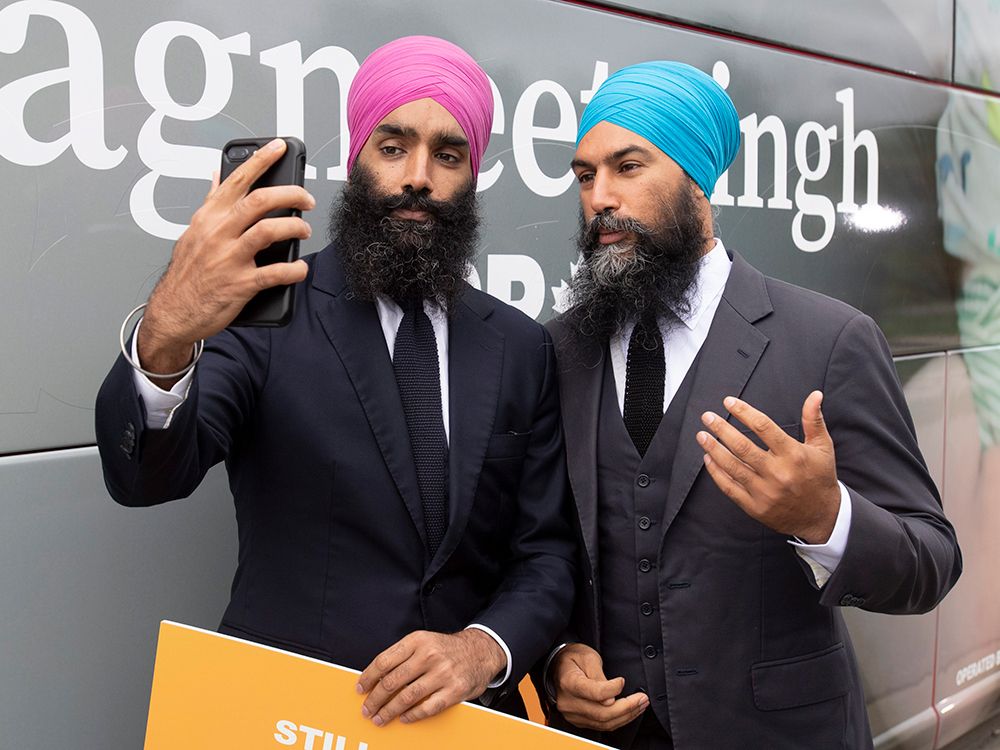
Jagmeet Singh, right, with his brother Gurratan Singh in 2019.

OTTAWA — The brother of former federal NDP leader Jagmeet Singh says Canadians who receive a duty to warn about a threat against their life and safety should be provided protection, calling the lack of security “unacceptable.”

Gurratan Singh says the need for protection is “paramount” and that the current situation results in people being left to “fend for themselves.”

“It’s unacceptable and an immediate step that must be given is security must be provided to those who are facing duty to warns from, especially, foreign governments.”

“I think any single Canadian who gets a duty to warn deserves that security immediately.”

Issues surrounding a duty to warn notification, a practice used by police to alert someone when it believes there to be a credible threat endangering them, have emerged in light of India’s Prime Minister Narendra Modi’s upcoming visit to attend the G7 in Alberta next week.

Sikh activists and community leaders have denounced Prime Minister Mark Carney’s invitation to Modi as a betrayal of their community.

They have pointed to the RCMP having said it has evidence showing links between violent crimes, such as murders and extortion, to the Indian government.

Former prime minister Justin Trudeau also told the House of Commons in September 2023 that it had “credible allegations” that agents acting on behalf of the Indian government were involved in the killing of prominent Sikh separatist and activist Hardeep Singh Nijjar.

India has denied the accusation, but had considered Nijjar, who advocated for an independent Sikh state to be created in India’s Punjab province, to be a terrorist.

Earlier on Thursday, Global News also reported, citing unnamed sources, that former NDP leader Jagmeet Singh had been surveilled by someone with ties to the Indian government, which resulted in the RCMP providing him protection.

During the recent federal election campaign, Singh himself revealed that the RCMP warned him about a credible threat against his life in late 2023, which resulted in him and his family being placed under police protection.

At the time, Singh’s wife was pregnant with their second child, and the former party leader told reporters he was so concerned about the threat that he considered quitting politics.

For Gurratan Singh, himself a former provincial member of Ontario’s legislature, what happened to his brother underscores the need for Canada to hold India accountable for its targeting of Canadians, which the RCMP has stated has been shown by evidence.

“My brother was the previously democratically elected leader of the NDP, a national federal party in Canada. We now know that there’s evidence that he was being surveilled by the Indian government, that his life was at risk by the Indian government and that the risk was so live that his daughter was born under the shadow of that risk in a hospital that had RCMP and security presence,” he said on Thursday.

He said the impact of his brother receiving that notification was tough, as was seeing him accompanied by police detail

“It represents that your brother’s life is at risk and those around him are at risk as well.”

Balpreet Singh, legal counsel and spokesman for the World Sikh Organization, in a news conference on Thursday, called it “unacceptable” that Jagmeet Singh now lacks this protection and that others who receive similar warnings from police are not provided security and receive minimal information.

NDP Edmonton MP Heather McPherson told reporters she believes security should be offered to Singh. Interim NDP Leader Don Davies declined to comment on the matter, saying he was unsure of the specific details.

Monninder Singh, spokesman for Sikh Federation Canada, says he has received multiple duty-to-warn notifications, as have “well over” a dozen other Sikh Canadians and activists.

As a father of young children, he said their family had to come up with a plan that included discussions with child and family services. At one point, Singh said he left their home and returned after five months.

“You move around constantly looking over your shoulder,” he said. “Every aspect of your life changes. You can’t go to your kids’ school. You can’t go to their practices. You can’t go to family events. You avoid weddings, you avoid any type of family gatherings, public spaces.”

National Post

staylor@postmedia.com

Get more deep-dive National Post political coverage and analysis in your inbox with the Political Hack newsletter, where Ottawa bureau chief Stuart Thomson and political analyst Tasha Kheiriddin get at what’s really going on behind the scenes on Parliament Hill every Wednesday and Friday, exclusively for subscribers. Sign up here.

Our website is the place for the latest breaking news, exclusive scoops, longreads and provocative commentary. Please bookmark nationalpost.com and sign up for our politics newsletter, First Reading, here.


“What’s happening in TMU is a microcosm of what’s happening everywhere else. Canada is not a safe place. TMU is not a safe place for Jewish students,” says a recently retired TMU professor.

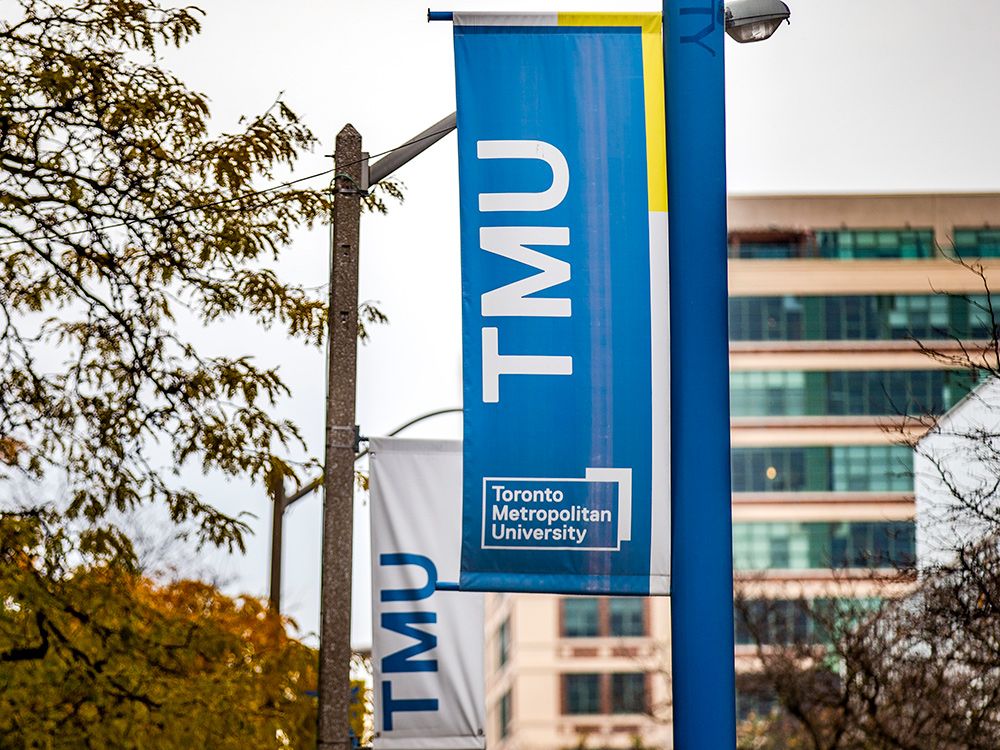
Hillel Ontario is calling on Toronto Metropolitan University to investigate Maher El-Masri, a recently appointed interim associate dean, because the group says he has “repeatedly engaged with and spread extreme, antisemitic, and deeply polarizing content on his social media account.”

Hillel Ontario, a Jewish student organization with a presence on nine campuses across the province, including TMU, sent an

action alert

last Thursday alongside several screenshots of social media posts from an account Hillel says belongs to El-Masri. The

X account

is under El-Masri’s name and the biography describes the user as the “son of (a) Nakba survivor,” referring to Palestinian refugees from the 1948 Arab-Israeli War. The account states that the user is in Ontario, has a Palestinian flag for its profile picture and a background quote claiming “humanity is failing the Palestine test.”

One message Hillel highlighted from the account concerned a post about Noa Marciano, an Israeli intelligence soldier abducted by Hamas on Oct. 7, 2023, during its invasion of Israel. Marciano later died in captivity. “This is what is so scary about people like her,” the TMU professor wrote beneath a graduation photo of Marciano, which claimed she was killed in an Israeli airstrike. “They look so normal and innocent, but they hide monstrous killers in their sick, brainwashed minds.”

Marciano’s friend,

Ori Megidish

— another hostage rescued by Israeli forces in late October 2023 — said she was killed by a doctor in al-Shifa hospital. Her parents

said

the same thing in subsequent interviews.

“I hate everyone who directly or indirectly caused this indignity to the most honorable and most dignified people on Earth,” an undated post flagged by Hillel reads alongside broken heart emojis, an apparent reference to the conflict in Gaza. In December 2023, El-Masri was interviewed by

CBC

for a story about his brother, who he said was killed by Israeli forces in Gaza while searching for food.

El-Masri has continued to post about the conflict on the X account, which remains open to the public. “Israel is a baby killer state. It always has been,” he

wrote

on June 6, a day after the Hillel notice.

Some of his posts compare Israel to Nazi Germany, a comparison deemed antisemitic by the

International Holocaust Remembrance Alliance

(IHRA).

On May 7, 2025, El-Masri

commented

on a photo of a proposed humanitarian zone in Gaza. “The irony of history: The last time such a concentration camp was erected, it was by the Nazis!”

El-Masri returns to the point repeatedly throughout his social media feed.

“How could a people who have endured the worst human persecution in the holocaust carry this deep hate and inflict unimaginable pain on a nother (sic) people who, in fact, had nothing to do with the holocaust!!!!” he wrote last June.

“When the victims of the holocaust call for a holocaust,” El-Masri

wrote

in early May 2025.

He has also downplayed the role of Hamas in the conflict on several occasions. “This is NOT a war against Hamas. This is a genocidal war against the very existence of the Palestinian people,” he wrote in August 2024. In May 2025, he argued that “‘Hamas’ is the zionists’ code word to dehumanize the Palestinian people.”

National Post reached out to El-Masri for comment but the professor responded with an email ordering the Post not to contact him anymore.

He described the allegations around the content of his social media account as a “smear campaign.”

Liat Schwartz, a Jewish TMU student in the same department as El-Masri, called his online statements alarming, “especially since I’m openly Jewish.” Schwartz, the president of a pro-Israel group on campus, called on university leaders to protect “the well-being of Jewish and Israeli students,” saying El-Masri’s presence “makes me feel profoundly unsafe and unheard within my own faculty.”

Hillel Ontario called on TMU to rescind El-Masri’s appointment as interim dean.

“TMU’s decision to promote Dr. El-Masri, despite his extensive history of promoting antisemitic and extremist content, is egregious,” Jay Solomon, the group’s chief advancement officer, told the Post in a written statement. “Those in leadership positions must be held to the absolute highest standard, and ensure that all students — including Jews and Israelis — feel supported. This appointment sends exactly the opposite message. TMU must act swiftly in removing El-Masri and alter their process to ensure this doesn’t happen again.”

University spokesperson Jessica Leach underscored the personal impact the ongoing conflict was having on members of the university community but said that El-Masiri’s “posts do not reflect the position of the university.”

“The posts are his personal views as a faculty member, with no mention of or affiliation with TMU. The university is reviewing this matter,” she said in a written statement encouraging university members “to be respectful, collegial, and empathetic.”

Leach initially challenged Hillel’s press release, claiming the organization was mistaken and El-Masiri was not a dean. When asked if El-Masiri had ever held the position of dean, interim or otherwise, Leach wrote the Post that he had not. Her response was contradicted by Hillel, who shared with the Post an email sent in early June apparently from the Faculty of Community Services dean announcing El-Masiri’s appointment.

“Dr. El-Masri has a demonstrated track record of excellence in teaching, research and service, and he is widely respected for his enormous engagement with health care systems in Toronto, across Ontario, and even globally,” the email says.

TMU later followed up with a statement confirming that El-Masri has been appointed an assistant dean, but he has not yet assumed the post.

“His appointment as interim-acting Assistant Dean is not effective until July 1. Until that time, Dr. El-Masri is the director of the school of nursing, a faculty-level position. Directors within faculties, such as Dr. El-Masri’s position, are not administrators. They are full members of the Toronto Metropolitan Faculty Association (TFA),” the statement says.

El-Masri is

scheduled

to be the convocation speaker for the Faculty of Community Services graduation event on June 18.

Steven Tissenbaum, a recently retired TMU business professor, said the university’s failure to properly deal with allegations of antisemitism has coloured life at the downtown Toronto campus since the October 7 massacre. He called the administration’s failure to discipline

dozens of law students

who signed a letter defending “all forms of Palestinian resistance” days after the Hamas atrocities “the real defining moment” for him.

“Jewish professors at large recognize that TMU is not a place to be,” Tissenbaum told the Post, explaining this realization is spreading to Jewish students and families as well. Two other academics from TMU reiterated Tissenbaum’s point but wished to remain anonymous because they are still actively teaching at TMU.

“I am writing to let you know that it is worse for faculty and staff,” one tenured academic, who wished to remain anonymous, wrote the Post after an

earlier story

chronicling the harassment Schwartz and other Jewish students experienced on campus was published. “Faculty who are demonstrably Jewish have been attacked, harassed, and threatened, and some have even resigned.”

Tissenbaum taught at TMU for nearly three decades and said the university has grown increasingly insensitive to the concerns of Jewish academics and students. He was particularly alarmed by the university’s faculty association passing a motion in May

recognizing

anti-Palestinian racism (a new term which

advocates

for the dismantling of the IHRA working definition of antisemitism) at a time of increased Jew hatred.

“The undercurrents of antisemitism have been there,” he said, recalling a time in the nineties when someone drew a swastika on his desk. When he raised the incident during a university diversity and equity session, Tissenbaum says he “was ghosted” and that no one responded to his concerns. “It’s always been there, but what’s happened since October 7 is that it provided a spark for people to be outwardly aggressive with their antisemitism.”

Tissenbaum decided to retire early from TMU. He stepped away in August 2024.

“I retired primarily due to the increased antisemitism being experienced on campus due to the lack of administrative support from the president down,” he wrote the Post.

Although Tissenbaum said he did not feel physically threatened on campus, he believes the treatment Jewish students have endured in recent years is not conducive to a healthy learning atmosphere. The entrepreneurship professor sees TMU’s troubles since the October 7 terrorist attacks as part of a broader national malaise.

“What’s happening in TMU is a microcosm of what’s happening everywhere else. Canada is not a safe place,” he said. “TMU is not a safe place for Jewish students. It’s not a future.”


Minister of Energy and Natural Resources Tim Hodgson arrives for a meeting of the federal cabinet in West Block on Parliament Hill in Ottawa on Wednesday, May 14, 2025.

OTTAWA — Prime Minister Mark Carney’s government is coming under fire for its plan to push its internal trade and major projects bill through the House of Commons next week at high speed.

Government House leader Steven MacKinnon has put a motion on notice that would push Bill C-5 through the House of Commons by the end of next week at an unusually rapid pace — leaving only a few hours to hear from civil society groups, stakeholders and experts.

If the motion is adopted, it would quickly move through debate at second reading stage and a vote, after which the bill would be referred to a House of Commons committee.

Members of the committee would meet Tuesday and Wednesday to gather evidence from witnesses, before undertaking a clause-by-clause consideration of the legislation.

The expectation would be for the committee’s report to be presented to the House on Thursday, and debate and a vote at third reading to happen on Friday — which is the last calendar day before all MPs will be going back to their respective ridings for the summer.

C-5 would grant the government sweeping powers to quickly approve major natural resource and infrastructure projects once cabinet deems them to be in the national interest.

The legislation also looks to break down internal trade barriers and make it easier for workers to take jobs in other provinces.

MacKinnon

rejected a call from the Bloc Québécois

this week to split the landmark legislation in two — so the House could speed through the less contentious internal-trade provisions while putting the controversial major projects portion under the microscope.

Luc Berthold, the deputy House leader for the Conservatives, declined to say if his party would support the fast-tracking of C-5 and said discussions between all parties were ongoing.

“When a minority government decides it wants certain things, it needs to negotiate with all parties. So, we’re awaiting the result of these negotiations,” he said on Thursday.

Bloc Leader Yves-François Blanchet said his party would oppose the motion “with vigour.”

“The kind of impetuosity from the prime minister to supercharge the legislative agenda in the short term and to bypass, from the very start of his mandate, the usual parliamentary rules are a matter of concern,” said Blanchet in French during a press conference.

“I would respectfully suggest that Mr. Carney’s entourage inform him that one is not supposed to work in such a cavalier manner when facing a Parliament fresh from the oven,” he added.

NDP MP Leah Gazan also expressed concern with the rapid pace at which the bill will be studied and what she said is a “clear violation” of Indigenous peoples’ modern treaties.

“I understand the need to respond quickly to the threats coming from the States, but the bill that’s being proposed by Prime Minister Carney isn’t in fact going to build the economy. It’s going to wind up having different economic initiatives ending up in the courts.”

Gazan said she is calling on the prime minister to “slow down” the legislative process.

Pressed on the subject during a press conference on wildfires, Natural Resources Minister Tim Hodgson defended the urgency with which the government is moving forward with it.

“I think the prime minister has been clear: we are in a trade war. We need to move as quickly as possible. Canadians are losing their jobs today,” he said.

Hodgson said the bill will create employment opportunities for people who are facing the prospect of losing their jobs and stimulate the economy during the ongoing trade war.

Asked by National Post why the government cannot wait until the fall to pass C-5 in order to properly consult with stakeholders and Indigenous peoples, Hodgson did not mince words.

“You should ask that to all the auto workers who are losing their jobs, to all the aluminum workers who are losing their jobs, to all the steel workers who are losing their jobs, to all the forestry products, people in small towns across the country who are losing their jobs.”

“Every day, our economy is being attacked. Every day, we are losing jobs. We need to fight for those people. We need to move,” he insisted.

For its part, the Senate adopted a motion on Thursday to conduct a pre-study of C-5 from Monday to Wednesday next week. The Senate will hear from ministers Chrystia Freeland, Dominic LeBlanc and Rebecca Alty, as well as a host of other witnesses on the bill.

The Senate has also agreed to speed up debate and votes, after C-5 is sent to the upper chamber, and ensures a final vote take place on Friday, June 27, at the latest.

Carney, who has vowed repeatedly to eliminate interprovincial trade barriers by Canada Day, would therefore fulfill his promise.

National Post,

with files from the Canadian Press

calevesque@postmedia.com

Get more deep-dive National Post political coverage and analysis in your inbox with the Political Hack newsletter, where Ottawa bureau chief Stuart Thomson and political analyst Tasha Kheiriddin get at what’s really going on behind the scenes on Parliament Hill every Wednesday and Friday, exclusively for subscribers. Sign up here.

Our website is the place for the latest breaking news, exclusive scoops, longreads and provocative commentary. Please bookmark nationalpost.com and sign up for our newsletters here.