LP_468x60
on-the-record-468x60-white

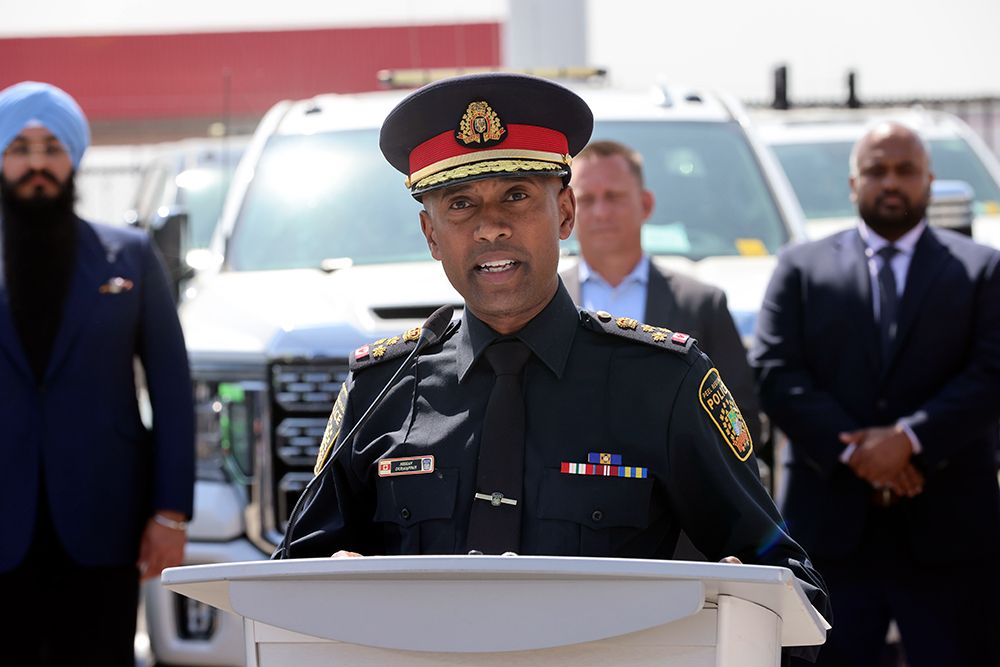
Peel Regional Police Chief Nishan Duraiappah speaks about Project Outsource, an investigation that targeted the tow truck industry in Brampton and Mississauga, Monday June 16, 2025. In total 18 people were arrested with 97 charges.

Another police probe in southern Ontario connected a violent crime wave to the tow truck industry, this time a large criminal network accused of extortion, fraud, shootings and arson.

Peel Regional Police said more than $4.2 million in assets were seized and 18 people were arrested, including two men alleged to be the bosses behind a network involved in two streams of criminality: one dedicated to extortion and violence, and the other to systematic fraud through staged car collisions rooted in the towing industry.

Of the 18 charged, almost half were already on a form of judicial release for previous charges at the time of their arrest.

Since their most recent arrest, three of the 18 were quickly released with an order to attend court at a later date. Of the 15 who were held in police custody pending a court appearance, seven have had that hearing, where all but one was released on bail. The remainder await a court hearing.

In 2023 a wave of violent extortions — demands for large sums of money accompanied by threats of violence — targeted members of the South Asian business community in Peel, west and northwest of Toronto encompassing the cities of Mississauga and Brampton.

“These threats escalated into a variety of different offences including drive-by shootings, arson, a variety of acts of violence that spread fear and insecurity, not just into our local community but it gripped international news,” said Peel’s Chief of Police Nishan Duraiappah.
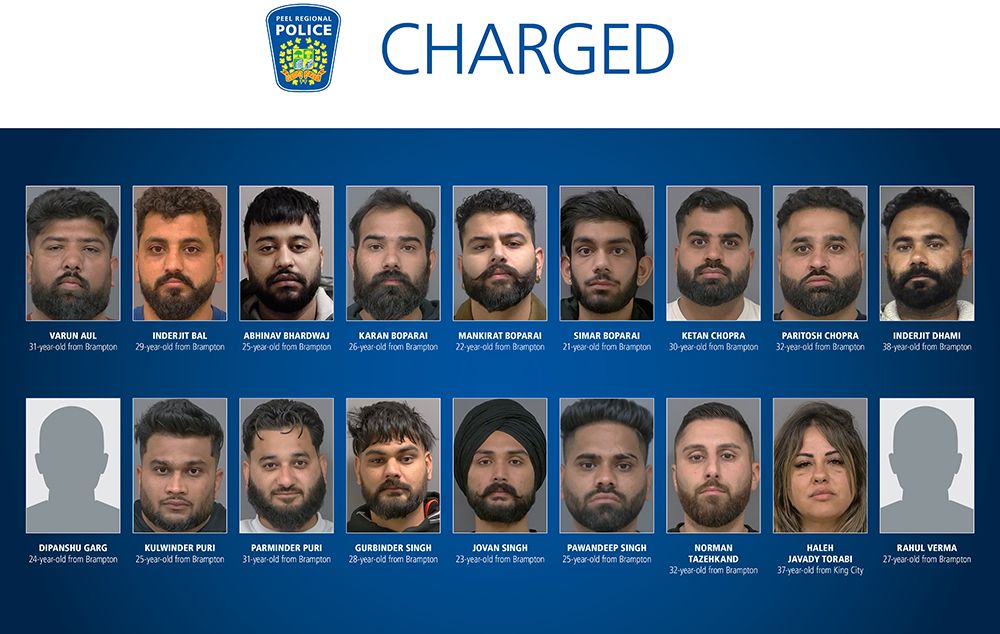
 Police in Peel Region released phots of the alleged leaders and underlings of a violent crime network behind extortions targeting the South Asian community and frauds linked to the tow truck industry.

Patrick Brown, mayor of Brampton, said the extortions and violence terrified his community.

“Everyone was scared. They heard about these incidents and there was a real concern that we were only hearing the tip of the iceberg, that there’s more and more of these very dangerous extortions happening.”

The police response led to a task force formed last summer that led to a large probe named Project Outsource.

The investigation pointed to two Brampton men who are now under arrested. Investigators allege Inderjit Dhami, 38, and Paritosh Chopra, 32, were at the top of the criminal organization’s hierarchy.

“They are charged with instructing the commission of an offense for a criminal organization,” said Peel’s Deputy Chief Nick Milinovich. “What that means is they were in charge of this organization and providing direction to others that were a part of it,” he alleged. “This was a crime group who attempted to extort hundreds of thousands of dollars from our community with threats and also engaged in tow industry related violence and crimes like fraud.”

A police parking lot packed with items seized during the investigation, raids and arrests — 18 tow trucks, six guns, a crossbow, 586 rounds of ammunition, cash, a stun gun, baseball bats and a ballistic vest with a “POLICE” logo on it — suggested the violence or potential violence involved.

“We have substantial evidence linking the group to dozens of staged accidents and potentially costing insurance companies between $80,000 and $100,000 for each staged accident. In total those fraudulent claims exceed a million dollars for this particular investigationm” Milinovich said.

“To our community members, if you receive a demand for money under violence do not pay. Call the police immediately. We are committed to protecting your identity and your safety,” he said.
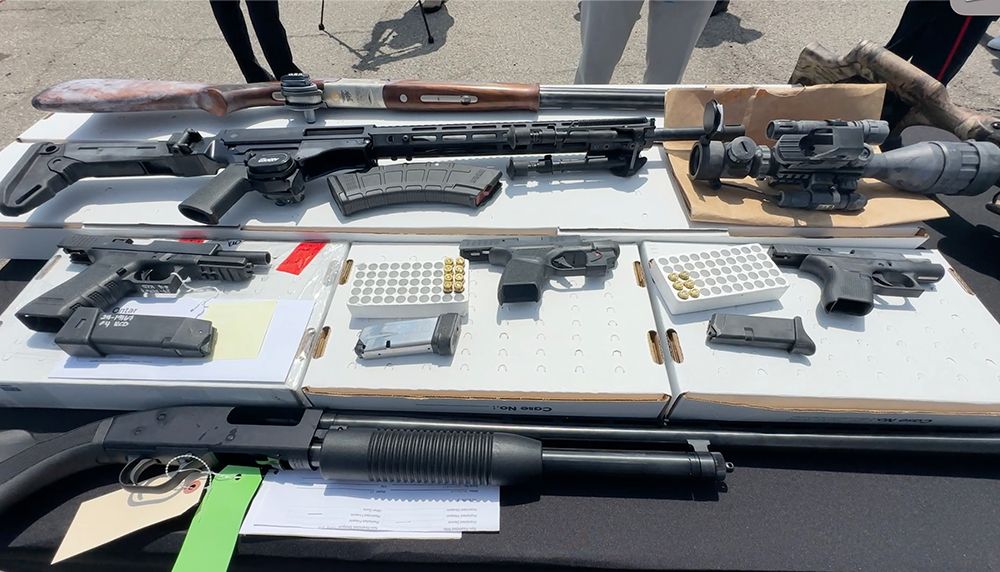
 Some of the weapons seized during Project Outsource on display.

Acting Detective Sergeant Brian Lorette, the primary investigator in Project Outsource, said the 18 tow trucks seized, valued at $2.8 million, were found to be associated with two towing companies, operating under the names Certified Roadside and Humble Roadside.

Four personal vehicles, valued at $840,000, were seized and five stolen vehicles recovered.

Lorette said the investigation is still ongoing, and he anticipates further arrests and charges. The guns are being examined both to trace their source and also for potential use in other crimes. One gun has already been linked to a shooting. A ballistic vest bearing a police logo was seized from one of the accused, he said. Police are investigating its authenticity and whether it came from a police service.

All but one of the accused is a male living in Brampton. One woman was arrested, who lived in King City, north of Toronto. Like their victims, almost all of those arrested are from the South Asian community.

The announcement was used by federal and provincial politicians to promote their crime reduction policies and promises.

Ruby Sahota, federal secretary of state of combating crime in Prime Minister Mark Carney’s new cabinet, was bullish on the Liberal’s crackdown.

“This is not just an investigation, it’s a turning point,” she said, calling the Peel announcement “a warning to organized crime that we will not stop here. Our new government is going to provide law enforcement with even more tools to take down organized crime.

“When law enforcement does great work like they have today through Project Outsource, we need to make sure that it’s met with a bail and sentencing system that fits the nature of these crimes.”
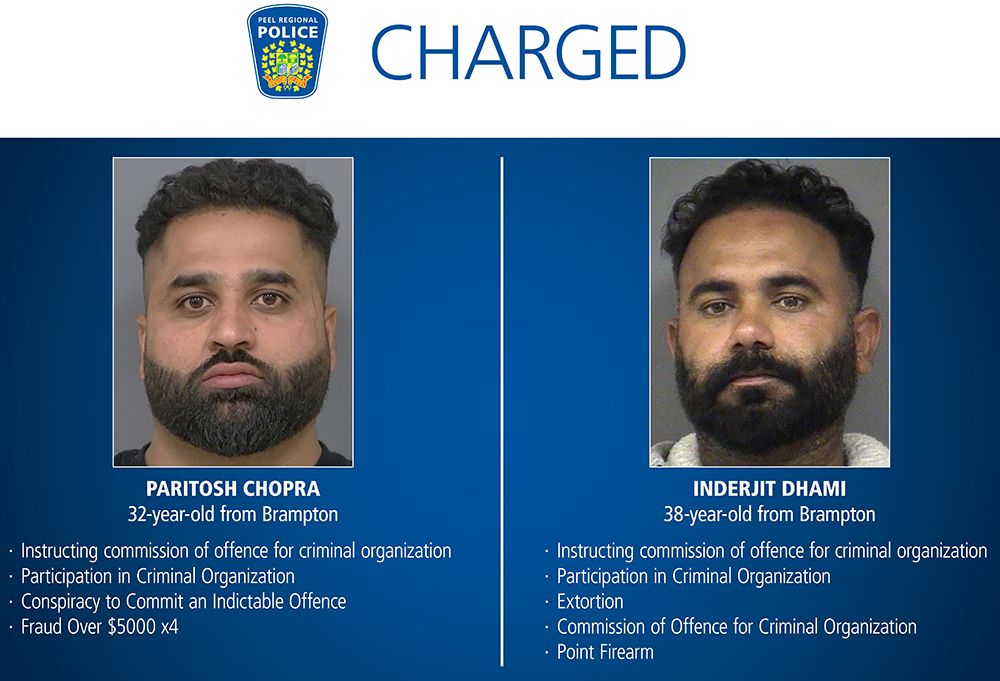
 Investigators allege Paritosh Chopra, 32, and Inderjit Dhami, 38, were at the top of the criminal organization’s hierarchy.

Silvia Gualtieri, Ontario’s parliamentary assistant to the solicitor general, said public safety is an Ontario government priority.

“There has never been a government more focused on public safety than the one under the leadership of Premier Ford. Thanks to his leadership, Ontarians can wake up, go to work, and return home knowing their safety is a top priority every single day.”

A violent turf war over tow trucking business and ancillary spin offs, such as auto repairs, insurance payments, and medical and therapy bills, has been hitting the Greater Toronto Area with shootings and arsons for several years.

Earlier this month, Toronto police announced that a shocking mass shooting inside a Toronto pub in March was linked to an ongoing tow truck turf war that included other shootings and a robbery. Toronto police charged 11 people in their probe.

• Email: ahumphreys@postmedia.com | Twitter:

Our website is the place for the latest breaking news, exclusive scoops, longreads and provocative commentary. Please bookmark nationalpost.com and sign up for our newsletters here.
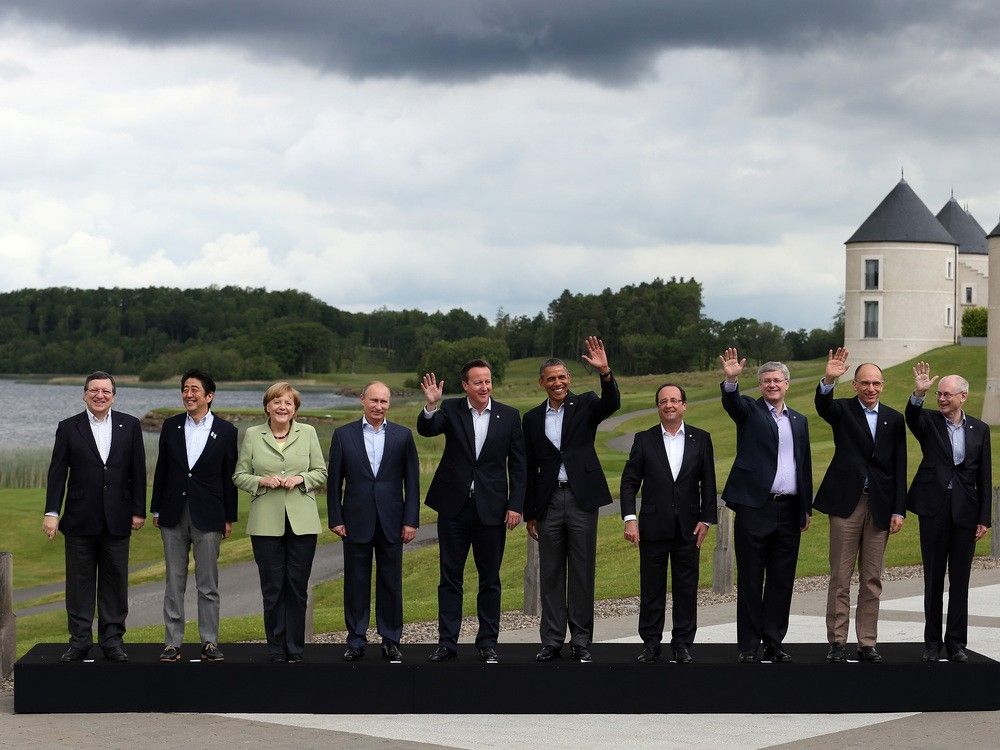
Leaders, including Russian President Vladimir Putin, fourth from left, stand for a group shot at the G8 venue in Enniskillen, Northern Ireland, on June 18, 2013.

BANFF — When world leaders gathered for the 70th anniversary of the D-Day landings, it was an awkward situation: Just months before, Vladimir Putin’s Russia had invaded Ukraine, annexing Crimea.

That invasion precipitated a diplomatic and military crisis that, more than 10 years later, is still unfolding. And in one of the earliest signs of the international community’s resistance to Russian belligerence, the leaders of the world’s advanced economies ejected Russia from the G8, in March of that year.

“Personally, and I only speak for Canada here, I don’t see any way of a return of Mr. Putin to the (G8) table unless Russia fundamentally changes course,” said then prime minister Stephen Harper at the time.

In fact, Putin had been slated to host world leaders in Sochi, Russia, in 2014, but the now seven-member summit regrouped and reorganized the event for Brussels, in Belgium. Since then, Russia has dramatically escalated its war on Ukraine, launching a full-scale invasion in February 2023.

John Kirton, the director of the G7 research group, said that in 2014 the sidelining of Russia was a “very big deal.”

“Russia, which had been a democratizing country — which is why it had become basically a full member of the G8 — was clearly turning back and in a very big, bold way, and even beyond that, that was a violation of the core membership criteria for being a G7 member, you have to be a democracy,” said Kirton.

Yet, on Monday morning, U.S. President Donald Trump, who’s widely perceived as friendly with the Russian strongman, lamented the ejection of Russia from what was then the G8 in remarks before reporters after meeting with Canadian Prime Minister Mark Carney.

“The G7 used to be the G8. Barack Obama and a person named Trudeau didn’t want to have Russia in, and I would say that that was a mistake, because I think you wouldn’t have a war right now if you had Russia in, and you wouldn’t have a war right now if Trump were president four years ago,” Trump said. “It was a mistake in that you spend so much time talking about Russia, and he’s no longer at the table, so it makes life more complicated, but you wouldn’t have had the war.”

The story of Russia leaving the G8 is more complicated than that, however. For starters, Justin Trudeau wasn’t prime minister in March 2014 — Harper was. And Harper was a bullish defender of Ukrainian sovereignty, becoming the first G7 leader to visit the embattled European nation

following Russia’s invasion

and famously telling Putin at a Group of 20 meeting in November 2014 that he should “get out of Ukraine.”

It was also not just Obama and the Canadian prime minister that condemned Russia’s invasion of Ukraine.

The Hague Declaration

, signed by the leaders of Canada, France, Germany, Italy, Japan, the United Kingdom, the United States, the president of the European Council and the president of the European Commission, jointly condemned “Russia’s illegal attempt to annex Crimea in contravention of international law and specific international obligations,” and announced the member nations of the G8 would not participate in the Sochi summit, effectively bringing that organization to an end.

Even as far back as 1997, when Russia officially joined the G8, not all members were enthusiastic about the country joining, Kirton said, being distrustful of Putin and his policy goals.

On Monday, Trump said that Putin, who was then — as now — president of Russia, was incensed by the ejection.

“He’s not a happy person about it. I can tell you that he basically doesn’t even speak to the people that threw him out, and I agree with him,” said Trump.

But, back in 2014, Russian Foreign Minister Sergey Lavrov said being kicked out hardly mattered.

“The G8 is an informal club, there is no formal membership in that club, so nobody can be expelled from that club by definition,” Lavrov said. “If our Western partners believe that this format has no more future, well so be it. We are not clinging to that format and we will not see it as a tragedy if it does not convene.”

Harper, at the time, responded: “I am not surprised at the kind of cavalier reaction of Putin and then to strut and shrug off any reaction. That is how he handles these things.”

Get more deep-dive National Post political coverage and analysis in your inbox with the Political Hack newsletter, where Ottawa bureau chief Stuart Thomson and political analyst Tasha Kheiriddin get at what’s really going on behind the scenes on Parliament Hill every Wednesday and Friday, exclusively for subscribers. Sign up here.

Our website is the place for the latest breaking news, exclusive scoops, longreads and provocative commentary. Please bookmark nationalpost.com and sign up for our newsletters here.

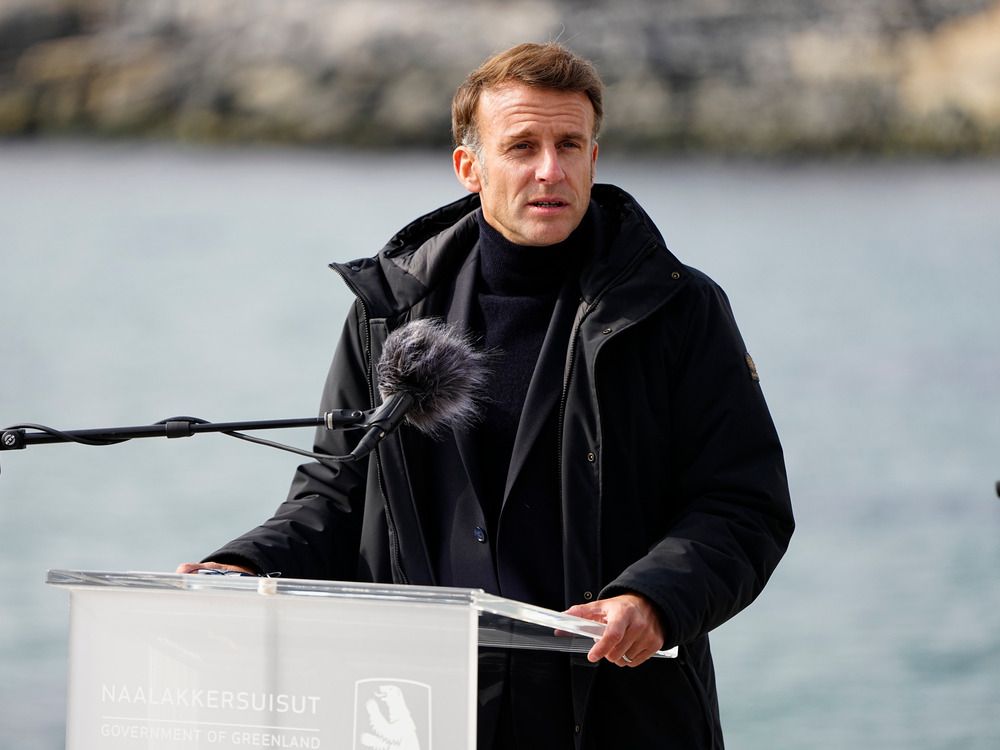
French President Emmanuel Macron speaks during a news conference in Nuuk, Greenland, Sunday, June 15, 2025.

French president Emmanuel Macron has come out strongly against U.S. President Donald Trump’s musings about annexing Greenland, making his comments during a stop in Denmark’s island territory ahead of the G7 meeting.

Macron paid a visit to Greenland on Sunday, on his way to the G7 conference in Kananaskis, Alta. He became the first foreign leader to visit the region since Trump’s recent talk of annexation, and was openly critical of those plans.

Reuters reports that

, when asked on his arrival about Trump’s ambitions, Macron said: “I don’t think that’s what allies do … it’s important that Denmark and the Europeans commit themselves to this territory, which has very high strategic stakes and whose territorial integrity must be respected.”

In a speech

that was received by cheers and applause from locals, Macron said: “Everybody thinks in France, in the European Union, that Greenland is not to be sold, not to be taken.” He added: “The situation in Greenland is clearly a wake-up call for all the Europeans. And let me tell you very directly that you are not alone.”

Referring to Greenland as a part of Europe, he said: “We know our common flag and we know our long-standing choices, and this is why it’s very important for French people and all the European people to convey very clearly this message of solidarity and the fact that we stand with you, now, for today, and for tomorrow.”

A source at the Élysée Palace told Reuters that Macron’s trip had a “dimension of European solidarity and one of strengthening sovereignty and territorial integrity,” without directly mentioning the Trump administration’s threats to purchase Greenland, or take it by force.

Additionally, the source said the French president’s six-hour visit would focus on Arctic security, climate change and Greenland’s economic development, and would include a tour of a glacier, a hydroelectric power station and a Danish warship moored near the territory’s capital, Nuuk.

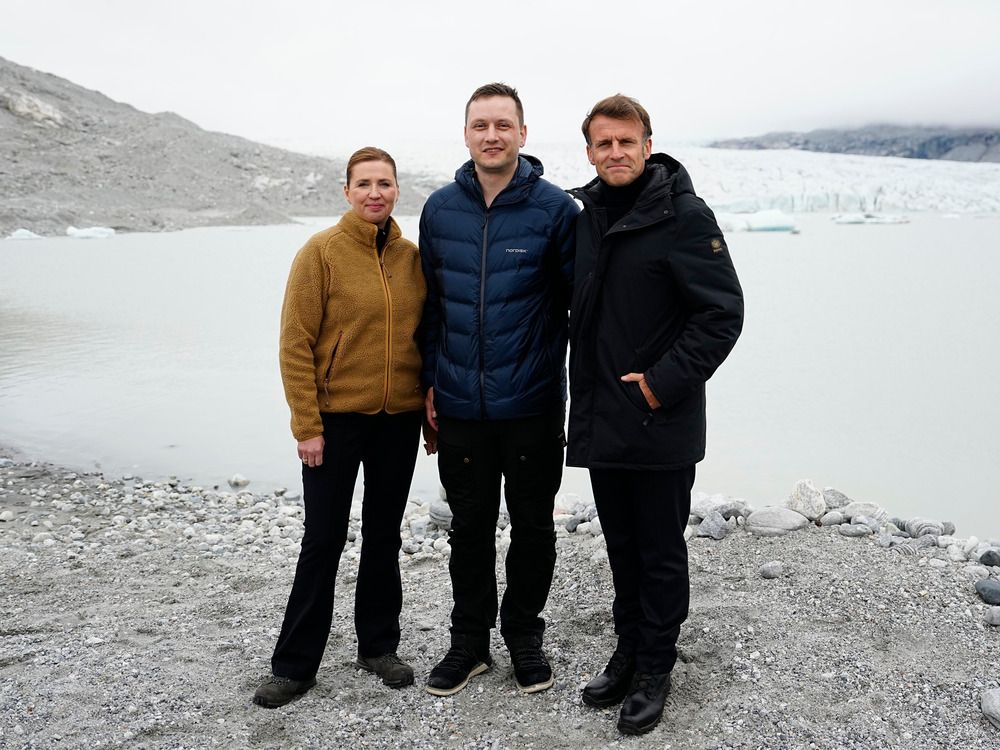
 French President Emmanuel Macron, right, Danish Prime Minister Mette Frederiksen, left, and Greenlandic leader Jens-Frederik Nielsen at a glacier in Greenland, Sunday, June 15, 2025.

Trump’s comments about wanting to buy Greenland or just take it over go back to his first term as president, when he briefly considered

the purchase option

.

But since his re-election, he has been more bellicose in his musings. This month, U.S. Defence Secretary Pete Hegseth

seemed to acknowledge

that the Pentagon had contingency plans to take Greenland and also Panama by force if necessary, telling a congressional hearing: “Our job … is to have plans for any contingency.”

That said, U.S. designs on the world’s largest island can be traced back over more than a century. U.S. senator William Henry Seward, who oversaw the purchase of Alaska in the 1860s, had a similar plan to buy Greenland from Denmark,

going so far as to write

that its incorporation into America would “flank British America for thousands of miles … and greatly increase her inducements, peacefully and cheerfully, to become a part of the American Union.”

In other words, Canada might have become the 52nd state, after Greenland.

Instead, there is pushback on all fronts today. Florian Vidal of the Paris-based think tank Ifri

told the Guardian

newspaper that Macron’s comments, especially as the head of a nuclear-armed nation, will carry great weight in the world.

“The Trump administration’s more aggressive posture makes the French vision of Europe, one that is more autonomous, appear more reasonable for Denmark,” he said. “From a Nordic point of view, France is a military power that counts.”

Our website is the place for the latest breaking news, exclusive scoops, longreads and provocative commentary. Please bookmark nationalpost.com and sign up for our daily newsletter, Posted, here.


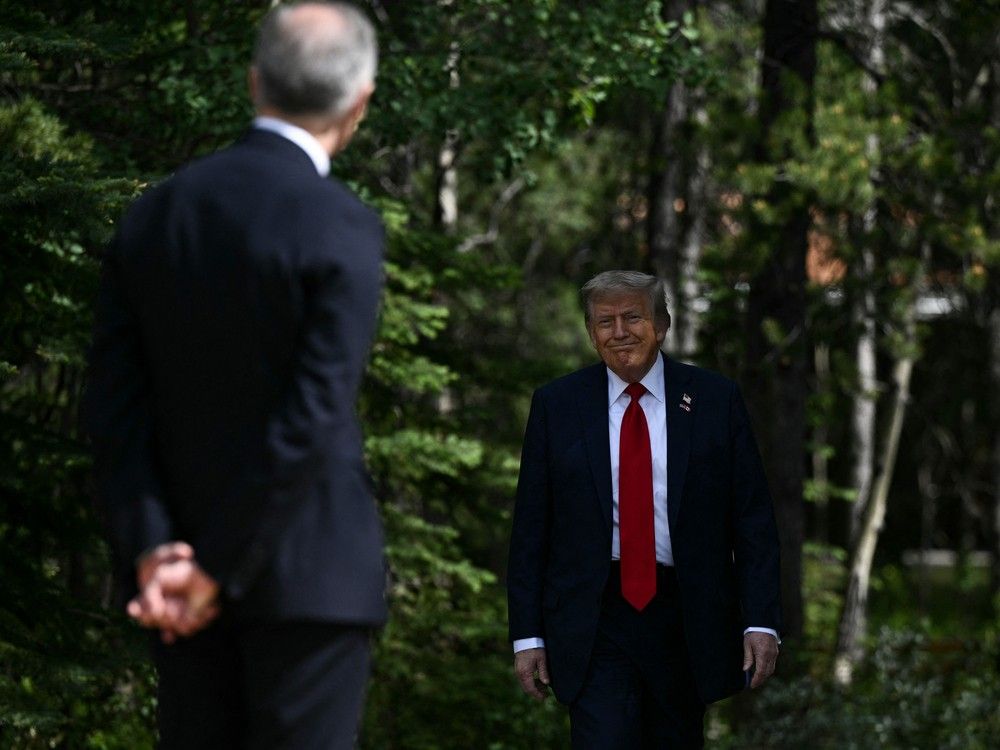
Canadian Prime Minister Mark Carney (L) greets US President Donald Trump during an arrival ceremony at the Group of Seven (G7) Summit at the Pomeroy Kananaskis Mountain Lodge in Kananaskis, Alberta, Canada on June 16, 2025.

KANANASKIS — As U.S. President Donald Trump stepped onto a podium for a photo with Prime Minister Mark Carney and his wife Diana, he wore two lapel pins on the left side of his suit.

The first, a small pin of the American flag. And underneath, paired Canadian and American flags.

Earlier in the day, when Trump and Carney met and took questions from reporters, Trump affected an upbeat mood, praising the relationship that he had built with Carney.

But given the oft-strained relationship between Canada and the United States, and in particular between Trump and former prime minister Justin Trudeau, the lapel pin is perhaps indicative of a warming relationship between the two countries.

In fact, it’s perhaps the first time Trump has worn such an adornment. In contrast, when Israeli Prime Minister Benjamin Netanyahu visited the United States in April, photos from the Oval Office show Trump in his trademark blue suit, with an American flag lapel pin — but no Israeli flag. Ditto for the May meeting between Carney and Trump. No Canadian flag in sight.

Trump caused a major diplomatic rift between the two allies when, late last year, he began musing publicly about Canada becoming the 51st state. On Christmas Day, in 2024, Trump mocked Trudeau, referring to him as governor. He also suggested that retired NHL star Wayne Gretzky could be the governor of Canada. He referred to the 49th parallel border as “artificial,” and suggested that Canada would have lower taxation and a stronger military if it became part of the United States.

The comments sparked nationalist outrage in Canada, and was likely partially responsible for the Liberals’ resurgence in the polls and eventual victory in the late April federal election in Canada. In his election night victory speech, Carney said the world had changed.

“Our old relationship with the United States, a relationship based on steadily increasing integration, is over,” he said.

At least part of what’s on the agenda for the G7 Summit this week is discussions of trade deals between Canada and the United States, after Trump slapped tariffs on Canadian goods, and Canada reciprocated, sparking the North American front in what has become a larger, global trade war.

Get more deep-dive National Post political coverage and analysis in your inbox with the Political Hack newsletter, where Ottawa bureau chief Stuart Thomson and political analyst Tasha Kheiriddin get at what’s really going on behind the scenes on Parliament Hill every Wednesday and Friday, exclusively for subscribers. Sign up here.

Our website is the place for the latest breaking news, exclusive scoops, longreads and provocative commentary. Please bookmark nationalpost.com and sign up for our daily newsletter, Posted, here.


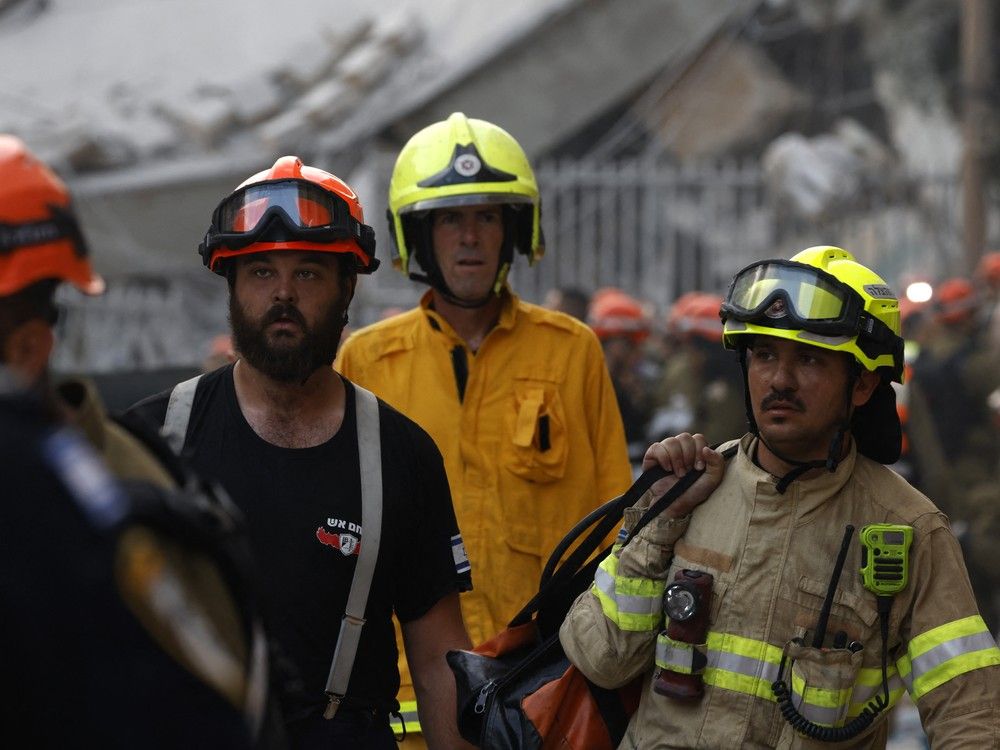
Israeli firefighters, not those shown, rescued a Canadian embassy worker from a building hit during the Iranian missile barrage on Tel Aviv over the weekend.

A Canadian embassy worker in Tel Aviv needed to be rescued from a building hit by an Iranian missile over the weekend, according to Foreign Affairs Minister Anita Anand.

In a post to X on Saturday evening, Anand offered thanks to the “brave firefighters” who helped a woman escape one of the many structures severely damaged in the Iranian missile bombardment in recent days.

“She was eventually rescued, along with other occupants of the building, and is safe and sound,” Anand reported.

Anand also confirmed a discussion with Gideon Sa’ar, Israel’s minister of foreign affairs, in which she pledged that “Canada firmly supports Israel’s right to defend itself in the face of Iranian attacks.”

In a

separate post

, Foreign Policy Canada, an arm of Global Affairs Canada, said Anand had also liaised with counterparts in Europe, Jordan, the Kingdom of Saudi Arabia and Oman on Middle East peace talks over the weekend.

National Post has contacted both Global Affairs and the Canadian Embassy in Tel Aviv for more information on the staffer and her rescue.

The incident comes as long-simmering tensions between the rival Middle East nations have boiled over into spiralling violence following Israel’s

Operation Rising Lion

— a series of surprise airstrikes on more than 100 strategic targets, including Iranian uranium enrichment sites, to keep Iran from building nuclear weapons. The attacks resulted in the deaths of high-ranking military leaders and scientists.

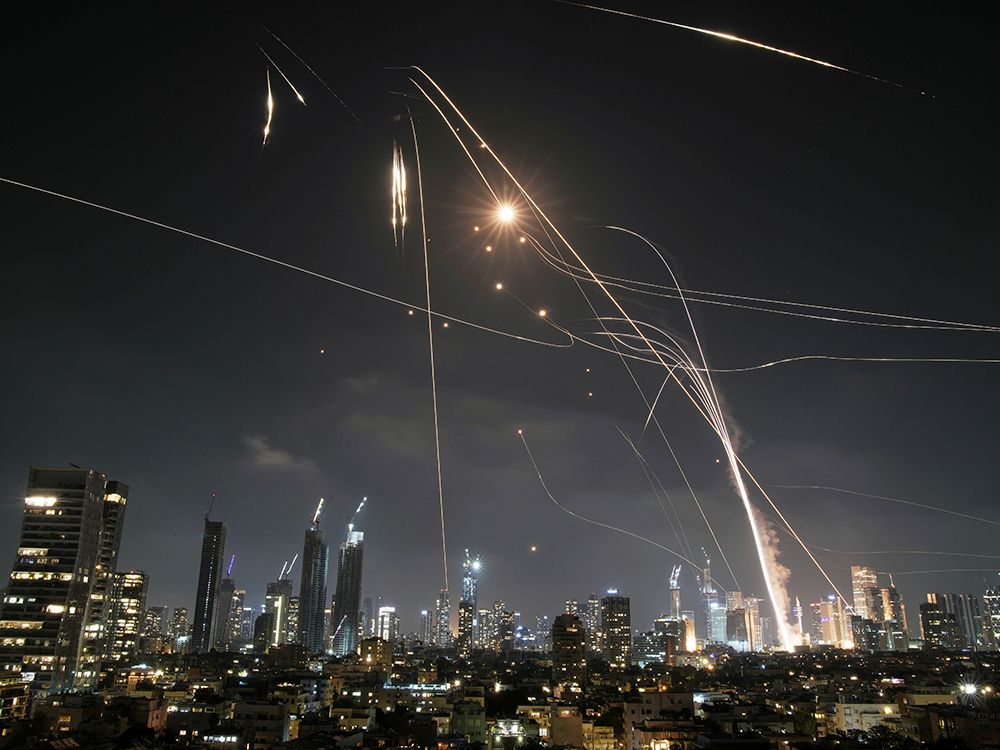
Iran responded with Operation True Promise III, launching several hundred ballistic missiles and drones in two waves Friday and Saturday, striking locations in Tel Aviv, nearby Bat Yam, Haifa, and other places.

 The Israeli Iron Dome air defence system fires to intercept missiles over Tel Aviv, Israel, Friday, June 13, 2025.

The nations exchanged missile attacks again on Sunday and into Monday.

As of Monday morning, Israel says 24 people have been killed and more than 500 injured,

per the Associated Press

. Iran, meanwhile, says its death toll is at least 224, per AP.

“Canada condemns Iran’s attack on Israel and urges restraint on both sides. Further actions can cause devastating consequences for the broader region,” a Saturday morning X thread from Foreign Policy Canada begins.

It goes on to suggest that “U.S.-Iran negotiations” are the way to resolve regional and global concerns with Iran’s nuclear program, noting the theocratic republic should not have nuclear weapons.

“Iran’s continued efforts to pursue nuclear weapons, support for terrorists, and direct attacks on civilian centres embody Iran’s persistent threat to regional stability and to Israel, which has the right to defend itself. ”

Ottawa is also urging Canadians to

“avoid all travel”

to Israel due to the new conflict with Iran and the existing war with Hamas in Gaza. A similar warning is in place for

Iran

.

Our website is the place for the latest breaking news, exclusive scoops, longreads and provocative commentary. Please bookmark nationalpost.com and sign up for our daily newsletter, Posted, here.


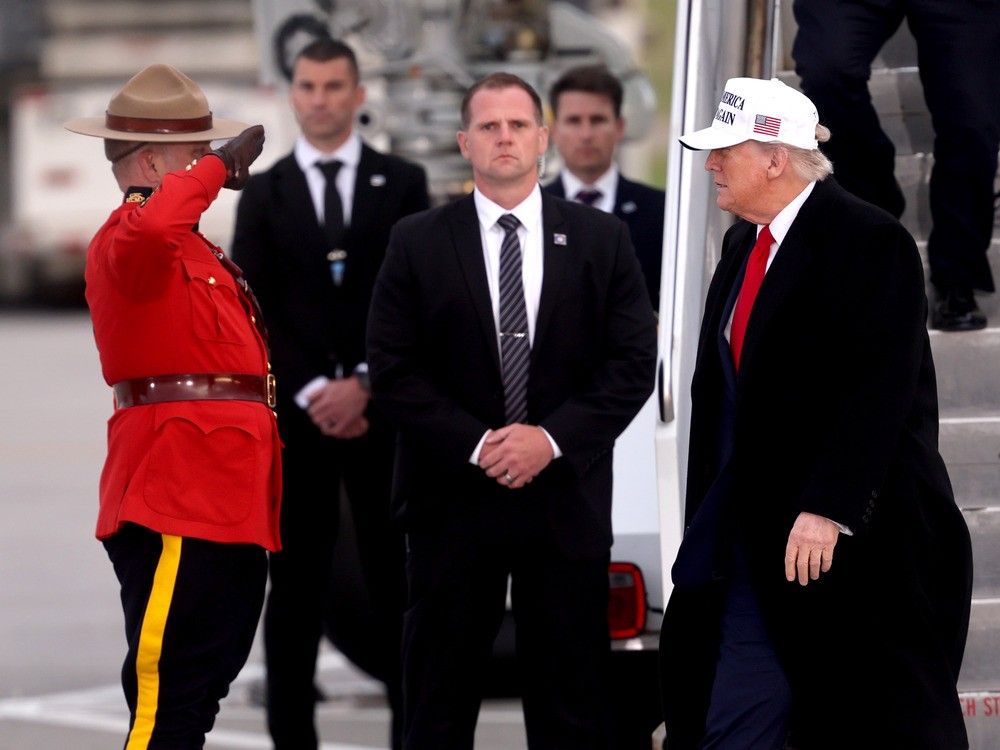
United States President Donald Trump arrives in Calgary for the G7 2025 Summit in Kananaskis on Sunday, June 15, 2025.

OTTAWA — It may not be his favourite team but Prime Minister Mark Carney is now the proud owner of a Washington Capitals jersey emblazoned with his name and the number 24 thanks to U.S. President Donald Trump.

Trump gifted Carney, a die-hard Edmonton Oilers fan, the framed and mounted jersey after the leaders sat down for their first in-person meeting in the Oval Office last month, according to a public registry of disclosures.

That meeting laid the groundwork for what Canadian political and business leaders hope leads to a reprieve from Trump’s global tariffs on autos, steel and aluminum. It is a deal the two leaders have yet to lock in as they meet again, this time in Alberta, as Canada plays host to the G7 leaders’ summit.

Gift-giving between leaders is a diplomatic custom during official visits. Another round is unfolding this week as Carney welcomes leaders from across Europe and other parts of the world for the G7 gathering.

For his part, the last time Carney and the rest of the Canadian delegation saw Trump, they left behind a photograph of a famous football game played between Canadian and American soldiers several months before D-Day in 1944, snapped by a Canadian military photographer.

It was an image meant to signal the coming together over sports, and amid global uncertainty, the latter of which Carney is trying to bridge with a volatile Trump administration.

Canada also gifted Trump a hat and golf gear from the Kananaskis Country Golf Course, given that Kananaskis is where he and other G7 leaders are meeting.

It appears Trump stuck with the sports theme for his last gift to Carney, too.

The Washington Capitals are not only Trump’s hometown team, but also where Russian-born NHL star Alexander Ovechkin plays. Trump mentioned Ovechkin by name during his Oval Office meeting with Carney last month, which began with a wide-ranging question-and-answer session with the U.S. president, while Carney and other Canadian ministers watched on.

And while the president may not have gotten the team quite right for Carney, who cheers for the Edmonton Oilers, he nailed his number, given that Carney serves as Canada’s 24th prime minister.

Most Canadians will likely be relieved that the president chose that digit over the number 51, given how often Trump has repeated his desire for Canada to become the U.S.’s “51st state.”

staylor@postmedia.com

National Post

Get more deep-dive National Post political coverage and analysis in your inbox with the Political Hack newsletter, where Ottawa bureau chief Stuart Thomson and political analyst Tasha Kheiriddin get at what’s really going on behind the scenes on Parliament Hill every Wednesday and Friday, exclusively for subscribers. Sign up here.

Our website is the place for the latest breaking news, exclusive scoops, longreads and provocative commentary. Please bookmark nationalpost.com and sign up for our politics newsletter, First Reading, here.


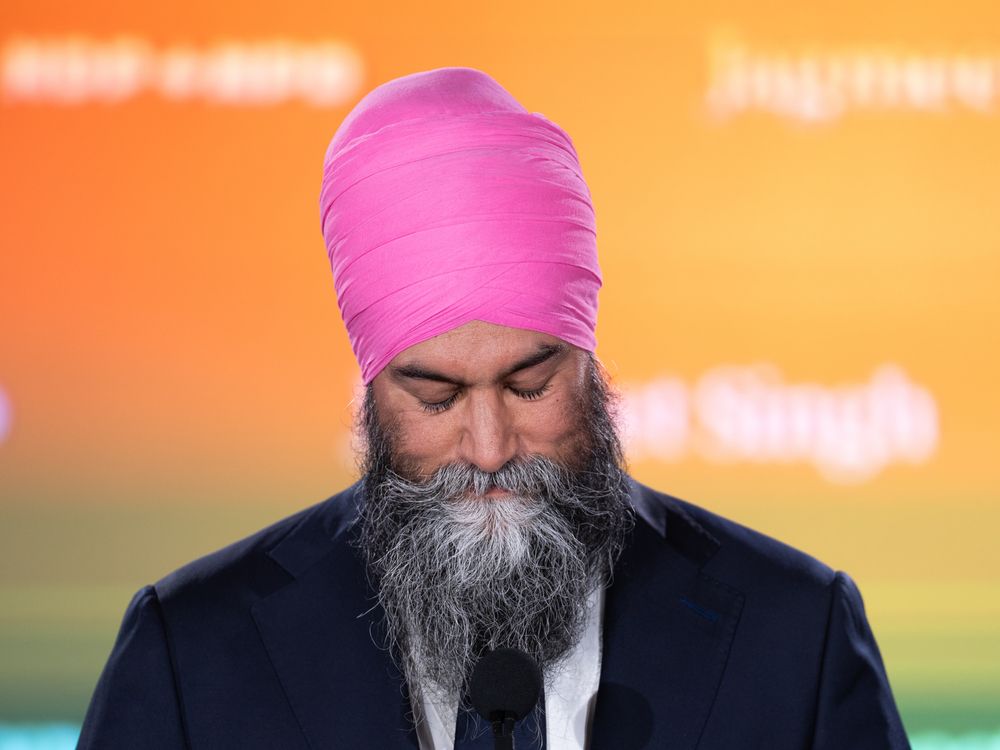
Jagmeet Singh on election night, April 28, 2025, in Burnaby, B.C.

Barely a month out of the political spotlight, former New Democratic Party leader Jagmeet Singh has entered a potentially more fraught arena — that of the ongoing feud between rappers Drake and Kendrick Lamar.

On Sunday night, Singh posted a message to

his Instagram account

after attending one of the two Toronto shows on the Grand National Tour, headlined by Lamar and fellow rapper SZA, at the city’s Rogers Centre.

Singh had been widely noticed at the event, with Drake himself posting a screenshot of an Instagram message and referring to the politician as a “goof” for his patronage of the concert.

Singh then took to Instagram himself to apologize.

“I shouldn’t have gone at all,” he wrote on his post.

He explained, “I went for SZA, not Kendrick,” adding: “I was born in this city. I love this city.” Drake is a native Torontonian, while his rival Lamar hails from Compton, California.

 An Instagram story posted by Jagmeet Singh.

Singh then went on to say: “But real talk, I get it. I shouldn’t have gone at all.”

He concluded: “OVO and Drake have lifted up this city and (Canadian flag emoji). For me it’ll always be Drake over Kendrick.” He signed off with a peace sign.

OVO is a reference to to OVO Sound, short for October’s Very Own, a record label Drake founded in 2012.

The concert included a performance by Lamar of his hit Not Like Us, a diss track aimed at Drake.

The Canadian Press reported

that the song received a standing ovation from the crowd, along with chants of “one more time.”

The song is the subject of a

lawsuit by Drake

against Universal Music Group, which was filed in a New York court. It alleges that the label falsely pumped up the popularity of Not Like Us on Spotify and other streaming services.

Universal has called the suit a baseless “attack on the commercial and creative success of the rap artist who defeated him.”

Our website is the place for the latest breaking news, exclusive scoops, longreads and provocative commentary. Please bookmark nationalpost.com and sign up for our daily newsletter, Posted, here.


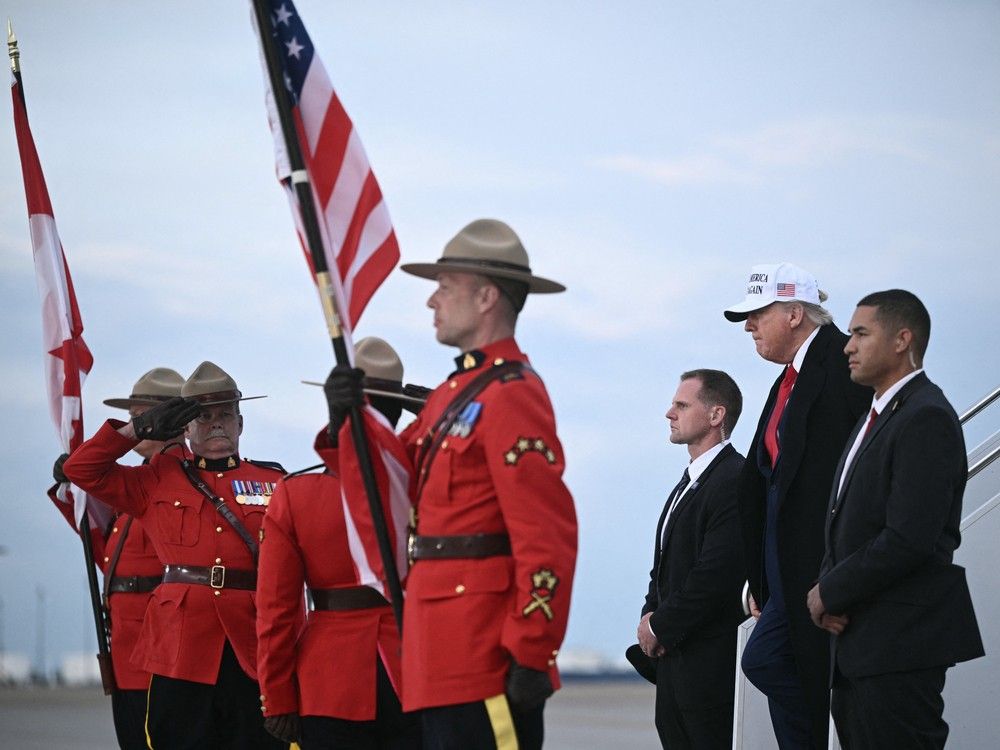
US President Donald Trump steps off of Air Force One upon arrival at Calgary International Airport, before the start of the G7 summit, in Calgary, Alberta, Canada, June 15, 2025.

KANANASKIS, ALTA. — U.S. President Donald Trump said that he feels a new trade deal with Canada could be achievable shortly, telling media at the G7 that ejecting Russia in 2014 was a mistake and that he is open to adding China to the summit.

Trump’s remarks during a photo op with Prime Minister Mark Carney at the onset of the summit Monday set the stage for what will be a high tension two-day G7 meeting in Kananaskis, Alta.

“I think we have different concepts,” said Trump on trade with Canada. “I have a tariff concept. Mark (Carney) has a different concept, which is something that some people like. But we’re going to see if we can get to the bottom of it today.”

Asked if a new deal could come within days or weeks, Trump said yes but noted that both parties had to come to an agreement.

Trump and Carney met for roughly one hour at the Pomeroy Kananaskis Mountain Lodge, half of which was one-on-one before they were joined by a coterie of advisors and their countries’ respective ambassadors.

“We’ve developed a very good relationship. And we’re going to be talking about trade and many other things,” Trump told U.S. and Canadian reporters crammed into the small meeting room.

The heads of the world’s seven most powerful economies are meeting amid a U.S.-led tariff war and global uncertainty over conflicts in the Middle East and Ukraine.

On the opening day of the summit, Trump was sporting a lapel pin featuring both Canadian and U.S. flags for what appears to be the first time in his current presidency.

In remarks made before the media on Monday morning, Carney wished Trump a belated happy birthday, which was Saturday. Trump also told reporters that he believes China, the world’s second largest economy, should join the leaders of the seven most advanced economies in the world.

“Well, it’s not a bad idea. I don’t mind that,” said Trump. “If somebody wants to suggest China coming in, I think we — but you want to have people that you can talk to.”

The idea is likely to raise hackles among the Canadian delegation. During the election campaign, Carney said he believed China was the greatest threat to Canada’s national security.

Trump also criticized the decision to eject Russia from the G8 in 2014, following that country’s annexation of Crimea, and said that Vladimir Putin “was very insulted” by the decision.

He also wrongly blamed former Prime Minister Justin Trudeau for pushing for Russia’s ejection, which happened while Stephen Harper was prime minister.

In fact, Russia’s membership in the G8 was suspended in March 2014. While Obama was the American president at the time, Conservative Stephen Harper was Canada’s prime minister. Months later, Harper made international headlines at the Group of 20 Summit in Australia when he admonished Putin, then Russia’s president, to “get out of Ukraine.”

“The G7 used to be the G8. Barack Obama and a person named Trudeau didn’t want to have Russia in, and I would say that that was a mistake, because I think you wouldn’t have a war right now if you had Russia in, and you wouldn’t have a war right now if Trump were president four years ago,” Trump said. “It was a mistake in that you spend so much time talking about Russia, and he’s no longer at the table, so it makes life more complicated, but you wouldn’t have had the war.”

However, while saying booting Russia from the G8 was a mistake, Trump stopped short of saying that Putin should be invited back.

“I’m not saying he should at this point, because too much water has gone over the dam, maybe. But it was a big mistake,” he said.

Monday morning’s meeting is the first since the two men met in Washington, D.C. in early May. Canada has been a major target of Trump’s trade and rhetorical belligerence. Although Trump has largely scaled back talk of annexing Canada, making its northern neighbour the 51st state, trade troubles remain top of mind for observers and Canadian diplomats. Canada will be pushing Trump this week on lowering the 50-per-cent tariffs placed on Canadian steel and aluminum and further tariffs on foreign vehicle imports.

Before flying to Canada on Sunday, Trump said, without providing any details, that he thinks “

we’ll have a few new trade deals

” to announce while at the G7.

“Our primary focus would be trade and trade with Canada, and I’m sure we can work something out,” Trump told reporters.

Carney told Trump that the G7 is “nothing without U.S. leadership and without your personal leadership.” Trump responded that he and Carney have developed a “very good relationship.”

Trump then took multiple other questions, about the Iran-Israel conflict and about U.S. Immigration and Customs Enforcement raids in American cities that have seen major street protests mobilized in response. Eventually, Carney stepped in, ending the questions, saying that the leaders had to get to other meetings.

The Trump factor generally is looming over the G7 meeting. In 2018 in Charlevoix, Que,. the defining image of the G7 summit that year was Trump sitting down, arms crossed, a look of curious disdain on his face, while Angela Merkel, then the German chancellor, leaned over a table towards him. That year, Trump refused to sign on to a joint declaration with the other countries and criticized then prime minister Justin Trudeau as “dishonest and weak” over his criticism of tariffs. For 2025, Canada ditched the plan to issue a joint communiqué at the end of the summit, avoiding an overt show of disunity.

With additional reporting from Christopher Nardi

Get more deep-dive National Post political coverage and analysis in your inbox with the Political Hack newsletter, where Ottawa bureau chief Stuart Thomson and political analyst Tasha Kheiriddin get at what’s really going on behind the scenes on Parliament Hill every Wednesday and Friday, exclusively for subscribers. Sign up here.

Our website is the place for the latest breaking news, exclusive scoops, longreads and provocative commentary. Please bookmark nationalpost.com and sign up for our daily newsletter, Posted, here.


Canada Prime Minister Mark Carney is greeted Mayor Jyoti Gondek and Premier Smith as he arrived in Calgary for the G7 2025 Summit in Kananaskis on Sunday, June 15, 2025.

BANFF, Alta. — The heads of the world’s richest economies are converging on Alberta today for one of the most high-stakes G7 meetings in recent memory amid a U.S.-led global tariff war and the growing crisis in the Middle East.

On many of the G7’s key issues — namely the global trade war and Israel’s military operations in Gaza — Trump and the rest of the G7 leaders are largely on opposite sides.

Canadian Prime Minister Mark Carney’s job as chair of the summit in Kananaskis, Alta., is to mediate discussions to make sure the tense alliance doesn’t blow up.

And that job has never been so complicated, G7 observers say.

On top of global issues such as Russia’s illegal invasion of Ukraine, ongoing Israeli military campaigns in Gaza and now Iran and the U.S.-led reshaping of global trade via sweeping tariffs, Carney will have to contend with the volatility and unpredictability of American President Donald Trump.

According to a schedule published by Carney’s office Sunday, the prime minister will meet Trump during a bilateral on Monday morning. It will be the first tête-à-tête between both men since Carney travelled to Washington last month.

Canada has been pushing for Trump to remove his recent 50 per cent tariffs on steel and aluminium as well as additional tariffs on foreign vehicle imports, both key Canadian exports to the U.S.

Speaking to reporters before flying to Canada, Trump said “

I think we’ll have a few new trade deals

” to announce at the G7 without specifying with which countries.

On many issues including trade and the Israel-Hamas war, the G7 summit is like a game of tug-of-war. Pulling on one side are the leaders of the U.K., France, Italy, Japan and Germany, and pulling on the opposite side is Trump, with Carney in the middle of the rope trying to keep it from ripping.

The fact that the longtime Iran-Israel conflict has pivoted from proxy wars to full-on conventional war in the last few days makes Carney’s job even more difficult.

“It makes the already very difficult job of Prime Minister Carney to manage the G7 even more difficult. It adds another layer of risk and complexity,” said Thomas Juneau, a national security researcher and professor at the University of Ottawa.

Seven non-member countries also attending the G7 from the sidelines: Australia, Brazil, India, Mexico, South Africa, South Korea and Ukraine. Delegations from NATO, the UN and the World Bank will also be present.

On the eve of the summit, Carney had a first G7 bilateral with U.K. Prime Minister Kier Starmer during which the men dined and then watched the Edmonton Oilers play the Florida Panthers.

Before travelling to Kananaskis on Sunday, both leaders put out a press release promising to boost bilateral trade and increase collaboration in artificial intelligence, defence, intelligence sharing, quantum, critical mineral development and military cooperation.

Carney’s schedule Sunday showed he will be hosting bilateral meetings with the leaders of all those countries except South Korea and the World Bank. Those meetings will allow Carney to hammer out the final details of new partnerships or iron out irritants in each relationship without Trump in the room.

Though there have been tensions between G7 members going into a summit in the past, never has the volatility of a U.S. president so risked blowing up the entire meeting agenda, he said.

During the last G7 on Canadian soil in 2018, Trump and the U.S. had initially agreed to sign on to the final joint statement, only to pull out in spectacular fashion via a post on social media lobbed from Air Force One calling Prime Minister Justin Trudeau “dishonest and weak” over criticism of American tariffs.

Juneau and other observers interviewed by National Post say that volatility has only increased in Trump’s second mandate, increasing the risk of implosion of the 52-year-old alliance.

“It just adds another major level of risk for Prime Minister Carney to manage this in a way that it doesn’t blow up,” Juneau said. “Carney is not an experience politician, but he’s a very experienced, knowledgeable, skillful individual, and that makes a difference.”

But absent the discussions will be leaders from Middle Eastern countries. Canada invited the heads of Saudi Arabia and the United Arab Emirates (UAE), but both leaders declined last week.

The leaders’ meetings will cover global economic outlook, economic growth, security, public safety, energy security and the Ukraine-Russia war.

But likely to Ukrainian President Volodymyr Zelensky’s dismay, the growing crisis in the Middle East will likely infringe on discussions on Russia’s ongoing invasion of Ukraine.

“There will be a focus on Ukraine in terms of the international security part, but there will be, of course, a discussion on Gaza that has now expanded,” said a former government official with extensive experience organizing international summits.

National Post

cnardi@postmedia.com

Get more deep-dive National Post political coverage and analysis in your inbox with the Political Hack newsletter, where Ottawa bureau chief Stuart Thomson and political analyst Tasha Kheiriddin get at what’s really going on behind the scenes on Parliament Hill every Wednesday and Friday, exclusively for subscribers. Sign up here.

Our website is the place for the latest breaking news, exclusive scoops, longreads and provocative commentary. Please bookmark nationalpost.com and sign up for our daily newsletter, Posted, here.


National Post's Tyler Dawson took a drive and bike ride to check out the G7 security situation.

KANANASKIS, Alta. — It’s an odd thing to be asked your business in your own country, in your own province, in an area where you’ve spent plenty of time hiking and climbing and skiing.

A place where the whole purpose is to be free — or at least freer than in the city.

You expect these questions going through customs or at checkpoints in less salubrious parts of the world. But not necessarily out on a gravel backroad in Kananaskis, Alta.

Of course, with the G7 in town starting Sunday and a massive security operation restricting access to huge swathes of the backcountry, it’s a matter of routine. So, not unexpected, but still vaguely unsettling, to be stopped and warned by the RCMP where you’re not allowed to go and asked what you’re about.

Kananaskis Village is nestled on the eastern slopes of the Rocky Mountains, and the meeting of seven of the most powerful people in the world will occur at the Pomeroy Kananaskis Mountain lodge. Motorcades will travel from the Calgary International Airport, along the Trans Canada Highway and down Highway 40, also known as the Kananaskis Trail, to get world leaders to the summit.

The location means that there is a massive security cordon set through the area backcountry. A stretch of Highway 40 is fully closed. And the security perimeter runs through miles of wild country, with many backcountry hikes shut down.

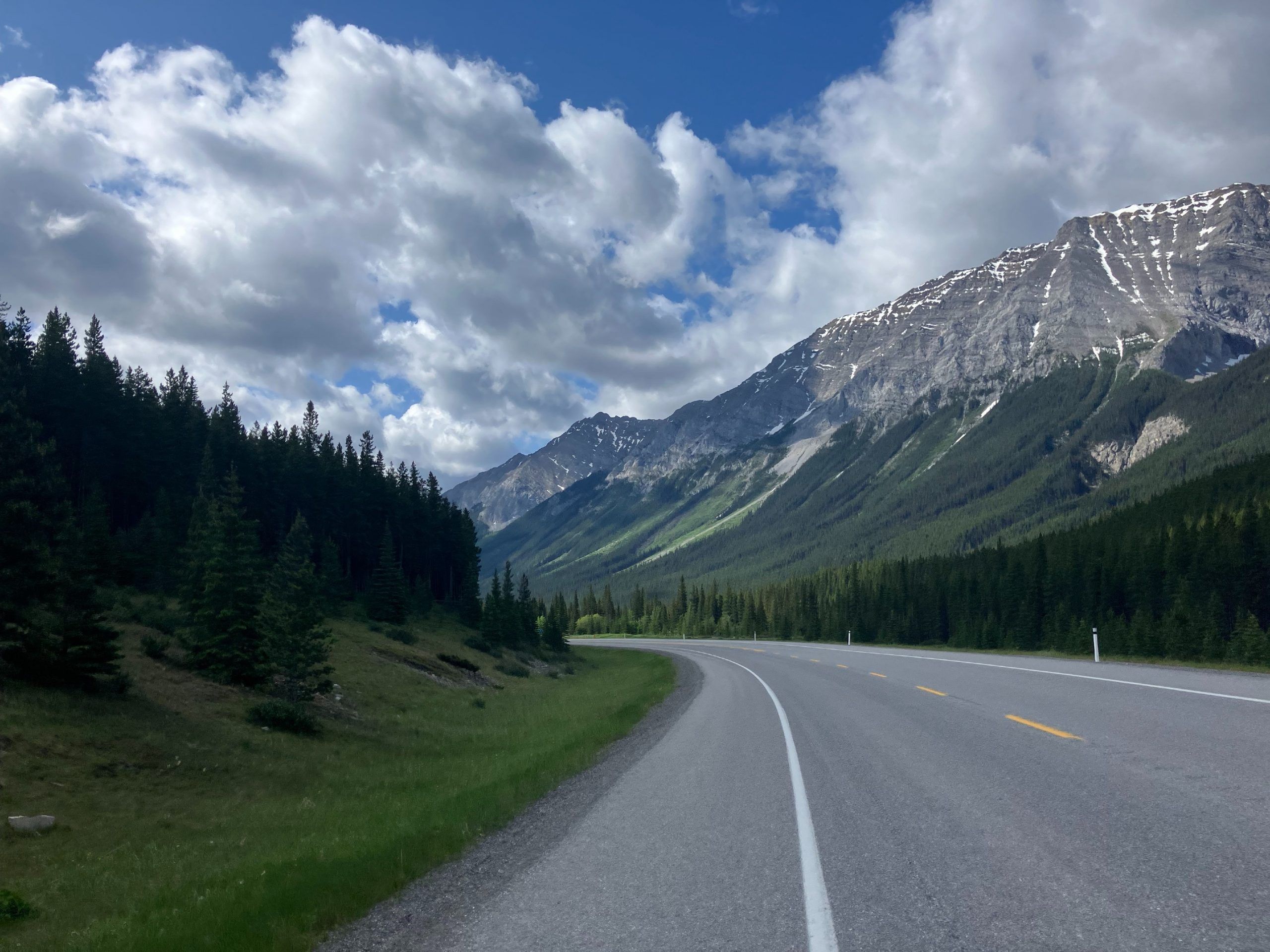
 The view looking along Highway 40 in Alberta’s Kananaskis region.

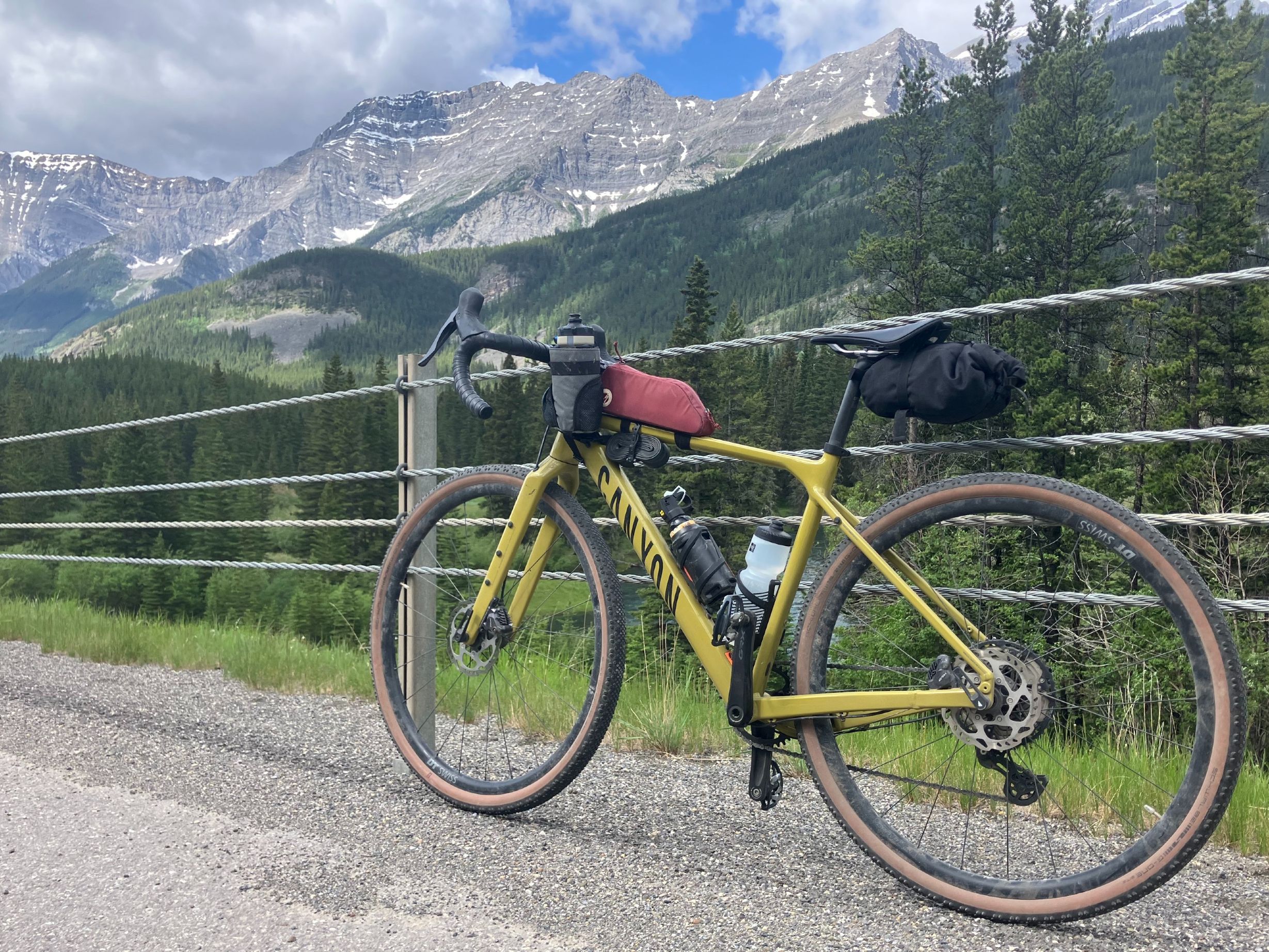
When I set out with my bike Saturday morning, that meant I had to traverse a gravel backroad to arrive at Highway 40, for just a 15 kilometre stretch from the intersection of Highway 742 and Highway 40 before I butted up against the checkpoint set for the G7.

Coming in from Canmore, roughly an hour drive on the gravel Smith Dorrien Trail, there were a handful of security checkpoints en route. Mounties asked where I was going and what I had planned, reminding me that hikes along the eastern slopes of the mountains in the region were closed. They seemed vaguely unclear on what I would be allowed to do with my bike, though I’d previously checked with Alberta Parks, so I was fairly sure I had it right.

As an aside, when I phoned Alberta Parks last week, the call began with a recorded message about cancelling reservations in K-Country, suggesting that a good number of tourists had trips planned and backed out when they discovered they wouldn’t be able to do what they wanted.

At other points, police and conservation officers had electric bikes on standby, along with the odd ATV. Mostly, police were just lounging around, drinking coffee in camp chairs. Given that everyone’s aware that there’s limited access to the backcountry, it was a quiet drive. I saw only a handful of civilian vehicles on the drive out there. The parking lot of Chester Lake, a popular (and easy) hike trafficked by tourists, sat empty but for some security.

In stark contrast, I swung by Banff for lunch with a friend after the ride, and it was an utter madhouse, especially with the Banff half marathon scheduled for Sunday.

At the start of the ride, I checked with two Mounties if I was allowed to ride where I wanted to. The officers were from British Columbia and Ontario, shipped to the area for the G7, and informed me that I’d be fine to ride.

In response to a somewhat desperate request, they let me use their port-a-potty, with the caution that if I made a mess, they’d clap me in irons.

And so I set out, pedalling for an easy 15 kilometres north towards where I knew the checkpoint would be. As I rode, an RCMP light-armoured vehicle went barrelling by in the opposite direction. At one point, a Mountie in a pickup truck stopped to ask where I was headed. I told her and she warned me about a grizzly bear and cub that had been frequenting the Opal day use area. (I checked the accessibility of my bear spray and carried on.)

The checkpoint itself was far less exciting than I’d expected. I’d imagined something from an apocalypse movie. All concrete barriers and military vehicles. Instead, there was an events tent and a couple of police officers. We chatted for a bit about skiing in the area and I turned around, discovering to my horror that the 15 kilometres back was quite a bit more uphill than expected and that the headwind on the way in turned out to … still be a headwind, as so often happens.

All in all, the security presence seemed far less intrusive than expected. On the way back, at a checkpoint near Mount Sparrowhawk, one officer did give my bike and vehicle a cursory inspection and declared that he was satisfied, while asking if I had any hikes planned. I did not. I did see a couple of security officials hiking back out of the woods.

Before I left, after loading my bike back onto my car, a woman pulled up to the King Creek parking lot for a hike with her dog. Before she headed out, she declared herself exasperated by all the security: “It’s almost over,” she said.

True, but the G7 itself is just getting started.

Our website is the place for the latest breaking news, exclusive scoops, longreads and provocative commentary. Please bookmark nationalpost.com and sign up for our newsletters here.