LP_468x60
on-the-record-468x60-white

Florida Panthers Matthew Tkachuk, front. and Gustav Forsling pour beer from the Stanley Cup onto fans at the Elbo Room, in Fort Lauderdale, Fla., the morning after defeating Edmonton in Game 6 of the Stanley Cup Final. The Cup was damaged the night before.

Some hockey fans are understandably bent out of shape over the

Florida Panthers damaging the Stanley Cup

this week, but the coveted trophy has been through worse.

It’s been sunk to the bottom of a swimming pool. It’s been used in the baptism of several infants and at least one baby has pooped in it.

It’s even been dropped — or maybe it was tossed — from a second-storey balcony overlooking a rock star’s whiskey-shaped pool.

“It happens every year, the bowl gets damaged — basically it gets ‘out of round’ if you know what I mean,”

Cup keeper Phil Pritchard told a Washington Capitals blogger in 2018.

“It is nobody’s fault; it just happens every year. It has become part of the lore of sports’ greatest trophy.”

Here are just a small handful of the known stories about what the silver and nickel trophy has endured through its 131 years.

Dents and cracks

At some point after knocking off the Edmonton Oilers in Game 6 on Tuesday night, the Panthers managed to crack the trophy’s bowl and dent the base before even leaving the arena, as evidenced by photos being circulated on Wednesday.

A spokesperson for the Hockey Hall of Fame told

the Associated Press

it will be repaired in time for Sunday’s victory parade in Sunrise, Fla.

It wouldn’t be the first time the Cup has been damaged almost immediately after it was awarded.

As the Colorado Avalanche gathered on the ice for a team photo to celebrate their 2022 championship, Nicholas Aube-Kubel stumbled and dropped the Cup as he skated into the dogpile, leaving a noticeable dent on the base.

Just a year before, the

Tampa Bay Lightning damaged it

at some point prior to or during a boat parade to celebrate a second-straight title.

Because the Stanley Cup spends 24 hours with each player and staff member of the winning team, how the damage occurred is usually a mystery or the stuff of anecdotal legend. But while visiting St. John’s with the Boston Bruins’ Michael Ryder in the summer of 2011, cameras captured the trophy taking a tumble from a table.

Three years earlier, a few days after the Detroit Red Wings claimed the Cup, it was dented after

falling off a table at the restaurant owned by defenceman Chris Chelios.

The Cup makes a splash

The Panthers were the last team to take the hockey’s holy grail swimming when they took it to Fort Lauderdale Beach after last year’s defeat of the Oilers in the final. At points during their revelry, players hoisting the Cup were diving into waves.

Pritchard, in an email to the

South Florida Sun-Sentinel

, expressed concern about possible erosion but said they “managed to clean it as good as possible and dry it off.”

Panthers forward Matthew Tkachuk later admitted it wasn’t ideal.

“I think somebody said that’s not technically allowed, but I said it was too late,” Tkachuk said Thursday. “It already happened.”

Other famous dips include the time it ended up at the bottom of Mario Lemieux’s pool following their 1991 win,

tossed there from a 20-foot high waterfall by defenceman Phil Bourque.

“We had to dive in,” Bryan Trottier recounted on the Spittin’ Chiclets podcast in 2022, “Troy Loney and I dive and get the Cup out of the Pool. It was very tarnished the next day.”

The most famous pool story occurred eight years later as the Dallas Stars celebrated the organization’s first championship.

While partying at the home of Pantera drummer Vinnie Paul, the Stars celebrity superfan said

Guy Carboneau tossed the Cup to teammate Craig Ludwig from a balcony above his pool

— that was s

haped like a bottle of Crown

Royal whisky — only for it to hit the pool deck and fall in the chlorinated water.

Carboneau disputed that version of events in a 2022 interview with

D Magazine in Texas

, saying it was an accident as he tried to hand it off to Ludwig.

“If I really wanted to throw the Cup, I would have thrown the Cup. But that was not my intention.”

Ludwig, who admitted in the same article that they were all fairly drunk by this point, couldn’t be sure what happened.

Oh, Baby!

The first known and reported instance of an infant being baptized in Lord Stanley’s Cup came in 1996 when the

Avalanche’s Sylvain Lefebvre used it for his daughter’s

He was followed in 2008 by the Red Wings’ Tomas Holmstrom, whose niece was welcomed into the Christian faith in the bowl from which countless beers and bottles of champagne have been slurped.

The Pittsburgh Penguins’ Josh Archibald had his three-week-old baptized in 2017, and the Avalanche’s Jack Johnson used it for all three of his kids on his day with the trophy in 2022.

In 2008, Kris Draper admitted to

the Toronto Star

that his newborn daughter “pooped in the Cup.”

“That was something. We had a pretty good laugh,” said Draper, who cleaned it out and “still drank out of it that night.”


Hours before Claire Bell’s disappearance, she appeared with her mother in an alarming selfie video posted online on TikTok. Rachel-Ella Todd spoke one line: “You try that again, and this is going to get ugly.”

Along with joy and relief at finding three-year-old Claire Bell alive in eastern Ontario after four days of searching come questions of how she survived and why she was alone at the side of a rural highway 150 kilometres from her home in Montreal.

Police officially aren’t saying much about the case, as their focus moves from the public search into a criminal investigation stage, but published accounts say the girl made a staggering and perplexing statement to her rescuers.

“I’m waiting for mom, she told me to wait for her,” Radio-Canada, CBC’s French-language branch, reported Claire telling police who found her. “Mom told me to wait,” the Journal de Montréal, a daily French-language newspaper reported the girl said.

Police officials would not confirm the conversations, saying there is already an ongoing prosecution in Quebec, after the girl’s mother, Rachel-Ella Todd, 34, was arrested late Monday night and charged with child abandonment while Claire was still missing.

There also may now be a prosecution in Ontario, as the girl was allegedly abandoned about 50 kilometres into Ontario from the Quebec border.

 Quebec toddler Claire Bell, 3, has been found three days after she mysteriously disappeared.

Police credit information from the public for helping solve the girl’s disappearance.

The strange way the girl was reported missing

and distressing twists during the search galvanized public interest in the case. Police asked the public to help them track the movement of a grey 2007 Ford Escape, which helped investigators shift their attention into eastern Ontario.

The SUV was reported to have been seen in the St-Albert and Casselman area.

A drone operated by the Ontario Provincial Police spotted the girl around 2 p.m. on Wednesday in a field along an on-ramp for Highway 417 near the rural community of St. Albert, Ont., about 150 kilometres west of Montreal.

OPP officers following behind the drone then swooped in to rescue her.

Police said Claire was “fine,” and described her as being conscious and able to talk. Photos from the scene show her looking stable and well, although a bit startled and unkempt. She was taken to hospital for a medical evaluation as a precaution.

“We were preparing for the worst, I think everyone was,” an Ontario police source said.

Officers were overjoyed when she was found. Officers were seen celebrating the outcome of their efforts.

“The last few days, officers and members of the community have held our breath and hoped while we searched,” OPP Acting Staff-Sgt. Shaun Cameron. “Now we exhale as one, knowing she is safe.”

“This is why we are police,” said Sûreté du Québec Capt. Benoît Richard.

 Jubilant officers shared the moment after 3-year-old, Claire Bell was found on the side of a highway on Wednesday June 18, 2025.

Cameron said police would not have found the girl in time without “critical information” from the public. “This was a search where we knew, especially given her age, that every hour mattered,” he said.

“This search proves that when a child goes missing, there are no interprovincial boundaries. There is only one goal: to find them.”

Claire’s father, Matthew Bell, thanked the public and asked for privacy in a social media post.

Quebec Premier François Legault described the girl’s safe return as “almost a miracle,” and thanked police as well as members of the public who called in tips.

Todd appeared before a judge on Tuesday by video from a police station, represented by a legal-aid lawyer. She was back in court briefly on Wednesday when the case was put off until Friday for a potential bail hearing.

Claire was last seen Sunday morning, Father’s Day, with her mother, at the apartment where Claire and Todd lived.

News that she was missing was revealed about six hours later when her mother pulled into a roadside fireworks and souvenir store about 55 kilometres west of their apartment. Police said she told an employee she had lost her child and didn’t know where she was.

 A bus of school kids cheer as they go by a police command post west of Montreal and learn toddler Claire Bell was found alive, June 18, 2025..

An enormous search began that shifted and grew from the Sunday missing child report through 72 hours.

Hot days with little or no access to water would have posed the greatest risk to the rescued Montreal toddler’s survival, a search and rescue coordinator who participated in the search

told the Montreal Gazette

.

“Water, normally after about three days, becomes a significant concern,” said Dany Chaput, on-site coordinator for the Association of Quebec Volunteers for Search and Rescue. The three days Claire was missing “were very hot. There was a lot of sun,” he said.

Around 120 volunteers under his direction spent three days combing areas near the Coteau-du-Lac exit where police had found the mother’s car. Those volunteers “drank enormous amounts of water and, despite that, had headaches, dizziness.” Claire wouldn’t have had the same access to water, Chaput said. “I don’t think she necessarily had access to her primary needs.”

National Post with additional reporting by Montreal Gazette and The Canadian Press

• Email: ahumphreys@postmedia.com | Twitter:

Our website is the place for the latest breaking news, exclusive scoops, longreads and provocative commentary. Please bookmark nationalpost.com and sign up for our daily newsletter, Posted, here.



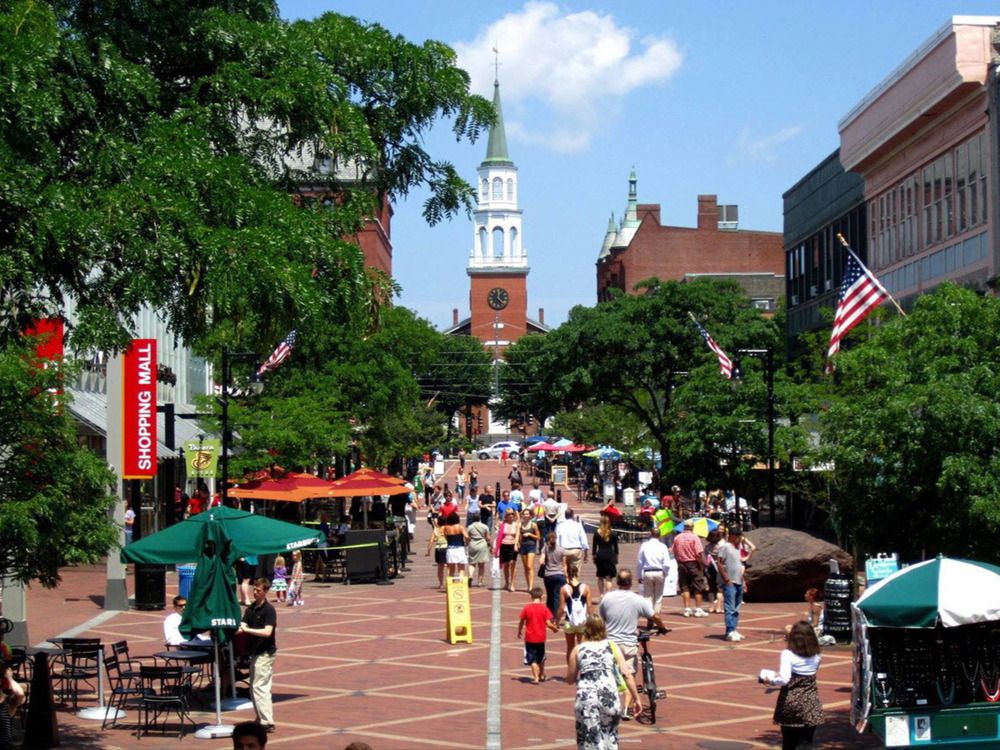
The bustling Church Street Marketplace in Burlington, Vt., is a favourite destination for visitors and locals.

The City of Burlington, Vt., has announced it will

rename one of its central avenues

from Church Street to Canada Street, from now until Labour Day (or Labor Day as it’s known there).

The name change was presented by a group of city councillors at their June 16 meeting, led by Councillor Becca Brown McKnight, who wore a maple leaf shirt and handed out Canadian flags to the other councillors.

“We have been fed up with Donald Trump’s damaging and insulting rhetoric towards Canada,” Brown McKnight

told CTV News

this week. “Renaming a street is something quick and easy for us to do, but also sends a message that we are in this fight with you.”

Church Street, named after the First Unitarian Universalist Church that sits at its north end, is a pedestrian-only retail hub of downtown Burlington and home to its popular Church Street Marketplace.

Vermont’s most populous city at 45,000, Burlington is less than 100 kms from the Quebec border by car, and is in one of two states where French is the second most common language spoken after English, the other being Louisiana. So it has also offered Rue de Canada as the French-language name for the street. Back in 2011, Burlington’s city council also voted to

add French to its local signage

, though the move was a recommendation rather than a law.

The new resolution passed unanimously, although one councillor expressed frustration with “performative” actions and said she hopes there will be further actions taken to support tourism and local businesses. Burlington city council says that more than 15 per cent of its summer tourism dollars typically come from Canadian visitors. However, visits by Canadians to the U.S. have fallen off since Donald Trump’s tariff threats and talk of annexation.

In the 1960s, the city joined with Burlington, Ont., to found the

Burlington International Games

, which eventually expanded to include Burlington, Iowa, and some non-Burlington cities, before ceasing in 2010 due to limited participation.

The city says it will spend US$3,000 to change signage and hold celebratory events in honour of the designation.

Our website is the place for the latest breaking news, exclusive scoops, longreads and provocative commentary. Please bookmark nationalpost.com and sign up for our daily newsletter, Posted, here.


Regular season MVP and playoff star Shai Gilgeous-Alexander is poised to become the greatest Canadian to play in the NBA.

Professional basketball’s often contentious greatest of all time debate will likely never be settled, but the conversation about the greatest Canadian to play in the NBA could very well be resolved as early as this week.

The Oklahoma City Thunder’s Shai Gilgeous-Alexander, who this season joined two-time NBA regular season MVP winner Steve Nash of B.C. as the only Canadians to win the award, has dominated this year’s NBA Finals against the Indiana Pacers, a series that continues in a potentially decisive Game 6 tonight in Indianapolis.

Should the Thunder emerge victorious, or in a Game 7 on Saturday back in Oklahoma City, Gilgeous-Alexander is the odds-on favourite to be awarded the Bill Russell NBA Finals MVP Award.

Only a handful of players have won both MVP honours in a single season, all of them among

the game’s true greats

: Willis Reed, Kareem Abdul-Jabar, Moses Malone, Magic Johnson, Lebron James, who did it twice, and Michael Jordan, who was bestowed both honours on four occasions.

While Nash’s MVPs came in successive seasons (2004-2006) when he was key to the Phoenix Suns’ success, he never played in the Finals during his remarkable 18-season Hall of Fame career. (Although he would later become a de facto champion by way of consulting duties with the Golden State Warriors in 2017.)

In an interview with

The Ringer

earlier this year, Nash himself admitted that if Gilgeous-Alexander isn’t already, “he’ll be the best Canadian to ever play the game — and in short order.”

He’s done so by approaching the game — on and off the court — with composure and humility, while developing into a leader who recognizes his broader role for the young team and its fans. A case in point: he signed 429 autographs in the hours before Game 2, thinking he’d only signed a few dozen.

‘Greatest season for a Canadian’

Statistically, the 26-year-old from Hamilton, Ont., conclusively produced the single best regular season by a Canadian player this season. His 32.7 points per game average led the league and was supported by five rebounds, 6.4 assists and a field goal percentage of 51.9 per cent.

His true shooting percentage, a stat used to determine shot efficiency, was an incredible 63.7 per cent.

Only two other players in the NBA’s history have averaged similar figures: Jordan and 2017-18 MVP James Harden.

“Steve (Nash) would tell you this is the greatest season for a Canadian,” said Dwayne Washington, founder of UPLAY Canada, who coached a young Gilgeous-Alexander for several years before he left to finish high school playing against stiffer competition in Tennessee.

“So when the dust clears, people are only gonna look at statistics, and statistically it’s undeniable.”

Similarly, Gilgeous-Alexander, already the recipient of the Western Conference Final MVP award, has produced playoff numbers that put him in rare air.

He has scored 30-plus points in 15 games, tying him with Kobe Bryant for the most in a single postseason and one off the record held by Jordan and Hakeem Olajuwon. He also set an NBA record by scoring at least 30 points in 10 straight home games.

Three of those have come in the Finals, during which he is averaging 32.4 ppg and 2.4 steals, both of which rank among the top five in history, per

the league

. That includes a 35-point performance in Game 4 — highlighted by a 15-point run in the final 5 minutes to help the Thunder come from behind and tie the series up at two apiece — and a 31-point, 10-assist double-double in Game 5.

According to Sportsnet

, his 162 points through the first five games are the fourth most by any player.

He also joined an elite group last week when he became the 12th player with more than 3,000 total points in a single season (regular season and playoffs combined).

Another staggering number: the 429 autographs he signed before Game 2. He thought he’d only done 50 or 60.

Humble and hard-working

Like he was all season, Gilgeous-Alexander has continued to be humble about his success on the court, promoting selflessness and a team-first mentality in post-game interviews, often hailing his teammates’ contributions as being just as vital.

After Game 5, he heaped praise on forward Jalen Williams’ 40-point effort and said he was just “trying to affect winning.”

“Trying to make a basketball play. I was trying to help the team win, trying to be in position for the next rotation, next play defensively. Whatever comes with that, comes with that.”

Washington, whose program has provided coaching and mentorship to other Canadian NBA talent such as R.J. Barrett, Lindell Wigginton, and Shaedon Sharpe, told National Post he’s been impressed with how Gilgeous-Alexander is handling the defensive pressure, even likening it to what Jordan experienced in the playoffs.

“That is so hard to do. Some of the best athletes in the world are double- and triple-teaming you, and you’re still getting 30, 10 assists and winning with a team so young,” he explained. (The Thunder’s average age is just 25.6 years, making them

the youngest squad to play for a title

since the 1977 Portland Trailblazers.)

Washington offered more comparisons to Jordan, along with Bryant, in terms of Gilgeous-Alexander’s approach to the game off the court — “He’s out-studying, outmaneuvering, out-planning, and out-working people before they even step on the court,” he said — and a fall-away mid-range jump shot that both legends deployed with lethal efficiency throughout their careers.

He said the six-foot-six guard has been working on that shot for years, and it comes naturally to him. However, most NBA coaches preach against the generally low-percentage shot attempt despite it being a go-to for elite offensive players.

Washington said Gilgeous-Alexander has been told not to shoot it “most of his career,” but he’s continued to perfect it anyway.

“I know he’s been working on it, so it’s great to see it in real time,“ Washington said. “I’ll be honest with you, if he’d listen to other people telling him what not to do, he wouldn’t be there.”

Nash also offered a Jordan and Bryant comparison in an interview with the

Toronto Star

last month, saying Gilgeous-Alexander “does the same thing they do.”

“If you look at the numbers and you break it down, there’s a lot of things he does that are greater than everyone that’s even close to those type of players. So he’s ascending towards that category.”

He’ll look to continue that ascension when the NBA Finals resume tonight. Game time is 8:30 p.m. ET.

Our website is the place for the latest breaking news, exclusive scoops, longreads and provocative commentary. Please bookmark nationalpost.com and sign up for our daily newsletter, Posted, here.


Former justice minister Arif Virani argued that the shortage of judges was partly because the Liberals had created over 100 new judicial positions across the country.

CALGARY — The Federal Court overstepped its authority when it ordered the government to fill an “unacceptably high” number of judicial vacancies within a “reasonable time,” the Federal Court of Appeal ruled Wednesday.

In a

forceful rebuttal of the trial court ruling

published Wednesday, the appeal court issued a sharp reminder to both judges and government: stay in your lane.

“No one disputes the utmost importance of filling judicial vacancies to ensure a healthy judiciary, and relatedly, a healthy democracy,” wrote Justice Richard Boivin on behalf of the panel of three appeal judges.

“But it remains that the judicial branch of government, like the other two branches of government — the executive and the legislative — fortify themselves by acting properly within their legitimate spheres of competence,” he continued.

Boivin said the Federal Court “overstepped its jurisdictional bounds” when it ruled that the court could order the government to fill a high number of empty judge positions within a certain amount of time.

In his 2024 ruling lambasting the Liberal government, Federal Court Justice Henry S. Brown issued an unprecedented declaration that the prime minister and minister of justice must fill current and future vacancies within a “reasonable time.”

The lawsuit was filed by Ottawa-based human rights lawyers Yavar Hameed and Nicholas Pope who argued that the lingering judicial vacancies were impacting Canadians’ access to justice.

At the time, there were 75 judge positions waiting to be filled, an unusually high number. Brown said that the long delay was “failing” Canadians.

His ruling noted that nine months after the chief justice of Canada wrote the Liberal government denouncing the situation, nothing had changed.

“The situation as outlined by the Chief Justice of Canada and Canadian Judicial Council is clearly critical and untenable and thus most serious, and therefore in the Court’s view may not simply be ignored,” the judge wrote.

“Very unfortunately, the Court has no reason to expect the situation will change without judicial intervention,” he added, while declaring the government needed to reduce the vacancy rate to “mid-40s.”

But the Federal Court of Appeal ruled that Brown made multiple serious or “concerning” mistakes in coming to its conclusion, including accepting to hear the case at all.

Boivin also found that Brown misinterpreted many jurisprudential decisions in order to support his conclusion, going so far as saying cases the Federal Court relied upon were “inapplicable or uninstructive.”

The FCA further ruled that Brown disregarded binding precedent from the Supreme Court of Canada on the limits of the Federal Court’s jurisdiction.

Finally, the appeal court criticized Brown for determining that constitutional conventions (unwritten rules that are binding but not enforceable by the courts) were reviewable by the courts. In this case, the convention was that the governor general appoints judges on the recommendation of the prime minister and cabinet.

“Although courts can recognize constitutional conventions, they cannot enforce them,” Boivin wrote.

“In the present matter, the Federal Court nonetheless considered constitutional conventions in relation to judicial appointments as federal laws and further characterized them as ‘judge-made rules’,” he continued. “This is misconceived and contrary to the non-legal nature of constitutional conventions.”

The appeal court also noted its concern that Brown had created a new constitutional convention compelling the government to henceforth fill judicial vacancies “within a reasonable time.”

It concluded that Brown had bypassed test adopted by the Supreme Court in 1959 that set the conditions for establishing a new constitutional convention.

“The Federal Court could not sidestep the normative requirements… in declaring a new constitutional convention that judicial vacancies must be filled within a reasonable time,” he wrote.

Brown’s decision may have already had the desired effect despite being overturned Wednesday.

After his decision, the Liberals under Justin Trudeau significantly boosted their pace of appointments,

dropping vacancies from over 90 to 22

as of June 1.

Former justice minister Arif Virani frequently argued that the high number of vacancies was partly because the Liberals had created over 100 new judicial positions across the country since 2015.

“Appointing judges at an unprecedented rate is one of our accomplishments that I’m proudest of, & we will keep filling vacancies with high calibre, experienced jurists. Access to justice will always be a top priority,” Virani said on social media in February.

National Post

cnardi@postmedia.com

Our website is the place for the latest breaking news, exclusive scoops, longreads and provocative commentary. Please bookmark nationalpost.com and sign up for our daily newsletter, Posted, here.


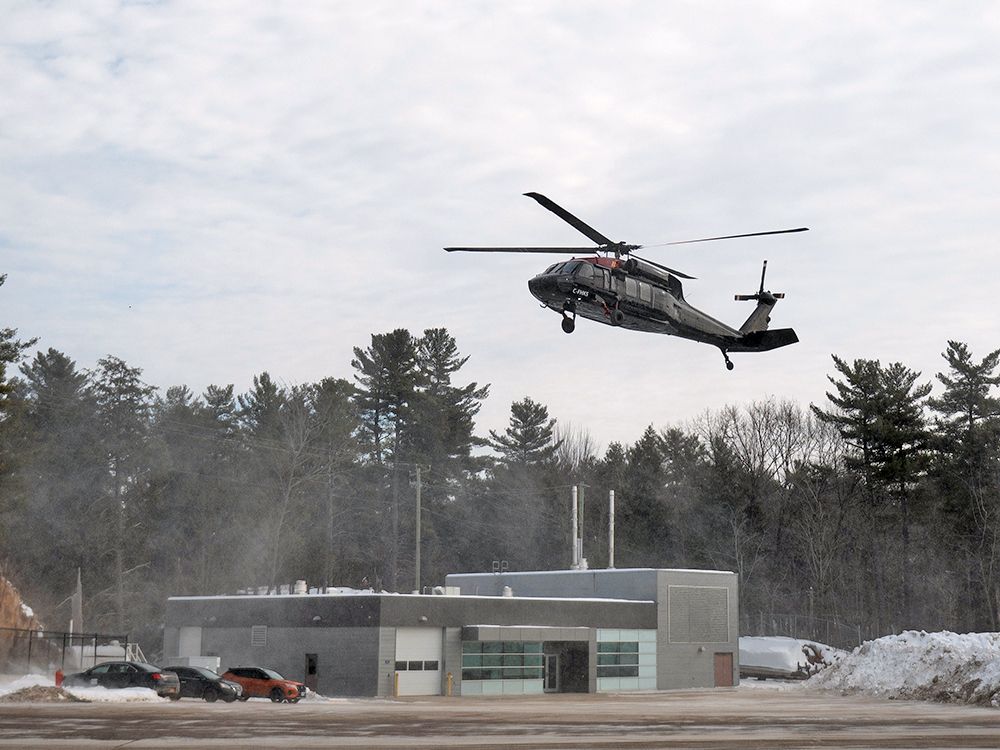
An RCMP officer takes a photo of a Blackhawk helicopter taking off at the London International Airport on Tuesday, Feb. 11, 2025.

OTTAWA — Canada’s helicopter industry is charging the federal government with a “serious breach” in allowing the RCMP to patrol the Canada-U.S. border with antiquated military helicopters that don’t meet the government’s own safety regulations, National Post has learned.

The second-hand helicopters, purchased on the open market by private Canadian operators who were then hired by the RCMP, were granted highly unusual special exemptions by Transport Canada. But documents show that the industry is accusing the federal government of breaking its own rules by allowing used choppers that don’t meet Canadian safety standards and aren’t supposed to carry passengers or even fly over developed areas.

“It’s not even something that should be considered,” said Trevor Mitchell, chief executive of the Helicopter Association of Canada (HAC), about the government’s decision to provide the special exemptions. “Why do some have to follow the rules and some don’t?”

For at least the last three years, the RCMP has been relying on a small number of private contractors to help patrol the border in search of illegal migrants, drug smugglers and other illicit activities. Those contractors, including two based in Ontario, have been using up to four Black Hawk helicopters that were purchased on the second-hand market after the U.S. military decided to update much of its own fleet.

According to the government’s Canadian Civil Aircraft Register, the second-hand Sikorsky Black Hawk UH 60As are each at least 40 years old and were imported between 2022 and last year.

The special exemptions from Transport Canada, the industry says in a series of letters to senior government officials, allowed them to do non-military jobs in Canadian air space.

HAC also says that the twin-engine Black Hawks didn’t come with “type certificates,” which act like recipe books for new owners in that they provide details about the aircraft’s parts and how it should be maintained.

But in a March 20 letter to Transport Minister Chrystia Freeland, Mitchell said even the conditions attached to the exemptions — such as not being allowed to carry passengers or fly over developed areas — have not been followed. “We urge you to direct your department to ensure the safety restrictions attached to these aircraft are strictly enforced for the balance of the RCMP’s contract and that the Force be urged to select a certified aircraft before the contract expires.”

The contracts, worth an estimated $16 million so far, expire June 30, documents show.

The Canadian helicopter industry, which relies heavily on conforming to streams of rules and regulations as its safety pillars, is angry and confused over Transport’s decision, Mitchell said. “It’s the hottest topic in the industry.”

HAC has been trying to find out why these helicopters got the green light but the association said that it hasn’t been given a full explanation from Transport Canada, which granted the exemptions, or the RCMP, who hired the contractors, even though the federal police force has its own helicopters.

None of the government players involved in the Black Hawk contracts agreed to an interview to address the industry’s concerns, despite repeated requests.

A RCMP communications officer wouldn’t say over a period of almost a week when the federal police would be available to comment.

Two Transport Canada executives involved in the granting of the special exemptions referred National Post to communications staff.

A communications official then said that the transport department is “unable to accommodate your request and facilitate a direct conversation.”

But in an email, the official confirmed that four Black Hawks have been registered in Canada, placed on the Civil Aircraft Register and issued “special certificates of airworthiness.”

The aircraft, the email said, are being operated by legally-approved air operators.

Freeland also could not be reached for comment.

Denis Pilon, chief operating officer of Helicopter Transport Services, a Carp, Ont. company that bought two of the four Black Hawks and then leased the helicopters and crew to the RCMP, did not respond to voice mail messages. The government’s civil aircraft registry says a third chopper was imported by Expedition Helicopters Inc. of Cochrane, Ont. The industry association says the fourth was contracted by the Alberta government.

Despite its reluctance to discuss the matter, the federal government is well aware of the situation involving the Black Hawks and the industry’s concerns.

In the spring of 2024, following interactions with HAC, former Transport Minister Pablo Rodriguez directed his officials to pause the issuing of special exemptions for the Black Hawks. But in September of that year, Rodriguez resigned from the federal cabinet to run for leader of the Quebec Liberal party.

He was replaced at transport for about seven months by Anita Anand, now the foreign affairs minister. She was then replaced in the new year by Chrystia Freeland, after Mark Carney became prime minister. Neither Anand nor Freeland has clarified the government’s view of the situation or publicly commented on the special exemptions for the Black Hawks.

Although the Black Hawk contracts pre-date the re-election earlier this year of U.S. President Donald Trump, Canada’s enhanced border patrol is in sync with the White House’s escalation of concern about illegal migrants and illegal drugs entering the U.S. from Canada, Mexico and elsewhere.

But it’s not like there aren’t other — even domestic — options beyond Black Hawks.

Mitchell says Canada has about 200 companies that offer helicopter services and pilots to fly them. Their collective fleets comprise about 1,700 choppers, many of which might be better suited than Black Hawks for patrol duties because they’re smaller and equipped with infra-red cameras that allow them to work in the dark.

Governments in Canada, mostly large municipalities, also own about a dozen helicopters. The military and the RCMP also have their own fleets.

If the RCMP’s own helicopters weren’t enough, Mitchell said, it would have no problem finding private contractors to help them patrol.

John Arquilla, a long-time defence analyst based in Monterey, Calif., said Black Hawks are mostly used to transport soldiers and other personnel but are considered “utility” aircraft because of their flexibility. But Black Hawks aren’t ideal for patrolling borders, he said, because they’re expensive to operate, have limited range and can easily be heard as they approach.

Arquilla said the broader problem with using Black Hawks to patrol a massive area such as the Canada-U.S. border is that they would have little effect, particularly compared to a cheaper, more effective technology such as drones.

“I view the whole idea of patrolling borders with helicopters skeptically.”

Despite being unwilling to agree to an interview, the RCMP seems to acknowledge that critics of the Black Hawk contracts have valid points. In a Feb. 27 letter to HAC, Commissioner Mike Duheme wrote: “I acknowledge your concerns with respect to the Blackhawk helicopters and would like to inform you that the RCMP is working with Transport Canada to review the current restrictions from a law enforcement context.”

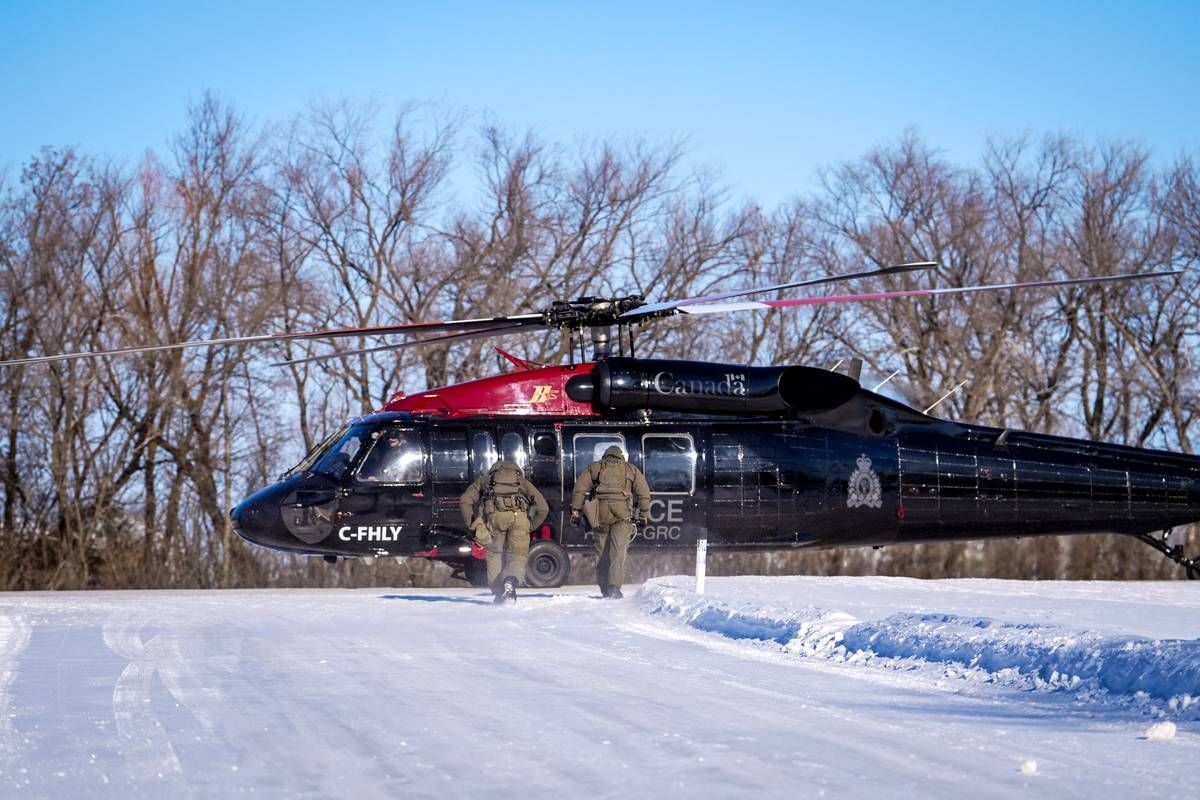
 An RCMP Black Hawk helicopter.

In that same letter, Duheme confirmed that the “Black Hawks in question became operational in mid-January and are conducting surveillance patrols along the border.” He also explains that the Black Hawks are being used to complement the RCMP’s existing fleet of nine helicopters, six of which provide border surveillance and support with cameras capable of thermal imaging, while one is capable of any necessary hoisting.

While the RCMP wouldn’t agree in recent days to an interview, the force was keen just a few months ago to publicize its new access to the Black Hawks and the enhanced capabilities that were to come with them.

In an interview conducted with a television network next to one of the Black Hawks, an RCMP official confirmed that the helicopters were leased with a crew and that the choppers were designed to boost capacity. “It’s really about the ability to move people quickly,” Mathieu Bertrand, the RCMP’s Director General of Federal Policing and Border Integrity, told the reporter. “Things happen quickly on the border.”

The issue of certifying the privately-owned Black Hawks has also been a topic of interest at Transport Canada for many months.

According to a June, 2024 internal departmental bulletin obtained by National Post, transport was to stop considering applications for “special certificates of airworthiness” that month. The document warns of increased interest among Canadian operators in using aircraft with the special certificates and that “this may represent a significant change in the risk environment.”

Transport Canada is responsible for the country’s transportation policies and programs. The department, known for its emphasis on safety of Canada’s road, rail, marine and aviation networks, says it promotes safe, secure, efficient and environmentally responsible transportation.

While the Black Hawk was designed for war more than border patrol, the one advantage it may have over other choppers in this regard, is that it’s large, well-known and American. Those could be important attributes, HAC’s Mitchell says, if Canada’s primary goal in the mission is to ensure that the United States saw its neighbour trying to step up its border patrolling efforts in a very visible way.

In a June 1 letter to the RCMP, Mitchell writes that the Black Hawks “offer no technological advantage to the mission profile, only an appearance.”

Helicopters are valued for their versatility and mobility. In Canada, they’re mostly used in search and rescue, fighting forest fires, helping combat floods, and commercial applications in remote areas such as mining and electrical lines.

But five-seat helicopters are typically used for patrol because they’re more nimble and cheaper to operate than a larger, 14-seater such as Sikorsky’s Black Hawk.

According to a February 10 letter by HAC to RCMP Commissioner Duheme, the choppers have not been approved by Canadian or American authorities for civilian purposes.

The RCMP’s Black Hawk contracts overlap with Carney’s vow to increase Canada’s military spending so that it reaches the NATO target of 2 per cent of gross domestic product (GDP). Carney has also vowed to do more to support Canadian business and to rely less on the U.S.

Industry sources say the older Black Hawks were selling in recent months for about $1 million each, as the market became flooded with supply. The market for used helicopters has grown in recent years as the U.S. military has modernized its fleet, including the purchase of a newer model of Black Hawks, called the UH-60M.

That has punted a number of older, but still functional Black Hawks to the second-hand market.

 An RCMP Sikorsky UH-60 Black Hawk helicopter lands at the Canada Border Services Agency port of entry in Lansdowne, Ont., on Feb. 12, 2025.

Prices of new and used aircraft vary widely, depending on a range of factors. But a new five-seat helicopter, including those made in Canada, sells for about $6.5 million, while a new 14-seater, similar in size to the Black Hawks, goes for about $12 million.

But the helicopter association says the special exemptions from the usual rules are not fair to Canadian helicopter makers, nor to those Canadian companies that offer helicopter services using certified choppers.

Bell Textron, a subsidiary of Fort Worth, Tex.-based Textron, makes commercial helicopters at its Mirabel, Que. facilities.  Its lineup of models includes the Bell 412, which could be used for border patrol.

Airbus Helicopters Canada, formerly MBB Helicopter Canada, has a 300-employee site at Fort Erie, Ont. That location focuses largely on sales, repair, engineering and composite manufacturing.

The Black Hawk, made by Sikorsky Aircraft, is a four-blade, twin-engine, medium-lift chopper in the “military utility” product niche. Stratford, Conn.-based Sikorsky was founded by the

Russian-American

aviation pioneer

Igor Sikorsky

in 1923 and was among the first companies to manufacture

helicopters

for civilian and military use. The Black Hawk was first conceived in 1972 when its design was submitted for a U.S. Army competition.

Carney, meanwhile, issued a statement earlier this month saying that Canada plans to boost its defence spending by $9.3 billion to $54.3 billion. The money will be used on a range of items, including submarines, ships, armoured vehicles and aircraft, as well as new drones and sensors for monitoring the Arctic and seafloor.

In the government’s latest signal that it intends to create some distance from the U.S. since Trump imposed a wide range of debilitating tariffs on Canadian exports, Carney said Canada wants to reduce how much of its defence budget goes to purchases of American equipment. The prime minister has said that about 75 per cent of Canada’s capital spending on defence heads to the U.S.

In March, Carney ordered a review of the plan to order 88 fifth-generation F-35 fighter jets to determine whether those aircraft represent the best investment. While Canada is legally obliged to purchase the first 16 of those jets, Auditor General Karen Hogan said this week in a report that it’s unlikely that the order will be delivered on time or on budget.

National Post

Our website is the place for the latest breaking news, exclusive scoops, longreads and provocative commentary. Please bookmark nationalpost.com and sign up for our daily newsletter, Posted, here.


Saskatchewan Premier Brad Wall at Council of the Federation meetings in Niagara-on-the-Lake, Ont., on Friday.

OTTAWA — Alberta Premier Danielle Smith and Saskatchewan Premier Scott Moe agree that Moe’s predecessor Brad Wall is the right man to repair Canada-India relations, amidst news that Canada will soon be sending a new high commissioner to New Delhi.

“I’d be supportive of that,” said Smith when asked on Wednesday about the prospect of Wall becoming Canada’s next high commissioner to India.

“I think that Saskatchewan has done incredibly impressive work on expanding its footprint internationally through its trade offices, in particular India,” she added.

Moe was quick to echo Smith’s sentiments, hinting that Wall could possibly aim even higher than being Canada’s envoy to the emerging Asian superpower.

“I would also be a proponent for (Wall) to be not only high commissioner to India but essentially the face and the voice for many of Canada’s foreign relations,” said Moe.

“We’ll see what his answer is to that,” Moe joked.

The two Prairie premiers were speaking at a press conference in Lloydminister, Sask., after a joint caucus meeting.

Moe praised Wall for building inroads to India and other emerging markets during his tenure as Saskatchewan’s premier, between 2007 and 2018.

“Why I would be a proponent of (Wall’s) to be high commissioner to India is because of the effort and focus that he provided … to those province to nation relations, and province to industry relations in not just India but in many countries around the world,” said Moe.

Moe also commended Prime Minister Mark Carney for taking steps to mend Canada’s strained bilateral relationship with India.

Wall became the province’s

first premier to visit India

in 2011 and led

a second trade mission

in 2014.

Saskatchewan’s exports to India were

valued at $1.3 billion

in 2023, a 52 per cent jump from the midpoint of Wall’s tenure in 2013.

The province now produces more than a quarter of Canada’s total exports to India, while being home to just three per cent of the country’s population.

It is the top supplier globally of lentils and potash to India.

Carney and Indian counterpart Narendra Modi jointly announced at

this week’s G7 summit

in Kananaskis, Alta., that they’d be designating new high commissioners for the first time since 2023, when the

murder of Canadian Sikh leader

Hardeep Singh Nijjar caused a rupture in bilateral relations.

India’s current Ambassador to Spain Dinesh K. Patnaik has already been tapped as the next high commissioner to Canada,

according to local reporting

.

Reports from India indicate that Carney

could reveal his pick

for high commissioner to India as soon as next month.

Wall, 59, was critical of Carney predecessor Justin Trudeau’s approach to managing Canada-India relations, notably panning Trudeau’s

controversial 2018 India trip

.

“Here’s hoping that the federal mission does no further harm,” Wall said in a tongue-in-cheek

2018 social media post

, which included screenshots of scathing international headlines documenting the visit.

Wall didn’t respond on Wednesday evening when asked about his interest in the high commissioner post.

He would join a number of ex-premiers who made the jump to key diplomatic posts, including ex-U.S. ambassador Gary Doer (Manitoba) and former high commissioner to the U.K. Gordon Campbell (British Columbia).

National Post

Our website is the place for the latest breaking news, exclusive scoops, longreads and provocative commentary. Please bookmark nationalpost.com and sign up for our daily newsletter, Posted, here.


Quebec toddler Claire Bell, 3, has been found three days after she mysteriously disappeared.

The Father’s Day disappearance of three-year-old Claire Bell was bizarre from the start, and as the frantic search for the missing Montreal girl stretched into its fourth day the escalating strangeness of the case was pointing to a dark ending. But then came joyful news. Claire had been found alive.

The missing girl was found by police in eastern Ontario, about 150 kilometres from her home in Montreal, on Wednesday afternoon. She was found in the St-Albert region after a strange and shifting investigation and large, intensive ground and air search.

As the news broke, some signs pointed to a parental dispute, perhaps designed to coincide with Father’s Day or perhaps fuelled by other concerns and desperation.

The case had galvanized the public. Claire’s mother was already under arrest. There was a dead dog and a mysterious witness described as a farm woman wearing an apron,

the Montreal Gazette reported

. Hundreds of police and specialized civilians were scouring woods and highway ditches over a huge area, all while a flurry of dramatic social media posts preceding the disappearance showed the erratic mother variously upset, sad and angry .

It was Sunday morning, Father’s Day, around 9:45, when Claire was last seen in Montreal, with her mother in the LaSalle borough, where they reside.

Something distressing happened at some point in the next few hours.

News that tiny Claire was missing was revealed about six hours later when her mother, Rachel Todd, 34, stopped her SUV at a roadside fireworks and souvenir store about 55 kilometres west of where Claire was last seen. Police said she told an employee she had lost her child and didn’t know where she was. An employee told CBC the woman ran into the store in a panic and said she couldn’t remember what happened.

The mother’s 3:30 p.m. statement at the store on St-Emmanuel Rd. in Coteau-du-Lac triggered a police investigation that quickly grew to a large search growing incrementally in scope and seriousness.

Five hours later, the Sûreté du Québec, the province’s provincial police force, issued a public alert announcing Claire was missing.

Police included a photo of the girl, with her brown curly hair, kneeling outdoors while drawing on an easel, a coloured marker gripped in each of her hands. She is described as three feet tall, wearing a white long-sleeved shirt with a red collar, grey pants and no shoes.

“Loved ones,” the release said in French, “have reason to fear for her health and safety.”

“Our specialist teams are currently deployed across various sectors to carry out intensive research,” the police added on X two hours later.  “All necessary resources are being mobilized to find the child as quickly as possible.”

 A bus of school kids cheer as they go by a police command post west of Montreal and learn toddler Claire Bell was found alive, June 18, 2025..

The search for Claire continued for days, stretching from an apartment in Montreal, believed to be where Todd lived, west through rural terrain and highways and into Ontario.

On Monday afternoon, the search took a darker tone when a dog matching the description of Claire’s pet, Hazel, a Chihuahua, was found dead in a Montreal suburb near Highway 30, which is a direct route between Montreal and the fireworks shop. The cause of the dog’s death has not been released.

Police asked the public for information from anyone who might have seen a grey 2007 Ford Escape with licence plate number K5O FVE on Sunday. The vehicle has a yellow “baby on board” sticker on the rear windshield.

Hours before Claire’s disappearance, she appeared with her mother in an alarming selfie video posted online on TikTok.

Speaking English, through gritted teeth, staring intently into the camera and holding Claire tight to her chest, Todd spoke one line: “You try that again, and this is going to get ugly.”

The video has text overtop saying “I know more than you think” and underneath, it is captioned: “Have you come up against a mother with nothing to lose????” followed by five hashtags: #motherhood #threat #energywork #narcissist #magic.

 A video posted to TikTok on Sunday, June 15, shows Rachel Todd holding her daughter Claire Bell, and a cryptic message.

The context of the video is not known, and police did not comment on it, but the social media account where it is posted has been reported to investigators.

The video, like many others on her TikTok feed, are now accompanied by comments from viewers about the case, including “Where is Claire?” “Where’s your daughter?” “Dieu voit tout” (God sees everything), and “Dit aux policiers où se trouve ta fill” (Tell the police where your daughter is). Many commenters speculated on what might have happened, little of it pleasant.

Older videos on the same account include Todd discussing personal struggles.

One video, posted a week ago, has text over top that asks “Does anyone know where trauma meets reality?” In it, she says: “After a year and a half of survival mode, six months of investigation, and an entire life burnt to the ground, my nervous system can finally feel safe with just existing, again, so that’s a relief. I’m a little disappointed I wasn’t able to manifest more clarity as to why an environment that felt so safe to me for my entire adult life suddenly became a threat. But it’s a relief to know that I’m not entirely nuts, so, baby steps.“

Police were concerned with what they learned.

The Journal de Montréal reported Todd did not take her cell phone with her when she left, meaning police could not use it to backtrace her movements. She also allegedly left her apartment through an emergency door which was not covered by a surveillance camera.

Late on Monday, Todd had a lengthy interview with police and was arrested and charged with child abandonment. The allegations do not accuse her of purposely harming Claire but allege she abandoned the child, which put her health in danger.

On Tuesday she appeared in court through a video link from a police station where she was being held. The hearing was short. The Crown opposed her release because of the seriousness of the charge and the unresolved search for Claire.

Todd wore a red shirt with a grey blanket over her shoulder. She said little but nodded as the judge explained the proceedings and what was to follow.

“For now, we don’t know what happened to the little girl, for now we have the police officers still investigating,” Crown prosecutor Lili Prévost-Gravel told reporters afterwards. “So, we want to make sure nothing more tragic is going on.” Todd has no prior criminal convictions.

A police search of her cell phone, according to Journal de Montréal, suggested someone used it to search for children’s urns and funeral arrangements. It was heartbreaking news.

Todd recently worked in the restaurant industry. Colleagues at a restaurant she worked for said she left about two weeks ago but declined to say why. Family and friends said police have asked them not to talk publicly about the case.

“We just want her home,” a family friend told Postmedia when asked about Claire.

Claire’s father, Matthew Bell, had not spoken publicly about the case

but was posting online messages

asking for the public’s help in finding Claire. He is described as a 35-year-old professional chef, suggesting he and Todd might have met through their involvement in the food industry.

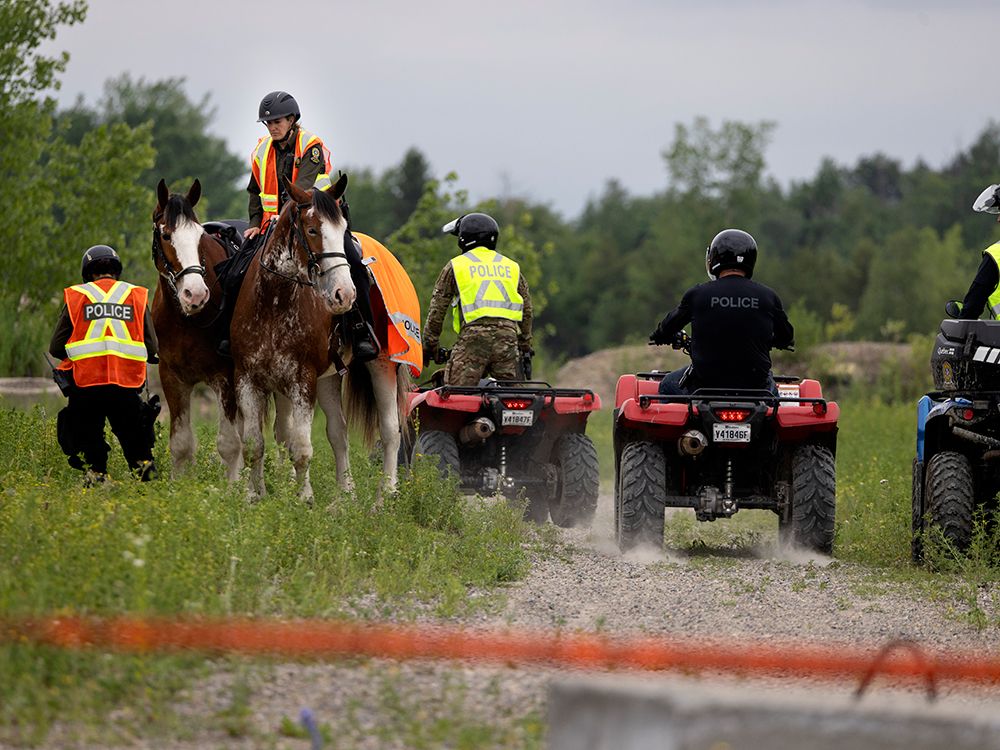
 Police search for missing 3-year-old Claire Bell at an old sand pit near St-Télesphore, west of Montreal, on Wednesday, June 18, 2025. The girl was found by a drone in Ontario the same day.

According to Bell’s Facebook profile, the two were engaged in 2021, although recent TikTok posts by Todd suggest they might have since separated.

That, along with the apparent vitriol in Todd’s videos helped fuel speculation over a parental feud.

One message Bell posted said: “Claire is still missing. Three years old. Very timid and quiet. Any and all information is needed.”

On Wednesday, provincial police gave a glimpse into something they say took place in the six-hour gap between Claire being seen at her apartment and her mother’s report that she was missing, but rather than solving mysteries it creates new ones.

Investigators said they were looking for a woman described as an important witness in the disappearance. Police wanted to speak to a woman who lives on a farm either in the Montérégie region or in Ontario who speaks English and French and was wearing an apron with the word “Abondance” on it, which is the French word for abundance.

Officers said the woman met the missing girl’s mother on Sunday prior to the mother reporting Claire missing. That offered hope, with an idea that perhaps the mother passed Claire to her before reporting her missing. Perhaps she was hiding Claire.

Late Wednesday afternoon came an enormous development: Police said that Claire was seen alive with her mother in eastern Ontario before she was reported missing.

Sgt. Eloise Cossette said Claire was spotted around 2 p.m. in the region around Casselman and St-Albert municipalities in Ontario, which is about 100 kilometres — an hour’s drive — from the fireworks store. The timing of the sighting would have given Todd time to backtrack to the fireworks store to make her report.

That shifted police attention. Sure enough, the police announced Claire had been found alive.

She was discovered by drones near Highway 417 by Ontario Provincial Police at 3:06 p.m.

“It is the best scenario we could have imagined,” Cossette told reporters Wednesday afternoon.

“She’s been found, she’s alive, she is conscious.”

The OPP said she is being examined by medical personnel as a precaution.

The girl’s father posted a message on Instagram following the news. He wrote: “Thank you everyone. Please allow me and my family to take this time for with our girl.”

National Post with reporting by Harry North and Kalina Laframboise, Montreal Gazette


Our website is the place for the latest breaking news, exclusive scoops, longreads and provocative commentary. Please bookmark nationalpost.com and sign up for our daily newsletter, Posted, here.


Bloc Quebecois Leader Yves-Francois Blanchet answers question during press conference on Tuesday April 29, 2025.

OTTAWA — The Bloc Québécois’ long and often rocky road to protect supply management from any concessions in future trade negotiations has come to a successful end. The Senate has adopted Bill C-202, making it the first bill set to receive royal assent in the new session of Parliament.

“We won,” said Bloc Leader Yves-François Blanchet enthusiastically, hours after the Senate adopted his party’s bill.

C-202 sought to amend the Department of Foreign Affairs, Trade and Development Act to prevent the minister from “making a commitment” that would increase the tariff rate quota for dairy, poultry, or eggs in trade negotiations. It would also prevent tariff reductions on these products when they are imported in excess.

The Bloc wanted to strengthen the long-standing federal government policy to maintain Canada’s supply management system, including its production control, pricing mechanisms and import controls.

The House of Commons unanimously passed the bill last week and the Senate did so “with division” on Tuesday evening.

“The notion of unanimity really weighed heavily. It was all parties and the unanimity of elected officials. So, everyone who speaks for Canadians and Quebecers was in favour,” Blanchet said at a press conference.

Bloc Québécois MP Yves Perron has been championing this bill for over five years. In an interview with the National Post, Perron expressed his pride.

“We have just demonstrated that the Bloc Québécois serves a purpose. I think we are capable of moving forward on issues and on a scale that is extremely positive for Quebec, but also positive for the rest of Canada,” he said. “And the rest of Canada has finally understood this.”

But the Grain Growers of Canada argued that “Parliament chose to prioritize one group of farmers over another,” while the Canadian Agri-Food Trade Alliance said it was “deeply concerned” by the adoption of “a flawed piece of legislation that sets a troubling precedent, undermining Canada’s longstanding commitment to the rules-based international trading system.”

Even if the Senate passed the bill, many senators still had some reservations on Tuesday. In a speech in the Senate, Alberta Sen. Paula Simons expressed concerns about what Bill C-202 means for national unity because it was from a Bloc MP, which advocates for the separation of Quebec from the rest of Canada.

“It does seem strange to allow a separatist party to set Canada’s national trade policy to such an extent, and at the expense of Western Canadian producers and agricultural exporters,” she said.

Parliament extensively studied an earlier version of the bill during the last legislature. A Senate committee heard from numerous witnesses, including government trade negotiators.

“From a trade negotiating perspective, the passage of the bill would certainly narrow the range of concessions that could be made to reach an agreement,” said Doug Forsyth, the director general of market access and trade controls bureau at Global Affairs Canada

in a Senate testimony

.

“I think it would be reasonable to expect future negotiating partners to adjust their own approach to negotiations with Canada,” he added.

The previous version of this bill made headlines last fall when the Bloc threatened to bring down the Trudeau government if it wasn’t passed alongside another bill. It was ultimately passed by nearly 80 per cent of the House of Commons in June 2023, despite opposition from some Conservative MPs.

However, the Senate never passed it, due to prorogation and political maneuvering by two senators, Peter Boehm and Peter Harder.

Harder was particularly opposed to the bill stating in 2024 that “supply management has enjoyed religious-like devotion” in recent years. He also characterized the bill as “both reckless and dangerous” that could “do significant harm to Canada’s interests.”

“I suppose congratulations are also in order for the strong dairy lobby because they played no small part in this. It’s the same dairy lobby that is financed and operated on the backs of Canadians through supply-managed goods themselves,” he

said at the time

.

In an interview with National Post on Wednesday, Sen. Harder said he believes the Senate’s role is to defer to the elected legislature, even if he stood by his previous statements.

“I’m an institutionalist and I believe that the Senate should not hold itself in opposition to the House of Commons,” he said.

In Quebec, the Union des producteurs agricoles (UPA), which represents roughly 42,000 Quebec farmers, celebrated the adoption of the bill, claiming “dairy, egg, and poultry producers have long awaited this necessary and legitimate protection for their livelihood.”

“All parliamentarians and senators who supported this bill, as well as its previous versions, can congratulate themselves on having strengthened the country’s food security,” said Martin Caron, the UPA president.

With files from Simon Tuck

Our website is the place for the latest breaking news, exclusive scoops, longreads and provocative commentary. Please bookmark nationalpost.com and sign up for our newsletters here.


Penny Boudreau, who strangled her twelve year old daughter, in 2009.

A Nova Scotia woman serving a life sentence for strangling her own daughter to death has been granted a 60-day unescorted temporary absence from prison, but was denied day parole.

Penny Patricia Boudreau

will be living at a halfway house in an undisclosed location for the duration of the two-month release.

“Your criminal history is limited, however that has very little mitigating impact in terms of the overall history because of the nature, the severity and the circumstances of your crime,” Francois Levert, a member of the parole board, said Wednesday.

“The impact of your crime cannot be overstated as this impact remains very much alive.”

Boudreau murdered her 12-year-old daughter Karissa Boudreau on Jan. 27, 2008, later claiming it was to save her relationship with her then boyfriend, Vernon Macumber. The Crown later said he had no role in the crime.

 Karissa Paige Boudreau.

“Holding a position of trust, you strangled the young victim and disposed of the body in the snow (beside the LaHave River) with hopes it would not be discovered,” according to a written decision earlier this year from the parole board regarding Boudreau.

“Moreover, you concocted a story that she might have been abducted and made public pleas for her return. An exhaustive police investigation involving undercover agents led to your arrest. It was your position that your decisions were taken to save your intimate relationship with your partner.”

The “paramount consideration” guiding Wednesday’s decision is the protection of society, Levert said.

Boudreau, now 51, has completed numerous escorted temporary absences from prison since they were first approved for her in 2018.

“There’s quite a bit of difference between a six-hour or seven-hour outing and a 60-day period,” Levert said.

“The board believes that, at the current time, it is difficult to foresee … within two months … you’ll be able to transition immediately” to day parole, he said.

The parole board can’t “assume things will go well,” Levert said.

While the board authorized the 60-day unescorted temporary absence for Boudreau, it wants to see how she does with that before giving her six months of day parole. On day parole, Boudreau would sleep at a halfway house, but she would be able to spend time in the community for work, education or treatment.

 Penny Boudreau is led from court in Bridgewater, N.S., in June 2008, after her appearance in the murder of her 12-year-old daughter, Karissa Boudreau.

During her 60-day release, Boudreau is to have no contact with several members of her victim’s family that were identified only by initials at Wednesday’s hearing. She must immediately report all relationships with men and disclose whether they have parental responsibility for children under 16. Boudreau must also follow a mental health treatment program.

While the board denied Boudreau day parole following the 60-day prison leave, it will order a review of her case in six months.

“This will allow time for your case management team … to give an assessment of how things are going and link it to risk,” Levert said.

Boudreau teared up several times during Wednesday’s hearing.

“It makes no difference and it doesn’t undo anything, but I want to acknowledge that I am aware that people are hurting because of what I have done,” Boudreau told the parole board.

“I realize that I can sit here, or I can be out, and I can’t undo it. I just want them to know that I don’t take this lightly at all. The amount of hurt I’ve caused I can’t undo but I just want (them) to know that I recognize it, and I just appreciate you guys at least listening to me.”

Karissa’s body was found in the snow along a riverbank in Bridgewater, N.S., about two weeks after she was last seen in her mother’s car on Jan. 27, 2008.

The year after Karissa was killed, Boudreau pleaded guilty to second-degree murder. A judge sentenced her to life in prison with no chance of parole for 20 years.

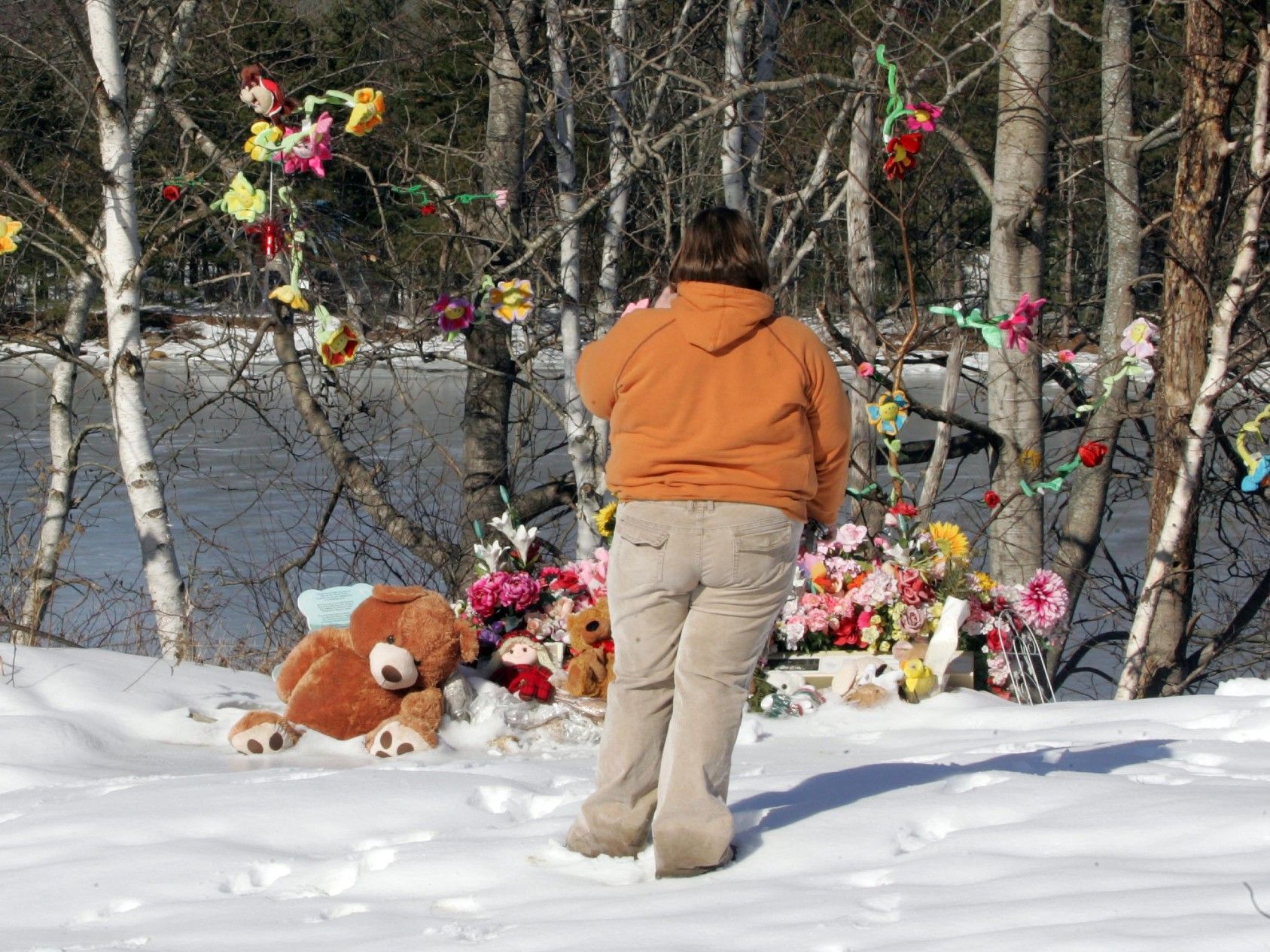
 The memorial site along the river bank in 2009 where Karissa’s body was found still exists today.

That would have meant a release date of June 13, 2028. However, under the Corrections and Conditional Release Act, she is now eligible to apply for unescorted passes, including day parole, three years prior to completing that sentence.

Boudreau is serving her time at the Nova Institution for Women in Truro.

The parole board heard Wednesday from Paul Boudreau, Karissa’s father.

“My whole world changed the day Karissa was taken away from me,” he told the board.

“Now, she’s only memories, pictures and a name etched on a stone.”

He told the board he’s questioned himself many times over his daughter’s murder. “Am I a failure as a father? Should I have seen this coming?” said the grieving dad.

Karissa’s murder had “long effects on her family, friends (and) schoolmates that knew and loved her,” he said.

“Hearing the horrific tale has changed them in many ways forever. Life will never be the same for any of us.”

Since she was sentenced in January 2009, Boudreau “has been fully engaged in recommended correctional programming and interventions,” her parole officer told the hearing.

In 2018, Boudreau “began the process of gradual reintegration,” which included escorted temporary absences to attend local church services, said her parole officer, noting Boudreau had worked as the chaplain’s assistant at Nova Institution for several years.

Her most recent risk assessment “suggests that Ms. Boudreau’s global risk for future recidivism of any kind, violent or general, is estimated to be in the very low range,” her parole officer told the board.

Correctional Service Canada recommended Boudreau was ready for the move to a halfway house for the 60-day unescorted temporary absence, as well six months of day parole.

“The fact that Ms. Boudreau’s risk to reoffend is currently considered very low combined with her consistent positive institutional behaviour (and) motivation to be involved in interventions suggest that the risk is manageable,” said her parole officer.

This past March, the parole board handed Boudreau 18 more escorted temporary absences “to participate in church services and/or church related activities, including but not limited to special community events, bible study, meetings with the pastor and/or congregation, for up to six hours each including travel time.”

It also granted her four escorted absences of up to seven hours each to see family, though the same decision noted Boudreau was no longer in contact with one of her parents.

Our website is the place for the latest breaking news, exclusive scoops, longreads and provocative commentary. Please bookmark nationalpost.com and sign up for our daily newsletter, Posted, here.