LP_468x60
on-the-record-468x60-white

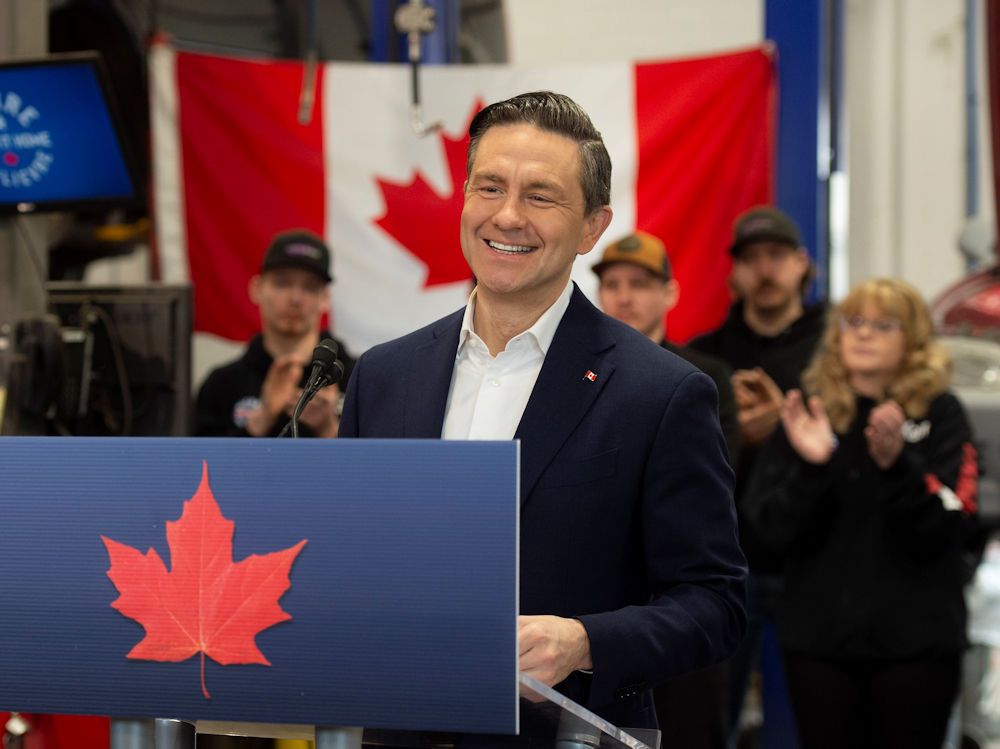
Conservative leader Pierre Poilievre making a campaign stop at a tire shop in SE Edmonton.

First Reading is a Canadian politics newsletter that throughout the 2025 election will be a daily digest of campaign goings-on, all curated by the National Post’s own Tristin Hopper. To get an early version sent directly to your inbox, sign up here.

TOP STORY

At a Wednesday rally for Conservative Leader Pierre Poilievre in Brampton, Ont., reporters noted a curious coterie of attendees wearing white sweatshirts bearing the slogan, “Do you believe the polls?”

The group has not previously appeared at any kind of political gathering, and their only official web presence is an Instagram page with just 12 followers as of press time.

This election has featured particularly volatile polls, and skeptics wouldn’t be wrong to note there are elections that are harder to track than others.

Still, a handful of people questioning public opinion surveys ended up inspiring a press question as to whether Poilievre himself was a poll skeptic and, by extension, likely to question the integrity of the election if it doesn’t go his way.

At a press conference on Thursday, Poilievre was asked if he believed the polls and would respect the results of the 2025 election.

“Yes, and that decision will be based on whether after a lost Liberal decade of rising costs and crime, and a falling economy, under America’s thumb, we can afford a fourth Liberal term,” he said.

Poll skepticism has cropped up before, as Conservatives experience the dissonance of witnessing the most enthusiastic campaign of their history, only to keep reading polls in which they’re destined to lose.

“Don’t believe the polls — just look at this crowd in Edmonton,” reads an X post this week by B.C. Conservative MLA Harman Bhangu. He was highlighting a Poilievre rally near the Edmonton International Airport that attracted 15,000 people, one of the largest Canadian partisan gatherings since the 1970s.

Early in the campaign, the conservative-leaning National Citizens Coalition also posted an image of a packed Poilievre rally with the caption, “Don’t believe the (Liberal) polls.”

One reason for the dissonance might be that the Conservatives are actually doing better in the polls than at any time in the 22-year history of the modern Conservative Party.

The problem for the Tories is that they’re hitting all-time highs in public support just in time for the Liberals to do the same thing.

In 2011, then Conservative leader Stephen Harper needed only 39.62 per cent of the popular vote to secure a majority government. Throughout the 2025 campaign, by contrast, there have been 16 polls in which the Conservatives charted higher than 40 per cent.

In any conventional election, they’d be well on their way to a majority win. But support for both the Bloc Québécois and the NDP has cratered, leading to a consolidation of the progressive vote around the Liberals unlike anything seen in the last 50 years.

Not since 1968 have the Liberals scored a share of the popular vote higher than 45 per cent. Throughout the 2025 campaign, the Liberals under Mark Carney have consistently charted at 45 per cent or higher.

Only four months ago, there wasn’t a single poll in Canada that wasn’t projecting a Conservative supermajority.

However, there hasn’t been a single poll conducted since the beginning of the campaign that hasn’t projected a vote share likely to result in a Liberal victory.

But polls are only projections of what might happen, and the Conservatives can at least take heart the polling in the 2025 election has been unusually volatile, leaving the door open to unexpected swings.

Even minor rebounds in support for the NDP or the Bloc could change the dynamic overnight. So could an unexpected surge in voter turnout.

And the polls aren’t always right. In October, the Saskatchewan provincial election yielded one of the largest polling gaps in the history of Canadian public opinion surveys: The Saskatchewan Party secured a 12-point victory, despite multiple polls showing them likely to lose by three points.

The aforementioned 2011 federal election is a leading example of why polls are not always representative of electoral outcomes.

Only hours before that election, one EKOS poll put the Conservatives at 33.9 per cent — barely enough for the party to win re-election as a minority government. It ended up being off by six points, and they won a majority with 11 seats to spare.

LET’S POLL

Speaking of polls, Abacus Data is now tracking a six point lead for the Liberals (42 per cent, to 36 per cent for the Conservatives). This is notable because Abacus has been one of the pollsters more favourable to the Tories. Their survey from last week showed a clean 38/38 tie between the two main parties. This is in part because Abacus has been weighting their results to reflect the fact that the Conservatives are likely to attract outsized numbers of non-voters to the polls.

But their latest 42/36 poll is being driven in part by eye-watering Liberal gains in Ontario and Atlantic Canada. Ontario was polling 47/37 for the Liberals, while the Atlantic provinces had them at 63/26.

 Liberal Leader Mark Carney issued this promise on Thursday. The only problem is that he’s describing something that is already the law; firearms ownership has long been barred for convicted criminals of any kind. Canadian law actually goes much farther than that; the RCMP are empowered to unilaterally pull a firearms license and seize a gunowner’s firearms without so much as a charge, never mind a conviction.

POLICY CORNER

Most of this campaign has featured rehashes of policies that Canada has pursued before. Home-building schemes, tax cuts, apprenticeship incentives, pledges to expand energy production; all of them have appeared in prior elections to some degree.

What no leading Canadian politician has ever seriously proposed is a “three strikes” law for recidivist offenders. Conservative Leader Pierre Poilievre proposed such a law on Wednesday, albeit with a notable difference from the “three strikes” laws that have existed in the U.S. Whereas the Americans usually jailed someone for life after three criminal convictions, Canada would do it for 10 years.

Get all of these insights and more into your inbox by signing up for the First Reading newsletter here.


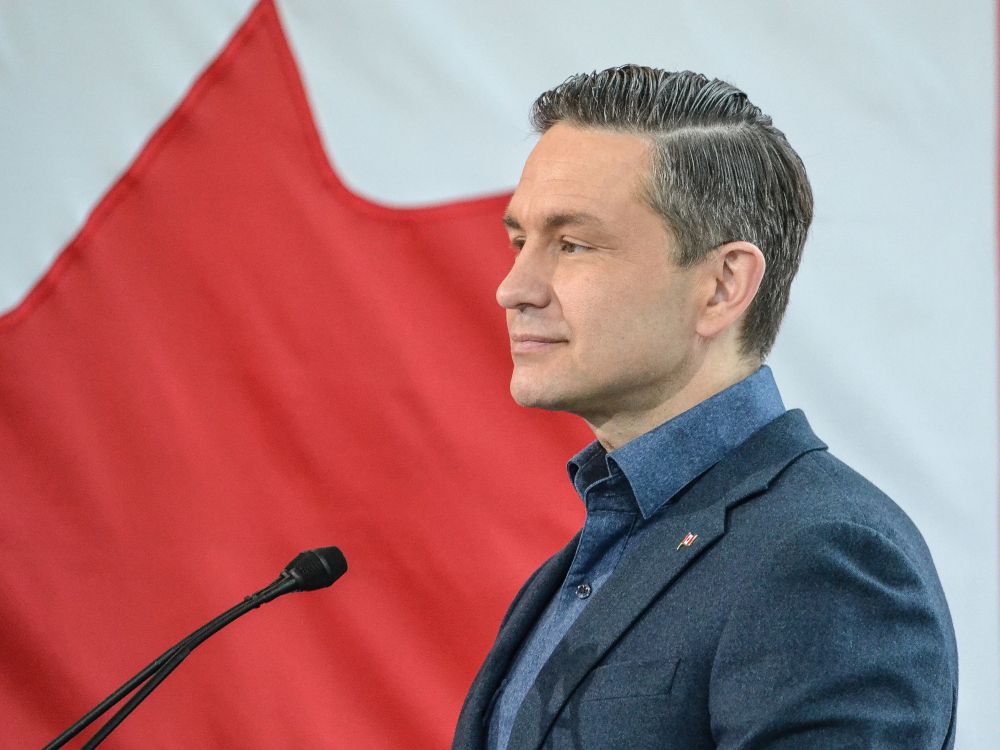
Conservative Leader Pierre Poilievre

In an incident last month that may soon be considered ominous foreshadowing, Prime Minister Mark Carney was

pressed

by the media about his financial holdings and the ethical conundrums that they present. To change the subject, Carney boasted about his recently acquired security clearance, and claimed it was irresponsible for the leader of the Opposition not to obtain one himself.

This criticism flirted with the

conspiracy theory

that Conservative Leader Pierre Poilievre would fail a background check, which ignores the fact that Poilievre received security clearance after becoming a cabinet minister in 2013, demonstrating that there had been no concerns by security and intelligence officials about his loyalty to Canada or compromising foreign connections.

Unlike other party leaders, Poilievre declined the offer to be cleared in order to view an unredacted National Security and Intelligence Committee of Parliamentarians (NSICOP) report on foreign electoral interference, which contained the names of parliamentarians alleged to be witting or semi-witting accomplices.

He noted that doing so would only lead to “some breadcrumbs of intel and then (being told) you can’t talk about any of this stuff anymore.” Later, his office reiterated that unlike those party leaders who “are willing to limit their ability to hold the government to account on important issues of national security, Mr. Poilievre will not be gagged.”

After it came to light that Liberal MP Paul Chiang had suggested that one of the Chinese Community Party’s (CCP) most repressive laws should be enforced on Canadian soil — urging his constituents to turn another candidate over to the Chinese Consulate in exchange for a bounty — Poilievre’s refusal to be briefed and therefore retain his ability to speak freely would seem to be the correct choice.

Owing to his lack of access to classified information, Poilievre was free to observe that the Liberal party had been reticent to stand up to a “

foreign hostile regime

.” The NSICOP foreign interference report had been redacted to obscure privileged information that, in its

unclassified summary

, “assessed that the PRC (People’s Republic of China) believes that its relationship with some members of Parliament rests on a quid pro quo that any member’s engagement with the PRC will result in the PRC mobilizing its network in the member’s favour.”

If Poilievre had been cleared to read the unredacted report (which would have entailed him promising not to reveal special operational information), and what he read had included the actions of PRC proxies, Poilievre’s criticisms about the unwillingness of the Liberal government to take these networks seriously could lead to allegations that he had committed an offence under Sec. 13 of the Security of Information Act, which carries with it a threat of up to 14 years in prison. In other words, he might have learned the details of lax responses to the CCP’s influence operations earlier, but he would been prevented from speaking to Canadians on the topic when it mattered most.

Poilievre’s unfettered ability to speak freely without fear of politicized claims of misuse of classified intelligence will remain vital during his campaign, as stunning evidence has just come to light that the CCP’s Central Political and Legal Affairs Commission is interfering directly in this election. The Privy Council Office’s (PCO)

briefing

revealed that this body’s “information operation is taking place on the social media platform WeChat,” while the

PCO’s backgrounder

noted that it involves “deliberately amplifying narratives in a co-ordinated and inauthentic way.”

Michael Chong, himself a target of sophisticated CCP disinformation and interference,

noted

that this revealed that “the Communist party in Beijing is engaging in a sophisticated campaign to interfere in Canada’s election with the aim of re-electing Mark Carney and the Liberals.”

This WeChat interference campaign conducted by the CCP, via the Youli-Youmian account, has all the hallmarks of the operations detailed in the NSICOP foreign interference report. Had Poilievre obtained the security clearance required to view the full report, all his comments about this outrageous intelligence operation would be tainted by his prior knowledge of the special operational information that revealed similar campaigns outlined by NSICOP, such as the operation conducted against former Conservative MP Kenny Chiu.

In order to hold the government accountable at this critical juncture, Poilievre made the unpopular but responsible choice. Poilievre’s decision will be vindicated whenever he speaks freely about this stunning attempt by the CCP to secure Carney’s election.

National Post

Ryan Alford is a senior fellow at the Macdonald-Laurier Institute and professor at the Bora Laskin faculty of law at Lakehead University.


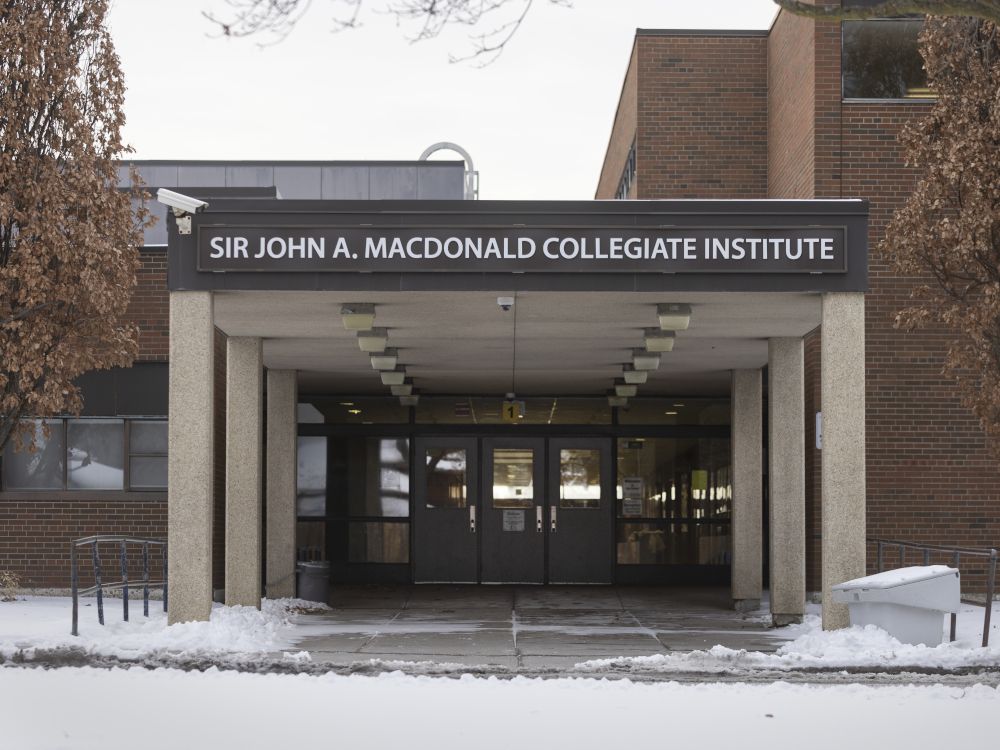
The Sir John A. Macdonald Collegiate Institute in Toronto.

In its childish effort to delete historical names from its schools, the Toronto District School Board (TDSB) appears to have violated its own bylaws.

In February, TDSB trustees voted to

rename three schools

named after Sir John A. Macdonald, Henry Dundas and Egerton Ryerson.

Their decision was outrageous on many grounds, one of which is that it may be in violation of the

bylaw requirement

that financial and budgeting information be publicly presented. Equally bad, after I reached out to TDSB trustees asking for them to comment on this apparent violation, they clammed up and have stayed silent for over a month.

To be clear, the issue is not about denying the injustice of Canada’s residential schools, nor the admirable goal of making our schools welcoming for all. This is about an altogether different subject — the misguided tearing down of our great leaders and the cack-handedness of the TDSB in doing so.

In addition to the bylaw breaches, the school board admitted that it did not consult

a single historian

as part of its renaming review. Otherwise, it would have had more accurate portraits of these men than the marred ones recently painted by ideologues.

How can the TDSB determine and judge 19th-century events without the benefit of historical research? Simple: it was a sham all along, nothing more than the righteous application of a 21st-century woke purity test.

It’s time to speak out.

Save Our History

has been formed to do just that. We’re a newly created, non-partisan, grassroots movement dedicated to preserving and celebrating our rich Canadian history by protecting the historical names of our schools. And there is much to celebrate.

Save Our History works in concert with other groups such as the

Canadian Institute for Historical Education

, a group of notable historians who are setting the record straight and countering the false narratives that took root several years ago.

To dismissively erase Macdonald, Canada’s founding prime minister, from schools dishonours our history. Of important note, residential schools existed decades before he arrived on the scene.

Ryerson was an education reformer who founded our free, public education system and lived among the Mississaugas, but who has been erroneously condemned for simply writing a report about boarding schools for Indigenous youth that reflected the contemporary educational consensus, long after they had been established and long before they became government policy.

Henry Dundas was an active abolitionist who represented a runaway slave in the late 1700s, but who advocated a more tactical approach to abolition given the previous failures of others to do so amidst the prevailing politics.

All three men were ahead of their times. Were they perfect men? No. Were they great men? Yes. Should they be honoured? Yes.

Sadly, the TDSB doesn’t plan to stop at these three schools. It made known its intention to rename other schools, as well.

Nor is this only a Toronto issue. At least 10 other Ontario schools are named after Macdonald in various cities. Will their school boards also be divisively deleting his name from their schools?

Our schools are falling apart. Precious money is needed to carry out urgent repairs, which is surely a more pressing need and appropriate use of scarce resources than name changes. Our kids deserve better schools and, equally importantly, to be proud of Canada.

Given that the Toronto board educates around 239,000 children, its provincial overseers at the Ministry of Education should sit up and pay attention to what’s going on.

At a time when our country’s very existence is threatened by U.S. President Donald Trump, this is the worst possible time to give him added ammunition to question the validity of our country.

If the Toronto school board were truly interested in correcting the mistakes of the past, it would start with its own. But it is likely too far gone and too far captured by revisionists to admit that renaming schools was a mistake.

Right-minded citizens must stand up and our leaders must act. If you care about our national heritage, you must speak out. And the Ontario government must step in.

National Post

Mark Johnson is the founder of SaveOurHistory.ca. He was a Conservative candidate in Toronto in the 2021 federal election and is a corporate lawyer who has worked in the private and public sectors.


Around 1,250 people were in attendance at  Liberal Leader Mark Carney campaign stop in Saskatoon on Wednesday, April 9, 2025. (Michelle Berg / Saskatoon StarPhoenix)

How best to sum up the current Canadian political situation? “Mark Carney looks like Paul Martin — and baby boomers think it’s still the 1990’s.” Their children, however — and their grandchildren — know nothing of such Liberal leaders. They live in the current decade. Consequently, an unprecedented divide now exists between Canadians this election cycle, segregated by age.

According

to pollster Nanos

, 55 per cent of those over 55 favour the Liberals under the leadership of Mark Carney, and 29 per cent the Conservative Party under Pierre Poilievre. Among those aged 35-54 party support converges, with 44 per cent favouring the Liberals and 39 per cent the CPC. Among the youngest voters, Conservative support is pronounced: only 33 per cent of Canadians 18-34 support the Liberals, while 43 per cent approve of the CPC.

This reverses the standard proclivity with regards to politics and age. People tend to start left in their youth and move towards the right as they age. As the cliché has it (with the wisdom that such cliches so often encapsulate): If a man is not a socialist by the time he is 20, he has no heart. If he is not a conservative by the time he is 40, he has no brain.

One interpretation of this well-documented age shift toward the Conservatives is that older people are simply more hidebound, and that radicalism, however necessary it might sometimes arguably be, just doesn’t sit well with those too set in their ways.

Another view, which I believe to be more psychologically valid, is that there is little difference between holding traditionally classic conservative/liberal views and being sensibly mature. According to this view, not widely held (yet), idiot radicalism (and the heedless hedonism that inevitably accompanies it), is an expression, not of brave and forthright revolutionary sentiment, but the constantly screaming political voice of the still immature and pathologically entitled.

In any case, Canadians are apparently bucking the universal developmental/political trend, with the youth tilting to the right (insofar as Canadian Conservatives can be considered right) and the elders in our society rejecting their political coming of age and support for tradition. This all could be read to perversely set the radical elderly against the wise and cautious youth in the Great White North.

But is this truly the case? Those who hold that view must simultaneously assume that the CPC is the party of tradition, and that older Canadians perceive the federal Liberals under Carney as more radical or progressive. Neither of these assumptions are warranted.

Before we dive into this question, some initial considerations, for context.

First: there is no doubt that the Justin Trudeau Liberals were an unmitigated disaster, even when considered from the narrowly economic side. Canada fell from parity with the U.S. with regard to per capita GDP growth a decade ago to stagnation today.

Second: it’s not as if Canadians failed to notice this catastrophe as well as the much more fractionated and much less generally functional, stable and happy country the Liberals produced. Canadians noticed, and two months ago, the Trudeau Liberals were set for an electoral disaster of unprecedented magnitude. They could well have lost their official party status.

Then, in a fit of good fortune and Machievellian brilliance, they put the narcissistic Justin unceremoniously out to pasture and coronated Carney as leader and prime minister. Simultaneously, the orange-haired demon to the south (or so the story goes) started rattling his sabres and snorting and pawing at the ground with regard to Canada and the rest of the world. One unexpected consequence of this posturing was that Canadians — even progressives — remembered, however temporarily, that they indeed had a country, if they could keep it.

Liberal fortunes almost instantly reversed. According to Polymarket, a place where people have to put their money where their mouth is to express a political opinion, Pierre Poilievre’s popularity as leader peaked in support in mid-January, at 90 per cent cent to the Liberal’s 10. Now, the odds have reversed. Carney bets stand at 70 per cent; Poilievre at 30. Now, is this a reflection of the strange emergent radicalism of older Canadians? (Who even has this opinion?)

No. However misguided, it is still a modern and quintessentially Canadian variant of the age-old pattern of older traditionalism.

Consider the persona of our prime minister, rather than his actual continually stated and written views. He is grey-haired, calm, sensible, a bit peevish in a manner of a wise father who’s simply been asked too many stupid questions — the very image of 1990’s (or even 1950’s) reliable patriarchy. He is Mark J. Carney, after all, banker, economist, former governor of the Banks of Canada and England — a man vetted by our betters; a man of international cachet and renown. Could there possibly be a better symbol of the essentially conservative desire of mature old age and judgement? Who better to stand forth against the imprecations of Donald J. Who better to put forward the eternal vision of Peace, Order and Good Government still so dear to central and Atlantic Canada’s establishment heart?

The boomers aren’t radical, or even particularly leftist — let alone globalist or green. They are simply pining for the Old Canada — you know, the one that Trudeau said no longer needed to exist; the pre-post-national Canada; the Canada that from the end of the Second World War until even ten years ago was reliable, sane, peaceful, productive, orderly, industrious, tolerant, and appropriately self-regarding. And who better than three-piece-suited, pro-capitalist, free-market-but-not-too-harshly, “I’ll set things right, you bet,” Mark J? After all, he looks the part — just as his fashionable but ultimately narcissistic-to-the-point-of-delusion predecessor looked the part that seemed so desirable 10 years ago; looked every inch the deliveryman of the bright tolerant sunny ways he promised while producing exactly the opposite.

And then, shudder, contrast the staid and reliable Carney with Poilievre, a westerner (so is Carney, although you’d never notice, and thank the Heavens for that). He’s a populist, a man who smacks-of-America and un-Canadian rallies — often pugilistic. Are we sure he’d behave appropriately in civilized Toronto company? Would he upset grandma with his critical tone and his impolite concern that things have gone seriously sideways? Is he, despite Trump’s explicit disavowal, somehow allied with that dreadfully unwashed lower-class MAGA crowd south of the border — those Confederate flag-flying, pistol-packing, truck-driving car-racing fans, misogynists and racists all, the alleged funders of the too-similar-for-Canadian-taste Freedom Convoy, according to Trudeau.

Better to go back to what’s safe and time-tested. Better to go back to the time of Paul Martin, John Turner and, better yet, Lester Pearson. Better to return at least to the pre-2010 glory days of Canada, when we were nearly as rich as the Yanks, but so much better as human beings. We made a mistake with Justin, admittedly — so say the elders. But the ever-reliable Liberals have learned their lesson (despite being all the same people). They’ve returned to staid and respectable centrism under their staid and respectable banker/father-figure and pragmatist. He’ll surely set things right. And it is possible, even necessary, to have some sympathy with this perspective. Older Canadians are tired of drama, and they have reason to long for the good old days.

But younger Canadians have known nothing but drama, and they didn’t have the good old days. Worse still Mark Carney is not Paul Martin, nor Lester Pearson. He’s not even John Turner. He’s a wolf in sheep’s clothing, and the older citizens of Canada, deluded by his slick, charming, well-practiced and professionally stage-managed persona, have no idea whatsoever how the world has shifted in the last twenty years. Worse, they have little desire to know, taking refuge as they are in their too-convenient and too-willful blindness.

Carney claims to be the old-school, essentially centrist/conservative Liberal “outsider” who will bring sanity back and normalize Canada. But he is no outsider, that’s a walloping lie, and one that Canadians would do well to notice. Furthermore, he is no industrial magnate in the 1950’s — or 1990’s mode. He is, instead, The Man who believes that carbon dioxide poses a threat so catastrophic and immediate that strict control of fossil fuel emissions is not only necessary, but morally required. He has indicated in his own writing that all means at hand must be employed (and watch out for that “must”) to ensure that every single financial decision taken by every company and every individual — man, woman and child — must prioritize NetZero and decarbonization.

He is The Man who indicated, in his own writing, in his alliance with the UN and the World Economic Forum, that the free market cannot be relied upon in its distributed decision-making capacity; that all important decisions in fundamental issues must be taken by the appropriate concerned experts (remember the COVID “emergency,” folks); that the entire world economic system must be radically re-tooled, despite the untold trillions that this has and will continue to cost. He is The Man who assumes he and his compatriots are the only ones wise and informed enough to manage such a retooling, despite its increasingly evident impossibility. He is The Man who believes fervently that at least three-quarters of the world’s fossil fuel must remain in the ground (bye bye Alberta, and the transfer payments that Quebec depends on so appallingly). He has written that businesses who cannot or refuse to adapt to the hyper-expensive and anti-industrial reality that must be imposed will “cease to exist” in a war for the survival of the planet.

He is The Man who believes he can wave his magic wand and make a whole new sustainable green economy arise out of nothing in a manner that will somehow make Canada — even Alberta — richer and morally better. How? `

And who are this “outsider’s” compatriots, allies — friends? “Outsider” Carney — a descriptor accurate in that the man who is now our PM has never stood for election, however minimal — is tightly associated not only with Chrystia Freeland, former deputy prime minister under Trudeau, to whose child he serves as godparent — but with one Gerald Butts. This is the selfsame Gerald who was prime advisor to Trudeau before stepping down in the wake of the now-almost-forgotten Lavalin-SNC scandal.

That didn’t slow Butts down one bit, let it be known. A man with his connection network remains valuable, no matter how incompetent. He continued to operate both behind the scenes as Liberal Party strategist and consultant and, simultaneously, as now-vice-chairman of the Eurasia Group, a consultancy which emphasizes radical net-zero financial adjustment for the world’s largest corporations. Butts, like Carney himself, is a main player in the network of companies, governments and media organizations that make “climate change” the zeitgeist that justifies a green revolution.

What does all this mean? It means that Carney is a degrowth radical masquerading as a 1990’s banker. He’s been pushing a radically leftist globalist green agenda for years — with far more effect, nationally and internationally, than Trudeau whom he’s replaced. It means that Carney will do to Canada exactly what the equally deluded Boris Johnson did to the U.K.: break it, while moralizing madly about the role he is playing, as veritable planetary saviour.

Everything is justified, when the world is at risk. Or is it that the world must be made to seem at risk, when the true desire is unearned moral status and the unlimited power made necessary by an unprecedented and global emergency? And, older Canadians, if you think this is a vision too extreme, too pessimistic, too “conspiratorial” — ask yourself this: why do young people reject the man that appeals to you so deeply, in your desire to turn back the clock? Is it possible that they know something you don’t, given that their entire future is at stake? Terrified as you are of Trump and his idiot bullying machinations; tempted as you are to parade your admirable anti-populist fashionable anti-Americanism — your children and your grandchildren are much more terrified of Carney, the globalists, and lifelong downward-spiralling poverty, and rightly so.

You want to feel good about your country and your green delusions. You want to pretend that your new leader can, and will, stand up to Trump, even though the Liberals you now trust were the very people that purposefully placed Canada in a position where the orange-haired demon holds all the cards.

Your children and grandchildren want an economy instead of moral comfort. Your children and grandchildren want the kind of jobs you had, the kind of future you looked forward to — the economic and familial opportunities you had — a house, at some point, and a wife or husband and some kids. They don’t think that they are likely to get it — not under Carney, for sure, and possibly not ever.

Unlike you, many of your children and grandchildren don’t like Carney. They don’t believe his all-too-convenient pro-industrial stance. They are skeptical of his association with the World Economic Forum, which promises young people, so famously, that they’ll “own nothing, and be happy.” They know that while governing the Bank of England the U.K. housing became so costly that young people there are perhaps even more desperate for the future than they are in Canada. They are not the least bit impressed that he served the UN as “climate envoy” — they live in Canadian winter in a country that depends for its very survival on the fossil fuels that Carney, his wife, and their global networks condemn in the harshest and most absolute possible terms.

Thus, unlike you — because they have much more to lose — your children and grandchildren see Carney as he is: not as the warm-milk and grandfatherly-advice 1950’s Jimmy Stewart banker who will stand up to the mad Yankee mob and Make Canada Sensible Again but as The Man at the vanguard of antigrowth economic collapse and authoritarian financial control.

And they’re right, old folks, and you’re wrong. And you’re apparently willing in your blindness and desire for a long-vanished security to hand the country over, once again, to the Trudeau Liberals — but this time on steroids. Top it off, he’s chosen the shortest election period possible.

Carney is not only not who he appears, and not who you think he is, he is much worse. He is everything terrible about Trudeau, with a greater reach, internationally, and with more executive and managerial skill. The country will not return to it’s pre-2010 glory, under the oh-so-conservative appearing Carney.

Preston Manning, the man who reconstructed and revitalized the Canadian right — a very reliable and careful sort — has already in writing indicated the necessity for Western Canada to consider an immediate post-election convention aimed at restructuring the country. This is talk of secession, folks — and from someone who is a lot more sensible than many very annoyed people in Alberta, Saskatchewan, Manitoba and all of B.C. outside of Vancouver and Victoria. And the young people in Canada see the writing on the wall.

And that, boomers, is not a return to the pre-2010’s peace, prosperity and sanity that you were fortunate to mature during. It is instead a move forward to a future so radical you can’t imagine it — or won’t, judging by your current willful blindness and willingness to betray your children and your country.

And your children and grandchildren know it, and plan to vote accordingly. So what’s it going to be, grandma? Grandpa? Your past — or their future?

National Post


Alberta Premier Danielle Smith responds to a questions following a speech at the Canada Strong and Free Network national conference in Ottawa, Thursday, April 10, 2025.

“I heard you didn’t like us anymore,”

Toronto Sun columnist Brian Lilley quipped

after Alberta Premier Danielle Smith’s address to the Canada Strong and Free Network (CSFN) Conference in Ottawa on Thursday afternoon. Lilley was Smith’s interlocutor in one of those “fireside chats” that are so popular at such conferences. He was reacting to Smith’s very patriotic “Team Canada” speech.

Smith sure didn’t sound like the traitor or quisling certain west-coast and central Canadian pundits have been describing her as.

“It should go without saying, but let me say it: Canada is worth fighting for,” averred Smith, who has recently been mocked and pilloried for

mooting a sovereignty referendum

should things go further wrong in Ottawa — roughly infinity per cent more than Parti Québécois leader Paul St-Pierre Plamondon has been mocked or pilloried

for promising the same

.

“We need to get serious about the hard work of nation-building if we want to compete and win in the next generation (but) there are immediate actions we have to take to ensure that Canada is a strong, prosperous and independent nation,” said Smith.

She said that includes, for example, getting the various oils, gasses and minerals buried beneath us — British Columbia’s natural gas, Alberta’s oil, Ontario’s “ring of fire,”

and Quebec’s natural gas as well

— to market.

Smith has been called a turncoat and a quisling

and probably worse in recent weeks for refusing to play along with the phony-baloney united front some other premiers, led by Ontario’s Doug Ford, have pretended to assemble in the face of Washington’s orange menace. And in theory CSFM — the self-styled annual meeting of Canada’s conservative movement — is somewhere Smith could safely have flown the flag for a very Alberta-centric vision of Canada.

Conservatives generally appreciate Canada’s natural resources and the prosperity they offer us — and of course, so do most Canadians.

A Nanos poll released last week

found opposition to “funding the construction of a new oil pipeline from Alberta to eastern Canada” topped out in supposedly bright-green Quebec at just 25 per cent. Nationwide, Nanos reckoned 77 per cent of Canadians were in favour of such a pipeline.

That’s

all

Canadians, not just conservatives.

Getting natural resources to market is not a position of which Conservative Leader Pierre Poilievre should or needs to be afraid. Smith’s Alberta-elbows-up approach probably hasn’t helped him much, though, since most Canadians get their news filtered through a a media ecosystem that abhors the very concept of petrochemicals.

So it was interesting to see Smith very deliberately leaning into a national vision, rather than the provincial one she has been accused (not entirely without reason) of espousing.

“How do we meet the moment?” Smith asked, rhetorically, referring to Trump’s tariffs and Canada as a whole. “The answer is simple: We build and we build fast, and we build big, and we build

now

. As Canadians, the answers to the challenges lie right beneath our feet.”

We need to get red tape out of the way of progress, she argued. “There is a desire to get this work done like never before.”

Indeed. This is, perhaps, something Poilievre himself might want to lean into even more than he already has been.

Personally, I support revenue-neutral consumer carbon taxes as the most transparent, efficient and honest way to fight carbon emissions. But the simple, observable fact is that most Canadians don’t really care about carbon emissions. If they did, campaigning Liberal candidates wouldn’t be out there bragging about getting rid of the carbon tax they insisted until 15 minutes ago was essential for the planet’s survival. Or if they were doing that, Mark Carney wouldn’t be in a position to win an until-recently unfathomable majority government.

Canada didn’t get a carbon tax, or a natural resources-skeptical government, because a critical mass of Canadians loved carbon taxes and were skeptical of natural resources. They got them because a critical mass of Canadians were done with Stephen Harper, or besotted with Justin Trudeau, or both. And carbon taxes came with the package deal.

What unprecedented numbers of Canadians

are

concerned about is their economic futures, and about their children’s economic futures. There’s no good reason for Canada to divide on these issues.

National Post

cselley@postmedia.com

Get more deep-dive National Post political coverage and analysis in your inbox with the Political Hack newsletter, where Ottawa bureau chief Stuart Thomson and political analyst Tasha Kheiriddin get at what’s really going on behind the scenes on Parliament Hill every Wednesday and Friday, exclusively for subscribers. Sign up here.


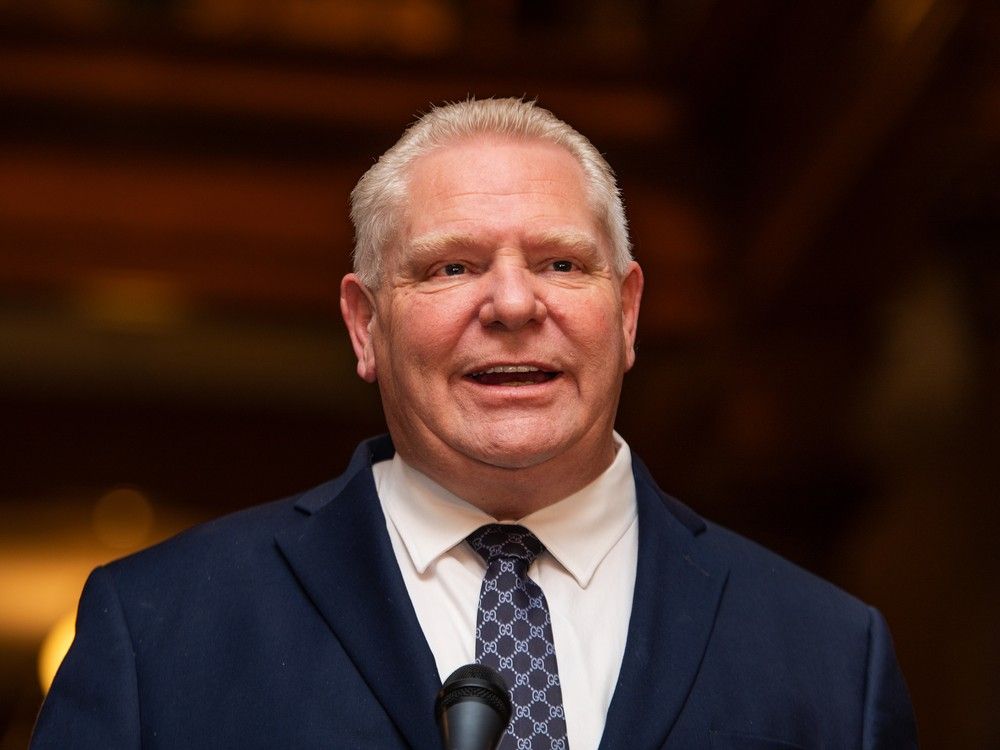
Ontario Premier Doug Ford speaks to media at Queen's Park in Toronto, on Thursday, April 3, 2025.

During the recent provincial election, Doug Ford promised to protect Ontarians from American tariffs and spend a lot of money doing it. The premier

delivered on the biggest part of his plan

this week, with $9 billion in temporary tax deferrals and $2 billion in workplace safety premium rebates.

At $11 billion, that sounds like a lot of business support, at least until you look at the details.

The $9 billion is simply a six-month deferral of a wide range of Ontario taxes. The idea is to give businesses more cash flow to sustain themselves during tough tariff times, but they still have to pay the taxes in the end.

If the premiums employers pay to support the Workplace Safety and Insurance Board program are higher than the program requires, they should have been rebated regardless of the tariff situation.

The tax deferral is not only temporary, it’s also not targeted. The money is available to all businesses, whether they have been hurt by tariffs or not. To do otherwise would have been an administrative nightmare, but a lot of businesses not hurt by tariffs will be in position to get what the government calls “an interest-free loan.” That dilutes the benefit to the hardest hit businesses.

To be fair, any provincial premier has limited tools to combat tariffs imposed by the country with the world’s largest economy. While Ford has done an excellent job of making Canada’s case here and in the American media, the tariff fight should never have been a provincial issue.

The federal government is much better placed to handle it. Not only is trade a federal responsibility, the tariffs imposed by Canada so far will provide money to help industries and workers hard hit by American tariffs. The 25 per cent auto tariffs announced this week by the federal government

would generate $8 billion

a year. Canadian tariffs on American aluminum and steel are

expected to produce $29.8 billion

.

The Ontario tax deferral is similar to one the feds have already brought in. The federal government has already pledged $40 billion in corporate income tax and GST-HST deferrals. Again, the plan is short-term and does nothing to make Canada’s economy less dependent on the U.S.

In announcing his $11-billion plan, Ford said his ultimate goal is to make Ontario the best place to do business in the G7. That’s a lofty goal, but how to accomplish it?

American tariffs have put Ontario in a significantly worse position than it was just last year, threatening the centerpiece of Ford’s manufacturing strategy. The province’s auto sector supports nearly 150,000 jobs and Ford has tried to make it larger by investing a lot of capital in it, both political and financial. Before the tariff war, the province committed billions of dollars to support new electric vehicle battery plants.

Now the status quo of building parts and cars in Ontario and exporting them to the U.S. no longer seems like an option. If automakers can’t make a profit in Ontario, they won’t stay in Ontario. The decision to move out would be made easier by the fact that they’re all foreign-owned. Canadian patriotism is not a factor for them.

Given the volatility of U.S. President Donald Trump, it’s too soon to pivot on the auto industry, but the province should have a strategy if it needs to.

Interestingly, Vic Fedeli, Ontario’s minister of economic development and trade, was in Washington this week arguing against tariffs but focusing specifically on auto parts, asking for no additional tariffs. This is a useful avenue for the province. Unlike auto assembly, auto-parts companies are Canadian-owned.

When a business decides whether to locate or remain in Ontario, many factors come into play. But the fundamental equation is simple. Can that business sell a product at a profit, given the taxes, tariffs, labour costs and regulatory burden? If the answer is no, temporary tax tweaks won’t drive long-term decisions.

To change the equation, Ontario should consider changing the corporate tax rate, preferably in concert with a reduction in the federal rate. Ford underlined the point this week when he said, “We can’t attract the brightest minds in the world and the best companies at a 43 per cent tax rate.” That’s federal and provincial corporate taxes combined.

Governments have a tendency to view businesses as cash cows rather than drivers of jobs and economic benefits. Cutting corporate taxes would cost money, but so would losing companies that can’t compete because of tariffs.

The temporary measures the provincial and federal governments are employing are based on the premise that the tariff issue will be short-lived. Maybe, but it would be smart to have a better plan in hand.

National Post

randalldenley1@gmail.com

Get more deep-dive National Post political coverage and analysis in your inbox with the Political Hack newsletter, where Ottawa bureau chief Stuart Thomson and political analyst Tasha Kheiriddin get at what’s really going on behind the scenes on Parliament Hill every Wednesday and Friday, exclusively for subscribers. Sign up here.


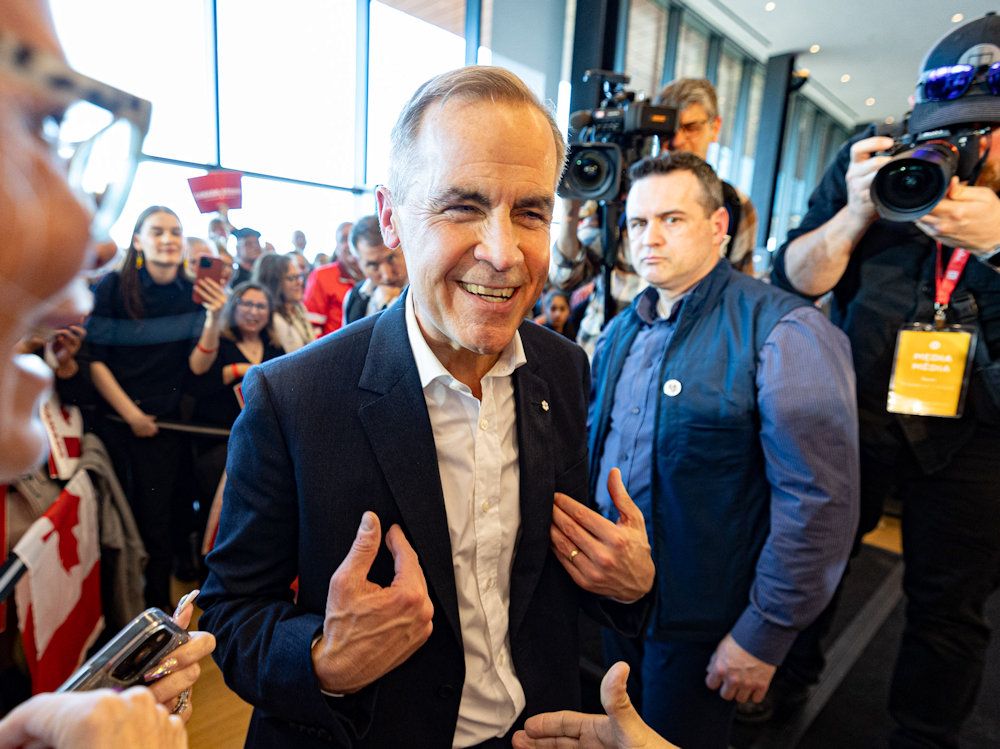
Prime Minister Mark Carney during a rally at the Red and White Club in Calgary on Tuesday, April 8, 2025. Darren Makowichuk/Postmedia

Well, I admit I didn’t see that one coming. I’m referring, of course, to Mark Carney’s

gaffe

at a Calgary campaign stop, where he responded to a protester’s yell that there was a “genocide” going on in Gaza, with agreement — “I know” — and a further sop, “I’m aware. That is why we have an arms embargo (against Israel).”

Carney later

claimed

, rather feebly, that he had not heard the word “genocide” and thought the protester was referring to the “situation” in Gaza. This does not jibe logically with the comment about “why” the Liberals imposed the arms embargo. Carney’s loyal supporters may buy it. I don’t.

In other, not unrelated news, describing their findings as “haunting levels of antisemitism,” B’nai Brith Canada has released its

2024 audit

of hatred targeting Jews. The reported 6,219 incidents — a 124.6 increase from 2022, and on average 17 incidents per day — are the highest documented since the audit’s debut in 1982. The report doesn’t provide information about those responsible for the incidents.

Alarmingly, there’s evidence that anti-Israel groups are organized and funded in Canada. What does Carney plan to do about that?

A

report

by NGO Monitor titled, “The NGO Network Driving Antisemitism in Canada,” found that the dramatic increase in violent antisemitism was “concurrent with an increase in activity by an interconnected and coordinated network of NGOs, whose campaigns of anti-Israel demonization, antisemitism, and intimidation create a hostile environment throughout Canada.” The report also noted that “a number of the leading groups are linked to Palestinian terror organizations and hide their sources of funding.” Worse, of 111 groups that were analyzed, the report found that 29 receive federal or provincial funding and 38 are registered as businesses or charities with Canada Revenue Agency.

It’s possible that groups like these are behind anti-Israel disruptors like the one who appeared at Carney’s event and the several who showed up at Freeland’s during the Liberal leadership campaign where there were

close to 20 disruptions

.

Are we in “emergency” territory yet on the antisemitism file? Carney has given no indication he believes we are presently witnessing a society in cultural crisis. But we have evidence for what he does consider a civic emergency.

The 2022 Ottawa Freedom Convoy encampment inspired an

op ed

by an impassioned Mark Carney for the Globe & Mail. In it, he wrote, many Ottawans felt “terrorized.” He inveighed against the convoy as “sedition,” “beginning anarchy,” an “insurrection.” But none of these fear-mongering words are in any objective sense applicable to the trucker protest, just as the word “genocide” — a Hamas-sourced accusation — is objectively inapplicable to Israel. (The president of the International Court of Justice, Judge Joan Donoghue, has

stipulated

on numerous occasions that the court “didn’t decide that the claim of genocide was plausible.”)

Carney published his fiery 2022 op ed 10 days into a protest in one city, but not one in an 18-month (and counting) rollout of organized anti-Israel hate fests across the nation.

Carney has not been completely silent on antisemitism. In February, for one of a few examples, Carney did

condemn

an attack on a Montreal synagogue. He wrote on X (not quite as dignified or meaningful as an op ed in a national newspaper): “This reprehensible vandalism is another reminder that Jewish Canadians have been targeted by a rising wave of antisemitism, particularly since October 7th. It has to stop.…”

“Reprehensible” is a prim and bloodless contrast to “anarchy.” This is Carney in characteristic calm and collected mode. Where is yesteryear’s discourse of outrage? I don’t accuse Carney of antisemitism, but of double standards. He experienced the hate-free, violence-free working-class trucker protest viscerally, as a personal affront calling for disproportionate retaliation, yet remains aloof from a hate-drenched actual threat to an identifiable group that includes actual violence.

And what does Carney mean by the self-distancing locution, “(the rising wave of antisemitism) has to stop”? Stop itself? Divine intervention? He writes that we must “say firmly and loudly that the Jewish community has the right to feel safe in Canada.” “Say”? That’s not a plan. That’s virtue-signalling.

Pierre Poilievre, by contrast, knows the difference between a genocidally-motivated terror group’s pogrom on innocent civilians and a democratic ally’s military response to it, conducted according to international laws of war. Poilievre understands the gravity of the supremacist ideology driving the anti-Israel hate rallies, that they are a threat to all Canadians: Jews today, western civilization tomorrow. So did — does — Stephen Harper. Which is why he vowed Canada would support Israel, a bastion against this movement, “

through fire and water

.” Poilievre is his rightful heir on that front.

Poilievre is a leader on the antisemitism file. His

plan of action

to quell the gathering passions possibly seeking an outlet in

European-level violence

would: “defund” those with a “woke anti-Semitic agenda,” including at universities receiving federal funding; crack down “on all terrorist networks that Trudeau has allowed on our streets”; pass laws against “perpetuating radicalism in our streets”; and much more.

It takes political courage to side openly with Israel because, as Harper once

noted

at a conference against antisemitism, there are “a lot more votes in being anti-Israel than in taking a stand.” That was true 15 years ago when he said it, and it’s exponentially truer today. Of the two contenders, only Pierre Poilievre has demonstrated that courage.

kaybarb@gmail.com

X:

@BarbaraRKay


Traders work on the floor of the New York Stock Exchange (NYSE) on April 09, 2025 in New York City. The Dow fell again Wednesday morning as investors continue trying to understand President Donald Trump's extreme tariff policy.

In an

interview

with Bloomberg Surveillance on Tuesday, top White House economic adviser Stephen Miran made the perfect Freudian slip: tripping on the words “tariff rates,” he instead said something closer to “terror rates” — and that really sums up the cudgel that President Donald Trump is now waving at the world.

That exchange took place as markets continued their post-“Liberation Day” bleed, reeling from the aftermath of new 10 per cent tariffs applied across nearly the entire globe, which took effect April 5, and the anticipation of steeper “reciporical tariffs” applied to countries based on the size of their trade deficits with the U.S.

Canada, though exempt from the above, is still under a 25 per cent tariff on non-USMCA compliant goods, a 10 per cent tariff on non-USMCA compliant energy and potash, a 25 per cent tariff on cars (but only on portion of cars not sourced from the U.S.) and a 25 per cent tariff on steel and aluminum. China, meanwhile, is being hammered worst of all, having been slammed with a mountain of tariffs that

now amount

to 125 per cent.

China double-down aside, much of the market’s nosedive was reversed midday Wednesday, upon Trump’s announcement of a 90-day pause on “reciprocal tariffs,” bringing the tariff rate back down to the baseline of 10.

But hey, maybe “terror rates” works just as well. That does seem to be their primary purpose, at the end of the day.

The logic of the tariffs, according to Miran, comes down to supposed fairness. The United States is a major provider of “global public goods” to the world, primarily in the areas of defence and currency — it is both world policeman and issuer of U.S. dollars, which most countries use to trade. This is all set out at length in a

paper

Miran published back in October.

But, Miran argues, the United States is not being fairly compensated for these goods, and is indeed being punished: the world’s demand for USD pumps up its value, which in turn punishes American manufacturers, whose products are consequently harder to sell abroad. The effect is worsened by other countries’ trade barriers, which hamper further exports. At this point in the story, populists lay blame for the hollowing-out of the middle class on the strong dollar and the world for pumping it. Free-traders

shake their heads

at this, chalking the shrinkage of the middle class up to the ascent of its members up the socioeconomic ladder.

Miran begrudgingly admitted in his October paper that Trump is unlikely to actually weaken the dollar and give up reserve status, so he foresaw that the administration would turn to “burden-sharing” arrangements instead.

What could be done? Miran

summarized

the options in a talk for the Hudson Institute on Monday. One: Countries could simply accept higher tariffs, sans retaliation, and the proceeds can supplement the U.S. Treasury. Two: Countries could open their markets to American goods and buy more. Three: Countries could boost defence spending and buy more American materiel. Four: Countries could move more manufacturing to the U.S. And five: “They could simply write checks to Treasury.”

But Miran does not apply his ideas to specific, practical scenarios when asked. Bloomberg, on Tuesday,

asked

him what countries need to do right now to get their tariffs dropped — and whether they’ve been made aware of this. His answer? “I don’t know exactly what combination of details they have to make in an offer, but all I can say is that negotiating is better than not negotiating.” Sounds a lot like the Canada treatment: despite the declared importance of the fentanyl issue, the U.S. kept its complaints

vague

; during the fruitless negotiations, it is not known to have provided us a wishlist of actions to take on the border (though we are known to have

asked

) before slapping us with “emergency” tariffs.

How about the cheque-writing route — what does that look like? Miran foresees a rent system, an equalization payment that passes matter-of-factly from one party to the other.

“There’s a variety of ways that that could work. For one thing, they could just simply say, ‘Hey, you know, America is providing us with a defence umbrella which creates prosperity…. America has created a global trading system backed by this defence umbrella…. And we’re going to help share costs of those things. We’re going to send some money to the United States to help it provide those things. I think that would be a fruitful outcome.”

In practice, it’s hard to see voluntary payments to the U.S. for existing security arrangements ever coming to pass. And without particular dollar figures being invoiced, it’s impossible to pay the supposed “global public goods” debt to begin with.

Not only that, some of the administration wants to use tariffs and trade threats as a negotiating tactic (which implies they’re temporary), others as a revenue-raising measure (which implies they’re permanent), others as a manufacturing-reshoring measure (which also implies they’re permanent). Meanwhile, the White House has used the claim that “tariffs do not raise prices” to

advertise

its strategy, which, if true (it’s not), would mean that tariffs won’t reshore much at all.

It’s reminiscent of the left’s economic interventions to supposedly end systemic racism: endless forms of reparations, reconciliation measures, racial privileges and budget lines — along with the constant reminders that we’re not doing enough, even though “enough” has never been articulated. This is what the right has stooped to in the United States, only with an eye to global trade.

The Trump administration’s

contradiction-ridden

take on tariffs really just show that they’re being used as a universal medicine to a problem that we’re not sure existed in the first place. The Americans presume that they’re owed extreme unquantifiable amounts by those who do any sort of business in USD, in any lands and waters protected to some extent by the U.S.

The other side of that view? The American empire — scaffolded upon its defence umbrella and financial system, because

that’s how it wanted to protect its interests around the world

— benefits the United States above all. Other countries benefit too, as a side effect, but that doesn’t necessarily mean they should have to pay for every little positive externality they soak up from existing in a global economy that trades mostly in USD. (They should still meet their collective defence obligations, which Canada and chunks of Europe have not done.)

This all seems to be a shakedown. The Americans have decided that it’s time to pay rent, even though they’re not sure how much. It just needs to be paid. Now. Or else. And if we feel fraught with anxiety — terrorized, perhaps — over future investments and trade prospects, well, that’s part of the point.

National Post


Liberal Leader Mark Carney at a campaign stop in Saskatoon at the Remai Modern.

First Reading is a Canadian politics newsletter that throughout the 2025 election will be a daily digest of campaign goings-on, all curated by the National Post’s own Tristin Hopper. To get an early version sent directly to your inbox, sign up here.

TOP STORY

After Liberal Leader Mark Carney announced that Canada’s future lay in “prefabricated and modular housing,” online critics noted that his former company just happens to be a major player in the modular housing industry.

This week, Carney provided more details of his plan to start a new government agency, Build Canada Homes, tasked with constructing 500,000 homes every year. As Carney told reporters on Tuesday, most of those homes would be prefabricated.

“Prefabricated and modular housing will catalyze a productivity boom,” he said.

Until he quit just four months ago to run for the Liberal leadership, Carney was chair of Brookfield Asset Management, one of the world’s largest investment firms. In 2021, the firm spent $5 billion to acquire Modulaire Group, a major manufacturer of modular buildings. While the company currently operates in Europe, Australia and New Zealand, Modulaire’s website notes that they are specialists in the realm of “rapid urbanization.”

And this has been happening a lot. Brookfield’s investments are so vast and its interests so wide-ranging that with many Liberal announcements, the company could potentially be indirect beneficiaries.

After zeroing Canada’s consumer carbon tax last month, Carney unveiled a climate plan which promised to “improve subsidies for heat pumps to make home heating more affordable.”

In 2023, Brookfield spent US$5 billion to acquire HomeServe, a British home repair multinational that has leaned hard into heat pump refurbishments.

Carney’s links to HomeServe have gotten him into trouble as recently as October, when Britain’s The Telegraph reported that Carney had been actively lobbying the British government to increase heat pump subsidies on Brookfield’s behalf.

“Mark (Carney) is working on our behalf in government and he did have a meeting on this with (Chancellor of the Exchequer) Rachel Reeves,” HomeServe founder Richard Harpin told The Telegraph.

Carney’s newly released Canadian climate plan also promised to “increase financial incentives for energy efficient homes.”

Brookfield Residential, the $6 billion property development arm of Brookfield Asset Management, is already a major builder of energy efficient homes in both Ontario and Alberta. They just opened Seton, a planned community outside of Calgary that advertises itself as a model of sustainable building. “When you live in a home in Seton, you can rest easy knowing you’ve made a sustainable choice,” reads promotional literature.

In 2022, Brookfield partnered with Trane Technologies “to offer decarbonization-as-a-service for commercial, industrial, and public sector customers.”

Last week, Carney said he would maintain the Trudeau government’s 2019 Impact Assessment Act, the so-called “No New Pipelines Act” due to its much higher regulatory burden on new resource projects.

This is despite rising support for a fast-tracked east-west pipeline that would reduce Canadian dependence on U.S. oil infrastructure. A recent Bloomberg-commissioned poll found that a record 77 per cent of Canadians supported such a project.

While Carney has said it would make sense for Quebec to use Canadian oil instead of American, he said he would only support such a project “where we have the support of First Nations (and) we have the support of all the provinces, obviously including Quebec.”

At the same time, Brookfield is closing in on a $9 billion deal to acquire the 8,850 kilometre Colonial Pipeline in the United States. Running from oil-rich Texas all the way to New York State, the Colonial Pipeline is basically an American equivalent to any future Alberta-to-Quebec pipeline.

The potential conflicts of interest presented by Carney’s Brookfield ties have been an issue ever since Carney first took a job in September as an economic advisor to then prime minister Justin Trudeau.

As Conservative opponents noted at the time, Carney was employed through the Liberal Party rather than the Prime Minister’s Office, which dispensed with the usual ethics disclosures that would accompany such a position.

Upon becoming prime minister, Carney put his assets into a blind trust and said he was working with the ethics commissioner to put “screens around certain issues” in which his business interests might intersect with his policy decisions.

Carney is required to disclose his assets within 120 days of becoming prime minister, a deadline he won’t hit until after the election. Although he is not volunteering them before then, Brookfield’s own disclosures show that Carney holds options in the company that were worth US$6.8 million as of December.

On Wednesday, Conservative candidate Michael Barrett — previously the party’s ethics critic — renewed his frequent accusation that Carney is backing policies poised to directly enrich his Brookfield interests.

“Mark Carney’s $1B heat pump plan could deliver BIG profits for him & his friends at Brookfield. But he still refuses to disclose his assets & financial interests,” Barrett wrote in a post to X.

Carney is one of the wealthiest figures to ever become Canadian prime minister, and he has compared his situation to that of Paul Martin, who prior to entering politics was the CEO of the shipping juggernaut Canada Steamship Lines.

In 2003, just prior to becoming prime minister, Martin sold the company to his sons, bowing to criticism that merely putting his shares in a blind trust would not be sufficient to avoid conflicts of interest.

“I want Canadians to know that my only business … would be the public’s business,” Martin said at the time.

LET’S POLL

Polymarket — an online prediction market where you can bet on electoral outcomes — is now heavily favouring a Liberal victory in the election.

The question “Next Prime Minister of Canada after the election?” has attracted more than $40 million in bets, and is now at 78 per cent likelihood for Liberal Leader Mark Carney, and 23 per cent for Conservative Leader Pierre Poilievre.

The question “Which Party wins most seats in Canadian election?” has attracted more than $10 million in bets, and its ratios are similar: 79.1 per cent for the Liberals, 21 per cent for the Conservative Party.

 Last week saw both CBC and APTN report on the fact that Mark Carney’s father Robert Carney was a principal at a federal Indian school – and in his later academic career is on record as defending the aims of the Indian Residential School system. This all came up at a press conference, where Carney replied that he loved his father, but that a Carney government would continue to “advance” the reconciliation process.

GAFFETERIA

The Trudeau government was extremely conciliatory to the anti-Israel crowd in the months following the October 7 massacres in Southern Israel, to the point where they were once directly thanked by the leadership of Hamas. Nevertheless, they never endorsed the claim that Israel’s actions in Gaza constituted a “genocide.”

So it’s notable that when a heckler at a Mark Carney event accused him of ignoring the “genocide happening in Palestine,” Carney replied “I’m aware, that’s why we have an arms embargo” — an apparent reference to Canada’s suspension of military exports to Israel.

When asked about this later, Carney said he didn’t hear the word “genocide,” and just thought the heckler was shouting about “the situation” in Gaza.

Get all of these insights and more into your inbox by signing up for the First Reading newsletter here.


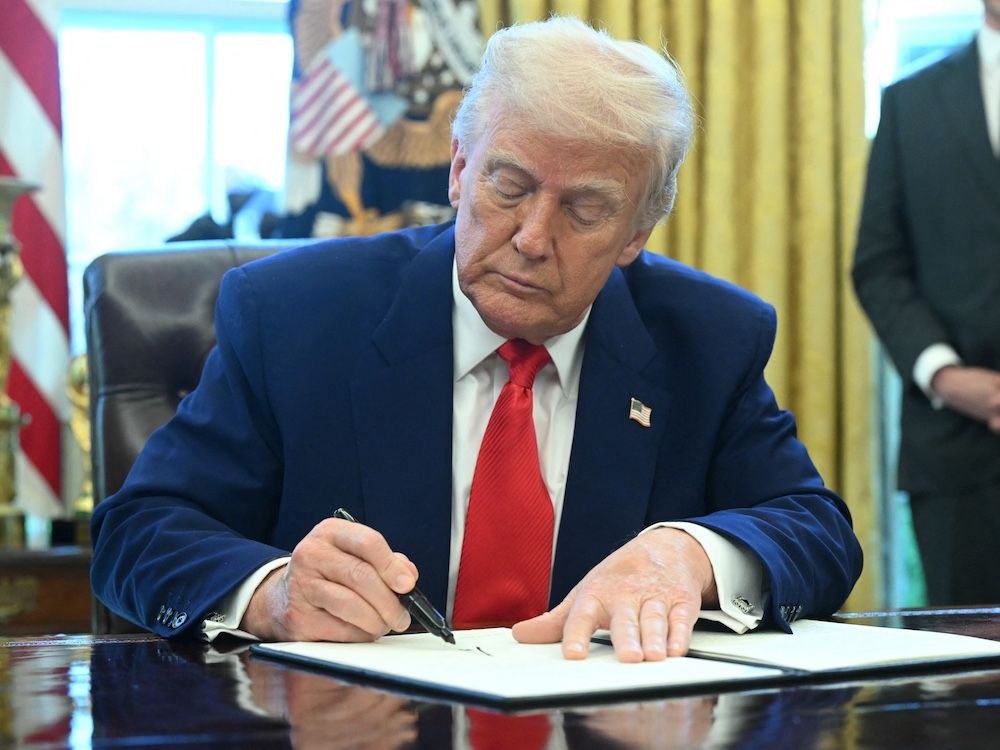
US President Donald Trump signs an executive order in the Oval Office of the White House on April 9, 2025 in Washington, DC.

Pinning down the Trump administration’s justifications for its trade war with the world is a bit of a challenge. One minute it’s about pressuring neighboring countries to crack down on drugs and illegal immigration, and another it’s about forcing “reciprocity” in trade barriers. But the president himself frequently talks about bringing manufacturing and, especially, industrial jobs back to the United States. 


The good news is that President Donald Trump and company can rest easy about the manufacturing sector; it’s healthy, despite seemingly endless government efforts to strangle it in red tape. But those jobs aren’t coming back in large numbers anytime soon — unless you count robots among the employed.


In an April 2

executive order

, Trump declared a national emergency as grounds to hike tariffs on countries around the world. He argued that “large and persistent annual U.S. goods trade deficits have led to the hollowing out of our manufacturing base” and that “increasing domestic manufacturing is critical to U.S. national security.”


The president is certainly interested in seeing more production take place at home — especially if that means factories closing in China and reopening in the United States. But he constantly emphasizes manufacturing employment. In March his administration

boasted

that “the country gained 10,000 manufacturing jobs in President Trump’s first full month in office — a swift turnaround after losing an average of 9,000 manufacturing jobs per month” under the Biden administration. The press release went out without any reference to productivity or output. Well, if you care only about jobs, you can pay workers to dig holes and then fill them in again. That’s not productive, but it’s work.


Fortunately, U.S. manufacturing is productive, and output is healthy. The Manufacturers Alliance

points out

that, while Chinese companies’ low costs have allowed them to displace U.S. firms as the world’s leading manufacturers, “the U.S. is the second largest manufacturer in the world and is responsible for 17 per cent of world manufacturing activity.” That’s not necessarily seen in terms of inexpensive consumer goods, which are largely produced by lower-cost plants elsewhere, but “the U.S. sector’s domestic value increasingly comes from advanced manufacturing, which leverages the growing availability of cutting-edge design, production, and automation technologies.”


According to the

World Bank

, as of 2021, the “value added” of American manufacturing in current U.S. dollars was roughly $2.5 trillion, up from $2.12 trillion in 2015 and $1.79 trillion in 2010, the year China took over the leading position. China, a more-populous country than the U.S., and one catching up with developed nations, has been rapidly growing its manufacturing sector, but American manufacturing keeps chugging along. 


And, while China continues to be the leader for global manufacturing, that country’s harsh lockdowns during the COVID-19 pandemic severely disrupted supply chains. Growing international tensions add to worries about relying on China for production of anything critical. A

July 2024 analysis

by the financial firm BlackRock noted that by their own choice and under government pressure, many companies are reshoring at least some of their manufacturing capacity to the U.S. “As of May 2024, annual construction spending in manufacturing soared to $234 billion, tripling since January 2020.”


But — and this is important — the story is very different if you’re looking at manufacturing jobs. The Trump administration boasts of an uptick in employment for that sector, and that’s good news indeed for the people now cashing those paycheques. But

data from the Federal Reserve Bank of St. Louis

shows that manufacturing employment peaked 45 years ago and, despite recent gains, has been largely flat for several years. While manufacturing still accounts for nine per cent of American employment, according to the Manufacturers Alliance, “between 2000 and 2010 the factory sector shed 5.7 million jobs.”


How can the U.S. still be country with a healthy manufacturing sector, but also have far fewer jobs available to people who want to work in factories? As noted above, the U.S. excels in advanced manufacturing which involves the growing use of automation. Fewer people are making a lot of stuff.


In a 2021 paper, MIT economist Daron Acemoglu and his co-authors

argued

that automation plays a bigger role than outsourcing in reducing the ranks of manufacturing employees. Nationalists may pine for the age of old-school assembly lines, but the disappearance of those jobs is better explained by robots than by factories in China.


Even more interesting is that the manufacturing openings that continue to exist often go unfilled. An

analysis last summer

by Jonathan Tilley and Julian Salguero of the consulting firm McKinsey and Company observed that U.S. openings for manufacturing jobs were at double their level from before the pandemic, but “manufacturing companies in most sectors are struggling to find enough personnel to make, pack, and ship their products.” They proposed that manufacturers turn to more automation to replace the workers who aren’t showing up. 


The future of manufacturing isn’t thousands of workers along 1950s-style assembly lines; it’s a few highly skilled ones operating armies of robots.


And, while Trump and company complain that other countries are hobbling American manufacturing, the real enemy is American politicians. In a

2023 study

, the National Association of Manufacturers warned that across the whole economy, “federal regulations cost an estimated US$12,800 per employee per year in 2022 (in 2023 dollars),” but “manufacturing firms overall incurred an average cost of US$29,100 per employee in 2022.” Small manufacturers with fewer than 50 employees suffered even more, with regulations costing an average of US$50,100 per employee.


To his credit, Trump emphasized the need for deregulation in his first term and

again after he returned to office

this year. But his tariffs threaten to undo any gains to be had from cutting red tape.


While American manufacturing

was growing in recent months

, S&P Global

noted a decline in March

in manufacturing output “with companies widely attributing falling output to tariff-related issues.” It’s not difficult to find corporate announcements of

reductions in production

and

layoffs

directly related to Trump’s entirely unnecessary trade war.


Trump launched a conflict with the world to, in part, revive American manufacturing. But the manufacturing sector might count prominently among the victims of his protectionism.


National Post