


LP_468x60
on-the-record-468x60-white

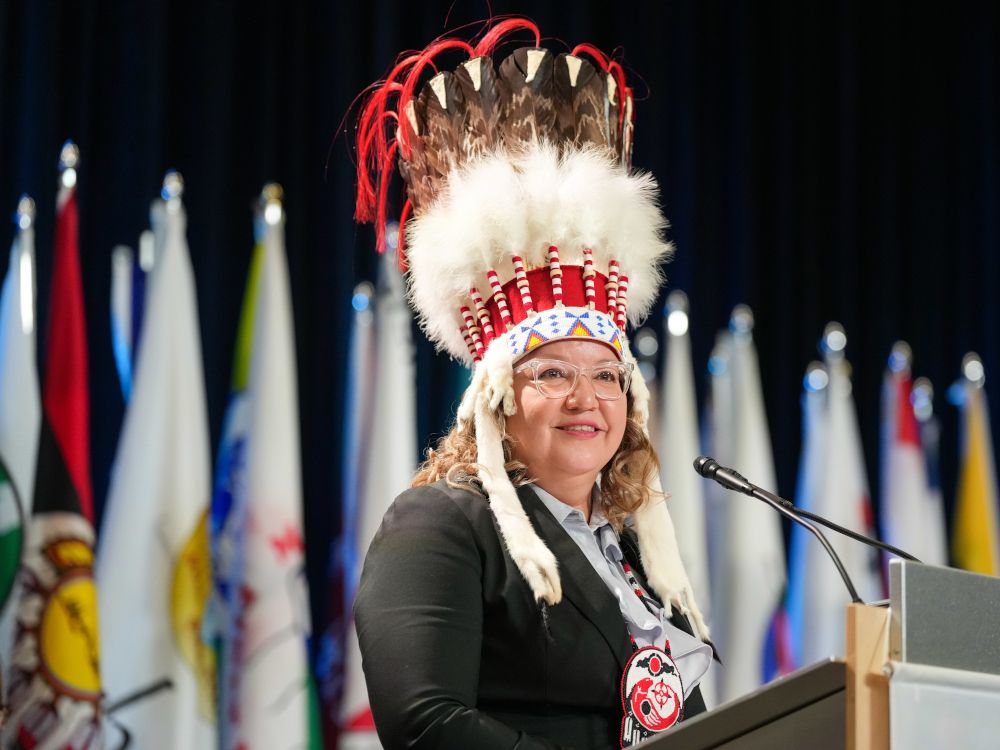
Assembly of First Nations National Chief Cindy Woodhouse penned an open letter to U.S. President Donald Trump calling for increased awareness of issues that affect First Nations straddling the Canada-U.S. border.

Canada is awash in economic uncertainty. The challenges that existed in January 2025 have been accelerated by the actions of U.S. President Donald Trump. As Canada develops forward-looking strategies, it’s clear that Indigenous peoples must be fully engaged in our national economic revitalization.

All Canadians share concerns about tariffs and the cost of living. Indigenous economic reconciliation may well be the trump card — to waste an easy pun — in Canada’s pursuit of a stable and prosperous economy. Many national leaders talk about supercharging the natural resource economy, a sector where Indigenous people have moved from the sidelines to the boardrooms in a single generation.

For too long, Indigenous peoples have been excluded from national economic conversations, depriving Canada of a remarkable economic revolution. Indigenous energy, infrastructure and tourism businesses are

thriving

, contributing to economic independence and reduced reliance on government programs. They’re catalysts for social change, building stronger, self-sufficient communities. It’s time for Canada to recognize that Indigenous economic power is a cornerstone of its future.

The numbers don’t lie. Over 500 Indigenous

economic development corporations

in Canada collectively manage hundreds of millions of dollars worth of assets. They generate hundreds of millions in annual revenue and employ thousands of Indigenous and non-Indigenous people.

Indigenous financial institutions

(IFIs) — long overlooked by mainstream banks — are now key players in financing Indigenous entrepreneurs. In turn, these business leaders foster economic independence and build wealth in their communities.

For the first time in their history, many communities are experiencing real prosperity. The

success stories

prove that economic reconciliation isn’t some fantasy. It’s happening, and it’s reshaping the Canadian economy.

At a time when Canada is looking for new economic paths forward, Indigenous businesses are prepared to participate. But the real potential hasn’t yet been tapped. The impact could be much greater if Indigenous businesses receive equitable access to capital, market opportunities and policy support.

Ottawa’s promise that at least

five per cent

of government contracts will eventually go to Indigenous businesses was a positive first step. But there’s a serious problem: weak enforcement and false claims of Indigeneity have undermined the effectiveness of Indigenous procurement within the federal government. The process for identifying authentic Indigenous businesses must be Indigenous-created and Indigenous-led.

Enter the

First Nations Procurement Authority

(FNPA). This Indigenous-led organization ensures procurement processes are transparent and that contracts go to legitimate businesses. The FNPA would not only prevent exploitation, but also direct economic growth to the communities where it’s most needed.

Investment in IFIs is also essential. These institutions have already demonstrated their ability to support Indigenous entrepreneurs where traditional financial institutions have failed. Strengthening these organizations with additional supports will provide them with greater access to capital, allowing them to contribute even more to Canada’s prosperity. Empowering Indigenous financial institutions means investing in a sector that has proven its worth.

Cindy Woodhouse Nepinak, national chief of the Assembly of First Nations, demonstrated bold leadership by

reaching out

to President Trump shortly after his inauguration. She appealed for special attention to the issues of Indigenous groups whose territories cross the Canada-U.S. border. Her message emphasized the need for Indigenous voices in policy discussions that affect both countries.

For generations, Indigenous peoples have fought for a seat at the table. This marginalization must end. Indigenous peoples are no longer passive players. Their economic interests are vital to the prosperity of Canada. The outdated narrative of Indigenous poverty has been replaced with a new reality where First Nations, Métis and Inuit wield significant economic and political power. Indigenous peoples must be fully included in discussions about Canada’s economic future.

Reconciliation cannot be shuffled to the sidelines during times of economic uncertainty. If Canada is serious about long-term stability and emerging stronger from the tariff wars, Indigenous entrepreneurs and financial leaders must be at the table. We are not afterthoughts. We are key partners in shaping Canada’s economic strategy.

The Indigenous business community and political leadership are ready. Yet it is not clear that the country’s politicians, business leaders and institutions fully understand the potential and the determination of Indigenous peoples to be key players in building Canada’s future.

National Post

Shannin Metatawabin is CEO of the National Aboriginal Capital Corporations Association and a contributor to the Macdonald-Laurier Institute.
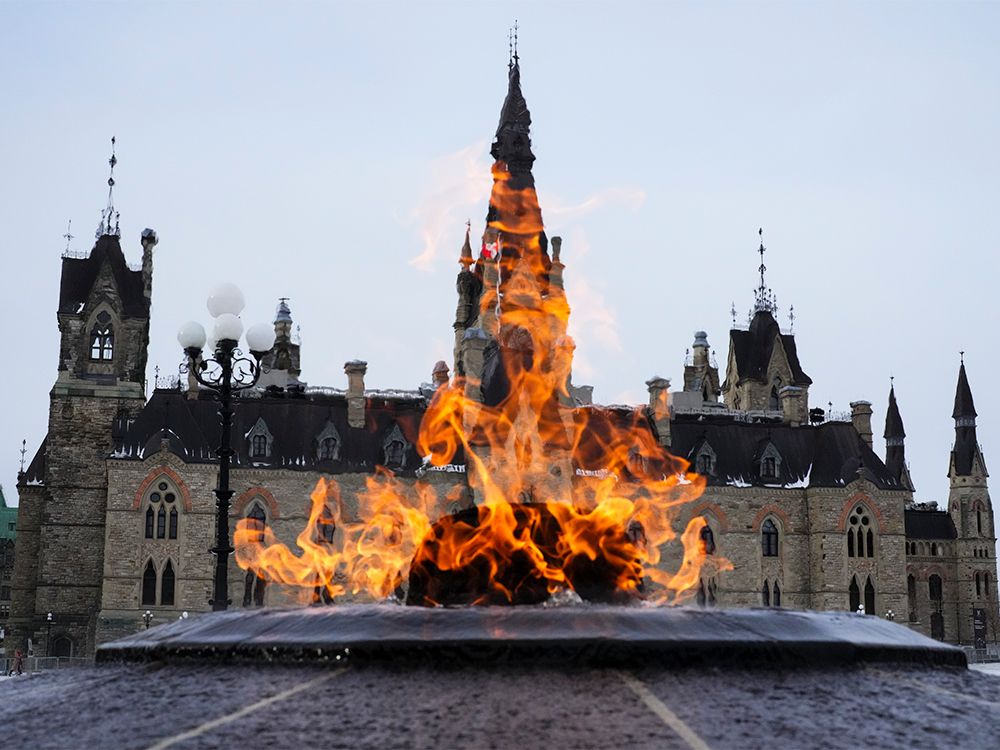

The Centennial Flame burns on Parliament Hill in Ottawa in January.

The Manning Centre Networking Conference — now called the Canada Strong and Free Networking (CSFN) Conference — has never been a deep-thinkers’ event. That’s not a criticism; the words “networking conference” are right there in the title, and the words “graduate-level political-philosophy seminar” are not.

But at a time when U.S. President Donald Trump has basically obliterated any coherent vision of American conservatism, or classical liberalism if you prefer — and who on some days seems intent on terribly corrupting the institutions, checks and balances generally thought to underpin its principles — the question of what exactly conservatism means in 2025 in North America could not be more alive or kicking.

Bari Weiss, founder of The Free Press newsletter, and Patrick Deneen, a constitutional scholar at the University of Notre Dame in Indiana, offered conference-goers two competing such visions this week.

Weiss, broadly speaking, seems to believe we had things basically right in Western society before “wokeism” (to use a reductive but undeniably descriptive term) corrupted classical liberalism’s basic ideals of freedom and meritocracy. Campus radicalism used to burn itself out in most Americans once graduates were jettisoned into the real world with a sack of debt on their backs, Weiss argued. But in more recent years, it has metastasized in society in general — not just in education, at every level, but in government and corporate America as well

(Weiss, for those unfamiliar, is best thought of as a very traditional American classical liberal — a younger David Brooks, perhaps. She was a staff writer at The New York Times before

quite spectacularly resigning

in 2020,

claiming her centrism and support for Israel made her persona non grata in the newsroom

and on the august organ’s pages as well.)

“I think the broad story of how we allowed it to get so bad is the story of cowardice,” Weiss told the CSFN conference. “People (who) did see it was bad, to be very blunt about it, valued prestige more than they valued principle.”

 Bari Weiss.

Deneen’s 2018 book, Why Liberalism Failed,

became an improbable bestseller,

touted by no less an influencer than Barack Obama

. (I say “improbable” because Deneen is the sort of writer, speaker and lecturer who forces you to think

really hard

while reading or listening to him. If you don’t know your Plato, Tocqueville, Burke and Mill off by heart — and I’m a bit rusty, I’ll concede — you might struggle!)

His position is essentially that excesses like wokeism were an almost inevitable result of the Ayn Rand-ian individualist philosophy to which many Canadian conservatives at least theoretically subscribe — if not in public politics, then privately. (Deneen mentioned seeing Rand, the radical-capitalist author of The Fountainhead and Atlas Shrugged, depicted “about six times in the hallway” at the conference.)

Rand “ought to be attractive to a young person because young people are rebellious and they want to break away,” Deneen argued. “(But her vision is) a terrible way to organize a society because a society is essentially organized around the continuity of institutions and practices.”

 Ayn Rand in New York, August 1957.

”Liberalism (has been) the operating system of the West that has informed the thinking of both the left and the right, at least since the Cold War,” Deneen said. “And the debates that we think of as … between the left and the right, in fact, are contending versions or understandings of how thoroughgoing liberty can be achieved.

“(The right believes liberalism) is achieved especially through the free market and the unleashing of, in many ways, the desires that we pursue in the free market. The left believes that liberty is achieved especially by tearing down all of those institutions, or remaking all those institutions, that were once in the job of teaching (classical) liberty. So that once we’ve remade the family, we’ve remade educational institutions, we’ve remade, of course, government, then we will have and enjoy perfect freedom.

“And indeed, we see this at the heart of the left’s project today — of liberating us even from our gender.”

When all of those anchors fall to the sea floor, Deneen argued, government is basically all that’s left to fill the gap, and the left wins. He compared Weiss’s pursuit of a new enlightenment to preventing the Titanic’s sinking by backing up five feet from the iceberg.

Deneen clearly understands Canada to some extent. He gave a gushing review to Lament for a Nation: The Defeat of Canadian Nationalism, George Grant’s 1965 polemic about John Diefenbaker’s electoral fate, even producing a copy on stage. But I don’t buy his critique of liberalism, as we used to conceive of it, especially in Canada. If there’s anywhere that can combine solid political and social institutions, and a strong social safety net, with robust individual liberties, it’s Canada.

We have done remarkably well at it thus far, albeit with many hiccups along the way, especially over the past decade or so. And we can do remarkably well at it in future.

National Post

cselley@postmedia.com

Get more deep-dive National Post political coverage and analysis in your inbox with the Political Hack newsletter, where Ottawa bureau chief Stuart Thomson and political analyst Tasha Kheiriddin get at what’s really going on behind the scenes on Parliament Hill every Wednesday and Friday, exclusively for subscribers. Sign up here.


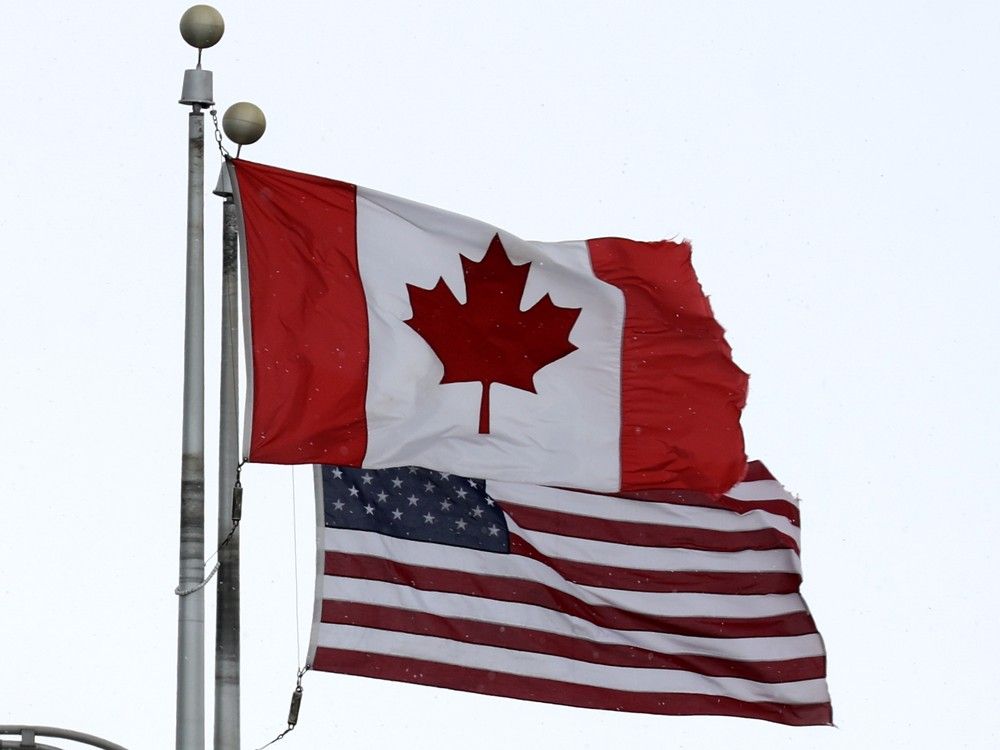
A Canadian flag flies next to the American one at the Lewiston-Queenston border crossing bridge on Feb. 04, 2025 in Niagara Falls, Canada.

Donald Trump’s tariff crusade has frequently made Lewis Carroll’s Mad Hatter look like a paragon of sanity. While is it is tempting to mock and deride the United States at the moment, Canadians need to remember where our economic bread is buttered. Despite anything politicians or leaders may say, and like it or not, Canada’s economic future and success is tied to the United States for the foreseeable future.

While there is no question that our relationship with the U.S. has changed, the notion that “our old relationship of steadily deepening integration with the United States is over,” as Mark Carney

suggested,

is ridiculous. Seeking better access and optionality to world markets for many of our products is a path Canada should unquestionably pursue, but it’s integration with the United States that is essential to our future economic prosperity.

Ever since Trump stood, like a used car salesman, with his

billboard of tariff

offerings for the world ready to “make a deal,” countries have scrambled to respond appropriately as markets roiled like no time since the

Great Financial Crisis of 2008

. But let us remember who was not on Trump’s bizarre chart outlining tariff rates: Canada and Mexico. Why? Because our economies are too important to the United States to be treated like other countries in the world. That is due to our level of integration. Trump may not like Canada, but he can’t get rid of us. Despite not completely avoiding tariffs — notably on automobiles, steel and aluminum — it is important to remember that it is almost certainly Canada’s level of US integration which avoided a far worse outcome.

This is, of course, is not an argument against Canada seeking better international access for our products, most notably our oil, gas and mineral reserves. We have been poorly served by sending too large a percentage of our natural resources at discount prices to the U.S. because we refused, or were incapable of, building out export capacity to other nations.

But let’s get real for a second. Whether it’s the Liberals’ proposed “

Trade Diversification Corridor

” which would invest $5 billion to build infrastructure to “…help diversify our trade partners…” or the “

National Energy Corridor

” Pierre Poilievre has suggested which would “…fast-track approvals […] for critical infrastructure across Canada in a pre-approved transport corridor…” Does anyone seriously believe either of these will happen at speed?

I’d sure like to. However, even if you support Canadian economic diversification and believe in Canada’s potential (as I very strongly do) our track record for rapid, decisive delivery of large-scale infrastructure in the last 20 years is at best poor and, more realistically, pathetically embarrassing. The Northern Gateway, Energy East are long consigned to the graveyard of “should have been built” and mining projects like Rook I has been stuck in federal permitting hell for six years despite provincial project approval, indigenous consent and full project financing being completed, with no further hearings scheduled until November.

Is Canada capable of the large-scale infrastructure projects now being trumpeted by all and sundry? Yes. Should any sane person bet our actually building them in a timely manner that would replace our U.S. dependency? No.

We are exceptionally fortunate that by an accident of geography we sit right next to the largest economy on Earth and have, despite the recent tensions, an overall good relationship with the U.S. Having a friendly, rich consumer market of more than 350 million people right next to you is a privilege most other countries can only dream of.

Donald Trump will be gone in 4 years. Despite his grand performances, the U.S. will remain our number one ally and trading partner no matter what we do. The smart money is that even in 40 years this will still be the case. Integration with the United States has been and will continue to be the key to Canada’s economic success. We should not want that to end.

National Post


Thomas Darcy McGee, a Canadian cabinet minister who was assassinated in Ottawa in 1868 by a member of the Fenian Brotherhood, is seen in an undated photograph.

Those who recognize his name today likely know he was assassinated in downtown Ottawa in April 1868. Those who knew Thomas D’Arcy McGee when he was alive — friend and foe alike — would have been familiar with the bold vision he had for Canada. Those who don’t know about McGee should take a moment to discover the words of the man born 200 years ago this day (April 13).

Thomas D’Arcy McGee came from a Catholic family based in County Louth on the east coast of Ireland. He lost his mother when he was eight years old and sailed for the United States when he was only 17, desperate to find a firm footing in a rapidly changing world. Smart and energetic, young McGee found work as a budding journalist in Boston, where an Irish community thrived. McGee revealed himself as an Irish patriot, eager to see Great Britain’s grip on Ireland weakened. He even wrote that the United States should absorb Canada.

By his early 20s, McGee had found a voice. He discovered his identity as an Irish nationalist after less than three years in Boston and in 1845 returned to the Emerald Isle. He wrote for Young Ireland’s The Nation and seemed to impress audiences with his eloquent voice and his tireless dedication to the nationalist cause at a time when the potato crop — a food source on which more than a third of the population absolutely depended on for sustenance — was failing. He joined the Irish Confederation in 1848 and was on the organizing committee of the failed rebellion.

McGee, under threat of arrest, shuttled back to the United States and settled in New York, home of another vibrant Irish community. He was exposed to a wide variety of opinions in that intellectual hub and soon caught himself having doubts about Ireland, the United States and Great Britain. The potato famine had exposed grave socio-economic realities and the easy solutions of his youth no longer cottoned to reality. He turned to ultramontanism, a Rome-centred Catholicism, as a shield to the harshness of American life. It was a sturdy protection against the unforgiving anti-Irish sentiment that dominated the American metropolises.

He also turned to Great Britain with a kinder predisposition and reconsidered Canada — a land he increasingly appreciated for its tolerance. He moved his family to Montreal in 1857, started a new paper, the New Era, and threw himself into politics. He caught the imagination of his new countrymen and within a year the 32-year-old was elected to Parliament. The man who had once condemned Canada as a country destined to join the United States now advocated protective tariffs against the Americans, an accelerated program of infrastructure building, and enhanced immigration. John A. Macdonald fell for him and soon included McGee in his cabinet as minister of agriculture, immigration and statistics.

McGee’s economic policies were not tools merely to build wealth. Instead, they were instruments to bring about a new culture, perhaps even a new country. He called it a “New Nationality” — a union of progressive forces that would temper ardent ethno-religious identities in order to foster a strong country where both law and order could thrive. He raged against the Protestant extremists as much as he railed against the Fenian Catholics who still lived to weaken Great Britain by way of harming Canada.

McGee was now a man whose political views featured a patchwork of the emotions he felt, the battles he experienced and the ideas he championed with a head-turning eloquence. “This is a new land,” he reasoned, arguing that Canada — a Canada that would extend from coast-to-coast — was a place where virtue and talent could thrive. In a landmark speech he gave in early 1865 — months after he had participated in the pro-Confederation meetings at Charlottetown and Quebec City — he argued that Canada had to protect itself from the American threat. “We are in the rapids and must go on,” he declared. “Our neighbours will not, on their side, let us rest supinely.” Canada had to strengthen its ties to its enduring friends, even Great Britain.

His words still hold a prescribing strength to us, eight generations later. “We should strengthen the faith of our people in their own future, the faith of every Canadian in Canada,” he declared. “This faith wrongs no one; burdens no one; menaces no one; dishonours no one; and, as it was said of old, faith moves mountains.” The salvation of this country, in his eyes, lay in “the pure patriotic faith of a united people … we cannot stand still; we cannot stave off some great change; we cannot stand alone.”

McGee called for change. He knew that while Britain remained a friend, there were strong pressures for Canada to assume its own direction. He also recognized that as the American Civil War came to an end and Washington was eyeing northern territories such as Alaska, the threats from the United States required a strong response. McGee offered a solution, his “New Nationality,” a country with a renewed sense of purpose built on economic strength but also one of conviction that mankind could be bettered by bold new ideas of unity, civility and purpose. His undying words ring true today as clear as the church bells that had inspired his ideas in his earlier days.

National Post

Patrice Dutil is a Senior Fellow at the Macdonald-Laurier Institute and the author of Ballots and Brawls: The 1867 Canadian General Election.


Israeli and Ukrainian flags fly in front of the Lviv Regional State Administration building as a sign of solidarity with the Israeli people, on Oct. 13, 2023, in Lviv, Ukraine.

The wars in Ukraine and Gaza are not isolated regional conflicts. They are existential battles that will determine the future of the world order.

In both cases, authoritarian forces — Russia in Ukraine, Iran and its proxies in the Middle East — are testing the resolve of western democracies. Yet, instead of responding with a unified strategy, the United States and Canada have taken diverging approaches: Washington prioritizing Israel while retreating from Ukraine, while Ottawa does the reverse.

This inconsistency reflects a broader strategic paralysis in the West that emboldens adversaries and weakens the democratic world. Despite strained relations between Canada and the U.S., the two countries should unite and start treating Ukraine and Israel as two fronts in the same war against authoritarian aggression. Doing so would not only send a strong signal to our enemies, it would pave the way for greater cohesion between western nations.

It’s no secret that U.S. President Donald Trump’s return to power has reshaped America’s foreign-policy priorities. While staunchly pro-Israel, the administration has significantly scaled back support for Ukraine. Aid packages for Kyiv have stalled, and Trump’s rhetoric suggests a willingness to force Ukraine into an unfavourable peace, freezing the conflict in a way that benefits Russian President Vladimir Putin.

Trump’s skepticism toward NATO further complicates the situation. His statements questioning the alliance’s relevance have emboldened Russia, which now sees an opportunity to exploit the West’s dysfunction. European countries, recognizing this risk, have stepped up support for Ukraine, but without sustained U.S. backing, Kyiv faces an uphill battle.

Meanwhile, Trump has strengthened U.S. support for Israel. Washington has continued military aid, backed Israeli operations against Hamas and signalled strong opposition to Iran’s regional ambitions. This approach reflects Trump’s worldview: prioritize strong bilateral relationships while disengaging from multilateral commitments.

But selective engagement creates vulnerabilities. If Ukraine collapses or is forced into a settlement that rewards Russian aggression, it will embolden Moscow to push further into eastern Europe. At the same time, Iran and its proxies — keenly aware of Trump’s unwavering support for Israel — may escalate their attacks elsewhere, knowing that the U.S. lacks the same commitment to Ukraine.

Canada has taken the opposite approach. Liberal Leader

Mark Carney

has reaffirmed his intention to provide assistance to Ukraine and continue putting pressure on Russia. Yet Carney’s government, much like Prime Minister Justin Trudeau’s before it, maintains a cautious stance toward Israel.

While Canada has condemned Hamas’s actions, it typically does so in statements that also condemn Israel — creating a moral equivalence between terrorist organizations that have murdered Canadians and a sovereign member state of the United Nations.

Canada has also stopped short of offering full-throated support for Israel’s military response. Carney has even

suggested he agrees

with the dangerous and outlandish claim that Israel is committing genocide in Gaza. In addition, Ottawa has been hesitant to align with Washington’s more aggressive stance toward Iran, preferring a diplomatic approach.

Domestic politics play a role in this positioning. Canada’s large Ukrainian diaspora — one of the biggest in the world — ensures that support for Kyiv is a near-universal political consensus. By contrast, the Israeli-Palestinian conflict is deeply polarizing, with large segments of the Liberal electorate critical of Israeli policy. To avoid alienating key voter blocs, Carney has opted for a middle ground that lacks strategic coherence or vision.

But if Israel faces another escalation from Iran or Hezbollah, or if Washington pressures allies to align more closely with its pro-Israel position, Canada may be forced to choose between diplomatic neutrality and its alliance with the U.S. A failure to support Israel could deepen divisions within the western alliance.

Ultimately, the U.S. and Canada’s opposing priorities are self-defeating. The same adversaries are behind both conflicts. Tehran supplies Moscow with drones and other advanced military equipment to sustain its war against Ukraine, while Russia has provided Iran with military aircraft, intelligence and assistance in bypassing sanctions.

In addition, both countries seek to undermine the West by draining its resources, eroding its unity and proving that democracies lack the will to fight. If the West cannot recognize this interconnected challenge, it will remain a step behind its adversaries.

This division also fuels cynicism among allies. In eastern Europe, there is growing frustration that the U.S. prioritizes Israel over Ukraine. In the Middle East, there is anger that western countries that rush to defend Ukraine show hesitation when Israel is attacked. These perceptions matter. They shape alliances and determine how willing nations will be to stand with the West in future crises.

Moreover, failing to support both Ukraine and Israel weakens deterrence elsewhere. Nowhere is this clearer than in Taiwan. China watches how the U.S. and its allies handle these conflicts. A western failure to sustain Ukraine would reinforce Beijing’s belief that the U.S. will not intervene forcefully if Taiwan is attacked. Taiwan is now more vulnerable than ever.

All told, the West does not have the luxury of picking its battles. The U.S. should not allow domestic politics to weaken Ukraine’s war effort, and Canada must overcome its reluctance to fully support Israel — its strongest and oldest regional ally.

Instead of reacting to crises as they arise, the West must proactively strengthen deterrence against authoritarian actors. This means permanent military aid for Ukraine and Israel, enhanced NATO co-ordination in eastern Europe and a clearer containment strategy for Iran.

If the West cannot muster the will to defend Ukraine and Israel simultaneously, it will lose more than two wars — it will lose its credibility, its deterrence and, ultimately, its global leadership.

National Post

Alan Kessel is a former legal adviser to the Government of Canada and deputy high commissioner of Canada to the United Kingdom. Casey Babb is a senior fellow at the Macdonald-Laurier Institute’s Center for North American Prosperity and Security, a fellow with the Institute for National Security Studies in Tel Aviv and and advisor to Secure Canada in Toronto.


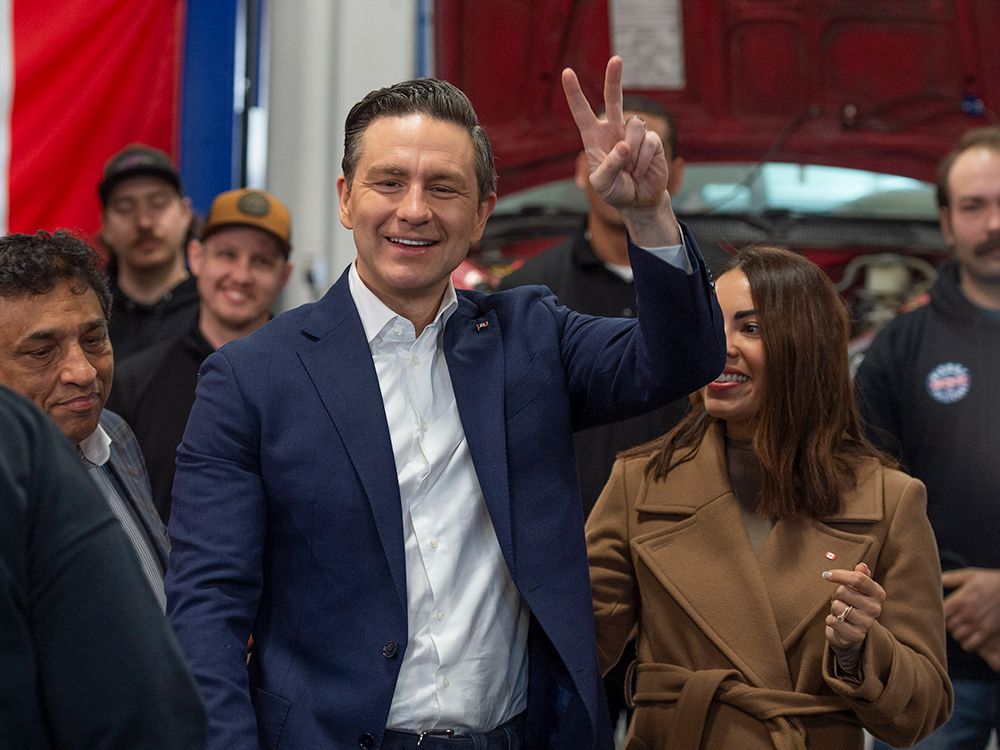
Conservative Leader Pierre Poilievre makes a campaign stop at a tire shop in Edmonton on April 8, 2025. The Tories' election campaign has been careful, disciplined, with plenty of policy proposals and massive rallies, writes Raymond J. de Souza.

“How do we meet the moment?” Premier Danielle Smith of Alberta

asked

the Canada Strong and Free Network (formerly Manning Centre) conference in Ottawa this week, calling for a patriotic groundswell to defend a Canada “worth fighting for.”

But sometimes the moment meets you, as Smith and others — notably Liberal Leader Mark Carney and Conservative Leader Pierre Poilievre — are discovering.

The CSFN was launched some 20 years ago by Preston Manning as part think-tank, part practical training school, but not directly engaged in partisan politics. Manning is no longer involved and he did not attend his year, as he used to do as a benign patriarch. He has got his own conference to organize next month, a sort of Reform Party redux, aimed at firing up the western populism of 40 years ago.

The CSFN serves as an annual

omnium gatherum

of Canadian conservatives. Conservative premiers often attend, and last year Poilievre spoke.

This year it was all very Trumpy, and Donald Trump is a very different kind of conservative, if conservative at all. The program included three former Trump administration officials, various crypto and vaping advocates and, most improbably, had Imperial Tobacco introduce Patrick Deneen, the political philosopher-cum-guru to Vice-President JD Vance and quondam thesis supervisor of U.S. Secretary of Defence Pete Hegseth at Princeton.

Premier Smith was certainly the lead attraction, a packed hall giving her a rapturous reception, while poor Prof. Deneen had a scattered few listening to an erudite condemnation of liberalism (both the progressive and conservative strains) root and branch. His advice to read George Grant’s

Lament for a Nation

was a singular paean to the

Red Tory tradition

in Canadian conservatism.

The assembly, preoccupied with the federal election, was on balance discouraged that Poilievre may lose. He may not, and in these tumultuous few months in our politics, nothing should be assumed to be inevitable. But he is not cruising to a mammoth majority. It happens. Recall that in 2003, a biography of Paul Martin was published entitled

Juggernaut

. There was wide talk of a historic majority in the offing. He won a minority in 2004 and was out in 2006.

Smith herself knows something about the moment meeting her. In 2014, she abandoned the leadership of the Wildrose Party to cross the floor to join the Progressive Conservatives of Jim Prentice. It went very badly and in 2015 the New Democrats ended the 44-year Tory dynasty in Alberta. Smith bided her time and returned in 2022 to takeover the leadership of the United Conservative Party.

The UCP had been put together by Jason Kenney from the wreckage of 2015. That impressive coalition of PCs and Wildrose came asunder when the pandemic drove a piercing stake between the two principal wings of the coalition, urban and rural, establishment Tories and grassroots reformers, elite business interests and populist disrupters. The moment had shifted and even Kenney’s mighty majority win in 2019 was not sufficient to resist it.

Another figure at CSFN was John Baird, Stephen Harper’s foreign minister. Baird got his start in elected politics in the 1995 Ontario election won by Mike Harris, who had run as “The Taxfighter” in 1990. He came in third as Bob Rae’s New Democrats surprised everyone. By 1995, Ralph Klein in Alberta had slashed government spending and Paul Martin had done the same in Ottawa. The moment had shifted. The moment met Mike Harris, who was more or less the same as he was five years earlier.

Has another moment arrived? Poilievre was riding high five months ago. He was the same then as he is now.

There has been plenty of murmuring against the Poilievre campaign. Kory Teneycke, Doug Ford’s campaign manager, was also at CSFN, and he has not been murmuring, but shouting, that Poilievre and his team have committed “

campaign malpractice.”

But have they? Their campaign has been careful, disciplined, with plenty of policy proposals and the massive rallies. In

the polls

they are ahead of where the Conservatives were in 2019 or 2021.

The moment though has shifted. Justin Trudeau has gone. Jagmeet Singh has disappeared. Trump has arrived, and global chaos in his wake. Poilievre was polished and ready for a time that has passed. The moment has shifted.

For example,

Abacus Data reported

that, by a margin of 55-28, poll respondents credit Carney, rather than Poilievre, for eliminating the carbon tax. Is it possible that Poilievre could have done more to oppose the carbon tax? Is it his fault that the moment has shifted to the extent that Carney is credited for the change to a policy which he long favoured?

It is certainly not Poilievre’s fault that the entire globe is transfixed on whatever should emerge from the Oval Office at any particular moment. Could he have foreseen that the economic well-being of billions would be held hostage to the humours and vapours of a single man?

Poilievre harnessed populist energies, which have a long and often noble history in Canada, on both the left and right, from the Prairies to Quebec. There is nothing shameful in that. Yet the moment has shifted and now the populist odour strikes many as a foul air. That may pass soon, just as it blew in with greater force in recent months. But the election is just a fortnight away.

Political leaders can convince themselves that just this strategy, just that policy, this clever positioning, that carefully adjusted message, will move the voters and shape the moment. Sometimes that is true. But at times the moment shapes the voters, the Earth moves, and all on the landscape are cast down or lifted up.

National Post


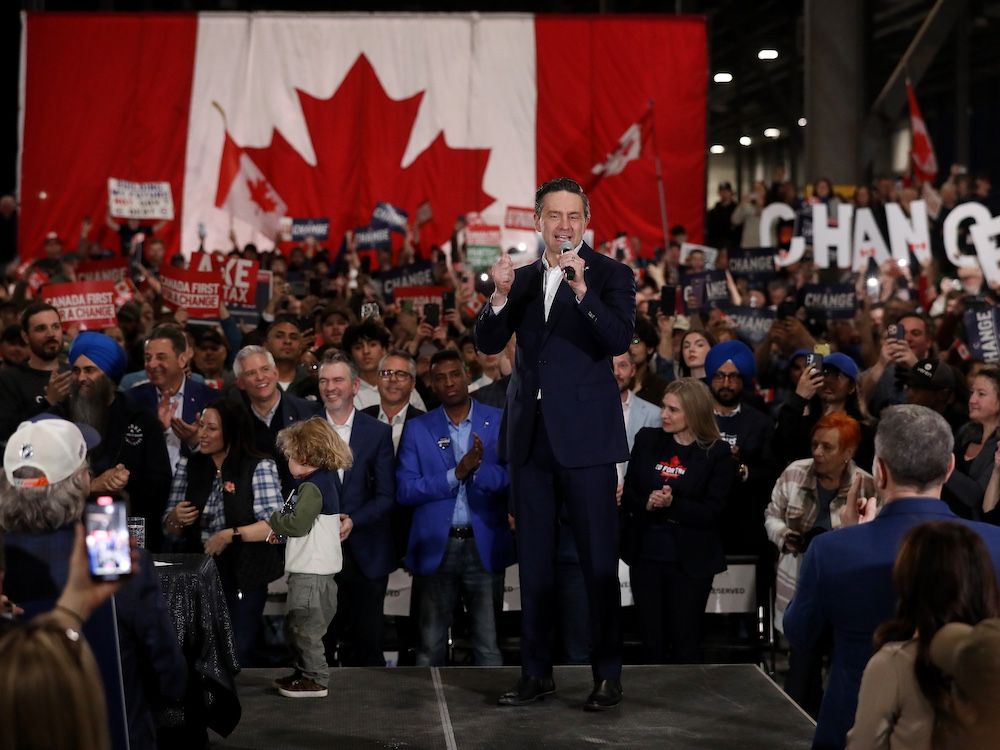
Conservative Party leader Pierre Poilievre speaks to the crowd during a campaign rally in Nisku (just south of Edmonton) Monday April 7, 2025. Photo by David Bloom

Having started with a rally larger than anything seen in recent Canadian history, and ending on yet another policy fail by Liberal Leader Mark Carney, this past week marked a turning point in the Conservative campaign.

Conservative Leader Pierre Poilievre has honed a message of strength when it comes to managing Canada’s relationship with the United States, tying the issue to affordability and quality of life with the common denominator of self-sufficiency.

Meanwhile, the election has shifted away from the U.S., now that President Donald Trump has dialled back his wrath for Canada and spread it to the rest of the world. There’s been little talk lately of a 51st state and its “governor.”

The conversation has thus turned back to Canadians’ homes becoming less affordable and their cities becoming less safe over the last 10 years.

It’s true that the Liberals are

ahead

in the polls, and a somewhat

narrowed

gap hasn’t changed the trajectory. But a trickle of underwhelming Liberal proposals and a breeze of current events favour the Conservatives with about two weeks left in the campaign.

On the ground, this has translated to a dedicated, large, organic following for the Conservative leader. Poilievre has been attracting crowds of vast sizes across the country:

2,000

in Fredericton (pop. 63,000);

3,000

in Kingston, Ont. (pop. 140,000); 6,500 in Oshawa, Ont. (pop. 190,000);

2,000

in Sault Ste. Marie, Ont., (pop. 72,000);

3,500

in Winnipeg (pop. 750,000).

Largest of all was his Monday night rally in the small town of Nisku, Alta., on the outskirts of Edmonton, which hosted between

9,000

and

15,000

people — so many, it had to be moved to a bigger venue at the last minute.

Carney, on that same evening, attracted only

1,500

to a Richmond, B.C. (pop. 223,000) event. Then, in Calgary on Tuesday, he drew

2,300

supporters in a city of 1.4 million. The next day,

800

came out in Saskatoon (pop. 290,000), followed by

500

in Hamilton, Ont. (pop. 600,000). He’s lacked Poilievre’s magnetism, and has instead drawn smaller, older crowds that are more

prone to

heckling

.

At the same time, the ink in Carney’s policy pen seems to be running out, as he’s been copying the gist of Poilievre’s ideas and filling in the details with what are often proven Liberal failures.

Last month, Poilievre

proposed

to harmonize provincial rules to allow tradespeople to work everywhere in the country and to increase apprenticeship grants. Carney followed that up last weekend with a similar promise to work towards ending trade barriers by

increasing funding

for trades training up to $8,000 (the key term being “up to”).

Carney also says he’ll keep the

Liberal grants

of “up to $10,000” for employers of newly hired apprentices. These grants encourage employers to discriminate on the basis of identity by paying only $5,000 to hire apprentices who don’t check any diversity boxes, while doubling the payment to $10,000 for racial minorities and new immigrants, among others.

Carney’s proposed training grants could very well come with the same identity-based strings attached. All he has are more Trudeau-style programs, when all that most people really want are back-to-basics solutions that get more young people into steady, reliable jobs.

Similarly, Carney finally elaborated on his solutions to the housing crisis,

proposing

to spend nearly as much on prefabricated homes as the Liberal government has spent on battery plants (which are

poised

to result in a net loss to taxpayers, by the way), a project proposal that will fail if the Liberal

record

on building anything is any indication.

What’s needed are not more incentives for under-performing contractors to bloat their budgets, as the Liberals propose, but the liberation of builders from the mountain of project-killing taxes, charges and procedural gunk that stand in the way of building new homes.

Poilievre’s straightforward

plan

is to cut sales taxes on new homes and to incentivize municipalities to cut development charges — immediately opening the taps on supply.

On energy, Carney is primarily echoing the skeleton of Poilievre’s plan with sub-par ideas grafted on. Poilievre’s concept of an

energy corridor,

for example, has been

copied

by Carney; both are promising shorter project review timelines (Poilievre’s being

one year;

Carney, two).

But Carney is planning to keep the same old review process in place and funnelling even more cash to Liberal-approved climate projects, while Poilievre would make serious reforms by

repealing

the Impact Assessment Act entirely.

Meanwhile, on crime, Carney has shown himself to be desperate for ideas: after

avoiding the issue

for weeks, he is now struggling to make the case for a safer Canada as Poilievre puts forward plans for

greater

minimum sentences for violent criminals, human traffickers and

repeat offenders

, along with tighter bail rules.

In response, on Thursday, Carney vaguely

claimed

that he’ll tighten bail laws for a narrow selection of crimes (with no explanation as to how), and proposed to continue pouring gas on the Liberals’ gun buyback dumpster fire, which is

expected

to cost $2 billion. He even promised to revoke gun licenses from people convicted of domestic violence — which is

already the law

.

Carney has since suspended his campaign for a third time to deal with the week’s American trade war chaos, from which Canada was largely exempt. It’s no wonder that he’d want to change the channel: Poilievre continues to cultivate a supportive base — and a policy platform that speaks to the needs of Canadians — which could indicate better performance than the numbers show.

National Post


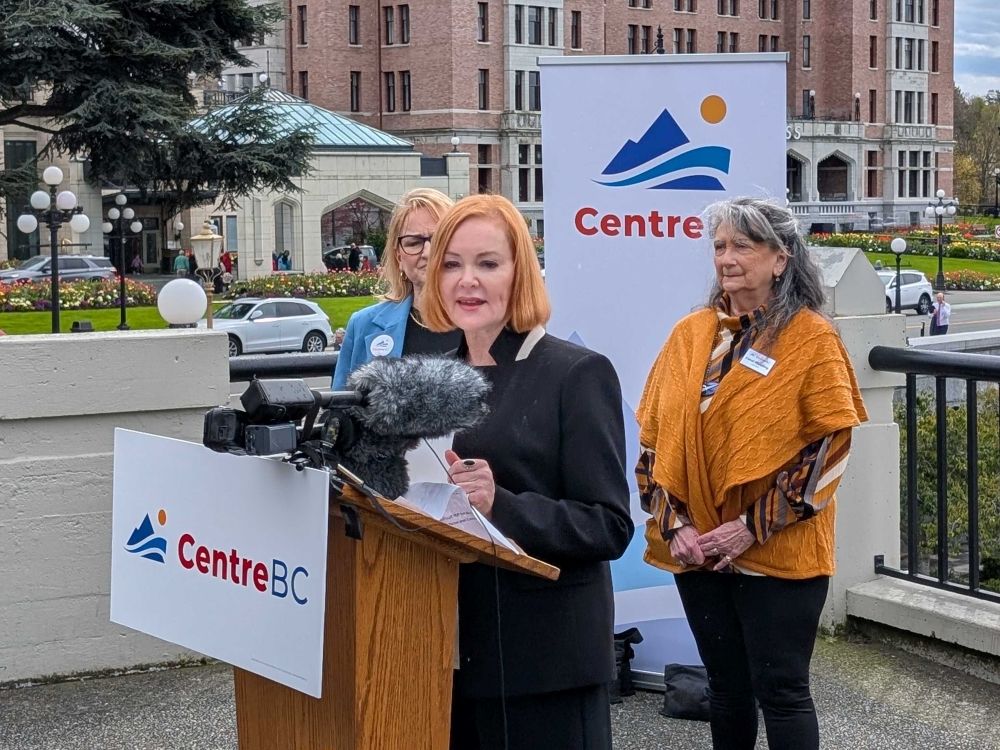
Karin Kirkpatrick, a former B.C. United MLA, launches her new CentreBC party in Victoria on Thursday.

When British Columbia’s newest political party, CentreBC, launched on Thursday, NDP Premier David Eby

wished

it “the best of luck.” Eby’s well-wishes were no doubt genuine, as B.C.’s political history shows that any significant vote split on the right has resulted in an NDP government every time.

The B.C. NDP’s first ever win in 1972, with 40 per cent of the vote, was due to the right’s three-way split between the previously governing Social Credit party (31 per cent), the Liberals (16 per cent) and the Progressive Conservatives (13 per cent).

When the right united in 1975, the NDP lost 20 seats and the election itself, but maintained its share of the popular vote. The Socreds formed a majority government with 49 per cent of the vote, and the Liberals and PCs got just 11 per cent between them. The Socreds went on to win three more elections in 1979, 1983 and 1986 as the right remained united and the Liberals and Conservatives failed to surpass seven per cent of the vote combined.

The NDP’s second win in 1991 was due to a split between the re-emerging Liberal party and the tired Socreds whose scandal-plagued leader, Bill Vander Zalm, had been replaced by Rita Johnson. The split between the Liberals (who went from zero to 17 seats and 33 per cent of the vote) and the Socreds (who declined to just seven seats and 24 per cent) allowed the NDP to win a majority of seats with 41 per cent of the vote.

The NDP’s first ever re-election in 1996 was due to yet another split, this time between the BC Liberals under Gordon Campbell (who won the popular vote at 42 per cent but not the most seats), the Reform Party (nine per cent) and another upstart party, the Progressive Democratic Alliance (six per cent).

By 2001, the BC Liberals had reunited the right under Campbell, winning 77 of 79 seats in the legislature. The party governed under Campbell and then Christy Clark until 2017. In the three intervening elections between 2001 and 2017, the right was unified; alternative parties never achieved more than five per cent of the vote.

When the NDP formed government in 2017, it was not due to an electoral “win” per se (the BC Liberals won the popular vote and 43 seats to the NDP’s 41), but because they reached an agreement with the BC Greens to topple Clark’s short-lived minority government.

While the Conservatives received less than one per cent of the overall vote in 2017, vote-splitting still played a consequential role on a riding-by-riding basis given the close seat count. The NDP narrowly won two seats over the BC Liberals due to the votes that Conservative candidates received in those ridings. Without those splits, the BC Liberals would very likely have formed another majority government.

In 2020, the NDP called a snap election to benefit from the pandemic advantage that saw many incumbent governments re-elected. For the first time, it won a decisive majority of seats without a significant split on the right (the Conservatives got just two per cent of the vote).

Uniting the right has thus never been more important. The NDP can win a majority without a split on the right, and is even more likely to do so when the right is divided. It was this reality that drove BC United (the renamed BC Liberal party) to withdraw from the 2024 election to prevent an NDP supermajority as the newly revived Conservatives surged past them in the polls.

Despite decades of evidence to the contrary, CentreBC leader Karin Kirkpatrick, a former BC United MLA, recently

said:

“If (BC United) hadn’t pulled out … the Conservatives and BC United could be government now working together. And I think that there would have been more seats won … they could actually be forming a coalition government right now.”

This flawed assessment is belied by B.C.’s electoral past and the outcome of the 2024 election itself. The NDP won a slim majority with 47 seats, to the Conservatives’ 44. Some former BC United candidates ran as Independents, resulting in a substantial divide in the centre-right vote in two key ridings. Had these splits not occurred, the Conservatives would likely have achieved 46 seats to the NDP’s 45, resulting in a tenuous balance of power in the legislature for whichever party formed government, and a strong likelihood of another election in the near term. (The Conservatives have been

criticized

for not inviting those independent candidates to run with their own party to avoid splitting the vote).

What happens next, particularly when it comes to the viability of any centrist alternative, will depend most on how the Conservatives themselves choose to address the realities of B.C.’s political history. Uniting the right should be a priority. This doesn’t mean giving up on the conservative principles that have driven much of their success, but it does mean making space for a broad range of views, welcoming a wide swath of members from B.C.’s last successful right-of-centre coalition, and, most importantly, setting out a vision so compelling that the right is drawn together in its pursuit.

The leaders who built B.C. — W.A.C. Bennett, Bill Bennett and Gordon Campbell — knew the unifying power of a bold ambition for British Columbia, and saw great success for their parties and for the province as a result.

More political parties fighting for votes on the right aren’t the answer. Unity is. The evidence is there for those who care to look.

National Post

Caroline Elliott is a North Vancouver-based political commentator and former vice-president of BC United. She has a PhD in political science and teaches B.C. politics at Simon Fraser University. Follow her @NVanCaroline.


Liberal Leader Mark Carney at campaign stop in Saskatoon on Wednesday, April 9, 2025. (Michelle Berg / Saskatoon StarPhoenix)

Canada is perilously close to the greatest electoral disaster in its history. A Liberal victory would commit the country to the deliberate pursuit of comparative poverty to reduce Canada’s minimal contribution to the fear of a rise in the world’s temperature due to carbon use. This is insane and must not happen.

It was probably a mistake to evict Wilfrid Laurier for Robert Borden in 1911, but Borden was a competent and honourable man. It was surely a mistake to defeat Louis St. Laurent and C.D. Howe to bring in John Diefenbaker in 1957, but Mr. Diefenbaker was formidable and admirable in many ways, though not an effective prime minister. It is now clear how regrettable it was to replace Stephen Harper with Justin Trudeau, but Harper ran a poor campaign and appeared to have run out of imagination, though he had governed well. Those collective misjudgments, not numerous in nearly 160 years of Confederation, were a mere sorbet, easily digested, compared to what will happen if Mark Carney is elected on April 28.

Voters should recall the reasons why the federal Conservatives enjoyed a

lead

of 29 points prior to the involuntary retirement of Justin Trudeau. The Trudeau government, partially under the intellectual and Mephistophelean influence of Mark Carney, presided over a dangerous net deficit of over $300 billion of excess of capital leaving the country over the amount entering for investment in Canada, while the inflation-adjusted per capita income of the average American has risen at four times the rate of Canadians in the last ten years. This is drastically uncompetitive.

As former Prime Minister Harper

wrote

last week, “Canada should be the wealthiest and most self-reliant economy in the world. We have the third largest oil reserves in the world yet we import 179 million barrels of foreign oil every year because the liberals shut down our wealth-generating pipelines while leaving us reliant on the United States. We are the fifth largest supplier of natural gas, but we still can’t export liquid natural gas because the liberals claim there is ’no business case’” for doing so. “We have more farmland per capita than almost any country, yet food prices have risen 37 percent faster than in the United States because of the Liberals’ carbon tax on farmers and truckers.”

The Trudeau government, which has been advised by Mark Carney informally since 2020 and formally since September 2024, has doubled the national debt, doubled the cost of housing, doubled the lineups at food banks, approximately doubled waiting times in our healthcare system, reduced us to inexcusable dependence on foreign oil, raised taxes, and caused a flight of capital unprecedented in our history. On the basis of this desperately incompetent performance, support for the Liberal party collapsed, and the party grandees organized the landslide election as Liberal leader of a man of complete electoral inexperience with a hyped-up record as a central banker.

The great Liberal myth-making machine has fabricated the fairytale that Carney was responsible for managing Canada’s economy through the global financial crisis of 2008-2009 when he was governor of the Bank of Canada. This country’s central banker in practice sets the prime interest rate. Fiscal and monetary policies are entirely in the hands of the government. Jim Flaherty, an outstanding finance minister in Ottawa and a brilliant treasurer in Ontario, guided us through that crisis. The banking system was saved by the conservative ratios established and administered under the Bank Act by the superintendent of financial institutions. Mark Carney was a factotum as the losses from the effects in this country of the implosion of the American real estate bubble were absorbed under the guidelines governing the banking system.

Where Carney did have influence was as an advisor of the Justin Trudeau government and we have him to thank, in part, for carbon taxes, the non-construction of pipelines, mountainous deficits, and irresponsible bloating of the money supply. This is Mark Carney’s celebrated “experience:” that of being mistaken on every major issue.

It would be unfair not to mention, as I did last week in this space, his performance as governor of the Bank of England. He threw himself head-first into a

rending

referendum campaign over remaining in or departing the European Union, when his duty was to be impartial and responsible. His successor as governor of the Bank of England has repudiated his stentorian campaign to terrorize the British people into voting to submit definitively to the authority in Brussels. At the same time, he transformed the central bank into an agency for frenzied advocacy of an extreme green agenda, which has absolutely nothing to do with central banking and was, to say the least, little appreciated in the UK.

By contrast, the Conservative leader, Pierre Poilievre, although he is only 45, is a seven-term member of Parliament and former cabinet minister, as well as the most formidable shadow minister of finance since Walter Gordon more than 60 years ago. He is an authentic conservative who, despite the customary biased efforts of the national political media to sandbag him as an extremist, has presented comprehensive suggestions for tax and expense reductions, promotion of energy and other resources exports, and a renovation of our faltering healthcare system. Mark Carney has

presented

our healthcare system as indicative of our conscientious superiority over the American system of government, but we are suffering from a terrible insufficiency of the number of doctors, the absence of private medicine, the disappearance of clinics, the chronic overcrowding of hospital emergency rooms, and a resulting promotion of the virtues of suicide-healthcare is supposed to prolong life, not shorten it.

The Liberals reversed the Conservative lead in the polls by amplifying Justin’s nonsense that President Trump is contemplating the takeover of Canada and by portraying Mark Carney as a modern Leonidas at the (International Peace) bridge to the United States. As I wrote here at the time, Trump has been playing poker, and now 75 of the world’s nations are seeking to renegotiate their trade arrangements with the U.S. and not one of them imagines that the result will be an improvement for them on the status quo. It is another Trump victory in the making, justified by the U.S. trade deficit of over $1 trillion. In 11 weeks, Trump has reduced illegal entries into the country by 97 per cent, identified up to $500 billion of wasted expenses, received pledges of foreign investment in the United States of approximately $10 trillion and is collecting $2 billion a day from enhanced tariffs. This is effectively a voluntary tax, as tariffs will not affect the cost of necessities, and will finance a comprehensive reduction in the country’s income tax, especially for people with modest incomes. This should be the end of Mark Carney’s claptrap about the ”tragedy” of American tariff policy, but don’t count on it — he has nothing else to run on.

National Post


Mark Carney speaks to the press after a cabinet meeting about the US tariffs on April 11, 2025 on Parliament Hill in Ottawa, Canada. (Photo by DAVE CHAN/AFP via Getty Images)

All the scrutiny and questions may be getting a bit too much for Mark Carney as he suspends his campaign for a third time.

Carney has clearly been irritated and put his “elbows up” after being questioned about a number of controversies swirling around him. Among the recent issues that have put Carney under a glaring spotlight have been: why Brookfield Asset Management used a Bermuda

bike shop

as a tax haven while he was an executive at the firm; whether his previous jobs

create

a conflict-of-interest for him and whether he met a pro-Beijing lobbying group in Toronto, as

reported

in the Globe and Mail on Thursday.

Carney said he had never heard of the Jiangsu Commerce Council of Canada (JCCC) but the Globe pointedly revealed that there were photographs on the organization’s website showing the prime minister with two of its senior members.

All that heat must have left Carney in a flop sweat.

On Thursday, Carney said he was suspending his campaign to return to Ottawa to convene a meeting Friday of the cabinet committee on Canada-U.S. relations. The reason was to respond to the continuing fallout from U.S. President Donald Trump’s tariffs, according to the Liberals.

Except, that on Wednesday Trump reversed course. He paused his decision about reciprocal tariffs on some countries and took no additional action on Canada. What was there to urgently respond to?

The immediate need for Carney to flee to the safety of an Ottawa committee room may have had more to do with taking a breather from all those troublesome questions.

But it also has another benefit: it plays into the Liberals’ attempts to mythologize Carney as the only saviour of Canada from the enemy that is Trump. Carney must be portrayed as the chosen one, the hero of the hour, the slayer of beasts and the scourge of the evildoer.

It wouldn’t be surprising if the Liberals installed a Bat Signal on top of Parliament with his face on it.

But it has to be this way because the Liberals have no other plank on which to stand.

The housing crisis, the food crisis, the immigration crisis, the lack of infrastructure/investment crisis, the health-care crisis, the crime and drug crisis — all caused or exacerbated by nine years of Liberal misrule.

Who would vote for Carney if his platform was: Vote for Liberals because this time — pinky promise — we are going to get it right?

And so Carney versus Trump is the only platform.

A week ago, pundits were saying that the only “ballot question” was Trump’s tariffs and that Pierre Poilievre was wrong to concentrate on “domestic issues” – as if they don’t matter to Canadians.

Now the tariff threat has receded somewhat. It may come back, only to recede again and then come back again. Trump will be the rogue factor for the next four years.

However, all those crises that screwed Canada for the last nine years aren’t going away and they need to be dealt with.

Which is why Poilievre has been so adamant about raising them time and again.

On Friday, he was asked whether he had committed “campaign malpractice” by squandering a 25 point lead in the polls, the implication being that he should have spent his firepower on Trump.

But Poilievre refused to back down.

“The Liberals and lobbyists want me to stop talking about the food prices,” he

said

. “Well, I’m not going to do that because single mothers should not be going to bed hungry worrying about how they are going to feed their kids in the morning.

“And they want me to stop talking about the doubling of housing costs during the lost Liberal decade. I’m not going to stop talking about that.

“They want me to stop talking about the rampaging crime that’s overtaking our streets and the overdose crisis that the Liberals caused that has taken the lives of 50,000 people. I will not stop talking about that either.

“We can’t afford a fourth Liberal term.”

Th Liberals can’t run on their record — who runs on a record of failure? Which is why we are witnessing the bizarre spectacle of Carney and his entourage of Trudeau ministers acting as if the last nine years had never happened.

Carney’s only hope of electoral success rests on him being portrayed as prime ministerial.

This means that he may have to stretch the limits of the caretaker convention that call for a government to act “with restraint” during an election period. The Privy Council

guidelines

do allow governments to deal with matters which are “urgent and in the public interest.” But who makes that call? Carney.

And so we have an unelected prime minister and novice politician making profound and significant decisions with regard to tariffs and retaliatory measures that may well hamstring a future government.

Critics might argue that the business of government must continue. And so it must. But the appalling timing of all this is down to the Liberals, and if Carney wanted to govern on behalf of all Canadians and in a time of dire emergency, he could well have convened a wartime cabinet, and sought the confidence of the House instead of calling an election.

In Britain, Carney was called the “high priest of Project

Fear

” because of his political attempts to dissuade people from leaving the European Union.

He has now revived those odious tactics and is playing on the anxieties of a nation, a new Project Fear, to scare Canadians and get himself elected.

But as Franklin D. Roosevelt might have said, we have nothing to fear but Project Fear itself.

National Post