



LP_468x60
on-the-record-468x60-white

Nova Scotia Premier Tim Houston appears in a video published on social media.

This week, while the federal Conservatives were renewing their vows to

crack down

on so-called woke ideology, Nova Scotia Premier Tim Houston released a

three-minute video

that did more to counter the excesses of political correctness than Conservative Leader Pierre Poilievre has done in his entire career.

This is because Houston’s “I am Nova Scotian” video (what some suspect is a precursor to his future bid for federal leader) offers a version of Canadian conservatism that celebrates patriotism and diversity at the same time — and most rare: in a way that isn’t annoying or cringey.

The video is a disarming Maritimer take on the “I am Canadian” Molson ad from the 1990s. Instead of beer, its focus is Peggy’s Cove, Celtic strings and “skaw-lups” (not “scaah-lips,” we are sternly reminded).

We see the premier, in a windbreaker of course, tour various Nova Scotia landmarks while his voiceover recounts the long list of important things invented in the province. Hockey. The telephone. Newsprint. Kerosene. The donair.

There are many nods to old-stock maritime tropes. “I have asked who your father is, and I give directions based on landmarks that are no longer there,” Houston says.

But there are also nods to themes rarely seen in Canadian Conservative politics these days.

We were “first in the country to legalize that love is love,” the premier says about his province, amid images of gay couples marching in a Pride parade.

“And ours is the province where Viola Desmond sat wherever she damn well pleased.…  Inspired by the Black Loyalists and the Trelawney Maroons, we will not be bullied by those that look to oppress us. We were the first province in Canada. The first port of call for generations of new Canadians. And we will never be the 51st of anything. My name is Tim and I am Nova Scotian.”

Houston’s video could be naked political opportunism masked as Maritimer pride, or a little bit of both of those things (it probably isn’t a coincidence the video launched days prior to an election result that could spell the end of Pierre Poilievre’s tenure as party leader).

But whatever its motive, it is frankly a masterclass in inclusion done the right way. Houston manages to acknowledge his province’s painful complexities without endlessly apologizing for the injustices of its past; he includes diverse groups without casting them as victims or invoking jargon to describe them.

In other words, the Nova Scotia premier is offering Nova Scotians — and by extension Canadians — a picture of a conservatism that says, “We see you for who you are — now let’s get on with it and do something great together.” It might seem trite to some, but it is a whole lot more invigorating than the identity politics offered by the federal Conservatives, which could be boiled down to: “We must destroy the woke mind virus to re-establish a warrior mentality in the Armed Forces.”

It’s not just that the latter worldview is, as many have pointed out, a tad Trumpy for an electorate practically allergic to U.S. President Donald Trump. It’s that it has almost zero relevance to the lives of average Canadians.

Granted, you’d probably be hard-pressed to find a Canadian of any gender who doesn’t consider “radical wokeness” annoying, or who doesn’t cringe every time a man in the workplace begins a sentence with the apology, “Sorry, I didn’t mean to mansplain …” And it’s not as though “woke ideology” on campus or in government is harmless. I’m a gay Jewish woman — I am very familiar with a strain of politics on the left that celebrates one facet of my identity but shuns another.

But the ironic bottom line for the current top brass in Conservative federal politics is that they can’t stop committing the same sin that progressives themselves are historically guilty of: obsessing about identity politics when most people are simply tired of hearing about it.

The fight we find ourselves in now, all of us, is not against dreaded hordes of shrieking woke zombies. It is, as Tim Houston and Canada’s premiers seem to know well, a fight for the preservation of our independence and our soul against a rapacious force that lives next door and is not about to fade away. The sooner the federal Conservatives realize this, the less likely they will be to fade away themselves.

National Post


A student protester stands in front of the statue of John Harvard, the first major benefactor of Harvard College, draped in the Palestinian flag, at an encampment of students protesting against the war in Gaza, at Harvard University in Cambridge, Mass., in 2024.

It’s difficult to summon much sympathy for Harvard University. Famously elitist, smug and with its graduates overrepresented among the ranks of the powerful, the school is a bastion of an increasingly unpopular establishment. Harvard’s recent indulgence in antisemitism and intolerance towards dissenting ideas do it no favours in terms of public esteem.

But in its ongoing tussle with the Trump administration, Harvard enjoys a significant advantage: the government has no right to condition money and tax-exempt status on ideology. The elite school could further reinforce its independence by emulating another college that cut ties with the government, in favour of private funding.

In two letters, one dated

April 3

and the other

April 11

, the Trump administration demanded that Harvard University implement specific reforms in return for access to federal funds. Prominent among them was a condition that that the school adopt “oversight and accountability for biased programs that fuel antisemitism.”

The letters also called for improved campus discipline, merit-based admissions and hiring to replace identity-based preferences, the abandonment of diversity, equity and inclusion (DEI) programs and encouragement of viewpoint diversity on campus.

In an

April 15 post

on Truth Social, U.S. President Donald Trump doubled down on the demands and the consequences of noncompliance. He speculated that, “Perhaps Harvard should lose its Tax Exempt Status and be Taxed as a Political Entity if it keeps pushing political, ideological, and terrorist inspired/supporting ‘Sickness?’ ”

Taken by themselves, the administration’s proposals are generally sensible. Elite colleges and universities really do have an

antisemitism problem

dating back even

before campus protests

supporting Hamas’s October 7 massacre. Administrators at some schools, Harvard included, seem to coddle or even encourage misbehaviour when they agree with the political motivations.

DEI programs

function as ideological litmus tests and fuel inter-group tensions. And with

around 80

self-identified “liberal” or “very liberal” faculty members for every “conservative,” Harvard is even more ideologically monolithic than most of academia, which is famously left-wing (a 2020 National Association of Scholars

study

found “no evidence that is inconsistent with the broad evidence that conservatives and Republicans are absent from leading colleges around the country”).

Increasingly removed from, and even hostile to, American society, institutions of higher education are losing public support. In 2024,

Gallup reported

that, “An increasing proportion of U.S. adults say they have little or no confidence in higher education.”

The result is an almost equal division among those who have “a great deal or quite a lot of confidence” (36 per cent), “some confidence” (32 per cent) or “little or no confidence” (32 per cent) in colleges and universities. Also last year,

Pew Research found

that, while 53 per cent of Americans believe “colleges and universities are having a positive impact,” 45 per cent say they actually hurt the country.

Yet even though Harvard and other institutions of higher learning have lost the Trump administration and much of the population, they still have the law and the U.S. Constitution on their side. Elected officials may have good reforms to suggest, but they have no right to impose them.

“Harvard isn’t entitled to federal funding. No institution is,”

points out

the Foundation for Individual Rights and Expression (FIRE). But, the group adds, “just as the law gives us certain protections, it also says the government can’t cancel funding on a whim, like the administration did last week.”

If the Trump administration believes Harvard or any other institution has violated the conditions under which it benefits from tax exemption, grants and financial aid — say, by

allowing the persecution

of Jewish students — it must launch a formal investigation and prove its point. It is compelled to offer the school an opportunity to challenge any findings. Due process matters.

Harvard also enjoys constitutional protections for the ideas espoused on campus or embraced by the institution as a whole, even if, as President Trump characterized them, those ideas constitute a “sickness.” Eugene Volokh of the Hoover Institution

commented

: “Under the First Amendment, tax exemptions have to be distributed without discrimination based on viewpoint; that means that evil views have to be treated the same way as good views.”

Note that neither FIRE nor Volokh are fans of the state of higher education. In 2023, FIRE awarded Harvard the “

worst score ever

” in its college free speech rankings. Volokh

moved to Hoover

from the UCLA School of Law for greater freedom to “be able to write and say what I think is right, regardless of whether I’m mostly, partly or not at all in step with my colleagues or the administration.” Nevertheless, they assess Harvard’s battle with the administration on its merits and believe the school is likely to prevail in court.

But if Harvard really wants independence from the current administration and those to follow, there’s another approach. On April 14, as

Harvard announced

its resistance to the government’s demands on X, Michigan’s

Hillsdale College responded

: “There is another way: Refuse taxpayer money.”

Founded in 1844 and recognized as an early bastion of anti-slavery sentiment, Hillsdale College resisted federal efforts in the 1970s and ’80s to force colleges to categorize their students by race. In 1984, rather than comply with government demands, the college began

refusing federal money

, including financial aid for its students. Instead, it raised money from private donors to make up the difference.

In 2007, Hillsdale announced it would no longer accept money from the state of Michigan — again, as a means of minimizing any levers government officials might use against the school. Instead, it relies on private funding, which has built Hillsdale’s endowment to

over US$900 million

(C$1.25 billion).

Since then, a few other colleges — mostly religious in nature — have emulated Hillsdale. With an endowment of over US$53 billion, Harvard University is especially well-positioned to assert its independence from government oversight and interference. Demonstrating its financial strength, last month, Harvard began

offering free tuition

to students whose families earn less than US$200,000 a year.

Like all American individuals and institutions, Harvard enjoys constitutional protections against government meddling. But if the school really wants to assert its freedom from politicians and from an increasingly alienated public, it should look to itself and its supporters for funding.

National Post


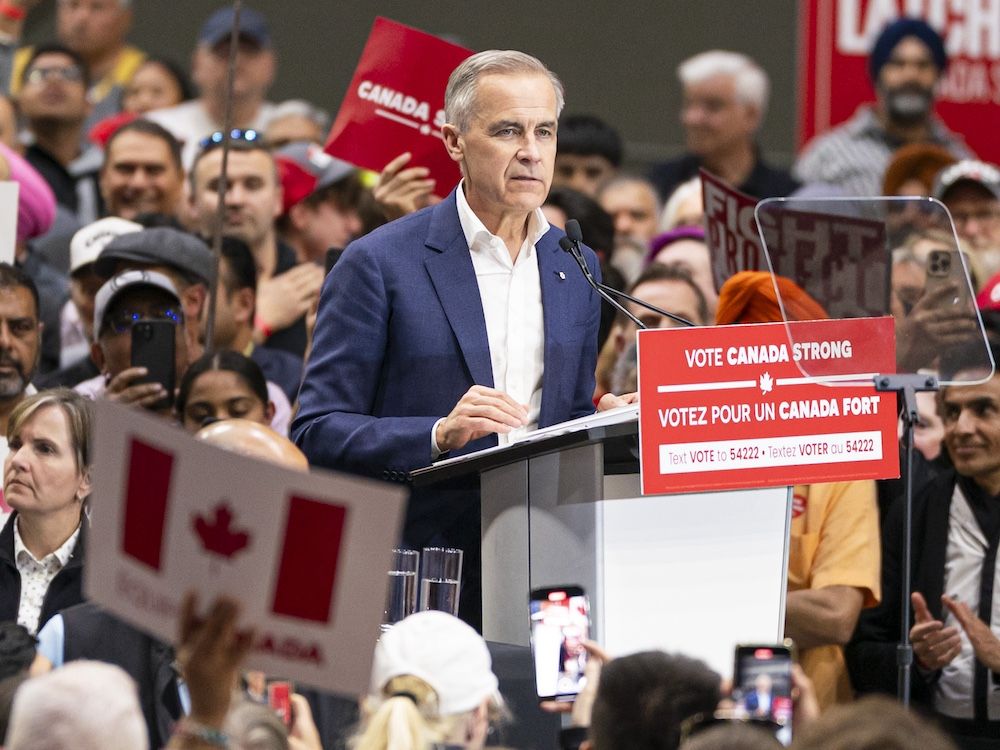
Liberal Party Leader Mark Carney speaks to supporters during a rally on April 23, 2025 in Surrey, Canada. (Photo by Rich Lam/Getty Images)

What do you suppose it is like to be Michael Ignatieff right now? Gosh, he must really think the good Lord has it out for him. In 2006, as a stylish liberal intellectual with a star reputation in Europe, he rolled up his sleeves and ran for the Commons seat in Etobicoke — Lakeshore. His ultimate ambitions were no secret, but he thought he had better learn the ropes first, get yelled at on a few doorsteps and absorb the sights and scents of an actual Canadian neighbourhood. In 2009, the suffering Liberals turned to him as a new leader and anointed saviour, with other dignitaries flinging themselves out of his path to make way.

As you’ll recall, this didn’t go at all well for them, even in Etobicoke — Lakeshore. And, of course, Ignatieff immediately cleared out of Canada altogether, having learned that the moment just wasn’t right for a national rescuer-figure on horseback. I’ve pointed out specifically that Ignatieff had truancy problems that today’s Liberal leader doesn’t, but he did, after all, attempt to serve a parliamentary apprenticeship. He knew it wasn’t customary to barge into the Commons for the first time already clothed in the power of a prime minister. He was aware that the keys to the kingdom wouldn’t simply be tossed to him in desperation. Poor devil.

The political polls suggest that … well, things may have changed since the Count’s college try. I am very agnostic about the Canadian polling profession, and this is not just because I am a migrainous, despairing middle-aged Albertan whose youth was spent bathing in the weird cauldron of the Reform party. Even if you are willing to give our pollsters a few tons of benefit of the doubt on ethics, they are working in a Canadian environment of preposterous data poverty, period.

Assuming they’re not “herding” inveterately, mistakenly following the scent of each other’s bovine flatulence, and assuming they’re not just torturing their mid-election numbers with an eye to future work contracts, there are inherent limits to the resolving power of their forecasts. In Canada, these limits are as low as it goes. And, frankly, I’ve read a few times too often in recent years about hair-raising last-minute surprises in other countries’ elections.

But surprises can go both ways, and there can be no doubt that the current election has been affected by an illiberal mood of post-Trump panic. The Canadian conservative movement has been punching itself in the face because the federal party’s current brain trust prepared for an election that was going to involve heavy litigation over a decade of

harmful, sophomoric, economically stagnant Liberal government.

The shared sense that this would be a useful and appropriate exercise has fled us altogether, along with the valuable instinct that governments ought to be changed like underwear from time to time (and, indeed, for analogous hygienic reasons). A serious exterior threat from a great power has eradicated all memory of our own recent past, and extinguished any contrition Liberal voters might otherwise feel.

This ought to bestir the heebie-jeebies of a liberal-minded person at least a little. Mark Carney has genuinely relevant credentials to serve as a prime minister of Canada, but if you were actively hoping we would get the Goldman Sachs neoliberal monster version of Mark Carney, you cannot be pleased that he is throwing the famous “fiscal anchors” into the ocean without their chains while blathering arrogantly about how he has “managed economies.”

Our whole modern world is significantly defined by the laser-bright line between fiscal and monetary functions of the state. Carney, as he would be the first to tell anyone he didn’t believe to be thick as a brick, has successfully managed currencies — and has no experience of the inherently more complex handling of public treasuries. The one thing he seems to be sure of is that he has an uncontestable personal claim to the use of our future federal revenue; the sovereign right, that is, to take out a third mortgage on Canada to go with the second one his predecessor bought.

Vote how you like if you haven’t voted yet, but I hope you’ll acknowledge that this could go very, very poorly. Or, one supposes, it could just be more of the same: more urban decay and grotesque street crime, more failed industrial planning, more ad-hoc voter bribery and more insane housing and immigration policy.

National Post


A sign showing the Canadian Charter of Rights and Freedoms is shown during a rally at Central Memorial Park in downtown Calgary on Saturday, September 18, 2021. Jim Wells/Postmedia

Western democracies face increasing pressures toward censorship, now is the time for Canada to distinguish itself as a nation that protects robust debate. The three major federal parties have released their platforms, revealing dramatically different approaches to free expression. Not only do the platforms make very different commitments — the platforms also provide insight into how the party leaders think about this fundamental freedom: do they see free expression foundational to democracy, or as threatening it?

The NDP

platform

implicitly positions speech as something to be suspicious of and requiring curtailment. While asserting they would ensure that Charter rights are protected, they immediately pivot to expanding support for the CBC and local journalism as “critical during this time of misinformation, disinformation, and U.S. threats.” To be clear, a diverse and vibrant press is beneficial to democracy. But there is nothing about funding the CBC that is constitutionally required. And the NDP’s stance ignores that the CBC has its own perspective. The NDP’s definition of the term “misinformation” is undoubtedly broad, and will ultimately be selective. When the government defines these terms, there’s a non-zero chance that they will define them in a way that captures the speech of their opponents.

Perhaps most concerning is the NDP

promise

of “concrete action to protect Canada from misinformation and disinformation — whether it comes from foreign actors, bad-faith influencers, or unregulated ‘media’ platforms.” This sounds frighteningly like an intention to target independent media outside “state-sanctioned” outlets, essentially putting government in the role of truth arbiter — a dangerous proposition for a democracy.

Additionally, the NDP proposes legislation to criminalize “residential school denialism” — a likely unconstitutional measure with unclear boundaries that could stifle legitimate historical inquiry.

The Liberal

platform

says significantly less about free expression, but what it does say is concerning. It begins by claiming “the Liberal party is the party of the Canadian Charter of Rights and Freedoms,” because the Charter was introduced by a Liberal government. This partisan framing of our constitution is deeply divisive and unhelpful.

The platform promises to “stand up for the Charter,” but ignores how the Liberal government has repeatedly undermined Charter rights. The Trudeau government illegally invoked the Emergencies Act, made unconstitutional amendments to the Canada Elections Act (struck down by courts), proposed censorship legislation (Bill C-63) that would have put people under house arrest for future speech crimes, and passed the Online News Act and Online Streaming Act, which undermine free expression.

The Liberals also propose expanding the Court Challenges Program, which uses taxpayer money to fund litigation against the government’s own laws. Research from the MacDonald Laurier Institute has shown this program has an overwhelming progressive bias, with 96 percent of funding going to progressive activism.

Their platform also proposes criminalizing obstruction of access to places of worship, schools, and community centers. While ostensibly responding to concerning protests targeting Jewish communities, such “bubble zone” laws often restrict legitimate protest activity and get the government involved in determining which topics of protest are permissible — fundamentally undermining the content-neutral right to free expression.

The Conservative

platform

contains multiple commitments to free expression. It promises to modernize laws against online harassment and strengthen child protection online “without infringing on the civil liberties of law-abiding Canadians” — a direct criticism of the Liberals’ Bill C-63.

The platform proposes tougher sentences for religious property damage and penalties for masked rioters. While these offenses are already criminalized, the Conservatives emphasize stronger enforcement.

What distinguishes the Conservative platform is its dedicated section on free speech, which begins by quoting Wilfrid Laurier: “Canada is free and freedom is its nationality.” It commits to restoring free speech through a Freedom of Speech Act that would repeal “liberal censorship laws” and restore Canadian news on platforms like Meta — a direct reference to repealing the Digital Streaming Act.

The Conservatives also commit to protecting free speech on campus by requiring universities to enforce Charter guarantees of free expression as a condition for federal funding — addressing the well-documented challenges to academic freedom at Canadian universities. This is good. A university without a commitment to freedom of expression isn’t a very good university. The situation has gotten so bad that the Canadian Constitution Foundation is

helping

a group of professors and a former student at the University of British Columbia sue that university over academic freedom.

How we approach free expression reflects our vision for Canada. The NDP sees speech as something to be suspicious of and requiring government control. The Liberals offer rhetoric about Charter rights while having undermined them for years. The Conservatives position freedom of expression as central to Canadian identity.

When casting your ballot on April 28, consider which vision of free expression aligns with your values for Canada’s future. Can we be trusted with the freedom to speak, debate and disagree? Or does the government need to protect us from “harmful” ideas?

Free debate is essential to discovering truth and maintaining a healthy democracy. As voters, we should demand that all parties commit to robust protections for this fundamental right.

National Post


The Google logo at the company's Bay View campus in Mountain View, California. Google will acquire cloud security platform Wiz for $32 billion. (Photo by Josh Edelson / AFP)

In November, Matthew Boswell, Canada’s Commissioner of Competition,

stated

, “The Competition Bureau conducted an extensive investigation that found that Google has abused its dominant position in online advertising in Canada by engaging in conduct that locks market participants into using its own ad tech tools, excluding competitors, and distorting the competitive process. Google’s conduct has prevented rivals from being able to compete on the merits of what they have to offer, to the detriment of Canadian advertisers, publishers and consumers.”

Commissioner Boswell must be pleased that United States District Judge Leonie Brinkema, in a

detailed opinion

, ruled last week that Google engaged in unlawful monopolistic conduct in controlling the software used by publishers to manage online ads as well as the exchanges used to buy and sell them.

As Brinkema wrote in 2023, “The essence of antitrust law is to try to keep the system working by recognizing that, at certain points, some companies may get too big for their own good, they’re self-imploding, or the technology may become so dominant that it’s just crushing all other elements where there can be innovation.”

Every newspaper or website that wants to sell ads pretty much has to use Google’s software to place and match ad buyers and sellers. And the reason is Google has bought a bunch of companies and engaged in practices like tying its products together and excluding rivals from the market by restricting whether its customers can use non-Google services. As a result, Google’s middleman software services take 30 to 50 per cent  of revenue spent by advertisers on ads meant for publications, instead of one to two per cent. So, if the judge finds a good remedy, it could mean billions of dollars more for the press, because Google won’t be able to take nearly as much.

Here are five key points about her decision.

• First, this decision is now the  third  loss for Google. In 2023, Google

lost a monopolization case

to Epic Games over its control of the Android app store. Last year, the company

lost a case over its control of search

. Last week, it lost a third case over yet another line of business. These decisions build on each other; Brinkema cited the decision in the search case to describe why Google had control over so many small advertisers. Referencing across the cases will continue to happen as we move into the remedy phase. Additionally, private and state antitrust cases, like a case led by the Texas attorney general on adtech currently working its way through the courts, will

benefit

from this decision.

• Second, this decision shows antitrust cases don’t have to take as long as they do. The complaint for this one was filed in January of 2023, and it has been decided just 26 months later.

• Third, all three judges overseeing these Google cases have criticized the behaviour of the company’s lawyers, specifically calling out its top lawyer, Kent Walker, for false claims of privilege and for allowing the wholesale destruction of documents while on a litigation hold. Judge Brinkema wrote, “Google employees and executives also misused the attorney-client privilege. For example, Kent Walker, an attorney who served as Google’s President of Global Affairs and oversaw the company’s legal team, marked an email in which he asked his colleagues for reactions to a New York Times article as ‘privileged …’”

Google’s systemic disregard of the evidentiary rules regarding spoliation of evidence and its misuse of the attorney-client privilege may well be sanctionable. But because the court has found Google liable under Sections 1 and 2 of the Sherman Act based on trial testimony and admitted evidence, including those Google documents that were preserved, it need not adopt an adverse inference or otherwise sanction Google for spoilation at this juncture. As in Google Search, the court’s decision not to sanction “should not be understood as condoning Google’s failure to preserve chat evidence.”

• Fourth, this decision is an illustration of how judges are updating antitrust law as they confront modern commercial realities. When judges write decisions like this, they interpret the laws and set future precedents. Judge Brinkema noted that Google wasn’t blocking rivals, but customers. She also pointed out investment patterns of a monopolist — a willingness to sacrifice short-run benefits to harm smaller competitors for longer term benefits.

• Fifth, the likelihood Google is taken apart has gone up. The judges involved in the various Google decisions are likely going to have to co-ordinate with one another over how to manage the various remedies, and at some point, consent decrees over behavioural elements are simply too complex to administer, especially when the legal authorities within the company are engaged in bad faith. They may need to allow technical committees managing such decrees to share information.

The broader dynamic here, as illustrated by the Google decision, is unmistakable. The antitrust revolution rolls on. Canada, make sure your Competition Bureau has the resources it needs to be a leader in fighting against monopolists who abuse their market power.

National Post

Matt Stoller is the publisher of the newsletter BIG and the author of “Goliath: The 100-Year War Between Monopoly Power and Democracy.”


Doug Ford's government announced this week that it will spend $750 million over five years to cover the cost of 20,500 student places in science, technology, engineering and math (STEM).

The Ontario government this week took a welcome and long overdue step towards paying for the kind of post-secondary system the province needs to drive economic growth.

It will

spend $750 million over five years to cover the cost of 20,500 student places

in science, technology, engineering and math (STEM). People with those skills are essential in a tech-driven world. It makes sense to train as many as possible.

However, the news isn’t quite as good as it would first appear. This is not a major expansion of STEM training. Rather, it is largely the Doug Ford government belatedly providing the money for something universities, and to some extent colleges, are already doing.

Ontario’s rigid and out-of-date university funding formula hampers universities’ ability to respond to economic demand by limiting the number of students they can take. Universities have been able to get around this to some degree because of significant numbers of foreign students, who pay higher tuition fees. Those numbers will be down next fall because of

federal government caps on foreign student permits.

The provincial government is stepping up with permanent base funding to make sure STEM training is not affected, but that’s not all it is doing.

Ontario’s post-secondary funding hasn’t had a fundamental review since 2016, but the Ford government is about to begin one. It’s about time. Ontario’s government operating grants per university student are

the lowest in the country

and about $4,000 less than the national average.

In the interim, the Council of Ontario Universities (COU) is

asking for help in this year’s spring budget

. Last year, the provincial Ford government announced $1.3 billion over three years to help schools stay afloat. The problem is that the money is temporary, as if the sector’s financial problems are some kind of blip, not a systemic shortfall.

COU would like the sustainability amounts to be made permanent and doubled. It’s not an unreasonable request, but it will be surprising if it meets a positive reception.

Still, it’s encouraging to see the post-secondary sector and the provincial government moving towards a point of convergence. The language of this week’s STEM announcement was all about “protecting workers and jobs by investing in post-secondary education.” The universities’ pitch for money also emphasizes their economic contribution, while reminding the government that the university system isn’t big enough to meet future needs. COU estimates that an additional 100,000 spaces will be required by 2030 to meet the needs of Ontario domestic students.

 The University of Windsor on Wednesday.

The financial implications of that are significant. Not including the latest money, Ontario spends $5 billion a year to educate about 920,000 post-secondary students now.

This is not a problem the Ford government is willing to throw money at without a clear expectation of results, nor should it.

Ontario’s colleges and universities are in the middle of a shakeup driven in part by the reduction in foreign students. Colleges in particular had drifted far from their core mandate of training people for the Ontario economy and some of them now face program cancellations, closure of satellite campuses, and layoffs.

Universities didn’t rely on foreign students to the extent that colleges did, but the loss of those students has hurt them too, and made worse the underlying pressures from low provincial funding.

The solution lies in universities adopting a clearer focus on what the Ontario government wants and what the province’s economy needs.

Ontario universities seem willing to do that, up to a point, but change won’t be easy. For decades, universities have defended the privilege of teaching whatever they want; in effect, demanding that the public subsidize learning that does little to boost the province’s economy.

That’s not a realistic approach given the Ford government’s focus on economic growth and the

control it has over university budgets

. Government operating grants and research contracts amount to 40 per cent of university funding. Tuition provides 44 per cent, but the government controls tuition levels.

Universities have long said that a degree in anything has value, the old learning-to-learn argument. No doubt it has some, but learning something useful has more value still. That needs to be the focus of a renewed, financially stable post-secondary system.

University’s offerings need to be driven less by the preferences of teenaged first-year students and more by economic requirements. The government has responsibilities, too. It has made STEM a priority, but it needs to do more to meet the need for teachers and nurses, too. Too many qualified applicants are being turned away in a province that requires their skills.

Ontario’s universities are pillars of the provincial economy, and the more they do to enhance that role, the easier it will be to convince the public and the government to support the substantial extra money they require.

National Post

randalldenley1@gmail.com

Get more deep-dive National Post political coverage and analysis in your inbox with the Political Hack newsletter, where Ottawa bureau chief Stuart Thomson and political analyst Tasha

Kheiriddin

get at what’s really going on behind the scenes on Parliament Hill every Wednesday and Friday, exclusively for subscribers. Sign up here.


Federal NDP leader Jagmeet Singh at the annual Surrey Khalsa day Vaisakhi Parade in Surrey, BC Saturday, April 19, 2025. (Photo by Jason Payne/ PNG)

Jagmeet Singh is urging people to vote NDP and calling it the only defence against a Liberal “

supermajority

.

” It is a rather pathetic conclusion to Singh’s time as party leader, but par for the course when taking into account the entirety of his career in federal politics.


When Singh first became NDP leader in 2017, he did so with a mandate to build a young, multiracial coalition to challenge Justin Trudeau’s place as leader of Canada’s progressive movement. That coalition has been built, but they’re not voting for the NDP. 


Win or lose the federal election, Pierre Poilievre’s Conservatives made themselves the standard-bearers for the aspirations and anger of millennial and gen Z Canadians. Arrayed against them are the resurgent Liberal party led by Mark Carney and his almighty base of boomers.


Where do the Singh and the NDP fit into this remarkable realignment? Apparently nowhere. 


Contrary to Singh’s delusional past assertions that he would one day become prime minister, nobody ever seriously expected an NDP government under his leadership. Under his leadership, the NDP lost 15 seats in 2019, along with the party’s lowest vote share in 15 years, and that was only his first election as leader.  


This year, he is reduced to begging for enough votes to prevent a Liberal majority government, and his party will be lucky to get close to 10 seats. It will set a new standard for disastrous leadership in Canadian politics. 


Some diehard NDP supporters

have declared

that Singh will be remembered as some kind of great statesman whose efforts gave birth to expansive new social programs like pharmacare and dental care. 


There is some truth to this, as Liberal concessions to these ideas were Singh’s price for supporting the Liberal minority government from 2019 until now, but Canadians remember events in strange ways. 


Few recall how Pierre Trudeau’s many social democratic reforms in the 1970s during his own minority government

only passed

with the NDP’s support, let alone award the NDP their share of the accolades.


Considering how surveys suggest that Canadians credit Mark Carney for axing the consumer carbon tax, rather than the long Conservative opposition that made the tax into a vial of political poison. Singh would be a fool to believe he will ever receive his laurels. 


Instead, if Canadians remember Singh at all, it will be for trying to ride the wave of millennial Democrats like Alexandria-Ocasio Cortez and others elected before the pandemic. With social media savvy and popular appeal, AOC and company were seen as the

youthful torchbearers

of Bernie Sanders and the future of the Democratic Party’s left-wing. 


Never one to pass up an opportunity to import American political trends, Singh hopped on

TikTok

to spread the NDP message and show off his dance moves. AOC even

granted him

an audience on Twitch where they played video games for a live streamed audience. 


So impactful were Singh’s hip efforts to reach out to Canada’s disaffected, terminally online youth that they began running away to the Conservative party. The problem for Singh is that his outlook was crafted in a different time.


The last dregs of rebellious but hopeful Occupy Wall Street-style rhetoric died during the pandemic, replaced by a dull anger and frustration at yet another setback for young people in North America. When aged, paranoid columnists

decry

the rise in populism in Canada and think it cannot be anything but a Trumpist ideological satellite, they are missing the point completely. 


Canada is not a great place to come of age right now, and the sense of hopelessness for the future felt by younger people cannot be ignored. They bore the brunt of the pandemic in the name of protecting the elderly, and have not received their due for shouldering that tremendous economic and psychological burden. 


Apathy towards Canada among them has risen to dangerous levels, with Angus Reid finding just 39 per cent

aged 18 to 34

have an unconditional attachment to the country at the end of last year. 


Their anger is fully justified, and Pierre Poilievre has captured the mood among them by bashing the “gatekeepers” and promising to bring back Canada’s promise to the youth and the have-nots. 


Even if this youthful infusion cannot push the Conservatives over the top this time, it may simply be a biological inevitability that their coalition will age into power as the demographic weight of boomers declines.


This era could have been primetime for Singh and the NDP had they adopted a left-wing populist message, the likes of which

have found

great success

in Europe and Mexico in recent years. Instead, they attached themselves to the Liberal government that upheld this brutal status quo, rendering them into their lackeys in the public eye. 


If the NDP are not seen as the party of change and the aspirations of the hard up, they are failing. Under Singh, the NDP are so far from that after six years of supporting the Liberal government that Mark Carney, an elite central banker, is seen as a superior change candidate. 


At the ballot box, Singh and the NDP will receive the body blow of all the frustrations with the Trudeau government. The failures of the past decade to build a wealthier and more just Canada has created a generation of the hopeless, and Singh’s NDP are its last visible vestige after Carney managed to convincingly set himself apart from Trudeau for millions of voters. 


The English-language debate was probably the last time most Canadians will ever see or hear Singh on television. He spent most of it behaving like a newly elected student councillor, and attempting to talk over Poilievre. On social media and living rooms across Canada, Liberals and Conservatives were united in expressing their desire for Singh to simply go away. 


Considering how few people will likely vote NDP on Monday, Canadians are relatively united at least on this matter. It will be one result of the election that should make most people very happy. 


National Post 


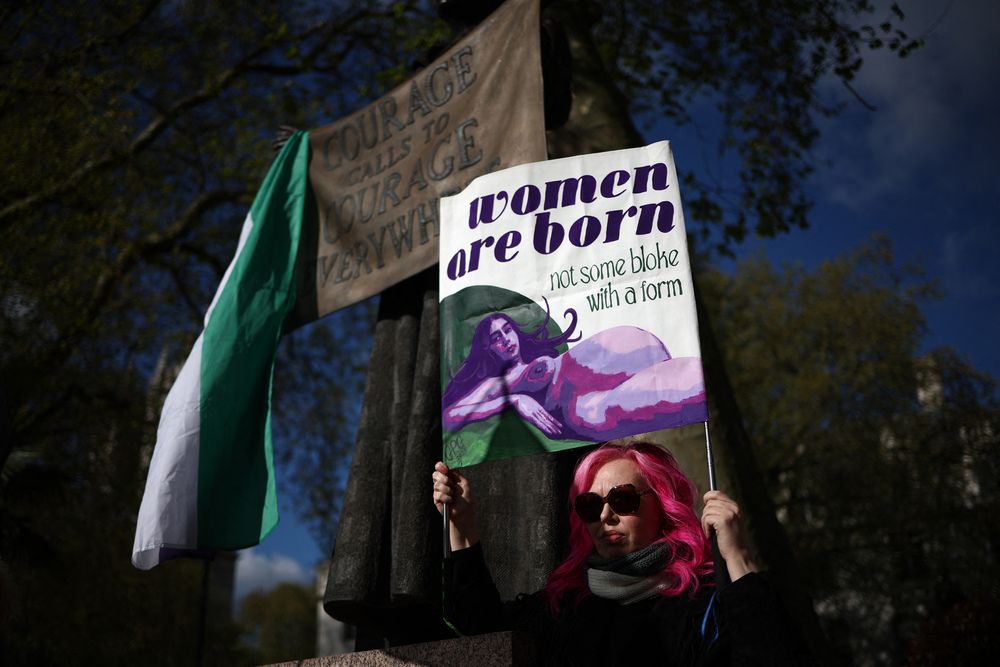
Within a week of the U.K. Supreme Court issuing a landmark

ruling

confirming that women are female, the Conservative Party of Canada has taken a small, but long-overdue, step in the same direction. The newly released CPC

platform

announced it would repeal a federal policy that allows trans-identified men to be housed in women’s prisons and committed to ensuring that “women’s spaces and services remain protected in federal institutions and policy.”

After years of official political platform silence on the erosion of women’s sex-based rights in Canada, this marks the first major promise by any federal political party to confront the legal consequences of gender ideology head-on. The Canadian legal system may also soon be forced to wrestle with the matter.

Across the Atlantic on April 16, the U.K.’s highest court delivered clarity that remains sorely lacking in Canada. Five justices

ruled

that under the U.K. Equality Act, the term “woman” refers specifically to biological females, and “sex” denotes biological sex.

The ruling further clarified that when it comes to women-only spaces or services, men who identify as women — even those in possession of a gender recognition certificate denoting a female gender identity — do not have a legal right to access those spaces. The judges maintained this was the only interpretation that could be consistent and coherent within the law.

Such consistency and coherence have been absent from Canadian law ever since gender identity was embedded in the nation’s legal framework. This happened through a gradual process that began with the

Northwest Territories

in 2002 and culminated in the federal Parliament’s passage of Bill C-16 in 2017, amending the Canadian Human Rights Act and Criminal Code to include

gender identity and gender expression

as prohibited grounds of discrimination.

Protecting gender identity alongside sex isn’t just contradictory — it’s logically impossible. Ontario’s Human Rights Code perfectly

demonstrates

this doublethink. It permits sex-based segregation in spaces like bathrooms and change rooms to preserve “human dignity,” yet the Ontario Human Rights Commission’s

own interpretation

of the Code states that trans-identified people “should be provided access to facilities that are consistent with their lived gender identity.” This means men who identify as women are permitted into female-only spaces, rendering those spaces no longer female-only, while all concern for the safety and dignity of women is tossed aside in the process

Canadian women and girls find themselves at a distinct disadvantage to their

British counterparts

given that, unlike the U.K. Equality Act, our human rights laws contain no clear language allowing for female-only spaces. Instead, Canada

relies

on vague balancing tests and case-by-case rulings. Female-only spaces can exist, but they must be justified as necessary.

It should be self-evident that sex matters in contexts where safety, dignity, and vulnerability are at stake.

Males in Canada

(and elsewhere) commit most sexual offences, and females comprise nearly all the victims. That fact alone ought to justify single-sex spaces. But in Canada, evidence still takes a back seat to ideology.

Nowhere is this reckless capitulation to gender ideology more starkly felt than in Canada’s female prisons. After the passing of Bill C-16, the Correctional Service of Canada adopted Commissioner’s Directive 100, which allows male offenders to be placed in women’s prisons based solely on self-declared gender identity, “

regardless of their sex (i.e., anatomy)

.” It is this policy that Pierre Poilievre’s Conservatives have pledged to repeal if elected on April 28th.

Poilievre’s announcement comes just days after the launch of a

Charter challenge

by the feminist organization Canadian Women’s Sex-based Rights (CAWSBAR). Their legal challenge

argues

that women have the right “to be protected from mental, physical and sexual abuse by Trans-identifying Male Inmates with whom they are forcibly confined,” and “pleads that such forced confinement has caused, and will continue to cause, serious harm to Female Inmates.”

CAWSBAR’s case claims that forcing vulnerable female inmates — many of whom are victims of male sexual violence — to be housed with trans-identified males is “cruel and unusual punishment,” and “undermines their rehabilitative efforts.” It also notes that trans-identified male inmates are “significantly more likely to have been convicted of a sexual offence” compared to the general male prison population.

The reality is that an “F” on a man’s driver’s licence or birth certificate is a legal fiction: a symbolic gesture that does nothing to alter the biological reality of his male body. It doesn’t change his anatomy, his physiology, or the statistical risk he poses. No reclassification on paper can erase the well-documented disparity in violent and sexual offending between males and females. Yet, policymakers in Canada continue to act as though this fiction carries the weight of reality.

It’s time Canada grappled with some difficult questions. Should Canadian society be compelled to structure itself around a legal fiction? And should women and girls be expected to shoulder the very real risks of male intrusion into their spaces in order to uphold that fiction? The U.K. Supreme Court has drawn a clear line in defence of women and girls. It remains to be seen whether Canada’s judiciary will have the courage to do the same.

Mia Hughes specializes in researching pediatric gender medicine, psychiatric epidemics, social contagion and the intersection of trans rights and women’s rights. She is the author of “The WPATH Files” and a senior fellow at the Macdonald-Laurier Institute.

National Post


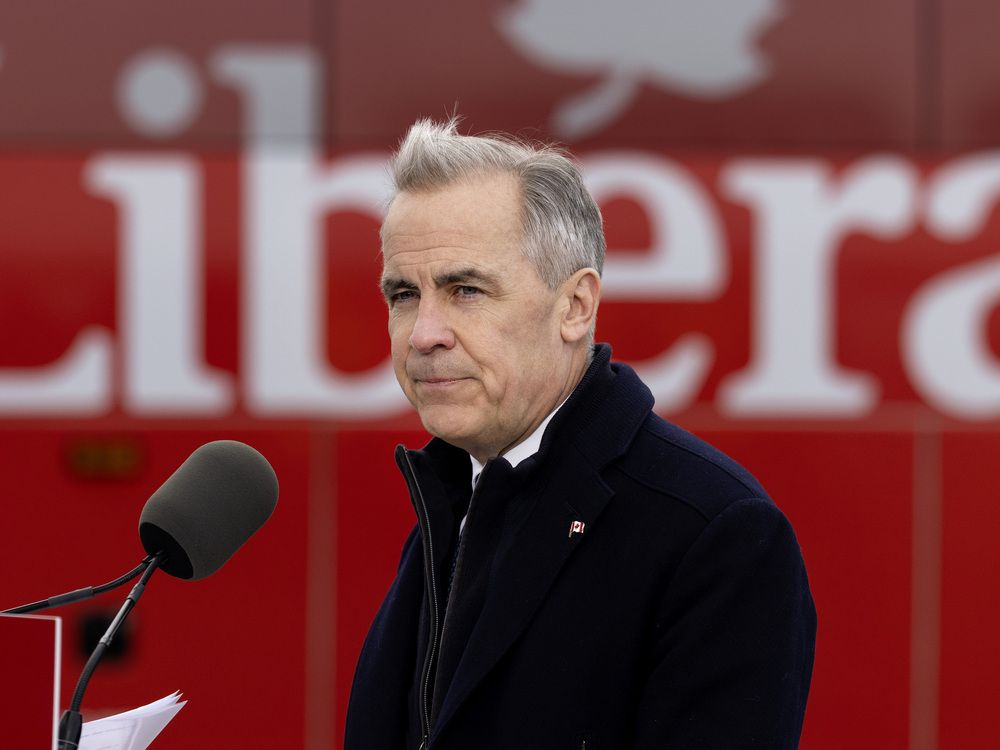
Liberal leader Mark Carney speaks to the media in the Port of Montreal, in Montreal, on Friday, March 28, 2025.

Long before he entered politics, Mark Carney was a full-throated supporter of social engineering via progressive policy. His platform, released Monday, has confirmed that his government will be no different in that regard than that of Justin Trudeau.

Carney’s plan shallowly pushes diversity both in form and in substance. Form-wise, his platform alleges itself to have been “reviewed through an equity lens using a GBA+ analysis,” meaning that for each commitment has been mulled over extensively by the privilege police.

In government, this has become standard operating procedure for even the most minute regulatory changes and budget lines under Trudeau. Thorough identity analyses have been a feature of: 2024 changes to

waterfowl hunting laws

(analysts concluded that most hunters were white and male), the 2023

ivory importation ban

(analysts attempted to study the race and gender of travelling piano players); the 2024

rules

on the disclosure of fragrance ingredients; the 2023 federal tampons-in-the-workplace

mandate

(which covered “non-binary individuals, transgender men and intersex people”); and much more.

The same exercise is even

applied

to the entire Canadian budget, because the Liberals made this the law in 2018. Carney’s priorities are no different: “We will continue to update the GBA+ tool to ensure it reflects the identities and values of all Canadians, including diversity as a core value.”

In substance, the Carney platform is just as friendly to the traditions pioneered by Trudeau. Support is thrown behind the various identity-based programs that have taken root in the past few years. Most notable is his

commitment

to keep in place a

Trudeau-era grant to employers of apprentices

— a program that pays double when the apprentice ticks a diversity box. The program thus penalizes employers for hiring white, straight — non-diverse — males, because their corresponding grants of $5,000 are only half as lucrative. These are unfair on their face, explicitly valuing some apprentices less due to characteristics they can’t control.

To appeal to niches of voters, Carney’s also set aside various funding packets, committing to make permanent various programs to give cash to

activist LGBT non-profits

(

$40 million

, so far) and

what the government

describes

as “women’s and equality-seeking organizations” ($100 million, so far) and

Black businesses

. These are the latest in a long line of breadcrumbs to keep interest groups following in line, which the federal government has spent the last decade laying out.

Most concerning of all, however, aren’t the specific lines of new DEI-related spending in the Carney platform. What matters more is the general commitment to the ideology that the Liberal leader has made in writing, preparing to submit his prospective government to the very same unproductive, often toxic, constraints that plagued the Trudeau Liberals.

Two platform points of note are these: one, Carney promises a country “where everyone has a fair shot, feels a sense of belonging, and contributes to our shared future by reshaping systems to better reflect and support all Canadians and make sure that no matter your heritage or identity you can fully participate in Canada.” Two, he commits to “confront systemic barriers” and “create opportunities for Indigenous Peoples, Black Canadians, and racialized communities, ensuring equal treatment and access in all aspects of Canadian society.”

Carney is correct in asserting that every Canadian should be treated equally — that’s just an essential element of human dignity. But his vague platform points about “full participation” and “systemic barriers” echo the language of the

federal anti-racism plan

, which aims to favour minority groups over others in all aspects of the government’s role. He seems to buy into the social panic that animated the 2020 BLM crisis, in particular, the idea that any statistical disparity that doesn’t favour a minority group is evidence of sinister systemic forces working to keep them down.

This will make him no better than Trudeau, whose departments and agencies mechanically

cranked

out

diversity

plans

accordingly, whose judges are appointed with identity as a

prime factor

, and whose research funding apparatuses have

steeped themselves

in politics. The force is inescapable because in 2021, the clerk of the Privy Council — Trudeau’s most senior civil servant —

issued

directions across the federal government to pursue

identity-based promotions

(and penalties for failing to meet targets), provide

racially targeted career help

and overall, orchestrate a whole-of-government paradigm shift. I would expect these shallow, degrading instructions to be repealed under Conservative leadership, but Carney? There’s no way.

In the past, Carney has embraced the same principles that Trudeau did as prime minister: as Britain’s central bank governor, he touted the power of DEI as far back as 2017, referencing in

speeches

the same tired cliches that government hiring should aim to demographically reflect its country, and that greater surface-level diversity decreases groupthink. He beat Canada in doing so, as our own central bank didn’t begin kissing the DEI ring

until 2021

.

Later, when he entered the private sector, Carney became an environmental, social and governance (ESG) fund manager in the Brookfield universe, where once again, his priorities strayed into using power to achieve preferred social outcomes.

It’s clear from Carney’s platform that he promises to take that very same approach to governing Canada. If you’re expecting a rational technocrat, prepare to be disappointed if he wins.

National Post


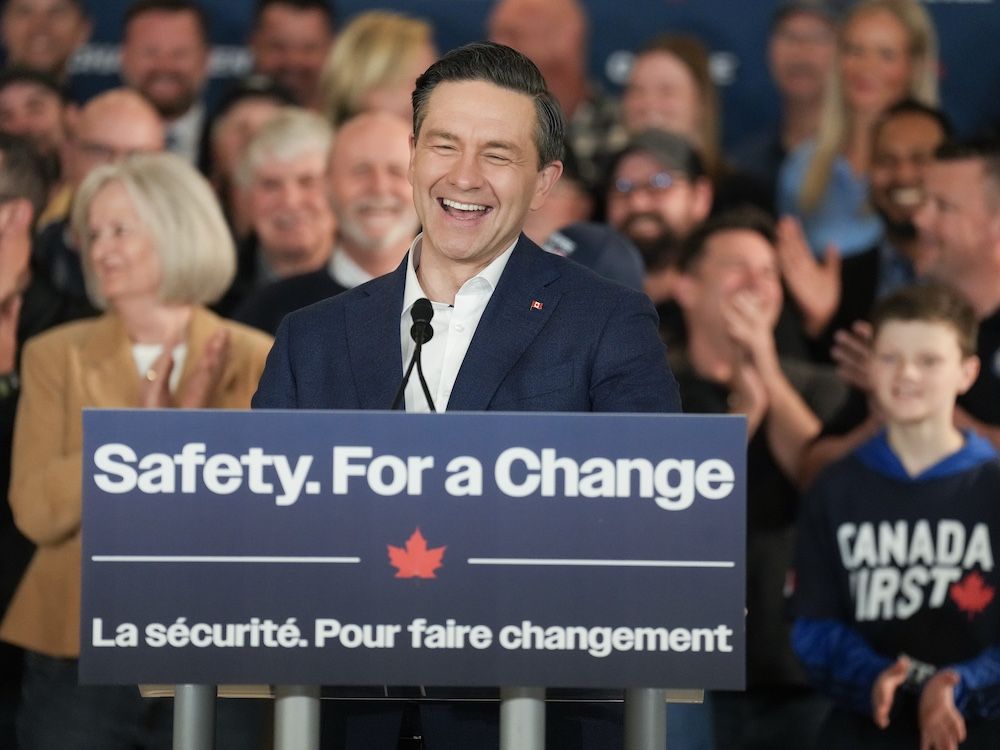
Conservative Leader Pierre Poilievre holds a news conference at the Croatian Sports and Community Centre of Hamilton in Stoney Creek, Ont., on Wednesday, April 23, 2025. THE CANADIAN PRESS/Chris Young

The biggest, though by no means the smartest or the most coherent, complaint against Conservatives is that they aren’t Liberals. This complaint comes, bizarrely, as often from other conservatives, as it does from the left. Or perhaps it isn’t so bizarre, as Conservatives who want their side to become more like the other side will always be given time by Canada’s monochromatic media, which seems to agree that the only good Conservative is a Liberal.

Throughout the election campaign, this

assumed consensus

has dogged Conservative Leader Pierre Poilievre, who has been attacked for not focusing enough on U.S. President Donald Trump, and too much on the Liberals. This, despite the fact that it is Poilievre’s platform that would allow Canada to weather any storm coming from the south. If his policies had been in place for the last 10 years, we wouldn’t even be contemplating a crisis, as the Canadian economy would be vibrant and growing.

Unfortunately, for his efforts, he’s been criticized from all sides.

Kory Teneycke,

who ran Ontario Progressive Conservative Premier Doug Ford’s re-election campaign, accused the federal Tories of “campaign malpractice” for the Liberals’ resurgence in the polls, and for failing to refocus their campaign on the threat of tariffs. Ford, who could have chosen to say nothing, instead backed his campaign manager and told his federal Conservative counterparts that

“the truth hurts.”

About a week into the campaign, the

Globe and Mail

reported on more than a dozen Conservatives who were frustrated by what they saw as Poilievre’s “unwillingness to pivot from attacks on the Liberal government record to a laser focus on the trade war launched by U.S. President Donald Trump.”

And when Poilievre didn’t oblige, the Globe ran a headline that read,

Poilievre Continues To Attack Liberals’ Record,

as if the leader of the Opposition, in the middle of an election campaign, was doing something wrong by criticizing his opponent. Much of the coverage of the election has been flavoured like this, assuming Liberal Leader Mark Carney is facing the “crisis” while Poilievre is too busy, uh, attacking the government’s record … during an election.

A lot of the media, in fact, is openly campaigning for Carney, while pretending to be neutral and objective, constantly bringing up bogus issues like implying that Poilievre’s lack of security clearance means he has something to hide, along with unfounded and unsupported comparisons between the Conservative leader and Trump.

On policy, this week, media have tended to ignore the vast differences between the Conservative and Liberal spending plans, suggesting that because the Tories would also run a deficit, they are not much better than the Liberals, which leaves the incumbents off the hook for their much more irresponsible plan, and their record of doubling the federal debt.

Or consider

crime and drugs,

issues on which many in the media can’t contain their contempt for the fact that the Conservatives think voters want order in the streets. Or the fact that there has been little interest in what Carney was doing before he ran for the Liberal leadership in January, when he was working and advocating to keep natural resources in the ground, which is conveniently ignored to present him as the man who will fix Canada’s economy.

The media hasn’t quite endorsed the Liberals’ accusation that Poilievre would restrict abortion, but we still have four days before election day. Give it time.

As for whether the Conservatives should be focused on the threat of tariffs, it is one thing for Doug Ford to have won re-election in Ontario with a Trump-focused campaign. He was the incumbent in what was, at least at the time, a crisis, and crises almost always favour governments that are already in power. Just think of the popularity boost federal and provincial leaders got during the COVID pandemic.

It also makes sense for the Carney Liberals to focus on Trump, because, to the extent it is still a crisis, it will naturally benefit them as the Liberals are the incumbents. Demanding Poilievre effectively replicate the Liberal campaign is what would be a disaster, not the other way around.

As much as some in the media try to suggest

that there is little difference

between the Liberal and Conservative platforms, except of course the parts where Poilievre is scary, and thereby implying the Liberals deserve another chance, the Tory platform is a genuinely conservative document that offers a clear, and much needed, break with the last 10 years.

Most importantly, the Conservatives would repeal the Impact Assessment Act, the emissions cap on oil and gas, fuel regulations and the electric vehicle mandate, while reforming the government’s regulatory regime and cutting taxes — plans that largely reverse Liberal policies that have discouraged investment and left the country overly reliant on trade with the Americans.

Sure, it would be preferable if the Conservatives also planned to reform labour laws, and weaken union power, and change the age at which seniors are eligible for retirement benefits, but it is important to pick your fights. In a country where the temperament is not particularly conservative, the best approach is to identify those areas where the public is conservative and lean into them. Getting government out of the way to make it easier for people to find well-paid work is the right approach.

Negotiating with Trump, who is inexplicably suspicious of free markets, may be necessary and unavoidable. What should have been avoidable is the weakened state of the Canadian economy. It is Poilievre’s plan, not Carney’s, that corrects this colossal mistake.

National Post