LP_468x60
on-the-record-468x60-white

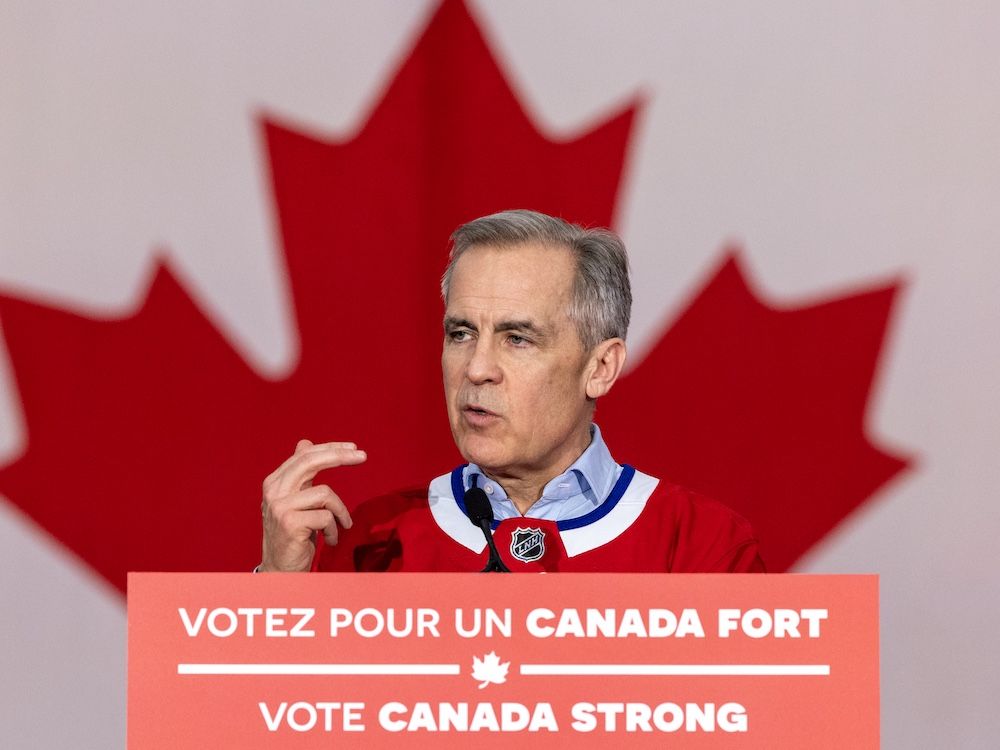
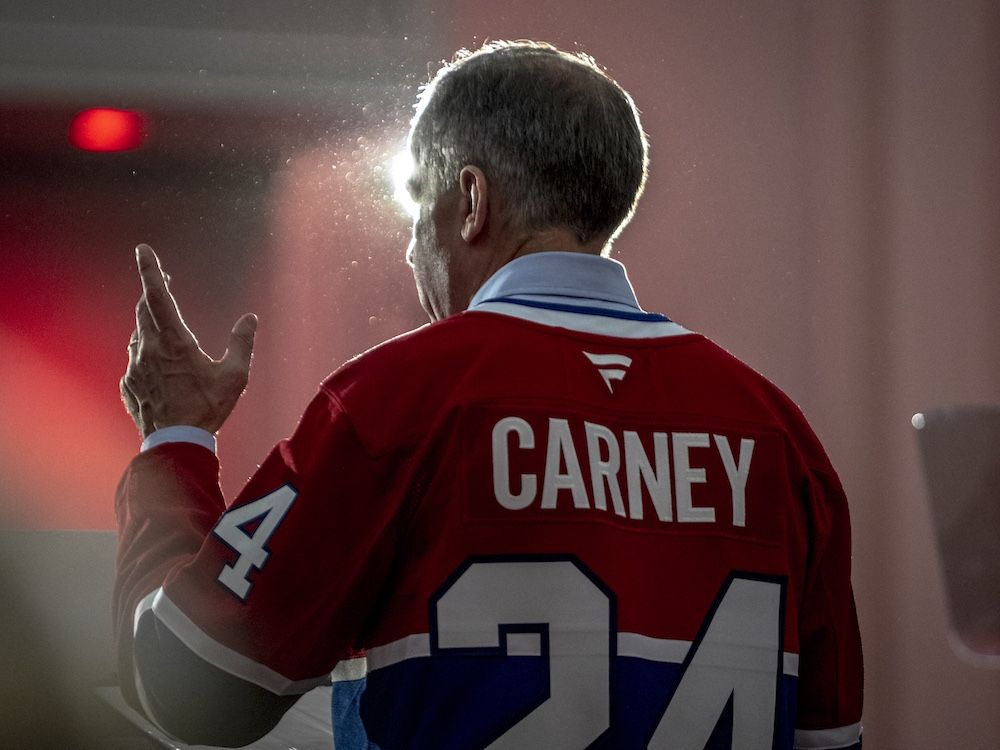
Canadian Prime Minister and Liberal leader Mark Carney, wearing a personalized Montreal Canadiens  jersey, speaks during a campaign rally in Laval, Que., Canada, on April 22, 2025. (Photo by ANDREJ IVANOV/AFP via Getty Images)

We’re told this is the most consequential election in our lifetime. It’s certainly among the most puzzling.

Is there a better word for the lately-released Conservative ad featuring two old guys at the driving range dissing Mark Carney and his Liberals?

It’s a brilliant piece of filming in one sense, given that it’s 100 per cent true to life. That’s exactly what old guys at the driving range look like, talk like and swing like. These are perfect renditions of authentic old white guys (like me) out whacking balls (like me) and beefing that Ottawa’s filled with a pack of imbeciles who are slowly but surely driving the economy into the ground (totally like me).

But wait a minute. Let’s be honest for a moment: in the entire history of the world, have any old guys, white or otherwise, been as supported, protected and generally looked after as Canadian boomers? And who, exactly, put in place the programs that provide the costly safety net that keeps things that way, if not boomers? We spent 70 years in charge of this country, now we want to decry the result? If I didn’t know better I’d suspect the intent was subversively satirical, lampooning retirees with the money and time to putter away another day on the range, complaining about the economy. But campaign ad writers aren’t that subtle.

Maybe this is the Tories’ way of distinguishing themselves from the Liberals’ happy slappy Mike Myers moment, which seeks to extinguish the memory of Justin Trudeau by sticking Mark Carney in exactly the sort of celebrity moment Justin Trudeau would kill for.

The ads are a mirror of a campaign predicated on the assertion Canada faces a critical, perhaps existential moment in its history while simultaneously filling the air with a set of discrepancies, contradictions and inconsistencies complicating even a vaguely educated guess as to which set of remedies it’s safe to bet the farm on.

Mark Carney’s contribution to the confusion is spelled out in the Liberal party platform. Launched over Easter weekend — because Easter Sunday is obviously when people turn their thoughts to national politics — it contradicts everything the new party leader has been telling us about himself. While claiming to be sober, pragmatic and considered, with a catalytic agenda focused firmly on the bottom line, Carney nonetheless takes every wild Trudeau spending impulse of the past nine years and doubles the wager. It’s as if 12 years as a central banker being cautious with people’s money left him desperate for just one big devil-may-care blowout.

The key to righting the economy, the Liberal boss has told us time and again, is to spend less and invest more. The way to spend less, apparently, is to

budget

in an extra $130 billion above and beyond the bloated figure Chrystia Freeland was preparing to announce in her final budget as finance minister before she abruptly decided she couldn’t live with it any more. More debt than Trudeau planned, no timeline to a balanced budget, billions more for the sort of social engineering Trudeau favoured and which does nothing to generate investment or strengthen economic growth, which Carney insists is his paramount priority.

The trick to this is simple: Carney Liberals don’t count investing as spending. Yes, the money goes out, but you get a bridge or a port or maybe even a pipeline in return. These generate revenue that offset the cost, justifying debt and deficits far beyond anything Justin Trudeau ever imagined. Voters are expected to accept this as proof Trudeau’s successor has a far tighter grip on the public purse.

In contrast to their proprietorial math, Liberals depict Pierre Poilievre as a close-fisted tightwad. A Poilievre government, they predict, would cut cut cut, chopping benefits, hemorrhaging jobs and turning Canada into a sad shadow of what could have been. The crisis facing Canada, Carney declared as the final week of campaigning opened, is even worse than the one faced by Jean Chrétien and Paul Martin in 1995, seemingly unaware that Chrétien and Martin attacked that crisis not by supercharging expenditures but by

hiking

taxes and slashing expenditures, producing a decade of surpluses and buoyant growth that Liberals have been bragging about ever since.

On Tuesday Poilievre spoiled the Liberals’ caricature of him by demonstrating he could match Carney one-to-one on extravagant spending plans, releasing a

platform

stuffed with more than $100 billion in tax cuts and new spending. Like the Liberals, a Conservative government

would

dedicate more money to housing, more money to defence, a bigger tax cut than Carney is promising, and a meatier package of promises than Liberals offer for seniors, whether they play golf or not. Like the Liberals, Tories hope to pay for it all by generating revenue from a stronger economy and income from tariffs. Like the Liberals there would be no date set for a balanced budget. Like the Liberals, the Tories expect to find hidden billions in efficiencies and a war on waste. Like the Liberals, there’s a lot of guessing going on with the figures.

For reasons left unexplained, Conservatives waited until after advance polls had closed before unveiling their plan, meaning more than seven million voters had already cast their ballot, making the big reveal somewhat redundant. The Tories could have promised free gold bars to everyone in Canada and it couldn’t have changed one of those votes. For a party arguing it knows a better way to run the country it was perplexing at best.

No matter. Faced with a conundrum — hey, those Tories would break the bank just like us! — Liberals had to think quick for a response, and came up with a blast from the past: There’s a secret agenda! Poilievre, Carney charged, is “hiding his plan.”  There are cuts in store, big ones! He’s just not telling us where they are. Just like Stephen Harper had secret plans to limit abortion. Ok that never happened, but this time for sure!

One of these two manifestos will become the blueprint for the next government, which will be headed by one of two men who portray themselves in one way while acting in another, promising to bring prudence and discipline to the economy while throwing around spending promises like confetti at a wedding. A lot of us thought we’d had enough of that.

National Post


Liberal Leader Mark Carney, left, has indicated his policy on Israel and the surging antisemitism in Canada would be no different than his predecessor's, while Conservative Leader Pierre Poilievre, right, has condemned antisemitic violence in unequivocal terms and has emerged as a principled and consistent voice in defence of the Jewish people and the State of Israel, writes Nadav Steinman.

As Canada prepares for a pivotal federal election on Monday, the stakes for the Jewish community — and for the future of Canada-Israel relations — have never been higher. This is not just another ballot. It is a litmus test for the country’s moral compass, a reckoning with the rising tide of antisemitism, and a defining moment for Canada’s role in supporting its democratic allies in the world, Israel among them.

Canada’s Jewish community, numbering nearly 400,000 strong, has always been an integral part of the national fabric — contributing to the arts, science, politics and business while maintaining a proud identity rooted in values of justice, human rights, and solidarity with the State of Israel. Yet today, Jewish Canadians are facing an unabated tsunami of antisemitism — one that has been emboldened, in part, by political ambiguity and moral equivocation from those in power.

Once seen as a beacon of tolerance and an oasis of peace for Jews, the Canada I knew and loved, the one I grew up in and where I lived most of my life before moving to Israel, has become unrecognizable today, after the October 7 Hamas massacre. Seldom a day goes by without reports of Jewish schools being targeted by gunfire, synagogues being firebombed, including my own, and Jewish-owned businesses repeatedly vandalized. In the meantime, our students are fearful of just stepping foot on campus, while jihadists are publicly marching on our streets every week, as authorities stand by.

Yet the government’s response has been tepid at best.

Under prime minister Justin Trudeau, the Liberal party made a series of troubling decisions that have undermined both the Jewish community’s sense of security and Canada’s historical support for Israel. The suspension of funding to UNRWA following credible reports that numerous staff members participated in the October 7 atrocities was initially welcomed. However, the abrupt reversal of that suspension and the decision to restore funding — without sufficient safeguards or accountability — sent a chilling message: that moral clarity can be sacrificed for political expediency.

Even more concerning was Canada’s decision to pause arms exports to Israel in the midst of a war for its survival against a genocidal terrorist organization. This policy shift was not grounded in international law or strategic logic, but in a misguided attempt to placate pro-Hamas voices on the radical fringe. Let us be clear: Israel, like any nation, has the right —  indeed the obligation — to defend its citizens against terror. To hamstring Canada’s democratic ally at such a critical juncture is not only a betrayal of values, but a dangerous precedent that emboldens terrorists and undermines democracies.

Trudeau’s replacement as leader of the Liberal party, Mark Carney, has not only failed to address these issues, he has indicated his policy on Israel and the surging antisemitism in Canada would be no different than his predecessor’s.

Carney’s recent response to allegations of “genocide” in Gaza was immensely disconcerting. By lending credence to such baseless and incendiary accusations — later backtracked only after fierce backlash — he played directly into the hands of those who seek to delegitimize Israel’s very existence. The consequence? A normalization of antisemitic rhetoric cloaked in the language of human rights, and a further erosion of trust between the Jewish community and its government.

In stark contrast stands Conservative Leader Pierre Poilievre, who has emerged as a principled and consistent voice in defence of the Jewish people and the State of Israel. Poilievre has not only condemned antisemitic violence in unequivocal terms but has pledged to reorient Canada’s foreign policy in support of democratic allies and against terrorism. He has committed to defunding UNRWA, recognizing its deeply compromised role in perpetuating incitement and terror. He has promised to confront antisemitism in all its forms — on campuses, in politics, and online — through meaningful action, not just performative rhetoric.

This is not about partisanship. This is about values. And values must matter.

For Jewish Canadians, this election presents a stark choice. On one side, a government that has failed to show moral clarity in the face of terror, and on the other, an opposition that has articulated a firm commitment to fighting hate and standing by Israel.

But this is about more than just the Jewish community. This is about what kind of country Canada aspires to be.

Will it continue to be a nation that champions human rights, democracy, and the fight against antisemitism — not just in words, but in deeds? Will it stand with its democratic ally, Israel? Or will it cede the public square to radical ideologies that demonize the Jewish state and threaten the safety of its own citizens?

Canada is at a crossroads. And the choice will reverberate far beyond Ottawa. It will be felt in Jerusalem, in Toronto, and on every campus and synagogue where Jewish Canadians wonder if their country still has their back.

The time for equivocation is over. The time for moral courage is now.

Special to National Post

Nadav Steinman, originally from Montreal and Ottawa, is a lawyer who serves as Board Chair of the International Legal Forum, an NGO focused on combating antisemitism.


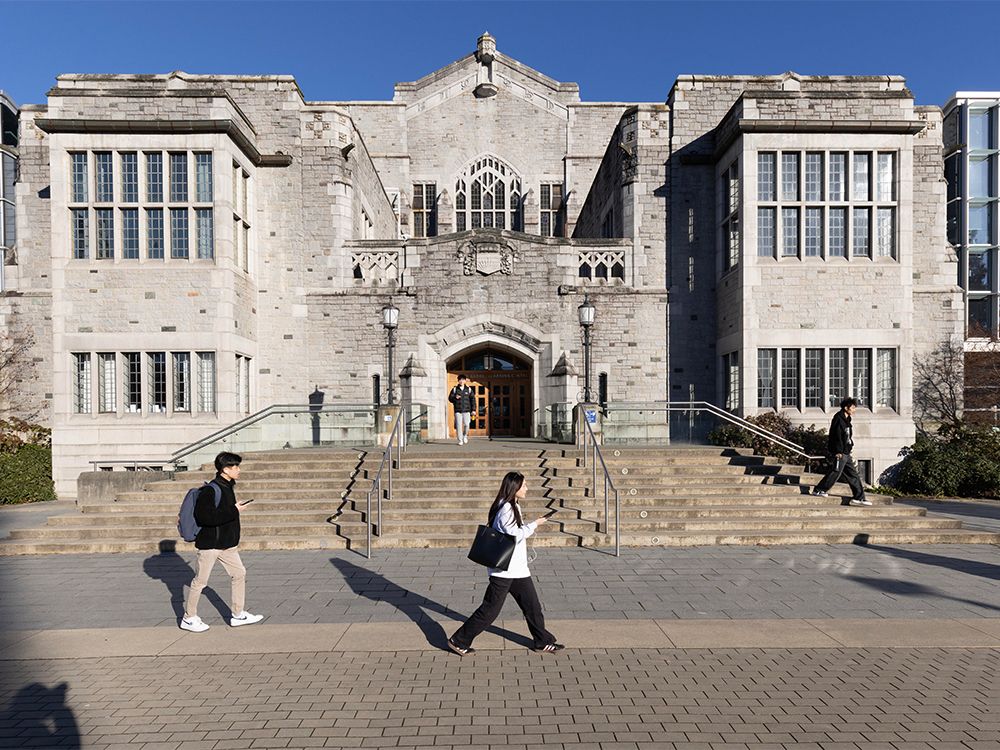
The Irving K. Barber Learning Centre at the UBC in Vancouver is seen on Jan. 27, 2025. Four professors and a former graduate student have launched a legal challenge in the B.C. Supreme Court, demanding that UBC’s administration comply with provincial law requiring universities to remain politically neutral.

The

petition

I and others filed earlier this month asking the Supreme Court of British Columbia to require administrators representing the University of British Columbia to stop engaging in political activity has begun to generate discussion.

According to a press release from the BC Civil Liberties Association, the lawsuit “is a perverse interpretation of the prohibition of political activity under the University Act.” The authors go on to assert wrongly that we are using our submission as part of a “hidden agenda” in an attempt to “override” rights of Indigenous self-governance.

According to a press release issued by the Union of British Columbia Indian Chiefs, our case in favour of academic freedom represents “outdated and regressive views” and that “There is no academic value in debating the validity of First Nations’ basic human rights.”

These organizations misunderstand our position. We take no position on land acknowledgements, other than that they are political in nature. Our case in no way attempts to override or diminish Indigenous rights.

It is also worth emphasizing that we in no way attempt to diminish Indigenous presence on either of UBC’s two campuses and that nothing in our petition is intended to prevent UBC from continuing to engage with local First Nations, from continuing to promote awareness of Indigenous history, or from negotiating agreements about land or financial management with First Nations.

Instead, the case focuses on a single, separate issue: the extent to which a public, taxpayer-funded university whose statutory goal is the advancement of knowledge may also engage in overtly political activity. The issue is fundamental, since Section 66 of the B.C. University Act states that “A university must be non-sectarian and non-political in principle.”

Our case is not politically partisan. It is not intended to support one side of any political or religious debate. Instead, we are simply asking for judicial confirmation that a clear line needs to be drawn between a university’s administrative and governance activities on the one hand and its academic activities on the other.

We are asking the court to remind the university that administrators have no mandate to take political positions on behalf of the university. They have no mandate to try to influence the academic work of professors, instructors, lecturers, scholars, researchers, artists, performers, librarians, archivists, curators or students as they engage in research, scholarship, teaching and learning about political and religious issues. Simply put, this is a case about academic freedom.

A plain-face reading of Section 66 tells us that universities are not permitted to introduce religious or political tests for the admission of students or the hiring of professors. It tells us that universities are not permitted to introduce religious or political criteria for the evaluation of academic work done by students, faculty and other members of the academic community. It tells us that the use of an administrative land acknowledgement to begin a university examination is no more appropriate than the use of a university-encouraged public prayer.

Whether one agrees with a land acknowledgement, or with a university statement about the Middle East or about diversity issues, is not the issue. What is at issue is whether university administrators violate the University Act when they engage in partisan political advocacy.

Academic freedom is the freedom academics have to pursue their work as they see fit, evaluated only on the basis of academic rather than non-academic criteria. Having academic freedom means that student, faculty, professional and creative work will be judged without reference to non-academic considerations, without reference to a person’s religion or lack of religion, a person’s political or sexual beliefs and preferences, a person’s national origin, or the religious and political views of one’s colleagues. Academic freedom is what makes universities inclusive.

In our submission to the court, we give examples of how DEI (diversity, equity and inclusion) hiring requirements, land acknowledgements and official university statements have been abused, encouraging and often requiring faculty to accept and promote one politically partisan position rather than another.

Universities have been down this road before. During the Cold War, multiple American universities instituted a “sign or resign” anti-communist loyalty-oath requirement for faculty teaching in California and New York. Eventually, the requirement was struck down by the courts. No less than a loyalty-oath requirement, today’s hiring requirements — which regularly include requirements for job applicants to “strongly commit” to announced political values — effectively bring with them the diminishment of academic freedom.

Groups and individuals regularly lobby universities to help them promote their preferred social, political or religious causes. Students and professors need to be free to participate in such causes if they wish to do so. Universities rightly encourage their members to investigate important questions of their own choosing and to make public the results of their findings.

But once people speaking on behalf of a university become partisans in the ongoing social, political, religious, legal, scientific, historical or public-policy debates of their day, it becomes more difficult for the members of a university to fulfill their statutory mission.

Universities need to be places where faculty can follow the evidence wherever it might lead, rather than being told what to believe by their employer. They need to be places where students can hear from a wide variety of voices so they can make up their own minds about the complex issues they care about.

This is what is at issue in our court case. Nothing else.

Special to National Post

Andrew Irvine teaches at the University of British Columbia.


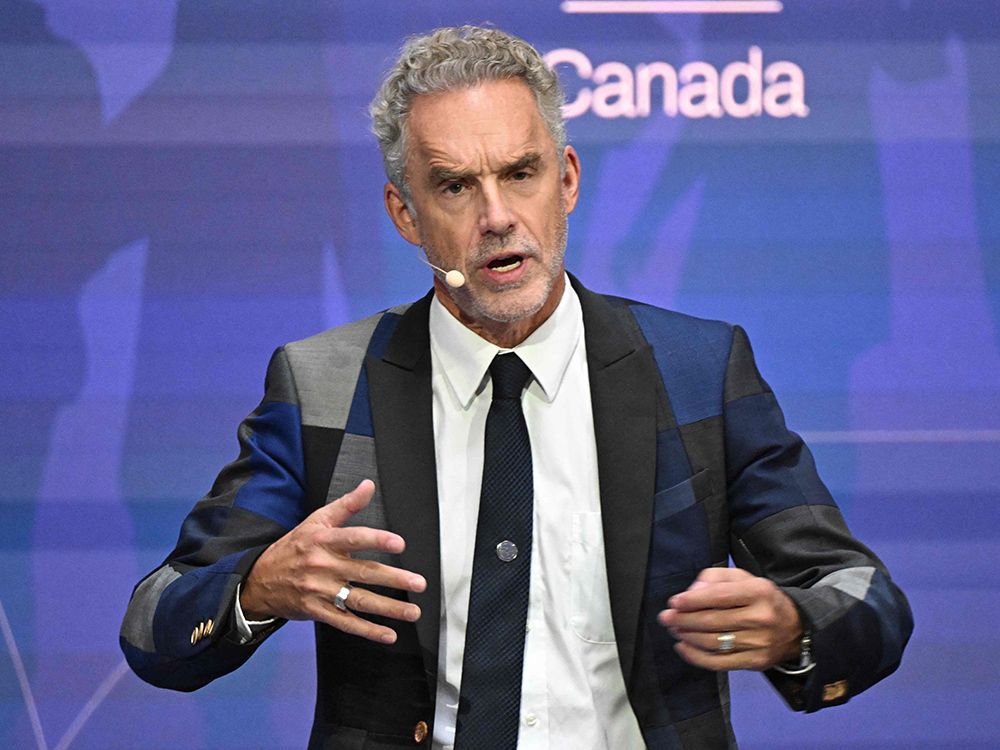
Jordan Peterson: “We look at Carney and we don’t pay any attention to politics ... and so we see someone who looks like a banker from the 1990s, when everything was just fine in Canada.”

If Canadians elect Liberal Leader Mark Carney in the 2025 election, they will have chosen the path of “severe pain,” Canadian psychologist Jordan Peterson said in a Tuesday interview with American podcaster Joe Rogan.

“People correct course either by waking up or by experiencing severe pain, and it looks to me like we’ve chosen the severe pain route,”

said Peterson

, forecasting that a Carney government would yield accelerated economic decline and an increase in social disorder.

On the disorder issue, Peterson specifically referenced the anti-Israel demonstrations and blockades that are now a regular feature of his former Toronto home.

“I don’t like seeing that. It’s awful. And all those psychopaths who have been parading around their moral virtue since October 7, they’re plenty emboldened. Plenty,” he said.

The 190-minute podcast first veered onto the subject of Canadian politics when Peterson mentioned that he had twice read Carney’s 2021 book Values, summarizing it as a manifesto for deindustrialization and central planning that is often at odds with the platform now being pushed by Carney as Liberal leader.

“All you have to do is read his book, but people don’t, of course, because it’s a book,” said Peterson.

“Either he’s decided that every single thing he’s ever believed was wrong right to the core,” said Peterson, or he’s a “wolf in sheep’s clothing.”

Peterson has been vocal about his disillusionment with the course of the Canadian federal election.

In an

April 11 op-ed

for the National Post, he criticized his generation for supporting the Liberals at outsized rates compared to younger voters, saying it represented a misguided attempt to return to the “good old days” of the 1990s.

“Your children and grandchildren see Carney as he is: not as the warm-milk and grandfatherly-advice 1950s Jimmy Stewart banker who will stand up to the mad Yankee mob and Make Canada Sensible Again but as The Man at the vanguard of anti-growth economic collapse and authoritarian financial control,” he wrote.

Peterson took up a similar theme with Rogan, attributing Carney’s rise to a kind of reflexive nostalgia.

“We look at Carney and we don’t pay any attention to politics and we certainly don’t read his goddamned book, and so we see someone who looks like a banker from the 1990s, when everything was just fine in Canada and Canadians were just as rich as Americans and the whole country was stable and peaceful,” he said.

But Peterson largely attributed the change in Liberal fortunes to U.S. President Donald Trump, citing Trump’s threat to annex Canada as the singular factor that saved the party from likely “extinction.”

“He’s going to pay for that, because once Carney is elected, Trump will not have a more seasoned enemy in the West,” he said.


Liberal Leader Mark Carney speaks at a campaign rally while wearing a Montreal Canadiens jersey given to him by Liberal MP Marc Miller,  in Laval, north of Montreal Tuesday April 22, 2025. (John Mahoney / MONTREAL GAZETTE)

As Canadian doomsday scenarios go, it’s a bit of a letdown. But you’d never know it by the headlines.

First prize goes to the American news site Politico: Apocalypse Now. Runners-up: The Toronto Sun’s “Government report predicts 2040 dystopia: Collapsed economy, hunting for food,” Alberta’s Todayville went with Breaking: The Federal Brief That Should Sink Carney, and the Better Dwelling webzine chose Canada To Become A Dystopian Nightmare, Households Will Flee: Gov Report.

The report was first brought to light by Blacklock’s Reporter, which was more usefully succinct: Fed Report Predicts Collapse.

These accounts are all reasonable enough except for a couple of odd things about the report itself.

It was produced by something called Policy Horizons Canada, an organization that serves Employment and Social Development Canada with what the veteran journalist Paul Wells calls scenarios to broaden the horizons of politicians and policy makers. Or rather, as Wells put it, “to make sh*t up,” which, to be fair, in the narrowest context, is not as unworthy an exercise as it might seem.

One of the odd things about it: The dystopian predicaments described in gradations of likelihood 15 years down the road resemble quite closely the conditions that prevail in Canada already.

Here’s one of the report’s frightening scenarios, for instance: “In 2040, owning a home is not a realistic goal for many.” You suppose?

A similar exercise in peering into the possibilities of future civil disturbances was undertaken by the RCMP and acquired last year through an access to information request, in redacted form, by assistant law professor Matt Malone of British Columbia’s Thompson Rivers University. Citing the already-existing dysfunctions that could cause things to go haywire down the road: “For example, many Canadians under 35 are unlikely ever to be able to buy a place to live.”

In the Policy Horizons report, among the many monstrous things that might prevail in Canada in the years to come: Upward social mobility is “almost unheard of.” Few people believe they can build a better life for their children. Homebuyers require help from family members, sometimes taking out intergenerational mortgages or forming multigenerational households; a growing number of property owners oppose policies to expand the housing supply, or to freeze rents, and society degenerates into divisions among those that own and those that don’t.

In this brutish future world, workers find it hard “to save enough to start a business,” people increasingly “struggle to afford rent, bills, or groceries,” and the stress results in growing mental health challenges that place strains on social services.

How is this not a reasonable description of Canada in 2025?

Then there’s this: “People may lose faith in the Canadian project.” That describes not just the present but the recent past. Last year, an Ipsos poll found that seven in ten Canadians agreed with the proposition that “Canada is broken,” with younger Canadians and Conservatives coming in at 78 per cent and 96 percent.

Another odd thing about the report is some of the really bad things the report’s authors imagine occurring by 2040 don’t sound that bad at all, all things considered. “Housing, food, childcare, and healthcare co-operatives may become more common.” This would ease burdens on social services, the report concedes, but wait. Cooperatives could also challenge “market-based businesses.”

Barter systems might grow in popularity, but hold on. That would mean “reducing tax revenues.” People might turn to “hunt, fish, and forage on public lands and waterways,” but they might not be especially assiduous about obtaining the proper licences. “Small-scale agriculture could increase.” This would be a bad thing? One must be wary of “grassroots solutions,” the report suggests. “Governments may come to seem irrelevant.”

So?

Reliable soothsaying requires a tremendous degree of patience and foresight, and foreseeing economic upheavals isn’t what you could call an exact science. You could be the former governor of both the Bank of Canada and the Bank of England, in the case of Liberal Leader Mark Carney, for instance, and still be thick as a post.

In one study, the International Monetary Fund’s Prakash Loungani found that economists are absolutely awful at predicting things. His study found that economists had failed to predict 148 of the previous 150 recessions. A lot of that’s got to do with fear of bucking the consensus. Going back just three months, did anyone predict that the Conservatives would be fighting tooth and nail just to head off a Liberal majority in the current federal election campaign?

To cut the Policy Horizons fortunetellers some slack, it is exceedingly difficult to argue that the whole world, especially with a crazy man in the White House, is not going to hell in a damn handcart at the moment, taking Canada along with it.

But the Canadian dystopia would still be a real and present nightmare even if Donald Trump had been drawn and quartered by the Harris Democrats last November.

Both the Liberals and the Conservatives have elucidated an amazing array of ambitious remedies and tax incentives and massive prefab-housing corporations and stick-and- carrot applications to build hundreds of thousands of new homes in Canada. But there’s no evidence that “build, build build,” by either Pierre Poilievre’s formulae, or Carney’s, will make housing affordable.

It’s not like there hasn’t been any house construction going on. The result is thousands of empty condominiums that no one can afford in Greater Toronto and Metro Vancouver.

Stats Can’s “population clock” counted 41,627,154 people who live in Canada as of Wednesday afternoon, up from 35,851,800, in 2015. Much of that growth — roughly three million people — occurred in the last four years.

Canada has one of the worst ratios of income to housing costs among the 29 member states of the Organization for Economic Cooperation and Development. The average cost of rent has doubled across Canada over the past decade. Just to purchase an average home in Canada you’d need a minimum income of $150,500 to afford the mortgage, and the median household income is $124,672. But the houses just aren’t there.

The Canada Mortgage and Housing Corporation reckons the capacity of Canada’s construction industry, full bore, is about 225,000 homes per year. Firing “gatekeepers” and slashing development fees and taxes is all very well and good but none of these things will cut very deeply into the crippling speculative price of land.

Worse than that, for all of the scandals and controversy about what even the Liberal government finally agreed last year was an “out of control” immigration system, Canada still admitted 483,591 permanent residents in 2024, the highest number since 1972, along with 291,000 non-permanent residents.

That brings Statistics Canada’s tally of the known non-permanent population to 3,020,936. Among them are 457,285 asylum claimants stuck in various stages of the system, up from 328,606 from this time last year. Ottawa doesn’t even know how many temporary visa holders have overstayed their welcome from the past few years, but the federal consensus is it’s at least 500,000.

A Leger poll commissioned by the Association for Canadian Studies last December showed that roughly two-thirds of Canadians say there are simply too many immigrants being admitted to Canada, and nearly half the respondents favor mass deportation.

This is a horribly dystopian scenario, and it’s not something somebody imagined might prevail in 2040. It’s already upon us, and it’s hard to say whether any of our politicians want to admit it.  

National Post


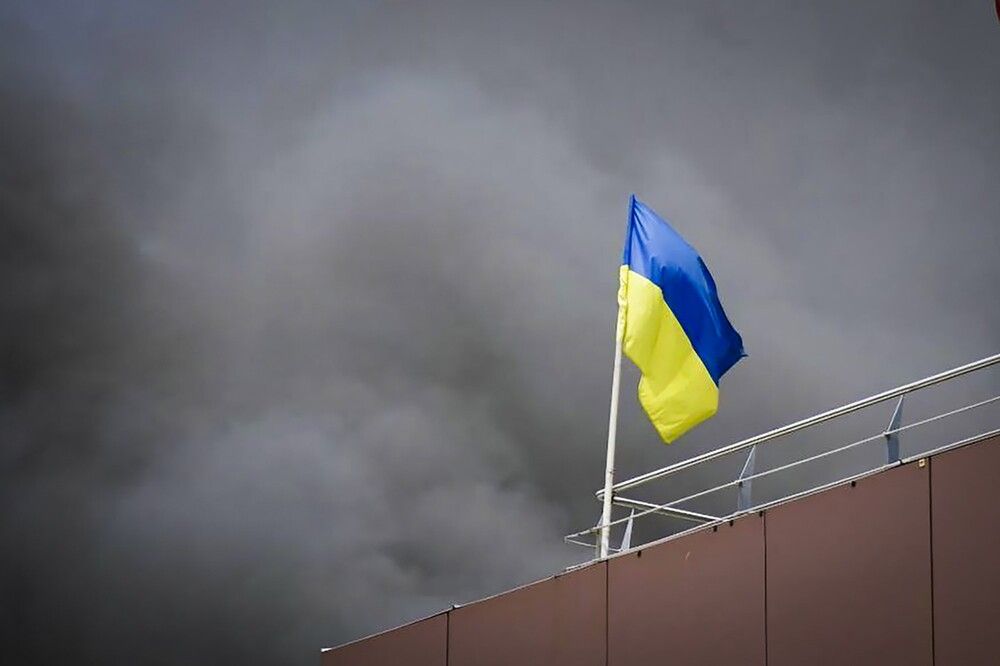
CP-Web. In this photo released by the Dnipro Regional Administration, Ukrainian flag waves as smoke rises after Russia's missile attack in Dnipro, Ukraine, Wednesday, July 3, 2024. (Dnipro Regional Administration via AP)

Whoever wins Canada’s election next week will immediately face a decision with huge implications for global security and international law. At stake is the

equivalent

of US$300 billion of frozen Russian central bank reserves held in western currencies,

C$22 billion

of which is held in Canadian dollars. Given uncertainty among western allies, there’s no guarantee these assets will remain frozen.

Canada will soon host the G7, providing an

invaluable opportunity

to help stop hundreds of billions from going back to Russia should a European freeze lapse in July. If that happens, Russia will get a massive bailout, pay nothing for Ukraine’s reconstruction, and leave western taxpayers on the hook for both supporting Ukraine and our own defence.

We urge the Canadian government to support the immediate transfer of Russia’s frozen central bank reserves into a fund for Ukraine’s reconstruction and defence. Canada can lead by example and reaffirm that sovereignty, democracy and the rule of law are non-negotiable — and that we stand resolutely with Ukraine. European, G7 and other allies will be compelled to follow. In addition to supporting this asset transfer with its partners, Canada must signal its resolve by taking two policy measures.

The first is to ensure that the Canadian share remains in Canadian hands. The Finance Ministry can do this by segregating the assets into discrete accounts that Canada can independently freeze. The second measure is to pass Sen. Donna Dasko’s

proposed amendments

to Canada’s sanctions legislation, which would improve the legal basis to transfer Russia’s frozen funds held in Canadian dollars.

With uncertainty in Washington and the EU having to unanimously reaffirm sanctions every six months, there is significant risk countries like Hungary and Slovakia may

veto an extension of EU sanctions

, emboldened by the White House’s recent dovish turn on Russia. If that happens, Russia will be free to take back approximately $210 billion (USD equivalent), even though Canada and the vast majority of other allies oppose it. This would include the $22 billion Canadian share, unless the Finance Ministry

segregates

it.

A bailout for Vladimir Putin will

strengthen

Russia financially and militarily, unleashing hundreds of billions for Russia to wage war, possibly beyond the borders of Ukraine, including in Canada’s Arctic. Putin is estimated to have hidden US$300 billion in off-book debts to fuel Russia’s war effort. If these assets are returned, the West will have given him a bailout and be complicit in the destruction of Ukraine. For perspective, from 2022 to the end of 2024, Ukraine has received a total of US$445 billion in defence, humanitarian and financial assistance from countries around the world.

With Canada’s C$22 billion share being

substantially higher

than the aid it has provided to Ukraine since 2022, this is the single most important thing Canada can do right now for Ukraine to increase its resources and leverage — at no extra cost to the Canadian taxpayer. It would shatter Putin’s belief that he will have the funds to outlast western support. It would go a long way to securing a just and lasting peace.

Numerous prominent legal experts have supported the legality of seizing and transferring Russian sovereign assets under the international law doctrine of state countermeasures. Prominent economists and financial experts have stated it won’t harm financial stability.

As the next G7 host, we urge the winner of the upcoming election to demonstrate Canadian leadership at a critical time, setting a powerful precedent against aggression.

One Nanos

poll

shows over 80 per cent of Canadians in favour. Individual members of both major political parties and independent senators have already voiced their support. Canada is well-positioned to provide leadership.

All Canadian political parties and leaders should clearly articulate their position on this issue prior to the April 28 federal election, so that voters can take it into account. Canada has welcomed

almost 300,000 displaced Ukrainians

and the 1.4-million strong Ukrainian community is one of Canada’s largest ethnic communities. The message Canada sends them — and the world — must be clear: Canada does more than offer refuge and words. We take meaningful, courageous action and influence other nations to do the same.

Signatories:

The Right Honourable Stephen J. Harper, 22nd Prime Minister of Canada, 2006-2015

The Right Honourable Boris Johnson, 54th Prime Minister of the United Kingdom, 2019-2022

The Right Honourable Rishi Sunak, 56th Prime Minister of the United Kingdom, 2022-2024

Krišjānis Kariņš, 23rd Prime Minister of Latvia, 2019-2023

The Honourable Lloyd Axworthy, Minister of Foreign Affairs, 1996-2000

The Honourable David Collenette, Minister of Multiculturalism (1983-1984); Minister of National Defence and Minister of Veterans’ Affairs, 1993-1996; Minister of Transport (1997-2003)

The Honourable Allan Rock, Canadian Ambassador to the United Nations, 2004-2006 and Minister of Justice, 1993-1997

The Honourable Irwin Cotler, Minister of Justice and Attorney General, 2003-2006 International Chair of the Raoul Wallenberg Centre for Human Rights (RWCHR)

The Honourable Peter MacKay, Minister of Justice and Attorney General, 2013-2015, Minister of National Defence, 2007-2013 & Minister of Foreign Affairs, 2006-2007

The Honourable Ed Fast, Minister of International Trade, 2011-2015

The Honourable Chris Alexander, Minister of Citizenship and Immigration, 2013-2015 and Canadian Ambassador to Afghanistan, 2003-2005

Artis Pabriks, Deputy Prime Minister & Minister of Defence, 2019-2022 & Minister of Foreign Affairs, 2004-2007, Republic of Latvia

Kajsa Ollongren, Minister of Defence, 2022-2024 & Deputy Prime Minister, 2020-2022, The Netherlands

Lawrence H. Summers, US Treasury Secretary, 1999-2001

Natalie Jaresko, Minister of Finance, 2014-2016, Ukraine

Gabrielius Landsbergis, Minister for Foreign Affairs, 2020-2024, Republic of Lithuania

The Honourable Ed Stelmach, 13th Premier of Alberta, 2006-2011

Dr. Marie Bountrogianni, Ontario Cabinet Minister, 2003-2007 & Advisory Board Member, Eurobank e.g.g. business accelerator

The Honourable Thomas A. Lukaszuk, Deputy Premier of Alberta and Minister of Education, 2012-2013

Norman Spector, Chief of Staff to the Prime Minister, 1990-1992; Canadian Ambassador to Israel 1992-1995

Amb. John Herbst, US Ambassador to Ukraine, 2003-2006

The Honourable Donna Dasko, Independent Senator for Ontario

The Honourable Stanley Kutcher, Independent Senator for Nova Scotia

The Honourable Ratna Omidvar, retired Independent Senator for Ontario, 2016-2024

Borys Wrzesnewskyj, MP 2015-2019 & Founder, Canada-Ukraine Parliamentary Association, Former Chair, Canadian-NATO Parliamentary Association

General (Retired) Rick Hillier, Chief of the Defence Staff, 2005-2008

James C. Temerty, Chairman of Temerty Foundation; Founder, Northland Power

Bill Browder, CEO Hermitage Capital Management, Head of the Global Magnitsky Justice Campaign

Oleksandra Matviichuk, 2022 Nobel Peace Prize co-laureate; Founder, Center for Civil Liberties, Ukraine

Robert Zoellick, President of the World Bank, 2007-2012

Olivier Blanchard, Chief Economist, International Monetary Fund (IMF), 2008-2015; Senior Fellow, Peterson Institute for International Economics

Nazanin Afshin-Jam, Founder, Nazanin Foundation

Chantal Kreviazuk, Juno award-winning singer-songwriter; Founding Artist and Ambassador, War Child Canada

Heidi Yetman, President, Canadian Teachers’ Federation

Noah  Shack, President, Centre for Israel and Jewish Affairs

Raoul Wallenberg Centre for Human Rights (RWCHR)

Democratic Strategy Initiative (DSI)

Macdonald-Laurier Institute (MLI)

Montreal Institute for Global Security (MIGS)

David Edwards, General Secretary, Education International

Marcus Kolga, Co-Founder, Central and Eastern European Council in Canada; Director, DisinfoWatch; Senior Fellow, Macdonald-Laurier Institute and CDA Institute

Kyle Matthews, Co-founder and Executive Director, MIGS

Fen Osler Hampson, President, World Refugee & Migration Council

Jay Rosenzweig, CEO, Rosenzweig & Company;  Chair of RWCHR

Brandon Silver, International human rights lawyer & Director of Policy and Projects, RWCHR

Aaron Gasch Burnett, Co-Founder & Senior Fellow, Democratic Strategy Initiative

Balkan Devlen, Senior Fellow, MLI; Co-Lead, Pendulum Geopolitical Advisory

Yaroslav Baran, Chair of Board, Parliamentary Centre; Founding Partner, Pendulum; Board, Canada-Ukraine Foundation

Jonathan Berkshire Miller, Senior Fellow, MLI; Co-Lead, Pendulum Geopolitical Advisory

Matthew Bondy, CEO of Bondy & Associates; Senior Fellow, MLI

Richard Shimooka, Senior Fellow, MLI

Alexander Dalziel, Senior Fellow, MLI

Sheryl Saperia, CEO, Secure Canada

Adam Bolek, President and CEO, Canada Strong and Free Network

Bob Onyschuk, Partner (ret.) Gowling WLG International Law; Founding President CUCC

Jaime Pitfield, CEO, Parliamentary Centre

Alexander Lanoszka, Associate Professor, Balsillie School of International Affairs, University of Waterloo

Michael Cholod, Executive Director, Peace Coalition Foundation

Timothy Ash, Senior Sovereign Strategist, RBC Bluebay Asset Management; Associate Fellow, Chatham House

Philip Zelikow, 27th Counselor of the United States Department of State (2005-2007), Botha-Chan Senior Fellow, Hoover Institution, Stanford University

Anders Aslund, Senior Fellow, Stockholm Free World Forum

Yuliya Ziskina, International lawyer & Senior Legal Fellow, Razom for Ukraine

Tetyana Nesterchuk, Barrister, Fountain Court Chambers; UK expert at the Council of Bars and Law Societies of Europe

Jamison Firestone, Co-Founder, Global Magnitsky Justice Campaign

Katherine Vellinga, CEO, Zirkova Vodka; Board of Directors CUCC

Mariana Budjeryn, Harvard Kennedy School’s Belfer Center for Science and International Affairs; Author “Inheriting the Bomb”

Heather Bakken, Founding Partner, Pendulum Group

Stephen Leckie, CEO Canada’s Culinary Championships; CEO Canada’s Great Kitchen Party

Rupert Murray, Marine Conservationist and Filmmaker, United Kingdom

Iranian Justice Collective, “Woman, Life, Freedom” Iranian diaspora movement, Canada

League of Ukrainian-Canadian Women (LUCW)

Canada-Ukraine Foundation (CUF)

Canada-Ukraine Chamber of Commerce (CUCC)

Ukrainian-Canadian Professional and Business Federation (UCPBF)

Ukrainian-Canadian Bar Association (UCBA)

Kelowna Stands With Ukraine (KSWU)

Special to National Post


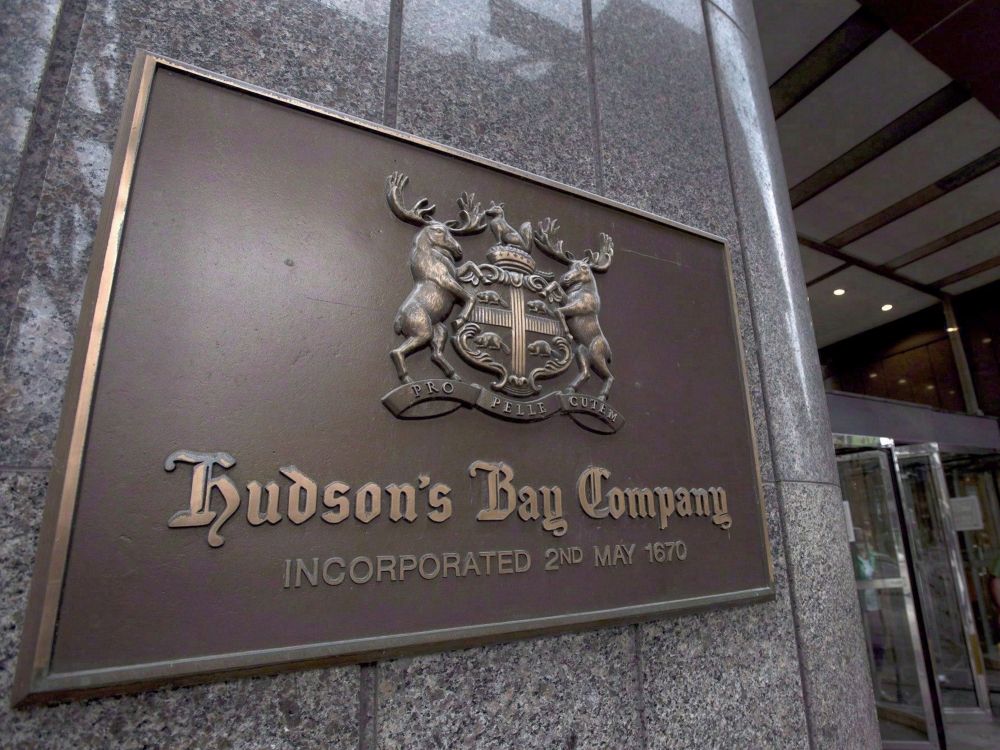
A Hudson's Bay Co. store sign is shown at its Toronto flagship store on July 29, 2013. Hudson's Bay Co. accused an activist investor of misleading shareholders regarding the sale of the retailer's Lord & Taylor Fifth Avenue building and a related investment by Rhone Capital.

The newspapers are

whizzing

with

speculation

about the fate of historical artifacts in the possession of the bankrupt Hudson’s Bay Company (1670-2025), and particularly the royal charter whereby King Charles II gave the company title to the nearly four million square kilometres of the Hudson Bay watershed. The dying HBC has long since donated its official corporate archives and related material to public museums, and it mostly retained what amount to a few absorbing display pieces. But these happen to include the 1670 charter, which is the legal basis of the company’s existence and a crucial documentary foundation of today’s Canada.

The charter is nearly certain to be auctioned off in a matter of weeks, and heritage authorities, especially those on the soil of Prince Rupert’s Land, are scrambling to understand how it might be acquired for the public benefit. Not, mind you, that this benefit could be quantified. There’s a heavy element of superstition in this news story, an uneasy sense that a country which treats its history as a mere commodity is inviting damnation.

Unfortunately, HBC will have a supreme fiduciary duty to get the maximum price on behalf of its creditors, including some unfortunate employees, so the charter will have to be won in a fair and open fight. If some Charles II admirer in the Saudi royal family felt like owning it — and it’s not at all impossible that a person fitting this description exists — there is not necessarily much we could do about it, short of an extraordinary intervention possibly requiring federal government resources.

Indeed, I’m a little surprised nobody has tried to make an election issue out of this yet. A commitment to buy the HBC charter at auction would be of unpredictable fiscal size, but none of the party leaders seem

especially

afraid of that kind of thing, now do they?

It has struck me that none of the news stories about the threatened charter have tried to assign a hard number to its prospective auction value, and it makes sense that museum professionals would be shy, because items of this nature and antiquity are almost never offered for sale in the first place. Unlike the HBC’s documentary archive, the charter doesn’t offer much opportunity for historical research in its own right. It’s valuable just because it is history — a fulcrum on which the fate of Canada’s West pivoted.

If you tickle an AI chatbot’s gizzard, it is likely to talk about the fact that copies of Shakespeare’s First Folio change hands for anywhere from $3 million to $14 million — but that’s the magic of Shakespeare. About 10 years ago, one of 11 surviving copies of the so-called “

Bay Psalm Book

” (1640) sold for nearly $20 million; but this was the first book printed in North America, and is of value to book collectors just by virtue of being an early book.

The nearest match I can find to the HBC charter, the closest thing in significance and nature that has been sold at auction in recent times, is

a copy of the 1660 Declaration of Breda

that Sotheby’s put on the block in 2023. The declaration is the handiwork of Charles II, and is of unquestionable global significance and interest. It’s the manifesto he wrote in exile, during the Interregnum, in order to persuade Britain that he would, if invited home as king, respect the political results of the violent revolution against his father Charles I. In other words, it’s not a legal-commercial document quite like the HBC charter, but it does have a similar quasi-constitutional status.

The declaration worked like a charm as political theatre, which is the reason our head of state is now the third Charles. Charles no. 2 is known to have made five copies of the declaration. Two survive, with one in the possession of the U.K. government. The other, a copy made specially for the Royal Navy, came into the hands of the immortal diarist/bureaucrat Samuel Pepys (1633-1703) and his heirs.

It is that copy, the one read out loud to the sailors who brought Charles II home from the Netherlands, that changed hands in 2023. The actual sale price has not been published, but Sotheby’s estimated in advance that it would go for somewhere between £400,000 (C$740,000) and £600,000: the higher figure comes to $1.1 million in Canadian money at today’s rates.

I would take this to be a decent order-of-magnitude anchor for the potential auction value of the HBC charter. Canadian buyers are probably not going to get away with buying it for $500,000, but they should not have to scrape up $10 million. There are quite a few Western Canadian businessmen who could probably find the necessary sum in their couch cushions. And, yes, many Saudis.

National Post


Liberal Leader Mark Carney

Liberal Leader Mark Carney is

arguing

that he can “tighten” industrial carbon taxes without increasing costs for consumers. That’s a tough sell. After all, a carbon tax on businesses is a carbon tax on Canadians that will make life more expensive for families struggling to make ends meet.

New polling conducted by

Leger

for the Canadian Taxpayers Federation shows that Canadians overwhelmingly understand that the costs of an industrial carbon tax, like the one championed by Carney, are passed on to consumers.

When asked who they think ultimately pays carbon taxes on businesses, 70 per cent believe that most (44 per cent) or some (26 per cent) of the costs are passed onto consumers. Only nine per cent believe Carney’s talking points that businesses will pay most of the cost.

When undecided responses are removed from the equation, 89 per cent understand that consumers — i.e., normal Canadians — are going to be paying the costs of Carney’s carbon tax.

That’s a major problem for Carney, as almost no one actually believes his carbon tax talking points. Canadians understand that if Carney slaps refineries with a carbon tax, it makes gasoline and diesel more expensive.

If Carney hammers concrete plants with a carbon tax, it will make building homes more expensive. And if he hits fertilizer plants with a carbon tax, it will become more expensive for farmers to grow the food that winds up in your local grocery store.

Carney claims he’s going to make “big polluters pay,” but Canadians know who will actually be left with the bill: families at the checkout counter.

Nearly half of Canadians say that rising prices are already greatly affecting their ability to meet day-to-day expenses, according to

Statistics Canada

. Hiking hidden carbon taxes that pass costs down to consumers would likely only make the situation worse.

For his part, Conservative Leader Pierre Poilievre says he will axe all carbon taxes. He is the only major federal leader making that promise. Eliminating all carbon taxes is the right move to support Canadians struggling with the cost of living.

Carney, on the other hand, wants to keep hammering you with hidden taxes. While he did move the consumer carbon tax rate to zero, he left the law on the books, which means there’s nothing stopping him from jacking up the consumer tax, too, if he wins the election.

The

vast majority

of countries, including three of the four biggest carbon emitters, do not charge a national carbon tax. If Carney and the Liberals are seriously planning on hammering Canadian businesses with a carbon tax, we will see more companies shifting production and jobs to other countries.

When we are staring down the barrel of a trade war with the United States, hammering Canadian businesses with a carbon tax is like putting a backpack full of bricks on a runner before a marathon.

A carbon tax on businesses will push our entrepreneurs to cut production in Canada and increase production south of the border. Anti-Canadian policies like the hidden carbon tax play right into U.S. President Donald Trump’s hands.

Carney can keep spinning his carbon tax fairy tales, but Canadians can see right through them. Canadians want relief, not rhetoric, and the only way to provide real relief is to leave more money in their pockets by ending carbon taxes on consumers and businesses.

National Post

Carson Binda is the B.C. director for the Canadian Taxpayers Federation.


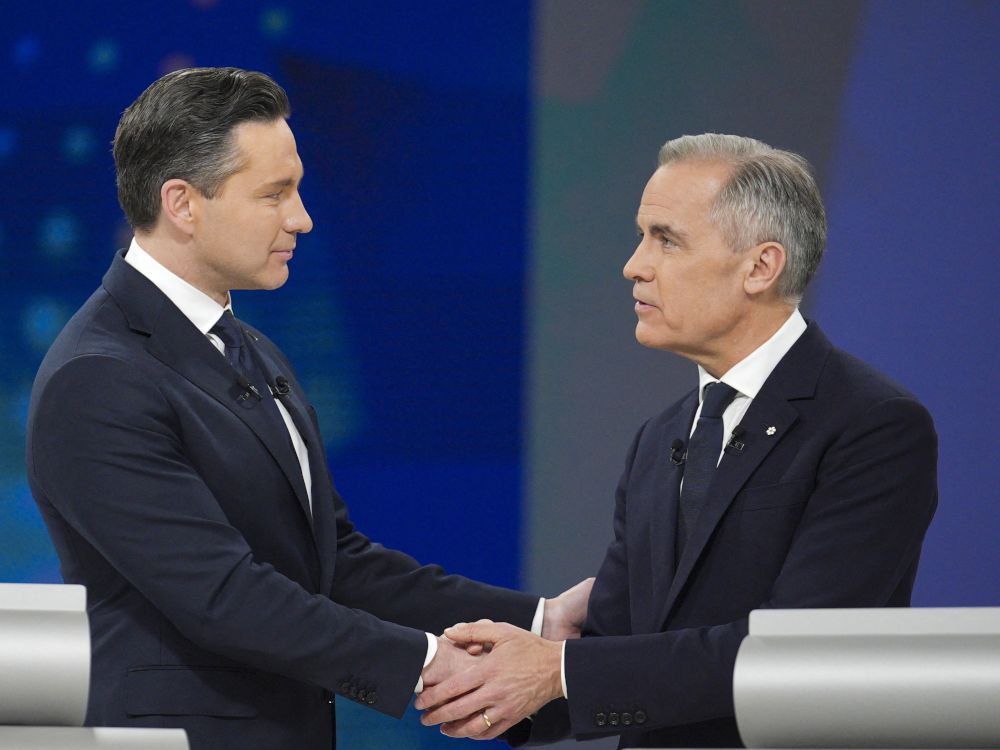
Conservative Leader Pierre Poilievre, left, and Liberal Leader Mark Carney shake hands following the English federal leaders debate, in Montreal on April 17.

Did last week’s leaders’ debates leave you still undecided on how to vote on April 28? If so, then take a look at the very different answers that Liberal Leader Mark Carney and Conservative Leader Pierre Poilievre gave to the question about a government’s use of the notwithstanding clause.

Poilievre made it clear that he supports Quebec’s use of the notwithstanding clause to protect the French language. He also stated that if the Conservatives form a majority government, he will invoke Section 33 to keep mass murderers in jail without parole — a policy that was struck down by the Supreme Court.

Carney talked about the question but never answered it. After several circling comments about finding “the right balance,” he quickly exited the discussion by saying it was a “question for the Supreme Court.”

By way of background, there would be no Charter of Rights without the notwithstanding clause. When it was being debated in the early 1980s, the only way Prime Minister Pierre Trudeau could get the provincial premiers to accept the Charter was to include Section 33.

The debate then — and still today — is not about rights versus no rights, but who gets the final word on the meaning and scope of rights on complex issues on which reasonable people can reasonably disagree. In cases like these, where the nine judges on the Supreme Court themselves are often divided, why shouldn’t a government be able to choose the dissenting judges’ interpretation?

The provincial demand for a notwithstanding power was also based on their desire to protect policies that fall under provincial jurisdiction. Some premiers already thought the Supreme Court — under then-chief justice Bora Laskin — had a pro-Ottawa bias in federalism cases.

The premiers saw — correctly — that Trudeau’s Charter could further exacerbate this risk. They understood that when the Supreme Court strikes down one province’s law for an alleged Charter violation, it effectively imposes a new, one-size-fits-all rule for all 10 provinces. They feared that the Charter could facilitate a form of disallowance in disguise, a policy veto exercised by judges rather than by the federal cabinet.

Forty years later, these fears have been realized. In practice, the Charter means what the Supreme Court judges say it means. Over the past half century, the majority of them have been appointed by Liberal prime ministers. The Court Challenges Program funds the litigation costs of interest groups that the Liberals support, and who in turn support the Liberals. (The Harper government defunded the program, but it was resurrected by government of Prime Minister Justin Trudeau.) It’s a tidy and efficient little circle.

The policy veto the Supreme Court gained from the Charter — disallowance in disguise — has been most aggressively used to strike down provincial policies dealing with bilingual education (Section 23). This is precisely what Pierre Trudeau intended, which is why he exempted the clause from any provincial use of the notwithstanding power.

But judicial policymaking under the guise of legal interpretation has not stopped at the boundaries of bilingual education. The Charter winners’ circle includes almost all rights-advocacy groups promoting the new “progressive” agenda. In policies dealing with DEI, Aboriginal or climate-change issues, provincial governments that do not accede to the new woke priorities can now expect to be hauled into court by federally funded interest groups and the case decided by federally appointed judges.

The losers in Charter politics have been the provinces, and by extension, the voters who elect provincial governments. Remember: federalism is itself a way of protecting minority rights. Each province is a minority — Quebec first and foremost because of its unique linguistic and ethnic heritage, but the other provinces, as well.

Regional differences and diversity are being sacrificed on the altar of this new version of minority rights. This de facto “jurocracy” is eroding provincial rights and undermining Canada’s traditions of responsible government and democratic accountability.

The beneficiaries of this new Charter jurocracy — and their allies in the law schools and the media — have worked hard to stigmatize the use of the notwithstanding power. They want judges to have the final word. (Just watch the reaction to this column!)

But in the last five years, Section 33 has experienced something of a renaissance. It has been used not just by Quebec, but also by governments in Ontario and Saskatchewan. This may be — and I hope it is — the beginning of a renaissance for Canadian federalism. Maybe Canadians from sea to sea to sea have had enough of the Liberals’ one-size-fits-all, Ottawa-knows-best policies of the past 10 years.

The choice between Carney or Poilievre, the Liberals or the Conservatives, gives Canadians an opportunity to reclaim their heritage of responsible and accountable government. As illustrated by our sister parliamentary democracies in the United Kingdom, Australia and New Zealand, constitutional supremacy does not require judicial supremacy; and the rule of law need not entail the rule of lawyers.

National Post

F.L. (Ted) Morton is an executive fellow at the University of Calgary School of Public Policy. His most recent book is the fifth edition of “Law, Politics and the Judicial Process in Canada,” first published in 1984.


Prime Minister designate Mark Carney.

Watch the full video directly below. (If using the National Post iPhone app, the video is at the top of the post.)

He’s written a book on the subject, but his willingness to promote fear and disinformation about his opponent, as well as his failure to act decisively in response to the outrageous behaviour of his staffers and an MP begs the question: what are Mark Carney’s values, anyway? Watch National Post columnist Michael Higgins and senior editor and columnist Terry Newman discuss the 2025 federal election campaign.

National Post