LP_468x60
on-the-record-468x60-white

French President Emmanuel Macron, right, welcomes Prime Minister Mark Carney at the Elysee Palace in Paris on March 17.

The Peace Arch Border Crossing — which connects the cities of Blaine, Wash., and Surrey, B.C. — bears the words of Psalm 133: “Brethren dwelling together in unity.” While this biblical inscription testifies to the close relationship the two countries maintained for decades, the feeling in Canada today is that the brotherly relationship has become more reminiscent of the fratricidal kinship of Abel and Cain.

Apart from Ukraine, no ally or partner of the United States has faced a more radical shift in its strategic fortunes than Canada since U.S. President Donald Trump’s return to the White House. The trade dispute between the two countries poses an existential threat to Canada’s economy, while presidential comments about our territorial integrity and political sovereignty have upended the cross-border harmony and trust.

Amidst such tumult, Liberal Leader Mark Carney has signalled his intention to realign Canadian foreign relations towards the European Union and other allies. At first glance, Canada and many of its European allies share a sense of whiplash that has accompanied the Trump administration’s lurch into protectionism and potential disengagement from the Euro-Atlantic security community. Yet those similarities may obscure major differences between Canada and its European allies, and the limits of such a realignment.

Just like Canada, European militaries rely heavily on U.S. tech — especially with respect to intelligence, surveillance and reconnaissance. Importantly, however, European states have pre-existing political and military arrangements independent of the U.S. The European defence industry is also heavily protectionist — with state-owned or heavily subsidized companies receiving preferential treatment. Consequently, the Canadian defence industry would have difficulty securing business from EU members.

Moreover, European production lines are unfit for Canadian purposes as their products are biased towards European needs. Their capacity is also mostly spoken for, with major defence contractors churning out NATO procurement for the Ukrainian conflict. Canadian orders would suffer lengthy delays. One might think that Canada should thus join the EU. Yet this solution is fanciful. Entry into that union would require Canada to relinquish sovereignty to EU institutions,  and would likely take over a decade to come to fruition.

Bilateral co-operation with the U.S. is not a luxury for Canada, but a necessity, since its prosperity and security depend foremost on pursuing common interests. The Canadian defence industry, like almost every other sector, is highly integrated with the U.S., with 63 per cent of Canada’s defence exports going there in 2022. This is because the Defence Procurement Act (DPA) in the United States has a provision (Title III) that specifically allows Canadian defence companies to be treated as if they were American companies.

This unique position makes Canada the envy of the world. Indeed, it was only recently granted to two other countries, Australia and the United Kingdom, for the purposes of the AUKUS submarine pact. Should Canada lose its Title III status, it would be devastating to the already diminished Canadian capacity to produce defence equipment.

A strong pivot to Europe faces significant constraints. Some might argue that even considering this option signals that Canada is finally taking its own defence seriously. However, we think the emerging dialogue on Canadian security betrays a lack of seriousness.

The Canadian election is making an already impassioned national discussion lose more of the nuance that has traditionally characterized Canada’s approach to its southern neighbour. It has generated a “rally-around-the-flag” effect that political candidates want to exploit for votes, all while many commentators declare that Trump’s domestic agenda and foreign policy has made the United States irredeemable.

This surge in patriotism is unsurprising given the circumstances. It can be channelled positively to make national investments that would still be worthy if Trump were not president. However, it risks producing decisions that are good politics but bad policy. Certain positions floated by Canadian leaders, such as reviewing the F-35 purchase, could alienate key allies in the U.S. — both in Congress and state capitals — who will be essential for Canada to navigate the Trump administration in the years ahead.

After all, Canadian officials have signalled their resolve to addressing continental defence needs. Reviewing purchases such as the F-35 and seeking a shift in military procurement away from North America will only reinforce Canada’s perceived unwillingness to address continental security. Worse, they will further the very capability gaps that already expose Canada internationally.

Being realistic about the prospects of a shift to Europe does not entail normalizing Trump’s appalling behaviour. However, it would be wrong to confront his brand of dangerous populism with a misguided populism of our own. Abel should not commit suicide for fear of death.

National Post

Richard Shimooka, Alexander Lanoszka and Balkan Devlen are senior fellows at the Macdonald-Laurier Institute.
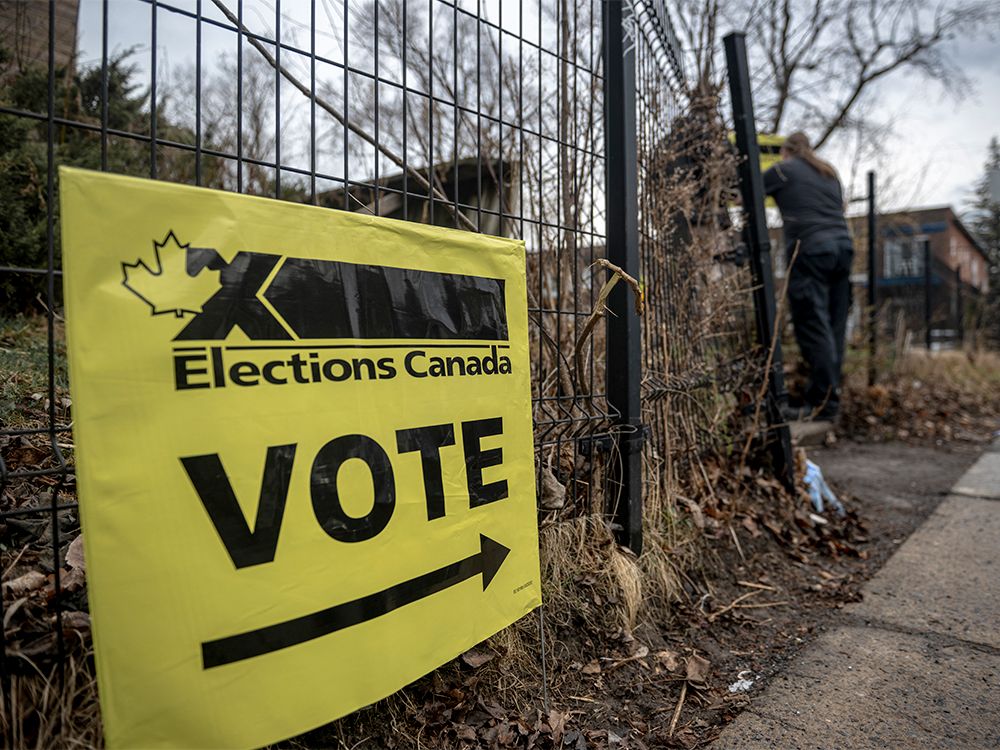

A volunteer sets up signage directing people to a polling location during early voting in Montreal on April 19, 2025. The Liberal government has allowed antisemitism to flourish in Canada, write Karine Toledano and Aline Levi.

By Karine Toledano and Aline Levi

After nearly a decade of Liberal government, we are watching history repeat itself. Synagogues are being burned, schools shot at, businesses attacked, and hatred paraded openly through our streets. These are not isolated incidents — they are warnings. And ignoring them now would be a deadly mistake.

This election is not just political. For Jewish Canadians, it is existential. Our future in this country hinges on choosing leadership willing to act decisively against rising hate.

Across Canada, Jews and our institutions have become primary targets. According to Statistics Canada, antisemitic hate crimes have risen over 400 per cent under Liberal leadership. Though Jews represent less than one per cent of the population, we were the target of 70 per cent of all religiously motivated hate crimes in 2023. Yet as antisemitic violence overflowed across Montreal — cars torched, windows smashed, synagogues and Jewish schools under siege — the country’s leader was literally dancing the night away at a Taylor Swift concert, tone-deaf to what was happening.

The federal response to such violence has been shameful. Liberal ministers routinely fail to call out antisemitism directly or unequivocally. Their silence and ambiguity send a message: Jew-hatred is tolerated in Canada.

Some hope that things will improve under Mark Carney. The facts say otherwise. His first statements as Liberal leader included an

attack on Israel

. One of his first actions as prime minister was pledging another $100 million in taxpayer-funded aid to Palestinian organizations — despite widespread evidence that such aid ends up in the hands of Hamas. When a heckler yelled “There’s a genocide happening in Palestine!” Carney

responded

, “I’m aware. That’s why we have an arms embargo.” He later claimed he hadn’t heard the word “genocide.”

Carney promoted Foreign Minister Mélanie Joly despite her disturbing record. Under her watch, Canada abandoned its democratic ally, Israel, after the October 7 attacks — blocking exports, equating Israel with Hamas, and breaking Canada’s long-standing bipartisan support at the UN. In October 2023, Joly falsely blamed Israel for bombing a hospital — a claim disproven within days. She still hasn’t deleted the post.

In

conversation

with former NDP leader Tom Mulcair, Joly justified Canada’s foreign policy shift by saying, “Have you seen the demographics of my riding?” That kind of electoral calculus is dangerous. When leaders pander instead of lead, anti-Israel rhetoric quickly turns into real-world violence.

Meanwhile, the Liberals have empowered organizations that promote division. Since 2016, the Liberals have funneled over $200 million into UNRWA, despite credible evidence linking the agency to Hamas — including staff who participated in the October 7 massacre. In 2024, they backed a motion in Parliament to explore the recognition of a Palestinian state, while Israeli civilians were being held captive in terror tunnels in Gaza.

In 2022, Liberal MP Ahmed Hussen, then minister of diversity and inclusion, approved over $100,000 of taxpayer funds for “anti-racism training” by

Laith Marouf

— a man who openly supported ex-Syrian leader Bashar al-Assad, also known as “The Butcher of Damascus,” and who has worked with Kremlin propaganda outlets. Marouf is notorious for making virulently hateful statements against Jews and Black communities.

Little known to most Canadians, Carney and Joly also pledged $84 million in taxpayer funds to Syria — into the hands of Abu al-Julani, a former al-Qaida commander, who, until recently, was on the U.S. terrorist wanted list. He may wear a suit now, but his

recent massacres

of Alawites and Christians show his ideology hasn’t changed. Yet this is where the Liberals are prioritizing sending our tax dollars — while hospitals here collapse and Canadians cannot afford housing.

Just a few months ago, the Liberals nearly appointed

Birju Dattani

— who had allegedly compared Israel to Nazi Germany and openly supported the Israel BDS movement — as Canada’s top human rights official, reversing the decision only after public outcry.

This is not a one-off failure. It’s a pattern. A worldview.

Under the Liberals, Canada has lost its soul. The promise of a country grounded in freedom, fairness and mutual respect has given way to rising hate, crumbling institutions and a government that no longer defends its own citizens. The result is a nation adrift.

Pierre Poilievre and the Conservative party offer a clear and necessary alternative: a return to the Canadian values that once defined this country — freedom of religion, public safety, real pluralism, and unity rooted in shared responsibility. They understand that diversity cannot survive without security, and that multiculturalism collapses when it tolerates hate.

The Liberals have made Canada unrecognizable. The Conservatives are the only party prepared to make it home again.

Because, in the end, this is not just about the Jews. Antisemitism is the canary in the coal mine of civilization. A society that embraces antisemitism collapses under the weight of its own hatred.

Special to National Post

Karine Toledano is an Adjunct Professor of Anesthesiology at the Université de Montreal and McGill University. Aline Levi is a family physician in Montreal.


Prime Minister of Canada and Liberal Party Leader Mark Carney shakes hands with supporters as he enters a rally on April 23, 2025 in Surrey, Canada. (Photo by Rich Lam/Getty Images)

Canada is tragically a nation in decline. For a number of years, the key economic and quality of life metrics have slowly but surely worsened. This has happened while comparable countries have done much better. And it’s largely been a policy choice. We are not in accidental decline, but managed decline.

This is where we find ourselves, as we are on the cusp of a momentous national election. The choice voters face on Monday is whether to continue down this path or to turn things around by going in a different direction.

The facts are that a vote for the Liberals and Mark Carney is a vote for more of this slow decline and a vote for the Conservatives and Pierre Poilievre is a signal that we need to pivot and take seriously the work required to repair the damage caused by Justin Trudeau over the past decade. The people who broke the country are not the people to fix it.

The whole reason that Donald Trump can speak cavalierly about absorbing Canada into the United States is because — in business terms — our country is so mismanaged and underperforming that we have downgraded ourselves into a penny stock that is ripe for a swift hostile takeover.

We have underlying assets — our natural resources, our entrepreneurs and what’s left of our manufacturing sector — but we don’t appreciate their value and we undermine their flourishing. This needs to stop if we are to get back in shape and provide a brighter future for younger generations.

The best way to protect our sovereignty is to strengthen our country and grow our economy so we are not as vulnerable to such offensive overtures. This can’t be accomplished by the Liberal philosophy of even greater government control of our economy.

The argument that Carney is the preferred choice for prime minister because he’s an economist ignores the fact that this job title does not always denote pro-growth and pro-business. Karl Marx was an economist.

Carney — as he has shown via his track record, his writings and his policies — has a left-leaning view of an economy, one that is more centrally controlled by government and prioritizes the green agenda over sound fundamentals.

Carney will make job creators, founders and entrepreneurs less free to build future opportunities. This will send them packing, which will in turn hollow out our tax base and erode our social services.

As iconic Canadian entrepreneur Jim Balsilie has recently

written

, “Mr. Carney’s economic policy proposals will simply perpetuate the status quo, making Canada more vulnerable, less prosperous and less sovereign.”

Anyone concerned about sovereignty should then also be concerned about Carney. He has been a servant to too many masters and it’s unclear where, if at all, the regular Canadian voter fits in his list of priorities.

Carney, who sneers at honest questions from the press, refuses to answer about his global cocktail circuit conflicts. We still don’t know the extent of his financial holdings. We do not have clarity on his relationships with prominent figures connected to China. And we do not even know when he actually started permanently residing in Canada again. It could have been mere days before the Liberal leadership race began.

Justin Trudeau asked Carney more than once to serve in public office and cabinet. He said no. Carney was apparently only willing to stay full time in Canada if he could be handed the top job in the land.

As reported by the BBC, it was only a few months before Carney was installed as prime minister that he was meeting with former British PM Tony Blair at a high end restaurant in London, England, to plot his entry into politics. If politicians are going to scheme about taking over Canada, could they at least have the decency to do it from within our borders? We have nice restaurants here too.

It is a fact that Carney is the least vetted political leader in recent Canadian history. Carting out Mike Myers and Neil Young and Carney’s hockey jersey gimmicks — these are all meant to compensate for the fact that he’s lacking in Canadian street cred. We know so very little about the man.

Yet when Pierre Poilievre opens up and speaks about the concerns he has for our nation and our children, when he speaks from the heart about his own special needs daughter, we see a man well known to us, his best years ahead of him, deeply committed to building a better future and deeply committed to Canada.

It’s going to be a tough slog getting Canada out of the rut it’s now in, regardless of what Trump does or doesn’t do. Poilievre will work like hell to turn it around. Carney will keep us on the same path of managed decline. Vote wisely Canada.

National Post


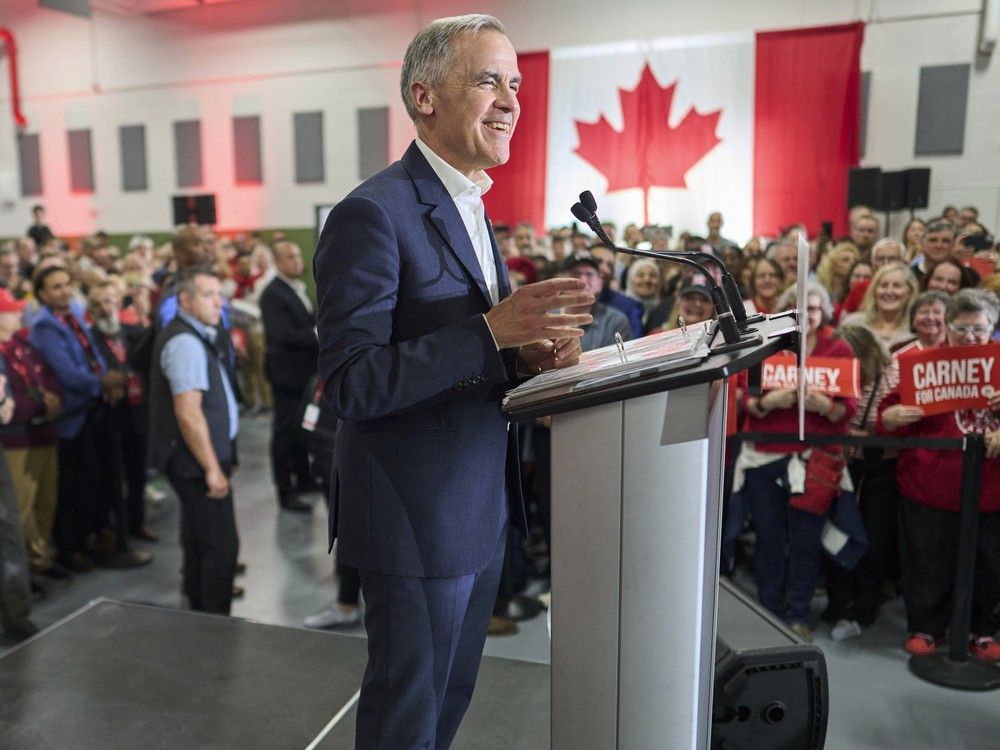
Liberal leader Mark Carney speaks during a campaign rally in London, Ontario. Canadians go to the polls on April 28, 2025. (Photo by Geoff Robins / AFP)

KING CITY, ONT. – With two days to go until polling day, Mark Carney was careful not to break into a victory lap.

At a campaign event at Seneca College in this commuter community 40 km north of Toronto, Carney was asked to grade his own campaign performance.

The problem with being successful is that it breeds hubris, a quality voters tend to find toxic.

But the Liberal leader is a quick study and sidestepped a curve-ball that could have struck him squarely between the eyes. “Every study I’ve ever taken, it is the teacher who gives the grades,” he said.

It was a prudent response. The polls give the Liberals a four-point cushion nationally, with regional break-outs in Ontario and Quebec looking even more rosy. Carney consistently outpolls Pierre Poilievre on perceived competence and likeability.

The race does not always go to the candidate ahead in the polls, but that’s the way to bet. Betting markets give the Liberals a 71 percent chance of forming government, compared to a 20 percent chance for the Conservatives. A certain Donald Trump faced similar odds in 2016 and triumphed.

But the momentum is with the Liberals. You can see it and feel it on the ground. On Friday night, Carney campaigned in an NDP-held riding, London—Fanshawe, that has been held by the mother-daughter dynasty of Lindsay and Irene Mathyssen since 2006.

On Saturday evening, Carney is scheduled to hold a rally in Windsor West. The seat is held by veteran NDP MP, Brian Masse, who has won there eight times.

It is a measure of the rise in Liberal fortunes, at the expense of the NDP, that Masse’s seat is now considered to be in play.

There is no sentiment in politics, and in return for propping up the government for the past two years, the Liberals are intent on wiping New Democrats from the electoral map.

The King—Vaughan seat is currently held by the Conservatives, but it too is considered a potential pick-up for the Liberals.

The reason is the story of this election: Carney has been the candidate who has best addressed the anxieties about the Trump administration felt by millions of Canadians.

He has talked about “the biggest crisis of our lifetimes” and the rhetoric has felt overblown at times, particularly in the weeks between Trump bloviating about Canada becoming the “51st state.”

But the president has entered the stage again, as if on cue from the Liberal campaign.

In an interview with Time magazine, he said he is not trolling when he says he wanted to grow the American empire to include Canada, Greenland and the Panama Canal.

“I say the only way this works is for Canada to become a state,” he told the magazine.

Carney referred to the comments in his remarks. “I take it literally,” he said. “Others ignored it and said it’s a joke. But I took it seriously.”

He said Trump’s efforts to reshape the global trading system “demonstrates the costs and consequences of our democratic choices.”

The line of questioning from reporters focused on how Carney would deal with Trump’s threats, if elected.

He was asked if he is setting unrealistic expectations by saying Canada can win a trade war.

He said the country loses any negotiations if it gives the Americans what they want. “We will be damaged if we lose access to the (U.S.) market,” he said. But building a single Canadian economy and exploiting trading opportunities elsewhere would give Canada leverage. “That’s winning the trade war,” he said.

He said he does not believe the U.S. would ever resort to military force. “But I do think the U.S. is trying to put economic pressure on us to gain major concessions … a level of integration of our countries that would impinge on our sovereignty,” he said.

“We have to be clear-eyed about this. These aren’t just words when I say in a crisis we have to prepare for the worst. And the worst is, that is the goal. Take what the president says literally.”

Carney said he sees “a landing place” of a negotiated settlement but did not expand on what that might look like.

Earlier this month in Oakville, Ont., he was asked whether Trump is likely to abide by any deal that is reached.

He said negotiations would have to focus on sectors where the fundamental economic interests are so tightly bound that the incentives to reach agreement are present.

“I look specifically at the auto sector, where it is going to become very apparent very quickly that taking apart something that has been built up over my lifetime is not in the interests of U.S. jobs,” he said.

In large measure, the election appears to have come down to voters answering the question Carney posed in his remarks in King City: “Is Pierre Poilievre the person you want sitting around the table with President Trump?”

It will be a stunning reversal for the pollsters and the pundits if the answer on Monday is “yes.”

jivison@criffel.ca

Twitter.com/IvisonJ


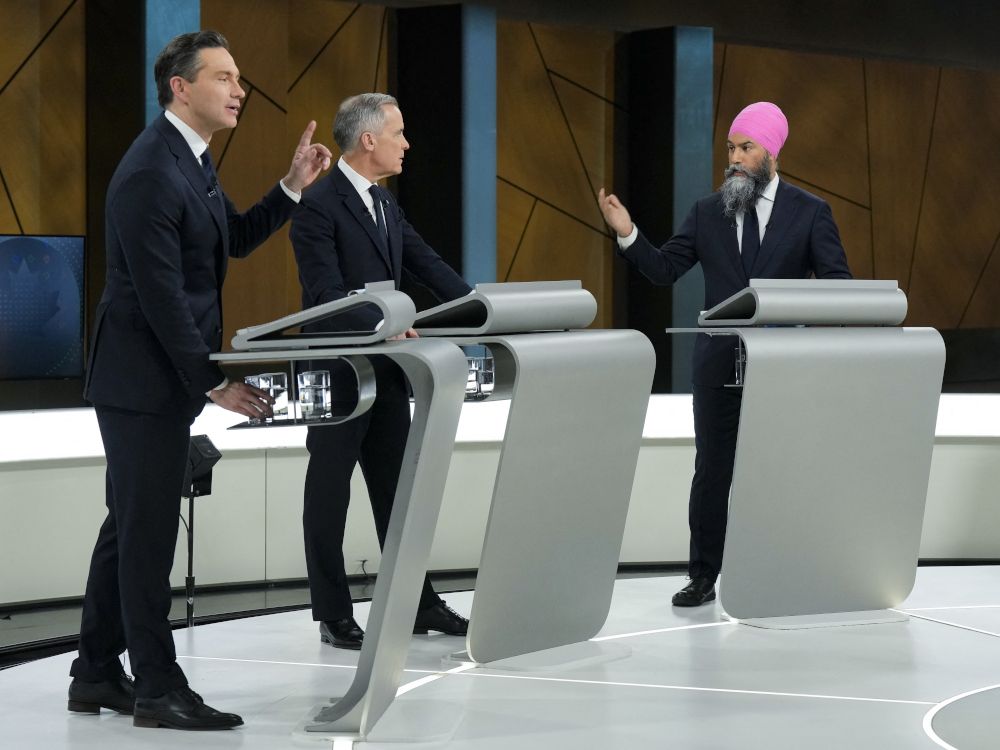
From left, Conservative Leader Pierre Poilievre, Liberal Leader Mark Carney and NDP Leader Jagmeet Singh square off in the English federal leaders debate, in Montreal, on April 17.

In the final weeks of Canada’s 45th general election, the Jewish vote has taken centre stage, with media reports on how a lot of Jews are turning 

to the Conservatives

 as the best party to deal with rampant Jew-hatred, and how left-wing Jews are 

feeling politically homeless

 due to the NDP’s anti-Israel policies and deep-seated antisemitism.

But it was an article in the 

Canadian Jewish News

 last week that caught my eye, as it quoted a number of pollsters who suggested that, like other segments of the electorate, some Jews may end up supporting Mark Carney’s Liberals due to the party’s perceived advantage in dealing with the threat posed by U.S. President Donald Trump.

I find this curious given the lack of evidence that Carney would do a better job of handling Trump than his rival, Conservative Leader Pierre Poilievre, and the fact that it is the Tories who are offering 

a concrete plan

 to kickstart the country’s economy and diversify our export markets, which would help Canada weather the coming economic storm and put us in a much better position when dealing with the Americans.

There’s no doubt, however, that many in the Jewish community are deeply concerned about the security of the Jewish state and the safety of Canadian Jews amidst an unprecedented rise in antisemitism. So let’s take a look at what the three major parties have to say on these issues.

At last week’s 

English-language leaders’ debate

, the candidates were asked what role Canada should play in the Middle East. Poilievre stood on principle, saying that, “We must condemn Hamas, and more importantly the terror sponsors in Tehran who initiated the attacks, the horrific attacks, of October 7. We need to defeat the terrorists so that all the peoples of the world can live in peace.”

He then proceeded to condemn the antisemitic protests and violence we’ve witnessed in our streets, arguing that, “We need to get back to the Canadian tradition, which is that when people come to this country, they leave foreign conflicts behind.” This should be a fairly uncontroversial statement. He wasn’t arguing that people shouldn’t be proud of their heritage, just that newcomers should not bring ancient hatreds, like antisemitism, with them.

But NDP Leader Jagmeet Singh immediately took issue with it, saying that, “People come from countries from around the world and they care deeply about where they come from and they should be able to do so,” while calling Poilievre’s treatment of Palestinians “disgusting.” Singh then attacked Carney for not repeating the lie that Israel is committing a “genocide” in Gaza.

For his part, Carney took the same wishy-washy, middle-of-the-road approach as his predecessor, former prime minister Justin Trudeau, calling for an “immediate ceasefire,” the “return of all the hostages” and a two-state solution. He then touted the $100 million his government pledged to Gaza after he became prime minister and noted that we have to be “clear-eyed about the fundamental risk of Iran and do everything with our international partners to check it.”

The 

Liberal platform

 also hints at a continuation of the Trudeau Liberals’ policies, which have seen Canada turn its back on Israel at the United Nations and during its time of need following the October 7 massacre, while consistently failing to take serious action to combat antisemitism.

Although the Liberals note the “horrifying rise in hate, and hate-related crimes,” they continue their pattern of equating antisemitism with Islamophobia, even though the vast majority of hate crimes have targeted the Jewish community. Nevertheless, the Grits pledge to make it a crime to block access to, or intimidate anyone entering, “any place of worship, schools and community centres.” The party also promises to implement “Canada’s Action Plan on Combatting Hate” and “increase the annual budget of the Canada Community Security Program.”

While the platform does not mention the Middle East conflict directly, it does say that the “Liberals will continue to stand behind the institutions that support Canadian values and our global stability, including the UN and its agencies.” Which sounds like code for continuing to support UNRWA, whose members were found to be involved in the October 7 massacre, and the International Criminal Court, which issued an arrest warrant for Israeli Prime Minister Benjamin Netanyahu last year.

The 

NDP platform

 hints at similar policies, saying that New Democrats would increase “international aid funding to 0.7 per cent of our gross national income” and support “international justice institutions like the International Criminal Court and the International Court of Justice,” which is currently hearing South Africa’s “genocide” case against Israel.

It goes on to address the Israeli-Palestinian conflict directly, pledging that an NDP government would “recognize the state of Palestine,” “impose sanctions on key figures in the Netanyahu regime” and “immediately impose a two-way arms embargo on Israel.” It’s little wonder that left-wing Zionists find themselves increasingly alienated by the party.

As we saw in the leaders’ debate, only the Conservatives seem to take seriously the threat posed by terrorist organizations like Hamas, its state sponsors in Iran and its supporters here at home.

The 

Tory platform

 promises to “strengthen alliances and ties with countries that share our values to stand up against hostile and authoritarian regimes that threaten global security and stability”; “stand up against the tyrannical regime in Tehran” by seizing its Canadian assets, expelling IRGC agents and supporting Iranian dissidents; and defunding “international institutions like UNRWA … that don’t uphold Canada’s interests and values.”

The Conservatives also plan to crack down on antisemitism by creating “tougher sentences for religious property mischief and penalties for masked rioters”; forming an anti-hate crime task force; directing “CSIS to implement threat reduction measures, including communicating with Jewish communities about antisemitic threats”; and streamlining “access to the Security Infrastructure Program for places of worship, community and cultural centres.”

I would not presume to tell people how to cast their ballots, but as a Jew, I cannot, in good conscience, vote for any party other than the Conservatives in this election. Canada is in desperate need of a government that will prioritize our economy and strengthen our country in the face of Trump’s tariffs and imperialist rhetoric. We also need a government that will stand up for what is right on the international stage, support countries like Israel that share our values and take threats to minority communities here at home seriously. Pierre Poilievre is the only leader offering a concrete plan to achieve these goals.

National Post

jkline@postmedia.com

Twitter.com/accessd

This column was originally published in the Channel Israel newsletter. Sign up here.


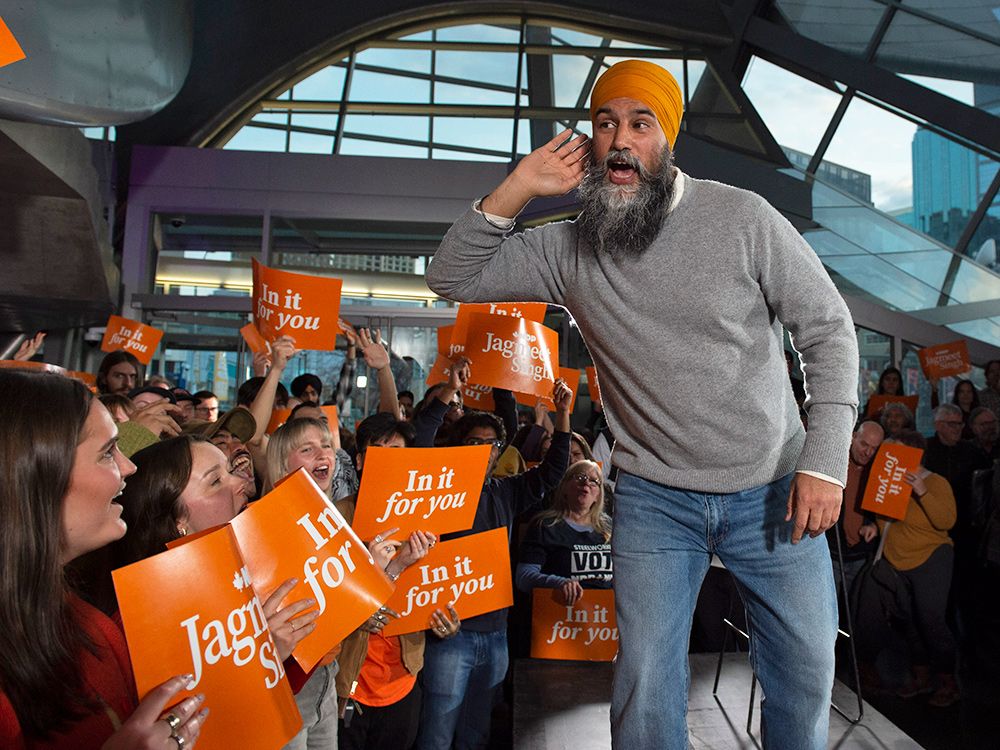
Jagmeet Singh's NDP is seen as having only a small chance to meet the threshold to be recognized as an official party after next week's federal election.

Whatever happens on Monday, one thing is certain: both the New Democratic Party and its Green cousin are headed for collapse.

As of Thursday, poll aggregator 338Canada has the NDP

projected

to win eight seats (or at least, somewhere in the range of two to 15). It’s therefore very possible that the NDP will lose official party status in the House of Commons, which

requires

a minimum of 12 seats.

The Green Party is projected to win only one seat, with the most optimistic scenario topping off at three.

Better yet, it’s more likely than not that both party leaders won’t be returning to the House of Commons. The NDP’s Jagmeet Singh is

almost certain

to lose, with the competition in his riding of Burnaby Central shaping up to be one between the Liberals and Conservatives. Elizabeth May, Green co-leader No. 1,

is just a hair behind neck-and-neck

with her Conservative opponent. Green co-leader No. 2, Jonathan Pedneault, can be counted on

to lose

against the Liberals.

Take a good look at the NDP in its current state, because by Tuesday, only a husk will be left over.

These parties couldn’t deserve their fates more. The NDP, long ago known as the “conscience of Parliament,” abandoned that role and transformed itself into a Liberal crutch with confused priorities after Singh assumed the leadership in 2017. He’s spent his years in Parliament propping up the government — even formalizing his position as Trudeau’s toadie in a supply-and-confidence agreement from

2022

to

2024

.

As leader, Singh turned his back on workers for woke nonsense and

abandoned

traditional labour unions for the politics of student unions.

Pre-COVID, he spent his time in office

demanding

electoral reform that never happened,

pushing for

a ban on “conversion therapy” that prohibits attempts to convince children they aren’t trans (but allows children to be pressured into becoming trans), and

calling

his House of Commons colleagues — and the

country

as a whole — “racist.”

During the COVID pandemic, he pushed for major wealth redistribution schemes (

wealth taxes

and

universal basic income

),

encouraged

the anti-police movement, all while exacerbating social tensions during an already tense time. In May 2021 — a year-and-a-half into the pandemic — Singh hypocritically

accused

Canadians against mask mandates and lockdowns of corroding the social order.

“To brazenly not follow public health guidelines puts people at risk and that is something that we’ve seen with extreme right-wing ideology,” he said.

Later that month, a video of Singh

surfaced

showing him violating pandemic restrictions by not wearing a mask in the presence of someone not in his household. The year before, he

participated

in Toronto protests against the death of American Black man George Floyd. COVID precautions mattered to him, yes — but only when it suited him.

In the post-pandemic age, he moved on to other social panics,

gaslighting

parents concerned with rules that allowed schools to secretly socially transition their children and, worst of all, helping Hamas in its campaign against Israel in the aftermath of the brutal, Oct. 7, 2023 terror attack. Singh’s party became a

keffiyeh crew

, donning the

same garment

worn by the Parliament Hill terrorist who literally attacked our democracy in 2014, while

motioning

to recognize a state of Palestine. The Greens were quick to offer

support

on this front — giving the Hamas terrorists exactly what they wanted.

It’s an insult to Canadians how Singh and May spent their time as Liberal proxies in office: even in this year’s campaign, Singh’s made a farce of advocating for affordability by suggesting disastrous

food price caps

, while continuing to prioritize foreign concerns like Gaza at the expense of Canadians. As of late, May’s often refrained from criticizing the Liberals, focusing instead on

Donald Trump

and the

Conservatives

in an attempt to cling to

relevance

.

In 2025, Singh is pitching the NDP as a worthy choice for voters by running on the record of his opponent Liberals, taking credit for Trudeau’s tumultuous $10-per-day child care program, as well as his dental care program and his very limited pharmacare program. He’s positioned himself as

running against

the

Conservatives

. “Vote NDP for more of the same,” seems to be the message — and it’s failing, based on the party’s absolute collapse in the polls. Greens candidates, meanwhile, are

trying

to

outflank

an already-progressive Liberal party to little effect.

It would be a believable campaign if the Greens and New Democrats had spent the last several years demonstrating they’re actually capable of holding the Liberal government to account. They had ample opportunity to vote against Liberal budget bills and bring forth non-confidence motions when the government failed to meet expectations. Had the New Democrats done so

last fall

, they could have crushed the Liberal party and avoided their own devastation.

Yet, at

every

opportunity

, Singh devoted his political career to dragging the federal government further to the left and enabling the worst of its overspending habits. He

refused

to instigate elections that, compared to the current one, wouldn’t have plunged the federal arm of his party into near-extinction. Instead of accountability, he delivered the opposite by using false threats to give the Liberals political cover.

Like the boy who cried wolf, his posturing lost its meaning. In turn, Canadians are now ignoring his pleas for support. Good riddance.

National Post


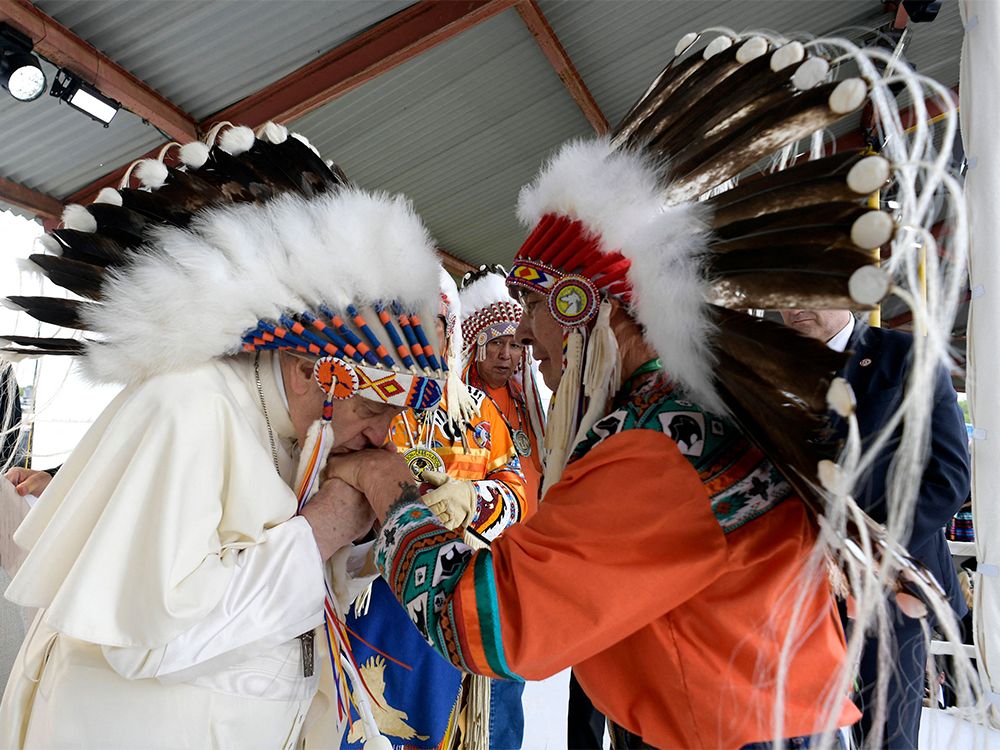
Pope Francis kisses the hands of Chief Wilton Littlechild after receiving a headdress during a papal visit to Maskwacis, Alta., on July 25, 2022.

In their comments upon the death of Pope Francis, both Liberal Leader Mark Carney and Conservative Leader Pierre Poilievre referred to the Holy Father’s visit to Canada in 2022 — the “penitential pilgrimage,” in his characterization, to offer an apology related to Indigenous residential schools.

His visit to Canada was the longest of any trip during the pontificate, save for the Pope’s initial foreign trip to Brazil in 2013, only months after his election. By 2022, confined to a wheelchair, his decision to spend so much time in Canada — even going to Iqaluit — was a compliment to our country.

That visit bears remembering. After Justin Trudeau, Canada will have to decide whether Indigenous reconciliation means continuing his denigration of Canadian history as a brutal, criminal, genocidal enterprise. Pope Francis came to Canada with a different approach.

During an airborne press conference returning to Rome, the Holy Father casually accepted the term “genocide” in response to a journalist’s question. That was a mistake. His

prepared addresses

were careful, balanced and more faithful to truth and reconciliation than the proposals of the eponymous commission.

“In-depth study shows that, on the one hand, some men and women of the Church were among the most decisive and courageous supporters of the dignity of the Indigenous peoples, coming to their defence and contributing to raising awareness of their languages and cultures,” Pope Francis said. “On the other hand, there was unfortunately no shortage of Christians, that is, priests, men and women religious and laypeople, who participated in programs that today we understand are unacceptable and also contrary to the Gospel. And this is why I went to ask for forgiveness, on behalf of the Church.”

He made the point that the residential schools were a project of the state, that it was “a deplorable system, promoted by the governmental authorities of the time.”

The truth is that religious institutions took part in a government project; the root problem was too much co-operation with state power arrayed against Indigenous families.

The significance of the 2022 visit was not the papal apology,

per se

. Pope Benedict XVI had offered an apology in 2009, before the Truth and Reconciliation Commission even began its work. The Catholic religious order most involved in residential schools, the Oblates of Mary Immaculate, offered a comprehensive

four-page apology

in 1991, long before most Canadians were familiar with the issue.

The important contribution of the 2022 visit — neglected even by many Catholic leaders — was that Pope Francis insisted on telling the truth in its fullness, acknowledging the Christian faith of most Indigenous Canadians. The wound of residential schools is a wound within the household of faith. Reconciliation is not a matter of Catholic institutions negotiating with an external party. It is a matter of reconciliation within the body of Christ.

The most beautiful address of the visit was in Edmonton at an Indigenous Catholic parish, where Pope Francis spoke in the language of faith, not the words of government bureaucracy.

“On the cross, Christ reconciles and brings back together everything that seemed unthinkable and unforgivable; he embraces everyone and everything,” he said. “Everyone and everything! Indigenous peoples attribute a powerful cosmic significance to the (four directions), seen not only as geographical reference points but also as dimensions that embrace all reality and indicate the way to heal it.”

Pope Francis then gave a cruciform meaning to the four directions.

“Jesus, through the four extremities of his cross, has embraced the (four directions) and has brought together the most distant peoples; Jesus has brought healing and peace to all things. On the cross, he accomplished God’s plan ‘to reconcile all things’.”

Pope Francis reminded us in 2022 that authentic reconciliation between peoples may include government policies and enormous spending, but it cannot be reduced to that. It remains a timely lesson for both church and state in Canada now.

****

In his

comments

on Easter Monday, Mark Carney indicated that the late Holy Father’s thinking about markets and culture had shaped his own thinking on economics, a point he had made in the introductory pages of his 2021 book,

Value(s)

. He takes a different approach regarding the life questions, especially abortion; there his “faith is private.” That incongruity warrants comment. My Post colleague Chris Selley beat me to it, wondering why, on abortion, religious convictions are out of bounds.

“No politician would argue that their non-religious philosophical convictions have no effect on their day-to-day decision-making — that they’re guided by nothing but day-to-day political expediency,” Selley wrote. “Why would they, when their convictions are divinely inspired?”

Selley said it well, and being “as atheist as they come,” his comments may well resonate more than mine would, though we concur in the analysis.

National Post


Conservative leader Pierre Poilievre speaks at a press conference at a Halifax car dealership on Thursday, April 24, 2025.
Ryan Taplin - The Chronicle Herald

We are finally at the watershed that everyone agrees is one of the most important elections in Canadian history. I realize that regular readers would already be familiar with my opinion of the merits of the contending parties and to some extent I’m putting old wine in a new bottle while, in a scandalous melange of metaphors, preaching to the choir. The Liberal campaign is a gigantic fraud. It pretends that since they have a new leader, though that leader is up to his eyeballs in the failed policies of the debunked Trudeau regime, it can simply slink out of its responsibility for the clangorous Gong Show of misgovernment of the last 10 years. It pretends that it has the ideally qualified candidate, when he has never been in active politics, has never actually run anything except a central bank, and in that capacity in Canada he tinkered with the interest rate while Finance Minister Jim Flaherty navigated Canada through the financial crisis of 2008-9, and he was a catastrophic failure as governor of the Bank of England. He was almost tarred and feathered as he left London’s Heathrow Airport. He represents now that he warned the British about the dangers of leaving Europe and that they now regret that decision. He tried to terrorize the country into remaining in the EU, which Britain had never voted for, (they voted for a common market, not a European government), and his projections of disaster have not occurred. The British left Europe and have shown no disposition to return and despite an unprecedented six successive incompetent governments in ten years, Britain has performed better economically than the EU.

The Liberals pretend that they are running against Donald Trump. In one of the most asinine moments in the recent party leaders’ debates, when asked to comment on the housing crisis caused by the Liberals admission of masses of immigrants without any facilitation of increased accommodation for them, thus badly financially squeezing both the newcomers and Canadians of modest incomes who deserve more consideration from their government, Mark Carney blamed the crisis on Donald Trump. Trump had been in office for ten weeks. Such a fatuous answer highlights the cynical contempt that the modern Liberal party has for the Canadian voter, that its self-styled Davos man-elitist leader thinks that the electorate that he seeks to lead is so unfathomably stupid it could believe such bunk. If such stark Liberal cynicism succeeds, Trump is correct that Canada, despite all its good fortune in location, resources and people, is a failed state. In other words, either Canada will give this appalling regime the order of the boot or it will voluntarily complete its journey on the treadmill to national oblivion where the Liberals have put us. Trump is not trying to “break us” as Carney claims. His claims against Canada are rubbish and Ontario Premier Doug Ford, among others, has mentioned several imaginative responses. Canada can take care of itself if it has some leadership.

Much of this election campaign has been a Monty Python sendup. Mark Carney masquerades as the master of public finance and central banking and has produced a platform with nearly a quarter of a trillion dollars in new debt. He has tried to persuade Canadians that because the president of the United States has said some rude things about Canada, he covets us as Hitler and Stalin did Poland. Trump cannot be greatly faulted for taking Trudeau at his word after Trudeau said, according to Trump, the country would collapse if the Americans raised their tariffs and failed to make a meaningful contribution to the defense of this country, (apart from keeping to hand the telephone number of the Pentagon). Justin Trudeau said we have no identity and are a “post-national state; what was Trump supposed to think? The great Liberal myth-making media machine came out of the gate a week after Mark Carney’s elevation as leader like a fire horse on steroids proclaiming from the rooftops that Canada was under attack from the United States. The average Canadian could be forgiven for expecting United States marines to occupy his neighbourhood any morning like the halls of Montezuma or the shores of Tripoli.

Trump’s remarks were annoying and ludicrous, but not inexcusable, given Trudeau’s preemptive renunciation of any will to serious nationhood. What has reduced this election to farce is the claim that the greatest power in the world, which has also been the least interested in suppressing unoffending neighbouring countries of any serious nation or empire in history, from Egypt, Babylon, and ancient China to the present, is the greatest threat to Canada. The greatest danger is the re-election of the Liberals. In the debates as on the hustings, Carney went full metal jacket in presenting the United States as a sinister juggernaut led by an orange monster darkening our skies. Between Jagmeet Singh’s constant interruptions, Yves-Francois Blanchet’s representation of Quebec as a victim of Canada, and Mark Carney’s ashen fixation on a foreign leader, all that was missing was a local version of the leader of Britain’s outlandish Monster Raving Loony Party. After the French debate, Carney unctuously declined to answer any questions from Rebel News because it disagreed with him. The Conservative leader, Pierre Poilievre, is not the greatest pied piper since Peter the Hermit, but he was sensible, factual, on message, bilingual, and reasonably persuasive. In the kingdom of the fabulists, the only person who makes any sense should be the winner.

Canadians! Do you really believe that Donald Trump is a hypertrophic carrot-topped Napoleon with two thin lines of saliva at the corners of his mouth, pulsating with a lust to devour Canada? (If so, make the most of the two psychiatric sessions that our bankrupt health-care system that Carney thinks exalts us morally above the Americans provides for psychotics.) Can you really take that seriously and not see it as another pitiful effort to distract you from the incumbent government’s saturnine conspiracy to impoverish us further by raising taxes, raising the deficit, scorching up energy prices and strangling the oil industry in a climate-frenzied wild goose chase?

If this country gives a fourth straight term to an incompetent government that is running on the shabbiest bogeyman theory since Vlad the Impaler was portrayed to Transylvanians as a vampire, then the U.S. president is correct that we have failed as a nation. Let us elect a government that will build this country back, make it thoroughly competitive, put an end to the nonsense of absorption by the Americans, and get back to standards of good government that both major parties contributed to in what was the Canadian success story until the onslaught of the Liberal malaise which cheekily wishes to perpetuate itself. Don’t throw our future away. Poilievre’s Conservatives are the only one of these parties that has any idea how to govern.

National Post


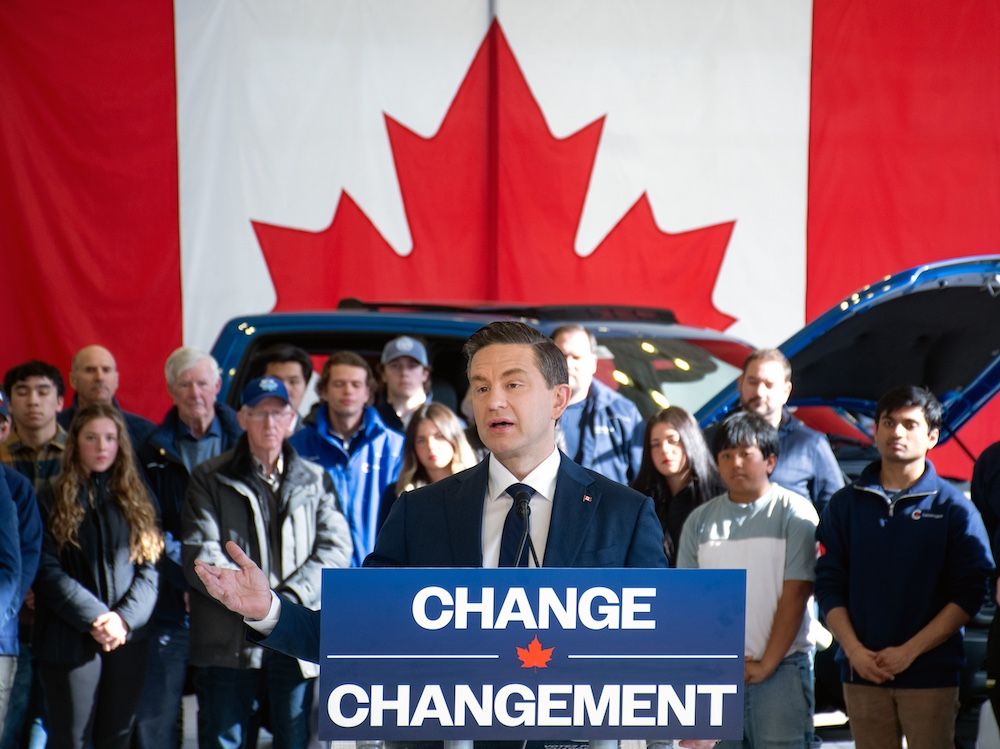
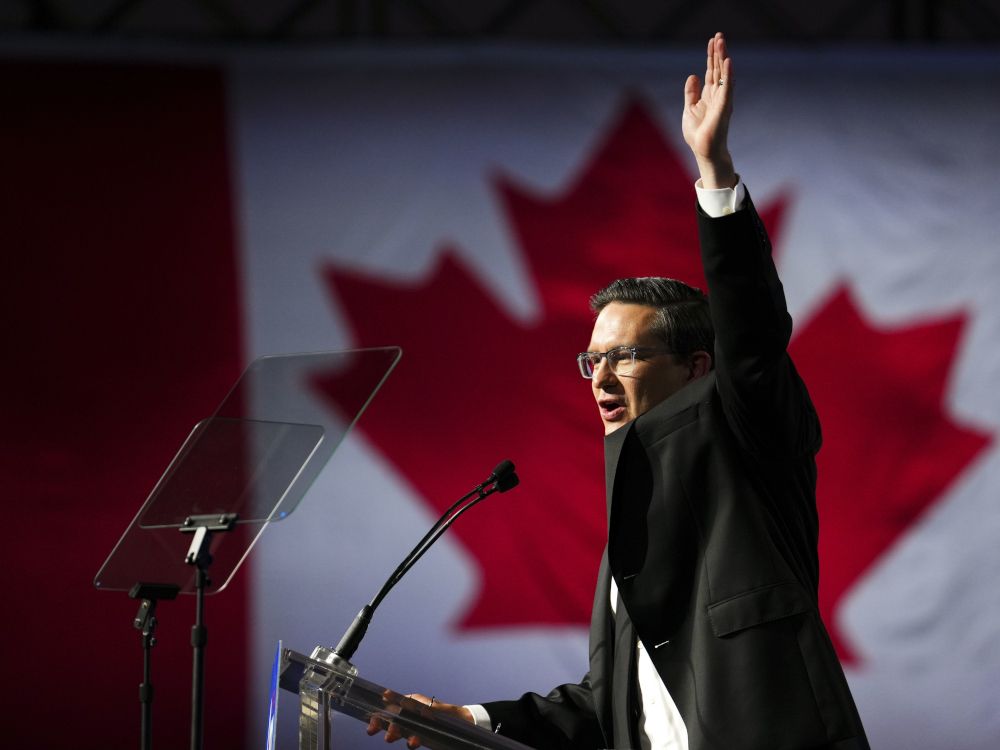
Conservative Leader Pierre Poilievre

The topsy-turvy federal election is in the home stretch. Mark Carney’s Liberals are out in front, but Pierre Poilievre and the Conservatives have gradually narrowed the gap. There’s just enough time for the Tories to win, and they have just enough momentum to do it.

Let’s begin by deconstructing the election’s most frequently heard narrative: the most likely scenario on April 28 is a “Liberal majority.” Canada’s talking heads have parroted this assessment so many times, I’ve lost count. In reality, the election seems to be much closer than many pollsters, columnists and political commentators would have you believe.

Considering how volatile the Canadian electorate has been over the past two months, this year’s campaign has been defined by instability. The Conservatives

lost the lead

in the polls they had held for over two years.

Part of their support was always going to dissipate when former prime minister Justin Trudeau announced his long-awaited departure, but the vast majority evaporated due to U.S. President

Donald Trump’s tariffs

. Canadian anger and frustration, combined with the inaccurate belief that Trump and Poilievre were two sides of the same political coin, was a lethal combination.

When Carney became Liberal leader last month, he rode this unplanned political wave with unbridled enthusiasm. The Liberals moved ahead in most polls. A March 13 Ekos poll even suggested their lead was in the double digits.

Yet Carney couldn’t sustain this unexpected shift in momentum. His political inexperience, arrogant demeanour, inflated ego and aloofness have worked to his detriment. His curt responses to reporters raised red flags.

When economist

Trevor Tombe wrote

in the Hub that the “entire fiscal trajectory of the federal government is now pointed in a potentially unsustainable direction” due to Carney’s political platform, the

Liberal leader erupted

in a contemptuous manner and said he was wrong.

Carney has barely proposed an original idea, having

stolen

several Conservative policies (removing the carbon tax, tough-on-crime legislation) and maintaining some Liberal policies (the no new pipelines act). He’s not much different than Trudeau, either.

That’s why some Canadians have started to sour on Carney. Polls released by Liaison Strategies, Mainstreet Research, Nanos Research and YouGov on Tuesday showed the Liberals ahead by between one and 5.6 points. Innovative Research had them

dead even

the following day (38-38 per cent).

Of additional interest,

Ipsos

had the Liberals ahead by three points (41-38 per cent) on April 21, while

EKOS suggested

the Liberal lead was 4.5 points (43.5-39 per cent). The former had the

Liberals ahead

by 12 points on April 6, while the

latter showed

the Liberals with a 13 point lead on April 10.

Of course, the party that wins the popular vote doesn’t necessarily earn the largest number of seats. The Conservatives finished ahead of the Liberals in popular support when Andrew Scheer and Erin O’Toole led them in 2019 and 2021, respectively — and they lost both elections. So how does Poilievre avoid a similar fate?

The Conservatives need to get 40 per cent of the popular vote. They’re either pretty close or have reached this target in most polls. On Wednesday, CBC News’s

Poll Tracker

noted the gap in two battleground provinces, Ontario and British Columbia, are both in single digits and getting more competitive.

A stronger NDP and Bloc Québécois showing would be helpful as well, but isn’t entirely necessary. As

I wrote

in a recent National Post column, the former doesn’t require a significant percentage of the popular vote to be competitive in ridings — and the latter’s momentum in Quebec appears to be growing.

None of this seems to suggest a Liberal majority, but rather a Liberal or Conservative minority government. I believe that’s the most likely scenario.

There’s also the possibility that the polls have been inaccurate since the beginning. “What if the Liberals never really led by like 8 to 12 points and it was just response bias?” Abacus Data CEO

David Coletto suggested

on X on Monday.

Response bias refers to the possibility of inaccurate or false information provided to pollsters. This would help explain why the political needle has shifted all over the map in this election. Time will tell if there’s anything to this.

Whatever the case, Poilievre must stay focused and emphasize several key messages for the remainder of the campaign. Discussing the economy and the financial well-being of Canadians is vitally important for him. Pushing for affordable housing, reduced food costs and lower energy prices will give Canadian families hope for the future.

Consistently using the word “we” instead of “me” for Conservative messaging creates a unified approach to issues and ideas. Pushing for a renewed foreign policy agenda that removes the stench of the Trudeau years would be helpful. Talking about getting tough on crime, drugs and gangs is a must.

The recently released

Conservative platform

— which includes a 15 per cent income tax cut, reduced taxes on new home and a $5,000 top-up for TFSA investments in Canadian companies — must be presented to more undecided voters, as well.

Could Poilievre go from winning to losing to winning the election in two months? We’ll find out shortly.

National Post


Prime Minister of Canada and Liberal Party Leader Mark Carney delivers a speech to supporters during a rally on April 23, 2025 in Surrey, Canada. (Photo by Rich Lam/Getty Images)

Has there ever been a politician who has been worse at telling untruths, mistruths and falsehoods than Liberal Leader Mark Carney? Yes, yes, they all twist facts to suit whatever nonsense they are pushing on a given day, they omit important details that contradict their claims and they imply their opponents are guilty of the most heinous of crimes. But Carney is unique in that he is a virtual fountain of claims and comments that are easily disprovable.

He’s not a typical politician who bends the truth, he breaks it with a frequency and level of comfort that’s rarely seen in Canada.

On Thursday, it was

revealed

that during Carney’s phone call with Donald Trump, the U.S. president did, in fact, bring up his desire to annex Canada and make it the 51st state, contradicting Carney’s claim that Trump “respected Canada’s sovereignty” during the call.

Also this week, Carney

claimed

that it was “a fact,” not merely “an accusation,” that Conservative Leader Pierre Poilievre would use the notwithstanding clause to override abortion rights. Poilievre has, of course, said he would not seek to restrict abortion.

Liberals have long tried to argue that their Conservative opponents wouldn’t protect abortion rights, or stand up for the right to choose, or otherwise imply that Conservatives want to make “The Handmaid’s Tale” a reality. Yet rarely have Liberals made such a pointed and false claim as Carney did — or one that could so easily be shown to be wrong.

It wasn’t enough for him to say he doesn’t trust Poilievre to respect abortion rights, he had to say it is a “fact” that the Conservative leader would use the notwithstanding clause to restrict abortion, which is obviously false.

This approach has become something of a habit for the Liberal leader. When running for the party leadership,

he tried to say

he had nothing to do with Brookfield Asset Management’s decision to move its headquarters to New York from Toronto. Carney, who served as Brookfield’s board chair until January, told reporters in February that the “formal decision” was made after he left the company. “I do not have a connection with Brookfield,” he said at the time.

While the move may have officially happened shortly after Carney resigned, he wrote a letter to Brookfield’s shareholders on Dec. 1, encouraging them to support the move, and noted that the board, of which he was the chair, endorsed the decision.

Also when running for the leadership, Carney claimed to have resigned from all his roles before throwing his hat into the race,

even stating on Jan. 16,

“Just to be clear: I resigned all my roles, cut all my ties. I am all in.”

However, this also proved to be untrue. According to

reporting by National Post’s Ottawa bureau,

as of Feb. 28, Carney still had connections to at least five organizations, including as president of Chatham House, a British charity that claims to help “governments and societies build a sustainably secure, prosperous and just world,” as a board member of the Peterson Institute for International Economics and as chair of the Group of Thirty, an international non-profit, among others.

These are just some of the blatant lies told by Carney, but he has also committed an impressive list of gaffes and exaggerations about his past.

There is the now iconic exchange between Carney and the CBC’s Rosemary Barton, when she asked about potential conflicts of interest that could arise from the assets he may still hold in Brookfield. Carney responded, “Look inside yourself Rosemarie, you start from a position of conflict and ill will.” He then reiterated that he was following the ethics rules as laid out by Parliament, and accused Barton of trying to “invent” new ones.

Of course, the next day, Carney

admitted

that there is, indeed, a potential conflict of interest between the assets he holds and his role as prime minister.

When Carney was

heckled

at a Calgary event about the false claim that a “genocide” is taking place in Gaza, he said, “I’m aware,” only to later claim he didn’t properly hear the heckler. During the French Liberal leadership debate, Carney similarly said that he agrees “with” the terrorist group Hamas, but later claimed he intended to say

that he agreed “with no Hamas.”

He was also caught telling western audiences that he supported pipelines, while appearing to tell Quebec audiences

the opposite,

that he would “never impose (a pipeline) on Quebec.”

In another time, any number of these gaffes and lies would at least have dented a politician’s popularity, if not ended his career altogether. But in this day and age, where reality is a matter of politics, Carney is getting a pass, riding on the myth of his presumably impressive pre-politics career, but even here the truth isn’t what it seems.

During the English Liberal leadership debate, Carney

said,

“It was my privilege to work with Paul Martin when he balanced the books — and kept the books balanced,” a statement that is, at best, highly misleading. Martin balanced the budget as finance minister in 1998, and Carney didn’t join the finance department as a senior bureaucrat until 2004. Yes, that was when Martin was prime minister, but it was long past the time when he balanced the budget, and the finance department would have reported to the finance minister of the time, Ralph Goodale, not the prime minister.

Carney is most happy to let people believe that as governor of the Bank of Canada, he helped steer the country through the 2008 financial crisis, when in fact, the crisis barely touched this country

thanks to a long history of aggressive bank regulation

(some might say overly aggressive). He lowered interest rates, but so did every other central banker in the western world.

The Liberal leader’s aversion to the truth is so blatant, it is almost refreshing. A more experienced politician would spin. Carney does exactly what he wants to do, and that doesn’t involve telling the truth.

National Post