LP_468x60
on-the-record-468x60-white

By Derek H. Burney and Raymond Chrétien

With the election now behind us, Canada needs to confront tactfully the Trump tariff barrage and move swiftly to rectify, with bold policy reforms, the dismal decade of drift that has delivered chronically low economic growth and productivity performances. While Donald Trump’s tariff mania is causing huge uncertainty and confusion around the globe, and particularly for Canada, the unprecedented surge of national pride and unity across the country suggests that Canada is ready for serious change. Self-reliance is the new watchword. Complacency is not. We must confront the new reality of Trump’s world with action to safeguard our economic and national security interests, and by expanding our prospects for both with like-minded allies and real friends.

Here is a core agenda for the new government:

1)

Our economic growth policy framework on taxes, regulations, investment initiatives and project approval processes must be revamped to build a more competitive Canada, especially vis-à-vis the United States. The focus of tax reform should be more effective corporate and capital gains tax rates to attract business investment. The needs of small and medium-sized businesses should receive a higher priority.

2)

Remove all impediments to the development of our huge energy and natural resource products and expedite permitting of facilities to support exports to receptive markets for oil and LNG in Europe and Asia. Empower our natural resource sector in a similar manner to exploit Canada’s strengths in raw and rare earth minerals. Development of the “Ring of Fire” in northern Ontario and its rich deposits of cobalt, nickel, copper, platinum and chromite has been stalled for decades by endless, often duplicative studies. Rare earth minerals are locked in by similarly negative regulatory processes that take 15 years or more to gain approval. Invite Indigenous communities to take a stake as investment partners in natural resource extraction instead of spending tax money in courts squabbling endlessly and unproductively over jurisdiction.

3)

Liberate the oligopolistic domination of key economic sectors like banking, telecommunications and transport to bolster real competitiveness in Canada.

4)

Task the premiers to remove all internal trade barriers within six months or face reductions in federal grants. After more than 20 years of talk, it is time to deliver.

Urge the provinces as well to modify educational institutions and give more emphasis to talents we need in science and technology for the age of artificial intelligence. Ensure teaching of fact-based history that relates, in a balanced fashion, the extraordinary success of the Canadian experience recognizing that the heavy influx of new Canadians should know and respect what those who have preceded them have achieved.

5)

Restructure our health-care system, which may be universal but has sadly become universally deplorable on availability. The problem is structural, not monetary. Allow a portion of private care to complement the public system, enabling an element of competition to improve overall quality while preserving core elements of service. Encourage the provinces to accelerate accreditation of foreign-trained medical practitioners to rectify current shortages of doctors and nurses.

6)

Overhaul our immigration system and give top priority to merit. Provide incentives to attract medical talent and STEM graduates for the modern economy. Balance the overall numbers more judiciously against housing, health and education capabilities.

7)

As two former Ambassadors to the U.S., we recognize that the relationship will never be the same. Mutual trust and respect — the essence of co-operation — have been vaporized by Trump’s tariffs and his hostile threats to annex Canada. He relishes dominating the news cycle with impulsive, erratic tweets and is egged on by a chorus of compliant cabinet cheerleaders, but non-MAGA America is, we suspect, becoming exhausted by the pace, the confusion and the incessant combativeness of Trump’s style.

We can negotiate tactfully new terms on economic affairs and security even though any agreement may not be honoured by the current president, who has completely violated the terms of the CUSMA as well as the basic principles guiding the WTO and threatens the continued viability of NATO.

As a

report

by the Expert Group on Canada–US Relations observed, the U.S. has been transformed “from the guarantor of stability and the rule of law into a threat to be mitigated.” We should not rush into any negotiation until there is greater clarity and less confusion about the political climate in Washington. It would be prudent to first test the climate for diplomatic solutions if and as the political mood in America begins to sour on the president’s performance.

We should use the leverage of our substantial resources that America needs — uranium, oil, aluminum, potash, water, etc. — to our advantage and induce made-in-Canada products where feasible.

8)

Refocus our foreign policy more generally and align resources and activities more closely with real Canadian interests. There is no viable alternative to the dominant focus on the U.S., but we should intensify relations with the EU, Japan, South Korea, Singapore and all our TPP partners. Damaged relations with India and China should be repaired in a realistic, mutually beneficial manner.

9)

Double the size and expenditures for our military in three years. This could be partially paid for by a sharp reduction in the size of our bloated public service, notably the senior echelon. That would give us real capacity to serve our own security interests, notably in the Arctic. We can no longer be a “free rider” on our own defence — the ultimate example of chronic complacency.

10)

Reform our intelligence and police forces to better address domestic and global threats. According to a Parliamentary committee report in November 2023, the RCMP is stretched thinly across multiple tasks and

not adequately trained

for modern crimes like money-laundering — related primarily to drug trafficking — terrorism and espionage. Ensure, too, that our courts are better equipped to adjudicate these challenges.

The newly elected government certainly has the capacity for bold policy initiatives. The question is: does it have the will, the leadership and the stamina to deliver?

Derek H. Burney and Raymond Chrétien were career diplomats for Canada, each of whom served as Ambassador to the U.S. from 1989-1993 and 1994-2000 respectively.


Tourists visit the former U.S. embassy in Tehran on April 19.

The United States has once again engaged in negotiations with Iran, chasing the elusive goal of turning the Islamic Republic into a peaceful, terror-free and nuclear-free state. This has left the world wondering: “Haven’t we seen this movie before?” The talks are going on now and no one knows how and when they will end. U.S. President Donald Trump, however, said last week that he would prefer to negotiate rather than resort to military action.

Instead of getting into discussions about what level of uranium enrichment is sufficient for Iran’s nuclear program, the United States and its allies must ask this simple question: what goal are they trying to achieve? Is it Iran’s uranium enrichment that is a matter of supreme concern for the world and a threat to the region, or is it the regime’s ideology and quest to control the region through terror that is a matter of concern?

If the goal is to drop the country’s nuclear enrichment by a few percentage points, then the likelihood is that these negotiations will be successful and will give the Trump administration a perceived win to dangle in front of its base. But if the goal is to make Iran a normal country again, that will not happen until its Islamist rulers are thrown out.

If the peaceniks still have doubts, we would recommend reading Wendy Sherman’s book, “Not for the Faint of the Heart.” Sherman was deputy secretary of state under U.S. President Barack Obama and chief negotiator in talks that led to the 2015 Iranian nuclear deal. Her memoir proves, if any proof is needed, that the Iranian regime almost always comes to the negotiating table to weather the gathering storm, biding its time so it can gain a stronger position in the future.

Consider this: if Iran’s mullahs agree to all the conditions laid out by Trump negotiators regarding enrichment levels, will it lead to peace and security in the region? In all likelihood, it would just serve to pause the chaos in the Middle East for a period of time — until the regime recuperates. The point is that unless the Iranian regime in removed from power, the threat posed by Iran will continue to loom.

Not long ago, Iran was a normal state. Not a Westminster democracy, a monarchy alright, but a modern, progressive country with impressive economic indicators. The problem started when it was captured by the clergy and turned into a theocracy. Their regressive ideology gave birth to repression and coercion that characterizes the country today. Unless this problem is dealt with, peace in the Middle East will be as elusive as ever.

Peace will only be realized once the Iranian people rise up and get rid of the current theocratic order. Fresh young leaders of Iran could then be counted on to take their country away from this abyss of violence and regression. At that point, the U.S. would have real partners at the negotiating table.

This sounds idealistic, but until it happens, any peace negotiations would only serve to buy time for this oppressive regime. That time will certainly be used to build more weapons and arm proxies to project its regional hegemony. If the ideal solution is not available, it doesn’t mean you pick a bad option. Do it right or leave it till you can.

National Post

Raheel Raza and Mohammad Rizwan are directors of the Council of Muslims Against Antisemitism.


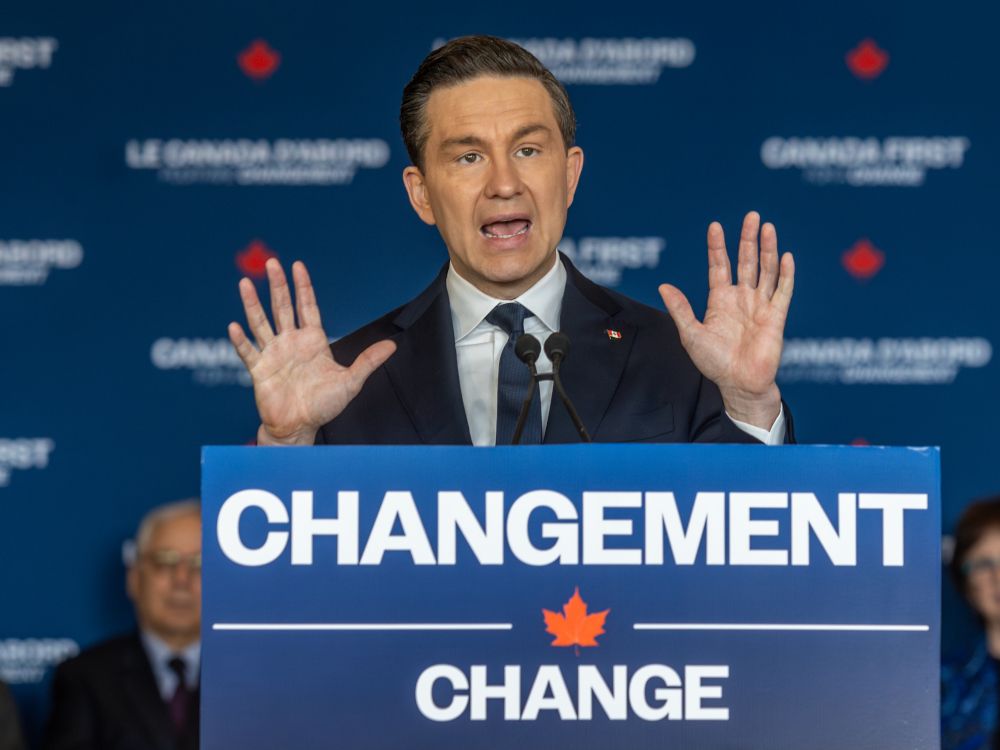
Conservative Party Leader Pierre Poilievre speaks to supporters alongside his wife Anaida Poilievre after losing the federal election, in Ottawa on April 29, 2025.

OTTAWA — The air was sucked out of the bizarrely freezing-cold Canada Room at the Rogers Convention Centre in downtown Ottawa at 10:07 p.m. local time, when CTV News made its call for a Liberal government. A relatively rowdy crowd near the stage, surrounded by photographers and cameras, had been leading chants of “bring it home!” as positive Conservative results trickled in from Atlantic Canada. Things quickly ran out of steam once results started coming in from Quebec and Ontario.

The last “bring it home” with a Conservative majority government still on the table came from one lonely woman trying and failing to get the crowd riled up, even as most slumped further and further into their chairs. (Picture that one superfan who constantly tries to get the wave going at a baseball game.)

By 10:30 p.m., the crowd wasn’t even applauding ridings being called for the Conservatives — though Mark Carney’s win in Nepean did get a healthy round of boos. At least one person was in tears. Another buried her face in a Canadian flag.

Things perked up briefly later, when Tories started looking on the bright side: At time of this writing, the Conservatives are elected or leading in 41 more seats than they won in 2021; nationwide, considerably more Canadians in raw numbers and as a percentage voted Conservative — 42 per cent, the best score since Brian Mulroney’s victories in the ’80s, and with voters younger than ever to boot.

Around 1 a.m., Poilievre took the stage with his wife Anaida to a rapturous reception — albeit from a much diminished crowd — and confirmed he doesn’t plan to step down as leader. “The promise that was made to me and to all of you is that anybody from anywhere could achieve anything — that through hard work you could get a great life, you could have a nice affordable home on a safe street.

“My purpose is and will continue to be to restore that promise,” he said to cheers.

Of course, none of this was remotely the Conservatives’ goal. This year’s election was supposed to deliver them a whopping majority, and it’s certainly not that. Moreover, as he spoke, Poilievre was in serious danger of losing his own riding of Carleton — trailing Liberal rival Bruce Fanjoy 51 per cent to 45.5 per cent, with two-thirds of polls reporting.

Inevitably, now comes the airing of grievances. In fact the airing started weeks ago, led by the Tories at Queen’s Park — especially Premier Doug Ford and his campaign manager Kory Teneycke, both of whom savaged the federal campaign led by Jenni Byrne — but also

by various disgruntled candidates

who put in work during nomination contests

only to be gazumped by the central campaign.

Just over three months ago, after then prime minister Justin Trudeau finally packed up his socks, the Conservatives had

a whopping 25-point lead, according to 338Canada’s rolling average of opinion polls

. Certain columnists (ahem) prefaced remarks about Poilievre’s chances with phrases like “unless something almost inconceivable happens” — even pundits (ahem) who had factored in the possibility of Donald Trump retaking the White House. And now: Wallop.

“What the hell happened?” has been a live question for weeks already. Allegations of campaign malpractice aside, in hindsight, it doesn’t seem super-complicated.

As Abacus Data reported a few months into Poilievre’s leadership

, he was much more of a known quantity among Canadians than either party leaders Erin O’Toole or Andrew Scheer before him — and much of that baked-in public opinion was negative.

Perhaps Poilievre won some people over with his various rebranding efforts: The contact lenses, the muscle tees, start-and-stop efforts to show a softer side. But his central “Canada is broken” message only seemed to gain credence as time went on.

Millennials and gen-Zers are giving up on home-ownership, and there is no immediate prospect of relief there: In the midst of a universally acknowledged housing crisis,

housing starts in some parts of the country have actually slowed

. Drug-fuelled misery and chaos on city streets — and by no means just big cities — turned public opinion against drug harm-reduction efforts with which most Conservatives have never been comfortable. Then it turned out “safer-supply” opioids were being diverted en masse onto the street, where they were often traded for fentanyl.

A Toronto Police officer advised residents to

leave their car keys by the front door

in plain sights so burglars wouldn’t have to rough them up before stealing their car — which the police might or might not have any interest in trying to track down. Carjackings became a regular news item. When police did make arrests, there was a decent chance the cases would fall apart in court for want of resources — resources as basic as appointing judges! — to ensure a suitably speedy trial.

On that front we’re not just talking about car theft, but about sexual assault cases, gun charges, human trafficking charges. Canada’s justice system, at the very least, is broken. Canadians have heard story after story about flamboyantly recidivist violent criminals offending while out on bail or parole, then being bailed or paroled again, and then reoffending again, over and over and over again. Protesters targeting Jewish neighbourhoods and businesses were

met as often with police assistance

as with pushback.

When

polls found out 70 per cent of Canadians agreed

with Poilievre about the country being busted, despite the horror it caused among the Laurentian Elite class, it suddenly broke into the mainstream.

But then Trump came along … and suddenly there seemed to be a huge rally-‘round-the-flag effect among voters — the same way Canadians rewarded governments during the pandemic for decidedly mixed efforts and results against COVID-19. Suddenly “Canada is broken” was unpatriotic, not the

cri de coeur

it had been. And then the NDP collapsed, and decades of electoral arithmetic suddenly went out the window.

National Post

cselley@postmedia.com

Get more deep-dive National Post political coverage and analysis in your inbox with the Political Hack newsletter, where Ottawa bureau chief Stuart Thomson and political analyst Tasha

Kheiriddin

get at what’s really going on behind the scenes on Parliament Hill every Wednesday and Friday, exclusively for subscribers. Sign up here.


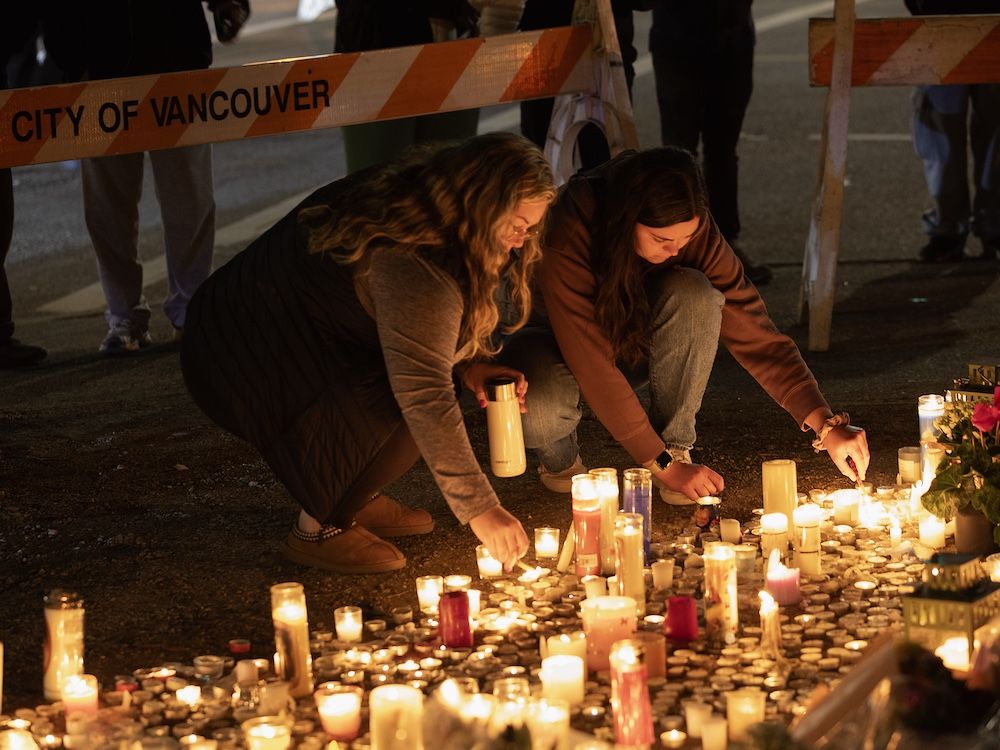
People attend the candlelight vigil near the scene where a car drove into a crowd of people during the Lapu Lapu Festival on April 27, 2025 in Vancouver, Canada.  (Photo by Andrew Chin/Getty Images)

A joyful Filipino street festival ended in carnage Saturday night after a man driving an SUV rammed into a crowd,

killing 11 people

and injuring at least 20 more. The man arrested and charged with eight counts of murder has a history of mental illness. While many factors contributed to this avoidable tragedy, perhaps the greatest of them was Canada’s failure to embrace involuntary treatment and institutionalization.


If the suspect,

Kai-ji Adam Lo, 30, is found not criminally responsible and sentenced to psychiatric care, instead of prison, he will be institutionalized, like he should have been in the first place. In this case, the outcome of our more “compassionate” approach to mental health is disturbing.

The

Lapu Lapu Day festival

was coming to a close when the suspect charged in the attack,

drove recklessly

through the neighbourhood and accelerated into a narrow street that had been reserved for pedestrians and food trucks. According to

witnesses interviewed

by the Vancouver Sun, the accused drove so quickly that many of his victims were flung like bowling pins and had no time to scream. There were bodies everywhere, some twisted grotesquely. The youngest of the deceased was just five years old.


By the time the car stopped, its hood had

disintegrated

from the force of hitting so many people. Although the accused attempted to flee, he was detained by bystanders until his arrest. When they screamed at him, he held his hand to his head and

calmly responded

: “I’m sorry.”


The provincial online court database indicates that Lo had no prior criminal record.


In a subsequent news conference, the Vancouver Police

ruled out terrorism

as a motive and disclosed that they, along with specialized health-care professionals, had had a “significant” number of interactions with Lo due to his poor mental health. The exact number remains unclear, but it appears that there were at least a few dozen.


Global News

later reported

that one such interaction had occurred the day before the attack, and that officials would not disclose further details beyond confirming that it did not warrant a hospital visit. Concerningly, the Vancouver Sun also

reported

that, just hours before the attack, a family member contacted a hospital psychiatric ward out of concern for Lo, as he appeared to be suffering from delusions and paranoia.


It appears that Lo’s unravelling was substantially driven by the sufferings of his family.


After his older brother was murdered in January 2024, Lo launched a

fundraising page

to cover the associated funeral costs, ultimately receiving more than $9,000 in donations. He wrote that he was “burdened with remorse” for not spending more time with his brother, whose death had left his mother with “an indescribable sorrow.” He further noted that his mother was “financially strained” after taking out “significant loans” to build his brother “a modest tiny home” that had involved “painful encounters with builders.”


Then, in August, Lo set up another

fundraising page for his mother

after she attempted suicide and was hospitalized for a month. He wrote that she tried to take her own life because of her grief over her son, and because a long period of unemployment had left her “struggling immensely with her finances” and “on the verge of losing her home.”


“The day I found her unconscious, I feared I had lost the only family member I have left,” he wrote. “I cannot stand to see her suffer anymore, and there’s nothing I can do to help her.”


He claimed that she told him that she would rather die than give up her home, and that he worried that she would attempt suicide again if she could not pay her bills. Yet, this fundraiser only secured $175 in donations. As they lived together, it appears that he may have been on the verge of losing his housing, too.


Several of Lo’s neighbours confirmed to

The Globe and Mail

that the suicide attempt and prolonged hospitalization occurred, and that Lo often yelled at his mother and showed signs of anxiety. A notice of claim filed in a provincial court also indicates that the family owned a $213,000 laneway home, which they now rent out, that had a list of alleged defects.


More details of Lo’s life will undoubtedly emerge over the next few months, but it is already clear that he was a profoundly sick man who should have been segregated from society before his breakdown reached its macabre climax. And yet he wasn’t. Why?


The root cause here is the dismantlement of Canada’s large psychiatric hospitals —  a process popularly known as “

deinstitutionalization

.” These asylums were shuttered, especially in the 1980s and 1990s, under the belief that their conditions were inhumane and that patients would benefit from living in regular communities while receiving outpatient support.


While not unreasonable in theory, Canadian deinstitutionalization

abjectly failed

because the mental health services that were supposed to replace these shuttered asylums were never adequately funded. Oftentimes, discharged patients were abandoned without adequate shelter or care, and ended up homeless or imprisoned.


Because of this movement and its philosophical baggage, we now have a status quo where, although involuntary care is still available, our capacity to provide it is limited. We have a status quo where this care is

frowned upon

as a violation of civil rights, and where its use is dominated by crisis management, rather than proactive healing. Under this system, people like Lo do not get help until it is

too late

.


Dr. Julian Somers, a clinical psychologist and distinguished professor at Simon Fraser University, argues that the federal government bears some responsibility here, as “there are really no good reasons not to change, other than a lapse of leadership and an unwillingness to alter the status quo.”


National Post


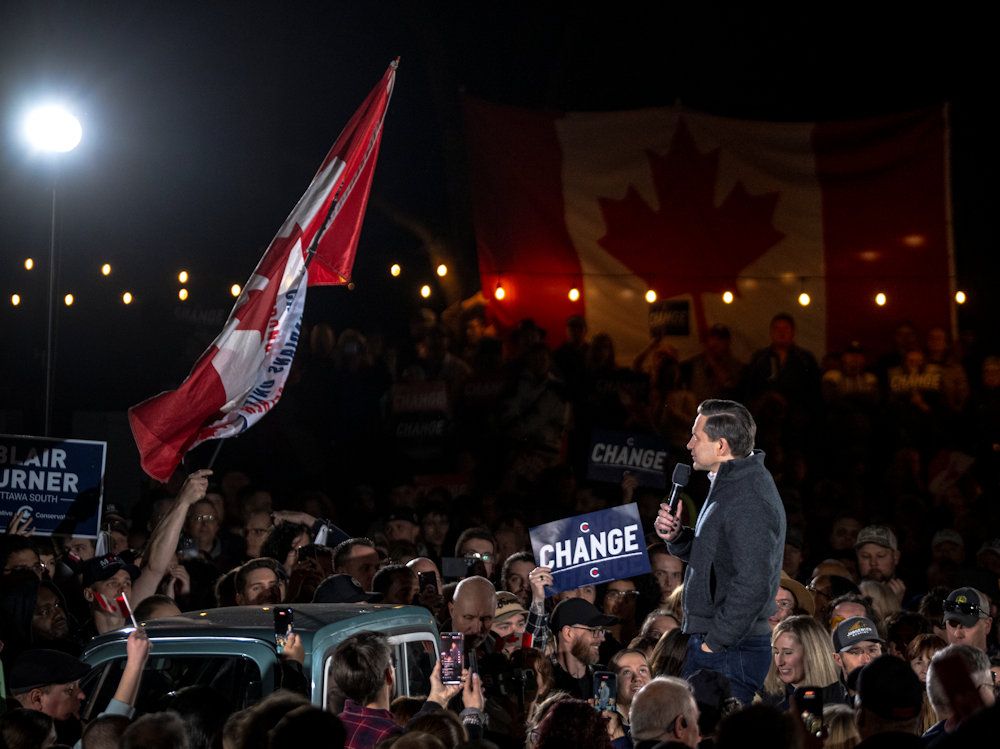
Pierre Poilievre speaks to supporters at a whistle stop event at Stanley's Olde Maple Lane Farm in his riding on April 27, 2025, in Ottawa.

First Reading is a Canadian politics newsletter that throughout the 2025 election will be a daily digest of campaign goings-on, all curated by the National Post’s own Tristin Hopper. To get an early version sent directly to your inbox, sign up here.

TOP STORY

Every single available indicator has the April 28 election going for the Liberals. Every poll aggregator is projecting Liberal victory. Every betting market is favouring Conservative defeat. Financial markets are already pricing in another Liberal term.

The Conservatives’ chance of victory is not high, but it’s also not zero. And if there’s ever been a Canadian federal election that was more likely to yield a surprise outcome, it’s this one. Below, a cursory summary of how this election could still go for the Tories.

Youth turnout breaks records

It wasn’t a sure thing in 2015 that Justin Trudeau was going to win a majority. For much of that election, polls showed a toss-up between the NDP, the Conservatives and the Liberals. What changed on election day was voter turnout: Non-voters, and particularly young non-voters, showed up for Trudeau in outsized numbers. The voter turnout in 2015 came to 68.3 per cent; the highest since 1993.

The singular reason that Trudeau was never able to replicate his 2015 victory in subsequent elections is that this kind of turnout never happened again. As per the stats, thousands of voters who cast a ballot for Trudeau in 2015 simply didn’t bother in 2019 and 2021.

So if election day yields a surprise outcome, it will likely be due to a bizarro version of 2015, in which youth again show up in outsized numbers, but this time to vote Conservative.

There’s no question that the Conservatives are doing well among young voters: The under-30 cohort has consistently been the strongest single age demographic for the Tories. All that cohort has to do to upend expectations on election day is to vote at the same rate as seniors.

The polls are slightly wrong

Canadian pollsters are doing their best, and they’re usually pretty good at this. Leger, the official pollster for Postmedia, called the 2021 election almost perfectly. Their last pre-election poll in 2021 had the Conservatives at 33 per cent and the Liberals at 32 per cent, as compared to the actual results of 33.7 per cent and 32.6 per cent, respectively.

But the polls are sometimes wrong. The 2013 B.C. election was so favoured to the NDP that the incumbent B.C. Liberals had almost nobody at their headquarters on election night since they assumed they were going to lose. Instead, they won a comfortable majority. As recently as October, polls in the Saskatchewan provincial election were off by nine points.

And if there was ever a federal election that would be difficult to forecast, it’s this one. As mentioned, youth are the most important variable in this election, and youth are notoriously difficult to survey accurately, if only because they’re more likely to ignore robocalls or text messages from polling firms.

The Conservatives are also leading a more populist campaign than any in their history. And populist campaigns can be hard to track as they often upend prior demographic expectations, and pull in outsized rates of non-voters.

This was most dramatically represented with the 2016 and 2024 elections of U.S. President Donald Trump. Both times, polls underestimated the extent of Trump’s support, and both times it was due in part to the fact that Trump was able to inspire outsized rates of turnout, often in unexpected categories.

And the polls for the 2025 election only need to be wrong in a few specific areas to upend projections: If they’re off by just a few points in Atlantic Canada or the Greater Toronto Area, a projected Liberal minority could very quickly become a projected Conservative minority.

Progressives abandon the Liberals at the last minute

The Liberals are leading the Conservatives by as much as five points going into election day, but their support has always been much more tenuous. The Conservative vote has been locked in at around 40 per cent for more than a year at this point, and polls consistently show that Tory voters are the most committed and motivated voter demographic.

The Liberals, meanwhile, were recently facing electoral extinction. Only a week before Christmas they charted an all-time low of 16 per cent voter support.

With the Liberals now polling in the mid-40s, this means that as much as two thirds of their support base is voters who were fully prepared to kick them to the curb only four months ago.

Thus, only a relatively small share of these last-minute Liberals would need to have second thoughts on election day for the lead to evaporate.

In Quebec, at least, a version of this is underway. At the beginning of April there were projections showing that the Bloc Quebecois would be lucky to get 10 seats. Now, they’re poised to take at least 25 seats.

The Conservative vote becomes more efficient

The Conservative Party actually won the popular vote in both 2019 and 2021. In the last election, the Tories received 5,747,410 votes to the Liberals’ 5,556,629 votes, but they didn’t form government because their vote was “inefficient.”

The Conservative vote was disproportionately consolidated in safe seats: 13 Conservative ridings in 2021 were won by margins of more than 70 per cent. Liberals, meanwhile, were uniquely able to capitalize on ridings where the vote was split in multiple directions. Trudeau cabinet minister Pascale St-Onge, for instance, won her Quebec riding of Brome–Missisquoi with just 35.1 per cent of the vote; the other 64.9 per cent of ballots being mostly split among the Bloc Québécois, the NDP and the Tories.

What could happen in 2025 is that Liberal support disproportionately surges in places where it’s not going to have any effect. A good example would be Conservative Leader Pierre Poilievre’s home riding of Carleton, which he is still favoured to win despite a reported increase in Liberal sentiments.

The B.C. provincial election in October is a model of how a Tory vote could become more efficient. The B.C. Conservatives turned 43.28 per cent of the vote into 44 seats. In the prior election, their predecessor, the B.C. Liberals, had turned 33.77 per cent of the vote into just 28 seats.

What the B.C. Conservatives had been able to do was to gain support in new areas, at the expense of support in “safe” ridings that they were going to win anyway.

Get all of these insights and more into your inbox by signing up for the First Reading newsletter here.


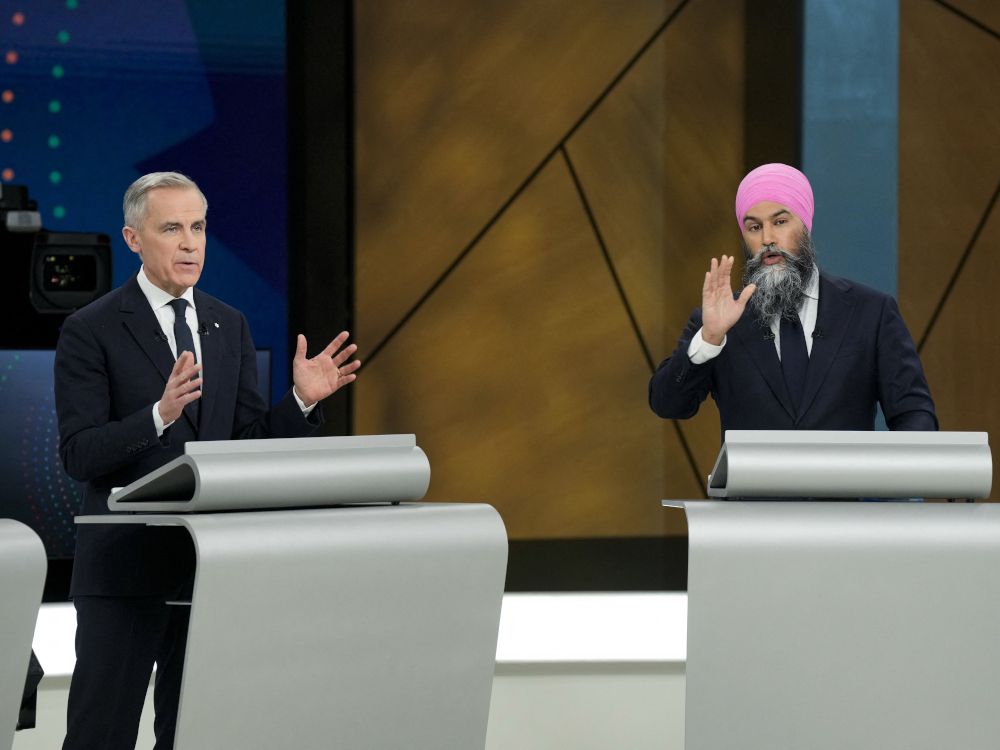
Liberal Leader Mark Carney, left, and NDP Leader Jagmeet Singh speak during the English federal leaders debate in Montreal, on April 17.

As the sprint of the shortest election period allowed under Canadian law nears the finish line, one aspect of the campaign that has stood out is the central role that international law has played in political messaging. The unsubstantiated claim that Israel is committing genocide while fighting against Hamas has surfaced several times.

During the French-language leaders debate last week, for example, NDP Leader

Jagmeet Singh asked

Liberal Leader Mark Carney, “Why don’t you call it what it is? It’s a genocide.” Carney responded that he prefers not to use the word “genocide” in a manner that will “politicize” the situation in Gaza.

The next evening, during the English-language debate,

Singh criticized Carney

for not acknowledging that “what’s going on in Gaza has now clearly become a genocide.”

This time, Carney did not directly address the genocide claim. Instead, he

stuck to

the

Liberal platform

of calling for an immediate ceasefire, the release of all hostages, more humanitarian aid for civilians in Gaza and a lasting two-state solution.

Earlier in the month, during a Carney campaign rally, an attendee

shouted

, “There’s a genocide happening in Palestine.” Rather than confronting the assertion, Carney responded, “I’m aware, which is why we have an arms embargo.” When asked later by a reporter if he concedes there is a genocide in Gaza,

Carney claimed

he “didn’t hear that word” during the rally.

While Carney’s assertion seems rather implausible based on

video

of the exchange, his campaign

did not return

repeated requests to clarify his position on the “genocide” issue following the rally and after

a video

surfaced of Liberal candidate Adam van Koeverden telling a group of constituents that their voices will help “end the genocide in Gaza.”

With the NDP leader stridently insisting Israel is committing genocide and the Liberal leader’s position on the matter unclear, the characterization of Israel’s conflict against Hamas in Gaza has emerged as a central — perhaps even pivotal — issue in the federal election. It is imperative to clarify whether the military campaign against Hamas actually does qualify as one of the worst possible crimes under international law.

In short, no, Israel is not committing genocide. Canada’s political leaders should be clear about this, or they should be held accountable for misleading the electorate.

The crime of genocide is established in the

Genocide Convention

of 1948 and clarified in the

Rome Statute

of 1998, both of which Canada has adopted. It is committed when prohibited acts are carried out “with intent to destroy, in whole or in part, a national, ethnical, racial or religious group.”

Israel’s political leaders have repeatedly affirmed that the strategic objectives of the campaign in Gaza are to destroy Hamas’s military and governing capabilities, thereby ending the enduring security threat posed by the terrorist group, and the return of all the hostages.

Israeli Prime Minister Benjamin Netanyahu

reiterated this message

earlier this month, and these remain consistent with the

goals

announced in October 2023, during the early stages of the ground offensive in Gaza.

Seeking to destroy a transnational terrorist group that promises a repeat of the October 7 massacre is not genocide — it’s war.

A significant number of civilian casualties are, unfortunately, predictable given that Hamas deliberately hides and fights among the civilian population. But harm to civilians that is incidental to attacks in pursuit of the destruction of a terrorist group during armed conflict does not constitute genocide.

To date, Turkey is the only NATO member that has

officially concluded

that Israel is committing genocide. Some activist groups, such as

Human Rights Watch

and

Amnesty International

, have also characterized Israel’s conduct as genocide.

However, these assertions are based almost entirely on comments from various Israeli political leaders that were taken out of context, coupled with observed effects of the conflict that can be consistent with the intent to destroy Hamas rather than the population of Gaza.

When it comes to

the genocide case

initiated by South Africa at the International Court of Justice (ICJ), it is

commonly suggested

that the court’s

provisional measures

concluded

that Israel’s conduct in Gaza amounts to a “

plausible genocide

.” However, this is an

incorrect interpretation

of the

purpose

of ICJ provisional measures.

Israel is not committing genocide in Gaza. When Canadians head to the polls, they should consider each party’s record on countering this pernicious disinformation directed against Canada’s closest ally in the Middle East.

National Post

Twitter.com/BrianCox_RLTW

Brian L. Cox is an adjunct professor of law at Cornell Law School, a retired U.S. army judge advocate, a journalism graduate student at Carleton University and a contributor to the Macdonald-Laurier Institute in Ottawa.


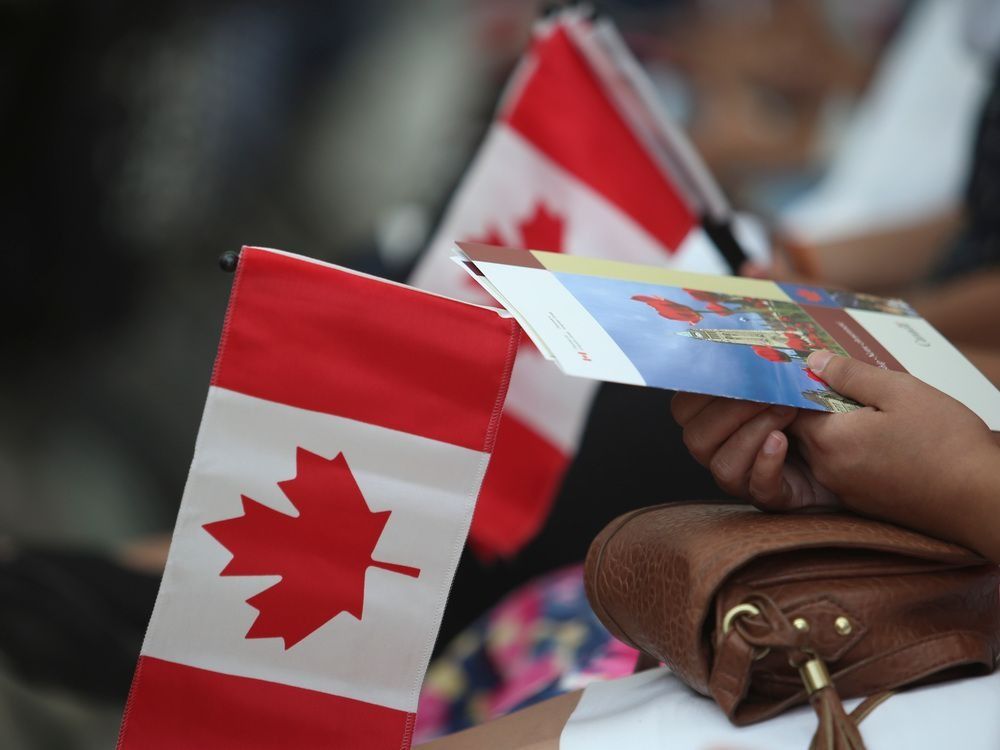
People hold Canadian flags at an immigration ceremony in Toronto.

It’s good that Liberal Leader Mark Carney at least understands his party’s role in overpopulating Canada faster than it can grow capacity, but it’s a problem that he doesn’t have a plan to wind it up.

That’s one big reason a Carney win on Monday would prove disastrous to Canada’s youth: the immigration excesses will continue, and with it, the affordability squeeze. This is only a recent problem: population growth reached an average of 320,000 people per year from 2001 to 2015 — but doubled to an average of 612,000 from 2016 to 2023. In turn, Canada’s longtime receptive attitude towards immigration has

cooled

; people have lost faith in a system that was once revered for welcoming only the world’s best and brightest.

In his campaigns for party leadership and Parliament, Carney hasn’t committed to any across-the-board immigration caps.

He has

committed

to capping temporary workers and international students — the two types of non-permanent residents — to five per cent of the population by 2027, consistent with the

plan

set by former immigration minister Marc Miller last year. But this idea isn’t poised to help us out all that much.

A five-per-cent cap may sound like an improvement, because non-permanent residents reached 7.4 per cent of the population in fall 2024, but it’s still atrociously far away from restoring the status quo. Before 2020, non-permanent residents

never surpassed

three per cent of the population.

Carney is also planning to limit annual permanent resident admissions to one per cent of the population by 2027, which is equivalent to a target of about 400,000 per year. This, too, is consistent with the

targets

set last fall by Miller. However, just like his non-permanent-resident targets, Carney’s goals are, once again, far beyond Harper-era numbers, which

only saw

permanent resident admissions reach 300,000 (these were often lower, in the mid-200,000s).

This is only a partial solution to our crowding problem. Carney’s platform makes no mention of new naturalized citizens or reducing the number of asylum seekers in Canada. All he

commits

to on this front is the “support” for legal aid for refugees and asylum seekers.

The challenges are numerous: Quebec is still being

overwhelmed

at its ports of entry by claimants coming over the United States border, a persistent problem that the Trudeau government never fully resolved. Claims by international students have

grown exponentially

, from less than 2,000 in 2018 to nearly 14,000 in the first nine months of 2024. The majority of claims from allied, not-at-war countries like Mexico and India, between 2018 and last fall, have been approved.

The result? Record numbers. In 2016, a total of just under

24,000

asylum seekers arrived. In 2025, we’ve already surpassed that, at just under

29,000

applicants in the first three months of the year. Where is this headed? Well, in 2024, Canada took in 172,000 asylum seekers, for reference. It seems the word has spread that Canada can hardly ever say “no.”

Most of these sojourners are likely here to stay, and soak up Canada’s extensive benefits —

free first-world health care

(the cost for which has

risen sevenfold

from 2017 to 2024),

free hotel rooms

,

free bonus money

— because our immigration bureaucrats

accept

more than 80 per cent of claims. (Even in 2018, acceptance rates were a more modest 62 per cent). Gaping loopholes have been created to open the door to unfalsifiable claims: the LGBT asylum

guidelines

, for example, don’t require much actual proof, leading to

suspicious claims

.

Carney’s fortunately open to deporting the few whose claims aren’t approved, promising to “Move forward with a credible and fair immigration system that removes failed claimants once due process has been accorded, reinforcing the system’s integrity.” But that should already be the case.

As for removing the small minority of non-citizens who commit crimes in Canada, Carney makes no mention of that, either. This is a platform promise of Conservative Leader Pierre Poilievre, at least.

It should be a more popular priority: at this time, non-citizens can commit crimes, ranging from minor to vile, and can often expect to remain in Canada even with a conviction — and sometimes even

receive

a sentence discount due to their immigration status. Convictions open the door to deportation, but in the lengthy quagmire of immigration tribunals, foreign criminals often remain welcome to stay.

Many of Canada’s problems in the last 10 years can be traced back to over-immigration: housing is

scarce

as more people try to cram into relatively fewer homes, youth employment has

suffered

, and federal supports have been over-extended. Culturally, large influxes can bring about problems, too: foreign conflicts have played out in

riots

and in

synagogue attacks

, and few assimilative pressures have worked to counterbalance the tendency for some communities to form enclaves. It’s a problem that is difficult to acknowledge, let alone solve.

It’s hard to see an end to it all. Not too long ago, the Institute for Canadian Citizenship, a

majority-government-funded

charity (essentially, a pro-government lobby group),

produced

a series of posters depicting immigration skeptics as mentally inhibited troglodytes, with distorted, slack-jawed, idiotic faces.

That about sums up how arrogantly the Liberals have gone about piling newcomers into the country, without concern for the people already here and the positive immigration consensus that was created through strict, high standards. Carney fully intends to keep immigration levels far above Harper-era levels, and we can bet that he’ll expect us to like it — heck, the propaganda campaign to snuff out objections is already underway.

National Post


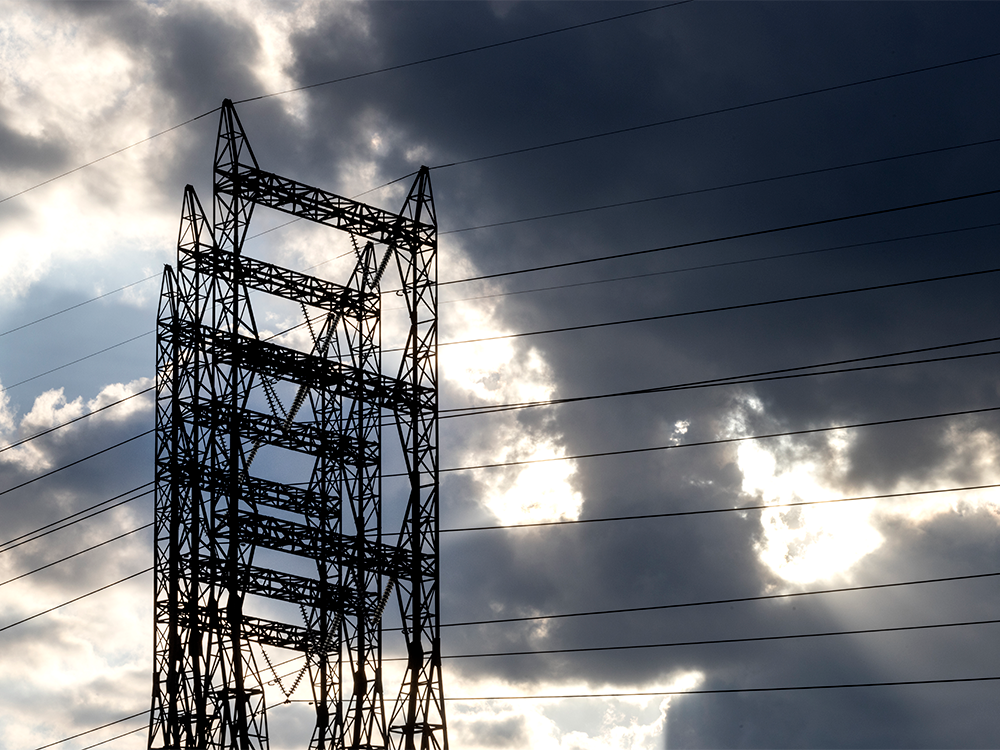
The sun sets behind hydro wires.

The Liberals are selling a new green-energy fiction in their 2025 platform — an East-West electricity grid — that will, no doubt, require them to impose additional disproportionate economic and social costs for a limited decrease in Canada’s contribution to global emissions. This is a problem, given Canada’s “lost decade” of growth and the Liberals’ failure to admit policy mistakes over the last ten years.

Canada’s global carbon emissions were already remarkably low when the Liberals came to power under former prime minister Justin Trudeau. In 2015, Canada’s share of gross global emissions was

1.6 per cent

. Fast-forward to the latest data from 2023 — Canada’s gross emissions have dropped to

1.45 per cent,

which is a measly 0.15 per cent share of global emissions.

And, Canada’s emissions contributions are a pittance compared to

other countries

, particularly China and India, which were at 31.5 and 8.1 per cent respectively in 2023, fuelled by their economic expansion and dependence on coal.

The effect we could have on global emissions was always negligible — considering our contribution to global emissions and the fact that other economies are not beholden to climate targets and grow their economies with fossil fuels. Despite this reality, and the fact that they’ve also burdened Canadians with the consumer carbon tax and all the inflationary costs that went along with it until they recently reduced it to zero (only because, according to them, it was “unpopular” and “divisive”) the Liberals’ new platform suggests an even more expansive version of the dream of net-zero.

This, even though how they’ve managed Canada so far has resulted in a “

lost economic decade”

during which the Liberals massively increased immigration and public spending leading to a larger economy in terms of size, but not wealth, as productivity remained stagnant.

The Liberals seemed to do everything in their power to stifle growth in the natural resources sector. And it looks like Canadians are in for more of the same. Liberal Leader Mark Carney has said he will

not repeal

the Impact Assessment Act, which strangles energy infrastructure projects, or the emissions cap on the oil and gas industry, and has additionally proposed an overly ambitious East-West electricity grid.

According to the party platform, this grid, would “unleash clean growth across the country, connecting more homes and businesses to the power of clean electricity and attracting new investments in resource projects” to “enhance connectivity to low-emissions electricity needed for industry and the broader economy to reach net-zero emissions.”

The party claims the policy provides new opportunities for clean electricity producers, such as

Hydro-Québec

and Manitoba Hydro — but neither appear to be up to the task.

While Hydro-Quebec is a major producer of electricity, it’s a strange thing for the Liberals to suggest it can be part of such a grid when it has its own capacity issues. Its own website makes it clear that “when all the power system’s resources are operating at full capacity, Hydro-Québec buys electricity from its neighbors.”

Anyone who lives in Quebec also knows that

incentives

are often suggested to customers to use less during these periods. One such incentive, the “Winter Credit Option,” encourages customers to curtail their energy use during the coldest time of the year. Winter “peak demand events” may occur 25 to 33 times (100 hours) per year. Customers are told, “the greater effort you make, the more you’ll save,” placing the burden of shouldering an insufficient grid on its customers. In other words, Hydro-Québec is currently struggling to properly service the province’s own customers, nevermind expanding to other provinces.

And this, get-the-customer-to-reduce-their-use communal mindset is

common

in Quebec, whose Energy Minister Pierre Fitzgibbon said in March 2024, “If we can reduce this peak, there will be more power available.” By 2023, demand in Quebec had hit 43,000 megawatts, exceeding its capacity of 38,000. At that time, he noted that Quebec companies could face energy shortages for ten years, if unresolved.

The Montreal Economic Institute concurs. Though once

brimming with surplus energy

, the think tank suggested last summer that Hydro-Québec’s surplus power would run out by

2027

, and that its proposed solutions of “

building or upgrading dams, building wind turbines, and reducing consumption through greater energy efficiency,” are “too little or too late.” While Quebec could stop exporting energy to the U.S., it’s not clear that will actually happen.

More importantly, due to exports and existing infrastructure constraints, neither Hydro-Québec nor Manitoba Hydro, which the Liberal platform also mentions, produce enough electricity for their respective provinces. In terms of end-use energy demand, in 2020, Quebec’s energy came from

a mix of resources

of which electricity is 41 per cent, followed by refined petroleum products at 35 per cent, natural gas at 14 per cent, and 11 per cent biofuels and others. Over the same period, Manitoba received

even less of its energy from electricity

and more from refined petroleum products with 41 per cent coming from refined petroleum, 29 per cent from natural gas, 26 per cent from electricity, and 15 per cent from biofuels. The idea that either of these provinces are in a position to contribute to an East-West electricity grid is a green fiction.

Quebec has been exporting so much energy elsewhere that it’s

experiencing shortfalls

as well as 

unfavourable weather

conditions which have negatively impacted those exports. And sure, Quebec could stop supplying New York State and New England with electricity, but how likely and advisable is that, given that our neighbours to the south will have a new president in four years?

To top it off, the Net-Zero Emissions Accountability Act, brought in by the Liberals in 2021, commits to achieving net-zero by 2050. This is neither feasible nor realistic, even if desirable. Renewable energy generation isn’t yet technologically capable of replacing fossil fuels. Canada can be both prosperous as a mixed energy economy, which develops its natural resources, while focusing on creating incentives for private companies to reduce emissions. This is the way.

National Post

tnewman@postmedia.com

X: @TLNewanMTL


Censorship and free speech. Getty Images

Islamism —

defined

most benignly as “the belief that Islam should influence political systems”— is,

according

to Joe Adam George, the Macdonald-Laurier Institute’s National Security Analyst, the “biggest existential threat to Canada within its borders.” Yet, in the English-language leaders’ election debate, when Bloc Québécois leader François Blanchet dangled the word “Islamism” for discussion, nobody took the bait.

Writing on the subject

in these pages

last year, George observed that, unlike China and Russia, “what makes Islamists such a formidable force to reckon with is their ability to weaponize Islam to silence, punish and deter” their critics. One Islamist group, the politically influential National Council of Canadian Muslims (

NCCM

), is particularly active on this front.

Leaning on the charge of Islamophobia, the NCCM launched a successful campaign to oust human rights lawyer Collin May from his positions as director of the Alberta Human Rights Commission and Tribunal (AHRC) shortly after his May 2022 appointment. Two weeks ago, the Lawfare Project and law firm Zacharias Vickers McCann LLP announced the filing of a

defamation lawsuit

against the NCCM on May’s behalf.

May brought sterling qualifications to his appointment. He had already served three years as a part-time commissioner, had written over 40 published decisions and conducted more than 40 mediation sessions. He has degrees in political philosophy and religion, including the intellectual history of rights. May is the first openly gay man to serve in the role. Nevertheless, he is also philosophically conservative, which stirred complaints amongst progressives that his was a patronage appointment by Alberta’s UCP government.

The campaign to unseat May began in earnest, like so many cancel-culture witch hunts, with a deep dive into May’s publishing history. In early July 2022, a NDP-affiliated blogger, Duncan Kinney (included as a separate defendant in the defamation suit), unearthed a positive 2009

review

by May of the Yale University Press published book,

Islamic Imperialism: A History

, by

Efraim Karsh

, professor and head of Middle East and Mediterranean Studies at King’s College London.

In a

blog post,

Kinney criticized the review, citing an Edmonton Al Rashid Mosque Imam Sadique Pathan who criticized May’s review of the book as  “binary thinking that is very convenient for people who engage in Islamophobia or outright racist views towards Muslims.”

May’s “

rather esoteric

” review had not raised objections at the time, but in July, 2022, Kinney erroneously attributed May’s summation of Karsh’s view of Islam as “one of the most militaristic religions known to man” directly to May, sparking NCCM’s call on the government to rescind the appointment. Premier Jason Kenney

instructed

May to meet and make peace with the NCCM. May met with them, but stopped short of apologizing. The NCCM was not amused. Kenney fired May in September, 2022.

May’s review did not stop him from doing his damnedest to get a HIV-positive gay Muslim out of Jordan and to claim asylum in Canada to save his life. (As May wryly commented to me in an email, perhaps that action could be seen as Islamophobic “because we simply accepted his contention that he was at risk in a Muslim-majority country.”)

In the

press release

, Benjamin Ryberg, Chief Operating Officer of The Lawfare Project, stated that May’s case was crucial “in defending the integrity of public discourse and ensuring that scholarly and intellectual freedom are not undermined by defamatory accusations of Islamophobia designed to intimidate and silence.”

If the lawsuit ends in a trial, the word Islamophobia will therefore be subjected to intense scrutiny, as well it should. When pressed to define it, Islamists are often vague or coy. In a 2009, the Organization of Islamic Cooperation (OIC), an influential bloc of 57 Muslim countries released a

report

on Islamophobia (a trope

invented

by the Muslim Brotherhood in the 1990s) appealing to individual nation-states to enact hate-speech laws with a view to banning “negative stereotyping of Islam” in the West. Its authors contend that Islamophobia is both “discrimination against Muslims” and the “distortion of Islam.”

The report claims it would be “an unfortunate error of judgment in believing that Islam is linked to terror; that it is intolerant of other religious beliefs…that it favours repression of freedom of expression…”  Interesting trope — ”error of judgment” — to my mind alarmingly redolent of Orwell’s “thoughtcrime.” Even in its mildest academic guise as in May’s case, apparently, Islamophobia under the “error” rubric is not a failure of scholarship, so much as poor judgment — a kind of inadmissible rudeness worthy of punishment — in calling attention to the truthful fruits of that scholarship.

One sees the same mindset in the related concept of “Anti-Palestinian racism,” which the

Arab Canadian Lawyers Association

describes

as speech or action that “silences, excludes, stereotypes, defames or dehumanizes Palestinians or their narratives.” “Narratives” — not “history” — is another blasphemy trap. (Some Palestinian “narratives” have been spray-painted on synagogues; others screamed in Jews’ faces on campus. No, thank you.)

This lawsuit will turn on Canadians’ right to express evidence-based opinions on Islam’s texts, history, and political causes without fear of censure, intimidation or wrongful dismissal. Ignored under Justin Trudeau, here is a new Parliament’s wakeup call, one that must be heeded, on Islamism’s escalating threat to intellectual freedom in Canada.

kaybarb@gmail.com

X:

@BarbaraRKay

National Post


Conservative Leader Pierre Poilievre.


Pierre Poilievre’s Conservative party, with the campaign’s momentum and tightening polls, could yet declare victory in the federal election. But the party infighting that started early in the campaign already has some sniffing around a potential leadership change, as the

Political Hack newsletter’s

Tasha Kheiriddin and Stuart Thomson discuss with Brian this week. Our 2025 election panel also gets into the surprises that could come with last-minute voters, the curious advertising blitzes of the two front-runners in the race’s dying days, and Liberal Leader Mark Carney’s exorbitant platform promises and his growing smugness about his standing. They also consider the new, likely power status of the Bloc Québécois, should either party need the separatists to sustain a minority. (Recorded April 25, 2025)