LP_468x60
on-the-record-468x60-white

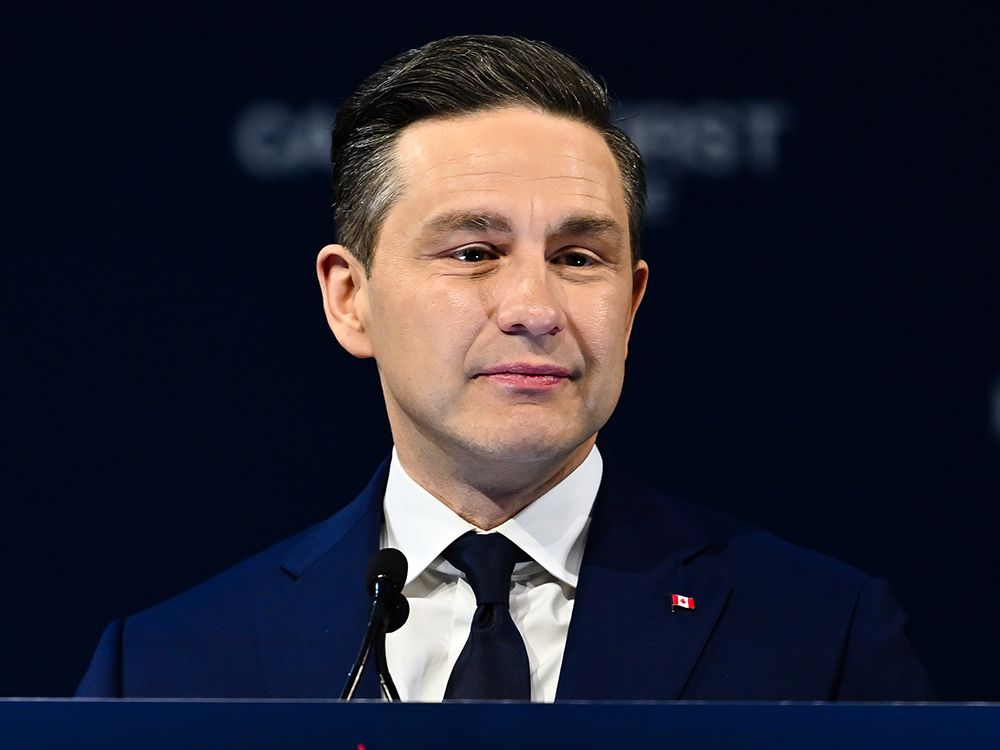
Pierre Poilievre has always been hugely popular among most of the Conservative party base.

Of the many possible scenarios that could have unfolded on Monday evening, not many people seem to have anticipated the one we got: A very impressive Conservative showing, but only good enough for second place, and with party leader Pierre Poilievre

suddenly finding himself without a seat in the House of Commons

.

Considering how confident many Conservatives were, and so recently, that they would vanquish the Liberals, and considering the one-and-done trend in federal politics, one might think Poilievre’s leadership would be in serious trouble. (Stephen Harper was the last Liberal or Tory to stay on having not won an election, and he happened to be the reconstituted party’s

first

leader.)

Instead, even as they ponder campaign missteps, missed opportunities and what they see as basic strategic errors — not focusing enough on the threat of U.S. President Donald Trump, chiefly — many Conservatives seem confident that Poilievre both can and should hold on to the leadership.

“To me it’s a strong enough showing, it’s a precarious enough Parliament, that to toss the leader out … would be cutting off our nose to spite our face,” Conservative strategist Amanda Galbraith told me Monday night. “I actually think there’s a lot here to work with.”

”There’ll be a very strong argument saying we can’t give them a free ride for a year and a half just because we’re having a leadership race and going through internal navel-gazing,” echoed Yaroslav Baran, a veteran government and war-room senior staffer from the Harper era. More prominent public support came from across the Conservative spectrum, from moderates like James Moore and Rona Ambrose to bluer Tories like Jason Kenney and Andrew Scheer.

“(Poilievre’s) inspirational leadership has brought more people into the Conservative movement,”

Scheer wrote on X

. “His continued leadership will ensure we finish the job next time.”

Naturally, not everyone agrees. “He’s divisive. He’s polarizing. He’s so aggressive. And he drove people that would have ordinarily voted for other political parties to the Liberal party,” a Conservative source kvetched to the Toronto Star. “That’s not a winning strategy for us.”

But Poilievre has always been hugely popular among most of the party base. He brought a whole lot more people, most importantly

young

people, into the Conservative fold. Unlike O’Toole before him, who ran for the party leadership as the “true blue” option and then campaigned as a moderate, Poilievre both won the party leadership and campaigned as more or less his true self. And 41.3 per cent of those who turned out to vote — 2.3 million more than in 2021 — went Conservative.

Even without a seat, Poilievre certainly has a compelling case to make for staying. But I can see two potential problems on the horizon.

One is that Parliament might not wind up being quite as precarious as it looks. The Conservatives finished 31 seats shy of a majority in 2006, and 28 seats shy in 2008, and Harper managed to govern just fine. That was without the galvanizing effect of an annexationist madman in the White House.

The Liberals, meanwhile, are just three floor-crossing MPs away from a majority government. (Asked by CBC whether she would consider sitting as a Liberal, re-elected Vancouver New Democrat

Jenny Kwan called it “an interesting thought.”

) Failing that, the Liberals have seven New Democrats, 22 Bloquistes and the Elizabeth May Party (sometimes exaggerated as the “Green party”) to negotiate with on an issue-by-issue basis. The NDP will be preoccupied with its own leadership race for the foreseeable future and, as such, might drive an even softer bargain than Jagmeet Singh did.

The other is that Liberal Leader Mark Carney might not turn out to be a terrible or unpopular prime minister, as some Conservatives seem to be assuming he will. As impressive as those 2.3 million new Conservative votes were, the thoroughly clapped-out Liberals, running a

very

Trudeauvian campaign (minus the carbon tax) pulled in

three million

more than in 2021. The rally-‘round-the-flag effect created by Trump is powerful, in Central Canada at least, and Trump has a

lot

of time left in the White House to keep nervous Canadians rallying.

As I say, authenticity has been one of Poilievre’s strengths. But as impressive as 41.3 per cent of the popular vote is, his authentic personality also clearly turns a lot of people off. One example from the campaign just finished was particularly striking, namely, his tough-on-crime agenda.

On April 13, an Ontario tourist

was repeatedly and savagely attacked along the seawall near Vancouver’s Stanley Park

, allegedly by one Peterhans Jalo Nungu,

who was out on bail for allegedly assaulting a peace officer

. He is now out on bail

again

. It’s objectively outrageous, and it happens over and over and over — in some cases dozens of times with the same alleged offender.

The Conservatives proposed toughening bail conditions for established public menaces and making it significantly harder for them to be released from prison. Perfectly sane. But Poilievre branded it a “three strikes” rule, deliberately invoking the United States, whose penal system is a whole other kind of disaster and not something to which Canada should aspire. And he repeatedly insisted he would ensure the most violent repeat criminals only came out of prison “in a box.”

I know Central Canadian Tories, and potential Tory voters. And I can tell you that kind of rhetoric — rightly or wrongly — makes many of them squirm like beached fish. Is Poilievre capable of toning it down? Does he even want to? Conservatives need to ask themselves that question. Canadians have a remarkable ability to find a reason to vote Liberal.

National Post

cselley@postmedia.com

Get more deep-dive National Post political coverage and analysis in your inbox with the Political Hack newsletter, where Ottawa bureau chief Stuart Thomson and political analyst Tasha

Kheiriddin

get at what’s really going on behind the scenes on Parliament Hill every Wednesday and Friday, exclusively for subscribers. Sign up here.

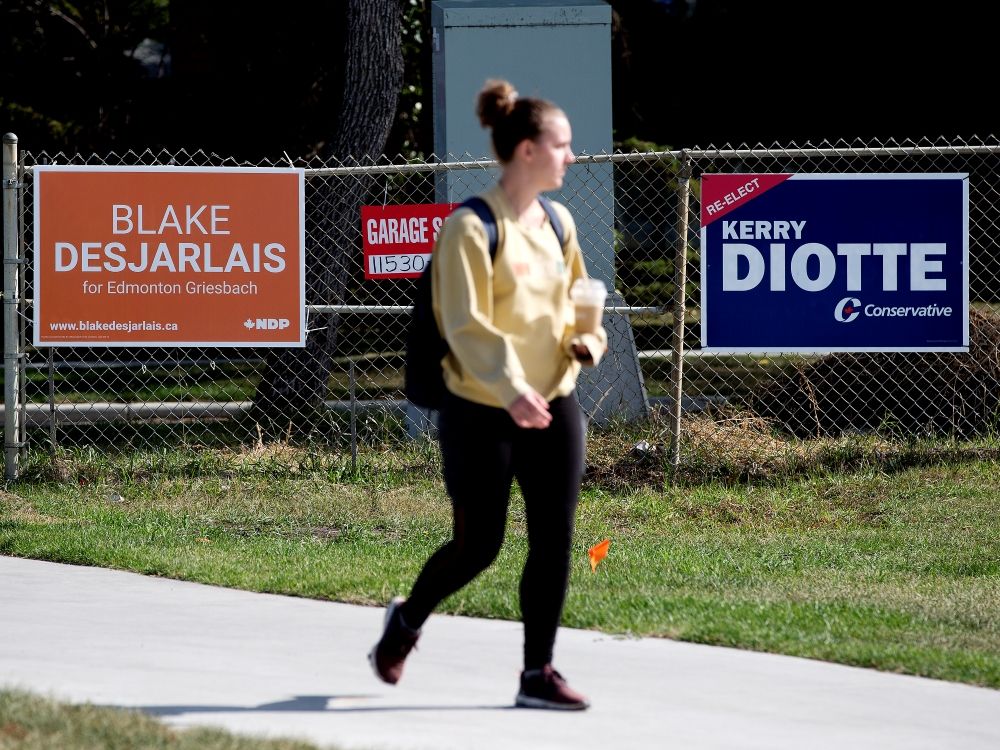
A pedestrian makes their way past signs for Edmonton Griesbach Federal election candidates Blake Desjarlais and Kerry Diotte, near 70 Street and 112 Avenue in Edmonton, Tuesday Sept. 7, 2021.

With the Liberals in for another term, separatist rumblings in Alberta can be expected to deepen. We expected this, but we shouldn’t indulge it. There’s still plenty good to be had here, and even the federal government isn’t a lost cause.

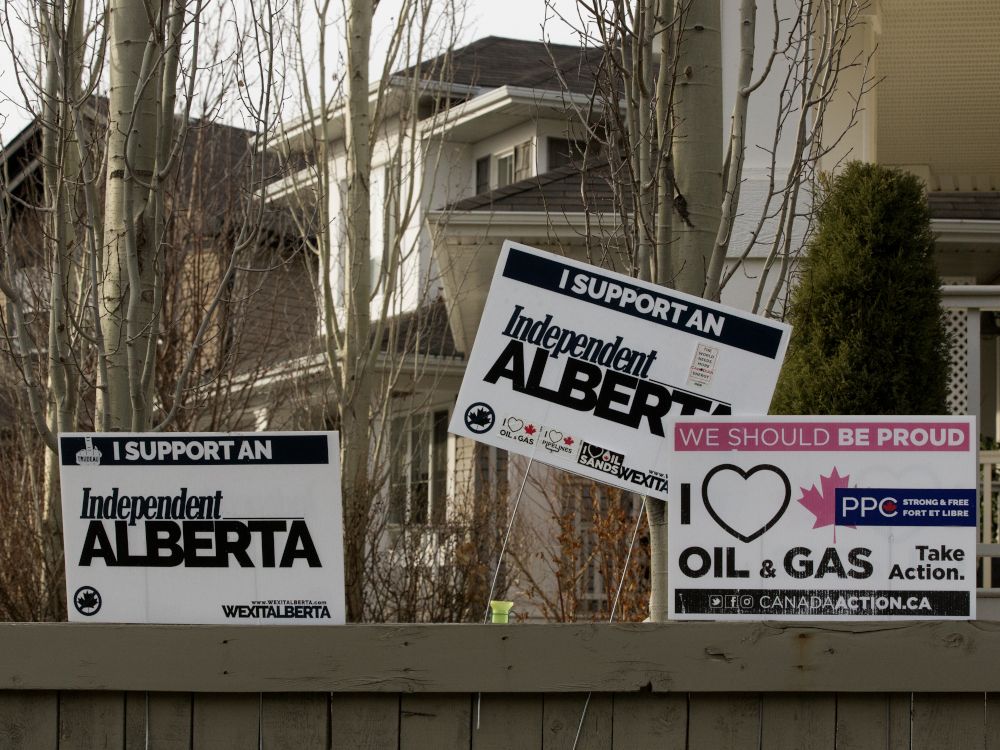
In some cases, the rumblings are coming from the fringes: a Republican Party of Alberta, formerly the Buffalo Party of Alberta, started

doling out

free memberships in the lead-up to what I assume will be an independence campaign.

The Republican Party of Alberta, FYI, is about as serious as the People’s Party of Canada. It has a following online, much less so in reality. It has attempted to demonstrate popularity by claiming to have the support of some MLAs — at least one of which was

surprised

to learn that his name had been slapped onto a project he’d never engaged with.

But the rumblings are also coming, albeit much more softly, from the government. Premier Danielle Smith, on Tuesday,

tabled

an election reform

bill

that increased the odds of success in a “citizen’s initiative” petition, which could theoretically make a separation referendum more likely.

In 2022, Alberta opened the door to citizen petitions that, if successful, would get the petitioned issue into committee for review and possibly bill-crafting, or to the provincial elections officer for a referendum. On constitutional matters, a successful petition must be signed by 20 per cent of the total electors in the province within 60 days — just about impossible. Smith’s bill would lower the threshold to 10 per cent, with the timeframe extended to 120 days — highly unlikely, but less impossible than it was before.

Smith’s legislative adjustments aren’t necessarily a signal of support for separation, but at very least they’re the equivalent of hoisting a middle finger at Prime Minister Mark Carney on Day One. It’s not as direct as, say, pulling the feds back into court over yet another interjurisdictional dispute. But hey, there’s plenty of time for more of that.

From the perspective of those hostile to the Liberals, Alberta, at least, has the makings of a good news story coming out of the 2025 federal election. No prominent, longtime Conservative MPs lost their seats, while both the Liberals and NDP sustained losses. Disaster candidates were averted. Try as he did, Mark Carney didn’t make any real inroads into the province.

The overall differences in result are small: both the NDP and the Liberals went from holding two seats to one. In Edmonton, Blake Desjarlais returned Edmonton-Griesbach to Conservative Kerry Diotte, the riding’s previous Conservative MP (before entering federal politics, Diotte was an Edmonton city councillor and before that, a Sun columnist).

This perhaps signals a change in the zeitgeist. Diotte was ousted from the riding in 2021, back when certain progressive cultural grievances were at their height. The MP had stumbled into a series of minor controversies, such as taking a photo — gasp — with right-wing commentator Faith Goldy, and making a Liberal buzzword question period

bingo card

with — gasp — words like “infrastructure,” “middle class,” “Syrians” and “first nations.” Cringey humour, sure, but these were favoured topics of the Liberals indeed.

Desjarlais was a perfect foil at the time: he was a Métis two-spirit man at the height of identity obsession; this was also around that time that the Canadian news cycle was focusing hard on the acquittal by an all-white jury of Saskatchewan’s Gerald Stanley, a white farmer who had been charged for killing Colton Boushie, an Indigenous man who drove onto Stanley’s farm with friends, and whom Stanley suspected was there to steal. Stanley blamed the death on a gun malfunction, and the jury agreed. The Globe and Mail, in a roundabout way,

drew a vague parallel

between the campaign in Griesbach and the case of Derek Chauvin, the police officer convicted of murdering George Floyd in the United States in 2020.

Well, Diotte’s back. It turned out that in 2025, no one cared about or remembered the controversies — which weren’t even controversies in the eyes of normal people. Political winds had blown away the atmosphere that made Desjarlais an attractive alternative to an older white male Conservative. Desjarlais,

his keffiyeh

and his endless pro-Hamas pandering, are gone.

Elsewhere in Edmonton, the city’s mayor — a former Liberal MP in search of his old seat —

failed

to make it to Parliament. Amarjeet Sohi has championed

neighbourhood renaming

initiatives,

sparred

with the provincial government on homelessness, and has supported tax property tax hikes as high as 8.9 per cent in

2024

and six per cent in

2025

(roughly twice what was

projected

back in 2022). A pro-spending, pro-Liberal social agenda kind of candidate. He at least won’t be in Parliament, though he will be returning to the mayor’s office.

In Calgary McKnight, Liberal George Chahal was ousted, leaving his celebratory “First Ever Re-Elected Calgary Liberal MP!” cake to go uneaten. He was a former city councillor and parliamentary transplant from Calgary Skyview. You may recognize him from the Liberal interregnum: it was Chahal who introduced Mark Carney at his leadership campaign announcement several weeks ago.

You may recognize him from his more shady dealings: Chahal literally tampered with election materials in 2021, removing a flyer of his Conservative opponent from a mailbox on camera — and then

stuffing that mailbox with incorrect information

about polling locations. He paid a $500 fine for his actions. So that’s at least one man of questionable ethics gone. He was replaced in spirit in the Calgary riding with

podcaster

Corey Hogan, who, at very least, was never reported to have gone prospecting in mailboxes.

Albertans were, for the most part, united against the left this election. Now, we just need to refrain from tearing ourselves apart in a quest for/against sovereignty.

National Post


Pro-Alberta independence lawn signs are seen in Edmonton in 2021.

The election of a minority Liberal government on Monday, and the strong showing of the Conservative party under Pierre Poilievre, cannot mask the fact that Canada remains seriously fractured on many fronts. Thus, one of the primary tasks of the Carney government will be to unite us for the sake of our own national well-being — not simply for the sake of presenting a strong front in future dealings with the United States.

But how is that to be done? When parliament meets as scheduled on May 26, will the government’s throne speech acknowledge the main sources of national disunity and propose the immediate adoption of remedial measures? Or will it ignore the problem entirely, which will serve to further alienate Quebec and the West from Ottawa and the rest of Canada, and weaken Canada’s bargaining position vis a vis the United States?

The principal tactic employed by the Liberal party to unite Canadians behind it in the recent election was to employ the politics of fear — fear of U.S. President Donald Trump trying to “break us so that America can own us,” as Liberal Leader Mark Carney has repeatedly said.

But if the only way to unite Canadians is through the promotion of anti-Americanism fostered by fear of some alleged American takeover — if reaction to the erratic musings of an American president is the only way to motivate more Canadians to vote in a federal election — then not only national unity, but Canadian democracy itself, is in critical condition.

We need to pinpoint what actually is fracturing the country, because if we can clearly define that, we can begin the process of removing those divisive elements to the largest extent possible. Carney and the Liberals will of course declare that it is separatist agitations in Quebec and now the West that is dividing us, but these are simply symptoms of the problem, not the cause.

Here, then, is a partial list of what underpins the division and disunity in this country and, more importantly, of some positive, achievable actions we can take to reduce or eliminate them.

First and foremost is the failure to recognize and accommodate the regional character of this country. Canada is the second-largest country by area on the planet and is characterized by huge geographic regions — the Atlantic, Central Canada, the Prairies, the Pacific Coast and the Northern territories.

Each of these regions — not just Quebec — has its own “distinctive” concerns and aspirations, which must be officially recognized and addressed by the federal government if the country is to be truly united. The previous Liberal government consistently failed to do this, particularly with respect to the Prairies, Pacific and Northern regions, which is the root of much of the alienation that even stimulates talk of western separation.

Second is Ottawa’s failure to recognize and treat the natural resources sector as a fundamental building block of our national economy — not as a relic from the past or an environmental liability, as it was regarded by the government of former prime minister Justin Trudeau.

Will the throne speech announce another 180-degree turn for the Liberal government: the explicit recognition that the great engine of the Canadian economy and our economic recovery is not the federal government, as Carney has implied, but Canada’s agricultural, energy, mining, forestry and fishery sectors, with all the processing, servicing, manufacturing and knowledge sectors that are built upon them?

A third issue we’ve been plagued with is the division of Canadian society based on race, gender, sexual preferences and other identity traits, rather than focusing on the things that unite us as a nation, such as the equality of all under the law. Many private-sector entities are beginning to see the folly of pursuing identity initiatives such as diversity, equity and inclusion that divide rather than unite, but will the Liberal government follow suit and will that intention be made crystal clear in the upcoming throne speech?

A final issue is the federal government’s intrusion into areas of provincial jurisdiction — such as natural resources, health, municipal governance, along with property and civil rights — which is the principal cause of tension and conflict between the federal and provincial governments.

The solution is to pass a federal “act respecting provincial jurisdiction” to repeal or amend the statutes that authorize federal intrusions, so as to eliminate, or at least reduce, their intrusiveness. Coincidentally, this would be a legislative measure that both the Conservatives and the Bloc could unite behind if such a statute were to be one of the first pieces of legislation introduced by the Carney government.

Polling is currently being done to ascertain whether the election of yet another Liberal government has increased the growing estrangement of western Canada from Ottawa and the rest of Canada, notwithstanding Carney’s assurances that his minority government will change its policies on climate change, pipelines, immigration, deficit spending and other distinguishing characteristics of the discredited Trudeau government.

The first test of the truthfulness of those assurances will come via the speech from the throne and the follow-up actions of the federal government.

Meanwhile, consultations are being held on the merits and means of organizing a “Canada West Assembly” to provide a democratic forum for the presentation, analysis and debate of the options facing western Canada (not just Alberta) — from acceptance of a fairer and stronger position within the federation based on guarantees from the federal government, to various independence-oriented proposals, with votes to be taken on the various options and recommendations to be made to the affected provincial governments.

Only time will tell whether the newly elected Carney government chooses to address the root causes of national disunity. But whether it does so or not will influence the direction in which the western provinces and the proposed Canada West Assembly will point.

National Post

Preston Manning, a former Alberta MP and federal Opposition leader, founded the Reform Party of Canada.


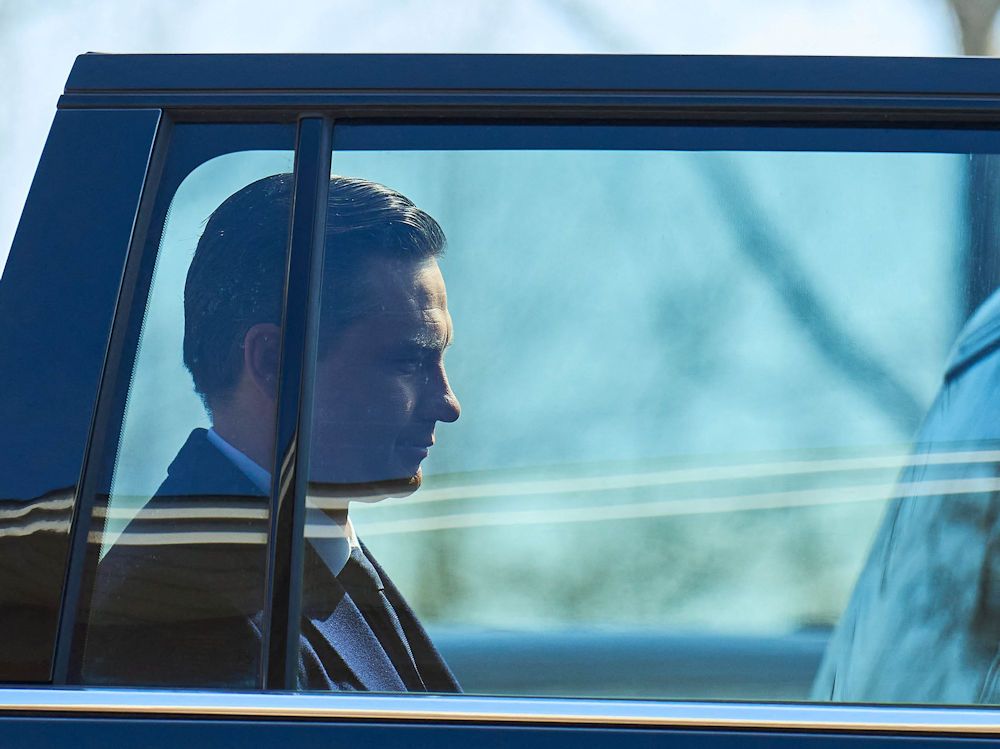
Conservative leader Pierre Poilievre waits for his wife Anaida to exit the vehicle as they arrive to vote at a polling place in Ottawa, Ontario, Canada on April 28, 2025.

First Reading is a Canadian politics newsletter curated by the National Post’s own Tristin Hopper. To get an early version sent directly to your inbox, sign up here.

TOP STORY

One of the many ironies of the 45th Canadian federal election is that the greatest electoral performance in the history of the modern Conservative Party was chalked up as a loss.

Conservative Leader Pierre Poilievre’s capture of 41.4 per cent of the vote has never been equalled in any of the seven prior elections contested since the party’s 2003 founding.

It’s higher than the 39.6 per cent that Stephen Harper needed to win a majority in 2011.

It’s higher than anything ever won by prime minister Justin Trudeau. His only majority win, in 2015, was delivered with just 39.5 per cent of the vote.

It’s higher than any victory by Prime Minister Jean Chrétien; across the Liberal leader’s three consecutive majority wins (in 1993, 1997 and 2000), he never managed anything higher than 41.24 per cent.

In his first-ever general election as Conservative leader, Poilievre actually scored a better result than the career high of multiple prime ministers. Lester Pearson, Paul Martin, Joe Clark; all of them won elections with vote totals that were well short of the low forties.

To find any kind of conservative party doing better at the federal level, one has to go all the way back to 1988, when Progressive Conservative Leader Brian Mulroney won his second majority with 43.02 per cent.

The problem for the Tories is that the greatest electoral performance in their history happened to coincide with the worst-ever performance by the NDP in their party’s history.

The NDP’s wholesale collapse saw the progressive vote consolidate around the Liberals unlike any time since the 1950s; ensuring that a Conservative Party at the top of its game was not only denied power, but isn’t likely to increase its caucus size by more than a dozen seats.

If Poilievre had brought a vote total of 41.4 per cent to any other federal election of the last 45 years, he would be prime minister. Prior to Mark Carney’s Monday night win, the most recent Liberal who posted a higher total was Pierre Trudeau in 1980 with 44.34 per cent.

As former Alberta premier Jason Kenney would note in an election night CBC panel, the Conservatives had also done better in Ontario than its premier, Doug Ford.

Poilievre’s Conservatives received 3.2 million votes in Ontario; one million higher than the 2.2 million ballots that Ford rode to a majority win in February.

What caused the Conservative loss more than anything is that the 45th general election effectively became a two-party race: It hasn’t been since 1958 that Canada has seen a general election in which at least 80 per cent of the popular vote has been shared among two parties.

Although multiple pundits noted that the Conservatives had “lost” a 20-point polling lead that was in place as recently as December, their performance on Monday was about on par with what had been projected. It’s just that their Liberal opposition had surged by 30 points in the interim.

It was on Dec. 16 that the Angus Reid Institute published the now-famous “extinction” poll: The survey that projected the near-annihilation of the Liberal Party.

The Liberals’ total of 16 per cent was “quite possibly the lowest vote intention the Liberals have ever received in the modern era,” reported an Angus Reid analysis at the time. Projections showed that if the result carried forward to a federal election, it was likely to yield a Liberal caucus of as few as 10 MPs.

And yet, the Tory numbers in that poll were only a few points off what came in on Monday night. The Angus Reid Institute had the Conservatives poised to cruise to an untouchable supermajority with just 45 per cent.


IN OTHER NEWS

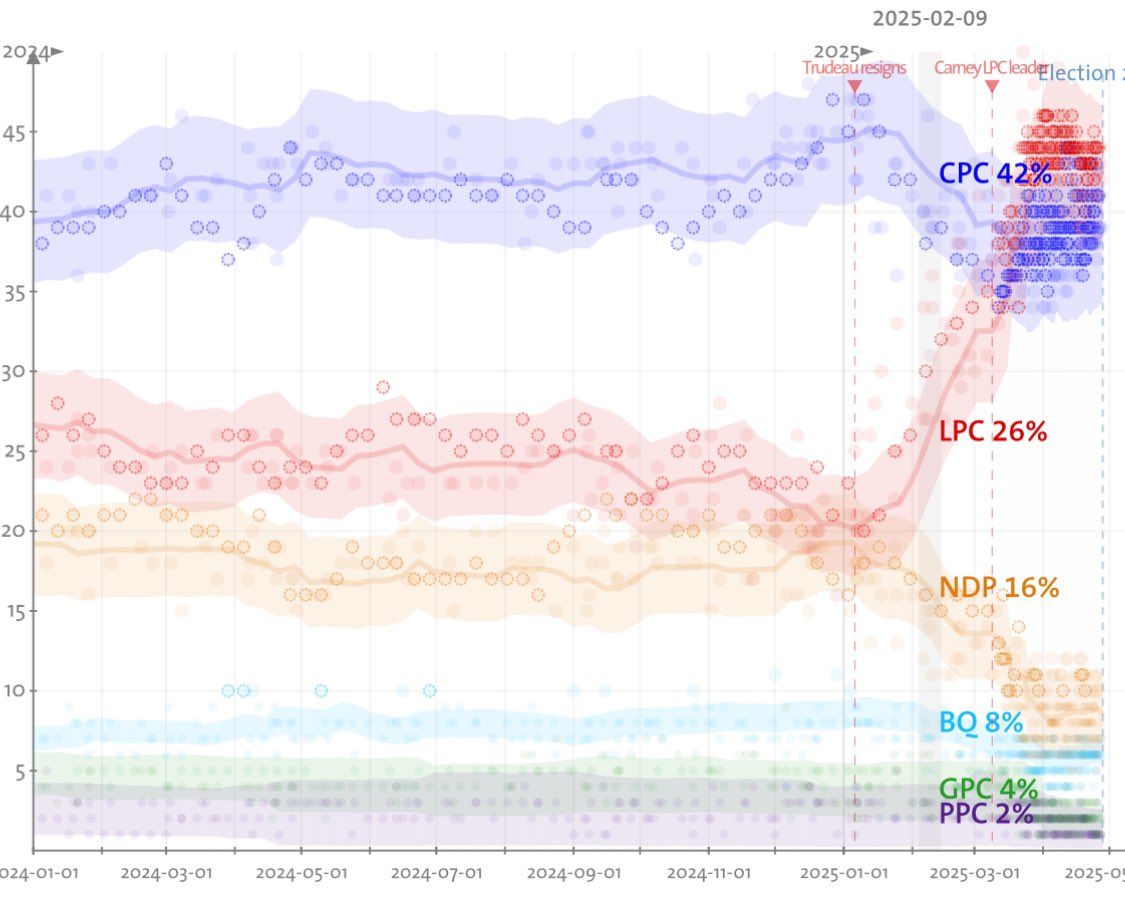
 This image of aggregated poll results was making the rounds among U.S. politicos on Tuesday morning. The point being that a Conservative Party had been set to take power in Canada right up until the point that U.S. President Donald Trump started threatening to annex the country as a state, and Justin Trudeau resigned.

Conservative Leader Pierre Poilievre lost his own seat on Monday night; a crazy turn of events given that he’d comfortably held it since 2004. As noted by the National Post’s Stephanie Taylor and Christopher Nardi, this not only means that he won’t be able to represent the Conservative Party in the House of Commons when it reconvenes, but he’ll be getting evicted. Stornoway, the official residence of the Leader of the Official Opposition, is only available to sitting MPs.

After recapturing his seat of Bowmanville—Oshawa North on Monday night, the Conservatives’ Jamil Jivani

used a post-victory interview with CBC

to pour venom on Ontario Premier Doug Ford,

whose government didn’t just refuse to endorse the federal Conservatives, but has been accused of actively working against them

. Said Javani, “he has taken the provincial Conservative Party and turned it into something hollow, unprincipled, something that doesn’t solve problems.”

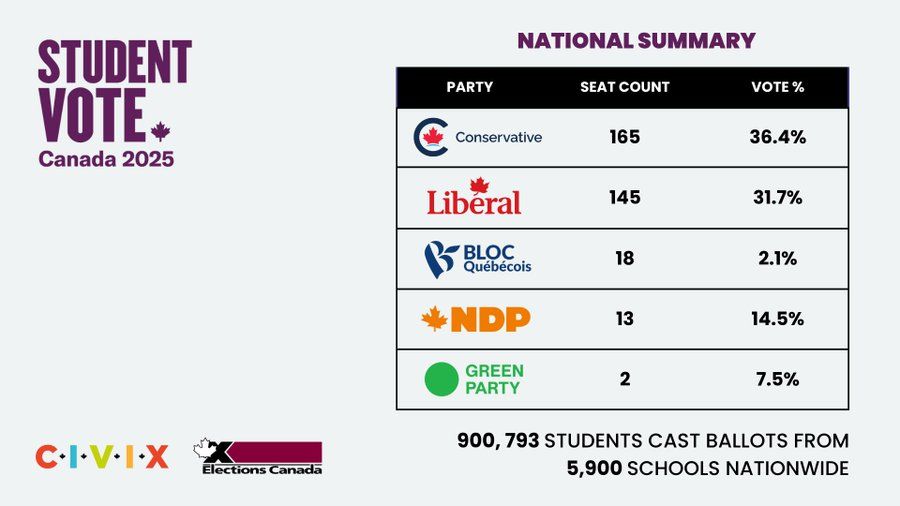
 The fabled wave of youth voters never materialized for the Conservatives. Although polls have long showed the party as being strongest among under-30 Canadians, the demographic does not appear to have broken with their usual habit of lax voter turnout. But the phenomenon of eerily conservative young Canadians remains, even if it isn’t deciding elections. Above is the results of a high school straw poll conducted by CIVIX, and it’s likely the only time in history where high schoolers have delivered a more conservative result than the general electorate.

There was no First Reading on Monday as Tristin Hopper was busy hanging around the official election headquarters of NDP Leader Jagmeet Singh in Burnaby, B.C. The NDPers present weren’t as crushed by catastrophic defeat as one would assume. For one thing, they may end up holding the balance of power just the same as in 2019 and 2021.

U.S. President Donald Trump seems to be rather pleased with how everything went. In an interview with The Atlantic published Monday, he acknowledged his singular responsibility in the revival  of Liberal fortunes. “You know, until I came along, remember that the Conservative was leading by 25 points,” he said. “Then I was disliked by enough of the Canadians that I’ve thrown the election into a close call, right?”

Get all of these insights and more into your inbox by signing up for the First Reading newsletter here.


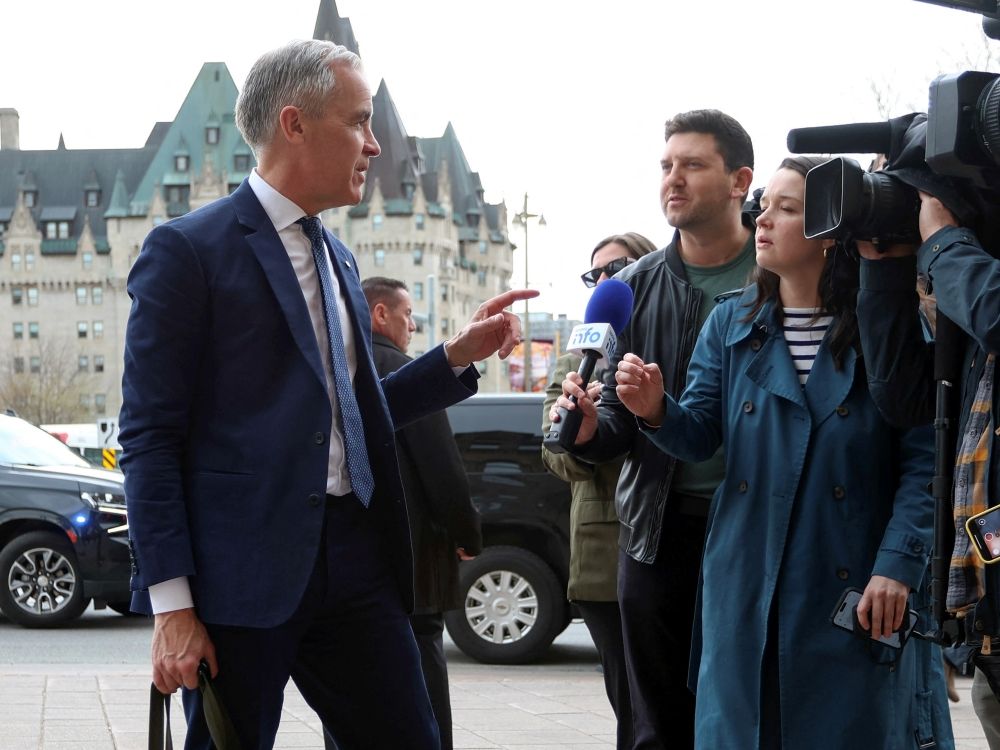
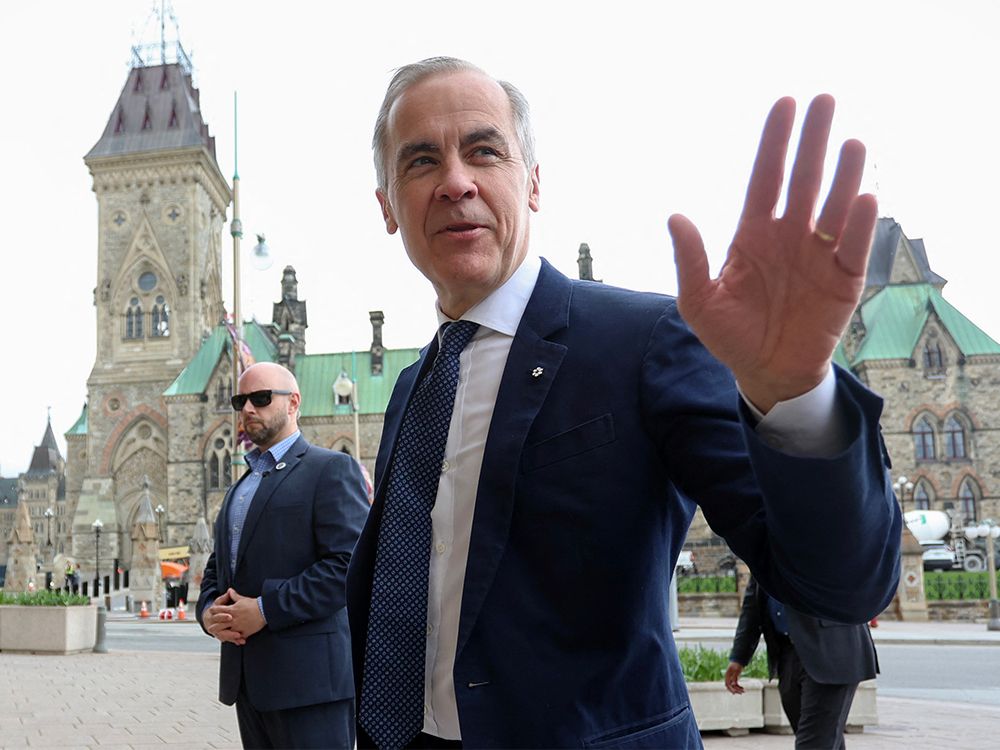
Canada's Prime Minister Mark Carney speaks to the media upon arriving at his office on Parliament Hill April 29, 2025 in Ottawa, Canada.

I think we have to admit from time to time that Westminster-style parliamentary democracy can have a schizoid quality. Canadians voted in a general election last night amidst an atmosphere of looming dread and economic panic. We were obviously desperate for safety and stability: voters of the left-wing luxury-beliefs parties turned against their leaders, and toward Mark Carney, with the savagery and single-mindedness of Cossacks having a pogrom. (Sympathy for federal New Democrats isn’t a natural impulse for me, but hoo boy. Some of those riding totals, man.)

But safety and stability aren’t on the ballot in their own right, and the result of our collective desire for these things, as often happens, is a House of Commons that offers instability and uncertainty. The Liberals have fallen just short of a majority in their own right, and are led by a man who has not yet felt the caress of a parliamentary pew. He articulates a grand vision of Canada which promises everything to everyone, while guaranteeing fast economic growth: this would be surely be hard enough with a Commons majority, even if you believe he has the right recipe tucked away in his desk.

Which I don’t, but, Lord, let me be wrong. Carney enjoys awesome, even frightening power within his own party, and the opposition on his left flank is seven-eighths dead, but he will have to bargain for legislation with lower beings, establish actual policy priorities and assemble a cabinet. The newspapers will be filled with guesswork about what this might look like, and reporters will be snatching at the smallest micro-hints.

Some Carney voters are surely betting that he’ll govern like a Conservative, but his rhetoric hews closer to a mid-20th-century industrial-planning approach than to a free-enterprise one. Even I feel a thrill when he talks of re-dedicating ourselves to building, to reshaping the continent for the 21st century, but what are we building? More insta-fail electric-vehicle battery factories? A toy train for the Golden Horseshoe?

The Conservative opposition is now bound to have a difficult year, with their leader inexplicably, inexcusably ejected from the Commons. Dedicated haters of Pierre Poilievre won’t find anything at all inexplicable about the Carleton disaster, but there will need to be a proper autopsy. Especially since Poilievre’s party gathered more vote share nationally than any right-wing party — or combination thereof! — has achieved since the days of Mulroney.

Even in Ontario, Poilievre’s Conservatives got

over a million more votes

than the hyper-critical Ford PCs did in a provincial election 60 days earlier, and they are headed toward a higher vote share within the province. So is Poilievre a generational leader potentially on the brink of a dynasty, or an unloved boob who got caught flat-footed by a change in public mood? I promise you that the quarrelling over that question is well underway.

I assume the CPC will keep its unlucky leader, which leaves only the question, “So then what?” The Liberals don’t have to call a by-election until six months

after someone decides to resign

to make way for Poilievre. And maybe I ought to say “if someone decides.” It’s not essential for a party leader to have a Commons seat, but it would certainly be ideal, especially with the Commons hung.

The Conservatives are bound to find themselves adopting more of a team approach to the Opposition job by default, and maybe this ought to have been considered while it was still optional. Even by Canadian standards, the CPC campaign was very leader-focused, and was obviously predicated on the idea that the people really wanted Poilievre and would like him more as they saw more of him. (And, again, this may actually have happened!) Now there’s a chance the CPC’s House leadership performs well over the next year or so — and then has to fade into the wallpaper behind the guy who already lost.

Questions abound. Can the New Democrats recover a sense of purpose, and find a leader who isn’t either an empty suit or an overgrown student radical? How far can the rump NDP go in cutting Commons deals with Carney without first deciding what they’re for and who is to be in charge? The Bloc Québécois suffered a surprising catastrophe, and while everybody outside Quebec finds their behaviour frustratingly predictable, how will they reconcile their Quebec-nationalist mission with a Canadian-nationalist frenzy? Who’s going to be Speaker of the House? And what demented utterances might spew forth from the Trump administration in the next 12 or 24 or 72 hours? How trying it is to live in interesting times.

National Post


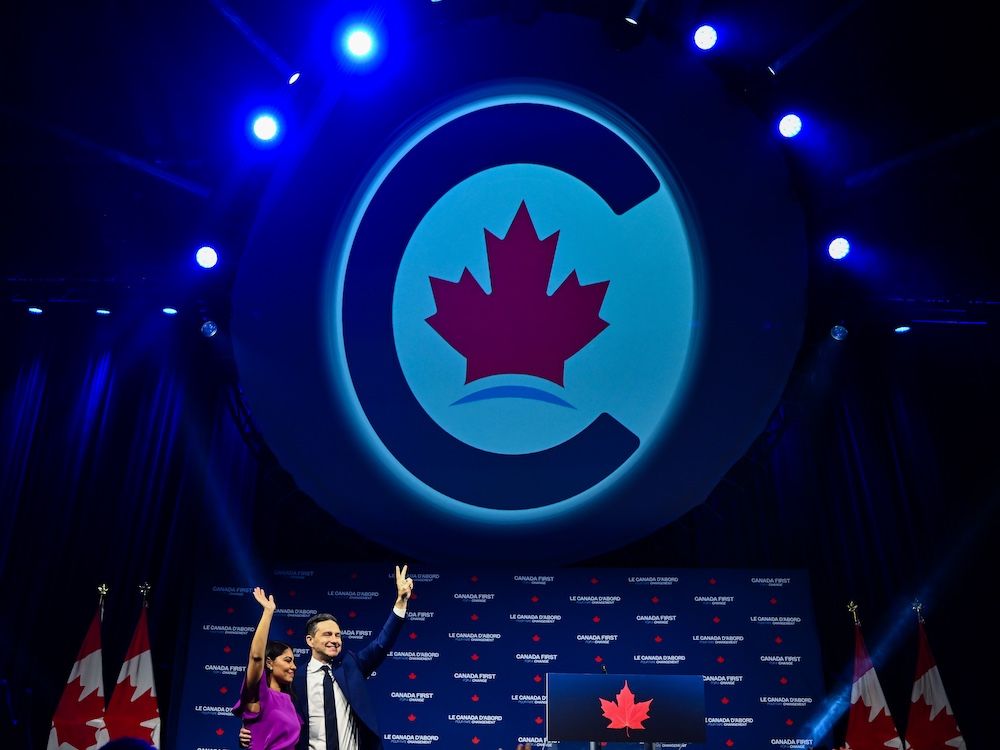
Conservative Party Leader Pierre Poilievre and his wife Anaida Poilievre salute their supporters after losing the Canadian Federal Election on April 29, 2025 in Ottawa, Canada.  (Photo by Minas Panagiotakis/Getty Images)

After losing to the Mark Carney Liberals, the Conservatives are going to be poring over their campaign strategy, with many blaming the outcome on leader Pierre Poilievre’s refusal to pivot his campaign more completely from issues of affordability to focusing on Donald Trump. There is some truth to that. As Poilievre’s 20-plus point lead in the polls collapsed, it is worth asking if he could have done more to keep some of those voters onside.

For instance, could he have moderated his policies, or his tone? Could he have been more congenial with the media? Or could he have worked harder to bring moderate conservatives like Ontario’s

Doug Ford,

or Nova Scotia’s

Tim Houston on board?

(More than anything, the internal warring in the Conservative movement resembled score settling between rival factions.)

Certainly, had Poilievre adjusted and refined his approach, he might have come a hair closer to winning the election, but gaining more than 20 seats and eight per cent in the popular vote over 2021 might have been the upper limits of what was possible.

In reality, it is not clear there is much the Conservatives could have done to win Monday night.

Poilievre was facing off against two behemoths: The first was U.S. President Donald Trump, whose threats to Canadian sovereignty and levying of tariffs created a crisis that benefitted the government. The second was the Liberal state itself, by which I mean the way the party uses the levers of government for nakedly partisan goals.

It was only four months ago that the Liberals were polling

as low as 16 per cent,

but it might as well have been a decade ago, for all it mattered. Once Trump started threatening 25 per cent tariffs back in November, followed by constant musings about annexing Canada, the die was cast. Although what followed Trump’s economic threats was chaotic buffoonery on the part of the Liberals as the party hit its nadir, they had been gifted with the chance to campaign against Trump.

Of course, at the time, it didn’t seem to be the boon to the Liberals it would become. When then-finance minister Chrystia Freeland resigned from cabinet and failed to deliver the fall economic update, and then-prime minister Justin Trudeau went days without speaking publicly, it seemed obvious that the clown show in Ottawa was ending.

All three major opposition parties — the NDP, Bloc Québécois, as well as the Conservatives — had pledged to topple the government in a confidence motion in January.

However, just as Poilievre’s chances appeared to be at their highest, what the Liberals did next ended his hopes right then and there.

The government claimed Trump’s threats constituted a crisis, but Trudeau responded by

resigning

on Jan. 6, and proroguing Parliament, bending the apparatus of government for partisan aims to give the Liberals a chance to select a new leader ahead of an election. Given that Trudeau was certain to lose a confidence vote, it is questionable whether he had a right to make that move in the first place.

The Liberal manipulations did not end with prorogation. Once Trump’s tariffs appeared to be imminent, Trudeau avoided calm attempts at negotiation, exploited the “crisis” to insult the U.S. president, blathered on in nationalistic platitudes, and started hinting at COVID-style income supports.

While negotiations were, no doubt, going on between Canada and the U.S., rather than convene Parliament to face questions from the opposition, and to debate possible responses to the Americans,

Trudeau kicked into campaign mode

, delivering his successor a massive assist. The longer the Trump crisis persisted, the better positioned Liberals would be in any election.

Although the opposition parties had promised to bring the government down, the former prime minister should have faced Parliament to at least try and get support for his agenda.

This was to become a bit of a habit for the Liberals.

Once Carney succeeded Trudeau in March, rather than meeting the House of Commons, he made multiple policy changes and flew to Europe to meet with government leaders in the U.K. and France,

both of which he arguably had no right to do.

Because Carney swore in a new cabinet, which had never tested the confidence of the House, some constitutional experts believed the prime minister should have been following the rules of caretaker government, which are normally reserved for election periods. They limit the prime minister to duties that are urgent or absolutely necessary.

Even when the election was underway, Carney failed to respect these conventions, pausing his campaign three times to deal with Trump’s upending of free trade. By

the third time

Carney put his campaign on hold, there were no new tariffs or fresh threats from Trump. In fact, the tensions between the two countries had significantly decreased by then, but that didn’t deter Carney. He wanted to appear to be governing in a crisis, even a dissipating crisis.

To top it off, a carbon tax rebate was deposited into bank accounts less than a week before the vote. The Liberals were able to set the carbon tax to zero, and claim they were saving Canadians money, while still depositing one final rebate ahead of election day. The Liberal state always wins.

Against all this, it is a wonder the Conservatives performed as well as they did. It speaks to the relevance of the serious problems facing Canada that Poilievre was so adept at addressing. Those problems still persist, from the housing shortage, food costs and crime, to the takeover of our cities by homeless camps, the strangling of our resource sector, mismanaged immigration, and economic stagnation that is almost grotesque in its nature. None of these issues will be fixed by the Carney Liberals, who promise the same big government approach to everything that Trudeau did.

That big government approach will need to be opposed again, as fervently as it has been by the Conservatives. Now that it is clear that Poilievre

lost his seat,

there will be those in his party out for blood. They should sheathe their knives. An extraordinary turn of events conspired against him in an unforeseeable way. If Poilievre merely had to contend with a leader less hated than Trudeau, or just Trump’s eruptions alone, he might have pulled it off. But with both together in such a short period of time, the Conservatives didn’t stand a chance.

National Post


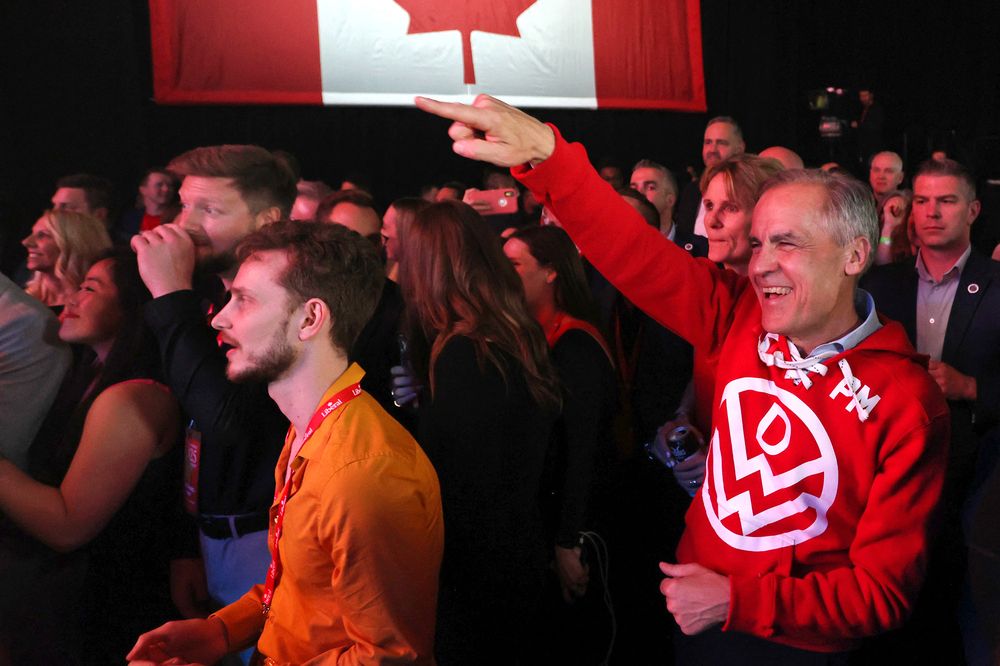
Canada's Prime Minister and Liberal Party leader Mark Carney (R) dances at a victory party in Ottawa, Ontario on April 29, 2025. Prime Minister Mark Carney won Canada's election on April 28, 2025, leading his Liberal Party to a new term in power after convincing voters his experience managing crises had prepared him to confront US President Donald Trump. (Photo by Dave Chan / AFP) (Photo by DAVE CHAN/AFP via Getty Images)

Early Tuesday morning, Liberal leader Mark Carney accepted a win for his party. How much of a win it was, was yet to be seen, because votes were still being counted in tight ridings across the country. But it looked as if it was, at least, a minority. T

hat lack of certainty about the size of his win didn’t stop Carney from taking a shot at Pierre Poilievre, whose seat was still in play at the time, not finalized due to an oversized ballot in Carleton. And he did this, ironically, only breaths apart from suggesting he has the values Canadians need, including kindness and humility. And because he spoke in a tone acceptable to Liberal Canadian sentiments, it didn’t seem to draw much, if any, criticism from election night pundits. He has convinced a large enough swath of the Canadian populace that we are at war with our American neighbours that such inherent value contradictions in himself and our country have ceased to be important.

Carney placed a heavy emphasis on Canadian values, the existence of which was ridiculed by the Trudeau Liberals when they entered the scene in 2015. This was taken up by CBC at the time, who appeared to take great joy in mocking then Conservative leadership hopeful, Kellie Leitch, for the mere suggestion they might exist, oh, and for the way she spoke. Ironic, given the uproar that was made, rightfully, by the Liberals and the rest of Canadians when a 1983 PC attack ad made fun of former prime minister Jean Chrétien for similar reasons.

The CBC, no doubt, celebrated Carney’s win on election night. How could they not? He called them “underfunded,” promising them $150 million in his platform. Until it was clear there was at least going to be a Liberal minority after 10 p.m., they were unsure whether or not the election outcome meant they’d have to be delivering their own eulogy, as Conservative Leader Pierre Poilievre had campaigned on defunding the broadcaster. 

Why did the Liberals of the past decade all but refuse to acknowledge the existence of Canadian values up until now? Seemingly, it’s because they thought it in contradiction with their “diversity is our strength” message. But it didn’t have to be. Canada can be both a welcoming nation to immigrants while asserting core values, including not rushing to the streets to celebrate, for example, the horrific acts of October 7 in cities across Canada or accosting Jews in their Toronto neighbourhoods. These values should be easy to point to. But we cannot expect them from Carney’s Liberals no more than we could Trudeau’s.

So, which values did Mark Carney decide Canadians have? According to him, three: humility, ambition, and unity. He told the crowd during his victory speech, he’d do his best to “uphold them every day” as our prime minister, ending with a “You betcha” — a folksy phrase popularized by the film Fargo, which takes places in Minnesota, not Canada. This was an awkward choice, given the juxtaposition between Carney’s status as a

former governor of two central banks and global emissions targeting investment banker. It was so clearly an affectation that matched neither his middle-class Canadian upbringing, nor his likely hefty undisclosed assets. It’s as if he keeps trying new versions, caricatures of what he thinks Canada represents, from elbows-up to Mr. Dressup, to rural expressions, hoping one will fit. But they all hang off him like a poorly-hemmed suit.

Why these values? Carney said that Canada was in a crisis, but reassured his audience that “Canadians are ambitious. And now, more than ever, it is a time for ambition. It is a time to be bold to meet this crisis with the overwhelming positive force of a united Canada, because we are going to build. Build, baby, build.”

And there seems to be no shortage to what he thinks his Liberal government should be building including “hundreds and thousands of not just good jobs, but good careers in the skilled trades,” “an industrial strategy that makes Canada more competitive while fighting climate change,” “new trade and energy corridors,” and, again, making the promise to “build Canada into an energy superpower in both clean and conventional energy.” But we know he’s refused to repeal Bill C-69, the Impact Assessment Act, and he can’t even bring himself to say the word “oil.” When he did during one of the Liberal leadership debates, he struggled to even get the word out. As if saying it made our clean energy saviour feel dirty.

And where does the necessity of Canadian humility come into play? He continued, “I want to be clear. The coming days and months will be challenging and they will call for some sacrifices. But we will share those sacrifices by supporting our workers and our businesses.” He followed up with, “We do things because they’re right, not because they’re easy,” again, congratulating his supporters on their kindness. But it’s not clear what sacrifices he was referring to. More national debt and a larger deficit? More counter measures against the U.S., which will hurt Canadians and possibly cost more jobs? More pain from carbon taxes, perhaps this time buried? It’s not clear even Carney knows what he meant.

In addition to the lack of clarity on these “sacrifices,” the suggestion doesn’t fit the moment. We’re not in war times, so the language of rationing is odd. And we’re not currently in a crisis, as U.S. President Donald Trump’s tariffs keep getting softened, and even Carney says he plans to negotiate a new deal with him. One thing’s for sure, though I doubt Carney truly got the message, Canadians do not need to make any more sacrifices for Liberal policies like the consumer carbon tax, which they recently reduced to zero — not because of the burden it placed on Canadians — but because it was too divisive and unpopular for them.   

Yet, Carney continued to use the word “fight,” arguing that: “our old relationship with the United States, a relationship based on steadily increasing integration is over. The system of open global trade anchored by the United States, a system that Canada has relied on since the Second World War, a system that, while not perfect, has helped deliver prosperity for a country for decades is over.”

To suggest that Canada’s relationship with the United States, as it has existed until now, is over for good, based on the chaotic choices of one American President who will be gone in four years does not seem wise or practical. But enough Canadians seem to agree with the prime minister, because what Carney said during this speech is what he’s been saying all along. Carney’s success hinged on an actual, foolish, and unhumble Canadian value — our deep-seated belief that we are somehow better than Americans, partially due to their ambitious natures. He sold us our own fiction, and it worked.

It now looks like Canadians’ concerns and values about women’s sex-based rights, the fool-headed administration of hormone blockers to children, the infiltration of toxic DEI into schools and workplaces rather than merit-based decisions, and anti-Israeli sentiment on campuses, streets, and neighbourhoods, among other things, will have to wait. As will concerns about Ottawa’s attacks on the resource industry, and issues of national unity. Carney has other ambitions.

National Post

tnewman@postmedia.com

X: @TLNewmanMTL


Liberal Leader Mark Carney speaks to the media upon arriving at his office on Parliament Hill on April 29, 2025, after winning Canada's federal election and leading his party to another term in power.

If you thought the past Parliament was dysfunctional, buckle up for 2025.

Mark Carney has pulled off a rare political feat: winning a fourth consecutive mandate for the Liberal party, despite not even holding a seat when he became leader. At the same time, the leaders of the NDP and Conservatives, Jagmeet Singh and Pierre Poilievre, both lost their ridings, meaning they won’t sit in the House, and Singh has announced he will resign.

But while Carney smiled for the cameras, and promised to “work with everyone,” behind the scenes, he must have been grimacing. Because what he’s really won is a poisoned chalice, which will make “standing up for Canada” a Herculean task.

As of 4:30 p.m. Tuesday, Carney’s Liberals were leading or elected in 169 ridings, just short of the 172 needed for a majority. To survive, Carney will have to dance with the Bloc Québécois (22 seats) or cobble together support from the seven NDP MPs and Green Party veteran Elizabeth May.

All three potential allies lean hard left, notably on the environment, crushing the possibility of nation-building projects like pipelines and nuclear-powered energy corridors. Carney’s vision for boosting Canada’s economy and securing energy independence now looks like a dead letter. The Bloc and Greens oppose fossil fuel development, and the NDP will demand social spending first, last, and always.

Could Carney turn to the Conservatives for support on such initiatives, especially those that would help the West? No way. Despite Poilievre’s statesman-like turn during his concession speech, the Tories will be out for blood after this election. As of 4:30 p.m., they had

racked up

more than eight million votes, just 479,306 shy of the Liberals, capturing a whopping 41.3 per cent of the popular vote — well above the high thirties most polls had predicted as their ceiling. They are looking ahead to the next time.

Where did Poilievre’s surge come from? Voters bled from the NDP, the Liberals, and the People’s Party, which all but

evaporated

this cycle, dropping to a marginal 0.7 per cent of the vote. This combination allowed the Conservatives to make gains in Ontario,

flipping Toronto ridings

and exurban strongholds like Newmarket-Aurora, Vaughan-Woodbridge, Markham-Unionville, Brampton South, and Milton East-Halton Hills South. They did well in

Atlantic Canada

, picking off a couple of Liberal seats — even though veteran MP Rick Perkins lost South Shore St-Margarets to Liberal newcomer Jessica Fancy-Landry.

Out west, the Tories wrested seats away from both Liberals and New Democrats. They ousted the NDP in Elmwood-Transcona in Manitoba and

Edmonton Griesbach

in Alberta, and won seats from the NDP in B.C., including North Island Powell River and Nanaimo Ladysmith.

As for the Liberals, they owe their victory

to Quebec.

They picked up 11 seats, mostly at the expense of the Bloc, pushing their total to 44 — exceeding their 2015 high of 40 under past PM Justin Trudeau. Despite his limited French, Carney managed to woo Quebecers by surfing a wave of newly awakened Canadian nationalism. Voters there didn’t buy Bloc leader Yves-François Blanchet’s pitch that sending more Bloc MPs to Ottawa was necessary to defend Quebec against Donald Trump. Ironically, however, Blanchet may end up with the balance of power anyway.

And that’s where the trouble really begins.

A Liberal government propped up by either separatists or a coalition of eco-socialists will not sit well in Alberta, Saskatchewan, or British Columbia. Western Canada already felt alienated before. Now, the discontent threatens to harden into full-blown separatist sentiment. Calls for greater provincial autonomy — or outright secession — will grow louder, particularly if Carney is forced to kill energy infrastructure projects to placate his partners. Alberta Premier Danielle Smith will howl at every opportunity — and U.S. President Donald Trump will only be too happy to fan the flames of discontent to achieve his dream of making Canada his “cherished 51st state.”

In short, a national unity crisis is brewing — one we haven’t seen the likes of in a generation. Unless Carney finds a way to get the West on board, his dream of building a stronger, greener, wealthier Canada may be smothered before it even begins.

Postmedia News

Tasha Kheiriddin is Postmedia’s national politics columnist.

Editor’s note: The seat and vote counts cited above have been updated from when this column was originally published shortly after noon.


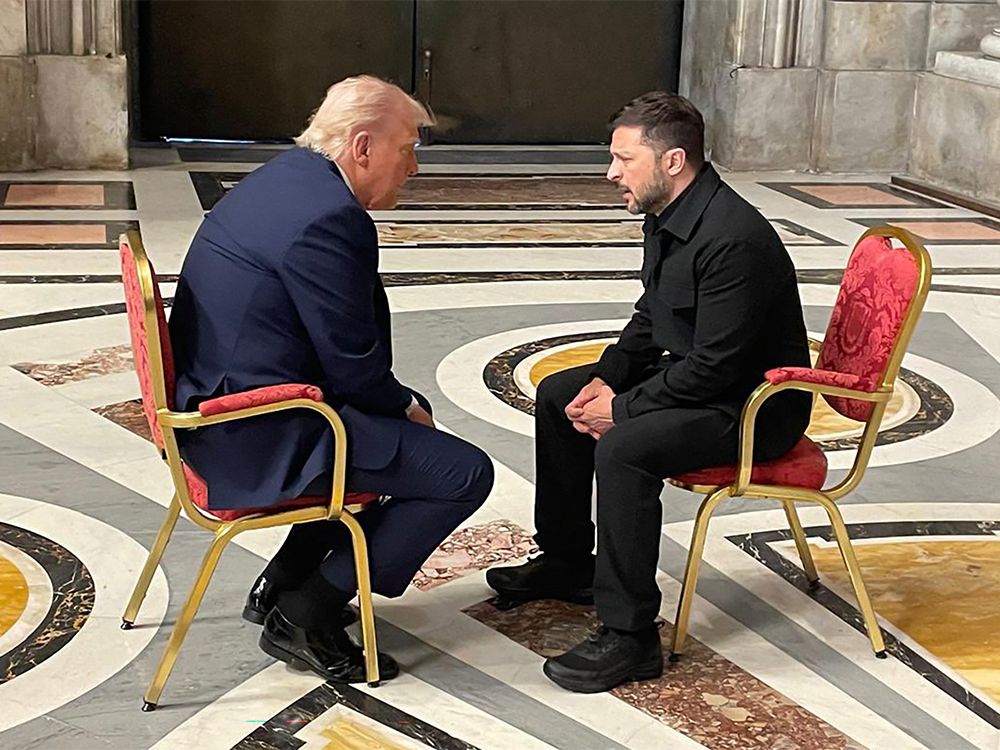
U.S. President Donald Trump and Ukrainian President Volodymyr Zelenskyy have a hasty bilateral sit-down in St. Peter's Basilica in Rome before Pope Francis's funeral on April 26, 2025.

U.S. President Donald Trump

quipped

on Sunday that it was “the nicest office I have ever seen.” He was speaking of St. Peter’s Basilica which, relative to the late-Saddam style of decor featured at Trump Tower and Mar-a-Lago, is rather understated.

He met with Ukrainian President Volodymyr Zelenskyy in St. Peter’s before the funeral of Pope Francis, whose mortal remains were still in the church while the two presidents decided to stage a hasty bilateral sit-down. Forty years ago,

Yes, Prime Minister

had an entire episode about the diplomatic benefits of a state funeral, but it was a satire and the discussions were held at ancillary receptions, not a few steps ahead of the procession of the casket.

The old line is that the narcissist must be the bride at every wedding and the corpse at every funeral. Trump apparently could not bear not to be the centre of attention, even at the funeral of a pope.

President Zelenskyy was likely grateful that the sacred ambience of St. Peter’s — and the absence of Vice-President JD Vance — made it unlikely that he would be ambushed by intemperate shouting. He was also likely pleased to see the end of this pontificate, for Pope Francis had been the only world leader to explicitly call upon Ukraine to surrender.

It was last March that Francis called for Ukraine to have “

the courage of the white flag

” and “negotiate before things get worse.” It provoked an incandescent response in Ukraine, including from Ukrainian Catholics. In essence, Pope Francis had the Trump position — things are bad on the battlefield, they may well get worse, so better to surrender now.

It may be that the surrender party — led by Trump strategically and Francis morally — is now in retreat.

Trump prefers to speak of “a deal” rather than “surrender,” but surrender is a type of deal. Trump knows that there are only two ways to end the war in “one day.” Either the invading party lays down its arms and goes home, or the invaded party surrenders.

Give Trump’s affinity for Russian President Vladimir Putin, the preferred option was Ukrainian surrender. Hence the ramping up of lies — to a greater degree than even the usual Trump standard — about Ukraine starting the war, the relative contributions of Europeans and Americans to Ukraine’s defence, and the reliability of Putin’s promises. When Zelenskyy refused to co-operate in his own surrender, Trump’s anger boiled over in the Oval Office.

What Trump has never understood is that Ukraine does not need the “art of the deal” to surrender to Russia. If Zelenskyy wanted to surrender, he could fly to Moscow in one day and not ruin his visit to the Bernini-adorned St. Peter’s by having to look into the eyes of Donald Trump.

It is not clear whether Trump pressures Ukraine to surrender because he favours Putin winning the war, or because he realizes that he is inadequate to the challenge of Putin’s belligerence. “Peace through strength” — the Reagan motto which Trump has adopted as his own — requires a man of clear vision and strong character to handle a Putin.

It may be finally dawning on Trump that, after faithfully parroting Putin’s propaganda points, he is now being played for a fool. Zelenskyy agrees to a temporary ceasefire; Putin rains down missiles upon Kyiv. Trump fired off a plaintive social media post: “Vladimir, STOP!” The laughter from the Kremlin reached farther than its missiles.

Trump now faces the prospect of escalating his pressure on Putin beyond even ALL CAPS. Zelenskyy has been trying to tell him so for months. He told the late Holy Father that, too, but while it elicited maximum sympathy for Ukraine, it led to minimal criticism of Moscow from Rome.

With Francis deceased, and Trump facing what he fears more than death — ridicule — it may be that a shift is underway. After months of pursuing the surrender strategy, Trump has mused about applying greater pressure on Putin.

During Trump’s temporary transformation of St. Peter’s into an extension of the peace talks held in Saudi Arabia, it was noteworthy that both U.K. Prime Minister Keir Starmer and French President Emmanuel Macron dropped by in an obvious gesture of encouragement for Zelenskyy. And when the various dignitaries made their way into St. Peter’s Square for the funeral, the hundreds of thousands greeted Trump with silence, while Zelenskyy behind him received an ovation.

Zelenskyy made clear in Rome that he has no intention of surrender, and that in any case he needs no assistance to do so. The announcement on Monday by Putin that he would observe a two-day ceasefire next month was literally the least he could do, but it is the first time he has proposed anything. Could it be that he senses that his position, heretofore backed by Trump’s support without having to make concessions, is slightly weakening?

On his flight home from the funeral of Pope Francis, Trump may have realized that it is a mistake — as the Holy Father made last year — to pressure Ukraine to end a war it did not start and is not responsible for continuing.

National Post


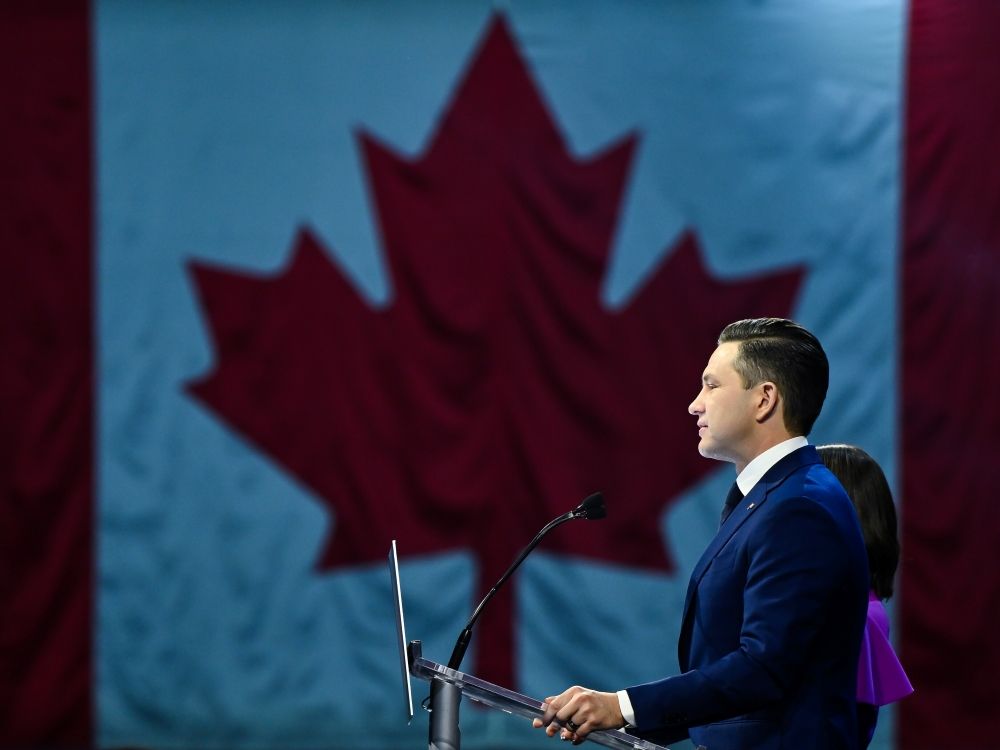
Conservative Party Leader Pierre Poilievre speaks to his supporters after losing the Canadian Federal Election on April 29, 2025 in Ottawa, Canada.

The Conservatives couldn’t control the one big thing that went wrong for them in the campaign, but they could control the mounting pile of little things. With an election so close — the Liberals winning 168 seats, the Conservatives, 144, as of 10 a.m. ET Tuesday — those little things amounted to a fatal speed bump. Even Conservative Leader Pierre Poilievre didn’t survive, politically speaking, in his riding, having

lost

his seat by about 3,800 votes.

The one big thing, of course, was Donald Trump, who the United States elected as president back in November, and who, by January, took to waging trade wars — first on Canada, then the world — and talking with increasing seriousness about making this country a 51st state. The deadweight leader attached to the Liberals cut himself free and lined up a technocratic replacement who didn’t repulse the country with every breathy sentence he spoke. Canada’s Conservatives, despite commanding a soaring lead since the summer of 2023, plummeted in the polls.

This phenomenon isn’t unique to Canada: in Australia, the opposition Liberal-National Coalition (the analogue to our Conservatives) was the favourite to win an election since the fall of 2024, their poll performance

peaking

in late December. From there, their ratings tumbled, and now they’re projected to lose the May 3 Australian federal election. The Trump effect is a real, brutal thing.

But unlike in Australia, Canada’s Conservatives held the lead since Poilievre became leader in the fall of 2022 — narrow, at first, but by two years later, that gap

was

nearly 20 points.

The initial collapse of their lead in the polls hurt, but at least it wasn’t the Tories’ own fault. Then came the self-inflicted wounds.

There was the slow pivot: in the weeks that Trump made daily annexation thrusts at Canada, the party stuck to its “axe the tax” messaging, treating the new hostility of the United States as a secondary concern. Canadians — boomers, in particular — wanted a protector more than they wanted a tax-axer, and Poilievre was slow to deliver.

Poilievre ultimately put anti-Trump resistance front and centre in his overarching pitch for economic resilience. But by that point, impressions had been made.

Which brings us to the next little hiccup: the media. The Conservatives diagnosed that mainstream Canadian broadcasters and newspapers typically have a systemic Liberal bent, and they were right; many journalists have leftward personal convictions, and many others outright believe that social justice — that is, the advancement of progressive politics — should be the core goal of their work.

As for what to do about it, Poilievre’s team limited the access of traditional journalists and engaged more with content creators native to YouTube and other parts of the internet. At most of his press conferences, he took only four questions, and his team pre-selected who would have the privilege of asking. His answers, though clear, could become cloudy with slogans that cast a formulaic shadow over his human side.

To his credit, Poilievre did show a warmer, relatable side in numerous podcast appearances, but these didn’t achieve a Trump-on-Joe-Rogan-Experience scale of reach.

Then there was the platform and, broadly, communications. The Conservative platform was decent on many fronts, but it still felt incomplete for a document that should have been three years in the making: the revenue assumptions

seemed

overly optimistic and

perhaps

based on number games. To add, it was poorly designed, with no white space, questionable photo placement, condensed spacing and lists unnecessarily broken by pages, while campaign communications had a tendency to YELL at any readers with overabundant capitals. Aesthetics and, yes, vibes, matter.

Finally — and a lot of this wasn’t Poilievre’s fault, but Conservatives elsewhere — was the party drama. Doug Ford’s staffers trash-talked the federal campaign, questioned its strategy and even seeded stories of doubt in progressive media. Nova Scotia’s Tim Houston launched an interestingly timed get-to-know-me video filled with Carneyesque nostalgia nationalism. The

rivalry

between Poilievre’s team and Houston’s team resurfaced. It didn’t help that Albertan separatists started to rev their engines. Egos flared, and the outward infighting signalled instability when the public was looking for the opposite.

Poilievre did his best to send a message of unification and hope — even, after congratulating Carney on the win,

hushing

boos made in response to the Liberal leader’s name.

Political parties all have internal spats. What’s essential now is that the Conservatives remember all that they got right. They set the parameters of political debate in Canada for the past two years, reversed the nation’s support for the carbon tax and appealed to the youth without becoming Liberal-lite, defended its stances on crime with principle. They had the makings of forming a mega-majority up until a few months ago.

And they very well may have that again, once Carney’s honeymoon phase reaches its end. They can try to fix the minor errors, or at least hope that no new political black swan events make the little things fatal again.

“We will continue to put forward the best arguments to improve the lives of our people right across this country,” Poilievre told the crowd in his concession speech, and that’s exactly what needs to be done now, even without an MP as leader. The movement has hope, as long as it holds together and keeps the feuds at bay.

National Post