LP_468x60
on-the-record-468x60-white

EDINBURGH — Imagine the scene that would have greeted any poor Scot who wandered off the street in Edinburgh to find himself in the middle of the annual British Association of Canadian Studies conference. Yes, there really is such a thing as the British Association of Canadian Studies (BACS) and 2025 is its 50th anniversary.

BACS is the well-worn but admirable remnants of the kind of soft power Canadian governments used to try to exercise — by getting people in other countries talking about Canada and encouraging academic links across the ocean.

The conference brings together Canadian expats living in the United Kingdom, Canadian academics who want to travel abroad and the small group of British and European academics who, for some reason or another, have decided that Canada is worth a little bit of their attention.

There’s a lot to be said for Canada’s British intellectual linkages and there were some excellent speakers here — historians, political scientists and others with some innovative thoughts on our country and, sometimes, its links to the wider world. But despite BACS’s once lofty goals, the vision of Canada it now displays is more than a little odd.

There’s nothing wrong with academic oddity. Indeed, there’s something to be said for the eccentric intellectual loftily wondering about some remnant of Canada’s literature or history. But the oddity of BACS — and pretty much all academic conferences in the humanities and social sciences these days  — is its ideological skew. This is academia after all, which is dominated by the left.

If you didn’t know any better, you’d think Indigenous peoples represented half of Canada’s population and not five per cent. The intellectuals at BACS were obsessed with things like indigeneity, decolonization and reconciliation. Virtually every session had an Indigenous panel. Even sessions on literature and social policy were heavily focused on Indigenous issues.

There was also a heck of a lot about multiculturalism. But don’t assume a focus on multiculturalism somehow put Canada in a good light. The most popular theory at work in the academy today argues that multiculturalism is just a facade that hides the white supremacy at the heart of Canada. It’s just a new way to whitewash the capitalist settler colonial project that is Canada. The title of one paper was pretty succinct: “Multiculturalism as Violence.” Yes, really.

There were other topics on the agenda, and talks given by a reasonable number of distinguished academics with more moderate views. The Scots are very interested in their own independence and so have always had a soft spot for Quebec. There were sessions on Canada-U.K. relations and even one on the federal election. There were, and are, many able intellectuals talking about Canada, at home and abroad.

But the world they are living in — and the light in which they are portraying Canada — gives off a leftish-tinged fun-house mirror image of our country. In a keynote talk titled “Who Owns the Prairies,” University of Alberta historian Sarah Carter started off by saying it was all about land and people’s relationship to the land.

She celebrated Indigenous people’s spiritual connection to the land before sneering as she talked about how the settlers came and commodified it. There were the expected jokes about Elon Musk, U.S. President Donald Trump and the patriarchy.

But there didn’t seem to be any awareness of the large body of academic literature that has linked the rise of democracies in the modern era with property rights and the claim they have given citizens to demand attention from the state. It could all be summed up as “Indigenous peoples good, capitalism bad.”

One academic seriously claimed that there was on ongoing racist state project in Canada to forcibly sterilize Indigenous women. This would, of course, be horrific. She didn’t note, however, that the Indigenous fertility rate is higher than the Canadian average. So if there really is such a program, it’s not only horrifically racist, it’s also pretty inept.

In private conversations in the hallways, more moderate academics would sheepishly shake their heads at some of the more egregious claims. When one keynote speaker talked about the future of Canadian studies being activism and more activism, some did whisper that perhaps this wasn’t exactly the search for truth about their country that intellectuals ought  to be engaged in. But no one openly voiced this criticism in the session itself.

In a final session on the Canadian election, the room was filled with people with an ideological diversity that ranged from socialists on the one side all the way to left-leaning Liberals on the other. Someone fretted (and expected everyone to empathize with the concern) that despite what the polls were saying, the Conservatives might win the election. God forbid!

The Trump era is exactly the time for the Canadian government to think about reinvigorating its links to the Commonwealth and other parts of the world. Canada needs to spread its wings and BACS, with all its eccentricity, could be part of that.

But before this could happen, Canadian universities need to deal with their zany radical leftist problem, and create a culture that calls out the truly bizarre and outrageous claims being made by activists posing as scholars. They would never let radical right-leaning scholars get away with making the same kinds of claims.

We need to put on a better show for the world — even to the random Scot in Edinburgh who shows up to learn about this bizarre things called “Canadian studies.”

National Post
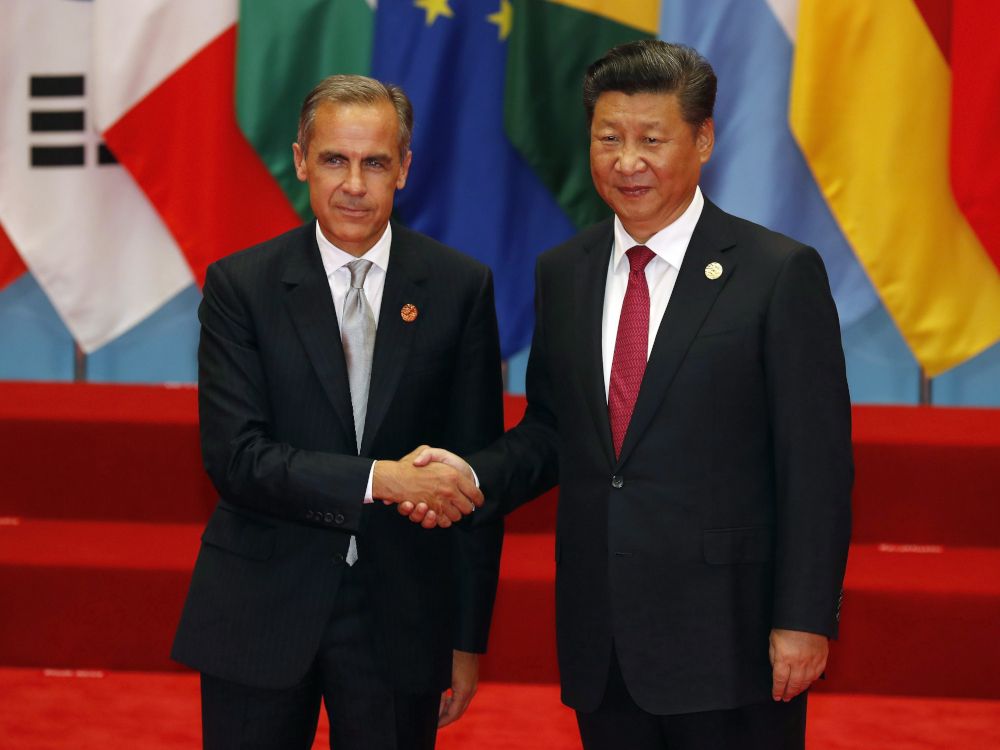

Then-Bank of England governor Mark Carney, left, shakes hands with Chinese President Xi Jinping at the G20 Summit in Hangzhou, China, in 2016.

By his supreme idiocy, U.S. President Donald Trump has stirred up

anti-American sentiment

, but largely to the benefit of America’s archrival, China. Although Prime Minister Mark Carney is European in his manners and predilections, he is a charter member of the cadre of useful idiots who seem intent on imposing Chinese vassalage on Canada.

The

Euro-centric economist

has proposed that Canada strengthen ties with the European Union, but Europe is, for now, a spent force. Canada is more delectable for China. It has many of the raw materials that Beijing craves, with

rising oil imports

at the fore. Canada also has a large Chinese diaspora community, roughly

1.7-million people

of Chinese descent, that Beijing seeks, with some success,

to manipulate

to its ends.

One would expect some Canadians to resist these trends but

Carney epitomizes

an establishment, including American corporations and Wall Street, that remain remarkably untroubled with Beijing’s

stated aim

of becoming a

global economic superpower

by 2049. So, while assaulting Trump for his trade policy, Canadian political leaders seem to be missing that the West’s greatest long-term challenge is the relentless

Sinic mercantilism

.

British Prime Minister

Keir Starmer’s attempt

to

appease China

in order to “

Trump-proof

” and revive the country’s moribund economy seems more like the road to ever great irrelevancy, as is the case for much of Europe. China is trying to build

a mega-embassy

in London that will help it surveil and harass those who fled Communist rule for the assumed safety of Great Britain.

Trump may be a posturing maniac, but the China challenge is of a more considerable magnitude. China already dominates the industrial world; it

now boasts

roughly as many factory exports as the U.S., Japan and Germany combined. It is the world’s the world’s

largest automobile market

and the biggest steel producer. It is also investing heavily to take over the

aerospace industry

from leading companies like Bombardier, Boeing and Airbus.

Carney and other members of the elite cannot address these threats as long as they adhere to notions like “net zero,” an obsession of Carney and his fellow poobahs. For all his talk about building energy infrastructure, Carney’s green obsessions could instead lead Canada into a dependent relationship with solar and electric vehicle manufacturers based in China, a country that emits

more greenhouse gasses

than the U.S. and the EU combined.

In embracing this double standard, Carney and much of the Canadian elite qualify as classic “useful idiots,” as defined

by Vladimir Lenin

. Essentially the same people who seek to block oil drilling and place burdens on Canadian mining, agriculture and industry for environmental reasons seem to have little trouble sourcing from a country that’s on a

coal-plant building spree

. A greener Canada will have to kowtow to China to procure the requisite

rare earth minerals

and

the technology

for processing them. This represents what Muhammad Ali called the “rope a dope,” essentially using the

West’s green obsessions

to supplant its own industries with those of the world’s biggest GHG emitter.

This occurs in part because the

global corporate elite

and their allies in the green movement, itself partially

funded by China

, seem fine with disarming western industry and lowering the middle class’s quality of life. If you think Trump threatens Ontario’s auto industry, the threat from China is even greater. Slapping tariffs on China is one of the few things winning Trump support from even

leftist trade unions

.

But that’s not the worst of it. Under such circumstances, China can build support both from its former citizens who are anxious to cash in on Beijing’s largess, along with left-wing activists to business interests that are lining up to make their fortunes selling resources to China.

Canada is an ideal place for Chinese political interference. In January, the sitting Liberal member of Parliament for Markham—Unionville, Paul Chiang,

told

Chinese-language media that electing his Conservative rival, Joe Tay, a former Hong Kong civil rights activist, would cause “great controversy.” Hong Kong police have placed a approximately

$180,000 bounty

on six foreign activists, including Tay, for violating Hong Kong’s

national security law

. Even after Chiang seemed to encourage voters to turn a Canadian citizen in to the Chinese government to collect the bounty, Carney did not abandon his candidate.

China takes advantage of our liberal institutions — and our comparatively open economies — to undermine them. The Chinese government has become skilled at

siphoning off

the technological edge of the West while trying to silence any objections to Beijing’s awful

human rights record

.

Before jumping into Chinese President Xi Jinping’s lap, Carney and his cronies might want to consider the long-term economic and political costs. Today, particularly with the imbecilic Trump at the helm, America may seem like the biggest ogre. But MAGA will not rule forever, nor will Trump escape mortality. His unnatural coalition of wealthy oligarchs and rabid populists is intrinsically weak and is already showing signs of splintering.

More critically, the U.S. shares not just a border but many of the same values as Canada — certainly far more so than the Chinese Communist Party. But to deal as equals with the U.S., or other countries, Canada’s identity needs to be more than just

not being American

. Canada’s own internal divisions are not insignificant, as evidenced by the recent comments by Bloc Québécois Leader

Yves-François Blanchet

that Canada is “an artificial country with little meaning.” And it’s also likely that Carney’s recent

nationalistic appeal

will not be able to forestall a

growing estrangement

between Ottawa and many provinces, notably Alberta.

In the short run, Carney will likely use the American bogeyman to paper over the serious divisions within the Canadian polity. This message will appeal to his potential partners in the NDP. Yet despite what the blathering media and political classes say, America and Canada have more in common than either does with the true quasi-fascist state emerging in China. It will take wiser heads than those who now rule in Washington and Ottawa to rebuild an alliance that’s advantageous to both countries.

National Post


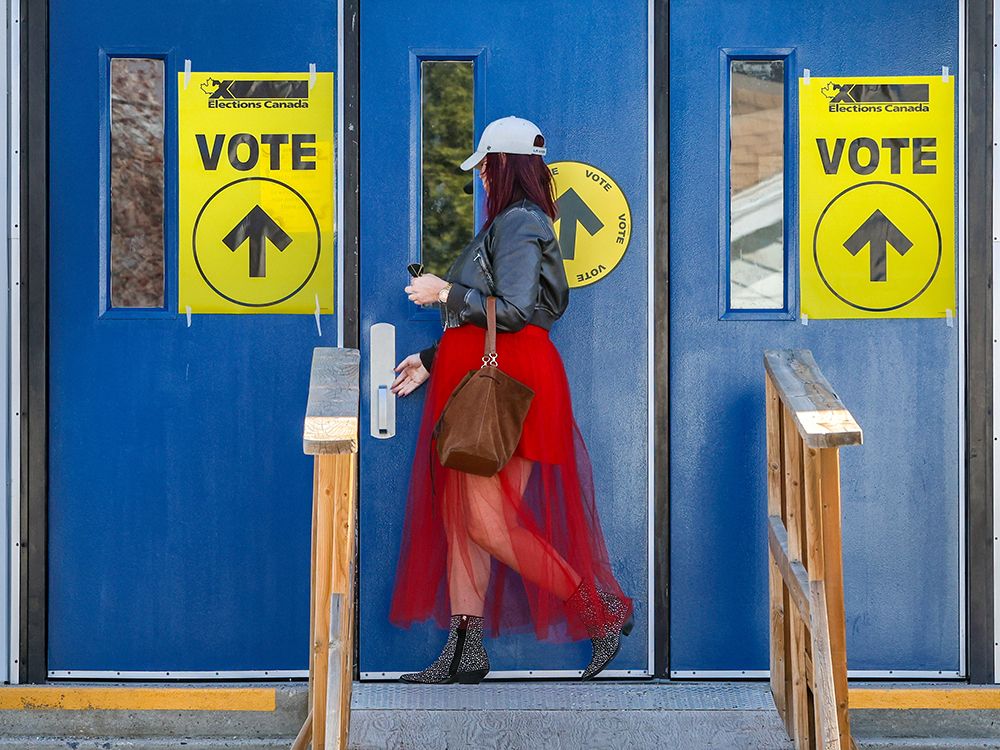
A voter heads into a polling station at Calgary's Stanley Jones School, on federal election day, April 28, 2025.

Former prime minister Jean Chrétien once said, “Without compromise, there is no Canada. Without compromise, there is no progress.”

It wasn’t a line meant to inspire applause. It was a warning and a lesson learned in the long, imperfect work of holding this country together. It echoed something many of us feel in our bones but don’t often say aloud: that Canada is not the product of uniformity or force, but of deliberate choices to meet in the middle, again and again, when it would have been easier to walk away.

We often forget this at our peril.

We’ve just been through an election. The campaigns are over. The winners have been declared. And now harder work begins — not of fighting, but of building.

That word — build — is everywhere lately. But building means more than capital plans or press conferences. It means articulating a vision big enough for a country as diverse, as demanding, and as fragile as ours. It means doing what Chrétien did — what every serious leader has done — and choosing pragmatism over purity, compromise over combat, planning over posturing.

Because the truth is this: Canada is at risk of falling further behind.

Our ports are ranked among the least efficient in the developed world. Our electricity grid is fragmented and strained. Our Arctic is unguarded while others threaten our sovereignty. And our productivity — the foundation of our standard of living — is declining.

Cynicism, sloganeering and grievance-mongering, however earnest or keenly felt, cannot solve those problems.

Unfortunately, we’ve seen where those things lead. South of the border, Donald Trump built an entire political movement out of resentment — one that turned institutions into enemies and disagreement into betrayal. It can be more tempting to tear things down than to do the harder, less glamorous work of building something better.

Canada is not immune to this temptation.

Pierre Poilievre gave voice to a country that feels stuck. His words — “everything feels broken” — resonated because, in many ways, they’re not wrong. But diagnosis is not direction. It’s one thing to name the problem. It’s another thing to fix it.

Mark Carney offers something that feels increasingly rare in our politics: seriousness. Not sanctimony. Not saviourism. Not a famous name. But seriousness. It’s a seriousness of the kind that recognizes borrowing to invest in productive infrastructure is not reckless — it’s required. Our present troubles demand energy corridors, national grids, modern ports and a real Arctic presence. These aren’t vanity projects. They’re sovereignty itself. Such projects are the only way to elevate productivity beyond a mere slogan or buzzword, and ensure that our children inherit something better, not worse.

I’ve seen what real building takes. In Premier Doug Ford’s office, I watched as we approved the largest capital investment in Ontario’s history — $159 billion. Not because it was safe. Not because it was easy. But because our hospitals were at capacity, our roads were clogged, and our energy systems were no longer fit for the future.

Now, Canada’s federal government needs that same courage and resolve to build again — before it’s too late.

And we must be honest with ourselves: vision is not a threat to fiscal responsibility. It is its partner. Every modern country we admire — Germany, South Korea, the United States — understood this. They didn’t shrink from investment. They structured it, deployed it, and built the systems that now power their prosperity.

The stakes for us are no smaller.

For the first time in our history, young Canadians are facing the prospect of being poorer than their parents. Not just in income — but in opportunity, mobility, and trust in their institutions. If we fail to build now, we will not simply disappoint them. We will lose them.

There will be those who say now is not the time. That the moment is too fractured, the country too divided.

But Canada has always been divided. That’s the point. The miracle is not that we’re different — it’s that we continue to find common cause despite it.

Chrétien knew that. So did Diefenbaker. So does every leader who’s ever walked the knife-edge between ambition and belonging in this country.

In a world drawn to extremes, it is easy to mistake anger for strength, or simplicity for truth. But Canada was never built on easy answers. It was built on the hard, deliberate work of compromise — the kind that holds nations together when slogans fall away.

The future will not be built by those who shout the loudest. It will be built by those who show up, roll up their sleeves, and choose the harder thing: to compromise, to plan, and to build anyway.

The election is over. The work begins again.

Let’s make it worthy of the country we still have time to become.

Special to National Post

Cody Mallette is Managing Director of Atlas Strategic Advisors and a former Senior Policy Advisor to the Premier of Ontario. He writes on public leadership, infrastructure, and the future of Canada’s economy.


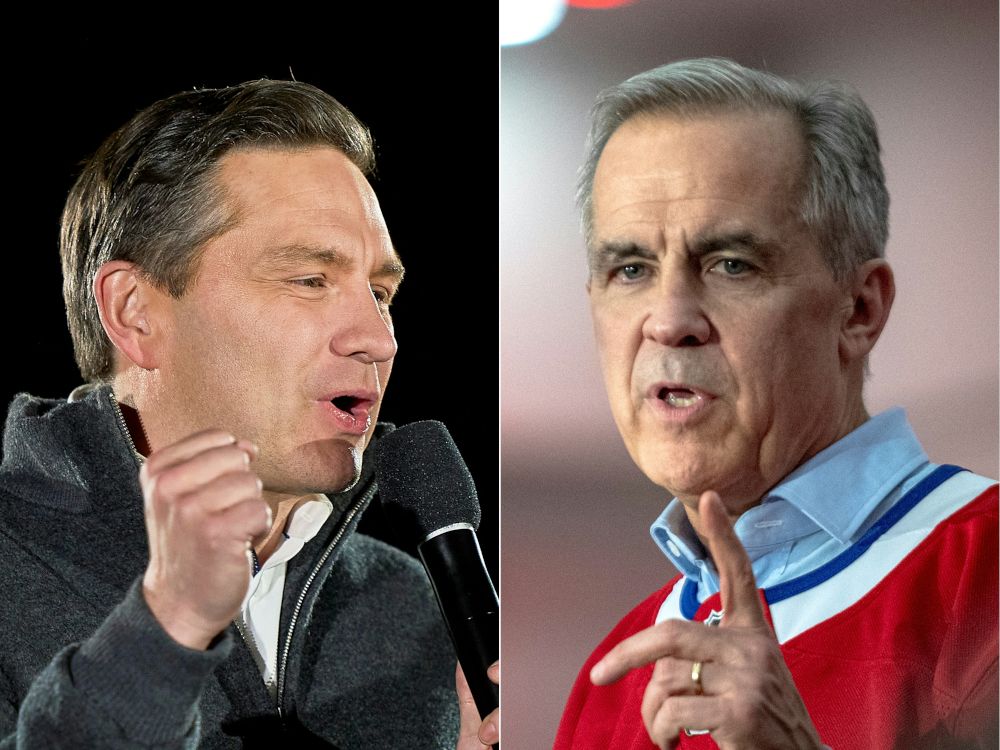
Polling found that more Canadians believed that Liberal Leader Mark Carney, right, was better suited to deal with U.S. President Donald Trump than his rival, Conservative Leader Pierre Poilievre, left.

Prime Minister Mark Carney’s Liberals successfully

held onto power

in Monday’s federal election. Yet Carney’s victory had virtually nothing to do with him. It was caused by the mistaken belief of some Canadians that he was the best choice to defend Canada against U.S. President Donald Trump.

A March 30

Ipsos poll

revealed those sentiments. Carney and Conservative Leader Pierre Poilievre were well ahead of the other party leaders as being the best choice for prime minister. Nevertheless, the former led the latter in 15 of 18 categories, including “Someone who is best to manage during tough economic times” (42 to 27 per cent) and “Someone who is best to represent Canada on the world stage” (43 to 28 per cent).

When Ipsos asked respondents which party leader “can stand up to President Trump,” Carney surprisingly led Poilievre by 12 points.

What proof did they have? None. There wasn’t a scintilla of evidence in Carney’s favour. It was a case of a Liberal Pied Piper using a magic flute to charm gullible Canadian voters and lead them down a path paved with sorrow and regret.

Carney and Trump had no existing personal or political relationship. They had a “constructive conversation” on March 28 about Canada-U.S. relations and “agreed to begin comprehensive negotiations about a new economic and security relationship immediately following the election,” according to

a readout

of the call.

Trump then

spoke with Carney

on Tuesday to congratulate him for winning the election. “The leaders agreed on the importance of Canada and the United States working together — as independent, sovereign nations — for their mutual betterment,” read a brief transcript from the Prime Minister’s Office, and they “agreed to meet in person in the near future.”

Both calls seemingly went smoothly. The conversations sounded more pleasant than Trump’s dealings with his favourite whipping boy, “

Governor Trudeau

.” Alas, they didn’t reveal much about the future of Canada-U.S. relations.

What was revealing was when, on Wednesday, a reporter asked Trump what relations with Canada might be like after the Carney talked about American betrayal during the election. The

president responded

:

“Well, I think we’re going to have a great relationship. He called me up yesterday. He said let’s make a deal. You know, he was running for office. They both hated Trump and it was the one that hated Trump I think the least that won.

“I actually think the Conservative hated me much more than the so-called Liberal. He’s a pretty liberal guy. But no, I spoke to him yesterday. He couldn’t have been nicer and I congratulated him … he’s a very nice gentleman, and he’s going to come to the White House very shortly.”

This may sound positive for Carney on the surface. But if you read it more closely and think about it more deeply, it’s hard to escape the conclusion that it’s actually Trump doing a victory lap.

The president likely realized early on that Poilievre wouldn’t readily do his bidding and criticized him on a few occasions.

“I think his biggest problem is he’s not a MAGA guy, you know? I mean, he’s really not … a Trump guy at all,” he

told the Spectator

in February. Trump also

told Fox News

that Poilievre is “stupidly no friend of mine,” and, of notable interest, “I think it’s easier to deal actually with a Liberal.”

Trump, like many Canadians, was tired of former prime minister Justin Trudeau’s incessant left-wing rhetoric and political platitudes. Carney is another weak-willed Liberal  who is brighter and more capable than Trudeau, but he’s socially awkward, aloof, egotistical and doesn’t possess a backbone.

Trump, who has always had an innate ability to identify weaknesses in people and those he can push around with ease, might believe he has found the perfect pigeon. Which is why the president seemed so happy about the outcome of the election.

Carney, an economist who served as the governor of the banks of Canada and England, is politically inexperienced. He’d never run for a parliamentary seat before this year’s election.

He doesn’t understand how to survive the dog-eat-dog world of politics. He has no idea how to run a political party, deal with internal party disagreements and inter-party strife, or build bridges with opponents and critics.

Trump is also a more complex political opponent than anything Carney has ever faced — and he’s barely faced anyone to date. Trump will tear Carney to shreds and continue to get his way.

When it comes to Trump, Carney isn’t going to succeed in standing up to him where so many others have failed.

National Post


Canadian Prime Minister Mark Carney arrives to address supporters at his campaign headquarters on election night in Ottawa, Tuesday, April 29, 2025. THE CANADIAN PRESS/Nathan Denette

It seems unlikely Canada has ever experienced so many people putting so much effort into an election without settling much. If anything, the country faces more unanswered questions today than it did when the campaign began.

Not settling issues is becoming a Canadian standard. We’ve had eight elections since 2004, six of them ending in minority governments. Only Stephen Harper and Justin Trudeau managed majorities, and neither could convince voters to give them another. Maybe we’re just chronically dissatisfied. Or maybe we’re less than enthused by what the parties have offered up in the way of leadership.

Prime Minister Mark Carney doesn’t have a majority but he also doesn’t have much opposition either. Pierre Poilievre and Jagmeet Singh both lost their seats. Singh resigned, Poilievre is hanging on to see what develops, but will have much explaining to do in the Conservative post mortem. Yves-François Blanchet found the constricted little world he inhabits in Quebec reduced even further, reduced to just 22 seats and slightly more than a quarter of the vote in the only province he cares about. Elizabeth May proved once again that Canada’s Green Party consists of Elizabeth May. Maybe they should quit kidding and name it after her, and relieve themselves of the embarrassment.

None of them will want another election soon. Of all the leaders, Carney has the clearest to-do list ahead of him: seek to wrangle some semblance of sense from the rampaging horror show that is the current U.S. administration, while trying to keep the country afloat in the meantime. It won’t be easy, but at least he knows what’s expected.

Not so the others. The New Democratic Party stumbles from the contest uncertain as to why it exists, and whether it should keep trying. Singh devoted two years to propping up a government that was on en route to self-destruction, and saw his career evaporate as a result. The seven remnants who now make up the Ottawa caucus could supply Carney with the votes he needs to push through an agenda, but do they want to repeat the same mistake so soon?

New Democrats have to ask them themselves what they’re in it for. Acting as an ongoing safety valve for Liberals in need could persuade many of those who fled to the Liberals to make a home of it full-time. The alternative is to coalesce as a leftist front, accepting their status as a movement rather than a party, with no pretense of ever running a government. It’s never been clear which they prefer, going back to the party’s birth half a century ago as a mouthpiece for labour unions and what was then known as democratic socialism.

Conservatives don’t have to worry about their existence, but they do have to accept that the world has changed and their strategies must change with it. Voters did not accept Carney as “just like Justin” and may not ever. The smooth post-Trudeau transition, in fact, suggests Liberal voters were never overly fussed with the party or its policies, no matter the depth of damage they wrought on the economy, but were simply fed up with the leader, and hope Carney will prove smarter and more competent. Should Poilievre remain as leader — no sure thing, though his 41 per cent share of the vote beats every Tory leader since Brian Mulroney — he can’t simply continue attacking the past.

If Conservatives choose to replace him they can’t hope to retain his obdurate approach, or keep treating the party’s centrists as defeated rivals from an earlier era. The politics of resentment might have worked against Justin Trudeau, had he stayed, but Canada is not Justin Trudeau, as even Liberals came to understand.

Carney now has to show which of the two versions of himself is the one we’ll be seeing, the hard-nosed banker or a big-spending, heavy-borrowing example of Liberal carbon paper. His development as a politician included quick learning skills when it came to avoiding clear answers to repeated questions and refusing to clarify the math behind his spending promises, even though we know he’s skilled at numbers. His resume suggests there’s more to the man than he showed us, but he’ll need to demonstrate that quickly with actions in place of words.

His priorities must include the matter of western discontent, which has moved past simple disaffection and is well into estrangement. How much longer can Liberals get away with treating two western provinces as an electoral graveyard, something to whistle their way past on the way to British Columbia, without endangering Confederation itself?

It took Alberta Premier Danielle Smith about a heartbeat to transmit this message to Monday’s victor. “Albertans are proud Canadians that want this nation to be strong, prosperous, and united, but we will no longer tolerate having our industries threatened and our resources landlocked by Ottawa,” she said after offering Carney the required congratulations.

“A large majority of Albertans are deeply frustrated that the same government that overtly attacked our provincial economy almost unabated for the past 10 years has been returned to government.”

Eastern Canadians tend to discount western alienation in a way they’d never treat Quebec’s ceaseless complaints, perhaps because many have no memory of the surge in anger caused by assaults from Ottawa in the 1970s and 1980s, or the rise of Reform and steady sense of estrangement in its wake. It may be comforting to view Smith as some sort of MAGA-ist crank; it’s more pertinent to ask why Albertans would put a crank in power unless their patience with Liberal indifference, and Canadians’ complicity in it, was at an end.

Lester Pearson never managed a majority in his five years as prime minister yet accomplished more than most of his successors who did. Health care, a pension plan, student loans, not to mention the auto pact and the magnificence of Expo ’67. It’s not necessary to have a majority, or to turn politics into a perpetual war game, to provide good government. Our current crop of politicians, Liberal and Conservative alike, have the opportunity to prove that.

National Post


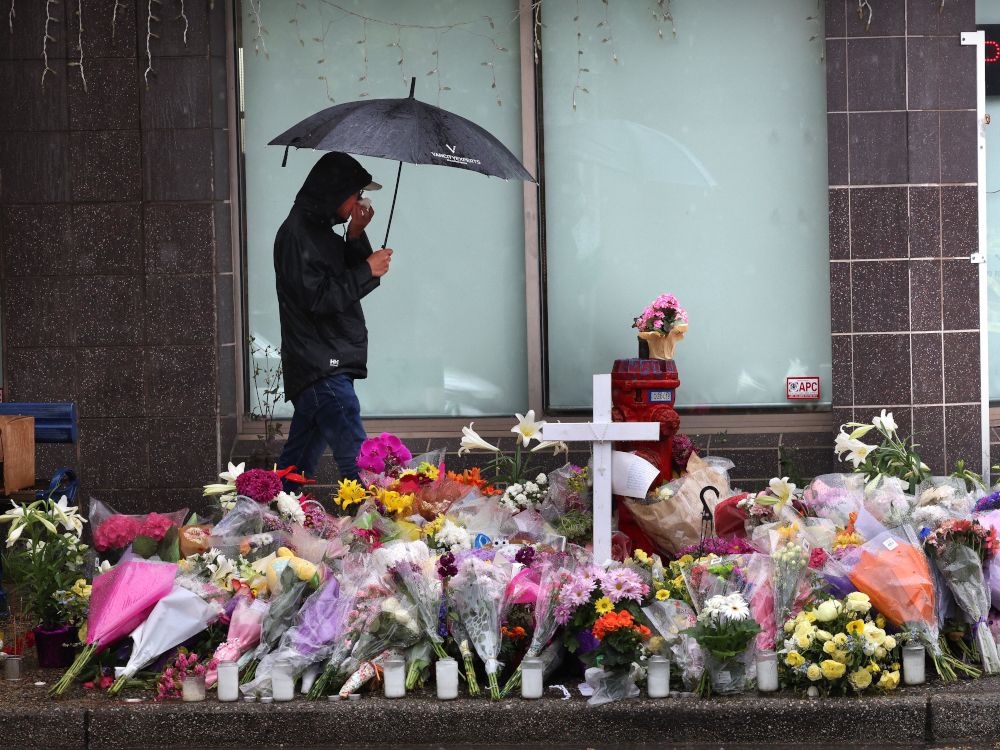
A makeshift memorial is set up for the victims of the Lapu Lapu Day car-ramming attack, in Vancouver on Monday.

The public is learning more about Adam Kai-ji Lo, the 30-year-old man who allegedly drove his vehicle into a crowd at the Lapu Lapu Day festival in Vancouver,

killing 11 people

, including a five-year-old child, last weekend.

Lo was

under the supervision

of a community mental health team, and had dozens of mental-health related “interactions” with police (though he apparently had no criminal record prior to driving an SUV into the crowd of people).

His

family history

is as troubling as it is tragic. The more we learn, the more questions we have. Chiefly among them, of course, is whether the attack could have been prevented. Having spent 13 years working within the province’s acute mental health system, my answer is a resounding “no.”

British Columbia’s current mental health-care system is overburdened, insufficient, understaffed and ruled by managers and directors with more interest in social justice issues — like trauma-informed care and harm reduction — than public safety.

Clients of mental health teams, like Lo, are typically on what is called “extended leave.” This means that they are certified under B.C.’s Mental Health Act, must adhere to certain conditions, such as receiving long-acting antipsychotic injections, and can be recalled to hospital, by a physician, if they fail to meet them.

Such people are assigned a case manager, who is either a nurse or allied health professional, and a psychiatrist. Case managers — who often and rightfully complain about unmanageable caseloads — see patients most often, though this could be as little as once a month, depending on how unwell the person is, or how easy the client is to engage.

All of these people should be seen more often and followed more closely. Yet staff shortages and a growing — and increasingly unwell — client population prevent this from happening. Without knowing the specific details of Lo’s case, it is nevertheless a safe assumption that his mental health team did their best under the constraints of a system that sets them up for failure.

It is obvious to the public that Lo, having had dozens of run-ins with the police, was not being adequately supported in the community. He needed better care. He needed, frankly, to be institutionalized.

Postmedia

reported

that Lo’s family contacted a psychiatry ward in the hours before the attack. Here’s what would have likely happened during that call: hospital staff would have told the family member to call 911 for an emergency, or, if not dire, to call Lo’s mental health team during business hours.

Since Lo was not an inpatient, the staff who took the phone call would not have had any professional obligation to follow up on it. Nor would staff have legal permission to view Lo’s health records.

Perhaps, in decades gone by, a hospital nurse would have investigated or followed up on such a call. But today, not a chance. Hospital nurses, like the community case managers, are typically burnt out and managing increasing patient loads — both in numbers and in acuity. We have more patients than ever, and they’re far sicker than they’ve ever been.

Making matters worse, psychiatric units are wholly unequipped to handle patients who have committed a violent act. I’ve seen patients bounced in and out of hospital wards by frustrated management and physicians who do their best to prevent them from being admitted, or release them early, because nurses and other staff — even other patients — are regularly assaulted by such people. These violent assaults happen far more often than the public sees in the media.

In addition to the 10 involuntary care beds that the B.C. government just opened at the Surrey Pretrial Services Centre, the province has limited space at its

Forensic Psychiatric Hospital

. Referrals to this program must come via the courts, not from health-care facilities. People involved in the forensics program — which also offers community care — can, and often do, end up in hospital psychiatric units.

Such patients disturb the “therapeutic milieu” that the health authority, and its out-of-touch leadership, envision for psychiatry units, which is one of a safe, quiet spot for trauma-informed healing. (As defined by the University at Buffalo School of Social Work,

trauma-informed care

“understands and considers the pervasive nature of trauma and promotes environments of healing and recovery rather than practices and services that may inadvertently re-traumatize.”)

The policies, and pervasive attitude, that elevate “trauma-informed care” also actively discourage staff from using “harsh” methods, such as seclusion rooms or restraints. It is often seen as a failure of nursing staff to not be able to de-escalate patients — who pose a significant risk when wandering freely on a psychiatric unit full of vulnerable patients — before they snap and become violent. Nurses are afraid to use these methods, lest they violate policy that says seclusion is “traumatic” and must always be a last resort.

The vision of B.C.’s mental health system as a therapeutic, trauma-free utopia doesn’t track with reality. The system we have is not the system we need. We have a serious mental health crisis on our hands, which is obvious to anyone working in the system.

Yet this hasn’t stopped health authorities from fattening up middle management and creating more and more positions that take skilled workers off the front lines, planting them instead in offices where they attend endless Zoom meetings to discuss the latest in diversity, equity, and inclusion, or spend years developing policy documents that frontline workers will never lay eyes on.

Meanwhile, dangerous patients are assaulting staff, or quickly discharged from hospital — posing a risk to the public — in attempts to prevent it.

The public can only hope there is not another would-be attacker having a psychotic breakdown, experiencing urges or hallucinatory commands to commit violence, who has gone undetected by our abysmal mental health system.

A lot must change, and fast. We need more involuntary beds. And we need to move bureaucrats back to the front lines where they belong, providing care and witnessing the stark reality of B.C.’s mental health crisis.

National Post


First Reading is a Canadian politics newsletter curated by the National Post’s own Tristin Hopper. To get an early version sent directly to your inbox, sign up here.

TOP STORY

As the U.S. awoke to a renewed Liberal government on their northern border, Americans of all political persuasions embraced the view that they — for better or worse — had caused it.

“Carney owes his job to President Donald Trump,” was the Tuesday view of the Washington Post editorial board, declaring that the U.S. president had singlehandedly thwarted the election of a populist Conservative government in Canada.

The Centre for American Progress Action Fund — a left-wing Washington, D.C.-based think tank — framed Carney’s win as a model for how anti-Trump rhetoric can win elections.

“Prime Minister Carney’s success demonstrates that resistance to President Trump’s bullying has mass popular appeal,”

read a statement

.

Actor Billy Baldwin, a perennial backer of progressive causes, cheered Carney’s victory with a viral social media post declaring “Trump singlehandedly delivers the election for the liberals in Canada with his 51st state bullsh-t.”

Even Rolling Stone, which put Justin Trudeau on the magazine’s cover in 2017, opined that Canada’s newest Liberal government was effectively a Trump creation. “Donald Trump single-handedly elected a new Canadian Liberal Government that was down 25 points in January with his endless ‘51st State’ bloviation,”

wrote the publication

.

Conservative podcaster Ben Shapiro broke down the Canadian election in an extended segment on his Tuesday show, framing it as a direct failure of Trump’s foreign policy.

“Let’s be real about this; the rhetorical attacks on Canada have not actually resulted in a net good for the United States,” said Shapiro. A perennial critic of Trump’s tariff policy, Shapiro said that the White House’s habit of “yelling at Canada” had helped install a “far left-leaning internationalist” hostile to U.S. interests.

“All of this started off as a joke, and I think President Trump is so committed to the bit at this point that he couldn’t get off the train,” said Shapiro, in reference to Trump’s repeated pledges to turn Canada into the “51st state.”

A Republican consultant

quoted anonymously by Politico on Tuesday

 was of a similar view, saying the outcome in Canada was a “pretty specific result based on the tariffs and 51st state trolling.”

Trump himself appears to be of the view that he bears responsibility for the Canadian result. Just prior to the campaign, Fox News host Laura Ingraham directly accused Trump of aiding the Liberals with his anti-Canada rhetoric, to which Trump replied “I don’t care.”

“I’d rather deal with a liberal than a conservative,” he added.

On Monday, The Atlantic published an interview with Trump in which he acknowledged that Conservative Leader Pierre Poilievre had been on course for victory prior to his own November victory.

“You know, until I came along, remember that the conservative was leading by 25 points,” said Trump, adding “I was disliked by enough of the Canadians that I’ve thrown the election into a close call.”

The reaction of some Trump allies was to blame Poilievre himself, alleging that he “

blew it

,” or hadn’t been sufficiently deferential to Trump’s Make America Great Again banner.

“This isn’t about Trump. (Poilievre is) just a bad candidate with a worse campaign. Poilievre is Canada’s Mitt Romney,”

read a viral tweet

by the MAGA-aligned X account Election Wizard.

Curt Mills, editor of the American Conservative, said Poilievre would have been “Canuck DeSantis,” a reference to Ron DeSantis, the popular Republican governor of Florida who challenged Trump for the 2024 Republican nomination.

“Trump will (and has already) weirdly get on with Carney,” wrote Mills in a social media post. “Trump vibes with the smart, hyper-Machiavellian center left type.”

The heterodox U.S. publication Compact similarly tried to position the win of Carney as a kind of indirect Trump victory, as the Liberals had won on an unusually nationalistic program.

“The fact that the liberals were only able to beat Trump by embracing the language of national independence, national interest, and sovereignty make clear that Carney’s electoral victory happened on Trumpian terrain,”

read a Wednesday analysis

.


IN OTHER NEWS

The world’s non-U.S. media was also quick to frame Canada’s race as the “Trump election.”  A sample of headlines:

  • Canadian PM Mark Carney wins snap election upended by Trump’s threats. Le Monde (France).
  • Trump made Carney’s turnaround victory possible. BBC (United Kingdom).
  • Canada’s Liberals ride Trump backlash to comeback election victory. RNZ (New Zealand).

India’s NDTV, meanwhile, was

just happy

that former NDP Leader Jagmeet Singh was gone. Singh has long been unpopular within conservative Indian circles for his perceived warmth towards Sikh nationalism.

And Chinese state media

reported

that China will “develop its relations with Canada based on mutual respect, equality and mutual benefits” after the election, although that’s pretty standard talk for Chinese media.

The Conservatives’ only chance at winning on Monday night was to attract outsized rates of voter turnout. That obviously didn’t put them over the finish line, but voter turnout did end up being slightly higher than normal. About

68.7 per cent of eligible voters cast a ballot for the 45th Canadian general election

, the highest since 1993 – and a rate far higher than the 62.6 per cent who showed up in 2021. Still, this means that the largest single block of voters in this election was the non-voter. The Liberals were re-elected by 30 per cent of eligible voters, while the non-voter tally came to 31.5 per cent.

This newsletter covered the phenomenon of more than 300 candidates endorsing a “Vote Palestine” platform pushed by the Palestinian Youth Movement, an extreme anti-Zionist group that openly celebrated the October 7 massacres. Well, 93 per cent of those candidates didn’t get elected, including

some of the most vocal anti-Israel MPs in the House of Commons

. Among them were New Democrats Niki Ashton, Blake Desjarlais, Matthew Green and Joel Harden.

Get all of these insights and more into your inbox by signing up for the First Reading newsletter here.


Prime Minister Mark Carney speaks to the media upon arriving at his office on Parliament Hill April 29, 2025 in Ottawa, Canada. (Photo by DAVE CHAN/AFP via Getty Images)

It’s a verdict that’s rapidly embedding itself as the answer to the riddle of the Liberal party’s revival from its vegetative state as recently as last December to this week’s election-day comeback, only a handful of seats shy of a majority in the House of Commons: Party standard-bearer Mark Carney owes his triumph to Donald Trump.

The notion is particularly popular in the United States. In Democratic party circles, especially, Canadians have lately become celebrated as plucky allies in the gallant resistance to their daft president’s jingoistic threats to break all the rules of global neoliberalism, annexing Canada along with Greenland in the bargain.

There’s definitely a case to be made for the proposition. Canadians are furious about all this, and a suave and worldly big-money asset manager should be presumed to possess a competence and dexterity that would definitely count as an advantage in the daunting work of muddling through the mercurial president’s tariff-war belligerence. Then again, Carney’s unique skill set would also lend itself well to the fashioning of elaborate masquerades of ad valorem equivalents, GATT Article 20 exemptions and other such resorts to the highly-specialized vocabulary of international trade pacts in order to camouflage a capitulation to the White House, or a suicidal deepening of economic dependence on China. You could dress these things up as masterstrokes of highbrow statesmanship.

But never mind that. The Liberals successfully marketed Carney as a kind of Svengali, and a significant body of voters bought it, so fair play to the Liberals.

It’s just that the presence of a dangerous president in the White House might not have been that much more significant in the scheme of things than the bizarre absence of someone else.

You’d never know it, but until just last month, Canada’s prime minister was Justin Trudeau. After Carney was formally anointed March 9 at the conclusion of the heavily ritualized Liberal leadership succession, Trudeau simply vanished from public view. He’d been prime minister for nearly a decade, and he was suddenly made invisible.

Everyone appears to agree that the just concluded federal election was one of the weirdest and most momentous ever. Carney has called the election “one of those hinge moments of history,” and it was. “Existential” is a word that came up a lot.

We know Justin Trudeau still exists. On March 17, he posted a selfie on Instagram. He was buying kitchen utensils at a Canadian Tire store, apparently in Ottawa. The Globe and Mail has cited unnamed sources who say Trudeau is renting a house in Ottawa’s Rockcliffe neighbourhood. That’s all we’ve heard from him.

The peculiarity of this state of affairs can be explained by the Liberal party’s understandable determination to induce a state of amnesia in the electorate, owing to the catastrophe of the Liberals’ more than nine years in power and the galloping unpopularity of Trudeau himself. By the final days of 2024, the Liberals’ approval ratings had been reduced to what pollster Angus Reid calculated at just 16 per cent.

It would be dead wrong to conclude that the threat of Trumpist inanity was merely an electioneering artifice manufactured by the Liberal campaign war room, but Carney did lean hard into Trump’s incitement of Canadian anxieties. Thus, the post-election verdict: Trump handed Carney a victory.

Global News: “It’s almost like a mania: How Trump won Carney the federal election.” The Washington Post: “Trump helped elect a liberal leader in Canada.” The BBC: “Trump made Carney’s turnaround victory possible.” Vox: “How Trump lost Canada.” Rolling Stone magazine: “Trump Inserts Himself Into Canada’s Election and Liberals Can’t Stop Saying Merci.” Le Monde: “Canadian PM Mark Carney wins snap election upended by Trump’s threats.”

Apart from some outliers, that’s pretty much the received wisdom. An exception, reported by the Montreal Gazette: ‘‘Mr. Carney owes one to Quebecers after election night,” according to Quebec premier François Legault. And he has a point.

Oddly, Canadians aren’t saying these things.

A deep dive by the United Kingdom pollster Focaldata for Politico found that while three-quarters of Canadian respondents said they had come to distrust the United States, 60 per cent of Canadians said “inflation and the cost of living” was their top concern as they considered how to vote, and only 39 rated Canada-U.S. relations as their big worry.

So if not Trump, then who does Mark Carney owe for his election victory? To some extent all those Bloc voters in Quebec who flocked to the Liberals, but across Canada it was traditional New Democratic Party voters that Carney should be thanking. If it weren’t for the self-destruction of Jagmeet Singh’s NDP, the Conservative Pierre Poilievre would be Canada’s prime minister today.

The NDP ended up with only seven seats, well below the threshold for “official” party status and all the benefits and resources that come with having at least 12 MPs in the House. That’s down from the caucus of 24 MPs who kept Truedeau’s minority government in power through the Liberals’ lowest standings in its approval ratings. That’s who Carney should be thanking: NDP voters who came too to late the realization that the Liberals were always going to be better at playing the politics of “progressive” postmodern leftism, because it’s a style that suits the Liberals’ base in the boardrooms, in the managerial caste, the public sector aristocracy, the faculty lounges and the corporate human-resources sector.

That’s what you get for abandoning the working class, in other words. From reducing themselves to the Liberals’ minority backstop in the House of Commons, the NDP is reduced again to playing an even smaller part in the Liberals’ legislative agenda, if they’re going to be relevant at all.

Apart from the campaign-period polemics, there wasn’t much of substance that separated the Liberals from the Conservatives in their proposed approach to Trump. Poilievre backed Ottawa’s countertariffs and made it plain that he was focused on the fate of ordinary working Canadians. And Trump made it clear that he held Poilievre in decidedly low esteem.

The Conservatives can be faulted for failing to articulate a patriotism that was fit for the purpose of the national mood. With or without Trump, there was bound to be an eruption of pent-up patriotism after nearly a decade of the Trudeau government’s tendency to encourage the idea that Canada is just a systemically racist, genocidal colonial settler-state.

But when the votes were counted, the Conservatives nonetheless registered a higher share of the popular vote than in any election this century. Their 41.4 per cent vote share was higher than Justin Trudeau managed to attract in his only Liberal majority government, in 2015.

That would have been more than enough to trounce Mark Carney were it not for the defection of all those New Democrats to the Liberals. So that’s what really accounted for Carney’s victory, when the rubber met the road. Donald Trump’s imbecilities mattered less than the overdue realization among quite a few New Democrats that their party was just a stand-in for the Liberals, that the NDP didn’t stand for anything “existential” beyond that. And so the NDP has pretty much collapsed, because if you don’t stand for something, you’ll fall for anything.

National Post


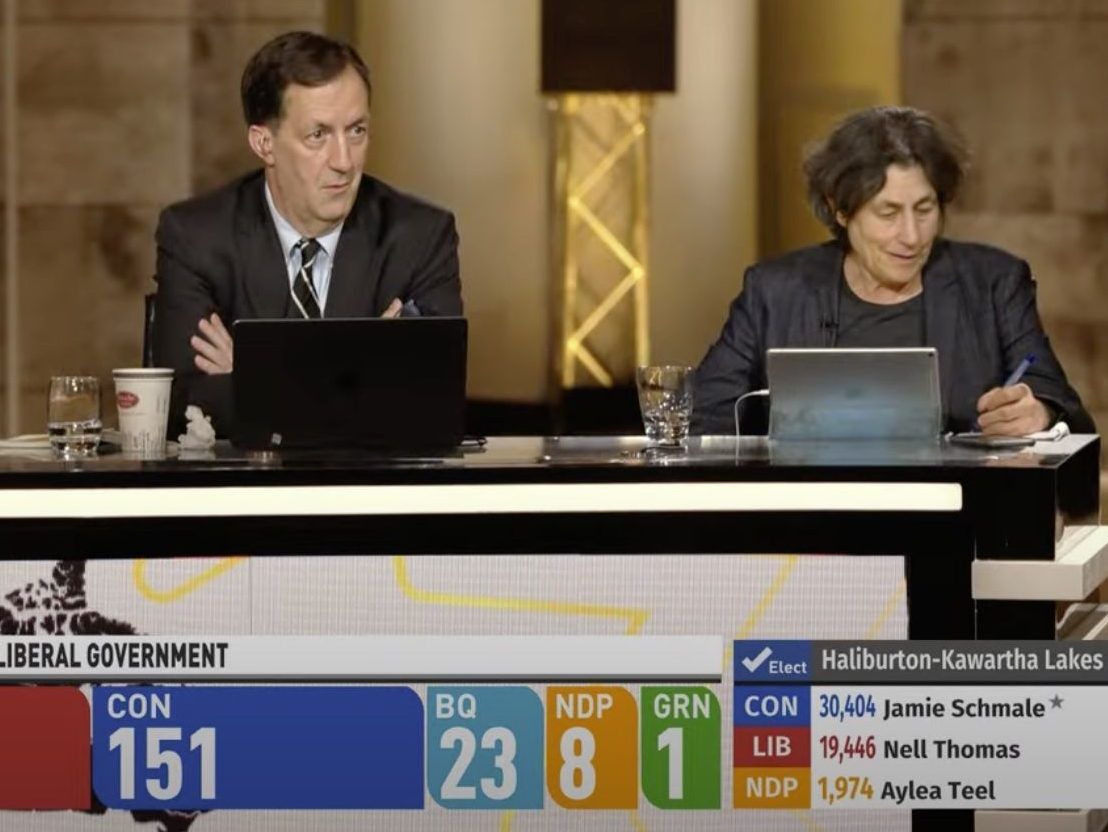
Andrew Coyne and Chantal Hébert from CBC's at Issue Panel on election night, Monday, April 28, 2025. (Screenshot of CBC broadcast on YouTube)

During

election night coverage

, some CBC pundits dropped much of the pretense of impartiality as soon as an “at least Liberal minority” was predicted shortly after 10 p.m. ET. At this point, the national broadcaster’s hosts and commentators could breathe a sigh of relief that they wouldn’t be delivering their own eulogy.

Conservative Leader Pierre Poilievre campaigned on defunding the English service of CBC, which, post-election, would have been forced to be self-reliant, rather than propped up by government and Canadian taxpayers despite poor viewership and constant complaints about anti-conservative bias. And if this didn’t give CBC pundits cause to celebrate, the Conservatives’ projected loss meant that not only would CBC not be defunded, it’d be accepting a boost of $150 million from Mark Carney’s Liberals. A few CBC pundits’ sudden shift of tone and election night commentary made this conflict of interest painfully obvious. The CBC’s subsidy is already a whopping $1.4 billion.

Under their “Protect Our Shared Canadian Identity for a Change” section of their platform, Poilievre’s Conservatives promised savings to Canadians through “defunding the CBC and reforming Crown corporations while maintaining Radio-Canada services.” Their main argument is one shared by many Canadians, including CBC pundit Andrew Coyne, that: “English-language CBC should be a Canadian-owned, self-sufficient media organization that is a not-for-profit and supported by listeners, donations, sponsorships, ad revenue, and licensing revenue.”

There are good reasons to support such a change, including CBC’s viewer/readership levels, exorbitant bonuses paid to executives despite its poor performance, and the fool-headed notion that a Crown media corporation should even exist (for obvious political reasons), let alone be concerning itself with defining national identity in terms of what it deems “

predominantly and distinctively Canadian.”

As well, CBC, as a Crown corporation, puts every private broadcaster, newspapers such as National Post and the Globe and Mail, as well as online-only outlets at a huge disadvantage. A strong argument can be made that CBC’s free online news articles and broadcasts are hobbling private media and causing the need for labour subsidies for these outlets in the first place. As it stands, the Liberals have decided you have to pay for a CBC subscription by default. Conservatives simply believe you should have the autonomy to make that decision yourself. If Canadians couldn’t wake up and hop onto CBC news online or on television for free, they would possibly have to buy a subscription. Isn’t journalism worth paying for, and shouldn’t it, ideally, be independent from government? 

Perhaps most damaging for national unity, though, and more specific to what was witnessed on election night, are the

constant and increasing complaints of CBC anti-conservative bias, illustrating they are failing at their own mandate to reflect Canadians. This is because, while its mandate mentions representing English and French, multiculturalism and multiracialism, as well as national and regional perspectives, nowhere is there a promise to reflect ideological diversity. And while this is arguably not a necessity for private, independent media — take a look at France and the U.K., which have strong liberal and conservative outlets serving as accepted counterweights in society — surely, a taxpayer-funded, government-owned Crown media corporation, should have to be held to such an ideal if it wants to be seen as both credible and legitimate. 

CBC’s editor in chief Brodie Fenlon

promised

“equitable treatment of the parties” near the beginning of the campaign. He even tried to head off the obvious conflict of interest the broadcaster was in, having been promised boosted funding by Mark Carney’s Liberals, asking and answering his own question, “How are we going to cover ourselves as an election issue?” He continues, “As for covering the CBC, well, yes, the CBC’s funding, and whether it should exist, will likely be an election issue. There’s an inherent conflict of interest in us covering that, but we’ll manage it. We’ve reported on the CBC before as a corporation, and we’ll treat this story like we would the funding of any other Crown corporation. That’s a promise.”

Fenlon misses the point. CBC’s anti-conservative bias existed long before this new funding promise, and would not be solved by his three pillars of “live,” “local,” and “listening.” There’s no evidence CBC has listened and become less anti-conservative. Being live does not address bias if reporters are biased, it amplifies such bias in real-time. There’s also no evidence that focusing on local communities will solve the issue of bias either. These communities have been consuming free CBC bias for decades. So, if they interview someone who gets all their news from CBC, the public broadcaster will simply end up reflecting a bias loop in which they feed a community bias, and a community member reflects their biased coverage back to them.

Election night coverage was not an improvement, at least from the perspective of hoping to see balanced coverage of the Conservatives, as well as the Liberals. Overall, the commentary and physical mannerisms from CBC panelists and hosts throughout the evening communicated distaste for a Conservative party win. Both hosts Rosemary Barton’s and David Cochrane’s tone appeared to turn ecstatic once a Liberal victory was projected. On the flipside, when, earlier in the night, the outlook for the Liberals looked sour, pundits took on that

gloom

in their own mannerisms — speech slowed, mood dired — laughs and giggles were nowhere to be seen.

Barton weighed in subjectively when she told viewers that “

British Columbia could be awfully important

” in terms of Mark Carney forming government, smiling and clucking, while raising her fist to Mark Carney hanging in as prime minister and beating Charles Tupper’s record of 68 days.

During the coverage, which should have included serious political commentary, former Alberta premier Jason Kenney was

the lone voice for Canadian conservatism.

 The At Issue panel of journalists, which Kenney joined at times, contained all progressives, and yes, this includes Andrew Coyne, who at one time may have served as a contrarian voice.

Kenney did his best to try to explain some of the strategy behind Poilievre’s campaign and inject something positive about the Conservative party, countering the dismissiveness of other panelists. He noted some of Poilievre’s successes: his ability to identify issues that matter to Canadians, growing support among working-class and younger voters that the NDP had forgotten, generally broadening the Conservative base, and Poilievre’s effectiveness as opposition leader. Barton’s response to Kenney was to laugh and point out that Poilievre got rid of the things that helped him, including Justin Trudeau and the carbon tax.

When Kenney pointed out that Poilievre “pointedly opposed the Quebec Bill 21 law against religious symbols in Quebec,” he was interrupted by both Chantal Hébert, who said “don’t go there, he didn’t,” and Althia Raj, who ultimately conceded “he says he’s opposed to it,” even if he hasn’t said whether or not he would intervene. What would it take for these pundits to take Poilievre at his word? A blood oath?

Around the same time, several pundits chose to mock Conservative MP Jamil Jivani for expressing anger at Ontario PC Premier Doug Ford, calling him a “hype man for the Liberal party,” comments made after Jivani won his seat, but also after it was clear his party lost. Ford, and his own campaign manager Kory Teneycke were highly critical of the federal Tories during the campaign.

Instead of focusing on the content of Jivani’s complaints, they attacked his

demeanor

, which was admittedly angry. The CBC’s Adrienne Arsenault

commented

: “If only he would speak his mind …., I mean, it’s so unfortunate that he’s so vague about his views.” Coyne called Jivani’s comments a “tirade,” accusing the Conservatives of “scabrous negativity.” Hébert called his complaints a “rant.” Raj described Jivani as having “an aggressive tone.” None of them engaged with the substance of his complaints against Ford.

At one point in the evening, Coyne

jumped in

to “hope” that there would not be any “conspiracy theories” about advance voting after the Liberal win. The suggestion seemed to imply that conservative Canadians are not capable of accepting election results, tying this suggestion to the refusal of Donald Trump and some Americans to accept the results of the 2020 presidential election. There were also some people who initially refused to believe that Hillary Clinton lost to Trump in 2016. Can we please stop pretending Canada is the United States?

More

conspiratorial suggestions

came from Hébert who said after Poilievre’s concession speech, “The first thing I’ll note, is that there was not a hint that he thinks the election result isn’t what it is, and I think it matters these days the person who loses says this result is legitimate.” There’s no evidence this is at all necessary in Canada. Again, it is bringing American concerns into a Canadian election and tying Canadian Conservatives to American Republicans, despite their obvious differences. Why even suggest the refusal to accept results as a possibility? Did Hébert suggest it for NDP leader Jagmeet Singh when he lost his seat? Nope. Would she have for Mark Carney, if he had lost? I’m guessing not.

Election night coverage showed that CBC still has not gotten the message that conservatives exist in Canada, making up around as much of the voting population as liberals, and that upholding principles of fair journalism as a Crown media outlet would require including that ideological diversity without gloom when Conservatives do well or laughter when they do not.

National Post

tnewman@postmedia.com

X: @TLNewmanMTL


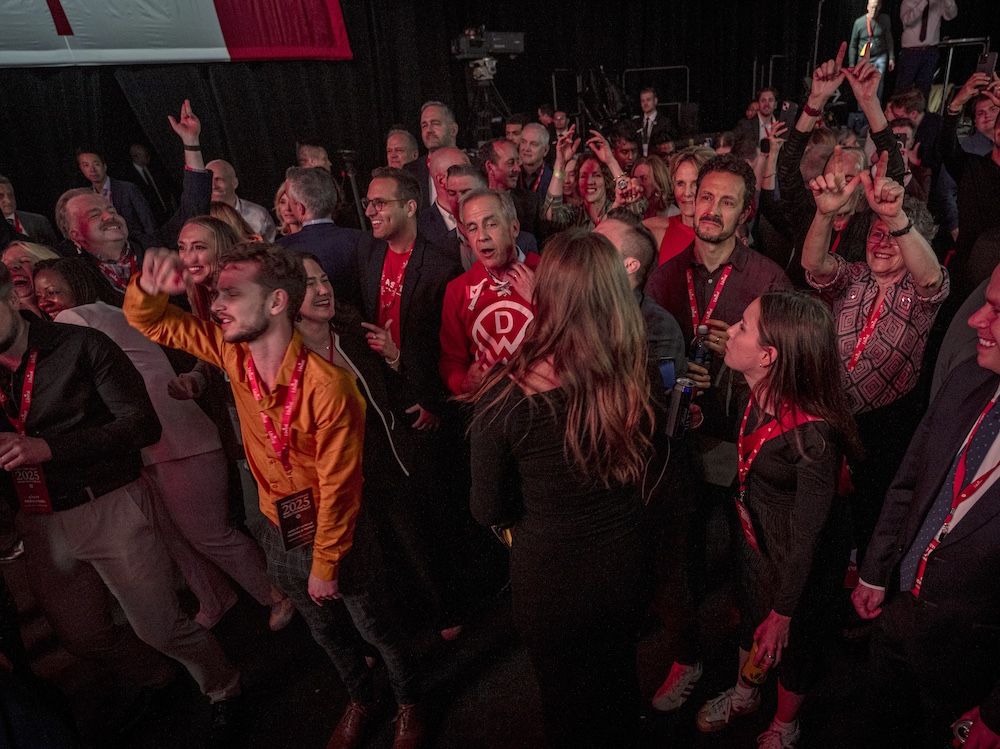
Canadian Prime Minister and Liberal Party Leader Mark Carney dances after winning the Canadian Federal Election on April 29, 2025 in Ottawa, Canada. (Photo by Andrej Ivanov/Getty Images)

In perhaps the most famous scene of the Charles Dickens classic Oliver Twist, the titular character walks up to the formidable beadle, Mr. Bumble, to meekly ask for more gruel. Monday night, Canadians voters asked for more of the same thin policy gruel from our own political beadles by sending the Liberals back to power for a fourth term. A decade of lost economic prosperity, denigration of national pride and failed immigration policy was ultimately not enough to turn the stomachs of the voting public.

The Liberals will fall just barely short of a majority, but still have a stronger mandate than when they left. Mark Carney’s Liberals are close enough to a majority that even the shattered NDP, with a mere seven seats, have enough support for them. Ultimately however, the result sends a message that has to be somewhat depressing: a great many Canadians have determined that the previous decade is one they approve of.

Let’s review that decade for a second.

By nearly every metric the country

is doing worse now than in 2015.

Canadians

feel less pride 

in their country. Our GDP growth per capita

is second to last among

OECD countries and total GDP per capita is

equivalent

to the poorest American states. Since 2015, Canada has been undeniably getting

poorer

, indeed, had our economy stuck to the 2015 baseline trends, we’d all be $4200 per year richer. Crime, including violent crime and drug abuse, are up. Finally, in perhaps the saddest result of all, young Canadians feel hopeless about their prospects of owning a home as prices have skyrocketed, with the average housing price getting more expensive by $43 dollars per day, every day, since the Liberals came to office; adjusted for inflation that’s an increase of over $150,000 for new homebuyers.

These are not the statistics we would normally associate with a populous demanding more of the same. And yet Canadians have just rewarded the Liberals a fourth term. We may search for other answers, but ultimately this vote reflects the fact that a great many Canadians are happy with our decline.

One hesitates to say that voters suffered from a lack of straight priorities, but let’s consider about the evidence we have. This election Canadian voters, specifically Liberal voters, appear to have ignored every domestic indicator of success in favour of threats from a bombastic president down south when deciding how to cast their ballot.

While by now there is little doubt that Donal Trump was the wild joker factor in this election, some Canadians seem to have forgotten is that the U.S. president was nowhere to be found on any ballot across the country despite his larger unavoidable presence. Trump is a problem, no doubt there. But the larger reason Trump can threaten us so well is that we have been collectively weakened by poor governance for nearly a decade.

We should, as Canadians consider this deeply for it raises a question which stalks us and has bedevilled us for decades, but today seems particularly poignant: What and who are we as a nation? In the aftermath of Trump’s election and threats of tariffs and annexation, Justin Trudeau went on CNN, and when asked what it meant to be Canadian, he said

“We’re not American.”

Mark Carney did not offer a more convincing answer during the campaign. Is that really all we can muster as a country and message? We’re just not Americans? Sadly, this vote is giving us a sense that a great many Canadians feel that is all we’ve got.

In any election, however, the loser can not avoid blame. Pierre Poilievre is a better man than his enemies would have him portrayed. But politics is an unsentimental business and there is something about the Conservative leader that voters simply did not respond to. He, and his party, must reckon with this. Is Trump an unfair factor? Yes. Will this matter? It remains to be seen, but Poilievre losing his own seat in parliament will sharpen any knives out for him.

For Carney, the key question is now whether Canada can seize our moment in the face of U.S. pressure? Our relationships with the United States has changed and it has swung an election. Will Carney and the Liberals build out a country to its full potential? Anyone who voted Liberal must believe Carney represents a meaningful and significant shift in economic and energy policy, as well as in national defence. These buildouts must happen. If sharp and decisive change does not happen in these areas, it does not matter who Canadians may or may not think is best to deal with Donald Trump as our country only continue to weaken.

So far, the indicators are not good. Carney has promised to keep Bill C-69, otherwise known as the Impact Assessment Act, and the emissions cap on the oil and gas industry. The day after the election Bloc Québécois leader Yves-François Blanchet (who’s support Carney may well need)

stated

there was “no future for oil and gas, at least in Quebec and probably everywhere.” Canadian energy dominance? I’ll believe it when I see it.

Canadians are more than simply “not Americans.” We are a proud nation with a proud history that has been listless for a decade. The Trump threat has created a unique opportunity for national consensus on developing our nation economically — notably in energy — culturally and militarily. Carney and the Liberals played their Trump card expertly to convince Canadians no one else could lead in the current moment. If they do not quickly make the changes necessary to stabilize and build our country then we are truly staring into an abyss.

National Post