LP_468x60
on-the-record-468x60-white

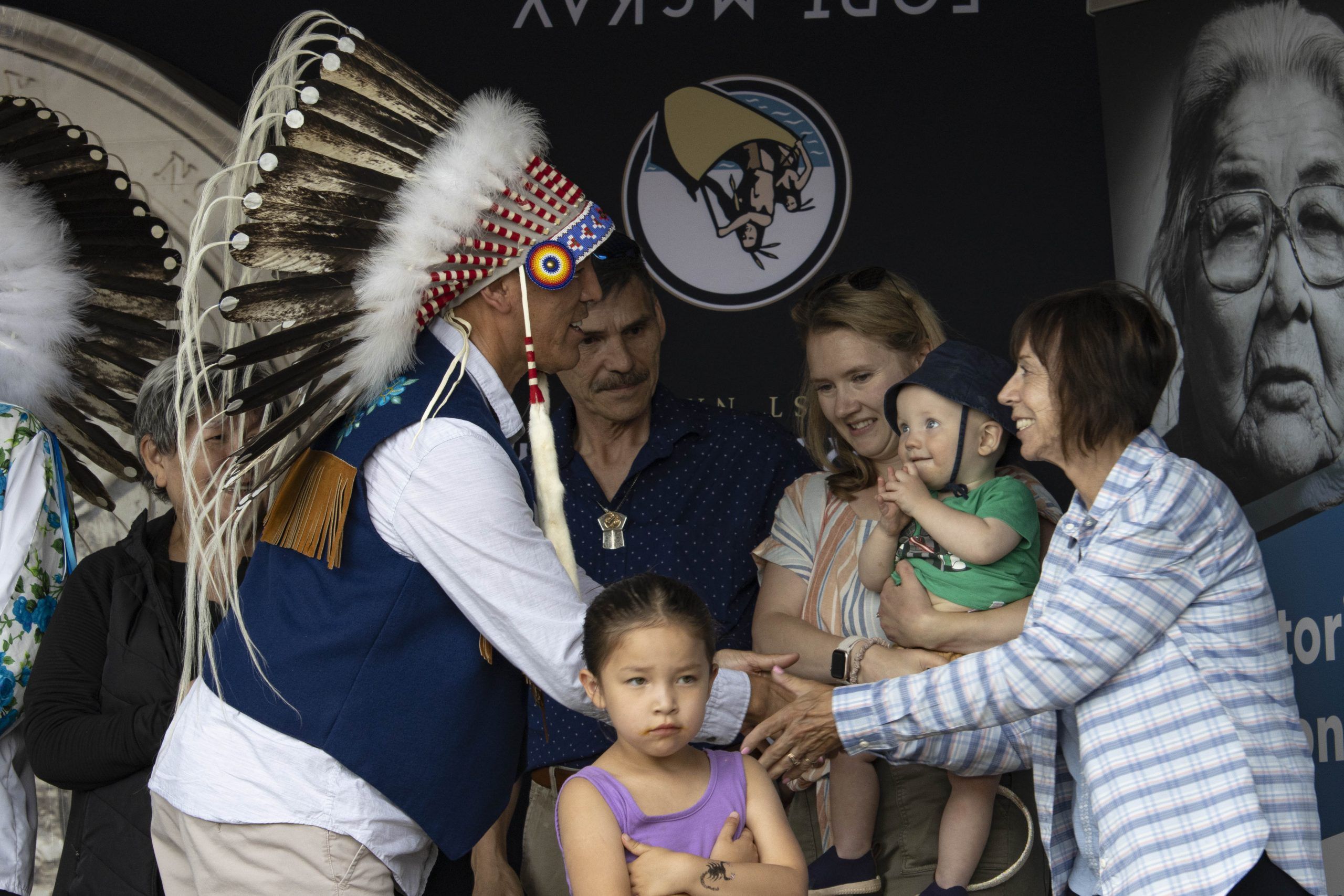
In a file photo from Aug. 3, 2024, Chief Raymond Powder of McKay First Nation in northeast Alberta shakes hands with the late Jane Stroud, a councillor with the Regional Municipality of Wood Buffalo, at an event celebrating the 125th anniversary of the signing of Treaty 8, an historic agreement between the Crown and various First Nations in northern Canada. Chief Powder writes that Albertans frustrated by the Liberal victory in last week's federal election should reject calls for separatism and instead seek reconciliation with the rest of Canada.

Last Saturday, a large crowd of people rallied for Alberta’s independence in front of the legislature in Edmonton. Disappointed that the federal election didn’t deliver their preferred result, many in the group felt a boost when the government of Alberta introduced Bill 54, which will lower the threshold for citizens to trigger a referendum. But that bill has also stirred up anger with another group: Indigenous peoples across the province.

Several First Nations leaders across Alberta have argued the law blatantly disregards Treaty rights. Many in our communities, including in my home Nation of Fort McKay, are outraged and emotional — and understandably so. But today I invite all frustrated Albertans to consider wisdom drawn from the path towards reconciliation.

Anger and alienation towards the government is a feeling that’s all too familiar for Indigenous peoples. The failed extermination of Indigenous cultures, languages and traditions fuelled those exact emotions, and far worse, for generations. Those sentiments have run deep, and have been an unfortunate fact of life with roots dating back before Canada’s Confederation.

But despite having more reasons than anyone to be bitter and resentful, Indigenous peoples are overwhelmingly rejecting separatism. We respect the Treaty relationship we made with the Crown. At times we have had to fight in the courts and negotiate hard to enforce the Treaties, but we have not walked away from the Treaty relationship.

Thanks to that determination, some Indigenous people of today’s generation are starting to see results — tangible improvements to their lives that are directly tied to our demand to be treated with the dignity and respect called for under our treaties with the Crown. But progress is uneven.

In truth, we are only on the first few steps of the road towards reconciliation. For Fort McKay First Nation, that has included making strides on economic reconciliation. After decades of work, today we are both a strong partner in the energy sector that drives Alberta’s economy, and we are environmental stewards developing innovative solutions to protect our land for the future. We got there by working hard, acting in good faith, and being persistent. We built our own financial success, one contract and one company at a time. When we needed to, we fought hard: we first negotiated and then litigated the Moose Lake Accord, which created a protected zone preserving our traditional lands from expanding oilsands development.

Our Nation is a living example of how a commitment to reconciliation and respect for Treaty rights can generate results. We advanced our interests by being reliable partners, using reason, and playing the long game.

Today, Canada is at a crossroads. We are living in a tense, critical time when Canadians’ livelihoods are threatened by a neighbour to the south. The pressure on leaders to make the right decisions is enormous. But the rewards for accomplishing it would be tremendous. For Indigenous peoples, that includes getting a permanent, overdue seat at the table, using new tools to forge our own prosperity, and creating better lives for our children.

Despite the many real frustrations, the threats to our economy have aligned the people of Canada on common goals to a degree that would astonish our ancestors.

A recent poll from Angus Reid shows a clear majority of Canadians, including in Quebec, support expanding the country’s oil and gas pipelines to reach new markets and secure our economy. The federal Liberal and Conservative parties, which together will make up 90 per cent of the seats in the new House of Commons, agree that there is an urgent need to get our natural resources to fresh customers, and to build the infrastructure to do it. In a recent report, RBC pointed out that 73 per cent of the major energy projects that are currently planned for Canada would run through Indigenous territory. For both Canada and Alberta, there is a clear path to opportunity, and the public will to take it.

As human beings, we must always acknowledge our own emotions. Frustrated community voices also have a right to be heard. But it is our responsibility as leaders to act practically, and to be constructive. We must not make a challenging situation even more fraught by feeding our most destructive instincts. The stakes, and rewards, are great enough already.

We must meet the moment. It’s time for us to put the division aside, and get to work together.

Special to National Post

Raymond Powder is the Chief of Fort McKay First Nation, in Northern Alberta.
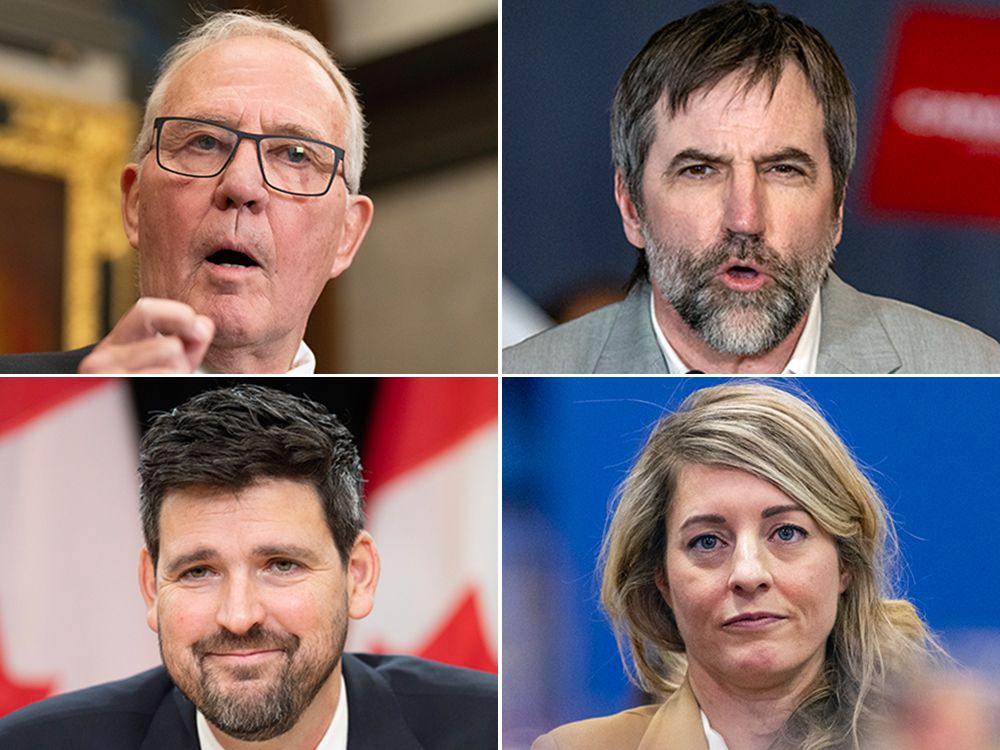

There are some Trudeau-era ministers that most Canadians don't want to see in Mark Carney's cabinet; for example, clockwise from top left: Bill Blair, Steven Guilbeault, Mélanie Joly and Sean Fraser.

Last weekend on NBC’s Meet the Press, President

Donald Trump kiboshed the notion that he might seek a third term as president

. That doesn’t mean he won’t go on CBS’s Face the Nation next weekend and say the opposite, of course, but it’s a reminder that Trump, who’s currently breathing most of the oxygen in Canadian politics, won’t be around forever. And when he’s gone, all the problems that gave credence to Conservative Leader Pierre Poilievre’s “Canada is broken” narrative will still be around. Housing. Law and order. The opioid crisis. Foreign interference in our politics. Landlocked natural resources. We are an inefficient and economically dysfunctional federation, to the point where breaking down

internal

trade barriers is a tall order.

If Prime Minister Mark Carney wants to go down in history as something other than the federal version of former premier Kathleen Wynne — who snatched victory from the jaws of defeat for the Ontario Liberals, then four years rode them into the ground

like Major Kong in Dr. Strangelove

— he is going to need help, and I don’t mean from a bunch of self-styled communications geniuses. The government-by-comms era has to be over if Carney is going to leave the country any better off than he found it.

Carney needs to cobble together a solid cabinet,

which is to be unveiled Tuesday

, that is noticeably different than Justin Trudeau’s cabinet was. Based on April 28’s election results, turning the page on Trudeau was clearly the Number 1 priority for

huge

numbers of Canadians. There are voices we just don’t need to hear from anymore: Bill Blair, Steven Guilbeault, Mélanie Joly and the narrowly re-elected Sean Fraser come to mind, but three of those made it into the

provisional cabinet Carney quickly assembled in March

.

Blair has no business there after

his alleged meddling in the RCMP’s investigation into the 2020 massacre in central Nova Scotia

, or

after taking 54 days to sign a warrant allowing CSIS to investigate foreign interference

in Canadian politics. Really,

his handling of the G20 debacle in Toronto in 2010

, during which he was chief of the city’s police force, should have long ago thwarted any political ambitions he had in the first place.

Guilbeault is popular in Quebec, but he makes very little sense to the rest of Canada (and seemingly vice versa). His current position as Carney’s Quebec lieutenant might make sense going forward. His reinstallation by Carney in March as heritage minister — now dubbed Minister of Canadian Culture and Identity — does not make any sense. He was a disaster there before, failing completely to defend Trudeau’s anti-internet agenda in English Canada, and there is no reason to believe he would be any better at it now. (Ideally, of course, Carney would simply abandon Trudeau’s anti-internet agenda.)

Former housing and immigration minister Fraser, who decided not to run again to spend more time with his family, then changed his mind when he saw Carney’s numbers suddenly improving — and then

nearly lost Central Nova to the Conservatives

— is always mentioned as one of the most talented communicators in the Liberal caucus. Communicating, alas, doesn’t actually get anything done. It doesn’t build houses, for example, and it doesn’t un-bugger up immigration.

What does Carney do with Chrystia Freeland, who’s currently slumming it at transport and internal trade? A terrible public communicator but one who can forge private alliances across party lines —

notably with Ontario Premier Doug Ford

— she might be a good choice to keep on in the latter job. Internal trade is terribly unsexy and, I imagine, exhausting work, but it’s something Canada needs to get done as a basic matter of national self-respect.

Carney should be looking for substance here, not tone. And while I wouldn’t be so naïve as to suggest Carney stock his cabinet according to aptitude rather than MPs’ personal characteristics — he has already said he’s aiming for gender parity and naturally all of Canada’s regions will need to be represented — Carney is blessed with some experienced new options that don’t carry Trudeau’s baggage with them: f

ormer Quebec finance minister Carlos Leitão in suburban Montreal; former Alberta status-of-women minister Stephanie McLean in Victoria; former Saskatchewan environment and northern affairs minister Buckley Belanger in northern Saskatchewan; and Corey Hogan, a former deputy minister under NDP and UCP governments in Alberta, in Calgary.

Assuming Carney appoints ministers with some basic level of aptitude and managerial competence for their portfolios, the real key might be whether they’re allowed to flex those muscles. One of the chief complaints about the Trudeau government was that very little got done without explicit sign-off from the Prime Minister’s Office. There only being so many people at the PMO and so many hours in a day, lots of stuff simply didn’t get done. That included lots of entirely uncontroversial but

crucially important stuff, like appointing judges so accused criminals don’t 

go free for lack of a speedy trial.

“Government by cabinet is back,”

Trudeau laughably promised in 2015

. It wasn’t, and Trudeau got nine-plus years in office anyway. Carney, who’s learning politics on the fly as the prime minister of a G7 nation under historic economic threat from its closest friend and neighbour, doesn’t have that option — not if he wants to last more than a few years, and certainly not if he wants to drag Canada out of its socioeconomic rut.

National Post

cselley@postmedia.com

Get more deep-dive National Post political coverage and analysis in your inbox with the Political Hack newsletter, where Ottawa bureau chief Stuart Thomson and political analyst Tasha Kheiriddin get at what’s really going on behind the scenes on Parliament Hill every Wednesday and Friday, exclusively for subscribers. Sign up here.


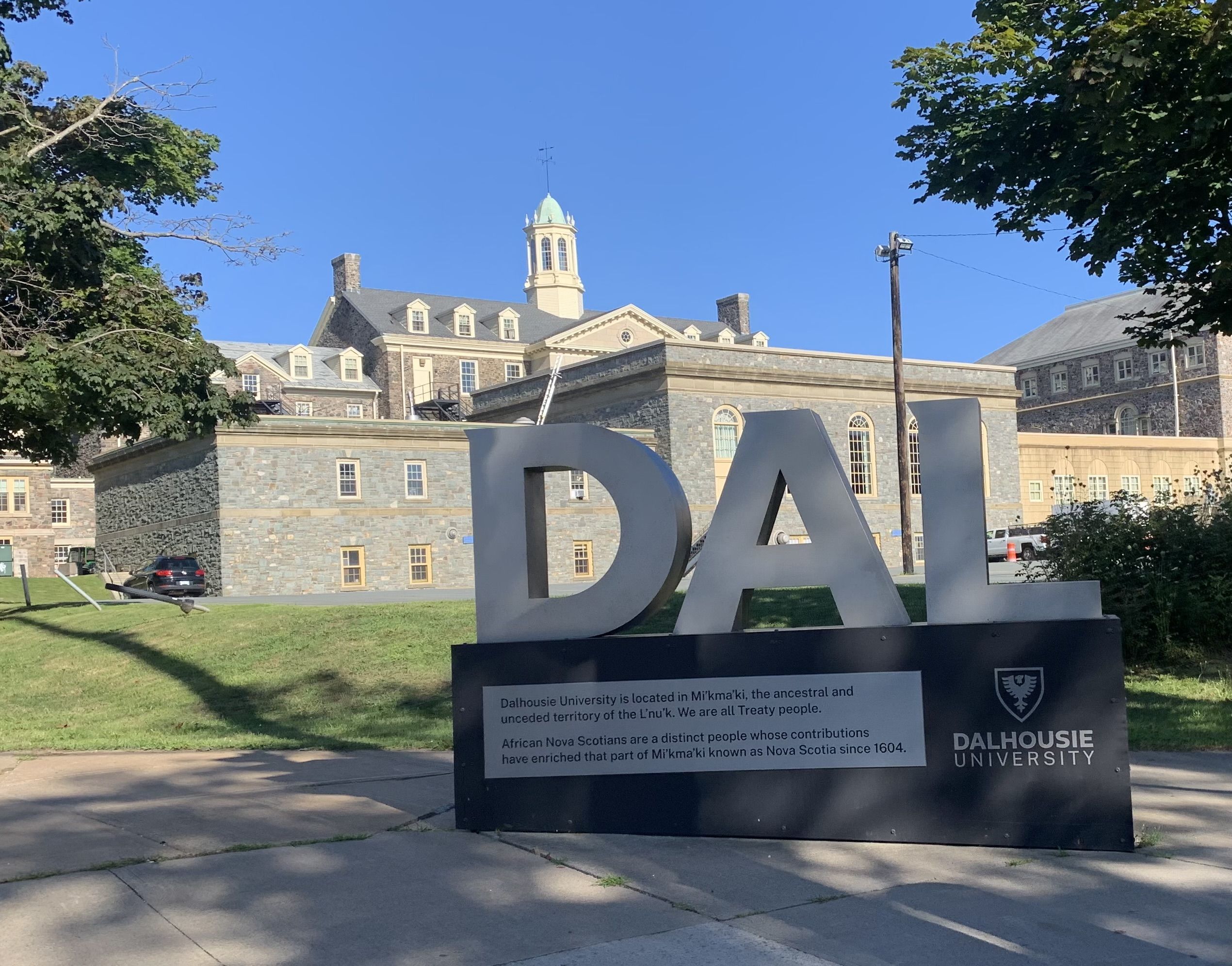
Dalhousie sign with double-acknowledgment.

On Wednesday, what should have been a timely update from the RCMP on the situation of two children who went missing from their home in Pictou County on May 2 — Lily Sullivan, 6, and Jack Sullivan, 4 — began rather awkwardly.

After stepping to the microphone and introducing herself, RCMP provincial public information officer, Cpl. Carly McCann, delivered not one, but two acknowledgments

reading

them both quickly and nervously: “First, I acknowledge that we are in Mi’kma’ki the traditional and unseated ancestral territory of the Mi’kmaq people.”

She continued: “I also recognize that African Nova Scotians are a distinct people whose histories, legacies, and contributions have enriched that part of Mi’kma’ki

,

known as Nova Scotia, for over 400 years.”

The latter was a whole new type of acknowledgment, not based on land, but race, and a claim about the value of a specific race’s enrichment of the province. The announcement seems to imply a sort of hierarchy of culture in Nova Scotia.

This double-acknowledgment was, easily, the most bizarre public relations performance I have ever seen, and I’ve worked in universities. And, of course, that’s where it appears to have come from. In this instance, Dalhousie University.

Under an initiative the school refers to as a

Third Century Promise

, two specific communities are focused on — the Mi’kmaq and African Nova Scotians. A testament to the initiative can be found on one of the campuses signs. It reads, “Dalhousie University is located in Mi’kma’ki, the ancestral and unceded territory of the L’un’k. We are all Treaty people.” There’s a space before it continues, “African Nova Scotians are a distinct people whose contributions have enriched that part of Mi’kma’ki known as Nova Scotia since 1604.”

 Dalhousie sign with double-acknowledgment. Rob Roberts/National Post

Introducing the initiative, then-Dalhousie president Deep Saini asks, “What would it take to lift Dalhousie University, widely recognized as one of Canada’s best, into the community of the world’s greatest universities? And while on that journey, how can we do our absolute best to serve our communities here at home, helping lift their aspirations to the same heights?”

In other words, the main goal is for Dalhousie to be seen as one of the world’s greatest universities, and they see helping these communities as a means to an end in achieving that goal. It’s right there, in black and white.

The Third Century Promise refers to the African Nova Scotian community as “a distinct people with unique needs and talents,” suggests they require “safe, culturally-specific academic, research, social, intellectual and physical spaces,” and implies that this initiative is necessary to “facilitate meaningful and safe integration” into campuses. From my perspective, the university aims to treat African Nova Scotians like children with special needs. There is no evidence this is necessary, and it should be insulting.

This has likely spread to the RCMP due to the initiative’s fifth stated action to: “Prioritize

advancing

the work of Dalhousie’s Diversity and Inclusiveness Strategy, Indigenous Strategy, African Nova Scotian Strategy, and actions that reflect Dalhousie’s commitment to an anti-racist culture.”

Now, putting the valid distinctness, histories, legacies, and contributions of African Nova Scotians aside for the moment, what use did the RCMP see in making this announcement? They’re obviously not looking to be recognized as one of the world’s leading universities.

Is the RCMP in Nova Scotia insecure about past and present treatment of African Nova Scotians? If that’s the reason, say so. Deliver a clear, public apology for each and every wrongdoing, not at a press conference scheduled for an update on missing kids, but at an event tailored specifically to that purpose. Then, move past it. Change policies that may have led to such wrongdoings. If forgiveness is what the Nova Scotia RCMP seeks from African Nova Scotians, then ask for it.

Was it the RCMP’s attempt to show African Nova Scotians that they can trust them? Well, there are better ways to do that, too. They can begin by stating outright that they are, in fact, seeking to earn their trust. They could become a more regular and warm presence at community festivals and participate in youth initiatives. If you want a community’s trust, earn it with actions.

Just don’t blow smoke up their backsides by delivering the vaguest of possible statements about their distinctness, histories, legacies, and contributions to the enrichment of the province. They know what they are.

Like the land acknowledgment which preceded it, this was a shallow ritual. Both were out of place in the context of an update on a search for missing children. Neither lead to any real-world effects, other than the delay of timely information being communicated to the public and a checkmark on some public relations expert’s checklist.

Even from the most well-meaning of orators, acknowledgments like these are largely a form of self-flagellation for actual or perceived wrongs. They are an attempt for the speaker and/or those in attendance to cast off feelings of guilt in a pseudo-religious ceremonial way. Their underlying purpose is to deflect blame by avoiding direct specific apologies and/or actual efforts needed to put issues to rest. They do not solve cultural problems. Instead, they ensure their persistence by enshrining them as if they were scripture, behaving as if a particular groups’ unfortunate conditions, stated or implied, will be a constant, continuing, and necessary feature of our society.

And where will these declarations end? Does the Nova Scotia RCMP have a hierarchy of groups it believes the public should be acknowledging? Which group is next? Will they be trickling them out one at a time? How do they make these decisions about groups and their contributions to the province? Clearly, they are no longer based solely on length of time spent in Canada. If so, Acadians — who were literally ethnically cleansed from Acadie in 1755 — would have been mentioned before African Nova Scotians. Or are they no longer “distinct” enough, whatever that means? Will future acknowledgment choices be added based on the relationship between the RCMP and particular groups they police? How long can we expect future RCMP updates on missing kids to take, by the time they get to the end of their acknowledgments list?

It’s not clear why such acknowledgments exist, at all, before RCMP updates. One thing is for sure — they certainly should not be reciting them in order to deflect blame, or to avoid apologies or the exertion of the genuine efforts required to actually engage with these groups, which they clearly see as disadvantaged, even if they do not admit it outright and, instead, state the exact opposite.

tnewman@postmedia.com

X:

@TLNewmanMTL


Yael, left, and Edan Alexander.

“It was very difficult to hear Bibi and Sara Netanyahu talk about three hostages not being alive,” said Herut Nimrodi, the mother of Tamir Nimrodi, a young soldier who was taken hostage by Hamas terrorists on October 7, at

a media briefing

on Thursday.

Herut Nimrodi last communicated with her son the morning of Oct. 7, 2023, when he sent his mother a series of text messages, not knowing that terrorists had already infiltrated his army base.

At 4 p.m. that day, Nimrodi’s 14-year-old daughter saw her brother in a video on social media. He was barefoot, in his pyjamas, without his glasses, clearly terrified and trying to shield his face from the relentless blows inflicted by Hamas terrorists. Tamir Nimrodi was led by force and walking on his own.

Since then, the family has received no sign of life. No sightings of him in the tunnels. No psychological warfare videos.

Herut Nimrodi shared that her family worries profoundly that their beloved Tamir may be

one of three

of the remaining hostages who have been murdered. If, in fact, that is even true.

Israel officially lists 24 hostages as being alive, but the question of whether three of them may have been executed has been swirling around Israel in recent days. Late Thursday night, Israeli media

published speculation

that the three are, in fact, Tamir Nimrodi, as well as a Thai worker and a Nepali agricultural student.

On April 28, Prime Minister Benjamin Netanyahu

was asked

about the status of the hostages. He confirmed that there were “up to” 24 believed to be alive, of 59 still held by Hamas. His wife, Sara Netanyahu, interjected loudly enough for the press to hear: “fewer.”

A week later, U.S. President Donald Trump also

let slip

that three of the 24 may be dead. “There’s 21, plus a lot of dead bodies,” said Trump.

This rather casual disclosure of such sensitive information understandably distressed the families. Is it true? Why did no one tell them anything? This is how they live — on rumours and crumbs of reliable intelligence, but mostly on hope.

Just a few weeks ago, Hamas

issued a statement

saying that it had lost contact with the guards holding Edan Alexander, a 20-year-old American-Israeli soldier, suggesting that he may have been injured or killed.

Alexander’s mother, Yael, did not speak of that particular event, but did share her torment in the briefing on Thursday, where Nimrodi and Hagit Chen, the mother of 21-year-old soldier Itay Chen, also spoke.

These mothers, bearing the heaviest of crosses, participate in these public sessions because they must. They must keep the fates of their sons — and all the hostages — fresh and at the forefront of this never-ending horror.

In addition to the cryptic Hamas message questioning Edan Alexander’s condition, Yael and her family have seen two

videos

of him in captivity in recent months. These signs of life bring relief, and so much pain.

Since the last one was released just before the Passover holiday in mid-April, Yael Alexander says she cries constantly and can’t sleep. In

the video

, her son, screaming in desperation, wailed, asking why he was still there. Why has the government just left him there?

Over 580 days on, these women are shocked to find themselves waiting. Still.

Of the three mothers, Yael Alexander has received the most information regarding her son. When women and children were released from captivity in late November 2023, there were several residents from Kibbutz Nir Oz who had been in contact with Edan Alexander in the tunnels. They spoke with him. He was alive.

Shortly after October 7, Hagit Chen and her husband, Ruby, were told by the IDF that they

did not believe

Itay had survived the attack. But she clings to hope. There have been no signs of life. On the other hand, there has been no confirmation of death.

So she lives in a surreal zone where she is prepared for the worst but hopes for a more positive outcome. Maybe — as has been the case with others — he is alive, held alone, in isolation.

With Israel threatening a renewed Gaza offensive later this month, these mothers share their disbelief. Nothing, they agree, should be more important than rescuing the hostages. And yet, there is one cabinet minister in particular — Finance Minister Bezalel Smotrich — who has been stating recently that rescuing the hostages is not a paramount war goal.

The mothers’ hopes are pinned on President Trump, who is widely credited with having been the main driver behind the most recent agreement, which saw 33 hostages freed.

“President Trump is a very creative person, and we want him to surprise us with good news,” said Hagit Chen, as the meeting was drawing to a close.

“We know that expanding the scope of the Abraham Accords turns on this war ending,” added Herut Nimrodi.

The mothers hope that when he arrives in the region on May 13, President Trump will announce a deal to release all the hostages.

Yet two hours after these mothers spoke on Thursday, Israeli journalists on the evening news discussed the possibility that America was going to announce a significant commercial and defence-related deal with Saudi Arabia.

Other Gulf states are expected to be included in the initiative, which President

Trump has teased

will be “one of the most important announcements that have been made in many years about a certain subject.”

Under former U.S. president Joe Biden, such carrots were linked to the normalization of Saudi-Israeli relations. Speculation is now rife that this condition may

be dropped

. With the Gaza war ongoing, the Saudis are believed to be steadfastly opposed to expanding relations with Israel.

So, the mothers, and the nation, wait. And hope.

National Post

Vivian Bercovici is a former Canadian ambassador to Israel and the founder of the State of Tel Aviv.


Prime Minister Mark Carney and U.S. President Donald Trump.

First Reading is a Canadian politics newsletter curated by the National Post’s own Tristin Hopper. To get an early version sent directly to your inbox, sign up here.

TOP STORY

Mere weeks after Prime Minister Mark Carney declared that bilateral relations with the U.S. were “over,” he’s leaned into a pro-American stance that is almost entirely at odds with the position he took during the federal election campaign.

In a video posted to Carney’s social media accounts on Wednesday, he featured smiling images of himself and U.S. President Donald Trump, and of U.S. Marines holding the Canadian flag. “Canada and the United States are stronger when we work together,” Carney says in a narration.

This followed on a Tuesday summit with Trump in which Carney offered effusive acclaim to the president in front of reporters.

Although Carney told the president that Canada is “not for sale,” he paired it with an extended paean to Trump’s leadership.

“Thank you for your hospitality, and above all for your leadership. You’re a transformational president focused on the economy with a relentless focus on the American worker. Securing the borders. Ending the scourge of fentanyl and other opioids. And securing the world,” Carney said.

And the paean was one of the few things that Carney said throughout the entire appearance. A video analysis of the half-hour press conference by the X account Vesper confirmed that Carney only spoke for three minutes as compared to 30 minutes for Trump.

This included Carney sitting silently as Trump went on multiple extended rants about the need for the U.S. annexation of Canada, and the abolition of the “artificially drawn line” between the two countries.

Trump also claimed to have won Carney the election. “I was probably the greatest thing that happened to him, but I can’t take full credit. His party was losing by a lot and he ended up winning,” said Trump, to laughter from the Canadian leader.

The whole approach is markedly different from Carney’s signature campaign pledge that he would take a tough line with the United States, and that Canada’s future lay in severing ties with its continental neighbour.

Carney’s first statement upon winning the Liberal leadership in early March was to accuse the United States of threatening to “destroy our way of life.”

In the first week of the election campaign, Carney declared “the old relationship we had with the United States based on deepening integration of our economies and tight security and military cooperation is over. It’s clear the U.S. is no longer a reliable partner.”

Just last week, Carney’s election night victory speech framed Trump as an existential threat to Canada.

“As I’ve been warning for months, America wants our land, our resources, our water, our country. These are not idle threats. President Trump is trying to break us so America can own us,” he said.

Polls repeatedly showed that Carney’s meteoric rise in public support was due largely to voter perceptions that he was the best equipped to take on the United States.

An Abacus Data analysis of electoral trends concluded that of the millions who flocked to the Liberal banner under Carney, most of them did so out of fear of Trump. “President Trump detonated a bomb that upended Canadian politics,” wrote Abacus Data’s David Coletto.

An Ipsos poll published just before the election call found that nearly half of Canadian voters saw Carney as “a tough negotiator who would get the best deal for Canada from President Trump.”

In Carney and Trump’s first phone call, the Canadian leader reportedly told Trump that he would be talking tough against the U.S. as a campaign tactic.

Although an official Canadian description of the call said it was “a very constructive conversation about the relationship between the two countries,” in the final week of the campaign a source told the National Post’s John Ivison that this description omitted Carney’s praise of Trump as a “transformative leader,” and the Canadian leader’s heads-up that his campaign rhetoric would necessarily need to be anti-Trump.

Carney’s sudden conciliatory approach to Trump is also very different from the tack taken by Carney’s predecessor, Prime Minister Justin Trudeau. Although Trudeau was civil in his various meetings with Trump, he frequently threw shade at specific aspects of Trump administration policy. Most notably, when in 2017 he publicly pitched Canada as a refuge for those turned away by Trump administration immigration policies.

All of this might be why Trump has been conspicuously cordial to Carney. The U.S. president has spared the prime minister the usual nicknames and insults he’s been known to throw at other senior Canadian figures, such as his penchant to refer to Trudeau as “Governor Trudeau.” On Tuesday, Trump even threw out an aside at former deputy prime minister Chrystia Freeland, calling her a “terrible person.”

But Trump has repeatedly indicated Carney as his preferred candidate in the recent federal election, saying that Carney “hated him” less than Conservative Leader Pierre Poilievre. Soon after Carney’s swearing-in as prime minister, Trump said in an interview that he’d “rather deal with a liberal than a conservative.”

In the immediate wake of Carney’s White House visit, Trump wrote on his Truth Social account, “It was a great honor welcoming Prime Minister Mark Carney to the White House today” – along with an image of them both giving the thumbs up.

IN OTHER NEWS

As Alberta leans into separatism like never before, there’s been a very different reaction from the two usual standard-bearers of Quebec separatism:

The leader of the provincial Parti Québécois offered unqualified tribute to Alberta Premier Danielle Smith

, and her efforts to ensure greater sovereign powers for her province. “I totally agree with provinces that stand up, that are loyal to their own Parliament, that are capable of showing a strong hand. And that’s the key word, strong hand,” 

said Paul St-Pierre Plamondon

.

The federal Bloc Québécois, by contrast, said Alberta lacks a culture and doesn’t deserve to be a nation

. In response to a question about what “tips” he would offer Alberta separatists, Bloc Québécois Leader Yves-François Blanchet said “the first idea is to define oneself as a nation. Therefore it requires a culture of their own, and I am not certain that oil and gas qualify to define a culture,” he said. Although, Blanchet also admitted that his own nationalistic visions haven’t worked out as planned. “Our success so far does not place me in a position to give them tips about what to do, but I could give them tips about what not to do,” he said.

Get all of these insights and more into your inbox by signing up for the First Reading newsletter here.


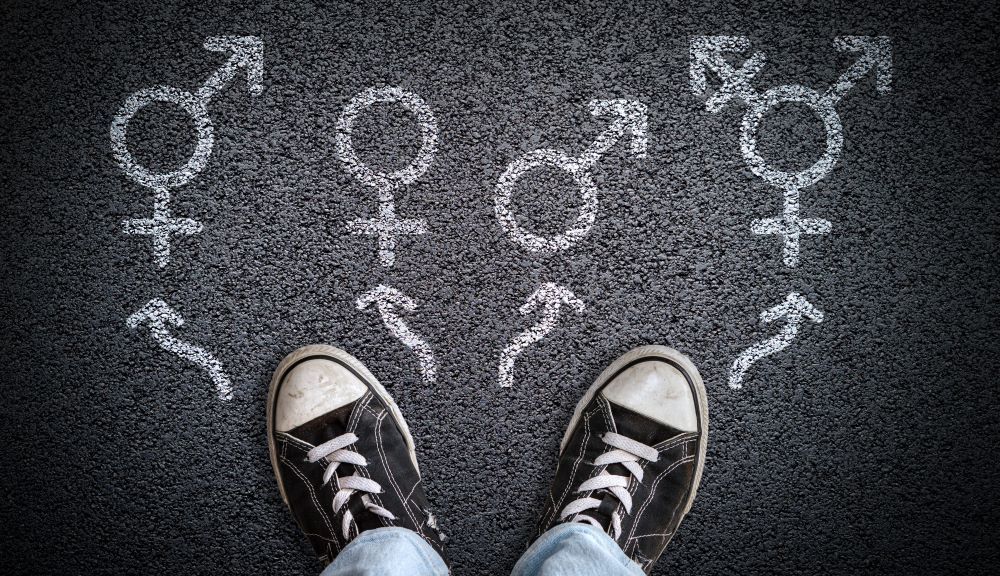
A person standing on asphalt road with gender symbols of male, female, bigender and transgender. Concept of choice or gender confusion or dysphoria.

On May 1, the U.S. Department of Health and Human Services (HHS) released a bombshell 409-page

report

laying bare the troubling state of paediatric gender medicine. This moment presents yet another opportunity for Canada to reckon with a medical scandal that has long gone unaddressed.

The HHS report highlights the exceptionally weak evidence used to support puberty blockers, cross-sex hormones, and surgeries for youth who identify as transgender, exposing how ideology dominates over science in the field of gender medicine. Its conclusion is damning: the medical establishment has failed vulnerable young people.

The review was commissioned by an

executive order

from U.S. President Donald Trump, whose directive was laced with politically charged and inflammatory language. In sharp contrast, the

report

itself is measured and grounded in evidence. Its recommendations echo the

cautious, evidence-based approach

to gender-affirming care now taking hold across much of Europe, contradicting the ideological positions of all major medical associations in the

U.S.

and

Canada

.


Acknowledging the political controversy surrounding the issue, the as-yet anonymous authors move past slogans and ideology to deliver a methodical, yet scathing, assessment of the current state of paediatric gender medicine. At the heart of the report is an “umbrella review” that synthesizes all the existing systematic reviews for these interventions, including those conducted in Sweden, Finland, England, and Canada. Unsurprisingly, like every one of those prior systematic reviews, the HHS review concludes that the evidence is of “very low” quality.


That’s because the research in this field, particularly surrounding claims that hormonal and surgical interventions improve mental health or reduce suicidality, is methodologically weak, lacking control groups or long-term follow-up. Meanwhile, the known risks of such interventions — infertility, reduced bone density, disrupted psychosocial development, and impaired sexual function — are not theoretical. They are documented outcomes of these interventions.

Until now, the typical response to this lack of evidence has been to call for more research, but the HHS report makes clear that, given what we already know, further research cannot ethically be justified. It does so by invoking the Nuremberg Code — the bedrock of international research ethics — citing that the anticipated results justify the performance of the experiment — and the Belmont Report which report emphasizes that no trial should proceed unless the intervention has a “favourable risk/benefit profile.” In paediatric gender medicine, every systematic review to date has found that the risks outweigh any potential benefits, making further research unjustified.

One of the most important sections of the report centres on psychotherapy. In a cultural climate where

talk therapy is often dismissed or derided

as being equivalent to gay conversion therapy, the HHS report makes a strong case for this non-invasive approach to replace life-altering medical interventions.

Echoing the U.K.’s landmark

Cass Report

, the authors call for gender dysphoria to be “de-exceptionalized,” meaning therapists need to approach treating these young people in the same way they would any other distressed patient. Instead of viewing them as “transgender adolescents” in need of powerful hormones and drastic surgeries, the report suggests that therapists should help these young people “develop self-understanding, engage with emotional vulnerability, and build practical strategies for managing distress.”

This therapeutic approach mirrors what has been implemented by leading

European health authorities

. It reflects a

growing awareness

that gender dysphoria among adolescents, especially girls, is a complex symptom of deeper psychological distress. And yet, while these developments are reshaping care standards across Europe, 

Brazil

, and now the United States, one country remains notably absent from this evolving consensus: Canada.

Despite mounting evidence that a major medical scandal is unfolding, Canada has yet to launch a review of the practices in its paediatric gender clinics.

Canadian guidelines

 remain closely aligned with those of the World Professional Association for Transgender Health (

WPATH

), an organization that has been discredited for prioritizing ideological commitments over scientific rigor. To date, only Alberta has

taken concrete steps

to shield vulnerable young people from a medical establishment that has abandoned science and basic ethical principles. In December 2024, the Alberta government banned puberty blockers and cross-sex hormones for youth 16 and under and placed restrictions on access for those age 17 and 18.

Canadian activists may

insist

the science here is settled, but that claim is becoming increasingly untenable. Science does not respect national borders. Canada has witnessed the same

dramatic surge in referrals

, the same

demographic shift

from mostly young boys to predominantly adolescent girls, and our gender clinics were

among the earliest

and

most enthusiastic

in adopting these experimental medical interventions. If other countries lack solid evidence or ethical justification for this treatment, the same holds true for Canada.

And yet,

calls

for a Canadian Cass-style review have so far gone unheeded, and the political environment continues to render even cautious scepticism as taboo.

Canada’s inaction on this issue has already brought shame on the nation. There are two

lawsuits

underway, and there will undoubtedly be many more over the coming years as

the number of detransitioners steadily rises

. Our government should take the publication of the HHS’s sobering report as a cue. If the rest of the world, including our closest neighbour, can reassess the science and revise their standards accordingly, there is no excuse for Canada to remain on autopilot. In the face of mounting international consensus and rising domestic concern, doing nothing is its own action — one that puts ideology before evidence and vulnerable youth in harm’s way.

Mia Hughes specializes in researching pediatric gender medicine, psychiatric epidemics, social contagion and the intersection of trans rights and women’s rights. She is the author of “The WPATH Files” and a senior fellow at the Macdonald-Laurier Institute.

National Post


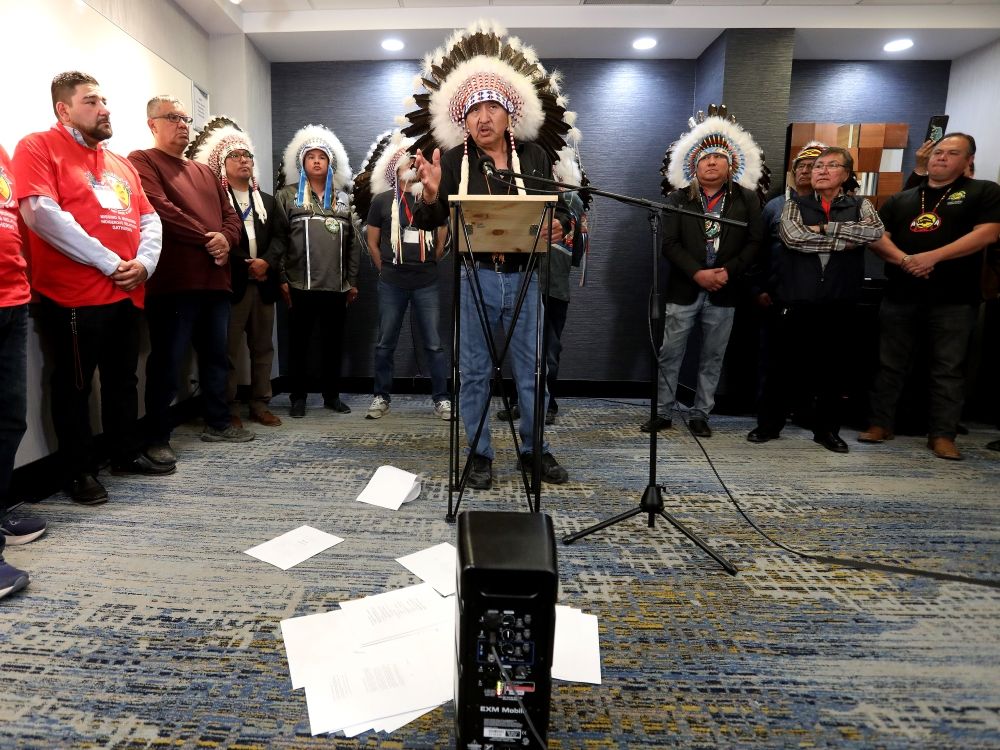
Chief Troy Bossman Knowlton speaks to the media during a press conference where Treaty Chiefs from 6, 7, and 8 rejected Bill 54, in Edmonton Tuesday May 6, 2025. A copy of Bill 54 is visible on the floor after being thrown in the air by Chief Billy-Joe Tuccaro during the press conference.

Various Indigenous leaders have complained vocally about Alberta Premier Danielle Smith’s roundabout way of engaging with the province’s separatist movement by making it easier for organized citizens to arrange for referendums.

But the moment they have me nodding along in understanding, they pull their own sovereigntist card: arguing that the numbered treaties situated in Alberta are a higher, purer form of authority; that secession talk violates treaty rights; and that treaty land is literally their property and thus untransferable.

We get statements like the one by Grand Chief Greg Desjarlais of Treaty 6, who

wrote

that Smith’s referendum-friendly amendments were a “direct violation of the Treaty relationship that exists between our Nations and the Crown,” adding, “Our Treaties are internationally binding, solemn covenants and cannot be broken by any province or political party…. These Lands were never ceded, nor surrendered.” What he meant by “internationally binding” wasn’t clear, and he certainly wasn’t correct about cessation. Treaty land is by definition ceded land — it was surrendered in exchange for benefits provided by the Crown.

Meanwhile, the Assembly of Manitoba Chiefs took greater liberties in

explaining

their view of the law, making the case that Alberta isn’t a “nation” at international law, but that First Nations are, per the United Nations Declaration on the Rights of Indigenous Peoples (UNDRIP). Provinces, says the assembly, are “administrative regions within the Canadian federation and do not possess the right to self-determination,” while First Nations have sovereignty and self-determination rights.

It’s a nearly malicious retelling of how Canada works: First Nations aren’t sovereign — they’re Crown subjects like anyone else; provinces have a large degree of self-determination power, which is detailed in the constitution. The fact that UNDRIP validates the existence of Indigenous groups around the world doesn’t make other levels of human organization illegitimate.

Similarly, the Federation of Sovereign Indigenous Nations released a

statement

arguing that “Any process of separation that fails to honour the true spirit and intent of our treaties would violate both constitutional and international law.”

Their frustrations make sense. Constitutional protection and the stability of a long relationship with Ottawa and hammered-out expectations are worth a lot. Plus, it’s the federal government that provides funding and benefits while laying off on the thorny matters of financial disclosure. The current federal government has been generous in signing billion-dollar settlements,

including

one for $1.4 billion last year in Alberta.

But in voicing their arguments, they often run high on emotion. In truth, it’s incredibly hard to predict the fate of the numbered treaties and the federal responsibility for Indigenous matters in a secession scenario.

When Quebec was rushing for the exit, the Supreme Court in 1998 weighed in on the requirements for legitimate separation; the Indigenous issue was brushed upon only lightly, concluding it was “unnecessary to explore further the concerns of the aboriginal peoples in this Reference.”

Scholarship has since tried to brainstorm what secession looks like on the Indigenous front, but it’s all speculation without the real thing, or at least, a real court decision that does explore the issue further. Bradford Morse, a legal scholar and former land claims negotiator who went on to become the dean of law at Thompson Rivers University,

covered

the what-ifs in a 1999 essay: it could be that Independent Quebec would inherit its treaties with the First Nations from the feds; it could be that Independent Quebec would have to re-negotiate them; or it could be something else. There were too many unknowns to be sure.

“Firstly, lawyers would have a field day debating the many procedural as well as substantive aspects that directly flow from secession generally, not to mention the added complexities that arise in the Aboriginal law context,” Morse concluded. “Secondly, dramatic and far-reaching arguments would be made, many of which cannot be dreamt of yet, given the uncertainties surrounding how the secession might occur and on what terms…. The last thing of which I am certain is that it will be a mess.”

Weighing in on Alberta, Dwight Newman, a constitutional law professor, Indigenous rights expert and Canada-Research-Chair-holder at the University of Saskatchewan, told me the treaties would raise “genuine issues” were the province to separate.

“It would seem plausible that there could be a state succession to a treaty…. People generally haven’t suggested that Quebec would be incapable of separating due to treaties,” he wrote in an email Wednesday.

“At a broad level, Alberta could likely take on the obligations associated with the treaties to ensure that they continue on. I do see it as appropriate that Indigenous peoples are part of the conversations.”

As for what involvement the federal government would have, Newman said that the duty to consult would be triggered “when there is a decision under contemplation that could affect Indigenous rights” — this could include early decisions and even negotiation stances. Obtaining actual consent from the First Nations for enabling separation would be ideal, he added, but he saw “little in law to say that it would be absolutely mandatory.”

The numbered treaties, however, haven’t been treated as international treaties. Newman noted that if they were, that would make everything a lot more straightforward, “as there are established rules on state succession to international treaties that have been applied in cases of secession.”

For me, it’s hard to take either side all that seriously. The most extreme parts of the Indigenous side have been arguing for ethno-sovereignty for years, embracing the freemen-on-the-land-like “land back” movement and urging for an expansion of unique treatment under Canadian law. They use UNDRIP, memetic news stories, and “reconciliation” as levers to pull for even more state benefits and permissions, and the current federal government almost never says no.

Their exaggerated understanding of Indigenous sovereignty — on display in their statements about separation — and their hold on Canadian land is voraciously lapped up by our own media, which often presents these views without counterpoints, giving them the appearance of legitimacy. Sure, they claim to love the Crown now, but just wait until it’s convenient to once again blame it for all their woes.

The Alberta separatists, too, put blind faith in the UN — in particular, a treaty that appears to guarantee port access for landlocked states (but in practice, does not). They, too, have outsized claims about their hold on these lands, drunk on nostalgia for a libertarian utopia that will never exist because the majority of the province doesn’t indeed want it. The provincial government doesn’t tell them to buzz off, and instead amends its laws to better accommodate their desires.

Though both are exercising their rights, they’re also antagonistic to the Canadian project. If only they used their voices to do something productive instead of trying to carve out bits of territory for their own.

National Post


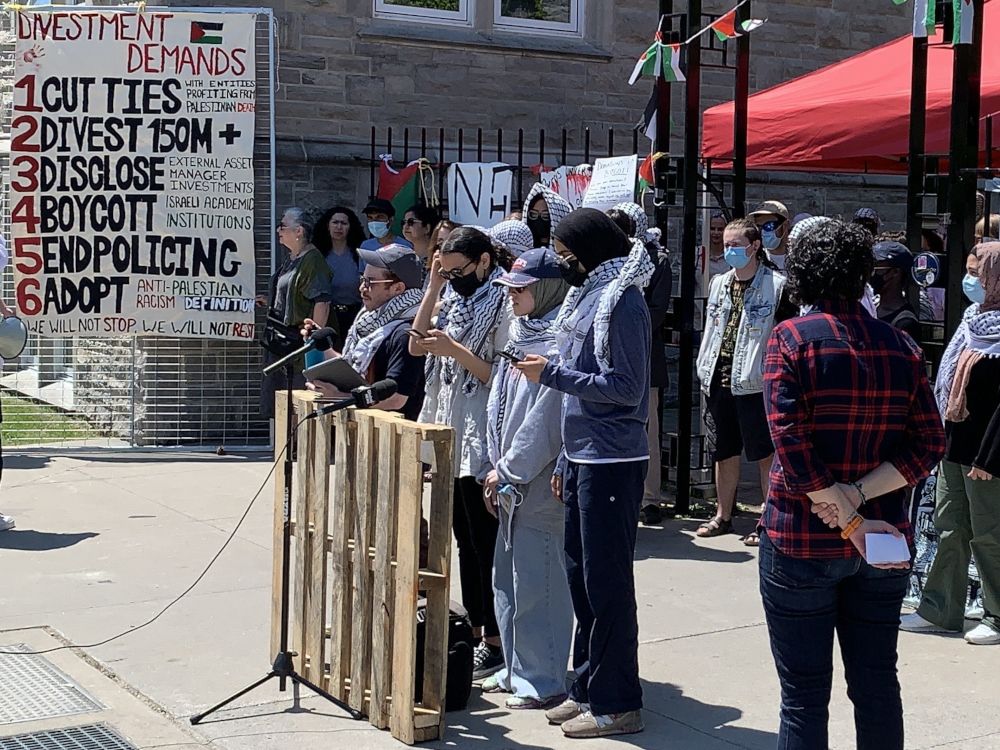
Anti-Israel protesters hold a news conference at Queen's University in May 2024.

Last spring’s anti-Israel encampments on university campuses across Ontario forced Jewish students, faculty and staff to navigate a climate of hostility. These protests, often framed as calls for justice, frequently gave way to exclusionary rhetoric and the vilification of Zionists (Jews). The calls for universities to divest from Israel were not simply about foreign policy — they were part of a wider campaign to delegitimize Jewish identity on campus.

In an effort to bring down the temperature, many university administrators agreed to undertake a review of their investment policies. Those deliberations have been ongoing since the fall. Now, in a welcome and principled development, several of Ontario’s leading universities have formally rejected the idea of divesting from Israeli companies and those that that do business with Israel.

Queen’s University, McMaster University and the University of Waterloo have each undertaken their own reviews of investment policies and found that divestment demands were lacking in both substance and fairness. These decisions mark not just a defence of academic freedom, but a decisive stand against the antisemitism that too often animates the BDS movement.

At Queen’s University, principal Patrick Deane’s review committee for responsible investing “recommended against divesting Queen’s pooled endowment and investment funds from companies conducting business with or in the State of Israel.” At McMaster, the university reaffirmed that investment decisions must be grounded in financial responsibility — not ideological pressure.

And last year, administrators at the University of Waterloo stated that, “The call to boycott, divest and sanction universities from one country is antithetical to our mission,” and that Waterloo “has not supported movements to unilaterally divest or boycott from any country or company outside of national security concerns or without guidance or direction from government.”

Each of these statements, while couched in careful administrative language, reflects a broader recognition that the BDS movement has contributed to an increasingly unsafe and exclusionary environment for Jewish students, and that it is contrary to core Canadian values.

On many campuses, BDS campaigns have been accompanied by calls to silence Jewish or Israeli speakers, exclude Jewish campus organizations and disrupt events and university business with chants equating Zionism with racism or genocide. In some cases, Jewish students who express support for Israel are harassed, shouted down or accused of complicity in war crimes.

This is not theoretical. In fact, just last month, a young man from Waterloo, Ont., was arrested and charged with uttering threats to cause death or bodily harm after he allegedly sent more than 100 antisemitic death threats through an online form on Hillel Ontario’s website.

Let’s be clear: targeting the world’s only Jewish state for economic punishment — especially while ignoring or excusing the abuses of countless other nations — is not a principled stand for justice. It is a selective, obsessive hostility that crosses the line into bigotry.

The campaign to isolate Israel in academic, economic and cultural arenas is not merely a misguided protest, it is a modern manifestation of Jew-hatred, repackaged for unsuspecting audiences.

The Ontario universities that have rejected calls to divest from Israel represents yet another public rebuff of the antisemitic BDS movement.

National Post

Jay Solomon is the chief advancement officer for Hillel Ontario.


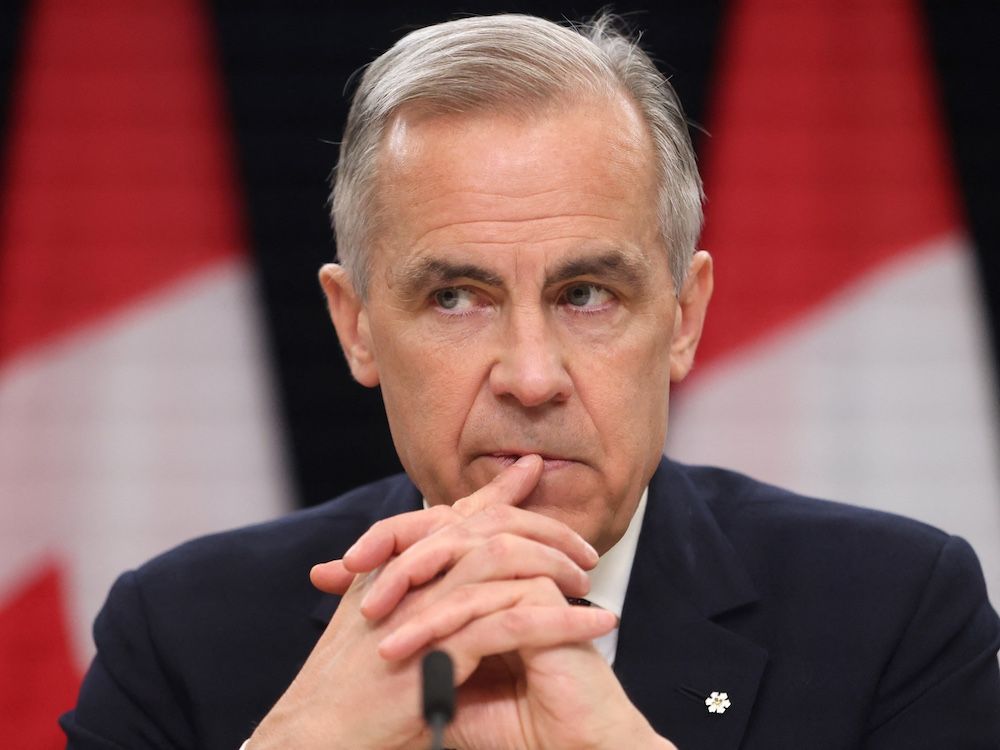
Prime Minister Mark Carney speaks at a press conference in Ottawa, Ontario, on May 2, 2025. (Photo by PATRICK DOYLE/AFP via Getty Images)

Prime Minister Minister Mark Carney cannot be trusted with our Charter-protected right to free expression.

The man has been clear: during the election campaign, Carney spoke scornfully of our most essential freedom, our speech, from which all our other freedoms flow.

Carney has hinted that his Liberal government will bring back some iteration of Trudeau’s tyrannical — there is no other word for it — Bill C-63, the Online Harms Act, which was killed when the former prime minister prorogued parliament this January. You will recall that this now-defunct legislation would have granted judges the ability to mete out life sentences for hate speech, and would have created a government “Digital Safety Commission” to police Canadians’ speech, and impose life-destroying fines upon those whose speech was deemed hateful by our government censors.

It was frightening legislation. But not, apparently, to Prime Minister Carney.

In April,

at two of

Carney’s

rallies in Ontario

, he announced his government’s proposed plan to tackle crime and improve public safety. “Large American online platforms have become seas of racism, misogyny, antisemitism, Islamophobia, and hate — in all its forms. And they’re being used by criminals to harm our children. My government will act,” said Carney.

Sound familiar? It should.

We have heard this before: Carney is using the same tactic of his predecessor. It was Justin Trudeau who first attempted to manipulate Canadians with fear for our children’s safety as a means to sneak in repressive, anti-free speech legislation.

Consider then-prime minister Trudeau’s words from a February 2024 news conference in Edmonton: “We know and everyone can agree that kids are vulnerable online, to hatred, to violence, to being bullied, to seeing and being affected by terrible things online. And we need to do a better job as a society to protect our kids online,” Trudeau said,

one week before tabling Bill C-63

.

And now, back to Carney last month: “New online platforms have created new threats, including and perhaps especially for children… And as much as we, as parents, want to protect our kids, we can’t always be there. We can’t always be looking over our kids’ shoulders to see what they’re doing, or what they’re exposed to online. And so while protecting children is, first and foremost, a parent’s responsibility, it is also a collective responsibility. And with the support of Canadians, my government will act to protect children online and bring those who seek to harm them to justice. We will first introduce legislation to protect children from online exploitation and extortion.”

Using Trudeau’s old manipulation tactic, Carney has found an additional excuse to promote and justify government censorship. He revealed it at his April rally in Hamilton: “One of the issues we’re dealing with… misogyny, antisemitism, hatred, conspiracy theories — this sort of pollution that’s online that washes over our virtual borders from the United States… and, that’s fine… I can take the conspiracy theory and all that, but the more serious thing is when it affects how people behave in our society. When Canadians are threatened going to their community centres or their places of worship, or their schools,” said Carney.

Much like Trudeau first weaponized child safety to push for censorship, so too is Carney is using Canada’s despicable rise in antisemitic hate crimes, since the October 7 attack on Israel, to try to convince Canadians that what we really need protection from is, first and foremost, words on the internet.

Do not fall for it.

Carney has no proof that online discourse — our free expression — is directly responsible for hate crimes or violence on our streets. And even if he did have the proof, it still would not justify censorship. Nothing does.

In the introduction to his book Free Speech, Danish human rights lawyer Jacob Mchangama reminds us that the powerful have good reason to detest new technology, or, in Carney’s case, “new online platforms”: “New communication technology is inevitably disruptive and every new advancement —from the printing press to the internet — has been opposed by those whose institutional authority is vulnerable to being undermined by sudden change,” Mchangama writes.

In Carney’s case, his institutional authority is indeed vulnerable. It’s not merely that he rules via a minority, made possible only by the collapse of Canada’s New Democratic Party, but that the entire political agenda of Canada’s left is on shaky ground. Our youth are moving right. But it’s more than that: on climate, fossil fuels, immigration, race, gender, identity politics, and free speech, too — leftist social justice perspectives on each of these topics, which were orthodox throughout the Trudeau era, are falling out of favour.

Carney knows this.

We mustn’t be lulled into a false sense of security with Carney’s promises to end child exploitation, antisemitism, or any other devious or violent crimes — if only his government can control the information we have access to. Such promises have nothing to do with safety, and everything to do with power.

While Canada’s economy can likely withstand four more years of asphyxiating Liberal policies, I’m not certain that our country can survive such a sustained attack on our freedom of expression.

National Post


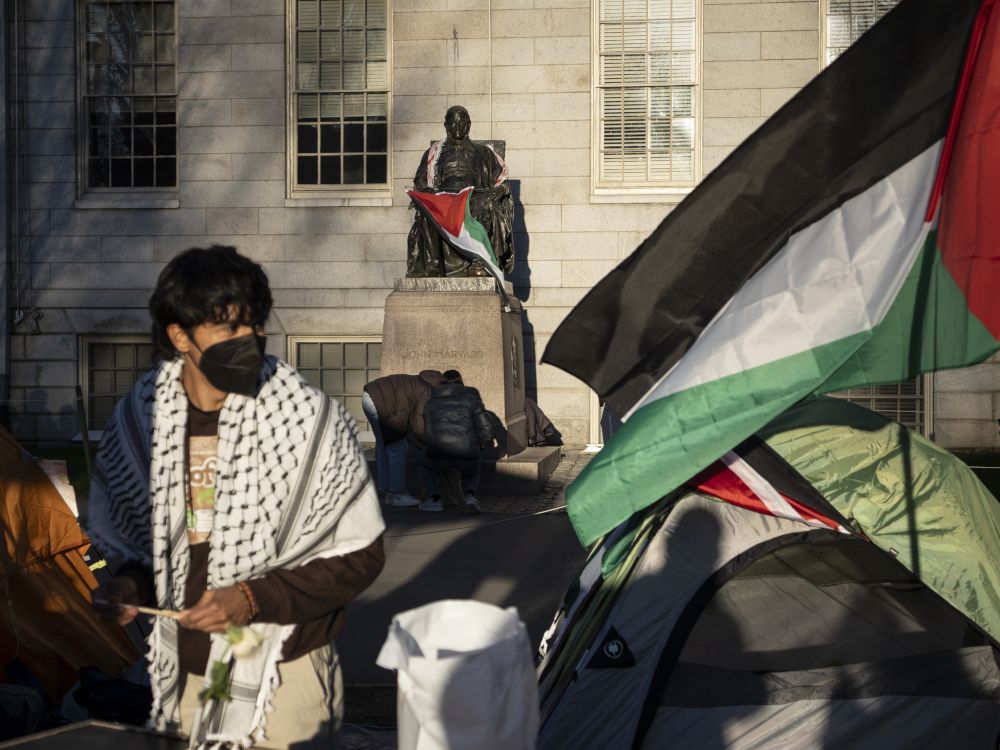
A student protester stands in front of the statue of John Harvard, the first major benefactor of Harvard College, draped in the Palestinian flag, at an encampment of students protesting against the war in Gaza, at Harvard University in Cambridge, Mass., in 2024.

Harvard’s

Presidential Task Force on Combating Antisemitism

released a sprawling 300-page report last week that attempts to confront the antisemitism festering on its campus. But beneath its ambition lies a troubling truth: antisemitism has become embedded in the ideological core of many universities. And the real question is no longer just how to address it — but whether universities can even be rehabilitated at all.
 

This crisis didn’t begin on October 7, 2023. That day, when Hamas terrorists murdered and raped innocent civilians, merely revealed the moral decay that had taken root over decades. Since the early 2000s, university campuses have been infected by movements like “Israeli Apartheid Week” and BDS — activist campaigns masquerading as academic inquiry, laying the groundwork for today’s open hostility toward Jews and Israel.
 

This week, the
National Post
declared: “You can’t be openly Jewish at TMU.” Students at Toronto Metropolitan University report being isolated, harassed, and afraid. At Columbia University, over 50 pro-Palestinian students were arrested for occupying a library, damaging property and disrupting campus life. This is not protest — it’s intimidation. And it has become the new norm.
 

Back at Harvard, Rabbi David Wolpe, who served as a visiting scholar, shared his chilling experience in the Free Press. At a Sukkot celebration at the Divinity School, a speaker began by assuring the crowd that it was “a safe space for anti-Zionists, non-Zionists, and those struggling with their Zionism.” In other words: not safe for Jewish students proud of their identity.
 

Wolpe described Israeli students being mobbed and assaulted; Jewish students ghosted by friends; professors eliminating Israeli sources from their syllabi; and required readings teaching that Zionism is a manipulative colonial ideology. Incredibly, “privilege training” was offered to Jewish students — not to support them, but to reframe them as oppressors.
 

It’s hard to imagine that after the horrors of October 7 — murders, rapes, mutilations committed by terrorists wearing the keffiyeh — students today are proudly wearing that same garment as a symbol of solidarity. The keffiyeh, co-opted by Yasser Arafat — the lead terrorist of his time — has become a symbol not of heritage but of terror. Its normalization on Western campuses is no different than wearing swastikas in the 1930s. And yet, here we are again.
 

But this isn’t only about Jews. The warning that “what starts with the Jews doesn’t end with the Jews” is more relevant than ever. The antisemitism on campuses today is the tip of an anti-Western, anti-democratic movement masked as social justice. It seeks to dismantle Judeo-Christian values, freedom of thought, and liberal democracy. Some call it wokeism. Whatever the name, its goal is clear: to destroy Western civilization from within.
 

Wolpe praises Harvard’s report for acknowledging the hate — but notes it offers no solution for the ideological bias entrenched in faculties, especially in the humanities and social sciences. Where once it was obvious to support the only democracy in the Middle East, today students are shamed and punished for even expressing sympathy with Israel.
 

In Canada, we learned that our government hired a U.K. contractor to monitor pro-Israel social media posts — labelling critics of pro-Hamas protests as “right-wing extremists.” Meanwhile, those glorifying Hamas remain unchallenged. None of these demonstrations have denounced the terrorist group. Some participants even wear Hamas-style insignia. Yet authorities choose to target those who dare defend Israel.
 

History shows that societies turning on their Jewish communities ultimately betray their own values. Harvard now claims it wants to build an inclusive environment. But let’s be honest — this report wasn’t born of conscience. It was born of pressure. The threat of lost funding, lawsuits, and public backlash finally forced their hand. Columbia didn’t call in the police to protect Jewish students — it did so to protect its own reputation.
 

The only way to change universities is to hold them financially accountable. That means suspending government grants, investigating foreign funding, and even reconsidering their charitable status if they enable hate. Academia was once the engine of Western success. Now it risks becoming the wrecking ball.
 

Universities are at a crossroads. They can choose to defend the values that built them — or continue down a path that will destroy them. The time for polite reports is over. What’s needed now is bold action, real accountability, and moral courage.
 

Avi Abraham Benlolo is the Founder and CEO of The Abraham Global Peace Initiative.