LP_468x60
on-the-record-468x60-white

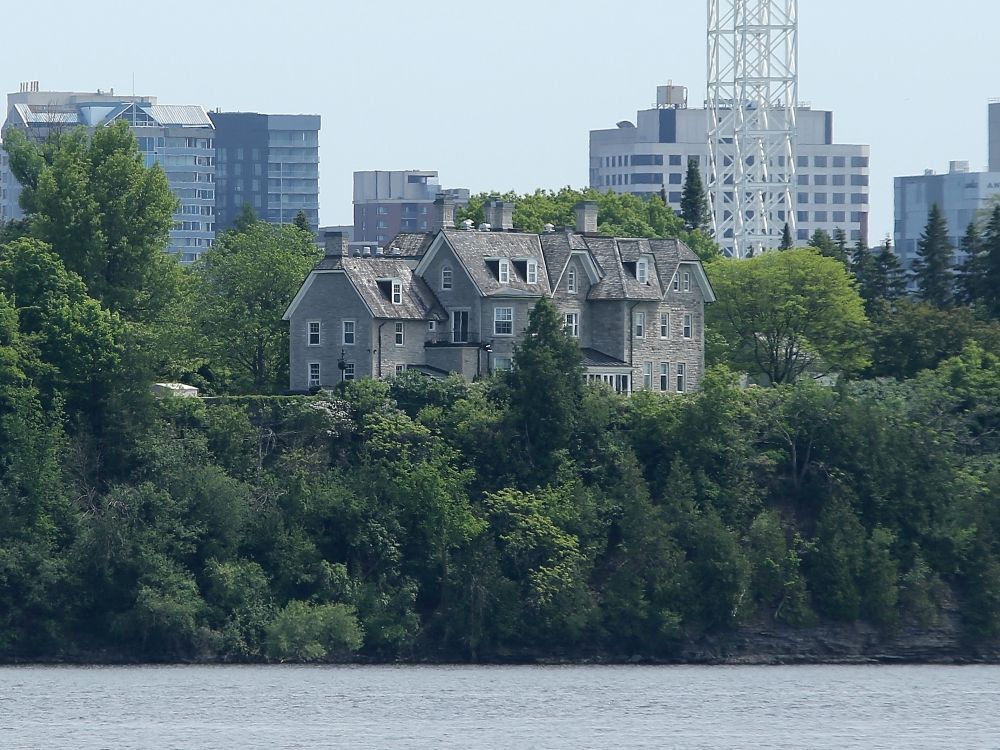
24 Sussex Drive, photographed on May 30, 2018.

Never mind Donald Trump. Never mind western separatism. Does Mark Carney have what it takes to confront the fiasco of 24 Sussex Drive?

Of all the issues on his plate it may be the most ridiculous. The long-running saga of the official residence without a resident offers evidence that absurdity isn’t just a feature of Canada’s shared sense of humour, but a national characteristic that envelopes its inability to construct a respectable roof over the head of its senior elected official.

Not that it’s the fault of the populace. I doubt that Canadians are so gnarled and nasty they object to the very thought of an official residence. It’s the potential inhabitants of the ramshackle homestead who can’t bring themselves to make a simple decision on its fate and be done with it. It’s their fear of voters — which consists, in truth, of distrust — that prevents them from getting off the pot.

Every prime minister since Pierre Trudeau has known something serious had to be done about the condition of the building at 24 Sussex Drive. Every one of them has recoiled in terror from doing so. Maybe it was Brian Mulroney’s

experience

within its walls that frightened them. Mulroney calculated he approved $211,000 on fixtures and furniture for a structure that

was

already 117 years old when he took over the keys. He was scorched for it. Fifteen years after he left office the Toronto Star was still

running

articles about his “extravagant spending.”

Jean Chretien refused to make the same mistake. He called the

house

“an embarrassment to the nation” but the man who invented the “Shawinigan handshake” acknowledged he did nothing rather than risk the negative headlines that might ensue. Paul Martin conceded it was drafty, and certain rooms were unbearable in winter, but neither he nor Stephen Harper would risk being Mulroneyed over it. Harper had a

chance

at a major repair job for just $10 million — which would barely get you garage space in parts of Toronto or Vancouver these days — but didn’t want to vacate for the 10 to 15 months needed to do it. It was 2008 and he only had a minority, so perhaps he feared that if he left the house he might not get back in.

So that was that. Justin Trudeau, who grew up in the place, refused to subject his own kids to the experience. He preferred to live across the street in a “cottage” while the Governor General swanned around in the much grander complex on the same grounds. In his nine years as prime minister Trudeau showed no reluctance to pour hundreds of billions into any project that caught his fancy. He happily

added

as much to the debt as all previous prime ministers combined, but supply the cash to save a bit of historic Canadiana? Not a chance. People might get upset!

So it falls to Carney to make a sensible decision. The Carneys live not far from the scene of the disaster so they’re well aware what a dump it’s become. Like his predecessors he could studiously avoid making a decision, hoping the house doesn’t actually collapse into rubble on his watch, looking away and humming to himself every time his motorcade passes its gates, but it would be an inglorious reaction by a man who says he’s intent on building a better, stronger and more respectable country. “Who’s ready to build Canada strong?” he demanded in his campaign. Yeah, sure … except there’s a house on Sussex Drive we can’t possibly be expected to repair.

The options aren’t as complicated as they’re regularly made out to seem. You either fix the place or level it and replace it with something else. It’s already been

cleared

of rats and asbestos, though the estimated cost of completing a full fix-up has risen to $37 million, and would probably be more based on the experience of every homeowner who ever redid a basement or added a porch. Big deal. Does anyone seriously think Canadians would storm the legislature in rage just because it’s a house where — apart from entertaining foreign dignitaries and conducting the country’s business — future prime ministers will sleep?

Two previous inhabitants of the building have already offered to raise the money to cover the cost. Stephen Harper and Jean Chretien

volunteered

a year ago to scout out private donors. Anyone think they wouldn’t succeed? God knows how much the two have raised between them to pay for their decades of campaigns for public office. A few pricey dinners and a respectable crowd-sourcing effort would probably do it. Offer voters a chance to kick in $10 each and see what happens. We build hospitals that come with much higher price tags, with local volunteers raising much of the money.

It’s not clear why Justin Trudeau

rejected

the Harper/Chretien offer. In his final days in power he asked one of his ministers, who might soon be out of office, to work up a proposal for a government that might soon not exist, to be considered somewhere down the road by someone other than himself. Way too little, way too late.

In any case, it doesn’t matter. “I’m not Justin Trudeau,” Carney has pointed out. “I’m a very different person from Justin Trudeau.” Which is a very big reason he got elected. So use these early days to prove it, and get one minor annoyance out of the way. See if the Harper/Chretien offer still stands. Set a firm budget and invite Canadian architects to bid on it.

Who was it said “Build, baby build”? Oh yeah, a guy named Carney.

National Post


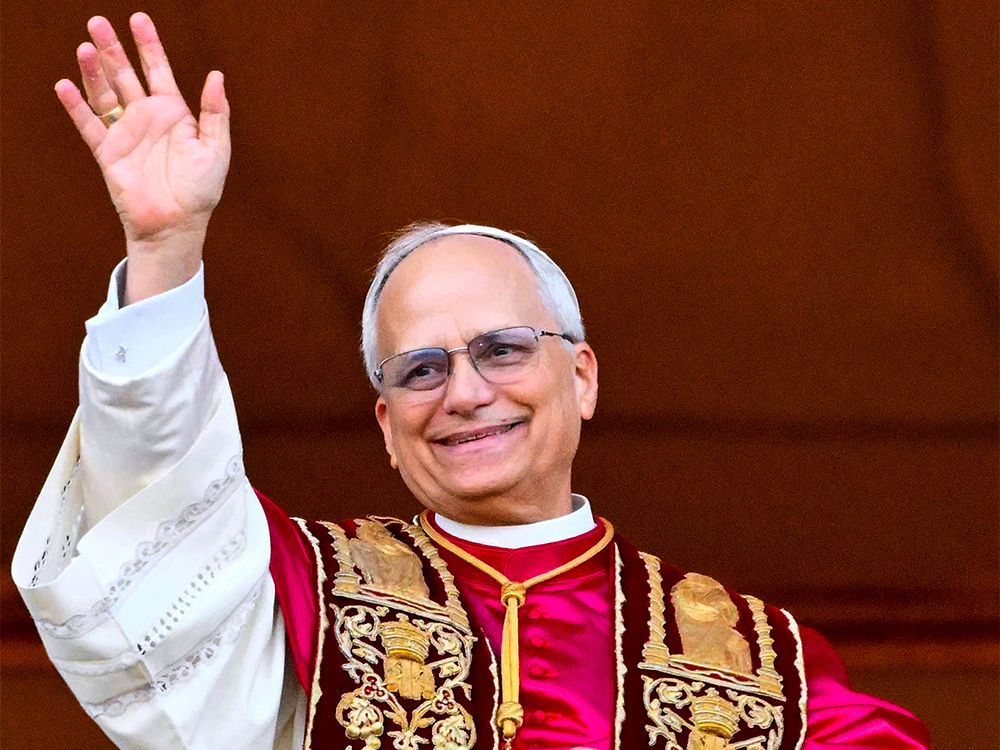
Pope Leo XIV appears at the main central balcony of St. Peter's Basilica in Rome to greet the crowds for the first time following his election.

Cardinal Robert Francis Prevost, born in Chicago, is now Pope Leo XIV. He is the first American, by way of Italy and Peru, to be elevated to the See of Peter.

His election coincided with the celebrations of the 80th anniversary of Victory in Europe Day, May 8, 1945. Pope Leo XIV’s first words on the balcony of St. Peter’s were the first words of the Risen Christ: “Peace be with you!”

The world ardently desired peace in 1945. Peace remains desired now — enduring peace, true harmony, not just the absence of war. That peace which is most deeply desired in hearts, in families, in cultures and between nations, is not the work purely of human hands, but remains the gift of Jesus risen from the dead.

Pope Leo began what has been the primary task of the Apostle Peter and his successors since the day of Pentecost, to bear witness to the Risen Christ who, as the Holy Father put it in his first address, “is the bridge by which the love of God reaches us.”

After Leo’s election, Cardinal Timothy Dolan of New York — the contemporary

caput mundi

, as Rome was in Peter’s day — said of the new Holy Father that he is a “citizen of the world.”

Having grown up in Illinois, Michigan and Pennsylvania, Leo studied in Rome, spent two decades as a missionary priest and bishop in Peru, and 12 years in Rome as the superior general of his religious community, the Order of St. Augustine.

“Citizen of the world” is an appellation in bad odour today, as “globalists” are denigrated as architects of all manner of evils and ills. Those who faced the reconstruction of Europe in 1945 — and the building of an enduring peace — did not fear the broader view. They had painfully fresh memories of the horrors of nationalism and the failure of international bridge-building.

Dolan of New York added that the Christian’s true citizenship is in “the world to come” or, as Pope Leo put it, “to walk together toward that homeland that God has prepared.”

Here and now though, the Christian is called to be a citizen of the world, not in opposition to his own country, but as a complement to it. The salvation promised first to Israel has become a light for all nations.

The word “catholic” means “universal,” which why the Catholic Church speaks of her pope as the “universal pastor” and herself as a sign of the universal bonds of humanity. Every Catholic is supposed to be a citizen of the world; Pope Leo’s tricontinental life just makes that more plain.

In Peru he was in a different country, but not amongst strangers. He learned a new language, but did not preach a different faith. He adopted the nationality of that country, but he already shared with his flock a common baptism.

In 2025, the world is turning away from the institutions of peace built after 1945. Those are strategic and commercial decisions, but they reflect a moral change, a desire to draw back from the other, a retreat from great catholic enterprises, in the universal sense.

God, we pray, gives the Church — and the world — the pope she needs rather than what any faction might want. Is it possible that this new shepherd — whose own life links together the rich and the poor, the north and the south, the material and the spiritual, the faith of a young country with the heritage of the Church Fathers — is what is needed now?

Some nonsense was talked about a taboo against an American pope. The papacy was in Italian hands since 1523, nearly a century before the Mayflower sailed. Any taboo, such as it was, applied to every country but one.

The first non-Italian in centuries was St. John Paul II in 1978, opening the papacy to all peoples. He lived until 2005, succeeded by a German and then an Argentinian. Thus “the American taboo” lasted 20 years and two popes.

The fear had supposedly been that the world’s commercial and strategic superpower ought not to “control” the moral conscience of mankind, too. Perhaps the cardinals in the conclave took note that America no longer aspires to lead the alliances of peace and comity that emerged after 1945.

In the course of World War II, Chamberlain’s famous “peace in our time” was roundly mocked as a great failure. The diplomacy failed, but the phrase itself comes from the lovely Anglican liturgy. It is a prayer addressed to God, not the chancelleries of Europe then, nor America now.

The world needs those words, the words of comfort, the words of fraternity, the words of salvation. The world needs them now, as always, and on Thursday evening they sounded again, to the city and to the world:

Peace be with you!


Members of the Palestinian Youth Movement hold a rally in Toronto in November 2023.

Prime Minister Mark Carney’s election victory speech included a note of humility: “Over my long career, I have made many mistakes, and I will make more, but I commit to admitting them openly, to correcting them quickly, and always learning from them.” Yet it is too late to correct one of his big mistakes. Will he at least admit to and learn from it?

During the election campaign, 28 Liberal candidates (19 of them elected) signed onto a five-point anti-Israel

Vote Palestine

platform. Vote Palestine began as

a BDS project

, and quickly gathered steam after a trial run in the 2021 election. The platform contains

demands

— such as a two-way arms embargo against Israel, a full boycott of Israel-controlled territories and recognition of Palestine as a state — that do not reflect current Liberal policy. In total, 362 candidates signed on.

Carney could have stopped his own candidates’ irresponsible trend early

in its trajectory

by issuing a memo that foreign policy is the purview of party leadership, not individual candidates, and ordering signers to rescind their endorsement of the platform. Instead, he remained silent, essentially giving the green light for more candidates to pledge fealty to a platform crafted by ideological stakeholders in a global campaign to delegitimize Israel and whitewash terrorism.

By endorsing these demands, the candidates lent an air of respectability to the anti-Israel groups that organized the campaign — including the

Palestinian Youth Movement

(PYM), one of the lead organizers — obscuring their ugly

values and activities

, which include celebrating Hamas’s October 7 pogrom, lionizing Hamas and Hezbollah, and organizing Jew-baiting student encampments at universities throughout the United States and Canada.

In May 2024, PYM organized the People’s Conference for Palestine, featuring speakers affiliated with the Popular Front for the Liberation of Palestine and Palestinian Islamic Jihad, both designated as terrorist organizations in Canada, the U.S., Israel and the European Union.

PYM’s aim is to normalize terror as a righteous response to (alleged) colonialists. The most insidious of the five Vote Palestine platform demands, therefore, is the innocuous sounding, “Address anti-Palestinian racism (APR) and protect freedom of expression on Palestine.”

The definition of “anti-Palestinian racism,” as conceived by the

Canadian Arab Lawyers Association

, includes speech or action that “dehumanizes Palestinians or their narratives.” The word “narrative” — in this case an origin story held sacred by a group of people that is based in belief rather than evidence — is a trap, inserted into the APR definition to promote a legal prohibition against criticism of that group’s beliefs.

Along with other Islamist groups obsessed with Israel’s alleged sins, PYM represents a movement best described by Israeli politician Einat Wilf as “

Palestinianism

.” The Palestinianism movement is dedicated to opposing the existence — and more important any right to the existence — of a Jewish state by any means necessary, including October 7-style massacres.

Palestinianism’s umbrella narrative is that Zionism is an inherently racist ideology. Drawing on that premise, pro-Zionist expression may be legislated as hate speech, but the glorification of Hamas “martyrs” and calls for the eradication of Israel should not be. (When Bill C-63, the online harms act, is revived, they may

get their wish

.)

Vote Palestine’s strategy, according to one of its

Instagram posts

, is to “force Palestine onto the debate stage through nationwide visibility” and shame political actors who do not endorse its platform.

Leading PYM activist Yara Shoufani, who has a

long rap sheet

of anti-Israel extremism, explained on a

podcast

how “pressure is applied” by PYM foot soldiers within ridings to non-endorsing candidates. They “make it impossible to organize fundraising events … impossible for those MPs to canvass without being met by someone from within the community asking, ‘Why are you not supporting an arms embargo?’ ” she said.

Shoufani seems proud that PYM has managed to, in her words, “create a kind of crisis within the Canadian electoral system.” And all of this, fellow Canadians, is what 362 candidates — not a single one of them Conservative — signed onto.

At 1.8 million and growing, Muslims constitute around five per cent of Canada’s population. The

Canadian Muslim Vote

, a nonprofit, estimates that Muslims hold significant influence in between 60-80 of 343 ridings.

According to

Joe Adam George

, lead researcher for Islamist threats in Canada at the Middle East Forum, “Islamists have been working overtime” to see “their favoured party,” the Liberals, re-elected, “so that the good times keep rolling for them for at least another four years.”

Credulous candidates’ greed for Muslim votes is understandable. Which is why it is so important in these matters that savvy political leaders provide a backstop to their candidates’ lack of judgment in collaborating with what essentially amounts to foreign interference in the election.

As my colleague Tristin Hopper

posted on X

in regard to the Vote Palestine scandal, “This is how foreign interference happens. If a literal pro-terror group can get an MP’s signature without difficulty, you think they’re standing guard for thee against Iran or China?”

National Post

kaybarb@gmail.com

Twitter.com/BarbaraRKay


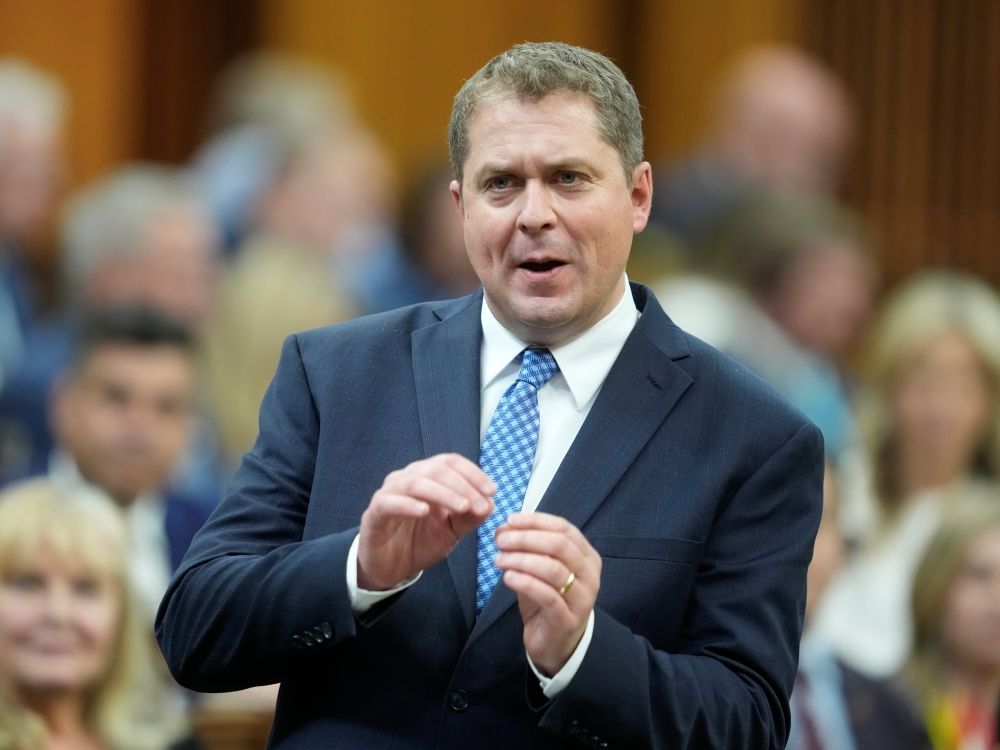
Conservative House leader Andrew Scheer rises during Question Period, in Ottawa, Thursday, May 30, 2024.

The Conservative caucus 

announced

on Wednesday that Andrew Scheer will serve as interim Opposition leader during the spring parliamentary session. It’s not only an incredible political comeback for the former party leader, but it’s also led to a hilarious amount of pearl-clutching from political critics and foes alike.

Filling the Opposition leader’s role in the House of Commons was unavoidable.

Conservative leader Pierre Poilievre led the party to a solid second-place finish and its highest share of popular support (41.3 per cent)

since

 former prime minister Brian Mulroney in 1988. Alas, he unexpectedly lost his seat in the Ontario-based riding of Carleton to Liberal candidate Bruce Fanjoy. Conservative MP Damien Kurek has agreed to 

step aside

from his extremely safe Alberta-based seat in Battle River-Crowfoot to trigger a byelection. The

earliest

 that Kurek can resign is late June, meaning Poilievre won’t be able to rejoin Parliament until mid-September.

This opened the door to Scheer’s return to political leadership, albeit on a temporary basis. While Conservative colleagues and supporters congratulated him, a brigade of rabid lefties began to freak out right on cue.

Scheer was called a “clown,” “loser,” “irrelevant,” “snivelling,” “misogynistic,” “unserious” and far worse on social media. He was labelled an “American” and “goofy and immature.” One person was “creeped out” by his “perma-smile.” There was also this offensive albeit creative insult, “Andrew Scheer said he’s confused, he thought they nominated him Pope.”

Putting this left-wing disdain for Scheer aside, why are some Canadians so irritated by the prospect of his brief sojourn as Opposition leader? People get triggered by almost anything these days, so that’s part of the equation. The other component? They remember how much they opposed his fiscal and social conservative beliefs and values.

Scheer has been in politics for over two decades. He was

first elected

in 2004 as a Conservative MP for the Saskatchewan riding of Regina-Qu’Appelle. (One of the members of that particular freshman class was, as it happens,

Poilievre

.) He’s never been a cabinet minister, but served as Deputy Speaker of the House and became the

youngest-ever

 House Speaker in 2011 at age 32.

His defining career moment was serving as Conservative party leader from May 2017 to August 2020. Scheer was effective in this role from the get-go. He fought for lower taxes, smaller government, private enterprise and more individual rights and freedoms with enthusiasm. He was

called

“Stephen Harper with a smile,” which gave him the ability to be compared to the well-respected former prime minister while still ensuring that his own personality and leadership would continue to shine.

Scheer 

led

 in most polls against then-Liberal Prime Minister Justin Trudeau starting around February 2019. He took advantage of Trudeau’s declining popularity in the midst of some of his worst scandals, including three older instances of wearing blackface. When the election was called, it seemed as if he was going to win.

Things soon began to fall apart. Scheer was hurt by several controversies of his own. These included

questions

 about his previous work in the insurance industry in Saskatchewan as well as the revelation that he actually 

held

 dual Canadian and American citizenship.

Moreover, he got dragged down for his social conservative values by his critics in politics and the media. Scheer has a strong Catholic faith. He supports religious freedom, family values and the rights of the unborn. That being said, he recognized that his private views had to always remain separate from his political ambitions. He also stood for a big tent philosophy in the Conservative party and movement. Those who differed from his own position on abortion and gay marriage would continue to have their views respected and heard in every corner of this country.

This was a fair and level-headed approach to these contentious issues. Anyone who knows Scheer on a political or personal level could vouch for its authenticity.

The problem was that he consistently struggled to convey those long-held positions with the right words and tone to ease people’s concerns. This became problematic when a 2005 video was unearthed in which he spoke out against gay marriage. He 

said

 that same-sex couples “have many of the collateral features of marriage, but they do not have its inherent feature, as they cannot commit to the natural procreation of children. They cannot, therefore, be married.” Although he 

acknowledged

his views on this subject had evolved and he would not reopen this debate in Parliament as prime minister, many doubted his words all the way to election day.

That was then, and this is now.

Scheer has worked hard to successfully rebuild his name and public image. He’s been Opposition House leader since September 2022. He’s one of the party’s main faces and voices to

get out

important political messaging and set the tone for policy initiatives. He’s well-respected by his leader, colleagues and peers. He’s earned the right to be leader of the Opposition until Poilievre returns to Ottawa.

Will pearl-clutching Canadians think differently about Scheer’s improbable political comeback once the House reconvenes? No. The world of politics may be his oyster, but they’re not going to let go of the shell.

National Post


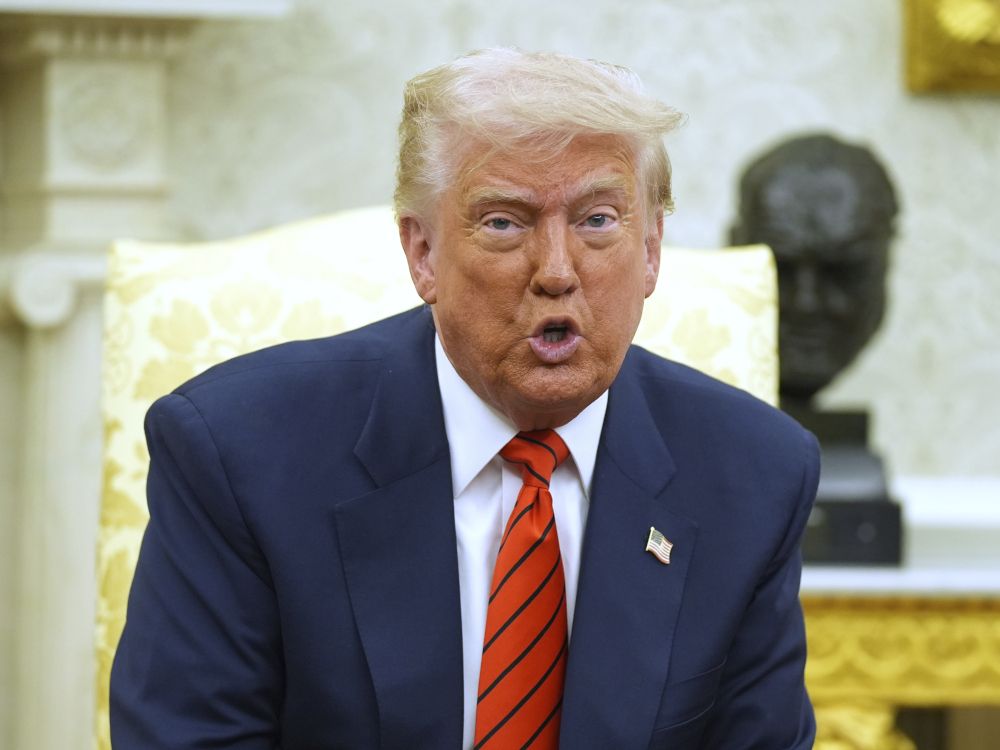
U.S. President Donald Trump

What allowed U.S. President Donald Trump to move so quickly since taking office in January is an approach that may also leave many of his policies easy to reverse by his successors: unilateral executive action.

The current occupant of the White House is very comfortable acting in a kingly fashion, but it’s an approach he inherited from his predecessors, as the presidency has increasingly come to resemble something akin to an elective monarchy, with Congress willingly — almost eagerly — assuming a lesser role.

But if the political class is comfortable sliding towards an all-powerful presidency, that’s not necessarily true of voters, most of whom believe the country should function more like the republic it was intended to be.

Last week, AP-NORC pollsters

reported

that “57 per cent of adults feel Donald Trump has gone too far in using presidential power to achieve his goals.” Unsurprisingly, Democrats are most likely to agree that Trump has gone too far, with 86 per cent endorsing that sentiment, while only 23 per cent of Republicans say the same. But a solid 61 per cent of independents also believe Trump is abusing his presidential powers.

Tellingly, if you take Trump’s name out of the question and just ask about the presidency, 54 per cent of respondents think “the president has too much power.”

Pew Research conducted a

similar survey

in February, which found that 65 per cent of American adults believed it was “too risky” to give Trump more power to deal with the country’s problems, and an even higher 78 per cent said the same of granting such powers to U.S. presidents in general.

The

executive orders

Trump has been relying on to carry out his agenda used to be more like interoffice memos for managing executive branch offices under the president’s control. Nobody even bothered trying to track executive orders

until 1907

. Over the years, however, they’ve evolved into a means for instructing federal agencies on the exercise of their power in novel ways and on the interpretation of laws — often beyond the intent of legislation passed by Congress.

“If it seems as if more recent presidents have had more power than even Washington or Lincoln, it’s not an illusion,” Erin Peterson wrote in

Harvard Law Today

in 2019. “The last three presidents in particular have strengthened the powers of the office through an array of strategies. One approach that attracts particular attention — because it allows a president to act unilaterally, rather than work closely with Congress — is the issuing of executive orders.”

Peterson wrote that even before the left-leaning editorial board of the New York Times

advised Joe Biden

, a president the newspaper supported, to “ease up on the executive actions,” because “this is no way to make law.”

The Times editorial board warned that, while executive actions are tempting for a president who can’t get his preferred programs through a resistant — or simply stalled — Congress, they’re relatively easy for a subsequent president to undo through new orders.

Sure enough, among Trump’s initial actions was

reversing
some

of Biden’s

orders

. The Biden administration, of course, had already done just that to

orders

issued during Trump’s first term. You can already guess what the next president is likely to do to Trump’s preferred policies.

Importantly, Trump has turned global trade into a matter of personal whim by invoking the

International Emergency Economic Powers Act

(IEEPA). Passed in 1977, the IEEPA is only one of a set of laws Congress passed to offload its responsibilities to the president.

The law allows the president to exercise wide authority to regulate the economy during declared emergencies. So President Trump issued

an order

declaring that “foreign trade and economic practices have created a national emergency” and imposed “responsive tariffs to strengthen the international economic position of the United States and protect American workers.”

Is simply evoking the word “emergency” a good enough excuse for exercising such power? Plaintiffs

suing

the federal government don’t think so. They point out that

Article 1, Sec. 8

of the U.S. Constitution reserves the regulation of foreign trade and tariff powers to Congress.

The courts will decide if Congress gets to surrender those powers to the president. If the courts go along with the cession of authority, it essentially means the constitution of a republic can be turned into the blueprint for a monarchy by sufficiently lazy or craven lawmakers.

“That turns the constitution on its head,” Gene Healy observed in his recently revised book, “

The Cult of the Presidency

.” “The Framers erected significant barriers to the passage of legislation in an attempt to curb ‘the facility and excess of lawmaking.’… But when the executive branch makes the law, those constitutional hurdles then obstruct legislative efforts to repeal it.”

But if the courts oppose Trump on his unilateral assumption of the power to impose broad tariffs, it’s reassuring to know that Americans expect the president to abide by the ruling. According to an

April Ipsos poll

, 83 per cent of Americans think the president must abide by court orders.

It’s worth emphasizing that criticisms of excessive presidential power don’t necessarily reflect one way or another on any given president’s policies. It’s possible to be enthusiastic about Trump’s

Department of Government Efficiency

, favour repealing intrusive

green appliance regulations

that raise costs and limit choice, and advocate for America’s military allies to

pay more

for their own defence costs without thinking that any U.S. president should rule unilaterally.

Unfortunately, even as the power of the chief executive grows with every new officeholder, Americans’ appetite for a restrained presidency tends to be situational.

In its

February poll

, Pew Research observed that, “In general, majorities of both Republicans and Democrats are skeptical about giving U.S. presidents more power. However, their opinions tend to shift depending on which party controls the presidency.” An accompanying graph of opinion over time shows supporters of both major parties becoming most skeptical of presidential power only when the opposing party holds the White House.

That an overall majority of Americans now agree that President Trump has gone too far in bypassing Congress and acting on his own demonstrates that there may finally be an opportunity to restrain the presidency. Whatever is done should bind not just the current officeholder, but all those to come.

National Post


Conservative Leader Pierre Poilievre arrives on Parliament Hill for a caucus meeting on May 6, following the federal election. Letter writer Susan Silverman says to replace Poilievre as Tory leader would be an insult to the millions of people who voted for him.

‘An effective opposition voice’

Pierre Poilievre won the right to stay on as leader — Terry Newman, May 5

In 2015, Canadian voters swooned over “nice hair” and voted in a sophomoric leader who decimated our economy, boasted his “faux-feminist” leanings, nearly doubled the size of an already bloated federal bureaucracy, and sponsored immigration that far exceeded our capacity for housing and health care. Under two successive leaders, the Conservative opposition failed to hold the (minority) governing party to account for its numerous ethical breaches and policy blunders.

Since assuming leadership in 2022, Pierre Poilievre, a smart, polished communicator, has been an effective opposition voice, with an unrelenting message of “axe the carbon tax,” “tough on crime,” and making housing affordable for working Canadians.

Fast forward to the coronation of Mark Carney as Liberal leader and prime minister, and the recent election. Formerly a card-carrying member of the Davos climate zealots, but willing to put his hypocrisy on full display, Carney immediately stole a page from the Conservative playbook, cancelling the consumer carbon tax.

The Conservatives earned 41 per cent of the popular vote and increased the size of the CPC caucus by 24 seats. To contemplate further leadership chaos would be an insult to the millions of Canadian voters who have put their confidence in Pierre Poilievre as our next prime minister.

May it happen sooner rather than later.

Susan Silverman, Toronto


Canada needs another national broadcaster

Re: On election night, CBC shamelessly cheered on Mark Carney — Terry Newman, May 1

Beyond doubt, anyone who is not powerfully committed to the Liberal party gritted their teeth every time they tuned into the CBC’s coverage of our past election. This is nothing new for anyone with a desire for more objective reporting of all things political in Canada. The bias against conservative themes and leaders is a constant factor in the national orientation toward left-leaning solutions to all issues.

But the issue is not just the CBC. All major Canadian broadcasters seem to share the same monochromatic view of issues that vary only in the sequence of presentation of their offerings. Of even greater concern is the selection of issues on which they report. Items of conservative interest generally receive lesser or no reporting when they might reflect badly on the government in power — particularly when the government is Liberal.

Canada desperately needs another national broadcaster beyond CBC, Global (Corus Entertainment), CTV (Bell Media), and Rogers. The monopolistic power of this group is controlled by CRTC licensing regulations that limit the emergence of another network — one that might reflect a more open interpretation of what warrants being reported.

The National Post is the only print/digital media that offers a centre-right balance in its content; there is no reason why the Postmedia-owned news site could not evolve into a national broadcasting network.

Canadians probably do not want a carbon copy of the U.S. Fox network, but a less partisan version of our current left-leaning media would be a welcome change. It’s high time for Canadian media to develop a more balanced interpretation of the events that inform and guide our national policy debates.

Raymond Foote, Ottawa


Notwithstanding crime concerns

Re: Doug Ford floats idea of electing judges during ‘rant’ on bail reform — The Canadian Press, April 30; Why Poilievre’s three strikes plan for violent offenders has promise — Jamie Sarkonak, April 17; and Mark Carney has quickly become the ultimate establishment Liberal — Chris Selley, April 22

Ontario Premier Doug Ford’s desire to reduce the frequency of criminal attacks is welcome, but late in the game. The hateful protests that occur regularly in the streets and schools of this province serve as a powerful message that people do learn to tolerate and fear a mob, and adjust to this as normal. It is very hard to put the brakes on when judges also alter their attitude to crime and deny their power to protect innocent citizens.

Inadequate policing and mental health care are damaging our society. It is now obvious that even a simple street festival is too hard to manage safely.

So it is hard to understand why, during the federal election, Ford seemed to support Liberal Leader Mark Carney, whose party created all these conditions, and turned his back on Conservative Leader Pierre Poilievre, who feels the same way as Ford does about crime. Personal feelings seem to have gotten in the way of good governance. Ford let us down.

Barbara Okun, Scarborough, Ont.


The subject article on Doug Ford missed a critical point. Canada has a notwithstanding clause in its Constitution. The Ford government does have the final say in the cited (bike lanes) case. Ford and his government could have invoked the notwithstanding clause. Politicians need to be reminded that they can be held accountable for not invoking this clause when the judiciary oversteps its mandate.

Steve Schillaci, Pickering, Ont.


Mark Carney’s concerns about the preventive use of the notwithstanding clause are understandable, but they miss the point. Section 33 of the Charter is not a loophole — it’s a constitutional safeguard designed to preserve parliamentary sovereignty.

Both federal Conservative Leader Pierre Poilievre and Quebec Premier Yves-François Blanchet are right: elected governments need tools to act in the face of complex issues, especially when urgent action is required. In Quebec’s case, the decline of the French language is not theoretical — it’s measurable.

The clause doesn’t abolish judicial oversight. It temporarily suspends certain remedies, allowing governments to act while remaining accountable to voters.

Rather than framing its use as undemocratic, we should recognize it for what it is: a deliberate feature of our system, not a bug.

Sébastien Chagnon-Jean, Montreal


Raining on Trump’s parade

Re: U.S. Army confirms it will hold anniversary parade on Donald Trump’s birthday — May 2

The U.S. army has confirmed it will be staging a military-style parade on President Donald Trump’s 79th birthday in June, in conjunction with celebrations of the service’s 250th anniversary.

Trump has long wanted a parade, but I, probably along with many others, wonder how the parents and relatives of those who were injured or killed in the wars feel about the man who allegedly referred to American war dead as “suckers” and “losers.” The hardest part is knowing that he himself successfully avoided the draft five times.

Peter Raschig, Barrie, Ont.


‘Drastically increasing government debt’

Re: A 10-point plan for the election winner to fix Canada — Derek H. Burney and Raymond Chrétien — April 29

Canada needs a Margaret Thatcher now more than ever. We have elected a government that promises to drastically increase the government debt. We have elected a government that will not make any changes to supply management in agriculture, yet promises to expand our trading relationships with other countries. In the past, freer trade discussions have been halted because of our refusal to alter supply management. We have elected a government that promises to create an “energy corridor” but will not repeal the “no pipeline act.” We have elected a government that will not reverse legislation that eased the granting of bail but will take guns away from lawful gun owners.

I predict that in about 18 months, inflation in Canada will be higher than it was under Justin Trudeau. We will have added billions of dollars to the public debt and we will feel the impact of carbon taxes on industry and the carbon tariffs Prime Minister Mark Carney is promising on imports.

Young people in particular should not be happy with the federal election results.

Rick Hird, Whitby, Ont.


Musings on separatism

Re: Danielle Smith lowers bar for Alberta referendum with separatism sentiment emerging — Rahim Mohamed, April 30

I’m glad to hear that Premier Danielle Smith is seeking a better deal for Alberta.

After we separate and we don’t have to send money to Ottawa anymore, I hope we have a referendum on Calgary leaving the province. It’s much wealthier than Edmonton, and I am tired of supporting those lazy Oilers fans with my tax dollars.

Next, my neighbourhood will be seceding from Calgary, because my neighbourhood is wealthier than Forest Lawn, and I don’t want my property taxes being used to clear their snow off of their roads.

Finally, my condo unit will be seceding from the rest of the building, because I’m richer than my neighbour. He speaks French and lives east of me, so I don’t care if the roof caves in over his section of the building.

Zack Shapiro, Calgary


Accuracy paramount in accounts of Canada’s past

Re: New campaign aims to give more balanced account of Canadian history — Louis Charbonneau, April 25

The Canadian Institute for Historical Education is right, often, that “context matters.” But sometimes it’s not context that is needed — but accurate evidence.

To say that the Sir John A. Macdonald Parkway in Ottawa was renamed because of his role in the “creation and the expansion of the residential school system” is factually wrong. He did speak in favour of separating Indigenous children from their families for education, a common view then, now rejected. Yet the 1884 law he introduced said “schools,” not “residential schools.” The worst aspects of those schools came years after he died. And, for the record, Egerton Ryerson had nothing to do with them, either. The words “residential school” appear nowhere in his writing.

What we need is accuracy — balance certainly if the evidence shows pluses and minuses, but there are some real scoundrels and some genuine heroes. Get it right.

Lynn McDonald, fellow, Royal Historical Society, Toronto


Concerned for Ontario wildlife, especially endangered species

Re: Ontario Species Conservation Act, 2025

The Ford government is proposing to wipe out the Endangered Species Act, 2007 and replace it with legislation so weak it may as well be a death sentence for Ontario wildlife.

The Species Conservation Act, 2025, is not conservation — it’s cover for deregulation. It strips away science, silences independent experts, guts habitat protection, and hands unchecked power to politicians and developers. This is not modernization. This is ecological vandalism.

Let’s be clear: the ESA was created because we had already failed endangered species for too long. It was a turning point — making recovery not optional, but a legal obligation. The new proposal reverses all of that. It abandons recovery planning, removes science from the equation, and redefines “habitat” so narrowly it would exclude vast areas that species rely on to survive.

Under this new law, politicians would decide which species deserve protection — not scientists. Developers could bulldoze critical ecosystems without independent review. Worse, it signals a chilling truth: Ontario’s government no longer sees the loss of species — or the health of ecosystems — as its responsibility.

We are in the middle of a global biodiversity crisis. More than 230 species in Ontario are already at risk of extinction. This is not the time to walk away — it’s the time to act with courage.

The ESA needs to be enforced, not erased. Future generations will judge us by how we protect what cannot protect itself.

Gord Miller, Chair, Earthroots, former Environmental Commissioner of Ontario


Jewish Canadians faced dilemma in election

Re: Bad blood, perfect luck and campaign by ‘gut’: Inside the election that surprised everyone — Simon Tuck and Stuart Thomson, May 3

Last Saturday’s Post delivered a detailed analysis of the federal election but did not touch on the dilemma faced by Jewish voters.

Canadian Jews in the majority have voted Liberal in the past, the party being viewed as one that champions universal social causes while keeping Canada strong and free.

In this past election, those who I know asked themselves, “Do I vote Liberal as I have in the past, or do I vote Conservative, given the party leader’s willingness to take real action in the battle against antisemitism in Canada and his stated position of supporting Israel, as opposed to the Liberals’ negligible response to antisemitism and their anti-Israel voting at the UN, along with financial support for UNWRA.”

Apparently the Jewish vote was divided. I can only conclude that some Jews found championing social justice issues more meaningful or less controversial than policies mainly of Jewish concern.

While universal liberal values including freedom, justice, and security and prosperity for all Canadians remain important to us, with the growing fear for our own safety, we must appeal to our new Liberal government to act forcibly this time to rein in this growing threat to the security of Jews and their institutions.

As Jews, we must at this time be for ourselves in the particular, and focus on antisemitism and support for Israel until this irrational pandemic of Jew hate in Canada and against Israel is cured. By doing so successfully we will be helping our country become once again, a place for all those who support freedom, justice and other democratic values, to support democracies overseas and to live here without fear from harm from those who hate.

Ron Hoffman, Toronto


National Post and Financial Post welcome letters to the editor (200 words or fewer). Please include your name, address and daytime phone number. Email letters@nationalpost.com. Letters may be edited for length or clarity.



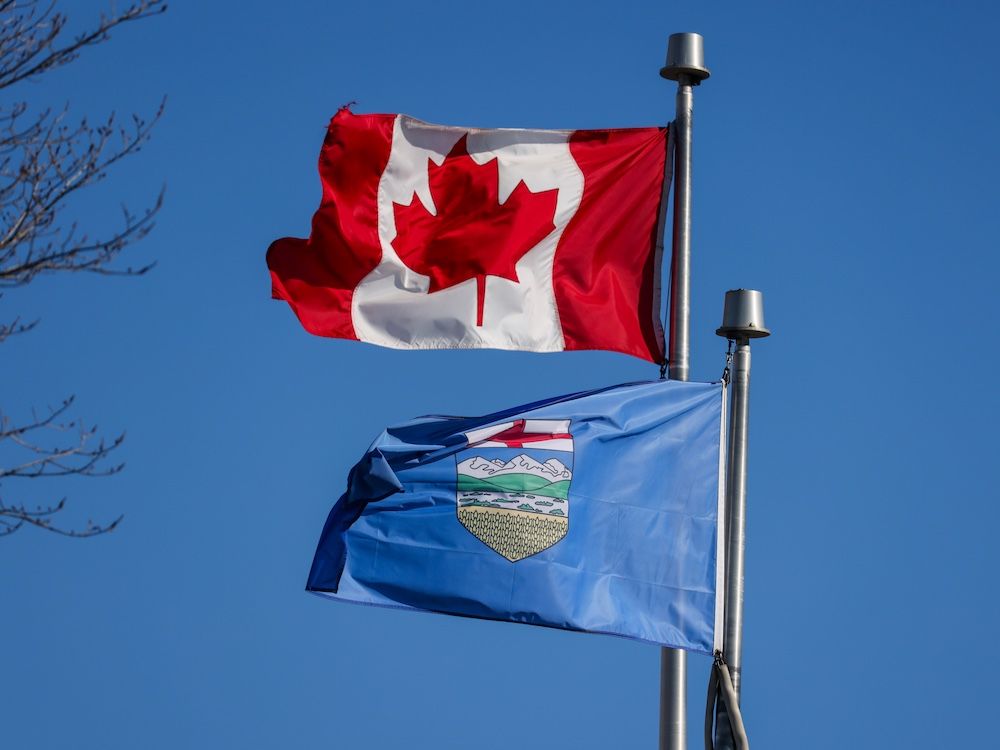
The Canadian flag and an Alberta provincial flag fly together in Cochrane on Tuesday March 4, 2025. 
Gavin Young/Postmedia

I’m not sure, as an Albertan, that the biggest Alberta political news of the week isn’t the official secession of

the Alberta New Democratic Party from the national NDP.

Last weekend members of the NDP-A voted at a general assembly to allow for separate provincial memberships in the party: no longer will the NDP be one and indivisible. It seems there is widespread agreement that Alberta’s economy and its political culture are so distinctive from Canada’s, and so permanently incompatible with it, that the two entities really needed to… what’s the word I’m looking for? “Separate”?

NDP-A leader Naheed Nenshi, who executed the NDP schism, also spent some of the weekend denouncing Premier Danielle Smith’s plans to allow and

even slightly facilitate

a referendum on Alberta independence: maybe I’m being flippant, but I guess he’s a separatist only for his own gang. As a federalist Albertan, I’ve observed a lot of dread and anger both inside and outside the province about Smith’s openness to using the threat of separatism as an advanced Quebecois-style version of what are otherwise time-honoured anti-Ottawa tactics.

Smith insists she favours a united Canada: even (or especially) if you take her at her word, any conscious risk to the political unity of the country could be seen as playing Russian roulette. On the other hand, she has to hold together her own political governing coalition, which certainly has a separatist minority of significant size within it. I do not see any reason whatsoever to believe that a test of genuine public separatist sentiment in Alberta, a test with stakes on the table, would accomplish anything other than to instantly reveal the pathetic size and feeble calibre of that minority.

I say this having near-total sympathy with most of Alberta’s grievances against Canada. The very constitution of the country is explicitly rigged to diminish our electoral and senatorial power. Our heavy funding of the rest of Confederation seems to earn us nothing but contempt from central Canada. I don’t have major complaints about explicit fiscal equalization between provinces per se, apart from the unceasing ad-hoc updates, but equalization is just the questionably necessary top layer of a cake.

Other provinces’ economies are all to some degree engineered around employment insurance, and around contrived seasonal industries that wink in and out of existence to allow for the hoovering of implicit labour subsidies from the federation. And unlike most of what the species calls “insurance,” eligibility to collect is lowered for the regions that use EI inveterately, not raised. The long-term effects of this haven’t been good for anybody.

Alberta’s contributions to the Canada Pension Plan are also, as the recent controversy over a project for an Alberta Pension Plan showed, enormously disproportionate. The most important source of Alberta’s relative wealth is its oil and gas, and perhaps the rest of Confederation is now prepared to stop treating this industry as a despicable moral poison. But what the RoC certainly won’t stop doing is dismissing Alberta hydrocarbons as a lucky endowment from heaven to which the province has no legitimate moral entitlement — unlike, say, nickel mines, or ocean fisheries, or hydropower, or potash and uranium, or old-growth forests and coastlines.

I’m a federalist anyway — and I’m sure I’m speaking for most Albertans. (At any rate, I can speak for any Albertans who, like me, put in a decade working at Alberta Report.) Say what you want about Quebec separatism: before it could become a threat to Confederation, it had to build, despite its huge inherent ethnic, linguistic, and historic advantages, and this took a good long time.

Alberta separatist political parties are gnats, invisible to the naked eye. They haven’t come within an order of magnitude of passing any electoral test, despite lots of chances, since the National Energy Program crisis. Alberta separatists don’t have recognizable intellectual leadership — none that you’d use those words to describe, anyway. They haven’t either captured or formed any popular journals of opinion. They haven’t written catchy songs that Albertans bellow at each other in bars.

The Maple Leaf flag is as popular here as anywhere. Try applying

Tebbit’s cricket test:

we Albertans cheer for Canada at the Olympics, and sing “O Canada” with incomparable gusto at hockey games. We don’t have an entire cultural vanguard that plays footsie with separatism. The separatists don’t have a permanent literature going back decades: there’s no ready-made Alberta pantheon, no list of Alberta sovereigntist classics.

And, of course, there’s the biggest problem of all. Who’s supposed to be the Alberta-separatist René Lévesque, the affable, stylish Alberta genius who routinely argues circles around federal ministers and Canada Council trough-feeders alike?

National Post


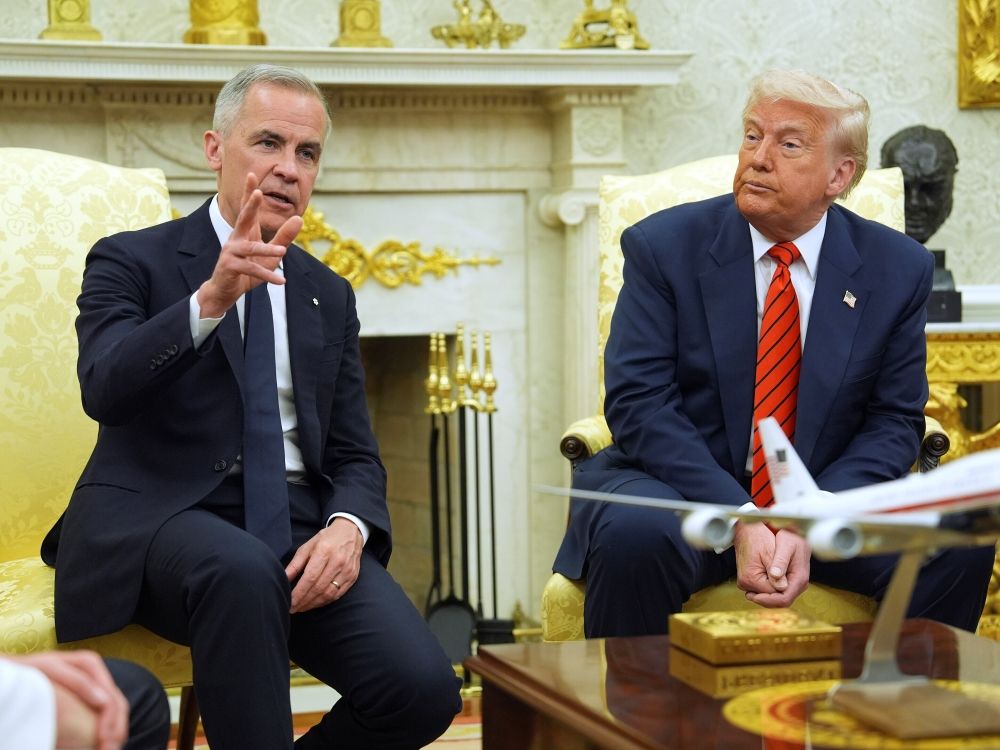
President Donald Trump meets Canadian Prime Minister Mark Carney in the Oval Office of the White House, Tuesday, May 6, 2025, in Washington.

Mark Carney has returned from Washington and is taking a bow from the highly supportive Canadian political media for a very cordial meeting with U.S. President Trump. He set out to replicate his mighty but unsuccessful effort as governor of the Bank of England to terrorize the British public over the prospect of the United Kingdom departing the European Union, which Britain had never voted to enter, and squeaked into the minority reelection of an otherwise failed Liberal government of Canada as the man who could stand up to Donald Trump. President Trump heaped compliments on his visitor and with some justification took credit for Carney’s election victory, said that he (Trump) was the best thing that ever happened to him (Carney) and slapped him jovially on the knee. Readers will recall that I said at every stage that the hysteria about Trump was a nothingburger and that no more would be heard about Carney’s theory that “Trump is trying to break us” and that “This country’s intimacy with the United States is over, a tragedy but the reality.” When asked about this last week President Trump said “He was running for public office,” a gracious explanation of the ludicrous canard that Trump is any kind of a threat to Canada.

The fawning political media of Canada could not accept being debriefed as abruptly as the prime minister was. In its otherwise unexceptionable cover story article about the visit, in the Globe and Mail on Wednesday, May 7, the word “annex” or “annexation” was repeated six times. Every informed person in Canada knows that the use of that word in this context is dishonest. Trump never spoke of annexation, which implies an involuntary takeover, something the United States did not do even with Texas or California, which it took from Mexico to the great pleasure of the inhabitants. Trump never uttered one word implying an aggressive act against the independence of Canada. He said that he thought the Canadians would do better as Americans after a voluntary federal union, and it was refreshing to hear him repeat this past week that if Canadians were Americans they would not only benefit from lower taxes but better health care, as well as being able to dispense with the defence budget altogether, since it has come so close to eliminating it anyway. Two whole generations of Canadians have been force-fed the fraud that Canada’s health-care system is superior to that of the United States; 80 per cent of Americans receive a level of health care beyond the dreams of any Canadian who does not go to the United States for medical treatment.

Some Canadian journalists even employed the word “Anschluss,” the German expression for annexation generally used in reference to Hitler’s occupation of Austria in 1938, as being Trump’s conception of the future of Canadian-American relations. And the media that touted Mark Carney as the virtuous and indomitable Dudley Do-Right to slay the American Goliath, when the whole scenario of total disruption of relations with the United States and American aggression was revealed as unutterable nonsense, have hailed his return from Washington as a triumph of the underdog. It is a triumph of political posturing and chicanery. In the abstract, Mr. Carney carried it off well and deserves professional commendation for selling a fable and then harvesting the credit for helping to banish the threat that never existed. The not-so-flattering aspect of this process is that where the British public correctly saw in 2016 that Carney’s Brexit ”Operation Fear” was a myth, as subsequent events have proved, Canadian voters were more gullible when presented with the new and much more implausible bogeyman of Donald Trump seeking to strangle the pure snow-maiden of the North. Trump this week repeated his well-known and oft-stated liking for Canada, had nothing but praise for Mark Carney and emphatically stated that Canadian-American relations would remain friendly and positive under any scenario. The Liberals’ monstrous electoral rodomontade, incredibly, saved a government which desperately deserved a punishing defeat on its record, and the Canadian political media that crooned the Liberal song sheet has justly praised the prime minister for elegantly disposing of the charade that he himself invented to save his party.

Now that he can retire from his stirring performance as Canada’s Demosthenes, Canadians can only hope that Mark Carney will prove as agile and successful in the new role that he and his host in Washington promised to play in the positive renovation of our relations. There is some room for optimism. As an almost hallucinatory climate change fanatic he was an apostle of the carbon tax and an enemy of pipelines but the Liberal party polltakers induced the grace of mid-campaign conversion, and he joined the majority that had already seen the carbon tax as another confiscatory tax inadequately disguised by a lot of claptrap about saving the planet; an enemy of pipelines, he has become an advocate of them. The best hope for a successful Carney government is that its leader will continue to put expediency ahead of dogmatism and translate his support of great projects that historically have built this country, from the Canadian Pacific Railway to the St. Lawrence Seaway to the Montréal World’s Fair and will assist in projects already well underway to bring some of the most sophisticated resources of this country to the world that needs them at huge profit to Canada and particularly to its short-changed native peoples.

Among these are the Ring of Fire chromite deposits that appear likely to supply the entire world’s consumption of that crucial metal required in making stainless steel for more than a century. There are similar prospects for the Magpie Mountain magnetite deposit of billions of tons on Quebec’s North Shore, with vanadium and titanium byproducts, and with the very large rare earth metals deposits on the North Shore of Lake Superior, and the Sussex New Brunswick potash deposits. The development and marketing of all of these projects are in advanced discussion and are supported by the relevant Indigenous groups. If the prime minister got behind these projects now, he would strike a mighty blow for the economic resuscitation of Canada and put an end to this foolishness about the 51st state, which Donald Trump described last week as “having fun with ‘Governor’ “Justin Trudeau.”

The conjured spectre of an American Canada has returned to the ether. Canada for the Canadians: let’s get back to making this country the world’s next Great Power.

National Post


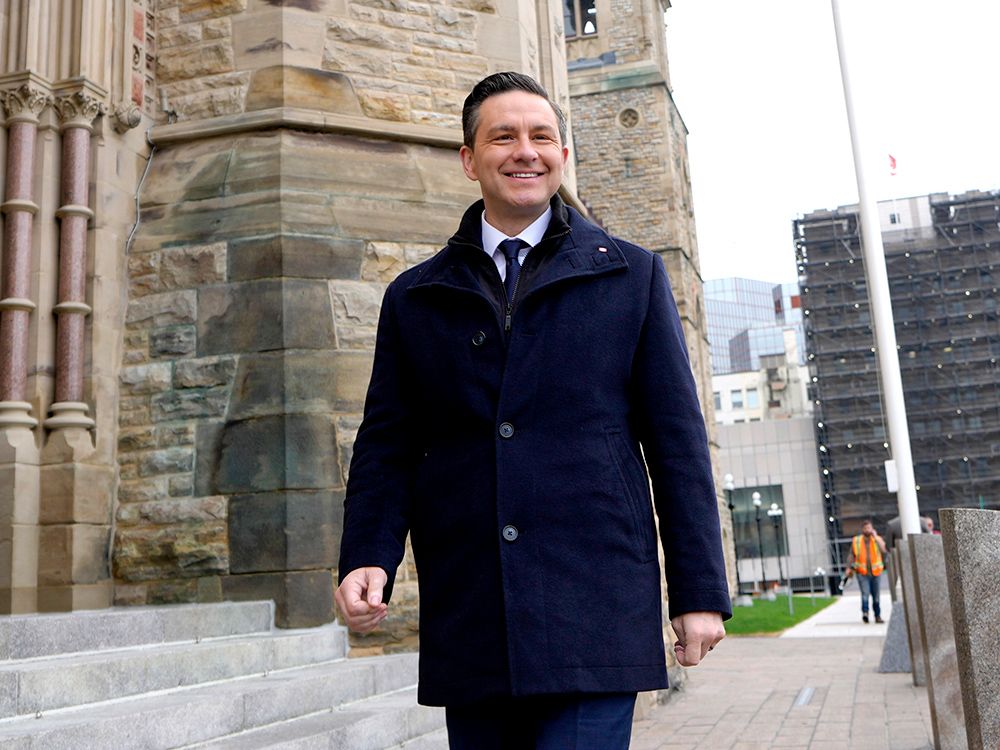
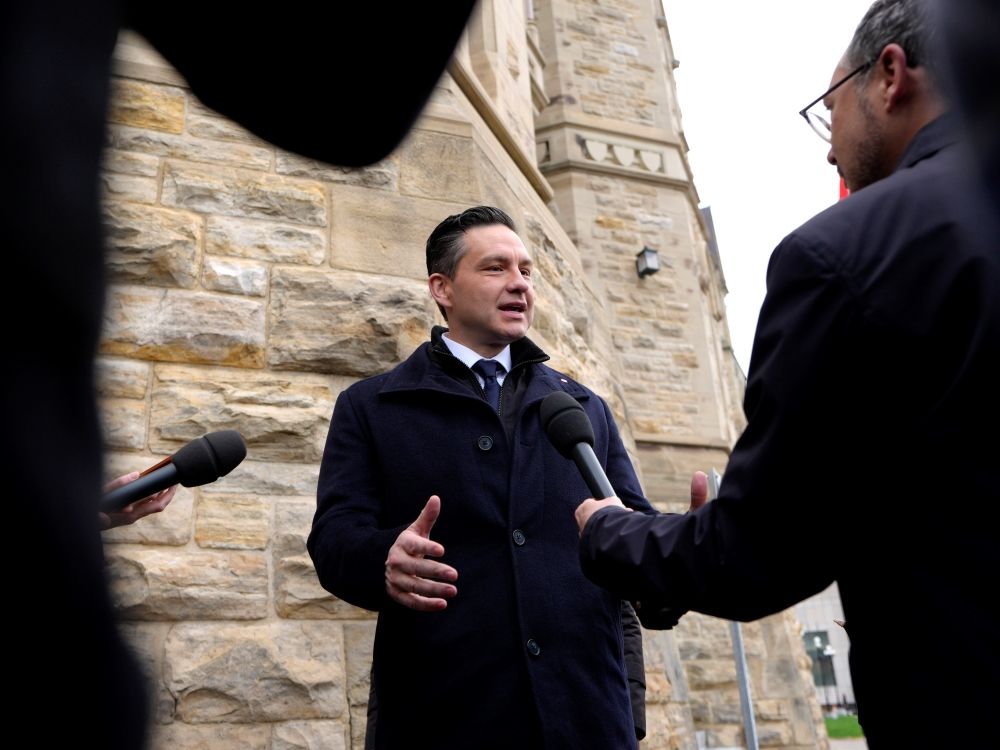
Conservative Leader Pierre Poilievre speaks to journalists as he arrives on Parliament Hill for a meeting of the Conservative caucus following the federal election, in Ottawa, on Tuesday, May 6, 2025.

By withstanding perhaps the worst case of foreign interference in Canadian electoral history, and managing to grow his party’s share of the House of Commons despite the electorate’s sudden Liberal rush, it’s clear that Conservative Leader Pierre Poilievre deserves his place at the head of the party.

There will again come a time when Canadians will have an opportunity to vote for change — and Poilievre should be there to lead when it does.

It’s true that the embattled party leader suffered setbacks of significance. His fortunes of leading the party at a time when the country was most receptive to new Conservative ideas crumbled as President Donald Trump assumed office in the United States and immediately waged a trade war — accented with threats of annexation — against Canada. Trump’s fixation immediately boosted the Liberals’ standings and, well, you know the rest.

Aside from losing the election after holding a commanding lead for months previous, he lost his own seat of Carleton, in suburban-rural Ottawa.

But, the only way to fairly evaluate the setbacks suffered by Poilievre is to take them in stride with his accomplishments, which are far greater than anything achieved by the two party leaders who preceded him.

Poilievre at his height had the party

leading

by

27 points

. Even when party support collapsed post-Trump — and this was only a collapse in the relative sense, since he retained most of his support — he still managed to grow the party’s foothold in Parliament. Poilievre now leads a party caucus of 144 seats, which makes his caucus larger than those of former prime minister Stephen Harper in both 2006 and 2008, as well as those of Andrew Scheer in 2019 and Erin O’Toole in 2021. He also gained

41.3 per cent

of the total vote share — a level unseen by the party since 1988, which, back then, won them a majority.

Poilievre’s Conservatives notably surged in Ontario. Before the election, they held only

40

of the province’s ridings; in 2025, they’re now at

52

(the Liberals, by contrast, have 70 Ontario seats, down from 77), with a strong showing in the 905.

Less quantifiable — but more impactful on the daily lives of Canadians — has been Poilievre’s influence on completely changing the conversation in Canadian politics, transforming the Conservative party from defence to offence.

On climate policy, the party was once completely under the thumb of the Liberals. After fighting the carbon tax since its inception under Trudeau, in 2021, then-Conservative leader O’Toole

conceded

that a carbon tax on fuel should be kept in place — a major flip-flop, as he had promised during his leadership campaign to get rid of the tax. O’Toole went further and proposed the

idea

of special carbon-rebate bank accounts, which would only be spendable on government-approved climate-friendly purchases. It was almost as if the party was trying to out-Liberal the Liberals.

Affordability, meanwhile, took a back seat. The Liberals took the offensive, inflaming social divisions by encouraging the country to see the world in terms of race, sex and COVID vaccine status and berating the Tories for not doing the same.

Poilievre took a sledgehammer to the status quo, embodying the frustrations of so many Canadians at a time when it felt like there was no light at the end of the tunnel. He unapologetically held the Liberals to account, forcing then-Prime Minister Justin Trudeau to answer for impoverishing the country. Instead of cowering to avoid attacks of COVID-denialism — a common, false accusation the Liberals launched against Conservatives —  he was

demanding answers

for Trudeau’s inflationary, COVID-excused overspending.

Instead of supporting drug consumption sites — as the Conservatives

did

under Erin O’Toole — Poilievre

promised

to close them. Instead of staying silent and avoiding the question of whether to cap immigration altogether — as

Scheer

and

O’Toole

both did — Poilievre boldly

announced

that he’d tie his intake numbers to homebuilding. And on the carbon tax, Poilievre’s steadfast criticism brought the Liberals to abandon their beloved flagship policy. At no point did he slouch away in shame of his own party; he stood up for common sense, and, until Trump stole the attention of Canadians, he had election-winning levels of support from his countrymen.

Trump’s interference in 2025, much like John F. Kennedy’s open

efforts

to defeat Progressive Conservative John Diefenbaker in 1963, robbed Canadians of an election about domestic issues at home. What should have been on the ballot in both elections was governance; it should have been a referendum on which party was better-poised to lead Canada into the coming years, and fix the broken bits left behind after longtime Liberal rule. Instead, we got an election about Trump — a temporary hurdle that inspired more fright than it should have, due to Canada’s weakened state after its decade of waste and decline.

Poilievre knows what he has to do next. In a post-election video, he

told

his followers that “it wasn’t enough. We didn’t get over the finish line, which means that I need to learn and grow, and our team needs to expand.”

The underlying fundamentals that made Poilievre the best leader the Conservatives have seen since Harper haven’t changed. His support is high. His principles are strong. He still has what it takes to win — and for the good of the Conservative movement, the party must give him that chance.

National Post


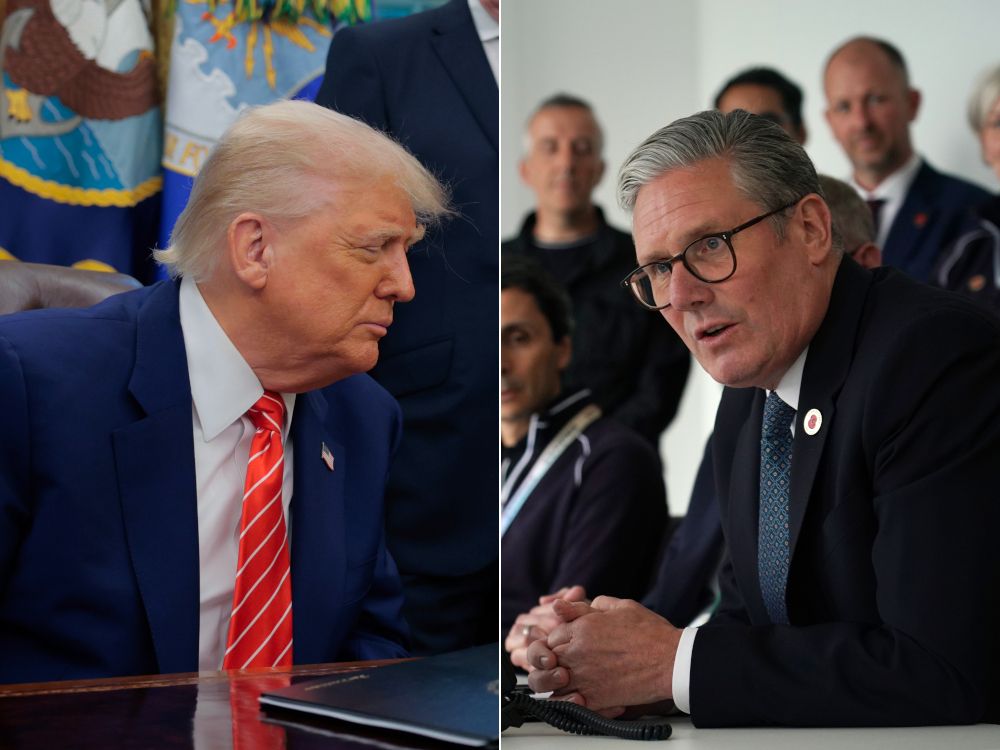
U.S. President Donald Trump, left, and British Prime Minister Keir Starmer announce a trade deal reached between their two countries on May 8.

LONDON — As America signed its first trade deal since threatening to rip up the postwar economic order, I was reminded of Shakespeare’s famous line: “All the world’s a stage.” Rarely has global trade felt more theatrical.

The announcement was made live on television, with

the screen split

between officials in their respective countries. On one side sat British Prime Minister Keir Starmer, hunched with advisers in London’s blandest, most claustrophobic conference room. It looked like a space launch: boffins squinting at screens, willing the mission into orbit.

On the other side sat U.S. President Donald Trump, in the leather-upholstered throne of the Oval Office, unmistakably leading the performance. The U.S. president hailed the deal as “comprehensive” and “historic.” Announced on the 80th anniversary of Victory in Europe Day, it was a symbolically loaded assurance that the United Kingdom remains, in Trump’s words, “truly one of our great allies.”

These were welcome words, no doubt, just weeks after the United States seemed ready to declare economic war on the world. Perhaps the fallout from Trump’s so-called Liberation Day, with U.S. economic growth dipping in the first quarter of this year, prompted the president to expedite the U.K. deal to lift the mood at home.

Free-market Conservatives were quick to

hail the deal

as a “win for Brexit.” It would not have been possible , after all, to skip to the front of the queue in bilateral trade talks had Britain still been inside the European common market.

It was another reminder that Trump’s America is nothing like former president Barack Obama’s, who once warned Britain it would be “at the back of the queue” if it left the European Union. America’s preference to deal with Europe as one entity had its day, but has now been eclipsed by Trump’s Euroscepticism.

He underlined the point himself. “That was always a big part of your decision on Brexit, they were never able to make that deal,” he told Starmer, a staunch Remainer.

In any case, the substance of the agreement was far thinner than either leader let on. Most tariffs, including the 10 per cent global baseline, stayed in place. For those hoping for a return to free trade, the olive branch looked more like a birch switch — one Trump shows no sign of putting down.

Britain’s economic outlook remains far gloomier than it was just two months ago, with the deal offering only minor relief on tariffs overall. British car manufacturers received some relief, with the tariff on the first 100,000 vehicles cut to 10 per cent from the 25 per cent rate initially touted; and levies on steel and aluminum were reduced to zero.

This is positive for Britain, and may provide, as ambassador Peter Mandelson optimistically put it, a “springboard” for future concessions. But ultimately, it is thin gruel: as Sam Ashworth-Hayes wrote in

the Telegraph

, “The net effect is that between lower export volumes and lower prices, we’ll still likely be £9.5 billion worse off than we were before.”

Still, the deal marked a tentative step toward economic rapprochement. It was a modest win for both Starmer and Trump, each eager to offer a sunnier economic story to their respective citizens.

Perhaps its overriding significance was the message sent to the rest of the world about China. The U.S.

demanded assurances

that Britain would freeze out Beijing from critical infrastructure, including pharmaceuticals and steel production. Anyone looking for favourable trade ties with the U.S. will likely have to follow suit. As ever, it’s not really Britain, but “Chi-na” that’s at the forefront of Trump’s mind.

National Post

Twitter.com/michaelmurph_y

Michael Murphy is a journalist based in London. He writes for the Daily Telegraph and presented the documentary “Ireland is full! Anti-immigration backlash in Ireland.”