
LP_468x60
on-the-record-468x60-white

Victoria imam Younos Kathrada.

First Reading is a Canadian politics newsletter curated by the National Post’s own Tristin Hopper. To get an early version sent directly to your inbox, sign up here.

TOP STORY

A Canadian Islamic preacher with a lengthy history of extremist rhetoric is under scrutiny once again after a sermon calling for the death of Jews.

“Oh Allah, destroy the Jews, oh Allah destroy the Jews … oh Allah destroy them for they are no match for you,” said Younus Kathrada in a sermon uploaded to the social media channels of the Dar al-Ihsan Islamic Centre in Victoria, B.C.

The April 18 sermon also praised the “bravery” of Palestinian children as young as 10 years old who expressed a wish to die as “martyrs” in armed combat against Israel.

“It’s the young girls as well … Did you not hear that little girl say: ‘I want to grow up, and I want to get married, and I want to give birth to and raise martyrs.’ Yes, by Allah. What kind of bravery is that?” he said in English.

Kathrada’s prayer calling for the destruction of Jews was then spoken in Arabic at the sermon’s end.

“This guy needs to be arrested or deported, before he does something to hurt someone here in Canada,” wrote B.C. Conservative Leader John Rustad in a social media post appended to a video of the April 18 sermon.

On Sunday, the Canadian Antisemitism Education Foundation announced it had lodged an official complaint with the Victoria Police Department, arguing that Kathrada’s sermon met the threshold for hate speech.

Specifically, the group argued, Kathrada’s statements violate Section 318 of the Canadian Criminal Code, which prescribes prison terms of up to five years for “every person who advocates or promotes genocide.”

National Post reached out to Kathrada via the Dar al-Ihsan Islamic Centre for comment, but did not hear back by press time.

An excerpted video of the “destroy the Jews” sermon was circulated by the Middle East Media Research Institute (MEMRI), a non-profit that provides translations of extremist media from across the Muslim world.

Kathrada has often been featured in MEMRI videos, going all the way back to 2018 when the group excerpted a sermon of him saying that a Muslim uttering Merry Christmas is a sin worse than adultery or murder.

“If a person were to commit every major sin … lying, murder, committing adultery, dealing with interest. If a person were to do all of those major sins they are nothing compared to the sin of congratulating and greeting the non-Muslims on their false festivals,” said Kathrada at the time.

In 2019, Kathrada urged his followers not to vote in that year’s federal election, declaring that every single candidate was “evil” for supporting homosexuality. “They are all evil. Every single one of them … They are all evil and filthy,” he said.

In 2020, after French schoolteacher Samuel Paty was beheaded in an Islamic terrorist attack, Kathrada denounced the deceased as a “filthy excuse of a human being,” called for a boycott of all French goods, and prayed for the destruction of the “enemies of Islam.” “Oh Allah, support those who wage jihad for your sake everywhere,” said Kathrada.

Just two weeks after the April 18 “destroy the Jews” sermon, in fact, Kathrada can be heard praying in an April 27 video for the victory of the “mujahideen” in Kashmir. Five days prior, Islamist gunmen had murdered 26 tourists in the Indian-administered territory.

Despite all of this, Kathrada’s group, Muslim Youth of Victoria, has previously been a recipient of government grants. In 2021 and 2022, the group received a combined $5,000 from a City of Victoria fund intended for those who “own or operate cultural facilities.”

In 2024, Global News reported that Kathrada’s group had also received grants from the Islamic Society of B.C., a federally registered charity.

As recently as last November, Kathrada had been scheduled to speak on the campus of the University of Victoria at an event sponsored by the school’s Muslim Students Association.

“Join us for an insightful lecture by Sheikh Younus Kathrada on the significance of building strong ties within the Muslim community,” read an advertisement for the Nov. 24 lecture, which was ultimately cancelled by UVic administrators following reports by Global News and National Post.

Born in South Africa, Kathrada’s extremist rhetoric has been making headlines since at least 2005, when one of his former students at Vancouver’s Dar al-Madinah Islamic Society was killed by Russian forces reportedly after joining a Chechen jihadist group as an explosives expert. At the time, CBC obtained recordings of Kathrada sermons in which he referred to Jews as “the brothers of the monkeys and the swines.”

Although Kathrada was briefly subject to a security probe at the time, it yielded no charges.

IN OTHER NEWS

Although there are a few groups pushing for Alberta separation, one of the leading ones, Alberta Prosperity Project, unveiled the question they intend to ask in a future separation referendum. It is …

Do you agree that the province of Alberta shall become a sovereign country and cease to be a province of Canada?

Under current Alberta law, the Alberta Prosperity Project will have to collect 600,000 signatures within 90 days in order to have the question taken up by Elections Alberta as an official referendum (However, Alberta Premier Danielle Smith’s government has introduced legislation to drop that threshold to 175,000). In any case, the draft referendum question is much more straightforward than the last time Canada had a secession vote. When Quebecers voted on separation in 1995, they faced ballots reading ….

Do you agree that Quebec should become sovereign after having made a formal offer to Canada for a new economic and political partnership within the scope of the bill respecting the future of Quebec and of the agreement signed on June 12, 1995?

At the last official count, Canada was just starting to see a slowdown in the extremely high rates of immigration that have defined much of the last three years. In the last quarter of 2024 the Canadian population increased by 63,382, almost entirely due to immigration. That still makes Canada one of the world’s highest-immigration countries, but it’s a marked decrease from the likes of 2023 or 2022, when the population was surging by more than one million per year. In the four months since, immigration intake has apparently continued to taper off enough that telecom companies are now complaining that it’s led to a decrease in new subscribers. Rogers, in particular, told investors its growth had slowed due to “slowing population growth as a result of changes to government immigration policies.”

Get all of these insights and more into your inbox by signing up for the First Reading newsletter here.
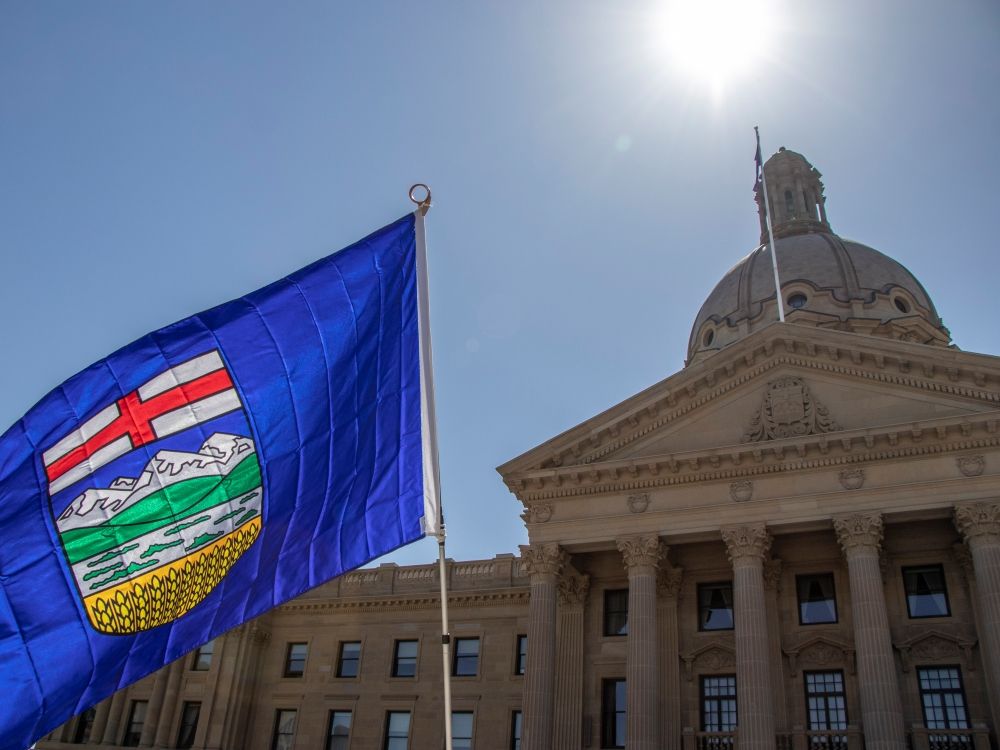

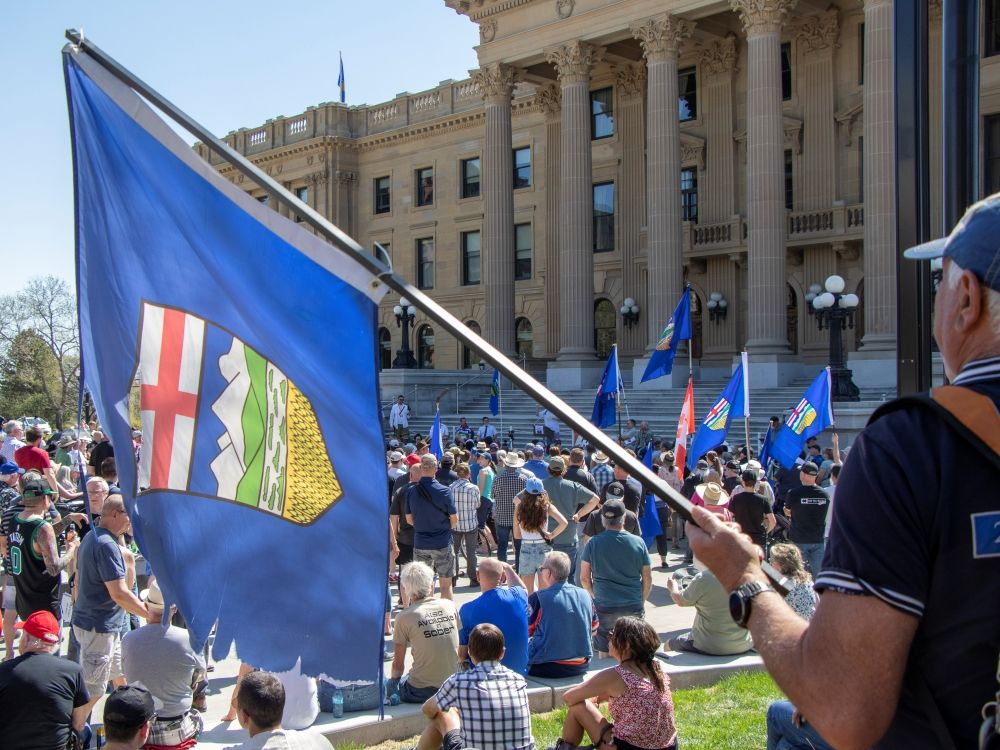
A rally and counterprotest for the Alberta separatist movement drew hundreds of people to the Alberta Legislature on Saturday, May 3, 2025.

This election showed that there are still strong regional divisions in Canada, setting Alberta, in particular, apart from the rest. The newly elected federal government has the opportunity to address them while strengthening the nation as a whole.

This task should begin by understanding some basic facts about Canada’s economy and finances, and how reforming our governance to align with the Constitution is all that is needed to fix our most pressing problems.

Oil and gas make up by far the greatest share of the country’s exports — 2.5 times

greater

than the auto sector. The fossil fuel industry supports

nearly 900,000

mostly high-paying jobs across Canada. There is a suite of policies aimed at prematurely phasing it out, but there is no replacement on the horizon that matches its productivity. The Canadian dollar and our economy will suffer greatly if these policies — particularly the impossible

emissions reduction target

of 40 per cent below 2005 levels by 2030 — are not swiftly discarded.

Canada is in a productivity crisis, and our natural resource strengths are unmatched in offering a path to remedying that. LNG exports to displace Asian coal power would reduce global carbon emissions more than anything else Canada could do.

Federal policies are not only overly aggressive in sacrificing a large economic engine for a tiny offset to the global expansion of carbon emissions, they also push right through the boundaries within our constitutional bargain. Natural resources and electricity are very clearly in the provincial domain — both before and after 1982. It will benefit all regions of the country if the feds respect this and retreat.

In addition to the economic benefits it provides Canada, Alberta’s productivity funds federal programs. Here, too, the constitutional bargain has been shredded.

When you filed your taxes last month, you may not have noticed you sent almost twice as much to Ottawa as to your province. With this imbalance of tax power, the feds have steadily made the provinces more and more dependent on them to deliver core provincial services like health, education and social supports.

Many Canadians want to see more spending in health, addictions and homelessness, education, skills training, infrastructure and many other areas that are under provincial jurisdiction. Provinces somewhat legitimately turn to the federal government for help, given that most of their residents’ tax dollars were sent to Ottawa. This not only erodes accountability, but when Ottawa does step in, it also does so with strings attached and an entire second level of bureaucracy that must be fed before any dollars get to the front lines.

In principle, if the federal government is using its dollars for legitimate federal functions, evenly spread throughout the country, there is nothing wrong with regions with higher incomes paying proportionately more taxes. Today in Canada, though, a large share of the federal budget is spent on matters of provincial jurisdiction and it is certainly not evenly spread throughout the country.

The combination of higher incomes and lower federal spending in Alberta means we subsidize federal programs outside the province. In 2023 the feds raised $78 billion in revenue from Albertans but spent only $58 billion in Alberta. The independent website

Finances of the Nation

shows that from 2000 to 2023, the inflation-adjusted total subsidy from Albertans was $529 billion.

Using an average of four million Albertans over this period and assuming each was living in a family of four, Albertan households have had $544,000 in their name spent by Ottawa in other provinces. These funds often went to provincial services, spent on hiring nurses, teachers and social workers, and the facilities they work in — all while Alberta has struggled to meet growth pressures in these same areas..

For the last 10 years, while the federal government spent those dollars, layers of jurisdiction-bending economic and social policies were built to stand in the way of a prosperous future. Albertans are not asking for gratitude, handouts or special favours; we have just been asking for Ottawa to respect the Constitution.

There is an opportunity now to fix this and restore Canada’s promise for the next generation.

Economic uncertainty from the United States has unlocked a window of opportunity and we must use it. In the recent election, both major parties pledged support for expanding resource development as the surest means to boost Canada’s productivity and self-reliance. Swiftly repeal or amend the obvious barriers and, and we can continue to build.

Both parties also talked about respecting the provinces and streamlining federal regulations. Now is the time for Ottawa and the provinces to hash out their respective jurisdictions and for Ottawa to transfer equivalent tax points permanently to each province. With the proper share of your taxes, provinces will be fully accountable for their economic decisions and free to deliver efficient and responsive services.

Ottawa will then be able to focus its energies and funds on needed investments in the military, borders and interprovincial trade corridors.

The problems are clear. Our Constitution lays out the answer.

Canada’s mounting debt issues, spending pressures, and regional challenges will get much worse if Ottawa does not get back into its constitutional lane and allow Alberta — and every province — to flourish.

National Post

Bill Bewick, Ph.D., is the executive director of Fairness Alberta, a grassroots group explaining Alberta’s contributions to Canada and the barriers it faces.


Joseph Hanaway

As a Canadian with an education in political science and a former executive of a major American news organization, I am dismayed by the ongoing economic tensions between Canada and the United States. This conflict — which Canada neither instigated nor desired — has been manufactured by U.S. President Donald Trump.

Despite political rhetoric on both sides of the border assuring us that Canadians love Americans, and vice versa, it is essential for ordinary citizens to take tangible steps to maintain and demonstrate this friendship — and to remind ourselves of the many thousands of past instances in our lives where that friendship has manifested itself without us consciously thinking about it.

In that spirit, and given the recent federal election, I wanted to share two stories: first, of a new varsity sports award; and second, of a historic, 151-year-old cross-border sports rivalry.

The first story begins with its two inspirations, a woman named Marie Evelyn Moreton (better known as Lady Byng, wife of Canada’s 12th governor general, Lord Julian Byng) and Winston Churchill. The former was a hockey fanatic who wanted to encourage gentlemanly conduct and good sportsmanship, and the latter famously quipped that, “Rugby is a hooligan’s game played by gentlemen.”

The other lead characters in the story include a rugby team founded in 1872, an American rugby player from McGill’s 1955 squad and a newly endowed sports award.

Throughout its storied history, the McGill University Rugby Football Club (MURFC, which is known today as the McGill Redbirds) has emphasized the importance of how its players conduct themselves on and off the field.

In keeping with the dicta expressed by Churchill and Byng, MURFC has officially announced the Dr. Joseph Hanaway McGill Rugby Gentleman’s Award. This award annually recognizes a McGill rugby player who consistently exemplifies gentlemanly conduct on and off the field for a minimum of two playing seasons.

The idea for a non-endowed award was first proposed to McGill Athletics in late 2020 to formally recognize the qualities of integrity, sportsmanship and respectfulness that are integral to rugby culture worldwide. After just five months of fundraising, we surpassed the $80,000 threshold required for an endowment and the newly endowed award was formally announced to the team at a ceremony on April 10.

As of today, McGill has received $107,000 in contributions, with additional pledges still coming. Beginning in December, the award will confer a $3,500 cash prize to the named recipient.

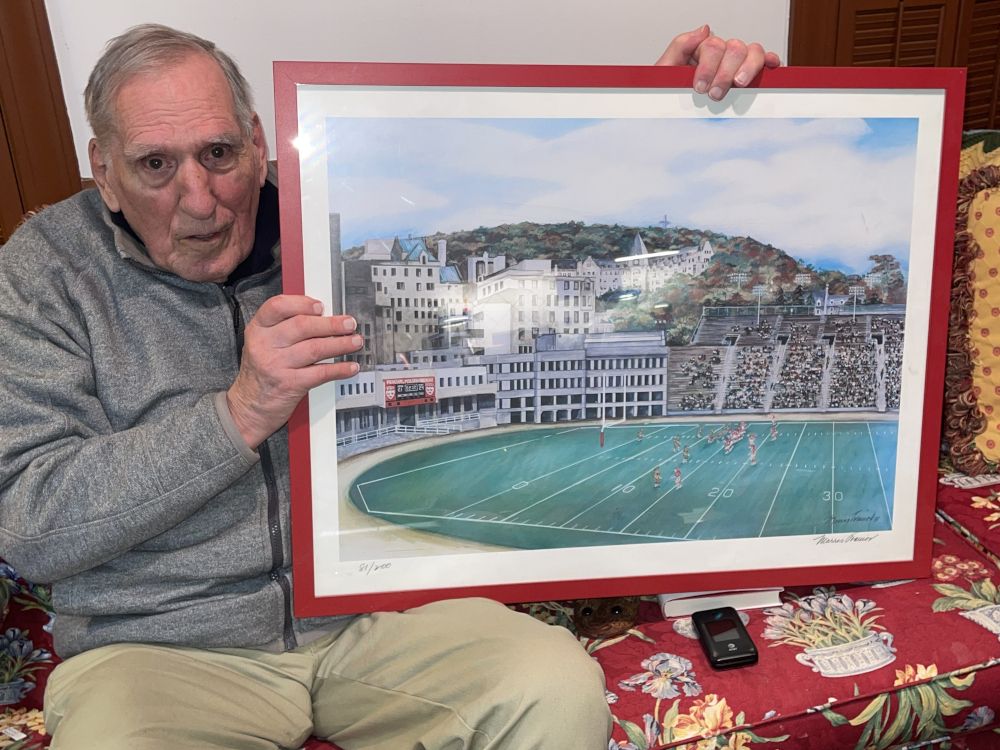
Joseph Hanaway, now 92 and residing in St. Louis, expressed his gratitude: “I am deeply honoured that this rugby gentleman’s award will encourage gentlemanly conduct by McGill’s young rugby players both on and off the field for years to come.”

Hanaway arrived at McGill from New York in 1953 as an undergraduate arts student. Initially joining the McGill football team as a kicker — earning him the nickname “Joe the Toe” — he later transitioned to rugby, where his team became the 1955 Dominion national rugby champions of Canada. He subsequently earned his medical degree in 1960, completed his post-doctoral studies at Harvard and enjoyed a distinguished medical career in the U.S.

Hanaway’s contributions to McGill extended beyond athletics. Upon retiring in 2008, he spearheaded the restoration of McGill’s iconic Roddick Gates clocks and bell tower on Montreal’s stately Sherbrooke Street and authored several books on the history of medicine at McGill.

Given his lifelong commitment to McGill and his embodiment of the new award’s core values, I felt that Hanaway was the natural choice to be its namesake and ambassador.

The second story involves a historic sporting relationship that has had a massive cultural impact, particularly in the U.S. During the fundraising campaign for the endowment, many donors were motivated by a desire to honour last year’s 150th anniversary of the landmark rugby matches of 1874 between Harvard and McGill in Cambridge, Mass. These matches planted the seed for the creation and growth of modern American football.

In honour of this cross-border camaraderie and sports history, any annual income from the endowment exceeding $3,500 will go to support the Covo Cup — the annual rugby game between McGill and Harvard, which symbolizes the enduring bond between these two institutions.

“As an American, I am hopeful that this award will stand as a living testament to the unbreakable brotherhood between America and Canada,” said Hanaway.

This new McGill rugby award named after an American alumnus, as well as the long-standing fraternity between McGill and Harvard rugby players, are just two small examples of how teamwork, co-operation and respect have defined the relationship between the peoples of our two countries for well over 150 years.

David Johnston — former McGill principal and governor general of Canada, who was elected to Harvard’s Athletic Hall of Fame as a former hockey player for the Crimson and later was the first non-U.S. citizen to serve as chair of Harvard’s board of overseers — observed that, “The Hanaway award is very special and unique. To my mind, this gentleman’s award makes a powerful statement not just about this rugby team, but is the very quintessence of the Canada-U.S. friendship.”

National Post

Neil D. Stephenson is the creator and lead fundraiser of the Dr. Joseph Hanaway McGill Rugby Gentleman’s Award. He is a former Atlanta-based CNN executive, a former corporate aviation lawyer and a McGill rugby alum.


A rally and counterprotest for the Alberta separatist movement drew hundreds of people to the Alberta Legislature on Saturday, May 3, 2025.

Twelve years ago, on Jan. 23, 2013, British Prime Minister David Cameron committed to holding a referendum on the United Kingdom’s membership in the European Union. “That is why I am in favour of a referendum, Cameron

explained

. I believe in confronting this issue — shaping it, leading the debate. Not simply hoping a difficult situation will go away.”

Considering the simmering discontent towards the E.U. amongst Britishers, this was a very risky bet, and Cameron knew it. Some of his advisers were opposed. But, with polls showing a majority in favour of remaining in the Union, the Prime Minister was confident that he could win such a fight. Three years later, a referendum was indeed held… and against all odds, Brexit won. The U.K. has been suffering the economic consequences of that choice since.

Alberta Premier Danielle Smith is following in Mr. Cameron’s footsteps, ignoring the fact that once the referendum genie is out of the bottle, no one can control it. We know that not only from Brexit, but also from the 1992 Charlottetown Accord referendum and from Quebec’s 1995 consultation on separation: once the campaign is launched, it takes a life of its own. Even the most talented politicians and the most rational arguments become nearly powerless in stopping the tsunami of public opinion.

I am not an expert on Alberta politics, but I do have sympathy for some of Albertans’ grievances. When I was chief editorial writer at La Presse, I took a strong stand in favour of the Energy East pipeline project. While I sat in the Senate, I opposed bill C-48 that imposed a tanker moratorium on the north coast of British Columbia.

I have lived through three referendums in Quebec. I know how unpredictable and divisive they can be. Even within families, the scars of those political fights take long to heal.

Premier Smith not only said that she would hold a referendum if a sufficient number of Albertans demanded one; her government recently

introduced

bill 54, a piece of legislation that will make it easier for separatists to mobilize and reach the required number of names on a referendum petition. The Premier appears to think, like David Cameron 12 years ago, that not responding in that way to the current anger of Albertans towards Ottawa would worsen the situation, including within her own party’s ranks. This looks eerily similar to Mr. Cameron’s motives.

In 1995, Jean Chrétien’s team decided that, considering favorable polling numbers, it was best that the Prime Minister not get involved in the referendum campaign. Then, three weeks before the vote, Premier Jacques Parizeau announced that the very popular Lucien Bouchard would be Quebec’s chief negotiator with the rest of Canada. Suddenly, the political winds turned, and the separatists took the lead in the polls. In the end, as we all know, Canada narrowly avoided Quebec’s separation.

Quebec separatist leaders have

greeted

the separation talk out of the Prairies with enthusiasm. Why wouldn’t they? They wish for Canada to be weak. A Canada that starts dislocating would be a huge boost to their chances of winning a third referendum on Quebec’s separation.

Notwithstanding its difficulties, Canada remains an extraordinary nation, a land of opportunity, tolerance and peace. Because it is such a large and diverse country, regional frustrations are unavoidable. Danielle Smith is right that those cannot be ignored. It is normal and fair that provincial leaders put pressure on Ottawa to address such problems.

However, using the threat of separation, as the Premier is presently doing, is unacceptable. One should not be playing games with our nation’s future. If, as she has stated, Smith is opposed to Alberta’s independence, she should be fighting it day in and day out, not fanning the embers.

André Pratte is a communications consultant and doctoral student in history at the Université du Québec à Montréal.

National Post


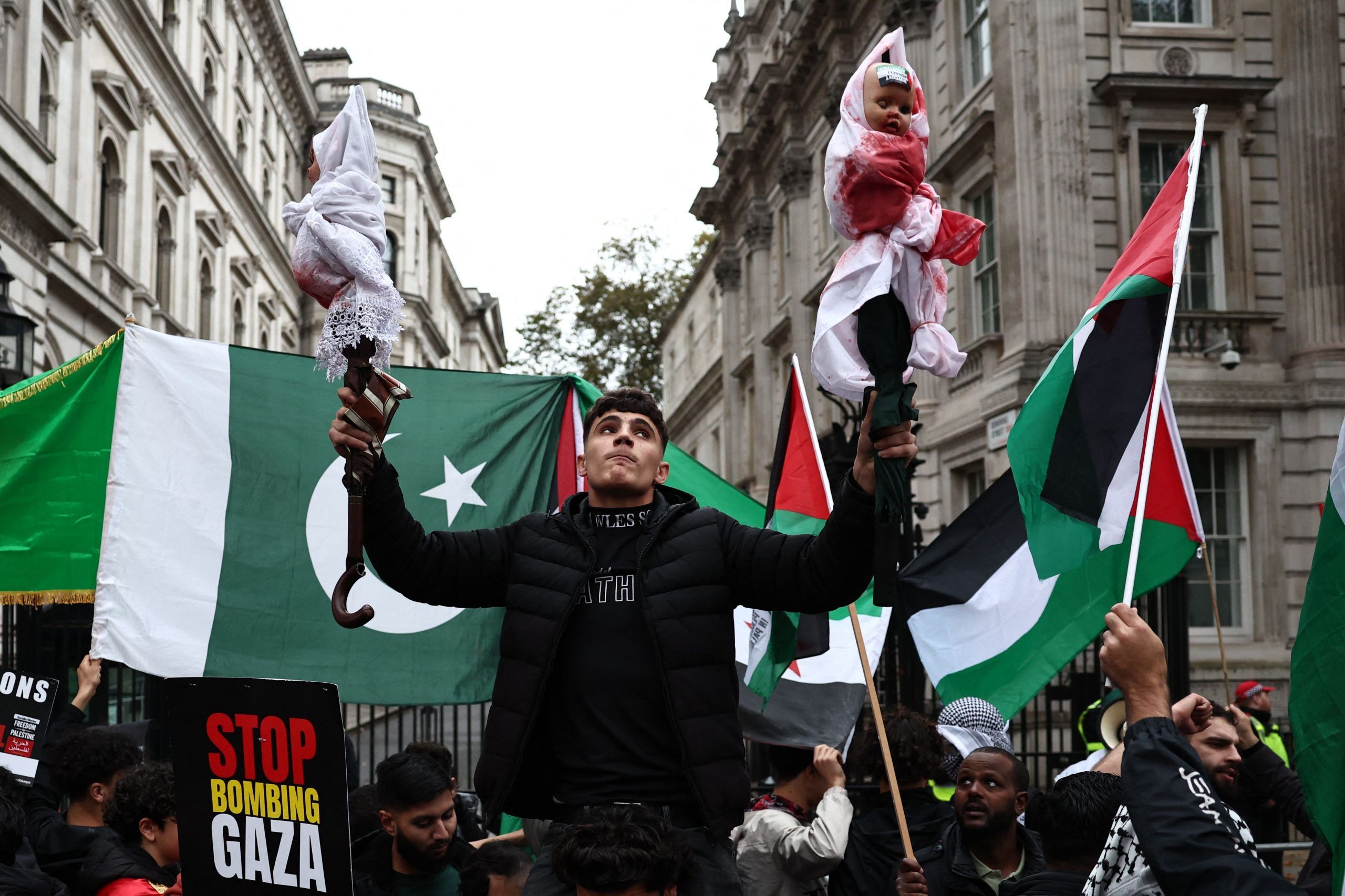
A protester holds bundles representing a dead baby outside the gates of Downing Street after taking part in a 'March For Palestine' in London on October 28, 2023.

They’re now waving fake dead babies in Jews’ faces.

This

sick taunt

took place in Westcliff-on-Sea in Essex in England last month. It’s a town with a large Jewish population, so naturally the keffiyeh mob made a beeline for it.

And this time the Israelophobic irritants brought with them their grimmest paraphernalia yet: dolls wrapped in bloodied shrouds to symbolize the kids who’ve died in the war in Gaza.

“Stop killing babies!,” they

hollered

as families walked home from synagogue following Sabbath prayers.

The protesters’ faces were flushed red with fury as they shoved their blood-spattered babes towards the startled Jews.

Of all the stunts executed by Israel-haters since Hamas’s pogrom of October 7, this surely ranks as one of the vilest.

Accusing Jews of spilling the blood of innocents is a calumny that stretches back centuries. It is a foundational lie of Jew hatred.

And here it was again, on the streets of Essex, in 2025. Seeing the keffiyeh-draped loons dangle red-stained shrouds at Orthodox Jews, like matadors waving their red cloth to tease the bull, I felt nauseous.

In the

words

of the Campaign Against Antisemitism, it was a “despicable” display with a “chilling echo of medieval blood libels”.

England has the dubious honour of being the birthplace of that libel. In Norwich, in 1144, a boy called

William

was found stabbed to death. And the Jews of Norwich were blamed, without so much as a sliver of evidence. A lie was born, and it spread like a pox through Medieval Europe.

Now it’s back, with added melodrama. Today, the pitchfork mob doesn’t only howl statements which imply that Jews kill children — they also parade gory dolls to drive home their delirious bigotry.

It is deeply shaming that nearly 900 years after the invention of this sick slander, England’s Jews once more find themselves accosted by mobs accusing them of lusting after the blood of the guiltless.

This wasn’t a “protest.” It was the resuscitation of ancient hatreds. It was the reanimation of medieval hysteria. It was Jew hatred in the drag of anti-Zionism.

The goading of the Jews of Essex brought home to me the epoch-shaking seriousness of our antisemitism crisis.

I fear even those of us who’ve been raising the alarm about the return of this racial animus may have underestimated how bad things are.

We are witnessing nothing less than the revenge of Jew hate, and it is the deadliest poison in the well of our civilization.

Across the West, antisemitism has clambered, zombie-like, from its shallow grave. It has been awoken from its thin slumber by the animus for Israel that exploded in our societies following Hamas’s savagery of 7 October.

Jewphobia now comes gussied up in the Palestine colours — a flimsy effort to doll up racism as radicalism.

It chills the blood to think of what we’ve witnessed in Britain these past 18 months. We’ve had people on the street

hollering

for the return of the Army of Muhammad to finish off the Jews.

Posters featuring the Jews kidnapped on 7 October have been savagely attacked. Everywhere I went I saw their remnants, scarred with the claw marks of the frenzied bigots who tore them down.

In a Jewish part of London, the faces of the three-year-old twins kidnapped by Hamas were daubed with

Hitler moustaches

. Denigrating Jewish infants? Branding them Nazis? You can call that anti-Zionism if you like — I call it fascism.

There’s been a huge rise in antisemitic attacks. Things got so bad that students at the Jewish Free School in London were given

permission

to remove their blazers on their way to and from school. Kids hiding their Jewishness to guard against the invective and violence of the mob? England, what happened?

In the U.S., the reheated Jew hate is rampant on campus. Jewish students have been harassed. They’ve been told to go back to “f–king Berlin where you came from” — the dream of a Jew expulsion masquerading as opposition to Israel.

“Long live 7 October,” said a

banner

in New York City, as gross a statement as “Long live Kristallnacht” would have been in 1938. We’ve seen activists angrily searching for “Zionists” on the New York subway and on the streets — Jew hunts in all but name.

Jew hatred soars in Canada, too. As Casey Babb

wrote

last week, this is now “one of the most antisemitic countries in the Western world.” From October 7 2023 to the end of 2024, antisemitic incidents skyrocketed by an alarming 670 per cent.

I was startled to read that in the year after Hamas’s carnival of Jew murder, there were

1,500 “pro-Palestine” rallies in Toronto alone

. As Babb says, that’s more than four a day, every day, for a year.

I didn’t think it possible for anywhere to have had more of these orgies of hollow virtue and thinly veiled hate than London has — I was wrong.

The virus of Jewphobia reaches as far as Australia. A synagogue in Melbourne was

burnt

. A Jewish

daycare center

in Sydney was torched. Chants of “F–k the Jews” were

heard

at the Sydney Opera House just day after Hamas’s pogrom.

A

car

in a Jewish neighbourhood in Sydney was daubed with “F–k Israel” on one side and “F–k the Jews” on the other.

Boom. There it was, in black and white: the interchangeable nature of anti-Zionism and antisemitism. Brute proof that today’s voguish and demented hatred for the Jewish nation is really a hatred for the Jewish people.

Indeed, it is striking that all the things people once said about the Jews, they now say about the Jewish homeland.

Israel is uniquely murderous, the activist class insists. It loves to murder children. It bloodlets in Gaza. It controls our weak governments here in the West.

Every old calumny uttered about the Jews — they’re child-killers, blood-spillers, the sneaky puppet masters of earthly affairs — has been revived on the altar of Israelophobia.

Those who still say “Hating Israel is not the same as hating Jews” deserve nothing but mockery at this point.

For if you devote every ounce of your moral energy to mauling, defaming and even dreaming of destroying the world’s only Jewish nation, then you are an antisemite. The End.

The revenge of Jew hatred, of the fascist imagination itself, is the clearest sign that Western society is in deep trouble.

These resurgent bigotries are the wages of our turn against the virtues of our own civilization.

Having educated the new generation to hate the West, to be skeptical of the very idea of civilization, we have no right to be surprised that many have fallen under the spell of barbarism.

It was the fashionable rage against Enlightenment that paved the way for the return of premodern lunacies like the blood libel. Those bloodied shrouds in Essex were physical proof of the moral chaos that has swept the West.

Confronting the new antisemitism is the great, pressing task of our times. If we fail, we will betray our Jewish citizens, and ourselves.

Brendan O’Neill is the author of After the Pogrom: 7 October, Israel and the Crisis of Civilization. He will be discussing his book in Montreal on Tuesday evening. Visit thechevra.ca for further details.

National Post


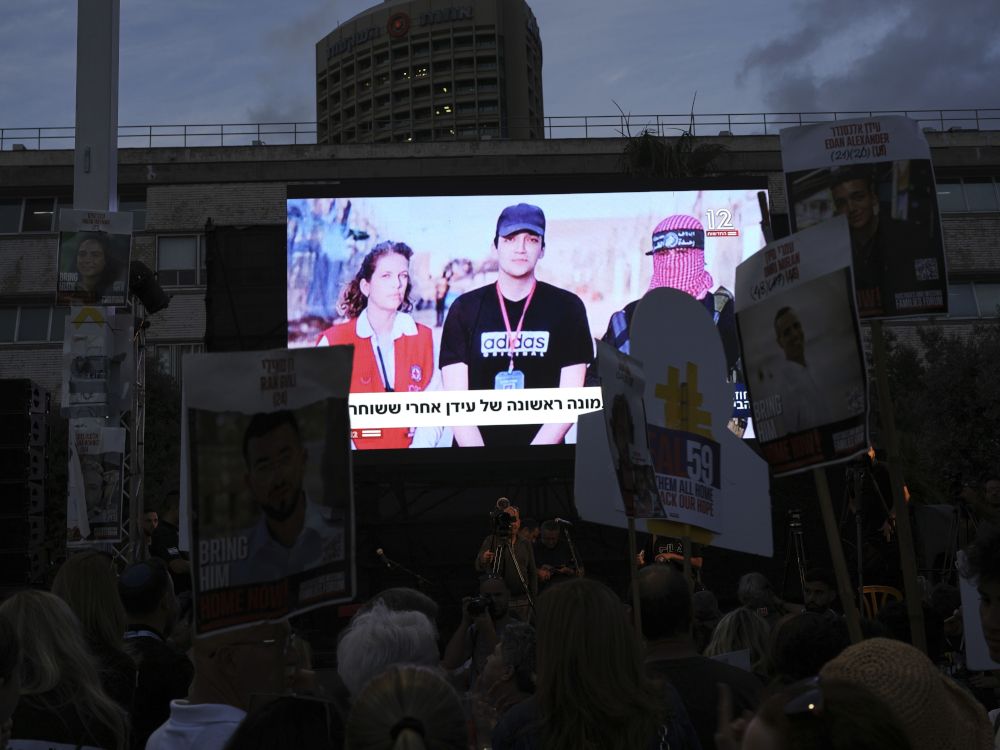
People watch a live broadcast of Israeli-American soldier Edan Alexander as he is released from Hamas captivity in Gaza, in Hostages Square in Tel Aviv, on Monday.

SDEROT, Israel — The release of 21-year-old American-Israeli soldier Edan Alexander from Hamas captivity on Monday has already shifted tectonic plates in the region. So many red lines were rubbed out in the way only U.S. President Donald Trump could manage.

Only a day earlier, Israelis learned that Alexander, the last living American hostage held by Hamas, would be released. We now know that the terms were negotiated between the United States and Hamas, with Qatar and Egypt acting as mediators. Israel was left in the dark. In fact, not until Sunday did Israel receive information regarding the time and location of Alexander’s release.

After a brief delay due to Hamas making a last-minute change to the rendezvous location in the Gaza Strip for the handover of Alexander, he was transferred to a Red Cross vehicle Monday evening, local time, and transported to Israel Defence Forces representatives within the Gaza Strip. And then, of course, he was taken to see his family, who were waiting at an IDF base just inside the border with Israel.

While Israel was not forced to agree to major concessions, it has been widely speculated that this is intended to kickstart negotiations for the release of all the hostages and an end to the conflict. But the negotiations will be conducted under fire. And fire, I can report, has resumed in the Gaza Strip, after a brief pause to facilitate Alexander’s safe return.

For weeks now, speculation about a rift between Trump and Israeli Prime Minister Benjamin Netanyahu has been persistent, but it has peaked in recent days. Netanyahu has been seen by many Israelis to have been detached from the hostage issue.

Decisions regarding hostage negotiations and the conduct of the war are often believed to be made in the interest of the survival of his fraught and extremist coalition government, and not necessarily with the best interests of Israelis and the hostages in mind. Then again, that depends on who you ask.

There is a hard-right cohort — led by Finance Minister Bezalel Smotrich — that believes that Israel must achieve “total victory” over Hamas. Smotrich openly advocates for Israel to occupy and settle the Gaza Strip and rout out every last vestige of Hamas’s military capability.

On the other hand, around

70 per cent

of the Israeli public supports a negotiated deal to release all the remaining hostages — and if that means accepting a ceasefire, then so be it.

Israeli society is weary and worn out. And after 19 months of war, the public is no longer accepting Netanyahu’s continued insistence that war is the only means of achieving Israel’s goals. As tens of thousands of Israeli men receive their call-up notices to do even more reserve duty in the army, they are beginning to question, aloud, what it’s all for.

Within the hostage family community, the release of Alexander raises complex concerns. This deal was possible because he is an American citizen and the U.S. government pushed hard for his release. Understandably, parents and spouses of hostages with only Israeli citizenship look at their government and express rage.

Speaking on Monday morning to a Knesset committee, Lishay Miran-Lavi, wife of hostage Omri Miran, verbally lacerated the MKs in attendance, saying, “Make no mistake. (Alexander) wasn’t released because of your good work. He was released because of the efforts of another state. And the efforts of another president.” Her contempt was searing.

In many ways, the humiliation of Netanyahu is complete. Trump is not even stopping in Israel for a few hours during his four-day sojourn through the Middle East. Reports of the Qataris presenting him with a US$400-million (C$560-million) gift — a Boeing 747 jumbo jet — have raised many eyebrows.

There’s also talk of Saudi Arabia investing US$1 trillion in the United States, rights given to Trump’s family business to develop a golf course in Qatar and other questionable deals. And Netanyahu, who was bursting with giddiness when he met with Trump in February, has been totally sidelined.

Netanyahu’s political advantage was always that he was experienced, tough and the only Israeli leader who could sit down, mano a mano, with the global heavyweights and get the job done. “In another league” was his slogan in recent elections. Multi-story banners featuring him standing alongside world leaders, such as Trump and Russian President Vladimir Putin, were unfurled to drive home the point.

The government’s recent decision to launch a renewed and intensified war effort in the Gaza Strip was received with astonishment, it seems, by President Trump and his team. How can that be, given that 58 hostages are still languishing in barbaric conditions in primitive tunnels, 19 months on?

Shortly after Alexander’s release, the mother of Nimrod Cohen — another soldier being held hostage — pleaded on television for the Government of Israel to demonstrate that an Israeli national merits rescue.

On Saturday night, hours after the release of a video of hostages Elkana Bohbot and Yosef-Haim Ohana, Bohbot’s mother, Ruhama, shared her anguish with the nation. “He did everything that was asked of him,” she implored, “as have so many others. What is this country that abandons its citizens to such a fate?”

Depending on Edan Alexander’s physical and psychological health, he may fly to Qatar in the coming days with his parents to meet President Trump in person and, one assumes, the emir of Qatar.

The thought of such a grotesque spectacle has been the focus of justifiable outrage in Israel. That a country such as Qatar, which has supported Hamas financially and diplomatically, could host such a meeting— with the president of the United States, no less — is incomprehensible. Hamas is already gloating that it has been legitimized, having sealed its first deal with America.

But it all depends on Alexander and his parents. There are no firm commitments. There are also no firm commitments, or expectations, that Netanyahu will go out of his way to see this young man who has suffered so much for his adopted country.

Israel’s leadership, sadly, is seen by many citizens to have lost its soul. And President Trump has changed so many rules of engagement, which have been almost sacrosanct in the Middle East for decades. He has also been steadfastly focused on securing the release of the hostages.

National Post

Vivian Bercovici is a former Canadian ambassador to Israel and the founder of the State of Tel Aviv.


An electronic billboard ad calling for an independent Alberta is seen in Edmonton in 2019.

Torn at for nine years by the divisive Trudeau Liberals, Canadian unity is seriously frayed, with Alberta now preparing for a possible secession referendum. In this episode, Brian Lilley talks with Reform party founder Preston Manning, Alberta Premier Danielle Smith and longtime Liberal pollster Dan Arnold to get a sense of how dire the situation has become. Manning explains that the separatist sentiment isn’t just in Alberta but spread across much of the West and even parts of the North. And all three warn that the threat needs to be taken seriously. They also consider the opportunity Prime Minister Mark Carney has with a fresh mandate to begin repairing the fractures if he’s genuinely willing to. But if he isn’t, the nation is in serious danger. (Recorded May 9, 2025.)


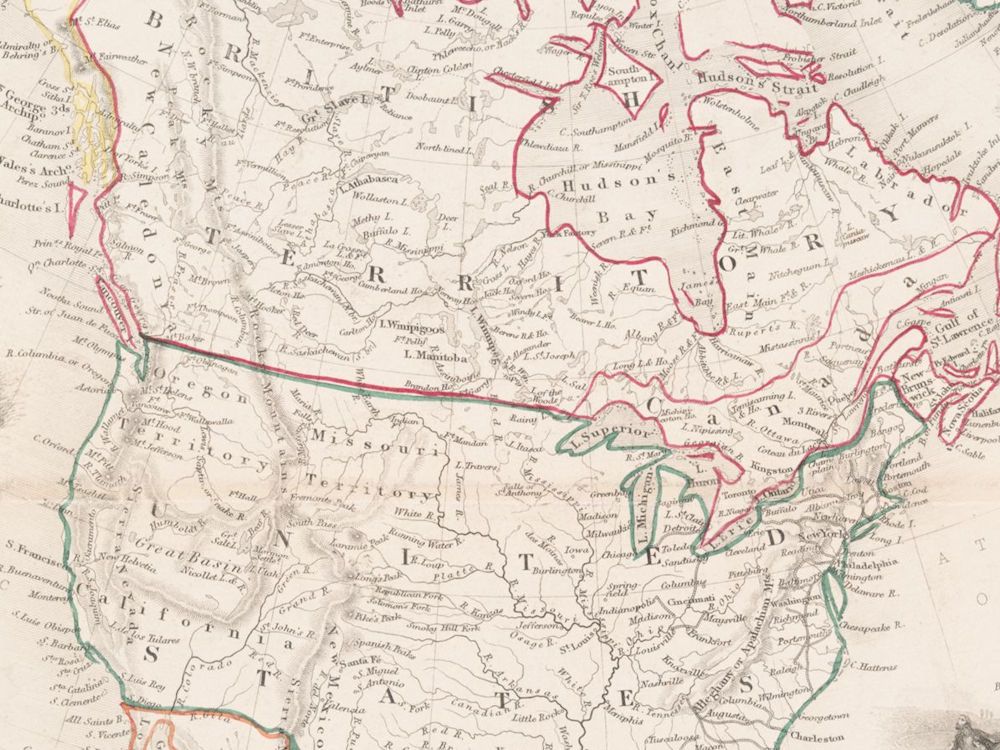
An 1850 map of North America.

First Reading is a Canadian politics newsletter curated by the National Post’s own Tristin Hopper. To get an early version sent directly to your inbox, sign up here.

TOP STORY

In front of Prime Minister Mark Carney on Tuesday, U.S. President Donald Trump went on an extended tangent denouncing the “artificially drawn line” that separated Canada from the United States.

It’s a term he’s used often before, but in this instance Trump added that its existence was “artistically” wrong, and that maps would be more aesthetically pleasing without it.

Trump is correct about the artificiality of the border, at least. The Canada-U.S. border is almost entirely an artificially drawn line. It was slapped across the landscape by diplomats who had never been in the territory they were defining, and often had no idea what it even looked like.

The border is so divorced from any kind of geographical logic that its first surveyors couldn’t even chart it properly. Although much of the Canadian border appears as a straight line on maps, it’s

actually a jagged frontier

that deviates from the 49th parallel so much that entire U.S. towns were accidentally built in what should technically have been Canada.

But the fact that it exists at all is the singular triumph of the Canadian project. A lasting monument to the miracle that a sparsely populated British dominion could rein in one of the most powerful and expansionist empires in human history using little more than pluck and misdirection.

“It’s actually astonishing to me that Canada even exists,” said Stephen Bown, author of the book Dominion, about the construction of the Canadian Pacific Railroad.

Around the time of Canada’s birth, it was taken as a given that the lands now comprising Canada would eventually become U.S. territory. One after another, European powers had abandoned their claims to the continent by literally selling out to the United States.

France struck a deal with Washington in 1803 to sell off the Louisiana Territory. Spain sold them Florida in 1819. Russia sold them Alaska in 1867.

Even in the U.K., it would have been reasonable to assume that Great Britain would eventually lose touch with its remaining North American possessions. The U.K. had fought two wars with the United States over control of North America, and was not willing to fight a third.

What’s more, much of British North America was in the increasingly incapable hands of the Hudson’s Bay Company. The vast expanse of Rupert’s Land was going to have to be sold off to somebody, and the U.S. was generally seen as the only realistic buyer.

“They (the Americans) just assumed it was going to flop into their lap,” said Bown.

What happened instead was the sudden amalgamation of North America’s various British colonies, many of whom were debt-ridden and plagued by stagnant, oligarchic economies.

Still, the country that resulted, Canada, was able to raise its hand as the only viable non-American purchaser of the HBC’s former domain — a deal that it struck in 1870.

But a mere contract was not enough. If the U.S. couldn’t purchase new territory, the other option was for motivated U.S. citizens to simply take it.

Multiple times throughout the 19th century, a community of Americans would become established in a foreign country or territory, decide that they wanted to live under the stars and stripes, and then agitate for annexation.

That’s what happened to Hawaii: U.S. citizens overthrew the kingdom’s monarchy and then successfully petitioned for U.S. intervention.

It roughly describes the lead-up to the Mexican-American War, which saw California, Utah, Nevada and pieces of five other states added to the U.S. fold.

It also describes any number of wars with Native Americans: Settlers would move into territory that had been legally set aside for Indigenous use, triggering armed conflict and a U.S. military response.

Early Canadian history is filled with instances of what, in different circumstances, could easily have become a prelude to U.S. takeover.

At multiple points, communities of Americans established themselves in Canadian territory, setting up whole economic networks that employed U.S. currency and served U.S. markets.

In the immediate aftermath of Confederation, some of the only non-Indigenous people in the Canadian prairies were American traders and hunters operating with impunity. “The whole area was entirely integrated into the American economic sphere,” said Bown.

The 1898 Klondike Gold Rush and the 1858 Fraser Canyon Gold Rush were primarily American endeavours. At its height, the Klondike gold rush centre of Dawson City was predominantly U.S. citizens using U.S. dollars and exporting gold primarily to U.S. buyers. One of those Americans was Friedrich Trump, grandfather to U.S. President Donald Trump.

Even the 1870 Red River Rebellion, a conflict over land in modern-day Manitoba, comprised Métis participants who hailed from the U.S. and whose sympathies lay closer to Washington than to Ottawa. In the early stages of the rebellion, leading U.S. figures openly saw it as an opportunity for the U.S. to calve off a piece of Canada filled with American sympathizers.

“Is there no other alternative for the people of northwest British America than to be cajoled or dragooned into this unnatural union with distant Canada?“ said then U.S. senator Alexander Ramsey, the leading booster for the effort.

And yet, every time, the Canadian government was able to assert just enough influence and authority that the lands remained under Queen Victoria.

Canada’s first decades are defined by efforts to slap together the semblance of a country north of the 49th parallel before the Americans could do it first.

The Canadian Pacific Railroad was the most conspicuous element of the plan, with its builders conscious that if they didn’t drive a route to the Pacific as quickly as possible, the Americans would do it for them.

In the words of one 2023 review of Dominion, the CPR was “built to protect British North America from an economically ravenous United States” and was the spine for a “paper nation.”

The Northwest Mounted Police, a precursor to the RCMP, was founded specifically as a means to evict U.S. whiskey traders operating in the Canadian prairies.

One of the inciting incidents for the force’s creation was the 1873 Cypress Hills massacre, the murder of an entire Nakoda camp by American wolf hunters in what is now Saskatchewan.

In the 1880s, the Canadian federal government approved a series of large, corporate-owned cattle ranches across the West. One of them, Bar U Ranch, remains a national historic site.

Ranches were effectively the easiest and fastest way to make it look like large swaths of the prairies were under Canadian control.

The operations employed predominantly American cowboys to produce cattle for American buyers, but under Canadian ownership and with a British flag flying over the proceedings.

The federal leases for these ranches were scandalously cheap, “but like other elements of national policy, these leases were designed to make the northwest profitable and assert Canadian sovereignty against American interests,” wrote historian Claire Elizabeth Campbell in a 2017 book chapter on the Bar U Ranch.

And then, starting in earnest in 1901, Ottawa consolidated its hold on the West with one of the most feverish immigration schemes in human history.

From just 1901 to 1913, millions of newcomers from Europe and the United States were settled onto prairie homesteads. At a time when all of Canada only had seven million inhabitants (roughly the population of the modern-day Greater Toronto Area), annual immigration briefly peaked at more than 400,000.

As Bown notes, many of these newcomers would have had very little allegiance to the new nation of Canada. Large portions of them didn’t even speak English. But it ensured that anyone crossing the 49th parallel would immediately encounter settlements filled with Canadian nationals ostensibly loyal to the Crown and flying the Union Jack.

Luck underwrote all of this, of course. The aforementioned Mexican-American War and the U.S. Civil War ensured that the United States had to shelve their early 19th century conception of an entire continent under the U.S. flag — a concept often known as “manifest destiny.”

But it’s been described as the Canadian “

flank thrust

.” While the United States was busy with its other borders, the Canadians were able to tape together just enough of a functioning state that the top half of the continent has remained in their hands ever since.

“It wasn’t valuable enough for the Americans to expend any blood or treasure to take it,” Bown said. And by the time it was, “it was too late.”


IN OTHER NEWS

When King Charles III opens Canada’s Parliament at the end of this month,

the Bloc Québécois has announced that they will not be showing up to work in protest.

This is pretty standard Bloc practice; they

usually skip anything

with even a slight tinge of royal ceremony, including throne speeches. But the atmosphere will still be far less troublesome than what Charles is used to. In the U.K., speeches from the throne are laden with weird rules, including Buckingham Palace’s practice of taking an MP hostage in order to ensure the King’s safety.

The U.S. Ambassador to Canada, Peter Hoekstra, just declared that we should all stop worrying about U.S. President Donald Trump’s repeated threats to annex us. “From my standpoint, from the president’s standpoint, 51st state’s not coming back,” he told National Post, adding, “he may bring it up every once in a while.” This is all somewhat awkward given that voters may have just decided an entire federal election on the basis of Trump ostensibly posing an existential threat to Canada.

Watch the full interview here with the National Post’s Stephanie Taylor.

Get all of these insights and more into your inbox by signing up for the First Reading newsletter here.

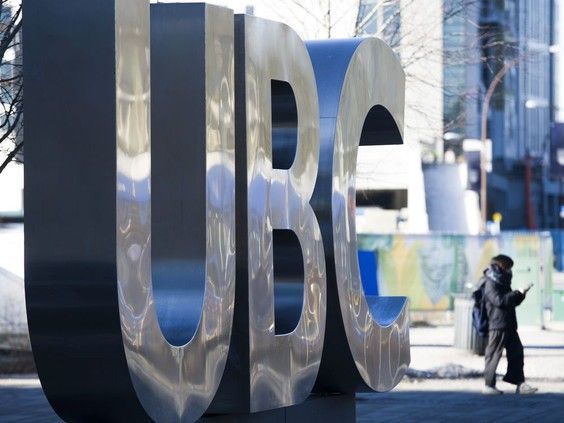
Sign at entrance to UBC in Vancouver.

Last month, with the assistance of the Canadian Constitution Foundation, a group of University of British Columbia professors and a former student filed a

lawsuit

asking the B.C. Supreme Court to protect academic freedom by ordering the university administration to stop breaching its statutory duty to remain non-political: No more requiring fealty to DEI ideology from job applicants. No more statements about the Israel-Gaza war. No more land acknowledgements by the administration in academic settings where academic freedom is impinged.

There’s been little pushback to our claims that DEI purity tests or Israel-Gaza statements contravene B.C.’s University Act requirement that the public university’s administration remain non-political. The criticism of our claim that land acknowledgements are political has been substantial. One critic is UBC assistant professor Scott Franks, who

argued

in an op-ed in the Globe and Mail that, rather than being political in nature, “land acknowledgments are statements of legal fact.” Franks offers an example: it’s a “legal fact,” he says, that the land that UBC Vancouver sits on is “unceded and that the Musqueam Nation retains title to those lands.”

It’s difficult to understand how the assertion that UBC is on “unceded” Musqueam territory, to which they have title, is anything other than political. There is no court decision that says the Musqueam possess title to those lands. That includes Aboriginal title, which is the communal right to use land that courts have found in small parts of B.C., where First Nations have lived continuously and with the ability to exclude others since the Crown assertion of sovereignty.

Franks writes that former Supreme Court chief justice Brian Dickson rejected in the 1984 decision Guerin v The Queen “the idea that Indigenous peoples’ rights were discretionary and political when he found that the Crown owed legal obligations to the Musqueam Nation when it assumed control over the nation’s lands.” But Guerin was not about the UBC lands; it was about former reserve lands nearby. Franks may argue that because the Musqueam once used the land that UBC sits on and never “ceded” it via treaty, that they retain some form of title (the Tsleil-Waututh make similar claims to the same lands). Right or wrong, that’s political. To understand why, consider the B.C. Human Rights Tribunals’ jurisprudence on what counts as “political,” developed in the context of political discrimination claims.

In the 1994 decision

Jamieson
v. Victoria Native Friendship Centre

, the tribunal found that the Friendship Centre had discriminated against a prospective employee, Jamieson, for his political beliefs asserted in connection with his membership in the Mohawk Warrior Society. The tribunal found that the beliefs in question were political because they concerned “the way First Nations communities are organized and governed and how these communities relate to each other and to other levels of government.” Claims that UBC is on “unceded” land, and that the Musqueam have title, are similarly about how the First Nation community relates to the B.C. government. Whether those claims are right or wrong (we take no position), they are political.

In the 2012 decision Wali v. Jace Holdings Limited, a pharmacist established that his employer discriminated against him by firing him over his statements opposing a policy from the College of Pharmacists. The tribunal found that Ahmad Wali’s statements were political in nature for three reasons: they were connected to a law, they involved the public welfare on a matter subject to debate within the community and they related to “

social co-operation

.” The claim that UBC is on “unceded” land and that the Musqueam have sovereignty or title ticks all three of those boxes.

In the 2019 decision in

Fraser v. B.C.

, the tribunal found that the B.C. government had discriminated against an applicant by rescinding a job offer over comments he had made about the way the B.C. government had dealt with the Council of Haida Nation on forestry matters, including its development the Haida Gwaii Reconciliation Act. The applicant’s comments were political, the tribunal said, because they

involved

“discourse on matters of public interest which involves or would require action at a governmental level.” Claiming in a land acknowledgement that land is “unceded,” which implies that is stolen, that it should be given back or that compensation is owing, is obviously related to an issue of public interest and discourse that would require action on the part of the government to achieve. Ergo, such statements are political.

The point is, whether you believe that UBC is on unceded Musqueam land or believe that the land has been ceded, you’re making a political statement. Individual professors and students must be free to take any and all positions in this political debate when pursuing their research, learning and teaching. They are not free to do so when UBC’s university administrators — the people who do the hiring, decide promotions and grant the degrees — have already taken a side.

National Post

Josh Dehaas is counsel with the Canadian Constitution Foundation.


Prime Minister Mark Carney says the effectiveness of safe injection sites is being reviewed by his government.

When Mark Carney was asked on the campaign trail about whether federal approval for injection sites would continue under his government, he avoided the contentious topic by saying the effectiveness of those sites

was under review

.

Even in his evasion, our new prime minister was undermining the position staked out by his predecessor, Justin Trudeau. When asked about such controversial initiatives as injection sites and the distribution of so-called “safer supply” opioids to those with severe addictions, the latter was fond of insisting his government was simply “following the science.”

If science had decided injection sites were wildly successful and necessary, then why does Carney’s government need to study them?

As it turns out, Carney and his minority government are going to be called on to conclude their alleged study of injection sites sooner rather than later. This is because the federal drug law exemption (required for injection sites across Canada to operate) expired for a site in the Sandy Hill neighbourhood of Ottawa on April 30.

The Sandy Hill Community Health Centre, which houses the injection site, applied to renew its federal drug law exemption on Jan. 30. Just a few months earlier, another injection site in the same ward, Rideau-Vanier, which is home to three sites, was granted a five-year exemption renewal under

controversial circumstances

.

So controversial, in fact, that the head of a local arts non-profit has since gone to federal court seeking a judicial review of the insular and secretive process Health Canada utilized in coming to its decision.

At the 11th hour, late on April 30, Health Canada advised the Sandy Hill site that it was renewing its exemption — not for five years but only 30 days. The obvious reason for such a short exemption renewal being that Health Canada needs to take direction from the new government.

One piece of good news for Mark Carney is that the materials required for his study of injection sites have recently been assembled in a very large, detailed package. This exhaustive analysis of the topic results from a legal challenge filed by an injection site in Toronto’s Kensington neighbourhood, claiming that legislation passed in Ontario late last year prohibiting injection sites from operating within 200 metres of schools and daycare facilities violates the charter rights of drug users.

The judge overseeing this litigation estimated the case’s court record to be 6,000 pages in total. I may be the only journalist to have read it in its entirety. So, free of charge, I will provide Mr. Carney with the Coles notes summary.

Yes, there is an obvious benefit to being supervised by people trained to use Naloxone who are also able to dial 911 when the relatively minuscule percentage of drug users across Canada who choose to inject dangerous street fentanyl at such sites overdose.

The bad news, however, is that even the small group of users who inject street fentanyl at such sites don’t do so exclusively during banker’s hours, Monday through Friday, when they are typically open. Many injection site clients fatally overdose eventually regardless.

In a

report

written by the provincially appointed supervisor of Toronto’s South Riverdale injection site, outside of which a mother of two young girls was killed during a gun fight in 2023 between drug dealers who’d been

commuting to the site from the suburb of Scarborough

for months, the endless waves of client (and staff) overdose deaths is raised repeatedly. It was such a frequent occurrence that staff morale suffered intensely.

The lawyers representing Ontario in the charter challenge litigation presented a platoon of expert witnesses to successfully establish that the science around injection sites is far from settled. The 2022

Stanford-Lancet Commission on the North American Opioid Crisis

states “there is no evidence that accessing a site lowers an individual’s risk of fatal overdose over time.”

Earlier this year, research was

unveiled

that showed nearly a third of those who died from an overdose in Ontario between 2018 and 2022 had been in hospital in-patient wards or emergency rooms within a week of their deaths. If hospitals are failing to connect that many vulnerable drug users to necessary care, it’s safe to assume injection sites aren’t faring any better.

According to the minutes for a meeting of Ottawa’s Byward Market Balanced Community Task Force in February, Rob Boyd, the CEO of the injection site operated by Ottawa Inner City Health, The Trailer, admitted that its clients “are routinely screened out of access” to treatment.

Boyd said this is because they lack the “social capital” — housing and employment, for example — to “support treatment success” and will almost certainly relapse when they “return to the environment driving the substance use.” Boyd called treatment for these clients “a waste of money” until social capital can be built up, a piece of the equation Carney might want to study next.

The team of pro-bono lawyers representing Toronto’s Kensington site in the charter challenge, during their day-long submissions in court on March 24, spent considerable time talking about how injection sites “save lives.” Not surprisingly, their focus on the needs of drug users was so singular that it took five hours of submissions before one of the site’s lawyers uttered the words “drug dealers,” a group without which injection sites would not exist.

In the 2012 feasibility study that led to injection sites opening in Toronto and Ottawa five years later, its author, Dr. Ahmed Bayoumi, an expert witness for the Kensington site, reported that “many” drug users disclosed in interviews that they would not use an injection site if it meant they had to walk more than a few minutes after obtaining their drugs.

Which means that for sites to be effective, drug dealers need to be operating within a few blocks of them. In the case of the South Riverdale site, this means encouraging drug dealers to be selling outside a site that’s within 150 metres of two elementary schools and six daycare facilities. (Note for Mr. Carney: drug dealing and open use have virtually disappeared around the South Riverdale site, which I live across the street from, since it closed on March 21.)

Dr. Jerry Ratcliffe, an expert witness in the spatial dynamics of crime for the province, said injection sites cause “microlevel” concentrations of crime and disorder. Ratcliffe cited a recent study of injection sites in Toronto that shows increases in assaults (61 per cent), robberies (62 per cent) and break and enters (47 per cent) within 100 metres following “sites’ implementation.”

While these increases levelled out over five years (as non-criminal mayhem exploded), Ratcliffe said the study “does not explore the wealth of other possibilities” that could explain why the initial crime spike slowly subsided, including the fact that police are discouraged from having a presence around injection sites and the Toronto police force’s de facto decriminalization policies that came into effect during those years (a policy that could have also contributed to reporting fatigue).

The court record contains dozens of detailed accounts (one being from me) of disorder within 200 metres of injection sites that often include a bounty of photographic evidence. A number of these affiants are from Sandy Hill.

In late February, a local community organization called Action Sandy Hill sent a 10-page letter to Health Canada’s Controlled Substances Directorate, formally withdrawing its support for the community’s injection site. The letter calls the Sandy Hill injection site’s impact on the community “catastrophic.” The consequences of the social disorder and crime around the site “have surpassed what we could even imagine when (our) 2016 letter (of conditional support before the site opened) was written.”

Prime Minister Carney, I suggest you get your hands on this letter and read the rest for yourself.

National Post