LP_468x60
on-the-record-468x60-white

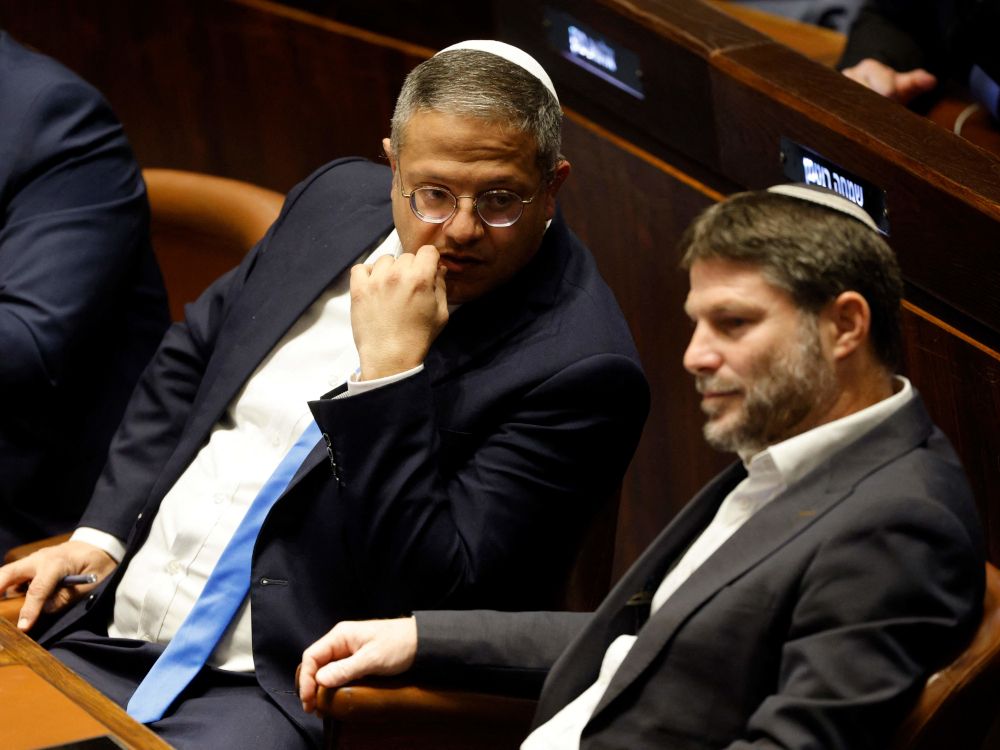
Israeli National Security Minister Itamar Ben-Gvir, left, and Finance Minister Bezalel Smotrich

The progressive left makes no secret of its disdain for colonialism. And yet, western governments, particularly those governed by left-wing parties, seem to think it’s perfectly reasonable to meddle in the affairs of the only democracy that’s taken root in the Middle East.

On Tuesday, the United Kingdom, the former colonial power in the Land of Israel, along with Canada, Australia, New Zealand and Norway,

announced joint sanctions

against Israeli National Security Minister Itamar Ben Gvir and Finance Minister Bezalel Smotrich for “inciting violence against Palestinians in the West Bank.”

A joint statement issued by the five governments accuses the two Israeli ministers of inciting “extremist violence and serious abuses of Palestinian human rights” through “extremist rhetoric advocating the forced displacement of Palestinians and the creation of new Israeli settlements.”

Exactly what the bar is for democratically elected members of an allied government to have their foreign assets frozen and be prevented from travelling to friendly countries is still not known, as Canada and its allies apparently did not feel obligated to lay out their case against the two nationalist ministers.

To be fair, it’s not hard to find extremist rhetoric that has come out the mouth of either man. They have been staunch advocates of expanding West Bank settlements and

resettling

the Gaza Strip, and have advocated for harsh measures to be imposed on Gaza in response to the October 7 massacre.

It would also be fair to question their

ministerial performance

. Ben Gvir has taken a lax approach towards settler violence and inflamed tensions on the Temple Mount. In his role as minister in charge of settlement affairs, Smotrich advanced plans to build new homes in the West Bank and legalize outlaw settlements.

But none of this was cited by Canada and its allies when they levelled sanctions against the two ministers. There was no indication that the burden of proof may rest with the countries imposing the sanctions, and no hint of what level of “extremist rhetoric” would negate the parliamentary privilege enjoyed by elected officials.

The rebuke of Ben Gvir and Smotrich would, of course, have more weight if the countries now chastising foreigners for inciting violence hadn’t spent the better part of two years sitting idly by as anti-Israel protesters turned central London into a “

no-go zone for Jews

” on weekends and repeatedly called for genocide against Jewish people in Canadian streets.

It would have seemed a little more even-handed if those same governments had sanctioned the leaders of the Palestinian Authority for running its so-called pay-for-slay program, which rewards terrorists who murder innocent Israelis, or for failing to hold

legislative elections

for the past 20 years. They would have had more gravitas if they had levelled concurrent sanctions against members of the Qatari government, who spent years funding Hamas and

allegedly supporting

its genocidal ambitions behind the scenes.

Instead, Ottawa and its allies have essentially given these dictatorial regimes a free pass, while singling out members of a democratically elected government. This point is important.

Ben Gvir and Smotrich hold extremist views that do a disservice to peace and have harmed Israel’s standing in the eyes of the world. They have done nothing but play into Hamas’s narrative that Israel is acting immorally, which has turned the Jewish state into a pariah on the world stage. But just as Canadians were outraged over attempts by foreign powers to meddle in our democratic affairs, we should be equally infuriated by our government’s attempts to do the same.

After all, if there’s one thing the ruling class in Ottawa, London, Canberra, Wellington and Oslo should be able to agree on, it’s that the proper way to sanction an elected official you disagree with is through the ballot box. And they may not have to wait long for Israelis to have the opportunity to do just that.

Israeli Prime Minister Benjamin Netanyahu’s government is on the brink of collapse, as ultra-Orthodox members of the governing coalition seek to

advance a bill

that would dissolve the Knesset and trigger an election. According to a

Channel 12 poll

released last week, if that were to happen, Smotrich’s Religious Zionism party would be completely wiped out and a bloc lead by former prime minister Naftali Bennett would win a clear majority.

Until that happens, it’s almost unfathomable that Netanyahu, who’s nothing if not a political survivor, would seek to sideline Ben Gvir and Smotrich, as doing so would further jeopardize his tenuous hold on power. Which means that if Canada’s Liberal government and its overseas friends want to influence Israeli policy, they will have to deal with the current cast of characters in Jerusalem. This will now be harder to do since we barred Ben Gvir and Smotrich from setting foot on Canadian soil and basically threatened to

arrest Netanyahu

if he ever shows his face here again.

Thus, while the joint statement talks about wanting to “work with the Israeli government” to secure an “immediate ceasefire, the release now of the remaining hostages and for the unhindered flow of humanitarian aid,” and reiterates Canada’s longstanding commitment to a two-state solution, its real-world effect will be to further strain relations between Israel and impede Ottawa’s ability to make any real progress on Middle East peace.

This isn’t diplomacy intended to achieve meaningful results, it’s performative political theatre intended to appease left-wing westerners who have become increasingly hostile towards the Jewish state and seem to have a newfound love for colonialism — when it’s used to support their anti-Israel agenda, that is.

National Post

jkline@postmedia.com
Twitter.com/accessd


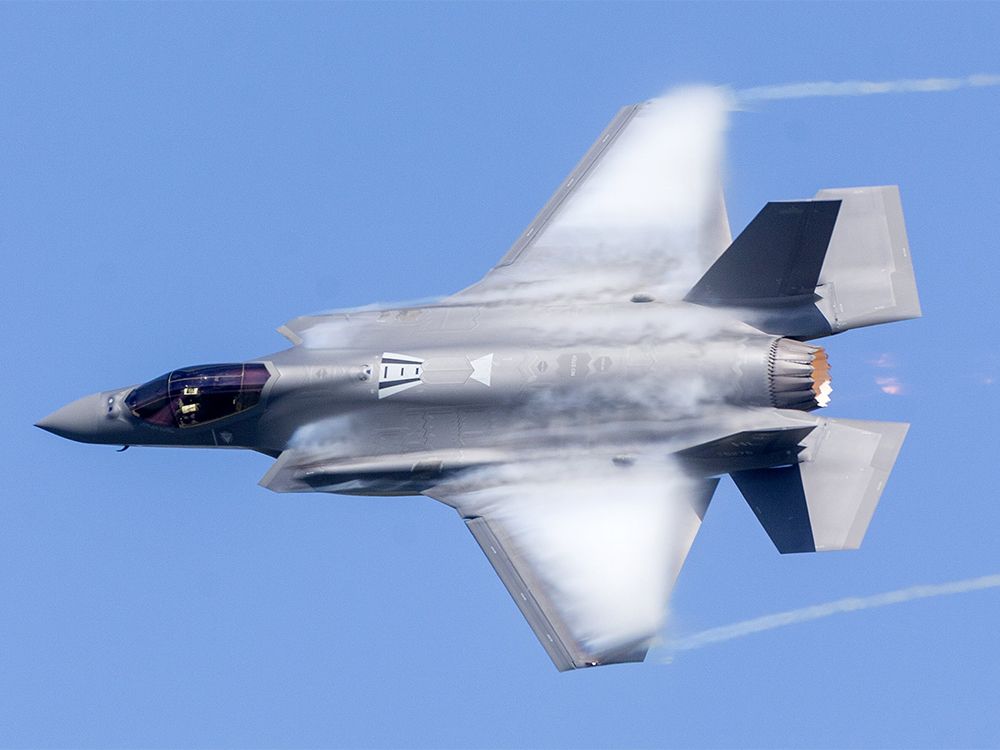
A U.S. Airforce F-35 Lightning fighter jet develops vapour on its wings as it practices for an air show in London, Ont., in a file photo from Sept. 11, 2020. Replacing Canada's aging fleet of F-18 fighter jets with a new, mixed fleet would be a bad idea, write Alexander Lanoszka, Richard Shimooka and Balkan Devlen of the Macdonald-Laurier Institute.

By Alexander Lanoszka, Richard Shimooka and Balkan Devlen

The proverbial canary in the mine of U.S.-Canada defence co-operation is grey, flies as fast as Mach 1.6, and has a very low radar signature.

Canada has named the F-35 — Lockheed Martin’s fifth-generation multipurpose fighter jet —

not once

,

not twice

, but

thrice

as the CF-18s’ intended replacement. Alas, the stealth fighter’s procurement has come under scrutiny again in view of U.S. President Donald Trump’s repeated wish to see Canada become the 51st state.

Hence, in his first days on the job, Prime Minister Mark Carney ordered yet another

review

. However, there was a ray of hope on June 10, when David McGuinty, Carney’s new defence minister,

issued a statement

that made no mention of reviewing the contract. Instead, he said, “this project will provide Canada with an invaluable air defence capability … well into the future.”

Let’s hope the government sticks with that plan. Given the history of this procurement, it continues to merit close scrutiny.

Politicians

 and 

international security analysts

 from across the political spectrum have supported Carney’s temporizing. From their perspective, the U.S. now represents at best an unreliable ally and at worst a territorial menace. Canada would thus be better off acquiring other aircraft made by purportedly more trustworthy European allies. Recognizing that it may be too late to cancel, 

some propose

Canada should acquire a mixed fleet — with either French-made Rafales or Swedish-made Gripens — so as not to rely exclusively on the U.S.-produced aircraft.

As Ottawa considers the implications of the June 10

auditor general’s report

, which found the estimated cost of replacing the F-18s has ballooned to $27.7 billion, it should note that a mixed fleet of fighter jets remains a terrible idea. Much of the costs are exogenous to the F-35 (like rebuilding dilapidated infrastructure), and would be borne by any fighter selected. It further underestimates the complex technologies involved, and takes too optimistic a view of what European defence contractors can provide. Tens of billions of public money could be wasted if Canada chooses a mixed fleet.

The idea may sound reasonable. By many attributes — speed, payload, range — the Rafale and Gripen seem comparable to the F-35, thereby making them appear interchangeable. Moreover, diversity in suppliers makes sense to provide resilience over matters related to sovereignty.

Yet this logic is flawed for three reasons.

First, despite overlapping capabilities, these aircraft have become so technologically complex that they have little interchangeability. Each aircraft has its own training program: F-35 pilots and support personnel cannot simply operate Gripens. The Canadian Armed Forces (CAF) would have to offer two distinct training pipelines. Considering it already suffers from a 

severe pilot shortfall

, a bifurcated training regime would further strain personnel capacity. Similarly, each aircraft requires its own logistical supply chain. Aircraft inevitably suffer from wear and tear, even in benign conditions, and their components are not interchangeable between fleets.

Indeed, inefficient supply chains in Europe plague European aircraft consumers with long delivery times and shortfalls in spare parts. Australia had to prematurely retire its 

European-made MRH90 and Tiger helicopter fleet

 because of reliability problems. Inadequate spares kept Royal Air Force Typhoon fighters 

grounded

 in the early 2010s.

The second problem with the mixed-fleet proposal is its misunderstanding of how situational awareness matters for the modern battlefield. The F-35 aggregates extensive data through 

sensors

and datalinks to detect, identify and monitor targets. Its efficacy is enhanced by Norad, through which the RCAF has sole access to vast quantities of highly sensitive operationalized intelligence.

This asset has tremendous value in the Canadian North, where four F-35s can cover the same territory as several dozen fourth-generation fighters like the Gripen or Rafale. Retrofitting older aircraft to integrate into these networks is too difficult.

Dassault

 and 

Airbus

withdrew their respective aircraft from the competition to replace the CF-18 because fulfilling this essential requirement was too demanding for them to achieve at a reasonable cost.

The third problem concerns the entire strategic rationale for a mixed fleet. Those who assert that the Trump administration might shut down U.S.-made aircraft abroad must consider why other allies do not share such worries. Those states include Finland, Japan and South Korea, all of which face more acute threats to their security than Canada. Last week the U.K. government

suggested it will buy more F-35s

 to strengthen its nuclear deterrent: a mission that requires utmost trust in Washington’s commitment to its security. Moreover the RCAF is an integral part of the U.S. continental defence, providing between one quarter to one half of the aircraft on alert for defending the northern approaches. Washington would be amputating its own security even if it could disable Canada’s F-35 fleet.

Years of chronic underfunding have created such capability gaps in the CAF that even spending as much as two per cent of gross domestic product — which Prime Minister Mark Carney has

pledged

to do — will not fill them. Given the sheer expenses and complexity it would involve, a mixed fighter fleet will only further undermine the CAF and Canada’s national security.

Special to National Post

Alexander Lanoszka, Richard Shimooka and Balkan Devlen are senior fellows at the Macdonald-Laurier Institute.


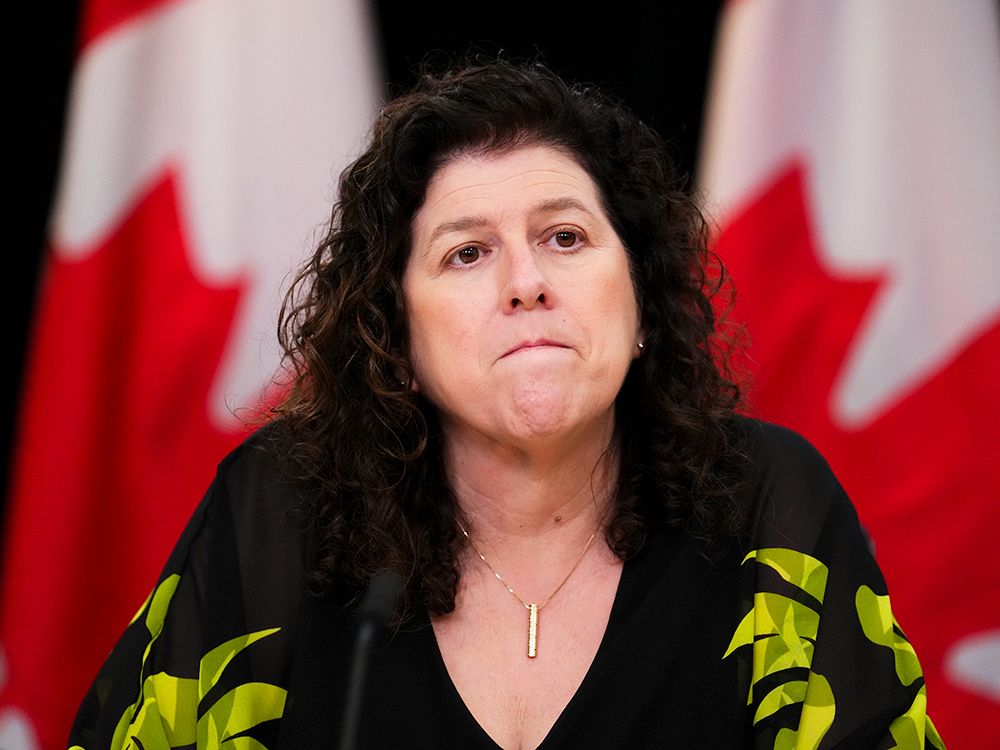
Auditor General of Canada Karen Hogan, holds a news conference in Ottawa on Tuesday, June 10, 2025.

When it comes to COVID-19 post-mortems, inquiries and audits, scrutinizing

the ArriveCan debacle shouldn’t really be at the top of the list

. But beggars can’t be choosers: If we can’t get a proper reckoning for having kept schools, summer camps, playgrounds, skate parks, golf courses and restaurant patios closed for reasons that look highly suspect in hindsight, even to quite cautious people, we might as well appreciate the feds getting pilloried for their spectacular failure in producing what ought to have been a very simple app.

You entered your personal info. You securely uploaded your proof of vaccination. By rights it should have made things

simpler

on arrival back in Canada. It wasn’t exactly Apollo 11. But it was a famous and outrageously expensive mess. And

GCStrategies, t
he company behind it
(if two guys with a post office box can be called that
,

 made out like bandits on plenty of other federal-government contracts besides: 106 of them, total value $92.7 million between 2015 and 2024.

Auditor General Karen Hogan didn’t blow any doors off their hinges in

her report released Tuesday

. We already knew that the federal government gave millions of dollars to a firm that didn’t seem to do much of anything except farm out the work they had been given to other contractors and, naturally, take a big cut of it for themselves.

It’s a relief, perhaps, to learn (again) that this was flamboyantly in contravention of federal contracting rules. “In 21 per cent of contracts examined, we found that federal organizations lacked documentation on file that showed valid security clearances for contract resources,” Hogan reported.

Yikes.

“In 33 per cent of contracts we examined, federal organizations could not show that contract resources had the experience and qualifications needed to complete the required work.”

Whoops!

“Federal organizations are required to monitor the work performed by contractors.”

Phew!

“We noted that federal organizations frequently disregarded government policies in this area. This included not having records showing which contracted resources performed the work, what work was completed, and whether the people doing the work had the required experience and qualifications.”

Damn!

Then Hogan twists the knife: “This report has no (new) recommendations but (rather) confirms weaknesses raised in previous audits. Rather than repeat previous recommendations on procurement, this audit re‑confirms that policy should be well understood and properly applied.”

Is anyone involved embarrassed? Apologetic? A bit chagrinned, at least? There hasn’t been much sign of that.

But Mark Carney has been cutting an interesting figure since taking over as prime minister: If Trudeau was Captain Apology — for past governments’ sins, for his own government’s sins, for his own idiocies,

vacation-related

and otherwise — Carney seems not at all interested in apologizing for pursuing Canada’s best interests, at least as he sees them.

Invite Indian Prime Minister Narendra Modi to the G7?

The fellow whose government Trudeau accused quite recently, and credibly

, of involvement in the assassination of a Canadian citizen on Canadian soil? After Liberal partisans spent years accusing Canadian conservatives of cozying up to Modi’s Bharatiya Janata Party, with former prime minister Stephen Harper leading the charge, tenting his fingers, rictus of evil, as head of the insidious International Democracy Union?

Well, sure. We need trade with India, don’t we? And China too, come to think of it.

Invite Saudi Crown Prince and Prime Minister Mohammed bin Salman to the G7?

The guy U.S. intelligence officials think ordered the assassination of Washington Post journalist Jamal Khashoggi

in Istanbul in 2018?

Whose family had … shall we say … uncomfortable links to the 9/11 terrorist attacks

, in which 24 Canadians died along with thousands of others while screwing up the whole world for decades?

Well, yeah. It’s Saudi Arabia. We’re Canada. They matter more. We can’t dictate terms to the rest of the world.

Carney says we’re going to hit the long-theoretical goal of spending

two per cent of our GDP on the military by March

.

This coming March

. Some of that is pretty simple, admittedly: Boosting our sailors’, soldiers’ and pilots’ salaries sure seems like a good and easy idea, considering the Armed Forces’ recruitment woes. But it wasn’t so simple that no one did it before.

And the ArriveCan debacle offers a tantalizing proposition for Carney, or indeed any other incoming new prime minister from any party: How much of Canada’s failure to thrive is just a matter of our politicians, deputy ministers and senior civil servants just being complacent, back-slapping scroungers? What if instead of farming out something like ArriveCan to the usual assortment of no-account grifters and hangers-on — or for that matter, something 25 times more expensive; military procurement, say? — we just did what any private company would have done and contracted it out for a quarter of the cost, at most, to the best reasonable bid?

I don’t dare dream Canada’s problems are that easy to solve. But we can’t solve the big ones without insisting on some basic standards for the smaller ones. Carney can’t personally watch over the entirety of federal-government contracting, but he should be giving his ministers some very pointed marching orders: No more ArriveCans.

National Post

cselley@postmedia.com

Get more deep-dive National Post political coverage and analysis in your inbox with the Political Hack newsletter, where Ottawa bureau chief Stuart Thomson and political analyst Tasha
Kheiriddin
get at what’s really going on behind the scenes on Parliament Hill every Wednesday and Friday, exclusively for subscribers. Sign up here.


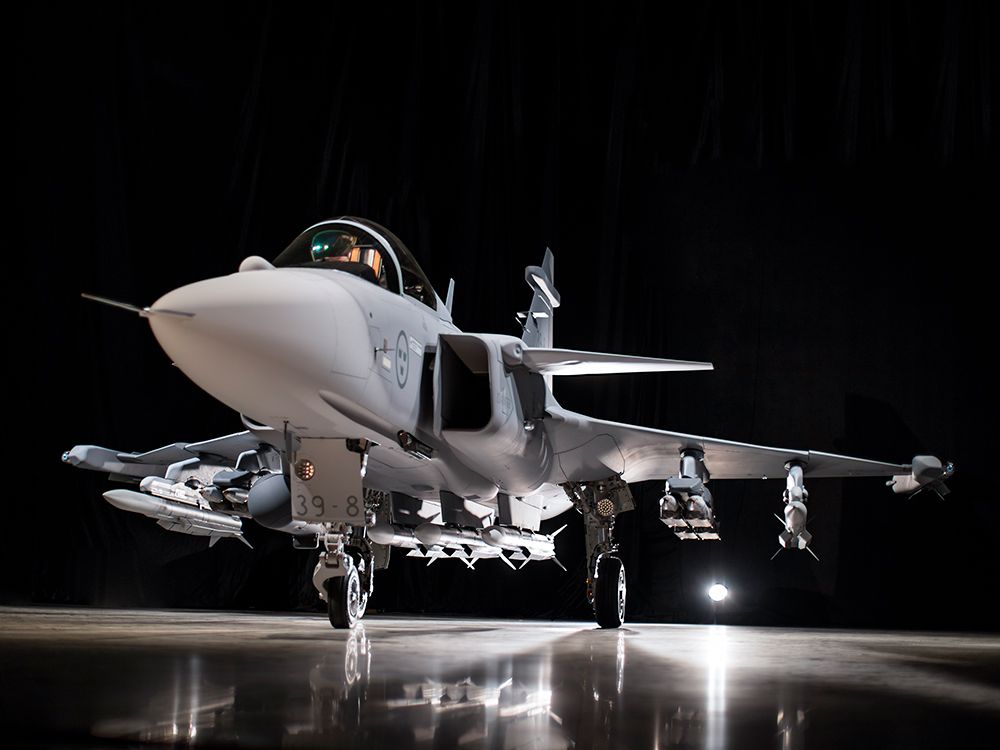
A better bet for Canada might be to opt for a mixed fleet of F-35s and a European alternative like the Swedish Saab Gripen E, above.

In his speech pledging to meet NATO’s two per cent spending target, Mark Carney expanded on his plan to rearm the Canadian military.

Key to this transformation are moves to strengthen the Canadian defence industry and to diversify defence partnerships away from the United States, where Canada spends 75 per cent of its capital budget.

Carney didn’t mention the F-35 fighter jet contract but in March

he ordered a review

to look at whether the order to buy 88 fifth-generation planes is the best investment for Canada.

The results of that review are expected this summer, and if the government is minded to cancel the remainder of the contract (it is legally obliged to take the first 16 jets), the auditor general’s office has just given it a good excuse.

The

AG’s latest report suggests that the F-35s will not be delivered on time or on budget

— which is, perhaps, as predictable as death, or Donald Trump turning on his closest confidants.

But the findings will prove maddening to a prime minister who has promised to build big things, from concept to completion, in short order.

The AG’s report suggests that the Department of National Defence should have known sooner that costs were considerably higher than had been made public. It probably did, but it has wanted to buy this aircraft for two decades and didn’t want nosy busybodies like the taxpayer intruding in the process.

The Trudeau government

finalized arrangements to buy 88 F-35s

in December 2022 (having initially cancelled the project in 2015).

Projected purchase costs at the time were $19 billion.

But the Department of National Defence’s own numbers suggest that, by 2024, inflation, fluctuating exchange rates and rising facilities costs had increased the cost to $27.7 billion.

The AG’s team calculated that another $5.5 billion can be added to that number to cover infrastructure upgrades and advanced weapons, taking the new bill to over $33 billion.

Delivery will start next year, with the first eight being sent to Luke Air Force base in Arizona for pilot training. The rest will be sent to Canada to form fighter squadrons at Cold Lake, Alta., and Bagotville, Que.

However, facilities at those two bases are three years behind schedule, the AG’s report said, which will add further costs to develop interim operations solutions.

The report cited another significant risk that a previous audit in 2018 identified —  a shortage of qualified pilots. “Six years later that was still the case,” it said.

It seems incredible that this is the same Royal Canadian Air Force that had 4,000 personnel in 1939 and went on to train 131,523 pilots, flight engineers and other aircrew over the course of the Second World War.

The hope must be that some of the

$9.3 billion in defence-related spending

unveiled by Carney on Monday will be used to help the air force reach full operational capability before the planned date nearly a decade from now.

But what will the review that is currently underway recommend?

Canada has already committed $1.6 billion to pay for the first aircraft, on training and on infrastructure for the new planes.

After delivery of the first eight for training in Arizona; the remaining eight from the first batch of 16 will be divided between Cold Lake and Bagotville. That hardly justifies the training efforts and infrastructure investments.

More likely, Canada will commit to two operational squadrons of 16 aircraft each: one in the west and one in the east.

That would mean purchasing 40 or so F-35s.

But buying 88 American jets does not satisfy the twin goals of building up the domestic defence industry or diversifying defence partnerships.

There are good reasons why Canada might not want to rely entirely on the Americans for its air security.

There have been concerns that

the F-35 has a “kill” switch

that would disable the jet, if the U.S. wanted to ground a foreign fleet. This has been denied but there are legitimate concerns that the F-35 relies on software upgrades that could be denied, if support was withdrawn. Over time, the jet’s capability would be degraded.

In the current political climate, it seems unlikely that any Canadian government would risk such dependency.

A better bet would be that the government opts for a mixed fleet of F-35s and a European alternative like the Swedish Saab Gripen E, which came second to the Lockheed Martin plane in the competition that concluded in 2022, or the French Dassault Rafale.

Saab has said that any Gripens Canada orders will be built by IMP Aerospace in Nova Scotia.

The Gripen doesn’t have the F-35s stealth capability but it is cheaper to maintain and can land more easily on short northern runways.

Proponents of the F-35 have argued that cancelling the contract could put the NORAD relationship with the U.S. at risk. But ordering 40 F-35s and twice as many Gripens would not mean cancelling the whole contract or restarting the procurement process. The Gripen could be sole sourced using a national security clause on the basis that it came second last time around.

Besides, would the Americans really want to risk leaving a Canada-sized hole on their northern border unprotected? NORAD is in the U.S.’s interests as much as it is in Canada’s.

The decision to buy the F-35 was the right one. It has been explained to me that it is a generational shift in air power and will be the link with autonomous aircraft that are the real future: picture drones tethered to a manned F-35.

But other countries, such as Germany, operate mixed fleets that mitigate, if they do not nullify, over-reliance on one partner (the Gripen uses an American GE F414 engine).

The auditor general’s report is a reminder that the F-35 is the Rolls Royce solution to air security. But Canada also needs a cheaper, more practical runaround for its everyday needs.

A typically messy Canadian compromise is the likeliest outcome.

National Post

jivison@criffel.ca

Get more deep-dive National Post political coverage and analysis in your inbox with the Political Hack newsletter, where Ottawa bureau chief Stuart Thomson and political analyst Tasha Kheiriddin get at what’s really going on behind the scenes on Parliament Hill every Wednesday and Friday, exclusively for subscribers. Sign up here.


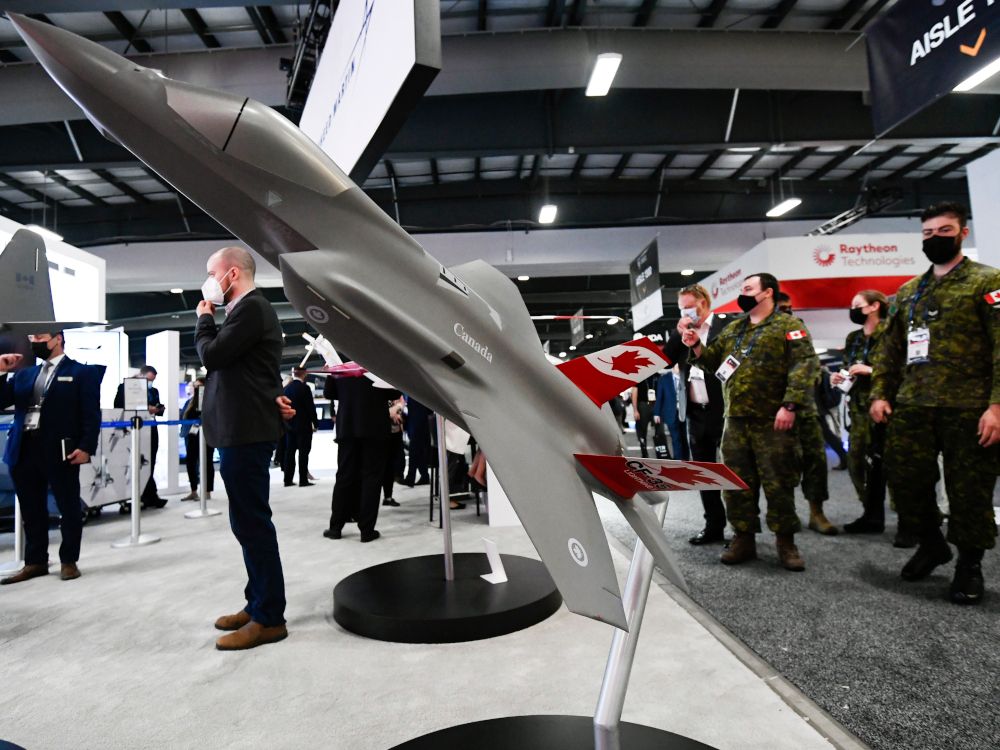
A model of Lockheed Martin’s F-35 fighter jet, featuring CF-35 markings and the Canadian flag, is displayed at a trade show in Ottawa in 2022.

Damn the torpedoes! Canada’s Liberal government is taking aim at defence — and it’s about time.

This week, Prime Minister Mark Carney announced that Canada will hit the NATO benchmark of 2 per cent of GDP on defence spending this year, instead of waiting for 2032, deploying an additional

$9 billion in 2025-2026

. Ever the banker, he’s also deploying some accounting manoeuvres, shifting $16 billion from the ledgers of other departments to the defence budget to bring it up to the required amount. But that is in line with the tabulations of other NATO countries — and is something predecessor Justin Trudeau should have done, so that Canada would have appeared to be less of a defence laggard for the last decade.

But better late than never — and perhaps, just in time.

Carney’s announcement comes just weeks ahead of both the G7 summit he is hosting in Kananaskis, Alberta and a meeting of NATO leaders later this month in The Hague. The change sends a message to both U.S. President Donald Trump and E.U. allies that Canada means business on defence. Together with the government’s border security bill announced earlier this week, Carney is paving the way for a trade deal, or at least some relief from tariffs, with the United States.

His spending boost will sit well with his recent pledge to join ReArm Europe, in light of upcoming NATO demands that members spend 5 per cent of GDP in coming years, instead of two. Carney also gets a gold star for

actual change

. The government will beef up salaries, recruitment and retention of troops, finally acknowledging that new equipment is pointless without skilled personnel. Ottawa will also overhaul the procurement process, a boost for the Canadian defence industry which could offset some of the costs to taxpayers through job creation and revenue. That could also help sell future spending hikes: while

polling shows

two thirds of Canadians support spending 2 per cent on defence, there’s not much appetite for five.

But as always, a landmine looms on the horizon: in this case, the infamous F-35 program.

On Tuesday, Auditor-General Karen Hogan

dropped a bombshell

. Canada’s planned fleet of 88 F-35 jets is now projected to cost nearly 50 per cent more. It has ballooned from $19 billion in 2022 to a staggering $27.7 billion in 2025, and that’s before factoring in infrastructure upgrades, weapons and inflation. Hogan’s audit was brutal: the Department of National Defence relied on outdated cost estimates, ignored improved data, and has no coherent contingency plan in place. Infrastructure to house the jets is running three years behind schedule, with some bases not expected to open until 2031. The RCAF is also short on qualified pilots — something it knew back in 2018, but which for the previous government was presumably not a priority.

Canada needs stealth fighters. We don’t, however, need another lake of red ink. Instead of sticking with 88 F-35s at

$27 billion-plus for the fleet

, Canada should look at Sweden’s Gripen, Boeing’s Super Hornet, or a mix of planes. If Carney approves the F-35 as-is, that failure will become the focus, instead of his ambitious plans to rearm. While Defence Minister David McGuinty

hasn’t committed to a review of the project

, saying only that he’d ensure that the auditor general’s recommendations will be “fully integrated” into his department. But he should, especially now that Canada is also building stronger ties with Europe, be considering where some of these planes could be sourced.

The reality of modern warfare is also changing, pivoting from planes to drones and battlefields to cyberspace. While the proposed spending spree would drop money on both, the trend to smarter spending versus splashing out of big shiny toys could help keep costs down. Ukraine has made significant use of three hundred dollar drones, recently taking out $100 billion dollar Russian bombers in a

daring assault

.

That’s the kind of smart thinking Canada’s government should copy as it rebuilds our military for the future — one that looks increasingly grim.

National Post


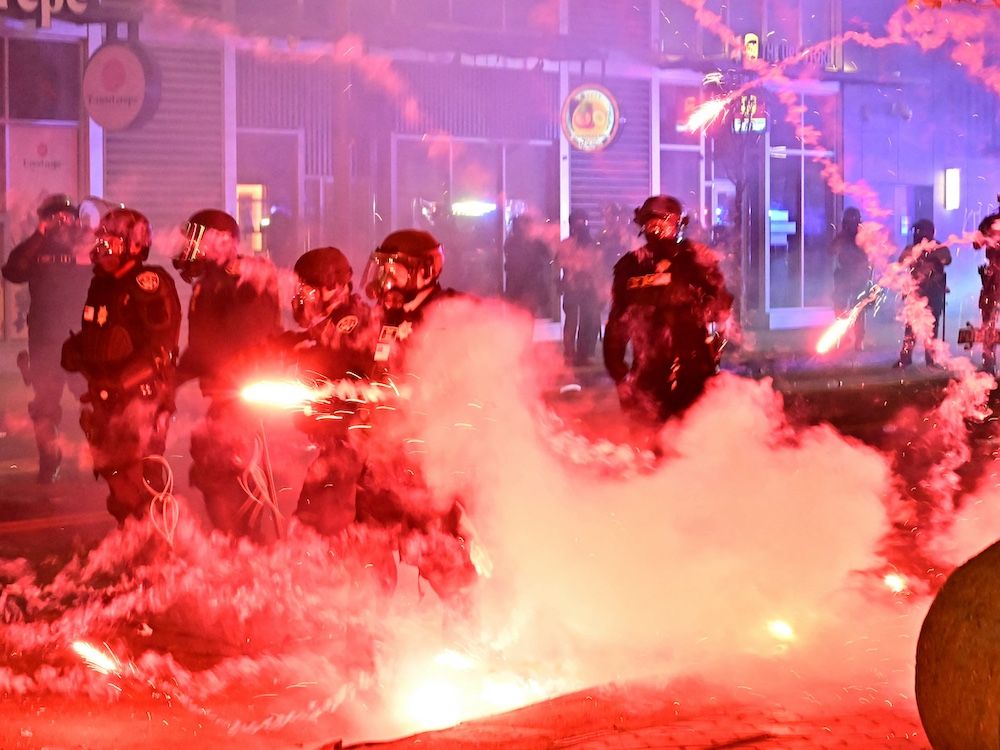
Fireworks explode around police officers in riot gear during a protest in response to federal immigration operations in the Little Tokyo neighborhood of downtown Los Angeles, on June 9, 2025. (Photo by FREDERIC J. BROWN/AFP via Getty Images)

Thanks to his good looks and fancy breeding, California Gov. Gavin Newsom has done remarkably well in Democratic politics. The one-time husband of one-time Donald Trump Jr.-paramour Kimberley Guilfoyle has survived sex scandals and COVID scandals and six separate recall efforts to somehow emerge as a 2028 front-runner for his party’s presidential nomination.

Then this weekend’s protests broke out in Los Angeles.

Now Newsom is fighting for his political life as President Donald Trump declares him Enemy No. 1 in Washington’s war on the rioters bringing anarchy to the City of Angels. The misfits — loosely-organized anti-anti-immigrant protesters — have been met by heavily armed members of both the U.S. Marines and National Guard as the riots extend into their fifth day. And Newsom — after undertaking a calculated shift rightward — is back in full-left mode as Trump’s legally-elastic deportation plan faces a bona fide rebellion.

It was barely four months ago that Newsom and Trump — the latter so disdainful of the former that he often referred to him as

“Newscum”

— were all smiles when the president touched down in California on his first official trip after re-entering the White House. Armed with wife

Melania

at his side, Trump was there to inspect the damage wrought by the catastrophic wildfires that left thousands homeless and both Newsom and Los Angeles Mayor Karen Bass’ competence in grave doubt. The governor dutifully prostrated himself to his far more powerful — and popular — superior in a flurry of awkward air kisses and bear hugs as Air Force One loomed omnipotently in rear view.

The optics could not have been clearer — California’s economy may be larger than both Germany and Japan, but Trump travels with the might of a nation behind him. And Newsom appeared to get the message —  reversing some of his most progressively polarizing positions — such as supporting biological men in women’s sports —

on his newly launched podcast which often features conservative voices.

As Congressional

enfant terrible
Alexandra Ocasio-Cortez

doubled-down on her progressive extremism during her Fighting Oligarchy tour with Bernie Sanders last month, Newsom appeared as the party’s most reasonable, likeable, electable adult in the room.

But taking on Trump is a far different matter than challenging the fringes of his own party. And take on Trump Newsom has. Monday, the governor sued the Trump Administration for

“trampling” over California sovereignty”

by sending in the National Guard. “He flamed the fires and illegally acted to federalize the National Guard,” said Newsom, adding — like a canny operator ailing for national prominence — “The order he signed doesn’t just apply to CA. It will allow him to go into ANY STATE and do the same thing. We’re suing him.”

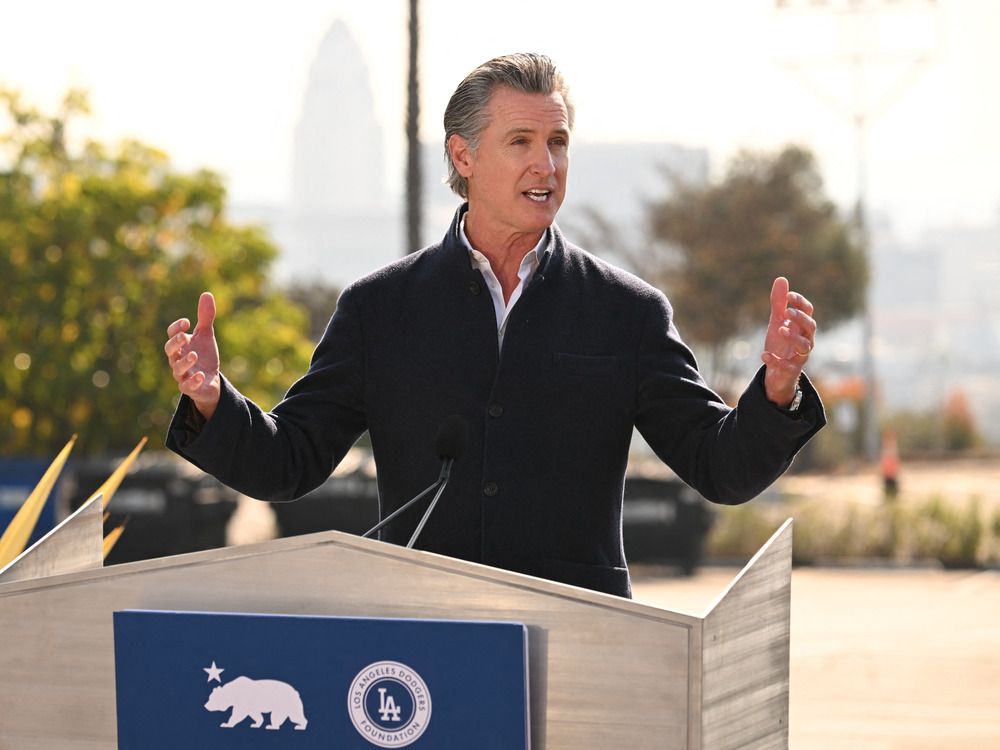
 California Governor Gavin Newsom speaks during an announcement of “LA Rises,” an initiative to support Los Angeles area wildfire recovery, during a press conference at Dodger Stadium in Los Angeles on Jan. 28, 2025.

California Attorney General Rob Banta has filed for a restraining order to get the National Guard off Los Angeles’ streets. Trump has declared that Newsom should be arrested for

“doing such a bad job”

governing his state. Undeterred, the president, 

quipped Newsom in return,

is taking “unmistakable steps towards authoritarianism”

While the courts determine the legality of Trump’s guard deployment, Newsom’s next moves could determine his political fate. Also on Monday,

Palestinian flags began to appear

alongside the Mexican flags that have come to visually define this nascent movement, suggesting an almost inevitable intersectional shift beyond merely immigration. Meanwhile, in New York,

police arrested dozens of anti-ICE protesters at Trump Tower

in the first signs of the demonstrations expanding nationally.

Newsom, of course, cannot control Gotham’s streets, but control over his own streets will set the tone for how — or even if — the protests can be contained. For the moment, Newsom appears committed to confrontationalism, daring Trump’s Border Czar Tom Homan to do his boss’ bidding and

“Arrest me, tough guy. Let’s just get it over with.”

With his posh background in winemaking and luxury real estate, Newsom makes for an unlikely — and frankly unconvincing — heavy. He knows this, Trump knows this and most Californians do, too. Which is why Newsom’s greatest liability isn’t Trump’s wrath, but that of his own fed-up constituents. In late 2023, for instance, California became the first state in the nation

to provide undocumented immigrants with health insurance.

Not only did this add $6.5 billion in costs to a state already facing a $12 billion budget deficit, such largesse fuelled the laissez-faire atmosphere that helped embolden the protesters now coursing through his streets. Meanwhile, Newsom has failed to deliver quality education, affordable housing, efficient public transport or safe streets to his legal, tax-paying residents.

Even before the weekend riots, the Trump-Newsom detente was already crumbling. Back during his wildfires visit in January, Trump made clear that he expected Newsom to rebuild his state – and fast,

leading Newsom to request some $40 billion in aid

. That money has yet to materialize, prompting a frustrated Newsom to challenge a range of Trump policies, including tariffs, which the governor labeled the

“poster child” of stupidity.

Such moves were clearly aimed at reinvigorating — and hopefully expanding — Newsom’s skeptical progressive base as he aims for national office. But considering Trump votes

increased in 57 out of 58 California counties

during last November’s presidential election, that base may have already crumbled.

David Christopher Kaufman is a columnist and editor at the New York Post.


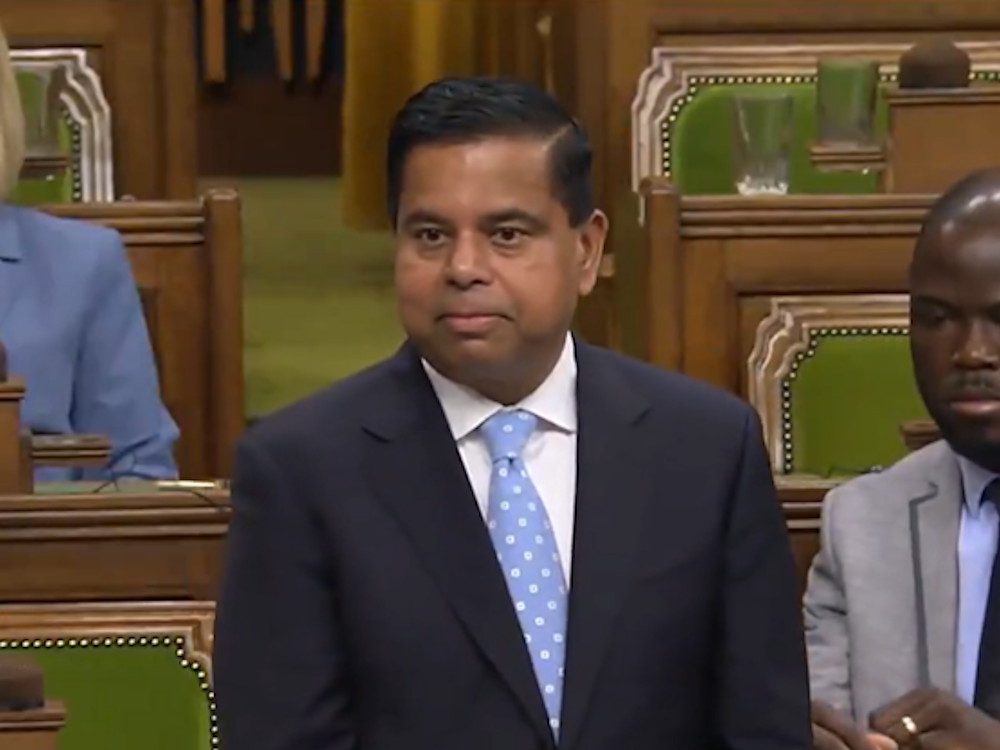
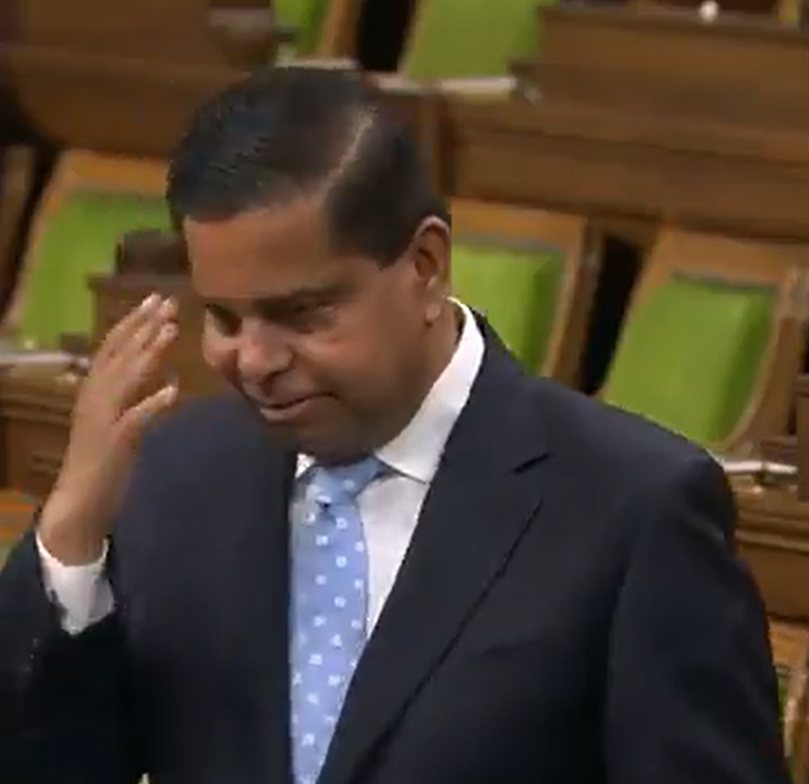
Gary Anandasangaree at the precise moment that he replied that he didn't know what an RPAL is.

First Reading is a Canadian politics newsletter curated by the National Post’s own Tristin Hopper. To get an early version sent directly to your inbox, sign up here.

TOP STORY

Canada’s new public safety minister, Gary Anandasangaree, is tasked with spearheading one of the more controversial pursuits of the Carney government. He’s the one championing a border control bill that will ban cash transactions over $10,000 and allow warrantless snooping of Canadian internet users. He will also be the one overseeing the Liberals’ various gun bans.

Despite this, Conservative MPs have taken turns in the House of Commons pointing out that Anandasangaree doesn’t seem to know about some of the more fundamental elements of his job. Some of the highlights are below.

He didn’t know what a handgun licence is

On Thursday, during a routine series of questions about Liberal gun control policy, Conservative MP Andrew Lawton suddenly asked Anandasangaree if he knew what an “RPAL” is.

“I do not,” replied Anandasangaree.

The term stands for “restricted possession and acquisition licence” and it’s the certification that must be possessed by any Canadian who owns handguns.

It’s a fair bet that most Canadians don’t know what an “RPAL” is. As of the most recent Commissioner of Firearms report,

only 752,002 Canadians

actually possess one.

But RPAL is a universally known term among any Canadian who has a familiarity with firearms. It would be akin to a driver not knowing what a “vehicle registration” is.

RPAL is also a central plank of Anandasangaree’s brief given that he is overseeing the ongoing “

handgun freeze

.” Since 2022, all of those 752,002 RPAL owners are not allowed to sell or transfer their handguns, and they’re barred from purchasing new ones.

He couldn’t identify the course required of Canadian gun owners

Lawton then asked Anandasangaree if he knew what the CFSC is. “I do not, no,” the minister replied.

The acronym refers to the Canadian Firearms Safety Course, a training program that is mandatory for any Canadian looking to own firearms. One of the hurdles of getting a gun licence in Canada is not only taking the CFSC, but scoring at least 80 per cent on both a written exam and a practical demonstration of proper gun safety.

It’s one of the tenets of Canadian firearms law that most differentiates it from the United States. In Canada, nobody is allowed to own a gun or buy ammunition for it unless the RCMP is confident that they know how to handle and store it.

And it’s Anandasangaree’s own party that is partially responsible for this. Among the many gun control measures introduced under the Trudeau government is that in-person attendance at a CFSC course is now mandatory. Previously, it was possible to simply challenge the exam.

He appeared to struggle with identifying the three basic categories of Canadian firearms

Speaking of the Canadian Firearms Safety Course, one of the first things it teaches is that Canada divides firearms into three categories, all of which are subject to different levels of control and licensing by the federal government.

The broadest category is non-restricted, which mostly covers long-guns. This is the categorization for anything used in hunting.

Handguns are covered as “restricted” firearms: Anything in this category is subject to extremely strict rules on storage and transport. Technically, a restricted firearm in Canada can only legally exist in one of three spaces: Locked up at home, at a licensed gun range, or in a car moving between those two locations.

Stricter still is “prohibited” firearms: These can’t really be fired under any circumstances, and Anandasangaree’s ministry is actively in the process of seizing many of them.

The three categories are pretty central to how the Liberals have pursued gun control. In multiple instances, they’ve taken whole categories of guns considered non-restricted and reclassified them overnight as being prohibited.

But when Conservative MP Frank Caputo asked Anandasangaree “what are the classifications of firearms?” the minister didn’t reply until he was handed a note, after which he correctly replied “restricted, non-restricted and prohibited.”

Replied Caputo, “this is the public safety minister, and somebody passed him a note with those classifications. Does the public safety minister not know the classifications of firearms?”

He didn’t get a “yes” or “no” from the minister, only: “Our intention is to ensure that law-abiding gun owners have the ability to hold on to their guns.”

He didn’t appear to know that his own government had allowed the decriminalization of hard drugs

Also on Thursday, Anandasangaree was asked by a Conservative MP whether he thought that drug decriminalization had been a “success.”

Aaron Gunn, the newly elected MP for North Island-Powell River, asked, “Does the Minister of Public Safety believe the Liberal government’s experiment to decriminalize hard drugs, including fentanyl, crack cocaine and crystal meth, has been a success in my home province of British Columbia?”

Anandasangaree replied that Gunn was “factually incorrect.” “This government decriminalized cannabis and did not go beyond that,” he said.

But ever since 2023, Anandasangaree’s government has indeed overseen the decriminalization of “personal use” amounts of hard drugs, ranging from fentanyl to crystal meth.

The decriminalization is a pilot project being pursued by the B.C. government, but illicit drugs are federal jurisdiction. As such, B.C. wouldn’t have been able to decriminalize anything

without an exemption

to the Controlled Drugs and Substances Act approved by the federal government.

Gunn tried to follow up on the point, but Anandasangaree didn’t acknowledge a federal role in the matter, saying, “We look forward to working with our provincial and territorial counterparts to ensure that there are no hard drugs available within their respective jurisdictions.”


IN OTHER NEWS

 To cap off Gary Anandasangaree’s very bad week in the House of Commons, he also extended his deepest condolences to “the late Mark Carney.” He obviously meant former Liberal MP Marc Garneau, and caught the flub immediately, as shown above.

In yet another check against the likelihood that the Carney government will be building any oil export pipelines, on Friday Prime Minister Mark Carney said that nothing’s getting approved without “a consensus of all the provinces and the Indigenous people.” The statement

misrepresents the power of the federal government

; obviously Ottawa is able to do things without first getting unanimous approval from all 10 provinces and also an undefined share of the country’s 630 First Nations. But with the statement,

Carney is effectively making it harder to build a pipeline than to amend the Constitution.

For big decisions (such as abolishing the Senate), the Constitution requires the virtually impossible threshold of obtaining unanimous consent from all the provinces – but without any similar benchmark for unanimous Indigenous consent.

 The National Holocaust Monument in Ottawa has only been open for eight years, but over the weekend it received its worst ever example of desecration: Large splashes of red paint against the words “feed me.”

In a recent interview with podcaster Joe Rogan, FBI Director Kash Patel 

alleged that Canada is an emerging hub of fentanyl production, in part due to U.S. efforts to combat fentanyl smuggling coming in from Mexico.

Patel said the component parts to manufacture illicit fentanyl come almost exclusively from China, and were now increasingly being routed through Canada. “Instead of having the Mexican cartels going right up the southern border and into America, do you know what they’re doing? They’re flying it into Vancouver, they’re taking the precursors up to Canada, manufacturing it up there, and doing their global distribution routes from up there because we’ve been so effective down south,” he said. B.C. Public Safety Minister Garry Begg dismissed the allegations in a statement to CTV News. “It’s no surprise that Trump’s appointee would use his position to continue the president’s narrative to justify his tariffs,” he said. “Their Drug Enforcement Agency’s National Drug Threat Assessment report in 2023 and 2024 didn’t even mention Canada.”

Get all of these insights and more into your inbox by signing up for the First Reading newsletter.


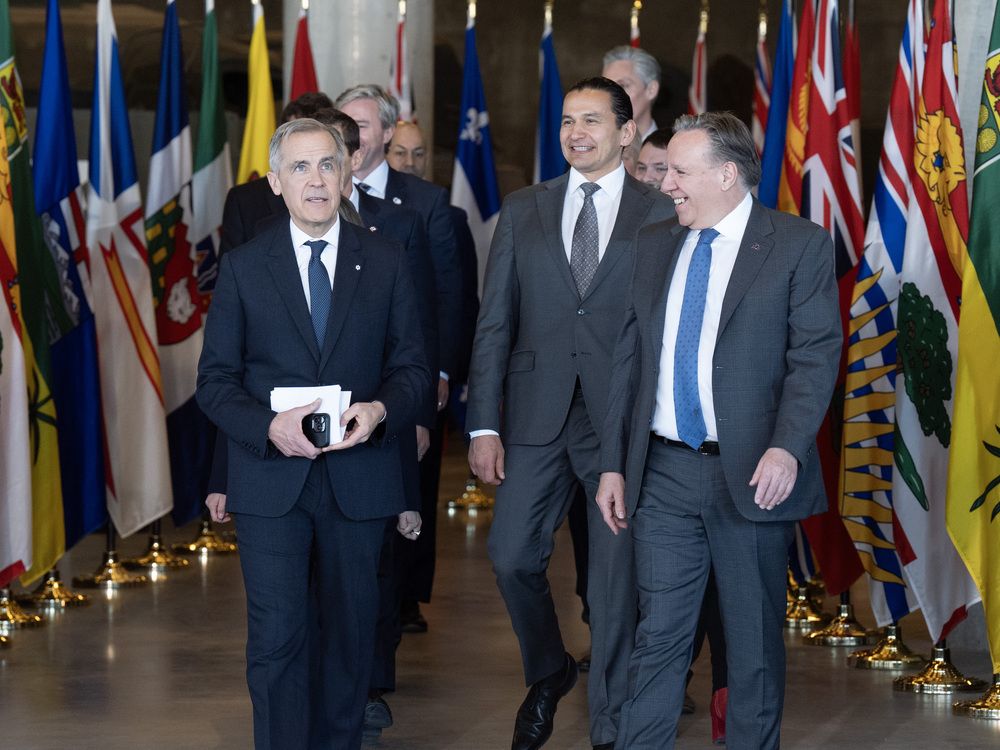
Prime Minister Mark Carney, front left, walks alongside Francois Legault, Premier of Quebec, as they are joined by first ministers as they arrives to take part in the First Minister Meeting at the National War Museum in Ottawa on Friday, March 21, 2025. THE CANADIAN PRESS/Adrian Wyld

Never since he became Quebec Premier in 2018 has François Legault come back from a meeting with a prime minister with such positive things to say. “We had an excellent meeting, the premier

said

of the First Ministers meeting in Saskatoon. I have never talked as much about the economy with a prime minister of Canada as yesterday. It’s refreshing.”

It was public knowledge that Legault and Justin Trudeau disagreed on most topics and did not get along well. Remember that during the 2021 federal election, the premier all but suggested that Quebecers vote for Erin O’Toole’s Conservatives,

calling

the Liberals and New Democrats “dangerous” for Quebec because of their centralizing tendencies.

Nationalist commentators — that is, the vast majority of columnists and editorial writers of the province — ridiculed Trudeau as an intellectual lightweight who multiplied gaffes during his foreign trips and lost control of the federal government’s finances and of the country’s immigration. The then Prime Minister made for an easy target. It may not be an accident that support for the separatist Parti Québécois surged during Trudeau’s reign.

Carney’s arrival on the scene and the rise in support for the Liberal Party on the eve of the recent federal election caused a panic amongst the sovereigntists’ ranks, who until then counted on a strong showing by the Bloc Québécois, even dreaming that the Bloc would form the Official Opposition in the next Parliament. To them, Carney’s popularity in the province did not make sense and could only be driven by an irrational fear of Donald Trump; how could Quebecers vote for a leader whose command of French was so imperfect? A leader committed to challenging Bill 21 (forbidding the wearing of religious symbols by government employees)? A leader who aims to build one Canadian economy instead of 13, thereby ignoring Quebec’s specific circumstances?

Québecor, the dominating media group in the province, launched an all-out offensive against Carney, and Bloc leader Yves-François Blanchet

made the insulting comment

that the rise in Liberal support in the polls was the result of an old Québécois reflex “when they are afraid to hide behind an Englishman to protect them.” Carney’s Liberals nonetheless gained 10 seats in Quebec, where they now dominate with 44 seats, against the Bloc’s 22.

Now, Mark Carney is Canada’s prime minister, and to the nationalists’ bafflement, he appears to be the exact opposite of Justin Trudeau: focused on work rather than image, deeply knowledgeable of the economy, and well-respected on the international stage. It is also more difficult to argue that Carney will ignore Quebec’s interests when the minister of finance, the minister of industry, the prime minister’s chief of staff and his principal secretary are all Quebecers. No Quebecer combines an understanding of Quebec’s and Canada’s politics, business environment and foreign affairs as the new chief of staff, Marc-André Blanchard. Blanchard is also a pragmatic problem solver; issues that Trudeau seemed content to let fester, including ones that were politically damaging in Quebec, will be promptly and rigorously dealt with.

For now, Premier Legault is asking the federal government to help fund transmission lines that will connect Newfoundland and Labrador and Quebec to power generated by new hydro projects along the Churchill River. The prime minister has agreed that such lines would be in the national interest, exactly the type of project that his government wants to accelerate as part of its effort to strengthen the country’s economy. The premiers of Quebec and Newfoundland and Labrador were very much pleased.

Quebec politics remain fraught with traps for any Canadian government. Immigration is a very sensitive topic; Ottawa and Quebec need to find a common ground that will reassure Quebecers that the numbers of asylum seekers and temporary residents will fall back to reasonable levels. If the Supreme Court invalidates Bill 21, there will be a strong reaction in the province that the federal government will have to carefully deal with. Finally, Carney does need to improve his French so that he is better able to communicate with Quebecers.

Regarding Quebec, the federal government does not have to bend to all its nationalist demands, of course. Rather, what is required is that Ottawa defends its policies and opinions strongly and intelligently. Quebecers might not agree, but they will respect a government that is competent and fairly appreciates their concerns. The prime minister has put together a team that can achieve that. And this causes a lot of frustration amongst Quebec separatists.

André Pratte is a communications consultant, doctoral student in history at the Université du Québec à Montréal.

National Post


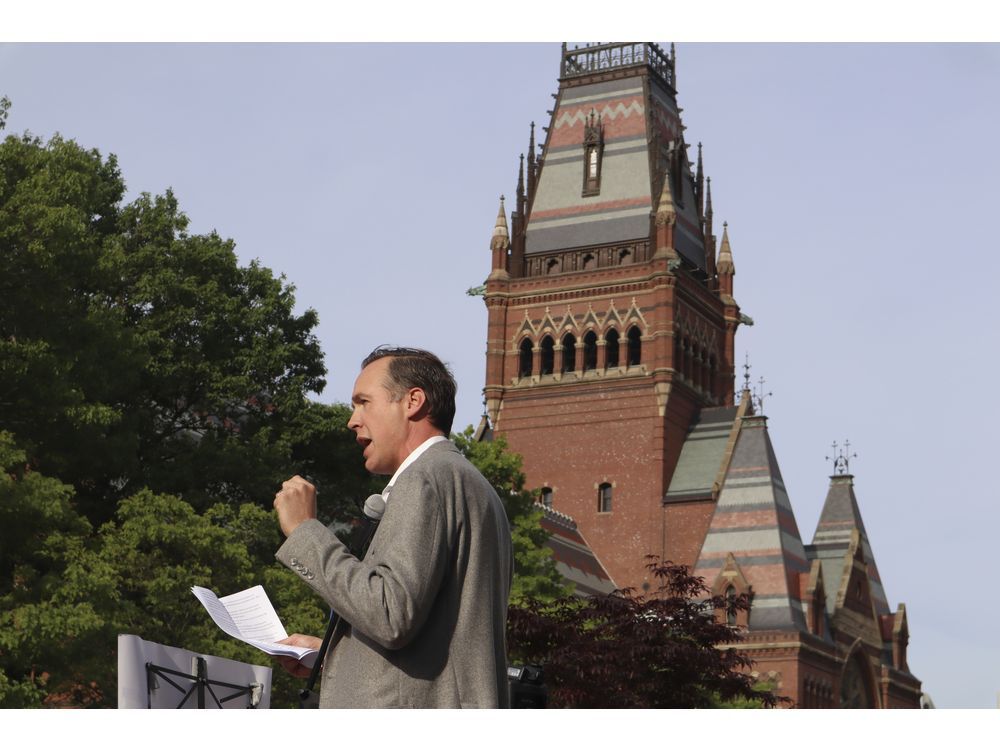
Ryan Enos, a government professor at Harvard University, speaks at a protest against Donald Trump's recent sanctions against Harvard in front of Science Center Plaza on Tuesday, May 27, 2025, in Cambridge, Mass.

The plight of American universities right now — Harvard in particular — is a striking example of everything that can go wrong with the politicization of education.

The Trump administration seems determined to undermine the very capacity of elite universities to exist. They are cutting funding, slashing the money to research granting agencies, cancelling international student visas, and justifying the whole thing because of allegations of

antisemitism

and

political bias

. Harvard is the sacrificial victim, but everyone is supposed to get the lesson: get into line politically or suffer the same fate.

Despite the very real threat of antisemitism in these places — the attacks on Jewish Americans have been many, and the problem is real — Trump is acting the role of a political thug. He’s like a mafioso boss shaking down one restaurant owner, so that all the other businesses in town get the message.

What’s also true, though, is that the institutions of higher learning in the United States (as in Canada) are politicized. They make for good targets for Trump’s populist anti-elite ethos not only because they are elite universities, but also because they have advertised themselves as such — and have acted as — places of left-wing social justice activism.

Who knows how this is going to end? Harvard is rich, with billions in endowments, but how long can it last? Without long-term funding, it’s going to be strategically smart for its leading researchers to look elsewhere, perhaps even here in Canada, for safer employment.

For Canada, the question is slightly different: what can we do to avoid the American dumpster fire?

The good news is that some universities seem to be getting the message. Over the last couple of years, several Canadian universities have announced policies of

institutional neutrality

. While individual faculty can speak politically, some universities have announced that they will be politically neutral.

This is fine, as far as it goes. But it’s far from enough. The leftist tilt at universities goes much deeper than public pronouncements. It can be seen in everything from who is hired, and who isn’t; which subjects get funding, and which do not; and which types of diversity issues get treated as problems, and which are ignored. On this, there is no sign that any university is seriously looking at the now long-term trend of

decreasing

male enrollments in higher education.

The reality is that most Canadian universities continue to act as institutions of leftist activism in ways that will require more than just institutional neutrality statements to unravel.

Large segments of the university world — though by no means all — emphasize their role as activists. They celebrate it.

The Congress of Humanities and Social Sciences that met in Toronto last week, brought together researchers from all over the country. As part of their program, they hosted a “

Big Thinking

” series to highlight what the Congress thought of as the most important research. Every single one of the “Big Thinking” events — the sessions that the Congress wants the public to know about — were focused on topics including

wildfires and climate change

, “

benefits and challenges” of implementing EDI in post-secondary research

, and

far-right (but not far-left) extremism.

There was no ideological diversity in these sessions — no sense that there could be anything other than a leftist-version of what counted as “justice.” The more than 41 per cent of the Canadian population who voted Conservative in the last election would not have seen their ideas of justice represented anywhere in these discussions.

Some universities have whole departments focused on social justice — and again, here, the notion of what is justice is politically-slanted. Job advertisements continue to call on candidates to demonstrate their commitment to DEI and social justice. These are political litmus tests — though universities act as if they are politically-neutral. This is what happens in politically-lopsided institutions. People come to see their own beliefs as simply normal and neutral.

A recent open-letter from over 200 Canadian professors

called out

this sort of taken-for-granted activism by the Canadian Association of University Teachers (CAUT). The letter noted CAUT’s activist tilt on issues from Israel to DEI, and also the bizarre choice of the organization to announce a travel advisory for researchers going to the United States. CAUT has announced no travel warning for any other country — not to war-torn Ukraine or the Sudan, nor has it warned of authoritarian surveillance, even in countries like China or Russia.

These actions — and more — show the weird political activism that is taken for granted in Canadian universities. When everyone around you refuses to wear deodorant, maybe you don’t notice that you all smell. But when an outsider enters the room, freshly showered and clean, you’ll have to excuse them for thinking that something stinks.

It’s incredibly unlikely that, if Poilievre’s Conservatives had won the recent election, they would have engaged in the kind of all-out war that Trump is now embroiled in. Despite accusations to the contrary, Poilievre is no Canadian Trump.

But it would have been logical for a Conservative government to look at universities and see them as major sources of anti-conservative activism in ways that are baked-in — and to want to depoliticize these institutions.

If you sell yourself as a political institution — committed to highly politicized versions of social justice — and then populate yourself with only those from one political persuasion, you’d have to be crazy for thinking that those who come from the other side of the political spectrum won’t consider that you are exactly what you claim to be: and then act accordingly.

A dystopian vision of what this could lead to is currently on display in Trump’s America. Maybe we could act now before it comes to this in Canada too?

National Post


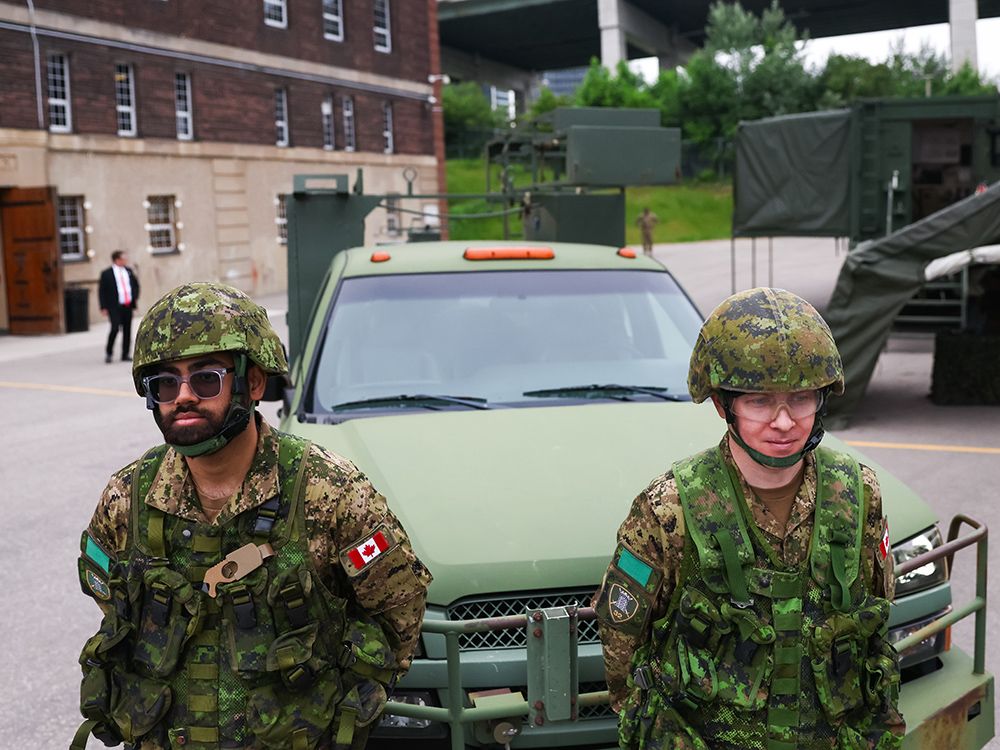
Soldiers from the 4th Canadian Division wait in front of a military vehicle as Prime Minister Mark Carney attends a tour of the Fort York Armoury in Toronto on June 9, 2025.

Justin Trudeau went to Washington

for last year’s NATO summit

and unveiled what he called a “credible, verifiable path” to spending two per cent of Canada’s GDP on defence … by 2032.

The lack of urgency and ambition was reflected in the then prime minister’s belief that two per cent is a “nominal target” that makes for easy headlines but doesn’t make Canadians more safe.

His disdain for military spending was apparent in a

Washington Post story from 2023

, when he reportedly told the Americans that Canada would never hit two per cent.

If credibility is a leader’s currency, Trudeau left the U.S. capital bankrupt in the eyes of many of Canada’s allies. Mike Johnson, the House speaker, said Canada was riding on America’s coattails and called it “shameful.”

Mark Carney, who is heading for this year’s NATO summit in The Hague later this month, clearly did not want a repeat of the Washington debacle, especially as NATO secretary-general Mark Rutte is proposing a new target of 3.5 per cent of economic output on military spending and another 1.5 per cent on “defence-related expenditure.”

On Monday,

Carney announced that Canada will hit the two per cent target this fiscal year

, five years ahead of the schedule he set during the general election.

Canada will spend an additional $9.3 billion this year in a defence package that is primarily focused on improving operational readiness.

“Canadian leadership will be defined not just by the strength of our values but also by the value of our strength,” Carney said, using another JFK-style antimetabole (“Ask not what your country can do for you, ask what you can do for your country.”).

Last year, Trudeau expressed frustration that his government got no credit for doubling defence spending over his decade in power. “We have stepped up massively,” he said.

Carney acknowledged the increase in spending over the past 10 years, but also pointed out Canada’s defence deficiencies: aging infrastructure and equipment; just one submarine being seaworthy at any given time; and,

only half the marine fleet and land vehicles being operational

, leaving the military more reliant on the U.S. than ever.

Carney said reaching two per cent is only the first step. “We will further accelerate our investments,” he said, citing the need for new subs, aircraft, ships, drones and long-range precision missiles.

The prime minister denied any creative accounting is taking place, even though a technical briefing by defence officials suggested a resourcefulness one hopes is reflected at an operational level.

The total defence spending that will be submitted to NATO will increase from $53.4 billion to $62.7 billion for 2025/26. The Main Estimates that came out less than two weeks ago pegged the Department of National Defence spending for the year at $35.7 billion. Additional planned spending over the year was expected to take that to $39 billion. The other $14 billion to reach $53.4 billion comes from 13 other departments, including 60 per cent of the Canadian Coast Guard’s budget for items such as new polar icebreakers. Officials said that an average of $10 billion of the total defence spending package comes from other departments in any given year. But when NATO’s accountants pore over the additional $14 billion, they are likely to find that some curious, and distinctly non-lethal, line items have been conscripted in defence of the realm.

While there may be justifiable skepticism about the underlying fiscal assumptions, the new money looks real.

The Department of National Defence has a poor track record of spending on capital projects: between 2017 and 2024, it spent $12 billion less than was planned, according to the Parliamentary Budget Office.

But this plan is designed to get money out of the door in short order.

Military officials said the expectation is that the cash injection will elevate the Canadian Armed Forces to the level of readiness required. “We could not afford to have the entire force at a similar level of availability,” one said.

For example, to help with the 13,000 shortfall in personnel, $2.6 billion is being earmarked to accelerate recruitment and improve retention by improving pay levels. The aim is to get the size of the CAF to a regular force of 71,500 and a reserve force of 30,000.

Carney recognized the potential for such announcements to be “empty rhetoric.” But there is a distinct feeling that Canada has joined the global arms race in earnest, a trend that has seen military spending worldwide rise for 10 consecutive years, according to

the Stockholm International Peace Research Institute

. Russia, Canada’s most likely adversary, is now spending seven per cent of its economic output on defence.

President Donald Trump’s animus towards NATO is well-known, to the point where he had to be persuaded not to pull out of the organization during his first administration. As such, Carney’s plan to build a more self-reliant defence industry at home, and to strengthen transatlantic links with European suppliers, is long overdue. Part of that plan will require a new defence policy, he said, which speaks volumes about his opinion of Trudeau’s

“Our North, Strong and Free”

review, which is only 14 months old.

That document talked about “exploring options” for an integrated air and missile defence system and for a new fleet of submarines, but made no financial commitments.

There was no hurry to right the ship. But now there is.

Carney admitted that such aspirations do not come cheaply and said it may require unspecified sacrifices.

But the public follows the news, even if it is in bite-sized chunks.

Canadians know we are living in a darker world and expect their government to fulfil its most fundamental duty of protecting them. For years, there was no political payback in increased defence spending, so governments didn’t bother.

But

opinion polls suggest two-thirds of Canadians

now believe the government should be spending much more on the military.

The old line was that Canada was guarded by Generals Atlantic and Pacific. That illusion faded during the last world war. Now, we can’t even rely on General Arctic.

The idea that Canadian sovereignty relies on a Canadian Ranger with a skidoo and a 60-year-old Lee Enfield rifle is no longer acceptable — and that’s progress.

jivison@criffel.ca

Get more deep-dive National Post political coverage and analysis in your inbox with the Political Hack newsletter, where Ottawa bureau chief Stuart Thomson and political analyst Tasha Kheiriddin get at what’s really going on behind the scenes on Parliament Hill every Wednesday and Friday, exclusively for subscribers. Sign up here.