LP_468x60
on-the-record-468x60-white

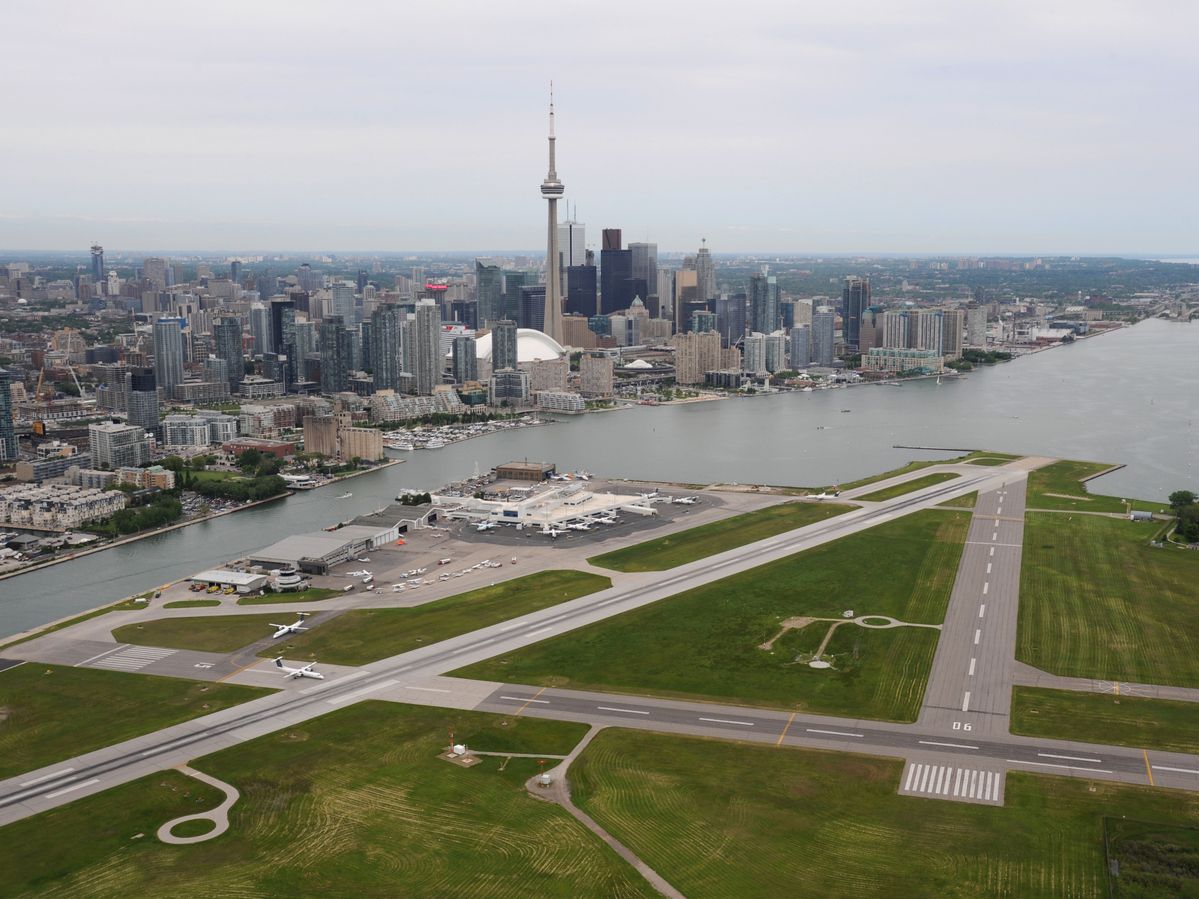
Billy Bishop airport in Toronto.

Only Mark Carney and Doug Ford know if there was actually a deal between them to each support a major transportation infrastructure project that the other had championed.

Maybe it wasn’t quite that formal, but The Toronto Star reported this week that it very much was: An agreement that the federal Liberals would wave through the Ontario PC plans for a massive expansion of Toronto’s island airport, and in exchange members of the Ford caucus would give their tacit blessing to Carney’s Alto high-speed rail vision. The pact was made between the two leaders at the premier’s Toronto home. There was reportedly a handshake and everything.

That arrangement was certainly given credence this week, when no sooner did the Liberals shelve Ford’s Billy Bishop dreams than a bunch of his MPPs in eastern Ontario — 11 of them, including two members of Cabinet and the government House leader — went public with a letter that declared their constituents needed to be fully consulted on Alto before it goes much further. The Ford caucus is tightly controlled, comms-wise, and there’s no way that letter sees the light of day without the blessing of the premier’s office. The timing cannot be a coincidence.

But while there are valid questions to be asked about whether Carney balked on his apparent deal with Ford to help his party in an upcoming Toronto byelection, and what that might do to their working relationship in the future, there’s an even bigger question that needs asking: what in blazes were they doing making that kind of deal in the first place?

It is, in a word, insane.

Both the proposed Billy Bishop expansion and the Alto high-speed rail concept are massive undertakings. The rail plan, such as it is to this point, is many magnitudes larger than Ford’s airport vision, but each involves many billions of dollars and years of investment. It is simply alarming that the two leaders would agree to some kind of quid pro quo on infrastructure projects of this scale without any, you know, facts. It is staggering. It’s unconscionable. Someone needs to invent a new word, because ridiculous does not begin to cut it.

We are used to Ford shooting for the moon with some of his ideas, for example the tunnel under Highway 401 that is currently in the middle of the world’s most pointless feasibility study. But Carney is supposed to be a business-school pragmatist. What is the point of the shiny new Major Projects Office if an airport expansion can simply be traded for a train line?

The fairest criticism of the Billy Bishop proposal at this point in its existence is that it lacked details. Proponents talked about the jobs it would create and the economic benefits it would bring, predictions that were highly speculative, but how it might work was left for another day. How big would the runway need to be? Where would the expanded terminal fit? How could the congested foot of Bathurst Street possibly deal with a quadrupling or more of passenger volumes arriving at the gateway to the island? None of that stuff, among many more questions, had been answered. And yet, we are to believe, the federal government was fine with all that as long as they got their train thing moving.

Not that the provincial government comes away looking any more discerning. The problems that the MPPs raised in their letter — chief among them, land expropriation along the train corridor — have been there all along, as have countless other concerns. (Readers have been well-informed by colleague Chris Selley in this regard .) And yet, until Tuesday, Ford’s caucus, even the rural members, had been quiet as church mice on the rail plan.

As this country embarks on tremendous infrastructure spending that was spooked by a broken trade relationship with the United States, is this seriously how major projects are going to be decided? Do the merits of any such project matter less than whether leaders can quietly fist-bump over the broad strokes of a proposal at dinner?

You’d like to imagine that the particulars of a given multi-billion dollar plan would matter a great deal to any leader before giving it an endorsement, tacit or otherwise. You would be wrong, evidently. (Lest anyone argue that this is what Carney has done by pulling his support, his transport minister cited public feedback as the reason for their decision, not doubts about the viability of the plan.)

Even at their most basic level, both proposals deserved skepticism. Would an expanded island airport really drive economic growth, or just move flights from one Toronto airport to another? And would an incredibly costly high-speed rail corridor really be a wise investment in a province that has struggled to build even the simplest of light-rail commuter lines?

Even those doubts weren’t enough to scare off either the premier or the prime minister, it would seem.

You back my project and I’ll back yours, details TBD. They might as well have written “big jets = speedy choo-choos” on a napkin and been done with it.

It seems like a crazy way to run a country. But here we are.

sstinson@postmedia.com


Israeli Prime Minister Benjamin Netanyahu, left, and U.S. President Donald Trump, right, attend the funeral for the late U.S. Sen. Lindsey Graham at the Washington National Cathedral in Washington, D.C., on Tuesday.

VIENNA, Austria – Was Tuesday’s Washington, D.C., funeral for Sen. Lindsey Graham a requiem for an era of which Graham was a champion? The use of military force to achieve geopolitical goals is facing limits not evident even five years ago. Have the war hawks been grounded?

“Lindsey liked war, to be honest with you,” U.S. President Donald Trump told Fox News on the morning of Graham’s funeral. “I jokingly say, and there’s nothing funny about it, but he’s never seen a war that he didn’t like.”

I followed the ceremonies in Washington while travelling from Warsaw to Vienna, historic capitals where history invites reflection on what it means to be the victim of imperial forces, and the limits of imperial power.

(Summertime trivia for those who like geography questions: how many sovereign countries have capital cities beginning with W in their own languages? Five: Washington, Warsaw, Wien (Vienna), Wellington and Windhoek, Namibia.)

Another W question, put to music back in 1970: “War, what is it good for?” Several important things, actually, beginning with defending sovereignty, liberty and justice. Not always, though, as war can be used for conquest, oppression and injustice. And war always brings suffering, destruction and death.

Another question: What if even a war with just goals doesn’t work? Then what is it good for?

Graham’s funeral brought two wartime leaders, Israeli Prime Minister Benjamin Netanyahu and Ukrainian President Volodymyr Zelenskyy, to Washington. Two wars, two continents, two Oval Office meetings, but one common theme: the limits of pure military force are becoming evident.

Russia’s full-scale invasion of Ukraine in 2022 was launched on the premise that the relative balance of armed forces greatly favoured the larger invader. Moscow did not count on the bravery of the Ukrainian resistance and, while it claimed territory in the east, Russian military force was simply not capable to seizing the centre of the country. Rapid technological transformations have turned the war moderately toward Ukraine, though Russia is still able to send missiles into residential neighbourhoods, which used to be recognized as a war crime.

Between 2014, when Russia seized and annexed Crimea without much effort, and 2026, the limits of military power have become more evident. Graham, the last of the soaring war hawks, died just as that new reality was dawning, not only in Ukraine (to his delight), but also Gaza and Iran (to his dismay).

After the Hamas invasion and massacre of October 2023, Netanyahu launched a crushing operation in Gaza, defending it against accusations of “war crimes” on the grounds that Hamas had deliberately embedded its fighting forces among civilians. The Israel Defence Forces, with total control of Gaza’s borders, absolute control of Gaza’s airspace and the ability to send ground troops wherever it wished in the tiny territory, had no limit on its power and reduced wide swaths to rubble.

Nevertheless, after two years of pulverization , when the ceasefire was declared in October 2025, Hamas was still in power in Gaza, with effective control of the territory not under direct IDF occupation. If the might of the IDF could not eliminate Hamas after two years of intense fighting in Gaza, it may well be that sheer might is not mighty enough.

In Iran, Trump infamously threatened that “a whole civilization will die tonight, never to be brought back again.” There is no doubt that American-Israeli air strikes could eliminate all of Iran’s bridges, major roads, ports, electrical grid and refineries. Hundreds of thousands of civilians could be killed and millions more could die from disease, hunger and lack of water access. That hasn’t happened because those would be clear war crimes.

Yet it also hasn’t happened because it is not clear that it would achieve the military objective. Set aside the evidently false claim that Iran was “weeks away” from a nuclear bomb — the nuclear program was already “obliterated” in last year’s Operation Midnight Hammer, according to Trump — the war is now about opening the Strait of Hormuz and protecting America’s allies from lesser, but real, damage from Iran.

Former U.S. president Ronald Reagan used naval power to keep Hormuz open nearly 40 years ago when Iran tried to close it at the end of the Iran-Iraq War. The original “peace through strength” president succeeded and it stayed open for four decades until Trump began his war. But Reagan did not have to worry about Iran’s missile and drone arsenal — or the Houthis using the same to cut off Red Sea access to the Arabian Sea.

It is not evident that even the pulverization of Iran — an enormous territory of over 90-million people — could put an end to attacks on shipping in the Persian Gulf and Red Sea, as well as attacks on ports, airports, refineries and desalination plans.

Consider Kuwait, which hosts a massive American military presence. It would be impossible now for any neighbour to invade it as Iraq did in 1990. But Iran needn’t invade. Kuwait gets 90 per cent of its drinking water from desalination, and Iran has hit its facilities, though they have been repaired. What if they were taken out? Kuwait exports all its oil — two-million barrels daily — through Hormuz. Iran has largely closed it for months.

Similar, though less severe, situations prevail in Saudi Arabia, Bahrain, Qatar and the United Arab Emirates. Hence Trump and Netanyahu’s conundrum. They have the force. But force may no longer be enough, even against a much weaker rival.

Their military power is formidable. War has changed. After Gaza and Iran, even as the late senator Graham was buried, it may be that the flight of the hawks has ended.

National Post


Israeli Prime Minister Benjamin Netanyahu, left, and U.S. President Donald Trump, right, attend the funeral for the late U.S. Sen. Lindsey Graham at the Washington National Cathedral in Washington, D.C., on Tuesday.

VIENNA, Austria – Was Tuesday’s Washington, D.C., funeral for Sen. Lindsey Graham a requiem for an era of which Graham was a champion? The use of military force to achieve geopolitical goals is facing limits not evident even five years ago. Have the war hawks been grounded?

“Lindsey liked war, to be honest with you,” U.S. President Donald Trump told Fox News on the morning of Graham’s funeral. “I jokingly say, and there’s nothing funny about it, but he’s never seen a war that he didn’t like.”

I followed the ceremonies in Washington while travelling from Warsaw to Vienna, historic capitals where history invites reflection on what it means to be the victim of imperial forces, and the limits of imperial power.

(Summertime trivia for those who like geography questions: how many sovereign countries have capital cities beginning with W in their own languages? Five: Washington, Warsaw, Wien (Vienna), Wellington and Windhoek, Namibia.)

Another W question, put to music back in 1970: “War, what is it good for?” Several important things, actually, beginning with defending sovereignty, liberty and justice. Not always, though, as war can be used for conquest, oppression and injustice. And war always brings suffering, destruction and death.

Another question: What if even a war with just goals doesn’t work? Then what is it good for?

Graham’s funeral brought two wartime leaders, Israeli Prime Minister Benjamin Netanyahu and Ukrainian President Volodymyr Zelenskyy, to Washington. Two wars, two continents, two Oval Office meetings, but one common theme: the limits of pure military force are becoming evident.

Russia’s full-scale invasion of Ukraine in 2022 was launched on the premise that the relative balance of armed forces greatly favoured the larger invader. Moscow did not count on the bravery of the Ukrainian resistance and, while it claimed territory in the east, Russian military force was simply not capable to seizing the centre of the country. Rapid technological transformations have turned the war moderately toward Ukraine, though Russia is still able to send missiles into residential neighbourhoods, which used to be recognized as a war crime.

Between 2014, when Russia seized and annexed Crimea without much effort, and 2026, the limits of military power have become more evident. Graham, the last of the soaring war hawks, died just as that new reality was dawning, not only in Ukraine (to his delight), but also Gaza and Iran (to his dismay).

After the Hamas invasion and massacre of October 2023, Netanyahu launched a crushing operation in Gaza, defending it against accusations of “war crimes” on the grounds that Hamas had deliberately embedded its fighting forces among civilians. The Israel Defence Forces, with total control of Gaza’s borders, absolute control of Gaza’s airspace and the ability to send ground troops wherever it wished in the tiny territory, had no limit on its power and reduced wide swaths to rubble.

Nevertheless, after two years of pulverization , when the ceasefire was declared in October 2025, Hamas was still in power in Gaza, with effective control of the territory not under direct IDF occupation. If the might of the IDF could not eliminate Hamas after two years of intense fighting in Gaza, it may well be that sheer might is not mighty enough.

In Iran, Trump infamously threatened that “a whole civilization will die tonight, never to be brought back again.” There is no doubt that American-Israeli air strikes could eliminate all of Iran’s bridges, major roads, ports, electrical grid and refineries. Hundreds of thousands of civilians could be killed and millions more could die from disease, hunger and lack of water access. That hasn’t happened because those would be clear war crimes.

Yet it also hasn’t happened because it is not clear that it would achieve the military objective. Set aside the evidently false claim that Iran was “weeks away” from a nuclear bomb — the nuclear program was already “obliterated” in last year’s Operation Midnight Hammer, according to Trump — the war is now about opening the Strait of Hormuz and protecting America’s allies from lesser, but real, damage from Iran.

Former U.S. president Ronald Reagan used naval power to keep Hormuz open nearly 40 years ago when Iran tried to close it at the end of the Iran-Iraq War. The original “peace through strength” president succeeded and it stayed open for four decades until Trump began his war. But Reagan did not have to worry about Iran’s missile and drone arsenal — or the Houthis using the same to cut off Red Sea access to the Arabian Sea.

It is not evident that even the pulverization of Iran — an enormous territory of over 90-million people — could put an end to attacks on shipping in the Persian Gulf and Red Sea, as well as attacks on ports, airports, refineries and desalination plans.

Consider Kuwait, which hosts a massive American military presence. It would be impossible now for any neighbour to invade it as Iraq did in 1990. But Iran needn’t invade. Kuwait gets 90 per cent of its drinking water from desalination, and Iran has hit its facilities, though they have been repaired. What if they were taken out? Kuwait exports all its oil — two-million barrels daily — through Hormuz. Iran has largely closed it for months.

Similar, though less severe, situations prevail in Saudi Arabia, Bahrain, Qatar and the United Arab Emirates. Hence Trump and Netanyahu’s conundrum. They have the force. But force may no longer be enough, even against a much weaker rival.

Their military power is formidable. War has changed. After Gaza and Iran, even as the late senator Graham was buried, it may be that the flight of the hawks has ended.

National Post


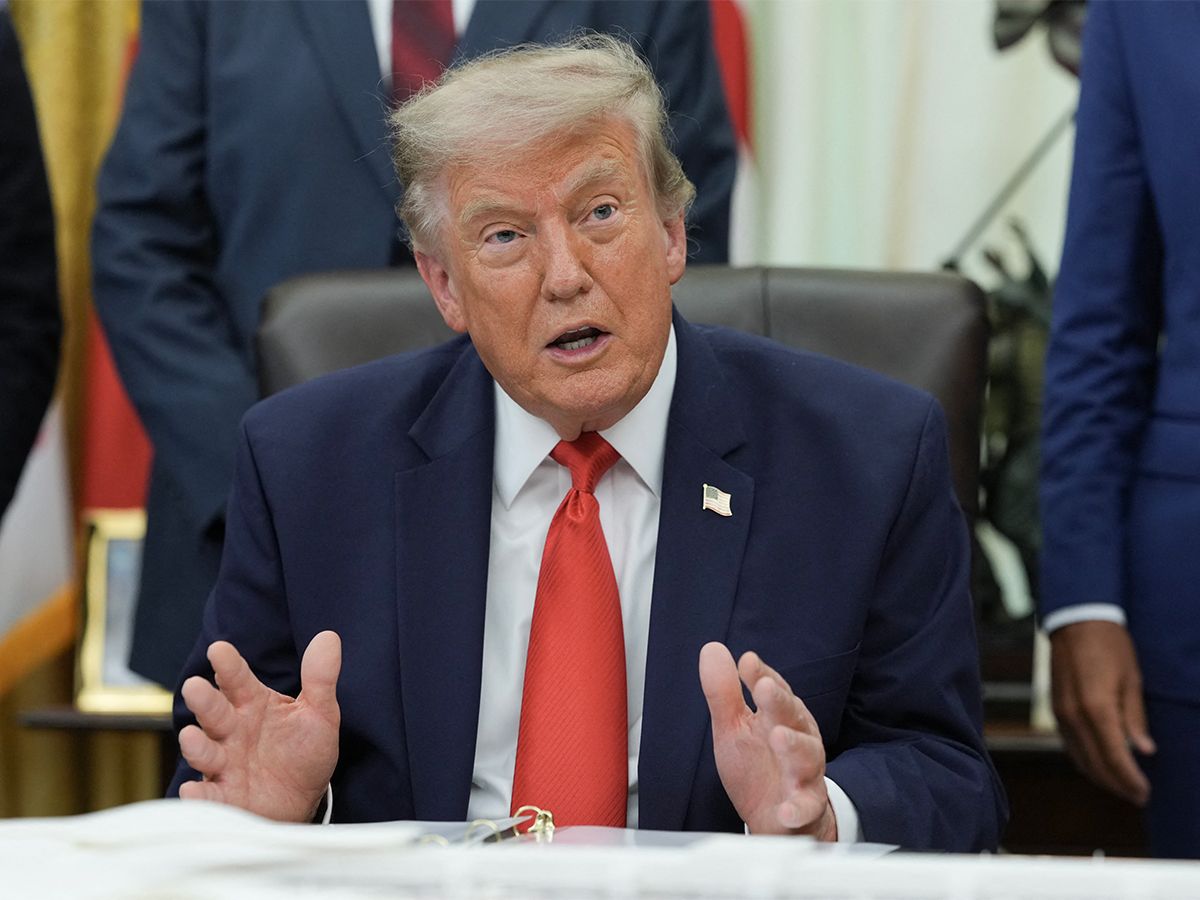
U.S. President Donald Trump speaks in the Oval Office on July 29, 2026. Letter writer Tony D'Andrea says the economic cost of resisting Trump is recoverable. The cost of surrendering and teaching democracies that truth is negotiable when power demands it, is not.

‘No longer merely a dispute over tariffs or trade’

Re: U.S. hits Canada, 59 other countries with new tariffs just days after 50% levy on Canadian goods announced — Tracy Moran, July 23

Tracy Moran’s report on President Donald Trump’s tariff tantrums against Canada, forced-labour imports one day, wildfire smoke the next, reads like governance by make-believe: evidence optional, belief mandatory. Believe his reality or pay for doubting it. The world is becoming a prisoner to his lies.

Consequently, Trump’s strategy has created a global prisoner’s dilemma. He bets that no democracy can afford to break with America first, that each will quietly accommodate his fictions rather than risk standing alone. Individually, appeasement looks rational. Collectively, it is ruinous. Every government that swallows one falsehood to preserve the relationship makes the next falsehood easier to swallow. That is why this is no longer merely a dispute over tariffs or trade. It is an existential test of whether democracies can defend a shared reality without destroying themselves in the process.

When Trump tells prime-time America he has proof the 2020 election was stolen, the lie becomes a loyalty test: accept his reality or risk political exile. His apprentices — Musk, Vance, Rubio, Hegseth and Fox News — have learned the lesson. Lie fluently or become irrelevant.

The danger is not simply that Trump lies. It is that lying becomes cheaper than resisting him. A chain of command built on fiction eventually collapses because no one knows which orders, promises or treaties can be trusted. His lies are reducing the world order to chaos.

Charles Mackay, in “Extraordinary Popular Delusions and The Madness of Crowds” (1841), wrote that crowds lose their senses together and recover them one by one. One hopes he is right. Defections are how prisoner’s dilemmas are broken: not necessarily by everyone at once, but by enough people refusing to play along.

So how do we deal with a nominal world leader who treats lying as statecraft? One practical way is to boycott the fiction, not America. Not tariff for tariff, which merely escalates the game, but deliberate diversification. Mark Carney should show new-found independence. Negotiate where necessary, resist where essential, and do not import Trump’s unreality into a new CUSMA. Reinstate the digital sales tax. Urge Canadians to avoid travel to America. Keep American booze off Canadian shelves. Remain Canadian through your purchases. And if that means being anti-MAGA, so be it. Talk back; don’t go silent. Keep diplomatic channels open. Engage Trump’s MAGA. But quarantine the falsehoods.

The economic cost of resisting Trump is recoverable. The cost of surrendering our shared reality, of teaching democracies that truth is negotiable when power demands it, is not.

Tony D’Andrea, Toronto


MAID’s dark irony

Re: Doctors consider ‘death by organ donation’ for MAID patients — Sharon Kirkey, July 23

There exists a singular, agonizing irony in the current state of the Nova Scotia government’s administrative priorities — one that would be comical were it not so profoundly tragic.

We find ourselves navigating a bureaucratic landscape where the entry into this world is strictly rationed, while the exit is provided with the seamless efficiency of a drive-through window.

Consider the expectant mother in Baddeck, or Richmond, or Glace Bay. Should she wish to bring new life into this dominion, she is met with a stern ledger of logistical impossibilities. The local wards are often shuttered; the specialized teams are centralized; the resources are consolidated. For the miracle of birth, our system demands a pilgrimage — a stressful, calculated dash down the Trans-Canada Highway to a select few regional hubs. Life, it seems, must strictly adhere to the government’s centralized schedule.

Yet, turn your gaze to the final chapter of human existence, and the administrative sea parts with astonishing majesty. For Medical Assistance in Dying — or MAID, as the planners so clinically acronymize it — the geographic barriers miraculously dissolve. There are no select locations here. No rationing of care. The apparatus of the state becomes entirely mobile, willing and eager to accommodate you in virtually any hospital, any clinic, or any living room from Cape Breton to the South Shore.

One cannot help but marvel at the grim, linguistic dark comedy of it all. For decades, the old folks used to say that when a man finally achieved total comfort and freedom from worry, he “had it made.” How twisted a transformation that the modern state has provided a literal interpretation of the phrase: to finally have peace, you simply have it MAID.

We have built a system that makes it remarkably difficult to arrive, but infinitely convenient to leave. Surely, a society that prides itself on compassion must eventually look in the mirror and ask why the cradle is so heavily restricted, while the hearse is granted an unlimited, all-access pass.

Mark Macneill, Mabou, N.S.


Behind Canada’s baby bust

Re: Anti-family propaganda has devastated a generation of women — Kate Marland, July 2

I cannot disagree more with Kate Marland’s opinion piece about why Canadian women are choosing to remain childless.

Women aren’t opting out of motherhood because of television shows that prioritize material success over having families. Women are choosing to remain childless because of the ridiculous costs for basic items like an apartment, and even milk and eggs. They’re choosing not to have kids because they have no choice but to work, and they know that in the majority of marriages/partnerships, it’s the woman who does all the work to take care of the kids.

The way our world has changed, it is almost impossible to live off of one income so that a father or mother can stay home with their child(ren). That’s a dream now, and it has absolutely nothing to do with Carrie Bradshaw or Hannah Horvath or any other character we watched in our late teens and early 20s.

The other issue that should have been addressed is that men need to step up and be more involved with their families and housework.

Vicky Welch, Montreal


An insult to Gordie Howe

R e: U.S. deal could have been ‘explained better’: PM — Jordan Gowling, July 25

Gordie Howe was more known for his hockey skills than his verbal skills but his style was honest. His name and reputation, however, have been besmirched by the political actors involved in his namesake bridge in Windsor.

Mark Carney’s Davos speech, his concern about spending by former governor generals through a secretive account, and his yet to be seen but apparent understanding that we need to develop our natural resources, are all promising indicators that he knows what the PM’s job is about. And, thankfully, he has yet to descend to the “I’m sorry for everything” mantra normalized by his predecessor.

None of the above, however, will balance the dismal display of leadership he has shown over “The Bridge.” His “I could have explained it better” was his apology for misleading us.

It wasn’t going to be hard for Carney to outshine Justin Trudeau’s flickering candle of “look-at-me” management. All he had to do was show up everyday. Now, though, no amount of Davos deception will get him a Mr. Hockey title, regardless of whether his elbows are up or down.

Larry Baswick, Stratford, Ont.


Crime and disorder in Canada

Re: The sex criminal in Canada illegally who got a work permit — Jamie Sarkonak, July 21

We Canadians tend to view ourselves as morally superior beings, especially in regard to our American neighbours.

Day after day the National Post, and sometimes even The Globe and Mail, publish articles like Jamie Sarkonak’s column that demonstrate our inability to govern ourselves effectively, as exemplified in this case by the lack of enforcement of removal orders and the endless ability of individuals to access our courts, all at the expense of taxpayers.

This inability is exacerbated by the lax sentencing imposed on criminals by soft-hearted, or more likely, soft-headed judges who fail to realize that going easy on individual offenders will likely mean hardship for the community at large.

While the U.S. certainly has its flaws, I’m not certain that theirs outweigh ours to an extent that would justify our smugness. President Donald Trump has a point that securing borders and enforcing laws are the basic things countries should be able to do. If we can’t do that, perhaps he is correct in calling the border just a line on a map.

John Harris, Toronto


FIFA World Cup a déjà vu of 1990s NHL hockey

Re: Hockey still rules in Canada despite heightened visibility of FIFA World Cup: survey — Stewart Lewis, July 19

Watching the final game of the World Cup, my inner — well, I should admit, not so inner — curmudgeon overtook my dutiful enjoyment of a sport I rarely watch. As one of the hosts, we Canadians felt the obligation to suddenly feign interest in a game unfamiliar to many — although I concede the familiarity is growing. But as I watched Spain and Argentina play for nearly two hours without scoring a goal, the thought suddenly popped into my head: I was actually watching 1990s NHL hockey.

Clutch and grab. Diving with faked injuries. No scoring. Blatant interference, almost always uncalled. Slow play, endless back and forth passing. The left-wing lock.

In the 1950s, Anatoli Tarasov, a Russian football coach, was asked to create a Russian hockey team, primarily for propaganda purposes. Famously, Tarasov didn’t watch any hockey. Instead, he read the rule book, over and over, until he felt he understood the game. Then he used his football background to devise a system of hockey that became well known to Canadians in the 1972 Summit Series against the Soviet Union.

It was all about possession. Five-player units who worked as one. Carry the puck up the ice, but if the opening was not there at the blue line, circle all five back into the defensive zone and try again. And again, and again, until the opponent made a mistake. Booooring.

Admittedly, it required a very high level of technical ability, skating and passing. But it was slow, robotic and mind-numbing. And that’s what international soccer is — Anatoli Tarasov hockey. Combined with Gary Bettman’s expansion-era holding, punching, elbowing and diving.

To his credit, Bettman allowed hockey to evolve. He had the referees crack down on clutch-and-grab, allowed speed and skill to take precedence. Possession remains an important metric, but stick handling, quick puck movement, and advancing play into the offensive area are the rule. International football could take a lesson

Tom Curran, Consecon, Ont.


National Post and Financial Post welcome letters to the editor (250 words or fewer). Please include your name, address and daytime phone number. Email letters@nationalpost.com. Letters may be edited for length or clarity.



U.S. President Donald Trump speaks in the Oval Office on July 29, 2026. Letter writer Tony D'Andrea says the economic cost of resisting Trump is recoverable. The cost of surrendering and teaching democracies that truth is negotiable when power demands it, is not.

‘No longer merely a dispute over tariffs or trade’

Re: U.S. hits Canada, 59 other countries with new tariffs just days after 50% levy on Canadian goods announced — Tracy Moran, July 23

Tracy Moran’s report on President Donald Trump’s tariff tantrums against Canada, forced-labour imports one day, wildfire smoke the next, reads like governance by make-believe: evidence optional, belief mandatory. Believe his reality or pay for doubting it. The world is becoming a prisoner to his lies.

Consequently, Trump’s strategy has created a global prisoner’s dilemma. He bets that no democracy can afford to break with America first, that each will quietly accommodate his fictions rather than risk standing alone. Individually, appeasement looks rational. Collectively, it is ruinous. Every government that swallows one falsehood to preserve the relationship makes the next falsehood easier to swallow. That is why this is no longer merely a dispute over tariffs or trade. It is an existential test of whether democracies can defend a shared reality without destroying themselves in the process.

When Trump tells prime-time America he has proof the 2020 election was stolen, the lie becomes a loyalty test: accept his reality or risk political exile. His apprentices — Musk, Vance, Rubio, Hegseth and Fox News — have learned the lesson. Lie fluently or become irrelevant.

The danger is not simply that Trump lies. It is that lying becomes cheaper than resisting him. A chain of command built on fiction eventually collapses because no one knows which orders, promises or treaties can be trusted. His lies are reducing the world order to chaos.

Charles Mackay, in “Extraordinary Popular Delusions and The Madness of Crowds” (1841), wrote that crowds lose their senses together and recover them one by one. One hopes he is right. Defections are how prisoner’s dilemmas are broken: not necessarily by everyone at once, but by enough people refusing to play along.

So how do we deal with a nominal world leader who treats lying as statecraft? One practical way is to boycott the fiction, not America. Not tariff for tariff, which merely escalates the game, but deliberate diversification. Mark Carney should show new-found independence. Negotiate where necessary, resist where essential, and do not import Trump’s unreality into a new CUSMA. Reinstate the digital sales tax. Urge Canadians to avoid travel to America. Keep American booze off Canadian shelves. Remain Canadian through your purchases. And if that means being anti-MAGA, so be it. Talk back; don’t go silent. Keep diplomatic channels open. Engage Trump’s MAGA. But quarantine the falsehoods.

The economic cost of resisting Trump is recoverable. The cost of surrendering our shared reality, of teaching democracies that truth is negotiable when power demands it, is not.

Tony D’Andrea, Toronto


MAID’s dark irony

Re: Doctors consider ‘death by organ donation’ for MAID patients — Sharon Kirkey, July 23

There exists a singular, agonizing irony in the current state of the Nova Scotia government’s administrative priorities — one that would be comical were it not so profoundly tragic.

We find ourselves navigating a bureaucratic landscape where the entry into this world is strictly rationed, while the exit is provided with the seamless efficiency of a drive-through window.

Consider the expectant mother in Baddeck, or Richmond, or Glace Bay. Should she wish to bring new life into this dominion, she is met with a stern ledger of logistical impossibilities. The local wards are often shuttered; the specialized teams are centralized; the resources are consolidated. For the miracle of birth, our system demands a pilgrimage — a stressful, calculated dash down the Trans-Canada Highway to a select few regional hubs. Life, it seems, must strictly adhere to the government’s centralized schedule.

Yet, turn your gaze to the final chapter of human existence, and the administrative sea parts with astonishing majesty. For Medical Assistance in Dying — or MAID, as the planners so clinically acronymize it — the geographic barriers miraculously dissolve. There are no select locations here. No rationing of care. The apparatus of the state becomes entirely mobile, willing and eager to accommodate you in virtually any hospital, any clinic, or any living room from Cape Breton to the South Shore.

One cannot help but marvel at the grim, linguistic dark comedy of it all. For decades, the old folks used to say that when a man finally achieved total comfort and freedom from worry, he “had it made.” How twisted a transformation that the modern state has provided a literal interpretation of the phrase: to finally have peace, you simply have it MAID.

We have built a system that makes it remarkably difficult to arrive, but infinitely convenient to leave. Surely, a society that prides itself on compassion must eventually look in the mirror and ask why the cradle is so heavily restricted, while the hearse is granted an unlimited, all-access pass.

Mark Macneill, Mabou, N.S.


Behind Canada’s baby bust

Re: Anti-family propaganda has devastated a generation of women — Kate Marland, July 2

I cannot disagree more with Kate Marland’s opinion piece about why Canadian women are choosing to remain childless.

Women aren’t opting out of motherhood because of television shows that prioritize material success over having families. Women are choosing to remain childless because of the ridiculous costs for basic items like an apartment, and even milk and eggs. They’re choosing not to have kids because they have no choice but to work, and they know that in the majority of marriages/partnerships, it’s the woman who does all the work to take care of the kids.

The way our world has changed, it is almost impossible to live off of one income so that a father or mother can stay home with their child(ren). That’s a dream now, and it has absolutely nothing to do with Carrie Bradshaw or Hannah Horvath or any other character we watched in our late teens and early 20s.

The other issue that should have been addressed is that men need to step up and be more involved with their families and housework.

Vicky Welch, Montreal


An insult to Gordie Howe

R e: U.S. deal could have been ‘explained better’: PM — Jordan Gowling, July 25

Gordie Howe was more known for his hockey skills than his verbal skills but his style was honest. His name and reputation, however, have been besmirched by the political actors involved in his namesake bridge in Windsor.

Mark Carney’s Davos speech, his concern about spending by former governor generals through a secretive account, and his yet to be seen but apparent understanding that we need to develop our natural resources, are all promising indicators that he knows what the PM’s job is about. And, thankfully, he has yet to descend to the “I’m sorry for everything” mantra normalized by his predecessor.

None of the above, however, will balance the dismal display of leadership he has shown over “The Bridge.” His “I could have explained it better” was his apology for misleading us.

It wasn’t going to be hard for Carney to outshine Justin Trudeau’s flickering candle of “look-at-me” management. All he had to do was show up everyday. Now, though, no amount of Davos deception will get him a Mr. Hockey title, regardless of whether his elbows are up or down.

Larry Baswick, Stratford, Ont.


Crime and disorder in Canada

Re: The sex criminal in Canada illegally who got a work permit — Jamie Sarkonak, July 21

We Canadians tend to view ourselves as morally superior beings, especially in regard to our American neighbours.

Day after day the National Post, and sometimes even The Globe and Mail, publish articles like Jamie Sarkonak’s column that demonstrate our inability to govern ourselves effectively, as exemplified in this case by the lack of enforcement of removal orders and the endless ability of individuals to access our courts, all at the expense of taxpayers.

This inability is exacerbated by the lax sentencing imposed on criminals by soft-hearted, or more likely, soft-headed judges who fail to realize that going easy on individual offenders will likely mean hardship for the community at large.

While the U.S. certainly has its flaws, I’m not certain that theirs outweigh ours to an extent that would justify our smugness. President Donald Trump has a point that securing borders and enforcing laws are the basic things countries should be able to do. If we can’t do that, perhaps he is correct in calling the border just a line on a map.

John Harris, Toronto


FIFA World Cup a déjà vu of 1990s NHL hockey

Re: Hockey still rules in Canada despite heightened visibility of FIFA World Cup: survey — Stewart Lewis, July 19

Watching the final game of the World Cup, my inner — well, I should admit, not so inner — curmudgeon overtook my dutiful enjoyment of a sport I rarely watch. As one of the hosts, we Canadians felt the obligation to suddenly feign interest in a game unfamiliar to many — although I concede the familiarity is growing. But as I watched Spain and Argentina play for nearly two hours without scoring a goal, the thought suddenly popped into my head: I was actually watching 1990s NHL hockey.

Clutch and grab. Diving with faked injuries. No scoring. Blatant interference, almost always uncalled. Slow play, endless back and forth passing. The left-wing lock.

In the 1950s, Anatoli Tarasov, a Russian football coach, was asked to create a Russian hockey team, primarily for propaganda purposes. Famously, Tarasov didn’t watch any hockey. Instead, he read the rule book, over and over, until he felt he understood the game. Then he used his football background to devise a system of hockey that became well known to Canadians in the 1972 Summit Series against the Soviet Union.

It was all about possession. Five-player units who worked as one. Carry the puck up the ice, but if the opening was not there at the blue line, circle all five back into the defensive zone and try again. And again, and again, until the opponent made a mistake. Booooring.

Admittedly, it required a very high level of technical ability, skating and passing. But it was slow, robotic and mind-numbing. And that’s what international soccer is — Anatoli Tarasov hockey. Combined with Gary Bettman’s expansion-era holding, punching, elbowing and diving.

To his credit, Bettman allowed hockey to evolve. He had the referees crack down on clutch-and-grab, allowed speed and skill to take precedence. Possession remains an important metric, but stick handling, quick puck movement, and advancing play into the offensive area are the rule. International football could take a lesson

Tom Curran, Consecon, Ont.


National Post and Financial Post welcome letters to the editor (250 words or fewer). Please include your name, address and daytime phone number. Email letters@nationalpost.com. Letters may be edited for length or clarity.


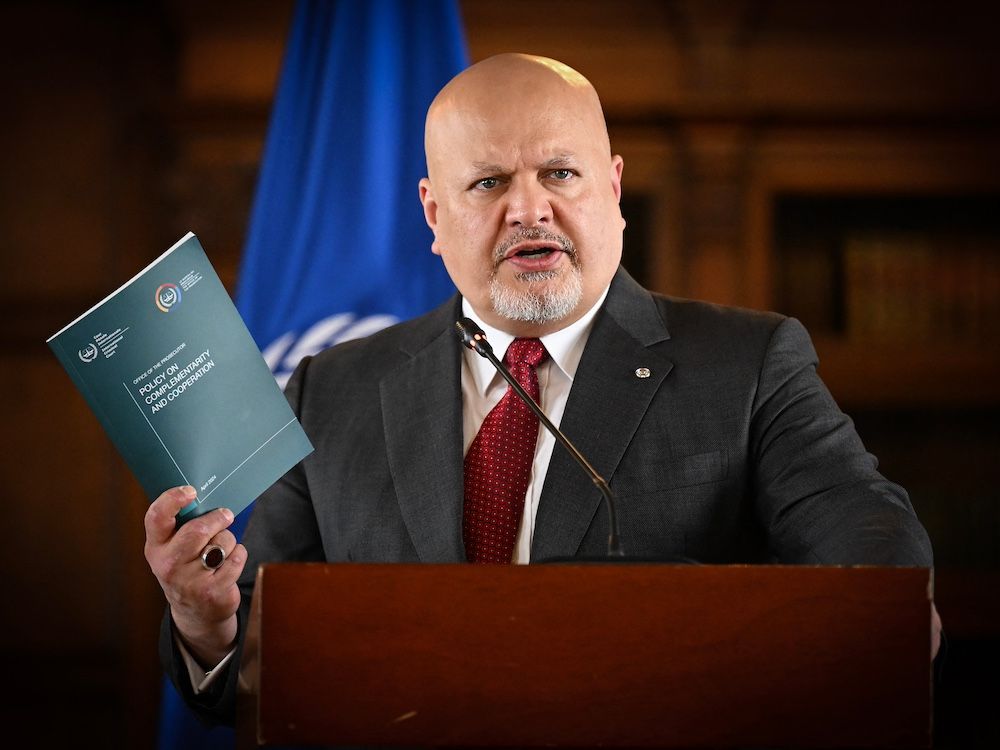
(FILES) International Criminal Court (ICC) Prosecutor Karim Khan speaks during a press conference at the San Carlos Palace in Bogota, on April 25, 2024. (Photo by LUIS ACOSTA/AFP via Getty Images) This content is reserved for subscribers.



(FILES) International Criminal Court (ICC) Prosecutor Karim Khan speaks during a press conference at the San Carlos Palace in Bogota, on April 25, 2024. (Photo by LUIS ACOSTA/AFP via Getty Images) This content is reserved for subscribers.

A protesters wears a sticker reading

The false accusation that Israel is guilty of genocide for its actions in Gaza has been repeated so often that it has become normalized in the media, academia, politics and civil society. Yet it is a mendacious blood libel that inverts the truth by absolving those who seek to wipe out Israel, for the cynical purpose of delegitimizing the world’s only Jewish state, a refuge for Holocaust survivors, and threatening diaspora Jews. Furthermore, it does a disservice to actual genocides that have been committed around the world.

The authoritative legal definition of genocide is set out in Article II of the 1948 United Nations Convention on the Prevention and Punishment of the Crime of Genocide , which defines genocide as specified acts committed “with intent to destroy, in whole or in part, a national, ethnical, racial or religious group.”

Genocide requires the specific intention to destroy the protected group, rather than an intent to defeat an enemy, seize territory, displace a population or even conduct military operations with reckless disregard for civilian life.

That distinction is crucial, or the allied bombing of German cities during the Second World War and the nuclear strikes on Hiroshima and Nagasaki would mean the United States, Britain, Canada and Australia were guilty of genocide.

Israel’s war is not against Gazans but Hamas, itself a genocidal terrorist organization whose overarching mission is to eliminate the State of Israel, which it tried to do on Oct. 7, 2023, murdering, burning, raping and torturing 1,200 men, women, children, infants and disabled people and taking 251 hostages, the largest massacre of Jews since the Holocaust.

No other country in the world would fail to respond to such an attack, do everything to recover its hostages and destroy the enemy who vowed to attack it again and again. Ironically, no other country would be subject to the opprobrium Israel has endured for doing so, including from countries that claim to recognize its right to defend itself.

Uniquely, Israel warned enemy civilians about bombings (thereby telegraphing its plans to the enemy) and provided food, humanitarian aid, humanitarian corridors and delayed ground operations to allow the population to move.

Protecting civilians in this type of urban warfare environment is especially difficult given Hamas’s calculated use of civilians as human shields, including urging them not to respond to Israeli warnings, and the extensive tunnel system that non-combatants were barred from using.

This does not suggest that civilians did not suffer — they did, some terribly. Nor does it imply that people cannot have different opinions about Israel’s conduct during the war, although criticism should be comparable to how other countries are held to account. However, Israel’s defensive war did not, by any objective measure, constitute genocide in action, intent or result.

Of course, fairness, context and the facts do not constrain Israel’s fiercest critics and sworn enemies, nor several Canadian politicians, including NDP Leader Avi Lewis, Green Leader Elizabeth May, Toronto Mayor Olivia Chow and Liberal MP Adam van Koeverden (which evoked crickets from the prime minister).

Very few political leaders publicly condemn these calumnies, perhaps because they appeal to the so-called red-green alliance between leftists and Islamists, yet rarely alienate the rest of the electorate. Indifference grants antisemites a free ride.

Hateful words that smear minorities can lead to violence. Repetition of the blood libel incites unprecedented incidents of antisemitism on the streets of Toronto, Montreal, Vancouver and elsewhere. Canada saw the highest number of antisemitic incidents in the world last year — in absolute numbers, not just per capita — according to Statista . That is a startling distinction that every Canadian should view with alarm and shame.

Anti-Zionism, used as a cover for religious hatred, undermines the personal safety and social peace that made Canada a wonderful country in which to live, work and bring up a family. Yet Jews have long been canaries in the coal mine, whose mistreatment foreshadows broader social and democratic decay and intolerance.

For several years now, the canaries have been getting sick, dying or flying away from our once peaceable kingdom. Failure to take concrete action in the face of rising hatred in word and deed is an abdication of political leadership, which will inevitably lead to tragedy.

National Post

Joe Oliver was the minister of natural resources and finance in the Harper government.


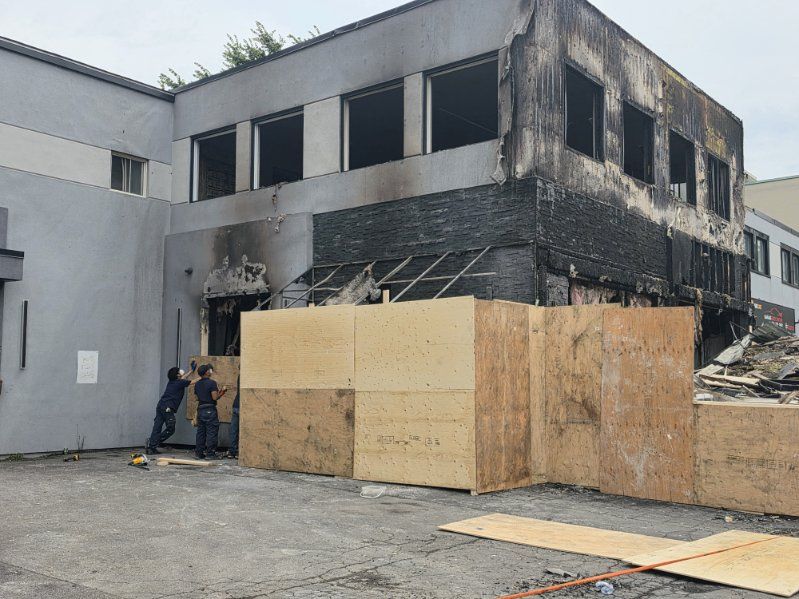
The fire that destroyed this kosher restaurant in Montreal is under investigation by the police arson unit.

Early Saturday, Nöam, a kosher Jewish restaurant in Montreal’s Côte-des-Neiges neighbourhood was completely destroyed by fire; it is being investigated as a possible arson and the motive has not yet been determined. This same neighbourhood is still reeling from an attack that shut down the entire area just over 40 days ago.

I visited the site of the former restaurant, now burnt to cinders. The mood was sombre.

Nöam is only a four-minute walk from the Hilton where, in late June, Seth Hatfield — a 25-year-old Albertan with grand delusions that capitalism and elites (including Zionists) were the cause of his dating woes — unleashed terror on the same community, resulting in the deaths of Mohamed Lamine Benredouane, a Muslim Montreal police officer, and a Jewish bystander, Michel Mizrahi.

In the short walk between the two locations, I noticed that a large sign memorializing both men lost to the Côte-des-Neiges community had been erected by the Jewish Community Council. As is customary in the Jewish community, it reads: “May their memories be a blessing.”

Upon arrival at Nöam, I noticed a chemical smell, likely an accelerant of some kind. The building Nöam was in also housed another business, which I was told was untouched by the fire.

 The fire that destroyed this popular kosher restaurant, Nöam, in Montreal, is under investigation by the police arson unit.

The Liberal MP for Mount Royal, Anthony Housefather, was on scene when I arrived. I asked him to say a few words about what he thought was happening.

In a recorded interview, he told me that the owners had just put a lot of money into renovations for the restaurant, and called it a “horrific tragedy” for the owners and their customers as well as the entire community.

Housefather told me, “It was clearly an arson attack,” based on the footage he’d seen, and that now the police need to investigate the motive. Housefather said that he also contacted the minister of public safety, Gary Anandasangaree, who he said was in touch with his local counterparts in the area.

Housefather told me that “Montreal police checked out all the cameras in the area,” and that the owners would be adding their footage later Saturday, after Shabbat. Housefather told me, “hopefully, there’ll be very clear footage of the guy who did this, and he should be prosecuted to the fullest extent of the law.”

I spoke to the owner of the building, who shared a video with the Post, which appeared to be a recording of surveillance video showing an individual running.

The mayor of the Côte-des-Neiges–Notre-Dame-de-Grâce borough, Stéphanie Valenzuela, posted a message to her Instagram account saying she was concerned about recent incidents in the area, and that members of the community should continue to look out for one another.

It doesn’t mention this is in her message, but, in addition to this apparent arson, early on Friday gunshots were fired in the neighbourhood at around 2:50 a.m. A house on Méridian Ave. near Ponsard Ave. was struck by gunfire. Reportedly, someone was seen at the residence before fleeing the scene.

Let’s hope that, if the Nöam fire was, indeed, an arson, that the courts do not entertain the kind of unbelievable excuse that admitted Montreal arsonist Mohamed Ilyess Akodad gave the court here, that he was unaware that the institution he was setting fire to was a synagogue.

The Jewish community in Montreal will find out whether the judge believed Akodad’s fantastical story, and just how seriously the justice system here takes attacks on the Jewish community when court reconvenes for his sentencing on Sept. 10.

National Post


The Montreal police arson squad are investigating a fire that destroyed a popular kosher restaurant in the city.

Beryl P. Wajsman: Special to the National Post

Montreal — There is a debilitating temptation within the Jewish community today to assume that every crime involving a Jewish institution must automatically be an act of antisemitism.

The temptation is understandable. After almost two years of escalating hatred, firebombings, shootings, vandalism, intimidation and open calls for violence against Jews, no one can be faulted for being alert. Vigilance is not only justified — it is necessary.

But vigilance is not the same as reflex.

The arson attack that heavily damaged the Nöam kosher restaurant on Décarie Boulevard in Montreal early Saturday is a serious crime. It deserves a thorough investigation, and those responsible deserve the full weight of the law. Certainly after the attacks in on Kiva’s kosher bakeries in Toronto.

What it does not deserve is an immediate verdict before investigators have completed their work.

I went to the scene. I spoke with people in the neighbourhood. I spoke with contacts familiar with the investigation. The picture that emerged was far more nuanced than the one rapidly circulating on social media.

The Montreal Police Service has assigned both its arson investigators and its hate crimes unit to the case. That is entirely appropriate. Every possible motive should be examined, including antisemitism.

But, as of now, no motive has been established.

According to reliable information surveillance cameras reportedly captured a lone individual walking away from the small commercial building at approximately 3:15 a.m. There were reportedly no antisemitic slogans, no graffiti, and no message claiming ideological responsibility.

The investigation is exactly where it should be: open-minded.

Yair Szlak, the president and CEO of Federation CJA, said that, “Federation CJA and the Security network (CSN) are closely monitoring the situation concerning the arson that took place at a Kosher restaurant in Montreal. We’re working closely with law-enforcement to understand the motive behind it. Regardless of motive, this is a terrible crime and must be punished in accordance with the law.”

This is precisely the right approach. They are working closely with police to determine the motive while emphasizing that, whatever ultimately emerges, grave criminal offences demand prosecution. That is responsible leadership.

I have written before that fear can become self-perpetuating. Every new incident is immediately folded into a predetermined narrative. Facts become secondary. Context disappears. The assumption becomes the conclusion.

Ironically, that weakens rather than strengthens the fight against antisemitism. Let us not forget that in 2022 — the last year before October 7 — Canada recorded some 2,700 antisemitic incidents, according to the League for Human Rights.

When every crime is immediately labelled antisemitic, even when no evidence of that has yet emerged, we blur the distinction between genuine hate crimes and other criminal acts. We invite unnecessary skepticism. We make it easier for those who truly wish to minimize antisemitism to dismiss legitimate concerns as exaggeration.

The truth is our strongest ally. If this investigation concludes that Nöam was targeted because it is a Jewish business, then we should say so loudly and unequivocally. We should demand enhanced penalties where the law permits and insist that governments confront the reality of antisemitism honestly and enforce Criminal Code and Charter protections.

But if investigators conclude it was another criminal motive, we should accept that conclusion with equal honesty.

The Jewish community’s strength has never been panic. It has always been resilience.

I have always argued that governments should stop simply issuing statements and start enforcing the Criminal Code. That principle applies here as well. We should let investigators investigate, prosecutors prosecute, and judges judge.

Our confidence should rest not in fear, but in facts.

Antisemitism is real. It is dangerous. It requires constant vigilance and uncompromising enforcement of the law. But credibility is also a strategic asset.

Every time we insist on evidence, we make it harder for genuine acts of antisemitism to be denied or explained away.

The answer to hatred is not hysteria. It is confidence.

Confidence in ourselves. Confidence in the rule of law. And confidence that truth, not fear, must always have the final word.

Beryl P. Wajsman is president of the Institute for Public Affairs of Montreal