
LP_468x60
on-the-record-468x60-white

Manager Dave Roberts of the Los Angeles Dodgers speaks to the media during All-Star Workout Day on July 14, 2025 in Atlanta, Ga.

Major League Baseball rolled into Atlanta, Ga., this past week for the playing of the 2025 All-Star Game. Amid the usual fanfare that accompanies the game and the Home Run Derby, there was a slightly awkward moment on Media Day when ESPN personality Pat McAfee was

asked by a reporter

why the game was in Atlanta at all, after it had been pulled from the city in

2021 due to voter suppression laws

that president Joe Biden had described as “Jim Crow in the 21st century.” Further adding to the awkward nature of the question was the fact that Dave Roberts, the National League manager for the game, had said in 2021 that he might

boycott the game

if it remained in Atlanta.

Neither McAfee nor Roberts wanted to answer the question this year however, with McAfee’s initial reply being, “I don’t know if any of us are the experts or the ones that should be giving the answers on that.” Roberts followed with, “I’m not a politician … but right now I really choose to just focus on the players and the game …”

How times have changed since 2021, and probably for the better. It would be a positive step if the incident reminded us that not everything has to be about politics and, in general, we should not expect in-depth and expert social commentary from sports personalities on all that ails society.

It is indeed a curious thing that we even look to a baseball manager or a sports reporter for their views on newly implemented state voting laws. Consider the reverse: asking a politician to explain the infield fly rule or what pitch to throw a batter in a 2-2 count with a man on second and two outs when the last pitch you threw was a cutter. It would be theatre of the most absurd kind. “I don’t know,” would a refreshing answer, although most politicians would likely take a blind stab at it for fear of being caught out for not knowing everything.

For this reason, McAfee and Roberts deserve a certain kind of credit for their avoidance of the question. While it is easy to be cynical and say they simply toed the company line (they probably did, by the way), McAfee’s assertion that “I don’t know if any of us are the experts …” is nonetheless a refreshingly honest admission that he and his fellow sports experts wouldn’t have any idea what they were talking about if they began discussing Georgia’s voting laws. Society would be better off if more people could boldly make that statement.

 Sports analyst Pat McAfee, left, and Ty Schmit, producer and on-air personality for McAfee’s sports talk show, introduce the participants in the MLB Home Run Derby in Atlanta, Ga., on July 14, 2025.

In our world today, self-identifying as a non-expert is rare. Rarer still is saying you don’t have a political opinion on any given issue. Much of this is likely due to our ability to access second-hand information online or via social media. If someone is not an expert, they can likely find enough information to form a strongly held opinion by quickly brushing up on a few facts for their five minutes in the spotlight, when their true grasp of an issue is actually rather tenuous. Kudos to McAfee and Roberts for not doing that.

Lest I be accused of blindness to the irony of an opinion piece about how too many people have opinions on things they perhaps should keep to themselves, I would ask any reader to take me at my word that I have a great many opinions on a great many things, but I do not by any means view all of them as worthy of public consumption, much less valuable print space.

On the MLB All-Star Media Day we were treated to what should be a more common occurrence: a celebrity or non-expert admitting they don’t have the expertise to comment on a political issue thrown at them by a journalist seeking a “gotcha” moment. As a society we should not expect everyone to be an expert on all things; especially political ones. Indeed, a majority of our fellow citizens are justifiably not all that interested in many things outside of their own field and life. That is just fine, that is normal and that is something people too wrapped up in politics have trouble getting their head around: sometimes it’s OK not to have an opinion.

For my part, I am happy to listen to Pat McAfee on punting and football and Dave Roberts on MLB lineup choices. Outside of that, I admire them — or anyone else — for recognizing when it may not be their moment to comment.

National Post


Prime Minister Justin Trudeau was on hand for the raising of a Progress Pride flag on Parliament Hill in June, 2022. Photo by Julie Oliver/Postmedia

Unlike his predecessor, Justin Trudeau, Prime Minister Mark Carney isn’t known for making flamboyant declarations of allyship to Canada’s 2SLGBTQIA+ community. But don’t be deceived: our national fealty to gender ideology remains the same as it was during the Trudeau years. Canada is no less woke under Carney.

Some may believe that Trudeau’s departure, coupled with international blows to the excesses of this ideology, marked the end of Canada’s struggle with the more absurd, anti-reality aspects of trans activism. Unfortunately, that is untrue.

Fighting gender ideology in Canada is a war of attrition. And more than ever, those on the front lines need armaments and sustenance.

Remember the case of Jessica Yaniv? The transgender-identifying Yaniv filed numerous

human rights complaints

against female immigrant estheticians for declining to wax male genitalia. Yaniv lost the cases at the B.C. Human Rights Tribunal (on a technicality) and has largely fallen out of the public’s eye. Until now.

Yaniv, now going by the name Jessica Simpson, has ongoing litigation against Canada Galaxy Pageants that is crawling its way through the Human Rights Tribunal of Ontario. Since 2019, Simpson has been seeking damages from the pageant company for refusing to allow Simpson to participate in a beauty pageant

The pageant is open to girls as young as six and contestants undress together backstage. Canada Galaxy Pageants’ policy rightly prohibits people with intact male genitalia from competing.

The Justice Centre for Constitutional Freedoms (JCCF) has been representing the company in what it describes as “a human rights case … that (deals) with whether children’s emotional, mental and physical safety should take precedence over a transwoman’s desire to access a female changeroom.”

The JCCF recently asked the tribunal to

dismiss the case

and expects a decision in the coming weeks.

At the same time, the JCCF is representing two Ontario teachers, a married couple who

were fired

for not holding approved opinions about gender ideology or the

progress Pride flag

.

According to the JCCF, Matt and Nicole Alexander’s teenage son began to vocally oppose his school’s gender self-identification policy. His parents did not teach at his school, or even in his school district. However, they soon came under direct attack from gender activists.

First, Matt Alexander was suspended from his teaching job in April 2023, over social media posts that members of the public made about him. A month later, Nicole Alexander removed a progress Pride flag that someone taped to the door of her kindergarten classroom. She was placed on suspension that same day.

The couple were both fired in October 2023. Making matters worse: their union refused to represent them.

Elsewhere, Alberta Premier Danielle Smith’s progressive — in the true sense of the word — legislation to ban “gender-affirming care” for minors has been (at least temporarily) thwarted by

a court injunction

. As such, an obvious, globally recognized medical scandal carries on,

harming

additional Canadian youth.

In National Post this week,

Terry Newman detailed

how Hockey Canada recently threatened the certification of its members who do not fall in line and take a course on gender identity and expression.

The organization allows players to compete according to their gender identity, rather than their biological sex — placing females at higher risk of injury.

CaWsbar, a non-profit that I co-founded, also has

ongoing litigation

against the Canadian government to remove biological males from women’s prisons across the country.

For years, female inmates have effectively been locked in cages with dangerous male sex offenders, including those at B.C.’s Fraser Valley Institution, who live alongside a rapist, murderer and pedophile known as

Tara Desousa

.

The prison also runs a

mother-child program

. Read that again: there is a convicted male pedophile-rapist-killer in a women’s prison where babies and children also live.

Clearly, the war against gender ideology in Canada is still being waged. Carney has said and done nothing to address the appalling legal injustices, the attacks on freedom of speech and belief, the loss of women’s sex-based rights or the threats of harm faced by women and children as a result of gender ideology’s stranglehold over this country.

Carney is sophisticated enough to understand that he would repulse the average voter by attempting to replicate Trudeau’s moralizing or ostentatious “allyship.” But, do not be lulled into a false sense of moderation. Trudeau is gone. But radical gender ideology is not.

National Post


On Tuesday a Harvard artificial-intelligence researcher, Keyon Vafa, published

a short tweet-thread

about a new paper

looking at how some types of high-performing intelligence algorithms

are behaving under the hood. If you’re interested in the implications of AI progress, this paper is instructive even if you don’t fully understand it, and, yes, that is tantamount to a confession on my part. (And, as the old joke goes, if you’re not interested in the implications of AI progress, rest assured that AI progress is interested in you.)

For academics like Vafa and his colleagues, AI has a pervasive “black box” issue that is part of why it inspires fear and confusion. We have learned how to make computers mimic intelligence quite convincingly, and sooner than almost anyone imagined, by applying previously unfathomable amounts of brute computing power. But our ability to understand how these thinking objects are thinking is often limited.

If you don’t understand anything at all about the Vafa paper, the thing to notice about it is that it is fundamentally

experimental

. The research approach is oddly like a biologist’s, like somebody who studies wombats by rounding up a bunch of wombats and observing wombat behaviour. The team “teaches” an AI algorithm to perform intellectual task X to near-perfection by giving it verbal instructions and data (in plain English), and then has to figure out “How did it actually do that?” using statistical inference.

It’s the choice of task X that makes this paper most intriguing. Anybody educated enough to still be reading a newspaper probably knows the basics of how the human understanding of planetary orbits evolved. In classical antiquity, the prevailing assumption was that the planets orbited the Earth in circular paths. Well before the birth of Jesus, astronomers were already good at

predicting

the movements of the planets on the basis of this false model. The planets sometimes apparently move backwards in the sky, so an unmodified “fixed Earth” + “perfectly circular paths” model couldn’t do the job on its own: to make accurate predictions, astronomers had to add other circular motions-within-motions, called “deferents” and “epicycles,” to the basic circular-orbit picture.

Well, fast-forward a dozen centuries, and along come Copernicus asking “What if Earth isn’t at the centre after all?”; Kepler asking “What if the orbits aren’t circular, but elliptical?”; and Newton, who got to the bottom of the whole thing by introducing the higher-level abstraction of gravitational force. Bye-bye epicycles.

None of these intellectual steps, mind you, added anything to anyone’s practical ability to predict planetary motions. Copernicus’s model took generations to be accepted for this reason (along with the theological/metaphysical objections to the Earth not being at the centre of the universe): it wasn’t ostensibly as sophisticated or as powerful as the old reliable geocentric model. But you can’t get to Newton, who found that the planets and earthbound objects are governed by the

same

elegant and universal laws of motion, without Copernicus and Kepler.

Which, in 2025, raises the question: could a computer do what Newton did? Vafa’s research group fed orbital data to AIs and found that they could correctly behave like ancient astronomers: make dependable extrapolations about the future movements of real planets, including the Earth. This raises the question whether the algorithms in question generate their successful orbital forecasts by somehow inferring the existence of Newtonian force-abstractions. We know that “false,” overfitted models and heuristics can work for practical purposes, but we would like AIs to be automated Newtons if we are going to live with them. We would like AIs to discover new laws and scientific principles of very high generality and robustness that we filthy meatbags haven’t noticed yet.

When Vafa and his colleagues found is that the AIs remain in a comically pre-Copernican state. They can be trained to make accurate predictions by being presented with observational data, but it seems that they may do so on the basis of “wrong” implicit models, ones that depend on mystifying trigonometric clutter instead of the beautiful inverse-square force law that Newton gave us. The epicycles are back!

The paper goes on to do more wombat-dissecting, using the game of Othello to show how AI reasoning can produce impressive results from (apparently) incomplete or broken underlying models. It is all very unlike the clean, rigorous “computing science” of the past 100 years: whatever you think of the prospects of AI, it is clear that the complexity of what we can create from code, or just buy off the shelf, is now approaching the complexity of biological life.

National Post


In “The Art of War,” the Chinese general Sun Tzu

wrote

: “If you know the enemy and know yourself, you need not fear the result of a hundred battles.” By

imposing tariffs

on Canada’s non-American trade partners, Prime Minister Mark Carney is taking that advice one step further — becoming the enemy he was elected to confront.

Throughout history, the prevailing international order has been overthrown countless times, but it doesn’t always go out with a bang, as it did in 1914 when Archduke Franz Ferdinand

took a bullet

to the jugular, precipitating the First World War and leading to a precipitous decline in international trade.

At our current moment in history, we are witnessing the process of trade liberalization that was started after the Second World War go out with a whimper.

The dismantling of the postwar economic order was started by U.S. President Donald Trump, who

began

by targeting Canada and Mexico, and then extended his tariffs to the rest of the world.

But in every crisis lies an opportunity. For Canada, the opportunity was not only to develop the natural resources we have allowed to sit idle for years, but to forge an alliance of free-trading nations that could act as a counterweight to Trump’s protectionist policies.

Carney is not only squandering this unique opportunity, he’s introduced policies that will only serve to broaden the global trade war.

This week, the prime minister announced a series of measures intended to protect Canada’s steel industry after Trump increased tariffs on Canadian steel and aluminum to a punishing 50 per cent. Some of the more sensible policies include a pledge to use Canadian steel for domestic infrastructure projects and funds to help retrain affected workers.

But Carney also announced sweeping tariffs on foreign steel imports, including from countries that Canada has free trade agreements with.

Going forward, the tariff rate quota will be set at 50 per cent of 2024 levels for countries that don’t have trade agreements with us and 100 per cent for those that do. Steel imports above those levels will be slapped with a 50 per cent tariff.

On the surface, the Liberals are following a certain logic: Trump’s across-the-board steel and aluminum levies will lead to a glut of supply in producing countries, which they will try to dump into the Canadian market at rock-bottom prices, putting our domestic industry at risk.

But in doing so, Carney is all but inviting our trade partners to bring in retaliatory tariffs against Canadian products.

Following the Trudeau government’s decision to impose a 100 per cent tax on Chinese electric vehicles and a 25 per cent levy on its steel and aluminum last fall,

Beijing retaliated

by sanctioning numerous Canadian products — including canola oil, fish, seafood and pork — which has had a deleterious effect on our agriculture industry at the most inopportune time.

The worst part is that Carney’s tariffs are also being imposed on countries that have free trade deals with Canada, which will surely violate the spirit, if not the text, of those agreements.

If any of those countries are found to be dumping steel into Canada at below-market rates, the proper course of action would be to use the dispute-resolution mechanisms contained in our existing agreements, rather than imposing blanket tariffs on everyone.

When he made his announcement at a steel company in Hamilton, Ont., on Wednesday, the prime minister said that, “Moving forward, we must diversify our trade relationships.”

But who’s going to want to do business with a country that stabs its closest allies in the back? And how are we going to entice more countries to open their markets to Canadian products when Ottawa has shown that it can’t be trusted?

Unfortunately, Carney has been so consumed with striking a deal with the United States — which he

now admits

is unlikely to fully eliminate tariffs on Canadian products — he has largely neglected the other side of the coin: expanding our trading relationship with other countries.

Yes, he travelled to Europe in June and signed a security and defence

pact

with the European Union, but it merely reiterates our commitment to the

free trade deal

we signed in 2016 but still hasn’t fully come into force because not all EU member states have ratified it.

If Carney can’t even convince his pals in Europe to ratify an agreement that’s already been negotiated, it’s hard to believe he will have much luck convincing other potential partners to cut new deals with us.

Especially given that one of the first things Canada’s 45th Parliament did following the spring election was

pass a law

protecting supply management from future trade negotiations.

This is the way the liberal economic order ends. Not with a bang but a whimper. Not with a mercantilist leading the most powerful economy on earth but with other world leaders emulating his tactics and playing right into his illiberal hands.

National Post


Mark Carney arrives in a BMW at the Paleis Huis ten Bosch on the sidelines of a NATO summit in The Hague on June 24, 2025.

The Conflict of Interest and Ethics Commissioner has released the full details of Mark Carney’s asset disclosures, and they reveal a prime minister who 
appears to be 
more constrained by conflicts of interest 
than any other.

Carney’s years of helping to oversee the trillion-dollar portfolio of Brookfield Asset Management gave him an equity stake over dozens of companies whose fortunes are likely to be directly impacted by the policies of his government.

And so, the Ethics Commissioner has accepted a complex arrangement wherein any time one of 103 Carney-linked companies comes up in cabinet discussions, he’s supposed to leave the room while declaring that he’s doing so.  

In Dear Diary, the National Post satirically re-imagines a week in the life of a newsmaker. This week, Tristin Hopper takes a journey inside the thoughts of Carney’s ethical disclosures.

Monday

I remember when I first heard that the ethics commissioner was looking for a comprehensive list of Mr. Carney’s assets. I figured it was like asking for a resume or an educational transcript; they were just looking to make sure they had the right guy. After all, what good is any senior politician unless he comes armed for the job with a vast and intersecting latticework of business interests?

But no, it turns out that all these assets were seen as a

liability

. A

bad thing

. The commissioner was prejudicially assuming that just because Mr. Carney happened to own substantial shares of a few dozen companies, this was itself evidence that he would use his public influence for personal gain. For shame, I say. Look within your heart, Canada. An intelligent, beautiful man volunteers to be your prime minister and your first impulse is to assume that he must only be doing it for selfish reasons?

Tuesday

What is a conflict of interest, anyway? Mr. Carney is a bipedal mammal who requires oxygen for cellular respiration. Does that put him at a “conflict of interest” if he takes pro-oxygen positions in public life?

I have known Mr. Carney to ride inside automobiles manufactured by Mercedes, Lexus and, if he’s slumming it, Volkswagen. Does that put him at a “conflict of interest” when it comes to foreign relations with the respective governments of Germany and Japan?

By your logic, surely his appreciation of the elegant and responsive interior of the 2025 E-class would instantly transform him into a Manchurian candidate loyal only to the whims of Mercedes-Benz AG and the Chancellor of Germany, in that order.

Perhaps your next ethical disclosure should uncompromisingly litigate everything that has ever given Mr. Carney joy or satisfaction of any kind. Did he once enjoy a matinee screening of Ladri di biciclette? Watch out; because that surely means he’ll sell us out to Italy at the first opportunity.

Wednesday

Frankly, the worst part of all this is the hypocrisy. Opposition critics demand a responsive and efficient government, and yet all they seem to do is burden us with a never-ending odyssey of disclosures, checklists and, dare I say it,

red tape

.

Mr. Carney has now been handed the Sisyphean task of keeping track of more than 100 companies in which he has some personal interest, and recusing himself from any government action that may affect them.

I ask you; how is this man supposed to get anything done? Mr. Carney amasses business interests the way a Lothario collects lovers. Are we to demand of him that he immediately exit every public space in which a former paramour may be present?

Thursday

I sometimes wonder what the ideal prime minister would be in the eyes of the Conflict of Interest and Ethics Commissioner. I suspect it would be a baby separated from its parents at birth and then raised in a windowless, clinical environment until adulthood. Sustenance would be provided via a flavourless mash engineered to maximize nutrition. Friendships, courtships and all other non-transactional relations would be strictly prohibited.

The child would know no joy, no fealty, no passions of any kind. Then, at a pre-arranged age, we’d bundle them into the prime minister’s office and command that they govern the country. Whatever unintended consequences this system would yield, I can assure you that this prime minister’s ethical disclosures would be nothing more than a blank and uncontroversial sheet of paper.

Friday

Mr. Carney would be the first to admit that he is a naif to the world of so-called politics. The various rituals, contradictions and liturgies of this line of work are confusing to him. The House of Commons is like a never-ending shareholder meeting filled with hostile and activist investors. It’s no way to run any institution, much less a G7 country.

While we can abide the various formalities and protocols of Parliament, I don’t think we’ll ever be able to accept this paranoid notion that members should not be active participants in the economy they oversee. See, in the business world, we believe in giving executives an equity stake: The idea being that they will be more invested in the outcomes of the organization if they stand to personally benefit from it.

As a hypothetical, let’s say you elected a man promising to expand green energy, triple the defence budget and pepper the country with modular homes. Would he be more or less likely to deliver on those promises if he had multi-million stakes in green energy, defence contractors and modular homes?


Conservative Leader Andrew Scheer drinks milk as he takes the stage at the National Press Gallery Dinner in Gatineau, Que., on June 3, 2017.

Supply management (SM) is a complex set of government policies that restricts production, marketing, and trade of dairy and poultry in Canada. At its core, SM is a textbook cartel in which producers collude to fix production at the national level, and set prices charged to processors who make the consumer food products sold in restaurants and grocery stores. Such collusion is illegal in other industries — food and elsewhere — but is mandated in SM through government policies.

Some market outcomes of these policies are high and stable incomes for producers, high consumer prices for dairy and poultry products, and smaller farms.

Government support for farm incomes is not new, or unique to SM. Field crop and other livestock producers in Canada receive generous government support as subsidized insurance, direct payments, and other programs. But the support provided to SM producers differs in important ways.

First, the level of support provided to SM producers is much higher; the OECD

estimates

that SM policies in Canada account for approximately one-third of gross farm receipts for SM producers. This is multiples higher than support provided to field crop and other livestock producers. It is noteworthy, too, that recipients of this support are

relatively high-income households

; average household income for dairy and poultry farm families is more than double the average income of the Canadian households who pay for the support through higher food prices (approximately $245,000 for SM farm families compared to the Canadian average of $116,000).

Second, the source of funding for support to SM producers comes from an implicit tax on food, not from government transfers. This has important implications. Support to other agricultural producers is funded from government revenues, much of which is raised through a progressive tax system and does not significantly affect food prices.

On the other hand, SM’s implicit food tax has regressive distributional effects, imposing a heavier burden on low-income households who spend larger shares of their incomes on food; this implicit tax rate is

five times higher

for low-income households than for high-income households. Our

research

shows that support for SM is higher among people who support progressive redistribution policies, despite SM doing precisely the opposite through a regressive tax on consumers and by supporting the incomes of relatively high-income families.

The opacity of how cartelized production and import restrictions increase prices is a feature, not a bug, of the system. The effects of these policies are difficult to understand without formal training in economics. Also, these policy tools allow lobby groups to

claim

that the system isn’t subsidized (

$5 billion in payments

to SM interest groups in the wake of recent trade agreements notwithstanding), while at the same time, admitting that “consumers pay twice for most food, once through their taxes (whether they buy it or not), and again at the grocery counter,” with the exception of dairy, poultry and egg products.

Other agricultural support programs that required government spending have been

dismantled

in response to budget pressures, including the Gross Revenue Insurance Program (GRIP) that was very generous and popular with farmers. Of course, the claim that SM “doesn’t cost anything” is nonsense; it’s just that costs are borne through a non-transparent regressive tax on food, instead of appearing on government balance sheets. An equivalent level of support could be provided to SM producers through more-direct transfers — like what other farmers receive — at lower costs than those imposed through production controls and trade restrictions.

The lobby groups — Chicken Farmers of Canada, Dairy Farmers of Canada, Egg Farmers of Canada, and their provincial counterparts — are extraordinarily successful in shaping public and political debates about SM.

For example, marketing campaigns have led many people to associate SM with food safety and animal welfare; food safety in Canada is enforced by the Canadian Food Inspection Agency across all food products (SM and non-SM), and animal welfare is regulated at the provincial level for all livestock (SM and non-SM). Cartelized production and

298 per cent

import taxes are not policy tools for targeting food safety or animal welfare.

I was recently approached by two national media outlets —

Globe & Mail

, and

CBC Radio

—to participate in stories about SM in Canada. After lengthy interviews and fact checks, my comments were not included in either story. The comments that were included were from academics at Canadian universities whose research has been funded by SM lobby groups.

Neither outlets’ story included funding or affiliation disclosures; it’s not clear whether this was an unintentional oversight, or if it reveals bias on the part of media. Perhaps it’s a bit of both.

SM producer groups fund several research projects at universities across Canada; some in physical sciences, and some in social sciences and policy. This is most concerning in cases of

SM-funded social science policy research

that allows paid advocates to operate behind a veil of academic objectivity, often without disclosing obvious conflicts of interest.

Lobby groups have also managed to silence political debate about SM. Every party with seats in the House of Commons publicly supports the preservation of SM, clamouring over each other to demonstrate their even-stronger fealty to SM interest groups — picture the hostage-style images of

MPs drinking milk

from

cartoonishly-large containers

on social media.

The political calculus for office-seeking politicians is simple. Our

research

shows there would be no electoral benefits for a party who proposes liberalizing SM, but there could be significant downside risks — mostly for the Liberal Party of Canada. The current prime minister is trained as an economist and understands the economic costs of cartels and trade restrictions. However, as party leader, he must focus on keeping enough seats to form government, which can get in the way of considering objective policy analysis.

We’ve had SM for approximately 50 years; the majority of Canadians

express support

for the system, and all parties with seats in the House of Commons pledge their continued support.

We could interpret this as Canadians’ willingness to — at least passively — accept the costs of the system in exchange for the perceived benefits. The reality is that the costs are opaque and often misrepresented. And the perceived benefits are often misperceptions. For example, SM is not a food-safety policy, and high food prices do not improve food security for Canadians.

Our

research

shows that support for SM is responsive to information about the unintended costs that cartels and trade barriers impose. But people are busy, and information is costly; voters have limited bandwidth when casting their ballots.

Economists explain the existence of policies like SM through public choice theory: interest groups that reap large, concentrated benefits can capture the policymaking process, and individuals who bear the costs may not be sufficiently incentivized to learn about, or oppose, complex policies.

A SM lobby group executive once commented to me — after hearing about research on food costs — that we’re “talking about a cup of Starbucks coffee per day.” He believes a government policy that imposes these costs on Canadian households is an acceptable price for maintaining the system. Well, maybe. My response was that many families can’t afford a cup of Starbucks coffee every day, and that small increases in food costs across 15 million households every day for 50 years really adds up.

Ryan Cardwell is a professor of Food & Agricultural Economics at the University of Manitoba.

National Post


A young and healthy pit-bull cross, slated for destruction after it attacked its owner and owner's girlfriend.

Two weeks ago, a Montreal woman was

viciously attacked

by her stepson’s previously amiable pit bull, losing two litres of blood from some 20 lacerations on both arms. Heavily bandaged victim Melanie Chartrand, marvelling that she survived, told TVA News (in French), “She was chewing my arm and she liked it,” adding, “These are dogs that were designed for fighting. I have the impression that it can happen to anyone, at any time.” Chartrand is right on both counts.

Four decades ago, when pit bulls were associated almost entirely with dogfighting, the general public understood the danger of the breed as empirically received wisdom. Then, pit bull related fatalities were vanishingly rare. Now, pit bull types are the

most popular dogs

in America, making up

six per cent

of the U.S. dog population. Between 2005 and 2019, they

accounted

for 66 per cent of 521 U.S. dog bite-related fatalities. There are far fewer pit bulls in Canada, but their disproportionately high

attack numbers

here mirror those in the U.S.

What eliminated the cultural guardrails that prevented so much carnage?

Ideology. Notably multiculturalism, which attributes all social discrimination to racism, and

speciesism

, which precludes moral distinctions between humans and other species. What we got, when these theories were applied to pit bulls, was “multicaninism,” and with it the assumption that, for example, if police shoot more pit bulls than other breeds — and they do — the disproportion is racially motivated. In fact, the police shoot more pit bulls because of

public safety and self-defence

.

Stereotyping individuals according to their race is wrong, but to describe the stereotyping of any animal breed as racism is simply absurd, since the entire point of “breeding” animals is to produce specific traits. Thus, the conflation of human “race” with animal “breed” runs

completely counter

to scientific facts. And yet the propaganda mill of the pit bull advocacy movement — resting on bogus “studies” by speciesism-enamoured academics — has successfully gaslit the media, many politicians and otherwise brainy

public intellectuals

into the belief that they are combatting racism when they defend the “right” of pit bulls not to be “profiled.”

Katja Guenther

, for example, a gender and sexuality studies professor and pit bull advocate, is the author of the

award-winning

book,

The Lives and Deaths of Shelter Animals

, which emerged from three years of field work at a high-intake animal shelter. (Pit bulls are the

highest-intake breed

in the U.S., making up between 19 and 32 per cent of the shelter population.)

In a

2020 interview

, Guenther described pit bulls as a “very powerful place to look for the ways in which race and class and gender intersect.” She linked issues to dogs that are irrelevant to them, like “misogyny,” “transphobia” and “environmental justice.” She compared caging dogs to incarceration. She embraced the promotion of “diversity and inclusion” in animal shelters.

It’s somewhat ironic that the entire animal welfare industry, at least in the United States, is dominated by middle-class white women, based on the demographics of respondents of a 2020 study by the American non-profit

Project Implicit

. The

leadership

of every pro-pit bull organization that fights against breed regulation is virtually female and colour-free, as well.

For a fine capsule tour of the pro- and anti-pit bull horizon, I recommend an excellent, comprehensively researched 2017

Fifth Estate documentary

with host Mark Kelley, titled “Pit Bulls Unleashed: Should they be banned?”

The documentary featured a

2016 study

of 1,616 dog bite injuries treated at an Atlanta pediatric trauma centre, whose lead author was a

facial reconstruction surgeon.

The most prevalent breed in the study was the pit bull, which sent more than 40 per cent of patients to the hospital. Pit bulls were “2.5 times as likely to bite in multiple anatomic locations as compared to other breeds,” and were responsible for 50 per cent of all bites that required surgery where the breed was identified. Analyzing these figures, the authors noted, “Although other breeds may bite with the same or higher frequency, the injury that a pit bull inflicts per bite is often more severe.”

Infants, they found, were “more than four times as likely to be bitten by the family dog, and more than six times as likely to be bitten in the head/neck region.” The lone mortality in the study’s four-year period, a five-day-old girl who died three days after surgery, was victimized by a pit bull.

Pit bull advocates will shun canine epidemiology as an annoying intrusion on their fantasies, but you, rational and unsentimental reader, should not. Hundreds of

jurisdictions

around the world restrict or ban dangerous dogs, pit bulls foremost, including on military bases and in public housing. When enforced, breed bans

work

.

National Post

kaybarb@gmail.com

X: @BarbaraRKay


The rail link between downtown Toronto and Pearson Airport uses Japanese-built trains, but  several levels of government are calling for the next TTC subway cars to be made in Canada.

It gets harder by the week to distinguish Canada’s response to U.S. President Donald Trump’s protectionism from … well, protectionism, as opposed to something more sophisticated, calculated or intelligent.

I argued recently

that there’s no good reason for BC Ferries to pay over the odds for new vessels if a Chinese shipyard can build them on time and for the best price — but of course I understand the unique sensitivities around China, just as I do those around the United States.

But now consider

this headline from hell in the Toronto Star this week

: “Everyone wants the new TTC (Toronto Transit Commission) subway cars to be made in Canada.”

“Everyone” in this case is all three levels of government involved: Toronto city council, led by an NDP mayor; the provincial government, led by a Progressive Conservative premier; and the federal government, led by a Liberal prime minister. So, not

literally everyone

, though I get the sense we’re not far away from the latter, even as we’re supposedly trying to project a free-trading image to the world. Right and left are united, at least rhetorically, on the “buy Canadian” thing.

It’s a major step backward, and I worry its effects will long outlast Trump.

When Rob Ford won the Toronto mayoral election in 2010, bringing brother Doug along with him to city council,

one of their major complaints against former mayor David Miller

was that under his watch, the city had paid far too much for new subway cars in order to ensure they were built by Bombardier in Thunder Bay, Ont. — which is more than a 15-hour drive from Toronto, and which many Torontonians probably couldn’t place on a map.

As the “Canada is not for sale” premier, Doug Ford is now David Miller. “I am requesting that the City of Toronto recognize this historic opportunity and consider a sole-source procurement with Alstom, which would support Ontario workers in Thunder Bay and across our province,” Ford’s provincial Transport Minister Prabmeet Sarkaria

wrote recently to the city

. (Alstom, a French company,

gobbled up Bombardier Transportation in 2021

.)

“With the procurement of these subway trains, I am supportive of any action that accomplishes a build Canada option in a manner that is consistent with the city of Toronto’s legal obligations,” federal Infrastructure Minister Gregor Robertson wrote to Mayor Olivia Chow this week.

Any

action? If I’m Alstom right now, I’m seeing nothing but dollar signs.

It’s one thing to rule out American or Chinese companies. I wouldn’t — the best deal is the best deal — but it’s at least coherent: China is not a Canadian ally, and Trump is taking dead aim at the Canadian economy. But the past few decades have seen a very welcome move away from protectionism in public-transit procurement.

Vancouver has

South Korean-built SkyTrains

. Edmonton has

South Korean-

and

German-built LRT cars

. Calgary uses some of the same German-built Siemens cars as Edmonton does. The rail link between downtown Toronto and Pearson Airport

uses Japanese-built trains

. Heck, even Via Rail — Montreal-based, Quebec-dominated, sclerotic federal Crown corporation Via Rail! — chose Siemens for its new Windsor-to-Quebec City corridor trains.

They were built in California.

This was progress. Every dollar we save by getting the best deal on subway or intercity trains is a dollar that remains at Canadians’ disposal to do something useful with. Even if we rule out Chinese or American rolling stock, and even if the South Koreans, Germans, Spaniards, Czechs or other rolling-stock-producing countries don’t have suitable bids to offer, we could at least maintain the

illusion

of a competitive process. Sole-sourcing these things on principle telegraphs to the world precisely the opposite message we’re trying to communicate: free trade good; protectionism bad.

Or at least, I

thought

that was the message we were trying to telegraph. Some tall foreheads

want us to join the European Union

, for heaven’s sake. The idea makes no earthly sense, but it certainly indicates an openness to free trade between sovereign nations. (Canada

already has a free-trade agreement with Europe

, of course.)

Many of us, not least politicians, seem instead to be sleepwalking in the other direction.

“We’re strengthening Canada’s steel industry,” Finance Minister François-Philippe Champagne

announced this week

: “curbing foreign imports with tightened TRQs (tariff rate quotas) and 25 per cent tariffs on steel melted and poured in China, investing $1 billion in producers/workers, and mandating procurement to source domestic so that nation-building projects are made with Canadian steel.”

“Isn’t this basically how Trump is justifying tariffs on everything?” University of Alberta

economist Andrew Leach asked on X

.

Yup. Pretty much.

National Post

cselley@postmedia.com


Robinhood Markets Inc. has agreed to buy WonderFi Technologies Inc., which runs two Canadian crypto platforms, for approximately $250 million in cash.

The shareholders of leading Canadian crypto trading platform WonderFi 

approved the sale
 

of the company to American financial services giant Robinhood Markets on Thursday.

The shareholders of WonderFi, which owns the Coinsquare and Bitbuy crypto exchanges, are happy, not least the company’s chairman, who stands to earn nearly $2 million for brokering the $250-million deal.

But not everyone thinks this deal should be allowed to stand, particularly when it has been reported there are interested Canadian bidders. (

The Logic reported this week

that Toronto online brokerage, Questrade, has expressed interest.)

Jim Balsillie, the Blackberry founder and chair of the Council of Canadian Innovators, sees the sell-off as another example of Canada giving away its best ideas.

His argument is that, while crypto trading is still in its infancy, allowing the Americans to buy up one of the leading Canadian companies could impact the finance industry for decades to come.

 Jim Balsillie is shown during an interview in Toronto on April 17, 2023.

Coinsquare, the WonderFi subsidiary, holds the licence as the first fully regulated investment dealer and marketplace with the Canadian Investment Regulatory Organization (CIRO).

“As a CIRO-regulated marketplace, WonderFi is Canadian institutional infrastructure,” said Balsillie in an interview. “A Robinhood takeover means that the ownership business model decisions and deposits will no longer be domestic. For decades, global markets have been suffused with strategic behaviour to affect state sovereignty, prosperity and security. It’s high time for Canada to do the same.”

Balsillie has long argued for more robust economic nationalism and been critical of the Canada-U.S.-Mexico trade deal for making it easier for the Americans to undermine homegrown innovation.

The election of President Donald Trump, with his aggressively protectionist agenda, has seen the world come round to Balsillie’s way of thinking, as he outlined in an article in this newspaper — “

We are all economic nationalists now

” — earlier this year.

In the past year, Canada has tightened up the Investment Canada Act (ICA) in an effort to safeguard national security and economic interests. The number of extended reviews is up by nearly one-quarter and a number of divestment orders have been issued.

Yet the ICA only calls for reviews on a net-benefit basis on deals over $2 billion for companies from trade-agreement partners. Ottawa can order a national security review on deals of any size, but neither the Industry Department nor WonderFi could confirm whether a review is taking place in this case.

Balsillie is of the view that WonderFi represents a test case for the government.

He has funded a new body called

the Canadian Shield Institute

to sustain domestic industrial and intellectual capacity.

Vass Bednar, Shield’s managing director, said WonderFi “feels like the equivalent of letting the U.S. buy a Big Five bank.”

“In three to five years, are we going to look back and say: ‘I can’t believe we gave up on WonderFi?’” she questioned.

Balsillie said another analogy would be selling off the Toronto Stock Exchange.

He said the question is whether the federal government thinks crypto is serious as a future payment system.

“I think it’s serious,” he said, pointing to the announcement by Citigroup, the third largest U.S. bank, this week that it is 

looking to issue a Citi crypto stablecoin

. Citi CEO Jane Fraser said stablecoins (which are pegged to the U.S. dollar) are the next evolution in the broader digitization of payments, financing and liquidity.

 Jane Fraser, current Citigroup CEO, is shown in this photo at the Milken Institute Global Conference in Beverly Hills, California, U.S., on Monday, April 29, 2019.

The combination of that development and the passage through the U.S. House of Representatives of a bill to create a regulatory framework for a stablecoin — 

the so-called Genius Act

 — are seen as watershed moments for digital assets, as is reflected in soaring prices.

“(But) in Canada, we have just tried to stop anything from happening in blockchain,” said Balsillie, referring the architecture behind cryptocurrencies. He cited the Bank of Canada’s decision to scale back its plans to create a 

central bank digital currency
 

(CBDC).

It’s not clear where Prime Minister Mark Carney stands on the matter now, but it is a subject on which he wrote extensively in his 2021 book, Value(s).

It is fair to say he was highly skeptical then of cryptocurrencies like bitcoin, which he said are volatile, lack intrinsic value and are not backed by any external institution.

“Bitcoin is backed by an algorithm,” he wrote, pointing to the potential for money laundering and terrorism financing, tax evasion and the circumvention of international sanctions.

“Many cryptocurrencies seem more attractive to those active in the black or illegal market,” he wrote.

He was more sympathetic to stablecoins pegged to underlying assets like gold or the U.S. dollar. But he questioned who would provide liquidity under stress, address data privacy or tackle the black-market issues. “The most likely future of money is a central bank stablecoin,” he wrote.

Carney’s thinking could have evolved since then, but Balsillie said he sees no evidence of it in official Ottawa.

Referring to the WonderFi deal, he said that if you don’t believe there is a future for crypto, Robinhood’s purchase is not important.

“But if you believe we are going to have to get into it, whether we like it or not, then it becomes strategic infrastructure. This is a very good issue when it comes to what you want the country to look like in 2035,” he said. “Doing nothing is a decision.”

National Post

jivison@criffel.ca


Conservative Leader Pierre Poilievre holds a news conference in Ottawa on Monday.

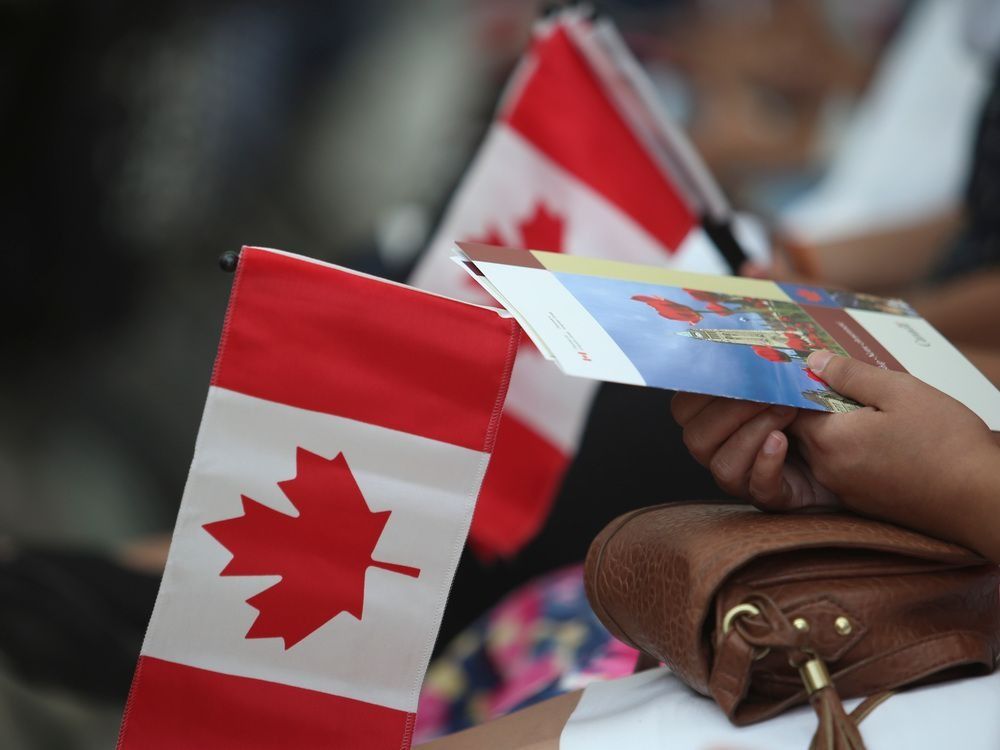
Conservative Leader Pierre Poilievre has long recognized what the Liberals have only started to acknowledge: immigration levels in Canada are too high and unsustainable. He has a plan to get things back under control, and it’s a sensible political strategy to take.

Poilievre suggested a new immigration policy for the Conservatives in June. “We want severe limits on population growth to reverse the damage the Liberals did to our system,”

he said

at a press conference last month. “The population has been growing out of control, our border has been left wide open. This has caused the free flow of drugs, illegal migration, human trafficking and much worse.”

Global News asked him to elaborate on his remarks at a press conference in Ottawa this week. “In order to fix the problem,”

he replied

, “we’ve got to put very hard caps on immigration levels. We need more people leaving than coming for the next couple of years … so our country can actually catch up.”

In addition, Poilievre pointed out that, “We’ve had population growth of roughly a million a year under the Liberals, while we barely build 200,000 homes. Our job market is stalled and yet we are adding more people to the workforce. Our young people are facing generational highs in unemployment because … multinational corporations are giving jobs to low-wage temporary foreign workers.”

He’s right. Conservatives recognize the importance of immigration on everything from promoting diversity to achieving economic success, but they also recognize that Canada simply can’t handle the financial burden that the annual influx of immigration has caused over the past decade of Liberal rule.

It wasn’t always this way. Statistics Canada’s 2016 paper, “

150 years of immigration in Canada

,” noted that the number of landed immigrants since the 1990s had “remained relatively high, with an average of approximately 235,000 new immigrants per year.” The highest tally ever recorded to that point was in 1913, when “more than 400,000 immigrants arrived in the country.”

Canada experienced a steady level of population growth through immigration for more than a century. Until Justin Trudeau was elected prime minister, that is.

Trudeau’s early years actually didn’t witness a significant spike in immigration. A

total

of 296,350 immigrants arrived on our shores in 2016, while the number decreased slightly to 286,480 in 2017. Nothing out of the ordinary, all things considered.

But in 2016, the federal government’s advisory council on economic growth

suggested

that immigration targets could be increased by 150,000 annually over the next five years. It specifically recommended Ottawa take a “gradual approach to scaling annual immigration to the recommended 450,000 level over the next 5 years.”

This was all the evidence Trudeau needed to follow in his late father’s footsteps as a champion of immigration and acquire more votes from appreciative new Canadians for elections to come.

The Liberals increased Canada’s immigration level to 321,040 in 2018 and 341,180 in 2019. It dropped to 184,600 in 2020, the first year of the COVID-19 pandemic, but rose to 406,055 in 2021, 437,630 in 2022, 471,820 in 2023 and 482,640 in 2024.

Trudeau

eventually admitted

that Ottawa “didn’t get the balance quite right” and announced a pause on population growth. But it was too little, too late. His immigration policies have caused numerous problems, including an affordability crisis, skyrocketing house prices and fewer job prospects.

Poilievre, like most sensible Canadians, knows this to be true. We’re in a financial hole and need to start digging ourselves out.

As an example, Canada has built an average of 227,130 new homes annually since 2015, while the Canada Mortgage and Housing Corporation

noted

last month that, “Housing starts must nearly double to around 430,000 to 480,000 units per year until 2035 to meet projected demand.” You can’t let more people into Canada if there’s nowhere for them to live. That’s common sense, ladies and gentlemen.

The solution to getting our shaky economy back under control is to follow Poilievre’s suggestion and establish a hard cap on immigration levels. We need to keep immigration at a very low level for a couple of years to help get our financial house in order.

Once that’s been accomplished, immigration levels could be gradually increased. Not to the ridiculous numbers that Trudeau set, but a more sustainable level that allows all Canadians, including immigrants, to live, work, prosper and achieve success.

National Post