LP_468x60
on-the-record-468x60-white

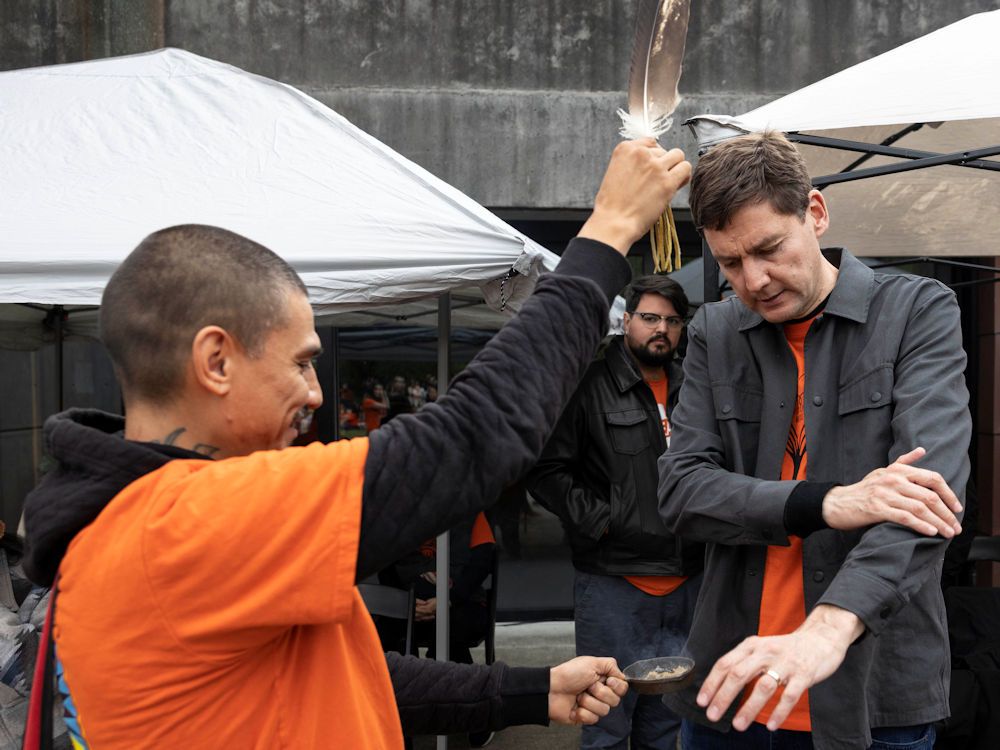
British Columbia Premier David Eby.

Winners and HomeSense have barely started stocking Halloween merchandise on their shelves, and there is talk of zombie revivals in British Columbia.

Like some mad scientists and taxidermists, the nostalgists for the dead B.C. Liberal Party are trying to take advantage of the crisis unfolding in the provincial Conservative party. Two years ago, the B.C. Conservatives famously bludgeoned the B.C. Liberals (by then going by BC United) into the dust and replaced them as the Official Opposition.

Now, with rookie leader Kerry-Lynne Findlay at the helm for less than three months, the party is apparently disintegrating as veteran MLAs and longtime staff are either being pushed out or officially leaving of their own accord. There are rumours of the KLF-led party being reconfigured along the lines of personal loyalty, usefulness and ideology rather than broad coalition-building.

Those unwilling to give KLF a chance to unseat David Eby’s NDP government are seeking revenge. According to radio host and former B.C. Liberal MLA Jas Johal, there was a great gathering of “Harper Conservatives, Carney Liberals, Horgan New Democrats” in the basement of a White Spot restaurant to plan an alternative, new “free enterprise” party.

Four promises will anchor this envisioned party: economic growth, controlled spending, resource development, improved affordability and nothing more. However, that would be akin to drinking the same medicine that made the non-left sick in the first place.

Johal described this coalition of “Harper Conservatives, Carney Liberals, Horgan New Democrats” as “Three tribes that used to spend their weekends attacking each other, now in the same room asking whether they want to win or want to be right.”

For starters, Harper left office in 2015, John Horgan (Eby’s more impressive predecessor) became B.C. premier in 2017, and Mark Carney became Liberal leader and PM in 2025. These are not former enemies. Rather, they are three labels used to segment a glorified focus group whose members share a passion for White Spot’s famous Pirate Paks.

People obviously cross partisan lines, but the label “Harper Conservative” in 2025 simply refers to some right-of-centre Canadians who can advise on taxes and nothing else. That is not actually a political tribe, as some of those same people are now “Carney Liberals.”

Also, a clichéd, cookie-cutter platform of growth, controlled spending, resources, and affordability is not very sturdy. Very few governments will ever actually rein in spending anymore, and what sort of ambitious politician will not promise growth and affordability? There are depressingly few examples of either promise being fulfilled in Canada as well.

At the end of the day, Canadian elections tend to be personality contests right now. People liked Horgan and like Carney because both passed the “beer test”; Carney, in particular, harnessed perverse Liberal nationalism. All of it was emotion, which former B.C. Conservative leader John Rustad failed to convey on most occasions. Most importantly, Carney has an impressive paper résumé as an international central banker to go along with his charisma and aura. Who in B.C. can come close to matching that? (There is perhaps only one, but that will be revealed later, if at all.)

Furthermore, the economy cannot be divorced from culture or the war for the latter. In B.C., the biggest issue in the province until KLF assumed the leadership was the ongoing effects of the Declaration on the Rights of Indigenous Peoples Act (DRIPA), which is intimately tied up with the “land back” movement and other far-left ideas. These same ideas helped inspire equally inane policies such as “safe supply,” the decriminalization of hard drugs, and rash gender transitions for children.

Is the new centrist Pirate Pak Party (the PPP?) going to simply ignore DRIPA and let the NDP apparatus of NGOs and other non-government elements continue to run roughshod over the province? This would mean accepting all the radical ideas of the NDP and freezing them in place, at best.

There have actually been multiple failed examples of this in recent Canadian history. The Canadian Future Party , envisioned as a “not left, not right” alternative meant to fill the supposed gap in the centre in the 2025 federal election, fielded just 19 candidates and received only 3,123 votes.

B.C. United/Liberals tried to pretend that the relative cultural and social harmony of the early 2000s, which made it easy to focus only on the economy, still existed in 2024. CentreBC, led by former B.C. Liberal MLA Steve Bernier, is now making a similar pitch .

Recent B.C. Conservative refugees Peter Milobar and Ian Paton have announced that they intend to form another moderate party for the “politically homeless.” It is unknown whether they plan to lead the Pirate Pak Party, but it would be unsurprising.

The success of the original B.C. Liberals depended on conditions that have long since faded into history. Their near-monopoly on the anti-NDP vote was predicated on relatively muted cultural conflict and the absence of a true alternative for conservative voters in the prince. Then, as now, their support was essential to forming a government.

The right wing cannot be treated as an embarrassing accessory to a free-enterprise coalition, and this is even more salient in an era of revived right-wing populism. Conservative voters provide members, donations and, most importantly, votes across the province. Although outnumbered in urban areas, those are still the largest numeric well-springs of non-left voters.

If this new “free-enterprise” party believes it can demand right-wing votes while condescending to those same people, it will need a great deal more than luck to succeed.

Findlay’s current difficulties do not vindicate stale, millenarian centrism. The case against her leadership has centred on ethics, hirings and an inability to hold a broad coalition together.

Conservatism did not cause seven MLAs to leave caucus in half a month, nor did it necessitate scandalous senior appointments.

B.C. certainly does need a broad, anti-NDP coalition, but that will be achieved by bringing factions together without declaring the convictions of its largest blocks invalid, outdated, or unwanted. How can such a party help drive the economy without dealing with DRIPA or promise affordability without reckoning with immigration, wage suppression and the other factors that drive unaffordability?

Without reconciling that, this new “free-enterprise” project will be scarcely more than garden variety donors and a pleasant logo. B.C. needs something far better, and as it currently stands, a salvaged and reinvigorated provincial Conservative party is the best vehicle for that.

National Post


Prime Minister Mark Carney with now newly-elected MP Daniel Gobeil, during a visit to a fruit farm in Saguenay, on Aug. 6, 2026.

“It’s a great time to be a Liberal in Canada.”

Those were the words of a smiling Tanveer Shahnawaz, the Liberal candidate in Beaches—East York, celebrating his victory Monday night. They may also be the political understatement of the year. Shahnawaz was one of three Liberals who swept Monday’s federal by-elections, winning his Toronto riding with 56 per cent of the vote. The party also held North Vancouver—Capilano in B.C. and took Chicoutimi—Le Fjord from the Conservatives in Quebec.

That last victory matters most. Chicoutimi—Le Fjord had been held since 2018 by Conservative MP Richard Martel, who Prime Minister Mark Carney appointed to the Senate in July. The contest was expected to be a tough battle between the Liberals and the Bloc Québécois. Instead, Liberal Daniel Gobeil won handily with 51 per cent of the vote, the Bloc got 33 per cent, and the Conservatives collapsed to 13 per cent.

Gobeil’s candidacy was a clever play in a region that has been hard hit by U.S. tariffs. The former head of Quebec’s milk producers entered politics just as the trade war came to a boil, with Canada’s dairy supply management system on the front burner. Monday night, Gobeil declared that the Liberals’ wins helped “maintain Canadian unity.”

Therein lies the particular — and familiar — genius of the Liberals’ strategy.

As Canada goes elbows-up in response to U.S. President Donald Trump, the Liberal Party is steadily identifying its brand with the nation itself. It’s a page from a very old Liberal playbook: Lester B. Pearson gave Canada the red-and-white Maple Leaf flag in the 1960s, while Pierre Trudeau championed official bilingualism and multiculturalism in the 1970s. Over generations, Liberal governments successfully conflated Canadian identity with party colors, symbols, policies, and institutions, cementing their reputation as Canada’s “natural governing party.” Carney is now pulling off the 21st-century version, with Trump supplying copious amounts of glue.

The biggest losers Monday night were therefore the Conservatives. No one expected them to win Beaches–East York, but they captured just 15.5 per cent of the vote there, while the NDP tripled their vote share to 26 per cent. But Chicoutimi–Le Fjord was far worse, losing a seat they had held for eight years, and handing Bloc Leader Yves-François Blanchet a devastating, if obvious, line : Canada might have a two-party system of Liberals and Conservatives, but Quebec has one between the Liberals and Bloc.

The results follow more grim numbers for Conservative leader Pierre Poilievre. A Liaison Strategies poll released Monday put the Liberals at 46 per cent and the Conservatives at just 29 per cent, their lowest level in the pollster’s tracking. That will inevitably revive questions about Poilievre’s leadership just as Parliament prepares to return.

But Monday’s results may have implications beyond Ottawa. In Quebec, the Trump effect could breathe life into a party that only months ago was the walking dead: the Coalition Avenir Québec.

Like Ontario Premier Doug Ford in the provincial election in 2025, and Carney in the federal race that same year, CAQ leader Christine Fréchette has made Trump a central character in her campaign, calling him her “real adversary.” Even more remarkably, the leader of a party created to transcend the federalist-sovereigntist divide is making a baldly federalist appeal: faced with an unpredictable and hostile United States, Quebec is safer within Canada — and the CAQ is the best party to stave off the separatist designs of the Parti Québécois.

It may be working. Polls by Pallas Data poll and Leger show the CAQ rising to second place, while the Quebec Liberals are falling. Meanwhile PQ leader Paul St. Pierre Plamondon declared that he would postpone a referendum until after Trump leaves office. With Canadians rallying around the flag, incumbency, stability and unity are the political currency du jour , regardless of the party that’s selling them.

Tasha Kheiriddin is Postmedia’s national politics columnist.


B.C. Conservative Leader Kerry-Lynne Findlay

On Monday, the cascade of MLAs fleeing Kerry-Lynne Findlay’s B.C. Conservative party continued with the resignation of A’a:liya Warbus. This brings the total refugees from Findlay’s doomed political cruise to seven over the past two weeks. It’s now clear that the party has no future with her as leader.

In a perfect world, she would resign immediately before her catastrophic time as leader fully sinks British Columbia’s Conservatives, if she hasn’t already condemned them to the political wilderness and the province to more miserable years under Premier David Eby’s leadership. The world, however, isn’t perfect and, ironically, it’s Eby who has found a way to prolong Findlay’s leadership by at least four more weeks.

By immediately calling a byelection for a seat recently vacated for Findlay to run for (she is not currently a member of B.C.’s legislative assembly), he has ensured that her circus will remain in town at least until the end of September.

Warbus’ resignation is uniquely damning. Following Eby’s byelection call on Sunday, it became clear that Findlay would remain leader until at least Sept. 27 — something that was not at all clear even last week, as the Conservatives leaving caucus went from a trickle to a waterfall. With the byelection now called, Findlay is there until it’s over.

As such, Warbus’ resignation on Monday carries with it an extra sting: her departure wasn’t merely calculated to bring about Findlay’s downfall (though it may well contribute to that), it was an expression of the fact that even four more weeks of being linked to Findlay was too much for Warbus to bear. Warbus sees that the house is on fire and has no interest in getting torched.

When Findlay won the Conservative leadership at the end of May, it was described by many as a “political earthquake,” as it signalled a shift to the right, away from the broader centre-right coalition the B.C. Conservatives had become following its merger with B.C. United (formerly the B.C. Liberals) ahead of the 2024 election.

That broad Conservative coalition under John Rustad came within a whisker of winning that election, taking 44 seats and 43 per cent of the popular vote. In the previous election under their fringe incarnation, the Conservatives took zero seats and 1.9 per cent of the vote. The “political earthquake” that Findlay now represents is set up to hand Eby another election victory.

There has also been turmoil among Conservative staffers. Perhaps most emblematic of the embarrassing fiasco that Findlay’s leadership has been is Apollo Chung, a former member of the separatist Republican Party of Alberta.

Last Wednesday, recordings were released in which a political staffer allegedly said that he doesn’t “care about … saving the province,” that “white people are, like, crazy” and that he has “the leader in our hands.” The recordings continued with dubious comments about the staffer’s plans for funds raised by the party, saying he would go in and “steal everything.”

Though nothing has been officially confirmed, Chung was fired nearly immediately following the release of the recordings, and both Chung and Findlay have refused to comment on the matter.

Eby has pulled a smart political move by essentially forcing the Conservatives to remain with Findlay as leader until the end of September, and possibly beyond if she manages to win the byelection. The Conservatives now find themselves in the unfortunate position of knowing their interests are best served if their leader loses and can be jettisoned cleanly on the grounds that she can’t even win a byelection.

Nevertheless, expect further resignations to come, with some no doubt planned to be close to the byelection date, so as to embarrass Findlay. If she finds a way to hang on, it would be cataclysmic for B.C.’s Conservative party.

National Post


MONTREAL, QUE.: August 30, 2026 -- Quebec premier and Coalition Avenir Québec leader Christine Fréchette holds a town hall at Théâtre de la Ville in Longueuil, on Sunday, August 30, 2026 .

Hannibal ad portas. “Hannibal is at the door.”

Trump is the imminent danger “at the door” that Christine Fréchette, CAQ leader and Quebec premier, is using to rally-round-the-flag against, in an attempt to rescue her government from what had seemed certain defeat in October’s election.

Sounds familiar? It is a very similar to the strategy that Mark Carney used for his own election against Pierre Poilievre.

A key figure from former premier François Legault’s government, Fréchette was handpicked by party apparatchiks and won a leadership race after Legault resigned this past winter. In power since 2018, Legault was at one time the most popular, and later the least popular, premier of the province this century .

Trump might not be about to sack Quebec City, but Fréchette is behaving as if he is. In her first campaign news conference on Thursday, she declared with all seriousness, yet could not help but crack a little smirk: “My opponent is named Donald Trump. He’s the real adversary.” The similarity with the Carney campaign is almost uncanny.

It is not a secret though that her campaign manager, Brigitte Legault, a former federal Liberal, is very close to Carney’s entourage. This association is even more remarkable considering the Liberal Party of Quebec still exists. The Coalition Avenir Québec is using the same playbook in an egregious way, considering Fréchette isn’t even leading trade talks. At least Carney could claim direct responsiblity for dealing with Trump.

The premier is not an outsider, and her resume is far from being in the same weight class as Carney’s. But, as we say in politics, the first rule is to choose your adversary, and chose she did. A recent Abacus Data poll showed that Donald Trump and his administration is the main issue of concern for Quebec voters at 63 per cent.

Fréchette is moving away from “how well the CAQ has governed” to “who do you trust to protect Quebec from Trump?” Only one of these questions requires the government to defend its record.

Fortunately, not everybody is falling for this dog and pony show. Two polls released in the first week of the campaign still show the CAQ in fifth place among 18-34 years old and fourth place among 35 to 54 years old. Most of the party’s support, comes from voters 55 and older, where we find most of the “elbows-up” crowd. Fréchette is leadeing this group by a wide margin.

Overall, poll aggregator Qc125 on Aug. 30th has the PQ at 29 per cent and the CAQ at 25 per cent, with the Quebec Liberals at 21 per cent. The latter were once at 32 per cent back in April. The Conservative Party of Quebec sits at 15 per cent and the progressive Quebec Solidaire at 10 per cent

In this current election, younger voters tend to support political parties that support change, nationalism, address the economy, the cost of living, housing, health care, immigration, the more bread-and-butter issues younger generations are facing. To these voters, though the tariffs’ impact is real and Trump poses a significal challenge to Canadian exports, Quebec needs to control what it can control and get its own house in order. Unfortunately, this does not describe a large part of the electorate, particularly among older voters.

An age divide along such drastic lines has rarely been seen in Quebec. It is not only a difference of opinion, but also a divergence of where these two different electorates get their political information from. Older generations still rely mostly on traditional media such as television. The Académie de la transformation numérique published a survey earlier this year that showed older voters use traditional media at a rate of 87 per cent, compared to 59 per cent with for voters aged 18 to 34, an almost 30-points difference.

An Influence Communication analysis showed that the media coverage of Donald Trump in Quebec was five times more important than the coverage of our Prime Minister Mark Carney. When we take a look at voters aged 18 to 34, they get their information through social media at 74 per cent compared to only 28 per cent with older voters. Not only that, but their trust towards the traditional fourth estate is declining. The aspirations of two different generations are now being amplified by their own echo chambers.

It’s not too much to pretend that the resulting dissonance is now epistemic. When these groups debate each other, they’re no longer arguing over the same set of facts. They often can’t even agree on which reality they’re talking about.

And Fréchette and the CAQ know exactly what they are doing by playing the Trump card. The “elbows-up” crowd is a larger voice that shows up to vote. Quebec’s domestic agenda is side tracked because political leaders can’t seem to see the bigger picture. It is easier to blame everything on a boogeyman in America than looking in the mirror and taking bold decisions to tackle a low level of productivity, a poor level of investments, and the need for energy diversification.

Only 22 per cent of entrepreneurs in Quebec would recommend people to start a business in the province. Where are the discussions about red tape and badly needed tax reform? Fréchette is throwing a smoke screen to the electorate to hide her government’s record while people deserve a premier who addresses key issues. Debates will be interesting as the Trump question will only last for so long.

The election campaign is still early, and plenty can happen. But the parallel between the CAQ and Carney strategies cannot be ignored. In the middle of this obvious fear campaign, let’s remind ourselves, that Hannibal never reached the gates and Rome survived. The fear, however, did more damage than the enemy.

Marc-Olivier Fortin is the former national Vice-President of the Conservative of Canada (2016-2018) and campaign manager for the CPC in Quebec (2021). He is now a regular commentator at RDI and on COGECO radio and works for Transfert, a firm specialized in social acceptability in mining, energy and heavy industry sectors.


The cover of Étienne-Alexandre Beauregard's Anti-Civilization: The Collapse of Society & the Case for the Common Good. Available Sept. 1, 2026, from Sutherland House Publishing.

What happens when a society loses the traditions, institutions and shared obligations that once gave people a sense of belonging and purpose? In this adapted excerpt from Anti-Civilization: The Collapse of Society and the Case for the Common Good — now available from Sutherland House Publishing — Étienne-Alexandre Beauregard examines what this loss has meant for Generation Z, the first generation to come of age fully within this new landscape.

Generation Z — those born from 1997 to 2012 — are reaping the fruits sown by the baby boomers, the “sixties generation,” who, in their libertarian fervour, broke the chain of transmission without realizing that the cultural and moral heritage they had received was precisely the condition of their freedom.

As generations succeed one another, the traces of this precious heritage fade and young people are orphaned of the civilizational transmission they desperately need. The idea that culture, established customs and civilization are burdens for human beings ultimately proves to be the greatest of “ luxury beliefs .” Because we took these treasures for granted and neglected to maintain them, we sorely miss them today.

The breakdown of value systems and social relationships has left behind a field of ruins. Several studies conducted among young Americans at the forefront of Western trends, point to a worrying impoverishment of social ties. They have fewer close friends and see them less often than before. Love is also in decline : young people have less sex than their elders did at the same age, and young people in relationships are sleeping together less often. It seems that “social distancing,” a term coined during the pandemic, has become an established reality. Unsurprisingly, a desocialized civilization is also one that has fewer children and where people become parents later, now after 30, in most of the Western world.

Has this “ open society ” made them happier? On the contrary , Generation Z is swept away by a nihilistic temptation, more inclined to believe that life has no meaning, to doubt themselves and to have a pessimistic view of the future. It would seem that individualism has created a need for identity, belonging, and reference points that have not been fulfilled by the void that has been offered to their generation.

The impoverishment of general culture, which, at present, dismisses the great works of the Western canon, goes hand in hand with a closing of the mind and horizons, making us incapable of communing with what came before us. As French essayist and politician François-Xavier Bellamy writes ,“Our ignorance renders statues mute, images indecipherable, texts incomprehensible; the signs we have inherited lose their meaning.”

This “ precariousness of all spheres of existence logically translates into a “ demand for protection, measure and limits ” to serve as a guide in an unknown and strange world to which they have been deliberately denied the keys. Left to fend for themselves in a labyrinth without a map to guide them, young people have every right to hold this new world accountable for abandoning them.

Increasingly, observers are realizing that the younger generations reject the progressive project as much, if not more than their elders, and are among the most enthusiastic supporters of the populist shift to the right. In the 2024 U.S. election, no less than 56 per cent of men and 40 per cent of women under the age of 30 cast a Republican ballot, whereas in 2008, 66 per cent of young people had voted for Barack Obama.

The first voters to rally behind Donald Trump in 2015 were Americans who were “ civically disengaged ” and experiencing the most severe social isolation. In France, the National Rally can count on voters who are significantly younger than those of Emmanuel Macron, to the point of challenging the far-left La France Insoumise as the “ party of youth .” In Canada, the arrival of Pierre Poilievre at the head of the Conservative Party has given rise to the same phenomenon: for the first time in recent history, young Canadians are voting more to the right than their elders.

Contrary to all expectations, it seems that increasing numbers of young people, disenchanted with the broken promises of deconstruction, agree with American political theorist and author Patrick Deneen that liberalism has failed , and wish as American political scientist Robert Putnam does for an “ upswing ” in Western civilization.

But how does one rebuild civilization on the ruins of deconstruction? Such a revival, on an individual and collective scale, requires, above all, a break with the concept of the atomized individual in perpetual struggle with the institutions that surround him. The present times call for a truly “post-liberal” reflection, which will dare to ask once again the question that was taboo for the great liberal thinkers of the last century: what should I do with my freedom? How can I lead a good life as a free person?

In line with Western tradition, from Aristotle to Christianity, let us think of a humanity and individuality that strengthens society, rather than setting itself against it. As American political philosopher Michael J. Sandel argues , “We are most fully human when we contribute to the common good and thus earn the esteem of our fellow citizens for the contributions we make. According to this tradition, the fundamental human need is to be needed by those with whom we share a common life.”

Therefore, we need to reverse the trend toward individual secession in order to rebuild community and mutual responsibilities, instead of commodifying solidarity through digital intermediaries. This means that there is no natural right to non-integration, contrary to what the theorists of multiculturalism claim. Those who join a nation and benefit from its social model must, in return, agree to embrace its customs.

This also means that the value of elites is measured by their contribution to the common good, not by the amount of prestige or capital they manage to accumulate for themselves. As Rod Dreher explains , “Civilization doesn’t exist to make it possible for individuals to do whatever they want to do. To believe that is an anthropological error. A civilization in which no one felt an obligation to the past, to the future, to each other, or to anything higher than self-gratification is one that is dangerously fragile.”

In order to learn once again how to live together, because that is what this is all about, we can fortunately still count on the first institution where the common good is lived out, which is also the last holistic institution we still know, the family. Against all odds, it remains the indestructible rock on which human beings can rely, never truly conquered by the spirit of the times, constructivism, or individualism. As French journalist Aziliz le Corre writes , “The family is a determinism that, by definition, cannot be broken. It is a matter of nature, even more so than culture. And it remains biological in its essence. Like birth, gender differences, old age and death, it is immutable.”

The family is the ideal place for a culture of normality to be reborn, because it is the school of responsibility and virtue through which we learn that what has real value is what money cannot buy. It is by giving selflessly to our children, parents, siblings, or grandparents that we can truly grasp the meaning of the common good, namely that life has no meaning if it is lived for oneself, in suspicion of what has gone before and what will follow.

According to British philosopher Roger Scruton, conservatism is, above all, the doctrine of love, for what we share, what defines us and what we will leave to those who follow us. It is from this love that we must draw to rebuild civilization, a love widely shared among ordinary people who, sheltered from politics, preserve precious treasures of knowledge, decency and common sense. As long as it exists, civilization will stand firm against the forces that seek to deconstruct it.

And what if Generation Z — that currently nihilistic, pessimistic and aimless cohort — could actually be the unlikely heroes who help rebuild norms and save the West from its current profound crisis?

National Post

Étienne-Alexandre Beauregard is an author and researcher at Cardus. Between 2022 and 2025, he was a speechwriter and strategic planning advisor in the office of the Premier of Québec.


Chinese President Xi Jinping (3rd-L) and Canada's Prime Minister Mark Carney (2nd-R) meet at the Great Hall of the People on January 16, 2026 in Beijing, China.

U.S. President Donald Trump’s much disliked visage will soon be passing, by biology or the Constitution, from screens. But it will take a bit for Canadians to ally openly with the United States, whatever the compelling geographic and economic reality .

Yet in their passion to dish on Trump, Canada seems to now align instead with China and the European Union. This shift could hasten Canada’s descent into its own authoritarian future. As a few leftist academics move to Canada to escape Trumpian proto-fascism, let’s look at how Canada’s new friends view free speech.

China’s free-speech efforts are an oxymoron; a permanent one-party police state does not exactly encourage debate. The European Union, for its part, thinks of itself as a bulwark of individual liberty, but it behaves in ways that are “ post-liberal. ” Restrictions on speech deemed to be hateful or, in some cases, simply disrespectful of authorities, has occurred in both Germany and Italy . The EU has ignored popular votes when they favour right-wing populists or seek to limit Brussell’s power.

Today in Europe, free speech is just a mild irritant . More worrisome still are developments in the U.K., the place that brought free speech to this continent. Instead of the Magna Carta, we see a great country becoming ever more authoritarian.

Take this. By some accounts , police in England and Wales made 10,000 arrests in 2024 for “communications offences.” The arrest of comedy writer Graham Linehan at Heathrow airport in 2025 was particularly chilling.

Canada seems to be moving in this same illiberal direction. To be sure, there are the promises of the 1982 Charter of Rights and Freedoms , which guarantee the right of “free expression.” But the Charter also provided a breezeway for censorship by stating that speech is subject to “such reasonable limits prescribed by law as can be demonstrably justified in a free and democratic society.”

This leaves power in the hands of the Prime Minister and Parliament to define “reasonable limits.” The growing Canadian thought police recently enacted the Combating Hate Act . And a bill that would impose strict new speech limits on social media companies is currently working its way through Parliament. As the American free-speech advocate Greg Lukianoff says , Canada’s speech is moving from free to “free … ish.”

This approach is also reflected in the ever more out of control Human Rights Tribunal. Former Chairman David Thomas claims the Tribunal has been almost completely taken over by notions of victimization popular on college campuses, including questioning any aspect of “trans rights,” a particular priority of the cultural left and the professional institutions they have captured. He compared the Tribunal to a “state funded extortion ring” that seeks to force those it attacks to make a deal in order to avoid greater financial and professional harm.

We can see where this is going by recalling the crackdown against the Covid era “ Freedom Convoy ,” with its pattern of arrests and defunding. Canada has long seemed a bastion of tolerance, sexual freedom and democracy, but how does that work when Prime Minister Mark Carney claims that Muslim values and those of his country, a product largely founded on European culture and Christianity, are the same. Perhaps the urbane PM is unaware of the lack of freedoms for women, gays or dissenters in virtually every Muslim country.

Islamism is not the only force pushing authoritarian approaches. Chinese penetration of Canada’s political system also does not seem to bother an elite raised in universities preaching anti-colonial indoctrination . In the last century, American, Canadian, French and British schools worked to promote loyalty to their countries, now they increasingly agitate newcomers against themselves.

Much of the problem, notes Kate Marland, executive director of the Canadian Free Speech Union, lies with Canada’s lack of the U.S. first amendment rights which are very broad. Canada’s Constitution lacks such guarantees which provides a path for government-led censorship.

“In the US,” she notes, “you have a First Amendment, and you don’t have censorship.” In Canada, the priority of preserving “a cohesive society” often takes priority over freedom of speech.

In the U.S., the Constitutional structure has made it difficult to fulfill the Trumpian dream of becoming. A fatter version of Mussolini, Trump faces constitutional constraints including a larger right of center Supreme Court , that ruled against actions of tariffs, birthright citizenship, immigration and federalization of the national guard. All these rulings even a leading leftist academic dubbed “enormously important.”

In addition, Trump’s power is already waning, even among his Congressional minions , particularly as he becomes a lame duck, and may lose one or both houses of Congress. Trump can harrumph all he wants, but the Constitution has proven stronger even his ego.

Of course, Trump seeks to demonize his tormenters but just ends up looking stupid, even by their low standards. More worrisome to basic freedoms may be the rise of the Democrats in America, who, like Liberals in Canada, embrace the idea of becoming more like Europe, including in terms of regulating speech. Then there’s the Democrats’ emerging far-left, now dominated by the Democratic Socialists of America, which embrace a frank Marxist-Leninist worldview, never a good thing for free speech.

Canadians are right to despise Trump, but in rejecting the U.S. model on speech, they are also turning away from the tradition of open debate that has long blessed both of our countries. Josh Dehaas of the Canadian Constitution Foundation notes that the current “anti-American” mood has allowed politicians like Justin Trudeau, and even more so Carney, to push for “more speech regulations” that are more in line with European and potentially even China.

I would be the last to suggest Canadians should embrace everything about the American model, largely based on distrust of government which leaves us more dissatisfied with our democracy than more potty-trained Europeans. But dissent is not always a bad thing, particularly when it checks government power. In this one thing — free speech — America is very much in the right. Sometimes even an ogre has something good to offer.

National Post


Turkish President Recep Tayyip Erdogan

Turkey is pursuing an increasingly dangerous bid to reshape the balance of power in the Middle Easter. Under President Recep Tayyip Erdogan, Ankara has combined support for Islamists, military intervention and economic leverage to expand Turkish influence across the region and beyond, challenging the existing geopolitical order.

Turkey’s dramatic departure from its “zero problems with neighbours” doctrine began around 2011, when the Arab Spring opened a new geopolitical opportunity for Erdogan. Ankara increasingly backed Islamist movements, including Hamas, the Muslim Brotherhood and Jabhat al-Nusra in Syria, then an al-Qaida affiliate led by Ahmed al-Sharaa. Erdogan’s support helped propel al-Sharaa from an al-Qaida commander into Syria’s president, making Turkey one of his most important external backers.

In 2012, while working for CNN in Egypt, I witnessed Erdogan’s arrival in Cairo as he exited the airport, where he was greeted by hundreds of ecstatic Muslim Brotherhood supporters carrying banners and chanting, “Erdogan and the Brotherhood are one hand.” At the time, the question was whether Erdogan was simply courting the Brotherhood, which had just come to power in Egypt, or whether Turkey was embarking on a far more ambitious strategy: using Islamist movements as instruments of Turkish influence and expanding Ankara’s political and strategic reach across the region. The events that followed suggest it was the latter.

After recognizing Libya’s National Transitional Council following Moammar Gadhafi’s ouster in 2011, Erdogan’s government provided it with $300 million in credit and, along with Qatar, backed several Islamist factions in that country’s civil war.

During my reporting in Libya, I met Islamist political figures and fighters who had been funded and trained by Turkish forces, giving me a firsthand view of Ankara’s growing role in the conflict. In 2012, Libya’s Muslim Brotherhood established the Justice and Construction Party, which has been supported by Ankara — illustrating Turkey’s emerging strategy of using Islamist partnerships to expand its regional influence

When Egypt, Saudi Arabia and the United Arab Emirates designated the Muslim Brotherhood as a terrorist organization in 2013-14, Turkey continued providing political and financial support, hosting Brotherhood-affiliated media and members wanted by Arab governments. This cemented Turkey’s role as a key Brotherhood hub and further strained ties with its Arab neighbours.

A recent Foundation for Defense of Democracies research memo — titled, “Islamist Turkey: A Forward Base for Muslim Brotherhood-Aligned Jihadism” — argues that under Erdogan, Turkey has moved further from its traditional western alignment toward Islamist movements, including the Muslim Brotherhood and Hamas. Since 2011, Hamas has expanded its presence in Turkey, establishing offices and networks that have allowed it to operate from Turkish territory.

Turkey’s support for the Muslim Brotherhood also extends into Syria, where Ankara has backed Brotherhood-linked political and Islamist forces while expanding its strategic footprint. The two countries share a roughly 900-kilometre border, and Turkey’s estimated 49 army bases and more than 100 military sites and observation posts in Syria, backed by over 10,000 troops, give Ankara a powerful platform to project influence into Iraq, Lebanon and the wider region.

Erdogan’s strategy extends beyond Islamist alliances, combining political influence, military power, economic leverage and diplomatic reach. The clearest recent example is the Mecca Joint Defence Agreement, a trilateral mutual-defence pact signed by Saudi Arabia, Turkey and Pakistan on Aug. 7. The agreement establishes a collective-security framework similar to NATO’s Article 5, treating an armed attack on any one member as an attack on all three. Its inaugural committee meeting began in Istanbul on Monday.

I spoke this week with Sinan Ciddi, a senior fellow and Turkey program director at the Foundation for Defense of Democracies, a Washington, D.C.-based nonpartisan research institute focused on national security and foreign policy. He believes Erdogan will seek to expand the pact’s membership.

“Turkey’s alliance-building initiatives should not be viewed in isolation. The Mecca Pact is one component of Erdogan’s broader vision of positioning Turkey as a ‘global actor.’ The pact with Saudi Arabia and Pakistan is a significant building block in his effort to co-ordinate the trade, energy and diplomatic interests of Sunni powers. Over time, he will seek to expand its membership,” Ciddi said.

“At the same time, Ankara is building robust bilateral partnerships across Africa while positioning itself to the European Union as a security bulwark against Russia. In the Mediterranean, Turkey is pushing to redefine maritime boundaries to its advantage, in concert with partners such as Libya, raising alarm in Greece, Israel and Cyprus. None of Erdogan’s initiatives is short-term or isolated; they are part of a broader strategy to increase Turkey’s geopolitical visibility and influence.”

Turkey’s relationship with Israel is perhaps best described as a dramatic strategic reversal. The two countries were once close security partners, sharing intelligence and co-operating militarily. Today, relations have reached a historic low, with Ankara and Jerusalem increasingly treating each other as regional rivals. The question is no longer whether their relationship can return to the way it was, but how far this confrontation will go.

Erdogan has increasingly positioned Israel as a strategic adversary. Addressing the Turkish parliament in 2023, he issued an unusually direct warning to Israel, targeting both its leadership and nuclear capabilities: “Hey Israel, you have an atomic bomb, a nuclear bomb. And you are making threats with this. We know this. And your end is near,” he declared , adding, “you’re on your way out.”

Such rhetoric reflects the broader deterioration in Turkish-Israeli relations and Erdogan’s effort to position Turkey as a leading political and strategic counterweight to Israel in the region.

On Aug. 18, Israel sent a direct warning to Turkey by striking the Abu al-Duhur airbase in Idlib, near the Turkish border, as Turkey was reportedly preparing to deploy troops and reactivate the base. The message to Ankara was clear: Israel will not tolerate a Turkish military presence that threatens its strategic interests. The strikes signal a growing contest between Ankara and Jerusalem over who will shape the emerging regional order in Syria.

“Ankara’s rebuttal is that its presence in Syria is lawful because Damascus consents, while Israel’s is not, but Turkey has seldom waited for permission when it entered Syria. It launched three major cross-border operations — Euphrates Shield in 2016, Olive Branch against Afrin in 2018 and Peace Spring across Ras al-Ain and Tell Abyad in 2019 — each justified by Ankara as self-defence against terrorism, each conducted over Damascus’s explicit objection,” said Ciddi.

“It armed and paid Islamist and jihadist militias throughout the war. It still effectively controls swaths of the north and continues paying the salaries of former Syrian National Army factions now folded into the new Syrian military — factions documented as detaining, extorting and abusing civilians.”

Turkey’s expanding military footprint and its growing ties to Islamist and Iran-aligned actors are increasingly bringing Ankara into direct competition with Israel. What was once a largely co-operative relationship has evolved into a broader struggle over influence and security across the Middle East. When Turkey offered troops for a postwar International Stabilization Force in Gaza, Israel rejected the proposal.

During my current reporting from Lebanon, I have seen that Iran-backed Hezbollah militants continue fighting against Israeli forces despite ongoing peace talks, underscoring the importance of UNIFIL as its mandate nears expiration. Erdogan’s bid for a security role in southern Lebanon is therefore likely to face Israeli resistance, as Jerusalem increasingly views a Turkish military presence on its northern border as a strategic threat.

Turkey’s ambitions are bringing Ankara into increasingly direct conflict with Israel. As both sides strengthen their military positions and enforce competing red lines, the risk is no longer merely diplomatic — it’s the possibility of a direct military confrontation between two increasingly assertive regional powers.

National Post

Mohamed Fahmy is an award-winning journalist who has covered the Middle East for numerous outlets, including CNN, Al-Jazeera, the Los Angeles Times and Foreign Policy.


Toronto Metropolitan University, formerly Ryerson University.

The Ontario Human Rights Tribunal has sided with a Muslim former teaching assistant who was fired after publicly denouncing “desecration by the Jews,” awarding him $7,000 for injury to “dignity, feelings and self-respect.”

Although adjudicator Cyndee Cherniak rejected Ayman Elkasrawy’s claim that he had been fired due to Islamophobia, she nevertheless approved the cash award due to “circumstantial evidence” that some discrimination may have inflected his dismissal.

In 2016, Elkasrawy was videotaped delivering an Arabic-language prayer at the Masjid Toronto mosque where he called for Jews to be slayed “one by one,” and for none to be spared.

The prayer was condemned at the time by both Masjid Toronto and the Muslim Association of Canada, who called it “an inappropriate supplication that was offensive to those of Jewish faith.”

It also prompted Elkasrawy’s dismissal from Ryerson University (now Toronto Metropolitan University) where he was working as a teaching assistant in the school’s engineering faculty.

“One of Ryerson’s core values is our commitment to community and inclusion … your comments are in contravention of this core value, do not foster a respectful learning environment and reflect adversely on, and are to the detriment of the University,” read his dismissal letter, according to Tribunal filings.

Clips of Elkasrawy’s prayer were first circulated by the now-defunct outlet CIJ News, which translated its lines as “Oh Allah! Count their numbers; slay them one by one and spare not one of them. Oh Allah! Purify the Al-Aqsa Mosque from the filth of the Jews!”

In front of the Ontario Human Rights Tribunal, Elkasrawy’s counsel said that this was a mistranslation, and that the comments had been “twisted, to make them appear inappropriate, violent and anti-Semitic.”

According to Elkasrawy, what he actually said was “Oh Allah; has full cognizance of them, slay them one by one, and don’t let one escape your punishment. Oh Allah; cleanse the Aqsa Mosque from the desecration by the Jews.”

He testified that the “slay them one by one” statement was unrelated to the second, and referred to members of Syria’s Assad regime.

As for the second, Elkasrawy confirmed that he was referring to Israeli control of Jerusalem and the Al-Aqsa mosque, but that if he could say it again he would change the prayer to “the occupying Jews.”

These explanations were accepted by Cherniak, who characterized the prayer as a “human moment.”

“Who amongst us has not, at some point in their lives, said something they wish they could take back and learned a life lesson because of it,” wrote Cherniak, who ruled they ultimately didn’t represent “his sincerely held beliefs.”

Elkasrawy had taken his case to the Ontario Human Rights Tribunal on the grounds that he had been the victim of an “Islamophobic attack.”

Cherniak largely rejected this, however, writing “I find that his identity as a Muslim is not the reason he was terminated because there is no evidence to support such a conclusion.”

Elkasrawy similarly claimed to have been the victim of an Islamophobic attack after unattributed posters were pasted up on the Ryerson University campus bearing his photo and the caption “fire him now.”

The posters — which stayed up only a short while before being removed by university staff — bore his image, the CIJ translation of his prayer, and a caption reading “Ayman Elkasrawy is a teaching assistant at Ryerson University. In 2016, he publicly made extremely hateful statements about Jews.”

Elkasrawy told the tribunal the posters were created by “the Islamophobia industry,” and that Ryerson had “participated in the Islamophobic attack” by acceding to their demand.

Wrote Cherniak, “I find that Dr. Elkasrawy has not presented clear, cogent and convincing evidence that the poster was made by the Islamophobia industry or is Islamophobic on its face.”

She added, “In my view, the poster is not Islamophobic.”

Although Cherniak rejected Elkasrawy’s claims that he had been fired because he was a Muslim, she did deem him to be a victim of discrimination over a Feb. 28, 2017 email sent by Ryerson president Mohamed Lachemi.

The Jewish group B’nai Brith had sent a Feb. 21 letter to Lachemi calling for Elkasrawy’s firing.

When Elkasrawy’s termination was finalized a week later, Lachemi sent a reply to B’nai Brith saying that Elkasrawy was “no longer employed by the university” and that “we remain actively engaged in addressing antisemitism in our community.”

Cherniak ruled that Lachemi’s decision to comment on a specific case violated the university’s usual privacy regulations. And from this, she inferred that this was because Elkasrawy was a “Muslim religious leader.”

Although it’s not explicitly mentioned in the tribunal decision, Lachemi is Muslim himself. His appointment in 2016 marked the first time a Muslim had led the school.

“I am satisfied that Dr. Elkasrawy’s creed was a small factor in President Lachemi’s decision to breach Ryerson’s confidentiality policy and send an email about Dr. Elkasrawy’s employment status to B’nai Brith Canada,” wrote Cherniak.

“I award Dr. Elkasrawy a remedy in the sum of $7,000.00 as compensation for injury to dignity, feelings, and self-respect for this Code violation.”


Ontario Premier Doug Ford during an event in Vaughan, Ont., on Tuesday, Aug. 26, 2026. This content is reserved for subscribers.


Quebec Conservative Party leader Éric Duhaime on Tuesday, August 18, 2026.

In the 2022 Quebec election, Éric Duhaime’s Conservative party received nearly 13 per cent of the vote and more than half a million ballots, yet failed to elect a single member to the National Assembly. Duhaime himself lost his riding. Normally, that kind of result sends a political party back to the margins, especially in a system where much of an opposition leader’s visibility comes from question period, parliamentary committees and a caucus generating daily media coverage.

Four years later, the Conservatives are still here. Duhaime has managed to retain much of his 2022 support and has even gained ground in recent polling, despite spending most of that time outside the legislature. More importantly, he has influenced the political debate from the outside. His message has remained fairly consistent: lower taxes, a smaller and more efficient state, less regulation and greater individual responsibility. Issues other parties could once afford to ignore have moved closer to the centre of provincial politics.

The most obvious example came last fall. With the CAQ sinking in the polls, François Legault shifted his government noticeably to the right, placing greater emphasis on law and order, state efficiency, reforming union legislation, national identity and social cohesion. The political calculation was easy to understand. Many of the voters the CAQ was trying to recover had once belonged to Legault’s coalition but were increasingly attracted to Duhaime. The problem for the CAQ was equally obvious: after seven years in power, borrowing the language of an opponent risks convincing voters to choose the original instead.

The Parti Québécois presents a different case. No one could mistake Paul St-Pierre Plamondon for a classical liberal. The PQ continues to view the Quebec state as an essential instrument of national power. Yet its vocabulary has also changed. The party now talks openly about government efficiency, reducing bureaucracy, questioning certain state structures and lowering parts of the tax burden. During much of the CAQ era, Quebec politics focused less on how large government had become than on what government should do next. Duhaime has helped reopen that debate.

That conversation is not exclusively economic either. In Quebec, language, culture and national identity are ultimately questions about what a society wants to preserve and pass on. Those instincts can fit naturally within a conservative worldview alongside attachment to family, personal responsibility and community. Duhaime has often spoken about moving Quebec’s Overton window. It is a somewhat academic expression for a fairly simple political objective: make ideas that once seemed marginal respectable enough that your opponents eventually have to address them.

Of course, the political moment has helped. Quebec’s finances are deteriorating, taxes remain high and many voters believe they are receiving less from public services despite years of additional spending. Businesses continue to complain about regulation and labour shortages. Duhaime did not create these frustrations, but the Conservatives have given them a political outlet.

The next question is whether that influence will finally produce seats. The PCQ is competitive in several ridings, particularly around Quebec City and its south shore, where the federal Conservative Party is strong. Even a modest caucus could matter considerably if Quebec elects a minority government. Budgets, confidence votes and economic legislation could suddenly require Conservative support. Duhaime would no longer be trying to influence the legislature from the outside; he could hold votes a government actually needs to survive.

That situation should interest conservatives elsewhere in Canada. Federal election results often leave the impression that Quebec has little appetite for conservative politics, but that picture is incomplete.

Quebecers may be more conservative than they sometimes believe themselves to be. The province’s attachment to family, language, culture and national identity reflects a deep instinct to preserve what matters and pass it on. Quebec also has a long tradition of entrepreneurship, local autonomy and suspicion toward distant institutions, especially the federal government, telling people how they should live.

What has often been missing is not necessarily conservative instincts, but a political narrative capable of bringing them together.

That is the opportunity for Duhaime. A party that can connect the desire to protect Quebec’s identity and way of life with frustration over taxation, government inefficiency and an increasingly intrusive state could appeal to voters who have never thought of themselves as conservatives at all.

That does not mean Quebec is about to become Alberta. It does mean the old assumption that conservative politics has a natural ceiling here deserves to be challenged.

Duhaime has already done something unusual: without a seat, without a caucus and largely without access to the National Assembly, he has pushed other parties onto issues he has been talking about for years.

If he enters the National Assembly on Oct. 5 with a caucus — and perhaps possibly with the balance of power — his influence could become much harder to dismiss.

Éric Duhaime does not need to govern Quebec to change the game.

In many ways, he already has.

Kevin Paquette is a consultant at Crestview Strategy. He was a political advisor to Quebec’s Minister of Public Security and president of the Coalition Avenir Québec’s youth wing.