LP_468x60
on-the-record-468x60-white

Prime Minister Mark Carney heads to the stage for a news conference on Canada recognizing the State of Palestine, in Ottawa on Wednesday, July 30, 2025.

OTTAWA — When Prime Minister Mark Carney was asked if he consulted with the United States prior to announcing

Canada’s intention of recognizing a State of Palestine

, he did not offer a clear “no” but his response pointed in that direction.

Carney clearly mentioned speaking this week with France President Emmanuel Macron and U.K. Prime Minister Kier Starmer — both of which have announced their intention to recognize a Palestinian state at the United Nations General Assembly in September.

Carney said he also had conversations with the President of the European Commission, Ursula von der Leyen, and Canada’s Ambassador to the UN, Bob Rae.

U.S. President Donald Trump was apparently not given the same heads up, and he promptly expressed his displeasure on his social media platform hours later.

“Wow! Canada has just announced that it is backing statehood for Palestine,”

he wrote on Truth Social.

“That will make it very hard for us to make a Trade Deal with them. Oh’ Canada!!!”

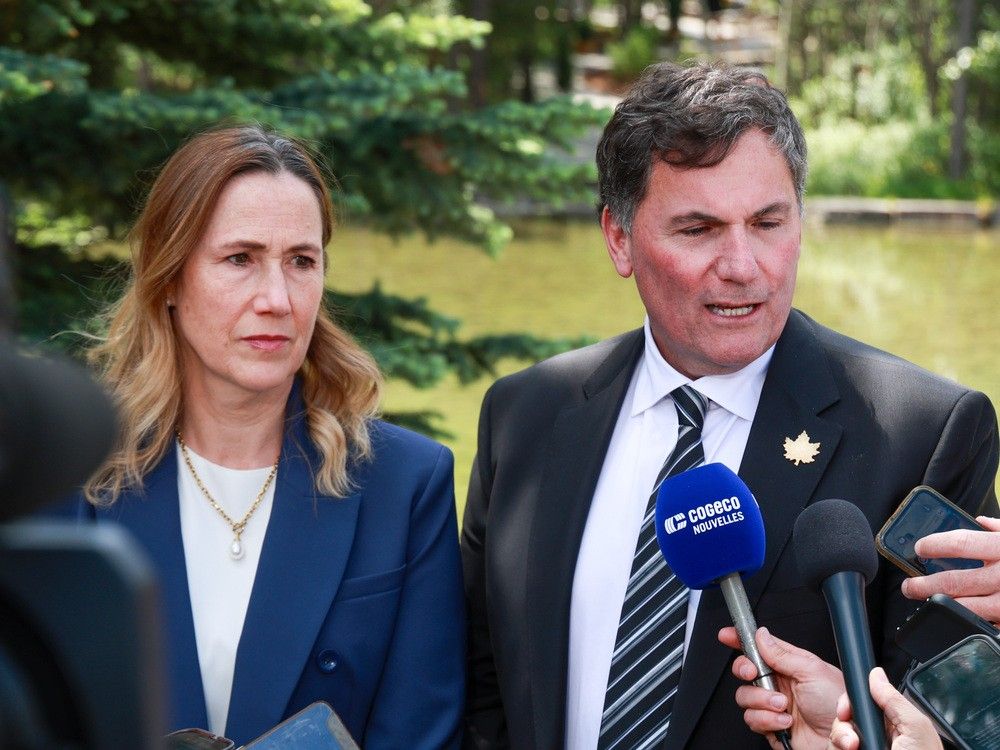
After meeting with his cabinet Wednesday, Carney told reporters that the recognition was conditional on the Palestinian Authority, which governs the West Bank, going forward with significant reforms which include demilitarization and holding a general election in 2026.

He added Canada’s longstanding hope for a two-state solution negotiated between the Palestinian Authority and Israel was “no longer tenable” because of the war in Gaza.

Carney called the U.S. an “essential partner” for peace in the Middle East, among many areas of the world, but made it clear Canada would be moving without its neighbour.

“We make our own independent foreign policy positions,” he said, later clarifying “independent of the United States.”

Louise Blais, who was Canada’s Deputy Permanent Representative to the United Nations in New York from 2017-2021, said this announcement marks a significant change of position for Canada, which has been more or less aligned with the U.S. on Israel for years.

“At minimum, I think it would have been prudent … to have had a conversation. It’s possible it took place. But it certainly doesn’t seem that way,” said Blais in an interview.

“It is always a good idea not to take allies by surprise,” she added.

A source close to Carney’s thinking, speaking on a not-for-attribution basis to speak more freely, said there has been a sharing of views between Canada, France and the U.K., but their subsequent announcements on Palestinian statehood were not a co-ordinated effort.

“This is an example of like-minded countries acting like-minded,” said the source.

Carney explained on Wednesday that “it does matter that others are moving … because it increases the prospect of success.” But he added that the “rights of people to self-determination” are at the core of this decision for the Canadian government.

“We have long … felt that this should come later in a process and that our recognition … of the State of Palestine, should come a point of maximum impact during a peace process,” he said.

“We’re now at a position … where, in our judgment and the judgment of others, the prospect of a Palestinian state is literally receding before our eyes,” he added.

Blais said Carney is clearly signalling that Canada is aligning itself with its European partners more closely, but warned he has to weigh that decision “very carefully.”

“Geography matters, and our neighbour is a superpower,” she said. “And last time I checked, we still very much depend on them for our national security, and it will be so for a while, and so we have to be fairly balanced and careful about that.”

It is also a question of timing. Blais said Trump definitely voiced “a level of annoyance” that was not preferable as Canadian negotiators were trying to get to a trade deal by Friday.

White House press secretary Karoline Leavitt said Trump “expressed his displeasure and his disagreement” with the leaders of France, the U.K. and Canada on that decision.

“He feels as though that’s rewarding Hamas at a time where Hamas is the true impediment to a ceasefire and to the release of all of the hostages,” she said.

But Trump is also dealing with growing displeasure towards Israel within his own ranks. This week, Marjorie Taylor Greene became the first House Republican to publicly refer to the humanitarian crisis in Gaza as “genocide.”

U.S. special envoy to the Middle East, Steve Witkoff, and U.S. ambassador to Israel, Mike Huckabee, will be travelling to Gaza on Friday to inspect food aid distribution sites in the area and hear first-hand from Gazans about their living conditions, said Leavitt.

Following their visit, they are expected to secure a plan to deliver more food.

Canada, for its part, partnered with Jordan to arrange airdrops of aid in Gaza on Thursday.

“Much more aid is needed and Canada will continue to do all it can to ensure it is delivered to the Palestinians in Gaza who so desperately need it,”

said Foreign Affairs Minister Anita Anand in a post on X. 

— With files from Christopher Nardi.

National Post

calevesque@postmedia.com

Our website is the place for the latest breaking news, exclusive scoops, longreads and provocative commentary. Please bookmark nationalpost.com and sign up for our newsletters here.


Illustration of dementia as memory loss due to brain degeneration and decline.

By 2050, over 1.7 million Canadians are projected to be living with dementia. This represents an increase of 187 per cent compared to 2020, when approximately 597,300 Canadians were living with dementia, according to the

Alzheimer’s Society of Canada

.

Dementia describes the decline of mental ability, while Alzheimer’s Disease is the medical term for the brain disease that commonly causes dementia.

Researchers are now saying certain lifestyle changes can stave off mental decline. A new

U.S
. study

sets out what Alzheimer’s researchers are calling the strongest evidence yet regarding what is involved in slowing the aging process and improving cognition.

It comes down to three key factors: a diet heavy on leafy greens, berries and grains, regular moderate exercise and ongoing social interaction. Regular cardiovascular monitoring is also a factor.

Jessica Langbaum, senior director of research strategy at the

Banner Alzheimer’s Institute

in Phoenix was not involved directly in the research but she presented the findings at an annual conference of experts in Toronto on Wednesday.

The

Alzheimer’s Association International Conference

(AAIC) is the largest international meeting dedicated to advancing dementia science and clinical practice. This year’s gathering brought together 8,000 scientists and clinicians from all over the world, with the goal of improving diagnosis, risk reduction and treatment.

The study pulled together diet, exercise and socialization in one substantial, structured study of 2,100 people in their 60s and 70s at risk of developing dementia, showing that bad habits “can really slow down memory and thinking” in adults at risk for cognitive impairment and dementia, Langbaum told the

PBS New Hour

in an interview on Wednesday evening.

The subjects who participated in the study changed their habits, shifting from a sedentary lifestyle to an active one and improving their diet over a two-year period, resulting in cognitive function scores on par with people one or two years younger.

That might not sound like much, but Langbaum says the results are significant evidence that change can occur without medication. “And so, it’s showing that we can change the trajectory of aging,” she said.

There were two groups in the study. In one, lifestyle changes were structurally prescribed. In the other, the changes were self-directed. The results for the prescribed group were much better, but Langbaum says both groups showed improvement.

The biggest challenge that study participants faced was sustaining a new exercise regime. Langbaum recommends people find something that they enjoy doing.

“If (you’re) frustrated by it, (you’re) just going to give up. But do something that you enjoy. Better yet, do it with somebody else or others around you because socialization is key, and lastly, something that you can adhere to, if you can schedule it. It’s something that you can stay committed to.”

Regarding nutrition she notes: “We say what’s good for the heart is good for the brain, so a nice balanced … nutritious diet with … those leafy greens, low in saturated fats, all of those things.”

The American Alzheimer’s Association spent close to

US$50 million on the study

. The National Institutes of Health spent even more to ensure many of the participants underwent brain scans, blood tests and sleep studies aimed at provide additional information down the road.

Meanwhile, Langbaum expresses concern that structured intervention may not be sustainable in most communities. “I think that’s really the next stage of the research is, how do we make this scalable in communities so that people can implement these things into their daily lives?”

The American Alzheimer’s Association is planning to spend another US$40 million on implementing the lessons of the study.

Langbaum says that will come with a change in the mindsets of doctors. They “should be treating lifestyle interventions as they would a drug,” she told

NPR

. That would mean prescribing improved exercise and eating regimens and getting insurers to cover those prescriptions, she added.

Our website is the place for the latest breaking news, exclusive scoops, longreads and provocative commentary. Please bookmark nationalpost.com and sign up for our daily newsletter, Posted, here.



Douglas Worth, convicted of killing a 12-year-old girl in 1987, has been released on parole and is living in Dartmouth, N.S., according to Halifax Regional Police.

A Nova Scotia man who raped and murdered a 12-year-old Ontario girl, later decapitating her dead body in an attempt to hide evidence, has been released on parole and is living in the Halifax area.

According to Halifax Regional Police, 73-year-old high-risk offender Douglas Worth is living in Dartmouth.

Worth, originally from the Pictou County area of Nova Scotia, was released after serving 35 years of a federal life sentence for the December 1987 second-degree murder of Trina Campbell in Brampton, Ont.

National Post has contacted the Parole Board of Canada to obtain a copy of their decision to release Worth, who police say can have no contact with children or his victims, no drugs or alcohol, and must report all relationships.

Worth has a criminal history dating back to 1968 that includes break-ins, motor vehicle theft and the 1978 rape of an Indigenous girl in Ontario, for which he was sentenced and served eight years, earning his release in June of 1987, about seven months before he killed Campbell.

The circumstances surrounding that murder are detailed in multiple news articles from the time and are also explored in

a 2005 episode of the television series Crime Stories.

In the show, it notes that shortly before his release, Worth had said he planned to kill people and go on a rampage as retribution for his incarceration. Despite those concerns, he had served his limited sentence, and nothing in Canadian law at the time established safeguards around release.

After Worth got out in the spring, however, police tracked him to Edmonton, where he reconnected with a woman named Mary Kelly and her teenage son from a different relationship, Shawn. Police said they lost track of Worth soon after, but believed he returned to Ontario.

Police said Campbell, a Metis girl who’d had a troubled life, was living in a group home in the fall of 1987 after having run away from foster parents on several occasions.

When she failed to return to the facility on Dec. 11, they thought at first she might have run away again.

A months-long investigation into her disappearance ensued, but police didn’t have any credible leads by the time February rolled around. Despite no evidence of foul play, the file was handed off to homicide detectives Edward Toye and Len Favreau.

Meanwhile, Peel police were completely unaware that Worth was living in a downtown boarding house close to where Campbell was last seen by her school bus driver.

”We had no idea this sadistic predator had moved into our area,” Inspector Rod Piukkala said on Crime Stories.

Authorities later learned Worth was soon rejoined by the Kellys, and in March of 1988, he asked Mary to rent a vehicle and accompany him so that he could move evidence related to an undisclosed crime.

“He left the car with a hockey bag and went into this ravine area. He then was seen by Mary to come from there carrying this hockey bag that was now laden with something,” assistant Crown prosecutor Al O’Marra said on the show.

The two drove about an hour north of Brampton, where Mary said Worth took the bag into the woods and came back with it empty.

Back in Brampton, he then ordered 14-year-old Shawn to clean up a stain left in the car’s trunk.

After the Kellys moved with Worth to his home province in April, Shawn asked his school’s guidance counsellor and Stellarton Police for help escaping the violence he was experiencing at home, according to a 2005 article in The Evening News in New Glasgow.

During that chat, Sgt. Hugh Muir, knowing Worth was wanted in connection with crimes in Ontario, asked Shawn about Brampton specifically, prompting the teenager to recount the stain story and that he had heard Worth tell other family members that he had killed a man there, not a girl.

“We were both stunned,” Muir said of himself and the guidance counsellor. “We had no inkling whatsoever that this was coming.”

Armed with new information, Toye and Favreau located the rental car with the dark stain. Testing quickly revealed it to be not only human blood, but decomposed human blood. They also discovered the rare blood type is common among Indigenous persons, leading police to think there could be a “loose chance” of a Campbell connection.

The Peel detectives travelled to N.S. to begin surveilling Worth, but had little evidence to act on. Before long, Sharon and Wade Lewis, Worth’s sister and brother-in-law, agreed to interviews, during which they spoke about the murder admission overheard by Shawn and Worth’s growing paranoia that someone would find the body and connect it to him.

“They advised us that Doug had approached them requesting assistance to get back to Brampton so that he could retrieve the head of the victim,” Favreau said on Crime Stories. “Doug told them that if you can get the head of the victim, it would prevent anyone from being able to identify the victim.”

Armed with that knowledge, police devised a plan whereby they would provide money and a rented car to Sharon that she would give to Worth and urge him to hit the road and deal with his problem.

Worth took the bait, and police discreetly tailed him back to Brampton, where he and Mary arrived on the night of May 7 under constant surveillance. Worth gave police the slip overnight, but officers fanned out and eventually located the pair exiting the woods.

“I’ll never forget that sight and that immense wave of relief that washed over me when we saw the car parked there and saw Doug coming out of the bush carrying a gym bag. He didn’t seem to pay us any mind,” Peel Det. Mike Cederberg told producers for Crime Stories.

To eliminate any chance of an alibi that he had found the remains and was returning them to police, officers allowed Worth to drive past two police stations before stopping him in Brampton. In the gym bag, forensics officers found a decomposing skull wrapped in garbage bags, which they soon confirmed was that of the missing girl.

The rest of her body was recovered from the area north of the city later that day.

“He broke her leg, fractured her skull, her body was butchered, he snapped off her forearms and dumped her body,” O’Marra told the court during Worth’s 1990 trial, according to the Windsor Star.

When first apprehended, Worth told police he’d grabbed Campbell in a supermarket, and raped and beat her before leaving her to die in a ravine.

During the trial, however, he pleaded not guilty to first-degree murder. Defence lawyer Damien Frost asked the jury to accept an insanity plea, arguing Worth was hallucinating and believed Campbell was a female prison guard from his previous time in prison.

It took jurors under an hour to reject that argument and present their guilty verdict to Justice Coulter Osbourne, who handed Worth a life sentence with no chance of parole for 23 years.

Worth unleashed a confusing and contradictory rant after his sentencing, per the Star.

”I did not kill her,” he said before adding, ”I’m not saying I’m not to blame for the cause of her death.”

He went on to add that people who commit crimes like this against children “should be shot.”

“That goes for me, too,” he said.

He also told O’Marra that he is “not the cold-hearted son of a b—-” he was made out to be during the trial.

”They say I’m mentally ill, but I don’t want to go on living like this if there’s no hope. . . I’ll put a bullet through my head.”

Halifax police said its advisory this week is meant to inform the public of Worth’s presence and is “not intended to encourage any form of vigilante activity or other unreasonable conduct.”

Our website is the place for the latest breaking news, exclusive scoops, longreads and provocative commentary. Please bookmark nationalpost.com and sign up for our daily newsletter, Posted, here.


Gold medalist Summer McIntosh of Team Canada celebrates on the podium during the Women's 200-metre Butterfly medal ceremony at the Singapore 2025 World Aquatics Championships on July 31, 2025.

Canadian swimming sensation Summer McIntosh won her third gold of the Singapore world championships on Thursday in the 200-metre butterfly, coming within two tenths of a second of setting a world record in the event.

McIntosh completed the race in 2 minutes, 1.99 seconds, just behind the world mark of 2:01.81 set by Liu Zige of China in 2009.

Still, the second-fastest time in history was more than enough to beat Regan Smith of America, who placed second at 2:04.99, and Australia’s Elizabeth Dekkers, who was third with 2:06.12.

It also moved McIntosh a step closer to match Michael Phelps’ record. He is the only swimmer in history to win five individual titles at a single world championships. McIntosh has already won the 400-metre freestyle and the 200-metre individual medley in Singapore.

Coincidentally, she announced this year that after Singapore she plans to move to Austin, Texas, to train with Bob Bowman, Phelps’ former coach. McIntosh also has a cat named Mikey, in honour of Phelps and his record as the world’s most decorated Olympian (28 medals, 23 of them gold).

“I was so close, that’s what upsets me a little bit,” McIntosh told CBC after Thursday’s race. “It was so close and I know that last 15 metres I took an extra breath and I should’ve had my head down.”

She added: “This is definitely going to fuel me for next season, so it leaves a little bit more fuel in the tank and really get closer and closer to that record. If there’s one world record that I wanted to break since the start of my career it’s this one.”

The swimmer, who turns 19 in August, has already been having an amazing summer, even before Singapore. In June she broke two world records in three days at the Canadian swimming trials.

McIntosh swam the 200-metre individual medley there in 2 minutes and 5.7 seconds, breaking the previous record of 2:06.12 set by Hungary’s Katinka Hosszu in 2015. And she completed the 400-metre freestyle in 3:54.18, shaving more than a second off the old record of 3:55.38 set by Ariarne Titmus of Australia.

“I’ve been knocking on the door on this one,” she told the Associated Press, referring to the 200-metre race. “I’ve just tried to chip away, chip away at it. To finally do it, it’s kind of like, wow, I’ve finally got that done.”

“I’m really trying to take it one race at a time,” she added. “Really kind of cruising the heats and then coming to every final super locked in and focused.”

Next up for McIntosh is the 800-metre freestyle Saturday, where she will square off against American legend Katie Ledecky, the world record holder. McIntosh early in her career had a swim cap once worn by Ledecky, who has 10 Olympic medals, seven of them gold.

If McIntosh takes gold there, Sunday’s 400-metre individual medley could offer a chance to match Phelps’ record of five.

McIntosh, the daughter of another Canadian Olympic swimmer, Jill Horstead, was at 14 the youngest member of the Canadian team selected for the Tokyo 2020 Olympics in 2021. The Toronto native took fourth place in the 400-metre freestyle that year.

A year later, in her World Aquatics Championships debut in Budapest, McIntosh won the 200-metre butterfly and the 400-metre individual medley, breaking the world junior record in both.

She went on to win six medals at the 2022 Commonwealth Games in Birmingham just weeks later, and last year she won three gold medals at the Paris Olympics in her three individual events of the 400 and 200 individual medleys and the 200 butterfly. She also won silver in the 400 free.

Our website is the place for the latest breaking news, exclusive scoops, longreads and provocative commentary. Please bookmark nationalpost.com and sign up for our newsletters here.


Google signage on a building in Toronto, Tuesday February 20, 2024.

In defending a lawsuit by a former employee claiming Google Canada fired her within days of telling her bosses she was pregnant, the tech giant claims that pregnancy is not a protected ground under the Ontario Human Rights Code.

Sarah Lilleyman filed a statement of claim in Toronto’s Superior Court of Justice last year claiming wrongful dismissal and a breach of the Ontario Human Rights Code because of “pregnancy discrimination,” as

previously reported by National Post.

Google Canada, headquartered in Toronto, filed a statement of defence in court as part of the legal process for adjudicating the claim. In it, Google, a leading provider of online search services and internet-related products, denies discrimination and wrongful dismissal.

Google says Lilleyman worked for the company from October 2021 “until her employment was terminated on March 22, 2024, as part of a workforce reduction.” She worked as an editor, responsible for user growth through writing, editing, and publishing content.

“In January 2024, due to changing business needs, Google Canada was forced to implement significant workforce reductions across various locations and divisions. Lilleyman’s role was among those impacted by this workforce reduction in Canada.” She was given two months’ notice.

“Google Canada denies it discriminated against Lilleyman in her employment or on termination on the basis of sex, gender, or any other protected ground under the Ontario Human Rights Code,” Google says in its statement of defence.

Lilleyman’s job, “along with many other positions,” was eliminated in a company-wide reduction and her pregnancy or leave were not factors.

The Google statement then continues: “Moreover, Google Canada states that Lilleyman’s allegations, even if true (which are expressly denied), do not amount to a violation of the Code…

“First, ‘pregnancy’ is not a protected ground under the Code.”

The Ontario Human Rights Commission, the provincial government’s official human rights watchdog, says otherwise.

“The Code protects a woman because she is or was pregnant, may become pregnant, has just had a baby or other pregnancy-related situations. Pregnancy includes the process of having a baby from conception up to the period following childbirth. It also includes the post-delivery period and breastfeeding,” the tribunal says in an information package

on the human rights code’s application

.

“It is contrary to the Code to fire you, demote you or lay you off (even with notice) because you are or may become pregnant. If you are or may become pregnant, you have the right to keep your job and not to be passed over for benefits and opportunities.”

Veronica Spada, a spokeswoman with the Ontario Human Rights Tribunal, a body that adjudicates discrimination complaints about the code, said she cannot comment on specific complaints but confirmed the province’s human rights code prohibits discrimination and harassment on several grounds, among them sex, “including sexual harassment and pregnancy.”

Google officials declined to discuss specifics of the case.

“We cannot comment on active litigation; our position is outlined in the documents filed with the court,” a spokesperson said.

Lilleyman’s lawyer, Kathryn Marshall, said Google made the statement in their public court filing and have not recanted or amended it since.

“This is their legal position and they are standing behind it despite the fact that it is contrary to the human rights code,” Marshall said.

“I believe that Google is trying to import American law into Canada and is willfully ignoring Canadian human rights law that protects women from pregnancy discrimination.”

Daniel Del Gobbo, an assistant law professor and chair of the Law, Gender, and Sexual Justice program at the University of Windsor, said Google is wrong in its interpretation of the Ontario Human Rights Code.

“Pregnancy in the workplace is a fundamental issue of gender equality in Canada. Individuals should not suffer negative consequences because they were, are, or may become pregnant. And individuals should not suffer negative consequences because they plan to take or have taken maternity or parental leave. Human rights law is clear on these points,” Del Gobbo told National Post.

“An employer cannot consider the factor that the employee is pregnant and/or planning a maternity or parental leave when deciding whether to terminate the person’s employment,” he said.

Lilleyman, of Trent Hills, between Kingston and Oshawa, moved to Google from a job at Shopify after a career in news media, including at the Winnipeg Free Press and as an editor at Toronto’s Globe and Mail.

In her lawsuit, she asks for damages for lost compensation and benefits, as well as $250,000 in punitive damages and $150,000 for alleged breaches of the Ontario Human Rights Code. Google said she earned an annual base salary of $181,980 plus a discretionary 20-per-cent bonus, a benefits package, and Google stock eligibility.

“The Plaintiff was terminated by Google shortly after she disclosed her pregnancy and her intention to take an 18-month maternity leave and her need for medical accommodations. At the time that the Plaintiff was terminated, she was in the second trimester of her pregnancy,” her claim says.

She claims a Google human resources representative told her she “should conceal her pregnancy when seeking new jobs during the working notice period,” the claim alleges.

Google denies that any Google human resources representative made such a statement and challenged Lilleyman to prove it.

None of the allegations have been proven in court.

Google is best known for its namesake internet search engine and has an immense presence on a global scale. It is a subsidiary of Alphabet Inc., which is ranked as one of the world’s largest companies and most valuable brands.

• Email: ahumphreys@postmedia.com | X:

Our website is the place for the latest breaking news, exclusive scoops, longreads and provocative commentary. Please bookmark nationalpost.com and sign up for our newsletters here.


A Delta Airlines flight bound for Europe was forced to land in Minneapolis-St. Paul after it hit significant turbulence that resulted in several injuries. Photo by SAUL LOEB/AFP via Getty Images)

A Delta Air Lines flight flying on Wednesday evening from Salt Lake City to Amsterdam was forced into an emergency landing after it encountered significant turbulence that injured 25 people on board.
 

The Airbus A330-900 landed safely at the Minneapolis-St. Paul International Airport, where it was met by
 the airport fire department and paramedics. Initial medical attention was provided to passengers and crew, and some people were taken to area hospitals.
 

“We are grateful for the support of all emergency responders involved,” Delta said in a statement released on Wednesday night. “Safety is our No. 1 value at Delta, and our Delta Care Team is working directly with customers to support their immediate needs.”
 

Passengers who weren’t wearing seat belts at the time were thrown about the cabin, according to the Associated Press.
 

“They hit the ceiling, and then they fell to the ground,” Leann Clement-Nash told ABC News. “And the carts also hit the ceiling and fell to the ground and people were injured. It happened several times, so it was really scary.”
 

“The overwhelming majority of the folks taken to the hospital for evaluation and treatment have been released,” a Delta spokesperson told CNN Thursday morning.
 

One passenger, William Webster, told CNN it was “the craziest turbulence I’ve ever seen in my life. I felt the centrifugal force. I was off my seat for like 30 seconds with the turbulence.”
 

People were screaming as phones and other items were thrown into the air, Webster said.
 
“I watched a wine cart just get thrown into the air,” he said, adding he was wearing his seatbelt and was able to grab his phone and an empty glass before they flew into the air. 

Turbulence is constituted by unstable air movements caused by changes in wind speed and direction. That includes jet streams, thunderstorms, and cold or warm weather fronts.
The severity can vary widely resulting in minor or dramatic changes in altitude.
 
It can even occur in placid skies, where it can be invisible to the naked eye and weather radar.
 

Serious injuries from in-flight 
turbulence are rare,
 says the Associated Press, but scientists say they may be 
becoming more common
 as climate change alters the jet stream.
 

According to the 
National Transportation Safety Board,
between 2009 and 2022, 163 people were sufficiently injured by turbulence that they required hospital treatment for at least two days.
 
Most were flight attendants, who are at higher risk due to moving around the cabin during flights.
 

In May 2024, a passenger on a Singapore Airlines flight
was killed
, marking the first turbulence-related death in several years. The Boeing 777-300 dropped 6,000 feet in about three minutes after it hit heavy turbulence over the Indian Ocean.
 

The NTSB is investigating what happened aboard the Delta flight and will provide a preliminary report in several weeks.
 

Our website is the place for the latest breaking news, exclusive scoops, longreads and provocative commentary. Please bookmark nationalpost.com and sign up for our daily newsletter, Posted, here.


Prime Minister Mark Carney announces that Canada

Jewish groups in Canada reacted swiftly and negatively to Prime Minister Mark Carney’s announcement Wednesday that the country will recognize a State of Palestine at the United Nations in September.

Carney told reporters that the recognition was conditional on the Palestinian Authority, which governs the West Bank, going forward with significant reforms including demilitarization and holding a general election in 2026. He also accused the Israeli government of failing to “prevent the rapidly deteriorating humanitarian disaster in Gaza.”

Noah Shack, CEO of the Centre for Israel and Jewish Affairs,

released a statement

Wednesday on what the group called “Canada’s Middle East Position.” The CIJA is the advocacy agent of Jewish Federations of Canada-UIA, representing Jewish Federations across Canada.

“Today, the Prime Minister stated that Canada will pre-emptively recognize a Palestinian state,” Shack said. “This is predicated on misplaced faith in vague commitments by Palestinian Authority President Mahmoud Abbas, notorious for his corruption, lack of democratic credibility, and funding of terrorists.”

He continued: “Extending recognition absent real change on the ground is a recipe for another failed Palestinian pseudo-state controlled by terrorists. It is deeply concerning that the government did not make statehood recognition contingent on the removal of Hamas from Gaza and the return of Israeli hostages. This only emboldens Hamas and condemns Palestinians and Israelis — including the hostages and their families — to more suffering.

“Our community seeks an end to this painful conflict and a better future where Israelis and Palestinians can coexist in peace. As the Prime Minister previously said, this requires a Palestinian state to be Zionist — affirming the right of a democratic, Jewish state to exist in safety. Pre-emptive recognition of a Palestinian state undermines this core principle.”

The organization also has information on how to

contact Carney

with the message: “Real peace = no failed terror state.”

B’nai Brith Canada

echoed that sentiment, calling Carney’s announcement

“dangerous and premature.”

“As the Government’s intent to recognize a Palestinian state is predicated on the Palestinian Authority (PA)’s commitment to democratic reform and demilitarization, B’nai Brith Canada questions whether the PA can be trusted as a legitimate state actor and partner in the peace process,” said Richard Robertson, the organization’s director of research and advocacy.

“Although Canada should play a leading role in securing an end to the Israel-Palestine conflict, recognizing Palestine as a state at this juncture would be premature and could undermine efforts to achieve a lasting peace,” he continued. “Such a decision could also be leveraged by anti-Israel extremists as an endorsement of their vitriolic actions that have been fomenting hate across Canada.”

Avi Abraham Benlolo, CEO and chair of the Abraham Global Peace Initiative and a National Post columnist, took to social media to announce that the AGPI “D

enounces Canada’s Announcement to recognize a Palestinian State (and) Calls on Canadians to take Action.”

“Canada’s endorsement of a Palestinian state — without a roadmap for peace or clarity on borders, leadership, or governance — is not a step toward peace; it is a reward for terrorism,” he said on the group’s website. “Prime Minister Mark Carney does not have a plan. There is no agreement between the two parties. A two-state solution cannot be imposed from abroad — it must be the outcome of direct negotiations between Israelis and Palestinians. And yet none of that is happening.”

The group is calling on

supporters “to immediately contact Members of Parliament in their ridings and across the country to express deep dissatisfaction with this dangerous and short-sighted decision.”

[related_links /

Our website is the place for the latest breaking news, exclusive scoops, longreads and provocative commentary. Please bookmark nationalpost.com and sign up for our newsletters here.


Quebec Liberal MP Sameer Zuberi (right) with Dr. Riyad Mansour. Palestine’s Ambassador to the United Nations.

“It’s time for Canada to join France in recognizing the State of Palestine,” wrote Liberal Member of Parliament Sameer Zuberi in a

<a href="%7B%22provider_name%22:%22Instagram%22,%22provider_url%22:%22https:%5C/%5C/www.instagram.com%5C/%22,%22object_url%22:%22https:%5C/%5C/www.instagram.com%5C/p%5C/DMnvNUKg3BN%5C/%22,%22html%22:%22

%20%20

%20

%20

%20

%20

%20

%20

View%20this%20post%20on%20Instagram

%20

%20

%20

%20

%20

%20

%20

%20

%20

%20

%20

%20

A%20post%20shared%20by%20Sameer%20Zuberi%20%5Cud83c%5Cudde8%5Cud83c%5Cudde6%20(@sameerzuberi.mp)%5Cn%22,%22type%22:%22oembed%22,%22channels%22:%5B%22desktop%22,%22tablet%22,%22phone%22%5D%7D?utm_source=ig_web_copy_link” rel=”noopener noreferrer” target=”_blank”>recent Instagram post

about his meeting with Dr. Riyad Mansour, Palestine’s Ambassador to the United Nations. “Nearly 150 states, Spain and Ireland included, already do.”

Zuberi represents the Pierrefonds-Dollard riding on the Island of Montreal. Ron Goldman, one of the riding’s constituents, says he left a “critical but civil” comment on Zuberi’s post and that his comment was removed shortly after being posted.

A screenshot of the comment shows Goldman accusing Mansour of “back[ing] a regime that educates children to hate and hides rockets in schools.” Goldman describes the ambassador as “a propagandist in a suit” and calls Zuberi’s meeting with Mansour an act of “moral surrender.” The comment was not visible on Zuberi’s Instagram post one day later, suggesting the MP or his staff may have hidden or deleted it. It is also possible that the comment was hidden by Instagram’s content filtering algorithms.

Zuberi’s original post was made on a verified public account that he uses to share information about his political activities. The alleged removal of Goldman’s comment raises questions about the line between appropriate content moderation and censorship by a public official.

Zuberi did not respond to National Post requests for comments before deadline.

Frustrated by the removal of his comment, Goldman says that he reported his experience to the Office of the Conflict of Interest and Ethics Commissioner. “We’re supposed to live in a democracy where all viewpoints are heard and discussed and debated. That’s what really pissed me off … Whether it’s on the left or the right, politicians should not be allowed to censor their constituents.”

The Canadian Charter of Rights and Freedoms protects freedom of thought, belief, opinion and expression. Section 32 states that the obligations expressed in the Charter apply to Parliament, the Government of Canada and all provincial governments.

Whether Section 32 extends to the online behaviour of individual Parliament members is “a bit of a grey area,” according to Marty Moore, a lawyer at the

Justice Centre for Constitutional Freedoms

.

“If [a representative is] acting as a member of the government, then clearly the charter applies,” says Moore. “If they’re acting as a Member of Parliament, there’s a textual argument to be made that the Charter applies, but it’s not clear.” Moore notes that Canadian case law does not clarify whether actions taken by an official social media account qualify as governmental action.

This grey area has allowed some politicians to censor content or block members of the public on their official social media profiles without facing legal consequences.

In 2018, the Toronto Star reported that

Michelle Rempel Garner

, a Conservative MP for the Alberta riding of Calgary Nose Hill, blocked a 17-year-old Indigenous youth representative named Lance Copegog from viewing or engaging with her official account on Twitter (now X).

Garner had tweeted about the rising number of asylum claimants, and Copepog replied, saying that “the only people that should be concerned about ‘illegal immigration’ to Canada are the original people to these lands.” Copepog said that his account was blocked by Garner within five minutes of his tweet.

In other cases, courts have intervened in politicians’ social media behaviour. In 2023, a federal court ordered then environment minister Steven Guilbeault to unblock

Ezra Levant

, the founder of alternative news platform Rebel Media, on X.

Levant successfully argued that while Guilbeault’s account was not officially attached to the Government of Canada, it resembled a government platform because it communicated important information about “matters of public concern.” Federal Court Justice Russell Zinn ruled that Guilbeault must leave Levant unblocked for the rest of his term in Parliament and contribute $20,000 to Levant’s legal costs.

As digital spaces take on a central role in civil discourse, some government bodies have published guidelines on how they will moderate online content. For example, the House of Commons states that it “does not discriminate against any views” when removing comments on its social media pages, but will remove content that is discriminatory, hateful, abusive or defamatory.

A representative from the House of Commons clarified these policies do not apply to the social media accounts of individual MPs, who are “individually responsible for … managing their accounts.” But few members of Parliament have published guidelines of their own, leaving their constituents uncertain as to what content is permitted.

Moore says that restrictions on online speech can threaten Canadians’ ability to express themselves and hold elected leaders to account. “Social media is the public sphere of our day,” he notes. “Canadians need to understand the benefits of permitting free and frank discussions in the public square.”

Our website is the place for the latest breaking news, exclusive scoops, longreads and provocative commentary. Please bookmark nationalpost.com and sign up for our newsletters here.


RCMP cadets are inspected during the Sergeant Major’s Parade at RCMP Depot Division in Regina on July 22, 2025.

OTTAWA — While the federal Liberal government has signalled plans to make good on its campaign promise to give raises to military members, it is keeping tight-lipped about whether it intends to do the same for RCMP recruits.

During this spring’s federal election campaign, Prime Minister Mark Carney

pledged to bolster the national police force by hiring another 1,000 members

, creating a new academy within the RCMP’s Depot training division, and, according to the Liberal platform, “increase pay for cadet recruits.”

Hiking the pay that RCMP cadets receive during their 26-week training program from its current $525 per week is one of the requests that the National Police Federation, the union representing RCMP members, has made of the government in recent budget cycles. The force itself supports the move, as it seeks

ways to boost sluggish recruitment numbers

.

Asked by National Post this week whether the government intends to move on its promise of increased pay, Public Safety Minister Gary Anandasangaree’s office declined to comment, citing an ongoing budget process.

“The RCMP plays a vital role in keeping Canadians safe, and we remain firmly committed to supporting their important work,” wrote spokesman Simon Lafortune in an email.

“Given the federal government’s ongoing pre-budget consultation process, we will refrain from commenting at this time.”

John Fragos, a spokesman for Finance Minister Francois Philippe-Champagne, who is planning to present the Carney government’s first budget in October, said in a separate statement that it would have more to say then.

“The minister is engaging in pre-budget consultations with stakeholders and agencies alike. This process spans 45 cities in every province and territory,” Fragos said.

Unlike other departments and federal agencies that

Champagne has asked to find up to 15 per cent in “annual savings,”

the RCMP, along with the Canada Border Services Agency and Department of National Defence, have only been asked to find two per cent in savings over the next three years.

That comes as Canada seeks to bolster its border security by

promising to hire more frontline personnel

and has committed to spending billions of dollars more to

reach the five per cent NATO spending target by 2035

.

Brian Sauve, president of the National Police Federation, said hiking the pay for RCMP recruits would be the “easiest” change the government could make as it looks for ways to help modernize the force’s recruitment process, citing how those who join other police services start receiving a salary from “day one.”

“Our average cadet now is 28 to 30 years old,” he said in an interview from his Ottawa office. “Twenty-eight and 30-year-old Canadians have lives. You know, a lot of them have mortgages, have wives, have husbands, have kids, have commitments, student loan debt.”

“Leaving a job of whatever, and dropping down to $500 a week for (26) weeks is a pretty big commitment,” he said.

Last fall, RCMP commissioner Mike Duheme told National Post he would be satisfied to see pay increase to $1,100 to $1,400 to close the gap between what RCMP cadets receive, compared to recruits of other police services.

He said at the time that he was “pretty confident” changes would be coming and had raised the issue directly with former public safety minister Dominic LeBlanc, whom Duheme described as being “very supportive.” Carney has since appointed LeBlanc to the intergovernmental affairs portfolio.

A response from the RCMP was not returned by press deadline.

Sauve said that while the issue of increased pay for RCMP recruits has “moved along,” it has “never crossed the finish line.”

“This government promised to put it across the finish line in their campaign and in their in their platform,” he said.

Last month, National Defence Minister David McGuinty

confirmed to reporters

that armed forces members would be receiving a 20 per cent pay increase as part of a $9-billion spending increase for the defence budget, which Carney announced as part of his plan to boost Canada’s defence and security commitments.

The Canadian Press later reported that McGuinty’s office was considering a “combination of approaches” for how to reach that pay increase, including by introducing retention bonuses for “stress trades.”

National Post

staylor@postmedia.com

Our website is the place for the latest breaking news, exclusive scoops, longreads and provocative commentary. Please bookmark nationalpost.com and sign up for our daily newsletter, Posted, here.


Osgoode Hall in Toronto, where the Ontario Court of Appeal is located.

Ontario’s top court has upheld a sexual assault conviction involving non-consensual condom removal, despite the Crown’s appeal for a harsher sentence.

In a decision released this week, the Ontario Court of Appeal dismissed the Crown’s appeal of the sentencing in the case of R. v. Ranatunga, where a man was convicted after failing to use a condom during a sexual encounter, despite his partner’s explicit condition that one be used.

The man, Nimal Ranatunga, was sentenced to a conditional sentence of two years less a day.

However, of the three panel of judges, one judge dissented, finding that the trial court should have sentenced the accused to incarceration instead.

“This was a serious sexual assault that has had devastating effects on the victim. Incarceration for the balance of the sentence is necessary to advance the objectives of denunciation and general and specific deterrence,” wrote dissenting Justice Eileen Gillese.

The case dates back to March 2022. The complainant, M.F., had begun a relationship with Ranatunga, the accused, a few months prior to the night of the assault, when the pair went home for pizza and drinks after a night out.

M.F. told the court that prior to the sexual encounter she had been very vocal about where she stood regarding the use of condoms, especially because she was not on any birth control.

On the night in question, the use of condoms was discussed once again, with the respondent asking if they could have relations without one, and M.F. saying “no.”

“She made it abundantly clear that wearing a condom was a prerequisite for sex that evening,” Gillese wrote in her summary of the case.

The pair began a sexual encounter at Ranatunga’s home. During at least part of the intercourse, Ranatunga was wearing a condom, but it was taken off at some point.

“(M.F.) said she learned for the first time that he had removed the condom during intercourse when he told her … that she would ‘need to take a ‘‘Plan B’’ in the morning,” Gillese wrote.

There was no dispute at trial that Ranatunga had removed the condom. However, he argued that he “told her loudly and clearly that he was taking the condom off,” and that while she did not consent verbally, she continued to kiss him, which he took as a sign of consent.

M.F. reported the encounter to police, saying, according to the court documents, that it was the worst day/ of her life.

“She considered self-harm and suicide. She called the suicide prevention line and said that the person who answered her call was her “saving grace” and got her through the night,” Gillese wrote.

Following a two-day trial, the respondent was convicted.

The trial judge found that M.F. had not heard Ranatunga say he was removing the condom and that there was no ambient noise in the bedroom that would have impaired her hearing. The trial judge also rejected Ranatunga’s argument that he had an “honest but mistaken” belief that M.F. had consented to unprotected sex.

At the sentencing hearing, the Crown sought a three-year penitentiary sentence, and the defence submitted that a conditional sentence of 18 months to two years less a day was appropriate or a sentence of imprisonment between 12 and 18 months to be served in a reformatory.

In the end, the trail judge sentenced the respondent to a conditional sentence of two years less a day, finding that he was a first-time offender with good rehabilitative prospects.

The trial judge found that removing a condom without consent is a “form of violence” and an “extremely serious violation,” but found that removing a condom is “qualitatively different in nature than a sexual assault which involves physically holding a person down against their will and penetrating them or penetrating them when they are in a state where they could not resist; for example, sleeping or intoxicated”.

The Crown appealed the case, arguing that the sentence was unfit and that the judge did not appropriately consider the violent nature of the offence.

Gillese objected strongly to the trial judge’s reasoning. “There is no principled basis to distinguish penetration following non-consensual condom removal from other forms of penetrative sexual assault nor is there any principled basis for creating a much lower sentencing range for non-consensual condom removal sexual assault than that for other forms of penetrative sexual assault,” she wrote.

She argued that forced penetrative sexual assault typically calls for three to five years behind bars.

However, the other two justices disagreed, saying the trial judge had intended to contrast sexual assault cases with overt force or incapacitation and that the trial judge was owed deference in her decision within the changing legal landscape of these sorts of sexual assault cases.

The decision builds on the Supreme Court’s 2022 ruling in R. v. Kirkpatrick, which clarified how condom use factors into sexual consent under Canadian law. In that case, the court found that a person can place conditions on their consent, and if those conditions aren’t met, the sexual activity becomes non-consensual.

Our website is the place for the latest breaking news, exclusive scoops, longreads and provocative commentary. Please bookmark nationalpost.com and sign up for our newsletters here.