LP_468x60
on-the-record-468x60-white

Prime Minister Mark Carney delivers a speech on his plans for Canada's economy in advance of the November federal budget, at the University of Ottawa in Ottawa on Wednesday, Oct. 22, 2025.

OTTAWA — For many students across Canada, affordability is top of mind when it comes to the federal budget set to be tabled on Tuesday.

That includes Graham Baskin, a student at Carleton University. After Prime Minister Mark Carney

told university students that Canadians should be ready

for “challenges” and “sacrifices” in a speech last month outlining his priorities for the upcoming budget, Baskin said he is worried for his future.

“We all want a reliable future at this stage in our lives,” said Baskin. “To hear the prime minister say that times are going to be tough is concerning.”

Baskin, 21, suffers from a neurological affliction, similar to cerebral palsy, that affects the connection between his brain and legs.

The history student said he remains determined to finish his degree, but in spite of navigating accessibility challenges on campus — one of the “biggest recent challenges” he has overcome in recent years — coping with rising costs after graduation looms as his next big hurdle.

“I don’t know what’ll happen once I’ve graduated,” said Baskin. “I’m worried in the sense that if I still can’t find work, and prices are still a mess, then life just gets harder.”

Baskin’s worries follow a recent study that found 75 per cent of surveyed students hope to see the federal budget prioritize cost-of-living.

Canada’s cost-of-living crisis and tough job markets are taking a toll on university students, with nearly half saying they need financial support from either parents or other sources to meet their expenses, according to a recent CIBC poll.

Baskin worked at a local golf store in his hometown of Uxbridge, Ont. until last summer, when management abruptly told him to “find work elsewhere.” After applying to several places, including a local library where he sought to leverage his history degree, he simply “didn’t hear back.”

Justin Wiltshire, a labour economist and professor at the University of Victoria, said Canada’s “disappointing” job market only compounds cost-of-living concerns for students.

“I don’t think the cost-of-living concerns are new for young people,” said Wiltshire. “But it’s now a question of, given the current state of the labour market, the threshold is higher for students to even meet basic cost-of-living expenses.”

Yet, Wiltshire said the “future can be bright” for students ahead of the Liberals’ first budget under Carney.

He said there are plenty of opportunities for policies to glean from, offering former prime minister Justin Trudeau’s cuts to interest on student loans as an example.

“It was not particularly expensive, and young people could concentrate their funds elsewhere rather than paying interest on the human capital they’ve accumulated,” said Wiltshire. He also added that Carney’s new federal agency aimed at building affordable housing is “promising.”

“While it’s difficult to forecast the budget, what’s been telegraphed so far could turn the tide for young adults coming out of university.”

With days to go before Carney’s budget, Conservative Leader Pierre Poilievre struck a different tone in a recent speech to youth in downtown Toronto.

“[Carney] said that things are going to get worse and the change will take a very long time,” said Poilievre, who also added Liberals “are going to try and get Canadians to accept this permanent reduction in our quality of life.”

Wiltshire admitted that fixing cost-of-living challenges and a tightening labour market “isn’t going to happen in the very near future.”

“There’s nothing that’s going to happen right now, overnight, but we want to give people reason to believe the future is bright.”

Nir Hagigi, 21, said, as a student, the budget is “really a pivotal moment to give youth hope in a crisis like one we’ve never seen before.”

He added that he, and many other students, are pressed to make ends meet, often relying on university scholarships and food banks to get by.

“Most are realistically living on like $100 a week. That’s nothing. That’s literally poverty living,” said Hagigi. “I think specifically, for students, our crisis is because there are just not enough jobs and too many people who want a job.”

Referring to the labour market, Wiltshire said, “I do think it’s been more difficult now than in previous years, and there is no easy solution from the government.”

However, Wiltshire said he wouldn’t call it a “crisis.”

By making sure “your skills are timely and relevant, pursuing some kind of extended higher education program, or overall finding ways to demonstrate you’re developing soft skills,” Wiltshire said, students can find stable income.

Hagigi said his experience tells a different story.

This past summer, Hagigi was let go as a public policy analyst. Similar to Baskin, Hagigi applied to several positions, highlighting the skills he developed studying global and international studies at Carleton University.

“I got some interviews, but not a single job offer. And my case isn’t even out of the ordinary, I’ve seen this with students all over,” said Hagigi. “We’re just not able to find a job.”

It comes after the youth unemployment rate edged up to almost 15 per cent in September, the highest level since 2010, excluding the pandemic years, according to Statistics Canada.

Kevin McNichol, CEO of Prospect Human Services, a not-for-profit that helps place Albertans in jobs, said he’ll be watching next week’s budget for signs of new investment in job training programs.

McNichol said that after last year’s budget cut a $625 million federal job funding program, he hopes Ottawa supports initiatives that promote local career development and help schools provide rapid skill-building for youth entering the workforce.

But McNichols cautioned youth against relying on, or even expecting, budget measures to overcome cost-of-living and labour market issues.

Instead, he clarified that young Canadians must partly lean on “the values that define Canada: our resiliency and bravery to do what needs to be done when the going gets hard.”

“If I’m a young person, I’m holding onto those cultural values, I’m going out into the world, and I’m finding ways to make a name for myself.”

While Baskin said he’s unsure what specific measures he wants to see in the federal budget, anything that improves his standard of living would help.

“Affordable groceries, affordable housing, not being worried about work, and just being able to live a better life on a reasonable income,” said Baskin. “That’s what I’d like to see.”

National Post

Our website is the place for the latest breaking news, exclusive scoops, longreads and provocative commentary. Please bookmark nationalpost.com and sign up for our daily newsletter, Posted, here.



Canada's Supreme Court struck down mandatory minimum sentences for child pornography offences, prompting conservative  leaders to demand tougher penalties and the use of the notwithstanding clause.

The conservative backlash is growing to Friday’s Supreme Court of Canada ruling throwing out mandatory minimum sentences for child pornography crimes.

“This ruling raises serious questions about whether the punishments will truly reflect the severity of these offences and the pain they inflict,” Nova Scotia Justice Minister Scott Armstrong said in a statement on Saturday.

“Child pornography offences are not abstract or victimless. As a former school principal, I have seen first-hand the devastating harm that sexual exploitation of children can cause,’ he said. “Mandatory minimum sentences send a clear message that exploiting children is among the most serious crimes, and will be treated that way.”

Canada’s top court narrowly ruled Friday to strike down the one-year mandatory minimum sentence requirement for the possession and access of child pornography, after examining the punishment’s impact on a hypothetical 18-year-old involved in sexting.

The decision prompted swift backlash from elected conservatives across the country.

Alberta Premier Danielle Smith and

Ontario Premier Doug Ford

called on the Liberals to keep the one-year mandatory sentence in place by using the notwithstanding clause, which would mean reintroducing the measure in legislation.

“This decision is outrageous,” Smith said Friday on the X social media platform. “The possession of child pornography is a heinous crime, and even a one-year minimum sentence is already far too lenient.”

On X, Saskatchewan

Premier Scott Moe wrote

that the ruling was why he believed “elected legislators, not unelected judges,” ought to make laws.

Former Alberta premier and federal minister Jason Kenney called on the Carney government to invoke the notwithstanding clause — or if it doesn’t, for Conservative Leader Pierre Poilievre to introduce legislation to do so.

“This aberrant decision by the Supreme Court cannot stand. It is a basic test of our fundamental values as a country. Put partisanship and slavish deference to judicial power aside. Do the right thing,”

he said on X.

Poilievre issued a statement late Friday vowing to reintroduce the mandatory sentence, should his party form the next government.

“My future government will reintroduce mandatory minimum sentences for possession of child sexual abuse material and ensure dirtbags like the ones before the court are in prison where they belong,” Poilievre said, adding on X that the Supreme Court ruling was “dead wrong.”

The case, which was heard by a nine-judge panel, involved a challenge to the sentencing rules brought forward by two men in Quebec who pleaded guilty to having hundreds of images of children as young as three being severely abused.

At the heart of the debate was a scenario which was not based on the facts of the actual case but on another possible scenario, which led to a 5-4 ruling from the top court.

The majority ultimately found the one-year mandatory minimum sentences for the crimes to be unconstitutional on the basis that the crimes themselves cover a variety of circumstances, which could cross the Charter-protected right that guards against cruel and unusual punishment.

Nova Scotia’s Armstrong said he would ask federal Justice Minister Sean Fraser “to take action to ensure our justice system continues to protect the most vulnerable, particularly children and youth.”

A spokeswoman for Fraser said on Friday the federal government was reviewing the decision.

“Crimes that exploit or abuse children are among the most serious and reprehensible in our society. Plain and simple: child abusers should face the toughest penalties Canadian law allows,” Lola Dandybaeva wrote in a statement on Friday.

The notwithstanding clause is a section of the Charter that acts as an override function that can cover other sections, including those that protect legal rights. A fierce debate has broken out in recent years about the limits of its use.

Our website is the place for the latest breaking news, exclusive scoops, longreads and provocative commentary. Please bookmark nationalpost.com and sign up for our newsletters here.


Newly-sworn in Mayor Jeromy Farkas speaks before taking part in a fireside chat with Calgary Chamber of Commerce President and CEO Deborah Yedlin on Thursday, October 30, 2025.

Calgarians like their mayors young and trail-blazing. 

Jeromy Farkas, 39, was officially sworn in as Calgary’s 38th mayor this week, alongside 14 city councillors, 10 of whom are rookies. Former mayor Dave Bronconnier assumed the mantle at age 39; Naheed Nenshi was 38. 

In 2010, Nenshi was widely hailed as the first Muslim mayor of a big North American city.  In 2021, Jyoti Gondek was elected as the city’s first female mayor. Farkas identifies as bisexual, making him Calgary’s first openly LGBTQ mayor. 

His worship is still beaming when we talk; he’s been mayor for less than 24 hours and has spent very little time in his new digs at the refurbished historic city hall. Wednesday night’s swearing-in ceremony was emotional, his team reports. They necessarily held off celebrating until the conclusion of an official recount of the Oct. 20 votes by Elections Calgary. 

Farkas won with a 616-vote margin of victory over his closest competitor, former city councillor Sonya Sharp. Gondek finished a distant third, becoming the first incumbent to fail to win re-election since 1980, when Ross Alger lost to Ralph Klein. 

 Calgary Mayor Jeromy Farkas is sworn in by Associate Chief Justice D. Blair Nixon at city hall on Wednesday, October 29, 2025.

“I am perpetually late for stuff,” Farkas chuckles, dashing into his office from a meeting with his executive leadership team. When the internet crashes, on his end, he assures me, “occasionally the WiFi goes on the fritz, but we have the ability to plug you in.” He then proceeds, unflummoxed — just like every other Millennial I know — to do just that. 

The new council is in the midst of onboarding and orientation, including getting familiar with the city’s 2026 budget to be approved by the end of November. Not surprisingly, Farkas has been poked and prodded on the upcoming budget, and assures everyone all options are on the table and pencils will be sharpened to bring down the tax increases proposed by the previous council. 

Beyond the budget, there are other challenges ahead for Farkas, in what looks to be a new council split between conservative-thinking folks and progressives. Farkas ran as an independent — without partisan affiliation — in Calgary’s first municipal election under new provincial rules allowing party alignment. When I take a look at the new city council, it’s quite feasible the mayor will find himself becoming the deciding vote on some of the more divisive issues, including blanket rezoning, the federal policy that ties housing funding to much higher density.

“You have a new council, with those on the right wanting removal of blanket rezoning and those on the left opposed to change,” I observe, then ask Farkas, pointedly: “How are you going to build consensus, on what’s clearly a hill to die on for so many in council?” 

The new mayor is ready for my question, and his response is thoughtful and compelling; I seriously hope his predictions come true.

“You know, I would challenge the premise,” he answers, amicably. “I don’t think that any one of my colleagues is willing to accept the status quo. We heard a lot through the course of the campaign about issues around housing, around affordability, around public safety.

“I think there’s a broad consensus amongst Calgarians,” he says, “that the blanket rezoning approach hasn’t worked in terms of delivering housing at an affordable price point and at the right location, supported by services and infrastructure, or even at the speed and scale that’s required.

“You’ll see $600,000 bungalows being torn down, replaced with four $750,000 luxury condos,” he continues, “and that hasn’t delivered housing that’s affordable. So obviously, I can’t speak for every single one of my colleagues, but there’s a broad consensus that the blanket rezoning hasn’t worked; even amongst some of the more progressive housing advocates, they recognize that there’s issues with the idea of say an eight-plex going in the middle of a block.” 

“What about all that federal funding, tied to blanket rezoning?” I ask. 

“I haven’t had the opportunity to speak directly with the prime minister, at least until Monday,” Farkas responds, “but in my early conversations with some of our federal counterparts, I understand that the housing accelerator funds are tied to performance, tied to units built, and if we can still build the units but in a more targeted way — closer to LRT stations, education, employment — then we’ve fulfilled our obligations. So again, the money is not tied to building expensive eight-plexes in the middle of a block. The money is tied to building housing, and if we can show that we’re still building the housing with a more targeted approach, we should be good to go.” 

It’s the voice of reason many Calgarians — indeed, many Canadians — have been longing for. 

The guy has been in the job less than a day, but I have another burning question, and the WiFi at historic city hall is still working so I wade into the sensitive question of how to manage Calgary’s exponential growth trajectory.

Premier Danielle Smith is on the record, projecting a goal of 10 million people in Alberta by 2050, and it stands to reason roughly half of that growth would be in the Calgary area. The new mayor agrees. “Our council, and me as mayor, we are going to be here to welcome the two millionth Calgarian,” he shares, “which is an amazing number, but rightfully so, it causes some anxiety in the public in terms of the strain on housing, on infrastructure, on services, and this is an opportunity or challenge that could break us or make us.”

“On the debate stage,” Farkas explains, “I was agnostic in terms of whether the number was the right number or the wrong number. As mayor, I do not have control over the number of people moving to the city. But once they are here, I have a clear responsibility and duty to ensure that every single Calgarian has access to a safe and affordable life here.”

It’s a daunting task, we both agree. And recent strike action by the province’s teachers has laid bare the consequences of not being prepared for that scale and speed of growth. 

According to recently obtained stats from the government of Alberta, the net international migration of school-aged children into Alberta rose from 3,347 kids in 2020-21 to 30,120 in 2023-24; net inter-provincial migration numbers are magnitudes lower. And at the Calgary Board of Education, the largest school board in the province, nearly one in three students is in an English as an Additional Language program. Roughly 44,000 K-12 students, in Calgary, are learning English. The implications, in classrooms, are staggering.

I’m left with the impression this young mayor knows what he’s up against, and he’s ready for what’s coming at him. “It’s a great place to be,” Farkas quips, “because, like our city and me personally, I’m now old enough to know and still young enough to do.”

Our website is the place for the latest breaking news, exclusive scoops, longreads and provocative commentary. Please bookmark nationalpost.com and sign up for our newsletters here.


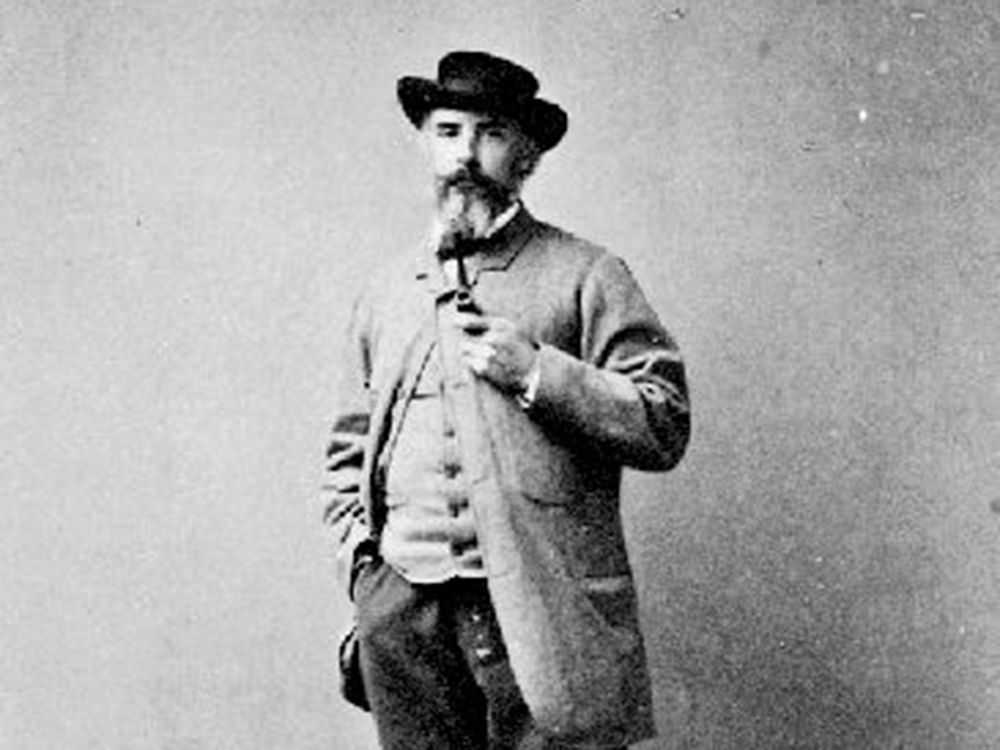
Matthew Begbie, former Chief Justice of the Crown Colony of B.C.

If he was American there would be a movie because Matthew Begbie had hero written all over him. He stood six-five, and when on a horse with his handlebar moustache and van dyke, he looked even bigger. Cutting a commanding figure, he tamed the Old West.

A circuit judge who brought bandits and outlaws to justice, he travelled the highways, biways and rivers of British Columbia before it joined Confederation. He went on horse, on foot, or by canoe, carriage or steamship, and carried out the law in a log cabin, under an oak tree, or in the open wilderness.

Begbie befriended the Native people and spoke Chinook, their trade language in the Pacific Northwest. In 1860 he declared that the Indians held aboriginal title to their land and this must be recognized by law. He forced legislation to ensure Native women shared in the estates of their white partners, married or not.

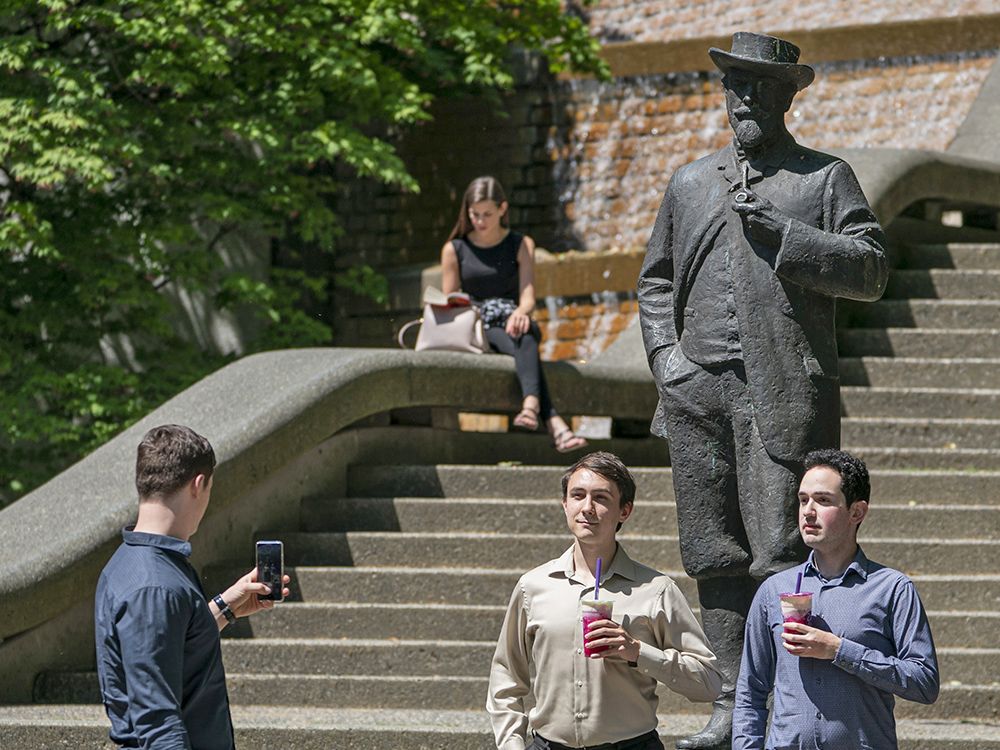
But Matthew Begbie wasn’t American. He was English. The British appointed him chief justice of the Crown Colony of B.C., then a colony of the British Empire. In no small way he helped pave the way for B.C. to join Confederation and they named things after him. Sir Matthew Begbie Elementary School in Vancouver. Mount Begbie. Begbie Summit. Two lakes and a creek. And in New Westminster a street and public square. But the big thing was that statue in front of the city’s courthouse and there was another one in Vancouver outside the Law Society of B.C. It was fitting because he pretty much wrote the law in these parts and for 125 years everything was fine.

In 1958 the National Film Board of Canada produced a docudrama – The Legendary Judge – that started this way: “He was the form and substance of British justice sent out from England to challenge the wild west.” When he arrived exactly one century earlier, in 1858, he was the first and only judge in B.C.

The January 1947 edition of The British Columbia Historical Quarterly ran a piece about Begbie by historian Sydney G. Pettit who described his subject: “Fearless and incorruptible, he made his name a terror to evil-doers who, rather than face his stern and impartial justice in the Queen’s court, abstained from violence or fled the country, never to return.”

Directly below the title of that publication were the words: “Any country worthy of a future should be interested in its past.”

Indeed.

Begbie was a lawyer in London before arriving in B.C. Remaining a judge for 36 years, he’d be responsible for much of B.C.’s early legislation – the Aliens Act of 1859, Gold Fields Act of 1859, Pre-emption Act of 1860 – statues involving immigration, commerce and settlement. But one case in particular sealed his fate and it was done in a way that only a self-flagellating country like Canada could conceive.

Gold discovered in the Fraser Valley led to the arrival of thousands of miners and that changed everything. Salmon fishing was vital to the Indigenous who fought inter-tribal wars over it. One of the worst massacres ever to occur in what is now Canada happened in 1745 in the Dakhel village of Chinlac. The dispute was between the Dakhel and neighbouring Tsilhquot’in, or as they were known, Chilcotin.

An account of the atrocities, written by a priest, describes in vivid detail how the Dakhel chief returned to his village only to see the bodies of his two wives and children hanging on poles. The children’s bodies had been ripped open and spitted through out-turned ribs like salmon drying in the sun.

The message? Don’t mess with salmon.

When the miners came they washed gravel through their mining sluices, diverting waterways, impacting salmon spawning grounds. Whether that caused the Chilcotin War or not, it led to the deadliest attack against whites in western Canada.

Ever.

In 1864 a crew started building a road through Tsilhqot’ territory. Over several days, a score of killings took place, nine in one fell swoop on April 30 when the men were “shot or bludgeoned to death in their tents” as they slept.  The war party then moved on and committed more murders. When it was over, 21 workers and settlers were dead, their bodies mutilated.

There are accounts of what happened. The colonial government set up a search party and found the alleged perpetrators, including their leader, a chief named Klatsassin.

 People pose for a photo with the statue of Judge Matthew Begbie outside BC Supreme Court in New Westminster in 2019. The statue has since been removed.

Begbie was the trial judge and court records exist. A jury trial resulted in guilty verdicts for five of eight men charged with murder. Later, a sixth man was found guilty. Back then such a verdict carried the death penalty and the six were hanged.

From then until 1993 there was no ‘controversy’ about Begbie. But that year a report of the Cariboo-Chilcotin Justice Inquiry examined the relationship between Indigenous People and the justice system, and called for a posthumous pardon of the six chiefs. More than two decades later, in 2014, B.C. Premier Christy Clark issued an apology. She said the chiefs were “fully exonerated of any crime or wrongdoing.”

Then the snowball effect. A plaque posted near the Fraser River in Quesnel, B.C., said the chiefs were wrongfully hanged. In 2015 we had the Truth and Reconciliation Commission report, in 2018 Prime Minister Justin Trudeau’s public apology, and in 2020 the murder of George Floyd and the Black Lives Matter movement. With that came the rising woke slant on history with everything Indigenous deemed good and everything white, colonial and settler bad.

I looked online for details of that plaque in Quesnel and found it under the headline Legacy of the crimes of British colonialists; the website belonged to the Marxist-Leninist Party of Canada!

The floodgates now opened for Begbie being the fall guy. But not everyone saw it that way. Peter Shawn Taylor wrote in The 1867 Project: Why Canada Should Be Cherished – Not Cancelled (Aristotle Foundation for Public Policy, 2023): “The final requirement for this new narrative affirming the natives as victims is the transformation of Begbie into a villain. His punishment is to have his reputation rubbished and his name scrubbed from the province’s road maps and lobbies.”

Never mind that it was trial by jury which meant the jury decided things and, as presiding judge, Begbie’s duty was to uphold the verdict and pronounce sentence.

Or that two members of the Tsilhqot helped find those who committed the massacre.

Or that one testimony came from a Clahoose Native who said the execution of the six was justified and his own people were “nearly annihilated” by Tsilhqot’in.

Begbie still paid the price.

In 2001 the University of Victoria removed his name from the school’s law building.

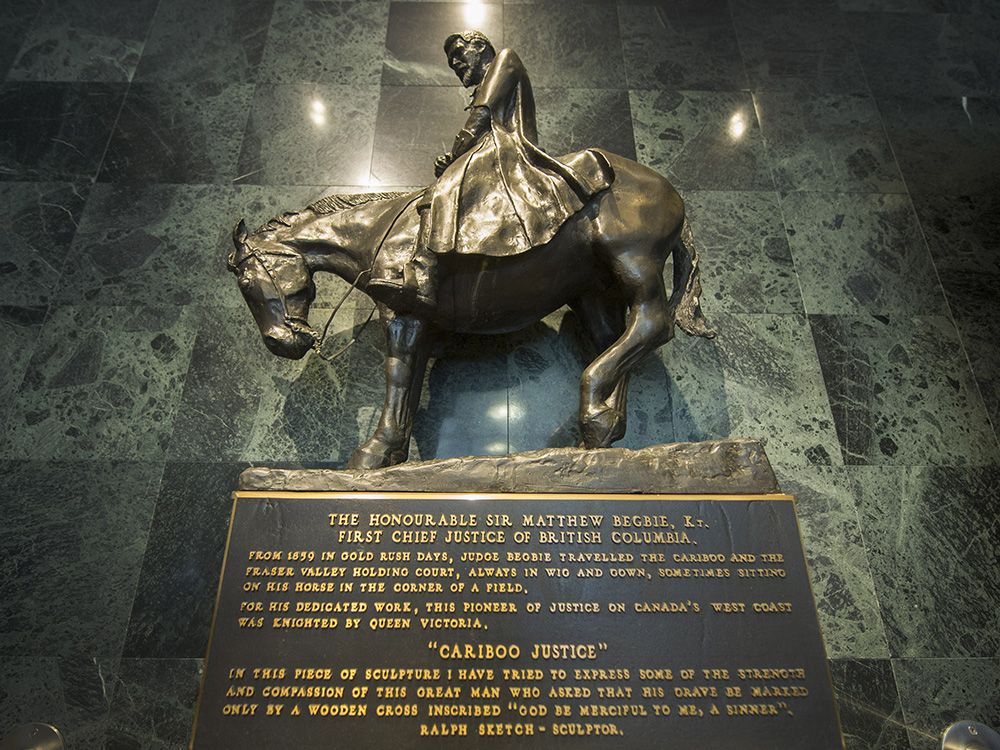
 The statue of Matthew Begbie that once stood inside the lobby of the Law Society of British Columbia building in Vancouver.

In 2017, the statue of him on horseback in the lobby of the Law Society of B.C. building in Vancouver was purged, as was a plaque that read: “His 36 years of fearless and impartial service made a lasting contribution to the administration of justice in the Pacific region of Canada.”

No longer.

The Tsilhqot’in leaders who inspired this then demanded that his name be removed from all public places.

As usual, the media played its sorry role in this misrepresentation of history. When Begbie’s ‘controversial’ statue was removed from the B.C. Law Society, CTV News reported: “The society previously featured the statue of Judge Matthew Begbie, who wrongfully convicted six Tsilhquotin War Chiefs of murder in 1864, sentencing them to death by hanging.”

The city of New Westminster renamed Begbie Square and Begbie Street in honour of two chiefs who had been wrongfully hanged, and Sir Matthew Begbie Elementary School in Vancouver was given an Indigenous moniker.

Sam Sullivan is a former mayor of Vancouver. After the Law Society of B.C. in Vancouver and the city of New Westminster removed their Begbie statues, he was so incensed he made a video about the gold rush, Indigenous inter-tribal conflicts, and Begbie.

“While south of the border the U.S. Army waged a dozen wars against Indigenous people, Judge Begbie risked his life in hostile environments for a more just society,” said Sullivan. “With a legal system that owes so much to him in a province whose very existence depended on the force of his personality, one must wonder if the justice he worked so hard for was done.”

Sullivan says the Law Society made its decision to remove the Begbie statue “in secret.”

Legal historian Hamar Foster is a law professor emeritus at the University of Victoria. He contributed an essay for the book Voicing Identity: Cultural Appropriation and Indigenous Issues (University of Toronto Press, 2022), his subject the Law Society decision to remove the statue. Foster’s essay made several points:

The Law Society report said Begbie “found (the Tsilhquot’in warriors) guilty” of murder and “ordered their execution,” but this was not so since the jury found them guilty and death was the mandatory sentence for murder.

The colonial governor, not Begbie, had discretion to commute the death sentences.

Said Foster: “I spoke to a number of people, and almost everyone, lawyers included, whose only source of information about the events of 1864 was the media, believed that the decision to convict and sentence the men to hang was Begbie’s, and his alone. Which is not true. Some also did not know what the hanged men were alleged to have done.”

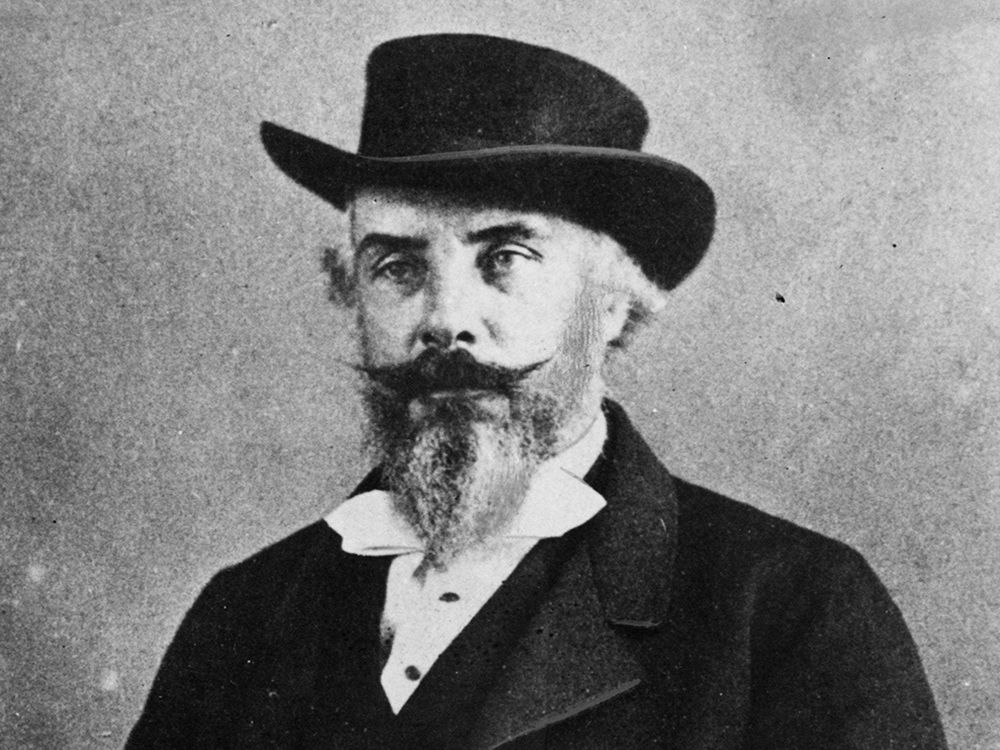
 “Fearless and incorruptible” Judge Matthew Begbie.

The Law Society report said Begbie “epitomizes the cruelty of colonization” and his relationship with Indigenous people was “negative.” Not true, says Foster. What does he conclude about Begbie?

“His record is much better than that of his contemporaries in Australia, the U.S., and the rest of Canada. And when his career is subjected to close examination, he stands out as both insightful and sympathetic when compared to most British Columbians of his day.”

Foster says the Chilcotin had legitimate grievances – not being consulted about the road, the threat of smallpox, sexual assaults against their women. As for the 21 white men killed and mutilated, he said the Chilcotin thought of this as warfare. But he has a beef with how the Law Society made its decision about the statue. He said the full membership wasn’t consulted and the benchers rendered the decision on an “incredibly one-sided report.”

Author David R. Williams wrote a biography on Begbie called The Man for a New Country (Gray’s Publishing Ltd., Sidney, BC, 1977). Said Williams: “No other judge in Canada combines an historical reputation of national proportions – Canada might, without Begbie and a few others, have had its western boundary at the Rocky Mountains.”

So, if not for Begbie, British Columbia as we know it today might not exist. Yes, if he was American there would be a movie. But in Canada we do things differently.

This excerpt is taken from Sleepwoking by Jerry Amernic, now available on Amazon

Our website is the place for the latest breaking news, exclusive scoops, longreads and provocative commentary. Please bookmark nationalpost.com and sign up for our newsletters here.


Exterior shot of the Central Nova Scotia Correctional Facility.

A female prisoner awaiting trial for a Cape Breton murder delivered more than 33 punches, kicks and knees to the head of another inmate known as “Crime Stoppers,” because women doing time at Halifax’s Burnside Jail believed she was a police informant.

The fight began with a handshake.

Pamela Hubley, who is left handed, had reached out to shake Carolyn Ann Dermody’s hand with her right in the jail’s “airing yard.” This was enough for the judge to consider the first few punches, thrown by Dermody in expectation of blows from Hubley’s dominant left, were in self-defence.

The fight was caught on surveillance cameras. After those first few shots, Dermody swung 22 times at Hubley, all within seconds of throwing the first punch. The fight, wrote Dartmouth provincial court judge Timothy Daley, quickly moved from self-defence to blows delivered with the purpose of “aggression, dominance and vengeance.”

“This included multiple strikes to the face with uppercuts using her right hand while holding Hubley’s sweatshirt with her left,” wrote Daley. She also hit Hubley repeatedly on the back of her head, “using a closed fist in what is often referred to as a ‘hammer fist’ punch.”

Hubley fell to her knees, covering her head with her hands. Grabbing ahold of Hubley’s sweatshirt and hair, Dermody punched Hubley 11 more times in the face and the back of the head. She also kicked and attempted to knee Hubley in the face.

Dermody was convicted Oct. 24 of assault causing bodily harm for the April 2024 attack.

The reasons for the assault: that Hubley was allegedly a snitch.

“I accept Dermody’s evidence that she believed, as did others, that Hubley was an undercover police officer, or at least a ‘rat’ who gathered information about the offences and inmates and used that to her advantage,” wrote Daley.

Hubley, according to the judge, described the pain after the fight as “10 out of 10,” and that she was shaking with pain from the attack.

The judge found that Hubley never fought back. “I also find that throughout the altercation, Hubley is face down while standing and face down when she falls to her knees.”

Paramedics took Hubley to hospital. An emergency room doctor examined her, indicating Hubley had “significant bruising and swelling to soft tissues in the face and blurry vision,” as well as pain and swelling in her left shoulder.

Hubley testified that she and Dermody had been imprisoned together for about two weeks before the altercation. Dermody testified that the pair had “hit and miss” interactions, with Hubley’s behaviour being anywhere from nice to intimidating. She also said that Hubley was trying to get information about her charges and testified that Hubley’s name within the jail was “Crime Stoppers” because she had been asking about others’ offences.

“(Dermody) was very clear that she and others believe that Hubley was an undercover cop, or at least a rat, and that this was unacceptable to anyone in the facility. It was her evidence that she believed that Hubley was looking to collect information about her and her offences. I find that this was at least part of the motive which became paramount soon after the altercation began. I find that Dermody was soon looking to exact vengeance, not to defend herself,” Daley wrote.

Hubley, 40, is 5’2” and weighs 160 pounds.

Dermody, who is 27 and three inches taller, weighed around 130 pounds at the time of the assault.

Dermody, of North Sydney, N.S., is one of three people charged with the murder of 48-year-old Natacha Leroy, a mother of six, at a home on Old Route 5 in Big Bras d’Or, on Nov. 22, 2023.

Dermody is slated to be sentenced Jan. 26, 2026, for the jail assault.

On the murder charge, her trial is scheduled to start March 30, 2026, in Sydney Supreme Court.

Our website is the place for the latest breaking news, exclusive scoops, longreads and provocative commentary. Please bookmark nationalpost.com and sign up for our daily newsletter, Posted, here.


A view of the pastoral village of Westmeath, Ontario.

A new court ruling combines sociological analysis and the facts of a minor crime to create a new genre of narrative that could be called Rural Ontario Gothic. Here is that ruling, in the case of His Majesty the King and Neil Valliant, handed down October 21, 2025, in Pembroke, Ont., by Justice J.R. Richardson, who compellingly tells the story of a shooting that injured no one but revealed a great deal:

Introduction

[

1

]         On February 12, 2025, shortly before 11:45 pm, the bucolic silence of the Village of Westmeath was broken by three sounds that are unnatural in that setting at that hour.

[

2

]         First, the blaring of a car alarm.

[

3

]         Second, the report of a shotgun blast.

[

4

]         Third, the report of another shotgun blast.

[

5

]         Mr. Valliant was sleeping in his home in Westmeath.  He had had too much to drink and had fallen asleep.  He had to work the next day.  His sleep was disturbed by the blaring of a car alarm from his neighbour’s F-150.

[

6

]         Frustrated with the disruption to his sleep, his judgment impaired by the consumption of too much drink, Mr. Valliant donned his 12-guage, which was one of the three firearms he had inherited from a relative.

[

7

]         He left his house and shot the grille of the F-150.

[

8

]         One shot was not enough for Mr. Valliant to express his utter disdain at the inanimate F-150 for the disruption to his sleep.

[

9

]         For good measure, he shot the vehicle again.

[

10

]      Mr. Valliant was not licensed to possess those guns or the ammunition that he had for them.

[

11

]      Police were called and he was charged.

[

12

]      On April 22, 2025, Mr. Valliant entered pleas to one count of committing mischief over $5000 by discharging two 12-guage shotgun rounds into the Ford F-150, contrary to

section 430
 of the
Criminal Code
 and one count of possessing a firearm without being the holder of a licence to possess it contrary to
section 91
 of the Criminal Code.
[13]      The issue in this case is the appropriate sentence.
[14]      Defence counsel argued for a conditional discharge.  Crown counsel argued for a suspended sentence.

Detailed Facts

[

15

]      On February 12, 2025 at 11:45 pm, Provincial Police responded to the complaint of a vehicle alarm sounding on Grace Street in Westmeath.  The caller advised that they also heard two gunshots.

[

16

]      The caller saw Mr. Valliant go outside with “something long in his hand”.

[

17

]      En route, police contacted Mr. Valliant.  Mr. Valliant complained that the alarm was going off and he had to work the next day. He confessed to shooting the truck.  Police told him to come out with his hands up when they arrived.  He complied.

[

18

]      Police arrived at 12:18 am.  Mr. Valliant was arrested without incident. Police observed two large holes in the grille of the F-150.  They also observed a spent shotgun shell on the roadway.

[

19

]      Mr. Valliant again admitted to shooting the truck. He was cooperative with the police and took them to where his firearms and ammunition were stored in his house.  Three firearms and a quantity of ammunition were ultimately seized.

[

20

]      He did not have a license to possess the firearms.

[

21

]      Upon hearing the plea, at defence request, the matter was adjourned for Mr. Valliant to engage in some counselling.

The Social-Geographic Context in Which the Offence was Committed

[

22

]      I have practised or presided in rural Eastern Ontario for about half of my thirty years of professional life, the last ten of which I have practised or presided in Renfrew County.  I do not own firearms, nor do I engage in hunting.  What follows is what I understand about the community where these offences were committed.

[

23

]      Westmeath is a quiet, peaceful village located on the shore of the Ottawa River in Whitewater Region Township in the County of Renfrew.  It is home to about 350 souls.

[

24

]      The village consists of a convenience store, a couple of churches, some local artisans and a winery.

[

25

]      The population increases substantially in summer due to cottagers.  This is a place where people come to escape the city and enjoy the outdoors.

[

26

]      Some might describe Westmeath as “sleepy”.  Surrounding the village is some of the finest farmland in the Valley.  There are idyllic rolling hills of fields of hay, corn, soybeans, dairy and livestock operations.

[

27

]      There is not a lot of crime in Westmeath.  There is the occasional break and enter, theft and the usual array of impaired driving and intimate partner violence cases that are unfortunately part of day-to-day life in Ontario.

[

28

]      It is, generally speaking, a tranquil environment.

[

29

]      Nighttime is still and silent.  One might hear the hum of an errant electrical transformer, the barking of a dog spooked by its shadow, the occasional passing of a vehicle, or the din of a farmer, working late with tractor to get the hay bales off the field before it rains.   In winter, when this offence was committed, it is even quieter.

[

30

]      At any time of day, car alarms and gunshots are rarely heard.

[

31

]      Unlike the city, or even a small town such as nearby Pembroke, where a car alarm is a more frequent and routine event, in Westmeath, car alarms are also rarely heard.  When they do arise, they somehow seem louder than in a busy city or town, even though logic dictates that cannot be true.

[

32

]      At night, they seem particularly loud.

[

33

]      Daytime gunshots are more common when people participate in the tradition of hunting. Occasionally, one will hear gunshots outside of hunting season, when teenagers are engaging in some target practice under the watchful supervision of a parent, or when a farmer must dispatch a pest to protect his crop or his livestock.

[

34

]      Gunshots at night mean trouble.

[

35

]      Many people in this part of Ontario learn the proper care and handling of firearms at an early age.  There are many gun and hunting clubs in the area.  Like a driver’s license, getting one’s gun licence and participating in the hunt is a rite of passage.

[

36

]      Firearms and hunting are part of rural Ontario culture.  Firearms are passed from generation to generation.  While hunting is traditionally a male-dominated pastime, that is less the case with each passing year.  Many women now also take part.  Children are often taken out of school to participate.

[

37

]      Lest one think that this an activity only pursued by the privileged, for many, hunting supplements the family food supply.  Indigenous people also hunt for subsistence and to practice traditional ways.

[

38

]      Albeit begrudgingly, most responsible hunters and firearms enthusiasts accept gun control as a fact of life.

[

39

]      I daresay that most of them would be annoyed to hear about Mr. Valliant’s crimes.

[

40

]      Some would be angered.

[

41

]      People who behave like Mr. Valliant perpetrate the stereotype that all gun owners are drunken, trigger-happy, redneck yahoos who are a hair’s breadth from committing a mass casualty event, such as we too often see on American news media.

[

42

]      Responsible firearms owners have licenses and obey regulations. They do not use their firearms when they are intoxicated.  They realise the inherent danger that comes with possession of their firearms.

[

43

]      It is not uncommon for individuals in this County to possess firearms without a licence.  Their disobedience is a result of one or more of the following factors:

a)   laziness,

b)   indifference,

c)   protest against what they perceive to be unjust laws brought about by city folk who do not understand rural ways,

d)   protest against what they perceive to be excessive government and regulation, and

e)   some also, unfortunately, believe that it is their constitutional, if not God-given, right to possess firearms.

[

44

]      Such individuals are not responsible firearms owners.  Such individuals flirt, not only with criminal conviction, and the collateral consequences that come with having a criminal record, but also with the prospect of being sentenced to a period of incarceration.

Victim Impact

[

45

]      The Crown advised that the victim did not wish to file a Victim Impact Statement.

[

46

]      The Crown stated that the victim was not really affected by what happened, other than he wished to receive $500 to cover his insurance policy’s deductible for the damage to his car that was not covered by insurance.

Counselling

[

47

]      Exhibit 1 is a letter dated July 20, 2025 under the signature of Taryn de Bruyn of the Robbie Dean Counselling Centre in Pembroke.  Ms de Bruyn advises that Mr. Valliant completed an anger management course.  The course consisted of eight weekly sessions, each lasting 90 minutes.  Ms de Bruyn wrote:

Mr. Valliant has been a reliable participant in the Anger Management Group.  He contributed thoughtfully to group discussions and has shown a genuine willingness to reflect on his experiences.  He has made notable progress in understanding and applying emotional regulation strategies.

[

48

]      Exhibit 2 is a letter dated August 5, 2025 under the signature of Adrienne Campbell of the Pathways Alcohol and Drug Treatment Services.  She reported that Mr. Valliant referred himself to Pathways on March 7, 2025.  Ms Campbell wrote:

To date, Mr. Valliant and I have met on eight occasions, focussing on prevention through identifying his triggers, managing cravings, education on the three stages of relapse, creating a recovery safe plan, dealing with slips and getting back on track and the importance of having a routine and incorporating self care.

Mr. Valliant engages in every appointment.  In just a few short months, Mr. Valliant has made impeccable progress in regards to his alcohol use.  He continues to work hard on his recovery and has been abstaining from alcohol.

[

49

]      She also noted that she expected Mr. Valliant to continue with therapy after he was sentenced.

Defence Submissions

[

50

]      Defence counsel asked me to grant a conditional discharge followed by 12 months of probation.

[

51

]      He indicated that most of the damage that was caused to the truck, amounting to over $7000, was paid for by the complainant’s insurance company.   He stated that the complainant was $500 out of pocket for the deductible, which defence counsel had in trust for payment over to the complainant.

[

52

]      Defence counsel indicated that Mr. Valliant works full-time as a driver.  He is a Canadian citizen with a high school education.  He is 50 years old.  He does not have a criminal record.  He is single and he lives in his own house.

[

53

]      Defence counsel essentially submitted that this was an isolated incident in which Mr. Valliant acted foolishly because his judgment was impaired by his alcoholism.  He was upset that the vehicle alarm on his neighbour’s F-150 was going off.  When the incident happened, he was using alcohol on a daily basis.  He had fallen asleep after drinking.  He was frustrated and angry because his sleep was disrupted.

[

54

]      He stated that, as evidenced by the counselling letters, Mr. Valliant has now made sincere efforts to live a sober lifestyle.

[

55

]       Defence counsel noted that although Mr. Valliant did not have a licence to possess the firearms, they were inherited from a relative and he simply did not follow through on obtaining the appropriate licenses.

[

56

]      Defence counsel acknowledged that the discharge of the firearm in a residential area is a serious matter.  He suggested that there was no risk to the public because it happened in the middle of the night.

[

57

]      He also acknowledged that there should be an order for forfeiture of the shotgun and Mr. Valliant should be placed on a weapons prohibiti

Crown Submissions

[

58

]      Crown counsel stated that the Crown position was a suspended sentence but allowed that a Conditional Discharge might be appropriate because Mr. Valliant was doing everything he can be expected to do to rehabilitate himself.  Crown counsel acknowledged that this appeared to be an isolated incident.

[

59

]      Crown counsel disagreed with defence counsel’s suggestion that there was no risk to the public.

[

60

]      I agree with Crown counsel.  Someone could have been seriously injured or even killed, if one of the bullets from Mr. Valliant’s shotgun had strayed into the home of one of his neighbours.

Mr. Valliant’s Allocution

[

61

]      Mr. Valliant apologized for his actions.  He admitted that he had been drinking.  The vehicle alarm disrupted his sleep and woke him up.  He stated that “it took me off the deep end”.

[

62

]      He stated that, in addition to the counselling set out above, he was going to AA.

[

63

]      He acknowledged that the victims and his neighbours are uncomfortable around him.  “It is a black mark on me forever”, he stated.  These are measures of specific deterrence and denunciation that the community has levied against Mr. Valliant.

Analysis

The Aggravating Factors

[

64

]      The following factors are aggravating:

a)   The firearms were unlicensed.  I note that the firearms were apparently inherited, but no excuse was offered for Mr. Valliant not following through with licensing them.  He does not benefit from the finding that he is an otherwise responsible gun owner.

b)   A firearm was discharged.  Twice.

c)   A firearm was discharged in a semi-urban environment or a small rural village in the middle of the night, increasing the risk of harm.   Responsible gun owners do not discharge firearms in a semi-urban environment in the middle of the night.

d)   Mr. Valliant had been drinking to excess.  Sometimes a drinking problem can work in mitigation of sentence.  In this case it works in aggravation given the exponential increase in the risk of harm that possession and discharge of a firearm by an intoxicated person entails.  A responsible gun owner does not use their firearms when they have been drinking.

e)   The firearm caused substantial damage to his neighbour’s vehicle.  The damage amount was over $7000.  Mr. Valliant is willing to pay the deductible.  The rest of the cost will be paid by his neighbour’s insurance.  I was not asked to make a restitution order in favour of the neighbour’s insurance company against Mr. Valliant.  If I had been so asked, I would have made it.  The insurance company will have to sue Mr. Valliant civilly to recover, failing which everyone pays for Mr. Valliant’s foolhardiness.

The Mitigating Factors

[

65

]      The following factors work in mitigation of sentence:

a)   Mr. Valliant was fully cooperative with the police.

b)   Mr. Valliant entered a guilty plea quickly.  The public has been spared the time and expense of a trial.

c)   Mr. Valliant has worked hard to address the underlying problems that contributed to his crime:  his alcoholism and anger management.

d)   Mr. Valliant does not have a criminal record.

e)   Mr. Valliant is gainfully employed.

f)     Mr. Valliant has given his lawyer $500 in order to make his neighbour whole.

g)   Mr. Valliant has been subjected to community-based deterrence and denunciation as a result of his crimes.

The Absence of Aggravating Factors

[

66

]      The following factors are not present here:

a)   The firearms involved were not handguns, nor were they prohibited or restricted weapons.

b)   Mr. Valliant was not in possession of the firearms to engage in a criminal enterprise, such as drug trafficking.

c)   Although he was not licenced, Mr. Valliant acquired the firearms legally (through inheritance).

(discussion of legal precedents removed)

The Sentence Imposed

[

84

]      This case places me on the horns of a dilemma.<

[

85

]      On the one hand, it is difficult to avoid the temptation of rewarding Mr. Valliant for all of the mitigating factors in this case, in particular, the glowing up-front work that he has completed and the extent to which he expresses remorse and insight into his crime.  I also acknowledge the degree to which he has been denounced and deterred by his community for what he has done.

[

86

]      On the other hand, it is equally difficult to not be swayed by the fact that Mr. Valliant was intoxicated when he committed the crime.  The crime involved not only possession but also the discharge of a firearm in a semi-urban setting.  He was unlicensed to possess three firearms without any excuse, and the risk of harm to the public by his conduct was extremely high.

[

87

]      In the final analysis, I find that the bridge to a conditional discharge is just too far.   It is not in the public interest.  I will suspend the passing of sentence and place Mr. Valliant on probation for 12 months with the following terms:

a)   The usual statutory terms.

b)   A condition requiring him to report to a Probation Officer until he has completed all his required counselling.

c)   A condition requiring him to have no contact or communication directly or indirectly by any physical, electronic or other means with Shane Dunstan except with the written consent of Shane Dunstan.

d)   A condition requiring him to not possess any weapons.

e)   A condition requiring him to attend and actively participate in all assessment, treatment and counselling including anger management and substance abuse.

f)     A condition requiring him to pay over $500 to the credit of Shane Dunstan for restitution.

[

88

]      Pursuant to

section 110 (b) of the Criminal Code
, I make an Order prohibiting Mr. Valliant from possessing any firearm for ten years.
[89]      Pursuant to

section 491
 of the
Criminal Code
, I also make an Order forfeiting the shotgun used by Mr. Valliant to the Crown.

Our website is the place for the latest breaking news, exclusive scoops, longreads and provocative commentary. Please bookmark nationalpost.com and sign up for our daily newsletter, Posted, here.
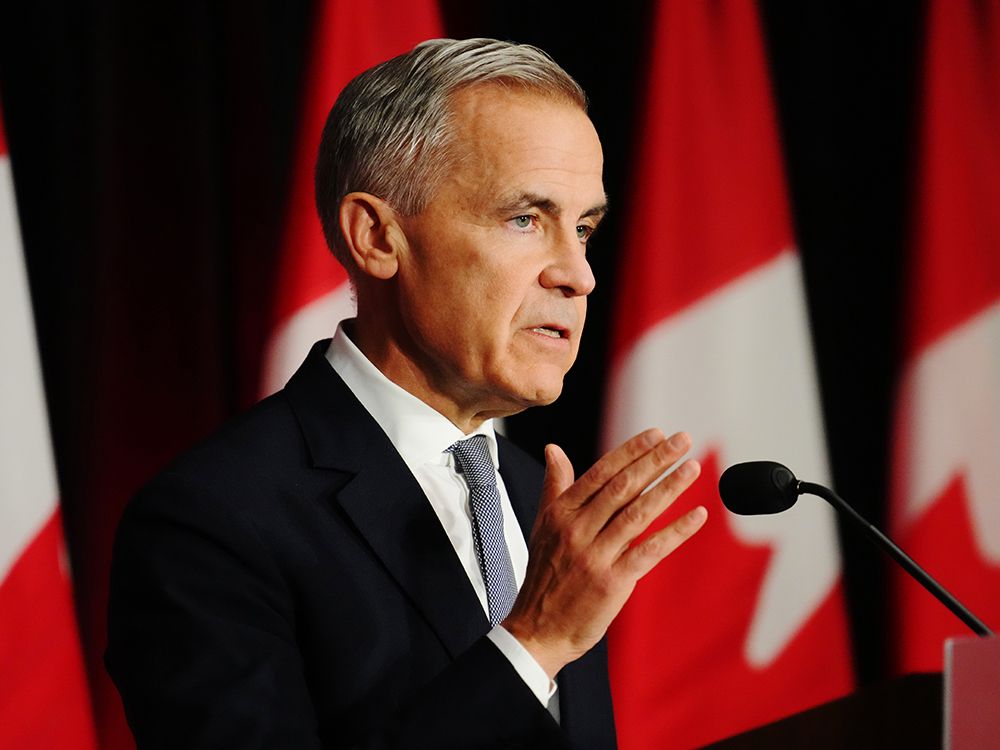

With daylight saving time ending on Sunday, it's a chance to get an extra hour of sleep.

At 2 a.m. on Sunday Nov. 2, daylight saving time (DST) will end and clocks will “fall back” one hour for most Canadians, forcing people to adjust their sleep schedules.

In Canada, DST always starts on the second Sunday in March and ends on the first Sunday in November.

DST is practiced in over 70 countries and by an estimated one billion people globally, but how did Canada come to participate in this peculiar routine, and why do some provinces just not bother? What are the potential benefits and downsides? Here’s everything you need to know about daylight saving time ahead of another clock shift this weekend.

How did daylight saving time come about?

DST has surprisingly Canadian origins, which can be traced back to the industrial revolution. The first municipality in the world to implement daylight saving time was Port Arthur (now Thunder Bay), Ont., in 1908, ostensibly because a local business magnate, John Hewitson, wanted more daylight for recreation in the summertime. The idea was proposed in various forms throughout the late 19th century, most notably by New Zealand astronomer and entomologist George Vernon Hudson, who suggested changing the time as a way to have more daylight hours for his bug-catching hobby.

But the widespread adoption of daylight saving time came during the First World War. In 1916, Germany became the first country to institute DST as a way to have more daylight during waking hours and to conserve coal for the war effort. Other countries, notably the U.S., the U.K., and Canada, followed suit, but DST ended when the war did. The practice was brought back during the Second World War.

After the wars, the federal law that mandated DST across the country lapsed and fell into the hands of provincial and local governments. While most parts of Canada stuck with the practice, some provinces, most notably Saskatchewan in 1966, ditched the system over time.

Did other provinces ditch DST?

Saskatchewan stays on Central Standard Time all year, except for Lloydminster, a city that is in both Saskatchewan and Alberta.

Yukon decided to stay on daylight time year-round in 2020, which is now known as Yukon Time.

Southampton Island, in Nunavut, stays on Eastern Standard Time all year, but the rest of the territory changes its clocks twice a year.

Other provinces have expressed a desire to abolish DST, but only if the U.S. agrees, including Ontario, Manitoba and B.C., where some places have already gotten rid of the practice. Atlantic premiers have said they would follow if others abolished the clock change.

Alberta narrowly (50.2 per cent) voted to continue DST in a referendum held on Oct. 18, 2021.

What are some of the potential health effects of DST?

Research shows that something as simple as switching the clocks may have some serious effects on cognitive health. John Anderson is an assistant professor in the departments of cognitive science and psychology at Carleton University. Anderson said one of the main concerns is how the system throws off our sleep schedules.

“You’ve probably got a sense of when your ‘best’ time of day is, the time when you can really hone in and focus and do your best work or exercise at your peak,” Anderson said. “When you mess with your circadian rhythm, that internal clock, it is very bad for people.”

Anderson said the research behind the DST switch increasingly shows the potential dangers this can have on our bodies, a phenomenon known as “social jet lag.”

“Artificially changing when you wake up throws off all the internal clocks in your body and can spike stress hormones, like cortisol, which can lead to impaired memory function,” Anderson said. “In addition to memory impairments, there are also changes in levels of alertness that can be dangerous. For example, there are way more car crashes after daylight saving time, and these likely reflect lapses in attention and sleep deprivation that come when we change the clock.”

Anderson added that these effects can often persist long-term and lead to other complications. “When your clock starts to become misaligned, it can cause a wide range of symptoms including brain fog, digestive issues, heart issues, and spike your risk for inflammatory disease including diabetes, heart attack, and cancer,” he said.

What’s behind the growing movement to get rid of DST?

Even since its inception, the time switch has been controversial. Most of us aren’t bug-catchers, and the western world no longer runs primarily on coal. Is it time to stop fiddling with our clocks twice a year?

Recently, Liberal Member of Parliament Marie-France Lalonde proposed a private members’ bill that would eliminate the bi-annual time-switch entirely.

U.S. President Donald Trump also isn’t a fan of the practice.

“The Republican Party will use its best efforts to eliminate daylight saving time,” Trump has said on Truth Social last December, calling it “inconvenient, and very costly to our Nation.”

However, he has since said it’s hard to get consensus around the issue. And people can’t agree whether to keep the clocks as they are in the fall or the spring.

“This should be the easiest one of all, but it’s a 50-50 issue. If something’s a 50-50 issue, it’s hard to get excited. I assume people would like to have more light later, but some people want to have more light earlier, because they don’t want to take their kids to school in the dark,” Trump said in March,

according to Reuters.

“A lot of people like it one way, a lot of people like it the other way, it’s very even. And usually I find when that’s the case — what else do we have to?”

Anderson also thinks it may be time to stop changing the clocks.

“The world we live in right now is so hard on sleep and biological rhythms, from the lights we get exposed to at night, to the schedules we keep,” Anderson said. “I think anything we can do to avoid further disruptions to the circadian rhythm is a good thing. The disruption may be short-lived, but it is noticeable.”

Our website is the place for the latest breaking news, exclusive scoops, longreads and provocative commentary. Please bookmark nationalpost.com and sign up for our daily newsletter, Posted, here.
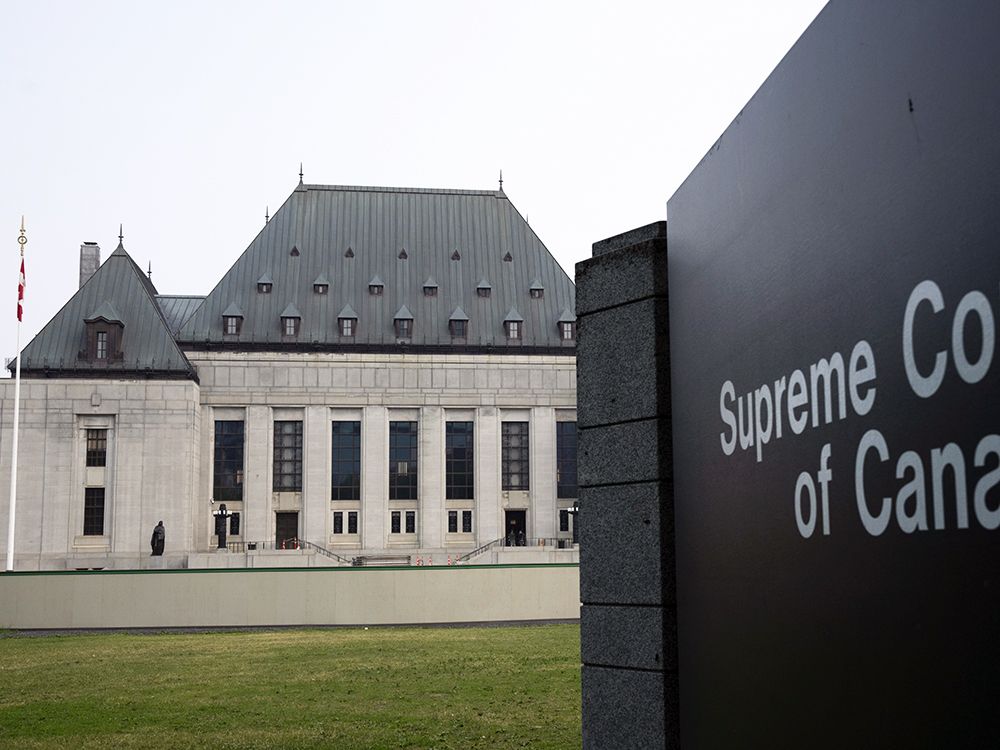

NEO, a humanoid robot that can be both autonomous and operated remotely by a 1X company employee.

California robotics company 1X has announced it is taking preorders for NEO, which they say is the “

world’s first consumer-ready humanoid robot

.”

The

first shipments

are expected to begin in 2026 for U.S. buyers and other regions starting in 2027. Priced at

US$20,000,

reports Fortune Magazine, customers must pay a US$200 deposit to secure priority delivery, while a subscription/rental option is also available at US$499 per month with a minimum six-month contract.

The company has previously developed robots for industrial use, but NEO is its first product for the home. The robot has a set of modes, including

chores, companion and autonomy

. 1X says NEO is intended for

household tasks

such as folding laundry, organizing shelves, fetching items and watering plants.

The machine can be controlled by its owner via a mobile app or through voice commands. NEO will then work autonomously, says the robotics firm.

Among the tasks that the company says NEO can do are

suggesting what to cook

by looking at the contents of your refrigerator. It can also teach you a new language. Or tell you where you left your car keys.

For more complicated tasks that the robot hasn’t been trained to do, there is an “expert mode” that will involve the intervention of a company employee “supervising” the session while the robot works, reports PC Magazine. That means a 1X employee based in the U.S. will be able to see inside your home while controlling the robot while in expert mode. That occurs through a Virtual Reality headset, The Wall Street Journal

reports
.

The obvious trade-off is privacy. But CEO Bernt Børnich told the WSJ: “If you buy this product, it is because you’re OK with that social contract. If we don’t have your data, we can’t make the product better.”

And the company notes, the robot’s “

emotive ear-rings

” will also change colour while an 1X Expert Operator is active, states PC Magazine.

Meanwhile, the company can

blur people inside your home, so a remote operator won’t see them

. And owners can designate no-go zones in their homes where the operator cannot send the robot. Finally, teleoperators cannot take control of a NEO without the owner’s approval.

NEO’s

specifications

are 5’6” in height and 66 lbs. It’s supposed to be able to operate for four hours on battery.

A unit is covered by a soft 3D lattice

polymer which comes in three colours

: tan, grey, and dark brown. It also has Wi-Fi, Bluetooth and 5G capabilities, which paired with the NEO’s built-in speakers, enables users to utilize it as a sound system.

1X is positioning NEO as the first consumer friendly humanoid robot available for preorder, reports Mashable,

ahead of competitors like Tesla’s Optimus or XPeng’s Iron

whose retail dates remain unclear.


Our website is the place for the latest breaking news, exclusive scoops, longreads and provocative commentary. Please bookmark nationalpost.com and sign up for our daily newsletter, Posted, here.

Wildfires burning near Flin Flon, Manitoba, on May 27, 2025.

This year’s Canadian wildfires and their impact American air quality have been a hot topic between the countries’ governments, with the Trump administration urging Canada to emphasize “forest management” as an antidote, the head of the U.S. Environmental Protection Agency (EPA) said Friday.

But the two nations don’t necessarily agree on the role of such measures, EPA chief Lee Zeldin suggested during a meeting of G7 environment and energy ministers in Toronto.

Climate scientists and data indicate that a warming planet has made forest fires wilder and bigger, something even the U.S. space agency

NASA confirms

. But

Zeldin is an opponent

of what he has called the “religion of climate change,” and proposed scrapping his agency’s ability to regulate fossil fuels, the foundation of U.S. efforts to combat climate change.

Facing pressure from politicians in states affected by drifting smoke, there has been “a lot of engagement” during the last three months with Environment Canada about the wildfires that ravaged huge tracts of forest here, said Zeldin.

“The impacts on the northern United States led to a lot of advocacy and questions coming from United States governors and congressional delegations and others,” he told a news conference during the G7 gathering.

“What Canada experienced, just like what California experienced last January highlights the need to lean into forest management.”

Zeldin praised Canadian officials for promptly answering his team’s questions about the fires, but suggested that there was a friendly clash about how to address the issue.

“Even though Canada might have a different approach to how to fight that particular wildfire that impacted them, and California might have a different approach than the Trump administration might prefer, that doesn’t mean we shouldn’t have maximum open dialogue as much as possible,” he said.

Zeldin said there were a lot of cross-border issues when he met Canadian Environment Minister Julie Dabrusin at this week’s G7 get-together, but “I just want to emphasize that (wildfires) was a topic I sought to raise at the first opportunity in our conversation.”

The interaction underscores a curious aspect of this week’s G7 meeting – the Trump cabinet officials’ rejection of climate change put the U.S. starkly at odds with the group’s other members.

This year’s fires actually became a political issue in the U.S., with a group of six Republican lawmakers from Wisconsin and Minnesota writing to Kirsten Hillman, Canada’s ambassador to Washington, to complain about their impact, and blame this country.

“Our communities shouldn’t suffer because of poor decisions made across the border,” Tom Tiffany, a Republican congressman from Wisconsin,

said in a post

on X in July.

Using management techniques like controlled burns, clearing away combustible debris from forest floors and creating fire breaks is a widely accepted means to lessen fire danger.

But Manitoba Premier Wab Kinew rejected the U.S. critiques at the time, noting that most of the fires in his province were started by lightning strikes in remote locations where preventive measures were all but impossible.

Asked about Zeldin’s comments Friday, Canadian Environment Minister Julie Dabrusin wouldn’t say how her department responded to the American outreach.

“When we’re talking about wildfires in Canada, my primary obligation and concern is about Canadians who are being impacted,” said Dabrusin. “Do I share an absolute commitment to slow down wildfires and protect communities? Absolutely.”

A leading academic expert was less diplomatic. The growing threat from wildfires is a complex one and research has proven that climate change – creating hotter, drier conditions – is the principle cause, said Lori Daniels, a forestry professor at the University of British Columbia.

“If the United States wants to contribute to a global solution, they need to reduce their greenhouse-gas emissions,” said Daniels. “Given that they are in the top-three of greenhouse-gas emitters, maybe the onus could go back to them for some of that responsibility.”

 U.S. Environmental Protection Agency Administrator Lee Zeldin speaks during a cabinet meeting with President Donald Trump at the White House in Washington, Aug. 26, 2025.

Another factor feeding the fire surge is, ironically, a decades-long history of efficient firefighting, she said. That has led to denser forests and growth of small trees that provide a sort of kindling to the flames that start by crawling along the forest floor. Meanwhile, the uniformity of vast oceans of evergreen trees makes them more susceptible to fire, disease and insects, said Daniels.

The kind of forest management that is “desperately needed” would require a timber industry shift toward harvesting smaller trees and for more broad-leaf species to be integrated into forests. But that would undermine a business model centred around selling the U.S. two-by-fours and similar products cut from big, old trees. Governments would probably have to offer subsidies and other incentives, Daniels said.

The further catch? Government subsidy generally prompts the U.S. to raise softwood-lumber tariffs, which have already gone up under President Donald Trump.

“Those rules to try to control our economy limit our options and, unfortunately, (Americans) had to pay the price this summer by breathing some smoke. They can’t have their cake and eat it too.”

 Smoke from wildfires in Canada shrouds the Empire State Building in New York City on June 30, 2023.

Our website is the place for the latest breaking news, exclusive scoops, longreads and provocative commentary. Please bookmark nationalpost.com and sign up for our daily newsletter, Posted, here.


Industry Minister Mélanie Joly, whose portfolio includes the Competition Bureau, says the Liberal government is “hawkish” on greater competition.

OTTAWA — As someone who has lived in Canada for just a little over three years, Victoria Lavrynenko has an easy baseline for gauging grocery prices.

When she and her family moved to Canada from Ukraine, a package of four chicken breasts was about $10. Now, she says, while scanning the poultry section with her husband and son at a Loblaw affiliate in her Ottawa neighbourhood, the price of that same package of chicken is consistently about 40-50 per cent higher.

Lavrynenko says she tries to kill two birds with one stone by shopping around to get both the best prices and the healthiest food, but that she finds it more difficult now to meet her twin goals because of the inflation in recent years, particularly the basic pocketbook items: gas, clothes, and, most of all, groceries.

“It’s not good, especially when you have kids.”

While she’s far from alone in her frustration about rising prices, Lavrynenko has at least one edge over many Canadians. She gets her groceries in a neighbourhood with at least five full-repertoire grocery stores — Loblaw’s Real Canadian Superstore, Metro, Food Basics (also owned by Metro), Produce Depot, and Farm Boy (owned by Empire, which also owns Sobey’s) — within a range of just over three kilometres, not to mention a number of smaller players that focus on niche markets such as fresh produce, baked goods or ethnic foods.

 Victoria, Yelisie, and Denyes Lavrynenko scan the poultry section at an Ottawa grocer.

That level of competition, unlike in thousands of smaller or more remote Canadian communities, should encourage better service, innovative, superior products and, perhaps most of all, lower prices. Yet, although most Canadians live in larger communities, there’s been no shortage of calls in recent years for greater competition and other changes to the grocery industry that might provide some price relief.

According to Canada’s Competition Bureau, those calls are on point. In a 2023 study of the grocery industry, the competition watchdog notes that grocery prices had been rising quickly for a variety of reasons, including Russia’s invasion of Ukraine, supply-chain interruptions and higher input costs. But that industry, while high in both profile and its prominence in the average family budget, is by no means alone or perhaps even the most egregious part of the Canadian economy when it comes to a lack of competition.

Canadians are understandably upset at U.S. President Donald Trump’s protectionist tariffs that contravene the free trade agreement that he signed just a few years ago, and his decision last week to cut off trade talks over an in-your-face Ontario government ad. But competition advocates say there are still plenty of made-in-Canada protectionist barriers that stifle competition at the expense of consumers, small business and the broader domestic economy.

The issue may not be sexy but that doesn’t mean the stakes aren’t high. The Competition Bureau says increased competition could spur economic growth, adding as much as 2.5 per cent to Canada’s gross domestic product (GDP) over a decade.

Prime Minister Mark Carney, meanwhile, said last week in a pre-budget speech that it’s the perfect time for “bold steps.” With a federal budget set to be unveiled within just days, the question remains: Will Ottawa take the necessary steps to boost competition?

The competition problems in Canada are wider spread that most Canadians might think.

Beyond the grocery sector, many economists and competition analysts point to problem industries that directly affect Canadian wallets, such as airlines, telecommunications services and banking, all of which are protected to some degree from foreign competition by legislation. There are also a range of professions that are protected by largely unknown barriers, and “hidden” industries that play only into supply chains but affect consumers and the economy nevertheless. And then there’s the American giants, more difficult to influence, that dominate critical technological sectors, such as phones (Apple), streaming services (Netflix), social media (Facebook), online retail (Amazon) and search (Alphabet’s Google).

In total, our domestic economy remains littered with oligopolies and other uncompetitive industries that may not be serving customers as well as they should.

“Where there is limited competition, incumbent businesses make the rules,” Matthew Boswell, commissioner of the Competition Bureau, said last month.

Non-competitive markets and their non-competitive prices also affect industries that otherwise would be competitive. Tim Sargent, head of domestic policy at the Macdonald-Laurier Institute think tank, said airlines, telecoms and banking are “infrastructure industries” because many other industries are their customers. That means, Sargent said, that increasing the infrastructure industries’ productivity would also make many other sectors more competitive.

But economists and competition advocates emphasize that increasing competition is about a lot more than saving a few cents on a box of pizza pops or even taking a slice out of cell phone bills.

Without a doubt, competition should mean better prices, but there are other benefits, too.

Competitive markets mean that consumers are more likely to get better services, such as convenient hours, and gain access to new innovations and ideas that are often unnecessary in markets where dominant players don’t feel the need to take chances, or to work hard at keeping or attracting customers. Innovation, whether a minor efficiency in a small business or the creation of the next gadget with mass appeal, is seen as a critical element in a thriving economy. It’s also viewed as one of the key factors that separates fast-growing economies from laggards.

 Competition Bureau Canada Commissioner Matthew Boswell.

Advocates say that the lack of competition in some parts of the Canadian economy means that we’re leaving piles of money on the table, unnecessarily higher prices, and economic growth that will never be realized. In a recent study of competition in the Canadian economy over the first two decades of this century, the Competition Bureau says the gains are potentially high and that the number of concentrated industries is growing, while those industries that were already concentrated are becoming more so.

“We’ve been getting worse over time,” Boswell told National Post in a recent interview.

While difficult to quantify the effects of one element such as competition in a complicated equation such as a national economy, there’s little doubt that the benefits could be significant.

Boswell and others cite the Australian example from about a generation ago to make their point. Aiming for more dynamism and economic growth, Australia launched a set of reforms called the National Competition Policy between 1995 and 2005. Those changes extended competition law to all professions and sectors, including utilities and others dominated by public sector organizations. The plan included an agreement from all levels of government to review their laws and regulations to remove unjustified barriers to competition.

The result, said Boswell, was GDP growth of about 2.5 per cent over a decade.

Ryan Manucha, a research fellow at the C.D. Howe Institute think tank and the author of a book on interprovincial free trade, said Boswell’s estimate is backed up by academic studies on the effects of greater competition.

“Those kinds of numbers are absolutely on the table.”

The possibility of that type of economic growth would come at an ideal time. The head winds facing the sluggish Canadian economy go beyond the Trump tariffs. There are also painful trade frictions with China, a lack of infrastructure for diversifying trade to non-American markets and a slowing global economy that mean fewer customers and smaller orders.

No wonder that the Carney government is desperately trying to find new ways to squeeze growth through new trade partners, fewer protectionist barriers among provinces, efforts to spur housing construction, lower taxes, and new infrastructure.

That new infrastructure, the railways, ports and perhaps pipelines that comprise Ottawa’s so-called “big projects,” could be added to the list of the affected if electricians, welders and other skilled trades are in short supply and prevented by protectionist barriers from crossing provincial borders to work.

So, with a federal budget just around the corner, will Ottawa do anything to increase competition?

Industry Minister Mélanie Joly, whose portfolio includes the Competition Bureau, says the Liberal government is “hawkish” on greater competition.

At a recent speech at a competition summit in Ottawa, she said that emphasis is part of the government’s plan to boost affordability. “Competition is another way we are lowering prices,” she said. “It keeps prices fair, it drives innovation.”

Joly was not available to comment for this article but said in her Ottawa speech that the government has already taken steps to increase competition in the telecommunications services and housing industries, and has also made reducing interprovincial trade barriers a priority.

Manucha agreed that Canada has taken some early steps but emphasized that there’s still a steep hill to climb.

Making that climb, however, will be easier said than done.

A lack of competition in some markets is buttressed by barriers that are difficult to topple.

In a review of the grocery sector, for example, the Competition Bureau noted that the industry in Canada is concentrated. But the Bureau also pointed out that one of the reasons for the concentration of the market is that it’s difficult to break into and remain competitive for a variety of logistical reasons and that the longer-term trend of higher profit margins pre-dates the pandemic.

Greater competition in the telecommunications services sector could be a boon for Canadian customers, but that was one of Ottawa’s top priorities for almost a decade during the Harper years. Foreign competitors were courted, occasionally came and mostly went, sometimes complaining that Canadian regulators and legislators weren’t serious enough about encouraging competition.

To this day, despite recent drops in prices, the market remains an oligopoly that lacks a big-time foreign player and Canadians continue to pay some of the highest cell phone bills in the world.

In other markets, some Canadians might be unhappy with some of the consequences that could accompany greater competition.

Greater competition in the airline industry, for example, might indeed lower prices. Boswell cited a recent Bureau study that found that airfares dropped by an average of 9 per cent when a single new competitor begins flying between two cities.

But there could be unintended consequences as well. If a new competitor happens to be a foreign player, it would mean Canadian airlines would likely have a smaller share of the domestic market, which could lead to layoffs at Canadian airlines. Air Canada, the country’s flagship air carrier, is already struggling following a recent flight attendants’ strike and announced hundreds of managerial layoffs on Friday. If Canadian airlines were forced to compete more in their backyard with American rivals, would Ottawa not be forced to level the playing field, such as rescinding legislation that forces Air Canada to be based in Montreal? The former crown corporation has other unique obligations too, such as maintaining a bilingual work environment, that don’t affect their competitors.

A new, large domestic airline, meanwhile, would be welcomed by many but is unlikely. It was only 25 years ago that Air Canada acquired its struggling domestic rival, Canadian Airlines.

But from the point of view of consumers, small businesses, and the broader economy, it’s unlikely that increased competition could affect any sector more than in banking. The industry is dominated by six large players who collectively posted profits of an incredible $51.3 billion in 2024, yet service fees and deposit requirements seem only to head in one direction, while small businesses and consumers continue to report on the difficulty of getting loans.

 Airlines, grocers, telecommunications services and banking are some of the industries protected to some degree from foreign competition by legislation in Canada.

In a September 2024 review of the industry, the Bureau found “many of our financial services markets are highly concentrated.”

Many professions, meanwhile, operate quietly in surprisingly non-competitive markets. In a 2007 study, the Bureau studied five groups of largely self-regulated professions: accountants, lawyers, optometrists, pharmacists, and real-estate agents. The study found that these self-governing powers often raised conflicts that only add to the need for greater competition. Not surprisingly, the professions, which comprised as much as 20 per cent of Canada’s service economy, comprise one of the least productive sectors, the study found.

While the market for real-estate agent services has since opened to greater competition, many professions remain shielded – and perhaps suppressed — by restrictions from working in other provinces, advertising, pricing, and even competing against others in their own professions. In many cases, these restrictions are imposed by provincial colleges and other self-regulating bodies that are responsible for much of their own professions’ governance, despite having incentives to restrict new entrants that would mean greater competition for their members. Perhaps ironically, Ottawa’s plans for big construction projects such as ports and rail – largely supported by the provinces — could be hampered if interprovincial barriers mean that these projects don’t have enough electricians, welders and other skilled tradespeople.

While Trump has put trade barriers on the front pages for much of this year, Canada’s domestic trade barriers can be traced back to pre-Confederation.

Historically, Canada got into the habit of erecting trade barriers as a way of protecting domestic producers from being crushed by usually larger American competition. Before long, policies to protect or subsidize “national champions” became conventional wisdom, leading to institutionalized monopolies or duopolies such as Air Canada or Bell Canada. These companies weren’t necessarily efficient or as consumer friendly as they could be, but they sustained home-grown Canadian players that were often legislated to provide services to communities or populations that open markets might otherwise ignore.

So where to from here?

With the Liberal government insisting it’s a big fan of competition, Boswell has in recent months been calling for a “whole-of-government” approach to addressing regulations, standards, licensing and other provincial and municipal rules that limit competition. Some advocates would like to see Ottawa give the Bureau greater powers so that it could tackle some of the problems, including the thorny question of interprovincial barriers.

Saskatchewan Senator Marty Klyne introduced a new bill Thursday designed to improve internal trade in Canada by empowering the Bureau to make recommendations to reduce barriers to internal trade, such as anti-competitive regulations.  Through changes to the Competition Act, the Canadian Prosperity Act would require Ottawa and “encourage” provinces to respond to the Bureau’s recommendations on reducing barriers to internal trade.

But many of the changes need to be at the sector level, advocates argue.

In the grocery industry, for example, a Competition Bureau study recommends that governments offer financial incentives for new entrants, particularly independent and foreign players, limit or ban any restrictions on where rival grocers can operate and clearer pricing so that it’s easier for consumers to compare rival products.

In banking and financial services, the Bureau recommends that governments take steps to address customers’ “stickiness” or reluctance to move to another company. The focus should be on lowering switching costs, such as eliminating the costly “stress test” that often accompanies a customer’s desire to switch mortgage providers.

And when it comes to professions that are largely self-governed, provincial governments have the power to change those dynamics, at a minimum forcing those bodies to apply a competitive lens to their rules and practices.

Provinces could also go a long way to eliminate the interprovincial trade barriers that have hampered the economy for decades. Earlier this year, Ottawa removed all federal exceptions to domestic free trade, but most of the barriers are controlled by provinces and territories that remain reluctant to open their protected industries to new rivals, or risk losing sales and skills.

While interprovincial trade matters are a constitutional hornets’ nest, Ottawa is largely responsible for governing the movement of goods and people between two or more provinces. That means the federal government has the authority, if not the political will, to rule on interprovincial trade and override many of the country’s domestic trade barriers. Instead, Ottawa has traditionally relied on federal-provincial or bilateral provincial agreements as the preferred options for encouraging freer trade within Canada.

It’s been an issue for decades.

The 1995 Agreement on Internal Trade was the first significant effort to reduce those barriers, but it had minimal effect because it included too many exemptions and not enough enforcement. That agreement was updated in 2017 with the Canada Free Trade Agreement, which included a dispute resolution mechanism. But that deal was also plagued by exemptions on everything from alcohol to trucking to legal professions and still lacked enforcement.

Unlike Canada’s efforts at reducing domestic trade barriers that have always relied on voluntary action from provincial, territorial and municipal governments, the Australian plan included binding commitments and a National Competition Council that represented independent authority.

Manucha said Canada has taken some early steps, but there’s much more to do to make our markets competitive and fair for consumers. “Competition is a massive problem in this country.”

Canadians will find out Nov. 4 — when the federal budget is unveiled — if we’re poised to take further steps, or to continue to pay the price for our uncompetitive markets.

National Post

Our website is the place for the latest breaking news, exclusive scoops, longreads and provocative commentary. Please bookmark nationalpost.com and sign up for our daily newsletter, Posted, here.