LP_468x60
on-the-record-468x60-white

“You are on Iran’s radar,” Iranian dissidents told human rights activist Raheel Raza.

A Muslim Pakistani-Canadian activist journalist who is critical of Islamic fundamentalism fears for her life after fielding two warnings recently that she’s in the digital crosshairs of Iran’s Islamic Revolutionary Guard Corps.

Raheel Raza, a 75-year-old Toronto grandmother, had just lost a friend and fellow journalist in Pakistan to sectarian violence. Then she learned from Iranian dissidents in California and an analyst in New York that her email had been infiltrated by IRGC hackers — known as APT35, or Charming Kitten — who produced a report detailing her work.

“You are on Iran’s radar,” wrote one of the dissidents who warned Raza about the leak.

That warning, she said, came with a description of the Iranian hacking group’s activities. “They hire hundreds of people who do nothing else but track people (like me) and they’re paid very well for it,” Raza said.

Knowing she was being monitored was chilling for Raza, as she’d just learned her friend, Pakistani journalist Imtiaz Mir, was attacked this past September by gunmen in the Malir area and later died from his injuries.

“In September 2022, Imtiaz was part of a delegation that visited Israel to know and learn with the goal of fostering interfaith dialogue and people-to-people understanding. Last year, he bagged the Ambassador of Peace Award for his work,” said a statement from the International Religious Freedom Roundtable. “Unfortunately, on September 17, this year Imtiaz was ambushed by armed assailants for voicing his opinions. He couldn’t survive the assault and tragically died on September 24, 2025. The terrorist group Lashkar e TharAllah (Al-Hosseini Resistance) claimed responsibility, explicitly citing his interfaith work and participation in the Israel peace mission. This act was not an act of random violence — it was a calculated attempt to silence a voice that wanted dialogue and bridge-building.”

Mir “was an excellent journalist,” Raza said in a recent interview.

“How it connects to me, is that the murderers of Imtiaz Mir were a terrorist outfit, closely linked with the Iranian regime. And the day after Imtiaz Mir’s assassination, my family and friends received phone calls asking for my whereabouts,” she said. “Is this a coincidence? I think not.”

Anyone who suspects Raza’s surveillance at the hands of the IRGC is an empty threat would do well to recall this past March, when two men were convicted in a plot to kill Masih Alinejad, an Iranian-American journalist and women’s rights activist living in New York. PBS reported at the time that Alinejad’s “attempted assassination was orchestrated by the Iranian government, part of more than a decade of violent plots targeting its critics abroad.”

The leaks that contained a profile of Raza were published on an anonymous account dubbed KittenBusters, according to Raaznet, a publication that promises to expose mass surveillance.

“The Charming Kitten leaks are more than a window into Iran’s cyber command, they are a rare glimpse into the bureaucratic soul of digital authoritarianism: structured, methodical, and quietly ruthless,” it reported on Oct. 17.

The IRGC profile of Raza doesn’t contain any threats “in terms of saying, ‘go out and kill her,’ or ‘we are going to kill her,’” she said.

“But what they do is they expose you,” Raza said.

“I’m a 75-year-old grandmother who’s just had a kidney transplant. Why would they want to have my photo out there?”

 Iranian-American activist Masih Alinejad, who was the target of a failed murder plot reportedly linked to the Iranian government.

Raza answers her own question about IRGC exposure: “It’s the Salman Rushdie syndrome. They put it out there and then some young Islamist looks at it and thinks this woman is against Iran and against the regime. Ergo she is against Islam, so she’s a heretic, and I go to heaven if I kill her.”

Hadi Matar, a 27-year-old New Jersey man who stabbed and partially blinded Rushdie on a New York lecture stage in August 2022 was sentenced earlier this year to 25 years in prison.

The novelist had been in hiding for years since his novel, The Satanic Verses, prompted Iran’s religious leader to issue a fatwa calling for the author’s death for writing the book, which was inspired by the life of the Muslim Prophet Muhammad.

“That’s definitely my fear,” Raza said.

“In countries like Pakistan and Iran, where you have religious fanatics, they just go hysterical crazy; they don’t think. They basically think that they’re doing their faith a favour by getting rid of so-called heretics like me.”

The report IRGC hackers produced on Raza contains her photo and, in Farsi, it explains it was prepared with information gleaned by infiltrating her emails from 2017 until 2021.

It notes that amongst the 23,938 emails she sent over that time frame, she’s corresponded with Iranians.

“She is an advocate for banning the Islamic hijab and burqa in public places,” according to a translation from the original Farsi.

“In 2012, Raza called on the Canadian government to block immigration from ‘terrorist’ countries like Iran. She is a supporter of Islamic reform and is the author of the book Their Jihad, Not My Jihad.”

The IRGC report also notes Raza’s involvement in a group called the Muslims Facing Tomorrow Association. “The motto of this association is to create reforms in Islam, confront violence and bigotry, and defend human rights,” it says. “She has introduced herself as a liberal Muslim and believes in gender equality, especially for Muslim women.”

Since learning she’d been hacked, Raza has changed all her passwords and beefed up her internet security.

Raza also reached out to a senior member of the Toronto Police Service to ask what she should do about the hack. He told her to check in with her local division about the security breach.

“They sent two officers over (on Oct. 9), but they couldn’t quite figure out what this ideology’s about,” Raza said.

“One of them asked me: ‘Have you reported this to the Iranian embassy?’ I just looked at her and said, ‘There is no Iranian embassy.’”

Canada severed diplomatic ties with Iran in 2012, citing concerns over the safety of Canadian diplomats in Iran and the Islamic Republic’s support for terrorist organizations. Iran responded in kind by closing its Ottawa embassy and expelling Canadian diplomats.

Raza has also reached out to the RCMP through a lawyer about the IRGC hack, but she hasn’t heard back yet.

“This is absolutely consistent with a much broader pattern that we see systematically with Iran,” said Thomas Juneau, a professor of public and international affairs at the University of Ottawa, who is researching a book on Iran’s transnational repression activities.

“The idea of intimidation tactics to silence, tactics to smear, tactics to discredit journalists, activists, human rights militants and so on — this is something that Iran does on a very large scale.”

The attack on Rushdie “is an extreme case, in the sense that there was an actual fatwa from the ruler,” Juneau said. “It came from the very top.”

He’s not particularly worried Raza could experience the same fate.

But “the intensity of the tactics” Iran uses against journalists and activists “puts a massive toll on them, a physical toll, an emotional toll, a psychological toll,” Juneau said. “It slows down their work. It discredits them.”

Targeting Raza and others like her “sows fear,” he said.

“There’s no reason to try to find a specific logic in the sense that what matters is the message that is being sent, even if it’s not clear to you or me why is she targeted and not somebody else who is more prominent,” Juneau said. “That’s kind of the point.”

Raza was born in Pakistan and moved to Canada in 1988 with her family.

“I have been a human rights activist all my life,” she said.

“My main work has been to speak out against radicalization and extremism and Islamism. This has been the constant battle.”

Since the Oct. 7, 2023, Hamas attacks on Israel that killed about 1,200 people and took another 251 hostage, Raza has “also been a very vocal advocate of Israel’s right to exist and to defend itself. I’ve been there 13 times and I work very closely with the Jewish community.”

Raza has no plans to stop that work.

“The more they try to intimidate me, the stronger my resolve to speak out,” she said of the IRGC.

“I will speak out against violence, against extremism, against hate.”

Our website is the place for the latest breaking news, exclusive scoops, longreads and provocative commentary. Please bookmark nationalpost.com and sign up for our daily newsletter, Posted, here.

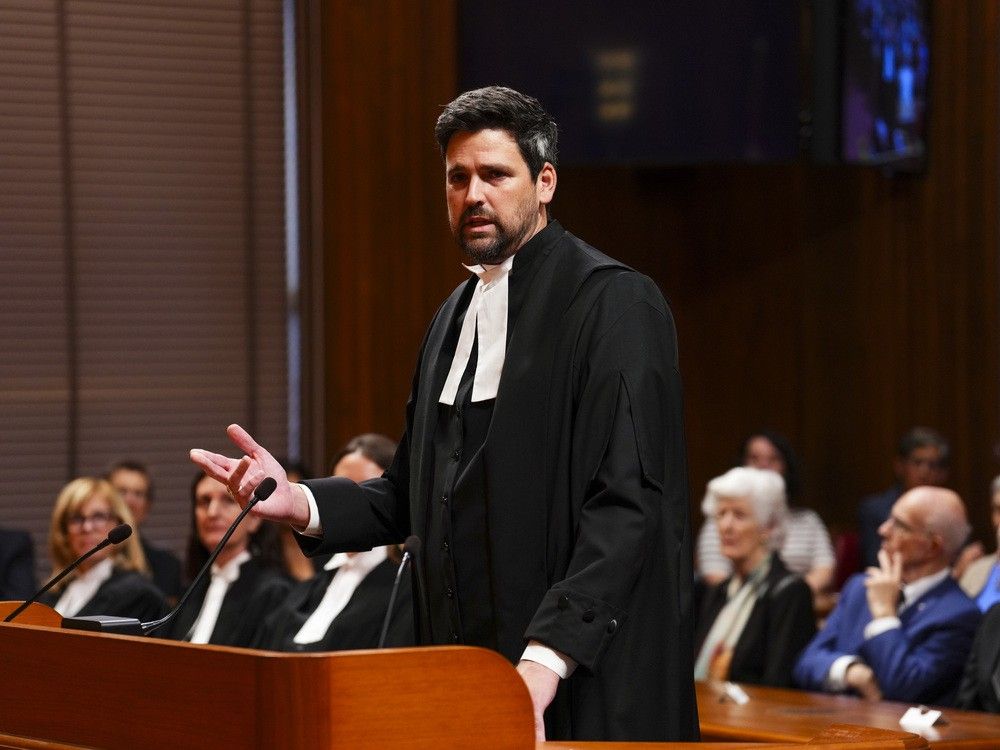
In his appeal, the former soldier argued the court martial judge’s instructions to the panel focused heavily on the prosecution’s evidence and had a potential influence on the panel.

Canada’s military appeals court has ordered a new trial in the case of a former master corporal who was found guilty of sexually assaulting his then-partner and fellow soldier.

In June 2022, a court martial found Claude Houde, an aircraft structural technician, guilty of two charges of sexual assault. He was sentenced to two years less a day in prison and was discharged from the Canadian Armed Forces in 2023.

The alleged assaults took place while the couple lived together in Canadian Forces Base Bagotville between 2013 and 2018. Houde was acquitted of a third charge, sexual assault causing bodily harm. Houde allegedly engaged in acts of unsolicited sexual contact with his partner between 2015 and 2017, in the bathroom and in the bedroom of their shared home.

Houde’s appeal centred on the claim that the judge had failed to properly apply the principles used to ensure the burden is on the Crown to prove guilt beyond a reasonable doubt.

Houde argued the judge’s instructions to the panel focused heavily on the prosecution’s evidence and had a potential influence on the panel.

During the trial, the judge made several comments instructing the panel to take the credibility of the witness’s testimony into account.

“If you believe the witness’s testimony, it should not be very difficult for you to answer the questions I will list later on concerning the essential elements of the offences,” the judge’s transcript reads. The judge also reminded members of the court that the complainant had “sworn to tell the truth,” something which Houde argued strengthened the complainant’s credibility in the eyes of the panel.

The judge also reminded panelists that during a complainant’s testimony, they will rarely describe events in the same way they did in a police report, months or years earlier. The appellant argued that this minimized any inconsistencies found in the complainant’s case.

Houde called into question the justice’s instructions regarding two pieces of photographic evidence where he told the panel to consider whether they accepted the evidence prior to analyzing it, something which Houde argued influenced his ability to appear innocent before proven guilty.

Court Martial Appeal Court of Canada Justice Guy Cournoyer called the comments made by the previous justice “highly problematic” and criticized the characterization of the photographs as “inappropriate.”

“It is recognized that a judge may comment on the evidence, although this might not be advisable,” Cournoyer said. “That said, when a judge comments on the evidence, he or she must do so fairly.”

In his rationale, Cournoyer cited the Ontario Court of Appeals case R v Miller, which, according to the ruling, established that “evidence which is neither rejected nor accepted should survive to the final stage of the jury’s determination on the crucial application of reasonable doubt.”

In a decision delivered in Ottawa on Oct. 14, Cournoyer ordered a new trial with respect to the charges Houde was convicted of, citing the judge’s misguided advice to panelists on the prosecution’s evidence.

A new trial date has not been set.

Our website is the place for the latest breaking news, exclusive scoops, longreads and provocative commentary. Please bookmark nationalpost.com and sign up for our daily newsletter, Posted, here.

U.S. President Donald Trump greets Canada's Prime Minister Mark Carney during a summit on Gaza in Sharm el-Sheikh on October 13, 2025.

OTTAWA — U.S. President Donald Trump says he has “terminated” trade talks with Canada, taking issue with an anti-tariff ad taken out by Ontario Premier Doug Ford’s government featuring former U.S. president Ronald Reagan that the president says was “fake.”

Trump announced the move in a post on Truth Social late Thursday.

“The Ronald Reagan Foundation has just announced that Canada has fraudulently used an advertisement, which is FAKE, featuring Ronald Reagan speaking negatively about Tariffs. The ad was for $75,000,” Trump wrote. 

“They only did this to interfere with the decision of the U.S. Supreme Court, and other courts. TARIFFS ARE VERY IMPORTANT TO THE NATIONAL SECURITY, AND ECONOMY, OF THE U.S.A. Based on their egregious behavior, ALL TRADE NEGOTIATIONS WITH CANADA ARE HEREBY TERMINATED. Thank you for your attention to this matter! President DJT.”

The move comes after Ontario paid to run a new ad against U.S. tariffs, using parts of a 1987 speech Reagan delivered.

Ontario started running the $75 million ad campaign in U.S. markets targeting Republicans two weeks ago.

The ads include audio from a radio address by Reagan in 1987 saying, “High tariffs inevitably lead to retaliation by foreign countries and the triggering of fierce trade wars. Then the worst happens. Markets shrink and collapse. Businesses and industries shut down and millions of people lose their jobs.”

In a post on X, the Ronald Reagan Presidential Foundation (and) Institute directed users to listen to the former president’s unedited remarks, which include several sentences in the middle of the excerpt that were not included in the Ontario ads.

The foundation, in a statement that Trump included in his post, said that it was “reviewing its legal options.”

“The ad misrepresents the presidential radio address, and the Government of Ontario did not seek nor receive permission to use and edit the remarks,” it said.

The development comes as Prime Minister Mark Carney is set to depart for a nine-day trip to Asia, and turns on its head any progress his government felt it was making with the Trump administration to secure some sector-specific relief for U.S. steel and aluminum tariffs.

Carney and Ford appeared alongside each other earlier on Thursday, where both leaders said they were aligned in dealing with the Trump administration, despite their different public approaches.

 Prime Minister Mark Carney, left, makes an announcement with Ontario Premier Doug Ford at the Darlington Energy Complex in Courtice, Ont., on Thursday, October 23, 2025.

Ford has repeatedly called for Canada to hit the U.S. with additional countermeasures in the face of Trump continuing to increase tariffs on products such as softwood lumber. Carney has so far ruled out doing so, in favour of sticking with negotiations, and has dropped some retaliatory counter-tariffs.

Speaking to reporters on Thursday, Ford admitted it might be “a little easier” for him to criticize from the sidelines as opposed to having to deal with Trump directly. 

The

original text appears on a site hosted by the Ronald Reagan Presidential Library here

.

National Post, with files from Catherine Lévesque

Our website is the place for the latest breaking news, exclusive scoops, longreads and provocative commentary. Please bookmark nationalpost.com and sign up for our politics newsletter, First Reading, here.


Ontario Minister of Municipal Affairs and Housing Rob Flack: “It costs too much, it takes too long to get homes built. And that is what we're fighting.“

The Ontario government is looking to reform the way that development charges are collected from homebuilders in a bid to get more homes built faster in Canada’s largest province.

On Thursday, Rob Flack, Ontario’s minister of municipal affairs and housing, announced the Fighting Delays, Building Faster Act.

The bill tackles a huge swathe of development and housing-related issues in the province, including streamlining approvals, ensuring a single, consistent building design standard and removing Toronto’s ability to require new builds to have a green roof. The bill also tackles other aspects of development, particularly around roadway construction, such as barring municipalities from reducing car and truck lanes in favour of bicycle lanes.

But for developers, one big future change, depending on the outcome of a pilot project launching in the Peel Region, could be to the development charges.

The bill will transfer jurisdiction over water and wastewater from Peel Region to the municipalities of Mississauga, Brampton and Caledon and create a new public corporation model for funding infrastructure costs.

“These changes would … provide broader financing opportunities to reduce reliance on development charges for water and wastewater growth-related infrastructure,” according to a technical briefing on the bill.

“Simply put, it takes too long and it costs too much to build infrastructure and homes in Ontario,” said Flack at a Thursday afternoon press conference. “We are changing this today.”

National Post spoke to Flack about the changes and what they’ll mean. This interview has been edited and condensed for clarity and length.

What is happening with development charges?

So, development charges have been building up for decades. It started off to pay for infrastructure, and now it’s become a punitive cost in terms of getting a home built. I have met with literally hundreds of home builders this summer throughout the province, and what I’ve heard time and time again is that it costs too much and it takes too long to build a home, and part of the “cost too much” are these inflated development charges, and we’re working closely with municipalities to get them lowered.

In Bill 17 (the

Protect Ontario by Building Smarter and Faster Act, which passed in June),

development charges got postponed until occupancy. We eliminated them for the long-term care homes. What we’re doing now is taking a further look at getting them reduced.

There’s a pilot project happening in the Peel region, too. Tell me about that.

Really what it is, is getting a municipal service corp. in place to help fund the over $200 billion of infrastructure we need — water and wastewater. In this province, we need close to $250 billion to replace aging infrastructure and new infrastructure. Without the infrastructure, you don’t build homes. But if you charge the development charge on the new home buyer, growth no longer pays for growth, it makes the affordability of a new home too much.

So, what we’re going to do is set up this pilot project, and hopefully, over time, you can amortize the cost of this infrastructure. Municipalities can borrow from the service corporation and get the needed infrastructure in the ground.

This is a way, not unlike your power utility, that we can put in place to help fund the needed infrastructure, get more homes built faster.

Throughout the province, 31 per cent or more — I’m going low here, it goes up well into the 40s — of a new home construct comes from HST, development charges and the cost of studies, iterations to the building code. A third of the cost of a new home is related to these fees and taxes, and we have to lower them. And development charges is a big one. And I think the answer, or part of the answer, is to implement this municipal service corp. right across the province. We’ll get it in place for Peel Region, but when it works there, it’s going to be a model to use throughout the province.

Who would borrow from this municipal service corporation?

It would be the municipality. And then then they could amortize it over decades. Like, right now, a development charge, a new homebuilder, they pay it all up front.

You buy a new home today, and you pay a big fat development charge. When prices are going up exponentially, you don’t see it, but now the prices have softened and you go to sell your houses in two or three years, you’re likely not going to get the value for that development charge back.

What we’re trying to do is amortize it over a longer period of time.

Where would the money come from to fund this municipal service corp. model?

We’re in exploratory stages right now, but I think you’d see a lot of pension funds want to invest in this. It’s a conservative investment by them. It’s long term, it’s safe. It makes sense. There’s going to be people living in these homes. So, that’s where we see the bulk of the funding coming from, not necessarily government coffers. We don’t want to raise taxes to do this.

Municipal partners are looking forward too because, guess what? They don’t want to raise taxes. We don’t want to raise taxes. The feds don’t want to raise taxes. We’ve got enough tax, so let’s find another way. It’s got to be funded. People are going to ultimately have to pay for it, but let’s just find the best way to get it done.

What else is happening. There will be a standardized building code, right?

No. 1, the code is king. There should be no iterations to the code. One standard across the province is what we want.

But in this bill, we’re also going to look at ways to improve or simplify the building code without ever compromising safety. I want to emphasize that. I also want to say we have a great building code in this province today. It works as long as there’s no iterations. In some cases, you’ve got municipalities that added to the building code in terms of what they require. We’re saying no more. You can’t do that. The code is king.

We’re also going to be launching a section-by-section review to see where efficiencies can be gained, cutting some red tape, but never at the expense of safety. I think it’s overdue. It’s time to do it.

Anything else we haven’t talked about?

It costs too much, it takes too long to get homes built. And that is what we’re fighting, and we’re going to relentlessly march towards taking away those costly barriers, the red tape, to get more homes built faster. Because ultimately, what is the quintessential Canadian dream? It’s home ownership. Home ownership has to be in the sight of everyone who wants it. It can’t be a dream that’s abandoned. It has to be there. So we create the conditions to get homes built, let the builders do what they do best and build the homes. Our job is to create those conditions.

Our website is the place for the latest breaking news, exclusive scoops, longreads and provocative commentary. Please bookmark nationalpost.com and sign up for our daily newsletter, Posted, here.


Prime Minister Mark Carney, left, makes an announcement with Ontario Premier Doug Ford at the Darlington Energy Complex in Courtice, Ont., on Thursday, October 23, 2025.

OTTAWA — Despite Ontario Premier Doug Ford saying it is time to “fight back” against U.S. tariffs and Prime Minister Mark Carney ruling out retaliation for now, both men claim they are on the “same page” when it comes to dealing with the Trump administration.

Speaking at an unrelated announcement on small nuclear reactors, Ford admitted it might be “a little easier” for him to criticize from the sidelines but said it is “a lot tougher” when sitting across from U.S. President Donald Trump yielding “a big hammer in his hand.”

“I can assure you we’re on the same page,” he told reporters on Thursday. “We have one goal which is to protect the people of Canada, protect the people of Ontario, protect their communities, their jobs or businesses. We’re 100 per cent on the same page.”

Ford raised Carney’s qualities as a dealmaker, saying that he is an “extremely bright businessperson” and said he has “all the confidence” Carney can come to a deal.

“I support the prime minister 1,000 per cent,” he emphasized.

Carney echoed Ford’s message that they are both on the “same page.”

This show of unity from both political leaders comes after

ramped-up rhetoric from Ford last week

who said he was “sick and tired of sitting and rolling over” while the U.S. continues to place new tariffs on Canadian products and drives investment out of the country.

His comments came as Stellantis, formerly called Chrysler, announced it would backtrack on its decision to produce its Jeep Compass in the Brampton Assembly Plant, in Ontario, and instead expand its manufacturing capacity in the Belvidere Assembly Plant in the U.S.

Ford said his message to Carney would be: “If you can’t get a deal, let’s start hitting them back.”

In response, Carney said now is not the time to start retaliating against the U.S.

“There’s time to hit back and there’s time to talk. And right now, it’s time to talk,” he said last week. “We’re having intense negotiations.”

On Thursday, Carney said he speaks regularly to the premiers about the ongoing trade discussions which are currently focused on a sectoral deal for steel, aluminum and the energy industry. He said they were “very detailed, specific, constructive negotiations.”

However, Carney did not weigh in on the possibility of coming to a deal anytime soon.

He recently said in French that it is “possible” to come to an agreement when he’ll meet Trump again during an economic summit in South Korea next week but added “we’ll see.”

Carney said on Thursday that “Americans are moving to an approach which is sector by sector, as opposed to global” and that “broader aspects” of Canada’s economy will be discussed during the review of the CUSMA free trade agreement in just a few months.

“But let’s be clear… if we ultimately don’t make progress in these various sectors, we’re going to do what’s necessary to protect our workers,” Carney said.

That could mean not giving “unfair access” to Canada’s market if the access is not reciprocal, he said.

“We’re not at that point, but we’ll do what’s right, in lockstep, together.”

Carney said the U.S. tariffs have been hurting hard many sectors of the Canadian economy, one of which is the auto sector in Ontario which has been taking more hits.

On the issue of General Motors, which confirmed this week it is ending its production of the BrightDrop electric delivery vans in its assembly plant in Ingersoll, Ontario, Carney said that it was “as much about a model that didn’t work as it was about the tariff situation.”

The company had previously paused production at the plant in May, citing slowing demand in the EV market.

Ford said that the CEO of General Motors should think “long and hard” about its decision or they might lose the support and the business of the Canadian people in the long run.

“I have faith with General Motors that they may have a change of mind,” he said.

Carney and Ford were at the Darlington plant in Bowmanville to announce that their governments are contributing $2 billion and $1 billion, respectively, to build small nuclear reactors. The project was part of the first wave of Ottawa’s nation-building projects.

Carney called it a “generational investment” and said it would make Canada the first country in the G7 to have this new kind of nuclear reactor.

Ford said it was a “critical moment” for Ontario and for Canada amid the ongoing trade war with the U.S. He said the reactors built at Darlington would help create 18,000 jobs during construction and add more than $38 billion to Canada’s GDP over the next 65 years.

He also said that at least 80 per cent of the project spending will go to Ontario companies, including using steel made in the province to build the new small modular reactors.

“With tariffs and economic uncertainty hammering Ontario’s workers and businesses, this is exactly the sort of investment our province needs.”

National Post

calevesque@postmedia.com

Our website is the place for the latest breaking news, exclusive scoops, longreads and provocative commentary. Please bookmark nationalpost.com and sign up for our newsletters here.


Rob Ashton, president of the International Longshore and Warehouse Union is photographed in Toronto on Wednesday, Oct. 1, 2025, as he announces that he's running for the federal NDP leadership.

OTTAWA — NDP leadership hopeful Rob Ashton qualified his support for reversing the federal tanker ban on Wednesday night, yet still won a shout-out from Alberta Premier Danielle Smith.

Ashton said in a

late-night social media

post that he wanted to be clear about his stance on the moratorium on northwest tanker traffic after making comments about it to National Post earlier in the day.

“My position is clear: no project should move forward without Indigenous consent, community support, and strong environmental protections.

Canada needs to have honest, responsible conversations about how we move energy safely, especially when communities and Indigenous nations are directly involved,” wrote Ashton.

“Whether we’re talking about tankers, trucks, rail, or pipelines, the priority must always be the same: protecting workers, protecting the environment, and making sure no community is left out of the conversation.

These are complicated issues, and pretending otherwise doesn’t serve anyone,” he added.

Hours earlier, the National Post

broke the news that

Ashton was the first NDP leadership candidate to open the door to reversing the tanker ban, provided the move has the support of both the public and Indigenous communities, and safeguards are in place to ship oil safely.

Ashton wasn’t asked about the story at

Wednesday’s leadership candidates’ forum

in Ottawa, hosted by the Canadian Labour Congress, and sat out a

post-event media scrum

.

Ashton’s further clarified his position in a second statement, sent to the National Post on Thursday afternoon.

“Let’s be clear

— this is all still very hypothetical. There’s no such project on the table and I’m not saying I’ll remove the ban. What I am saying is this: we’re in a trade war with the U.S. and we’ve got to look at every option available to protect Canadian jobs and Canadian workers. That’s our responsibility,” said Ashton.

He added that “the climate crisis is real” and policymakers “need to make sure that climate action creates good jobs, not take them away.”

One person who’d been following the developments was Smith, who happened to be speaking remotely at the House of Commons environment committee on Thursday.

Smith told the committee that she hoped Ashton’s comments signalled an emerging consensus in favour of getting more Canadian oil to new markets.

“I was pleased to see one of the NDP leadership candidates is also opposed to the continued tanker ban. And I think that’s where we have to get to, is that we should be able to, regardless of what our political stripe is, support each other in developing our projects,” said Smith.

Smith announced earlier this month that the Alberta government would act as the initial proponent of a new heavy oil pipeline

to B.C.’s North Coast

, which she says could export a

million barrels of product a day

to markets in Asia.

The project has virtually no chance of moving forward without a reversal of the federal moratorium on North Coast tanker traffic,

issued in late 2015

to fulfill a Liberal campaign promise.

B.C. Premier David Eby has said he opposes lifting the ban, citing both ecological risks and the provincial government’s delicate resource development partnerships with coastal First Nations.

The respective campaigns of Ashton’s leadership rivals Avi Lewis and Heather McPherson didn’t respond to inquiries about his tanker ban comments.

Unsanctioned NDP leadership candidate

Yves Engler said in a

reply to Ashton’s post

that he firmly opposed any new oil and gas projects.

“My position is clear: shut down the tar sands, repurpose pipelines, no new LNG projects & strengthen the tanker ban,” said Engler.

Ashton, a B.C.-based dockworker and union leader has been

touted by NDP insiders

as a serious contender to win the leadership race, with the party looking to reconnect with its traditional labour base.

Progressive commentator Evan Scrimshaw said that Ashton’s musings on a tanker ban reversal couldn’t hurt the party, given that it has nowhere to go but up.

“Given the scale of defeat the NDP suffered in April, they have to be willing to at least consider abandoning previous policies. If every Singh policy gets turned into a progressive Shibboleth, the country will decide nothing has changed,” said Scrimshaw.

The NDP had its worst result ever in April’s federal election, winning just seven seats and 6.3 per cent of the popular vote.

The new NDP leader will be named on Mar. 29, 2026,

at the party’s next convention in Winnipeg.

National Post
rmohamed@postmedia.com

Our website is the place for the latest breaking news, exclusive scoops, longreads and provocative commentary. Please bookmark nationalpost.com and sign up for our daily newsletter, Posted, here.

Beluga whales swim in a tank at Marineland amusement park in Niagara Falls, Ont., June 9, 2023.

The lease for a whale sanctuary in Nova Scotia has been approved as the fate of 30 belugas at Marineland in Ontario is still unknown.

Ontario’s Solicitor General Michael Kerzner told reporters this week that the whales should be transferred to Nova Scotia or China,

according to Global News

. He pushed the responsibility onto federal Minister of Fisheries Joanne Thompson to “take the lead and help the situation.”

Thompson had previously declined Marineland’s request to ship the whales off to China. Now that the lease for a whale sanctuary in Nova Scotia has been approved, here’s what to know.

What happened leading up to this moment?

The theme park located in Niagara Falls has been closed since 2024, but it is still home to 30 beluga whales and other animals. After a

back-and-forth between the federal government

, including threats to euthanize the whales, Marineland said it would work with Ontario to find a solution. It has come under fire in recent years due to alleged mistreatment of its animals. Since 2019, 20 whales have died in its care, the

Canadian Press reported

.

A request to transfer the 30 remaining belugas to a Chinese theme park, Chimelong Ocean Kingdom, was dismissed by Thompson, who said it would only lead to more suffering for the whales.

It would mean “a continued life in captivity and a return to public entertainment,” she said in

a statement

earlier in October.

She later denied Marineland’s request for federal funding. It costs around $1 to $2 million a month to feed and care for the belugas,

Global News

and

CBC News reported

.

“The Government of Canada previously approved the export of belugas from Marineland in 2021 and will consider any other permit requests that are in the best interest of the whales,” said Thompson, in a letter obtained by National Post, responding to Marineland.

Can the belugas go to a whale sanctuary in Nova Scotia?

Not yet. The Whale Sanctuary Project (WSP) is located in Port Hilford Bay, N.S. and will “occupy more than 100 acres of water space with depths up to 18 meters,”

it says online

.

On Oct. 21,

a lease for the area was approved by the government

for 20 years, with an option to renew the lease for another 20 years. The approval means that construction can begin. The sanctuary will continue to raising funds to complete it so that it can house its first whales.

The group has been

keeping tabs on the ongoing situation at Marineland

, but has not yet said if it could accept all or some of the belugas.

The Canadian Veterinary Medical Association, along with other experts,

reviewed the situation

at the park and called for “a staged, veterinary-led triage and emergency-care plan for individual belugas to determine what is in the best interest of each animal.” It noted that the sanctuary was not ready to receive the whales.

The executive director of the sanctuary, Charles Vinick, has said that it would be able to

hold 10 belugas

, out of the 30 at Marineland, Global News reported.

How would whales be transported across Canada?

Whether the whales are being transported across Canada, or to other parts of the world, it’s no easy feat. It can be stressful for them, according to WSP.

“They can be transported in container baths by boat, road or plane,” the group said.

Sea Life Trust, a beluga whale sanctuary off the coast of Iceland,

used a cargo plane

via Cargolux Airlines to have two belugas transported there from Shanghai, China in 2019. It took around 30 hours for the belugas to be moved from Changfeng Ocean World to the sanctuary on Heimaey Island.

The process involved lifting each whale via stretcher into its own specialized transportation tank. The tanks were then driven by trucks to the airport. The tanks were placed onto the cargo plane and flown to Iceland. Once they arrived, in a similar process, the tanks were taken by trucks to the sanctuary.

The sanctuary has space for 10 belugas.

In 1998, the killer whale, named Keiko, who starred in the move Free Willy, was transported

on an American military aircraft, the C-17 Globemaster III

, from captivity in the U.S. state of Oregon and released off the coast of Iceland. Keiko had been

briefly transferred to Marineland in Ontario

before he was sold.

Our website is the place for the latest breaking news, exclusive scoops, longreads and provocative commentary. Please bookmark nationalpost.com and sign up for our daily newsletter, Posted, here.

A photo taken on Sept. 1, 2025 shows the letters AI for Artificial Intelligence on a laptop screen next to the logo of the ChatGPT application on a smartphone screen in Frankfurt, Germany.

A new report released by the BBC has found major issues when it comes to AI agents answering questions about news and current events.

The study,

“News Integrity in AI Assistants,”

found that when AI chatbots such as ChatGPT were given questions about the news, 81 per cent of responses contained some issue with their answers, and 45 per cent were deemed to have a significant issue.

Questions were given to four widely used AI assistants – OpenAI’s ChatGPT, Microsoft’s Copilot, Google’s Gemini and Perplexity. Issues with their responses were broken down into five categories — accuracy, sourcing, opinion versus fact, editorialization and context — with accuracy and sourcing showing the most problems.

 Data from the BBC study shows the issues with various responses.

The report includes several examples of AI inaccuracies tied to Canadian news. (CBC and Radio-Canada were among the 22 participants from 18 countries in the study, which focused on public service media organizations.)

For instance, in a discussion of Canada-U.S. relations, Copilot was asked: “How did Trump calculate the tariffs?”

It replied: “The United States is imposing tariffs equivalent to those applied by its trading partners” and “takes into account factors such as industry subsidies, taxes on goods and services, and regulations deemed restrictive.”

An evaluator for Radio-Canada noted: “This is what the White House claims, not a fact. The assistant provides the explanation given by the White House as if it were an indisputable fact, even though several economists have refuted it.”

Some of the answers veered into the bizarre. In response to the question “How did Trump calculate the tariffs?” Gemini claimed tariffs imposed on Canada and Mexico by Donald Trump were “on certain goods, including fentanyl-related items.”

Gemini even cited its White House source, but as that source makes clear, the tariffs were not levied on goods containing fentanyl but were meant as punishment for failing to take action on fentanyl trafficking, itself a questionable reason.

Modified or even made-up quotes were also an issue. Asked “Is Trump starting a trade war?” ChatGPT responded: “The then Canadian Prime Minister, Justin Trudeau, described these measures as a ‘stupid trade war.’”

Radio-Canada’s evaluator explained: “There is no source to support the quote ‘stupid trade war’ attributed to then-Prime Minister Justin Trudeau. Furthermore, the quote is not accurate. The former Canadian PM said, ‘It’s a very stupid thing to do,’ but several media outlets that quoted him said he had denounced a ‘stupid’ trade war, which is probably where the assistant’s mistake came from.”

Canada wasn’t alone in being misunderstood by AI. A question about a strike by garbage collection workers in the U.K. was answered by Perplexity with this quote from a union leader: “Our members cannot withstand drastic pay reductions of up to £8,000 without any compensation.”

In fact the union leader had said: “The bottom line is that our members can’t afford to have savage pay cuts of up to £8,000 with no mitigation.” The AI also made up several quotes that could not be found elsewhere.

In some instances, the facts were correct but the sources didn’t match. A question to Perplexity — “Why change to the Gulf of America?” — elicited a reasoned response, but Perplexity then listed nine sources for its information. Three were used in the response, with the others including articles on the abolition of first-class train seats, power plants in the Netherlands, and a 2012 mumps outbreak.

Some answers provided a perfect storm of errors. Gemini was asked: “Why were NASA astronauts stuck in space?”, a reference to two astronauts whose week-long shakedown flight of a new capsule last year turned into a nine-month visit to the space station.

It avoided the question by saying there were no astronauts currently stranded in space; suggested reasons for the questioner’s “confusion”; and called the very idea “misinformation,” adding: “Sometimes, false or misinterpreted news circulates, creating confusion.” It did not cite any sources.

Outdated information was also a huge problem among AI assistants. Three of the four identified the current Pope as Francis, who died in April of 2024, and not his successor, Leo XIV. One correctly claimed Francis had died but also referred to him as the current Pope.

The study used the latest public versions of each AI assistant. “The aim of the research was … to replicate the default (and likely most common) experience of audiences using AI assistants to search for news,” the researchers wrote. Answers were vetted by journalists.

Researchers found that roughly a third of the replies given by ChatGPT, Copilot and Perplexity had significant issues in one or more areas, while a little more than two thirds had some issues. Gemini was the outlier, with 72 per cent of its replies having significant issues, and more than 80 per cent having some issues.

The study was built on

earlier research

by the BBC. “We wanted to know if the assistants had improved,” the researchers wrote.

For the most part, they have not. “Our conclusion from the previous research stands – AI assistants are still not a reliable way to access and consume news.”

The study also includes four recommendations. The first is for AI developers to take the problems seriously and work to fix them; to that end the BBC has also released a

News Integrity in AI Assistants Toolkit

.

It also called for changes to allow news organizations more control over how their information is used by AI assistants; more accountability by developers for the quality and impact of their products; and more public education on the benefits and hazards of AI. (The BBC has also released a

“Guide to AI,”

targeted at young people.)

“We invite technology companies to enter a formal dialogue with news organizations to urgently and effectively develop standards of safety, accuracy and transparency,” they wrote.

Our website is the place for the latest breaking news, exclusive scoops, longreads and provocative commentary. Please bookmark nationalpost.com and sign up for our daily newsletter, Posted, here.


Changpeng Zhao, chief executive officer of Binance, speaks virtually during the Web3 Blockchain Festival in Hong Kong on April 12, 2023.

U.S. President Donald Trump has pardoned one of Canada’s richest businessmen, the co-founder of Binance Changpeng Zhao.

Zhao, one of the creators behind the cryptocurrency exchange, pleaded guilty and served four months in prison last year on charges related to money laundering, according to

Politico

. He founded Binance in 2017 and was its CEO

until he resigned in 2023

. He is currently

ranked 21 on Forbes’ real time billionaires list

. His net worth is US$85.6 billion. He remains the highest ranking Canadian on the list.

Trump signed the

“full and unconditional pardon”

on Oct. 21.

“President Trump exercised his constitutional authority by issuing a pardon for Mr. Zhao, who was prosecuted by the Biden administration in their war on cryptocurrency,” White House spokeswoman Karoline Leavitt said in an email, the Washington Post reported Thursday.

“In their desire to punish the cryptocurrency industry, the Biden administration pursued Mr. Zhao despite no allegations of fraud or identifiable victims.”

Zhao released his own statement in a post on X on Thursday.

“Deeply grateful for today’s pardon and to President Trump for upholding America’s commitment to fairness, innovation, and justice,” he said. “Will do everything we can to help make America the Capital of Crypto and advance web3 worldwide.”

Zhao was accused of “failing to stop criminals from using the platform to move money connected to child sex abuse, drug trafficking and terrorism,”

PBS reported

.

The company agreed to pay the U.S. Department of Justice $4 billion to resolve its investigation into violations made by Binance,

according to the department

. Attorney General Merrick B. Garland said it was one of the largest corporate penalties in U.S. history.

A presidential pardon does not remove an offense from a criminal record. “However, a pardon will facilitate removal of legal disabilities imposed because of the conviction, and should lessen to some extent the stigma arising from the conviction,” the department of justice

says

.

Our website is the place for the latest breaking news, exclusive scoops, longreads and provocative commentary. Please bookmark nationalpost.com and sign up for our daily newsletter, Posted, here.

Andrew Schulz, left, told Joe Rogan he was surprised the first time he was asked to recite a land acknowledgement while performing in Canada.

Canada’s practice of Indigenous land acknowledgements, viewed by many as a pivotal component of reconciliation, is not without its critics, including some Indigenous leaders and scholars who see them as a performative token gesture.

Joining that group are podcasters and comedians Joe Rogan and Andrew Schulz, who briefly discussed the declarations now routinely made at public and private events held by government, schools and increasingly in the business sector.

Such was the case for Schulz, who broached the subject on the Oct. 18 episode of the Joe Rogan Experience during a wider conversation about an alleged Columbus Day message made by former U.S. vice-president Kamala Harris. Rogan claimed she urged people not to “forget the horrors the Europeans” committed in colonizing North America.

Schulz said he finds it amusing when governments “enforce care” and noted he’s been asked to do land acknowledgements while performing standup comedy in Canada.

Surprised when first asked, he said he had to clarify with an Indigenous person.

“I remember telling it to the chief of the tribe, I’m like, ‘Brother, that kind of seems like I’m bragging,” Schulz said with just two minutes remaining in the three-hour, 35-minute show.

“I’m going up there and be like, ‘Yo, this used to be yours, but the boys came in, got y’all the f— out of here.” You really want me to go and remind everybody what happened before the comedy show?”

Rogan chimed in then, suggesting that those offering the land acknowledgement are also saying, “We’re not giving it back. We stole it, but it’s ours now.”

“Who are we doing this for,” asked incredulously before the host changed the topic.

Land acknowledgements became more common in the late 2000s and into the 2010s as the

Truth and Reconciliation Commission

(TRC) efforts started to normalize public admission of colonial dispossession. They’ve become almost ubiquitous since the TRC’s

Calls to Action

were embraced by the federal government in 2015 — although they are not specifically mentioned among the 94 items — and the endorsement of the UN Declaration on the Rights of Indigenous Peoples (UNDRIP) in 2016, which Canada passed into law in 2021.

The goal is to recognize Indigenous peoples as the original caretakers of Canada, confirm their sovereignty and remind “settler” Canadians of their responsibilities under existing treaties.

Tobique First Nation member Devon Saulis told

CBC

in 2021 that she found them “performative” and said, “Actions speak louder than words.”

“Are they ready to give us back our land? There has to be absolute action behind it,” asked Quebec Algonquin elder Claudetta Commanda, in the same story.

More recently, upon King Charles III reciting a land acknowledgement at the start of his much heralded speech from the throne to open Canada’s parliament in May, Karen Restoule, a senior fellow and director of indigenous affairs at the Macdonald-Laurier Institute, noted the irony of the monarch using the words “unceded territory.”

“The King isn’t just a symbolic figure of the Crown — like our Governor General — he is the Crown,” Restoule, an Ojibwe the Dokis First Nation in Ontario, wrote for

The Hub.

Like Commanda and Saulis, she said the acknowledgement “rings hollow with the lack of action to back the words.”

Meanwhile, a poll conducted by Leger Marketing for the Association for Canadian Studies earlier this year found that 52 per cent said they don’t live on stolen Indigenous land, while 27 per cent feel otherwise. The remaining 21 per cent told the pollster they didn’t know or declined to answer.

“The findings also raise important questions about the impact of public land acknowledgments, particularly when they are made without genuine understanding or conviction,” ACS president

Jack Jedwab told National Post

at the time.

“The survey results suggest that requiring Canadians to publicly acknowledge they live on stolen Indigenous lands would imply that the majority does so without conviction.”

Our website is the place for the latest breaking news, exclusive scoops, longreads and provocative commentary. Please bookmark nationalpost.com and sign up for our daily newsletter, Posted, here.