LP_468x60
on-the-record-468x60-white

Monte Solberg wants Albertans to believe their “future is stronger within a united Canada than outside of it.”

Monte Solberg is between a rock, a hard place and a divided conservative base.

The former Conservative MP and founder of Vote to Stay wants Albertans to believe their “future is stronger within a united Canada than outside of it.” Of all the players trying to sway the Oct. 19 vote — pro-separation and pro-Confederation — his path is the most treacherous.

Champions of Alberta separation lean into a grievance culture carefully fed for a decade, especially during the Trudeau years. They have a motivated, sometimes angry base. Progressive “remain” campaigns — Thomas Lukaszuk’s Forever Canadian, Stephen Carter’s Alberta’s Voice, Anne McLellan’s Before You Vote — draw natural support in Liberal and NDP constituencies.

Solberg and his team, which includes former premier Jason Kenney, are hunting in tougher country. “We’d like to sway 100,000 soft separatists to vote on the federalist side,” he tells me over coffee in Calgary. “As far as I know, we’re the only ones in the Conservative fold.”

Those soft separatists are his people. “These are the people who say, ‘I’m going to send Carney a message,’” and choose Option 2 — forcing the Alberta government to begin the legal process for a binding separation referendum. They think they are being tactical; Solberg thinks they are playing with fire.

“I urge people not to see it as a way to send a message to Ottawa about Alberta’s ill treatment, which I acknowledge has been the case in the past. But I urge them to think about the consequence of blowing oxygen on a separatist movement.”

Sending a message divides, he says. “We don’t need to turn people against each other.” That is the real contest. The separatist campaigns need the soft separatists — the conservatives who think Option 2 is a warning shot, not a first step out the door. Solberg is asking those voters to stand down; the independence camp is asking them to use the ballot as leverage.

Solberg knows polarized politics. He chuckles recalling his youth in Saskatchewan under then premier Allan Blakeney, when the NDP partially nationalized the potash industry. “My dad was a conservative, very involved in politics, and fought against the NDP. It was a crazy time. You think democratic socialists are a thing in the U.S. now; they were way more extreme in those days in Saskatchewan.”

In Alberta, he grants the anger is often righteous. “We were really attacked by Justin Trudeau. No question.” But Trudeau is gone. Mark Carney, he says, has moved in a different direction on electricity regulations, the EV mandate and export pipelines.

“We’ll never know if we moved five people or 50,000 or 100,000,” Solberg says. The campaign’s job is to give people reasons to reconsider. “This is not a joke. Even though it’s a referendum on a referendum at this point, we could quickly be cast into a binding vote on the future of Alberta and Canada.”

He is at his sharpest when he leaves the atmospherics and talks specifics. The Alberta Prosperity Project recently released a draft constitution for an independent Alberta that includes elements he says most Albertans would not recognize. “Making Alberta an open-carry state is ridiculous. I say this as somebody who is a firearms owner myself. This is not what Albertans are looking for. It’s not a priority.” Albertans care about affordability and about not being swallowed by larger powers — risks, he argues, that are more manageable inside a country than as a “statelet.”

In a world now defined by an intense trade war with the United States, he would rather stay united than split off and become easy pickings. He will not go further into fear; I am surprised by the calm. These decisions are emotional, yet he remains relentlessly logical. The question hanging over Vote to Stay is whether logic is enough against people who are not trying to be reasonable.

The campaign has raised roughly $100,000 and hopes for more. It profiles prominent Albertans — Stephen Mandel, Iris Evans, Ed Stelmach, Brett Wilson, Mike Shaikh — with a civic message: you have a stake in this; spend an hour and vote.

That is a decent appeal to people who already like Canada. The voters who may well decide this thing are the ones telling Solberg they want to send Ottawa a message.

“My sense is that overall enthusiasm among federalists is picking up,” he says. Flags, online engagement, polling. “I think we saw the peak of separatism in the spring, almost concurrent with when the separatist group brought in their petition.” Maybe; but peaks do not matter if the other side is better at turning residual anger into turnout.

Solberg is a natural for this role. He was a Reform MP for Medicine Hat from 1993 to 2008, a Harper cabinet minister and an early believer in “The West Wants In.” After politics he founded New West Public Affairs in Calgary; his sons Matt and Michael Solberg are partners.

A card-carrying United Conservative Party member, he has sympathy for Premier Danielle Smith. “Politics within the UCP is very difficult these days, very elbows up.”

He credits her working relationship with Carney. “They’ve actually made great progress on things that are important to Albertans. We should celebrate that, not cheer against it.” Political courage is in short supply, he says, “and both are showing a bit of it. That should be applauded.”

Then the trade war with America made the argument more complex. Kenney — Solberg’s most prominent ally — publicly suggested that Alberta oil stay on the table as potential leverage with Washington. Keith Wilson, the Let Alberta Decide campaigner, immediately turned the remark into a separatist talking point. Vote Option 2, Wilson said, and put that leverage in Alberta’s hands rather than Ottawa’s.

Solberg’s pitch is that “sending a message” only inflames division. Wilson’s use of Kenney’s suggestion shows how fast that message escapes the conservative fold Solberg is trying to hold together.

“Canada is something more than a bunch of trade deals and it’s not an ATM,” Solberg says. “It’s actually all these relationships between people and provinces and communities and families. It’s all of that that is at stake.”

True enough. It is also the language of people who already agree with him; I know, I’m one of them.

The only frustration he shows is when I ask who has not shown up. “It’s the business community,” he says — the real one, not former premiers fronting for the Canadian Chamber of Commerce.

“Who has more to lose than the business community?” he asks. He understands the reluctance: some worry they will anger customers or anger workers in Red Deer and Grande Prairie. “But you know what,” he reiterates, “it’s about political courage. You need it everywhere.”

He is right. The separatists have warriors; the conservative case for Canada still needs some.

Our website is the place for the latest breaking news, exclusive scoops, longreads and provocative commentary. Please bookmark nationalpost.com and sign up for our daily newsletter, Posted, here.



In a 39-second video posted on X on Saturday, the Ontario premier said,

Ontario Premier Doug Ford unveiled a new sign in Winona, Ont. to remind Donald Trump “it’s Lake Ontario , now and forever.”

Ford’s message comes less than a week after he told the U.S. president to “ kiss my ass ” in response to Trump threatening to impose 50 per cent tariff against Canadian automobiles and auto parts. Trump, in retaliation, called Ford a “flunky.”

In a 39-second video posted on X on Saturday, the Ontario premier said, “You may have heard that President Trump is trying to rename this lake all because he doesn’t like Ontario and Canada standing up for ourselves. But let’s be serious. Long before President Trump, this lake was called Lake Ontario.”

Ford continued: “And long after President Trump is gone it will still be called Lake Ontario. But just in case President Trump or anyone else forgets, we have set up a sign to remind them, it’s Lake Ontario now and forever.”

On Thursday, the U.S. president signed an executive order to rename Lake Ontario, bordered by New York State and Ontario, to “Lake America.” The change, Trump said, will come into effect “immediately.”

After the trade deal fell apart between the two countries on Aug. 21, tensions between Canada and the U.S. have been high. When asked on Thursday if he was trying to send Canada a message with the executive order, Trump said, “Canada has been ripping us off for a long time on trade, very sadly,” and that “we defend Canada for nothing; they don’t pay us.”

Trump’s order has drawn flak not just from Canadian politicians but also politicians down south.

“An acronym for the Great Lakes used to be HOMES. Thanks to Donald Trump, it’s now SHAME,” New York Gov. Kathy Hochul’s office said in a post on X. The executive order was branded “ sad and pathetic ” by U.S. Senate minority leader Chuck Schumer. And U.S. Rep. Joe Morelle said on X that “pretending to rename a lake is an attempted distraction from the President’s disastrous trade talks with Canada.”

Meanwhile, American mapping company MapQuest in a social media post announced “we’re not changing it,” and shared an image of Lake Ontario and surrounding communities. The company jokingly invited social media users to “name it whatever you want at your leisure,” in a follow-up post with some suggestions that include “ Lake Double-Double, Lake Eh and Lake Oh Canada .”

Our website is the place for the latest breaking news, exclusive scoops, longreads and provocative commentary. Please bookmark nationalpost.com and sign up for our daily newsletter, Posted, here.


US President Donald Trump displays an executive order he signed that aims to rename Lake Ontario to Lake America in the Oval Office.

OTTAWA — Prime Minister Mark Carney says Canada is under attack, bombarded by U.S. tariffs and a trade partner that moves goalposts on a whim.

The federal government’s initial response was to offer short-term support payments for companies and workers hit by this latest round of American tariffs.

But economists say it’s the long-term policy moves that will do much more to inoculate the Canadian economy against the Trump tariffs, not to mention fuel a higher national standard of living.

The most powerful policy play, they say, would be an overhaul of Canada’s tax system because that could improve national competitiveness, something that was sorely needed even without the Trump tariff threat. They argue that tax changes, specifically cuts to personal and corporate income, would encourage increased investment and exports, which would then fuel increased economic growth.

“Canada really needs to do something large on tax reform,” said Jack Mintz, the president’s fellow at the University of Calgary’s School of Public Policy. “I think it’s even more crucial today.”

While Finance Minister François-Philippe Champagne has yet to signal the government’s broad goals for its upcoming budget this fall , the stars may have aligned for big change. The trade rupture has given Ottawa and the provinces rare political cover to make moves that might have been unpopular during normal times. The Liberals are also led by an economist, have a majority and are likely at least a couple of years from the next election.

The Liberal government might be leaning that way. Even before the trade war with the U.S., the party had vowed to hold a review of the corporate tax system during last year’s federal election campaign, although that promise that has not yet been kept.

The question is whether the Carney government will seize this moment to boost the economy or defy Winston Churchill’s quip to “never let a good crisis go to waste.”

It’s not just economists feeling the tides of change. The leaders of two of Canada’s largest banks, Scott Thomson of the Bank of Nova Scotia and Darryl White of the Bank of Montreal, said Tuesday that the tariff fight should trigger the federal government to act.

“There is an opportunity for the Canadian federal and provincial governments to recognize the moment for what it is and use it to drive transformational policy change,” White told equity analysts, “and not let this moment go to waste.”

A handful of economists surveyed by National Post were largely consistent in what they’d like to see the government do to spur and Trump-proof the economy.

Each said that their recipes for growth include, and usually begin with, income tax cuts: both corporate and personal.

Tim Sargent, director of economic growth and prosperity at University of Calgary’s School of Public Policy, said these two taxes touch and influence virtually every inch of the economy, which means that reducing them would also mean widespread improvements to competitiveness.

Fatter wallets

Despite some tepid cuts to personal income taxes in recent decades, economists say Canadians still pay way too much and the problem has been getting worse. Canada now relies more on personal income taxes for its revenue than any other G7 country.

While governments’ slice from Canadians’ pay cheques has been climbing for decades, Mintz pointed out that personal income taxes accounted for 11 per cent of GDP in 2010, but grew to 13 per cent by 2023. Personal income taxes are now responsible for easily the biggest chunk of government revenue, and almost twice the amount of any other form of federal or provincial tax.

While governments need money to pay for health care, education, defence and other big spending items, economists say it’s critical that legislators take the minimum and in a way that is as harmless as possible.

Don Drummond, a former high-ranking official at the Department of Finance and chief economist at TD Bank, said the four big tax baskets in order, from most to least harmful, are: corporate income, personal income, employment insurance and other payroll, then consumption taxes such as the GST.

Lower personal income taxes spur growth, economists say, because when people have fatter wallets, they tend to spend it, invest it, or use it to reduce debt which are all good things for the economy.

That’s particularly the case when governments cut “marginal” income taxes — the percentage that is taken off the next dollar that someone earns, not the entire amount. That is seen as an important distinction because that marginal rate influences whether people are motivated to work or invest more and high marginal Canadian rates kick in at relatively low levels, economists say, compared to other G7 countries.

Lower personal income taxes also help stave off the migration of highly skilled and entrepreneurial people to other countries.

Bigger business

And if you think cutting personal income taxes has political enemies, try selling corporate income tax cuts.

But economists argue that lower corporate income taxes are good for the economy, perhaps the greatest bang for the public buck, because they encourage and lower the long-term costs of investments in buildings, factories, and research.

And anything that leads to lower business costs should also lead to more productive employees and lower costs, at least where markets are competitive.

More profitable companies are also more valuable, giving them more equity heft to acquire competitors instead of the other way around. They can also pay employees more, which leads to more personal spending and investing, more government tax revenue, and reduces one of the key foreign lures that leads to “brain drain.”

To make those changes even more appealing, economists say, the government revenue lost by corporate income tax cuts is mitigated by a number of factors, such as the increased tax revenue derived from new investments spurred by the changes. Tax cuts also lead to behavioural changes, they say, such as multi-nationals moving profits to jurisdictions with lower rates.

In short, corporate income tax cuts don’t cost as much as they might appear.

In 2000-01, the federal corporate income tax rate stood at 28 per cent, and took in $28.3-billion. Flush at that time with growing revenue, Ottawa started cutting that tax and others. By 2012, it had been cut almost in half to today’s rate of 15 per cent. Ottawa took in $36.1 billion that year. In the last fiscal year, companies paid $97.1 billion in income tax, despite the lower rate

How is that possible? Economists say there are a few factors at play, including economic growth, multi-nationals accounting tools and higher corporate profits.

Sargent said Canada needs a national edge over the U.S., its biggest competitor for investment and production, and having a more efficient tax system that spurred and attracted investment would qualify.

While Canada used to have an edge in this regard, it’s been lost in recent years. In 2018, the U.S. cut its federal corporate income tax rate in 2018, which left its combined average federal-state rates at 25.7 per cent, compared to 26.1 per cent for Canada’s combined federal-provincial rate.

In a study released earlier this year, Mintz and two colleagues called for a “big bang” to Canada’s tax policy because they argued that the country’s tax system is contributing to weak economic performance. Despite the Canadian economy posting strong second quarter growth on Friday, the bigger picture remains less rosy. Over the last decade, Mintz said, the country has posted the slowest per-capita income growth in the G7 over the last three decades.

The “big bang” paper calls for the federal government to rely less on those taxes – namely corporate and personal income taxes — that hurt the economy the most, while shifting the burden to sales taxes and perhaps a new employer-paid payroll tax to help pay for health costs. They also call for cuts to government spending.

Part of the prescription in that paper is for a sharp cut in corporate income taxes to 10 per cent from today’s 15.

Doug Porter, chief economist at BMO Financial Group, suggested a more cautious approach, but with similar themes: slight trim to corporate income taxes and an across-the-board cut to marginal personal income taxes. Porter also said governments should broaden the base of taxpayers by reducing some exemptions and write-offs.

Either way, it’s not like a concerted effort at improved competitiveness hasn’t been tried before.

The most famous recent example of the benefits of lower corporate income taxes is Ireland.

In 1997, Ireland accelerated a plan to boost its economy, kicking off a series of corporate income tax cuts that dropped the rate to 12.5 per cent from 32 per cent over six years. Ireland already had low taxes for those companies exporting manufactured goods and some services and was enjoying a period of strong growth. But the big tax cut – accompanied by new investments in education and other policy changes – was the centrepiece of the plan, leading to a “Celtic tiger” that produced one of the world’s fastest-growing economies.

Beyond tax cuts

But it’s not just corporate and personal income tax cuts that economists point to for change.

There’s near unanimity among economists and just about everybody else that inter-provincial trade barriers are an economic menace that has been hurting Canadians’ pocketbooks since before Confederation.

Drummond said creating a legitimate Canadian economic union should be an important early step to economic growth.

Solving that dilemma was a signature piece of Carney’s economic plan. Ottawa has for the most part done what it can on this front as the federal barriers — which were never really the big problem — have largely been removed. But the broader goal of free trade within Canada, despite today’s trade challenges and a Constitution that says products from one province shall “be admitted free into each of the other provinces,” governments continue to reject the benefits of economic union.

There is some debate among economists about how much of an economic boost would be triggered by the elimination of provincial trade barriers,

Most studies have concluded that interprovincial trade barriers cost the Canadian economy between $50 billion and $130 billion a year in economic activity, or about 1.9 to 4.9 per cent of the gross domestic product. The International Monetary Fund recently estimated that Canada could boost its economy by seven per cent if it removed internal trade barriers. A recent analysis by Deloitte Canada estimated that a full elimination of the barriers could increase the Canadian economy by $881 billion over time.

Benjamin Tal , the deputy chief economist of CIBC World Markets, said the Canadian economy would also get an important boost if it were “opened up” to greater levels of foreign investment. The keys to that goal, Tal said, are loosening ownership caps on foreign investment, streamlining regulations and speeding up project approvals.

The Carney government has made that third objective a priority by, among other things, opening up a new major projects office. That’s part of Ottawa’s effort to diversify trade, with the goal set last year of doubling non-U.S. exports over the next decade.

National Post

Our website is the place for the latest breaking news, exclusive scoops, longreads and provocative commentary. Please bookmark nationalpost.com and sign up for our daily newsletter, Posted, here.


Quebec's Prime Minister Christine Frechette (L) applauds during a press conference with Canadian Prime Minister Mark Carney at the Davie Shipyard in Levis, Quebec, Canada on August 24, 2026.

OTTAWA — Coalition Avenir Québec Leader Christine Fréchette launched her province’s election campaign by talking about the importance for Quebec to transform its economy in the face of the trade war with the U.S. because their old relationship is over.

If that message sounds oddly familiar, it’s because it is.

That is exactly the message that Prime Minister Mark Carney has been repeating since the 2025 election that saw the Liberal Party of Canada get elected for a fourth mandate against all odds.

On Thursday, a reporter asked Fréchette if she was trying to emulate Carney.

“My name is Christine Fréchette — and it’ll stay that way,” she said with a laugh.

Fréchette took the reins of the Coalition Avenir Québec (CAQ) in April, succeeding its founder and longtime leader François Legault. The CAQ was expected to be wiped off the electoral map with the separatist Parti Québécois (PQ) poised to form a majority government.

But Fréchette took the bull by the horns, multiplying announcements in the province and adopting a new collaborative tone with Ottawa that led to the conclusion of pending deals with Quebec worth billions for infrastructure and major contracts.

Provincial and federal sources consulted for this story said that Fréchette and Carney have a “transactional” relationship which has benefitted both sides — showcasing Fréchette as a dealmaker and Carney as practicing “cooperative federalism.”

But they argue that Ottawa would be wise to take a step back now that the campaign is underway and let the different parties battle it out for the election on October 5.

“They shouldn’t do anything that smells of interfering. Quebec voters will look very unfavourably on the federal government doing anything that hints of picking a winner,” said Jonathan Kalles, a former Quebec advisor to former prime minister Justin Trudeau.

“I think people can figure out which side Mark Carney’s on. At least in terms of who he doesn’t want to win, I don’t think he needs to say that. And I think if he does, it would look bad, and it wouldn’t help whichever other party he, in essence, wants to win.”

Once Fréchette became premier, she travelled to Ottawa to meet with the prime minister — instead of him coming to Montreal or Quebec City — and Carney pointed out there were many years-long pending deals between both levels of government.

“He couldn’t wrap his mind around why we could not agree on good news,” said one senior government source.

Kalles, now senior vice president at Vantage, said the personalities and backgrounds of Trudeau and Legault were so different that their talks weren’t “always constructive.”

“Fréchette comes in and she’s looking to demonstrate that she can get concrete things done. And I think Mark Carney understood that, so he was in a deal mode,” Kalles said.

The first major announcement came in June when Quebec and Ottawa signed five infrastructure agreements worth nearly $10 billion which would pave the way for major investments in public transit, health care, housing and education over the next decade.

Earlier in August, the federal government also helped Quebec broker a new energy framework with Newfoundland and Labrador that the PQ promised it would review once in power and ask for compensation for Quebec’s loss of Labrador nearly a century ago.

And only three days before the start of the campaign, Carney was by Fréchette’s side in Lévis, Quebec, to announce that the federal government will invest $11 billion for Davie Shipyard to build six new icebreakers for the Canadian Coast Guard.

The multiple announcements between both leaders so close to the election did not go unnoticed by reporters, who asked Fréchette if Carney is becoming her “best friend” for the upcoming campaign and Carney if he would like Fréchette to win the election.

Carney took the podium first to say it is his job to work with premiers, unions, business leaders and all Canadians in a spirit of collaboration.

“That’s my choice,” he said in French. “It’s the only choice and I am happy that Madame Fréchette has the same attitude in terms of working in collaboration to create good jobs and bright futures for people.”

“When Madame Fréchette became premier, she said, ‘Let’s get to work.’ These are good words for me,” he added.

In a similar fashion, Fréchette said it is her job to work with anyone who wants to advance Quebec’s interests.

After the announcement, Carney crossed the St. Lawrence River to meet with the leader of the Quebec Liberal Party (QLP) Charles Milliard, for a brief lunch.

It was the first meeting between the two men and sources said they spoke about their vision of how to respond to the trade war. After lunch, Carney took the initiative to go around the patio, with Milliard, to shake hands with customers.

A provincial source said the Liberal Party of Canada has more natural links with the QLP than the CAQ. For instance, two of Carney’s top advisors — chief of staff Marc-André Blanchard and deputy chief of staff Andrée-Lynne Hallé — were involved with the provincial Liberals years back.

Kalles said he didn’t see Carney’s meeting with Milliard as an endorsement.

“I don’t think we know who’s going to win this election, so I think it’s trying to build a relationship — especially in the current circumstances of an economic crisis and the tariff crisis — and at least break the ice with any of the potential winners.”

No such meetings were in the works for PQ Leader Paul St-Pierre Plamondon or other provincial leaders before the start of the campaign, Carney’s office said.

And Carney will not be making partisan announcements with any of the contenders during the Quebec election either.

If the PQ were to form government in October, a senior government source said the prime minister would treat it no differently than other provinces.

For now, Fréchette is the one who seems to be benefitting from the current trade war with the U.S. while St-Pierre Plamondon and Milliard are losing ground.

A Synopsis-La Presse poll released Friday showed that the CAQ has soared to 27 per cent of voting intentions in Quebec among decided voters, a statistical tie with the PQ which now stands at 28 per cent. The QLP is in third place at 20 per cent.

In this scenario, the PQ would still form a minority government, but any movement upwards for the CAQ could compromise this scenario for the separatist party.

Jonathan Valois, a former CAQ chief of staff and PQ member of the National Assembly, said the polling shows that Quebecers are striving for more stability amid the trade war, and that as a result, all provincial parties will be forced to readjust their messaging.

“The campaign is going to be a long one, but it certainly sends very clear signals to political parties regarding the mood of the electorate concerning this American threat,” he said.

Valois said that while Fréchette has benefitted from her close proximity to Carney — who remains widely popular in Quebec — she also struck the right tone in demanding more information on the tentative Canada-U.S. deal before talks collapsed last week.

Earlier this week, U.S. Commerce Secretary Howard Lutnick said Carney walking away from a trade agreement and blaming it in part on the lack of protections for the French language because he was trying to prevent the PQ from winning in Quebec.

Valois said that while details around this issue are still fuzzy, Carney defending the protection of the French language from the U.S. is a “gift from heaven” for the CAQ.

“This makes things a bit easier for Christine Fréchette, who wanted to show that she is aligned with Mark Carney but also a staunch defender of Quebec’s distinct character.”

“Right now, the stars are aligned for her.”

National Post
calevesque@postmedia.com

Our website is the place for the latest breaking news, exclusive scoops, longreads and provocative commentary. Please bookmark nationalpost.com and sign up for our newsletters here.


The CBC logo at the broadcaster's Toronto headquarters.

The CBC has reversed its policy that prohibited reporters from referring to 9/11 as “terrorism” without direct attribution.

CBC made the change after it was criticized by Canadian and U.S. officials, including the U.S. ambassador to Canada and the FBI director.

In a blog post on Friday, Basem Boshra, CBC’s senior director of journalistic standards and public trust, wrote that a leaked memo about the policy “has caused significant concern, anger and hurt for many people who believe CBC News seeks to minimize or obscure the horror of that day and who was behind it.”

“That is the last thing we want to do,” said Boshra, who is the senior director of journalistic standards and public trust of CBC News.

Minister of Canadian Identity and Culture Marc Miller called the policy reversal “a welcome change to what was a piece of pedantic and foolish guidance that caused legitimate anger.”

The Conservative party’s shadow minister for culture, Rachael Thomas, had called on the CBC to apologize.

As National Post previously reported, the memo was sent to CBC staff ahead of the 25th anniversary of 9/11 reminding reporters and editors of its “longstanding language guidance” on the 2001 attack, which killed almost 3,000 people, including at least 24 Canadians .

“Do not refer to the Sept. 11 attacks as terrorist attacks,” the memo read.

In a post on social media, Public Safety Minister Gary Anandasangaree wrote that condemning the terrorist attack “is not merely a political position.” Canada has legally recognized 9/11 as a terrorist attack, he said.

“That legislation reflects Parliament’s own clear-eyed characterization of what happened that day: a deliberate, ideologically motivated terrorist attack on civilians,” Anandasangaree wrote.

“For nearly 25 years, Canada’s laws and policies have treated it as exactly that.”

In a pointed critique, FBI director Kash Patel referred to the language policy as a “bastardization of history.”

“Any agency in Canada that doesn’t publicly reject this bastardization of history, and an insult to the souls lost during our largest terrorist attack in US history will no longer have friend in this FBI… Not to mention our heroes that responded in the aftermath,” he wrote on X.

“The radical left (Canadian Broadcasting Company) is trying to rewrite history, but there is nothing controversial, complicated, or unclear about this,” the U.S. House Republicans wrote in a statement posted to X, adding, “9/11 was terrorism.”

CBC’s language guidance had instructed employees to “exercise extreme caution before using the words terrorist or terrorism” because they can be “highly contested” and could raise questions about the CBC’s “consistency and impartiality.”

“Terrorism generally implies attacks against unarmed civilians for political, religious or some other ideological reason,” the guidance reads. “But it’s a highly controversial term that can leave journalists taking sides in a conflict.”

According to Boshra, the CBC has reviewed its language guidance and has “decided to adjust it to clarify that direct attribution is not required for describing the historic events of 9/11 as terrorism. We are doing so to remove what has unfortunately (and unintentionally) become an impediment to clarity and public understanding.”

Among those outraged following reports of CBC’s policy was Maureen Basnicki of Collingwood, Ont., whose husband, Ken Basnicki, was trapped on the 106th floor of the North Tower of the World Trade Center during the attack and died on Sept. 11, 2001.

“To know that this directive was sent, and at the management level, there’s not enough adjectives out there to describe my reaction. I was more than dismayed; I was angry,” Basnicki said.

Our website is the place for the latest breaking news, exclusive scoops, longreads and provocative commentary. Please bookmark nationalpost.com and sign up for our daily newsletter, Posted, here.


Toronto Blue Jays catcher Russell Martin (55) homers to right in the bottom of the 6th Inning and is congratulated by Josh Donaldson in Toronto, Ont. on Thursday July 6, 2017.

OTTAWA — Former Toronto Blue Jays all-stars Josh Donaldson and Russell Martin have swept a doubleheader court battle with the Canada Revenue Agency as an appeal court confirmed they do not owe taxes on millions of dollars of income.

On Friday, the Federal Court of Appeal confirmed a 2024 Tax Court decision that found that the CRA’s calculation of Donaldson and Martin’s taxable income during some of the years they played in Canada was “faulty.”

As a result, both players won’t have to pay additional taxes on millions of dollars of income, as claimed by the tax agency.

As first reported by National Post in 2023 , Donaldson and Martin’s cases raised a common issue that tax experts argued could have a chilling effect on Canadian sports teams’ ability to attract top international athletes: how non-resident top earners can protect their income and mitigate Canada’s higher income-tax rates.

In this case, the tax agency challenged how much income the players could deduct from their taxes using contributions to a form of pension plan called a Retirement Compensation Agreement (RCA).

RCAs are commonly used by high-earning athletes and top executives recruited by Canadian organizations. It defers income and tax payments, and isn’t subject to strict contribution limits like an RRSP.

The taxpayer is allowed to contribute a “reasonable” amount to their retirement every year, but the CRA withholds half of it in a fund that cannot be invested.

When an RCA holder retires or loses their job, the pension account will begin paying out, at which point the money will be taxed, presumably when they are in a lower tax bracket. The CRA will then also refund the 50-per-cent portion of all contributions that it withheld.

The crux of the battle between CRA and the two former Blue Jays stars was a disagreement on how the players’ contributions should be deducted from their income tax while they played for Toronto.

At issue was that Russell and Donaldson spent 60 per cent of their time in the United States and only 40 per cent in Canada, with taxes payable split accordingly. The time spent in Canada was called “duty days.”

CRA argued that the retirement contributions should be deducted before the 60/40 American-Canadian split was calculated, meaning the players would end up paying more taxes on the Canadian portion.

The two baseball stars, represented by Davies lawyer Marie-France Dompierre, argued the opposite: that the contributions should only be deducted from the Canadian portion after the split.

The difference in taxable income was significant. For Donaldson, it was $2 million, whereas it topped $3.1 million for Russell.

Ultimately, both the Tax Court and the Federal Court of Appeal sided with the players.

“In my view, the correct interpretation of the provisions of the (Income Tax Act) is the approach adopted by Russell Martin and Josh Donaldson and confirmed by the Tax Court,” wrote Federal Court of Appeal Judge Wyman W. Webb on behalf of the panel of three magistrates.

National Post

cnardi@postmedia.com

Our website is the place for the latest breaking news, exclusive scoops, longreads and provocative commentary. Please bookmark nationalpost.com and sign up for our politics newsletter, First Reading, here.


The east leg of the Enbridge Line 5 pipeline near St. Ignace, Mich.

OTTAWA — A frightening scene played out on Tuesday morning, when a parked semi-truck rolled into an excavation site and hit an exposed section of the Enbridge Line 5 pipeline near the Wisconsin-Michigan border.

Drone footage that was widely circulated online showed a thick, white cloud of natural gas spreading from the accident site to a meadow on the other side of a dirt road.

While the leak was quickly isolated and no injuries were reported, the incident exacerbated an already tense political divide around the Canada-U.S. pipeline.

Fred Clark, a Democrat running for Congress in northern Wisconsin, quickly called on the state’s department of natural resources to halt work on Line 5 until a “thorough review of Enbridge’s construction methods and safety protocols can be conducted.”

Based on these incidents it’s clear that Enbridge does not have all of the details right when it comes to ensuring that this project can be executed safely,” said Clark in a press release.

Clark’s campaign didn’t respond to multiple calls from National Post.

The department sent Enbridge a letter on Thursday asking the Calgary-based company to stop work in the area while it investigated the spill. The letter didn’t say how long the investigation would take.

Tony Evers, Wisconsin’s Democratic governor, said he was “exceedingly concerned” about the spill and “other recent events involving Enbridge,” and called on the company to work “expeditiously” with state investigators.

Michigan Governor Gretchen Whitmer, also a Democrat, filed a legal brief on Friday calling for an underwater section of the pipeline running through her state to be removed.

The timing of the spill, coinciding with competitive, high-profile statewide races in both Michigan and Wisconsin, is likely to keep Line 5 in the spotlight heading into November’s midterm elections.

Here’s what you need to know about the debate over Line 5 south of the border.

What is Enbridge Line 5?

Enbridge Line 5 is a 1,038 km pipeline that runs from northern Wisconsin to Sarnia, Ont., and forms one segment of the company’s larger continental pipeline system. It moves up to 540,000 barrels per day of light crude oil, light synthetic crude, and natural gas liquids used to make propane. Roughly 80 per cent of this product originates in Alberta’s oilsands, with the rest coming from smaller deposits in the Midwest.

Completed in 1953, Line 5 was originally designed to bypass seasonal interruptions in oil tanker shipments across the Great Lakes.

“The ice cover on the lakes meant that they only got eight months a year of shipping,” said Jeffrey Insko, a professor at Oakland University in Rochester, Mich., who’s writing a book on the history of Line 5.

Insko said the construction of Line 5 helped accelerate an era of booming postwar oil production in North America.

Why is Line 5 controversial in the Midwest?

Line 5 came under increased scrutiny in 2010, after a rupture in nearby Enbridge Line 6B caused upwards of one million gallons (3.79 million litres) to spill into Michigan’s Kalamazoo River.

The Line 6B spill raised fears that a major rupture of Line 5 could do catastrophic damage to the Great Lakes, which supply drinking water to about 10 per cent of the U.S. population. One especially sensitive section of the pipeline runs underwater through the Straits of Mackinac, which bisect Lake Michigan and Lake Huron.

Environmentalists have also raised concerns about the 73-year-old pipeline’s aging infrastructure, which has already led to smaller-scale spills and seepage. Dave Holtz, a spokesperson for anti-pipeline campaign Oil & Water Don’t Mix told National Post that Line 5 has spilled at least 1.2 million gallons of product through its lifespan.

A long list of Tribal Nations have also called for Line 5 to be shut down, claiming it violates treaty rights and threatens their way of life.

What’s Line 5’s current state?

Line 5 is currently caught up in deep legal and regulatory certainty amid challenges from both the Michigan government and a coalition of Tribal Nations across Michigan and Wisconsin.

Governor Whitmer tried to terminate an easement allowing Enbridge to run the pipeline through the Straits of Mackinac in 2020, but was blocked from doing so by a federal judge.

Whitmer reversed course somewhat last month, giving Enbridge the green-light to build a $500-million tunnel under the Great Lakes as part of a Line 5 replacement project.

Mike Shriberg, director of the University of Michigan Water Centre, said locals were surprised to see the Government of Canada intervene on Enbridge’s behalf during the litigation.

“It’s pretty extraordinary for the Canadian government to weigh in, in the U.S. court system on behalf of a private company, over the objections of the state of Michigan and Tribal Nations,” said Shriberg.

Enbridge has also been mired in a separate legal dispute with the Bad River Band of northern Wisconsin. The company has agreed to re-route 41 miles of pipeline in response to a trespassing order from the band, which was upheld by a federal appeals court earlier this month.

Could Line 5 be decommissioned?

Holtz’s says Line 5 will likely be on its last legs if the Michigan tunnel project doesn’t go forward.

“If there’s no tunnel, Enbridge has lost the excuse for avoiding the discussion about the orderly decommissioning of the old existing pipeline,” Holtz.

Shriberg agrees that Line 5 could be shut down, noting that Michigan and the other Great Lake states are by no means dependent on the pipeline.

“There’s plenty of excess capacity in other areas to supply the needs of the U.S.,” said Shriberg.

Shriberg noted that, historically, temporary disruptions in the flow of product through Line 5 have not substantially affected energy prices in the region.

He added that a decommissioning of the pipeline would need to be “orderly” and take energy needs on both sides of the border into account.

Would Trump cut off Line 5 to punish Canada?

U.S. President Donald Trump’s escalating feud with Ontario Premier Doug Ford has sparked chatter that he could use Line 5 as a cudgel to attack his foe. (Trump issued an executive order changing the name of Lake Ontario to Lake America on Thursday, in response to a series of slights from Ford.)

Trump could theoretically try to disrupt the operations of Line 5 but he’d need to jump several hurdles to do so.

First, this would be a clear violation of a pipeline treaty struck between Canada and the U.S. in 1977. Trump would also likely need to get Enbridge, a private (and Canadian) company onboard.

Shriberg said that attacking Line 5 would be a retreat from Trump’s lengthy track record of support for oil companies. The Trump administration has notably sided with Enbridge in it’s legal battle with Michigan.

“President Trump is so closely aligned with the fossil fuel industry that I can’t see it happening,” said Shriberg.

National Post
rmohamed@postmedia.com

Our website is the place for the latest breaking news, exclusive scoops, longreads and provocative commentary. Please bookmark nationalpost.com and sign up for our daily newsletter, Posted, here.


U.S. President Donald Trump speaks during an event in the Oval Office of the White House on August 27, 2026 in Washington, DC.

As Canadian officials reject U.S. President Donald Trump’s order renaming Lake Ontario as Lake America, Canada’s own database of official place names carries eight entries called Trump.

Only one thing in the country is actually named after the U.S. president, and it is not on that list. Ottawa Coun. Tim Tierney told CNN it is Trump Avenue, a residential street in the capital’s Central Park neighbourhood.

CNN reported that council voted unanimously Wednesday to take a first step toward renaming the street, a day before Trump signed the Lake Ontario order, which followed the same pattern as his renaming of the Gulf of Mexico. Tierney said the replacements floated so far run to Obama Avenue, Ontario Avenue, Canada Avenue, Canada Goose Avenue, Pelosi Avenue and Taco Avenue, which spells out Trump Always Chickens Out.

Meanwhile, Prime Minister Mark Carney wrote on X that the name for Lake Ontario is more than 400 years old and comes from the Wendat word Ontari’io, meaning “the lake is beautiful, the lake is big.”

Conservative Leader Pierre Poilievre wrote on X that the lake “is and will always be Lake Ontario, and no executive order will change that.”

The Canadian Geographical Names Database, run by Natural Resources Canada and fed by federal, provincial and territorial naming authorities, still carries the lake as Lake Ontario, along with eight “Trump” entries. There is not enough information available on the origin of the “Trump” entries.

 The Canadian Geographical Names Database lists eight official entries called Trump.

Four of them sit off Newfoundland’s north coast in Notre Dame Bay, near Twillingate. Two are islands, North Trump Island and South Trump Island, about two kilometres apart. A third entry covers a group called the Trump Islands and a fourth carries that same name for a settlement.

Ontario holds the other four, in two clusters about 180 kilometres apart. Trump Lake and Trump Creek lie roughly 54 kilometres from Chapleau. East and West Trump Lake sit about 32 kilometres from Kapuskasing.

However, while the register records the date a naming authority last decided on each place, it mentions nothing about origin. Every Trump entry on it is filed with its language of origin listed as undetermined, a designation entered by the provincial authorities that own the names.

The most recent decision on any Trump entry in Canada was made in 1973, on East and West Trump Lake. The four Newfoundland entries date to January 1954, and Trump Lake and Trump Creek to that October.

Two more entries sit on the register as formerly official, meaning the name stays on record but is no longer recognized. Lac Trump lies in Pontiac County in western Quebec, about 49 kilometres from Maniwaki. Trump, Man., is about five kilometres from the town of Morris, south of Winnipeg.

Streets are not in the register, but Natural Resources Canada’s Geolocation Service returns two Trump streets in the country, roughly 2,850 kilometres apart. Trump Avenue runs through Ottawa’s Central Park neighbourhood off Merivale Road, while Trump Place is a cul-de-sac off Timothy Drive in the Timberlands neighbourhood of Red Deer, Alta.

How Trump Avenue got its name has never been documented. National Post columnist Colby Cosh wrote Friday that the developers who built Central Park in the 1990s named the street directly after Trump, then a New York real estate figure, for marketing reasons. AFP reported in 2021 that the neighbourhood was built on a New York theme, alongside a Madison Park, a Manhattan Crescent and a Staten Way.

A 2021 consultation asking the street’s 62 households whether they wanted the name changed split 21 in favour and 21 opposed, with 20 not voting. Tierney said the Lake Ontario dispute has put a renaming back on the front burner.

He said the focus belongs on trade and tariffs rather than names. “Stop with the lame name game and let’s get back to the table,” he said.

Both of Canada’s Trump-branded towers have dropped the name. The Globe and Mail reported in 2017 that the Toronto building’s owner had bought out the Trump Organization’s management contracts, five years after it opened. The Vancouver tower opened in 2017, closed in 2020 and had its signage taken down the year after, Global News reported.

Trump Lake , the one near Chapleau, has a Google Maps listing with five reviews and a rating of 2.4 stars.

Our website is the place for the latest breaking news, exclusive scoops, longreads and provocative commentary. Please bookmark nationalpost.com and sign up for our daily newsletter, Posted, here.
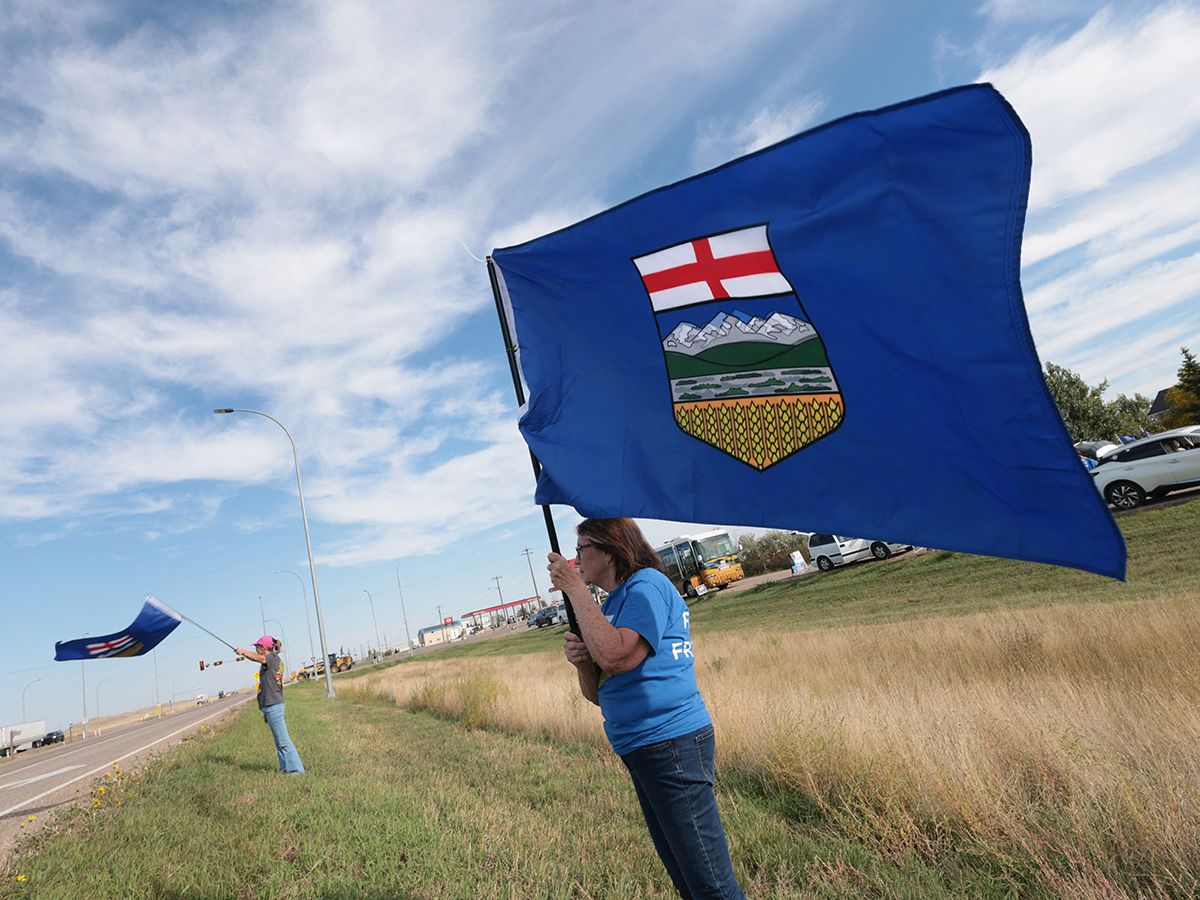

US President Donald Trump displays an executive order he signed that aims to rename Lake Ontario to Lake America in the Oval Office.

Political leaders in America are pushing back against U.S. President Donald Trump’s decision to rename Lake Ontario “Lake America,” calling it “sad and pathetic” and accusing him of trying to distract from “disastrous trade talks with Canada.”

The criticism comes after Trump signed an executive order on Thursday that he said would “immediately” change the name of the Great Lake that straddles the U.S.-Canada border.

When asked what message he was trying to send Canada with the renaming of the lake, the U.S. President replied: “No message,” adding that “Canada has been ripping us off for a long time on trade, very sadly,” and that “we defend Canada for nothing; they don’t pay us.”

U.S. politicians condemning Trump’s executive order include former U.S. secretary of state Hillary Clinton, who wrote, “It’s Lake Ontario,” in a post on X, and Vermont Sen. Bernie Sanders, who said, “The American people don’t want to rename Lake Ontario Lake America.”

He added: “They want affordable healthcare, childcare, housing, education & nutrition assistance — all of which you have massively cut in order to pay for your $1 trillion tax break to the top 1%.”

Elsewhere, politicians in New York, the state bordering Ontario, also expressed opposition to the name change.

New York Gov. Kathy Hochul’s office said in a post : “An acronym for the Great Lakes used to be HOMES. Thanks to Donald Trump, it’s now SHAME.”

Chuck Schumer, the U.S. Senate minority leader, called the order “sad and pathetic,” and U.S. Rep. Joe Morelle suggested the renaming is “an attempted distraction from the President’s disastrous trade talks with Canada.”

In a social media post , he said: “While Rochester families deal with the impacts of a trade war he started, President Trump is playing games with a map.”

Outside of New York, New Jersey Sen. Cory Booker said he’d rather see every hospital that had been closed due to Trump’s policies renamed “the Donald Trump Memorial Hospital” than for there to be a “Lake America.”

Georgia Sen. Raphael Warnock said in a social media post that while Americans “can’t afford to fill up their tank…our President is spending his day renaming a lake.” He added: “What a joke.”

And Connecticut Sen. Chris Murphy wrote that Trump spending “all his time on this BS” is the reason why Americans’ gas and grocery prices are so high.

The official X account for U.S. House Democrats posted: “It’s too expensive to live and Donald Trump is renaming lakes.”

Lake Ontario, one of the five Great Lakes, is located between New York State and Ontario, Canada’s most populous province, home to about 16 million people.

Prime Minister Mark Carney responded to Trump’s actions shortly after the executive order was signed, explaining on social media that “the name Lake Ontario comes from the Wendat word Ontari’io, which, appropriately, means ‘the lake is beautiful, the lake is big’.”

He added that the name is more than 400 years old and predates both Canadian Confederation and the U.S. Declaration of Independence.

“We know that America is changing. Their trading relationships, their foreign policies, their national monuments, their hydronyms,” he wrote. “Canadians also know that naming reality means calling it Lake Ontario — then, now and always.”

Conservative leader Pierre Poilievre echoed Carney’s sentiment, adding that the lake is not Trump’s “to rename on a whim.”

“Our two countries have real trade issues that impact our people,” he wrote on X. “Instead of responding to stunts and distractions, Canadians must stay focused on what we can control: making our economy strong and affordable at home and using our leverage to fight tariffs abroad.”

Elsewhere, Manitoba Premier Wab Kinew responded to the news at a press conference, comparing Trump to an over-the-hill rock band and calling the name change “not his best work.”

Former Conservative MP Tony Clement weighed in on X with the question: “What should Canadians henceforth refer to Lake Michigan as?”

The executive order Trump signed reads: “The body of water currently known as Lake Ontario is a tremendous asset to the United States and part of our Nation’s heritage. With the deepest parts of the Lake’s waters lying within United States territory, the United States claims most of the Lake’s volume.”

It also orders the Department of the Interior to update maps and databases to rename the lake.

This is not the first time Trump has renamed a body of water. Last year, he signed an executive order calling for the Gulf of Mexico to be renamed the “Gulf of America” — though other countries have not adopted the name change.

Our website is the place for the latest breaking news, exclusive scoops, longreads and provocative commentary. Please bookmark nationalpost.com and sign up for our daily newsletter, Posted, here.


Maureen Basnicki meets with Canadian artist John Coburn, who created pen and ink drawings in the aftermath of the tragedy, at his studio in Toronto ahead of the 25th anniversary of 9/11.

A 9/11 widow is “appalled” and “angry” after the CBC told staff in a leaked memo to not refer to 9/11 as “terrorist attacks.”

Maureen Basnicki, of Collingwood, Ont., lost her husband, Ken Basnicki, who was trapped on the 106th floor of the North Tower of the World Trade Center during the attack. Their children, Brennan and Erica, were 16 and 21 years old at the time.

Maureen Basnicki told National Post that she was “dismayed” when she saw reports of the leaked missive.

“I had an interview with some very friendly, kind, sympathetic journalists just the day before, to be aired on September the 11th. So it was ironic that I had just interacted with some CBC employees,” she said.

“To know that this directive was sent, and at the management level, there’s not enough adjectives out there to describe my reaction. I was more than dismayed; I was angry.”

With the 25th anniversary of 9/11 on the horizon, CBC issued a memo reminding reporters and editors across its platforms of the policy on the language used to describe the event.

The missive from the broadcaster’s journalistic standards and practices office, a copy of which was obtained by National Post, includes a section of the “longstanding language guidance” on the Sept. 11, 2001, attacks that claimed nearly 3,000 lives — including at least 24 Canadians.

“Do not refer to the Sept. 11 attacks as terrorist attacks,” it reads. “The hijackings led to passenger jet crashes in Washington, D.C., Pennsylvania and Manhattan. The World Trade Center (WTC in second reference) was destroyed.”

The letter is signed BB, who is identified by Toronto Sun as Basem Boshra, senior director of journalistic standards and public trust at CBC News.

Basnicki, who is a former Air Canada flight attendant, said her husband was murdered in a terrorist attack. “That’s a factual statement,” she said. “And to have the likes of CBC, who is supposed to be our Canadian broadcasting company, to make such a statement just appalls me.”

She added that when people say she lost her husband, she tends to correct them. “He was murdered,” she said.

“When CBC tries to lessen the significance of a terrorist attack, it just muddies the waters. Call it for what it is factually, and acknowledge that (terrorism) is still a threat to our Canadian society.”

Rachael Thomas, the Conservative shadow minister for Canadian identity and culture, said the CBC directive “ diminishes the reality of what actually occurred” and called it “ an insult” to victims and their families.

9/11 was a terrorist attack, plain and simple,” she said in a statement calling for the CBC to apologize. “Canadians deserve a public broadcaster that tells the truth: that terrorists attacked and murdered thousands of innocent people on 9/11 and they should have no difficulty saying so.”

Kerry Kelly, a public affairs spokesperson for CBC, previously told National Post in an email that “it is wholly inaccurate to state our journalists have been urged to declare that this was not a terrorist act.”

Rather, she said the memo was a regular reminder about adhering to the CBC’s language guide for the terms “terrorist” and “terrorism.”

“CBC preferences use of these words with attribution to credible sources, a practice shared by many of the world’s top journalistic organizations,” Kelly wrote, pointing to an October 2023 blog by Brodie Fenlon, CBC News editor-in-chief and general manager.

He was writing in response to a similarly leaked memo to staff regarding the use of the same words in reporting about Hamas’s terrorist attacks on Israel that had occurred a week earlier.

 Maureen and Ken Basnicki in an undated photo.

Staff will use the terms, he said, but they will always be “attributed to government officials, authorities, experts and politicians.” He added that “CBC News does not itself designate specific groups as terrorists, or specific acts as terrorism … because these words are so loaded with meaning, politics and emotion,” and noted that the policy has existed for decades.

Elsewhere, CBC Ombudsman Maxime Bertrand addressed the policy in March while responding to a complaint about coverage of Israel and Gaza.

She called the policy a “necessary safeguard” but added that “it doesn’t guarantee ethical clarity or eliminate the potential for unconscious bias.”

“In practice, sensitivity to language and power relations demands constant vigilance and nuanced reflection. Essentially, journalists cannot be too careful,” she said.

Previous CBC ombuds have also addressed the policy, with Kirk LaPointe writing in 2011 that some view using the terms “terrorism” and “terrorists” as a signal that a journalist has taken a side, which “undercuts the credibility of reporting.” However, he also acknowledged that avoidance of the term can be seen as a political statement.

Meanwhile, Esther Enkin, in 2013, said that the CBC “recognizes the need for caution when using these terms,” and that the emphasis on specific language is “so that the audience members can make up their own minds.”

Basnicki, however, said she never wants 9/11 to be sanitized. “People don’t like to dwell on hate and horror,” she said. “But we haven’t won the war against terror.”

 Flowers are seen on names of victims of the 9/11 terror attack during the annual 9/11 Commemoration Ceremony at the National 9/11 Memorial and Museum on September 11, 2024 in New York City.

She said it’s important to teach younger generations what happened that day and to show gratitude to men and women of service, which is why she hopes Canadians will embrace Service Day every Sept. 11.

On the morning of the attacks, 19 al-Qaeda terrorists hijacked four commercial airliners in the continental United States.

Two of the aircraft were flown into the World Trade Center towers in Manhattan — both of which would collapse — another was slammed into the Pentagon, and the fourth crashed in Pennsylvania after passengers fought back against the terrorists.

Al-Qaeda is listed on the UN Security Council Sanctions List as a terrorist network.

Since the 9/11 attacks, Basnicki has become an advocate for counter-terror policies and an outspoken activist for the rights of Canadian terror victims.

She is the founder of Canadian National Day of Service Foundation and co-founder of Canadian Coalition Against Terror, and contributed to the passing of the Justice for Victims of Terror Act , which allows victims of terrorism to sue attackers and their supporters. She also advocated for the passage of the Canadian Victims Bill of Rights , which provides the rights to information, protection, participation and to seek restitution for the victims of crime.

In 2012, she received Queen Elizabeth II’s Diamond Jubilee Medal for “her enduring dialogue on terrorism” and is the driving force behind Canada’s National Day of Service on Sept. 11.

Its purpose is to celebrate and show gratitude to Canadians who have served our country, Basnicki said. “Especially our Canadian armed forces that went to Afghanistan, and the firefighters and police officers who went down to New York post 9/11 to help communities.”

Our website is the place for the latest breaking news, exclusive scoops, longreads and provocative commentary. Please bookmark nationalpost.com and sign up for our daily newsletter, Posted, here.