


LP_468x60
on-the-record-468x60-white

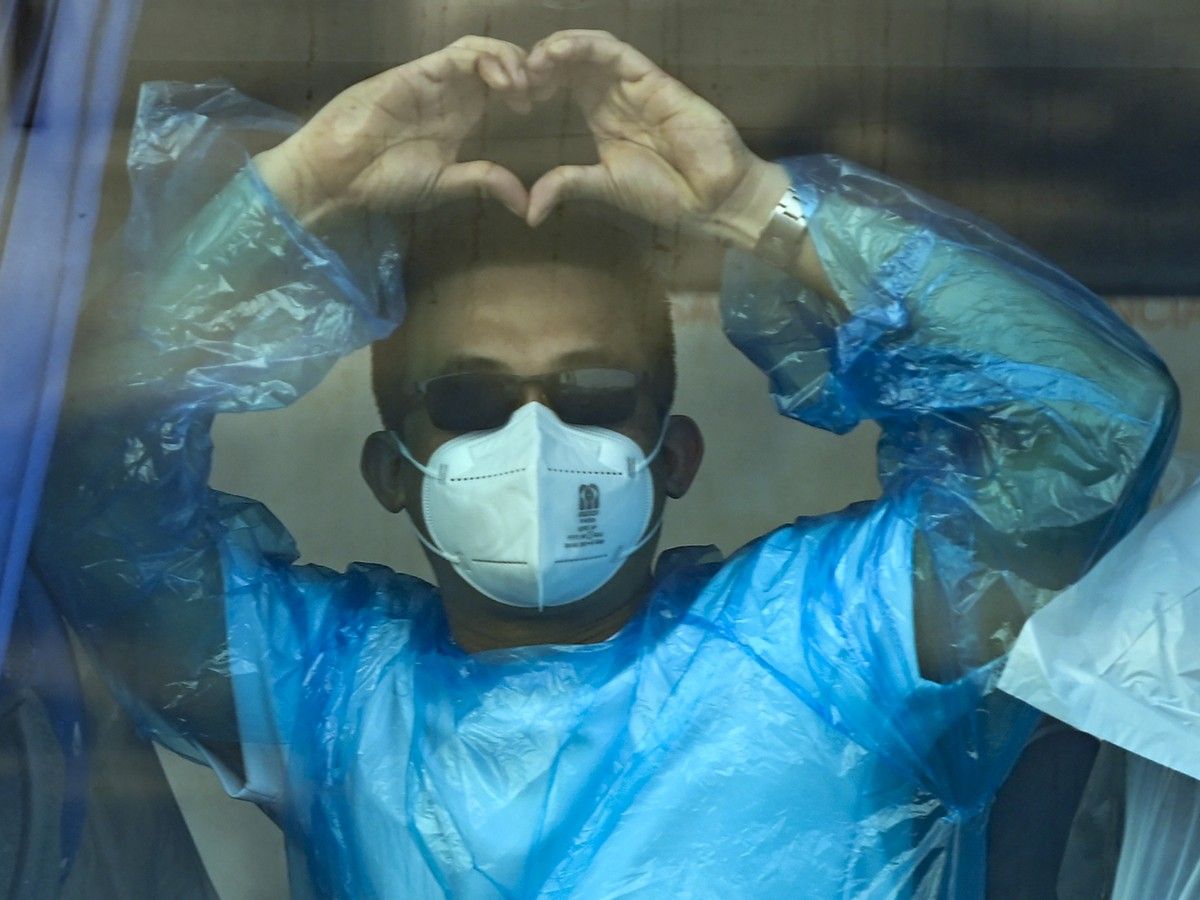
A passenger of the hantavirus-stricken cruise ship MV Hondius shown after disembarking on May 11. One of four high-risk individuals who was on the ship and self-isolating on Vancouver Island has tested presumptive positive for the hantavirus.

The B.C. Provincial Health Office is reporting that one of four high-risk individuals who was on the cruise ship M.V. Hondius and self-isolating on Vancouver Island has tested presumptive positive for the Andes hantavirus.

The person was transported to hospital for assessment and care on May 14, according to a statement released by the Public Health Agency of Canada released on Saturday. The person’s spouse also has mild symptoms and was taken to hospital.

“Both will remain in isolation in hospital,” says the statement. Meanwhile, a third person who was isolating has been transferred to hospital for assessment.

On Sunday, the Public Health Agency of Canada (PHAC) confirmed the case after samples were tested at the National Microbiology Laboratory in Winnipeg. The second person was confirmed negative.

“The overall risk to the general population in Canada from the Andes hantavirus outbreak linked to the MV Hondius cruise ship remains low at this time,” PHAC wrote in a statement. “All confirmed cases to date have been passengers or crew on the MV Hondius cruise ship. Given the severity of this virus, we are taking a precautionary approach to ensure Canadians are protected.”

On Saturday, B.C. Provincial Health Officer, Dr. Bonnie Henry, said that “for most of us (in B.C.) the situation has not changed.

“We’ve had infection control precautions in place from the moment these people arrived in British Columbia and I’m confident there’s no additional risk to anybody else outside of the people who’ve been caring for these individuals.”

Earlier this week, National Post reported on the four Canadians who were aboard the infected cruise ship and arrived in B.C. last Sunday, when they began a minimum 21-day isolation period. At that point, Dr. Henry said the isolation period might be extended as long as the full 42 days, depending on whether people develop symptoms and what’s happening globally.

All four will be followed daily for the full 42 days, in or out of self-isolation, Henry said.

Matthew Miller, a Canada Research Chair in viral pandemics at McMaster University told National Post on Tuesday that the statement put out by British Columbia is “reassuring (in that) they are saying a minimum of 21 days, which I think leaves the door open to extending that as more information becomes available.”

He added that the “data to date suggest the Andes virus requires sustained close contact, and not just close, like adjacent room. Close, physical contact. There have (historically) been relatively few human cases of this virus and even fewer where the evidence has been for human-to-human transmission, rather than rodent-to-human transmission.”

National Post reported on Thursday that PHAC said there were 26 more Canadians on a flight with a confirmed case of hantavirus who were being contacted. But, PHAC considered them “low or minimal risk” because of where they were seated.

PHAC said nine people in Canada were considered to be high-risk and told to self-isolate.

Almost 150 passengers and crew from 23 countries were stranded on the M.V. Hondius for weeks following the outbreak of the Andes strain of hantavirus. As of mid-week, a total of 11 cases, including three deaths, were reported — eight lab-confirmed for the Andes virus, two probable and one inclusive that’s undergoing more testing.

And while the outbreak associated with the MV Hondius cruise ship is evolving, acknowledged Canada’s chief public health officer Dr. Joss Reimer, she contended that the risk to the general population in Canada remains low and “further spread of the virus within Canada is not expected.”

Our website is the place for the latest breaking news, exclusive scoops, longreads and provocative commentary. Please bookmark nationalpost.com and sign up for our daily newsletter, Posted, here.
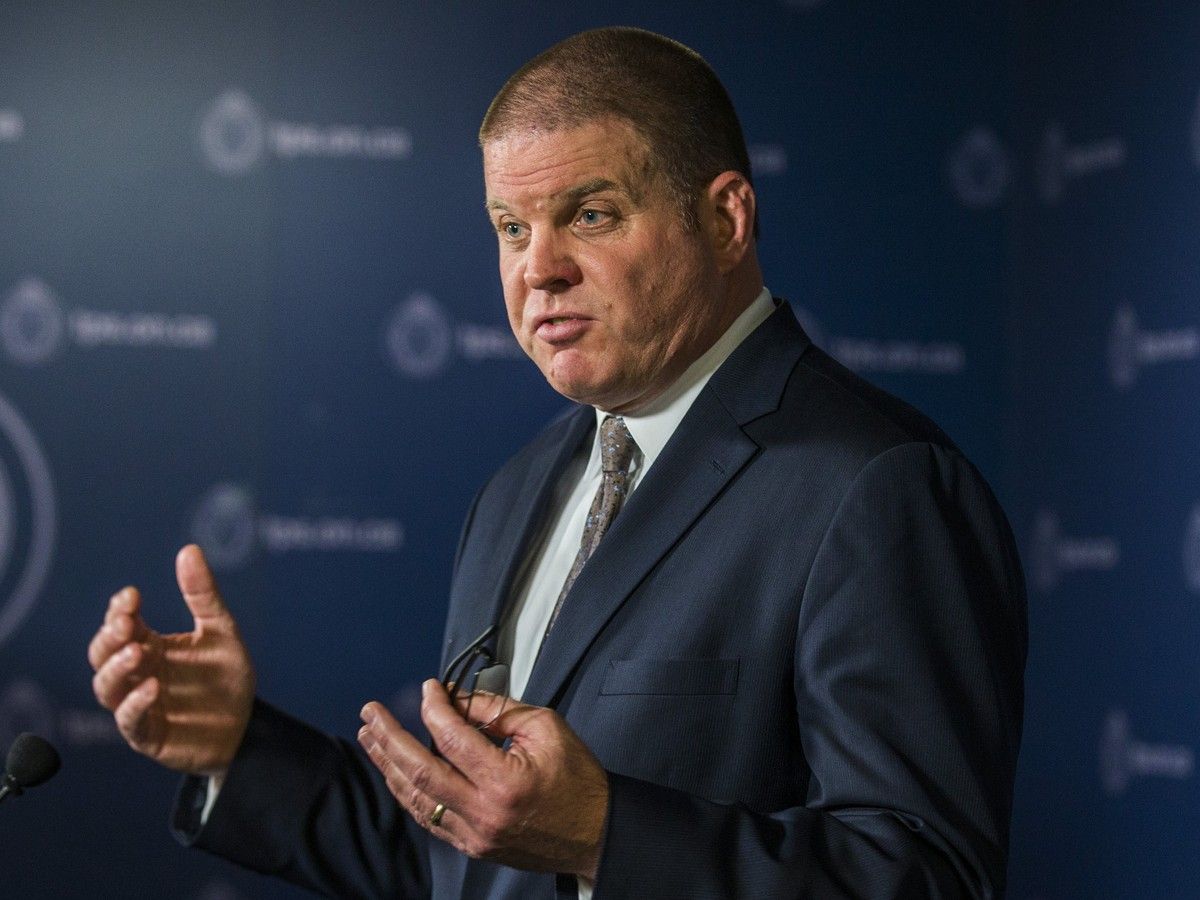


Former homicide detective Hank Idsinga made allegations of antisemitism in the Toronto Police Service in his recently released memoir, prompting a request from the TPS board to the Ontario Inspectorate of Policing to investigate.

The Toronto Police Service Board has made a request to Ontario’s Inspectorate of Policing to conduct an expedited inspection of recent antisemitism allegations levelled at the Toronto Police Service.

Late last month, former homicide detective Hank Idsinga made allegations of antisemitism in the Toronto Police Service in the pages of his recently released memoir.

In a public statement released Friday, board chair Shelley Carroll said the board’s request follows consultations with Jewish community stakeholders and members of the board’s Jewish Community Advisory Table.

“The Board has heard clearly from members of Toronto’s Jewish community that these concerns need to be examined independently and credibly,” said Carroll in the statement. “Residents should never have to question whether they’ll be treated fairly because of who they are or what community they belong to.”

Confidence that policing in Toronto “is professional, impartial, and free from bias” is a public necessity, she said.

The board’s request to the Inspectorate includes several recommendations that arose from community stakeholder consultations: appointing an external lead inspector, examining broader TPS culture and accountability, and confidentiality protection for participants.

The board recommends that corrective action be taken if the inspection identifies it is warranted.

Carroll’s statement noted that the board is making the request to the Inspectorate because it is the province’s independent policing oversight body and has the statutory authority to conduct inspections and issue binding directions.

“The Inspectorate exists specifically to examine systemic policing concerns through an independent process grounded in expertise, accountability, and public confidence,” Carroll said. “That makes it the appropriate mechanism for this work.”

As previously reported by National Post, Idsinga made the antisemitism claims in his memoir, The High Road: Confessions Of A Homicide Cop. He wrote that he had to cope with “racism and dysfunction” within the ranks and described instances of alleged antisemitism that left him “feeling physically ill.”

While he emphasized that members of the TPS “are overwhelmingly good, decent people,” he contended the police force is subject to “personal biases that exist in society,” including antisemitism, anti-Black racism, misogyny and homophobia. He levelled an accusation of “vile racism in the uppermost ranks of the police service.”

Our website is the place for the latest breaking news, exclusive scoops, longreads and provocative commentary. Please bookmark nationalpost.com and sign up for our daily newsletter, Posted, here.


Three men have been charged by the U.S. Attorney for the Southern District of New York with multiple offences connected with an alleged attempt to smuggle 89 firearms into Canada.

Three “inconsistent and evasive” men pulled over for a traffic stop in New York State were found with a cache of 89 firearms they were attempting to smuggle into Canada, say U.S. authorities.

Canadian citizen Malik Bromfield, 22, Pakistani citizen Faizan Ali, 25, and Kamal Salman, 22, a citizen of Canada, the United States, and Jordan were charged after a joint operation involving New York State Police (NYSP), the FBI and theU.S. Bureau of Alcohol, Tobacco, Firearms and Explosives.

The three men “were caught transporting more than 80 guns, including short-barreled rifles and stolen firearms, to smuggle them out of the country,” said Jay Clayton, the U.S. Attorney for the Southern District of New York, in a statement released on Friday.

New York state troopers pulled over the trio’s rented white Ford Explorer shortly after 6 p.m. on May 7 after observing traffic violations on State Route 90. Police asked the three men to get out for questioning.

During the course of the roadside interview, the troopers “observed that the defendants were providing inconsistent and evasive accounts in response to NYSP questioning,” according to a sworn complaint by FBI Special Agent Brian Jennings.

A sniffer dog was used to conduct a sweep of the exterior of the Explorer, and a preliminary search turned up an unusually heavy suitcase. It was found to contain a large cache of firearms. The troopers also found approximately $3,000 in United States currency, in $100 bills, in the glovebox, said Jennings.

The FBI complaint was subsequently filed in the U.S. District Court. It sets out the charges against the suspects.

Each man has been charged with one count of smuggling from the United States, which carries a maximum sentence of 10 years in prison; one count of unlicensed dealing in firearms, which carries a maximum sentence of five years in prison; one count of transporting stolen firearms in interstate commerce, which carries a maximum sentence of 10 years in prison; and one count of unlawful possession of firearms, which carries a maximum sentence of 10 years in prison.

“The quantity and variety of firearms … is wholly inconsistent with possession of firearms for personal use and instead consistent with the transport and trafficking of firearms for sale and distribution,” said Jennings.

Bromfield is also charged with unlawful possession of a firearm by an alien, which carries a maximum sentence of 15 years in prison. Police said he was the driver, and that they seized a cellphone from him.

“Visible on the lock screen of that cellphone, on an apparent GPS navigation application, was a certain address in or near Hammond, New York, which, based on my research, is located immediately across the St. Lawrence River from Ontario, Canada,” said Jennings.

The investigation showed that the Explorer had been spotted northbound on the I-95 in Jupiter, Fla., the previous day, police said.

Among the firearms recovered from the Ford Explorer were at least 17 firearms determined by the FBI to have been previously reported stolen.

The complaint states that none of the suspects “hold a license as an importer, manufacturer, or dealer of firearms.” Neither had any of them “applied for, or received a license to export firearms or ammunition.”

The prosecution is being handled by the U.S. Attorney’s Office in White Plains, New York. The suspects appeared before a U.S. magistrate in White Plains federal court and were detained.

Our website is the place for the latest breaking news, exclusive scoops, longreads and provocative commentary. Please bookmark nationalpost.com and sign up for our daily newsletter, Posted, here.


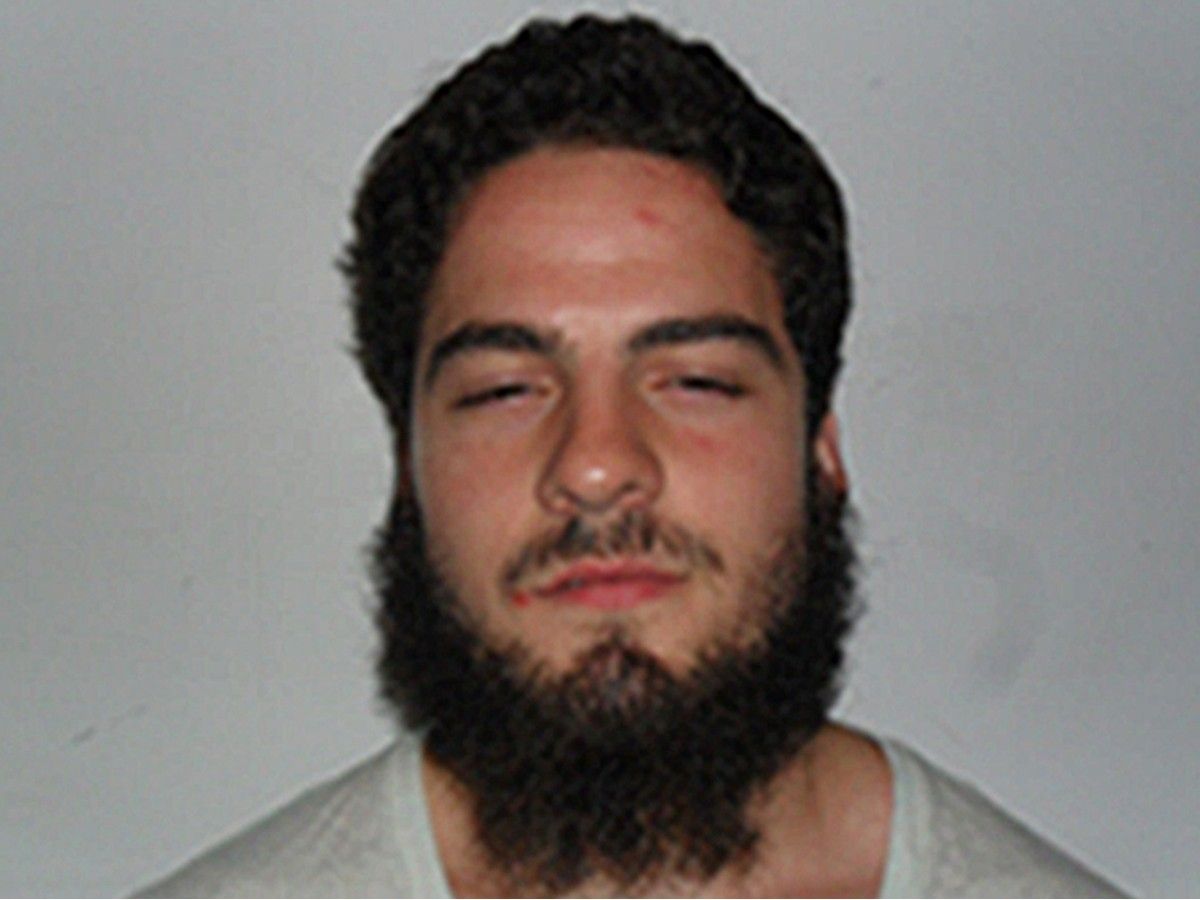
Police are asking for the public’s help to identify a male suspect and vehicle wanted in connection with the shootings of synagogues in Vaughan and Toronto in March. These images of the suspect were released on Friday.

The Toronto police service is monitoring the increase in threat level in the U.K. from substantial to severe.

The shift in the U.K. comes after a stabbing attack against two Jewish men in a London neighbourhood, previously reported on by National Post.

Acknowledging the “fear and anxiety here at home” caused by the London attack, Toronto police stated in an X post late Friday that the threat level in Canada “remains at medium” while noting that the service is “maintaining a heightened presence” in the city.

The announcement comes hours after police asked for the public’s help to identify a male suspect and vehicle wanted in connection with the March shootings of synagogues in Toronto and Vaughan, Ontario.

After an investigation by police services in both cities, investigators released photos of a male suspect and the vehicle allegedly used in both incidents.

The suspect is described in a statement released on May 1 by police as a male, Black, approximately 6’ to 6’2” tall, with a thin build and black curly hair. The suspect vehicle is described as an older model, black, four-door Honda Civic.

The investigation connected to the photo release stems from two incidents that occurred early in March.

https://twitter.com/YRP/status/2050219120092668074

On Friday, March 6, just before midnight, sounds of gunshots were reported around Clark Avenue West and York Hill Boulevard in Vaughan. When York Regional Police officers arrived, they found the front doors of a synagogue damaged because of gunfire.

Two people inside the synagogue were not injured.

Then on Saturday, March 7, just after midnight, Toronto Police Service responded to reports of gunshots at the Shaarei Shomayim synagogue in the Bathurst Street and Glencairn Avenue area. When officers arrived, they also found the front doors damaged by gunfire.

No one was inside at the time of the shooting.

The photos are being made available to the public pursuant to a court order. They will be available through the weekend.

Anyone with information about the suspect and/or vehicle is asked to contact police at 416-808-3500, Crime Stoppers anonymously at 416-222-TIPS (8477), or at www.222tips.com.

Our website is the place for the latest breaking news, exclusive scoops, longreads and provocative commentary. Please bookmark nationalpost.com and sign up for our daily newsletter, Posted, here.


Elen Steinberg, art collector and EJB Steinberg Arts Foundation director, stands with some of her collection at the Gina Godfrey Galley in Toronto in 2024.

A Toronto foundation has helped return a Renoir artwork allegedly looted by the Nazis to the Musée d’Orsay, after a 90-year journey as dramatic as the painting itself.

Le Jugement de Pâris, a circa 1915 sanguine sketch of a classic cultural myth, was loaned to the Parisian museum by Canadian non-profit EJB Steinberg Arts Foundation, which bought the artwork in 2023.

“From what I understand, this painting has a complicated history, but one that is all too common for many great European works of art,” said foundation director Elen Steinberg in an email.

It is part of a new exhibition displaying Pierre-Auguste Renoir’s lost drawings from the turn of the 20th century

The drawing depicts three nude women standing in various positions as a fourth figure kneels to the left of the page. The sketch uses browns, reds and terracotta to form their silhouettes without using harsh lines or intense colours.

 Le Jugement de Pâris, a 1915 sanguine sketch of a classic cultural myth.

The person kneeling to the left represents Paris, son to the King of Troy. The women depict three goddesses, Hera, Athena, and Aphrodite, and the ultimate choice Paris must make for their love . As the story goes, Paris chooses Aphrodite by giving her a golden apple, visible in Renoir’s later depictions.

Its onetime owner, Ambroise Vollard, was an ambitious European picture dealer, often investing in young, upcoming artists such as Picasso and Renoir. Vollard began in the arts in 1890, selling pieces out of his seventh-floor apartment.

Le Jugement de Pâris was owned by Vollard until his sudden death in a “suspicious” 1939 car crash. By that point, it is estimated he owned more than 6,000 invaluable pieces that lined the halls of his Paris townhome and gallery.

Following his death, Vollard’s brother Lucien became the executor to his will. Lucien incited his brother’s apprentice, Martin Fabiani, as an expert appraiser for the collection.

Vollard’s collection was to be divided between his family and his partner , Madeleine de Galéa. His brother quickly sold over 600 pieces from the family inheritance to Fabiani. But Lucien Vollard did not have legal authorization to sell this property.

Two weeks prior to Germany’s arrival in France, Fabiani fled to Spain with the collection in his car. He proceeded to Portugal, where he obtained a British origin certificate for Vollard’s property under the context that the art was collected in France before German occupation.

Fabiani managed hundreds of art pieces into four crates valued at roughly $10,000. The crates were loaded onto the American Excalibur cargo ship travelling from Lisbon to New York in 1940.

Two days after the ship left port , the British Ministry of Economic Warfare was warned that Fabiani secured a false certificate and seized the crates to the port of Bermuda.

Bermuda’s attorney general declared the artworks as a “prize of war” and transported them to a better climate for preservation. In November 1940, the Vollard collection travelled to Ottawa to be stored at the National Gallery (the present site of the Canadian Museum of Nature).

 Le Jugement de Pâris, a later painting by Pierre-Auguste Renoir based on his 1915 sketch.

Martin Fabiani was accused by the media of Nazi connections. His personal memoirs suggest he travelled back to France in 1940 to aid Jewish artists in maintaining their life and work. However, military records listed him in connection with The Schenker Transport Company, a corporation used to move Nazi-stolen art.

“( Le Jugement de Pâris ) ended up in the hands of the Nazis during the Second World War. After the war it was taken by the French government and exhibited in many museums throughout France,” Steinberg said, including the Musée d’Orsay.

The French government adopted the “Removal of cultural asset from public collections” law in July 2023 declaring that cultural property, like Le Jugement de Pâris , must be returned to its owners “for the purpose of restitution.”

“They weren’t interested in keeping it, however, as they put it into auction,” Steinberg said. “Which is where (the foundation) happened to see it and acquire it privately after the auction.”

Le Jugement de Pâris is back on display at the Musée d’Orsay as part of the lost Renoirs exhibition because “important works like this belong in the public eye,” she said.

“Through its efforts, the foundation not only safeguards works of historical importance but also plays an active role in education, promoting cultural dialogue, scholarship, and community engagement across the arts sector,” Steinberg said.

Our website is the place for the latest breaking news, exclusive scoops, longreads and provocative commentary. Please bookmark nationalpost.com and sign up for our newsletters here.


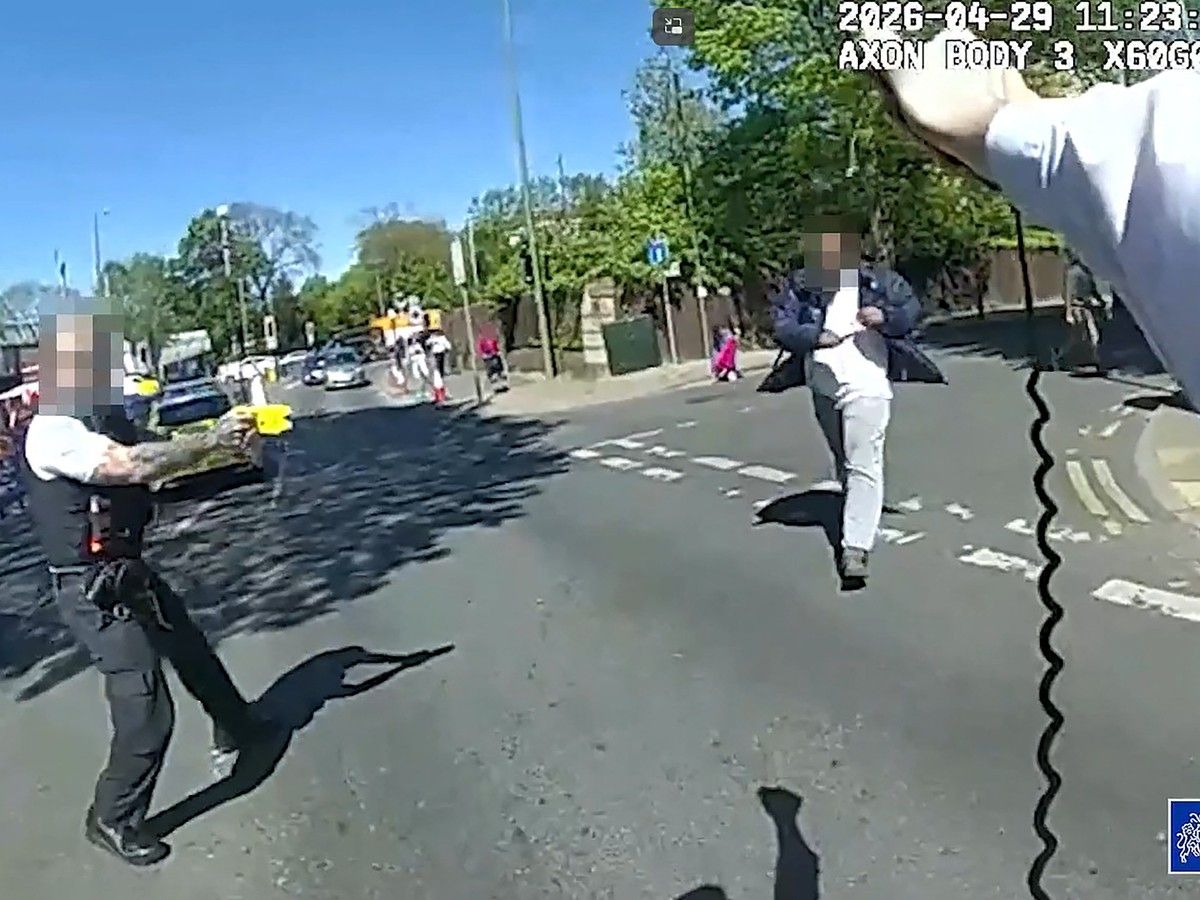
A screen grab taken from body camera video shows police pointing their tasers while arresting a man holding a knife after he allegedly stabbed two people nearby, in London, England.

The Metropolitan police of London, U.K. have released bodycam footage showing the moment when two officers arrested a man suspected of stabbing two Jewish men in north-west London neighbourhood, Golders Green.

He was arrested based on suspicion of attempted murder.

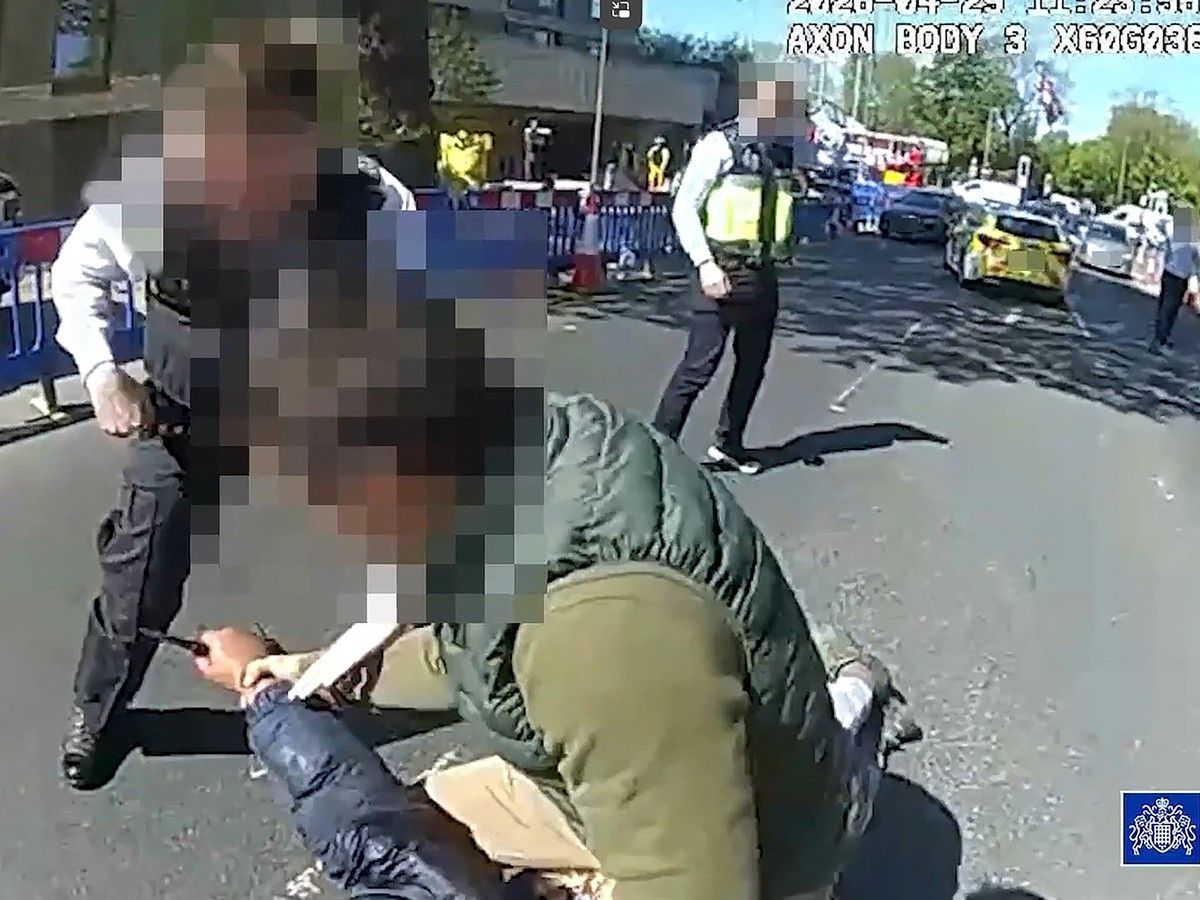
 A screen grab taken from body camera video shows police trying to disarm a man holding a knife as they detain him in the Golders Green neighbourhood of London, England, after he allegedly stabbed two people nearby.

What does the bodycam footage show?

The video shows the two officers confronting the man late Wednesday morning as he walked down the middle of a street carrying a knife.

The officers can be heard repeatedly shouting for the suspect to “get down on the ground” and demanding he “drop the knife.”

They brought down the suspect using a taser. After he fell, he held the knife close to his chest. The officers can be seen kicking the man in the head several times during the struggle to subdue him and get the knife away from him.

Then they handcuffed his hands behind his back.

 A screen grab taken from body camera video shows London police trying to disarm a man holding a knife, after he allegedly stabbed two people nearby.

Who are the victims of the alleged knife attack?

The victims were two local men, Shilome Rand, 34, and Moshe Shine, 76, the BBC reported. They were treated at the scene and are now in stable condition in hospital, according to police .

What do we know about the suspect?

The suspect is a 45-year-old man, a British national born in Somalia, who remains in custody, police said in a statement released on April 29 .

Police Commissioner Sir Mark Rowley added that suspect had a history of serious violence and mental health issues.

Police said the suspect was known to a U.K. counter-terrorism program and was the subject of referral to it in 2020. However, police said the referral was “closed in the same year,” the BBC reported.

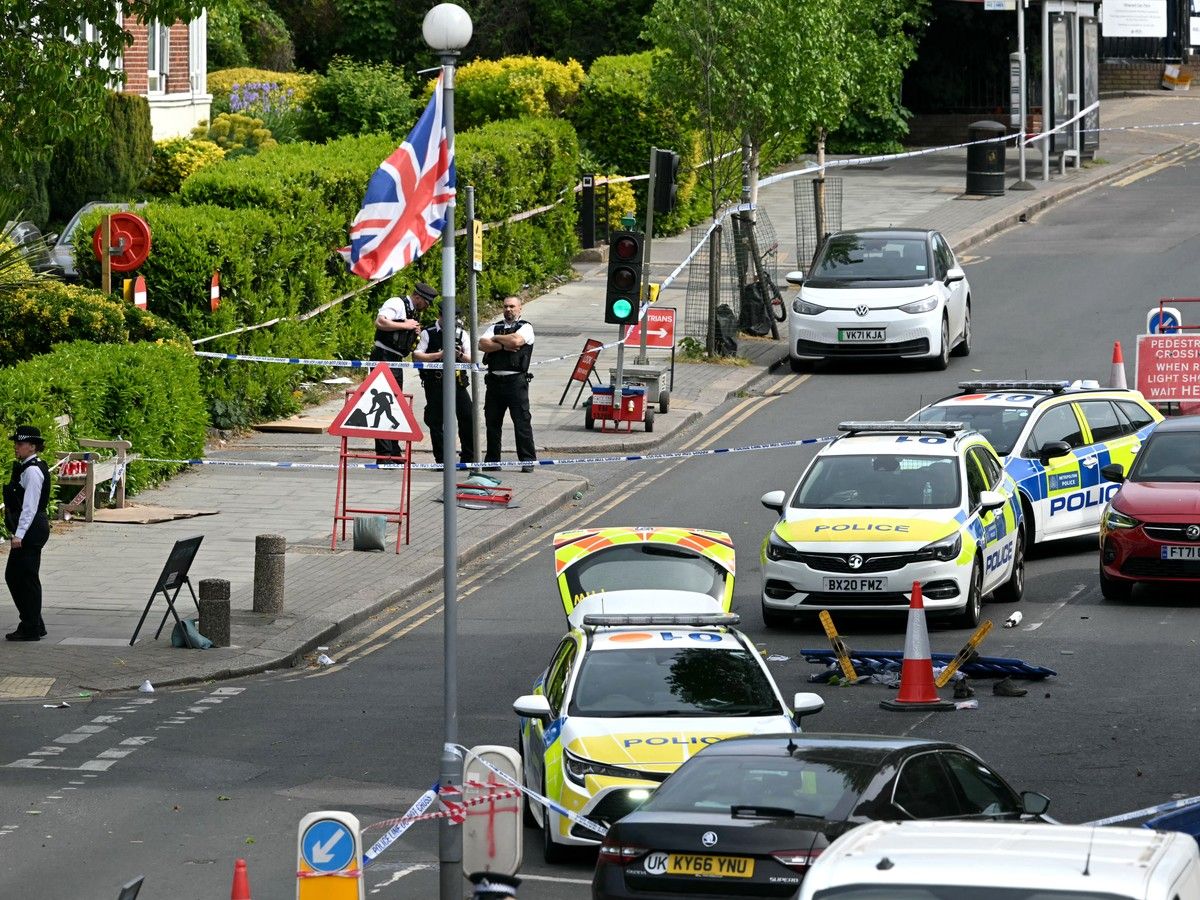
 Items including clothes and trainers are pictured strewn in the road inside a police cordon on Golders Green Road, after two people were stabbed. A man was arrested after he was seen running with a knife “attempting to stab Jewish members of the public”, the Shomrim Jewish neighbourhood watch said on social media. (Photo by JUSTIN TALLIS / AFP via Getty Images)

Is this considered a terrorist attack?

The attack in Golders Green was formally declared a terrorist incident, according to police .

The Counter Terrorism Policing unit is engaged in an ongoing investigation. Officers are searching an address in south east London.

“The suspect also attempted to stab police officers, and was Tasered before being arrested. No officers were injured … As part of this investigation, detectives are also looking into an incident that was reported to police earlier today in south east London. It is believed that the suspect in this incident is the same individual arrested in Golders Green.”

Earlier Wednesday, police said they responded to an incident at a Golder Green address, where the suspect armed with a knife is believed to have had an altercation with the occupant before leaving. The occupant incurred minor injuries.

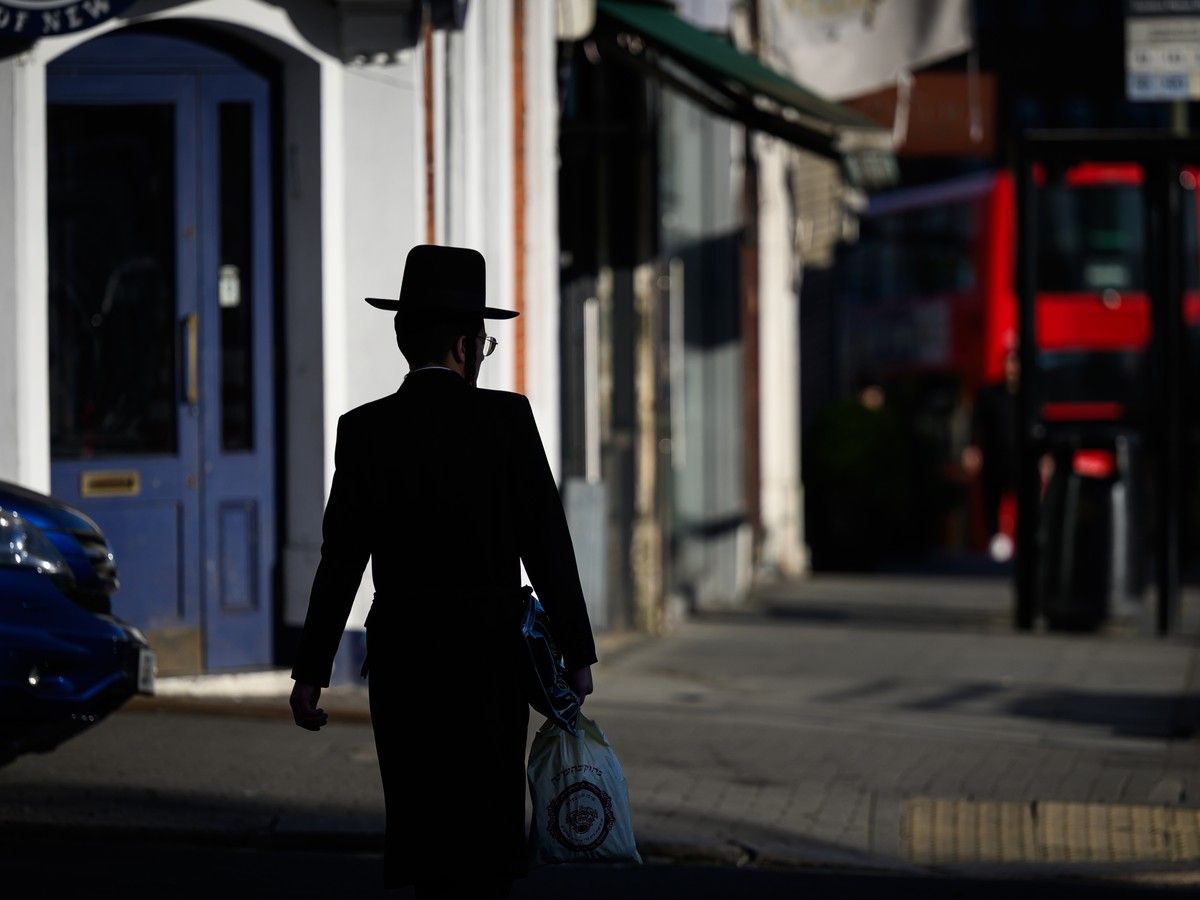
 A young Orthodox Jew walks towards the bus stop where a man was attacked yesterday in in a terrorist incident in London, England.The suspect, aged 45, was tasered and arrested.The two victims were taken to hospital and are in stable condition. (Photo by Leon Neal/Getty Images)

The focus of the investigation team, police say “remains on securing justice for the victims of this terrible attack.”

The Jewish security group, Shomrim, initially detained the suspect, reports the BBC. It dispatched volunteer responders after receiving a call about a man running along Golders Green Road armed with a knife, attempting to stab Jewish members of the public.

U.K. Prime Minister Keir Starmer has thanked Shomrim and announced £25 million to improve security for the Jewish community following the incident.

 Britain’s Prime Minister Keir Starmer meets first responders from Shomrim North West London during a visit to Golders Green in north-west London on April 30, 2026, the day after two men were stabbed. (Photo by Stefan Rousseau/AFP via Getty Images)

“Harry Potter” author J.K. Rowling has criticized British MP Zarah Sultana, accusing her of hypocrisy after she condemned antisemitism following the attack, reports the Jewish News Syndicate . “ I assume this is a different Zarah Sultana MP to the one who was recently filmed clapping along to loudspeaker chants for intifada,” Rowling posted on X Wednesday.

Our website is the place for the latest breaking news, exclusive scoops, longreads and provocative commentary. Please bookmark nationalpost.com and sign up for our daily newsletter, Posted, here.

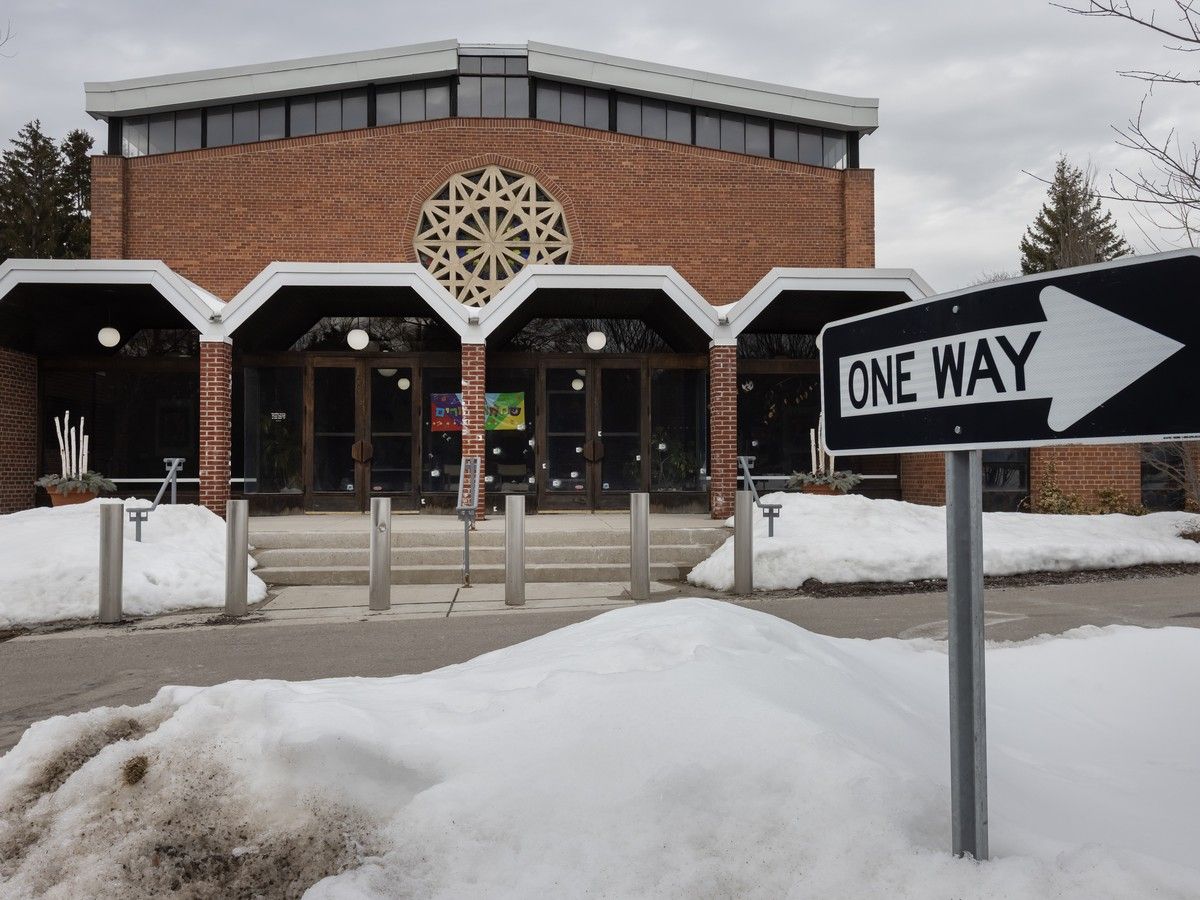
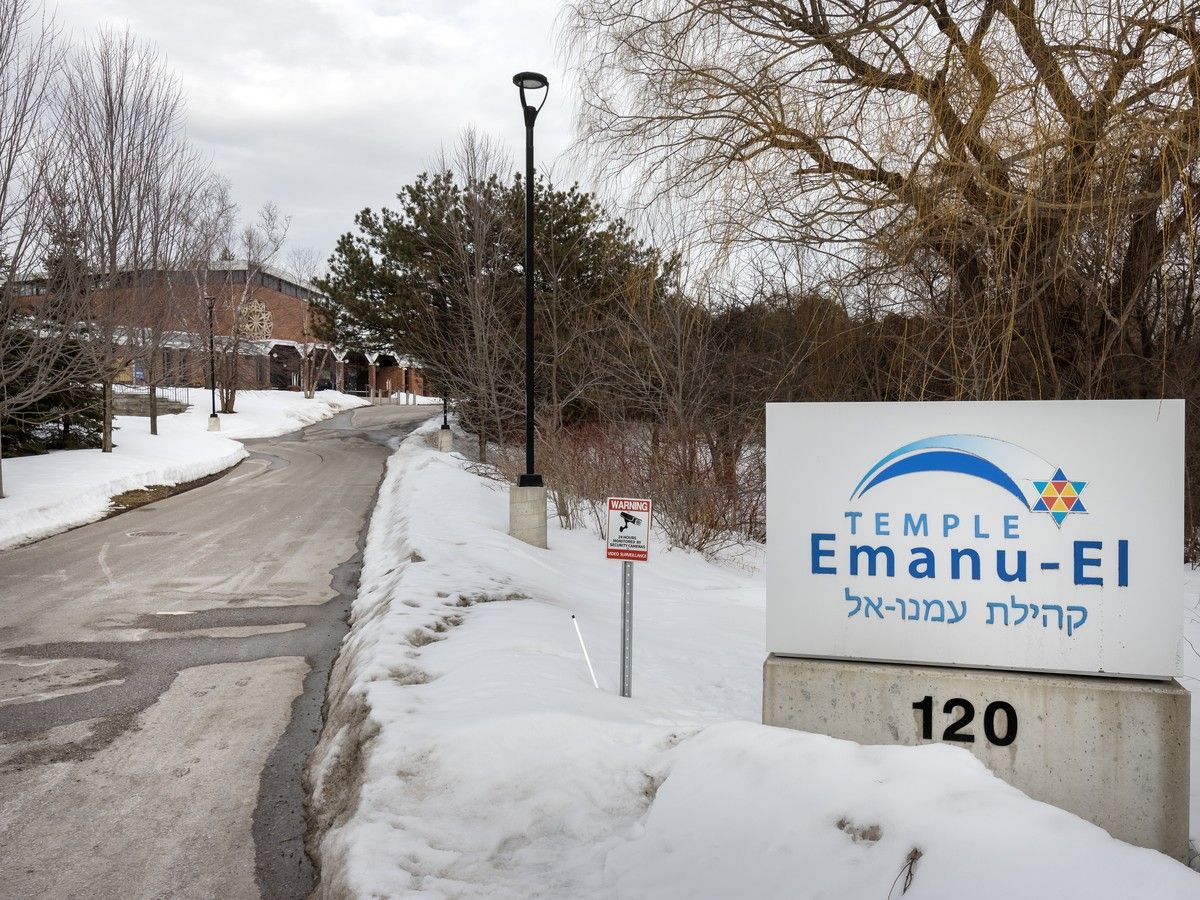
The Centre for Jewish and Israel Affairs welcomes a significant boost in funding in the spring economic update that will go toward paying for security measures in Jewish communities across Canada. The funding increase follows recent attacks such the shooting of Temple Emanu-El in Toronto in March. ([Photo By Peter J Thompson/National Post)

The Centre for Israel and Jewish Affairs is welcoming a substantial increase in funding from the Canada Community Security Program.

Ottawa has more than doubled its funding allocation over five years from $60M to $135M, said Noah Shack, the CIJA’s CEO in a statement on Tuesday. “This is a significant step forward in safeguarding Canada’s Jewish community.”

The federal program provides funding to safeguard at-risk communities, including security upgrades, security guard funding and emergency training supports.

Since the Hamas-led massacre of October 7, threats targeting Canadian Jewish communities have continued to escalate, said Shack.

Meanwhile, he adds, Canada’s security agencies have warned that a violent mass attack against the Jewish community is a realistic possibility.

“It’s essential that government programs evolve to meet this challenge head-on,” said Shack. “Today’s announcement, together with with the recent $10 million in emergency funding for the Jewish community, represents Canada’s most substantial investment in community security to date.

“These investments are essential for the future of Jewish life in this country, helping community institutions that are increasingly forced to divert resources away from education, social services, and childcare to meet urgent security needs.”

National Post previously reported on the CIJA’s lobby efforts for increased funding in today’s economic statement.

In an April 15 letter to Prime Minister Mark Carney, the CIJA estimated that annual security costs within Canadian Jewish communities will reach $100 million.

The letter was endorsed by more than 100 Jewish federations, community centres, synagogues, camps and schools.

“Rising security demands are forcing cuts and scaling back services, placing a growing strain on the future of Jewish life across the country,” stated the letter. It also harkened back to a Liberal party statement made in the federal election campaign that “increased security costs amidst rising antisemitism should not be borne by the Jewish community alone.”

Previously, the CIJA estimated that Canada’s per capita investment in Jewish community security is one-third of the United Kingdom’s and one-quarter of Australia’s.

Our website is the place for the latest breaking news, exclusive scoops, longreads and provocative commentary. Please bookmark nationalpost.com and sign up for our daily newsletter, Posted, here.

Ashton Larmond. (File photo)

An Ottawa man convicted in an ISIS terrorism case is getting out of prison after serving two-thirds of his 17-year sentence, even though the parole board says he continues to hold extremist views and remains a public-safety risk.

The parole board says Ashton Larmond has made some progress through programming available to him in prison, as well as counselling. However, the board also noted in its decision shared with National Post, that the 35-year-old man committed an assault on another inmate in March. He punched another inmate in the face, then kneeled on him and struck him again, breaking his nose, which the board cited as evidence he remains comfortable using violence.

Most offenders, except those serving a life or indeterminate sentence, must be released with supervision after serving two thirds of their sentence, under what’s known as “statutory release.” The parole board can impose special conditions on statutory releases that it considers necessary to manage an offender’s risk in the community. The parole board has placed special conditions on Larmond, which must be followed throughout the rest of his sentence. That includes monitoring his phone use and finances. He must also take part in treatment and live in a community-based residential facility or psychiatric facility approved by the Correctional Service of Canada.

He is noted by the board to be within the category of male offenders likely to reoffend within three years.

According to the parole board decision, Larmond converted to Islam sometime between 2009 and 2011. He adopted “terrorist views” and proceeded to recruit “several people, including (his) twin brother (Carlos) and a police officer to join the terrorist group.”

When he was arrested, police found 267 videos with extremist propaganda on his computer hard drive.

While in prison, he committed several assaults against other inmates and uttered threats against prison staff, says the parole board. He was initially held in a provincial facility, but was transferred to a federal prison due to “radical ideologies.” While in the latter, there was concern that he may have been attempting to radicalize another prisoner, but that appears to have abated. His “accountability” rating improved over time from low to medium.

Police awareness of Larmond goes back to the summer of 2013, when the RCMP intercepted conversations between Larmond and another Ottawa man who had flown overseas and joined ISIS in December 2012. He told the man that he wanted to join him. According to RCMP documents, Larmond’s mother called the Ottawa police in September 2013 saying her son wanted to go kill for terrorists.

Police arrested Larmond on January 9, 2015, in the Ottawa area, while his twin brother Carlos was arrested at Montreal’s airport as he was trying to leave Canada for Syria. Ashton had been considering taking an overland route through Alaska, Russia, and Afghanistan to reach Syria.

They were arrested along with a third suspect following an RCMP undercover counterterrorism operation called Project Slipstream.

Ashton subsequently pleaded guilty to one count related to encouraging others to engage in terrorist violence. His brother Carlos pleaded guilty to one count of attempting to leave Canada to participate in the activities of a terrorist group and was sentenced to seven years in prison.

The parole board noted that Larmond plans to take employment training while working part-time in the food industry or at a hardware store, aiming to eventually become a contractor. He expressed an interest in volunteering and fundraising for organizations that “focus on people of the Muslim faith who are suffering.“

However, the parole board rates his “reintegration potential” as low.

Our website is the place for the latest breaking news, exclusive scoops, longreads and provocative commentary. Please bookmark nationalpost.com and sign up for our daily newsletter, Posted, here.


Given the recent attacks against Jewish institutions in Canada and the ongoing threat of a violent mass attack, the Centre for Israel and Jewish Affairs is urging Ottawa to increase funding for enhanced security in the upcoming Spring Economic Statement.

With the latest warning from Canada’s Integrated Threat Assessment Centre stating that a violent mass attack remains a realistic possibility, the Centre for Israel and Jewish Affairs is urging Ottawa to increase funding for enhanced security in the upcoming Spring Economic Statement . security

“We’ve seen synagogues and businesses in the community targeted with gunfire recently in Toronto. That builds on the arson attacks and shooting attacks that had taken place previously, targeting synagogues and schools across the country,” says Noah Shack, CIJA’s CEO. “We need systemic change to protect the community.”

In an April 15 letter to Prime Minister Mark Carney, CIJA estimates that annual security costs within Canadian Jewish communities will reach $100 million.

The letter has been endorsed by more than 80 Jewish federations, community centres, synagogues, camps and schools.

“Rising security demands are forcing cuts and scaling back services, placing a growing strain on the future of Jewish life across the country,” states the letter. It also harkens back to a Liberal party statement made in the federal election campaign that “increased security costs amidst rising antisemitism should not be borne by the Jewish community alone.”

However, CIJA estimates that Canada’s per-capita investment in Jewish community security is one-third of the United Kingdom’s and one-quarter of Australia’s.

Shack raises the tragedy in Bondi Beach, Australia, when a father-son gunmen team killed 15 people, including 11 men, 3 women and a 10-year-old girl.

“Our hope is that we can get vital security measures in place before that happens here in Canada. To be proactive and preventative here,” says Shack.

Meanwhile, he adds that CIJA is very grateful for efforts that have already been undertaken by national security and local law enforcement agencies, “who have been able to prevent a number of these attacks plotted against our community.”

The sought-after funds would be channelled through the Canada Community Security Program , which CIJA says is an “essential program (that) provides life-saving security equipment and measures to safeguard our people. We cannot afford to wait for a mass-casualty attack before taking urgent action to safeguard Canadians.”

There are about 70 Jewish institutions in Montreal, estimates David Cooper, vice president of government relations for CIJA. In Toronto, there is probably double or triple that, he adds.

He says the $100 million estimate covers infrastructure costs, plus the amount community institutions “are paying for security guards, which has become an expensive endeavour for institutions to take on themselves.”

He remembers when he went to synagogue and “the doors were open, and we walked in, and nobody thought twice about security. Now, it’s a completely different reality.”

Our website is the place for the latest breaking news, exclusive scoops, longreads and provocative commentary. Please bookmark nationalpost.com and sign up for our daily newsletter, Posted, here.

A new survey looking at the impact of the war in Iran suggests prejudice against Israelis is more likely among Canadians. Photo is of counter-protetsers during Al-Quds rally in Toronto on March 14. (Photo By Peter J Thompson/National Post)

A majority of Canadians believe Israelis are more likely to face prejudice as a result of the Iran war, according to a new survey.

The survey is looking at “the impact of the War with Iran on Canadians’ views about groups that might associated with it — in the context of the wider middle east conflict,” says Jack Jedwab, president and CEO of the Association for Canadian Studies, which commissioned the survey from Leger on the occasion of the International Day for the Elimination of Racial Discrimination, which will be marked on Saturday.

Last month, Israel and the United States launched an assault on Iran, which is a sponsor of multiple anti-Israel terror groups including Hamas and Hezbollah.

The belief across Canada that Israelis will face more prejudice came out at 63 per cent. That’s more than Palestinians at 59 per cent and Iranians at 58 per cent. This intensifies when viewed through the lens of Canadians 65 and older. They are most likely to think Israelis will face prejudice (77 per cent) over Palestinians (68 per cent) or Iranians (66 per cent).

This differs from younger Canadians, ages 25-33, which are least likely to believe prejudice is being faced by Israelis (48 per cent), Palestinians (51 per cent) and Iranians (48 per cent).

“To some extent,” says Jedwab, “I think older Canadians are following the issues more closely, and are therefore more likely to react to (the war’s) varying effects domestically.”

Quebeckers are most likely to believe Israelis face prejudice: 67 per cent. That compares, for example, with 64 per cent in Atlantic Canada and 63 per cent in B.C. and Ontario. Regarding this polling point, Jedwab observes: “I think they see the greater effects in Quebec of the interreligious conflicts arising from the War and thus seeing higher overall rates of victims across the spectrum.”

People born in Canada are more likely to believe prejudice will be faced by all three groups in varying degrees: Israelis, 66 per cent; Palestinians, 62 per cent; Iranians, 61 per cent. For people born outside Canada, the numbers are respectively: 51, 50 and 46 per cent.

The level of a survey respondent’s education did not have an impact on their beliefs. For example, with regard to Israelis, 62 per cent of university-educated respondents believed they would face prejudice. For college graduates, that number was 65 per cent, and for high school grads, 62 per cent. Jedwab says education level usually makes a difference in the surveys the ACS commissions, but “in this case, it doesn’t.”

Jedwab notes that among respondents who think that Palestinians are “very likely” to be the object of hate and prejudice, some 84 per cent believe Israelis are also likely to the be the object of hate and prejudice (68 per cent very likely and 16 per cent somewhat likely).

Finally, he adds, a deeper analysis of the survey shows that Canadians expressing greater sympathy for the Iranian regime are much less likely to see Israelis in Canada as victims of hate and prejudice. “Among those who want Canada to politically support the United States and its allies in the war with Iran, some 73% believe that Israelis are the victims of hate and prejudice, compared with 50% among the minority that want Canada to support the Iranian regime.”

These findings are based on surveys conducted by Leger for the Association for Canadian Studies between March 6 and 8, 2026 with 1579 Canadians. While no margin of error can be associated with a non-probability sample of 1579 respondents would have a margin of error of ±2.52%, 19 times out of 20.

Our website is the place for the latest breaking news, exclusive scoops, longreads and provocative commentary. Please bookmark nationalpost.com and sign up for our daily newsletter, Posted, here.