


LP_468x60
on-the-record-468x60-white

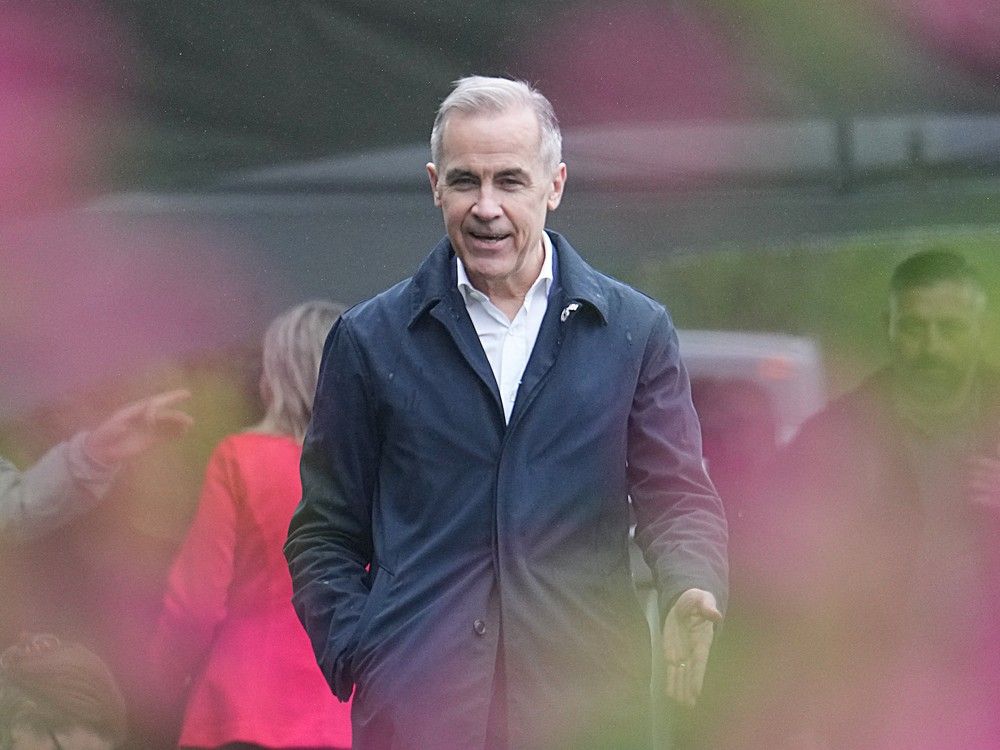
Liberal Leader Mark Carney makes an announcement during a visit to Vancouver Island at the Sea Cider Farm & Ciderhouse in VICTORIA, B.C. April  7, 2025.

VICTORIA, B.C. — In the mostly white-haired crowd at The Victoria Edelweiss Club, waiting to hear from Liberal Leader Mark Carney on Sunday evening, Rhonda Ljunggren stood out.

“I should be in bed at this point because I’m an old person. Here I am with flags in my hair,” she chuckled, pointing to the Canadian flag paraphernalia she was sporting for the occasion — two small flags shoved in a ponytail and a wind spinner in her hand.

Ljunggren said she was planning to vote for the incumbent NDP candidate, Laurel Collins. But as soon as U.S. President Donald Trump started threatening Canada with tariffs and annexation, she said she “cried her eyes out.”

“I just went nuts, literally,” she said. “I thought: I don’t want to spend my retirement worrying that my country is going to be invaded or something like that.”

So, she got a red sign on her lawn. She will be voting Liberal on April 28.

Jeremy Sturgess, another resident of Victoria, said he voted for the NDP’s Laurel Collins in 2021 but will be voting strategically for the Liberals for similar reasons as Ljunggren.

“I feel sorry for her,” he said, speaking about Collins. “It’s just not the right time.”

Sturgess said the upcoming election is “too important” for the country.

Their stories are not unique. Liberal candidates and organizers who spoke to the National Post during Carney’s visit in British Columbia said they are seeing shifting support on Vancouver Island — to the point they think they could elect a Liberal MP again.

The last time that happened on the island was during the 2008 election.

“It has changed a lot,” said Sulo Saravanabawan, the Liberal party’s regional chair for Vancouver Island. “People are coming into the campaign offices asking, ‘Can we help? Can we volunteer? Can we door-knock?’ We have never seen this, from 2015 until now.”

“You never know, right? Things could change. But it looks really good,” she said.

At the moment, New Democrats hold five of the six ridings on the island. Then, there’s Saanich —Gulf Islands, held by Green party co-leader Elizabeth May.

With the collapse of the NDP, 338Canada, a polling aggregator website, is forecasting a fierce battle between the Liberals and the Conservatives for those seats.

The riding of Victoria is leaning Liberal, according to the website’s projections, which explains why Carney was at the German social club with local candidate Will Greaves.

Greaves, an associate professor at the University of Victoria, claimed his chances of being elected are “very strong” and said all signs point to a growing “momentum” for the party.

“We’ve had an unprecedented number of volunteers, we’ve got a huge amount of donations… we can’t keep signs on the shelf because everybody wants their lawn signs, so we really are feeling incredibly good about our campaign right now,” he said.

Other ridings could see close races. May’s riding is shaping to be a toss-up between the Liberals, the Conservatives and the Greens; while Esquimalt—Saanich—Sooke looks to be a three-way race between Liberals, the Conservatives and the NDP, per 338Canada.

The Conservative message has been resonating on the island, especially in the northern ridings where their provincial cousins were able to make some gains last October.

As things stand, the federal ridings of North Island—Powell River, Courtenay—Alberni and Nanaimo— Ladysmith, are poised to become Conservative according to 338Canada.

Outside a cider house in May’s riding of Saanich—Gulf Islands, Carney was attempting to appeal to voters on two fronts: more help for seniors and protecting Canada’s nature.

But the overarching theme of those promises, he admitted, all comes down to Trump.

“The reality is that the key issue in this election is who can stand up to the threats from America to our sovereignty, to our nature, to our livelihoods, to our future? Who do you want at that negotiating table?” said Carney about targeting NDP and Green ridings.

The Liberal candidate in the riding is David Beckham — not the famous British soccer player by the same name, but a renewable energy specialist and a farmer.

In an interview, Beckham made sure to clarify that he is not running “against” May, who has represented the riding since 2011, but rather “running for the Liberal party.”

He said that while there is a “diversity of opinions” in the riding, the general consensus seems to be that “this is a moment in history (where) we need to lock arms, we need to be unified against this threat (from the U.S.), and the best option for that is Mark Carney.”

“I can tell you at the doors the enthusiasm and the optimism are infectious and, in some cases, even overwhelming,” he said.

Former environment minister Catherine McKenna, who came of her own accord to knock on doors and help the local candidates on Vancouver Island, is also surprised.

“There’s so much support. I’ve never seen so much excitement on the island,” she said.

“I think we have a real shot.”

National Post

calevesque@postmedia.com
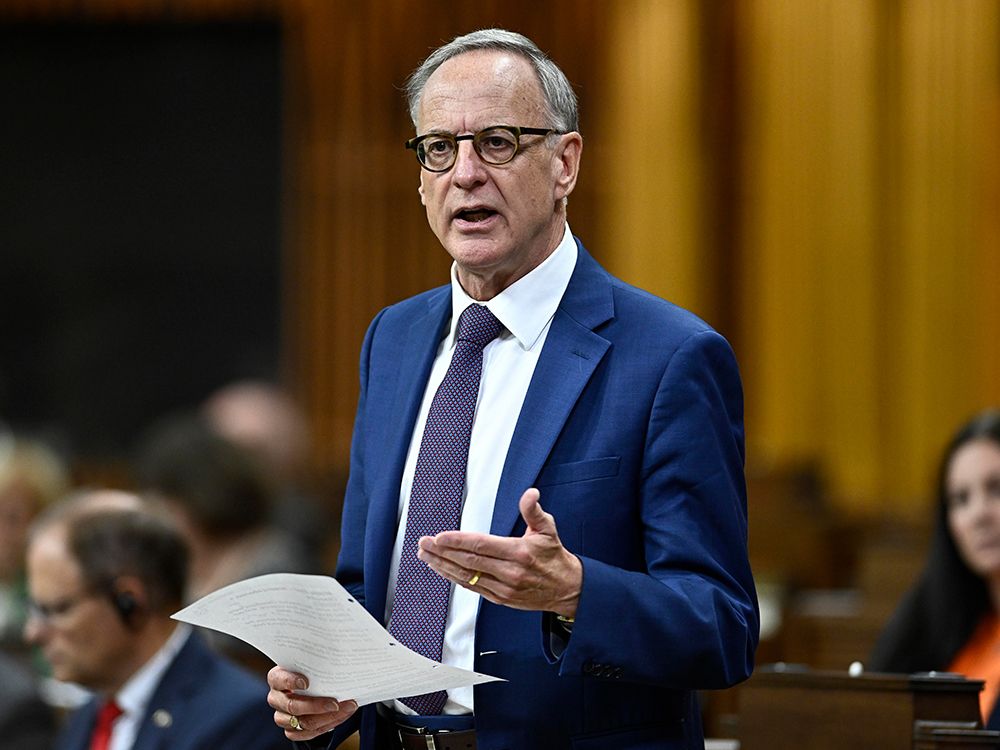

Parliamentary Secretary to the Minister of Foreign Affairs Rob Oliphant rises during question period in the House of Commons, on Friday, Sept. 27, 2024.

TORONTO

— On the front steps of a Toronto home, two Robs appear at the same door. 

The first is Rob Pierce, the Conservative candidate for Don Valley West, a solidly Liberal riding since the late 1990s, save for when the Tories captured it the last time the party won a majority government more than a decade ago.

Pierce is just beginning his campaign. He was only nominated the day before the election was called, replacing Yvonne Robertson, who had been eyeing a return.

“She ran twice, lost twice, and I think the party decided to try to do something different,” he told National Post.

Rob Oliphant is the second candidate to appear on the crowded doorstep. The veteran Liberal incumbent has held the urban riding since 2008, losing it when the Conservatives formed government in 2011 and returning when Justin Trudeau took power in 2015.

A decade later, Oliphant held off until Trudeau made it clear he was leaving before making it official that he would be running again, waiting out an unpopular leader whose name he left off campaign materials during the last federal vote.

“If he had not resigned in January, it would have been tough to run,” he admits.

Such is how a Liberal and a Conservative came to cross paths while canvassing on the same Toronto street, an interaction that highlighted the challenge of battling incumbency for a party that needs to pick up seats and the pitch a longtime Liberal makes to voters as to why they should give his party a fourth shot.

Finding himself in the middle was a voter named Jason.

“I was sort of surprised,” he said afterwards.

Pierce, the first to arrive at his doorstep, was armed with a stack of campaign leaflets citing the rise in car thefts in the city, while a member of his team waited at the bottom of the steps. A few minutes into Pierce’s conversation with the voter, Oliphant darts up the stairs.

“Good to meet you,” Oliphant says to his Conservative rival. “And good to meet you,” replies Pierce.

 Conservative candidate Rob Pierce knocks on doors in Toronto’s Don Valley West riding.

Jason, a business owner who has lived in the riding for 15 years, describes the neighbourhood as overall a good one. It has schools and parks for families and is less than 20 minutes from downtown. One local issue that remains an irritant is a long-delayed Metrolinx transit project.

But his concerns that day are around an earlier issue he had raised with Oliphant, which warranted unsatisfactory results.

Concerns about what Oliphant has done for the riding after so long is one of the issues Pierce hears from constituents, he said.

Still, the Conservative is under no illusions about the task before him when asked about his chances.

“It’s a tough riding.”

Several minutes after going back and forth with the voter, Oliphant announces he is moving onto the next door.

“After the election, one of us will help you,” he says before pausing for a brief second. “I suspect it’ll be me.”

“We’re going to make it a fight,” Pierce shoots back.

Although he finds himself at the starting line of an uphill battle, the Conservative walked away with a photo of at least one voter he can count on.

“I’m in my riding, I’d like to see change,” Jason told National Post. “It’s my number one view on this.”

Besides incumbency, Pierce is dealing with the gender divide in Conservative Leader Pierre Poilievre’s support.

“Mr. Poilievre comes up a lot,” he says, “specifically amongst the female voters. They find him aggressive.”

Pierce is hardly the first Conservative candidate to encounter this in a race where successive public opinion polls suggest Poilievre is doing well with men, particularly those aged 18 to 34, but is struggling to connect with older demographics, particularly women.

When the issue does arise, Pierce says his response is to ask, “is that because he speaks bluntly?”

“You can’t actually say what you think anymore, and he does say what he’s thinking,” he said.

For his part, Pierce believes Poilievre should stick to his talking points. Locally, he says crime is an issue voters are raising on the doorstep, particular when it comes to break-ins, car theft and home invasions.

It is also one the Conservatives are hoping drives turnout for them in big cities, as well as the cost-of-living.

As for the matter of U.S. President Donald Trump and his tariffs, Pierce said he hears concerns but questions how defining an issue it is for the election.

“I’m not sure it’s a federal election issue, frankly. I’m not sure that really anyone can deal with Mr. Trump.”

Oliphant would disagree.

Speaking in his campaign office, the incumbent says Trump has changed everything about the election, as has the entrance of Liberal Leader Mark Carney.

“People are afraid.”

Those two factors combined, plus the surge in national pride and worries Canadians have about the economy and their finances at a time when the Liberal leader has the background of being a two-time central banker, has led to a unique moment.

“It is helping us. It’s clear as day. I can feel it.”

Other issues have since faded into the background, including the government’s response to the Israel-Hamas war, which Oliphant, whose riding has both a sizeable Muslim and Jewish population, says has surprised him.

It has not completely disappeared. While canvassing, Oliphant hears a man sharing concerns about the Liberals’ support for

the United Nations Relief and Works Agency for Palestine Refugees in the Near East, saying he believes the incumbent to be “unfit for office.”

It is a household his team crosses off their voter list as not being Liberal. On the next street over, Oliphant has better luck.

“You’ve been doing a great job,” one man named Michael tells him. “You got my support.”

Several doors down, a woman says tariffs are her top concern and hopes Carney can help.

“It’s looming,” she said.

Oliphant knows that in a campaign, things can change quickly and that mistakes can be made.

However, he has experience in losing and knows what it feels like.

Back in 2011, when he lost to the Conservatives and the Liberals saw their fortress in Toronto along with the outlying suburbs in the vote-rich Greater Toronto Area fall, Oliphant says he heard it at the doors, especially how many people disliked then-Liberal leader Michael Ignatieff.

What hurt his vote the most was the rise of the NDP, he remembers, when the party had a historic showing and went on to form the official Opposition.

Now, polls suggest NDP Leader Jagmeet Singh is battling for party status.

“The NDP vote is almost invisible,” Oliphant said. “I think I’ve knocked on three NDP doors.”

Pierce nonetheless remains positive about his campaign. What he says he is hearing from many voters is indecision.

“But, typically,” he says, “the collapse of the NDP historically means, you know, bad news for the Conservatives. Typically.”

National Post

staylor@postmedia.com

Get more deep-dive National Post political coverage and analysis in your inbox with the Political Hack newsletter, where Ottawa bureau chief Stuart Thomson and political analyst Tasha Kheiriddin get at what’s really going on behind the scenes on Parliament Hill every Wednesday and Friday, exclusively for subscribers. Sign up here.

Our website is the place for the latest breaking news, exclusive scoops, longreads and provocative commentary. Please bookmark nationalpost.com and sign up for our politics newsletter, First Reading, here.


Donald Trump Jr., speaks at a campaign rally for his father at Madison Square Garden in New York, on Sunday, Oct. 27, 2024.

Rebel News is suing a federal Crown corporation and a Toronto-area member of Parliament, arguing that the Crown corporation imposed unwarranted security costs and attempted to put a stop to an event featuring Donald Trump Jr.

At issue was a two-day event, held in May 2024 and hosted by Rebel News and Rumble, the right-wing social media platform. The Rumble Live event featured Trump Jr., journalist Glenn Greenwald and Canadian lawyer and YouTuber David Freiheit.

The Rebel Live event featured speeches by Rebel News journalists and guests of the media organization.

It was held at the Warehouse, an events space Downsview Park in Toronto. Canada Lands Company Limited is the federal Crown corporation that operates Downsview Park.

The statement of claim filed Monday in the Ontario Superior Court of Justice by Rebel News and Rumble says that Rebel News took precautions so that “the event will not be influenced or ‘cancelled’ for political reasons,” which included a clause in the rental agreement that the Warehouse would “uphold free speech principles and contractual obligations, irrespective of the event’s content or the public’s reaction to such content.”

“Rebel News is a platform for some views and ideas that are outside of the mainstream,” the statement of claim says.

The event went ahead without a hitch, but the lawsuit argues that it happened despite a campaign intended to put a stop to it. The claims have not been tested in court.

In late March 2024, the lawsuit alleges that Robert Ng, the director of attractions at the CN Tower and Downsview Park sent an email to two of his co-workers, flagging the event as controversial and warning that it could lead to an “undesirable crowd.” Andrea Thompson, the director of property management for Downsview Park, forwarded the email onwards, saying “I suppose we can’t stop these undesirable events.”

The lawsuit claims that Roxanne Krause, who’s the director of security at the CN Tower, which is also owned by Canada Lands, was “tasked with disrupting and attempting to prevent the Event from going ahead.”

“I love a new challenge,” the lawsuit alleges she wrote in an email, while acknowledging that the Warehouse was a tenant, and Canada Lands had little sway over events it hosted. (The Warehouse is not listed as a defendant in the lawsuit.)

Krause, the lawsuit says, allegedly reached out to the Toronto Police Service to see if there were any potential security risks, including the possibility of counter-demonstrations. The police service responded that it was not aware of any potential concerns, the lawsuit says, but Canada Lands nevertheless considered renting security fences, if it saw any online chatter about the event. (At that point, they had seen little online about it.)

“The Defendants set about a course of action that was designed to prevent the Event from proceeding,” the lawsuit alleges. “The Defendants acted together to avoid what they considered to be the negative political implications of a polarizing group hosting an event in a federally owned park.”

The lawsuit claims that Canada Lands co-ordinated with Ya’ara Saks, the Liberal member of Parliament for York Centre, where Downsview Park is located. (The lawsuit concedes that the plaintiffs — Rebel News, its founder Ezra Levant and Rumble — do not know the details of a “response plan” allegedly developed by Saks, her office and Canada Lands.)

 Ya’ara Saks, Liberal MP for York Centre.

The lawsuit argues that the group then put forward an “unconstitutional plan” comprised of “unwarranted costs,” meant to prevent the event from proceeding. Specifically, the Warehouse was told by Canada Lands that there would be additional security costs, and if they were not paid by Rebel News and Rumble, the event would not be permitted to proceed.

“The Defendants knew that if the Plaintiffs could not pay the Unwarranted Costs, the Event would be cancelled, as this was the ultimatum they imposed on the Plaintiffs,” the lawsuit says.

David Silber, with the Warehouse, contacted Rebel News founder Ezra Levant, and gave him a roughly $37,000 invoice for $1,900 for port-a-potties and around $7,500 for security fencing, plus additional, unspecified costs.

Rebel News, Rumble and Levant paid the invoice “under protest and duress,” the lawsuit says. It argues the additional sums were not set out in the original agreement and “nor was there any basis to insist on these charges. There were no known threats of counter-protests.”

“There was no security threat created by the Event and any security issues associated with the Event were adequately and appropriately addressed by Rebel News and Donald Trump Jr., who had their own security personnel arranged for the Event,” the lawsuit says.

On the first day of the event, May 10, 2024, Saks — who had previously been sued by Rebel News over restricting access to her social media accounts — condemned the event, saying “Rebel News will be bringing its hateful and extremist views to York Centre.”

“While I am a strong supporter of the right to free speech, let me be clear that the vile views espoused by Rebel News are not welcome in York Centre, nor do its residents support them,” Saks said in a post to X.

Regardless, the event went ahead, the lawsuit says, adding that the additional security and infrastructure they had paid for was not needed.

The plaintiffs argue that its Charter rights to free speech were violated by the additional costs imposed and that the individuals sued — Saks plus staff at Canada Lands — were in breach of their roles as public officers.

“In breach of their fiduciary duties, the Defendants allowed their personal distaste for the Plaintiffs political, cultural, and social views to discriminate against the Plaintiffs,” the lawsuit alleges.

It also argues that they unlawfully pressured the Warehouse to breach its contract with Rebel News and Rumble, among other allegations.

The lawsuit seeks $37,177.80 in damages — the exact cost of the security invoice — and $250,000 in punitive and exemplary damages, plus any further damages for the actions of the individuals named.

Canada Lands Company Limited declined to comment on the lawsuit.

National Post also reached out to Saks by email but did not hear back by press time.

Our website is the place for the latest breaking news, exclusive scoops, longreads and provocative commentary. Please bookmark nationalpost.com and sign up for our newsletters here.


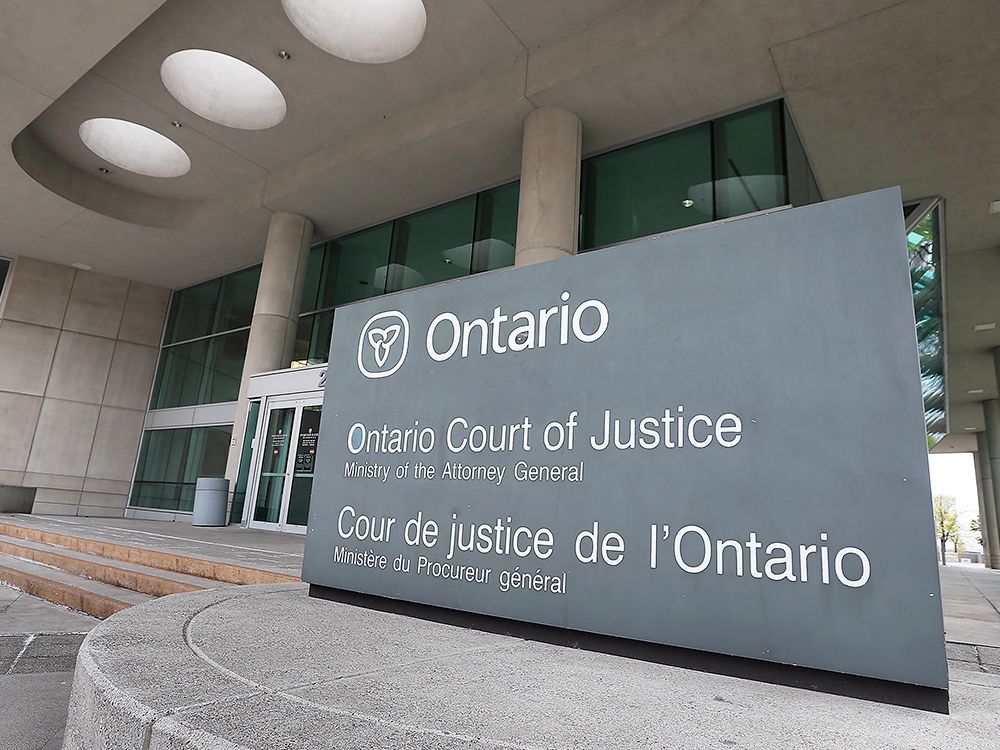
The Ontario Court of Justice in Windsor.

An Ontario judge has sentenced an Iraqi Uber driver to ten months in jail for sexually assaulting his passenger who was just looking for a ride home from a party.

The Ontario Court of Justice heard a woman engaged Sevan Halabi’s services as an Uber driver on Oct. 9, 2022. Halabi, who is a permanent resident of Canada, was angling for a lighter sentence to avoid deportation.

“She wanted him to drive her home from a party she’d attended. Rather than take her home, the offender drove her to an empty parking lot,” Justice Scott Pratt wrote in a recent decision out of Windsor.

“He told her they would have fun. He parked the car and got into the back seat. He moved closer to the victim and forcibly kissed her. He put his hand under her dress and touched her vaginal area over her underwear.”

Halabi ignored the woman’s protests, Pratt said.

“After he tried again to kiss her and she did not respond, he moved away from her,” said the judge.

“She asked if he would still drive her home and he said no. She got out of the car, and he left her in the parking lot.”

The married father of two had asked the judge for a sentence of six months less a day to avoid immigration consequences.

“I am not unsympathetic to the offender’s family,” Pratt said in a decision dated April 3.

“In my view, however, a sentence of six months less a day for this conduct would be unfit. It would prioritize the offender’s personal circumstances over the need to denounce and deter his conduct and would not be in line with relevant case law. It would be an inappropriate and artificial sentence imposed only to avoid legitimate consequences created by Parliament.”

According to the Immigration and Refugee Protection Act, permanent residents can be deemed “inadmissible” to Canada for “serious criminality” if they’re sentenced to more than six months in jail.

But six months less a day plus probation — the sentence Halabi’s lawyer argued unsuccessfully for — doesn’t reflect the seriousness of his actions, Pratt said.

“It would require me to cut the sentence nearly in half, solely to assist him in avoiding future penalties,” said the judge. “I cannot do that.”

In laying out the reasons for his sentence, the judge referred to other similar cases from the recent past.

“It is troubling that sexual offences committed by professional drivers are sufficiently common that they have created their own body of case law,” Pratt said. “But that is what has happened.”

The Crown argued Halabi should get a year in jail, followed by three years of probation.

Halabi was born in Iraq.

“He married his spouse in 2009, said the judge. “They have two sons, aged 10 and 14.”

They immigrated to Canada in 2018.

“His wife and children have since become Canadian citizens, but (Halabi) remains a permanent resident,” Pratt said.

“In submissions, the offender’s counsel advised he was unable to apply for citizenship because of the charge before this court.”

Halabi maintained his innocence to the author of a pre-sentence report.

But he told the judge “he regrets what happened, has learned a lesson, and that this will not happen again,” said the decision.

“I don’t know what happened between the (pre-sentence report) interview and the present, but to me the offender has now expressed remorse,” Pratt said. “I have no reason to doubt his sincerity, but it is a marked change from a report dated (Feb. 5).”

The victim read a statement in court.

“It reveals the ongoing and pervasive impact the offence has had on her,” said the judge. “She still suffers from panic attacks and flashbacks. The offence has hindered her professional life as a teacher and her personal life as well. She is fearful and angry. She didn’t know if she would be raped or killed (in Halabi’s car that night), and that fear continues to impact her life.”

Halabi has “shown some degree of remorse,” Pratt said. “He said he regrets what happened and that he has learned his lesson. It’s not clear, however, if that regret stems from his actions or from the consequences he has brought on his family.”

Halabi’s children were in court for the sentencing submissions.

“On that point, both children were visibly upset and crying during the proceeding,” Pratt said. “Respectfully, I question why they were here in the first place. It was not a case where their father was in custody and so this would have been a rare opportunity to see him in person; (Halabi) has been out of custody throughout this case and only appeared virtually from Iraq. I cannot find they were brought into the courtroom to engender sympathy from the court but given the offender’s focus on how my sentence could affect his family, that is certainly an inference available to be drawn.”

Pratt saw Halabi’s “very significant” breach of trust as an aggravating factor in the case.

“The entire business model of Uber and similar companies is to contact a stranger over the internet so you can get in their car,” said the judge. “It goes against everything we are taught and everything we teach about staying safe. As a result, the trust we necessarily place in these drivers is enormous. When that trust is broken with criminal actions, courts must respond harshly.”

Our website is the place for the latest breaking news, exclusive scoops, longreads and provocative commentary. Please bookmark nationalpost.com and sign up for our daily newsletter, Posted, here.


Gregor Robertson, former Vancouver mayor and current federal Liberal candidate.

VANCOUVER — Former Vancouver mayor Gregor Robertson, who is now running for Mark Carney’s Liberals, dismissed the size of

the crowds that Conservative Leader Pierre Poilievre is attracting

and compared them to the 2022 Freedom Convoy protests.

Robertson, who is the Liberal candidate for Vancouver Fraserview—South Burnaby, was present during Carney’s trip to the West Coast this week. He attended the Liberal rally in Richmond on Monday evening and was at Carney’s announcement in Delta on Tuesday morning.

Speaking to the press after the announcement, Robertson said he does not believe that a re-elected Liberal government would increase Western alienation, as suggested by former

Reform party leader Preston Manning in a recent op-ed.

“Absolutely not,” said Robertson. “I think what I’m hearing on the doors here in Vancouver is incredible confidence in the message that Mark Carney and the Liberals are sharing right now in tackling the challenge from (U.S. President) Donald Trump and the tariffs.”

“I don’t hear the message of Poilievre resonating at all here on the West Coast,” he added.

Poilievre’s message seems to be resonating, however, with the thousands of people who have been attending his rallies. In Edmonton, where he was on Monday, he claimed 15,000 people were in attendance whereas the RCMP estimated between 9,000 and 12,000.

In any case, the crowds that the Conservative leader have been attracting are huge.

Liberals are also attracting big crowds, but in lesser numbers which they claim is because their rallies are announced relatively at the last minute. The Richmond rally, for instance, saw 2,000 people in a hotel conference room and another 400 people in an overflow room.

Robertson said the energy in the room was “fantastic” but said “ultimately, people are going to make their choices at home” by the time the April 28 election arrives.

In his opinion, Conservative rallies amount to a normal democratic exercise.

“There are always going to be thousands of people who will go to protests and are not satisfied with what’s on the table,” said Robertson. “That’s the nature of democracy.”

Reporters pushed back, saying those gatherings are not “protests” but political rallies.

“It’s a political rally, but it’s very deeply aligned with the truck convoy rally that went to Ottawa,” said Robertson.

He was referencing the Freedom Convoy, which saw thousands of Canadians in the nation’s capital and across the country protest COVID-19 measures in the winter of 2022.

Robertson added: “There’s a lot of shared resentment for government in general that people express at these rallies around the country, south of the border and in countries around the world.”

“It’s a democracy. People can show up and express their feelings. We encourage that here in Canada,” he said.

After spending three days in British Columbia, Carney flew to Calgary where he held another rally attended by approximately 2,300 people — inside the room and waiting outside to get in.

National Post

calevesque@postmedia.com
Get more deep-dive National Post political coverage and analysis in your inbox with the Political Hack newsletter, where Ottawa bureau chief Stuart Thomson and political analyst Tasha Kheiriddin get at what’s really going on behind the scenes on Parliament Hill every Wednesday and Friday, exclusively for subscribers. Sign up here.


Conservative Party Leader Pierre Poilievre with his wife Anaida, son Cruz and Conservative MP Pierre Paul-Hus during a visit to Quebec City in June 2024.

QUEBEC CITY – As the Liberals widen their gap in Quebec, eyes are focused on the “Old Capital,” a longtime, mysterious Conservative stronghold. But the ground may be shifting, and one political icon is now hinting that a red wave could sweep over the city.

That’s former mayor Régis Labeaume, who served from 2007 to 2022 and left office with a 78 per cent approval rating.

Labeaume is still a local star. He knows the people and what they’re going through. In the four municipal elections he won, his worst result was 55 per cent of the vote.

When he was mayor of the province’s second-largest city, all political leaders wanted a piece of him. Including then-prime minister Stephen Harper.

“Things went very well with Mr. Harper,” he said over brunch in one of his go-to restaurants for the past four decades.

Labeaume was not always easy to get along with. He’s a strange breed, a bulldozer who loved to fight with his opponents and journalists. He shone in the spotlight and never hesitated to speak out against anyone who said “no” to him and to his city.

The National Post met with Labeaume to decode the “Quebec City mystery” on a Saturday morning, after week one of this campaign. It’s a mystery because the Conservative party, not known for its strength in Quebec, holds three seats, ahead of the Liberals and the Bloc Québécois with two each, in a province where they won only 10 in the last election.

If you include the greater Quebec City area, the Tories held six out of 10 going into the current campaign.

It’s historic, he said. In the first major French-speaking city in North America, language is paramount. Quebec City is “a village,” says Labeaume, and the residents are proud of it.

“The Conservative vote (here) is a protest vote… People are voting against the establishment,” he said.

Quebec City is historically no fan of the Liberals. The party’s two MPs in the area, Jean-Yves Duclos (Québec-Centre) and Joël Lightbound (Louis-Hébert), have won their seats by no more than a couple of thousand of votes in every election since 2015. They have never managed to add a third representative to the city.

People seem to enjoy having the opposition represent them. In 2011, every seat was won by the NDP during Jack Layton’s orange wave.

Even though the Liberals are leading the province, according to the most recent

National Post-Léger poll

, the Conservatives still appear to be dominating the capital. Polling aggregator

338Canada

is projecting five ridings for the Conservatives, while the Liberals would retain their two seats, and none for the Bloc.

“Everyone calls it the Quebec Mystery, but I have suggested that it’s more the Montreal Mystery,” said the Conservative candidate in Charlesbourg-Côte-Saint-Charles, Pierre Paul-Hus, with a laugh.

“If you go back 30, 40, or 50 years, people’s mentality has always been, ‘We work hard, we take care of our money, we have family values.’ Well, all of that is a fundamental fact that still exists. Quebecers are more conservative than we might think,” said Paul-Hus, who is Pierre Poilievre’s Quebec lieutenant.

Paul-Hus hopes his party will make gains, just like the Bloc Québécois. Leader Yves-François Blanchet launched his campaign in the city.

In downtown Quebec City, Simon Bérubé’s campaign headquarters had nearly a dozen volunteers working frantically. Bérubé, the Bloc candidate in Québec-Centre facing former Liberal minister Jean-Yves Duclos, has been canvassing door-to-door for nearly a year. He talks about public transit and the protection of the French language.

He hopes that Quebecers, who are passionate about debate and extremely politically informed, will see the value in having a strong Bloc MP who is also an expert on American politics. He points out that Duclos was “dumped, abandoned by his prime minister just before the election” when Carney formed his first cabinet.

Carney did not appoint any ministers east of Shawinigan, which is seen as a “slap in the face.”

“So, for all of eastern Quebec, there is no longer a minister, and it is a decision that Mr. Carney had to make consciously because he does not know Quebec, he does not know the importance of Quebec City and of the national capital of Quebec,” he said.

But people are afraid, said Labeaume. U.S. President Donald Trump’s repeated threats against Canada are terrifying.

“Psychosis exists here. People only talk about Trump… We are incapable, until further notice, of putting a little rationality into our thoughts. I have rarely seen that,” he said.

 Former mayor Régis Labeaume says that “The Conservative vote (in Quebec City) is a protest vote.”

At Halles Sainte-Foy, people from all over the city go to shop, have lunch or drink coffee. Joël Lightbound, the tall, calm, and soft-spoken Liberal candidate for Louis-Hébert, takes a deep breath before interrupting customers mid-conversation.

“I’m your MP and Liberal candidate here,” he says. They know him, and they rush to take his picture.

“I think there is definitely something going on in the population and there are ridings that I didn’t think were winnable a few months ago that now seem entirely within the realm of possibility,” he said in an interview.

Then, a couple of other customers stopped what they were doing. Their eyes almost popped out.

“It’s Mélanie Joly,” whispered an older lady at a coffee shop.

The minister of foreign affairs emerged and started to work the crowd. “Can we count on your vote?” she asked with a smile. “Maybe, I don’t know yet,” replied a woman.

She was undecided, but she was leaning toward a federalist party. She wouldn’t say which one, but her smile said it all when she talked about her encounter with the minister.

“Flipping undecided voters is the politician’s job in a campaign,” Joly said. She shook another hand, took another picture.

Liberals are feeling something in Quebec City but also everywhere in the province. Something like a wave in their favour.

Joly thinks the Liberals now enjoy greater support in the province than in 2015, when Justin Trudeau’s party won a majority in the province with 40 seats. Liberal sources privately said that winning 43 seats in the province would be a resounding success this time around. As of Monday,

338Canada predicted 49 seats for the Liberals

in the province.

A few months ago, Joly wasn’t as popular, and smiles were rarer. The Liberals had hit rock bottom across the country, including in Montreal, their last stronghold.

“It’s night and day,” she told the National Post. “There was anger among the population… We weren’t popular because people wanted change.”

Trudeau’s resignation, Trump’s threats against Canada, and the arrival of Carney have changed everything for the Liberals in this province. Perhaps even in the capital.

“Adding two seats in Quebec City would be amazing,” said Lightbound.

Régis Labeaume does not support anyone in this election. He’s a separatist who voted “yes” in two referenda; a social democrat who ran a mining company and became a millionaire before entering politics.

He wouldn’t say who he’ll vote for. But he told us very clearly that he appreciates the style of Carney, a “neophyte” who is making “bold” decisions and has a “son of a b–ch” instinct.

People are more afraid than ever, he said. Even more so than during the referenda on Quebec independence. Quebecers, he added, want someone in charge, someone “solid,” someone with “major league experience.”

“Carney is up there. It’s pretty clear,” he said.

He doesn’t think Poilievre is up for the task and says the Bloc is inevitably in a tough spot. He feels a wave. A red wave in Quebec City.

“There are Conservative ridings that will flip to the Liberals,” he predicted.

He finished his coffee, stood up, and headed for the exit.

Half a dozen people stopped him. “We need you,” said a man. “We miss you terribly, Mr. Labeaume,” said a woman nearby. “You’re my political hero,” added another.

He shook their hands with a smile. “See, I told you.”

National Post

atrepanier@postmedia.com

Get more deep-dive National Post political coverage and analysis in your inbox with the Political Hack newsletter, where Ottawa bureau chief Stuart Thomson and political analyst Tasha Kheiriddin get at what’s really going on behind the scenes on Parliament Hill every Wednesday and Friday, exclusively for subscribers. Sign up here.


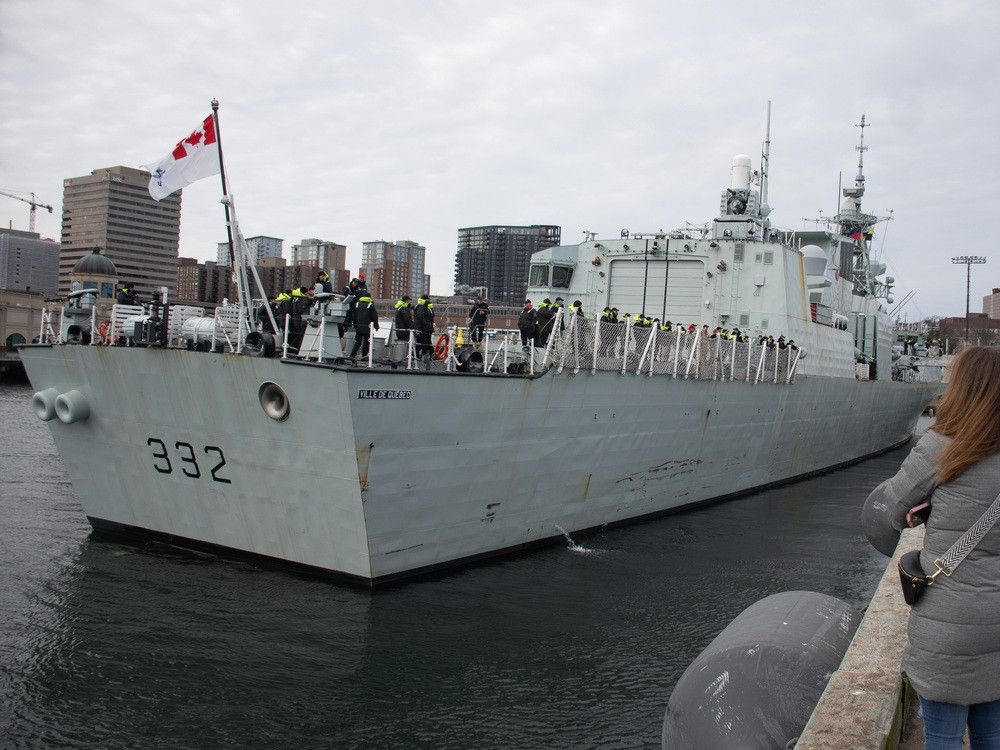
Friends and family watch as HMCS Ville de Quebec leaves Halifax on Monday, April 7, 2025.

It was a departure in two ways.

The Royal Canadian Navy frigate HMCS Ville de Quebec slipped out of Halifax Monday morning to join a United Kingdom carrier strike group on a seven-month deployment to the Indo-Pacific. Canadian warships regularly integrate with American carrier strike groups, but officials and military watchers insisted Monday the decision to sail with the Brits instead this time was a year or more in the planning and has nothing to do with U.S. President Donald Trump’s recent ramblings about making Canada the 51st state.

“This is just a happy coincidence,” said Ken Hansen, a military analyst and former navy commander.

It’s “also a bit of a symbolic change,” he said.

“The government is talking about disconnecting or decoupling the diplomatic and economic aspects of our network with the Americans and now you could view it symbolically as just more of the same in a military way,” Hansen said. “We’ll never be able to decouple completely from the United States military for the role that we play in continental security and safety of our shipping and ports, but for this kind of thing, where they’re deploying to a foreign theatre, you can easily hook up with the Brits or the French or anybody you choose to because the NATO alliance makes all of that possible.”

Canadian warships frequently operate with U.S. Navy carrier strike groups and it’s rare that they join Royal Navy formations except when they happen to be sailing in the same waters, according to Paul Mitchell, a professor at the Canadian Forces College in Toronto.

But he doubts Canada decided to sail with the Brits instead this time because of Trump’s tough talk.

“Ship deployments are typically planned long in advance. Engagements with foreign task groups especially so,” Mitchell said.

And while last month’s Halifax visit by a French nuclear-powered submarine drew lots of eyeballs as Trump raised the temperature on Canada, that, too, would have been “planned well in advance,” Mitchell said.

“Bottom line: while timely, none of this was likely timed to coincide with recent events,” he said.

 Commander Peter MacNeil speaks with reporters as HMCS Ville de Quebec prepares to leave Halifax on Monday, April 7, 2025. The Ville de Quebec is being deployed to the Indo-Pacific region as part of Operation Horizon.

The frigate’s skipper is keen to be sailing with the Brits.

“This an excellent opportunity because now that the U.K. has their two carriers that they alternate for their deployments, I’ve had the opportunity to go over to their headquarters, meet with the command teams and the carrier task group commander,” said Cmdr. Peter MacNeil. “We’re being more than just interoperable, but being integrated into the carrier strike group.”

MacNeil didn’t want to wade into Trump’s talk about taking over Canada.

“The best thing I can do is to keep this crew safe, conduct the operations to the best of my ability and my training after 20 plus years in the service,” he said. “I don’t have a political opinion; I carry out my orders.”

Ville de Quebec’s journey will circumnavigate the globe, taking its 242 sailors across the Atlantic Ocean, through the Mediterranean, the Indian Ocean, over into the South China Sea around the Pacific and back to the Atlantic, via the Panama Canal, then home to Nova Scotia.

The frigate will spend most of the deployment with a multinational naval force, led by HMS Prince of Wales, a Queen Elizabeth-class aircraft carrier.

“It’s the first time this ship has specifically deployed to the Indo-Pacific,” MacNeil said of Ville de Quebec. “So that’s very exciting for us and a key milestone.”

The routing and who the Canadian warship would be operating with “was solidified” over the last year, MacNeil said.

The journey will include a lot of war games.

“We’re going to conduct anti-submarine warfare serials, lots of exercises, training,” MacNeil said. “Being with the carrier, we have an opportunity to do lots of live tracking with live aircraft.”

 Dennis Oake holds his granddaughter Everly, 3, as they wave to Everly’s dad, Sailor First Class Andrew Oake, as he leaves Halifax aboard HMCS Ville de Quebec on Monday, April 7, 2025.

There’s “always an inherent risk” involved in naval deployments, he said. “It could be anything from an incident within the ship where a piece of equipment fails to, perhaps, something emerges internationally.”

For the next three weeks, sea training experts wearing red caps will put the ship’s crew through their paces “to give us some surprises, see how we react and let us enhance our standard operating procedures and how we’re going to deal with tactics in an emerging environment,” MacNeil said.

“Then we’ll be as ready as we can be should anything erupt worldwide.”

The Stadacona Band played Heart of Oak as Ville de Quebec left the dock, even though the navy is steering away from the naval march because the centuries-old anthem contains references to colonialism and slavery, and doesn’t represent everyone who wears the uniform, including women and Francophones. But the band also delved into more modern fare as families got one last chance to blow their sailors a kiss, including jaunty takes on the Spice Girls’ Stop and Canadian singer-songwriter Carly Rae Jepsen’s Call me maybe.

Janet Whalen was at the dock to wave goodbye to her son, Bradley, a cook on Ville de Quebec.

Was she happier that he’s sailing with the Brits than the Americans? “Never really thought of it actually,” Whalen said. “But, at the moment, yes…. Just the way things are right now. It’s crazy.”

Carl McWilliams was on the pier in Halifax to send off his stepson, Nicholas Soucy.

“Right now, I’d rather British than American, absolutely,” McWilliams said of Ville de Quebec’s aircraft carrying dance partner for this deployment.

“I was in the navy. So, I myself would rather be sailing with the Brits right now,” he said. “It’s a good wake-up call for us.”

Our website is the place for the latest breaking news, exclusive scoops, longreads and provocative commentary. Please bookmark nationalpost.com and sign up for our daily newsletter, Posted, here.


Both posts caught fire at a suspiciously fast pace, garnering an estimated one to three million views


Blanchet was answering a question in English about Carney’s understanding of Quebec