LP_468x60
on-the-record-468x60-white

NANAIMO, B.C. — In a Vancouver Island city best known for a

three-tiered dessert bar

that bears its name, three progressive campaigns are similarly sandwiched together, with each vying to be the “anybody but Conservative” vote.

But unlike the ooey-gooey custard filling at the centre of a Nanaimo bar, Nanaimo—Ladysmith’s three-layered progressive logjam is filled only with anxiety and dread.

“Nanaimo—Ladysmith is definitely a bit of an anomaly,” said Bruce Cameron, a pollster based in Vancouver Island.

Aggregator 338Canada shows the riding’s Liberal, NDP and Green campaigns in a virtual dead-heat,

with about 20 per cent of the vote apiece

, which may present a path to victory for Conservative candidate Tamara Kronis.

Cameron said on Wednesday that he’s wary of these numbers, but agrees that the strength of the riding’s NDP and Green candidates — incumbent Lisa Marie Barron and ex-MP Paul Manly — makes each a factor in the riding, despite both federal and provincial polls showing a two-horse race between the Liberals and Conservatives.

“Lisa Marie (Barron) and Paul (Manly) are both seasoned campaigners who know how to build an effective ground game,” said Cameron.

“So I guess the big question is, does ground game matter anymore in elections? I tend to think it does.”

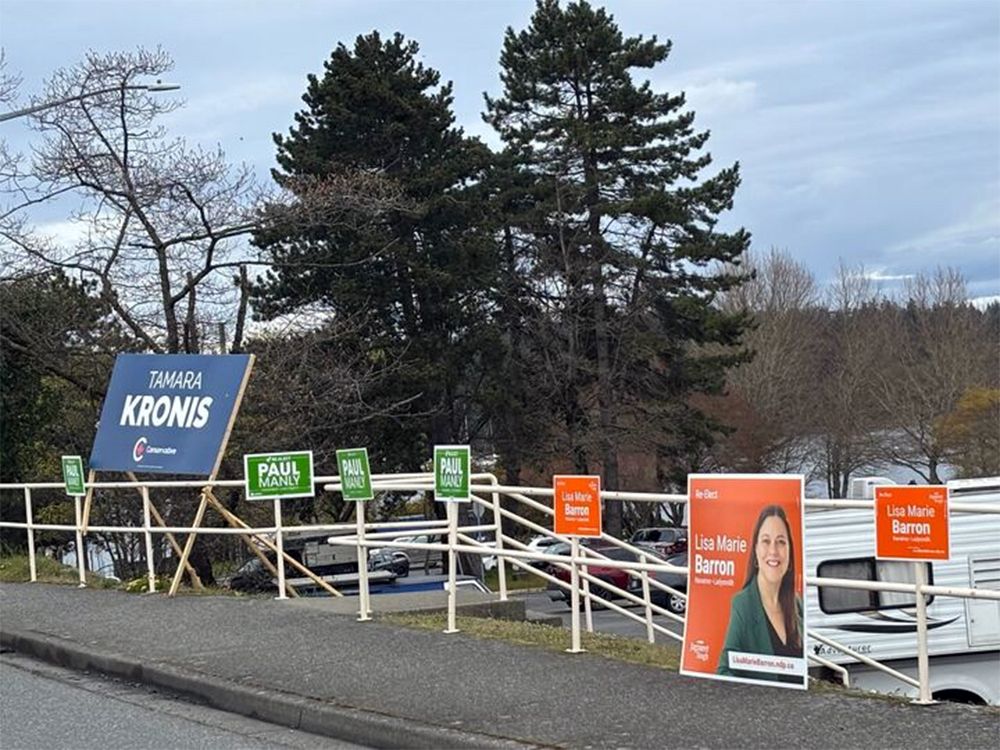
There are noticeably more green and orange signs — and, for that matter, Conservative blue ones — along Nanaimo’s main thoroughfare than red ones, indicating that Liberal candidate Michelle Corfield has some catching up to do in terms of visibility.

Interestingly, the same four candidates squared off in a tight 2021 race.

Just over 2,000 votes separated the top three finishers, with Barron narrowly edging out Kronis and Manly.

Corfield finished well behind, raking in a still respectable 13 per cent of the vote.

Nanaimo—Ladysmith was

the last riding called

in the country, with a final count released two days after election night.

Cameron says he expects to see Corfield get a substantial boost the time around, with the campaign dominated by the threat of U.S. President Donald Trump’s tariffs and economic aggression toward Canada.

“Since the start of the campaign, Liberal, NDP and Green voters have been almost entirely focused on the Trump threat, and who’s the best prime minister to deal with that,” said Cameron.

“And on that question, Carney is well ahead of the other leaders.”

Cameron said that, even with the advantage of incumbency, it will be hard for Barron to swim against the national tide of the NDP bleeding support to the Liberals.

“All the polls, and I’ve watched them religiously every day, are indicating that support for (the NDP) is melting away… They’re down below 9 per cent nationally.”

Barron, for her part, points to longer historical trends.

Nanaimo—Ladysmith

traditionally swings between orange and blue. The last time we had a Liberal MP was in the 1940s,” Barron told the National Post on Wednesday.

Barron also pointed out that she’s undefeated in the riding, while the Liberal and Green nominees have both lost multiple times.

“The current Liberal candidate is running for the seat for the fourth consecutive time, and in each prior race, she never attained more than 14 per cent of the vote. The current Green party candidate is also running for a fourth time.”

“(I)n the critical 2025 race, it’s clear in Nanaimo-Ladysmith we vote NDP to stop the Conservatives.”

Manly says that Barron is wrong, and he has the data to prove it.

“The polls we’ve done shows that I am the strategic vote here,” says Manly, speaking from his campaign office near the city’s waterfront on Monday.

Manly says that while the last two internal polls he ran, including one just before the late March election call, both show him running in second behind Kronis, a big challenge he’s already facing is convincing potential supporters not to put too much stock in poll aggregators like 338Canada.

“It’s just getting people to understand that 338 is not a poll. It’s a prediction, based on an algorithm, based on a national poll,” said Manly.

Manly, who first won the seat in a May 2019 byelection, said that 338 also undercounted his support in that fall’s federal election, where he won by an 8.5 point margin.

He lost the seat in 2021 but was elected to Nanaimo’s city council in 2022

with the most votes

of any candidate in the race.

Manly said that the NDP doesn’t deserve the support of the city’s voters, after failing to deliver on climate change, affordability and electoral reform, despite being given a seat at the governing table by the Trudeau Liberals.

“The confidence and supply agreement didn’t mention climate change. It didn’t mention a fair taxation system and it didn’t mention proportional representation,” said Manly.

“What we need is good strong voices in the House of Commons, for opposition to hold the government to account (and) be the conscience of Parliament,” he added.

 Nanaimo has been one of Western Canada’s fastest-growing cities in recent years.

Corfield told the National Post Thursday that the voters of Nanaimo deserved more than a voice of dissent in the halls of government.

“This election isn’t about protest. It’s about solutions — especially on housing, health care, and forestry,” said Corfield.

“I’m running to get things done for the people who live here, not just make a point in Ottawa.”

Kronis said that it isn’t just the split on the centre-left that’s given her the inside lane, but also the fact that the Conservatives are attuned to concerns in Nanaimo, and growing cities like it, about public safety and the cost of living.

“What I’m hearing at the doors is that people just feel that they can’t afford a fourth Liberal term of rising costs and crime,” said Kronis on Monday.

“It’s pretty much as simple as that.”

Nanaimo has been one of Western Canada’s fastest-growing cities in recent years, hitting 100,000 residents for the first time

in the 2021 census

. It’s also feeling some major growing pains.

StatsCan pegged Nanaimo as Canada’s

sixth-worst municipality for crime severity

in 2023, the most recent year for which data is available, citing increases in property crimes like shoplifting and auto theft.

Conservative Leader Pierre Poilievre notably visited Nanaimo

in the campaign’s opening days

to roll out his tough-on-crime platform, announcing life sentences for aggravated human and gun trafficking convictions.

Nanaimo has also been hit hard by the opioid crisis, seeing

a 400 per cent

increase in overdose deaths between 2019 and 2023.

Kronis said that Poilievre’s promise last week to fund

50,000 residential treatment spaces

, if he becomes prime minister, was well-received in the community.

“Our announcement of 50,000 new recovery spaces has spread like wildfire across the community,” said Kronis.

“(People) are particularly happy that we’re focused on recovery, and finding a balance with enforcement and prevention.”

“They want to be compassionate, but also practical.”

National Post

rmohamed@postmedia.com

Get more deep-dive National Post political coverage and analysis in your inbox with the Political Hack newsletter, where Ottawa bureau chief Stuart Thomson and political analyst Tasha Kheiriddin get at what’s really going on behind the scenes on Parliament Hill every Wednesday and Friday, exclusively for subscribers. Sign up here.


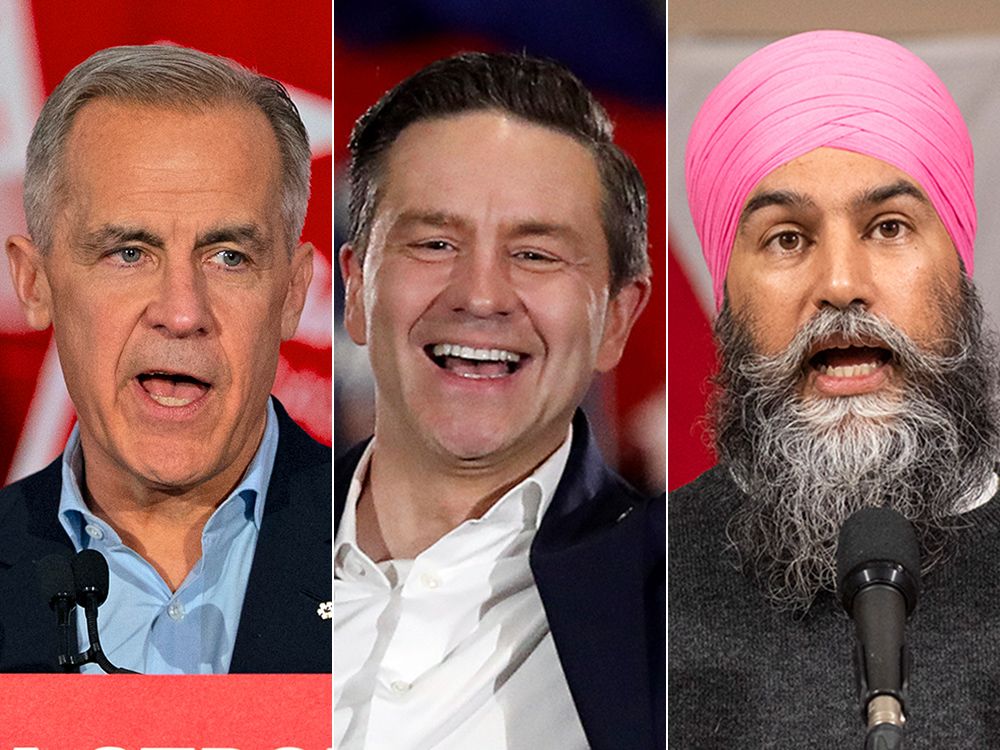
From left: Liberal Party Leader Mark Carney, Conservative Party leader Pierre Poilievre and NDP Leader Jagmeet Singh.

To help you cast an informed vote, the National Post has put together an issue-by-issue breakdown of the parties’ announced policies, so you can compare them side by side.

Go to topic:

TARIFFS/TRUMP


Provide $2-billion “strategic response fund” for workers in the auto sector and related fields impacted by tariffs.

Build “all-in-Canada” manufacturing network to bring more of the auto supply chain within our borders.

Work with premiers to create national energy and trade corridor.

Levy matching tariffs on U.S.-made vehicles that are not compliant with the Canada-U.S.-Mexico Agreement.

Bring in dollar-for-dollar tariffs targeting goods and services that can be easily provided in Canada, or imported from a third country.

Use revenue from retaliatory tariffs to reduce tax burden, setting aside a sum for targeted relief to workers hit hardest by U.S. tariffs.

Cut taxes, regulations to stop flow of investment dollars to U.S.

Stimulate internal trade by paying out a “free trade bonus” every time a province removes one of it’s exceptions under the Canada Free Trade Agreement.

Zero GST on Canadian-made vehicles.

Cut off exports of critical minerals such as lithium and cobalt to the U.S.

Dollar-for-dollar retaliatory tariffs, 100 per cent tariff on Teslas.

Change procurement to use more Canadian-made steel and aluminum for domestic construction and manufacturing.

Zero GST on Canadian-made vehicles.


TAXES


Cut lowest marginal tax rate by one per cent, saving two-income households up to $825 per year.

Cancel consumer carbon tax but keep and strengthen industrial carbon tax.

Cancel planned capital-gains tax increase.

Cut lowest marginal tax rate by 2.25 per cent over two years, saving two-income households up to $1,800 per year.

Add $5,000 top-up to tax-free savings account; top-up must be invested in mix of government designated “Canadian investments.”

Allow seniors to earn up to $34,000 per year tax free, $10,000 more than current limit.

Crack down on the ability of corporations and wealthy Canadians to use tax havens.

Eliminate tax write-offs for corporate jet travel.

Raise basic personal amount from $15,000 to $19,000, saving $505 for those earning between $19,500 and $177,882.

Permanently remove the GST from various essentials, including prepared grocery meals, baby accessories and monthly cell, internet and heating bills.

Keep the planned increase to the capital-gains tax hike passed in the 2024 budget.

Double the Canada Disability Benefit.


HOUSING


Waive GST on homes sold to first-time buyers for $1 million or less.

Invest $35 billion to build 500,000 per year for the next decade.

Waive GST on all newly built homes sold for less than $1.3 million.

Use demand generated from new home buyers’ tax cut to spur construction of 36,000 homes per year.

Incentivize municipal governments to cut red tape, development charges.

Cancel the Liberal Housing Accelerator and other federal housing programs.

Direct the Canadian Mortgage and Housing Corp. to give preferential long-term, low-interest mortgages to working and middle-class families.

Build rent-controlled homes on public land.

Create at least 500,000 units of affordable housing in next decade.

DEFENCE


Get to NATO defence spending target of two per cent of GDP by 2030 at the latest.

Source more Canadian steel and aluminum for domestic shipbuilding.

Boost salaries for Canadian Armed Forces personnel, bolster recruitment.

Procure new submarines, heavy icebreakers for deployment in Arctic.

Build permanent Canadian military base in Iqaluit, Nunavut.

Double the size of the 1st Patrol Group of the Canadian Rangers, from 2,000 to 4,000.

Deliver two additional polar ice breakers to Canadian Navy by 2029.

Divert foreign-aid spending to military projects.

Cancel Canada’s F-35 contract with Lockheed Martin.

Build replacement fighter jets in Canada.

Increase NATO-target defence spending to two per cent of GDP by no later than 2032.

Invest in Arctic defence infrastructure such as marine search-and-rescue stations and small-craft harbours.

Give Canadian Rangers raises, reimbursements for the use of their equipment.

ENERGY/ENVIRONMENT


Create a system of incentives to reward Canadian consumers and businesses for making greener choices.

Strengthen the industrial carbon-tax regime.

Make public investments in energy-efficient buildings and electrified transportation.

Develop a carbon border-adjustment tariff on imports from countries deemed to have inadequate carbon-control policies.

Streamline impact assessment process to make clean and conventional projects easier to approve.

Work with provinces and territories to develop a national trade an economic corridor.

Eliminate the federal industrial carbon tax.

Repeal the Impact Assessment Act.

Reverse federal clean electricity regulations and emissions cap on oil and gas.

Pre-approve energy projects to restore investor confidence.

Create a national energy corridor guaranteeing the approval of pipelines, railways and other resource-moving infrastructure across the country.

End any subsidies or tax credits for oil and gas companies.

Retrofit 2.3 million low-income households with heat pumps, air sealings and other energy-saving modifications.

CRIME


Bring in mandatory life sentences for aggravated human, gun and fentanyl trafficking convictions.

Strengthen bail system by repealing Liberal bills C-5 and C-75.

Use Section 33 of the Charter (the notwithstanding clause) to reinstate multiple life sentences for those convicted of multiple homicides.

Permanently assigned a maximum-security classification to serial killers such as Paul Bernardo, keeping them in maximum-security prisons for the entirety of their sentences.

Pass “three-strikes” law requiring sentences of 10 or more years for three-time serious offenders.


HEALTH/SOCIAL POLICY


Expand dental care to households with incomes of less than $90,000.

Fund 50,000 residential treatment spaces for Canadians with addictions.

Keep parts of Liberal dental plan that are already up and running.

Alter Liberal child-care agreements to give parents more flexibility.

Deliver full public pharmacare within four years.

Expand dental care to all households with incomes of less than $90,000.


EDUCATION/TRAINING


Cover apprenticeship training grants up to $8,000 for students in the skilled trades.

Double the funding of the Union Training and Innovation Program to $50 million annually.

Increase labour mobility for skilled trades people between provinces and territories.

Reinstate apprenticeship grants of $4,000 for an appre

Expanding the Union Training and Innovation Program.

Create a special class of rapid employment insurance payouts for apprentices who leave the workforce for more training.

Increase labour mobility for skilled trades people between provinces and territories.

Allow travelling trade workers to write off all travel, accommodation and food costs.


Screengrab from video of Conservative candidate Neil Oberman speaks with Ariela Cotler, wife of former Liberal MP Irwin Cotler in Mount Royal.

OTTAWA — A Conservative sign in front of a Liberal stalwart’s home. That’s what’s happening in the Liberal stronghold of Mount Royal during this unusual spring election.

The home in question is that of Irwin and Ariela Cotler. Mr. Cotler is a world-renowned human rights lawyer and a former Liberal MP for the riding.

Ms. Cotler was a social worker known for her work with Montreal’s Jewish community.

The Cotlers are practically legends in Mount Royal. The former Attorney General of Canada under Paul Martin represented the riding in Ottawa from 1999 to 2015, and they are both influential within the Jewish community, which represents approximately 30 per cent of the riding’s population.

Having their support is therefore a big deal. Anthony Housefather, Liberal candidate and Mr. Cotler’s successor in the House of Commons, was proud to announce a few days ago that his “mentor” and “the greatest man (he has) ever known” had given him his support.

But then, there is a video. And a photo.

Ms. Cotler, standing outside the couple’s home alongside Conservative candidate Neil Oberman, announced that she was supporting the Conservatives, not the Liberals.

“I urge you, come out and vote, it’s the future of our families, our children, our grandchildren, and about all of Canada… Vote, of course, for Neil Oberman and the Conservative party, and I wish you luck,” she said.

Oberman’s post also showed a photo of him and Mr. Cotler shaking hands.

“Thank you Irwin Cotler for taking the time to share your wisdom and guidance on humanitarian issues that do and should matter,” he wrote.

That was widely seen as an endorsement. Dimitri Soudas, who was Prime Minister Stephen Harper’s director of communication,

wrote that

“former Chretien era MP and Liberal Justice Minister endorses Conservative Candidate.” Canada Proud, a conservative group, also saw it as a show of support.

When he saw the post online, long time conservative strategist Anthony Koch’s jaw nearly dropped on the floor.

“I would say that it’s a massive story,” he told National Post.

“The fact that Ms. Cotler felt comfortable doing this in such a public way … suggests that this was very important for her and a matter of extreme moral principle,” Koch, who lives in Mount Royal, added.

In a telephone interview with the National Post, Mr. Cotler laughed off the situation.

“We’re a pluralistic family, able to adapt to different political leanings,” he said. No, there’s no tension within the household.

“It was always clear that I would support Anthony and raised no questions or confusions about it. Anthony has always had my support from the time that he stood as a candidate and in each of his elections, and there’s no reason why I wouldn’t support him in this election,” he said.

In Liberal circles, no jaws were found on the floor. Ms. Cotler is known to be an independent woman who is more conservative than her husband. In fact, in 2006, there were reports that

she had left the party

.

Mr. Cotler even confirmed that she had put up Conservative signs on their lawn before.

However, this situation is another indication that Mount Royal has a strange vibe going into this election.

For more than a year,

the Conservatives have been targeting this riding

, spending a lot of money and sweat to oust the Liberal incumbent.

They also nominated a “formidable candidate,”

in Mr. Cotler’s own words

, in a context where the Liberals were about to lose their Toronto stronghold of Toronto—St.Paul’s in a byelection.

Oberman, a lawyer who filed

an injunction on behalf of McGill University students against an anti-Israel encampment

on campus in 2024, has been doing the groundwork, knocking on more than 10,000 doors, interacting with communities throughout the riding, not only with the Jewish community, but also with the Filipino, the Hindu and the Bangladeshi communities, for instance. He has been meeting with thousands of voters, trying to convince them to switch their vote.

“People don’t leave the Liberal party. The Liberal party left the people. We were all left by the Liberal party,” said Oberman in a long interview.

The growing anger from the riding’s large Jewish population towards the governing Liberals, particularly their positions on Israel and antisemitism since the Oct. 7 terrorist attack by Hamas, has put Housefather in a tough spot.

People are scared to go to synagogue, to drop their kids at the Jewish daycare or school in the wake of many antisemitic incidents.

“It is one of the ridings with the largest Jewish population and therefore is one of the ridings that is the most scarred by what’s happened over the last 18 months,” says Liberal strategist and Justin Trudeau’s former Quebec advisor, Jonathan Kalles.

“And so that will naturally play, will naturally be a factor in how people decide,” he added.

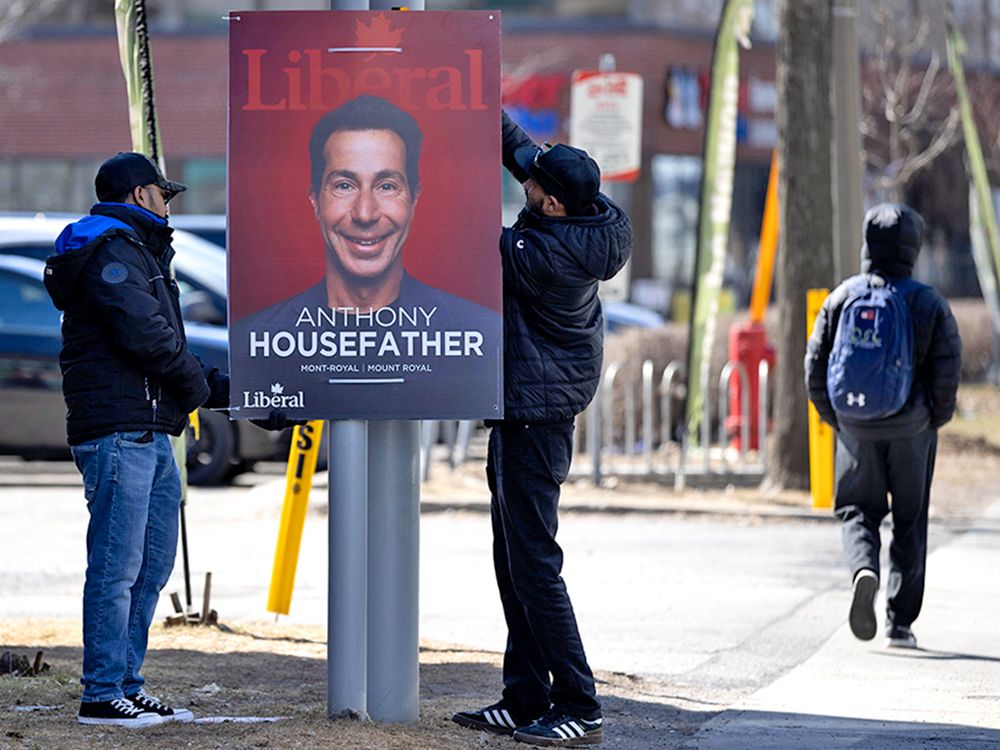
 Campaign workers put up an election poster for Anthony Housefather in the Mount-Royal riding in Montreal.

Housefather, a veteran local politician who has steadily increased his majority since 2015, has seen his support dwindle in favor of Oberman. Cracks have appeared in the Liberals’ concrete fortress.

Oberman said, with imagery, that the Conservatives realized that the concrete’s “mixture of cement to water to gravel was not properly laid in the foundation” and that the Liberals “thought they had the perfect recipe.”

“This no longer concretes. What it is is a mixture of sludge that needs to be set aside. And I didn’t create the problem, by the way,” said Oberman.

At some point,

Cotler even advised Housefather to leave the Liberals

and sit as an independent.

Anthony Housefather declined our interview request.

The Red Fortress, once represented by former Prime Minister Pierre Trudeau, seems to have the Liberals and Conservatives in a toss-up at one point, when the Conservatives held a 25-point lead in national polls.

But the situation has changed in Mount Royal, as it has across the country, with Donald Trump’s constant threats to Canada’s economy and sovereignty.

It has also changed radically since Prime Minister Justin Trudeau announced his resignation in January.

Even if the Jewish vote does indeed lean Conservative, Liberal sources have told us that Housefather’s groundwork should lead to a significant victory. After all, the riding is extremely diverse, and part of Côte-des-Neiges is as red as a beet.

And outside of the Jewish population, affection for the Conservatives isn’t very strong. In fact, as numerous polls in Quebec and across the country indicate, support for Leader Pierre Poilievre is weak compared to Liberal Leader Mark Carney.

And the national momentum is gaining ground in Mount Royal. According to poll aggregator 338Canada,

the Liberals would easily win the riding

.

Irwin Cotler feels it too.

“I think Anthony has, from what I can see, an appreciable lead here in Mount Royal as well,” he said.

National Post

atrepanier@postmedia.com

Get more deep-dive National Post political coverage and analysis in your inbox with the Political Hack newsletter, where Ottawa bureau chief Stuart Thomson and political analyst Tasha Kheiriddin get at what’s really going on behind the scenes on Parliament Hill every Wednesday and Friday, exclusively for subscribers. Sign up here.


Alberta Premier Danielle Smith delivers a speech at the Canada Strong and Free Network national conference in Ottawa, Thursday, April 10, 2025.

OTTAWA — Alberta Premier Danielle Smith says whether a re-elected Liberal government would pose a threat to national unity depends on how Albertans react, emphasizing that Liberal Leader Mark Carney has existing “damage” to repair.

Smith was speaking Thursday after delivering a speech and participating in a fireside chat at the Canada Strong and Free Network, an annual conference in Ottawa featuring speakers and leaders within the conservative movement.

This year’s event coincides with the federal election, at a time when successive public opinion polls show the Conservatives either tied with or trailing the Liberals.

Speaking to the crowd, Smith joked those in the audience should instead be out door-knocking and expressed support for Conservative Leader Pierre Poilievre winning the election, which she told reporters afterwards should come as no surprise.

Several days before the election was called, Smith

laid out a list of demands

she says must be fulfilled by the next prime minister at the risk of facing an “unprecedented national unity crisis” if they are not.

She presented it after having met with Carney shortly after he was sworn in as prime minister.

The list included repealing a suite of measures the Liberals introduced, including the federal law known as Bill C-69, the Impact Assessment Act, which critics say has created a intractable approval process for energy projects; scrapping the cap on oil and gas emissions; as well as eliminating the net-zero electricity grid and electricity vehicle mandates.

While Carney has pledged to speed up approvals for energy projects, he has said he would not repeal Bill C-69, which the federal Conservatives have pointed to as why voters who want to see more pipelines built should not believe him.

“You can’t ride two horses at once,” Smith told reporters on Thursday. “You’ve got to decide.”

Asked whether she believes a Liberal win would threaten national unity, the premier said it all depends.

“It depends on what the reaction is. If they don’t address those issues, then we’re going to have to see what the reaction of Albertans are,” Smith said.

“But I can tell you that having 10 years of having our economy beaten down by not being able to to have those kinds of investments have soured Albertans on the idea of a Liberal government, so it’s going to be required after the election to repair some of that damage.”

Former Reform Party leader Preston Manning warned in an recent

opinion piece

that Carney poses a threat to national unity, given the longstanding grievances those in Western Canada have towards the federal Liberals over it energy policies.

He wrote that, “voters, particularly in central and Atlantic Canada, need to recognize that a vote for the Carney Liberals is a vote for Western secession — a vote for the breakup of Canada as we know it.”

Poilievre

distanced himself from those comments

when asked about them on the campaign trail last week, saying he believes the country needs to be brought together instead.

Concerns about sovereignty have been heightened in recent months as U.S. President Donald Trump has repeatedly said that he wants Canada to become his country’s “51st state,” comments which all federal leaders have rebuked.

The Liberals have taken aim at Smith during the campaign, which concludes on April 28, with Carney recently joking to a rally crowd that it would be a “bad idea” to send the Alberta premier to fight against Trump’s tariffs.

Critics

have blasted Smith

for choosing to travel south of border to speak with right-wing figures such as Ben Shapiro about the ongoing trade war, a decision she defended before Thursday’s crowd as being part of an effort in diplomacy to speak with conservative influencers in hopes of getting through to the Trump administration.

“We shouldn’t be cheering on a trade war,” she told reporters afterwards, adding her office is receiving complaints about the retaliatory tariffs Canada has placed on the U.S. after it imposed 25 per cent tariffs on steel and aluminum.

National Post

staylor@postmedia.com

Get more deep-dive National Post political coverage and analysis in your inbox with the Political Hack newsletter, where Ottawa bureau chief Stuart Thomson and political analyst Tasha Kheiriddin get at what’s really going on behind the scenes on Parliament Hill every Wednesday and Friday, exclusively for subscribers. Sign up here.

Our website is the place for the latest breaking news, exclusive scoops, longreads and provocative commentary. Please bookmark nationalpost.com and sign up for our politics newsletter, First Reading, here.


Mark Carney, left, and journalist Nardwuar play the Hip Flip game at the end of their interview.

Like several Liberal leaders on campaign trails before him, Mark Carney successfully completed the Hip Flip with guerrilla journalist and radio host Nardwuar the Human Serviette in a new video posted Wednesday.

For those unfamiliar, every time an election is called, the celebrity journalist born John Ruskin, who made a name for himself in Canada with quirky interviews of subject he’s researched extensively, tries to meet with leaders of the federal parties. And without fail, he’ll ask them to do the Hip Flip with him.

“That looks like so much fun. Yeah, why not,” Carney responded.

As described by

Board Game Geek

, the object of the 1968 Hasbro game is for two dancers to spin a piece of plastic attached to a plastic tub between them by gyrating their bodies. The duo that spins the longest wins.

In Carney’s case, as it was for others before him, he achieved a single rotation.

Jagmeet Singh, who had already done it with Nardwuar during the 2019 and 2021 campaigns, was also featured in

a new Hip Flip video on Wednesday.

Other Liberals bosses who have taken part include Paul Martin, Jean Chretien, Michael Ignatieff and Justin Trudeau. Stephane Dion,

when asked during a press conference, refused.

When Nardwuar approached former Prime Minister Stephen Harper’s team about a meeting and Hip Flip attempt in 2004, the journalist was carried away by security as he pleaded with the former Conservative Party of Canada leader.

Others to have played along include former B.C. premiers Christy Clark and John Horgan, and former Green Party of Canada leader Annamie Paul.

The hip flip with Carney was a culmination of a 13-minute interview that was classic Nardwuar from start to finish, but also shed some light on Liberal leader.

Here’s what else we learned about the Liberal leader in his interview with Nardwuar.

Gifts galore

Carney’s aides likely left the get-together with their hands full, their boss having been gifted several vinyl records.

The first was a 45 RPM vinyl of King Richard’s Army’s 1982 single and iconic arena rock song

“Na Na Hey Hey Kiss Him Goodbye”

which featured Vancouver Canucks goaltender Richard Brodeur as the cover art. The album was released during the team’s quest for the Stanley Cup that year, led by the netminder. (They were swept by the formidable defending New York Islanders.)

“I coveted that Northland goal stick, but I could never afford it,” said Carney, who grew up tending the crease and was a third-string goalie at Harvard.

Next up, following a chat about The Clash, is a copy of the band’s “The Cost of Living” E.P., which features the iconic “I Fought The Law”, followed by a copy of their seminal record, “London Calling.”

“I will say one other thing about The Clash, which I think people remember, that their first drummer was Tory Crimes. Hmm,” he said, looking into the camera.

The play on words was an alias of the band’s first percussionist, Terrence Chimes, whom they chose not to credit on the first album after he dropped out.

Perhaps the most obscure gift is a copy of

a 1980 recording of a letter

written by a seven-year-old Michigan girl named Shelley Looney, thanking Canada for

its part in the 1979 Iran hostage crisis.

The letter ends with a postscript that says Canada has a “special place” in both her and her country’s heart.

“That’s good to know,” Carney said with a chuckle, “that’s a cold, cold heart. The black heart of America. Thank you, Shelley. We should track her down, maybe she could run for office.”

Some expert Canadian hockey fans might already be familiar with Looney. She grew up to become a Team USA hockey player who scored a game-winning goal against Canada in the gold medal game of the 1998 Winter Olympics in Japan.

He’s also given a copy of The Window Jumper’s “The Crash of ‘87” on vinyl and asked how tariffs will affect record production in 2025.

“A lot of creativity comes out of adversity, you find over the years. The Window Jumpers being exhibit A.”

He’s also given a Charli XCX’s “Brat” on vinyl, and mistakes it for “early XCX.” Still, he’s a fan, having come across her while serving as the Bank of England governor from 2010 to 2020.

Nardwaur also hands over a 1962 “Diefen Dollar,” a phony currency rolled out as an election prop by opponents of then Progressive Conservative prime minister John Diefenbaker’s government’s decision to devalue the Canadian dollar against the U.S. dollar. The Tories were reduced to a minority government.

 Nardwuar the Human Serviette in Vancouver in 2006 after failing to get the attention of then-prime minister Paul Martin.

“There was a crisis because the Diefenbaker government effectively fired the governor of the Bank of Canada, which is not a good idea if you want independent decisions and inflation under control,” Carney said, referencing James Elliot Coyne, who resigned after conflict with the Tories.

“It’s interesting how history rhymes because now another conservative government is threatening to do similar things,” he added, referring to past vows by Pierre Poilievre to fire current Bank of Canada governor Tiff Macklem.

The last item is a copy of a record produced by the CBC when it had its own record label, giving Carney an opportunity to express his support for the national broadcaster, which his opponent has vowed to defund.

He’s down with Down With Webster

Keen-eared politicos will notice Carney’s stump speeches often end with Down With Webster’s anthemic “Time To Win,” and he’s even thrown up the Canadian millennial rock band’s

“W” hand gesture as it rings out.

Turns out, he and his wife, Diana Fox Carney, were attending a performance by Canadian alternative rock band Sweet Thing at the Bronson Centre in Ottawa and stuck around to see Down With Webster. He’s been a “huge fan” ever since.

Carney quickly points out that the Liberals “employ them” for use of the music.

Our website is the place for the latest breaking news, exclusive scoops, longreads and provocative commentary. Please bookmark nationalpost.com and sign up for our daily newsletter, Posted, here.


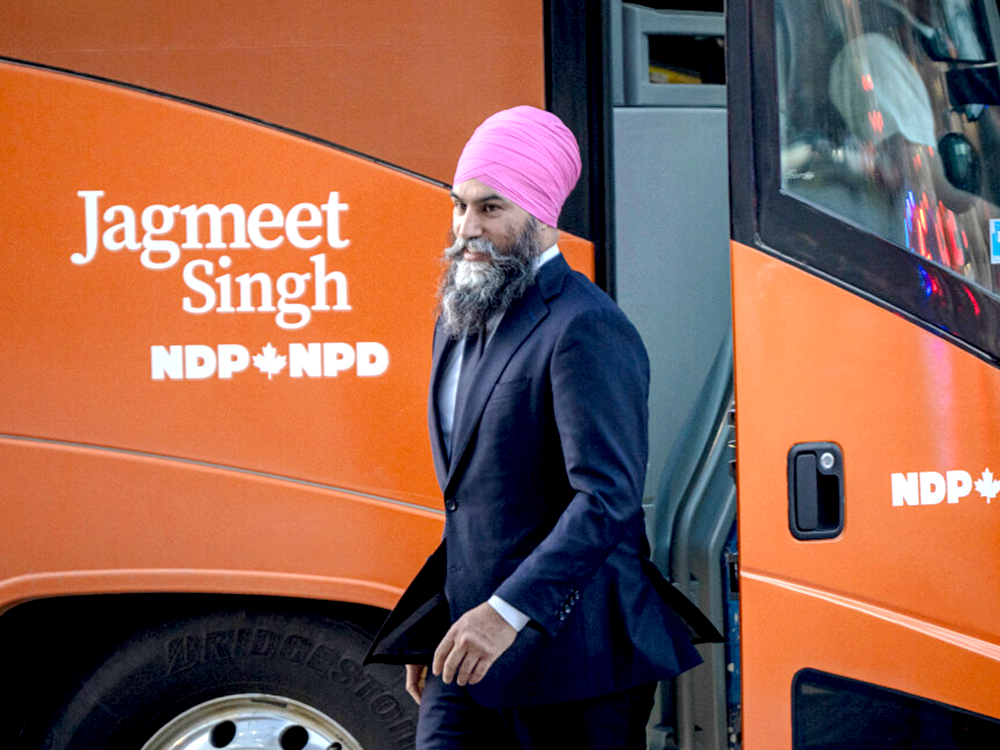
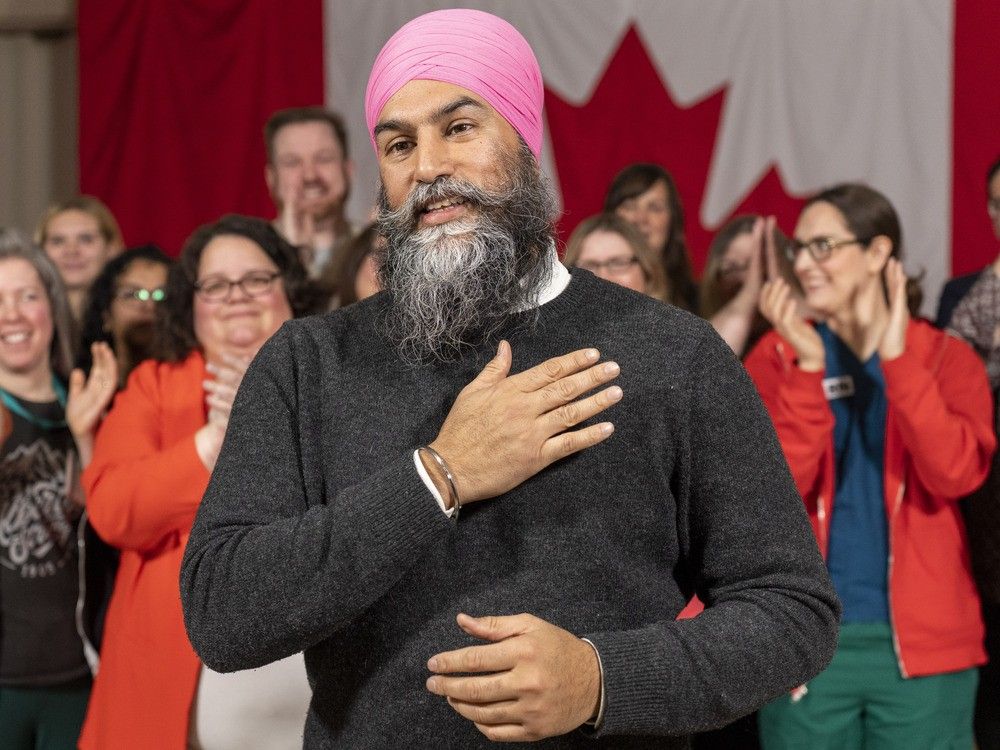
New Democratic Party Leader Jagmeet Singh in Montreal, Canada, on April 3, 2025.

Under

Jagmeet Singh

, Canada’s

New Democratic Party

has successes its leftist supporters can be proud of.

A national dental care program, pharmacare and anti-replacement-worker legislation are all in line with the party’s social democratic vision of governance.

But they came about in a curious way, as the NDP’s policy reward in a tit-for-tat arrangement that kept the governing Liberal party in power well past the end of its popular support.

The supply and confidence deal that gave Liberals control of the parliamentary agenda, supported by NDP votes, did not benefit Singh’s party as much as it could have, political experts say. It dragged on beyond its purpose. It needed a time limit, an earlier exit clause. For the NDP, it looked like all give and no take.

Singh made this deal in 2022 but never fully capitalized on what he had, and now it might be too late, because he has become a “bit player” in this current campaign, said Tamara Small, professor of political science at the University of Guelph, whose research focuses on the use of digital technologies in politics.

“He’s in a tough position,” Small said. “This race is coming down to two parties and there’s really no space for him.”

“Everything I thought about Canadian politics in December is wrong,” Small said. Late last year, when the obvious ballot questions seemed to be the cost of living crisis and a referendum on Justin Trudeau, the NDP potentially had the space to make the argument to progressives that they were the answer to a Conservative surge.

“At that point, (Singh) was in control of the NDP’s destiny. Had Parliament come back, he would have had some control. Now he’s out of control,” Small said. Singh was Trudeau’s third-term kingmaker, but he never got to perform the inevitable regicide.

 NDP Leader Jagmeet Singh speaks to supporters at the North Glenora Community League on April 1 in Edmonton.

Historically, NDP success is correlated with Conservative success. The Liberals have to tank and their voters flee to either side. Instead, now it looks like the NDP is tanking, boosting the Liberals against the Conservatives.

Singh and his NDP “are locked in this struggle for the working class vote with the Conservatives,” said Jim Farney, professor of political studies at the University of Regina, director of its graduate school for public policy, and a specialist in the politics of Canadian social conservatism. “The mystery of Singh to me as an outsider is that while he has not moved the numbers in a favourable direction his whole time as leader, he does seem to be very popular inside the party.”

Mark Carney, the new prime minister and Liberal leader, took any wind out of Singh’s sails by expanding the federal dental care program just before calling this

election

, and now the only question that seems to matter is American tariffs and national sovereignty.

“When people think NDP they don’t think foreign relations. They think of health care, dental care,” Small said.

In 15 years, she said, Singh is likely to get retrospective credit from his side for dental care and pharmacare, the kitchen table issues that move his natural voters. But hindsight doesn’t win elections. And Liberals have proven themselves adept both at dodging blame for their own bad ideas and at taking credit for other parties’ good ideas.

“The NDP doing terrible in this election is unlikely to be the fault of Jagmeet Singh,” Small said.

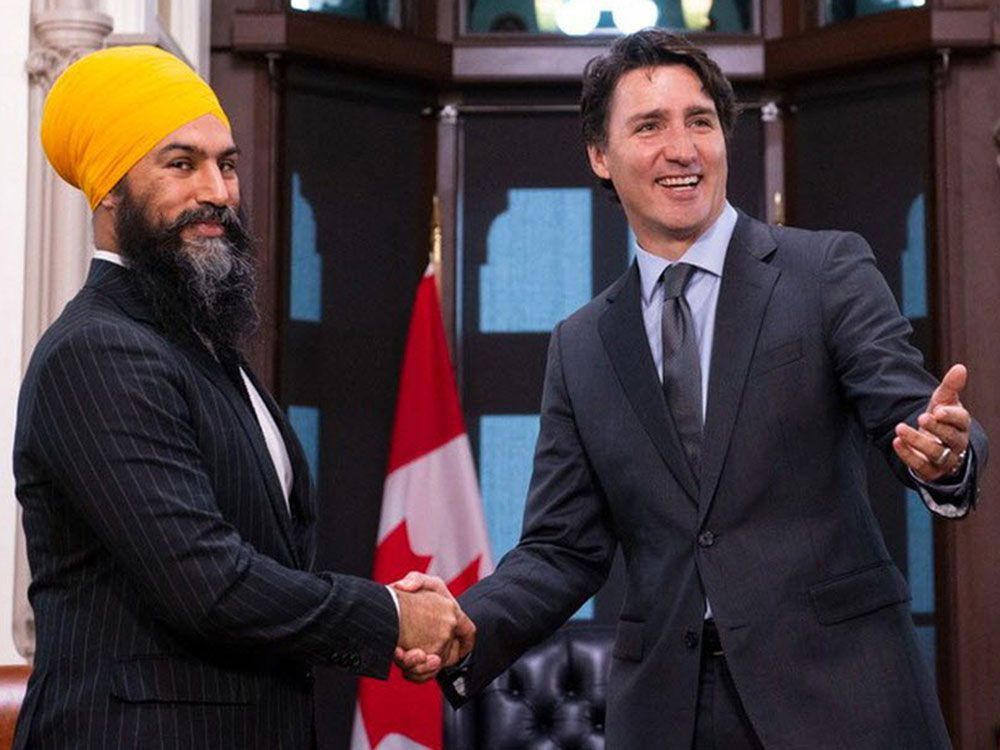
 NDP Leader Jagmeet Singh and Prime Minister Justin Trudeau during a meeting in November 2019.

By the time the fateful

supply and confidence deal finally collapsed

, in a church basement in Toronto last September, it all looked pretty sloppy, as if the moment had passed Singh by. He didn’t even actually tear up a printed agreement, which the cameras would have loved.

The federal government had just ordered

striking railway workers back to work

under forced arbitration, which Singh said rewarded railway companies for bad faith bargaining and collusion. If the NDP can’t stand up for unionized blue collar workers against private railroad companies, they might as well not bother with anything else.

It looked like Singh getting dragged before the cameras to admit what everyone could already see. The deal was over. The die was cast. This was a launch party for the campaign Singh wanted to run, and it was over before lunch.

Singh’s finger was on the pulse, as it then was, but only briefly. Polls had him nearly tied with the Liberals. His poster slogan was “Restore Hope.” He said the election he seemed to be triggering would be between the NDP and the Conservatives. He called Justin Trudeau weak and selfish, and Pierre Poilievre a callous sellout to the rich. This is the NDP strike zone, but Singh was swinging late.

“This used to be a country where working hard earned you a good life, where a paycheque from a decent job got you a home that fit your family and a fridge full of groceries,” Singh said. “There is a battle ahead of us, the fight for the Canada of our dreams, the fight against Pierre Poilievre and his callous agenda of Conservative cuts, the fight to restore hope, and the promise that working hard gets you a good life. I’m ready for the fight.”

Today, with the fight in full swing, his campaigning has been an effort to get noticed in a campaign dominated by a new foreign economic threat, which does not play well as a natural NDP campaign focus.

On domestic issues like the cost of living crisis, Singh has proposed measures such as emergency price caps on staple groceries, removing GST on some essential items, and low interest mortgage loans for first time home buyers. He has vowed to block American ownership of Canadian health-care assets as part of a broader opposition to increased privatization of medicine.

And then there are the slightly more loopy ideas, such as cancelling the contract with the United States for F-35 fighter jets and building our own fighter jets in Canada, which had a whiff of not only implausibility, but of attention-seeking desperation.

Jagmeet Singh, 46, lived as a child in Toronto’s suburb of Scarborough, in Grand Falls-Windsor and St. John’s in Newfoundland, and in Windsor, Ont. He studied undergraduate biology at Western University and then law at Osgoode Hall, then worked as a criminal defence lawyer in Toronto before entering politics. He ran federally for the NDP in Ontario and narrowly lost in the 2011 election, then won the provincial riding of Bramalea-Gore-Malton barely five months later. He won leadership of the federal NDP in 2017, and has held the British Columbia riding of Burnaby South since 2019. He is married to Gurkiran Kaur Sidhu, with whom he has two young daughters.

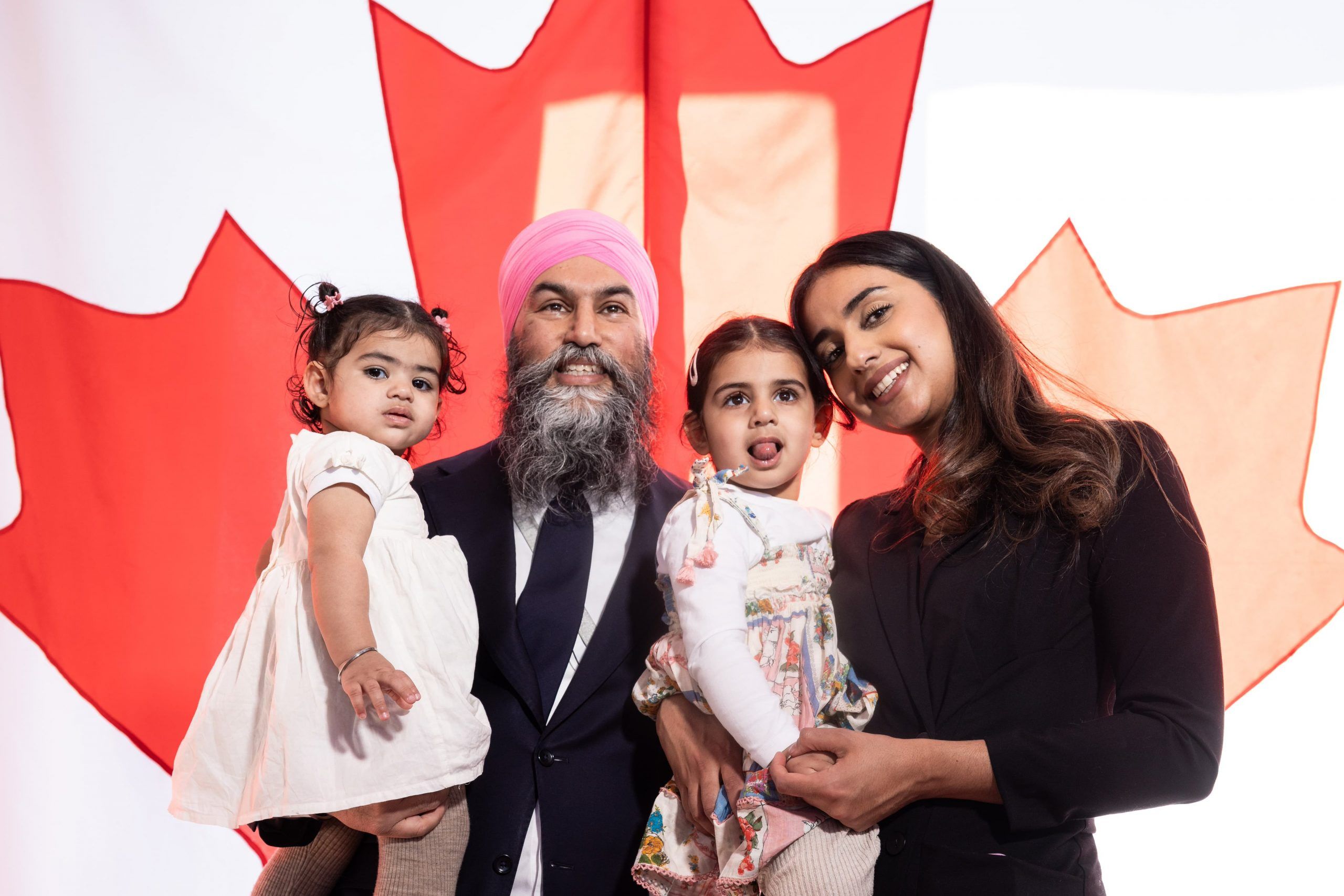
 Jagmeet Singh with his wife Gurkiran Kaur Sidhu and two young daughters.

His hard-left politics aside, people tend to like him personally. They often warm to him. He campaigns well and has high likeability polling.

In the 2019 election campaign, Singh’s first, his reaction to Justin Trudeau’s blackface scandal was a striking moment that revealed a depth of character the public had not yet seen. This was a difficult issue to manage for the only leader of an ethnic minority. The risk was real that Trudeau would use him as a foil for a public apology. Singh could have campaigned on it, but instead he set a higher tone with an impassioned defence of sensitivity to young Canadian men and boys who were recognizing the sting of frat boy racism on display by their own prime minister.

In a video shot in a hotel room the same night the news broke, Singh said he himself had known this sting, and as a young person he threw a few punches, but he urged a higher road.

“You might feel like giving up on Canada. You might feel like giving up on yourselves,” Singh said. “I want you to know that you have value, you have worth, and you are loved.”

People also like to see him fight, metaphorically, but also sometimes with the hint of a literal threat.

His confrontation last year on Parliament Hill

with a trash-talker

who called him a “corrupted bastard” for not bringing down the Liberal government was quite a sight. Singh turned around. “You got something to say?” he demanded of the man who appeared to have said it, who was filming on his phone. There was no more trash talking. Things got cordial real quick. The man denied saying anything: “I didn’t say nothing. It wasn’t me. It was the gentleman behind me I guess.”

No wonder. Singh has an imposing physical presence and practices the martial art of Brazilian jiu-jitsu. A police officer stood by as if he recognized Singh could take care of himself. But he just called the guy a “coward,” turned on his heel, and won the round.

Singh’s likeability has kept him alive politically. He’s charismatic and personable, with a compelling stage presence, said Elizabeth Goodyear-Grant, professor of political studies at Queen’s University and director of the Canadian Opinion Research Archive.

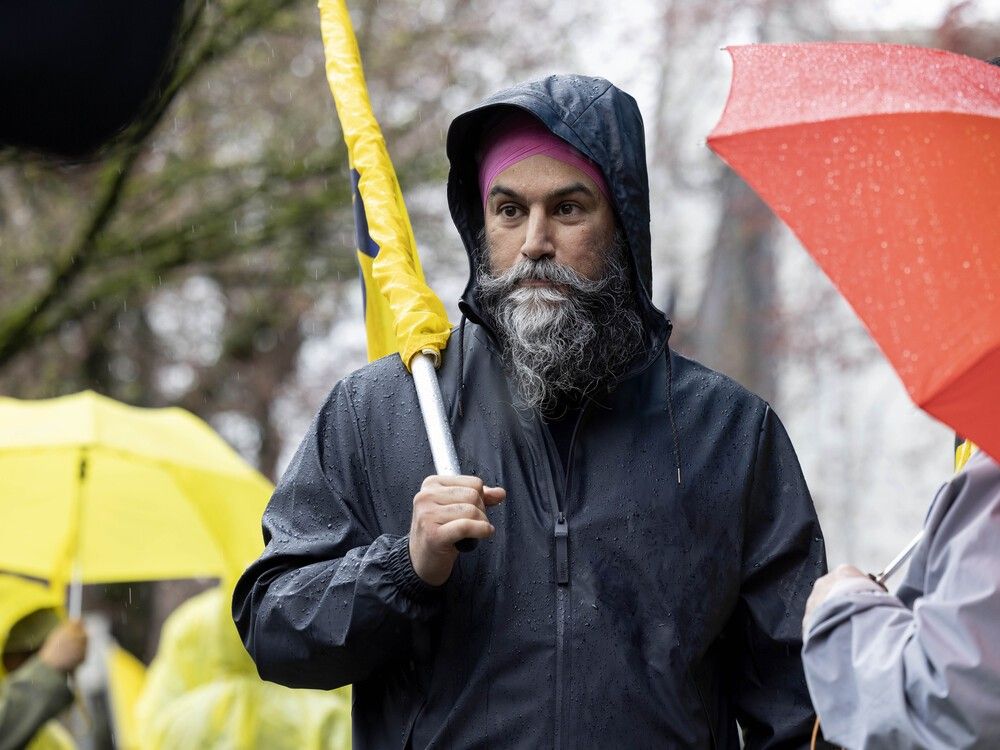
 Federal NDP leader Jagmeet Singh on the picket line with striking Life Labs workers in Vancouver, B.C., on April 8, 2025.

He can present as an idealist among cynics. But one problem with being in political opposition is that opportunities for advancement don’t come along every day. It’s hard to make them, and you cannot waste them like Singh has.

When Singh became NDP leader in 2017, the party was on the slide. They had reached a historic high under Jack Layton in 2011, taking Official Opposition status from the decimated Liberal Party under Michael Ignatieff. Layton’s successor Thomas Mulcair dropped more than half those seats when the Liberals took their majority in 2015.

(Mulcair has re-emerged in this campaign as a media pundit who

described his own party as an “afterthought”

and said this was an election between two parties, which is arguably true but probably hasn’t helped the communal cause.)

In Singh’s first election as leader in 2019,

it went poorly

. Almost half the party’s remaining seats were lost. In the next one, 2021, there was a new opportunity to boost the seat count, with Singh’s familiar face making a credible pitch against a tired government. He had the highest favourability rating of all the party leaders. But he knew this was not the right time for the NDP, and he argued against holding the election at all, and even asked Governor General Mary Simon to block it. In the end, the NDP gained a single seat.

“Now they’ve cratered,” said Goodyear-Grant, and they’re struggling to get noticed in the third election in a little more than five years. “There’s no scenario in which the leader stays on.”

One major failure for Singh, she said, is that he never landed with Quebec voters, despite the ideological and policy synergies that previous NDP campaigns have targeted.

Last fall, there was a theory making the rounds in conservative circles that Singh was prolonging the supply and confidence deal simply to become eligible for his

parliamentary pension

. Goodyear-Grant calls this silly. It trivializes the more charitable explanation that he did not wish to go to the polls with the looming spectre of a Conservative landslide. But things change.

In the pantheon of Canadian social democratic federal politicians, Singh today occupies a plinth somewhere between Alexa McDonough and Ed Broadbent. He’s no Jack Layton, who reached the party’s highest high, but nor is he Audrey McLaughlin, who reached the lowest low. So far, anyway. And even if the NDP is wiped out, Goodyear-Grant said, Singh has “every ability to be financially secure post politics.”

Even Tom Mulcair has a steady paycheque today.

So for Singh, this current election is do or die, but with even his own seat in peril according to polls, it’s looking like he probably won’t.


Canadian travelling to the U.S. are facing increased scrutiny by U.S. Customs and Border Protection (CBP) officers, which has led to fears of detainment or denial of entry based on the contents of travellers' devices.

Telling a client to take a burner phone with them to the U.S. is “the stupidest advice” you could give, says a Toronto-based immigration lawyer.

Canadians travelling to the U.S. are facing increased scrutiny by U.S. Customs and Border Protection (CBP) officers, which has led to fears of detainment or denial of entry based on the contents of travellers’ devices.

However, presenting a burner phone is the equivalent of “turning the lights off” and then telling a border officer, “Okay, now search me,” says Evan Green, one of the two managing partners, with Green and Spiegel.

“It’s an indication that you have something to hide. It’s negligent advice,” he told National Post.

Here’s a look at your rights at the U.S. border

This past weekend, the Canadian government

revised its U.S. travel advisory

to warn travellers about the extensive powers of U.S. border officers, emphasizing the need for acting prudently.

Searches of devices

such as phones and laptops can include accessing text messages and social media activity. CBP

officers can search devices

without any evidence of wrongdoing, including demanding passwords to unlock phones, laptops, or tablets. Refusing to unlock devices could lead to confiscation, delays, denial of entry, or even detention while awaiting deportation.

David Garson, managing partner with Toronto-based Garson Immigration Law, shares the view that presenting a burner phone will simply arouse suspicion.

The Customs and Border Protection officers “are trained in this kind of thing.” Presenting a phone with no texts and no social media is more likely to make the officer think, “Wait a minute. Isn’t this strange. This person has something to hide,” Garson told National Post.

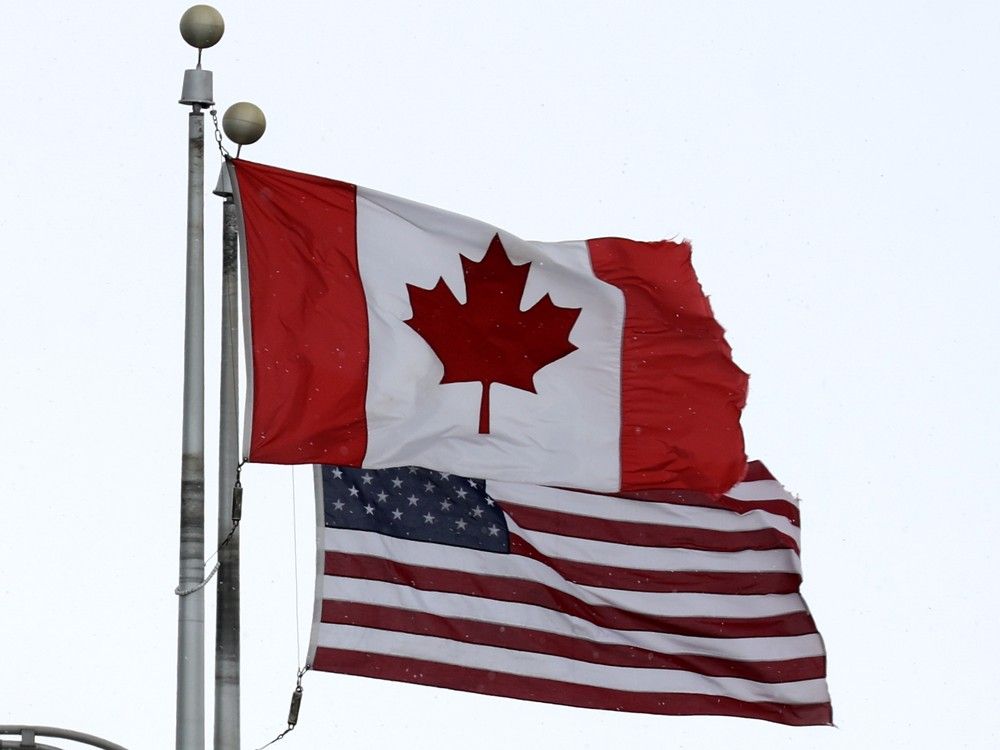
 A Canadian flag flies next to the American one at the Lewiston-Queenston border crossing bridge on Feb. 04, 2025 in Niagara Falls, Canada.

And it may result in “a domino effect,” leading to you being barred from entering the country, he adds.

Device searches have been rare, says Garson, less than one per cent of potential entrants in 2024. The American Civil Liberties Union confirms this. A recent ACLU statement says U.S. Customs and Border Protection searches of electronic devices at the border are relatively uncommon, even if they have been increasing in frequency.

In 2024, CBP reported that

only 0.1 per cent of travellers

crossing the border had their devices searched. However, says the ACLU, the number of searches has grown significantly over the years: CBP

searched over 41,000 devices in 2023

, compared to just 8,503 in 2015.

What should you do to minimize risk of search at the U.S. border?

The bottom line, says Green, is that “the rules haven’t changed, even if the refs are calling it more strictly.” Anyone crossing into the U.S. still has to answer the questions, he adds.

Green advises travellers, whether they’re going to the United States for business or pleasure to carry all their back-up documents. “Take your flight itinerary, a copy of your hotel reservation, a letter from your employer about the conference you’re attending or the theatre tickets to the Broadway shows you’re going to see.”

Canadian ‘nonimmigrants’ travelling to the U.S. exempt from new fingerprinting requirement

It should be noted that travellers seeking entry don’t have much of a leg to stand on if they insist on their rights. “Not a helluva lot” once you’re on U.S. soil, says Garson. The U.S. doesn’t extend the same rights to non-immigrants that Canada does.

However, Garson suggests there are small things you can do. For example, he suggests that you don’t give the border patrol officer the code needed to access your phone. “Open it yourself.”

His best advice to Canadians is to “self-assess.” Cut the risk of being barred from the U.S. could mean asking yourself about how you have been active on social media or in attending anti-U.S. rallies. If you are barred from entry, a future desire to enter the U.S. will require a waiver to do so, he cautions.

Will anti-Trump social media posts prevent you from getting into the U.S.?

But what about those anti-Trump social media posts? Will they prevent you from getting into the country? “No,” Green insists. “Half the country didn’t vote for him.”

Though Green had one person call his firm about being refused entrance. That person had antisemitic content on his device, he says.

On that point, Garson is also cautious. “They are starting to look at evidence of antisemitism more seriously.”

Entering the U.S. by air provides more flexibility for Canadians who aren’t comfortable with questions from U.S. border authorities. While still on Canadian soil, you can decide not to go south. You don’t have that luxury if you are entering by land and are on U.S. soil when you’re being questioned. Then you can be detained while awaiting deportation.

While on Canadian soil “the only reason for the border officers to hold you is if they think you have committed a crime. In that case, they will contact local police,” says Green.

Garson agrees that pre-flight areas in Canadian airports offer more flexibility.

 US President Donald Trump signs an executive order in the Oval Office of the White House on April 9, 2025 in Washington, DC.

Still, he says, travellers should keep in mind that one million people a week apply to enter the U.S. “If you’re going to do what you say you’re doing, you’ll be all right. If you’re evasive, it signals you have something to hide.”

Ultimately, says Green: “Just be polite. Answer the questions. Have the documents needed to support your answers.”

Our website is the place for the latest breaking news, exclusive scoops, longreads and provocative commentary. Please bookmark nationalpost.com and sign up for our daily newsletter, Posted, here.


There may be hundreds, perhaps thousands, of Canadians in Seattle watching the Toronto Blue Jays pay their annual visit to the Mariners in May; at the start line of the iconic Boston Marathon on April 21; in Buffalo for Sabres NHL hockey and Bills NFL football games; and Detroit for the Red Wings, Lions and Tigers.

Proximity and an open border has long spurred these and many other southern sportscursions. But the chilling of the economic and political climate in North America suggests there won’t be as many Canadians in any of those places this year.

There is no definitive accounting, of course, but Jeff Heatley, a 45-year-old material handler from Surrey, B.C., tells a pretty common tale these days. His six-person group cancelled plans to spend a weekend in Seattle to see his beloved Blue Jays. It was not a decision taken lightly.

“Even when the Jays were awful, I still looked forward to going down with friends to see my favourite team lose more often than not,” he explained in an email. “When I met my now wife, she started coming down with me; sometimes for a single game, now for a fun weekend getaway. Occasionally, we take our nine-year-old daughter (Beth) as well, but the majority of the time it’s a chance for us and some friends to have a child-free weekend in a beautiful stadium, in a fun city.

“This year, we and two other couples booked a hotel in downtown Seattle, organized babysitters and arranged to all drive down from Surrey to Seattle for the weekend. We were all very excited.

“Then, the president of the United States stepped in. We mulled it over for a couple of weeks earlier this year, thinking maybe the rhetoric would die down and he would move onto actually doing his job, and our two countries could resume being friendly. It wasn’t to be, however, and we unanimously decided to cancel. It sucks. We just couldn’t do it.”

They will do something else, somewhere else, like so many Canadians, sports fans or otherwise, have decided.

Donald Trump’s inflationary tariffs and inflammatory statements — calling former prime minister Justin Trudeau the governor of America’s 51st state — crossed a line, and in protest many Canadians won’t be crossing that border. So, it’s elbows up, air travel down. Bye, America. Buy Canadian.

And as much as the auto industry will soon feel the margin squeeze of tariffs, a quiet Canadian boycott is already eroding U.S. tourism numbers and revenue.

“While we do not have specific data on Canadians cancelling trips to the U.S. for sports-related tourism, Flight Centre Canada has reported a 40 per cent drop in leisure bookings to the U.S. in February 2025 compared to the same month last year,” spokesperson Amra Durakovic said in an email. “Additionally, 20 per cent of pre-existing U.S. trips over the past three months were cancelled, with many travellers opting for alternative destinations such as Mexico, Portugal and the Caribbean.

“Sports travel is considered a niche category, with only 10 per cent of Canadians identifying it as a top motivator in 2024,” Durakovic said, which means it ranks well behind beach vacations.

“However, it shows promise among younger travellers, as over one-third of Gen Z and millennials express an interest in sports-focused trips. Similarly, 48 per cent of Canadians planning travel in 2025 are likely to prioritize major events, including concerts and sporting matches, under the right circumstances.”

These are not even close to the right circumstances, and the sorry state of affairs could mean long-term pain for the big business of sports. NHL commissioner Gary Bettman

told Reuters

that the trade tensions were concerning and could have an impact on the league’s business. His comments followed the announcement on April 2 of the

12-year, $11-billion deal

between the NHL and Rogers Communications to secure media rights for the games across all platforms in Canada.

In early February, the U.S. Travel Association issued

a dire warning

. “New tariffs on Canada could impact Canadian visitation to and spending in the United States. Canada is the top source of international visitors to the United States, with 20.4 million visits in 2024, generating $20.5 billion in spending and supporting 140,000 American jobs. A 10-per-cent reduction in Canadian travel could mean two million fewer visits, $2.1 billion in lost spending and 14,000 job losses.”

New York City bus tour operator Matt Levy told CTV News the decline in Canadian reservations has already been “catastrophic” for his business. They are also feeling the pinch in Old Orchard Beach, Maine, where Canadians provide 30 to 40 per cent of the area’s tourism revenues annually. Hotel bookings in U.S. border cities are down, according to data analytics firm

CoStar Group.

For a four-week period through the end of January and most of February, demand for rooms decreased by eight per cent year-over-year in Niagara Falls, N.Y., and 12 per cent in Bellingham, Wash., about 80 kilometres south of Vancouver.

***

Paula Roberts-Banks has finished the Boston Marathon 12 times since 2008, when she started making the trek an annual event. She was there in 2013 when two terrorists detonated a pair of bombs near the finish line, killing three people and injuring 500 others. Roberts-Banks was unharmed, but the event has never seemed quite the same, even as the artist, writer and photographer from Rosseau, Ont. continued to make the pilgrimage. She registered again last September and was granted a spot in the field of 30,000, but won’t be pounding the pavement this time. She will miss the running friends she sees only in Boston, but said she has “soured” on America and its politics.

“Once November rolled around, once Trump was elected, I just realized that 50 per cent of the people in the States voted this guy in. I really didn’t want to go and spend a week down in the States with that segment of the population,” she said.

Roberts-Banks felt strongly enough to write a

first-person account

of her decision for Canadian Running magazine. She said responses to her story from people on both sides of the border have been mostly supportive, and other Canadian runners said they had made similar decisions. But that doesn’t make it easy.

“It’s just with Boston, I’m not trying to make it particularly special or anything like that, but there is that sense of loss and of guilt because you have to try so hard to get there. And then you’re basically just throwing that away and basically taking somebody else’s spot as well.

“But a number of Canadians chimed in and said that they were either not doing Boston or not doing other races. One person said they changed from Twin Cities Marathon to doing the Toronto Marathon. So, it was largely a lot of people saying they were revising their plans and that they weren’t going to go to the States.”

A spokesperson for the Boston Athletic Association, which hosts the race, said their organization did not have a running count of competitors who had withdrawn. That’s because there is no formal process; you just don’t show up on race day.

“If you don’t show up for Boston, you’re really the only person who knows that,” said Roberts-Banks. “It’s a massive race. And your friends will miss you or whatever but, I mean, people get injured, people get ill, people don’t make it to the starting line. And you know, you’re not there. That’s all.”

But that’s not all. It’s not nearly that easy. It is a decision that hurts her heart.

“Oh, very much so. I reconcile it with the fact that I’ve missed it before. I’ve been through that before, and I know what it’s like to miss it, so I’m kind of mentally ready for it. This year will be different because I could physically go. The other times I didn’t go was because either I was injured or something was going on in my family that just prevented me from going. But this time it’s a conscious decision. So that will be different. I feel like I’ll be ready, but I’ll also be very upset the day of.”

***

When National Football League training camps open in July, Chris Plouffe will also feel a sense of loss. It was an aspiration to become a season-ticket holder and Plouffe loves the community that he and wife, Jenna, and their Canadian friends have built with the fans from Buffalo, Albany, Rochester and Atlanta who sit near them in Highmark Stadium, home of the Bills.

It’s estimated that 15 per cent of the Buffalo stadium is filled with Canadian fans, the result of efforts by BIlls’ team owners to target Toronto and the southern Ontario market

to help build the fan base.

That becomes even more important with a new stadium currently under construction, scheduled to open in July 2026.

Plouffe has held a one-third share of four tickets for three years, but there won’t be a fourth. At least, not this season. “I really enjoyed sharing that camaraderie with these random people, because I do feel that a Bills game does have a very community-based vibe,” said Plouffe, a 39-year-old from Etobicoke, Ont. “You’re huddled around people very close to you. So, it’s very much always been in my nature to just high-five people around me. And now that it’s the same people, it’s been like, OK, I got to know them a little bit more and talk to them. I wouldn’t say necessarily make friends, but just the idea of the camaraderie of seeing the same people and you talk about the same things.”

Plouffe cannot abide Trump’s blatant disrespect for Canada, and decided to take a personal stand. He will re-direct the $2,000 he would have spent on those tickets, perhaps to trips inside Canada or membership in a curling club.

“It was a tough decision. I had thought about it a lot. It was, ‘do we keep them and sell them?’ But then it kind of came down to how many other Canadians are going to do this? We’re seeing a lot of that ‘buy Canadian’ movement. And for myself, if I’m going to be treated this way, being Canadian, I will want my money to (be spent) in Canada and not go to the States. So, as of right now, I’m not looking into buying them again in the future. Mind you, this could all change. It could all change if the respect is back by next year. I don’t know for sure. It’s how I’ll feel.”

It was and will be a personal decision, and Plouffe isn’t judging anyone who decides to keep going to the United States this year, regardless of their reason or circumstances.

“We don’t have kids. I know with kids, families, people are talking about cancelling vacations to Disneyland and things. I totally understand if someone doesn’t want to do that because it’ll disappoint their kids. I think that’s totally fair. And same thing, maybe if they want to go see a sporting event with their kid who loves the Bills, they can do a Bills game. I don’t think it’s right to chastise everybody for how to act.

“Having said that, do I feel like I’m doing my part? It’s a small part that I can do. I have money that I can spend and I’m lucky enough to be full-time employed and have this expendable income. So, I will do my part to spend that and keep that income in Canada as much as possible. I think it’s really good to support people that are trying to do things more Canadian, but again, not to be hostile towards them if they don’t. I hate the idea that ‘you’re a hypocrite unless you drop everything.’ You don’t need to be perfect. You just need to do little things that can build up and hopefully it just shows that, as a whole, Canada is strong.” He said he empathizes with people in Buffalo whose living depends in part on Canadian tourism.

“Those people are going to be hurt by this too. I really hate that because again, I’ve been treated nothing but nicely and kindly. And I love doing the Bills games, buying the food down there, hanging out with other people. This is probably going to hurt the Bills a bit too, and that sucks because, again, I love everything about the Buffalo Bills and being part of that community,” Plouffe said.

Patrick Kaler, president and CEO of Visit Buffalo Niagara,

told Canadian media

that cross-border travel dropped 14 per cent in February, and the area depends on Canadians for about 35 to 40 per cent of its total tourism. And it’s not just the Sabres and the BIlls counting on Canadians to help fill their seats. The Buffalo Bisons, a Triple -A baseball team affiliated with the Toronto Blue Jays, calls Ontario fans “part of their herd,” and offers

Canadian-at-par deals

at their home park Sahlen Field, the highest-capacity Triple-A ballpark in the United States. In 2020-21, the Jays played 49 MLB games at Sahlen Field, and helped pay for renovations prior to the 2021 season.

***

There is a much larger community of people in St. George, Utah, who stage and participate in the world’s largest annual multi-sport event for people aged 50 and up. The Huntsman World Senior Games runs over a two-week period each October, encompasses 40 sports and attracts 12,000 competitors, mostly from around the United States. However, weekend warriors from Canada comprise the next largest contingent, about 10 to 15 per cent of participants each year, according to CEO Kyle Case.

He said teams’ registration opened Jan. 1 and appears to be on a normal, healthy pace.

“Obviously, looking at the political climate, January 1st was before the inauguration so there wasn’t much reason to have concern at all. Since then, we’ve put registration for (individual) athletes on March 1st and to be honest, right now registrations are really looking fine. I will say that we have received a handful of notices from some of our friends from Canada who have indicated some of their concern or frustrations. It’s a little bit early in the game, but at least at this point, I wouldn’t say that we’ve seen a significant trend,” Case continued.

“The mission of our organization is to foster worldwide peace, health and friendship, and so from that standpoint for us, independent of political climates or speeches or rhetoric or whatever it is, our mission remains the same. We have an open arms invitation for anyone everywhere.”

In the Games’ 35-plus-year run, that policy has included athletes from Russia, Venezuela, Saudi Arabia, Iran and Iraq. “We’ve hosted athletes from all around the world even in the midst of political disagreements. We feel strongly that the best way forward is to just set aside the politics and come and be a part of something pretty amazing and get to know people from all around the world and recognize that independent of politics, we’re all people, we all love sports, we love to hang out, we love to have a great time and take care of ourselves. We’re going to keep our eye on the political discussion for sure, but right now, this early in the game, I would say that we haven’t seen a significant registration trend but of course we’re aware of what’s happening and excited to welcome our friends from around the world, including and especially from Canada.”

Phil Presakarchuk of Edmonton has been to St. George many times for the slow-pitch tournament. This year, he’s taking two teams in two age categories and will stay for two weeks, enjoying the sunshine, competition and camaraderie. The vacation will cost him about CAD $2,000, and he has no problem spending that kind of money in the U.S. this year, regardless of politics or economics.

“For me, it’s my annual trip. I really enjoy going down there. Outside of playing ball, it’s a very good social event for me, so I fully plan on going.”

There are 400 slow-pitch teams registered and another 120 on the waiting list, so there will be no shortage of goodwill and good games. They play mostly at a well-appointed, seven-field complex, and Presakarchuk and his teammates stay at an affordable hotel in Mesquite, Nev., which is a 40-minute drive from St. George.

“It’s at least a one-star hotel,” he laughed. “But you know what? We have a hot tub about 10 steps away. We’ve got a pool 10 steps away. And they’ve got food there that is, in my mind, exceptional.”

Presakarchuk imports medical equipment from the United States, and he talks to American counterparts on a regular basis.

“I’m not sure who is advising Trump, but they’re hurting themselves. I think some of the swing states that actually voted for Trump are saying, ‘boy, what did we do?’ because everything is more expensive for them now.

“These tariffs are causing a lot of grief on both sides — well, mainly our side of the border — but they’re not happy with it, like we are. They see their fuel prices going up, their grocery prices, everything. So, I think it boils down to one individual and a few of his close gophers, you might say. But the people in general are almost apologetic. They don’t want to see it happen, either.”

***

Shaun Ayotte of Edmonton is a big sports fan who has been to about a dozen NFL games in Seattle. He was going to take advantage of a friend’s connections to Eagles’ ownership this year to take a long-delayed trip to Philadelphia. A buddy’s sister-in-law is a special assistant to Jeffrey Lurie, the owner of the Eagles.

“We had a crew of us who were going to do it, and we planned to do it in November, and with everything that has happened in the U.S., we kind of pulled back,” said Ayotte. “Our buddy lives in Atlanta, and he’s kind of a pro-Trump guy. We just don’t feel right doing it, and it’s a shame, because I don’t know if we’ll ever do it now, and it would have been a great opportunity. There would have been a few perks involved with the connection that we had, but none of us feel like doing it.

Ayotte said there is also an economic consideration for him, given the sad state of currency exchange rates for Canadians.

“Where the dollar is right now, and then you add in everything that’s going on, you know what, I’m going to find something else to do. Let’s go to Mexico and sit on the beach. Or, as summer comes up, maybe let’s stay home and have a trip or two around Alberta and B.C., or something like that.

“I don’t know how good the Blue Jays are going to be this year, maybe let’s go to Toronto and catch a game there, where you stay in Canada, and you don’t have to worry about the exchange. I think this summer is going to be quite a bit different for a lot of people.”

***

Some of those people will be mourning the loss of their usual holiday plans, and some won’t. Bud Vallee, a self-professed baseball fanatic, falls into the latter group. The 67-year-old retiree from Burlington, Ont. said he won’t be setting foot in Trump’s America, and it won’t bother him in the slightest.

“I’ve got a sister in Detroit. She was over around Christmas, and I said I hope everything goes well for you down there because I’m not going to come see you for four years.”

He skipped spring training in Florida, where he often went to watch the Jays, Rays and Phillies. He won’t be making weekend trips to watch ball games in Detroit, Boston, Cleveland, Pittsburgh or Chicago, as he has done in the past. His decision was 100-per-cent political, and he won’t be changing his mind.

“I’m in a (fantasy) baseball league, and there’s only three Canadians and 17 Americans, and there’s probably six or seven Trump supporters. For the most part, politics stays out of our league, but I always get messages from a lot of the other team owners saying, ‘hey, sorry about this. I don’t support this at all.’

“It’s just the attack on our sovereignty. You know, the 51st state (B.S.), that’s just Trump yapping off about something just to try to stir up the chaos. But I think he does have a plan to try to economically squeeze and starve Canada into submission. I don’t think he ever thought there would be a 51st state possibility, but he also thought he could bring us to our knees and pretty much make us slave suppliers to his industry.”

Vallee has already decided how to better spend his time and money. “Well, for instance, this was February, we went to Moose Jaw, Saskatchewan, and checked into the Temple Gardens, which is a hot thermal spa. And we had it coordinated so we could walk up the street and see a Moose Jaw Warriors hockey game. We’d never been to a Western Hockey League or Ontario Hockey League game before. So, that was an experience.”

He owns season tickets for the Hamilton Tiger-Cats, and said he’ll attend some Jays games in Toronto. He’ll do his thing the way he wants to, and doesn’t really care what everybody else in Canada is going to do.

“I have no trouble making my own views said, why I won’t go. But as far as anybody else’s freedoms, that’s entirely up to them.”

dbarnes@postmedia.com


Liberal leader Mark Carney during a rally at the Red and White Club in Calgary on Tuesday, April 8, 2025.

OTTAWA — With over a million views, the most popular Liberal ad on Facebook and Instagram doesn’t quite fit the conventional profile of viral internet content.

The video is only six seconds long and it features Liberal Leader Mark Carney in a blue sweater, telling the viewer that “we will build a Canada that you can afford.”

It’s not exciting but,

for the Liberals, who are outspending Conservatives on the platform,

that’s the point

.

“They are putting out the most short-form, ‘I’m an inoffensive central banker man,’ ad you could possibly run,” said Cole Hogan, who has worked on digital campaigns for multiple provincial conservative parties and leadership races.

“The boomer vote is definitely on Facebook. gen-X- to-boomer is kind of the sweet spot for Facebook. There’s still a millennial contingent there too, which is why the Conservatives have spent so consistently there. But I can see Carney’s Liberals continuing to spend a lot on Facebook,” said Hogan.

The battle lines of the election campaign, which culminates with voting on April 28, can be easily seen in how the parties are spending advertising money on Meta platforms Facebook and Instagram. Hogan has been tracking the spending data and found that both the Liberals and the Conservatives have been pouring money into digital advertising since the writ dropped.

Between March 30 and April 5 alone, the Liberals spent $697,000 on Meta ads, while the Conservatives spent $565,000. The NDP spent only $8,000 during that time period, according to

Hogan’s data pulled from the platform

.

With

polls showing that older voters have been leaning towards

the Liberals since Carney became leader, the digital ad spending has also followed this pattern.

The ads on Facebook and Instagram can also be targeted geographically, which gives some clues about where the parties are looking to shore up votes. For example, the ad featuring Carney in his blue sweater was seen by people all over the country, but predominantly in Ontario and British Columbia. Forty-four per cent of people who saw the ad were in Ontario and 20 per cent were in B.C. and Meta estimates that the party has paid somewhere between $125,000 and $150,000 to boost that single ad.

Hogan said the strategic dilemma facing the Conservatives is well illustrated by the tone and content of the party’s digital advertising. With Carney only officially becoming Liberal leader a month ago, the Conservatives need to run ads that negatively define him in the mind of voters, while also reassuring those same voters that Conservative Leader Pierre Poilievre is a safe choice to lead the country while it faces trade turmoil with the United States.

“You have to be able to say, all right, we are equipped to address Donald Trump through our policies but also, Carney sucks. And it’s hard to do both those things at once,” said Hogan.

The most popular Conservative ad is a 15-second clip where Poilievre rejects the idea that Canada will ever become the 51st state of the U.S.

“Let me be clear, we will never be the 51st state. We will bear any burden and pay any price to protect the sovereignty of our country,” Poilievre says, in a clip from

the party’s “Canada First” rally in February

.

Another popular clip is almost entirely directed at Quebec, where Poilievre admits that his style can be blunt and grating, but that it makes him a

good choice to stand up to Trump

.

Polling suggests that older Canadians are far more likely to be concerned about Trump than younger Canadians and, since Facebook skews older, Hogan said it’s not surprising to see the parties’ addressing the U.S. trade war

“A lot of the emotional side of the reaction to the Trump stuff for the boomers is the annexation threats and the tariffs… It just kind of offends their sensibilities,” said Hogan.

National Post

stthomson@postmedia.com

Get more deep-dive National Post political coverage and analysis in your inbox with the Political Hack newsletter, where Ottawa bureau chief Stuart Thomson and political analyst Tasha Kheiriddin get at what’s really going on behind the scenes on Parliament Hill every Wednesday and Friday, exclusively for subscribers. Sign up here.

Our website is the place for the latest breaking news, exclusive scoops, longreads and provocative commentary. Please bookmark nationalpost.com and sign up for our daily newsletter, Posted, here.


Wayne Gretzky, left, and Washington Capitals left wing Alex Ovechkin, right, at a press conference after hockey game when Ovechkin broke Gretzky's career scoring record.

Wayne Gretzky has broken his silence to state publicly that he is “proud…to be Canadian.”

During a recent appearance on Corus Entertainment’s

Ben Mulroney Show

, Gretzky emphasized his

pride in his Canadian roots

and expressed that he will not be swayed by criticism or controversy surrounding his political associations.

Despite facing backlash for his ties to U.S. President Donald Trump and his perceived reluctance to speak up for Canadian issues, Gretzky maintained he is proud of his Canadian heritage.

He also insisted during the interview that he has “no political power with the prime minister or the president.” And told Mulroney that hockey players aren’t political by nature.

“We always, believe it or not, really never talk politics in the locker room…we watch basketball, we watch baseball, we talk about the Blue Jays, we talk about the New York Yankees. (For) hockey players, that’s never on the docket. It’s just something that we stay in our lane. The prime minister and the president don’t tell us how to play hockey. We don’t tell them how to do politics, right?”

Gretzky’s relationship with Canada has evolved significantly over the decades, marked by moments of national adoration, controversy, and complex perceptions. In the early stages of his career, Gretzky was celebrated as a symbol of Canadian pride. His record-breaking performances with the Edmonton Oilers, including leading the team to four Stanley Cup victories, cemented his status as a national hero.

However, his all-time scoring record was recently broken by 39-year-old Russian and Washington Capitals captain, Alex Ovechkin. He scored his 895th goal last Friday, one better than Gretzky’s 894.

Not long ago, Canadians might have mourned the demise of Gretzky’s record. Now it seems

most are ambivalent

.

Even if Canadians are uneasy about

Ovechkin’s vocal support

for Russian President Vladimir Putin, it might be argued that the investment some Canadians had in Gretzky ended when he went to Mar-a-Lago to laud Donald Trump after his second presidential victory — if not when became he went south of the 49th parallel to play with the Los Angeles Kings.

Gretzky’s trade from the Edmonton Oilers to the Kings in August 1988 was a shock for many Canadians who viewed “The Great One” as ours, not to be shared with America. Some viewed his departure as a betrayal, despite his openly emotional insistence at the time that the trade was not his decision.

Later on, Gretzky did serve in leadership roles for Team Canada, notably during the 2002 Winter Olympics. His passionate defence of Canadian hockey earned him some admiration, but others were

critical of his reluctance

to take on more prominent roles within Hockey Canada.

Over time, Gretzky’s connections to the United States seemed to deepen through business ventures and family life (his wife Janet is American, his five kids and seven grandchildren are also American citizens).

His

close relationship with U.S. President Donald Trump

has sparked criticism among some Canadians, especially during the ongoing political tension between the two countries. Gretzky and his wife attended Trump’s inauguration and he was photographed at Trump’s election victory party,

wearing a “Make America Great Again” hat

.

Trump has publicly

referred to Gretzky as a friend

and even joked about him running for political office.

Gretzky’s reluctance to

publicly criticize Trump’s controversial rhetoric

about Canada, including suggestions that Canada could become the “51st state” or threatening tariffs impacting Canadian industries has fuelled criticism.

Others argue Gretzky

should not be judged

for his personal friendships or political associations.

Meanwhile, his absence from his hometown of Brantford, Ontario, has disappointed locals who once idolized him. Social media reactions have accused Gretzky of “turning his back on Canada,” and his statue outside Edmonton’s Rogers Place was vandalized in protest.

Gretzky was awarded Canada’s highest civilian honour, Companion of the Order of Canada, in 2009. But he has yet to pick up the award.

Our website is the place for the latest breaking news, exclusive scoops, longreads and provocative commentary. Please bookmark nationalpost.com and sign up for our daily newsletter, Posted, here.