LP_468x60
on-the-record-468x60-white

Gad Hagai and Judy Weinstein Hagai, residents of the Nir Oz kibbutz, came under attack while taking a morning walk on Saturday 7 October.

The bodies of Gadi Hagai and Judy Weinstein Hagai, who were murdered by Hamas terrorists during the October 7 attack were recovered from Gaza and returned to Israel on Wednesday night after 607 days.

“My beautiful parents have been released. We have certainty,” wrote daughter Iris on social media. “We welcome the closing of the circle and their return to a proper burial at home, in Israel. We want to thank the IDF and security forces who were involved in the complex rescue operation and for fighting for us for more than a year and a half. However, our hearts will not be whole until all 12 hostages from Nir Oz are returned, and all 56 hostages in total.”

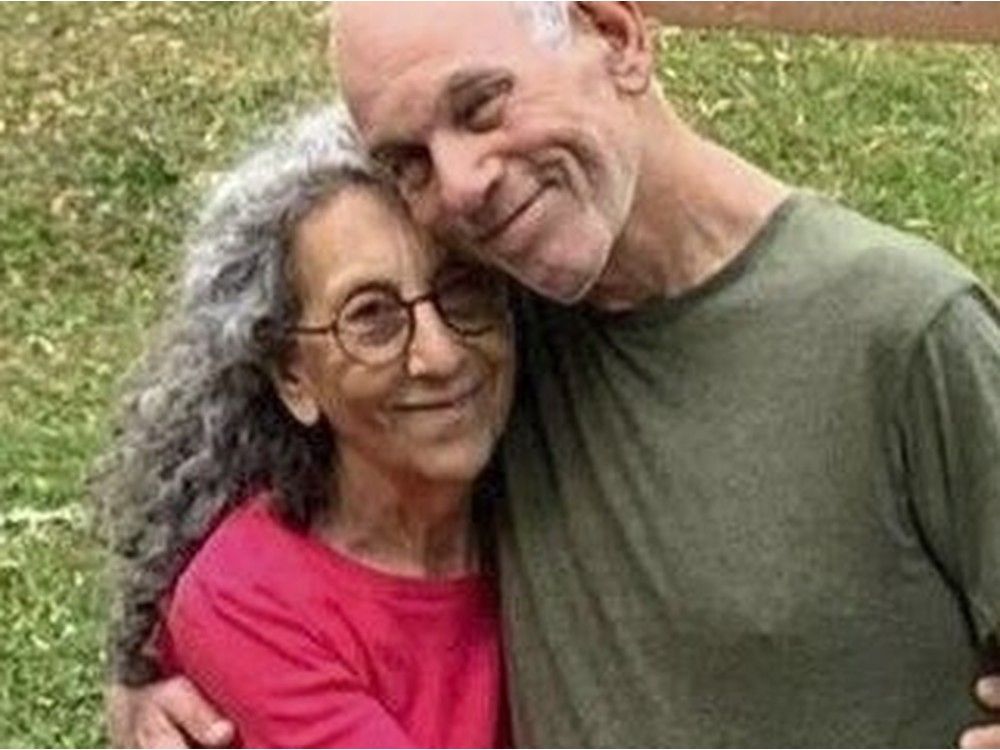
 This undated photo provided by Hostage’s Family Forum shows Israeli hostage Judy Weinstein and Gad Hagai, whose bodies have been recovered from Gaza by Israeli security forces.

Gadi Hagai, 72, and Judy Weinstein Hagai, 70, were both longtime residents of Kibbutz Nir Oz. Gadi, a dual US-Israeli citizen, was described as “a sharp man, a gifted wind instrument player since the age of three,” a chef who left his position at the Dan Hotel in Tel Aviv to manage Nir Oz’s dining hall, and a committed vegan who loved sports and the land. He had served in the IDF’s elite Sayeret Shaked unit before joining the army orchestra. In the 1980s, he founded a band called Brit Jazz. After the couple’s abduction, the family released some of the band’s recordings.

Judy immigrated to Israel from Toronto age 24 and met Gadi at Kibbutz Ein HaShofet. A dual Canadian-Israeli citizen, she later became an English teacher with a focus on children with special needs and anxiety, and had recently studied mindfulness to help children through puppet theater. She was remembered as a “poet, entrepreneur, and peace activist.”

“We are grateful to see them brought home for a proper burial in Israel,” the kibbutz said. “Yet our hearts remain incomplete until all 12 hostages from Nir Oz — and all 56 hostages still held — return home.”

 Judy Weinstein Hagai. Family Handout

President Isaac Herzog called the moment “one of deep pain, but also one of solace and the resolution of uncertainty.” In a statement, he said: “Judih and Gadi were murdered and abducted together from their home in the peace-loving Kibbutz Nir Oz – the place where they lived, raised a large family, and built their lives. Now, thanks to the rescue operation, they will be laid to rest together in dignity, in the land they so deeply loved.”

The couple was killed during the initial Hamas assault on Nir Oz. While taking one of their routine morning walks, they encountered a terrorist squad in the fields. They were shot and kidnapped to Gaza. Army intelligence confirmed their deaths in December 2023.

According to the Israel Defense Forces and the Israel Security Agency (Shin Bet), the couple’s remains were held by the Al Mujahideen Brigades, the same group responsible for the abduction of Yarden and Shiri Bibas and their two children, Ariel and Kfir.

The Hagais are survived by four children and seven grandchildren.

At least 1,180 people were killed, and 252 Israelis and foreigners were taken hostage in Hamas’s attacks on Israeli communities near the Gaza border on October 7. Of the 56 remaining hostages, 33 are believed to be dead.


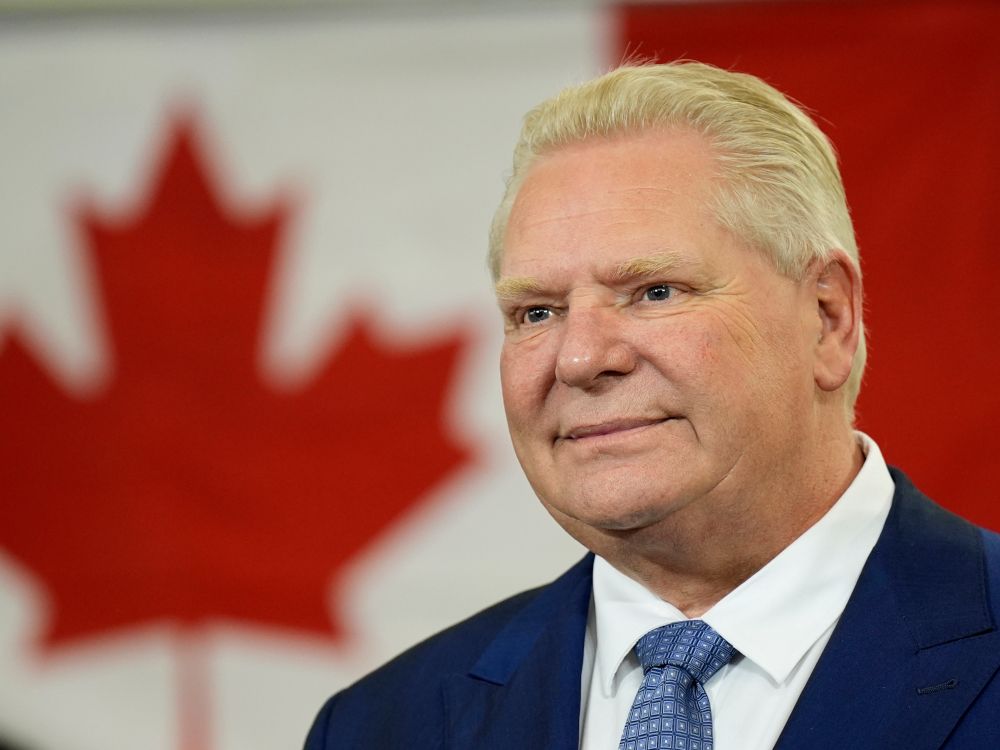
Ontarians have mixed feelings about Premier Doug Ford, and more than half say Ontario is 'on the wrong track,' according to a new Leger poll.

Roughly three months into his third consecutive majority mandate, Ontario Premier Doug Ford’s championing of Canada in its trade war with the U.S. has helped his star shine brighter. But a majority of poll respondents say the province is on the wrong track.

The latest Ontario Report Card from Leger found that almost half of residents (47 per cent) — and more than half of all men (52 per cent) — approved of the work Ford has done, compared to a third of respondents for NDP Leader Marit Stiles and Liberal boss Bonnie Crombie (33 per cent each). The pollster said Ford’s favourability was about on par with that of B.C. NDP Premier David Eby (51 per cent) and Danielle Smith (44 per cent), leader of Alberta’s governing United Conservative Party.

However, the proportion of Ontarians whose opinion of Ford has worsened over the last six months is 27 per cent — compared to just 14 per cent who say it has improved — and 11 per cent of Conservative voters said their feelings toward Ford have deteriorated.

Furthermore, more than half the respondents (51 per cent) said the province is either strongly or somewhat on the wrong track. A paltry four per cent deemed the trajectory as strongly trending in the right direction, and only five per cent of those identifying as Conservative supporters concurred.

‘A new Conservative dynasty?’ Here’s how rare Doug Ford’s third Ontario majority really is

Having one in two people thinking that way is not something to be overlooked, Jennifer McLeod Macey, Leger’s senior vice-president, told National Post.

“When we look at this, we know that the most important issues to Ontarians right now boil down to housing prices and affordability (18 per cent), closely followed by health care (17 per cent), which, of course, rises in some regions where access to primary care is of the utmost concern.

“There are definitely some issues that need some attention.”

Inflation and rising ​interest rates (12 per cent), the economy (11 per cent) and the U.S.-Canada trade relationship round out the top five issues of concern to Ontarians.

With the exception of the latter, a greater proportion of respondents said Ford and company were doing a bad job than a good job on each of those files, particularly the two most important issues.

In fact, government was only judged to be doing a good job in four areas: U.S. trade and tariff response (53 per cent), federal government relations (51 per cent), energy (41 per cent) and interprovincial relations with municipalities (39 per cent).

All of this, Macleod Macey said, points to voters being concerned with “a multitude of issues” beyond the beef with Donald Trump and his administration.

“While we’re focusing a lot on the U.S., and that is important, there are a number of things that need to be taken care of,” she told National Post. “I think if we could make some improvements in that direction, maybe we’d see a shift in those numbers.”

Ontario Place and Ontario Science Centre plans

Two local Toronto issues that have dogged Ford and his governments since June 2023 are the redevelopment of Ontario Place and the relocation of the Ontario Science Centre (OSC) to the former, which is planned to begin this year following the Don Mills Road facility’s abrupt closure last June due to structural integrity concerns.

Questions about the two were added at the behest of McLeod Macey, who said she wanted to filter out the “loud voices” in traditional and social media so as to measure the feelings of “everyday Ontarians.”

Leger polling found that while 30 per cent either somewhat or strongly support moving OSC to the waterfront, 47 per cent are opposed, 27 per cent of whom felt strongly about it.

 An artist’s rendering of the redesign of Ontario Place.

McLeod Macey also highlighted a 23 per cent cohort who are unsure.

“I think this speaks to the fact that many Ontarians don’t really know the back story. They don’t know all the conversations that have been happening,” she suggested.

When it comes to Ontario Place’s redevelopment to include a mix of public parkland and private facilities, favourability goes up (38 per cent) but is still overshadowed by unfavourability (43 per cent) at this time.

“There are some people who just aren’t going to get behind private development, but perhaps with some more communication, some more understanding, folks would be more supportive of the changes that are happening there and maybe seeing the waterfront being used to its fullest,” McLeod Macey said.

The entirety of work at Ontario Place — which includes a spa and wellness facility, a new Budweiser stage, among other projects — is expected to be complete by 2030.

Leger’s survey was conducted online on May 23-25 and polled 1,025 Ontario residents, almost half of whom reside in the GTA.

Our website is the place for the latest breaking news, exclusive scoops, longreads and provocative commentary. Please bookmark nationalpost.com and sign up for our daily newsletter, Posted, here.



Toronto Raptors guard Norman Powell reacts after dunking for a basket against Charlotte Hornets at Scotiabank Arena, on Nov. 18, 2019.

OTTAWA — On Feb. 4, 2022, former Toronto Raptors star guard Norman Powell received two pieces of news that would have a major impact on his life.

The first was from his agent telling him that he was part of a blockbuster trade that sent him from the Portland Trail Blazers to the Los Angeles Clippers.

The second was from the Canada Revenue Agency (CRA) claiming over $1.2 million in additional income tax on “inducements” paid by the Raptors in 2019 and 2020 to attract the star two-way guard to the surging Toronto team.

Powell, who was part of the Raptors’ 2019 championship team, is now appealing the CRA’s decision in the Tax Court of Canada.

Powell’s faceoff with the tax agency is over the same issue as ex-Toronto Maple Leafs

Patrick Marleau and John Tavares

, namely that his nearly $7 million in signing inducements should be taxed at only 15 per cent and not at the top income tax bracket (over 50 per cent).

A key question for the court to determine is if the inducement offered by the Raptors Powell’s contract to entice him to Toronto fits the definition of an “inducement” under the U.S.-Canada treaty that sets the tax rate at 15 per cent.

Powell says yes, but the CRA says no.

The case, like Marleau and Tavares’, could have a significant impact on how Canadian professional sports teams use signing bonuses or salary inducements as a tax incentive to attract foreign athletes to Canada instead of lower-taxed American organizations.

Powell’s lawsuit argues that the millions in inducements he signed with the Raptors to attract him to Toronto are covered by provisions of a Canada-U.S. tax treaty which set the tax rate for an “inducement to sign an agreement” at 15 per cent.

“The Toronto Raptors and the Appellant (Powell) both understood that the Inducement was a key component of the Appellant’s decision to sign” with the Canadian team, reads the appeal.

But, per Powell, the CRA disagreed. On Feb. 4, 2022, the agency issued notices of assessment to him for 2019 and 2020 that taxed his inducement payments at the ordinary federal and provincial income tax rates (likely over 50 per cent) instead of 15 per cent.

“The Toronto Raptors agreed to pay the Inducement to entice the Appellant ‘to sign an agreement relating to the performance of’ his services as an ‘athlete’,” Powell wrote, saying that CRA’s arguing otherwise is “to distort the legal and economic reality” of his contract with the Raptors.

Powell objected to the CRA, which he says accepted his objections “in full” on March 1, 2024.

But then to Powell’s surprise, six days later the CRA issued a reassessment that once again considered his inducements to be taxable at the full federal and provincial tax rates instead of 15 per cent.

Even more confusing is that one year later, the CRA “admitted and agreed” that the $7 million paid by the Raptors to Powell in 2019 and 2020 were in fact “an inducement… to choose the Toronto Raptors” under the terms of his NBA contract, his lawsuit states.

“The CRA has admitted that the Inducement was paid to the Appellant as an inducement for him to choose the Toronto Raptors. This should conclude the analysis,” reads his appeal.

In his lawsuit, Powell says the CRA made essentially the exact same arguments as they did in Tavares’ and Marleau’s cases without considering the differences between an NBA and NHL contract.

His appeal suggests that CRA copied its findings in the Tavares and Marleau cases and applied them to Powell, who plays a different sport in a different league with different player contracts.

“The position adopted by the (CRA) has been shaped following an audit conducted on an NHL player who received an inducement as per the terms outlined in his employment agreement. Subsequently, the (CRA) improperly extended the conclusions drawn from this particular NHL case to the Appellant” without considering the specificities of his NBA contract, Powell argued.

Both the CRA and Powell’s counsel, Marie-France Dompierre, declined to comment as the case is ongoing. The tax agency has not filed a statement of defence in court.

National Post has published a series of reports since 2024 detailing tax battles between former star players of Toronto’s three largest professional sports teams and the CRA.

Other than its fights with Powell, Tavares and Marleau, the CRA also battled ex-Maple Leaf Jake Muzzin over the tax rate imposed on his signing bonus in 2020.

The CRA also launched battles in 2023

with ex-Toronto Blue Jays all-stars José Bautista, Josh Donaldson and Russell Martin over multimillion tax bills. Late last year, the Tax Court ruled in favour of Donaldson and Martin, arguing that the

CRA’s calculation of their income tax owing was “faulty.”

cnardi@postmedia.com

National Post

Get more deep-dive National Post political coverage and analysis in your inbox with the Political Hack newsletter, where Ottawa bureau chief Stuart Thomson and political analyst Tasha Kheiriddin get at what’s really going on behind the scenes on Parliament Hill every Wednesday and Friday, exclusively for subscribers. Sign up here.

Our website is the place for the latest breaking news, exclusive scoops, longreads and provocative commentary. Please bookmark nationalpost.com and sign up for our daily newsletter, Posted, here.


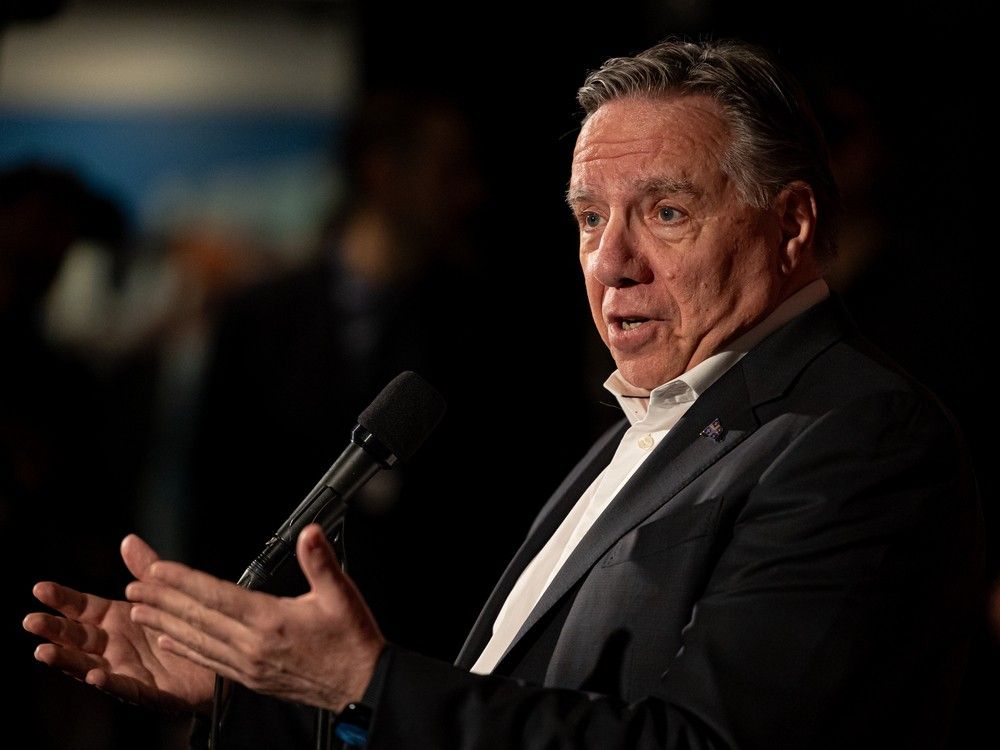
Quebec Premier Francois Legault speaks during the first ministers' meeting at TCU Place.

OTTAWA — At Quebec’s National Assembly and on Parliament Hill in Ottawa, pipelines have dominated the debates. The only issue? No projects involving the province are on the agenda.

“I think there is a fixation on pipelines on (Prime Minister Mark) Carney’s part at the moment, not on the part of Quebecers,” said Bloc Québécois MP and former Greenpeace activist Patrick Bonin.

Since taking office in May, Bonin has mentioned the pipeline issue more than 20 times in his speeches on the floor of the House of Commons.

“We will not allow the government to build a pipeline through Quebec,” he said on Monday.

According to Bonin, the prime minister is “rolling out the red carpet for the oil companies” by meeting with some 20 CEOs in Calgary the day before his meeting with the premiers in Saskatoon and by hoping to speed up environmental assessments.

Since the election, Carney has spoken cautiously about “conventional energy” infrastructure and has repeatedly stated that no decisions have been made at this stage regarding the major projects he wants to see come to fruition.

But he did take a step further on Wednesday, feeding Bonin’s worst fears.

“The consensus that’s required includes a consensus with the Indigenous people. We will stand with Indigenous Canadians, we will build pipelines and energy infrastructure in this great country,” Carney said on the floor of the House of Commons.

In Quebec, many politicians remain on the edge of their seats.

“Any pipeline project, any kind, is bad for the environment, bad for the economy, bad for Quebec,” said Ruba Ghazal, the Quebec solidaire House leader at the National Assembly.

“If the premier doesn’t want to completely shut the door on a pipeline project, can he at least ensure that environmental sovereignty is defended?” she asked.

Quebec Premier François Legault seemed baffled by the question the day after

Alberta Premier Danielle Smith appeared resigned

about the prospect of a pipeline through Quebec, saying she would have more success with a corridor between Hudson Bay and Prince Rupert.

“The leader of Québec solidaire is getting excited about something that doesn’t exist,” replied Legault. “There is currently no project that is taking place in Quebec.”

But what worries many Quebec MPs, particularly from the Bloc Québécois, is that the prime minister is using pipeline expansion as a solution to U.S. President Donald Trump’s attacks on Canada.

“For us, it’s worrying because the government is currently focusing on the idea of developing more oil and gas, putting in pipelines when it should be focusing on making the energy transition and that’s the priority,” said Bonin in an interview.

Heritage Minister Steven Guilbeault, who is also Carney’s Quebec lieutenant, said his boss insisted that for such a project to go ahead, “there would have to be social acceptability.”

Just like Guilbeault, Quebec Liberal MPs are also cautious about pipelines in their province.

“I can’t wait to see the appendix, the list of all the (major infrastructure) projects. I’m excited because we really need to build a strong economy”, said Pontiac MP Sophie Chatel. Does it take a pipeline? “We’ll see,” she told National Post while her Gatineau colleague and government House leader Steven MacKinnon said the country “must seize the moment.”

“We have major national projects, people are impatient for there to be a clear process to begin this work and see it through to completion, and so I am very, very confident that it will garner quite substantial support from Canadians,” he said, without pointing out specifically to pipelines.

MacKinnon said he would like to see the government’s bill to speed up construction of major national projects passed by the end of June.

Meanwhile, Conservative MPs are openly advocating for a pipeline crossing the province.

Quebec City MP Gérard Deltell pointed out in the House of Commons that a growing number of Quebecers support pipeline construction.

“We have had pipelines in Quebec since 1942. In 2012, a pipeline was built between Lévis and Montreal that crosses 26 waterways, including the St. Lawrence River. It is so good and works so well that no one knows about it, and no one talks about it,” he said.

National Post

atrepanier@postmedia.com

Get more deep-dive National Post political coverage and analysis in your inbox with the Political Hack newsletter, where Ottawa bureau chief Stuart Thomson and political analyst Tasha Kheiriddin get at what’s really going on behind the scenes on Parliament Hill every Wednesday and Friday, exclusively for subscribers Sign up here.

Our website is the place for the latest breaking news, exclusive scoops, longreads and provocative commentary. Please bookmark nationalpost.com and sign up for our newsletters here.


Edmonton Oilers captain Connor McDavid lifts the the Clarence S. Campbell Bowl presented by NHL deputy commissioner Bill Daly after defeating the Dallas Stars in the Western Conference Final on May 29.

Whatever the outcome of this year’s Stanley Cup Final rematch between the Florida Panthers and Edmonton Oilers, Florida Governor Ron DeSantis won’t be wetting his whistle on whiskey courtesy Alberta Premier Danielle Smith again this summer.

On Tuesday, Smith told National Post she would not renew the friendly wager with her U.S. counterpart, who would have been required to send a bottle of Florida rum north had the Oilers completed their series comeback to defeat the Panthers last June.

“We are following the lead of Captain Connor and are going to do things a bit differently this year,” she wrote in a statement.

Smith is referring to Oilers’ captain Connor McDavid, who, after helping his team knock off the Dallas Stars 4-1 in the best-of-seven Western Conference final, hoisted the Clarence Campbell Bowl presented to him by deputy commissioner Bill Daly.

Oilers vs Panthers: Why this could be the most important hockey finals for Canadians in years

NHL players, not unlike most professional athletes, can be the superstitious sort, and one of the most enduring superstitions is that you don’t touch the Campbell or the Prince of Wales Trophy, its Eastern Conference equivalent, should your team win and advance to compete for Lord Stanley’s trophy.

Fearing it will somehow bring bad luck, team captains won’t touch it, and the team will only gather around it for an official photo. The fear is that celebrating with the trophy will jinx your chances in the final.

It’s not clear how far it dates back for either trophy, but it’s only grown in prominence as the sport has grown in North America.

Speaking to Sportsnet’s Gene Principe on the ice as teammates celebrated around him, McDavid said he didn’t “know what was going to happen when we got up there” but decided to “give it a go this year.”

In the post-game press conference, a No. 97 offered a similar and succinct reply.

“Pretty obvious, I think. Don’t touch it last year, we don’t win. Touch it this year, hopefully we win.”

The Panthers, meanwhile, also chose not to touch the Prince of Wales after finishing off the Carolina Hurricanes last week, marking the second straight year they’ve done so. When the Panthers swept the Carolina Hurricanes in the 2023 East final and touched the Prince of Wales, they went on to lose against the Las Vegas Knights in the final.

While it’s mostly hit and miss, plenty of teams who’ve touched their respective trophies have gone on to win the Cup, including some of the games’ greats,

according to the league.

After not doing so before his first Cup final in 2008, Sidney Crosby and his assistant captains did touch the Clarence Campbell in 2009 and went on to win. He would do so again in 2016 and 17 when the Pittsburgh Penguins went on to win back-to-back cups.

 Sidney Crosby touched the Prince of Wales Trophy all three times he captained the Pittsburgh Penguins to Stanley Cup championships.

Alex Ovechkin also did it in 2018, and his Washington Capitals would win the organization’s first-ever title.

The all-star loaded Tampa Bay Lightning touched it ahead of three straight finals from 2020-21, winning the first two and dropping the third.

The NHL said the last time another team chose to touch the Prince of Wales trophy and went on to win was the 2011 Boston Bruins.

Our website is the place for the latest breaking news, exclusive scoops, longreads and provocative commentary. Please bookmark nationalpost.com and sign up for our daily newsletter, Posted, here.


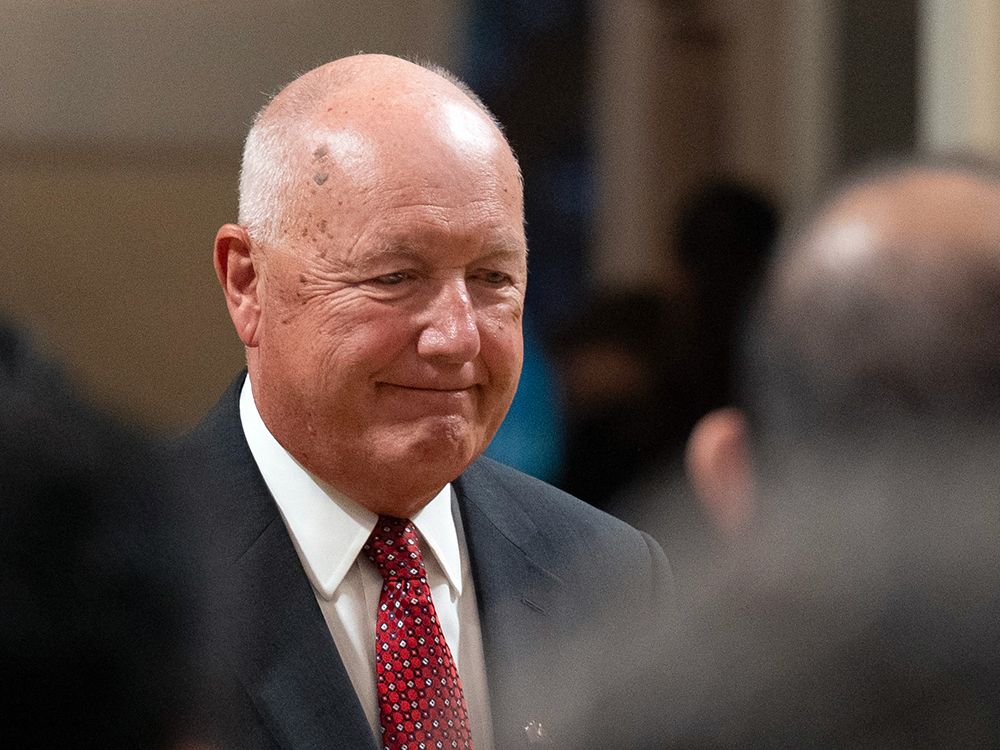
U.S. Ambassador to Canada Pete Hoekstra.

U.S. Ambassador to Canada Pete Hoekstra spoke at an event on Tuesday organized by the Empire Club of Canada. In conversation with Global Investment Banking at CIBC Capital Markets Vice-Chair Lisa Raitt, he

discussed Canada-U.S. relations

and responded to a question about the future of Canadians trying to go to Harvard — including Prime Minister Mark Carney’s daughter Cleo Carney.

The event came after the Trump administration revoked Harvard University’s ability to enroll international students. “They have lost their Student and Exchange Visitor Program certification as a result of their failure to adhere to the law,” said Secretary of the U.S. Department of Homeland Security Kristi Noem in

a post on X

. “This administration is holding Harvard accountable for fostering violence, antisemitism, and coordinating with the Chinese Communist Party on its campus.”

Carney’s daughter is expected

to return to Harvard as a second-year student in September, where she is earning a bachelor’s in economics

. This was brought up by Raitt, who asked Hoekstra about it on Tuesday near the end of their conversation.

“Any thoughts or any words for Canadians who may be trying to go to Harvard right now, like maybe the prime minister’s daughter?” said Raitt.

“Well, I mean, you know the what the U.S. is doing? OK, we cleaned up the border. We’re now tracking down people who are murderers, thieves and rapists, who are in the country illegally, and doing everything to get them out of the country and make America safe,” said Hoekstra. “When I was on the intel committee, I would get briefed regularly by the FBI about students from China in our universities who are — and our research institutions — who are stealing our technology or our research, sending it back to China. They would patent it before it ever came out of our research institutions.”

He said that U.S. President Donald Trump was “cleaning up that mess.”

“We recognize that American universities, and probably Canadian universities, are phenomenal bastions of knowledge — OK? — that our enemies want to have access to. This is why we have so many foreign students now. They want the knowledge, and in some cases, they want to steal our research,” he said.

“And so the president is saying, ‘No, we’re going to — we’re going to clean this up.’ We recognize the value of the commodity that we have, which are research institutions. So we still want people coming in, but we want to manage that process.”

He said that the U.S. has been “negligent” and hasn’t managed its resources well.

“We’re being exploited by those who want to destroy the United States and who want to destroy the prosperity and the security of Canada at the same time. They’re not picking and choosing. If they don’t like the U.S., I think there’s a high probability they don’t like you either,” he said.

The fate of international students who are supposed to attend Harvard remains unclear. Most recently, in May,

a judge extended an order

blocking the Trump administration’s ban on foreign students.

Meanwhile, in a statement on May 29,

a university spokesperson said

the court decision has allowed it to “continue enrolling international students and scholars while the case moves forward.”

It continued: “Harvard will continue to take steps to protect the rights of our international students and scholars, members of our community who are vital to the University’s academic mission and community — and whose presence here benefits our country immeasurably.”

Our website is the place for the latest breaking news, exclusive scoops, longreads and provocative commentary. Please bookmark nationalpost.com and sign up for our daily newsletter, Posted, here.

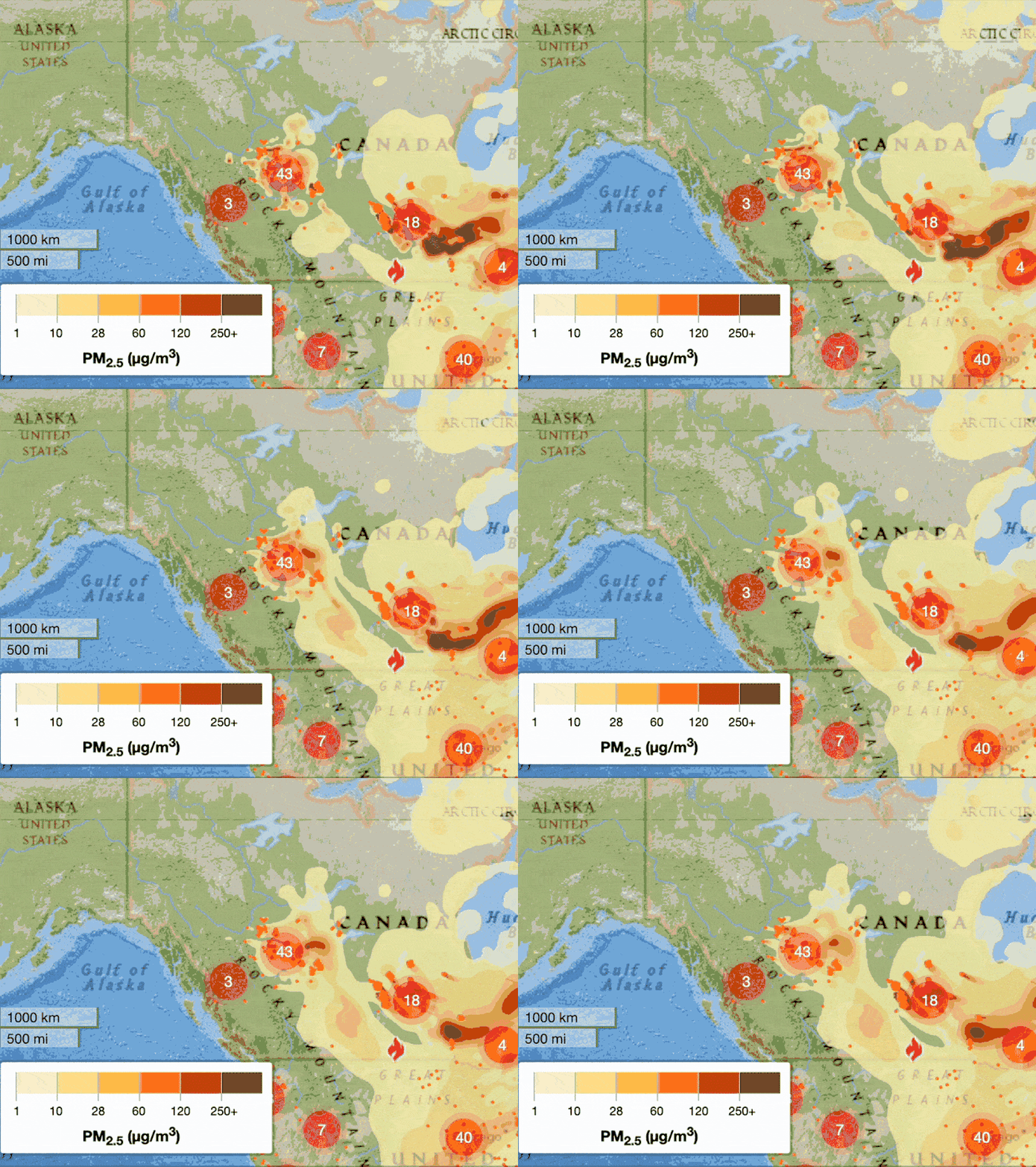
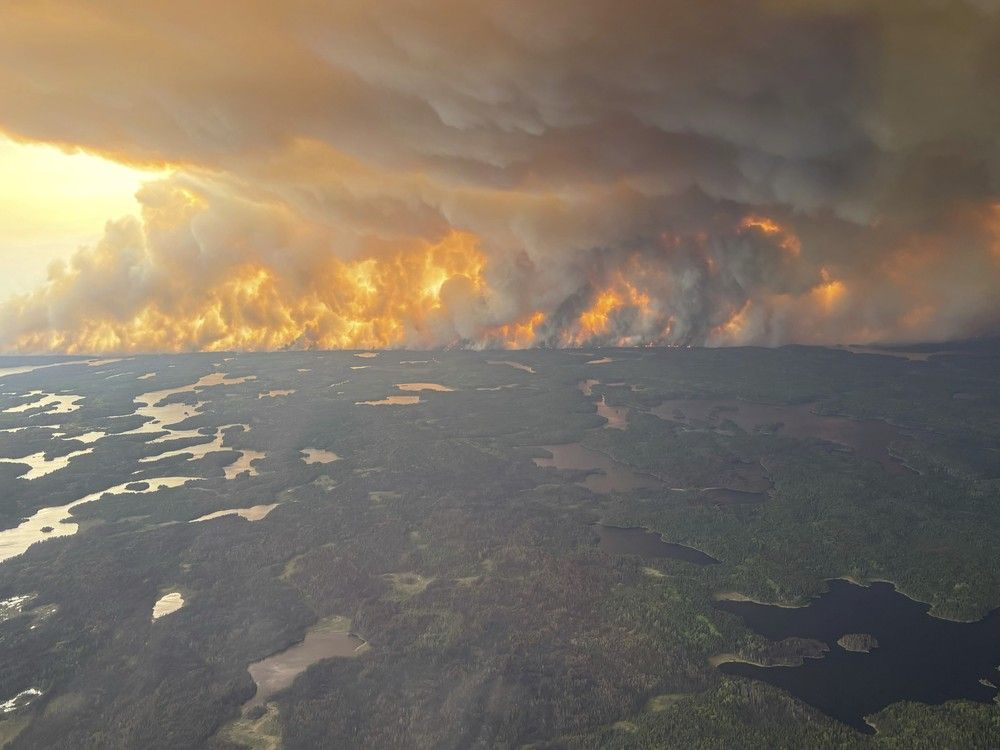
This image shows smoke coming from wildfires across Canada and the United States. At about seven times its ten-year average, the burn area in Canada is unusually large for this time of year

High winds coupled with a warm, dry spring are fuelling a wave of forest fires across western Canada and parts of Ontario.

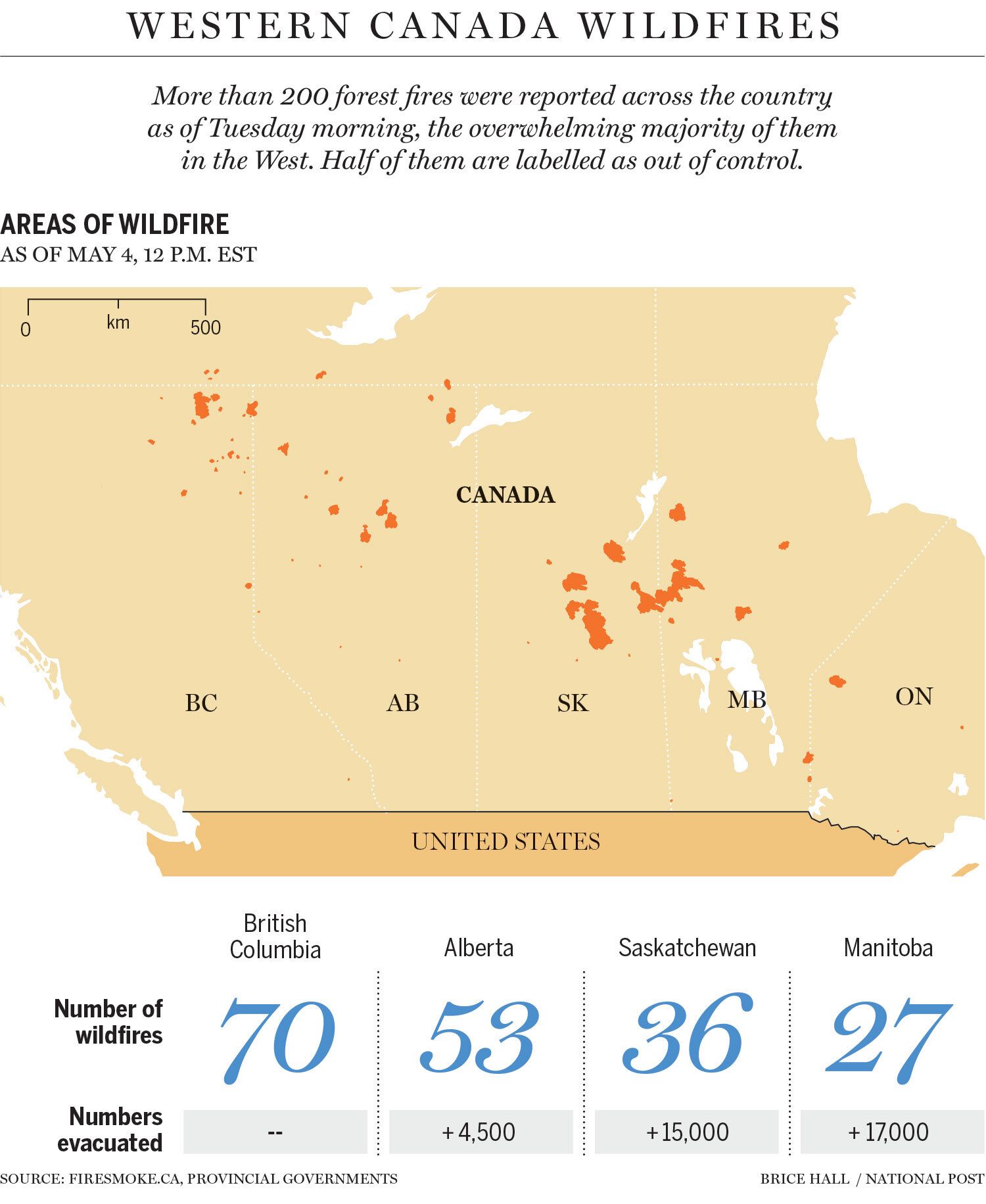
More than 200 fires were reported across the country as of Tuesday morning, half of which are labelled out of control.

Wildfires have already burned close to 2.2 million hectares this year, equivalent to the size of about 4 million football fields. At about seven times its ten-year average, the burn area is unusually large for this time of year.

Communities in Alberta, Saskatchewan and Manitoba have been shrouded in smoke, and air quality alerts have been issued across the provinces and bordering U.S. states.

With summer still weeks away, this year’s fire season is running far ahead of schedule. Here’s what you should know.

Which areas are most affected?

The worst blazes have occurred in the prairie provinces, leading led Saskatchewan and Manitoba to declare province-wide emergencies in late May.

Saskatchewan

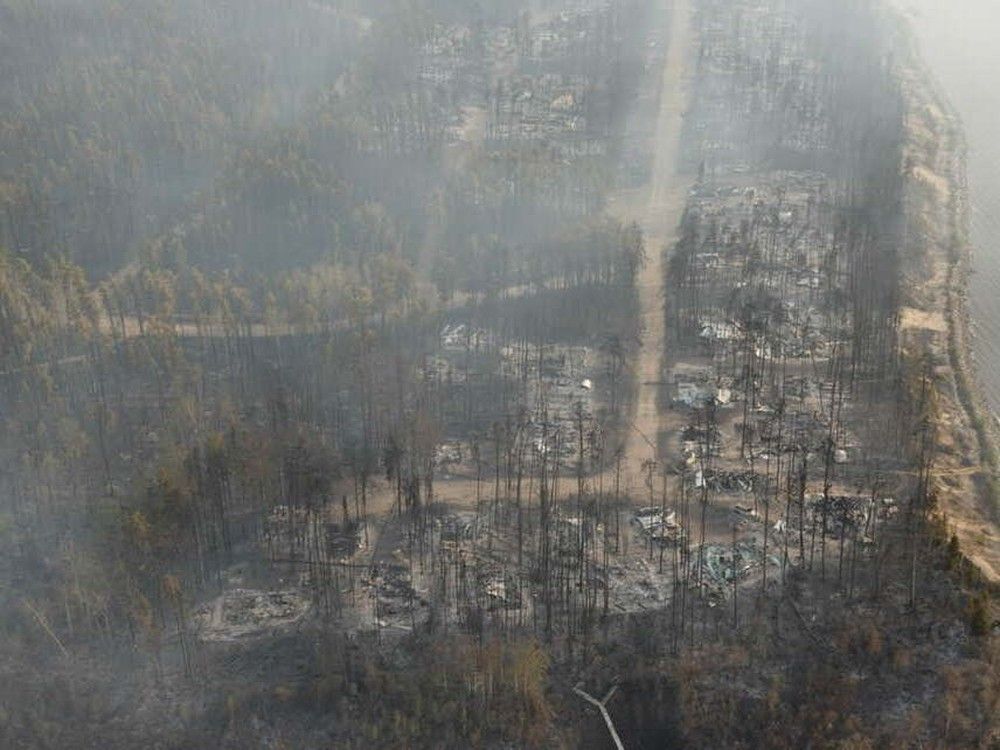
 The small resort subdivision north of Narrow Hills Provincial Park largely destroyed.

The Shoe fire in Saskatchewan’s Narrow Hills Provincial Park has scorched more than 400,000 hectares — roughly 18 times the size of the city of Saskatoon — and is threatening 11 communities.

To the north, a 83,000 hectare fire in La Ronge, Sask, forced several neighbouring communities to evacuate. On Monday , the fire had crossed into the town’s airport.

The evacuation also included 45 acute and long-term care patients from the care homes and a health centre in La Rouge, the Saskatchewan Health Authority said.

In total, more than 8,000 people, or about 30 communities, have been ordered to evacuate so far. There are 18 fires across the province, around half of which are uncontained.

It’s already shaping up to be the worst wildfire season Saskatchewan has seen in recent memory.

Manitoba

 Flin Flon, Manitoba, Canada on Tuesday, May 27, 2025. (Manitoba government via AP)

In Manitoba, more than 17,000 residents, including 5,000 people from Flin Flon, a mining city located near the Saskatchewan border, were forced to evacuate from their homes. The smoke has been too thick for water bombers to reach, leaving firefighters struggling to contain the blazes.

Multiple fires beset the First Nations communities of Pimicikamak Cree Nation and Pukatawagan, prompting the Assembly of Manitoba Chiefs to make an urgent plea for emergency response on May 30.

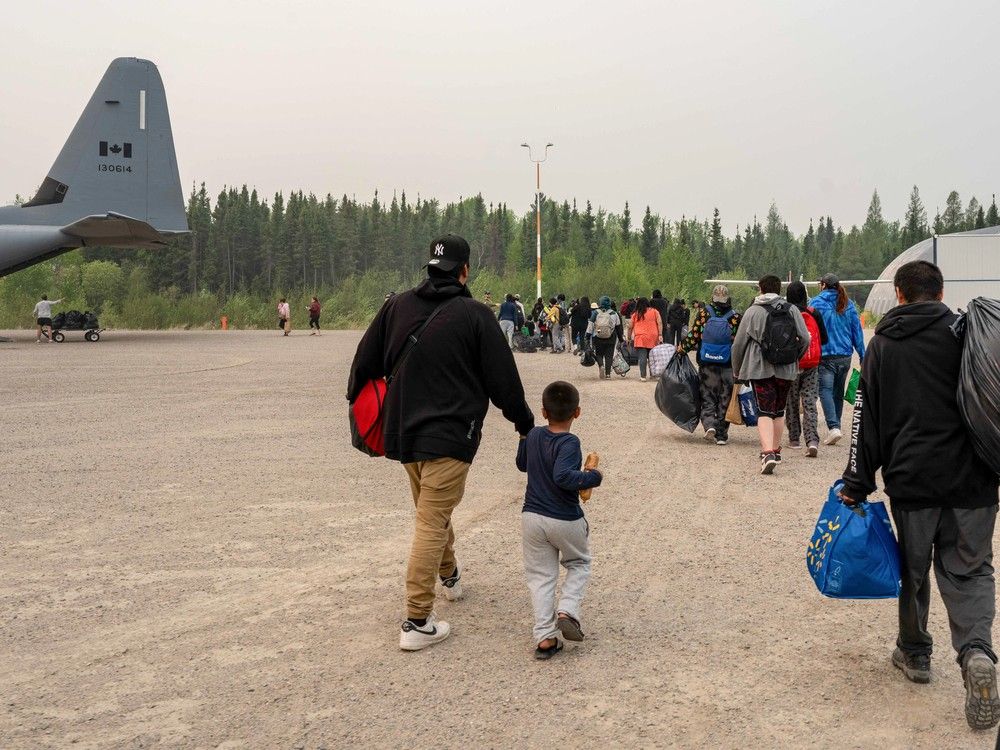
The fires made the roads inaccessible stranding close to 4,000 members from both communities. Military planes carried out the evacuations save for a handful of holdouts who have so far refused to leave.

Many of the evacuees have been allowed to carry only one bag with them and are told it might be weeks before they have a chance to return.

 The Royal Canadian Air Force helps transport evacuees out of Norway House, Manitoba, due to wildfires in Northern Manitoba on May 31, 2025.

The province has 25 fires, 10 of which are out of control.

With accommodations in cities and First Nations communities becoming scarce, evacuees have had to be flown outside the province. Hundreds of Pimicikamak Cree Nation residents have been taken to Niagara Falls, Ont., where hotel rooms are becoming difficult to wrangle.

Many of the evacuees have been allowed to carry only one bag with them and have been told it might be weeks before they have a chance to return.

In mid-May, two people were reported dead in Lac du Bonnet, Man., a little over an hour’s drive from Winnipeg, where evacuation orders were in place.

Alberta

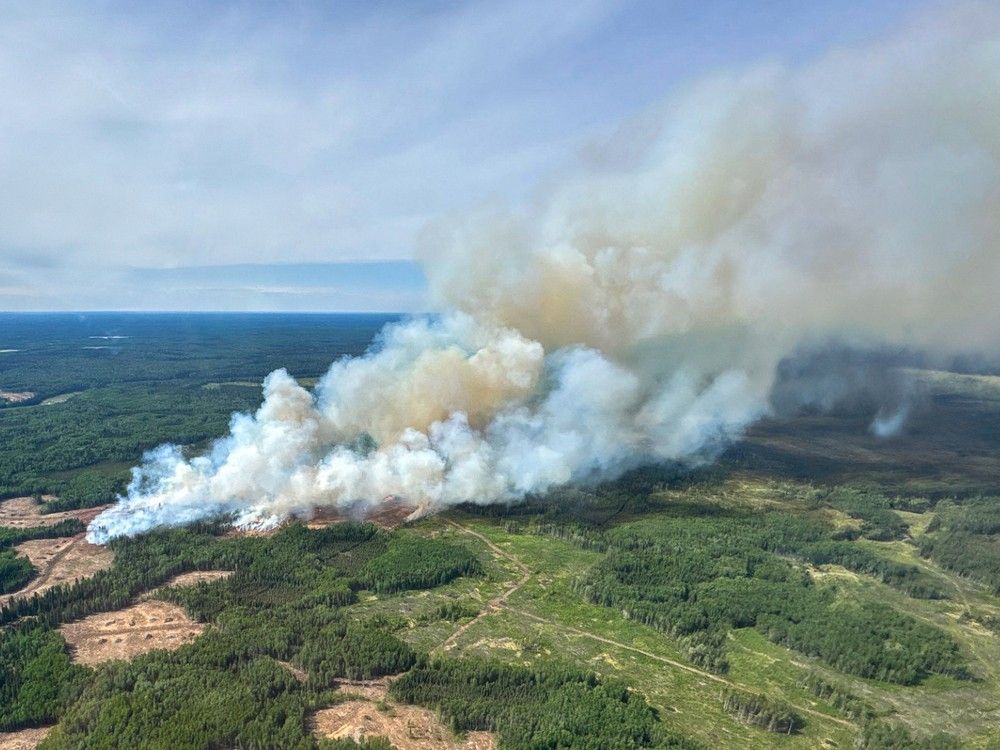
 Wildfires burning north of Joussard, Alberta, Canada, on May 30, 2025.

Cooler weather mild showers kept fires from escalating overnight in Alberta, but the rest of the week is expected to bring warmer weather. More than 4,500 people have been ordered to leave their homes, including the town of Swan Hills, located northwest of Edmonton. The fires have claimed more than 500,000 hectares, primarily in the province’s northwest.

Of the 53 active wildfires in Alberta, 24 are out of control and six are being held, meaning the fire is expected to be contained under given conditions. The province has had 505 wildfires this season.

The province’s oil sands sector has also been affected, shutting down about seven per cent of Canada’s oil production, or about 350,000 barrels a day, according to Bloomberg.

British Columbia

 The worst blazes have occurred in the prairie provinces.

Nearly all of the wildfires are concentrated in the province’s Northeast corner. A third evacuation order has been issued in Prince George as winds in excess off 50 kilometres per hour this week are expected to fan the flames toward the Alberta border. Much of the land is severely drought-stricken, according to Agriculture Canada.

This week, a major clean up response took place after a fire near Summit Lake cut off 160 km of the Alaska highway close to Fort Nelson, B.C. The major arterial roadway, which connects Alaska to the Yukon, was shut down for much of Tuesday. It reopened to a single lane that evening, according to the Drive B.C. website.

Ontario

Several high-risk fires are burning in northern Ontario. Several First Nations communities have been evacuated since May and two have declared states of emergencies.

Wabaseemoong Independent Nations, located west of Kenora, were placed under evacuation orders in mid-May. Fires started near the Manitoba border and have since scorched more than 36,000 hectares.

Evacuations for Webequie First Nation, in Nipigon, where the fires have blackened 8,000 hectares, were carried out last week, and more than 400 members relocated. Deer Lake First Nation was also being evacuated this week, with 1,300 members needing relocation.

What caused the fires?

A majority of the fires have been man-made, as is typical for this time of year.

Of the 111 total wildfires in Manitoba this season, 100 are believed to be human-caused while six are under investigation and another five are believed natural.

Over the weekend, Saskatchewan premier Scott Moe estimated that people were to blame for 90 per cent of fires in the province. Man made fires entail anything from burns that spread out of control, campfires that were left unattended, discarded cigarettes or, as in some cases, an act of malice.

Lightning becomes the primary driver starting in June, and these fires are usually the most devastating. During 2023’s record-breaking fire season, lightning accounted for 93 per cent of the area burned.

How unusual is this season?

Alberta, Saskatchewan, Ontario and Manitoba are seeing larger fires at this point in the year than their five-year average.

In Central Canada, a combination of weather conditions — including warm temperatures, drought and lack of humidity — made fires more prone to spread.

Manitoba exceeded average temperatures by double digits in the spring. Parts of Saskatchewan where fires are active were also several degrees warmer than average. Alberta also experienced a warm spring and is braced for heatwaves leading into summer.

Current models forecast Central Canada will remain dry and hot throughout the summer.

Fires have also been whipped up by strong winds and a lack of meaningful rains, conditions which are set to persist in much of the fire-stricken until later this week.

What about the smoke?

Hundreds of communities are under Environment Canada’s air quality warnings. The severity of smoke in any particular area can depend on factors such as wind direction, speed and fire proximity, according to the agency.

A large part of southern and central Manitoba has been blanketed with hazardous levels of smoke. Advisories have also been issued for communities in northern Alberta, northern Saskatchewan and north western Ontario.

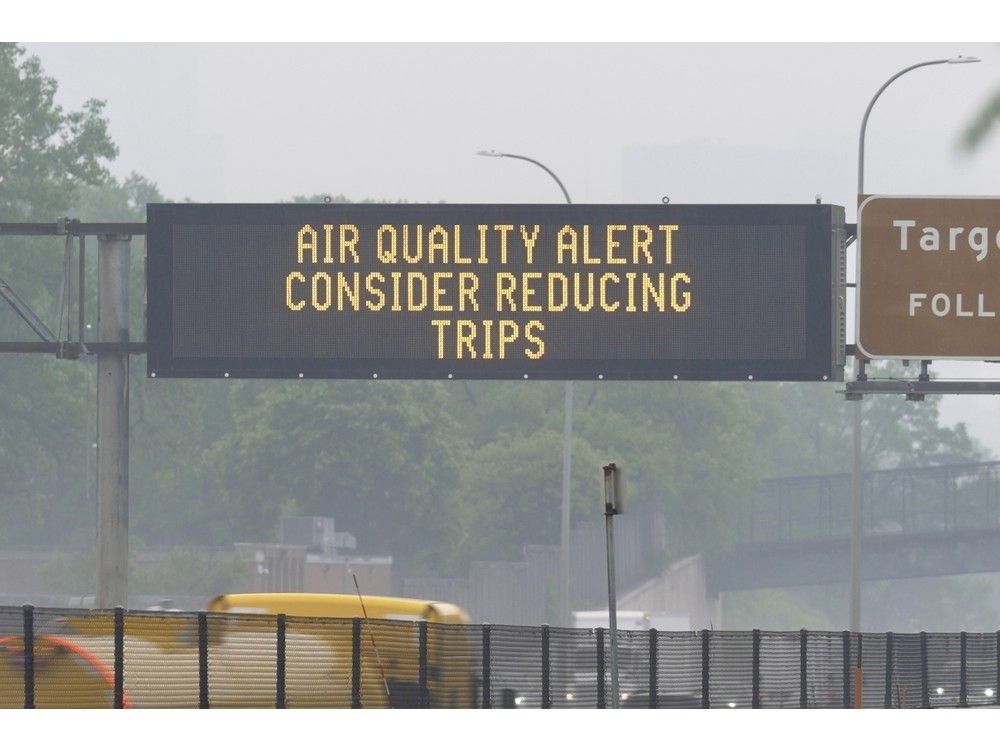
Smoke caused by the wildfires has extended from the Midwest states into the plains and even as far southeast as Georgia. Minnesota, in particular, was placed under a statewide advisory, while multiple bordering states have advised their people to reduce exposure by staying inside as much as possible and keeping doors and windows shut.

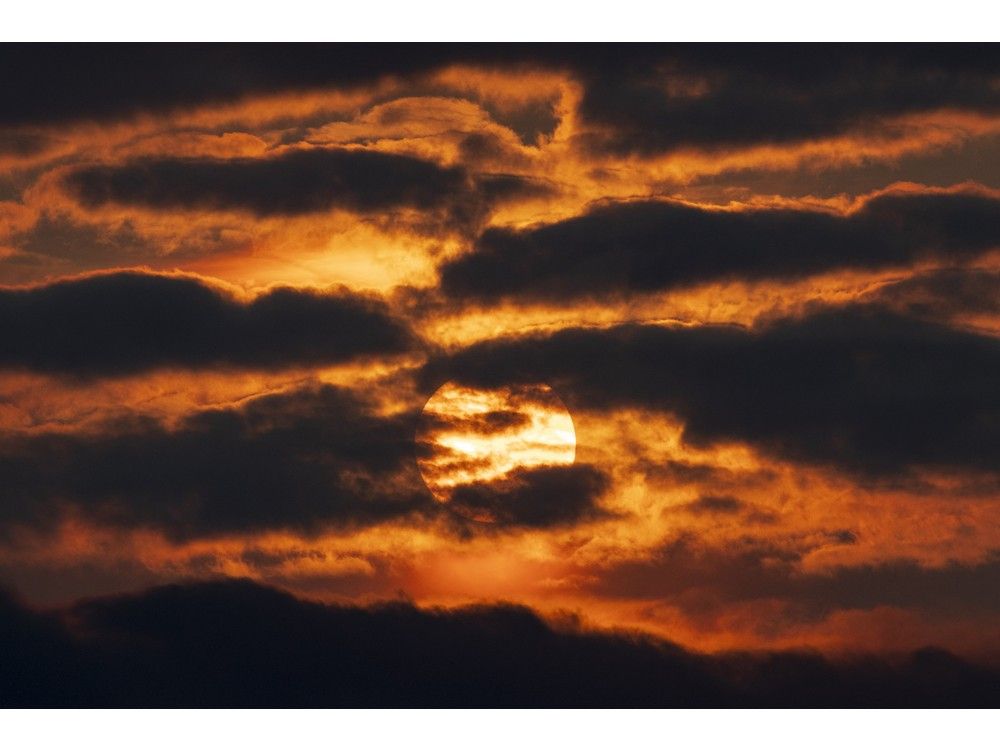
 Sunset in Ablain-Saint-Nazaire, northern France, on June 3, 2025. Large smoke plumes caused by violent and early wildfires in Canada have been hovering at very high altitudes without posing health risks.

Health authorities are recommending the use of air filters at home or for going to locations with filtered air, such as libraries or malls.

U.K. skies were also covered in a dull haze this week as smoke apparently carried across the Atlantic. Fumes also blew over into the Northern Europe, the Mediterranean and Greece a little over two weeks ago, with more expected in the coming weeks, according to the climate monitoring service Copernicus. The haze is hovering at high altitudes and poses no health risks, experts say, but has obscured the sun in an orangish haze.

What are the risks of exposure to wildfire smoke?

 A sign warns of an air quality alert as smoke from wildfires burning in Canada reaches Minneapolis, Minn., on Tuesday, June 3, 2025.

Wildfires release small particles in the air that are more harmful than regular air pollution. U.S. Environmental Protection Agency map shows moderate to severe concentrations of particles known as PM2.5 and ozone levels, in Minnesota, Wisconsin and Iowa.

These particles are used as a measure of air quality, with moderate levels affecting sensitive groups and more severe levels causing severe discomfort and even death. Young people, the elderly and those with heart and lung conditions are particularly at risk. At unhealthy levels, studies show an increase in stroke, heart attack and lung cancer among those who inhale wildfire smoke.

“Ground-level ozone and PM2.5 cause respiratory and cardiovascular problems and lead to tens of thousands

of premature deaths, with costs of more than $100 billion, each year,” guidelines from the NOAA states.

Wildfire smoke contributes to nearly 18,000 deaths a year, according to the Lung Health Foundation. It recommends keeping an emergency kit, filtering indoor air and checking carbon monoxide monitors to stay protected. At severe levels, the use of an air conditioner is not recommended. Instead, it is advised to check local governments for nearby cooling locations.


Our website is the place for the latest breaking news, exclusive scoops, longreads and provocative commentary. Please bookmark nationalpost.com and sign up for our daily newsletter, Posted, here.


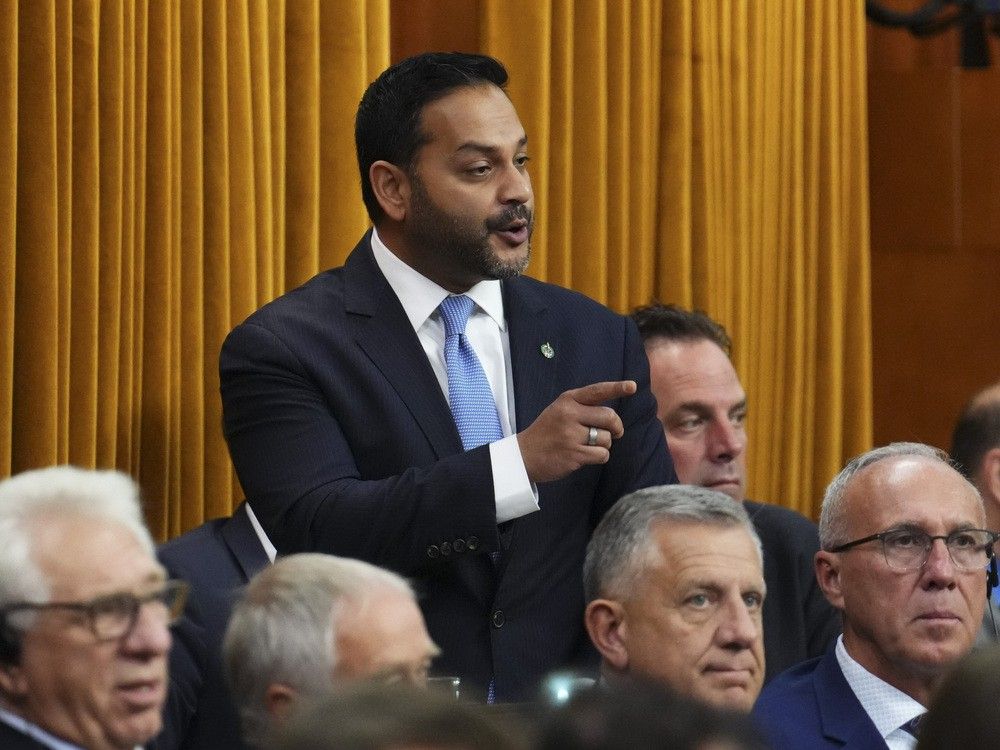
Conservative member of Parliament Shuvaloy Majumdar rises to ask a question in the House of Commons during question period on Parliament Hill in Ottawa on Monday, Sept. 18, 2023.

OTTAWA — With the House of Commons back in full swing, Conservative MPs from Alberta are sounding the alarm on rising separatist tensions in the province, warning Prime Minister Mark Carney to tackle the problem or reckon with a fractured country. 

Calgary MP Shuvaloy Majumdar blasted Carney on Tuesday for leaving

the first ministers’ meeting

in Saskatoon without giving Alberta a firm commitment on oil and gas pipelines and other energy infrastructure.

“Yesterday, the prime minister committed to more rhetoric, more lofty words, and no actual (oil and gas) project,” said Majumdar in Tuesday’s question period.

“Alberta’s heard all this before. We don’t need headlines, we need results.”

Majumdar told the National Post it’s time for Carney to back up his words with actions, after campaigning on an implicit promise to repair the rift between Ottawa and Alberta created by his Liberal predecessor Justin Trudeau.

“This is all about the pressure of resentment that has built up after (Trudeau spent) 10 years attacking the energy industry in Alberta,” said Majumdar.

“The prime minister ran on addressing those issues, lifting things from the Conservative playbook… The solution here is for (him) to deliver what he’s promising, lest he risk a constitutional crisis.”

Newly elected rural Alberta MP David Bexte said in his maiden speech last week that “Alberta separatism is no longer a fringe idea.”

“I heard (separatist talk) at the doors more times than I can count, and I’ll tell you plainly… Albertans know that they have options,” said Bexte.

“If this House continues to insult, neglect and abuse Alberta… then the future of this country is not guaranteed.”

Bexte declined a request to be interviewed for this story.

Departing Battle River—Crowfoot MP Damien Kurek sounded the same warning in his farewell speech to Parliament, imploring all members of the House

to “fight for Canada.”

“We face a national unity crisis. It is not something that can be flippantly dismissed by those in other parts of the country that would suggest that Alberta, for example, should simply pay up and shut up,” said Kurek.

“Alberta deserves a fair voice in the federation, just like every province.”

Kurek announced shortly after April’s election that he would vacate his seat to give Conservative Leader Pierre Poilievre, who lost his own Ottawa-area seat, an opportunity to run in a byelection.

A recent

poll conducted by Leger

found that Conservative voters are highly sympathetic to Alberta’s grievances, with 77 per cent saying they understand the province’s desire for independence.

A further 43 per cent of Conservatives said they’d support Alberta becoming independent from Canada.

The Conservative party dominated Alberta in April’s election, winning 34 of 37 seats and nearly two-thirds

of the popular vote

.

Majumdar said the Conservative caucus remains strongly pro-Canada, despite the shift in public opinion.

“I think we all have the same view… that we want to see a Canada that works for all Canadians,” said Majumdar.

Carney, who grew up in Edmonton, has been mum on the threat of a referendum on Alberta’s independence, addressing the topic just once since the election,

during a visit to Washington, D.C. last month

.

“Canada is stronger when we work together

,” Carney told reporters.

As an Albertan, I firmly believe you can always ask, but I know how I would respond.”

Carney made a brief stop in Calgary over the weekend, to meet

with oil and gas executive

, and will be back in Alberta later this month when he hosts the G7 leaders’ summit in the Rocky Mountain resort town of Kananaskis.

National Post

rmohamed@postmedia.com

Get more deep-dive National Post political coverage and analysis in your inbox with the Political Hack newsletter, where Ottawa bureau chief Stuart Thomson and political analyst Tasha Kheiriddin get at what’s really going on behind the scenes on Parliament Hill every Wednesday and Friday, exclusively for subscribers. Sign up here.

Our website is the place for the latest breaking news, exclusive scoops, longreads and provocative commentary. Please bookmark nationalpost.com and sign up for our daily newsletter, Posted, here.


Barstool Sports creator Dave Portnoy reacts to a man yelling an antisemitic slur at him in this screen grab from his One Bite Pizza Reviews series on YouTube.

Dave Portnoy, creator of media company Barstool Sports, was in Toronto trying different pizza spots for his online series, One Bite Pizza Reviews.

In a video posted online on June 2, he’s guided around Toronto by a local called Bill the Greek. One of the places they visit is Terrazza, a restaurant in the Little Italy neighbourhood. Portnoy meets with Terrazza owner Frankie Lasagna and sees the inside of the restaurant before walking out with a fresh pie. A group of on-lookers watch, some filming, as Portnoy does his review on the street.

Portnoy starts talking about

Lasagna’s story

, when someone off-camera cuts him off by yelling, “F— the Jews!”

“See? There we go,” says Portnoy, as he throws one arm up in the air.

The group in the background bursts out into laughter. Portnoy whips his head around and says: “What are you guys f—ing laughing about?”

He stares at the group until they stop laughing. “Exactly,” he says.

Then he continues on with the review for a moment, before remarking: “What is that Toronto hospitality?”

“Terrible, terrible,” says Bill the Greek.

“There’s old school and then there’s no school,” says a voice off-camera.

“There’s no school,” Portnoy agrees, before digging into the pizza.

Portnoy ended up giving the Terrazza slice a rating of 7.4 out of 10.

On Wednesday, the restaurant said in a statement to National Post that it was “deeply saddened and angered by the hate that was directed at one of our guests from a passing car outside our restaurant.”

The statement continued: “These actions have no place in our community. Terrazza is a family-run restaurant, and our foundation is built on the values we live by every day: kindness, respect, inclusion, and the belief that everyone deserves to feel safe and welcome at our table.”

Meanwhile, a clip of the review that included the antisemitic slur has been circulating online. It was shared by Jewish advocate, public speaker and author Jonny Daniels. He visited Toronto last year to help

Canadian Holocaust survivors restore a Torah

that was hidden in Poland during the Second World War.

He

shared the clip of Portnoy on Tuesday

with his roughly 84,600 followers on Instagram. The captions reads: “Toronto, 2025. Listen to what this man screams at Dave Portnoy.”

In a statement to National Post on Wednesday, Daniels explained why he wanted to share the video on his account.

“With this unbelievable rise in antisemitism that we are seeing all around the world, I feel it’s important that people see it and are aware of how normalized and accepted it’s become,” he said. “The video of Dave shook us up not just because of the nonchalant manner in which the abuse was screamed, but rather the way in which those around laughed at it.”

He added that Toronto and Canada at large have become a “hotbed of antisemitism with Jew hatred absolutely normalized.”

He said his hope is that by sharing such videos, those in leadership positions can see and understand “that something needs to be done, before it’s too late.”

This latest incident in Toronto comes a month after patrons at a Barstool Sports-owned bar in Philadelphia reportedly asked for a sign that read “F— the Jews” to accompany their bottle service order.

In a post online, advocacy group

American Jewish Committee said

: “Video footage showed the group laughing, dancing, and singing along to music, quickly going viral on social media.” Two staff members from the bar were

fired over the incident

for complying with the customers’ request. One of the two patrons believed to be involved was later identified as a Temple University student. He was placed on interim suspension,

the university said

.

Our website is the place for the latest breaking news, exclusive scoops, longreads and provocative commentary. Please bookmark nationalpost.com and sign up for our daily newsletter, Posted, here.

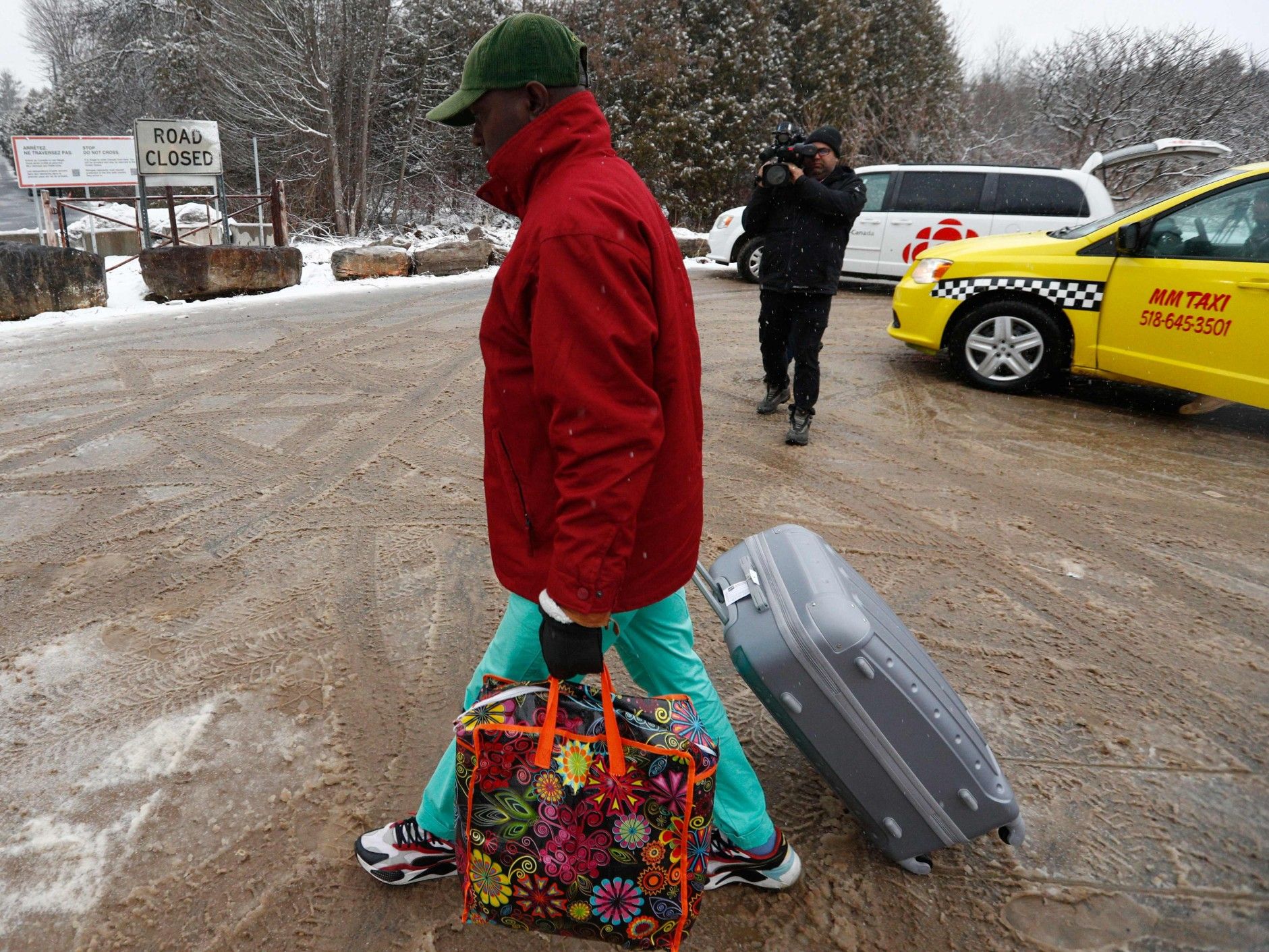
An asylum seeker arrives at the Roxham Road border crossing in March, 2023. Canada has seen a surge of refugees with the U.S. crackdown on illegal immigrants.

As fears of refugee deportation mount in the United States, a surge of asylum seekers is turning to Canada — only to find a border that is getting increasingly hard to cross.

The number of refugee seekers processed by the Canadian Border Services Agency (CBSA) has shot up by 87 per cent between January and April.

In April, 494 ineligible refugee claimants from the U.S. were turned back at the Canadian border under the Safe Third Country Agreement, which bars most people from seeking asylum in Canada at the border. That’s up from 280 in January — a 76 per cent increase.

Growing refugee traffic at the Canadian border this year has emerged amid a looming clampdown on illegal immigration in the U.S. that experts say could trigger a flood of asylum seekers to Canada.

A controversial U.S. move in late March that paused protected legal status for refugees from Colombia, Haiti, Nicaragua and Venezuela (CHNV) is likely behind the spike, say immigration lawyers and researchers.

“That is what we would see as a major indicator towards potential migration flows northbound,” said Dan Anson, director general of intelligence and investigations for the CBSA. “Those… main groups… are likely going to be targets of potential enforcement and removal operations (in the U.S.)”

Toronto immigration lawyer Mario Bellissimo said his office has seen around a 200-per-cent jump in inquiries in the past week.

“Any time you have a dramatic announcement, it does prompt individuals to move,” he said.

On Tuesday, the federal government responded to “rising migration” concerns with new measures it says will make the country’s immigration and asylum systems “more responsive to new and developing pressures.”

Among those steps will be new ineligibility rules to “protect the asylum system against sudden increases.”

The CHNV parole program in the U.S. initially offered “parole” to certain Cubans, Haitians, Nicaraguans and Venezuelans to stay in the U.S. for two years. The Trump administration paused those protections on March 25, 2025.

The following month, asylum claims processed by the Canada Border Services Agency (CBSA) rose to 4,560, up from 2,940.

A federal judge blocked Trump’s order in April.

CBSA data released to the Investigative Journalism Bureau on Tuesday shows a drop in refugee removals at the border in May following that court order.

But the U.S. Supreme Court reversed the ruling on May 30, triggering renewed fears of deportation for migrants in legal limbo. An estimated 532,000 refugees from the four countries are now vulnerable to removal from the U.S while the back-and-forth court battle continues.

Rosanna Berardi, an immigration lawyer in Buffalo, N.Y., called the shifting legal restrictions in the U.S. for refugees an “emotional rollercoaster.”

“A lot of individuals will have to leave quickly and go elsewhere,” she said. “Canada would be the easiest place to go with respect to logistics.”

But those who do attempt to flee the U.S. clampdown by coming to Canada may face long odds of getting in.

Under the Canada-U.S. Safe Third Country Agreement, refugees must claim asylum in the first country they land in. Refugees coming from the U.S. cannot claim asylum in Canada unless they have close family in the country.

“They can attempt to come into Canada, but chances are they’re gonna be returned to the U.S. And with that, they’ll probably be held at the border,” said Evan Green, an immigration lawyer in Toronto.

But many refugees either don’t know about those restrictions or are too afraid to care, said Lori Wilkinson, a professor at the University of Manitoba specializing in refugee resettlement.

“At some point, there’s going to be people so desperate that it doesn’t matter what kind of laws we have,” she said. “With Nicaragua, I think people don’t understand there’s been a many years-long drought and you either starve and die, or you pick up everything and walk through the Darien Gap and take your chances.”

Kate Swanson, an immigration expert and international development professor at Dalhousie University in Halifax, said Haitians in the U.S. are heavily incentivized to come north given the long-standing humanitarian crisis and armed gang violence at home.

“Many of these individuals will look north for safety rather than face deportation back to the very conditions they fled,” she said. “Clearly, the urgent humanitarian crisis persists, and I imagine that many of these individuals, especially those with family in Canada, will try to find safety here.”

An economic crisis in Cuba has been worsened by natural disasters and blackouts that have at times left millions without power. In Venezuela, political repression and economic collapse have led to a refugee crisis.

The Investigative Journalism Bureau (IJB) at the University of Toronto’s Dalla Lana School of Public Health is a collaborative investigative newsroom supported by Postmedia that partners with academics, researchers and journalists while training the next generation of investigative reporters.

Our website is the place for the latest breaking news, exclusive scoops, longreads and provocative commentary. Please bookmark nationalpost.com and sign up for our newsletters here.