LP_468x60
on-the-record-468x60-white

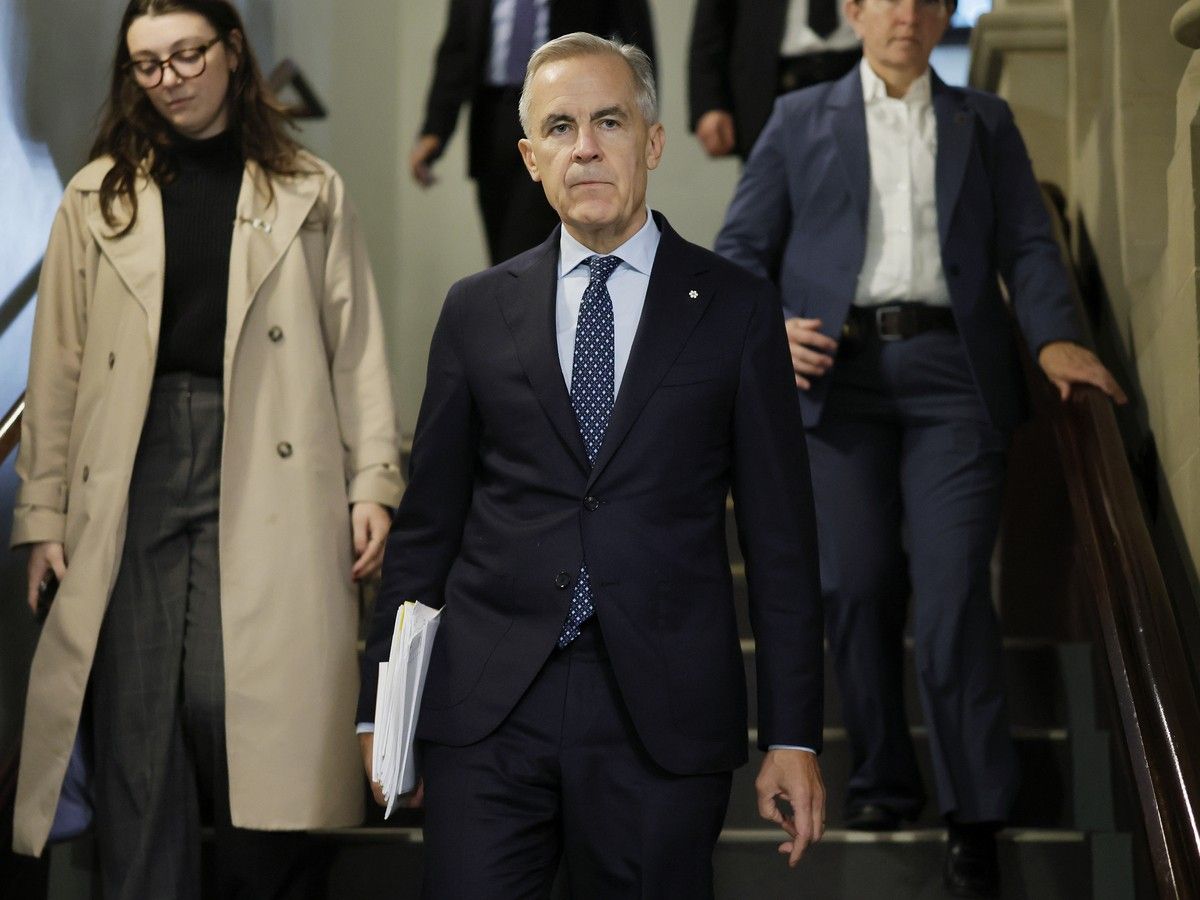
Prime Minister Mark Carney speaks to the media during a press conference at the Rio Tinto aluminum smelter in Saguenay Thursday August 6, 2026.

OTTAWA – Prime Minister Mark Carney said he plans to speak with U.S. President Donald Trump, as Canada braces for a 50 per-cent tariff set to hit $29 billion worth of Canadian goods in less than two days.

During a press conference in St. John’s, N.L. on Monday, Carney would not say what a good deal for Canada would look like and described the negotiations with the Americans as very intense and delicate.

The prime minister added that it’s not the time to talk about negotiations in public.

Canada-U.S. Trade Minister Dominic LeBlanc and Chief Trade Negotiator Janice Charette remained in Washington over the weekend, meeting with United States Trade Representative Jamieson Greer for a fifth time on Sunday.

LeBlanc and Charette are scheduled to meet with Greer again on Monday, with U.S. Secretary Howard Lutnick also in attendance.

Sources told the National Post on Friday that the U.S. and Canada remain “very far apart” on a deal. Canada is seeking relief on Section 232 tariffs on Canadian lumber, autos, steel and aluminum.

Canadian negotiators are also working to avoid new tariffs that will take effect under Section 338 of the Smoot-Hawley Tariff Act on Aug. 19, which will hit a range of Canadian goods from cement, clothing to alcoholic products.

Sources also said the federal government is considering ways to financially support impacted businesses, should the Section 338 tariffs go through.

Carney told reporters on Monday that his government has a plan for every eventuality.

The U.S. trade irritants cited as the reason for this latest round of U.S. tariffs include Canadian retaliatory tariffs on autos, U.S. alcohol boycotts in Canadian provinces and the dairy supply management system.

“Ontario will be prepared for any and every scenario,” said Ontario Premier Doug Ford, during an address in front of the Association of Municipalities of Ontario’s annual conference in Ottawa on Monday.

The premier reiterated his call for a team Canada response to the latest attack on Canadian workers and businesses.

More to come.

National Post

Our website is the place for the latest breaking news, exclusive scoops, longreads and provocative commentary. Please bookmark nationalpost.com and sign up for our newsletters here.
An Israeli flag is fixed to a street sign as police stand by off Pearl Street on the scene of an attack on demonstrators calling for the release of Israeli hostages held in Gaza, in Boulder, Co., on June 1, 2025. The FBI says U.S. hate crimes are declining, but Jewish people still account for more than two thirds of religion-based hate crimes in 2025.

Hate crimes were down about seven per cent in the United States from 11,404 incidents in 2024, to 10,606 in 2025, the Federal Bureau of Investigation said on Friday as part of an announcement of what it said was the “largest year-to-year decline in violent crime rates since FBI estimations began in 1936.”

Still, Jews were disproportionately targeted in hate crimes last year, according to FBI data. Of 2,572 religion-based hate crimes last year, 1,647 (64 per cent) targeted Jews — or 15 per cent of all hate crimes.

Jewish Americans, who number about 7.5 million, make up about 2.4 per cent of the U.S. population, according to the Pew Research Center.

Arabs were targeted in 130 incidents (5 per cent) and Muslims in 233 (9 per cent) last year, according to FBI data.

Of the 1,818 offences against Jews (13.8 per cent) last year, the overwhelming majority (1,003) involved vandalism or other property destruction. There were also 541 intimidation offences, 118 simple assaults, 51 aggravated assaults, 39 other larceny, 12 burglaries or breaking and entering, 11 thefts from buildings, seven robberies and six arson offences.

The FBI also recorded five weapon law violations, four extortion and blackmail offenses, three murders and non-negligent manslaughter offenses, three instances of pornography and obscene material, two con jobs, two thefts of motor vehicles, two instances of shoplifting and one count each of criminal sexual contact, drug or narcotic violation, hacking or computer invasion, identity theft, kidnapping or abduction, other unspecified offense, sodomy, theft from motor vehicle and weapon of mass destruction.

There was no other weapon of mass destruction offence against any other faith group, and just one other faith group was also a victim of murder and non-negligent manslaughter — two such offences targeted the Church of Jesus Christ of Latter-Day Saints, per FBI data.

In 2025, the only category of hate crime that exceeded the number of anti-Jewish crimes was the 3,048 anti-black hate crimes. Black people make up about 14.4 per cent of the population, according to the Pew Research Center, which suggests that in 2025, a Jewish American was about 225 per cent more likely to be the victim of a hate crime than a black person was.

Muslims are estimated to make up about one per cent of Americans, suggesting that in 2025, a Jewish American was about 190 per cent likelier than a Muslim American to be the target of a hate crime.

In 2024, Jews were targets of 2,095 (17.5 per cent) of the 11,949 hate crimes, and about 70 per cent of the 3,010 religion-based hate crimes, according to FBI data.

Arabs were targeted in 158 (5 per cent) of the religion-based hate crimes, and Muslims in 261 (9 per cent).

So far in 2026 — when FBI data draws on about 90 per cent coverage of the country in January to March, 85 per cent in April, 80 per cent in May, 75 per cent in June, 57 per cent in July and 21 per cent in August — the FBI has recorded 6,792 offenses as part of 5,741 hate crime incidents, 1,442 of which (25 per cent) have been religion-based hate crimes.

Jews have been targets of 829 hate crimes so far, or 57 per cent of all religion-based hate crimes and 14.4 per cent of all hate crimes.

Arabs have been targets of 65 (4.5 per cent) and Muslims 138 (9.6 per cent) of all faith-based hate crimes.

There have been about twice as many anti-black hate crimes as anti-Jewish ones, suggesting that so far in 2026, per available FBI data, Jews have been about 210 per cent more likely to be hate crime targets than black people have, and about 150 per cent likelier than Muslims have.

Our website is the place for the latest breaking news, exclusive scoops, longreads and provocative commentary. Please bookmark nationalpost.com and sign up for our daily newsletter, Posted, here.


Canadian Prime Minister Mark Carney shakes hands with employees at Rio Tinto, a major aluminum smelter in Saguenay Thursday August 6, 2026.

OTTAWA — Quebec, Newfoundland and Ottawa announced a deal Monday that would see a massive redevelopment and expansion of the Churchill Falls hydroelectric facility and both provinces set aside a decades-long conflict over electricity prices… for now.

Prime Minister Mark Carney and his Quebec and Newfoundland counterparts Christine Fréchette and Tony Wakeham were in Newfoundland to announce the new deal on Monday afternoon.

“After months of occasionally tense but always positive negotiations, we have achieved a rare win-win-win,” N.L. Premier Wakeham said, calling the original 1969 energy deal between Quebec and his province “one of the darkest chapters” of its past.

“What a great day it is for Quebec, Newfoundland and Labrador,” Fréchette added.

The renegotiated but non-binding deal promises to boost energy production at the Churchill Falls hydroelectric facilities significantly, as well as commits to build a long-debated production facility at nearby Gull Island.

Both provinces noted that the deal would not have happened without significant federal government investment. According to a release, Ottawa is committing up to $10 billion and promising to expedite approvals for the construction projects by referring it to the new Major Projects Office.

Plans to expand existing facilities and building the Gull Island power project as well as an onshore wind energy project and new transmission lines to Labrador in Quebec would triple the generating capacity of Churchill Falls to 14,000 megawatts of renewable power, Carney said.

“That is more than the entire generating capacity of BC Hydro. It’s more than double the output of Bruce Power, the largest nuclear plant on this continent. It is the equivalent of 18 Hoover Dams in America, at its current operating capacity,” the prime minister said, calling it the largest renewable energy investment in Canada’s history.

In a technical briefing for reporters Monday morning, Newfoundland government officials said much of the current agreement is non-binding until the deal if completely finalized and approved likely by the end of the year.

That means the agreement risks getting upended for the second time in two years if the Parti Québécois gets elected in the province’s upcoming provincial election in October. The PQ currently leads in provincial opinion polls.

The PQ previously told National Post that if elected, it would try to redraft any deal to include further compensation for the province’s historic loss of the territory of Labrador roughly one century ago. That could explain why both provinces moved to sign a deal before the provincial elections are called.

At the press conference, Fréchette admitted that the PQ could rip up the deal if it forms the next provincial government.

“It’s a possibility,” she argued.

With the Quebec election looming, both Hydro-Québec and N.L. Hydro hammered out a new agreement to update the terms of the 2024 memorandum of understanding to develop Gull Island and expand capacity at the Churchill Falls plant.

That deal was signed between then-Quebec Premier François Legault and former N.L. Premier Andrew Furey to replace a contentious 1969 energy deal that saw Hydro-Québec develop the Churchill Falls site and benefit from cheap hydroelectricity for decades. The deal caused generations of resentment in Newfoundland and Labrador, where it was perceived as a terrible deal on made the back of the province.

However, when Wakeham was elected N.L. premier in 2025, he promised to review the 2024 MOU. A report concluded the deal was not in Newfoundland and Labrador’s best interests and negotiations restarted between both sides.

Monday, Wakeham said that he was reneging on his promise to put the agreement to a provincial referendum and would instead reconvene the legislature in mid-September to debate the deal. The move could be tied to a desire to accelerate final negotiations before the Quebec election.

National Post, with files from Catherine Lévesque

cnardi@postmedia.com

Our website is the place for the latest breaking news, exclusive scoops, longreads and provocative commentary. Please bookmark nationalpost.com and sign up for our politics newsletter, First Reading, here.


Despite uncertainty around whether the tariffs will actually take effect, Canadians overwhelmingly expect negative consequences if they do.

Canada is just days away from 50 per cent tariffs taking effect on hundreds of exports, after U.S. President Donald Trump signed an executive order last month invoking the never-before-used Section 338 of the Tariff Act of 1930.

And Canadians are divided on what Ottawa’s response should be, with 36 per cent of respondents in an Abacus Data poll favouring counter-tariffs, even if they raise prices and risk escalation, compared to 30 per cent who want continued negotiations instead.

Meanwhile, just 18 per cent favour offering concessions to the United States, such as easing dairy restrictions or ending bans on American alcohol , even if doing so gets the tariffs removed.

Abacus Data notes that these responses suggest the public “want the government to be firm, avoid escalation where possible, and get an agreement without appearing to give too much away.”

However, this point sees some differences across regions and political affiliation, with just 12 per cent of Quebecers open to concessions, compared to 23 per cent in Alberta. Only 16 per cent of Liberal supporters and 14 per cent of NDP supporters favour concessions, compared with 26 per cent of Conservatives.

The survey examined Canadians’ awareness of ongoing tariff negotiations with the U.S. and found that Canucks are paying close attention to the dispute, with 91 per cent of respondents saying they have seen, read or heard at least a little about the threatened 50 per cent tariffs.

Elsewhere, 55 per cent say Canada should prepare to move on from CUSMA and build trade relationships with other countries, compared with 34 per cent who want to keep working to preserve the agreement. That view is shared by 60 per cent of Liberal voters, compared to just 43 per cent of Conservative supporters who are prepared to move on.

Abacus Data says that this apparent openness to a future where Canada is less dependent on CUSMA gives Carney room to resist U.S. pressure.

National Post previously spoke to trade analysts about what Canada’s response to the 50 per cent tariffs should be and, much like the Canadian public, they were split on the best approach.

Lawrence Herman, senior fellow at the C.D. Howe Institute and a specialist in international trade and investment law, said he thinks a list of possible tariff countermeasures should have been produced immediately after Trump’s announcement last month.

“You maintain those tariffs and enact them on the 19th of August, here’s the list that we’re going to use for our counter-tariffs,” he offered as an example of how Ottawa should have responded to the threat.

However, Ed Fast, Canada’s former minister for international trade under PM Stephen Harper, cautioned against retaliation, urging negotiators to keep the economic asymmetry between the two countries front of mind.

“If we retaliate with tariffs, as some have suggested, the Americans are much better able to absorb that retaliation than we are to absorb their tariffs against us,” he said. “As more and more tariffs get levied, the more difficult it becomes for Canada.”

Meanwhile, three senior federal or provincial government sources recently told National Post that despite frequent meetings between the Canadian and American negotiating teams, the two camps are “not even close” to making a deal .

Now, the sources say, the Canadian side is refocusing its efforts to find an “interim” deal to prevent sweeping new tariffs on Aug. 19.

That said, the Abacus Data poll found that Canadians aren’t convinced this latest round of tariffs will actually take effect, with 40 per cent of respondents putting the odds at 50/50, compared to 38 per cent who believe they will happen and just 10 per cent who think they are unlikely or definitely will not happen.

Despite this uncertainty, Canadians overwhelmingly expect negative consequences of new tariffs, with 70 per cent believing they would have a negative impact on the economy in their area, including 29 per cent who expect a very negative impact.

This view crosses regional lines, with 75 per cent in Quebec expecting a negative effect, along with 74 per cent in B.C. and Alberta, 68 per cent in Ontario, 65 per cent in Saskatchewan and Manitoba, and 58 per cent in Atlantic Canada. Overall, just nine per cent expect a positive impact.

Meanwhile, 74 per cent say the ongoing trade war over the past year and a half has had an impact on their household, including 30 per cent who describe the impact as major, a finding that remains consistent across regions and age groups.

The Abacus Data poll was conducted with 1,499 Canadians from August 7 to 12, 2026. The margin of error for a comparable probability-based random sample of the same size is plus or minus 2.5 percentage points, 19 times out of 20.

Our website is the place for the latest breaking news, exclusive scoops, longreads and provocative commentary. Please bookmark nationalpost.com and sign up for our daily newsletter, Posted, here.


On July 25, Belgian authorities announced the arrest of a

OTTAWA — The House of Commons public safety committee will meet Monday to decide whether to investigate potential security screening failures, after a Canadian woman was arrested in Belgium for allegedly spying on NATO.

On July 25, Belgian authorities announced the arrest of a “Canadian national of Chinese origin” on suspicion of spying for a third country while working as an intern at NATO’s central military headquarters in southern Belgium. The suspect was subsequently identified as Biwei “Claire” Zhang, a computer science and systems engineering graduate in her early 30s who’d previously held positions at multiple Canadian federal agencies.

Its also been reported that the overseas NATO internship was sponsored by Global Affairs Canada, and that the agency was responsible for conducting Zhang’s security clearance.

Five committee members — four Conservative MPs and a Bloc Québécois MP — said in a joint letter to Liberal MP Jean-Yves Duclos, the committee’s chair, that the “serious allegations of espionage” against Zhang warranted a special out-of-session meeting.

“These allegations raise urgent questions about how an individual now accused of spying was able to obtain an internship within one of Canada’s most important military alliances and what security screening, information-sharing and monitoring processes were in place at the time,” reads the letter.

The five MPs invoked a special order of House procedure to force Duclos to call a meeting on the matter.

The meeting is scheduled to start at 3 p.m. ET on Parliament Hill.

More to come.

National Post
rmohamed@postmedia.com

Our website is the place for the latest breaking news, exclusive scoops, longreads and provocative commentary. Please bookmark nationalpost.com and sign up for our daily newsletter, Posted, here.


Cape Breton-born fiddler Ashley MacIsaac has dropped his lawsuit against Google alleging that the tech giant is liable for the AI Overview’s statements, as well as the “foreseeable republication” that resulted in the concert cancellation.

Maritime musician Ashley MacIsaac has ended his defamation lawsuit against Google over an AI overview that falsely labelled him a sex offender.

The Cape Breton-born fiddler launched his $1.5-million claim earlier this year in the Ontario Superior Court of Justice, alleging that he lost a gig at a Nova Scotia First Nation after community members came across Google AI Overview descriptions falsely suggesting that MacIsaac had been sentenced for “sexual assault and internet luring” and placed on a sex offender registry for 20 years, among other erroneous statements.

However, MacIsaac’s lawyer filed a notice of discontinuance with the court on July 29 that ends his legal action. Reached by phone, MacIsaac declined to elaborate on the reason for the discontinuance.

“I have no comment. I’ll have to leave it at that,” he said. “I appreciate the opportunity to speak to media when I feel it’s necessary, but today I don’t.”

Toronto lawyer Maanit Zemel is one of many defamation lawyers mourning the missed opportunity for a full trial in the case.

“This generally means they’ve come to some kind of agreement and they can’t provide the settlement details because they’re privileged,” she explains.

MacIsaac’s now-withdrawn claim alleged that Google was liable for the AI Overview’s statements, which appeared to confuse him for a Newfoundland man with a similar name who was convicted of sexual assault, as well as the “foreseeable republication” that resulted in the concert cancellation.

“As the creator and operator of the AI Overview, Google is also liable for injuries and losses arising from the AI Overview’s defective design,” the claim continued, alleging that the tech giant had not taken reasonable steps to prevent harm to individuals when its AI system returns false information.

 The Google logo at the company’s Bay View campus in Mountain View, California.

Google’s Canadian lawyer did not respond to a request for comment, but in press coverage at the time of the concert cancellation, a company spokesperson pointed out that the search results linking MacIsaac to the criminal offences no longer appeared in the AI Overview, adding that: “When issues arise — like if our features misinterpret web content or miss some context — we use those examples to improve our systems, and may take action under our policies.”

Zemel says she was not surprised to see the case cut short, noting that few individuals have the resources to take on a company the size of Google. Importantly, she says the tech giant may have had its own incentive to settle the case without a formal ruling.

“Google do tend to fight if they think they can set their own precedent, but this is not the kind of case they want to make a precedent of,” she says. “I certainly wouldn’t be advising them that it’s one worth fighting if I was Google’s lawyer.”

While Google and other search engines enjoy considerable protection when indexing or linking to defamatory material thanks to a landmark 2011 Supreme Court of Canada decision known as Crookes v. Newton, Zemel says that the facts in MacIsaac’s case were quite different.

In Crookes, a majority of the nation’s top court ruled that hyperlinking to a defamatory statement does not constitute “publication” of the material, as long as the hyperlink itself does not repeat or endorse the defamatory material.

Meanwhile, in MacIsaac’s case — which remains unproven in court — there was a strong case for arguing that Google itself was the publisher of the allegedly defamatory material, Zemel says.

“It’s never simple in a defamation case, but I think a court is likely to consider the AI-generated overview as content created by Google itself. At that point, they would no longer be a re-publisher, but the original author,” she says. “The law is pretty tech-neutral, so my position would be that it doesn’t matter whether it was their software or a person who wrote it; they’re liable the same way.”

Howard Winkler, a veteran media and defamation lawyer with more than 40 years of experience, had also been following proceedings eagerly and was disappointed with the outcome.

“This is unfortunate in terms of the development of important and timely legal principles,” he says.

Unanswered questions left by the discontinued case include whether an AI creator can indeed be considered a publisher of information, whether the owner of an AI platform can rely on an “innocent dissemination” defence and whether cases involving AI hallucinations could be handled under product liability law dealing with defective products.

“Regrettably, we will now have to wait a little longer to get clarity,” he added.

Zemel won’t be holding her breath, considering the notoriously slow progress that cases make through the court system.

“Eventually there will be a decision. It’s just a matter of time,” she says. “And by then, the technology will probably have changed.”

Our website is the place for the latest breaking news, exclusive scoops, longreads and provocative commentary. Please bookmark nationalpost.com and sign up for our newsletters here.

The Toronto Metropolitan University in downtown Toronto.

Jewish students, faculty and staff at Toronto Metropolitan University (TMU) say they have stopped wearing religious symbols, changed their routines, avoided campus events and, in some cases, concealed their identities because they fear harassment or assault.

Those accounts are among the findings in a new external review of the TMU’s campus environment, which paints a picture of a “fractured campus environment” where the climate for its Jewish community has drastically worsened since Oct. 7, 2023, and Israel’s subsequent war with Hamas in Gaza.

Before Hamas’ terrorist attack on Israel, most of the Jewish community interviewed for retired Justice Mary Lou Benotto’s review felt the school was a safe and inclusive space where they were free to express their identity without fear of reprisal.

“Many Jewish students, faculty, and staff described October 7 as a turning point in their experience of campus life,” the former Ontario Court of Appeal and Superior Court judge wrote in her 192-page report. “Activities and expressions that were previously unremarkable became sources of discomfort or concern.”

One Jewish staff member said they “just stopped talking about anything Jewish.”

Another described a university where they had once felt able to “bring your whole self to work,” but said the same confidence no longer extended to being Jewish.

A Jewish lecturer who normally wore a Star of David necklace said they no longer do. (The report doesn’t use gender-specific pronouns when talking about participants’ experiences.)

“I will not wear it at TMU,” they said, explaining that doing so would “feel incredibly unsafe” because they fear being physically or verbally assaulted.

Jewish students and faculty said they had become more guarded about what they said, how they dressed and where they went. Some described calculating how much information could be safely disclosed about Jewish events.

One participant said even organizing a Shabbat dinner — a “simple dinner, nothing political” — requires a security assessment of the guest list and advance information about the event.

Some Jewish students felt unsafe attending Hillel or Students Supporting Israel (SSI-TMU) events when anti-Israel demonstrations were taking place nearby. They described aggressive filming, megaphones directed at Jewish tables, demonstrations outside private Jewish gatherings and vandalism as part of a pattern that made Jewish campus life feel increasingly fraught with danger.

In addition to witnessing a marked increase in antisemitic graffiti in washrooms and common areas, participants reported being spat on, verbally harassed, and having objects thrown at them. In one incident, a masked individual threw spoiled milk at visibly Jewish students who were set up on campus.

 On Feb. 23, an unidentified person threw an open carton of past-dated milk at a group of Jews and Israelis participating in a student tabling event at Toronto Metropolitan University for Students Supporting Israel in partnership with StandWithUs Canada.

Other examples included individuals wearing Hamas-style headbands or combat clothing, and campus materials featuring automatic weapons, paraglider imagery they believed to be associated with the Oct. 7 attacks, and slogans such as “SMASH ZIONISM.”

One Jewish professor said that after objecting to students wearing Hamas badges for a planned photo they were told by an undisclosed person, “‘Well, then, you’re not going to be able to participate.’”

The review also found that social media was used to identify and publicly shame Jewish students.

“Examples described included posters, pamphlets, and online postings of Jewish student leaders with inverted red triangles over their heads, manipulated videos of confrontations posted publicly after encounters, and calls for removal of SSI-TMU as a student organization for hosting ‘war criminals.’”

Faculty members described classroom environments where statements were made that were regarded as antisemitic or dehumanizing.

Among the examples were Holocaust denial or minimization, the assertion that “academic power is rooted in Jewish supremacism” and should be “rooted out of academia,” that violence against Jews might be justified to support activism, and statements suggesting violence against Jewish children could be acceptable when their parents were perceived to support Israel.

“Several participants described these statements as particularly troubling because they were reported to have occurred in educational settings led by faculty or within spaces intended to foster learning, contributing to diminished trust in classroom neutrality and concerns regarding the safety and inclusion of Jewish students,” Benotto wrote.

She also drew a distinction between criticism of Israel and antisemitism. While the former is legitimate expression protected under the charter, she said, many Jewish participants experienced the word “Zionist” as an alternative to “Jewish,” and usually in a pejorative manner.

She and the reviewers heard and saw examples of calls for Zionists to be removed from campus and descriptions of them as “baby-killers” and “murderers.” Although some people using those terms maintained they were referring to political ideology or alleged support for Israel government actions, Jewish participants said the rhetoric was often indistinguishable from antisemitism.

“The redefinition of Zionism to incorporate genocide and the insistence that anyone who fails to actively support anti-Zionism is likewise culpable have contributed to an environment that has enabled antisemitism to flourish,” Benotto wrote.

The review was commissioned after two events were disrupted by Students for Justice in Palestine at TMU (SJP-TMU), with both incidents leading to arrests and charges.

In September, a forum with Minister of Artificial Intelligence and Digital Innovation Evan Solomon was cancelled after SJP-TMU protesters shouted “war criminal,” “baby killer,” and “murderer” at specific members of the audience. One woman was arrested after allegedly assaulting a security guard while being escorted out of the building.

The second was an SSI-TMU speaking event — held just off campus because the school denied the group space over safety concerns — featuring speakers with ties to the Israel Defense Forces.

SJP-TMU protesters mobilized at the location, which led to a confrontation during which a glass door was shattered and injuries were sustained. Several protesters were arrested when police arrived.

By not allowing the event to happen on campus with “stronger security, clearer conduct expectations, and enforcement of rules,” Benotto said “TMU effectively permitted a ‘heckler’s veto.’”

“Allowing the prospect of disruption to determine whether a lawful event may proceed risks undermining viewpoint neutrality and the University’s obligation to protect the expressive rights of all members of its community.”

Benotto said the two incidents “were symptoms of a deteriorating campus climate that, absent decisive institutional action, are likely to recur.”

The review of the incidents determined the university already has policies in place to address the conduct, but hasn’t applied them consistently. The lack of enforcement and ambiguity around freedom of expression and protest has fueled the conflicts and leads many to think there are few consequences, she said.

“The University cannot resolve the conflict in the Middle East or eliminate disagreement, grief, anger, or competing historical narratives,” Benotto concluded. “It can, however, establish clear behavioural expectations, protect the rights of all members of the community, and enforce its policies consistently, transparently, and predictably.”

 Students were injured when an off-campus gathering organized by a Jewish group at Toronto Metropolitan University was broken into by anti-Israel protesters on Nov. 5, 2025.

The review includes a series of recommendations, the most consequential of which is that the school adopt the International Holocaust Remembrance Alliance working definition of antisemitism to provide a clearer framework for distinguishing between protected political expression and discriminatory conduct.

“Without the guidance of IHRA, Jewish people at TMU have less protection from antisemitism than the rest of Canada,” she wrote.

It also calls for faster responses to misconduct, a simpler complaints process, stronger enforcement of university rules, regulation of online harassment and targeted filming, and mandatory education for incoming students on respectful conduct and the boundary between protest and harassment.

“Freedom of expression, safety, inclusion, and institutional neutrality are not competing objectives; the success of each depends on the protection of the others,” the report reads.

“Maintaining that balance requires clear expectations, consistent enforcement of the university’s policies, and a shared commitment to ensuring that disagreement does not give way to intimidation or the silencing of others.”

TMU, in response, announced Friday that it was creating a task force on campus expression, antisemitism and community to “carefully consider and respond to every recommendation … as well as provide an implementation blueprint to the university by March 2027.”

“Many of the issues the report identifies are complex, but it is our responsibility to carefully review each of the recommendations. We know we have work to do and we accept this responsibility,” TMU president and vice-chancellor Mohamed Lachemi said in a news release.

Noah Shack, CEO of the Centre of Israel and Jewish Affairs, urged the school to fully and immediately implement the Benotto report’s recommendations.

“With classes set to resume next month, it is chilling that TMU announced a ‘Task Force’ to ‘consider and respond’ to Justice Benotto’s recommendations with an ‘implementation blueprint’ by March 2027,” he wrote on X.

“Students should not be expected to wait for another school year to pass without change.”

Our website is the place for the latest breaking news, exclusive scoops, longreads and provocative commentary. Please bookmark nationalpost.com and sign up for our daily newsletter, Posted, here.


Local Input~ Eli Lilly & Co. corporate headquarters stand in Indianapolis, Indiana, U.S., on Monday, May 21, 2012.

OTTAWA — CRA found some revenues for the U.S. pharmaceutical giant behind diabetes and weight-loss medication Mounjaro lower than expected and suspects the company didn’t pay enough taxes in 2020, National Post has learned.

New Federal Court filings reveal that the Canada Revenue Agency (CRA) launched an audit of pharmaceutical company Eli Lilly’s Canadian arm in 2024 after noting that the firm’s 2020 profit margins appeared suspiciously below the norm.

“The Agency determined that Lilly Canada acquired all its inventory from related offshore entities with the bulk of the inventory coming from Ireland, a low tax jurisdiction,” reads the CRA’s lawsuit filed July 31.

“It further determined that Lilly Canada’s profit margins were below the margins typically earned by independent entities involved in the marketing, promotion, and distribution of pharmaceutical products, signaling potential transfer pricing issues.”

The lawsuit is the first public revelation of CRA’s ongoing audit of the U.S.-based pharmaceutical giant behind major diabetes medications such as GLP-1 Mounjaro as well as Prozac and Cialis. Eli Lilly is considered the most valuable pharmaceutical company in the world.

The CRA’s audit is still ongoing and there has not been any public finding of wrongdoing against Lilly Canada. But the process could lead to a battle over millions of dollars in taxes over how the company and CRA interpret transfer payment obligations.

“Lilly Canada disagrees with the characterizations in the Canada Revenue Agency’s application and we will respond formally through the Court process in due course. We are confident in our position and remain committed to working constructively with the Canada Revenue Agency to resolve the matter,” company spokesperson Ethan Pigott said in a statement.

The CRA and Lilly Canada are locking horns very early in the audit. The CRA’s lawsuit is asking the Federal Court to oblige the pharmaceutical giant to fork over certain documents it has so far refused to disclose as part of the tax agency’s verification.

The lawsuit reveals that the tax agency is interested in transactions of monies and certain goods and services between Eli Lilly’s Canadian and Irish arms as part of what is called transfer pricing.

In particular, the tax agency is looking into the company’s transactions pertaining to distribution and marketing activities, clinical research and development services and other “support services” for the company’s other foreign entities.

Transfer pricing rules in Canada state that a Canada-based company selling or purchasing goods and services from one of its foreign divisions must price those transactions appropriately to “ensure the appropriate amount of profit is reported in Canada.”

The rules aim to prevent a company from selling itself products at artificially low prices to pay fewer taxes, for example.

In a sector like pharmaceuticals where most large companies are multinationals, transfer pricing is a huge part of tax filings and business considerations, said Matthew Wall, an accountant and preeminent Canadian specialist in transfer pricing.

He said it wasn’t surprising that CRA was looking into Lilly Canada’s transfer pricing accounting, as the company likely declares hundreds of millions of dollars of such transactions yearly in Canada. That makes them “target number one” for CRA.

“So, a small error would have a big impact on the on the Canadian profits and taxes,” he told National Post.

What’s unique about this case is the length of the audit, said Wall, who is frequently called upon as an expert witness of transfer pricing in court.

Normally, these audits last up to two years. In this case, the audit is two years old and seems far from complete, Wall noted.

“This is a high-stakes game,” he said.

The CRA declined to comment, citing the ongoing legal case.

National Post

cnardi@postmedia.com

Our website is the place for the latest breaking news, exclusive scoops, longreads and provocative commentary. Please bookmark nationalpost.com and sign up for our politics newsletter, First Reading, here.


The front door of the residence of the man alleged to have made threats to the U.S. consulate is seen in Clayton Park in Halifax on Friday August 14, 2026.TIM KROCHAK PHOTO

The bomb scare at Halifax’s U.S. consulate that shut down much of the city’s downtown last week had its echoes in Clayton Park, the suburb established in the 1960s that in recent years has been a magnet for the port city’s burgeoning population of immigrants.

As downtown was swarmed by police, including bomb experts who found potentially explosive items in a car outside the consulate, the investigation took Halifax police to the quiet cul-de-sac home of the man charged in the episode.

Although no alleged motive has been discussed, the suspect is from Iran, where the Islamic Regime is fighting a war with the United States.

Days later, neighbours told a visiting reporter that the family was new to the area. They also said newcomers should leave their political troubles behind when they come to Canada.

“Everyone has their opinion, but it should not impact others’ lives,” said Ashok Kumar, who lives near the suspect and his family.

“If you’ve got an opportunity to come to a developed nation, you should do your job and feed the family, pay taxes and follow the rules … Why do you want to take all the baggage here and dump it?”

The suspect’s legal aid lawyer confirmed his client is Iranian, but could not confirm reports that he came to Canada in 2024.

Kumar, who came to Canada from India nine years ago and became a Canadian citizen in 2023, cautioned against painting all immigrants with the same brush. “It should not be generalized.”

The father of two young children isn’t particularly worried about safety in the neighbourhood.

“When somebody already informs the authorities that ‘I am doing this,’ to me it looks like they just want to get caught or give a message,” said the registered nurse.

“It’s definitely different than a school shooting or something like that, which is really scary.”

The suspect was arrested last Monday morning, shortly after police investigating a bomb threat received the day before discovered his vehicle in the parkade at Purdy’s Wharf, the harbourfront office and retail complex where the U.S. consulate is located. The headquarters of Canada’s East Coast navy is also nearby.

 A member of the Halifax Regional Police bomb disposal unit walks towards a parkade during a bomb threat investigation in Halifax on Monday, Aug. 10, 2026.

A propane tank was visible in the vehicle, along with several containers believed to contain flammable liquid, prompting Halifax Regional Police to call in their explosive disposal unit and evacuate a large area of the downtown. A suspicious bag was also found nearby.

Kumar is pleased police took the alleged threat seriously by evacuating a good chunk of the city’s downtown core around Purdy’s Wharf.

“One hundred per cent,” Kumar said. “I’m really happy. You never know.”

Kumar has lived on the street for two years and he believes the suspect’s family was already living there when he moved in.

He’s never exchanged words with the suspect, who speaks Farsi and Arabic.

“I think language barrier is the problem,” Kumar said.

“Any new language after you are an adult, I think, is difficult.”

Few neighbours in the area seem to know each other.

“Nobody talks here; everybody works,” Kumar said.

A young boy came to a second-storey window at the suspect’s home Friday and said he wasn’t home alone. But nobody opened the door when the National Post rang the bell.

Druv Mashashruwala, who also lives in the neighbourhood, said some of the suspect’s children go to school with his kids.

Mashashruwala came to Halifax from India a decade ago and became a Canadian citizen in 2020.

“I believe, personally, that we need to accept the culture of the country where we are moving,” he said.

“I am not saying forget about your roots 100 per cent or your beliefs 100 per cent but try to adapt to a culture which is where you’re moving … Protesting here is not going to improve the situation there — trust me.”

 People are seen leaving the Barrington Hotel in downtown Halifax after a bomb threat to the nearby U.S. Consulate.

Mashashruwala said the suspect’s 14-year-old son was wandering the cul-de-sac in the hot sun last Monday while police searched his home.

The business analyst said he got the boy to come in for something to drink and some shade.

“He was a good chap,” Mashashruwala said. “I personally felt it was too hot to be outside without water.”

The boy “was a little bit traumatized,” he said. “I told him if you need any help, just knock on my door.”

His older sister eventually came to Mashashruwala’s house for a drink, as well as the suspect’s wife and 11-year-old.

“I offered coffee to the mom. They all were tired, trust me … They all were stressed.”

Police, who descended on the street in large numbers last Monday morning, didn’t allow the family back into their home until around 8 p.m. that night, he said.

“They had no place to go,” Mashashruwala said.

“I wish they get settled very soon, whatever has happened, they try to forget and move ahead with their life.”

Rebecca Ruan, who has lived in the area for nine years, said she hasn’t spoken with the suspect, but one of his children catches the school bus with her kids.

“I’m not sure if they’re new to Canada, but they’re pretty new to this place,” she said.

Ruan is from China, but she immigrated to Canada 16 years ago and is a permanent resident here.

She’s not keen on newcomers bringing their beefs to Canada.

“I don’t really like that here,” she said.

“If it’s personal anger related to the United States, why do that in Canada?”

Ali Assakereh, 54, is charged with threatening to “destroy or damage” property belonging to the U.S. Consulate, and with public mischief for misleading police by reporting a bomb threat. A bail hearing for Assakereh that was slated for last Friday was put over until this coming Wednesday.

Our website is the place for the latest breaking news, exclusive scoops, longreads and provocative commentary. Please bookmark nationalpost.com and sign up for our daily newsletter, Posted, here.


Toronto police are looking for this man in connection with an 'unprovoked' downtown stabbing that left the victim seriously injured.

Toronto police have released a photo of a man with extensive facial tattoos who allegedly came up behind a total stranger and stabbed him, unprovoked, at 8 a.m. Friday at Yonge and Bloor, one of the city’s busiest intersections.

The stranger was seriously injured but is expected to survive, police said.

“The male victim was walking alone on the sidewalk when he was approached from behind,” police said.

“The suspect, unprovoked, stabbed the victim.”

His alleged attacker fled. Initial reports described him as a bearded male, and a photo that appeared to be taken from security cameras showed a man wearing a backwards baseball cap.

But a release late Saturday included a suspect photo that showed a man whose face and neck are covered in tattoos, including a large cross on his forehead.

Police named the suspect and two charges against him: Anthony Christopher David McLaughlin, 36, is wanted for assault causing bodily harm and assault with a weapon.

It noted he was last seen wearing a “We The North” ballcap.

The attack comes as crime and quality of life are among the top issues in a Toronto municipal election set for Oct. 26. A day earlier, a police officer was shot a few blocks away at Bloor and Sherbourne while arresting a suspect in the theft of an e-bike.

Our website is the place for the latest breaking news, exclusive scoops, longreads and provocative commentary. Please bookmark nationalpost.com and sign up for our daily newsletter, Posted, here.