LP_468x60
on-the-record-468x60-white

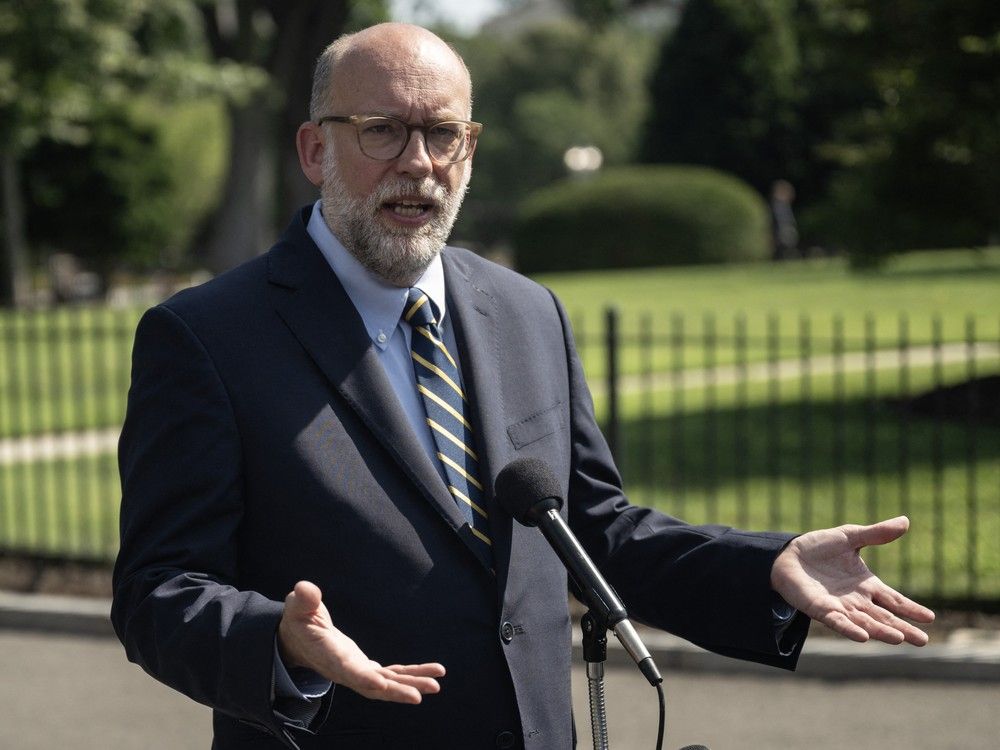
Director of the U.S. Office of Management and Budget Russell Vought speaks to reporters outside the West Wing of the White House in July 2025. Donald Trump met with Vought on Oct. 2 to determine which federal agencies to cut amid a federal government shutdown that he has hailed as an

U.S. President Donald Trump appears to be warming to

“Project 2025,”

the blueprint for governance developed by American conservative thinkers that he distanced himself from during the election.

Project 2025 was originally set out as a policy and personnel “playbook” should Trump win re-election, aiming to quickly implement sweeping changes across the federal government. During the 2024 election campaign, Trump

disavowed Project 2025,

distancing himself from the content and its creators, claiming he knew nothing about it or the people involved.

“I’m not going to read it,” Trump

said at his first presidential debate

against then vice president Kamala Harris. “Everybody knows what I am going to do.”

However, that has changed since his second-term inauguration. Key contributors and authors involved in Project 2025 have been placed in

influential roles

within the Trump administration, a number of its policy proposals appear to have been enacted and Trump posted on social media about Project 2025 on Thursday.

Here’s what you need to know about Project 2025 and what Trump has said about it.

What is in Project 2025?

Its origins are as a comprehensive conservative policy and personnel initiative designed to prepare for a transition into a new Republican administration. The 900-page playbook was produced by

The Heritage Foundation

and an alliance of over 100 conservative organizations.

The Project 2025 website is tracking

318 objectives

across 34 federal agencies. It has garnered widespread attention due to its scale and intent to replace thousands of civil servants with loyalists and roll back what are deemed to be progressive regulations and programs. To date, the website states that 48 per cent of its objectives have been implemented, including some by the White House itself.

The

core aim is to impose sweeping changes

in U.S. government structure and policy. This includes dismantling the so-called “administrative state,” consolidating executive power under the president, eliminating certain federal agencies, dismissing senior civil servants, and rolling back regulations regarding environment, civil rights, and diversity. The project also calls for significant changes to abortion policies, LGBT rights, and education, among other areas.

It consists of

four main components

: a policy guide (“Mandate for Leadership 2025”), a database of vetted conservative personnel, candidate training (the “Presidential Administration Academy”), and a 180-day playbook for executive actions.

While many of the policies outlined in its 900-plus pages align closely with the agenda that Trump was proposing during the election — particularly on curbing immigration and dismantling certain federal agencies — others called for action Trump had never discussed, like banning pornography, or Trump’s team was actively trying to avoid, like withdrawing approval for abortion medication.

What did Trump and his team say about Project 2025 during the election?

“I know nothing about Project 2025,” Trump insisted in July 2024. “I have no idea who is behind it. I disagree with some of the things they’re saying and some of the things they’re saying are absolutely ridiculous and abysmal. Anything they do, I wish them luck, but I have nothing to do with them.”

Trump’s campaign chiefs were equally critical.

“President Trump’s campaign has been very clear for over a year that Project 2025 had nothing to do with the campaign, did not speak for the campaign, and should not be associated with the campaign or the President in any way,” wrote Susie Wiles and Chris LaCivita in a campaign memo. They added, “Reports of Project 2025’s demise would be greatly welcomed and should serve as notice to anyone or any group trying to misrepresent their influence with President Trump and his campaign — it will not end well for you.”

What is the Republican party history behind it?

Project 2025

builds directly on
a tradition of conservative transition planning
, most notably the “Mandate for Leadership” framework first published by The Heritage Foundation in 1981 for Ronald Reagan’s incoming administration, influencing how Reagan reorganized the federal government.

Heritage and allied think tanks produced

similar blueprints for subsequent Republican transitions

, including those for George W. Bush in 2001 and Donald Trump in 2016, but Project 2025 is the most expansive to date.

How might it guide the Trump administration’s actions?

A few days into the federal government shutdown, Trump posted on social media about meeting with

Russell Vought

— one of Project 2025’s chief architects and the director of the federal Office of Management and Budget (OMB) — to

coordinate his administration’s handling of federal workers

.

“I have a meeting today with Russ Vought, he of PROJECT 2025 Fame, to determine which of the many Democrat Agencies, most of which are a political SCAM, he recommends to be cut, and whether or not those cuts will be temporary or permanent,” Trump wrote on Truth Social, on Oct. 2.

He continued: “I can’t believe the Radical Left Democrats gave me this unprecedented opportunity.”

The federal government was thrown into a shutdown on Oct. 1, as Democrats held firm to their demands to salvage health care subsidies that Trump and Republicans in Congress have dismissed as something to possibly discuss later.

Trump has seized on the government shutdown as an opportunity to reshape the federal workforce, threatening mass firings of workers and suggesting “irreversible” cuts to programs important to Democrats.

Trump’s post prompted former Vice President Kamala Harris to tweet that this was “always” Trump’s plan and “he’s implementing it right in front of our eyes.”

Asked about Trump’s reversal, White House spokesperson Abigail Jackson said, “Democrats are desperate to talk about anything aside from their decision to hurt the American people by shutting down the government.”


Who is Russell Vought?

Vought is an American

government official

and conservative political strategist. He is recognized as creating a sweeping conservative policy agenda designed to reorganize the federal government according to Trump-aligned priorities.

He was

also director of the Office of Management and Budget

during the first Trump administration.

Vought’s career

spans over two decades in Washington, including key roles as deputy OMB director, vice president of Heritage Action for America, and in leadership positions with several Republican policy organizations. He has played a leading role in drafting budget reforms, pushing for executive branch power, and advocating for deep cuts in federal spending and restructuring several agencies.

His

tenure has been marked by efforts to centralize power within the executive

, utilize government shutdowns strategically, and implement far-reaching administrative changes.

In his chapter in the blueprint, Vought made clear he wanted the president and OMB to wield more direct power.

“The Director must view his job as the best, most comprehensive approximation of the President’s mind,” he wrote. Vought described OMB as “a President’s air-traffic control system,” which should be “involved in all aspects of the White House policy process,” becoming “powerful enough to override implementing agencies’ bureaucracies.”

Sen. Mike Lee, R-Utah, said on Fox News Channel that Vought “has a plan, and that plan is going to succeed in further empowering Trump. This is going to be the Democrats’ worst nightmare.”

House Speaker Mike Johnson echoed that message, insisting the government shutdown gives Trump and his budget director vast power over the federal government and the unilateral power to determine which personnel and policies are essential and which are not.

Who else is tied to Project 2025?

Trump has close ties with many of its authors, including John McEntee, his former director of the White House Presidential Personnel Office, and Paul Dans, former chief of staff at the U.S. Office of Personnel Management.

Trump has stocked his second administration with the project’s authors, including “border czar” Tom Homan, CIA Director John Ratcliffe, immigration hard-liner Stephen Miller and Brendan Carr, who wrote Project 2025’s chapter on the Federal Communications Commission and now chairs the panel.

Heritage did not respond to a request for comment from The Associated Press on Thursday. But Dans, the project’s former director, said it’s been “exciting” to see so much of what was laid out in the book put into action.

“It’s gratifying. We’re very proud of the work that was done for this express purpose: to have a doer like President Trump ready to roll on Day One,” said Dans, who is currently running for Senate against Lindsey Graham in South Carolina.

National Post, with additional reporting from The Associated Press

Our website is the place for the latest breaking news, exclusive scoops, longreads and provocative commentary. Please bookmark nationalpost.com and sign up for our daily newsletter, Posted, here.


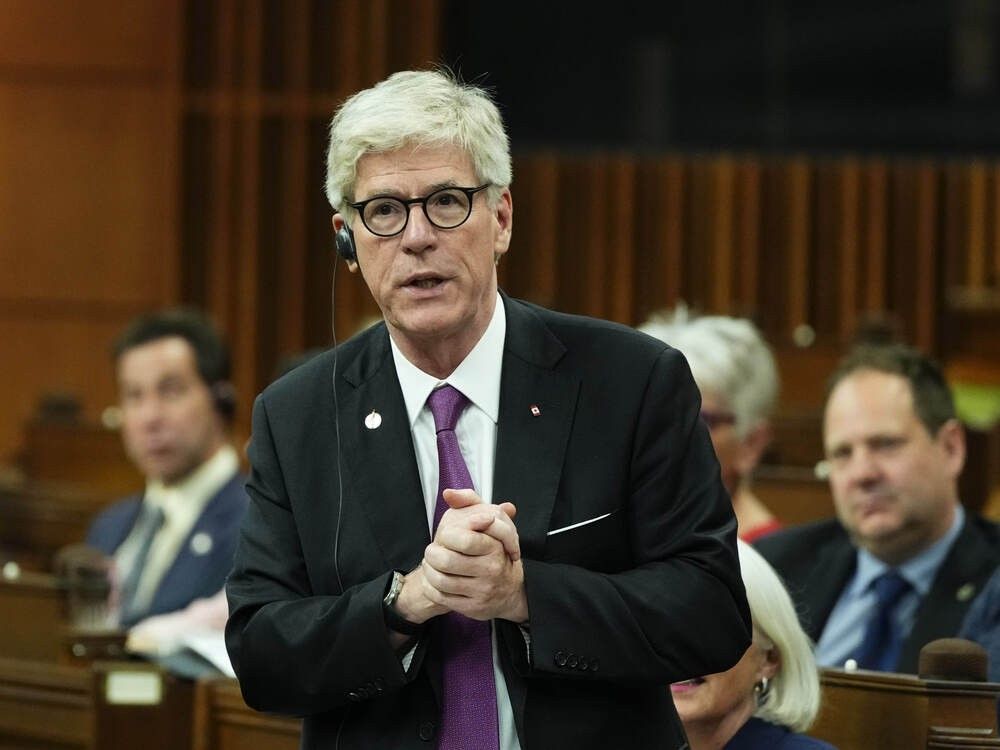
Minister of Energy and Natural Resources Tim Hodgson rises during Question Period in the House of Commons on Parliament Hill in Ottawa, Friday, June 20, 2025.

OTTAWA — Natural Resources Minister Tim Hodgson declined to say if the federal government would consider repealing the oil tanker ban on British Columbia’s north coast

to make way for Alberta Premier Danielle Smith’s pipeline project pitch

in a few months.

“It’s a hypothetical question right now, because there is no project before us,” Hodgson said on Friday on the margins of a battery investment announcement in Montreal.

Ottawa has been under pressure by the federal Conservatives, provinces and industry leaders to scrap some of its environmental regulations which they say have been stifling energy investments — while private businesses are building pipelines south of the border.

However, B.C. Energy Minister Adrian Dix said in a recent interview with National Post that the oil tanker moratorium has allowed the province the “social license” to develop liquified natural gas on the north coast.

“And secondly, of course, there’s the north coast itself. There’s a reason why the tanker ban was put in place to begin with. So, all of those are arguments we make,” he said.

Dix added the coastal First Nations have also made their position “clear.”

“There is no pipeline and oil tankers project or proponents that would be acceptable to us on the North Coast,” says Marilyn Slett, President of the Coastal First Nations-Great Bear Initiative and Chief Councillor of the Heiltsuk Tribal Council, in an open letter in July.

“Anything that proposes to send crude oil through our coastal waters is a non-starter.”

Dix said the province should have the final word on laws that concern its north coast.

“Should British Columbians, coastal First Nations, residents of the region, people of B..C, the government of B.C., have a role in a decision that’s about British Columbia and its coast? Yes,” Dix said. “As should the 20 federal Liberal MPs from British Columbia.”

One of those MPs, speaking on a not-for-attribution basis to discuss their views more freely, admitted Hodgson’s comments on the tanker ban were not at all reassuring.

“No, it’s not, because it means that we might consider it, and if we’re going to consider it, then that’s a problem,” they said.

The B.C. Liberal MP said it would be safe to assume that they, and many others within caucus, would be asking for the government to clarify its position on the issue.

The federal government will soon have to decide if it includes Smith’s new proposal to build an oil pipeline to British Columbia’s coastline on its list of nation-building projects.

That step, however, would require lifting the tanker ban that has been in place since 2019.

Smith said she would like to see her project listed in the federal government’s next tranche of projects, set to be announced by mid-November. This week, she claimed that the actual proposal will only be ready to be submitted to the Major Projects Office in May 2026.

Hodgson said that the government will only consider Smith’s project once it meets the federal criteria set out for projects to be considered for more streamlined approvals.

That includes having a high likelihood of successful execution, advancing the interests of Indigenous peoples, strengthening Canada’s autonomy and resilience, providing economic benefits to the country, and showing “clean growth potential.”

“They don’t think they’re ready to do that until next spring,” said Hodgson.

“When they bring it forward, like every other project, at that point, we’ll take a look at where they are, and we’ll evaluate it at that time,” he said.

National Post

calevesque@postmedia.com

staylor@postmedia.com

Our website is the place for the latest breaking news, exclusive scoops, longreads and provocative commentary. Please bookmark nationalpost.com and sign up for our newsletters here.



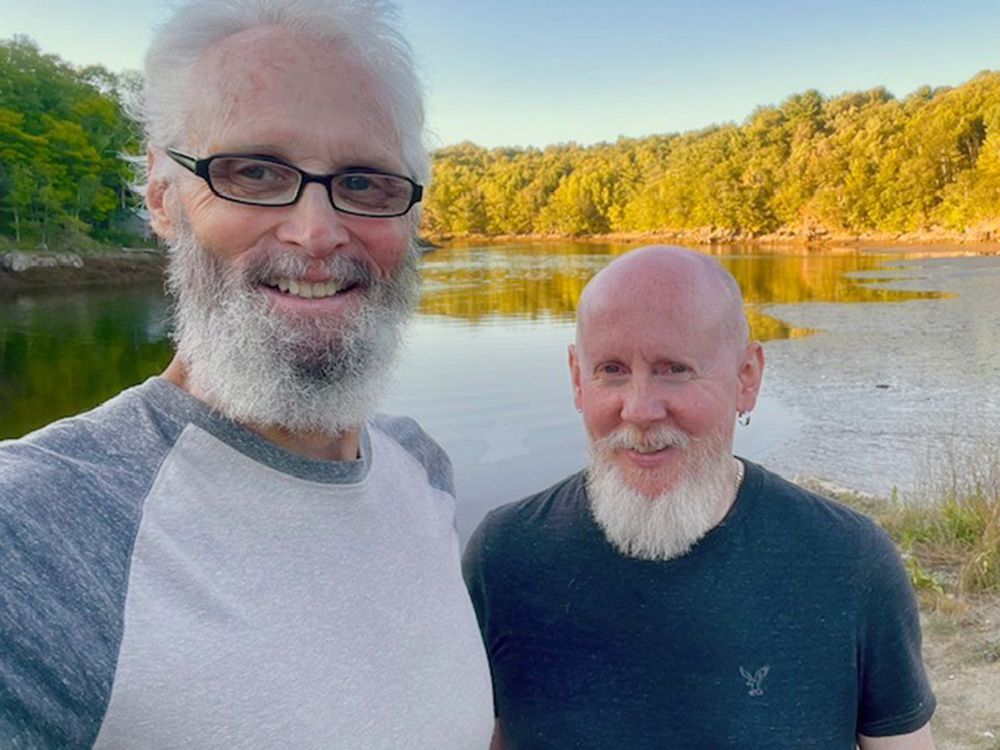
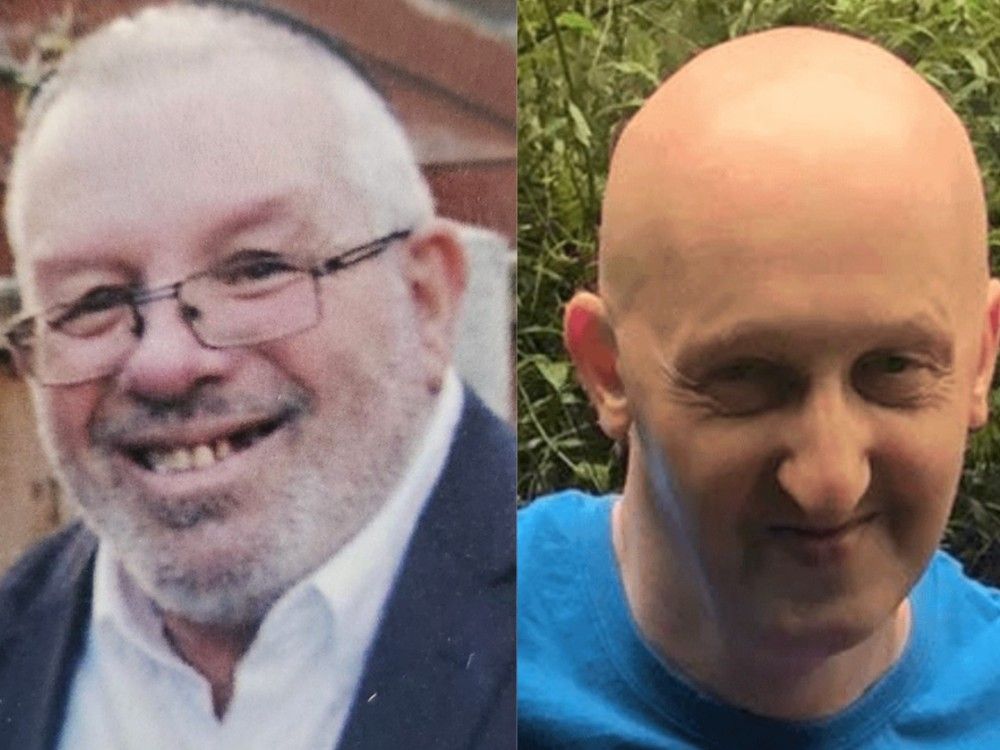
David Parker, left, and and Mark Grantham, right, were assaulted on Sept. 6, police say.

The moon over the Bay of Fundy along Nova Scotia’s coast on Sept. 6 was one night shy of full but showy enough to attract attention from Mark Grantham, a professional artist, and his partner David Parker, a musician who has played with symphonies around the world.

Outside their home on Highway 1 near Clementsport, about 200 kilometres west of Halifax, they were photographing the moon around 9 p.m., when a Mazda 3 smashed into a guardrail nearby.

The RCMP said Grantham and Parker offered to help the male driver inside, who had allegedly been drinking, but things went crazy.

The driver is accused of beating the two men severely, causing what police described as life-threatening injuries for both, one aged 61 and the other 58.

“Without warning or provocation, a stranger brutally attacked them and left them,” Grantham’s sisters said online.

That’s what the RCMP believe as well.

“I think they were in the wrong place at the wrong time,” Constable Mandy Edwards said. Police say the accused driver is known to police for past acts of violence.

What neither Grantham nor Parker knew at the time is that shortly before the Mazda crashed, the driver was allegedly involved in a different altercation, with someone he knew, and then left the scene in the car. A 46-year-old man, also from Clementsport, received non-life-threatening injuries in that prior incident, police said.

After the assault on Grantham and Parker, the driver allegedly abandoned the car and ran.

The two older men’s injuries were significant. They were taken to a local hospital and then transferred to Halifax for a major trauma centre because of the severity of their injuries.

Grantham is an architect whose paintings of urban and rural landscapes have been shown and celebrated throughout Atlantic Canada. Parker has worked with symphonies around the world, including the Kitchener-Waterloo Symphony, the Barcelona Symphony Orchestra, the Israel Sinfonietta and the Quebec Symphony Orchestra, as well as principal horn with Symphony Nova Scotia.

Almost a month since, they remain unable to return to work, family said on a GoFundMe fundraising campaign to help the two men recover and support them as self-employed artists who currently cannot work.

“They both required surgeries to repair their severe facial injuries. Mark also sustained a fractured arm. David received serious head trauma and spent three days in the ICU. Mark was discharged to be cared for at home, but David remains in hospital,” the fundraiser said.

The afternoon after the attack, Sept. 7, in nearby Digby, police arrested 25-year-old William Cedric Douglas Windsor, of Clementsport.

He has been charged with two counts of aggravated assault, assault causing bodily harm, assault, uttering threats, dangerous operation of a motor vehicle, operation while impaired and two counts of failing to comply with a probation order.

Windsor is scheduled to appear in Annapolis Royal provincial court for a bail hearing on Oct. 8.

A family friend of Grantham and Parker said they are not speaking with media at this time.

“They have begun what doctors expect will be a long and challenging road to recovery. While the suspect has been arrested … it doesn’t undo the trauma and damage inflicted on these two innocent people,” reads a statement.

“Mark and David will both require ongoing medical care, physical therapy, and dietary support. David will also require cognitive rehabilitation. They will be unable to work for the foreseeable future…. The financial burden of this senseless attack is creating serious challenges during an already traumatic time.”

As of Friday,

the fundraiser

had raised $127,969 from 334 people.

“Mark and David have been touched by the support from friends, family, colleagues, and strangers alike. Your kindness has made a real difference during a difficult time,” Grantham’s sisters, Monica Grantham and Jenn Ferguson, wrote.

Chronicle-Herald and National Post 

Our website is the place for the latest breaking news, exclusive scoops, longreads and provocative commentary. Please bookmark nationalpost.com and sign up for our daily newsletter, Posted, here.


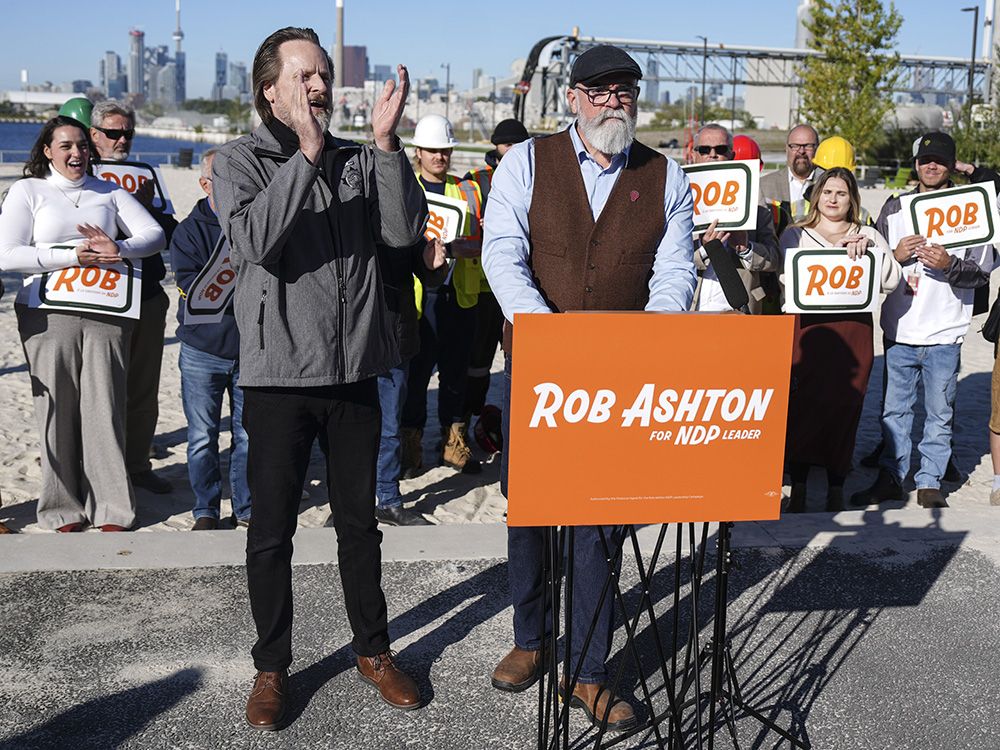
Rob Ashton, president of the International Longshore and Warehouse Union is joined by supporters in Toronto on Wednesday, Oct. 1, 2025, as he announces that he's running for the federal NDP leadership.

OTTAWA — British Columbia union leader Rob Ashton says he’s happy to take NDP icon Jack Layton’s mantle of the guy you’d have a beer with, but there’s one important caveat.

“It doesn’t have to be over a beer because we have a lot of people in this country who are in recovery and can’t do alcohol. I’m happy to meet anyone over a coffee, too

I kind of like tea myself,” said Ashton in an interview with the National Post.

Ashton, a burly career dock worker who heads up the International Longshore and Warehouse Union Canada, said that genuine one-on-one conversations will be key to rebuilding the NDP from the ground up, after the party had

its worst result ever

in April’s federal election.

“We’ve forgotten how to communicate with workers, for whatever reason, and that’s something we’ll have to re-learn,” said Ashton.

The NDP bled seats in blue-collar strongholds like Hamilton and Windsor, Ont., retaining just seven MPs, five short of the number needed for official party status.

Ashton became the third official candidate to enter the NDP leadership race on Wednesday, joining filmmaker Avi Lewis and Edmonton MP Heather McPherson.

He said in a short launch video that he wanted to make the NDP a workers’ party again.

“I’m running because I want our party to get back to its roots, putting regular working Canadians first,” says Ashton, speaking from a dock in B.C.’s Lower Mainland.


Ashton told the National Post that he hoped his blue-collar bona fides would make up for his lack of name recognition relative to the other two contenders.

“The difference between me and the other candidates is I’ve been a longshoreman for 30 years (and) I’ve represented workers for the last 20 years,” said Ashton.

He added that the first step to reconnecting with workers will be to stop talking down to them.

“Look, every industry has its type of language, whether it’s, let’s call it colourful language or parliamentary language, and I don’t think you fault workers for speaking a way in which they were brought up in their workplace,” said Ashton.

Even so, Ashton says he rejects the notion that there’s any inherent tension between plain language and inclusive language, pointing to

the media’s recent fixation

on the use of the term “cis man” in

the NDP’s leadership rules

.

“I’ve had this exact conversation with people, about the ‘cis man’ thing, and I’ve never had any trouble getting the concept across: ‘cis man’ means you were born with a penis and identify as a male. That’s it,” said Ashton.

He added that he announces his pronouns when he speaks at conferences because “everybody should feel welcome in the house of labour.”

Ashton conceded that conservatives like Ontario Premier Doug Ford and U.S. President Donald Trump have eaten into the left’s traditional blue-collar base in recent years, but said it would be a mistake for the NDP to follow the populist right’s lead into performative “anti-woke” politics.

“(Conservatives) rule on fear, and they rule on the unknown … They say, because that person doesn’t look like you, they’re stealing your jobs, and I’m going to make it better when I get elected. But when you actually look at what happens when they get into power, they don’t make anything better,” said Ashton.

“Division is the weapon of the boss, and any division always creates chaos and havoc within the working class,” he added.

Former NDP strategist Erin Morrison, now a

vice-president at Texture Communications

, said that Ashton’s everyman appeal could be a huge asset for him in what’s shaping up to be a wide-open race.

”Authenticity matters. Feeling like the person who is speaking is telling you the truth about who they are, where they come from, and what they are going to do for you is very important in politics. You want to feel like the person who is speaking understands what you’re going through,” said Morrison.

Ashton will make his debut on the national stage at the NDP’s first leadership candidate forum, set for later this month.

National Post


rmohamed@postmedia.com

Our website is the place for the latest breaking news, exclusive scoops, longreads and provocative commentary. Please bookmark nationalpost.com and sign up for our politics newsletter, First Reading, here.


Melvin Cravitz, left, and Adrian Daulby were killed during an attack at a synagogue in Manchester on Yom Kippur, Oct. 2, 2025. A suspect was shot dead by police at the scene.

Adrian Daulby lived near the Manchester synagogue where he was killed on Thursday after a terror attack.

The Heaton Park Hebrew Congregation was a 10-minute walk from the 53-year-old’s home,

The Telegraph reported

. On the morning of Yom Kippur, Judaism’s holiest day, he “lost his life in the act of courage to save others,” his

family said

. It is believed that Daulby died after being accidentally shot by police, who were trying to stop a suspect wielding a knife from entering the synagogue.

Another victim, Melvin Cravitz, 66, who was working as a security guard at the synagogue at the time of the attack, also died.

A man identified as

Jihad Al-Shamie

rammed passersby with his car outside the building and then stabbed people. He tried to get inside the synagogue, but Daulby, Cravitz and others, prevented him from entering.

 Flowers and tributes are pictured on the main road outside Heaton Park Hebrew Congregation synagogue in Crumpsall, north Manchester, on October 3, 2025, following an attack at the synagogue the day before.

Daulby’s family called him a hero. “He was a beloved brother, loving uncle to his four nieces and one nephew and a cherished cousin,” they said.

Both Cravitz and Daulby were regular members of the community, Brian Bell

told The Times

. He said Daulby “rose to the terrible danger, because he ran to close all the doors, back and front,” and it was while he was holding onto one of the doors that a bullet struck him.

A neighbour, Abdul Rahimi, who lived near Daulby for more than 20 years, said he was “like an angel,”

BBC News reported

. “He was a very good neighbour, very good guy, always helpful.”

Rahimi said Daulby was loved by his children, who would exchange gifts with him on holidays like Christmas and Eid.

Another neighbour, John Kelly, had known Daulby since they were young children. He called him “a lovely guy,”

The Telegraph reported

. The day before the attack, Daulby was captured on CCTV video going to Kelly’s home to feed his cat, which he did while Kelly was away. “I used to do his garden,” he said. Daulby’s father, who died three years ago, worked as a tailor, said Kelly.

Hussain, a member of a Muslim family who lived next door to Daulby and only wanted to provide his first name,

told The Times

that Daulby was a cancer survivor. He enjoyed tending to his garden and adored children. Daulby started going to synagogue again after his father died, said Hussain.

“I spoke to him on Tuesday and he was talking about how it was going to be a big celebration day but because he was not feeling too good he was not going to fast. But he was debating if he was going to the synagogue or not,” he said.

Cravitz was the security guard on duty at the synagogue when the suspect attacked, police revealed Friday. He “bravely prevented the attacker from gaining access” to the building.

“Melvin would do anything to help anyone. He was so kind, caring and always wanted to chat and get to know people,”

his family said

in a statement. “He was devoted to his wife, family and loved his food. He will be sorely missed by his wife, family, friends and community.”

 Members of the Jewish community comfort each other near to the Heaton Park Hebrew Congregation synagogue, in Crumpsall, Manchester, England, Thursday, Oct. 2, 2025 after Police reported that two people were killed and three others were seriously injured in a synagogue attack in northern England.

Friends of Cravitz, Elchonon and Hindi Cohen, said he would visit them often, The Times reported.

“Before every festival we would have him over for a meal,” said Hindi. “He was very beloved. He was a figure round here. If you saw Melvin you stopped and talked.”

She added that he had health issues, but “he was always with a joke and a smile.”

The couple told The Telegraph that Cravitz didn’t have his own children, but his wife Karen’s children from another marriage looked up to him as “a beloved uncle figure.”

Andy Kordas, who lived near Cravitz for many years, said he “always had a kind word,”

BBC reported

.

“He always used to come over and have a chat and ask me what I was up to,” said Kordas. “He always had a smile on his face. It’s just terrible.”

Three other victims who were injured during the attack remain in hospital.

One has been identified as Yoni Finlay by

BBC

and

Sky News

. According to reports, he was believed to be the victim accidentally shot by officers. Another victim, Andrew Franks, was identified by Sky News. Police have not confirmed who the injured victims are.

In an effort to prevent the suspect from entering the synagogue, Finlay was holding the doors of the building closed, BBC reported. He was injured in the gunfire and left the scene in a stretcher. He underwent surgery at the hospital.

A man speaking at a vigil held near the synagogue to honour victims said that his second cousin, whom he referred to as Andrew, was in a “really bad way” after being was stabbed in the neck and chest during the attack,

BBC reported

. He was trying to stop the attacker. He is “fighting for his life” in a critical care unit, said Robert Rosenfield.

Our website is the place for the latest breaking news, exclusive scoops, longreads and provocative commentary. Please bookmark nationalpost.com and sign up for our daily newsletter, Posted, here.


Prince William and Eugene Levy in the third season of The Reluctant Traveler, now streaming on Apple TV+.

Eugene Levy, famous for (depending on your generation and nationality) SCTV, the American Pie movies and/or Schitt’s Creek, recently had a pint of Guinness with William, the Prince of Wales. (William, born in 1982, loved American Pie.)

The Canadian comedian and actor has been circling the globe of late for

The Reluctant Traveller

, an AppleTV+ show that has seen him visit places as far-flung as Finland, Tokyo, South Africa and Utah.

Season three was devoted to his bucket-list locales, and the latest of those is London, England. And, as it turned out, an audience with a prince, after a hand-signed note arrives at his hotel, ending with: “Would be great to see you, with best wishes.”

“Was getting drunk with Prince William on your bucket list?” William asks as they head for a pub near Windsor Castle. Levy replies: “That’s the bucket itself!”

It’s a remarkably down-to-Earth, apparently unscripted meeting, as the prince arrives (to Levy’s great delight) on an electric scooter and offering a cheery: “Eugene, good morning!”

The

BBC’s coverage

announced: “

William’s interview with Eugene Levy is the most open we’ve ever seen him.” Or as Levy told the camera at the end of the episode: “

He was fun to hang with.”

But it’s not really an interview as such. William shows Levy around Windsor, the oldest continuously occupied castle in the world, which was built beginning in the 1060s and almost razed by fire nine centuries later, in 1992.

“How do you know where you’re going?” Levy asks. “I don’t usually,” William says.

They visit the King’s drawing room. (“It’s kept in very good nick,” says the prince.) Levy meets Orla, the prince’s dog, who is for the record a black cocker spaniel and not a corgi.

 Orla, Eugene Levy and Prince William on the grounds of Windsor Castle.

And he asks about all the noisy, low-flying jets heading to nearby Heathrow, suggesting the Royal Family do something: “You’ve got cannons.” William chuckles and tells the story of the tourists who asked: “Why did they build the castle so close to the airport?”

William talks a lot about his family, especially his grandparents, the late Queen Elizabeth II and her husband, Prince Philip. “My grandfather was incredibly amusing,” says William. “Sometimes not deliberately, sometimes by accident. But we had a lot of laughs and he had a great sense of humour.”

And he talks a lot about change.

“I think it’s important to live for the here and now,” he says at one point. “I think if you’re too intrinsically attached to the history, you can’t possibly have any flexibility, because you worry that the chess pieces move too much and therefore no change will happen. And I like a little bit of change.”

He adds: “I want to question things more.”

Later, over a pint in the local pub — sweet cider for the Prince of Wales, Guinness for his guest — Levy asks if the notion of one day being king weighs heavily on him.

“It’s not something I wake up in the morning and think about,” William says. “Because to me being authentic and being myself and being genuine is what drives me.”

He adds, with a mention to the next heir to the throne: “I want to create a world in which my son is proud of what we do.”

Levy suggests that a future monarchy under King William IV (or whatever name he chooses) might look different from what people are used to.

“I think it’s safe to say that change is on my agenda,” William says, nursing his cider. “Change for good. And I embrace that, and I enjoy that change. I don’t fear it. That’s the bit that excites me, is the idea of being able to bring some change. Not overly radical change, but changes that I think need to happen.”

Levy asks if William considers himself an optimist.

“I’m generally a very optimistic person, especially when I’m with someone like you, Eugene.”

Our website is the place for the latest breaking news, exclusive scoops, longreads and provocative commentary. Please bookmark nationalpost.com and sign up for our daily newsletter, Posted, here.


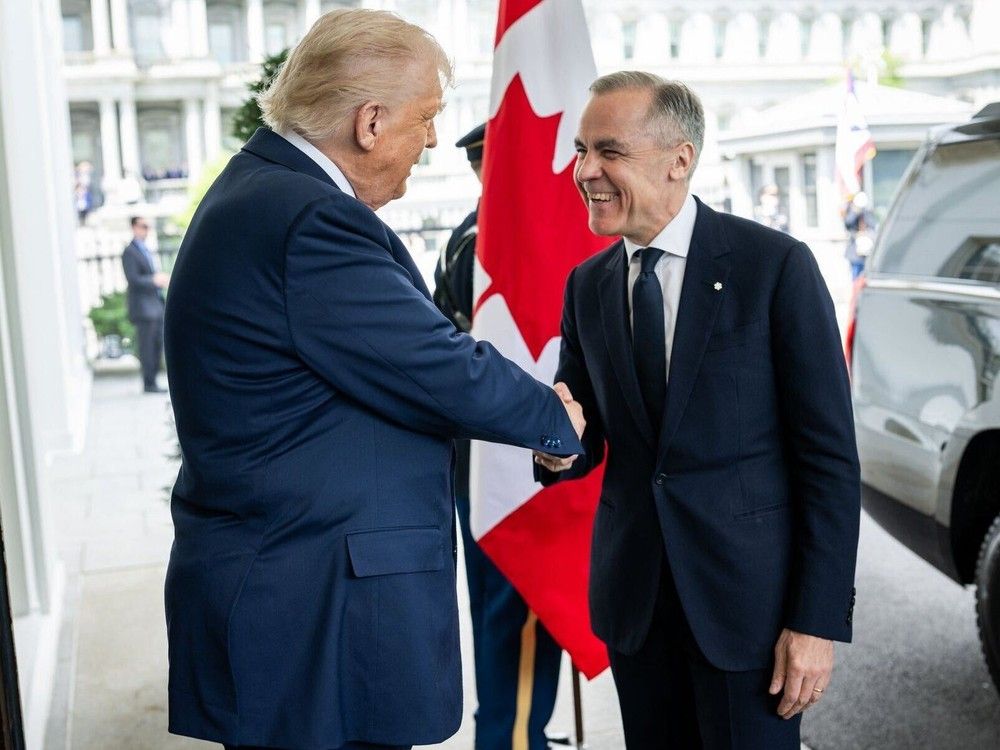
U.S. President Donald Trump greets Prime Minister Mark Carney upon his arrival at the White House earlier this year. (Photo: White House)

Prime Minister Mark Carney is traveling to Washington next week to meet with U.S. President Donald Trump on Tuesday.

The meeting will be “a working visit,” according to a

statement from the Prime Minister’s Office

, focussed on security and trade.

It will come a few days after the U.S. president again spoke about Canada becoming the 51st state during a meeting with military generals in Virginia about his proposed “Golden Dome” missle defence system. Claiming Canada called him and expressed a desire to be part of it, he said: “‘Well, why don’t you just join our country? You become the 51st state and you get it for free.”

It will be Carney’s second visit to the White House since he took office.

The PMO statement says, Canada and the U.S. launched consultations last month in preparation for the first joint review of the Canada-U.S.-Mexico trade agreement (CUSMA). This week,

Canada-U.S. Trade Minister Dominic Leblanc warned against expecting trade with the U.S. to revert to past patterns.


I do believe this is resolvable,” LeBlanc said at the Senate Committee on Foreign Affairs and International Trade on Thursday, but added “the relationship with the United States has fundamentally changed and it will not magically go back to what it may have been a year ago or 25 years ago.”

He said

Canada has a two-track strategy: sectoral deals for industries such as steel, aluminum or softwood lumber or a broader deal. “Both tracks are still in discussions.”

Canada has been

holding talks for months

with the U.S., with the aim of removing or lessening tariffs on Canadian goods.

In late June, Ottawa rescinded a

tax on big U.S. tech firms

at Trump’s request. A self-imposed, joint

deadline

to reach a deal came in July, then shifted to August. In September,

Ottawa dropped retaliatory tariffs

to try to advance talks.

But the talks seem to have stalled.

Meanwhile, since returning to the White House this year, Trump has imposed tariffs on vulnerable Canadian sectors: 50 per cent on steel and aluminum, 25 per cent on autos – with a carveout for U.S. parts – and 35 per cent on any goods not covered under CUSMA.

On Sept. 30, Trump imposed a new 10-per-cent tariff on softwood lumber raising the total levy to more than 45 per cent. And, as of Oct. 14, upholstered furniture, kitchen cabinets and bathroom vanities will face new tariffs of 25 per cent.

While other countries including the U.K. and European Union have landed agreements with the U.S. by saying yes to a set rate of tariffs on all their exports into the U.S, LeBlanc said Canada will not accept a deal with a baseline tariff.

Carney has repeatedly argued that Canada has the best deal with the U.S. because 85 per cent of Canada’s exports to the U.S. are tariff-free. Instead, he is aiming for relief for industries such as aluminum, lumber and autos.

And as time passes without a deal, pressure is mounting by the

Conservative opposition

to achieve results. Carney has said he’s in regular talks with Trump, including over text message. This meeting will be a chance to advance talks in person.

Our website is the place for the latest breaking news, exclusive scoops, longreads and provocative commentary. Please bookmark nationalpost.com and sign up for our daily newsletter, Posted, here.


An armed police officer stands at a cordon on White House Avenue, near the Heaton Park Hebrew Congregation synagogue in Crumpsall, north Manchester, on Oct. 2, 2025, following an attack at the synagogue.

One of two victims who died in an antisemitic attack at a synagogue in Manchester was hit by police gunfire, authorities said.

The deceased victims were

identified by police

as local residents Adrian Daulby, 53, and Melvin Cravitz, 66. The attack occurred on Thursday outside the

Heaton Park Hebrew Congregation

on Yom Kippur, the holiest day of the year for the Jewish community.

 Armed police officers talk with members of the community near Heaton Park Hebrew Congregation synagogue in Crumpsall, north Manchester, on Oct. 2, 2025, following an incident at the synagogue.

A person injured in the attack and currently recovering in hospital was also shot by police, but the gunshot wound was not life-threatening. Two other victims are in the hospital receiving treatment.

The suspect, Jihad Al Shamie, drove a car to the scene, rammed into people and stabbed them. He did not have a gun, police said. A

witness who called police

said he saw a suspect banging on the door of the building with a knife, trying to gain entry, BBC News reported.

While trying to subdue the suspect, officers at the scene shot at him, according to a statement from Greater Manchester Police Chief Const. Sir Stephen Watson.

“It is believed that both victims were close together behind the synagogue door, as worshippers acted bravely to prevent the attacker from gaining entry,” police said.

It was a “tragic and unforeseen consequence of the urgently required action taken by my officers to bring this vicious attack to an end,” said Watson.

The attack occurred in the suburb of Crumpsall, just less than five kilometres north of Manchester’s city centre, in northwest England.

Our website is the place for the latest breaking news, exclusive scoops, longreads and provocative commentary. Please bookmark nationalpost.com and sign up for our daily newsletter, Posted, here.


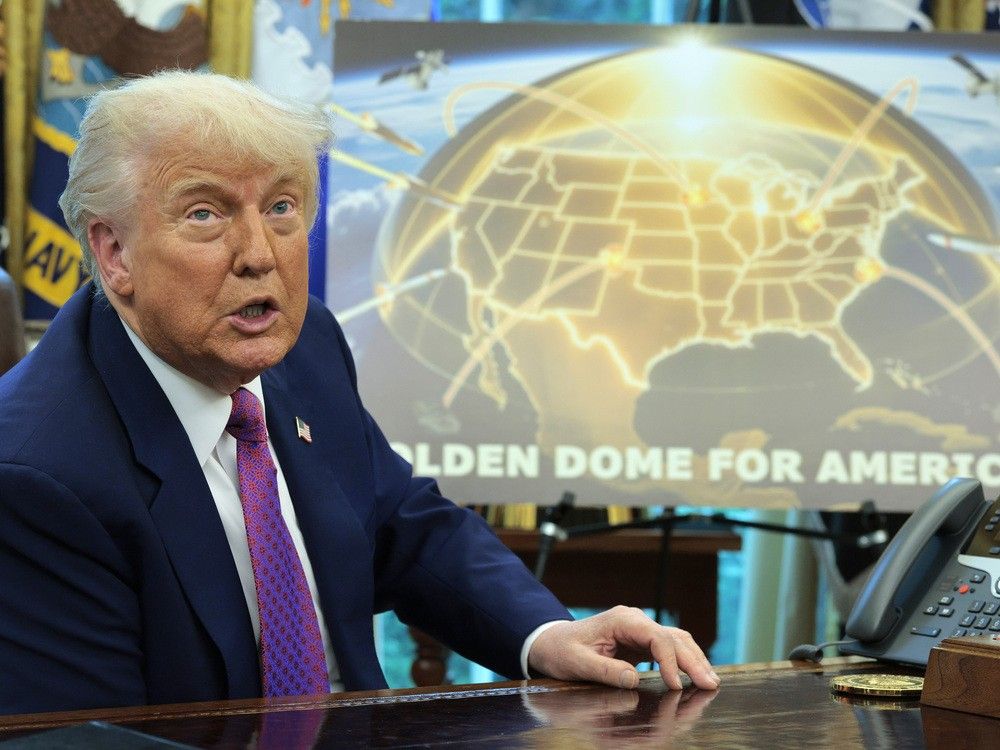
U.S. President Donald Trump speaks in the Oval Office at the White House on May 20, 2025 in Washington, DC. President Trump announced his plans for the

WASHINGTON, D.C. — The U.S. administration is set to publish its National Defense Strategy this month at a time when the Pentagon is planning for a leaner, meaner military, and President Donald Trump is inviting Canada to enjoy the protection of Golden Dome defence by becoming the 51st U.S. state.

So, National Post spoke with Jennifer Kavanagh, a senior fellow and director of military analysis at Defense Priorities and an adjunct professor at Georgetown University’s Center for Security Studies, to get her insights on American defence strategy and the road ahead.

(This interview has been edited and condensed due to length.)

Q: The new National Defense Strategy is expected to prioritize homeland and North American defence with less emphasis on China and global commitments. How do you assess this shift in policy?

A:

It’s being portrayed a bit misleadingly. Homeland defence has always been an important part of the NDS. It obviously should be the No. 1 focus of any military: defending the homeland. Traditionally, it hasn’t been the first thing mentioned, and I think it will be this time.

I think this will indicate a shift back towards a hemispheric defence strategy, which is what the U.S. pursued prior to World War II. I think there will be a broader definition of homeland defence in the sense that it won’t just include air and missile defence. It’ll also include border security, a focus on drug cartels and drug smuggling, human trafficking, and other threats that the administration sees coming from Latin America as well as broader strategic interest in the Western Hemisphere, whether that’s the Panama Canal or preventing Chinese influence elsewhere, or thinking about the Arctic, and natural resources in Greenland and Canada. I think those are things that the administration’s thinking about and that will factor into the NDS.

But you don’t need a trillion dollars to do those things. You don’t need a trillion dollars to fight cartels in Latin America. The United States has a one-war military, and the war that it’s preparing for is still a war with China. China will still be the pacing threat. It will still be what drives training and acquisition decisions.

Things like the F-47, the B-21 bomber, new submarines — these are not things you need if you’re going to focus only on Latin America. So even if China isn’t the first thing mentioned, even if there is a focus on shifting from a global military to a military more narrowly focused on existential core interests, China will still play a major role in what the Pentagon does, how it plans, and how it thinks.

The big strategic shift will be that Europe will be a distant third. There is an interest in the administration in retrenching, if not in terms of personnel, then strategically from its commitments in Europe.

Q: What are the most critical implications for NORAD and U.S.-Canada security cooperation in the Arctic and maritime domains, given Russian and Chinese activities?

A:

I think those things will become a bigger focus. Certainly, NORAD and missile defence of North America will become a bigger focus for the Pentagon. You already see that with the talk about Golden Dome (missile defence). And Golden Dome isn’t something that’s going to be a proximate outcome just because the technologies will take time to develop.

But thinking about gaps in missile defence and how the United States and Canada can work better together to mitigate the increasing number of missile threats from not just Russia and China, but other countries as well, is obviously a priority. In terms of U.S. interests in the Arctic, I think the main interest is an economic one — preserving U.S. access to key natural resources and to opening sea routes. I think there is concern in the administration about Russian but also Chinese activities in the Arctic, and making sure that those don’t preclude the United States from also operating in the region. So that will also be a focus. Because this hasn’t been a major focus in the past, the United States will have to turn to allies like Canada as well as Northern Europe to operate effectively in that area. So I do think that’s an area of expanding cooperation.

Q: With the U.S. narrowing its strategic focus away from Europe, could this force Canada into being the primary defender of the Arctic? Is it prepared for that?

A:

I’m not an expert on Canadian defence, but I do think that the U.S. continues to see itself as a major leading Arctic power. I don’t think it will necessarily be looking to offload that burden. If anything, I see it taking an expanding military role in the Arctic. That’s not something I would necessarily advocate, but I do think it’s something that the administration could potentially be interested in.

Since strategic retrenchment from Europe will initially be in terms of the ground commitment and reducing the U.S. focus on conventional threats coming from Russia, continued U.S.-European cooperation in the Arctic is likely. So I think there will be an increasing interest in having Canadian cooperation. Certainly, there’s an interest in Europe in increasing European-Canadian cooperation in this area, but I don’t know that it will result in burdens that Canada does not want or is unready for.

Q: How does Washington’s narrowing view of NATO’s Article 5 and reduced European role affect Canada’s military obligations and wider allied cohesion? Do you believe the U.S. would uphold Article 5, given today’s defence spending levels among the allies?

A:

Article 5 has often been interpreted in a very broad way to sort of mandate the commitment of U.S. forces in response to any threat to European allies. That’s not actually what it says. Article 5 is actually quite narrow in its commitment. It requires that allies consult and respond and take some sort of action consistent with their constitution and with their assessment of the threat. So the U.S. could meet the Article 5 commitment with much less than a deployment of military forces.

I think that the administration has no intention of withdrawing from NATO or ignoring Article 5. But I do think that there would be a more careful assessment if threats were to emerge of what type of U.S. commitment is appropriate, given the threat, rather than just a knee-jerk response to send the maximum commitment.

That means that allies will be expected to do more. There is increasing focus on ally defence levels, and I do think there will be increasing pressure on Canada to spend more, just like there is increasing pressure on all allies to spend more.

But I don’t know that, ultimately, the decision would be made based on how much allies had spent. The ultimate decision will be made on what is in U.S. strategic interests.

Q: Canada is pledging to meet NATO’s 2% defence-spending target — do you find this credible, and will it improve Canada’s reliability as a U.S. and NATO partner?

A:

I think more spending would make Canada a more reliable partner and a partner that can contribute more to NATO’s defence. But I have to be honest: Canada’s calculations here in terms of not spending 2% are completely rational. Any threat that affects Canada is gonna affect the United States, and the United States will clearly act to defend its best interests. That means Canada has a little bit of a security blanket, no matter what. It’s hard for me to say whether it’s credible or not because that is a rational calculation.

The Trump administration has used other tools to try to force allies to spend more, not just security guarantees, but also tariffs and other types of sticks that it has used to apply pressure. So I do think that Canada will meet that 2% target. Whether it will meet the 5% target, I don’t know.

I like to say the United States is blessed with favorable geography. It has oceans on two sides and friendly neighbours to the north and south. That allows the United States to do much less militarily and have a much smaller military footprint than it does now. Canada is also blessed with favourable geography in the sense that it is also protected by oceans and it has the United States to the south. I think that will always factor into how Canada views its defence and its spending.

Q: Do you view U.S. retrenchment from Europe and the limited military aid to Ukraine as a betrayal of NATO commitments? Does it risk the alliance’s credibility?

A:

The United States has shouldered the burden of NATO security and European security for eight decades. Previous administrations have calculated that it was in the U.S.’s interest to underwrite the security of Europe. I disagree. If you look back at the founding debates of NATO, many were skeptical of whether the United States should be taking on such a large military role in Europe — whether it would’ve made more sense even in 1949 to remain more focused on the Western Hemisphere.

My view is that the mistakes that were made were in 1949 in extending this broad security guarantee to the European continent as well as in 1991, when, instead of taking the end of the Cold War as an opportunity to retrench more and to think about a new European security architecture that could have included Russia, the decision was made instead to continue to pursue militarization as the main pillar of the U.S.-Europe security relationship.

I’m in favour of a move that would retrench U.S. military commitments from Europe. I think Europe is very capable of defending itself against any threat that might come from Russia.

The Russian military has not proven itself to be all that strong in Ukraine. So, no, I don’t see it as a betrayal. I think the United States has long taken on a much broader definition of its interests than it should have — and that it makes sense for the United States now to ask Europe to take on responsibility for its own defence, to take on responsibility for Ukraine, and for the United States to focus on its core interests, which don’t lie entirely in Europe.

Q: President Trump has pivoted a little bit rhetorically around Ukraine in recent weeks, and there has been talk of possibly increasing some weapon assistance to Ukraine. How do you assess that, given this new approach? What do you expect in the year ahead in terms of U.S. support?

A:

Trump has made it pretty clear that he expects Europe to shoulder the burden of defending Ukraine and that the U.S. will provide weapons that Europe purchases. But I don’t see a large appetite for any more U.S. military assistance that isn’t purchased.

There’s a small amount in the National Defense Authorization Act, but it’s not a lot, and I don’t expect the United States to do more than that. Trump has talked about providing more weapons, but it’s always been in the context that Europe will pay for them.

Trump has no interest in expanding U.S. involvement in supporting Ukraine, although he’s supportive of Europe spending money to support Ukraine. And I don’t think that Trump wants Ukraine to collapse. He’s not going to walk away because he’s concerned about being accused or being seen to have lost Ukraine in the way that Biden was seen to have lost Afghanistan, when the United States pulled out.

Q: So there are limits to his retrenchment?

A:

Yeah, I don’t think Trump will walk away from Ukraine. He expects Europe to shoulder the burden, but he doesn’t want to see Ukraine collapse. If he wanted to just walk away to cut ties with Ukraine, he would’ve done it already. But he hasn’t, and the reason he hasn’t, in my view, is because he doesn’t want to be seen as the one who lost Ukraine. He is concerned about the domestic political ramifications of a Ukraine collapse on his watch.

Q: President Trump recently told U.S. military leaders that Canada had expressed interest in joining the Golden Dome missile defence system, and he suggested that if Canada wanted to participate, it should consider becoming the 51st state of the United States. Do you think such rhetoric risks undermining the defence relationship between the two countries? Could it fuel diplomatic tensions?

A:

Absolutely, it could fuel more diplomatic tensions. I think it’s unhelpful. The United States does benefit from having Canada’s assistance and participation in any sort of homeland defence. It benefits from being able to position radars on Canadian territory. It benefits from having Canada as an active member of NORAD and in any future sort of Golden Dome project. So, in my view, having Canada as a friendly and helpful partner is in the U.S. interests, and talking about Canada becoming the 51st state works against that.

I also don’t see why having Canada as a 51st state would be in U.S.’s interest, to be honest. The countries have great relationships, and taking on more territory is not something that I would advocate for. The United States can benefit from having a friendly relationship with Canada without controlling Canada.

Q: Could Canada use access to being able to position radars for missile defence in their country as leverage in ongoing trade talks and in the CUSMA renegotiation?

A:

Anything that Canada can use to show that it could benefit U.S. interests is something that I think would be appealing to the administration. This is a transactional administration, so anytime it can make a deal that seems like it’s getting something for anything that it’s giving, that is something that works, that the administration has pursued and seems to like. And you’ve seen how they do it with other countries — with Japan and Korea, it’s in the messaging about the deal. It’s all about what the U.S. got.

Q: But the U.S. already has access to Canada and its defence support. So would Ottawa have to actually threaten to take that away?

A:

I think reminding the administration of these benefits and potentially offering additional benefits or offering to shoulder the costs of any U.S. assets in Canada are things that other countries have found to be beneficial in these types of negotiations.

Q: How should the U.S. and Canada coordinate on ambitious homeland defence projects like Golden Dome, and do these initiatives risk overstretching allied budgets at the expense of conventional NATO commitments?

A:

I’m a little bit skeptical of Golden Dome. I think the United States needs more air and missile defence, but I’m not sure that Golden Dome is the way to go. I think it’s quite risky. I’m not sure all the technologies will pan out. You risk spending a lot of money on capabilities that you don’t need and that don’t actually give you the security benefits that you would get from just investing more in cheaper technologies.

Any sort of homeland defence for the United States has to include Canada, because Canada is right there and part of the same territory. So, having Canada participate in Golden Dome or anything like Golden Dome is advantageous and beneficial, and there’s certainly plenty of room for cooperation on the relevant technologies to missile defence, even if it’s not Golden Dome.

I am concerned about the excessive cost of Golden Dome and potentially low returns, especially for Canada, given that it is looking to ramp up its defence spending. It’s not clear that spending on a pricey, risky project is the right move, but that’s true for the United States, too.

Q: What under-appreciated risks and opportunities do you see for Canada as the U.S. pivots home, and what advice would you give both governments to safeguard North America and allied defence?

A:

To me, the biggest threats to North America involve air and missile defence, which I’ve already talked about, cyber, and other types of hybrid threats. I think that the two countries should focus on cooperating in those areas.

To me, pivoting home is the right decision, but the United States doesn’t need a big military or a lot of new military activity in North America or in the Western Hemisphere. So the pivot home only makes sense if you’re going to cut the military’s size, downsize, get a leaner military, and focus on economic and law enforcement, and other types of activities in the region itself.

Border security does not have to be a military task — it’s a law enforcement task. Exploiting economic resources is not a military task — it’s an economic task. So my concern is that the pivot home is over-militarized. We don’t need to pivot home and then use all the military forces that we have in Europe or in Asia to do things in the Western Hemisphere. That’s not necessary and leads to risks that we end up militarizing the northern border just like we have the southern border. It leads to the use of U.S. military forces in cities and domestically for domestic purposes, which isn’t helpful. It leads to an over-militarized approach to the Arctic, which is also not ideal.

So, in my view, the pivot home only makes sense if it’s going to be accompanied by downsizing of the military and a shift to other tools of national power.

Q: Are you getting the sense that that’s the plan?

A:

It’s not clear. There’s only so much that the United States can do militarily in the Western Hemisphere, which is why I don’t think that the pivot home is going to be the pivot home that I imagine.

I think it’s going to be, “Yes, we’re prioritizing the Western hemisphere, but we’re still also pivoting to Asia.” So it’s kind of like a double pivot away from Europe and the Middle East, but we’re going to stay focused on China, and we’re going to focus more on the homeland.

I would advocate something quite different, that also downsizes U.S. presence in Asia, and I don’t think that’s going to happen.

In terms of the focus on the Western Hemisphere, it’s already been more militarized than I would recommend. So, I commend the administration for trying to rethink U.S. strategic interests, and I do think something that prioritizes the Western Hemisphere makes sense. However, I’m not sure that the pivot home is quite as extensive as it’s being portrayed in the press.

Asia will continue to play a big role, and it will continue to be a heavily militarized role, which raises the risk of war with China. And so far, the approach to the homeland and the Western Hemisphere has also been quite militarized in ways that I’m not sure are the best way to approach the challenges that the United States faces in that region.

Q: Any advice for Prime Minister Mark Carney in his dealings with the Trump team on all matters defence?

A:

I think spending more on defence matters a lot to this administration, but any leader who’s playing the defence-spending bargaining game with Trump should recognize that it could be a temporary bargain.

So, really, any government leader — of Canada or anywhere else — thinking about how U.S. retrenchment might affect their security should make security decisions like what is necessary to defend Canada if I can’t count on the United States, whether that’s more or different types of spending.

That should be the goal: trying to figure out what that looks like, and then you can work with Trump on areas of cooperation and meeting whatever targets are necessary to preserve the relationship and achieve other types of economic or diplomatic goals.

But there should never be the assumption that because I spent X on security, I’ve dealt with that problem, because I don’t think that’s a secure bargain with this administration or a future one.

National Post

Our website is the place for the latest breaking news, exclusive scoops, longreads and provocative commentary. Please bookmark nationalpost.com and sign up for our newsletters here.


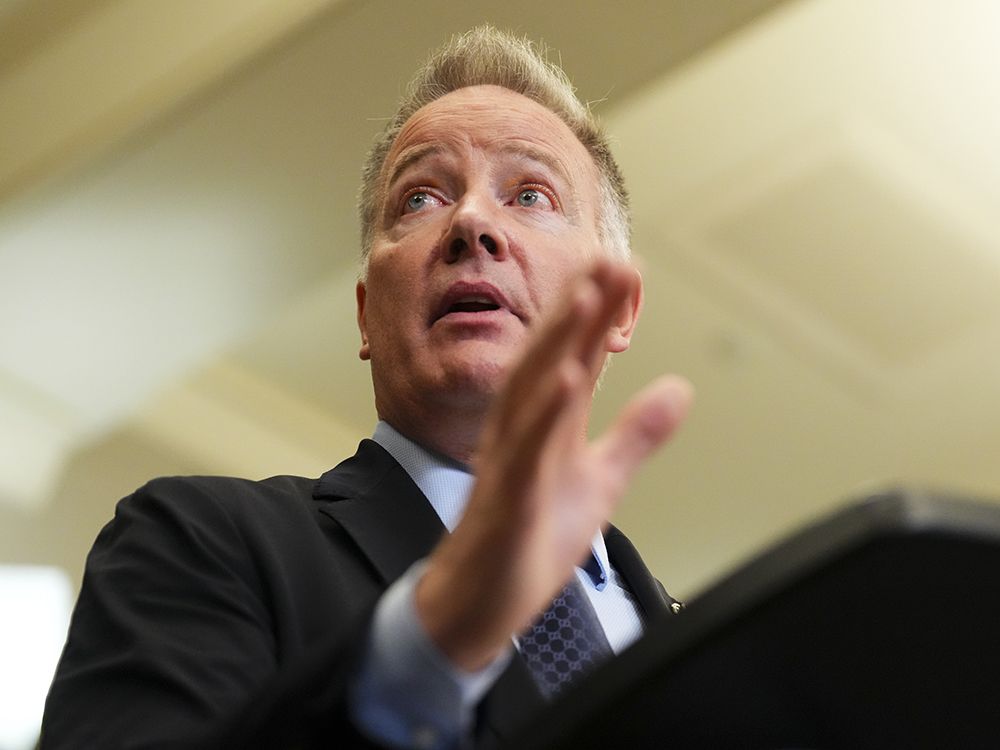
Secretary of State (Defence Procurement) Stephen Fuhr holds a news conference regarding the Defence Investment Agency in the foyer of the House of Commons in Ottawa on Thursday, Oct. 2, 2025.

The Liberal government launched a new agency Thursday aimed at speeding military procurement.

The Defence Investment Agency is promising to “rebuild, rearm, and reinvest in the Canadian Armed Forces faster,” according to a statement from Prime Minister Mark Carney’s office.

“The goal or aim of this agency is to equip the Canadian Armed Forces with the tools and equipment they need at the speed of relevance, bringing Canadian industry into the tent to stimulate our own economy and to create good paying jobs for Canadians,” Stephen Fuhr, the secretary of state in charge of defence procurement, told reporters Thursday.

According to Carney’s office, the new “agency will align Canada more closely with partners such as the United Kingdom, Australia, and France, who already have dedicated procurement bodies, making joint defence purchases and partnerships easier and more efficient.”

Fuhr, a former Royal Canadian Air Force pilot, pointed out that Canada had 220 small- and medium-sized enterprises at a recent defence trade show in England.

“I want to make sure that our capacity and capability … to deliver outside our own borders is well-understood and leveraged where it can be,” Fuhr said.

He indicated Canada will still buy military equipment from the United States.

“But we’re not going to be spending 75 cents of our dollar south; we’ll be amortizing that money out in Canada where we can, and then spending it in other places where we have to,” Fuhr said.

He couldn’t “nail down a target” for how much the new agency plans to spend in the U.S.

President Donald Trump’s ongoing trade war and musings about turning Canada into the 51st state have rattled many in this country.

“There are some systems that we will just have to buy from the U.S.,” Fuhr said. “We’re not abandoning that relationship. It’s going to change and we’re going amortize or diversify ourselves in ways that meet the moment, and that’s not having all our eggs in one basket, whether it be the U.S. or anybody else.”

Defence analyst Ken Hansen said the new agency has the potential to speed military procurement in Canada.

“The prime minister is surging forward with this very aggressively,” said Hansen, a former naval commander.

“I’m just amazed at what an energizer bunny he seems to be.”

The largest advantage it offers “will be diversification for the sake of security of supply,” Hansen said.

“But also, the non-American partners seem to be much more interested in sharing technology instead of holding on to intellectual properties.”

The agency’s first purchase should be weapons that can defend against drones, he said, which have changed the modern face of warfare in Russia’s invasion of Ukraine.

“Absolutely the most pressing thing is tactical ground close-range air defence against drones,” Hansen said. “That is clearly in my mind, the biggest immediate need.”

Germany and Australia have demonstrated a “very sophisticated (light armoured vehicle) mounted gun system that shoots 30-millimetre rounds,” he said.

“They can saturate the air with exploding steel pellets to take out flying objects.”

The ammunition can be changed to take out bunkers or moving vehicles, Hansen said. “It’s incredibly effective and flexible tactical fire that seems to be the need.”

The new procurement agency will only deal with projects over $100 million.

It will be staffed with people from the purchasing branch of National Defence, Public Services and Procurement Canada, and the Coast Guard.

“This isn’t another layer of anything,” Fuhr said.

“We’re porting resources from three departments into this agency, right, so there’s no extra. This is a single point of accountability. So, on Day 1, fragmented oversight is now gone.”

Fuhr called the launch of the new agency “a step change” in the way Canada handles military procurement.

“It requires a major machinery of government change,” he said. “Everyone, even the opposition, over years of talking about this, everyone thinks it’s a good idea, but when you go to these departments to ask for their people, their authorities and their resources, often times they go, ‘Hey, just a second here, we kind of like it the way it was.’ That was kind of my experience.”

The prime minister announced the appointment Thursday of Doug Guzman, a former deputy chair at the Royal Bank of Canada, as the new agency’s chief executive officer.

“Mr. Guzman brings three decades of experience in investment and finance, including leadership roles at RBC and Goldman Sachs,” said the statement from Carney’s office.

“His expertise in capital allocation, project execution, and large financial projects will be instrumental in accelerating procurement and growing our defence industrial base.”

Our website is the place for the latest breaking news, exclusive scoops, longreads and provocative commentary. Please bookmark nationalpost.com and sign up for our daily newsletter, Posted, here.