


LP_468x60
on-the-record-468x60-white

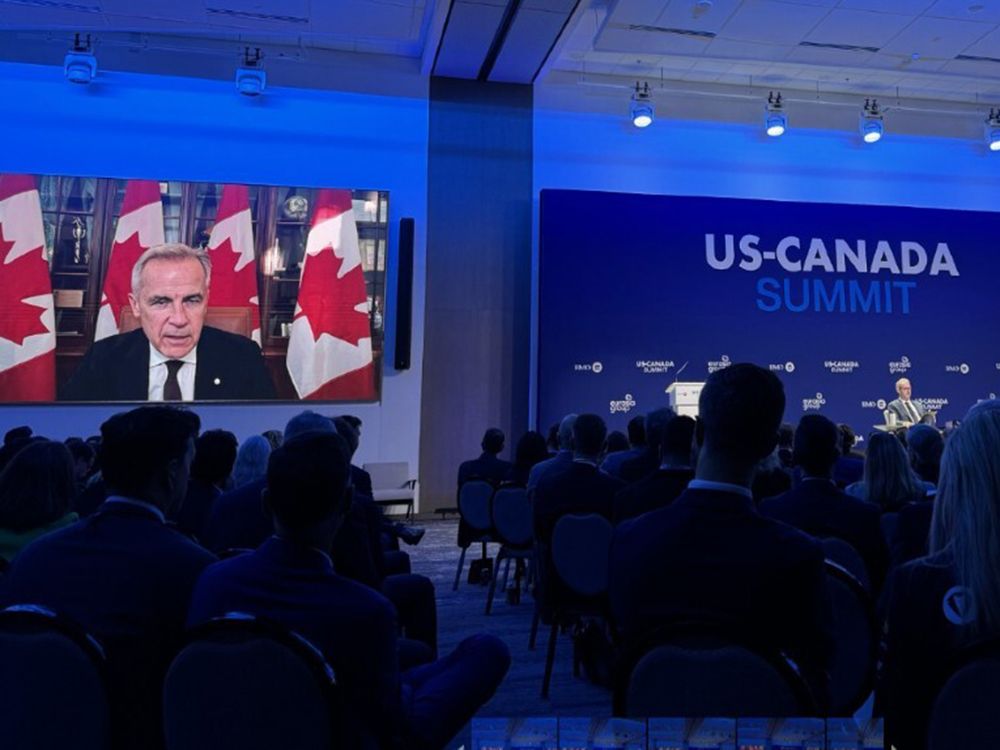
Prime Minister Mark Carney speaks to the U.S.-Canada Summit in Toronto via video call on Oct. 8, 2025.

Canada and the United States “are much more coordinated” than it may appear, says Prime Minister Mark Carney.

“There is still a very deep, enduring and reinforcing relationship between Canada and the United States. As Canadians, we benefit from that,” said Carney via video call to the U.S.-Canada Summit in Toronto on Wednesday.

The comments were made in conversation with Gerald Butts, the vice chairman of Eurasia Group, a political risk analysis and consulting company. Butts was former prime minister Justin Trudeau’s principal secretary from 2015 to 2019.

Carney pointed out that the two neighbours were in line when it came to border security and defence. “Canada is quadrupling its defence expenditures between the end of last year and the end of this decade,” he said, adding that Canada had been “lagging.”

Canada and the U.S. were also on the same page when it came to major global conflicts, he said, such as the ongoing war in Russia and Ukraine, and in the Middle East.

Carney’s remarks come a day after a meeting with U.S. President Donald Trump at the White House. The conversation between the leaders was friendly in tone, but little was accomplished in terms of

a new tariff deal

for Canadians. Trump said there was a “natural conflict” between the U.S. and Canada. He attributed this mainly to the proximity of the two countries and competing industries, like the auto sector.

Although there were areas where Trump and Carney did not see eye to eye — Carney recognized a Palestinian state, while Trump did not — Carney still said he endorsed the president’s Gaza plan that could bring the Israel-Hamas war to an end.

“I shouldn’t overplay it, but the momentum is there,” he said.

As for tariffs, Carney insisted that Canada had “the best deal of anyone” — but “it can be better.”

“We are in a position because of the integration, because of the level of commercial relationships, other ties between our countries, where we do have the best trade deal with the United States right now,” said Carney. “It does matter that 85 per cent of our trade is tariff-free. It does matter. Our average tariff is five and a half per cent.”

He said he was aware there were “real issues” within certain areas and he was “deliberately” working on the steel, aluminum and energy sectors to make progress. With respect to aluminum, for example, Carney said there was a discussion about whether it was the best use of energy to manufacture it for the United States, seeing as Canada produces 60 per cent of the supply to the U.S., but there’s a 50 per cent tariff.

But Carney made clear that it was Canada on his mind everyday, not the U.S.

“I don’t get up first thing in the morning, think about the U.S. relationship,” he said, “As much as I love the U.S., I think about Canada. I think about building Canada.”

With the Liberal budget

set to be released this fall

, Carney said in front of a crowd of Canadians and Americans in the business sector, that the takeaway should be that “we’re building this country.”

“We’re taking our responsibility seriously as government in terms of helping to build the enabling infrastructure,” he said.

Nearing the end of the discussion, Butts turned to one of the most Canadian topics available: hockey. He asked the prime minister about NHL star

Connor McDavid’s contract extension

with the Edmonton Oilers.

“I’m very pleased that he signed, and it’s going to be a hell of a season,” said Carney. He also added, given that the conference Wednesday was being held in Toronto, that a journalist pointed out during his meeting with Trump that Canadians were travelling the U.S. much less.

The journalist asked what would bring more Canadians to the U.S. and Carney said he replied: “Well, we’re going to be coming down for the World Series.” The Toronto Blue Jays are a contender for the Major League Baseball’s final showdown. The Jays face off against the New York Yankees Wednesday night.

Our website is the place for the latest breaking news, exclusive scoops, longreads and provocative commentary. Please bookmark nationalpost.com and sign up for our daily newsletter, Posted, here.
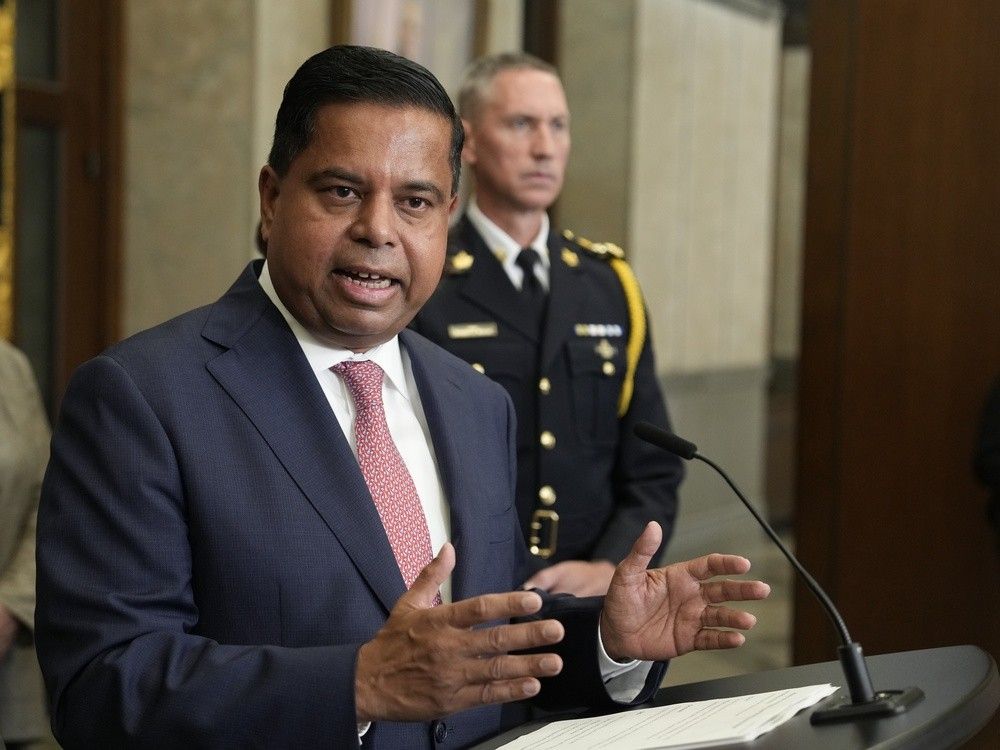

Minister of Public Safety Gary Anandasangaree speaks in the Foyer of the House of Commons on Parliament Hill in Ottawa, Tuesday, Sept. 23, 2025.

OTTAWA — The Carney government tabled a new version Wednesday of its flagship national and border security bill without a host of contentious search powers for law enforcement, but is not giving up on the first, controversial version of the legislation.
 

Public Safety Gary Anandasangaree tabled Bill C-12, which is a near-copy of
the “Strong Borders Act” (C-2) his government
tabled in the spring as U.S. President Donald Trump accused Canada of poorly defending the shared border from drug smugglers.
 

The new bill proposes vast changes to Canadian border security, data collection and sharing by federal authorities, anti-money laundering rules, the asylum claim system and the Canadian Coast Guard.
 

But missing from the new bill are sections of C-2 allowing law enforcement sweeping new powers such as opening mail or demanding any service provider fork over limited subscriber information without a warrant. Also missing is the restriction on cash payments or donations over $10,000.
 

But that doesn’t mean the government is backtracking on those powers, the minister said, as the original bill C-2 will remain in Parliament and be debated separately.
 

Anandasangaree told reporters that by removing the most contentious elements of C-2 from C-12, he expects the latter bill would garner “broader support” in Parliament. But in the same breath, he said that changes were not done to placate opposition parties.
 

“I do anticipate the Bill C-12 will have a great traction and likely go through the committee phase early,” he said, adding that he hopes debate on the new legislation will begin in the next several weeks.
 

When asked why he tabled a new bill instead of simply amending the existing one, Anandasangaree said the amendment process was “quite cumbersome”.
 

He explained that the original bill was introduced “within days” of the Carney government’s election and that subsequent feedback over the summer pushed the government to draft a new bill.
 

With regards to border security, C-2 proposes to tighten rules around asylum claims, allow the RCMP to share information about registered sex offenders with domestic international partners and gives the Coast Guard a new protective security role.
 

Much of the “Strong Borders Act” tabled in June had little to do with securing the border and instead granted police and intelligence agencies new, and in some cases warrantless, legal tools to obtain or intercept information.
 

The bill has garnered intense criticism from privacy and civil liberty groups as well as Conservative Leader Pierre Poilievre.
On Wednesday, Conservative House Leader Andrew Scheer said it was “embarrassing” that Anandasangaree was already changing the Carney government’s first bill.

The ability to obtain Canadians’ information and intercept communications, known as “lawful access,” is one of the most intrusive powers afforded to police and intelligence agencies.
 

Lawful access rules are perennially in the middle of a tug-of-war between the needs of law enforcement to investigate threats and Canadians’ rights and expectations of privacy.
 

Intelligence and police agencies have long complained that they face “significant challenges” in securing lawful access because existing rules are antiquated and poorly adapted to the digital world.
 

On Wednesday, Anandasangaree said he was “quite committed” to modernizing the lawful access regime, noting Canada lags significantly behind its Five Eyes intelligence sharing partners.
 

But privacy, civil liberty and even some national security advocates say the Liberals’ Bill C-2 is a profound overreach that gives police and intelligence services far too much warrantless power.
 

They point to sections of the spring bill that allow authorities to issue a demand letter to any public service provider requiring them to disclose some under information.
 

Anandasangaree incorrectly stated on Wednesday that the new power only allowed authorities to ask a service provider if an individual used their service. “That is the only question that can be asked. Beyond it… the police need to provide a warrant,” he said.
 

But the government’s own website states
that officers could demand that service providers also provide information about the “nature of the services” provided, if they have any information relating to that account, where those services were provided and for how long.
 

“We’re not just talking about Rogers, Telus and Bell here,” national security law expert Leah West explained on the
Secure Line podcast last month
. “Your doctor, your gynecologist, your Substack, your dog groomer, anyone who is providing a service.”
 

“What could be revealed is a lot more potentially privacy-intrusive because of how broad the application is.”
 

Authorities only needed a reasonable ground to suspect that an offence had been or may be committed to request the information. They did not require a judge’s approval via a warrant.
 

Another controversial section of the bill created what many called a “digital back door” via a new law that requires electronic service provides to make it easier for police and intelligence agencies to access their data.
 

The new law could compel an organization that uses any form of electronic services geared towards people in Canada or that operates in the country to implement tools to ensure data can be extracted and provided to authorities when mandated.
 

“It has the potential to introduce significant vulnerabilities into the systems we use every day for our most private communications and could also completely upend the practice of information-sharing that is the foundation for keeping the internet safe and secure,”
privacy lawyer David Fraser
wrote in July.
 

In a recent report, the National Security and Intelligence Committee of Parliamentarians — an intelligence oversight committee of MPs and senators — largely agreed with law enforcement agencies’ concerns about lawful access and called on the government to carefully and incrementally address the issue.
 

Canadians would be “surprised to learn how difficult it actually is” for national security agencies to intercept communications and obtain information lawfully, the report noted.
 

“It is time for the government to act and provide the security and intelligence community with the tools, policies, and lawful authorities they require to do the work asked of them in the manner expected by Canadians which is responsive to and protective of their privacy.”
 

National Post

cnardi@postmedia.com

Our website is the place for the latest breaking news, exclusive scoops, longreads and provocative commentary. Please bookmark nationalpost.com and sign up for our politics newsletter, First Reading, here.


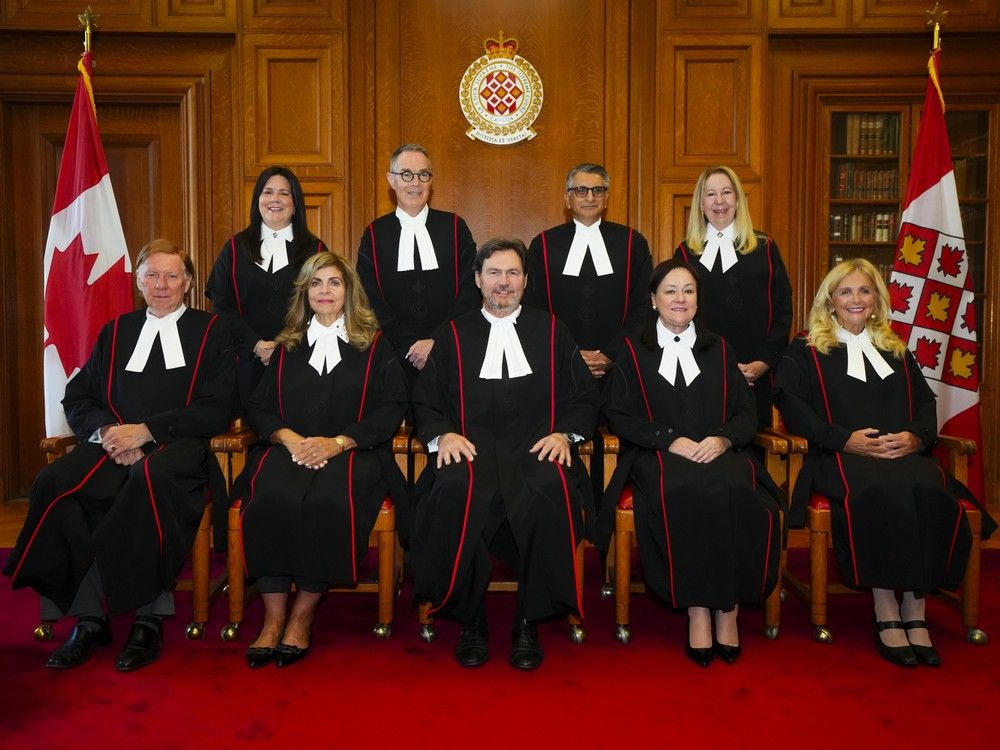
Supreme Court of Canada Justices Malcolm Row, left to right, Michelle O'Bonsawin, Andromache Karakatsanis, Nicholas Kasirer, Richard Wagner, Mahmud Jamal, Suzanne Cote, Mary T. Moreau, and Sheilah L. Martin wear their new robes as they take part in the Official Bench Photo in the Judges' Conference Room at the Supreme Court of Canada in Ottawa on Monday, Oct. 6, 2025.

The Supreme Court of Canada is marking its 150th anniversary this year and decided for the first time in 39 years to have a formal opening ceremony that involved an unveiling of sorts that has provoked debate within the legal profession.

The judges of the court donned new robes. New black fabric was highlighted with red piping on the fringes. Absent were the red robes with white mink fur trim, fondly known as

“Santa robes.”

The simpler,

made-in Quebec gowns

are meant to represent a balance between weighty tradition and openness to future legal developments. They are also meant to reflect Canada’s identity and values more authentically, Chief Justice Richard Wagner told the Canadian Bar Association’s magazine,

The National

.

“They have a modern and simple design that echoes our commitment to openness and accessibility in a way that is distinctly Canadian,” he said to the legal publication.

It should be noted, however, that these were not the day-to-day working robes of the country’s highest court.

When the court is in session, the judges wear traditional black robes

, as barristers do in courts throughout the country. But Canadians not in the habit of watching

SCC hearings on CPAC

or via the

court’s own website

 might think the Santa robes were de rigeur.

That said, the red robes trimmed with white were symbolic of Canada’s colours. Moreover, they were thought to be

perfect for important occasions,

such as the opening of Parliament or a visit from the King.

However, the heavy red gowns were known to be unpopular among some of the judges.

“Am I allowed to say, they’re awful,” Justice Andromaches Karakatsanis

told CPAC eight years ago

. “They’re so hot. They’re heavy … I’m glad that we wear (them) only for ceremonial events. I’m not sure I could do it every day.”

However, Justice Suzanne Côté

shared a different view

with CPAC. The court has traditions it needs to keep, she said, for instance, when “we wear our red robes for official events.” Decorum is important, she said, “given the type of institution that the court is.”

This judicial difference in opinion over the high court’s ceremonial fashion has been reflected in online debate among Canadian lawyers.

University of Calgary

professor of law, Ian Holloway

, has been highly critical of the change.

“Presumably, the chief justice is not criticizing the scarlet colour of the (ceremonial robes). After all, one can’t imagine that he would openly be throwing shade at the RCMP; the Mounties are about as iconically Canadian as you can get, and they’ve been wearing scarlet longer than the Supremes have. And for that matter, Canadian soldiers have been wearing ceremonial scarlet for even longer.”

Instead, Holloway suggests, “the principal objection to the current ceremonial robes is that they superficially resemble the robes worn by judges in England. Never mind that judges in places as diverse as Nigeria, Jamaica, New Zealand, and Australia also wear similar robes, the fact that ours have English roots makes them imperative candidates for the chopping block.”

A discussion on LinkedIn Tuesday reflected clashing sartorial opinions among the legal profession about the top court’s attire.

“No more Supreme Court of Canada judges as Santa Claus! Old robes are out. New Robes are in,” Jeremy Opolsky, litigation partner at Torys LLP

wrote on LinkedIn

Tuesday.

“I like these ones much better,” writes Myriam Seers, Toronto-based International disputes lawyer and arbitrator, responded. “They’re clean, modern and don’t (or shouldn’t) give rise to any point-and-laugh reactions by members of the public. That’s important when public confidence in institutions is constantly undermined on multiple fronts all at once.”

However, this was not a unilaterally shared view. Tax lawyer, Carl Irvine, didn’t pull his punches: “Boo! I liked the Santa Claus robes. Someone said these look like the leather package on somebody’s new Honda Civic.”

Comments from animal rights lawyer and Executive Director at Animal Justice, Camille Labchuk, may have gotten to the nub of one reason why the change was made.

“I love that they finally ditched the fur trim. A number of years ago I spoke with the owner of the robing company that created the Santa attire, and he told me each robe took the skin of 60 individual ermines who came from a fur farm,” wrote Labchuk. “Sends a great message that the Supreme Court is choosing modern, fur-free attire!”

Animal activists have been lobbying

for the court to ditch the fur-lined robes for years.

Senior legal consultant, Thom Harley, brought these legal threads together in

his LinkedIn post

: “Some court watchers see balance and modernization. I see a loss of identity. After 150 years, that robe was more than costume. It was a visual signature, part of the institutional DNA of Canada’s highest court.

“If the old robes looked like ‘Santa suits,’ as some wags put it, the new ones now resemble something else: a sleek business suit with a stripe. Efficient, unremarkable, and easily forgotten in a crowd. The distinction between ceremony and everyday has blurred. … I don’t believe robes make the justice. But symbols matter. In law, institutions derive part of their authority from ritual, continuity, visual cues. When we strip those away, we risk making the Court look like just ‘another administrative body.’”

Our website is the place for the latest breaking news, exclusive scoops, longreads and provocative commentary. Please bookmark nationalpost.com and sign up for our daily newsletter, Posted, here.
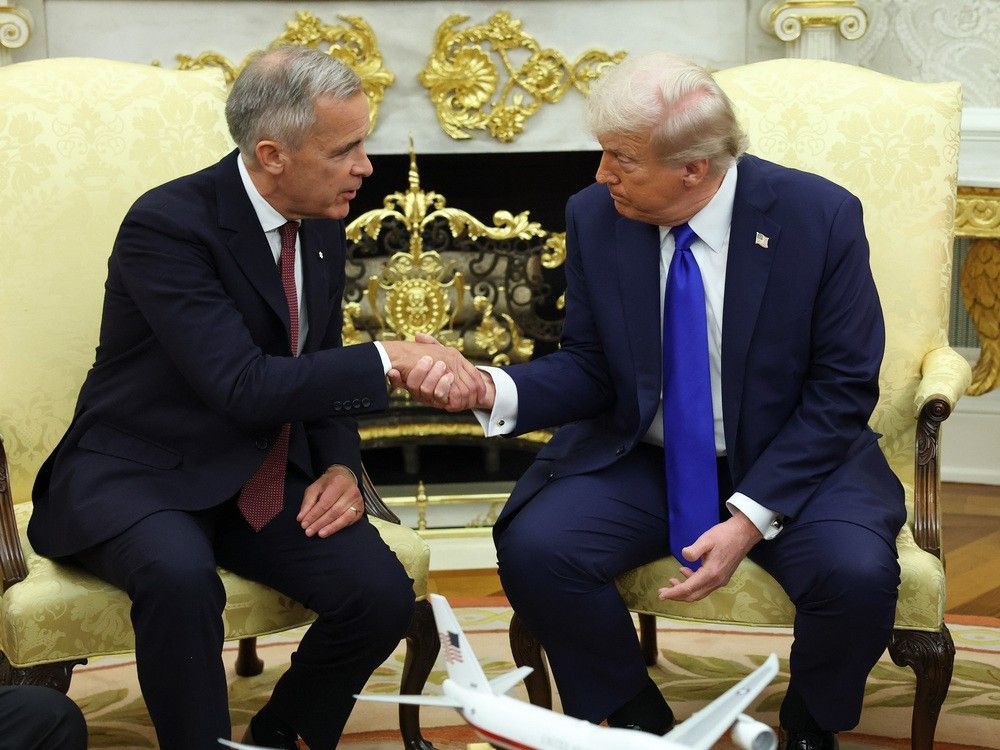

U.S. President Donald Trump (R) shakes hands with Canadian Prime Minister Mark Carney during a meeting in the Oval Office of the White House on October 07, 2025 in Washington, DC.

OTTAWA

— As Prime Minister Mark Carney hopes for a hastened resolution on U.S. steel and aluminium tariffs, he left the White House having put energy on the table as an area of cooperation in exchange for progress on a trade deal. 

A source with knowledge of the discussions between the president and the prime minister said that Carney raised the idea of possibly revisiting the Keystone XL pipeline, which Trump has supported for years.

The pipeline, which was first proposed back in 2005, would carry oil from northern Alberta to Nebraska and has had a troubled history. It was first rejected by former U.S. President Barack Obama, but then later revived by Trump during his first term in office. His predecessor, however, former Democratic president Joe Biden, revoked its permit on his first day in office back in 2021.

National Post is not naming the source, who spoke on condition of anonymity. The conversation was first reported by CBC News.

The source emphasized that Carney brought up the cancelled pipeline in the hopes of seeing progress made on a deal regarding the 50 per cent steel and aluminum tariffs, which Trump levied under S

ection 232 of the U.S. Trade Expansion Act. 

The source said it was only an initial discussion, but that leaders agreed that the idea of cooperating on energy would be part of the negotiations going forward.

Intergovernmental Affairs Minister Dominic LeBlanc, who was set to remain in Washington for the coming days, told reporters after their White House meetings on Tuesday that both sides discussed “strengthening the energy partnership with the United States.”

Speaking more broadly, the source said that Keystone XL was just one example of the ways Canada could work more closely with the U.S. on energy. Other areas include uranium and electricity.

That means as Carney presses for a trade deal, restarting the Keystone XL pipeline could transform into a potential bargaining chip.

The source added that the next step would be for Trump to issue a new presidential permit for the project.

Speaking at a conference on the Canada-U.S. relationship in Toronto, Alberta Premier Danielle Smith suggested energy and raw materials could be used as leverage when it comes to negotiating with the U.S. president, but only if it is done in such a way that it is presented as being a benefit to America.

“His love language is, ‘Let me tell you how I can make America even greater. Let me tell you how Canada being able to provide you raw materials or critical minerals or energy and natural gas allows you to have energy dominance in the world,” Smith told the crowd. 

As Carney returned to Ottawa on Wednesday, his office signalled he was looking for results on the Canada-U.S. trade talks within weeks.

“The leaders identified opportunities for material progress in trade in steel, aluminium, and energy, and directed their teams to conclude this work in the coming weeks,” reads a statement from the Prime Minister’s Office. 

Carney spent his time in the House of Commons on Wednesday defending the state of the trade talks, as Opposition Conservative Leader Pierre Poilievre hammered him on his lack of a deal.

“We’ll go soft on him today because I know he’s still recovering from surgery to have his elbows removed,” Poilievre said, referring to the “elbows up” approach Carney touted during the spring federal election campaign, when it came to dealing with Trump.

Bloc Québécois Leader Yves Francois-Blanchet also pressed Carney for proof of results, questioning whether he felt Trump’s nice words towards him were enough.

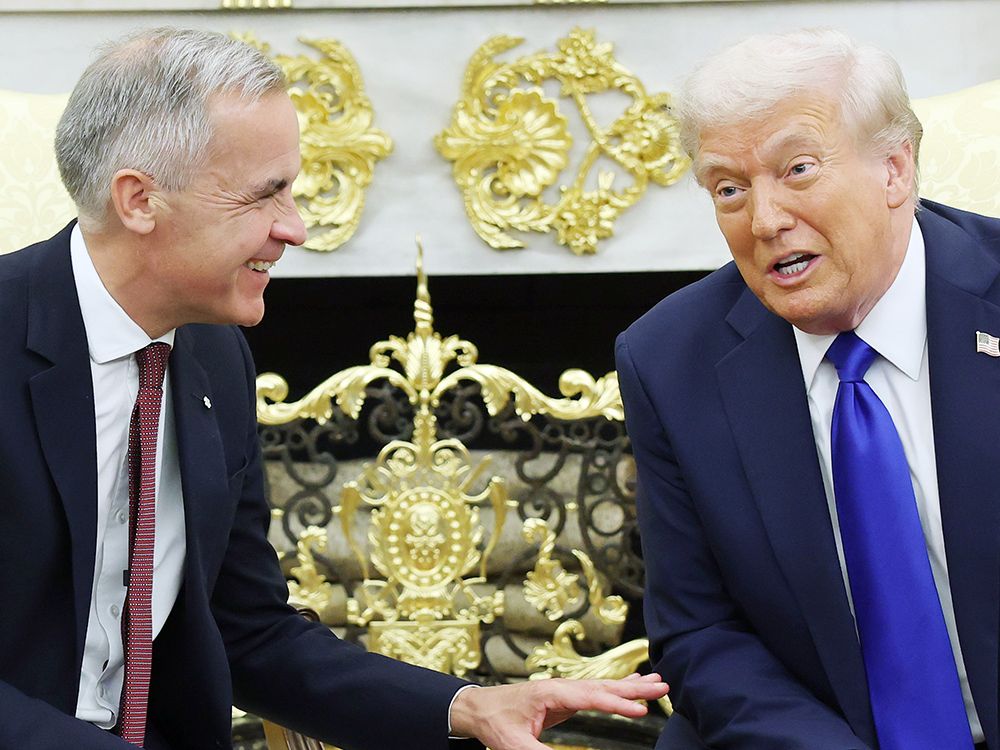
During their roughly 30-minute Oval Office meeting, Trump praised Carney as a “world-class leader” and a “nice man,” and drew laughter when he said the prime minister could also be “very nasty.”

Carney told MPs that Canadian and U.S. officials were negotiating the terms of the discussed deals regarding steel, aluminum, and energy.

Diamond Isinger, who served as a special advisor to former prime minister Justin Trudeau on Canada-U.S. relations, said it was worthwhile for Carney to meet Trump as he needed to forge a stronger relationship with the president.

“Relationships matter a lot to President Trump, and he is also someone that receives feedback and is suggestible on the basis of who was last in his ear,” said Isinger.

“The opportunity for Canadians to have face time with him to really advance some Canadian interests and concerns face to face means that those are top of mind for him, at least in these coming days and weeks, as opposed to the many inbound texts, calls, other interactions that he’s surely having on a daily basis.”

She added that Carney remains a relatively new prime minister who has yet to spend much time with Trump one-on-one, outside of on the sidelines of international summits and other major world events.

Carney sat down for his first Oval Office meeting with Trump back in May, shortly after his April election win.

Isinger said a face-to-face meeting between leaders would be to announce a joint deal or to try and force progress, the latter of which appeared to be the case for Carney, she said, given Trump’s many tariff announcements.

The latest includes a new 25 per cent tariff on heavy trucks and a new levy on softwood lumber.

“This forced the U.S. to actually focus their attention, face-to-face in real time, on Canada,” she said.

She added that it also matters that both leaders left their meetings by directing their respective teams to continue trade talks, especially on the U.S. side, given, as she said, Trump’s cabinet secretaries act at the president’s “expressed direction.”

“If he asked them to continue talks with the Canadians, it indicates that he’s making this a priority.

Before the prime minister left Washington, he met with

Joshua Bolten, the president and CEO of Business Roundtable, an association representing U.S. business leaders. 

He also dined Tuesday evening with Vice President JD Vance and his wife at their residence. Carney was joined on the trip by several of his senior ministers, including Foreign Affairs Minister Anita Anand, who on Wednesday morning met with her U.S. counterpart, Secretary of State Marco Rubio.

-With files from Courtney Greenberg in Toronto

National Post

Our website is the place for the latest breaking news, exclusive scoops, longreads and provocative commentary. Please bookmark nationalpost.com and sign up for our politics newsletter, First Reading, here.


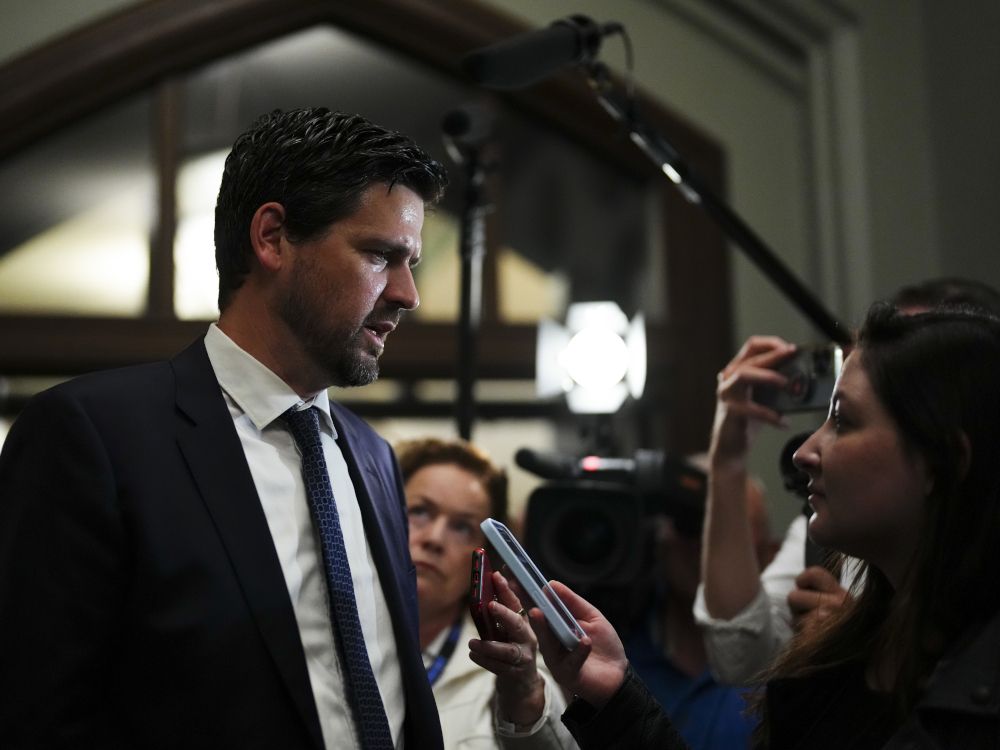
Justice Minister Sean Fraser

OTTAWA — Federal Justice Minister Sean Fraser says he supports the continuation of birthright citizenship, calling it a bedrock of equal rights, in response to a Conservative MP’s push to end the practice.

“I believe that we should maintain birthright citizenship in Canada, and I don’t know if I can be any more direct than that,” Fraser told reporters on his way to a Liberal caucus meeting on Wednesday.

“I think when you start to pick and choose who amongst Canadians gets the full benefits of citizenship, you obviously enter into a very troublesome conversation. One of the things that’s very important to us is that governments don’t get to pick and choose which Canadians get to have their rights fully realized, and to the extent that we can have certainty in the law guided by the rights that accrue to all citizens,” said Fraser.

Fraser’s comments came after a proposed Conservative amendment to the

Liberal government’s new citizenship bill

, withholding birthright citizenship from children born in Canada to temporary residents, was voted down in committee.

The amendment would have required at least one parent to be a citizen, permanent resident or protected refugee for citizenship to be automatically granted at birth.

This would put Canada in line with peer countries like the United Kingdom, Germany and Australia.

Conservative immigration critic Michelle Rempel Garner, who sponsored the failed amendment, told the National Post that Canada must curtail birthright citizenship, with temporary arrivals

surging in recent years

.

“There are three million temporary residents in the country right now

— seven per cent of the population — who are having children, and those children are using services at a rate that the government is not accounting or planning for,” said Rempel Garner.

She stressed that this doesn’t even account for children of the

up to 500,000 undocumented immigrants

currently in Canada.

Rempel Garner noted that some Canadian hospitals have

reported levying childbirth fees

for non-resident, non-insured patients, suggesting a strain on hospital resources.

“You have hospitals that are issuing edicts that they’re having to charge temporary residents who are giving birth. This is unprecedented,” said Rempel Garner.

The federal government doesn’t track the migration status of all new parents, but live births

to non-resident mothers

in Canada have increased sevenfold since the Liberals took office in 2015. These still accounted for less than half a percent of all live births in 2024 (1,610 out of 367,347).

Rempel Garner said she’s been made aware of

videos circulating social media

advertising giving birth in Canada as a “loophole” for permanent residency.

Prime Minister Mark Carney has said he’ll cap the number of non-permanent residents to five per cent of the population.

The failed Conservative amendment would have been added to a Liberal government immigration bill seeking to create a pathway to citizenship for

so-called “Lost Canadians,”

 who were born abroad to to Canadian parents who were also born outside of Canada.

The bill will go to the House of Commons for approval, after

passing the committee stage

on Tuesday.

National Post

rmohamed@postmedia.com

Our website is the place for the latest breaking news, exclusive scoops, longreads and provocative commentary. Please bookmark nationalpost.com and sign up for our daily newsletter, Posted, here.

Family relationships, caring for a friend and volunteering are among the activities that give meaning to our lives.

A sense of purpose in life sounds like it might be its own reward, but scientists have discovered that older adults who reported such feelings also had a reduced chance of developing dementia as they aged.

The study by researchers at the

University of California Davis

, and reported in the

latest edition

of the American Journal of Geriatric Psychiatry, is based on data collected from 13,765 participants aged 45 and older. They were surveyed between 2006 and 2020 as part of a long-term U.S.-based study, the

Health and Retirement Study

. All had normal cognitive functioning at the start of the study.

The team found that people who reported a higher sense of purpose in life were about 28 per cent less likely to develop cognitive impairment, including mild cognitive impairment and dementia, over the length of the study. Even among those who did experience cognitive decline, the onset was delayed by about 1.4 months, a difference the researchers described as “meaningful when compared to current treatments.”

The team found that the so-called “protective effect” of having a sense of purpose was seen in both sexes and across multiple racial and ethnic groups. It also remained significant even after accounting for education, depression and the APOE4 gene, the last of which is a known risk factor for Alzheimer’s disease.

“Our findings show that having a sense of purpose helps the brain stay resilient with age,” said Aliza Wingo, the study’s lead author and a professor in the UC Davis Department of Psychiatry and Behavioral Sciences. “Even for people with a genetic risk for Alzheimer’s disease, sense of purpose was linked to a later onset and lower likelihood of developing dementia.”

The participants were not asked what specific activities or beliefs gave their lives a sense of purpose, but the researchers noted a variety of possibilities. These included:

— Relationships, such as caring for family, spending time with grandchildren or supporting a friend.

— Work or volunteering, including mentoring or contributing to community causes.

— Spirituality or faith, including beliefs and involvement in faith-based communities.

— Personal goals, such as pursuing hobbies, learning new skills or achieving personal milestones.

— Helping others, whether acts of kindness, caregiving, philanthropy or advocacy.

These types of activities are sometimes summed up with the word “ikigai,” a

Japanese term

meaning “

that which brings value and joy to life.”

The study echoed findings of

earlier, similar studies

, but the researchers noted that the number of participants and the length of this study made these results more meaningful. However, they noted that while the study found an association, it did not definitively prove higher levels of purpose caused the lowered rates of dementia.

Even so, the findings support the idea that psychological well-being plays a key role in healthy ageing.

“What’s exciting about this study is that people may be able to ‘think’ themselves into better health,” said Thomas Wingo, a co-author of the study and a professor and neurologist at UC Davis Health. “Purpose in life is something we can nurture. It’s never too early — or too late — to start thinking about what gives your life meaning.”


President Donald Trump waits to greet Canada's Prime Minister Mark Carney, as Carney arrives at the White House, Tuesday, Oct. 7, 2025, in Washington.

WASHINGTON, D.C. — With the U.S. arguing that Canada’s digital policy is discriminatory and protectionist, and claiming they harm the business interests of other nations, Canadians may see it as a little bit ironic.

It’s a theme we’ve heard plenty about in reference to U.S. President Donald Trump’s trade war, but in this case, it’s the White House’s view of Canada’s Online News Act and Online Streaming Act.

The president claims these Canadian policies are unfairly protectionist and discriminate against U.S. tech firms and streaming giants. Meanwhile, the White House’s aggressive use of tariffs on everything from whipped cream canisters to automotive parts has disrupted trade worldwide with a level of protectionism not seen from the U.S. in nearly a century.

Trump wants both of these Canadian policies to follow the path of the now-defunct Digital Services Tax (DST), which he said had to go if the U.S.-Canada trade talks were to continue this summer. Prime Minister Mark Carney, in turn, directed Revenue Canada not to collect the tax, but that move did not seem to win him any favours.

“Don’t, don’t, don’t show your cards ahead of time,” said Mark Dalton, senior policy director of Technology and Innovation at R Street, a public policy think tank based in Washington, D.C., about Carney scrapping the DST. “If you cave to demands ahead of time, when you get to the negotiations, there will be more demands.”

The DST and the lifting of retaliatory tariffs were the latest concessions Carney’s team made, at least publicly, to the U.S., and while it’s unclear whether these led to Tuesday’s sitdown at the White House, one thing is certain: A Canada-U.S. trade deal has yet to be reached.

Both sides had a more detailed discussion than in the past, according to Dominic LeBlanc, the minister responsible for Canada-U.S. trade, who described Tuesday’s talks as “successful, positive, substantive.” He said he and his colleagues, along with their American counterparts, were directed “to continue the conversation and to quickly land deals that will bring, we think, greater certainty in (some) areas,” including steel, aluminum and energy. LeBlanc said the Section 232 tariffs in these sectors have been the most challenging for Canada.

Noticeably absent from Tuesday’s remarks were the 35 per cent tariffs on (non-CUSMA) Canadian exports, the Canada-U.S.-Mexico renegotiation preparations, and how the controversial digital policies might play into the broader trade talks.

Bill C-11, the Online Streaming Act, regulates streaming services like Netflix, Spotify, and Amazon Prime, pushing them to prioritize and contribute financially to Canadian programming. Bill C-18, the Online News Act, meanwhile, requires platforms like Google and Meta to compensate Canadian media for using links to their content. Google played ball and pays $100 million a year, but Meta didn’t and opted instead to block Canadian news content on Facebook and Instagram.

Trump, the tariff man, sees both

as protectionist, but why?

The Republican view

The U.S. administration opposes C-11 and C-18 because of their economic impact on U.S. tech firms, seeing them as discriminatory and protectionist trade barriers, said Daniel Cochrane, senior research associate for the Center for Technology and the Human Person at The Heritage Foundation

While the Online News Act has the good intention of trying to compensate content creators for what they do online, said Cochrane, “the implementation has been pretty problematic.” He referred to how it concentrates payments in large Canadian media organizations, which raises concerns about negotiation transparency and fairness for small outlets.

There is economic concern in terms of how the policies affect U.S. companies, he said, but there’s also a broader free speech concern.

Dalton, the senior policy director at R Street, described the policies as though Canada is “looking to sort of shore up legacy industries that aren’t competitive in the market by extracting fees and taxes.”

“The country that is paying those or having to pay into those through their private industry is obviously not gonna be in favour of that,” Dalton added, noting that the Trump administration “would go after anything that looked like protectionism, regardless of the potential irony in that approach.”

Digital policies as bargaining chips

Trade experts think both C-11 and C-18 will be targeted in the upcoming CUSMA trade talks, with the renegotiation set to begin next summer.

Dalton, for one, believes the digital policies will be part of the conversation but that they may play a minor role. “I don’t think they’re going to be major sticking points,” he said, noting how non-digital assets are more important for trade.

But there are too many digital legal matters in CUSMA to have them not play a strong role in talks, said Mitch Stoltz, IP litigation director at the Electronic Frontier Foundation. Issues like copyright law and laws circumventing access controls on media are in CUSMA and other various trade agreements, Stoltz explained.

“At the behest of U.S. media and entertainment companies that wanted them in there,” he said, “I could see a renewed conflict over that.”

Cochrane believes these policies will very much remain in Trump’s crosshairs.

“The president is asking for a pretty unilateral walkback of the laws,” he said.

From a conservative point of view, Dalton, Cochrane and Stoltz argue for greater decentralization and competition in the tech sector. So rather than taking Canada’s more centralized and regulatory approach, they prefer a more hands-off one — as does Trump.

The prime minister seemed open to revisiting both policies, but Heritage Minister Steven Guilbeault’s office said recently that Carney’s government had “no intention” of repealing either act. Was it a bluff? Does Carney hope to use both policies as leverage in upcoming talks?

If so, it may prove problematic.

Ottawa’s hands are tied

Carney may not have much wiggle room to accommodate the White House when it comes to C-11 and C-18.

While Carney was able to change gears on the DST, the Canadian government is unlikely to alter or repeal the Online News Act and Online Streaming Act because they have deep domestic cultural importance, said Graeme Thompson, senior analyst at Eurasia Group’s global macro practice.

Both policies have a cultural focus, which is politically sensitive. “Canada has for a long time had protections for cultural industries — so-called Canadian content — and that is an especially acute issue in Quebec, where the cultural industry is really vibrant,” said Thompson.

As a result, both the Online News Act and Online Streaming Act will be a lot harder to get rid of because of the political consequences that would follow, especially in Quebec, he explained.

“I think it will be harder for the government to alter those pieces of legislation significantly enough to placate the White House,” Thompson said.

And this could be a problem in trade talks moving forward because Trump is unlikely to care about Carney’s domestic political restraints.

“Ottawa has given much of what they’re able to easily give to the Trump administration, and what’s left are things that are much more challenging politically,” Thompson said. “But the Trump administration wants some of that, and I think that’s partly where the impasse lies.”

National Post

Our website is the place for the latest breaking news, exclusive scoops, longreads and provocative commentary. Please bookmark nationalpost.com and sign up for our newsletters here.


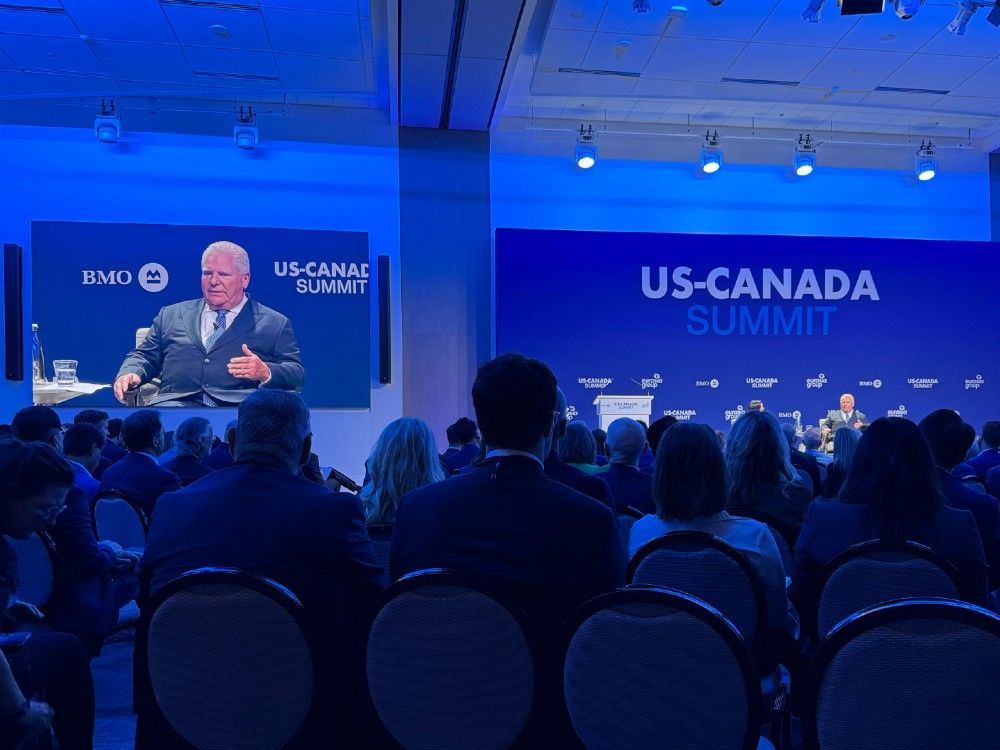
Doug Ford spoke at the U.S.-Canada Summit in Toronto on Wednesday, Oct. 8, 2025.

TORONTO — When it comes to Canada’s relationship with the United States, Ontario Premier Doug Ford says “we have to think beyond” Donald Trump’s presidency.

Trump only has three more years in office and “is not going to be around forever,” the premier said while speaking at the U.S.-Canada Summit in Toronto on Wednesday. Ford’s comments come a day after Prime Minister

Mark Carney met with Trump at the White House and left without any concessions on tariffs.

“I always plan five, 10, 15 years down the road. We’ll get through it. There might be some bumps on the road, but I’ll tell you one thing. I will not roll over,” he said.

Ford said the politicians that he speaks to, including Republicans, are “terrified to come out and say anything” against tariffs. Canada is expected to “play fair” and not fight back. “But I take a different approach,” he said. He said Trump decides to go after Canadian industries, like softwood lumber and steel, “out of the blue.” Copper and auto parts not covered by the Canada-U.S.-Mexico free trade agreement are also being heavily tariffed. A new

detailed trade deal

has yet to be revealed after Carney and Trump’s latest White House meeting.

 Prime Minister Mark Carney and U.S. President Donald Trump appear to be having a good time as they met in the Oval Office of the White House on October 7, 2025.

“As we’re decreasing the tariffs, he’s increasing the tariffs. Well, if we can’t get a deal, we have to hit him back twice as hard,” he said, calling Ontario an economic powerhouse. “We need them, but they need us as well.”

He said he wouldn’t put

American liquor back on the shelves

until a deal was reached.

As for the auto sector, Ford said it’s “so integrated” with the United States, you just can’t separate it overnight.”

Trump on Tuesday said

that the U.S. was at an advantage because of its “massive market.”

But Ford said Ontario would continue to make automobiles, which it has been doing for 100 years. He also said Canada was a powerhouse when it came to buying vehicles.

Ford was asked if he thought Canada was asleep at the switch in failing to tap the leverage the country has, especially in regards to resources like minerals. He was also asked how he thought Carney was handling the situation.

“I’m in support of the prime minister, but I think we have to be tougher,” said Ford, adding that it’s the provincial government that is in charge of its own minerals. “I would love to sell our critical minerals to our closest friends and allies,” he said — “not foes.”

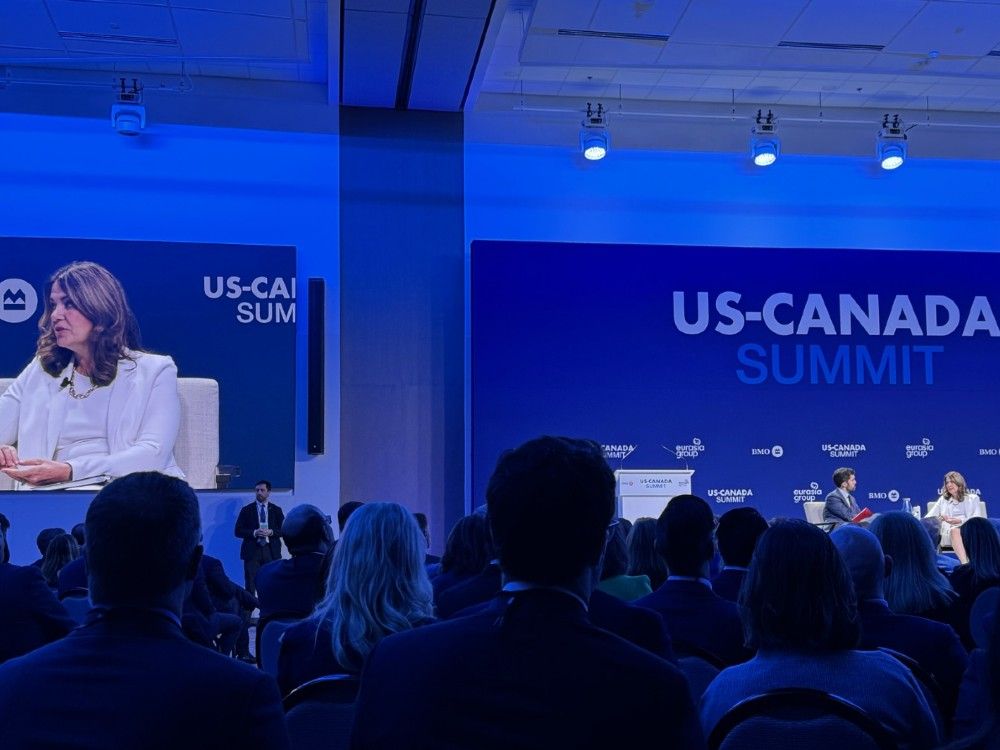
 Alberta Premier Danielle Smith spoke at the U.S.-Canada Summit in Toronto on Wednesday, Oct. 8, 2025.

Alberta Premier Danielle Smith, also speaking at the summit on Wednesday, said that Canada’s minerals, along with its raw materials and energy, could be used as leverage when dealing with Trump, but it had to be done in a way that appealed to the president.

“If you go to the U.S. president and say, ‘You should do this because it helps me,’ or ‘You should stop doing this because it hurts me’… That is not his love language,” said Smith. “His love language is, ‘Let me tell you how I can make America even greater. Let me tell you how Canada being able to provide you raw materials or critical minerals or energy and natural gas allows you to have energy dominance in the world.”

She thought that Carney was already adapting how he interacts with Trump. She called Trump a “relationship guy.” And the lack of a good relationship with former prime minister Justin Trudeau “led to a lot of the problems that we’ve found ourselves in today.”

Our website is the place for the latest breaking news, exclusive scoops, longreads and provocative commentary. Please bookmark nationalpost.com and sign up for our daily newsletter, Posted, here.


Earl Haig Secondary School is seen on Google Maps.

A Toronto high school has been issued a rebuke from Ontario’s Minister of Education, after he learned that it played the national anthem in Arabic on Tuesday morning, the second anniversary of the Hamas terror attack on Israel that killed more than 1,200 Israelis and resulted in more than 240 hostages, of which some 48

remain in captivity

.

Earl Haig Secondary School is a public school near Yonge and Sheppard in north Toronto, with about 2,000 students. It is also home to the Claude Watson Arts Program, which opened in 1982 and offers artistic as well as academic education.

“It is hard to believe that no one recognized the significance of this day, where the world recognizes the anniversary of the worst terrorist attack perpetrated against the Jewish people since the Holocaust,”

Paul Calandra, the Minister of Education

, released a statement on social media Tuesday evening. “This further underscores that school boards should be focused on creating safe learning environments for all students, never at the expense of one community over another,” he wrote.

Media reports Tuesday indicated that the school broadcast O Canada in Arabic on that morning over its PA system.

“They have a CD that includes O Canada in English, French, Métis, Farsi and Arabic. Today, they decided to play the Arabic one,” a source at the school told

Juno News.

The source added that the principal then made a brief announcement. “He said it was a tough day for our community and encouraged students to reach out to friends if they needed support. He didn’t mention October 7 specifically.”

Calandra said he was “disappointed” that he had to reach out to the school and remind them of their responsibilities.

“The federal National Anthem Act sets out that the official lyrics are in English or French, and if the school boards choose not to represent our national symbols and federal legislation, then I will take action,” he added.

Kevin Vuong, former Member of Parliament for Toronto’s Spadina–Fort York riding (he did not run in the most recent election) also took to social media, saying: “This was, at best, insensitive, and more than likely intentionally meant to cause distress & harm to their Jewish students.” He added, referring to whoever made the decision: “That person should be fired.”

Earl Haig’s website

lists a Jewish Students Union (JSU) among its clubs, and a contact for Jewish Family and Child Services in the English version of its parent handbook, which is also available in Chinese, Korean and Farsi. Media reports say that approximately 100 of the school’s students are Jewish.

National Post has reached out to the school, its principal and the JSU for further information.

Our website is the place for the latest breaking news, exclusive scoops, longreads and provocative commentary. Please bookmark nationalpost.com and sign up for our daily newsletter, Posted, here.

Four-year-old Jack Sullivan, left, and six-year-old Lilly Sullivan, right, seen in this handout photo, went missing on May 2, 2025 in the community of Lansdowne Station, N.S.

Cadaver dogs did not find the remains last month of two young children who went missing more than five months ago from their home in rural northeastern Nova Scotia.

The RCMP is continuing “to explore all possible scenarios in its efforts to locate (six-year-old Lilly Sullivan and four-year-old Jack Sullivan) after searches in Lansdowne Station (in late September) didn’t result in finding human remains,” the force said Wednesday in a news release.

Insp. Luke Rettie and his police dog, Narc, as well as Sgt. Dave Whalen and his police dog, Kitt, searched a total area of 40 kilometres, it said.

“The teams, specially trained in detecting human remains, searched at the property from which the children went missing, along the pipeline and intersecting trails, and in an area where a pink blanket was previously found — all locations where there was the highest probability of finding the children. However, the teams did not locate any remains.”

The “dogs are highly trained to detect and indicate the scent of human remains,” Staff.-Sgt. Stephen Pike, who trains the animals, said in the release. “If the dogs did not alert their handlers, it suggests the dogs were never in the presence of human remains odour.”

That does not “definitively rule out the presence of remains in the areas that were searched,” Pike said. “It means either the odour is there and couldn’t be detected or the odour isn’t there.”

Mounties say investigators continue to “assess and follow up on information that has been gleaned from the more than 860 tips received to date, 8,060 video files that have been reviewed, and forensic testing that continues.”

The probe has multiple prongs, said the release.

“Each piece of information, including the results from the search teams, helps inform our next steps,” Staff-Sgt. Rob McCamon, a major crime investigator, said in the release.

“With support from agencies across Canada, the investigative team is working to validate or eliminate leads and follow the evidence wherever it takes us. At this stage, and as we’ve said all along, we’re considering all possibilities. We’ll keep going until we determine, with certainty, the circumstances of the children’s disappearance and they’re found.”

The children were first reported missing by their mother Malehya Brooks-Murray at 10:01 a.m. on May 2.

 Lilly and Jack Sullivan.

Brooks-Murray told police she believed the two children had wandered away from their home in rural Lansdowne Station, N.S. Police arrived 26 minutes later.

Searchers scoured the area around Lansdowne Station after the children vanished. Police dogs were employed early on that can pick up human scent, including that of recent remains. But last month marked the first time specialized cadaver dogs joined the hunt for the missing kids.

Jack and Lilly’s family mobile home sits along a gravel road surrounded by dense woods. The house also has a back patio, with a sliding glass door, which is most likely how the children got out that morning.

Court documents investigators used to obtain search warrants in the case indicate “the last time the children were seen outside their home was on May 1, when they were captured by video surveillance at a local Dollarama store with Brooks-Murray and Daniel Martell, their stepfather.”

RCMP conducted at least four polygraphs during their investigation. The first two were on May 12 with the children’s parents. Martell’s polygraph “indicated he was truthful,” as did the test for Brooks-Murray. She was found truthful when answering specific questions.

 Daniel Martell, the stepfather of Lilly and Jack Sullivan, speaks with reporters on Wednesday, May 7, 2025, after the RCMP announced they were scaling back the search for the missing children.

On June 10, the children’s step-grandmother, Janie MacKenzie, underwent a polygraph examination but another document notes that her “physiology was not suitable for analysis and an opinion on the polygraph examination was not rendered.”

The children’s biological father, Cody Sullivan, underwent a polygraph on June 12, and he passed the examination, with his answers found to be “truthful.”

In July, the Mounties said they were running forensic tests on a pink blanket found during the search of the heavily wooded areas near the children’s home. Police said at the time that the family had confirmed the blanket belonged to Lilly, but investigators released few details.

Later, police dispatched a sniffer dog to the area where the blanket was found, but the animal was unable to pick up a scent of Lilly or Jack, according to information police filed in court to get search warrants.

The children’s mother told police at one point that their biological father might have picked them up and taken them to New Brunswick. But investigators met with Sullivan on May 22.

“He said he did not know what happened to Jack and Lilly,” police noted. “He was home on May 2, 2025, and never goes anywhere. He has not been anywhere other than his house recently and has had no contact with Malehya since the children went missing.”

Police received lots of tips in the case, including one from a witness who said she was travelling with her sons on the morning of May 2 and saw two children walking along the side of the road. She told police she saw the children that morning walking toward a Caucasian female of about 50 to 60 years old who was waiting next to the passenger side of an older model tan or gold sedan with the back door open.

Investigators urge anyone with information about Lilly and Jack’s whereabouts to call the Northeast Nova RCMP Major Crime Unit at 902-896-5060 or to contact Nova Scotia Crime Stoppers, toll-free, at 1-800-222-TIPS (8477), submit a secure web tip at www.crimestoppers.ns.ca, or use the P3 Tips app.

Our website is the place for the latest breaking news, exclusive scoops, longreads and provocative commentary. Please bookmark nationalpost.com and sign up for our daily newsletter, Posted, here.