LP_468x60
on-the-record-468x60-white

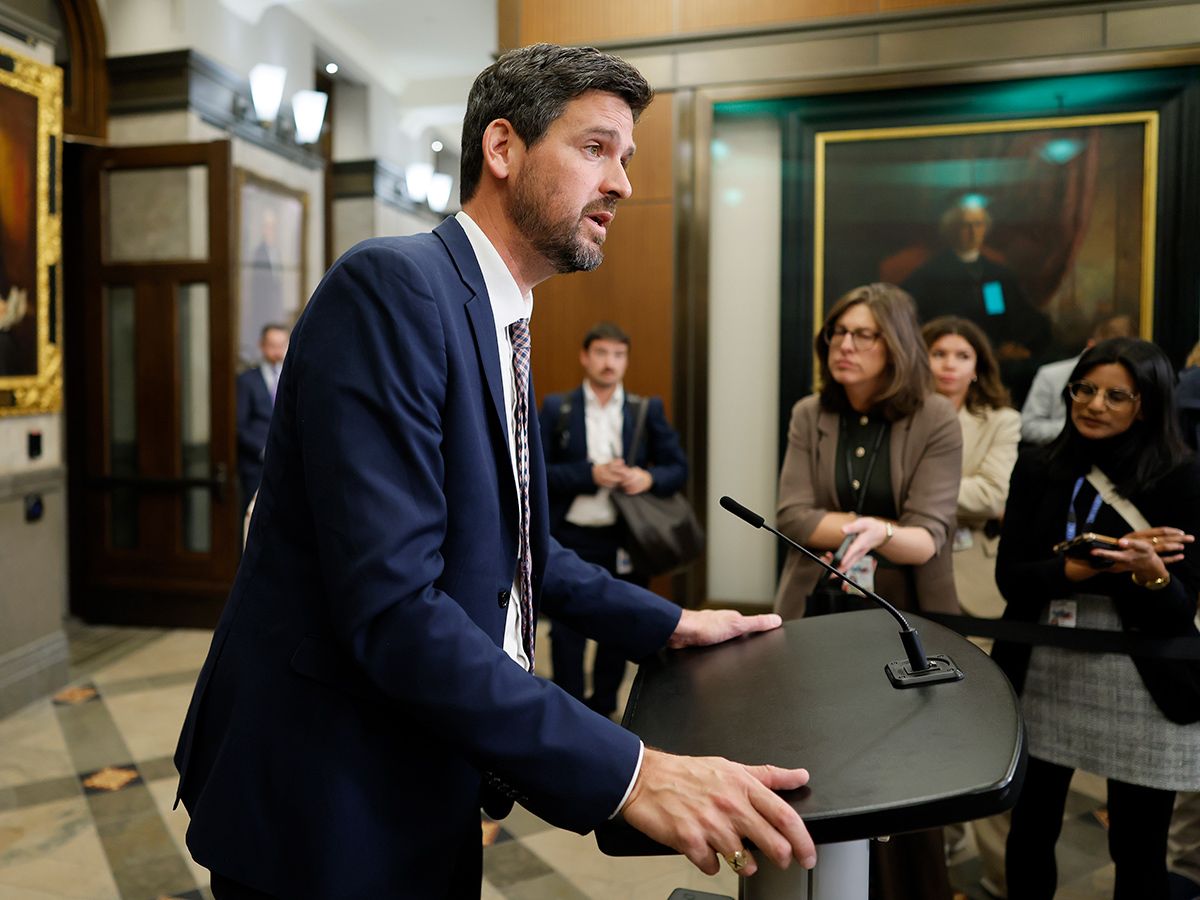
Minister of Health Marjorie Michel speaks during Question Period in the House of Commons on Parliament Hill in Ottawa on Wednesday, June 17, 2026.

OTTAWA — The minister in charge of Alberta’s hospital system is calling on her federal counterpart to shut down talk of sanctioning the province over its new private health care law.

Alberta Hospitals Minister Adriana LaGrange said she was surprised but undeterred by a report earlier this week that federal Health Minister Marjorie Michel is considering penalizing Alberta under the Canada Health Act for provincial legislation that allows some physicians to practice in both the public and private systems.

LaGrange said she was especially concerned to see the reporting reference discretionary penalties , which are exceptional punitive measures under the CHA.

“I was quite surprised by … somewhat of an implied threat on discretionary penalties, which have never been a conversation between myself and Minister Michel,” LaGrange told National Post in an interview.

LaGrange said she texted Michel shortly after the reporting was published but didn’t get a clear response on the question of discretionary penalties.

“Minister Michel had responded back that … she was reiterating what she’d already told me, but (she) did not address the tone (of the reporting) nor the discretionary penalties,” said LaGrange.

LaGrange sent her own message to the federal government on Monday, saying in a social media post that Ottawa “needs to respect Alberta’s … authority to determine how health care is delivered in this province.”

She said in the post that Alberta’s new dual-practice model does not violate the CHA, and that she remained committed to ensuring “Albertans never have to pay out of pocket for medically necessary care.”

Health care is a provincial responsibility, but the federal government uses the CHA to tie health transfers to public administration.

Provinces and territories that allow patient charges are regularly hit by deductions but hitting Alberta with discretionary penalties — indicating that the province has egregiously breached the CHA — would be an unprecedented move.

It’s a move that, LaGrange says, “would not be received well by the province of Alberta.”

LaGrange said she’d fight discretionary penalties “vigorously, with all the tools at our disposal, including if we had to fight it in court.”

She said that she had a good rapport with Michel but admitted that the report of potential discretionary penalties has created some tension in the relationship.

“I have a great working relationship with Minister Michel, but we also have jobs to do. And I will defend our province vigorously on this,” said LaGrange.

A spokesperson for Michel didn’t comment on discretionary penalties, but said she was working closely with the Alberta government to “mitigate possible adverse impacts on the public system.”

A senior Liberal source who asked to remain anonymous said that Michel has been under significant pressure from advocacy groups and concerned Canadians to steer Alberta away from further privatization.

The Opposition Alberta NDP has also called on Ottawa to intervene.

Colin Craig, president of Calgary-based think tank SecondStreet.org says it would be challenging for the federal government to slap Alberta with discretionary penalties, when Quebec has effectively had two-tier health care for the past two decades.

“The feds would basically be conceding that, when it comes to health care, Quebecers have more rights than everybody else in the country,” said Craig.

Craig said that the federal government should give provinces and territories space to experiment with mixed models of health care that have proven successful in much of Europe.

National Post
rmohamed@postmedia.com

Our website is the place for the latest breaking news, exclusive scoops, longreads and provocative commentary. Please bookmark nationalpost.com and sign up for our daily newsletter, Posted, here.


Maple syrup cans at a sugar shack in Quebec.

Metro, Sobeys and Loblaw are now defendants in a proposed class action over maple syrup tests found to be half cane sugar.

An amended application filed Aug. 3 in Quebec Superior Court added the three chains and Groupe Epicia, which runs Val-Mont grocery stores, CTV News reported.

The four are accused of demonstrating “negligence, recklessness, carelessness, or serious indifference” by putting the syrup on their shelves. The suit says the price alone should have prompted them to check it.

A Quebec judge has to authorize a class action before it can proceed, and nothing in the application has been tested in court. The case has moved from the producer to the chains that sold his product.

The proposed class covers anyone in Canada who bought a can produced by 9227-8712 Quebec Inc. since Oct. 5, 2010, which the suit gives as the date Erabliere Steve Bourdeau began selling maple syrup. Hundreds of thousands of people, and possibly millions, could be eligible, CBC News reported.

It seeks a refund of the purchase price, unspecified compensatory damages and $100 in punitive damages for each person in the class.

Radio-Canada’s investigative program Enquete bought five cans of Bourdeau’s syrup at random in April, from different stores and different batches, and had them tested at le centre ACER , the provincial lab responsible for maple syrup quality control in Quebec. Grocers were selling his cans for as low as $4.99.

All five were labelled pure. All five came back with at least 50 per cent cane sugar. Luc Lagace, the lab’s director of research, told Enquete he had never seen falsification of that kind.

Bourdeau told Enquete his syrup sold in hundreds of grocery stores across Quebec and Ontario, naming IGA and Metro in Quebec and Farm Boy in Ontario. IGA and Farm Boy are both Sobeys banners. The Montreal Gazette reported that the producers’ federation alleged the syrup also reached Adonis stores.

The suit cites Quebec agriculture ministry inspection reports and alleges Metro knew of complaints about the syrup as early as 2016, and Epicia as early as 2025, CBC reported.

Loblaw confirmed to National Post that it had been served.

“We can confirm that we have been served with the proposed class action claim and intend to contest authorization. As this is now an active litigation matter, we are unable to provide further information at this time,” Youmna Rab, a Loblaw spokesperson, said in an email.

“As legal proceedings are currently underway, we have no comment at this time,” Catherine Latendresse, a communications manager at Metro, said in an email.

Metro, Sobeys and Epicia had already filed to contest, CBC reported.

Bourdeau denies altering his syrup and blames his suppliers. “Maybe we were sent a bad batch,” he told Enquete. He also acknowledged to the program that he had sold Ontario syrup in cans labelled product of Quebec, which is illegal.

A separate proceeding is running in front of Quebec’s agricultural markets regulator. The Quebec Maple Syrup Producers federation asked it in April to investigate three years of Bourdeau’s operations, suspend his production quota, seize his syrup and impose more than $166,000 in penalties plus unpaid contributions, the Gazette reported.

He admitted buying syrup “on the black market” for years and has acknowledged rule violations going back more than a decade, including settlements covering 2010 to 2022, the filing says. The regulator has not ruled.

The federation had been looking into the company since January and complained to Quebec’s agriculture ministry on Feb. 20, weeks before Enquete aired.

In June, the Canadian Food Inspection Agency recalled all lot codes of 540-millilitre pure maple syrup under the 9227-8712 Quebec Inc. and L’Erabeille brands, sold in Ontario and Quebec. The recall was for container integrity defects and spoilage, not adulteration, and was rated Class 3, the least severe level.

Many grocers offered refunds in the weeks after the broadcast. The suit argues that is not enough, because a class action can also award punitive damages and interest.

Quebec inspects roughly 90 per cent of the syrup it produces in bulk. It does not inspect the cans a producer sells straight to a grocer, which is how Bourdeau sold his.

“We don’t classify maple syrup from a producer who sells directly to a supermarket,” Genevieve Clermont, head of ACER’s inspection division, told Enquete.

Sobeys and Slater Vecchio, the law firm behind the class action, did not respond to National Post’s requests for comment.

Our website is the place for the latest breaking news, exclusive scoops, longreads and provocative commentary. Please bookmark nationalpost.com and sign up for our newsletters here.


Public Service Alliance of Canada (PSAC) signage in Ottawa on Thursday, Aug. 20, 2026.

OTTAWA — The Public Service Alliance of Canada (PSAC) has issued a lifetime ban against one of its own local presidents just days before he planned to run to keep his job, marking the latest battle between the country’s largest public sector union and one of its own.

In an Aug. 11 letter obtained by National Post, PSAC National President Sharon DeSousa wrote to Theo Lagakos, president of a local that represents more than 1,200 workers at a popular Toronto casino, to say that he had been retroactively banned for life from PSAC due to “a concerning pattern of repeated and targetted behaviour against the complainant.”

The letter doesn’t identify a complainant nor specify the precise accusations against Lagakos, long-time president of Local 533, but quotes from a section of the union’s constitution that includes such infractions as circulating “false reports” among members and disturbing meetings.

The ban means that, as a non-member of the union, Lagakos is no longer eligible to run in union elections this Friday to keep his job. That could open the door for someone more in line with PSAC’s executive team to get the local’s top job.

Lagakos said the ban came a year after his local was put into trusteeship by the parent union, effectively shutting down the local’s power and ability to serve its members. He said he doesn’t know what he’s been accused of, but that both disciplinary measures against he and his local follow their decision to consider presenting members with the option of aligning with the Union of National Employees (UNE), a component group within PSAC, instead of directly under PSAC.

If members had voted to be under UNE, it would have meant that PSAC would have had to share union dues with the component union, an annual loss to PSAC of an estimated $200,000. It also could have tilted the balance of political power within PSAC away from its current executive team.

The trusteeship issue is now before the Ontario Labour Relations Board. Lagakos and his local, which represents employees at The Great Canadian Toronto Resort, formerly known as Casino Woodbine, provided testimony last week. PSAC officials will offer testimony in September.

Lagakos said his dispute with PSAC is about principle as much as anything else. “This is a battle for transparency,” he said. “This is a battle for real democracy.”

In many cases, there’s also a financial incentive for union executives — both within the parent organization and the components — to keep their jobs. The high-ranking union jobs often pay up to two or three times more than the government or private sector positions that the executives used to have.

The battle between PSAC and Local 533 marks the latest dispute between PSAC, which represents nearly 240,000 workers across Canada and in other countries, and one of its own component units or locals.

Harun Jasarevic, a PSAC spokesperson, said the union doesn’t generally comment on internal matters. PSAC has also declined to comment about other cases between the union and its components.

Those other cases, as many as a handful, also involve accusations that PSAC has been trying to sideline or punish those who lead locals or one of its 15 component unions if they challenge PSAC leadership.

In one case, Alisha Kang, who was UNE president until being effectively stripped of her role last fall, said in court documents that that she was set to expose “significant financial irregularities” and other union problems before being suspended.

Those irregularities, according to Kang’s claims, included a scheme involving union staff making “spurious or artificially substantiated” classification grievances, which were then settled informally by granting “general damages for human rights.”

In two other cases involving sidelined component executives, the tension can be traced back to the union’s negotiations with the federal government in 2023. At that time, some component executives initially decided to support a campaign to vote against a tentative deal because they wanted stronger provisions for members to work from home.

PSAC responded to the ”no” campaign by suspending the component union bosses. The ensuing punishment in that case also included suspensions of their PSAC memberships, which meant that they could no longer do their union jobs.

Larry Savage, a labour studies specialist at Brock University in St. Catharines, Ont. , said tension within a large union is not unusual, especially one that represents diverse interests such as PSAC.

Larger unions have the advantage of more power, Prof. Savage said, but also have the greater challenge of trying to democratically manage a range of interests.

“Solidarity doesn’t mean that every member has identical priorities.”

PSAC members work for the federal government, universities, casinos, community services agencies, Aboriginal communities, airports, and the security sector among others. According to PSAC’s 2024 audited financial statements, the union had a total budget that year of 172.8-million, the vast majority of which ($164.4-million) was derived from membership dues.

National Post

Our website is the place for the latest breaking news, exclusive scoops, longreads and provocative commentary. Please bookmark nationalpost.com and sign up for our daily newsletter, Posted, here.


Osgoode Hall, home to the Ontario Court of Appeal, is pictured in Toronto in October 2025.

Ontario’s top court has upheld a house arrest sentence for a man who grabbed a gun from armed intruders who shot his son and fired it at them from his porch while they fled.

The Crown tried to appeal Jason Munroe’s conditional sentence from the Ontario Court of Justice. But the province’s Appeal Court dismissed the case.

“Given the exceptional circumstances of the offence and the significant mitigating factors, we see no error in principle in this case. Nor do we find that the sentence was manifestly unfit,” the three-judge panel said in an Aug. 19 decision.

Justice Nathan Baker of the Ontario Court of Justice sentenced Munroe last August to two years less a day of house arrest and three years of probation.

According to the appeal decision, armed intruders entered Munroe’s home in Whitby, Ont., forcing him and his family into the basement.

“There was an altercation during which Mr. Munroe’s son was shot. Mr. Munroe wrestled a handgun from one of the intruders and shot one of them. The intruders fled the house. Mr. Munroe chased them. He then stood on his porch and shot at them approximately three times as they were fleeing in their car.”

Munroe’s shots didn’t hit anyone.

“When the police first interviewed Mr. Munroe, he lied and said that he did not have or use a gun. He subsequently told the police that he used the gun he wrestled from the intruders to shoot at them, saying that he tried to kill them and that, if given the chance, he would have killed them all,” said the appeal decision.

Baker found Munroe “not guilty of any charges related to what occurred in the house while the intruders were still there,” said the appeal decision.

“The trial judge was satisfied that Mr. Munroe was acting in self-defence.”

But Baker found that Munroe “was no longer acting in self-defence when he shot at the intruders from his porch,” said the appeal decision.

“The trial judge found Mr. Munroe guilty of reckless discharge of a restricted or prohibited firearm. He also found him guilty of obstruction of a peace officer for lying in his initial statement to the police.”

Baker found that the five-year mandatory minimum sentence for reckless discharge of a restricted or prohibited firearm “was unconstitutional if applied to the circumstances of this case,” and sentenced him to 729 days of house arrest, said the appeal decision.

The Crown unsuccessfully appealed the length of that sentence, “arguing that the trial judge erred by failing to give proper effect to the principles of denunciation and deterrence and that the sentence is demonstrably unfit.”

The Appeal Court did not agree.

“There is no doubt that weapons offences are very serious and that they should generally carry a significant custodial sentence, especially in circumstances where an accused discharges a firearm in a public place,” said the panel.

“In his reasons, the trial judge recognized that denunciation and deterrence are generally the primary objectives when sentencing an individual for discharging a weapon in a public place.”

But Baker “also found that the circumstances of the offence in this case are exceptional,” said the panel.

“When Mr. Munroe shot at the intruders from his porch, he was no longer acting in self-defence but he was still acting in the heat of the moment after seeing his family under threat and his son shot. In addition, Mr. Munroe used a handgun he had wrestled from the intruders to protect his family; this was not a handgun he acquired unlawfully and brought to the scene.”

There were other “significant mitigating factors, such as Mr. Munroe’s demonstrated remorse and extensive rehabilitative efforts, and that he had overcome a turbulent youth to become a dedicated father and a skilled worker with a stable job and income,” said the appeal decision.

The panel also pointed out that Munroe “is not going unpunished for his convictions. The two years less a day conditional sentence carries onerous conditions, including house arrest (except for going to work) and GPS monitoring,” said the appeal decision.

“The conditional sentence is to be followed by three years’ probation. This is essentially the maximum available conditional sentence short of a custodial sentence.”

Our website is the place for the latest breaking news, exclusive scoops, longreads and provocative commentary. Please bookmark nationalpost.com and sign up for our daily newsletter, Posted, here.


U.S. President Donald Trump, with Vice President JD Vance and Speaker of the House Mike Johnson (R-LA) looking on, delivers his State of the Union address during a Joint Session of Congress at the U.S. Capitol on February 24, 2026, in Washington, DC.

WASHINGTON, D.C. — Paul St-Pierre Plamondon, leader of the Parti Québécois, said this week that a PQ government would not hold a sovereignty referendum while Donald Trump is president of the United States, even if the party wins a majority in Quebec’s October election.

St-Pierre Plamondon’s announcement illustrates what political observers see as a significant domestic aftershock of Trump’s pressure campaign: the president is reshaping Canadian politics below the federal level, turning Quebec independence from a domestic constitutional question into one increasingly wrapped up in international affairs.

But Trump may make the PQ easier to elect while making its core project harder to achieve. St-Pierre Plamondon, after all, is asking Quebecers to vote for change without requiring them to endorse independence.

“Generally speaking, it’s a problem for the PQ. It’s a problem for Quebec nationalism, because the Trump factor is a fear factor,” explained Frédéric Boily, a political scientist at the University of Alberta’s Campus Saint-Jean.

Polls already reflect that support for Quebec independence is low.

Recent data from Angus Reid show that just 26 per cent of Quebecers would vote, or lean toward voting, to leave Canada in a referendum. Sixty-three per cent would vote or lean toward staying.

“There are many Quebecers, a significant segment of them, who do wake up with the dream of Quebec not just being a nation as recognized in Parliament, but a true sovereign nation,” said Shachi Kurl, president of Angus Reid Institute.

“But for many other Quebecers, the relationship with Canada is one that’s basically, as long as this is a country that provides a good standard of living, and as long as their cultural and linguistic and other self-determinist needs are met, there are other things that Quebecers are focused on.”

That’s why political commentators call St-Pierre Plamondon’s decision tactically smart. By ruling out a referendum during Trump’s presidency, while still leaving open the prospect of one later, the PQ’s leader lowers the perceived risk for voters who may want a new provincial government without wanting to make an immediate choice on independence.

Now, a vote for the PQ is not necessarily a vote for a “Yes” coalition, Boily explained. Without the delay, he said, the party would have faced a more direct message from opposing parties that a vote for the PQ was a vote for independence.

Kurl also said deferring a referendum gives the PQ room to campaign as an alternative to the Coalition Avenir Québec (CAQ) government, rather than as a party preoccupied with sovereignty.

PQ is doing well largely because the other parties are not as popular, and because voters may be ready for change, according to Boily.

“The popularity of the PQ is the unpopularity of the CAQ,” he said.

Andrew Enns, Léger’s executive vice-president, said Léger’s federal polling suggests support for federalist parties in Quebec has risen during Trump’s second term. Liberal support in Quebec, for example, has increased from the mid-to-high 20s in 2024 to 44 per cent this month.

The rise in the Liberal vote means combined support for the Liberals, Conservatives and NDP amounts to well over 60 per cent of the electorate, “which was not always the case pre-Trump,” Enns said.

Provincially, the PQ remains at about 30 per cent in recent Léger polling, ahead of the Quebec Liberals. But the race remains fluid: only 47 per cent of decided voters said their choice was final.

Meanwhile, support for separation in Quebec has dropped in the second Trump era, Enns said. In October 2024, support was around 35-37 per cent; this year it has dropped to around 30 per cent.

But the polling, cautions Kurl, should not automatically be read as warmer feelings toward Canada.

“These findings are less about what they find in Canada and more about what the fear of the unknown … of the potential of Quebec standing on its own two feet with a president who’s been very open about wanting to annex what he considers to be smaller or weaker countries looming right south of the border,” Kurl said.

Political analysts agree, noting that Trump is not making Quebecers fall in love with federalism or Canada so much as he’s making Canada look like the safer protective structure against a coercive United States.

“We’ve never had a secession in a modern advanced industrial liberal democracy because it’s very hard to convince citizens to support that because it’s inherently risky compared to the status quo,” said André Lecours, a political scientist at the University of Ottawa who studies federalism and nationalism.

“With this Trump administration down south, the risk is amplified.”

Boily tends to agree.

“It’s not necessarily a new love story with Canada,” he said. “It’s more fear (of) Trump.”

Angus Reid data earlier this year found that 79 per cent of Quebecers believed the United States would use economic means to pressure an independent Quebec to join the country.

But it’s not just economic pressure, said Kurl.

“The issue of separation (is) … very tightly tied to Donald Trump and annexation fears, whether it’s economic annexation, cultural annexation or actual annexation,” she said.

Fifty-one per cent in that poll also said they believed the United States could use military means to compel an independent Quebec to join the country.

Still, the very fear that makes the delay electorally useful for the PQ may make a referendum harder to win later.

If the PQ wins on a change message rather than on an explicit mandate for sovereignty, it could govern without a clear popular mandate to hold a referendum. But holding and winning a referendum after Trump could be even tougher moving forward.

St-Pierre Plamondon has tied the referendum to Trump’s tenure, but the president’s departure won’t necessarily stop the United States from being nationalist, protectionist and coercive in the future.

It could be “JD Vance, maybe, or another Trumpist” who wins the presidency next, said Boily. “It’s a possibility to have another Trumpist presidency.”

Lecours also notes that by postponing the referendum, St-Pierre Plamondon’s decision reflects that the economic case for independence — one based on 1990s-style, low-friction continental trade, softer borders and a predictable Washington — is harder to make.

The premise that Quebec could simply trade south if Canada objected to its sovereignty or politics is now harder to sell, laying bare that an independent Quebec would still have to make concessions and hold negotiations with Washington, Lecours explained.

“We’re not coming back to the 1990s even when Trump is gone,” he said.

“I think that’s going to make the PQ’s job in convincing Quebecers that an independent Quebec will not suffer economically — that the change won’t be so dramatic — more difficult.”

National Post

Our website is the place for the latest breaking news, exclusive scoops, longreads and provocative commentary. Please bookmark nationalpost.com and sign up for our newsletters here.


The Ontario Superior Court of Justice in Toronto.

An Ontario judge has discounted the sentence for an Ecuadorian man convicted of violently sexually assaulting a woman because he’s likely going to be deported when he gets out of prison.

Sergio Reyes Loor was convicted of sexual assault causing bodily harm earlier this year in the Ontario Superior Court of Justice. A ban has been placed on the publication of information that would identify the victim. The Crown argued that a five-year prison sentence was in order for Reyes Loor, who is a permanent resident of Canada.

“Defence counsel agreed that a five-year sentence would be fit and appropriate were the facts as I found them,” Justice Gillian Roberts wrote in her sentencing decision.

“However, he announced that the factual findings were unsafe. He declined to make submissions on sentence and instead used his time to gaslight me and embark on a shockingly sexist and misogynistic attack on the complainant. I will not dignify his submissions with a summary.”

The judge said she doesn’t hold the defence lawyer’s “offensive submissions” against Reyes Loor.

“I add that I stand by my factual findings. I made them after careful consideration of the entire record and the submissions of both counsel,” Roberts said.

Under Canadian immigration law, permanent residents sentenced to more than six months behind bars are inadmissible to Canada on grounds of serious criminality and face deportation.

While she said, “five years is a fit and appropriate sentence in the circumstances,” that’s not what the judge gave him.

“The conviction will have devastating immigration consequences, making any punishment I impose more severe than it otherwise would be. As a result, I decrease the sentence to four years,” Roberts said.

The court heard that on the evening of April 6, 2023, the woman went out with a friend for an evening of drinking and dancing in Toronto.

They “went to a series of nightclubs before ending the evening at Mr. Reyes Loor’s apartment, around 5:30 a.m. on April 7, 2023,” said the sentencing decision.

Reyes Loor worked in the Toronto club scene and knew the woman’s friend.

Reyes Loor let the pair into the nightclub Early Mercy without waiting in the lineup or paying the cover charge around 1 a.m. on Aug. 7, 2023, said the decision, which notes Reyes Loor provided them with vodka shots.

The pair moved on to other clubs, “but returned to Early Mercy at closing time, around 4 a.m.,” said the decision.

They accompanied Reyes Loor to a party, then came home with him to his apartment, it said. “Surveillance video from his lobby shows the trio arriving around 5:30 a.m.,” and the woman leaving with her friend around 9 a.m.

The woman “became extremely intoxicated over the course of the night,” said the decision. “Apart from a few flashes of memory, she does not remember anything after around 2 a.m. until the following morning, around 9 a.m. One of the flashes of memory she has is about 10 seconds at Mr. Reyes Loor’s apartment. He is on top of her, beginning to penetrate her vagina with his penis. She did not want him to penetrate her but was so drunk that she could not move or speak.”

The judge was “satisfied beyond a reasonable doubt that Mr. Reyes Loor knew that (the woman) was too intoxicated to consent to sexual intercourse at the time.”

Roberts was also “satisfied that Mr. Reyes Loor caused” the woman injuries during the non-consensual sexual activity.

“She was bruised all over, and the skin of her genitals torn. It was painful and mentally disturbing to go to the bathroom. It was also difficult to do many of the movements she was required to do at work. In addition, the medications she was prescribed had side effects on her gastrointestinal system,” said the judge.

“More significantly, she is no longer the confident, trusting, innocent person she once was.”

The victim told the court her “perception of bonding through trust has been affected in ways that are hard to articulate,” said the decision.

“Social spaces that once felt natural are now fragile.”

She told the court that the “psychological and emotional impact continues to affect” how she lives, loves and experiences the world.

“It feels every day is a process of navigating grief, anxiety, vulnerability and inner peace while regaining my sense of normalcy, routine and control,” she said.

Reyes Loor, 31, “initially came to Canada in 2015 to study English and returned later to study business,” said the decision.

“He graduated from George Brown in 2018.”

His common-law partner testified that she was “shocked by the charges and believed them to be out of character.”

Reyes Loor “maintains his innocence,” said the judge. “When I asked him whether he had anything to say before he was sentenced, he noted simply that his mind was at peace and his conscience clear.”

Assuming the conviction is upheld, Reyes Loor’s lawyer was “unequivocal that he will lose his status and be deported,” said the decision.

Reyes Loor took advantage of the woman’s “condition to violently sexually assault her,” said the judge.

“He did not wear a condom. The offence involved gratuitous violence. He bit her. He tore her genitals.”

The victim was injured both physically and psychologically, Roberts said.

Reyes Loor “has no criminal record or any history of involvement in the criminal justice system,” said the judge. “He is a good son, partner, and employee.”

According to Roberts, “the sentence must be as short as possible to achieve general deterrence and denunciation.”

The judge noted that “collateral consequences can never reduce a sentence to the point where it becomes disproportionate to the gravity of the offence, or the moral blameworthiness of the offender.”

But given Reyes Loor’s “immigration situation,” Roberts said, his conviction will “nearly certainly result in him being deported, making whatever punishment I impose more severe.”

She reduced his sentence to four years “in light of the serious collateral consequences that the conviction will likely have on Mr. Reyes Loor. The circumstances of this case are far too serious to impose a sentence that will not have immigration consequences…. Nonetheless I believe the near certain immigration consequences still factor into the sentence in so far as they will make the sentence harsher than it otherwise would be. I believe it is important to take this into account in order to ensure the sentence is proportionate.”

Our website is the place for the latest breaking news, exclusive scoops, longreads and provocative commentary. Please bookmark nationalpost.com and sign up for our daily newsletter, Posted, here.


From left, Prime Minister Mark Carney, Dominic A. LeBlanc, Minister responsible for Canada-U.S. Trade, Intergovernmental Affairs and Minister of Internal Trade, and Nova Scotia Premier Tim Houston chat before the start of a First Ministers meeting in Charlottetown, P.E.I. on July 23, 2026.

Prime Minister Mark Carney has asked Canadian provinces to end their bans on U.S. alcohol sales as part of a deal struck with American trade negotiators, Nova Scotia Premier Tim Houston said on Wednesday night.

Donald Trump announced a “pause” on planned tariffs against a variety of Canadian goods that were scheduled to go into effect on Wednesday pending the completion of an agreement that is now working toward a Friday deadline.

As part of that deal, Houston told reporters after a call with Carney, provinces that have kept products from Kentucky bourbon to California wine off of store shelves since the U.S. President’s trade war began last year were requested to make them available for sale again.

Houston told reporters that he was willing to end Nova Scotia’s ban, pending a resolved deal.

Ontario Premier Doug Ford, who has generally been in favour of strong trade action against the United States and has repeatedly complained about Trump’s behaviour toward a close ally, said last week that he would be willing to end his province’s ban as part of “a fair deal.”

That was a change from his long-held stance that he would only allow the LCBO to sell U.S. products once the Trump administration removed the tariffs that it imposed last year.

A spokesperson from the Premier’s Office did not immediately respond to a message seeking comment.

In a statement Wednesday, Carney congratulated Canada-U.S. Trade Minister Dominic LeBlanc and United States Trade Representative Jamieson Greer for their significant progress in negotiations.

“Canada entered these discussions with the best overall trade terms,” said Carney, in a post on X.

“We are now moving towards an agreement that reinforces that Canadian advantage, including by securing the best terms in each of Canada’s most important strategic sectors and providing greater certainty about our future trading relationship,” the prime minister added.

No terms of the tentative deal have been officially released, but reports on Wednesday said Canada would receive reduced, but not eliminated, tariff rates on steel, aluminum and auto parts that were imposed at the beginning of Trump’s trade war.

Trump has indicated that U.S. farmers would be “thrilled” with the deal as proposed, suggesting a possible end to Canada’s supply-management dairy system, but LeBlanc subsequently said on Wednesday that the Canadian approach would remain “entirely intact.”

The U.S. President has often announced deals or agreements on social media that turn out to be significantly different than his original statement.

Our website is the place for the latest breaking news, exclusive scoops, longreads and provocative commentary. Please bookmark nationalpost.com and sign up for our newsletters here.


A Canada Post community mailbox soon be switched.

A Montreal manufacturer bid to build Canada’s community mailboxes and lost. It won’t name the Canadian company that holds the contract now.

Neither will Canada Post . The Crown corporation is installing community mailboxes for about 136,000 addresses late this year and early next, the first phase of moving four million addresses off door-to-door delivery over about five years.

Canada Post said in a statement the mailboxes are “being provided by a Canadian supplier” and that it buys them “through established agreements that support our operational requirements across the country.”

The corporation “does not disclose commercially confidential information related to supplier agreements,” it said. The statement does not say where the boxes are made, and Canada Post did not answer a follow-up asking whether the Canadian supplier is also the manufacturer.

P. Riopel Inc. has built mailboxes in Montreal since 1957, by its own account. “RIOPEL had many years ago unsuccessfully bid for the contract to supply Canada Post,” operations manager Pascal Brandt told National Post in an email. “A company in Denmark received the contract back then.”

That company was Treco A/S, a metal fabricator in Aalestrup, in northern Jutland. The Vancouver Sun reported in 2017 that Treco would build 7,500 community mailboxes a year for four years, 30,000 in all, with the first shipment due that August.

The Danish company register lists a Treco production unit called Treco CMB, registered that April and still active. Treco’s founders sold control of the company to a Danish investment fund in March.

The federal Buy Canadian Policy took effect Dec. 16, 2025. The government says it applies to federal departments and agencies and “will be applied, where possible, to crown corporations and their subsidiaries.” Treasury Board’s policy notice says Crown corporations “are encouraged to align” with it.

Canada Post said it is “subject to a Government of Canada directive requiring alignment with the Buy Canadian Procurement Policy” and has been updating its procurement practices accordingly. It did not say which directive.

Vincent Geloso , an economist at George Mason University in Virginia and senior economist at the Montreal Economic Institute, said rules of that kind work one of two ways. Foreign firms are barred outright, or a domestic bidder wins at a higher price. “But this is costly,” he said. “This is really costly.”

Geloso said he is critical of Canada Post on other grounds, but not for buying Canadian mailboxes instead of cheaper Danish ones, because the rule is not Canada Post’s to make. “I can blame them for poor management. I can blame them for a lot of things,” he said.

Public Services and Procurement Canada was asked whether the policy covers Canada Post. It said it needed more time to answer. The Canadian Union of Postal Workers did not respond to two requests. Treco referred questions to Canada Post. Two other Montreal manufacturers, Cendrex Inc. and Canadian Mailbox Company, did not say whether they supply Canada Post.

Brandt was the only person outside Canada Post to say the contract is now Canadian. He would not go further.

“Today, it is a Canadian Company that has that contract,” he wrote. “If Canada Post does not wish to name them, then it is NOT up to me to do so.”

Our website is the place for the latest breaking news, exclusive scoops, longreads and provocative commentary. Please bookmark nationalpost.com and sign up for our daily newsletter, Posted, here.


President Donald Trump welcomes Canadian Prime Minister Mark Carney outside the White House.

On Tuesday, at the eleventh hour, Donald Trump announced that Canada and the U.S. have reached a tentative trade deal, and paused a scheduled 50 per cent tariff on Canadian goods for three more days.

On Wednesday morning, the development featured as the top story on most, if not all, major Canadian news websites, including Bloomberg Canada, CBC, Global News, CTV and here, at National Post. It was also the front page story in today’s Globe and Mail.

But in America, not so much.

Press Gazette puts the New York Times, Fox, CNN and Yahoo Finance as the top news websites in the U.S. by audience and, on Wednesday morning, none of them featured the tariff development as the main story on their homepage.

Scroll down past the top articles on the Times website and you’ll see the headline “Canada gets 3-Day Reprieve From Punishing Trump Tariffs,” but the development didn’t get a mention on today’s front page.

The news is similarly low down on the CNN and Yahoo Finance homepages, while the highest-placed Canada story on the Fox News website is about WNBA star Sophie Cunningham drawing boos during a game against Toronto Tempo.

This lack of prominence may well be a judgement based on audience interest. After all, a poll from the Angus Reid Institute published on Aug. 9 found that Canadians are much more likely (91 per cent) than Americans (69 per cent) to be following news about the latest tariffs.

Meanwhile, a quick Google search of “tariffs” from Canada versus with a VPN based in the U.S. shows a stark difference between the websites Canadians are served compared to their southern neighbours.

While a Canadian user will see dozens of news reports about the latest development, the U.S. search results page shows an AI overview of what a tariff is, followed by a string of think tank and government websites. Trade negotiations seem to matter a whole lot more north of the border.

And Joseph Steinberg, Professor of Economics at the University of Toronto, has an idea of why this is. He tells National Post that, regardless of the specifics, “when it comes to tariffs, it’s always much more important for Canada than it is for the United States.”

The U.S. economy is ten times bigger than Canada’s, he points out, so “all of these trade issues are roughly 10 times more important for us than they are for the United States.”

A tentative deal would mean avoiding a levy on roughly $28 billion worth of Canadian goods — something which economists have said would hit certain businesses and industries “extremely hard.”

And Steinberg adds that while 50 per cent tariffs could potentially lead to job losses and plant shutdowns in Canada, the same would not be the case for the U.S. — though it would mean some products would be more expensive for American consumers.

In addition, people in the U.S. are “undoubtedly” paying more attention to the war in Iran, Steinberg says, as well as local elections — both of which are likely to push trade negotiations further down the agenda.

“Quite honestly, there are things that Americans perceive as being more important than (trade negotiations) this week,” he adds.

Meanwhile, Trump has said that U.S. farmers and manufacturers will be “thrilled” with the tentative trade deal with Canada. He made the comments during a press conference in Washington on Wednesday, adding, “Basically, we have no tariffs going into Canada anymore.”

This comes as U.S. Trade Representative Jamieson Greer told reporters in Washington that the deal eliminated “some of the irritants” of the last year, while Canada-U.S. Trade Minister Dominic LeBlanc swore that Canada’s supply management system remained “entirely intact.”

In the PM’s statement on Tuesday, Carney did not outline which concessions, if any, Canada may have made.

“Substantial progress has been made, although there is important work still to be done,” he said. “Canada remains focused on building a stronger, more independent, and more competitive economy at home.”

Our website is the place for the latest breaking news, exclusive scoops, longreads and provocative commentary. Please bookmark nationalpost.com and sign up for our daily newsletter, Posted, here.


Canadian powerlifting champion April Hutchinson at 'pep rally' for WNBA player Sophie Cunningham outside of the Scotiabank Arena.

Supporters of a WNBA player caught at the centre of a debate about transgender athletes in women’s sports led a rally outside her team’s game in Toronto on Tuesday.

Ahead of the hometown Tempo’s game against the Indiana Fever, a group gathered on the sidewalk outside Scotiabank Arena bearing signs in support of Fever guard Sophie Cunningham, whose July comment to ESPN about wanting to protect women’s sports has resulted in demonstrations in cities where the team has played road games.

“I got a lot of negative feedback about me hating trans. And I’m like, ‘I never once said that,’” she told ESPN in a profile published July 21. “I think that I am here to extend love. But I also think with that love is truth, being honest. And I want to protect young girls in a locker room, or young girls in sport who shouldn’t have to go against biological men.”

The signs on display read, “With Love is Truth,” “Canadian women and girls thank you #8,” and “This lil’ beaver loves women’s sports,” showing a beaver caricature in a maple leaf T-shirt and holding a non-descript flag with three horizontal stripes.

It was the first Cunningham rally held outside the United States, according to Fox News . Supporters first gathered outside Seattle’s Climate Pledge Arena on July 28, then in Portland on July 31, Minneapolis on Aug. 2 and Chicago on Aug. 8, where the Chicago Young Republicans and XX-XY Athletics organized a rally on Madison Street outside the United Center. Counterprotesters turned out at each one.

Some of the women in Toronto also wore shirts from XX-XY Athletics, a company founded by former U.S. gymnastics national champion Jennifer Sey that says it donates part of its sales to fund “the fight to protect fairness and opportunity in women’s sports.”

Among them was Canadian powerlifter April Hutchinson, who came to the fringe sport during the COVID-19 pandemic and has since won gold and silver medals in national and international competitions.

Speaking on the sidewalk outside the arena before tipoff, Hutchinson told the Toronto Sun she wanted Cunningham to know the group was there.

“Thank you so much for being brave but thanks for having integrity because a lot of people just don’t have integrity these days,” she said.

On her own website, Hutchinson has written that the Canadian Powerlifting Union suspended her for speaking out about a transgender competitor, and that she chose not to renew her membership afterward.

Toronto police also issued tickets over a mobile billboard truck parked outside the arena associated with the rally, Fox reported, with the charge reportedly falling under a section of the Toronto Municipal Code barring signs that carry video display elements.

Cunningham, meanwhile, has tried to distance herself from the debate.

“I think it’s just people practising their rights of freedom of speech and doing what other fans have been doing since the WNBA has started,” she told reporters in Portland last month. She has since called the attention a distraction and said she wants to get back to basketball.

Inside the arena, there was a mix of cheers and boos when Cunningham entered the game. Fans cheered when she missed her first free throw, and cheered again late in the fourth quarter when a banner supporting transgender rights appeared on the video screen during a timeout.

The 2026 collective bargaining agreement says only players who are women are eligible for the WNBA, with no further definition and no public policy on transgender or intersex eligibility. In 2024, NCAA president Charlie Baker told Congress he knew of 10 transgender athletes among more than half a million students on college teams.

Cunningham thanked the Toronto crowd afterward.

“You’re going to get boos, you’re going to get cheers,” she told reporters.

Our website is the place for the latest breaking news, exclusive scoops, longreads and provocative commentary. Please bookmark nationalpost.com and sign up for our newsletters here.