

LP_468x60
on-the-record-468x60-white

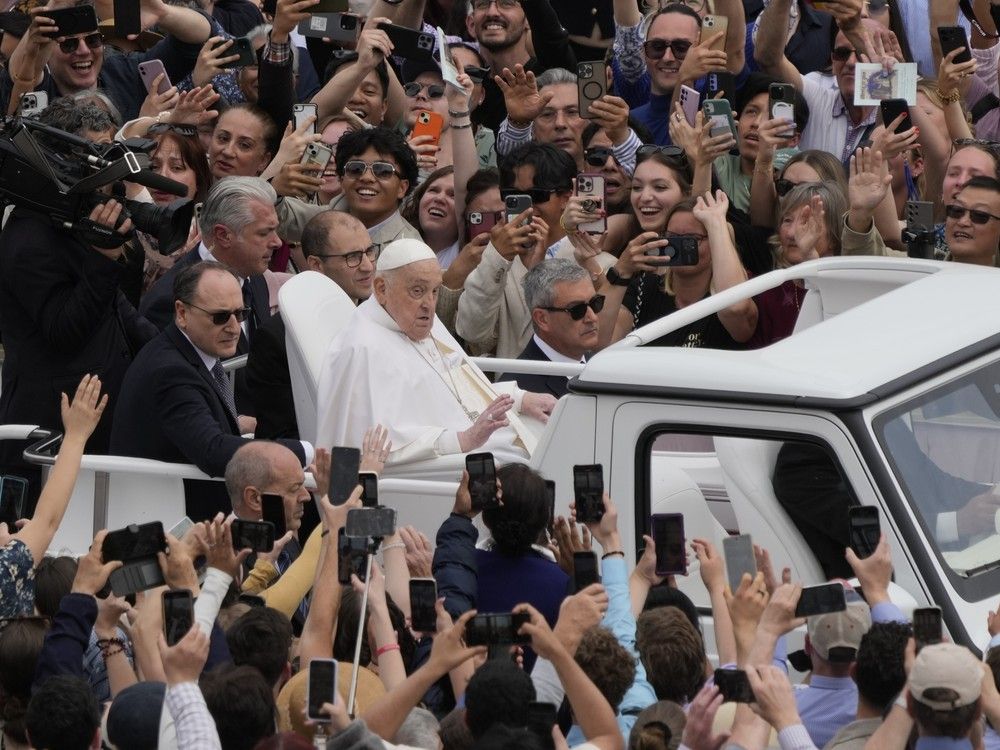
Pope Francis tours St. Peter's Square in his popemobile after bestowing the Urbi et Orbi (Latin for to the city and to the world) blessing at the end of the Easter mass in St. Peter's Square at the Vatican Sunday.

The real achievement of Pope Francis was not often remarked. It was that he managed to do the job at all, sometimes well, sometimes less so. But after two historic predecessors, the great fear was the office would overwhelm the man.

Pope John Paul II, already canonized, was spoken of by Francis himself as “the Great” — a title given only to Pope Leo the Great (440-461) and Pope Gregory the Great (590-604). John Paul, one of the dominant figures of the 20th century, is amongst those few popes who will be remembered centuries after his death. Likewise, his successor, Pope Benedict XVI, a rare case of a towering theologian seated on the papal throne, will be studied for generations hence. They were unusual; most popes, maximally prominent during their lives, fade quickly after their deaths.

In 2013, the question was whether any successor could truly succeed. The demands of the modern papacy were such that Benedict abdicated under the increasing burden of age. Even the most accomplished of men might be crushed by the burden. But Cardinal Jorge Bergoglio of Buenos Aires, the first Latin American pope, was not at all overwhelmed.

From the first he bent the ancient office to his will, refusing to wear the customary ceremonial garb on the balcony, refusing to use the papal car (he hopped on the Cardinals’ shuttle bus) and then refusing to live in the papal residence (he took quarters in the Vatican hotel). He was confident and charted his own course.

No office — even one established by Jesus Christ — can endure if it requires only superheroes to fill it. Pope Francis brought the office back down to size after 35 years of giants, John Paul and Benedict.

The humble Pope was massively popular at the outset, paying his own hotel bill after the conclave, calling the newspaper vendor back home to cancel his subscription, inviting a garbage scavenger he had befriended to his inaugural Mass in St. Peter’s Square. A more familiar papacy emerged — Francis gave lengthy press conferences while airborne on trips, engaged a parade of journalists, providing material for a constant stream of stories, and published some two dozen interview books.

All that made the papacy not only humble in style, but smaller in impact. Often enough Francis became only another voice in the noisy digital environment. Last year and this year he released what were billed as “first-ever autobiographies.” Both sank without making a significant splash.

The rhetorical shrinking began at the outset when, just months into his papacy, Francis made his most famous statement, in what would become the signature theme of his pontificate: “Who am I to judge?”

To certain more traditional Catholic ears, the answer was obvious: The Pope. Popes judge. As Jesus did, frequently enough with great severity — “throw him into the outer darkness, where there will be weeping and gnashing of teeth.”

The verb “to pontificate” exists for a reason. It’s what popes do.

To more worldly ears, Francis was cause for rejoicing. The age of nonjudgmentalism had found an unlikely hero in, astonishingly, the Roman Pontiff. The laudations sounded around the world, especially because the context of “who am I to judge?” was a question about homosexuality. Pope Francis didn’t change Church teaching, but his manner and mode of teaching was a change from his predecessors. It was widely welcomed with enthusiasm.

Time

magazine named him Person of the Year before his first anniversary; as did the gay magazine

The Advocate

. In contrast, John Paul had been pope for 16 years and brought down the Iron Curtain before

Time

gave him similar recognition in 1994. The secular world, and the various quarters of liberal Christianity, were euphoric. Finally, the pope they had fervently desired had arrived, a pope who would not pontificate.

Francis was more complicated than that.

In point of fact, he delivered judgments on a wider array of topics than his predecessors, and in much more vivid language. Abortion, he said, was “like hiring a hitman.” Gender theory was the “ugliest ideology of our time.” “This economy kills,” he said of financial markets. Regarding his closest collaborators in the Vatican, he identified “curial diseases” to which they were prone — and then proceeded to list more than a dozen of them, including “spiritual Alzheimer’s”, “rivalry and vainglory,” “existential schizophrenia,” “indifference to others” and a “lugubrious face.”

No pope in living memory spoke like that.

And none of his predecessors spoke so specifically on policy matters, preferring to restrict themselves more to principles than practical application. Pope Francis released a major encyclical — the highest form of papal teaching — specifically to influence the 2015 Paris climate conference. He objected to the immigration policies of President Donald Trump and various European conservative political parties. He made no secret of his sympathy for Palestinians relative to Israelis, calling every day the Catholic parish in Gaza since the Hamas war began. And he advised Ukraine to have the courage to embrace the “white flag” in the face of Russia’s invasion.

In foreign policy, so to speak, his impact was limited. His advocacy of the climate change agenda and liberal migration was ardent, but his papacy ended with both losing popularity and suffering policy reversals.

Regarding tyrants, he never found the same voice he had on other issues. Ukrainians were frustrated that he found it difficult to condemn Russia’s aggression by name. The persecution of Catholics in China intensified, but Francis never said a word. In Venezuela and Nicaragua, the regimes openly declared war on the Catholic Church — the latter expelled Mother Teresa’s nuns and threw bishops in jail without trial — and the first Latin American pope could not muster a robust response.

The things he didn’t say about China and Russia angered conservatives. The things he did say about Church practice — on blessings for same-sex couples, for example — encouraged liberals, but over time they lamented that words — not concrete reforms — seemed to be his limit.

Toward the end, Pope Francis became a figure of affection more than admiration. Conservatives objected to his liberalizing tendencies; liberals objected that they remained only tendencies. Yet the affection remained for a modest pastor who had a heart transparently open to the suffering and the afflicted, those on the margins and the “peripheries” — a word he introduced into Catholic vocabulary, an echo of Jesus’ command to feed, clothe, and visit the “least of my brethren.”

St. Paul wrote to the Corinthians, “For if the trumpet give an uncertain sound, who shall prepare himself to the battle?” (I Corinthians 14:8)

Pope Francis was wary of the certain trumpet. In his autobiography published in January 2025, the concluding lines — a sort of final testament — reveal his suspicions of certainty.

“It is no good a person saying with total certainty that they have met God,” he writes. “If someone has answers to all the questions, this is proof that God is not with them. It means that they are a false prophet, someone who exploits religion, who uses it for themselves. The great guides of God’s people, like Moses, always left space for doubt.”

There will now be a conclave to elect Francis’s successor. Last year’s eponymous movie features an address to the Cardinals by the dean of their college.

“There is one sin which I have come to fear above all others: certainty,” says Cardinal Lawrence, played masterfully by Ralph Fiennes in

Conclave

. “Certainty is the great enemy of unity. Certainty is the deadly enemy of tolerance. … Our faith is a living thing precisely because it walks hand in hand with doubt. If there was only certainty and no doubt, there would be no mystery and, therefore, no need for faith. Let us pray that God grants us a pope who doubts.”

That Pope Francis in real life and the papal desideratum of the movies would apparently agree explains why so many Catholics were disturbed by him. He was quite sure that they needed disturbing, to be shocked, if need be, out of a complacency that empties the Cross of Christ of its power (cf. I Corinthians 1:17). The cross of Jesus — indeed the entirety of Christ’s ministry — were profoundly disturbing to the contented clerical caste of the day.

That same capacity to disturb explained why Pope Francis was so beloved by those usually more hostile to the papal office.

At conclave time, the eyes of the world turn to Rome, the Eternal City. In Evelyn Waugh’s historical novel,

Helena

, he creates a marvellous conversation between Constantine, the first Christian emperor of Rome, and his mother, the empress dowager, known as St. Helena. Constantine is fretting about the Eternal City, then only a thousand years old. He was planning to move east, to establish Constantinople on the Bosphorus, a capital in his own image.

“I hate Rome,” says Constantine. “I think it’s a perfectly beastly place. It has never agreed with me. Even after my battle at the Milvian Bridge when everything was flags and flowers and hallelujahs and I was the Saviour — even then I didn’t feel quite at ease. Give me the East where a man can feel unique. Here you are just one figure in an endless historical pageant. The City is waiting for you to move on.”

The city has now moved on from Francis, Bishop of Rome, as it has for two millennia. How will he be remembered? Fondly, but not as one whose passage made a lasting impression. He, more than those before him, gave his judgments to passing things. Passing things pass. The city and the Church move on.

National Post

At Passover — observed this week — divine liberation from a fearsome tyrant is solemnly remembered. The Pharaoh of ancient Egypt presided over a dominant imperial power. Deliverance for an enslaved people was miraculous.

Christians mark on Easter Sunday the resurrection of Jesus Christ from the dead. He “was crucified under Pontius Pilate” — as the Christian creeds put it — and Pilate was the local governor of the expansive world empire of the day, Rome. The Christian understanding of history emphasizes that the central events of salvation took place in a Jerusalem occupied by imperial Rome.

At that time, at that place, a providential intersection fell. Jerusalem, the royal capital of the Chosen People; from there the elect nation was charged with carrying the name of the Lord God to all peoples. Rome’s worldly power provided the juxtaposition, the might of the world against the light of the nations.

How could the Jewish people, relatively tiny then as now, fulfill the promise made to Abraham? The Christian drama of the crucifixion and resurrection takes place within the Jewish story; at the Last Supper, Jesus eats the Passover with the apostles. The Roman empire provided the highways and byways by which, in time, those same apostles preached the Christian faith, including in Rome itself, where St. Peter and St. Paul were martyred.

As the Lord God used the obstinate despotism of Pharaoh for divine purposes during the Exodus, so, too, did the reach of Rome serve, contrary to expectation, to accomplish the redemption of the whole world — and then to carry that gift of salvation to the ends of the Earth.

For the past several years, Christians the world over have been transfixed by the historical drama,

The Chosen

, a crowdfunded sensation that chronicles the life of Jesus. Faithful to the scriptures, its creative genius lies in developing the backstories of many of the characters about which the bible is largely silent. Its fifth season, entitled “The Last Supper,” presents Holy Week, from the triumphal Palm Sunday entrance into Jerusalem to the arrest of Jesus on Thursday evening. Filmed last summer, it’s showing in theatres now, and scheduled for streaming in a few months.

The central figure is Jesus, but what He said and did during those sacred days is well known. What fascinates is the development of the other characters, whose names live on in perpetual memory, but of whom holy writ tells us little.

In the telling of

The Chosen

, Holy Week is also the time of the tyrants. These are not world historical tyrants. They are inflated bullies, small men of mean ambition, who take their part in that first passion play, the drama of life and death and life again in the world’s spiritual capital.

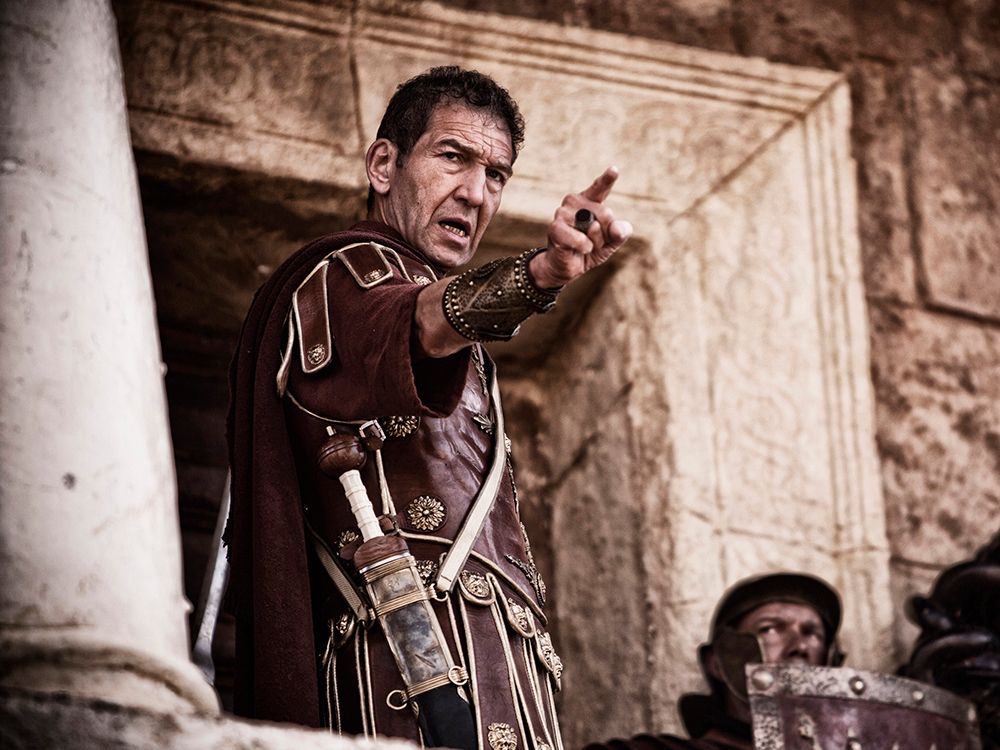
This season opens with the high priest Caiaphas summoned to the palace of Pontius Pilate. The Romans have confiscated the vestments needed by the high priest for Passover, and they keep custody of them so as to humiliate the high priest, forcing him to supplicate for them when needed. The pettiness of Pilate is manifest. His servants have prepared a table groaning with shrimp and oysters, which he offers to Caiaphas, knowing that they are not kosher. When Pilate’s wife is embarrassed by his rudeness, he retorts that he has pork being prepared, too.

The minor tyrant and the corrupt priest engage in the perennial preoccupation of insecure men: Are they sufficiently recognized? Caiaphas reminds Pilate that he is essential to maintaining public order when Jerusalem is filled with pilgrims. That provokes from Pilate a reprimand, namely that he finds it annoying that Caiaphas is not more “grateful” that Pilate is as agreeable as he is wont to be. He holds the sacred vestments hostage, and he wants Caiaphas to say thank you.

The little man with large responsibilities is exquisitely attentive to whether others acknowledge him, knowing in his heart that he is morally unworthy of his office. Hence the demand for gratitude. Both Pilate and Caiaphas are daily showered with the flattery of a retinue of sycophants, but the extravagant obsequiousness of those from whom it is expected grows tiresome. How much more satisfying is gratitude and obeisance from those whom you treat badly.

As is the case with such men, eventually it comes down to money and power. What does Jesus think about paying imperial taxes? What does Jesus think about how the priests regulate the pious commerce in the temple courts? Whose power does Jesus challenge?

Both Caiaphas and Pilate will, in turn, sit in judgment over Jesus. For the most part, He remains silent, permitting the supposed superiors to convict themselves before the court of history. Tyrants, petty and otherwise, are plentiful enough. The names of only a few endure. Caiaphas and Pilate do, even though worshippers today recall neither the name of the Egyptian pharaoh nor the Roman emperor.

Tyrannies pass away. Truth endures. That remains good news in a world where aspiring tyrants plague us still.

A blessed Easter to all!

National Post


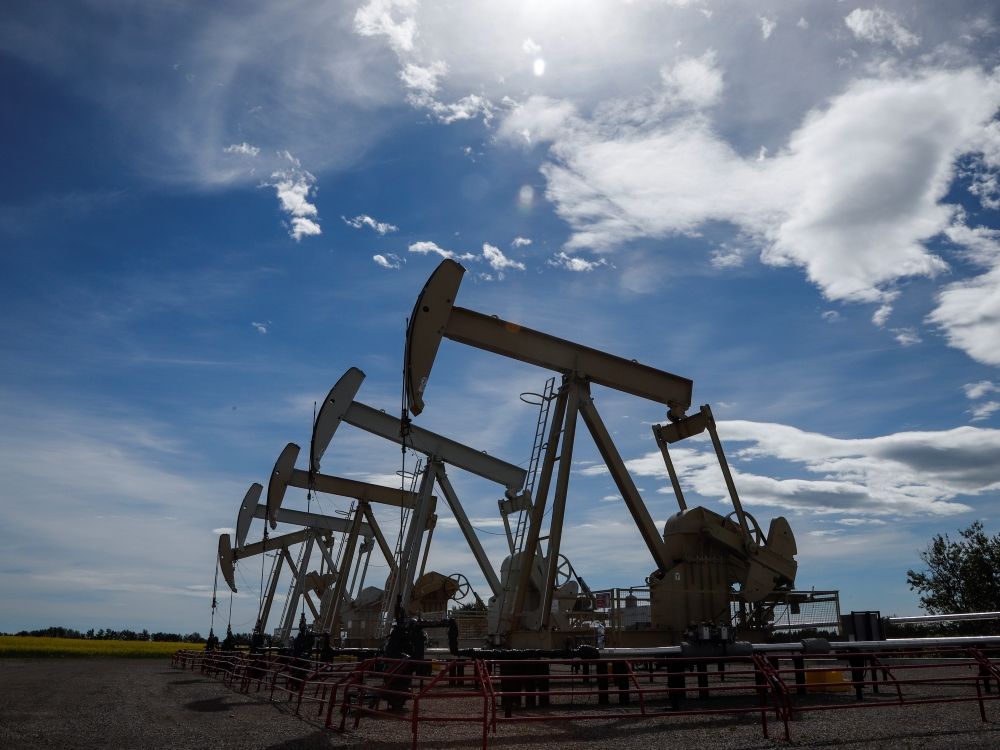
Pumpjacks draw oil out of the ground near Olds, Alta., on July 16, 2020.

Among U.S. states, New Mexico is the only one to end the last four decades less economically free than it began, finds a recent report. Even worse, binding its residents in red tape and smothering them in government leaves its residents poorer. Sadly, even as a laggard that’s moving in the wrong direction on economic freedom, New Mexico still allows its residents more leeway when it comes to business, money, and property than all but two Canadian provinces. And its people, while poor relative to many Americans, are more prosperous than the residents of most Canadian provinces.


There’s a great deal of ruin in a nation, as Adam Smith once

commented

. But if New Mexicans are testing the limits of that ruin, the state is also a testament to the importance of economic freedom. 


Economic freedom means “personal choice, voluntary exchange, freedom to compete in markets, and protection of person and property,” as

noted

by Professor Robert Lawson of the Southern Methodist University Cox School of Business. Such freedom requires a minimum of government interference from regulations, taxes, trade barriers, and money manipulation.


Almost all U.S. states have improved their standing with regard to respecting people’s liberty to start businesses, use their property, keep their income, and otherwise make their own economic decisions. New Mexico, by contrast, “is the

only

state to have reduced the economic freedom of its citizens over the four decades for which we have data,” according to a

March report

by Matthew D. Mitchell, of the Fraser Institute, and Paul Gessing, of Albuquerque’s Rio Grande Foundation.


That places New Mexico in an unimpressive 43

rd

place among American and Mexican states and Canadian provinces in the Fraser Institute’s separate

Economic Freedom of North America 2024

report. For context, the Washington, D.C.-based Cato Institute’s

Freedom In the 50 States

index puts

New Mexico

in a nearly identical 41

st

place for economic freedom, and losing ground on regulatory issues.


“New Mexico lags its neighbors in every area, but especially in government spending and labor regulation,” add Mitchell and Gessing.

New Mexico spends a larger share of its residents’ income than almost any other state in the union.” And the state set its minimum wage so high it discourages businesses from creating jobs and hiring workers.


Disrespect for economic freedom has real consequences in terms of human wellbeing, point out the Fraser and Rio Grande authors. New Mexico trails when it comes to growth in employment and real GDP. “It has the third-highest poverty rate in the union, a larger share of children on federal food assistance than any other state, and a larger share of citizens on Medicaid (tax-supported welfare medicine) than any other state.” While most of the Southwest booms, with neighbouring populations growing by an average of 12 per cent, New Mexico’s population has risen by only one per cent. The state’s restrictive red tape, taxes, and excessive government are causing it to miss out on a regional bonanza.


That’s unfortunate for the Land of Enchantment. But as laggard as New Mexico is among U.S. states, it has more economic freedom than any Mexican state, and all but two Canadian provinces.


“Alberta (8.01) is the highest-ranking Canadian province, tied for 12th place with Tennessee, South Dakota, Colorado, and Texas,” according to Fraser’s

Economic Freedom of North America 2024

report. “The next-highest Canadian province is British Columbia (7.84) which is tied with Massachusetts, Minnesota, and New Mexico for 43rd place.” Mexico’s states all bring up the rear as the least economically free jurisdictions on the continent.


That mismatch in economic freedom has real-world consequences when it comes to prosperity. Mexico, while it has made progress, trails far behind the U.S. and Canada in terms of per capita GDP, according to the

World Bank

. But Canada, after largely parallelling its southern neighbor for decades, has fallen badly behind. As of 2023, per capita GDP in current U.S. dollars was $82,769 for Americans, $53,431 for Canadians, and $13,790 for Mexicans.


Writing for

The Hub

in 2023, Trevor Tombe, a professor of economics at the University of Calgary,

worried

that most Canadian provinces lag in productivity and income far behind almost all U.S. states. “Ontario, for example, has a per-person level of economic output that is similar to Alabama (both equivalent to $55,000 USD worth of final goods and services produced annually per person),” he wrote. “Only Alberta exceeds the U.S. average of $76,000, but even Canada’s strongest economy ranks 14th overall.”


The only other provinces ranked ahead of 46

th

-place New Mexico were Saskatchewan and Newfoundland and Labrador.


Last October, working from their own calculations contrasting the U.S. and Canada, the Fraser Institute’s Alex Whalen, Lawrence Schembri and Joel Emes

concluded

that Canadians are getting comparatively poorer. “By 2022, all ten Canadian provinces ranked in the bottom ten positions for earnings per person.” Alberta remained the most prosperous Canadian province, “but as of 2022 was surpassed by all US states—in 2010, only 12 US states reported earnings higher than Alberta.”


Making the case even more compelling is the

historical evidence

that economic freedom tends to go

hand-in-hand

with

civil and political liberty

. Limiting one type of liberty erodes the others.


There are lessons to be learned for everybody involved. While, as Adam Smith had it, there’s a great deal of ruin in a nation, the U.S. at the national level has been flirting with ruin under first the

big-spending and interventionist policies

of the Biden-Harris administration and then the

aggressive protectionism

of President Trump. With both of America’s major political parties unfriendly to economic freedom, there’s little constituency in the nation’s capital for leaving people alone to manage their own affairs.


Canada has already demonstrated that a country much like the U.S. can lose ground on economic freedom and the prosperity it creates. There’s nothing to prevent Americans from following suit. The U.S. currently has further to fall, but once the plunge begins wealth can be quickly lost. New Mexico needs more economic freedom, of course. So do both Canada and the United States.


As we look at a world of trade war, confiscatory taxes, and politicians who won’t leave people alone, let’s take New Mexico as an example of what not to do.


National Post


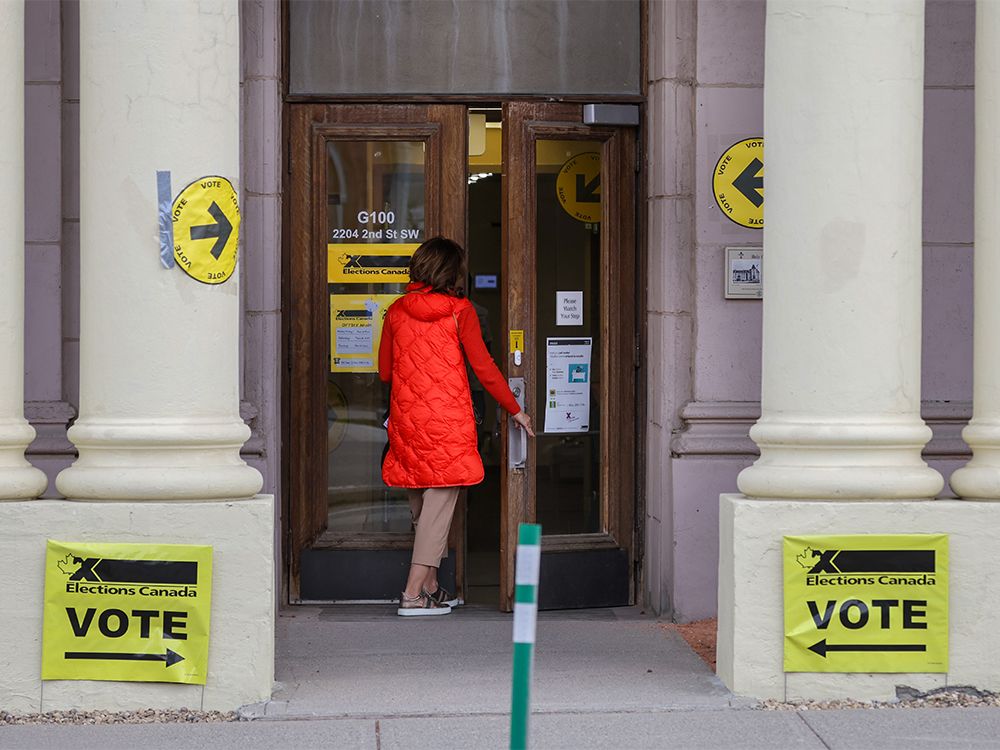
A woman enters a polling station that was open for early voting in Mission, B.C., on April 16, 2025.

Not all ‘old people’ vote Liberal

Re: Are older Liberal-voting Canadians selfish — or blind?Jordan Peterson, April 11

While I agree with most things Jordan Peterson writes, as a boomer I am a wee bit insulted by the fact that he lumps us all together as unconcerned old people who long for the old days.

The only days I long for are in the future. The old days were just that. They are done, never to return, and I for one am thinking only of the future for me, my husband, our children and grandchildren. I am sorry that Peterson thinks all old people are so uninformed about politics that they would consider voting for Mark Carney.

My husband and I are Conservatives. Always have been, always will be. We wish Pierre Poilievre all the luck and strength it will take to win the upcoming election and turn Canada into the great country it is meant to be. My hope is that any boomers who usually vote for the Liberals will see the error of their ways and do the right thing for this country.

So, yes, Mr. Peterson, I am voting to secure the futures of our whole family.

Valerie Boyd, Woodbridge, Ont.

The NDP have debased themselves

Re: ‘They’ve cratered’: For NDP Leader Jagmeet Singh this election is do or die — Joseph Brean, April 10

The NDP debased themselves to the Liberals in the past Parliament to the point where they became de facto Liberals, indistinguishable from the Liberal Party of Canada. Look at what it’s got them.

Keith Brady, Empress, Alta.


The NDP are drowning in their own missteps and missed opportunities. The only way for their survival now is probably a change of leadership and a rebuild to introduce a fresh new party in the future. Perhaps even a new name. How about the NINDP (New and Improved NDP)?

Douglas Cornish, Ottawa

Stop the Danielle-Smith bashing

Re: Smith is right, progressive men can’t handle conservative women — Amy Hamm, April 9

As a former professional geoscientist who worked in a male-dominated world for my entire career, I do not consider myself a feminist but I do believe in equal opportunity for all. Canada has always been a place that rewards honesty, sincerity, hard work, experience and commitment in business, industry, academia etc. — in other words, a place where you can achieve your dreams regardless of sex, sexual orientation, or ethnicity.

Like columnist Amy Hamm, I am greatly disturbed by the constant Danielle Smith-bashing going on at all levels of federal politics in Canada. Smith is doing what she was elected to do — represent and defend the interests of Albertans in her role as elected premier of Alberta. It’s a job that she appears to be doing admirably and to the fullest extent of her abilities.

When former premiers Peter Lougheed and Ralph Klein did the same, standing up for Alberta and providing the resources needed for Alberta to withstand constant attacks from within our own “ federation,” they were hailed as heroes. When I see the top officials in our federation (premiers and prime minister-unelected, mind you) engage publicly in this kind of sport, especially when faced with a domestic economic crisis, not of our making, I think Hamm is right; when it comes to feminism, our leaders might talk the talk about equal opportunity for women but they don’t walk the walk.

As a woman who enjoyed working in a traditionally male environment and had the respect and support of all male colleagues throughout my career, I am saddened that in this day and age, this is not reflected in highest and most visible elements of our own government.

If Rex Murphy was still here, he would be saying exactly what I have just said but people would be listening! I hope they are listening to Amy Hamm, and that Danielle Smith gets the respect she deserves. She is doing what our male politicians are afraid to do, with dignity and the respect of Albertans.

Judith Potter, Calgary

Time for Tory unity

Re: Ford helping Carney’s Liberals won’t help him take over the federal Conservatives — Randall Denley, April 16

As a committed member of the Conservative Party of Canada since 2011, I feel compelled to speak up as I watch history threaten to repeat itself. The recent tensions between Ontario Premier Doug Ford’s circle and Pierre Poilievre’s federal campaign are deeply troubling — and dangerously familiar.

Conservatives have been down this road before. In the 1990s, the right was fractured between the Reform (and Canadian Alliance) and the Progressive Conservatives. That split kept the Liberals in power for over a decade and crippled our ability to deliver real change for Canadians. The cost of division then was steep. It would be catastrophic now.

Canadians are desperate for competent leadership. They’re struggling with inflation, housing affordability, rising debt and a federal government that seems more concerned with identity politics and photo ops than with delivering results. There is a real opportunity for the Conservative party to earn a mandate for bold, necessary reforms — if, and only if, we are united.

Pierre Poilievre has galvanized millions by focusing on real issues — affordability, economic opportunity and restoring common sense. Whether or not every provincial Conservative agrees with his approach, now is the time to support the national campaign, not undermine it with backroom jabs or media-friendly infighting.

Doug Ford and others need to understand that this is bigger than any one strategist or premier. It’s about giving Canadians a credible, coherent alternative to the status quo. Undermining the federal party now only helps the Liberals — and alienates the very people we claim to represent.

We cannot afford to relive the politics of division. Conservatives must stand together — or risk falling apart, again.

Louis-Philippe Noël, Montmagny, Que.

‘Same old jalopy’

Re: Mark Carney still can’t explain how he’s different from Trudeau — Kelly McParland, April 10

Underneath that fresh coat of red paint the Liberal Party of Canada has put on the car, it is the same old jalopy that Canadians were happy to send to the junkyard only months ago.

Perhaps the only thing that has changed is that it steers even more left than before given the significant tinge of orange in all that red. We forget at our peril.

Andrew D. Weldon, Calgary

Take responsibility

Re: Ozempic for kids? Doctors are being encouraged to offer weight-loss drugs to Canadian teens — Sharon Kirkey, April 14

Sharon Kirkey’s report about a new Canadian guideline that recommends that, in addition to advice on diet and exercise, doctors consider offering weight-loss drugs to children as young as 12, was startling.

Having been an obese kid myself, I would like to protest the fact that many individuals’ problems are now considered to be the responsibility of the government. They are not. There is a degree of responsibility that must be assumed by both the individuals and their parents.

At the rate we are going, people will soon be expecting medical professionals to solve all their problems. This will exacerbate the need for more physicians and hospitals, neither of which we have.

Joel Rubinovich, Toronto

A bully blames others

Re: Tariffs are to Trump what DEI is to the left — Jamie Sarkonak, April 10

Thanks to Jamie Sarkonak for her explication of Donald Trump’s predatory mindset — laid bare in White House economic adviser Stephen Miran’s grievance logic justifying tariffs — because it is a master class in how a bully claims victimhood to absolve his abuse of others. Miran and Trump’s twisted logic — that cheating by others forced America to be cruel — is transparently absurd. Its pitifulness would be funny if it didn’t inflict so much economic pain on the world. The injustice is glaring: America, already reaping outsized rewards, demands even more through tariffs, cheating the global system by expecting returns it doesn’t deserve.

In theory, their argument might sound convincing, but in practice, it fails. Trump’s “Liberation Day” tariffs flopped. They didn’t set America free to grow deservedly richer; instead, they backfired in the markets, where merit decides outcomes. The U.S. mislabelled its tariffs as “reciprocal,” but the targeted nations didn’t line up to kiss Trump’s hand as he claimed — they retaliated. The blowback made America poorer. Investors lost trillions, and soon, spiking costs and rising economic strain will hit American wallets hardest.

Unfortunately for the world, win-win isn’t Trump’s predatory style — his is a zero-sum game where others must lose everything. This economic crime stings deeper when the top dog claims victimhood. The exploiters cry that they’re the exploited, all while tariffs squeeze poorer nations and distort global markets, disproportionately harming developing economies reliant on exports.

Canada is right not to negotiate with a tariff terrorist like Trump, a man who is clearly not true to his word.

Tony D’Andrea, Toronto

Liberal party needs the CBC

Re: Carney thinks Canada is too weak to survive without the CBC — Kelly McParland, April 15

The CBC was established in 1936 to counterbalance American radio and push Canadian identity. With today’s social media and podcasts, that reasoning no longer exists. In actual fact, without the CBC, the Liberal party could no longer rely on its tax-funded propaganda machine. That is why Liberal Leader Mark Carney is doing everything possible to preserve the CBC forever.

Larry Comeau, Ottawa

Supply management mystery

Re: Standing up for supply management is not standing up for Canadians — Chris Selley, April 3

Chris Shelley’s column covered the issue of the continued existence of dairy and poultry supply management in Canada. What was missing, and what I and I would imagine a number of Canadians would like to know, is exactly what leverage the dairy lobby has over our political leadership.

Selley notes the small numbers of dairy, poultry and egg farm workers, however he doesn’t indicate how that group is able to exert such overwhelming influence on political decision-making regarding their industries.

Canadians deserve to know how this ridiculously unacceptable situation — which is hampering our trade status and causing all of us to pay more than necessary — is permitted to continue.

Tom Tulloch, Halifax

Another Liberal ‘fear op’

Re: Carney is fearmongering his way into the PMO — Conrad Black, April 5

“Operation Fear,” which was Mark Carney’s campaign against Brexit (Britain leaving the EU) while governor of the Bank of England, describes to a “T” the electoral strategy used by the Liberals after Justin Trudeau’s team abandoned its original “Sunny Ways” approach.

Since then, Operation Fear has been their campaign standard, first the fear of Premier Doug Ford (2019) and then the fear of COVID (2020). This time it’s a fear of U.S. President Donald Trump that is the focus of their campaign. The only good thing about it is that the Liberals don’t have to run as strong a fear campaign against Premier Danielle Smith and Alberta, which they can keep in their back pocket for another time.

John L. Riley, Mono, Ont

.

‘Darwin of the Diamond’

Re: When ‘being clever’ crowds out the joy of the game — Dave Sheinin, April 7 (print)

In his article about baseball analytics, Dave Sheinin credits American Bill James as being the “godfather of sabermetrics” in baseball in the late 1970s. He did not mention that a Canadian, Dr. George Lindsey, was the real pioneer. Lindsey was the Chief of Operational Research and Analysis Establishment at the Department of National Defence. He had worked in radar in WW2, was a member of the Order of Canada and had a PhD in nuclear physics.

In 1963, he published “An Investigation of Strategies in Baseball” in the journal Operations Research, which followed other works. Globe and Mail journalist Sandra Martin noted in an obituary for Dr. Lindsey that “Sportswriter Alan Schwarz called Lindsey the Darwin of the Diamond for his painstaking compilation of baseball statistics.” An obituary in the Ottawa Citizen referred to him as the “’father’ of baseball statistics.”

His data source was his father, Col. Charles Lindsey, who after his retirement followed baseball frequently on TV and the radio and in newspapers, filling out thousands of detailed forms covering almost 1,800 games, along with George himself. Lindsey, on weekends, transcribed these into computers. He analyzed every detail such as intentional walks, base stealing or substituting a batter or pitcher of opposite handedness. He quantified how values of these managerial decisions changed by inning. He evaluated an expected number of runs matrix that is now central to sabermetrics. He proved that good baseball managers were often scoring in the high 90 percentiles in their decision making.

His work was shared with the Montreal Expos, who gave him free seasons passes to all games. Lindsey’s contribution to baseball was only eventually acknowledged. A book, “The Selected Works of George R. Lindsey,” is available from the University of Toronto Press.

His wife June Lindsey (née Broomhead) was similarly overlooked. Her PhD dissertation at the Cavendish Labs at Cambridge significantly aided James Watson to recognize the

double helix structure of DNA

, for which he and Francis Crick received the 1962 Nobel Prize. Her work was only referenced in a later paper.

Irwin Pressman, Ottawa


National Post and Financial Post welcome letters to the editor (200 words or fewer). Please include your name, address and daytime phone number. Email letters@nationalpost.com. Letters may be edited for length or clarity.


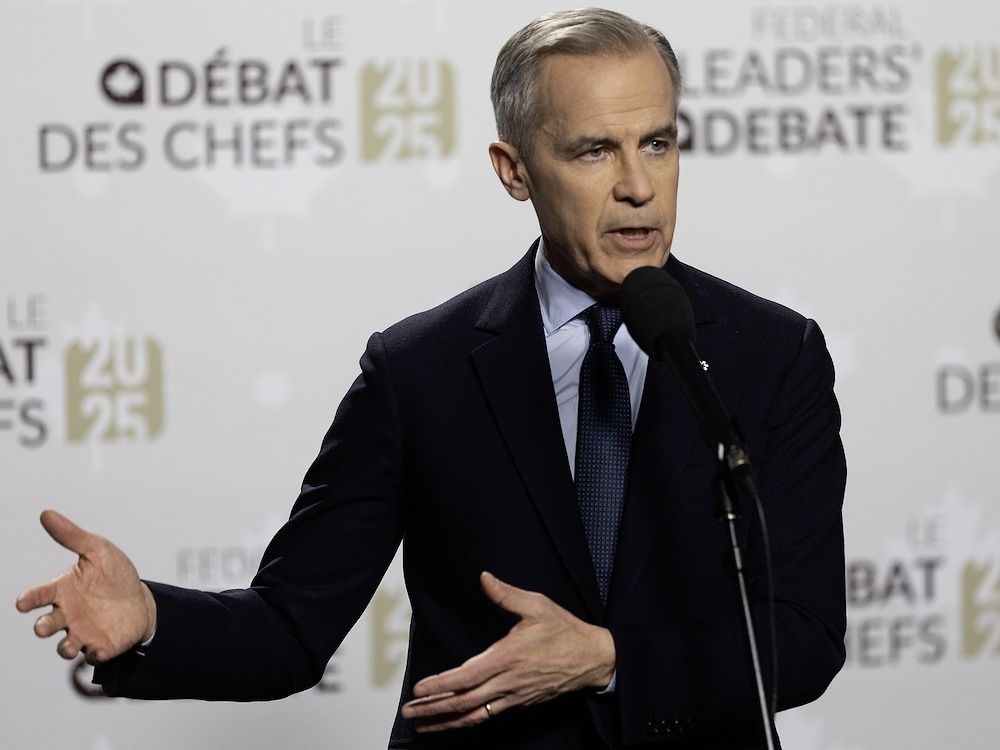
Liberal leader Mark Carney following the french Federal Leaders’ Debate in Montreal on Wednesday April 16, 2025. (Pierre Obendrauf / MONTREAL GAZETTE)

If there is one thing the Liberal party deserves credit for, it’s how it transformed what looked to be a devastating, even existential, electoral defeat, into frontrunner status a week out from election day. We understand why Liberal supporters have returned to the fold. The chaotic leadership of former prime minister Justin Trudeau was replaced with the relatively steady, calming hand of Liberal Leader Mark Carney, during a moment of intense conflict with U.S. President Donald Trump.

But before you cast your ballots, consider this: the various crises Canada faces — from tariff threats, to sluggish economic growth, enormous deficits, a broken immigration system, rampant violent crime and a poorly equipped military — were all created, or were made much worse, by the Liberal party. Carney’s Liberals are nearly identical to Trudeau’s, and nothing he has offered so far would address these problems.

Take the most immediate concern facing Canadians — the threat of wide-ranging tariffs from Trump, and the possible upending of Canada’s relationship with the United States. Because of geography, trade will continue to go north and south, but Canada would be better equipped to absorb trade disruptions if Ottawa hadn’t brought in a suite of policies that stifle investment and keep wages flat.

Never mind the consumer carbon tax, which the Liberals have set to zero after spending years defending it. Carney has pledged to keep Trudeau-era growth-killing policies, such as the

emissions cap

on the oil and gas sector and

the Impact Assessment Act

 — the latter of which has been

responsible

for slowing down infrastructure projects, such as pipelines, LNG terminals and mines, exactly the kinds of projects Carney says need to be built at speeds faster than ever before.

He has also promised to add new environmental regulations that would raise costs even further. This includes

carbon tariffs,

which would see taxes imposed on imports from countries that don’t meet the Liberals’ climate standards.

For all the talk about standing up to Trump, the truth is that some of the greatest threats to Canada’s economy are internal. Carney has promised to largely maintain Trudeau’s anti-business policies, which will continue to leave Canada vulnerable. Since the Liberals took power, per capita GDP growth has been near-zero per cent, according to IMF data and

calculations

by Quebec economist Louis Lévesque. If it feels like you’re struggling to get ahead, that is because of federal policies, most of which Carney promises to keep.

Under the Liberals, the national debt doubled, which contributed to the intense inflation that followed the COVID-19 pandemic, and which will be a drag on economic growth for decades to come. Carney’s promises would involve even more spending, not less.

Another area where Canada has been vulnerable is in defence policy, where we have neglected our spending commitments to NATO, left the North unprotected and the Canadian Armed Forces poorly staffed, and even more poorly equipped. Carney’s pledge to increase spending above two per cent of GDP “within a few years” is hardly inspiring.

Over the past decade, housing costs have soared, leaving younger generations unable to purchase a home, even those earning what would be considered good wages. Immigration levels increased at unsustainable rates, putting additional pressure on housing, health care and other services. The reasons why so many people were unsatisfied with Trudeau’s leadership have not been corrected, and Carney has said nothing to suggest he would be any different.

As for the alternative, Conservative Leader Pierre Poilievre has run a consistent and competent campaign focused on affordability and economic growth. Rather than keep economy-killing environmental policies, he would repeal them. To address crime, Poilievre would bring in a three strikes law that would lock up violent offenders for longer periods, and he would permit judges to stack parole eligibility for mass murderers, effectively bringing in consecutive life sentences.

On housing, the Conservatives have identified a key reason buying a home has become so unaffordable — layers upon layers of taxes and fees. Poilievre’s housing plan involves cutting the GST from homes under $1.3 million and reimbursing municipalities for cutting development charges, taking about $100,000 off the price of an average home in Vancouver or Toronto.

On social issues, the Conservative leader is moderate. He said he would not bring restrictions on abortion, and while he wouldn’t expand access to assisted suicide, if elected, “people will continue to have the right to make that choice,”

he said

on Saturday.

Partisan attacks comparing Poilievre to Trump are not based in reality. Yes, the Conservative leader has taken a populist approach, but it is of a uniquely Canadian flavour. Trump has forced the Republican party away from conservative principles such as the rule of law and respect for free markets,

while Poilievre has done the opposite.

It has never been more important to look at the policies of both parties with an open mind. Most especially, Liberal supporters should take another look before casting their votes for Carney.

National Post


Liberal Leader Mark Carney

With only a little over a week to go before the federal election, and with the debates out of the way, the wheels of the Liberal campaign for a fourth-straight term are finally starting to wobble on their axles. The providential political fantasy land in which the Liberals launched the campaign — the complete fraud that Canada’s continued existence was being threatened by the United States — has receded. U.S. President Donald Trump and his senior colleagues are now processing a queue of 130 countries filing into Washington offering concessions to contribute towards the elimination of the completely unnecessary United States trade deficit of around $1 trillion. Another resounding Trump victory is in the making and Canada is not an inordinately large part of it, although there will be challenging negotiations.

When former prime minister Justin Trudeau told Trump that 25 per cent American tariffs on Canada would cause the Canadian economy to collapse, Trump put that assertion together with the shameful record of Canada as a freeloading passenger in its own military defence, which in practice is almost entirely outsourced to the great military power of the United States, and concluded that if Canada was afraid of tariffs and couldn’t make a serious contribution to its own national defence, it would be better off within the United States. Having uttered a great deal of fatuous nonsense about Canada being a post-national country and a vanguard for the realization of the Beatles’ song about a world without nationalities or religions, Trudeau leapt with considerable spontaneity into promoting Trump’s comments as a genuine threat to the continued existence of Canada as a sovereign state. As this week’s events and exchanges confirmed, it remains the core of the Liberal campaign.

Somehow, we are to be persuaded that the United States is threatening Canada’s existence, which it is not. Nothing Trump or any other American leader has said or done in nearly 200 years could be plausibly misconstrued to be a threat by the United States against the independence of Canada. It must be said that grasping at this unfeasible straw and waving it around through an election campaign like a bloody shirt has been a historic act of imaginative desperation in the interests of political survival. Trump did us a favour by pointing out the ludicrous anomaly of our agricultural price supports, which should be abolished and replaced, as appropriate, with straight income supplements to some categories of farmers. Beyond that, he seeks only reciprocally equal tariffs with Canada.

In Quebec, the issue has been a double-edged sword because Quebec nationalists have tended to regard Canada as an artificial country: a patching together of English Canada with a French Canada that would rather be independent and only joined Confederation because independence was not feasible in 1867 and Confederation with the English-Canadians was preferable to continuing in a colonial status or for Quebec to take its chances as the sole linguistic outsider in an English-speaking continent north of Mexico. In their more narcissistic and grandiose moments, French Quebec nationalists have pretended that English Canada is just a buffer zone of America to anaesthetize Quebec and to delay its rightful destiny as an independent French nation. This fabrication of a counterfeit fear of an American takeover has at least had the virtue of frightening Quebec into a heightened recognition of Canada’s virtues.

It is galling that this waving about of the Maple Leaf flag has been conducted by the same party that has falsely accused Canada of cultural genocide against its Native people, although cultural genocide is not recognized by the United Nations. What is meant is an assimilation that immigrants to a society speaking a language other than their own voluntarily seek, but which was never attempted to be inflicted upon the Aboriginal peoples of Canada. And this is the same government that has po-facedly acquiesced in the attempted suppression of the English language in Quebec. If cultural genocide existed as a concept, the Government of Quebec under successive political parties has been guilty of attempting it against the principal language of this country and continent.

Apart from this slowly departing miasma of a supposed vocation to defend the ramparts of Canada against the American hordes (who are naturally oblivious to these suspicions since they are unfounded), the Liberal campaign is to forget about the innumerable failures and competitive debacle of Canada under 10 years of Liberal government. “I just arrived,” said Liberal Leader Mark Carney. We are to place our confidence in someone with a confected CV, of no electoral experience, a controversial record in the private sector, a man immensely well-paid and under-taxed, someone who holds himself out as a Davos socialist truckling to the deprived with money taxed from those who’ve earned it while padding around the country goading the president of the United States as “the orange man,” as he falsely accuses him of coveting the takeover of this country.

In this process, Conservative Leader Pierre Poilievre has emerged as the best candidate. He is young but not too young in the Justin Trudeau manner, is a seasoned seven-term MP and has practical proposals for eliminating the grotesque Liberal deficit and restoring the competitive edge of Canada and its desirability as a place of investment and bootstrapping up its status as a NATO ally. It is no fault of Carney’s that his grasp of French is inadequate for the office he seeks. Not everyone has had the privilege of learning two languages. But Canada cannot have a prime minister who sounds in one of the official languages like an Englishman trying to navigate a menu in Romania.

Polls indicate that something like 30 per cent of Quebecers and citizens of Saskatchewan and Alberta will entertain the separatist option if the Liberals are reelected. After nearly 160 years as an autonomous state, this country is in sight of dissolution. This is the product of 10 years of Justin Trudeau’s assault upon the oil and gas and other natural resources industries, counselled by Mark Carney, who will continue and escalate that war. A vote for the Liberals on April 28 is a vote to play Russian roulette with Canadian Confederation. Don’t do it.

National Post


As U.S. President Donald Trump threatens to reignite a trade war with Canada, the economic risks are real — but so are the political ones. We’re not just talking about tariffs or supply chains. We’re talking about the quiet, dangerous pressure to trade away the very things that make Canada, Canada: our public health care, our clean air and water, and our right to decide what kind of country we want to be — without bending to Trump’s chaos or corporate demands.

We’ve seen this playbook before. When corporate lobbyists and government insiders get nervous about trade pressure, the talk turns quickly to “flexibility.” Suddenly, rules meant to protect people become “barriers to growth.” Protections become “negotiating points.” And what used to be off-limits — like universal health care, environmental regulations or access to medicine — gets put on the table.

The last time Trump picked a fight with Canada, Canadian workers paid the price. But this time, it’s our public health-care system and environmental laws that could be in the cross-hairs. Today, Trump is threatening tariffs on pharmaceuticals to force drug production back to the United States — a move that could destabilize our already fragile medical supply chains. We saw this during the pandemic, when Canada struggled to secure vaccines because we didn’t have the capacity to produce them at home.

That’s why New Democrats pushed for a public Crown corporation to manufacture vaccines and essential medicines — because no country should be forced to rely on U.S. goodwill or corporate profit margins for life-saving care. And with Trump, nothing is ever stable or straightforward — the rules change on a whim, and the consequences land on everyday people. Now, as American pharmaceutical giants push to extend patents and block Canada from lowering drug prices, the risk is clear: our health-care system could end up on the chopping block.

And it doesn’t stop there. As Trump targets our exports, voices in Canada are calling to delay or water down environmental standards — to fast-track fossil fuel projects, weaken emissions rules or “align” with less ambitious American regulations. In moments like this, where public pressure meets corporate power, there’s a real risk that governments start to quietly back away from commitments they once claimed to champion.

Let’s be honest: not every law or regulation has been implemented well. Liberal governments often failed to protect jobs and workers when introducing environmental policies — leaving people to shoulder the cost without support. But there’s a difference between improving policy to make it fair and gutting our protections to appease Donald Trump. Canadians want clean air, safe water and strong public health care — and they expect their government to stand up for those things, not trade them away.

And now, with Trump back, we’re already seeing signs that some politicians are preparing to give ground. Liberal Leader Mark Carney talks about climate and economic stability, but he hasn’t said what he’ll keep off the table if Trump turns up the pressure. He’s spent his career in boardrooms and global finance, so when the demands come from CEOs and corporate lobbyists, we know exactly who will have his ear. And when they get their way, it’s everyday Canadians who will pay the price — through higher costs, fewer protections and weaker public services.

Then there’s Conservative Leader Pierre Poilievre. His position is clear: tear it down. He’s voted against dental care, pharmacare and other attempts to strengthen our health-care system. He promises to cancel environmental protections.

Canadians deserve better than silence, slogans or surrender. They deserve clarity — and courage.

I believe we can build a stronger economy without making it harder for people to get the care they need, when they need it. We can fight climate change and protect good jobs. And we can make sure no one is left waiting longer for surgery, struggling to afford their prescriptions or facing shortages of essential supplies because Donald Trump decides to weaponize trade. Health care, clean air and safe communities are part of what holds this country together, and they should never be treated as bargaining chips.

But we need people in Ottawa who will hold that line. People who won’t put health care, climate action or clean water on the table — not now, not ever.

New Democrats are fighting to protect what makes Canada, Canada. And we won’t back down — no matter who’s at the other side of the table.

National Post

Jagmeet Singh is leader of the New Democratic Party.


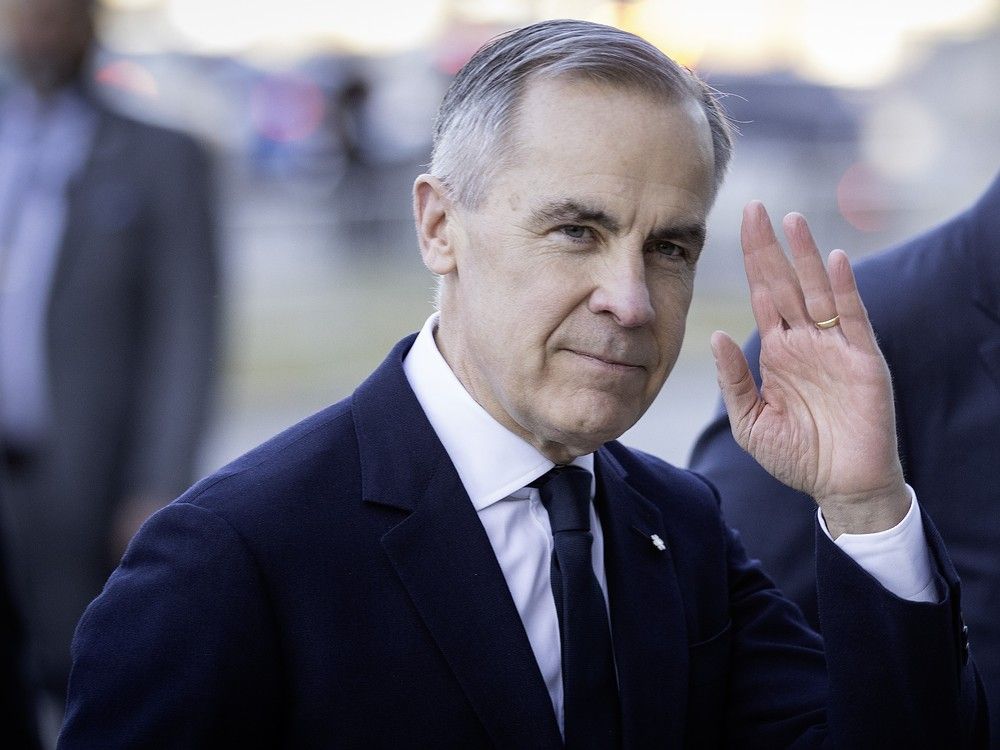
Liberal leader Mark Carney waves to the crowd as he arrives for the English Federal Leaders' Debate in Montreal on Thursday April 17, 2025.

Project Fear almost worked for Mark Carney in Britain and now he is trying the same tactic here.

To listen to Carney is to envisage that the United States is about to invade us; steal our oil, gas and water; ravage our resources, land and women and generally wreak havoc.

It is a message of despair and fear, and it is rooted in nothing but guile and political ambition.

Carney’s closing message during the Leaders’ Debate was a chance to show Canadians that he was made of the right prime ministerial stuff, that he had answers to these challenging times, to bolster the mood of the nation and unite us in a common purpose based on hope.

Instead, he chose fearmongering.

“We are facing the biggest crisis of our lifetimes,” said Carney. “Donald Trump is trying to fundamentally change the world economy, the trading system, but really what he is trying to do to Canada, he’s trying to break us, so the U.S. can own us. They want our land, they want our resources, they want our water. They want our country.”

Carney is trying to build a platform on Trump ranting about the 51st state which was a barb against former prime minister Justin Trudeau, or the “governor” as the president persistently called him.

Trump has also

referred

to the great “faucet” in Canada that could help drought-stricken California.

Call Trump’s musing about annexation what you will – childish, petulant, a game of bluff or simply loud-mouth bullying – but they are most certainly not a declaration of war.

And yet Carney, in all seriousness, boldly declares, “They want our country,” as if troops were massing on the border.

Carney has been in another economic crisis and that time he also chose fear over hope.

As governor of the Bank of England, from 2013 to 2020, he was supposed to be apolitical as Britain navigated through Brexit and its break-up from the European Union.

But it was clear to many that Carney was playing politics and was aligned with those who wished to remain in the union, members of Project Fear.

Britain leaving the EU was the “biggest domestic risk to financial stability”, he

told

a parliamentary committee in 2016.

Another time, Carney

warned

of the dangers of a recession should Britain leave, sparking a

call

for him to resign by Jacob Rees Mogg, a Conservative MP and Treasury Select Committee member.

“He has shown himself to be partial in a political debate when the Bank of England needs to be independent. That has permanently damaged his credibility as Governor of the Bank of England,” said Rees Mogg.

Norman Lamont, a former British finance minister, was also scathing of Carney’s fearmongering.

“The governor should be careful that he doesn’t cause a crisis. If his unwise words become self-fulfilling, the responsibility will be the governor’s and the governor’s alone. A prudent governor would simply have said that ‘we are prepared for all eventualities’.”

Nigel Lawson, another former finance minister, joined in saying, “He’s behaved disgracefully. I have known all six of his predecessors as governor of the Bank of England and not one of them would have thought it proper to behave as he has done, particularly during the campaign when he joined in the chorus of scaremongering.

“It is appalling and I think the sooner he stands down from the governorship, the better.”

So Carney’s attempts to instil fear in Canadians is a tried and tested tactic. But it is a despicable way to try to win an election.

Trump’s tariffs are not just aimed at Canada, but at the world. The president may well be upending the world’s economy and sowing chaos, but the answer to that is to make Canada stronger, more self-reliant and to encourage trading with other nations and not just our ally to the south.

In a time of crisis, what is needed from a prime minister is someone who can embolden a nation to greatness, not leave people cowering in fear.

Carney is not a man who uses words unwisely or without consideration. His closing statement must have been carefully thought out, the anti-Americanism a deliberate choice, the fearmongering a calculated decision.

If Carney was hoping to be Churchillian he missed the mark by a long way. This was not Churchill but churlish.

Fear was the weapon Carney used in Britain in trying to persuade a nation not to leave Europe, and fear is his weapon of choice in this election campaign.

Britain rejected fear and chose hope. Canadians should do the same and reject Carney.

National Post


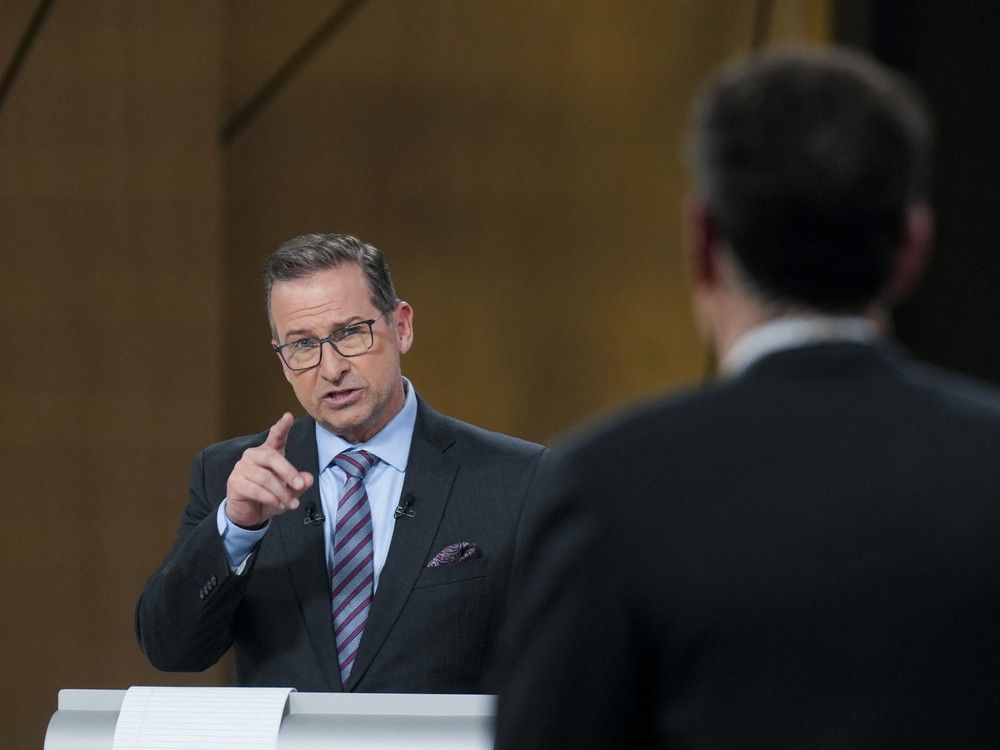
Bloc Quebecois Leader Yves-Francois Blanchet looks towards moderator, TVO's Steve Paikin during the English Federal Leaders Debate broadcast at CBC-Radio-Canada, in Montreal, Canada, on April 17, 2025.

Wednesday evening’s French-language leaders’ debate kicked off with a video montage that mentioned President Donald Trump roughly 175 times. (I exaggerate somewhat.) Thursday evening’s English-language leaders’ debate was much less focused specifically on Trump, to an almost bizarre extent. When moderator Steve Paikin offered each leader a chance to ask a question of an opponent, Liberal Leader Mark Carney chose to ask Conservative Leader Pierre Poilievre about

the security-clearance drama

.

Carney’s campaign clearly believes Poilievre’s Achilles’ heel is Trump. One has to wonder how many Canadians even know the basics of the security-clearance issue. It was a baffling decision.

Ultimately, though, leaving Trump aside was a benefit. One of Carney or Poilievre will be prime minister in a month, and they essentially agree that Trump is too unpredictable to strategize against with any confidence from our current position as a semi-deadbeat country. (Again, I paraphrase.)

The only thing we can really do is focus on our own affairs in ways that would make us more prosperous, safe, happy and independent in every sense. In the long term: diversify our trade partners in every sector, including natural resources; improve border security, not to satisfy Trump’s fentanyl obsession but to prevent the northbound flow of illegal firearms (and because borders are supposed to be secure by definition); rebuild the military, not because Trump demands it but out of respect to our existing commitment to NATO and our self-styled reputation as An Important Country; fix health care; make housing affordable; get a handle on our own opioid crisis; fix our broken justice system. All that jazz.

You might think in a debate on those big national issues Bloc Québécois Leader Yves-François Blanchet would be extraneous on the stage. I saw plenty of people reacting in real time in that vein: Why is this man here? But in fact Blanchet served a very useful purpose: He was the voice of comfy Canadian inertia; the voice of Quebec continuing to plod along in its own way under Canada’s protective umbrella (ludicrous sovereignty-referendum threats notwithstanding).

Blanchet embodied how Canada might very plausibly abandon the opportunity that Trump’s kick in our rear end, however unjustified, offered us to live up to the greatness Canadian politicians always ascribe — often dubiously — to this country.

“The building of (new) pipelines will take at least 10 to 14 years. Mr. Trump will be 90 years old, not president … and somebody of course less terrible will be there before you can even dream of having oil through (a new) pipeline,” Blanchet said, kiboshing (as ever) the notion of any new pipeline running through Quebec.

For the record,

a SOM poll conducted for La Presse in February

found 61 per cent of Quebecers were in favour of reviving

the moribund GNL Quebec project

, which involves a natural-gas pipeline to the Port of Saguenay. Only 21 per cent were opposed. Meanwhile 59 per cent were in favour of, and only 22 per cent opposed to, reviving the Energy East oil pipeline project, which would travel from Alberta through Quebec to Saint John, N.B.

Blanchet essentially scoffed when Paikin pointed out that public-opinion phenomenon during the debate. But surely getting our resources to more diverse markets

has

to be a key element in any Canada-first strategy.

One of Poilievre’s strongest moments in the debate was when he asked Carney, repeatedly, how he could possibly square

his “pipelines aren’t necessarily a priority” talking point

with the gravity of our current situation.

The Canadian Centre for Energy Information reports

“Canada’s energy sector accounted for … 10.3 per cent of nominal GDP in 2023.” That same year, according to the Canada Energy Regulator,

we exported 97 per cent of our crude oil to the United States

,

representing 60 per cent of American oil imports

.

All of our natural gas exports go to the United States

.

“Canada was the source of 85 per cent of the electrical energy imported by the U.S. (in 2023),” the Canada Energy Regulator reports. This is what you call leverage — or it would be, if we had more competing bidders whose orders we could fill.

If we’re going to export fossil fuels — and no one on stage in Montreal Thursday night other than Blanchet really said we shouldn’t — then we obviously should be diversifying our customer base, just as any business in any industry would.

But isn’t it so easy to imagine Blanchet’s vision coming true? Every day of Trump’s second term, no matter how chaotic, is one day closer to Trump not being president anymore. Things aren’t

quite

as crazy on the annexation/51st state front as they were a few weeks ago. Trump’s approval ratings are down. Trump voters didn’t sign up (willingly, anyway) to have their retirement savings diminished.

Maybe we can just ride this out and go back to our half-assed status quo, right? By rights, this election should be about which of Carney or Poilievre can best prevent that. As it stands, it’s difficult to tell.

National Post

cselley@postmedia.com

Get more deep-dive National Post political coverage and analysis in your inbox with the Political Hack newsletter, where Ottawa bureau chief Stuart Thomson and political analyst Tasha Kheiriddin get at what’s really going on behind the scenes on Parliament Hill every Wednesday and Friday, exclusively for subscribers. Sign up here.


Liberal Leader Mark Carney during a rally at the Red and White Club in Calgary on Tuesday, April 8, 2025.

Liberal Leader Mark Carney may be auditioning to lead Canada, but his recent comments show he still has much to learn about the people he hopes to represent in Nepean, Ont. — especially in neighbourhoods like Craig Henry and West Barrhaven, where lived experiences speak louder than talking points.

Last week, Carney was asked to clarify his remarks after he appeared to agree with a protester who invoked the word “genocide” in reference to Gaza. Carney responded flatly: “I didn’t hear that word.” It was a carefully evasive answer from a man who has built a career on cautious precision. But the problem isn’t just what he said — it’s what he doesn’t seem to understand.

If Carney knew where Craig Henry or West Barrhaven were, I would invite him to come and speak to the congregants who attend synagogues here. I would ask him to meet the Nepean family of Adi Vital-Kaploun — a young Canadian woman who was murdered by Hamas terrorists on Oct. 7, 2023. Perhaps then he’d understand why so many Canadians feel abandoned by leaders who minimize or sidestep the realities of modern antisemitism and terrorism.

The Vital family’s loss is not abstract. It’s not a geopolitical talking point. It is the profound grief of a family that lives in my community and is grappling with the fact that their daughter was murdered, simply for being Jewish. That pain deepens when would-be national leaders equivocate, dodge or fail to recognize the gravity of terrorist atrocities that target civilians and tear families apart.

This is not about denying the suffering of civilians in Gaza. Any child lost to violence — anywhere — is a tragedy. But moral clarity demands that we reject false equivalencies. Hamas is a listed terrorist organization in Canada. It perpetrated a massacre that should outrage every decent Canadian. That outrage must not be drowned out by slogans that erase the nuance and trauma of the victims.

Carney’s polished public image, international experience and high-minded rhetoric won’t mean much if he can’t speak with conviction about the threats faced by people in his own backyard. Nepean isn’t a footnote. It’s a community of many faiths, of families, of immigrants and of survivors. Leaders don’t get to lead us unless they know us.

If Mark Carney wants to represent Canadians, he should start by listening to the voices in places like Nepean — not just the ones that echo his worldview, but the ones that carry grief, fear and resilience. That includes the Jewish community and the family of Adi Vitall-Kaploun.

If he can’t say the word “terrorism,” if he denies hearing the word “genocide” when he responded to it and if he doesn’t know where Craig Henry is, he’s not ready to lead in Nepean, let alone Canada.

National Post

Lisa MacLeod is a former Ontario cabinet minister who represented the riding of Nepean.