
LP_468x60
on-the-record-468x60-white

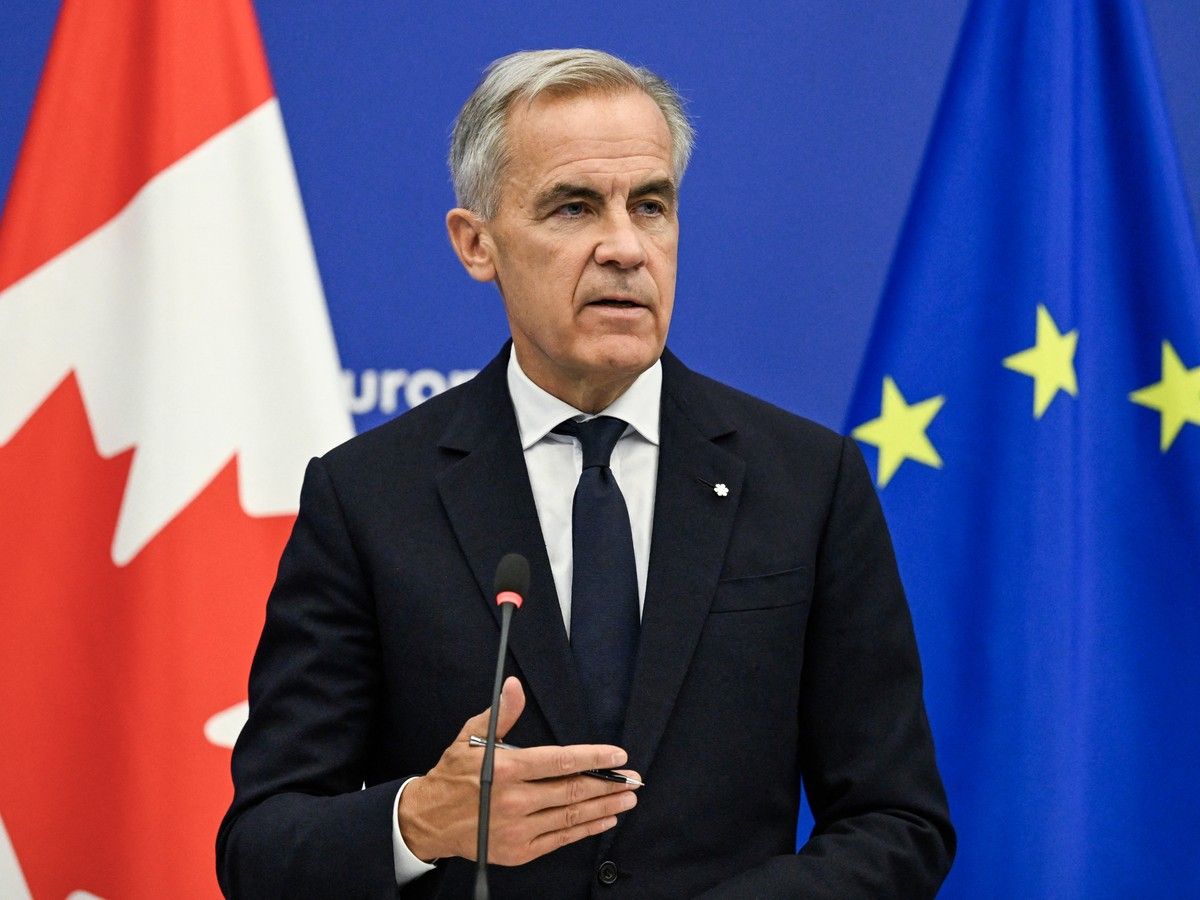
Canadian Prime Minister Mark Carney speaks about the trade dispute with the United States at the Davie Shipyard in Levis, Quebec, Canada on August 24, 2026.

Prime Minister Mark Carney has been evasive and unreliable, if not blatantly self-serving, when it comes to discussing his negotiations with Washington. We learned that when his government lied about the reworked Gordie Howe Bridge negotiations earlier this summer.

However, the federal government’s own disregard for the truth does not automatically validate the version of events put forward by the Americans. Taking what Donald Trump’s officials say at face value is crass credulity at the worst possible time.

Let there be no question about whether Carney was right to walk away from the latest eleventh-hour revisions to the Canada-U.S. trade deal. The White House wanted Canada to agree to permanent, supposedly favourable, tariffs while effectively ceding our own freedom to strike deals abroad.

Alan Beattie of the Financial Times wrote , “There were reports that the U.S. wanted exclusive access to Canada’s critical minerals … and that the US wanted to pull Canada more tightly into its trade orbit by restricting Ottawa’s right to sign deals with other countries.”

Canada is a trading nation, and accepting economic vassalage would end that status, as would giving the Americans more power over our natural resources. Therefore, no deal was absolutely better than a very, very bad deal.

It is old news at this point, but Carney still bears responsibility for trying to conceal the true extent of the mess that was the Gordie Howe Bridge renegotiation in July. The original agreement involved Canada financing the $6.4 billion cost of the bridge between Michigan and Ontario, with Canadian governments being permitted to recover those costs before dividing revenues.

Then, at the last second, before the bridge was due to open, U.S. Commerce Secretary Howard Lutnick blocked its opening and demanded a richer American share.

Carney claimed that the original bargain had been preserved, saying , “We are sharing after Canada is paid back.” He later insisted that “any sharing of toll revenue won’t happen until all of the debt is repaid.”

The released agreement revealed a vastly different story: net revenues would be divided for 15 years before Canada had recovered the construction debt, while Washington gained leverage over major toll changes.

Carney gave a false account of a concession muscled out of him by a foreign government. Even if it was merely the result of gross ignorance of his own agreement, it is a black mark on Carney’s record. However, this apparent dishonesty does not make Howard Lutnick or any of his compatriots into honest men.

Rather, the bridge deal is the clearest evidence that the current American administration is not, and has never been, a good-faith actor. Washington waited until the project was finished and ready to open before turning the opening into a hostage situation, demanding new concessions and offering nothing to Canada in return.

Now, the same strategy has been used in trade negotiations. Both sides agreed that they had a tentative deal in place, with industry groups kept informed and President Trump even announcing that the agreement was ready for final review.

Then, in the final hours of negotiations on deadline day, it fell apart due to a combination of differences over automobiles, French-language provisions, and, most critically, Canada’s sovereign ability to negotiate trade with other countries.

Washington claimed that it was Canadian demands for lower tariffs on trucks that sank the deal, which Carney acknowledges was part of the disagreement, if not the decisive factor. Politico has reported clashes within the Trump administration and said that U.S. Trade Representative Jamieson Greer disagreed with Lutnick on policy issues related to the failed trade agreement.

Carney does not need to be given a free pass for Canadians to understand a very clear pattern of predatory renegotiations, in which a deal is nearly complete, only for Lutnick to demand ridiculous or impossible terms that Canada is then expected to accept.

Saskatchewan Premier Scott Moe responded to the breakdown by getting right to the point:

“Saskatchewan has also been clear that any attempt by the United States to influence or place conditions on Canada’s trade relationships with other nations is a non-starter. Decisions about who Canada trades with must be made by Canada. Saskatchewan, more than any other province, is diversifying its trade to other countries, and that will not be compromised.”

At an absolute minimum, a sovereign country requires the ability to freely conduct commerce with others around the world. Anything less is genuine vassalage. Canada is already dependent enough on trade with the U.S., and accepting that deal would have locked us into that dependency in a vise grip.

National Post Managing Editor Carson Jerema correctly wrote , “(W)alking away from negotiations, even if it leads to a protracted trade war, was the right thing to do. It may have been the most important moment for Canadian sovereignty in generations, and much credit to the prime minister for having the nerve to stand up.”

It would be a terrible mistake to simply make the best of this rupture. Saying no to a terrible agreement is the bare minimum of governance, but it is not an economic strategy.

This country remains bogged down in internal trade barriers between provinces, protected industrial oligopolies, and other minefields of overregulation.

Canada should be using this emergency to rapidly fix everything that has dogged and degraded its economy from the inside for too long. Capital should be able to deploy without a decade of supplication to Ottawa, the courts, and bloated regulatory boards.

Carney has pledged to unlock the domestic side of Canada’s economy, but failing to introduce internal shock therapy during this critical period will mean missing the mark once again, and Canadians will suffer even more for it.

Two things can be true at once: Carney has proven to be a slippery fellow, and the current American administration cannot be trusted either.

Right now, we should be building an economy so strong that neither opacity from Ottawa nor thuggery from Washington can put us in the position in which we currently find ourselves. Nor does anyone need to pledge loyalty to the Liberal government to back their country at this time.

National Post


Prime Minister Mark Carney speaks to the media on Saturday, Aug. 22, about the decision to walk away from trade talks with the U.S.

Walking away from trade talks with the United States was the easy part. Prime Minister Mark Carney now needs to sell Canadians a kiss-and-make-up strategy.

Because sooner or later we are going to have to sit down and hammer out a trade agreement or get very hurt in the divorce proceedings.

As expected, U.S. President Donald Trump is already threatening retaliation for Carney’s decision to collapse the U.S.-Canada trade talks at the weekend.

“On January First, 2027, Tariffs on all Cars, Trucks, both large and small, Automotive Parts, and Steel, will be increased to 50%. Build in the U.S. and there are ZERO TARIFFS. Canada will be treated like a State no longer!” Trump wrote on his Truth Social account.

“On Trade, and in other ways, also, they are among the worst Nations in the World to deal with. They feel entitled, and yet, WE DON’T NEED CANADA, THEY NEED US!”

It comes as no surprise that the president is threatening more tariffs and even less of a shock that he feels the need to belittle Canada.

Even his facts are wrong.

“They do 95% of their business with the U.S.,” said Trump.

Well, not quite. The U.S. is certainly our largest market, accounting for about 70 per cent of exports. That fact alone should have been an encouragement to diversify our markets and build the infrastructure that was so necessary — like pipelines — but unfortunately our previous prime minister was too shortsighted to see that.

Carney is keen on expanding to different markets and building the infrastructure. Diversity will make us stronger and more resilient, he said at a press conference Monday, and he’s right. But that is going to take time so breaking up with the U.S. now really isn’t a viable option.

Walking away from trade talks and telling Canadians that we are all in this together is marvellous political theatre that will unite the country in hatred towards the U.S. and will boost the prime minister’s ratings.

But it won’t help us economically. It will do nothing for business and will result in perhaps hundreds of thousands of job losses.

“Elbows up” was always an emotional ploy (and a very successful one) but it is not a strategy that puts food on the table or pays the rent. Carney has manipulated the zeitgeist so that we can all feel proud that we have stood up to the bully. Well, hurrah, except that doesn’t actually get us anywhere.

Patriotism is not a bad word. Love of one’s country is felt in the bones and the soul. There are those in this country who have disparaged our history, disgraced the reputations of fine and venerable men and women and who believe we should be ashamed of being so-called colonizers.

But Canada has nothing to be ashamed of and plenty to feel proud about.

Nevertheless, Canadians should be very wary when patriotism is being spouted from the mouths of politicians. An appeal to emotion is usually a form of deflection to avoid scrutiny of the facts.

One way to avoid this is for the ruling party to be subject to interrogation on those facts. Democracy is a wonderful thing in that it allows an opposition to bring to light that which the government might like to leave in the shadows.

Conservative Leader Pierre Poilievre is absolutely right in calling on Carney to reconvene Parliament.

“Parliament’s duty is to hold government accountable. That job has never been more pressing,” said Poilievre in a letter to Carney.

The prime minister needs to do more than hold press conferences. He needs to answer questions in the House of Commons, to reveal why the trade talks broke down, to disclose his plans for helping Canadians hurt by this trade war and to divulge how he intends to put negotiations back on track.

Whatever the reasons for the breakdown in talks, it is the government’s job to overcome them. The U.S. is our biggest customer and not talking to them is churlish.

No deal is better than a bad deal is fine political rhetoric but is simply BS. It’s an excuse for not putting in the work needed to govern. Yes, Trump is unpredictable. However, we elect our leaders (or we should) not to walk away from challenges but to confront them — even better to solve them.

And we can’t rule out any options. We might have to reconsider sacrosanct policies like supply management. It’s quite possible that we might have to sell American wine without the label being bilingual. But we need to be at the bargaining table to discuss the options.

Recalling Parliament is an obvious first step for the prime minister so that Canadians can get the hard facts about why things went so disastrously wrong.

The next step is to get back to the bargaining table.

National Post


Premier Doug Ford at the Guelph Data Centre on Aug. 13, 2026.

Doug Ford’s increasingly annoyed rhetoric toward Donald Trump reached a new level on Monday when the Ontario premier said the U.S. president could “kiss my ass” in response to his latest tariff threats.

Speaking on a Toronto radio station shortly after Trump posted on social media that he would bring 50 per cent tariffs against Canadian automobiles and auto parts in January, Ford offered the pithy invite about his nether regions, and then said that Canada should “go at him full steam.”

In the same interview, Ford said Canada should use “every tool in our toolbox to go after President Trump” and that “we have to make sure they feel pain.” He said he and his fellow premiers should be willing to impose export tariffs on electricity sent to the United States, and that provinces that send key inputs like oil and potash should be willing to either tariff them or withhold those supplies entirely.

Ford said such a move would cause political blowback for Trump and his Republican Party ahead of midterm elections in November.

“And all of a sudden, you’ll see going into the midterms the reactions when gas jumps one dollar a barrel in the United States,” Ford said.

Prime Minister Mark Carney, while saying bluntly on the weekend that Canada had been “attacked” by its southern neighbour, has so far ruled out restrictions on energy exports as part of Canada’s planned retaliation.

The Ontario premier’s input on Canada-U.S. trade relations has been all over the map in recent days. Long an advocate of harsher retaliation against Trump’s tariff regime, Ford went publicly silent for much of last week while federal negotiators worked on what was said to be a tentative trade deal that would have avoided a new round of Trump tariffs.

It seemed possible then that Ford, who had repeatedly vowed that he would not return U.S. alcohol to the shelves of Ontario’s liquor stores unless Trump removed the tariffs that he began imposing last year, was offside with the prime minister. Ottawa’s tentative deal was said to include reduced U.S. tariffs in exchange for a number of concessions, including an end to provincial alcohol bans.

Ford said on Monday that he was never in favour of such an agreement. “I was dead against this on Wednesday, I was dead against it on Thursday and I’m still dead against (it),” he said during his radio appearance.

Over the weekend it emerged that Ford had sent Carney a letter last Monday outlining the Ontario government’s position ahead of the trade deadline.

“While we share the goal of an agreement that brings relief and certainty to workers and businesses, we must be clear that no deal is better than a bad deal that would only embolden the United States to continue seeking concession after concession,” the letter said.

Ford’s letter said Trump’s threatened tariffs, which have since come into effect, “were clearly intended to gain leverage in negotiations.”

“Canada must remain united and prepared to defend its interests,” the letter said. “We cannot allow arbitrary deadlines, shifting justifications and or escalating tariff threats to weaken our resolve.”

Ford was scheduled to meet with leaders in the Ontario steel industry in Hamilton on Monday morning.


Seabridge Gold with regulators on the Mitchell Deposit at the KSM Project in northwestern British Columbia.

Despite the initial feel-good moment of telling the United States to take a hike after trade negotiations broke off on Friday, Canada now finds itself staring into an uncomfortable reality. For however good it may feel to tell U.S. President Donald Trump to stuff it, it doesn’t change the fact that around 70 per cent of our exports go to the U.S. and that isn’t going to change overnight, no matter what we do. Exactly what Canada’s response should be is a matter of debate, but we must avoid our tendency to kneecap and maim ourselves at a time of maximum urgency.

The most recent example of this is the depressing case of Seabridge Gold’s Kerr-Sulphurets-Mitchell (KSM) Project in British Columbia. Seabridge was granted both provincial and federal environmental permits back in 2014, a full 12 years ago. Yet the mine remains unbuilt, despite the approximately $1.2 billion that Seabridge has spent developing it. After years of wrangling, the most recent news is that the hereditary chiefs of the Gitxsan Huwilp government have withdrawn their initial support for the project.

This is a larger problem than it may appear on its surface. It’s true that a few years ago the Wet’suwet’en hereditary chiefs opposed the Coastal GasLink pipeline and that ultimately went through. But that was before the full weight of laws designed to implement the United Nations Declaration on the Rights of Indigenous Peoples (UNDRIP), including B.C.’s Declaration on the Rights of Indigenous Peoples Act (DRIPA), had become apparent to us.

As a result of DRIPA and the federal government’s UNDRIP Act, UNDRIP has effectively become positive law in Canada, an interpretation that was upheld by the B.C. Court of Appeal and the Supreme Court of Canada .

What this means for the development of large-scale infrastructure projects in Canada is frightening given the recent actions of the Gitxsan hereditary chiefs. One of the core principles of UNDRIP is that Indigenous peoples must give their free, prior and informed consent before any action is taken that may affect them or their traditional territories.

For a while, it a was unclear what this meant in practice, but following the B.C. appellate court ruling, it is becoming ever clearer that this effectively gives First Nations a veto over mines, pipelines and other large-scale infrastructure projects — the very projects Canada must develop if we are to diversify our economy away from the United States.

The case of the KSM mine is especially troubling because it now appears that “consent” for projects can be given and then taken away. That creates a highly inappropriate “pay-to-play” system wherein the threat of consent withdrawal hangs like the Sword of Damocles over any and every company that decides it might be worth investing money in Canada.

While we like to describe ourselves as a “Tier 1” jurisdiction for resource development, creating legal mechanisms by which First Nations can dangle the threat of a veto over badly needed infrastructure projects is anything but “Tier 1.” It’s more of a red light or “Stay Away” sign for businesses. Seabridge, as a reminder, has put over $1.2 billion into the KSM Project and could well be watching it incinerated because consent has now been withdrawn.

Prime Minister Mark Carney was right when he said that Canada has what the world wants. We have critical minerals, oil, gas and experts in those fields. The real question now is whether both B.C.’s provincial government and Carney’s federal government will finally understand that they must repeal DRIPA and the UNDRIP Act, and do what is necessary to get us back to developing our resources without the fear that approved projects will suddenly be scuttled without recourse by those who would see our economy stagnate and falter at every stage.

National Post


Trust in legacy journalism is plummeting, and after years working inside the CBC, Tara Henley has a good idea why. The author of the new book, “The Trust Spiral: Why the Media Needs Objectivity,” discusses with Brian Lilley how broad-mindedness in newsrooms was ruined by the emergence of an urban and elite class of group-thinking journalists combined with a revenue crisis that discouraged the risk of nonconformist perspectives. Making things worse, Henley argues, is that government subsidies have corrupted market signals that could force badly needed discipline on media owners. But the answer isn’t internet outlets that are even more one-sided, she explains: media need to relearn the tools they once used to keep themselves more honest. (Recorded July 10, 2026.)


Canadians whose families have been here for centuries are hardly uninvited guests, argues Geoff Russ.

Canada can be a home to everyone except those who made it, as the official story so often now goes. At universities, in corporate boardrooms, and at municipal ceremonies from Victoria to Halifax, Canadians are reminded that they sleep, live, and breathe upon somebody else’s “traditional territory,” as “uninvited guests” on “stolen” land. This is the doctrine of delegitimization, designed to make Canadians politically and spiritually docile, for whatever reason.

In fact, Canada is the traditional land of the Canadian people because this is where they became a people in the first place. True, at some point, their ancestors may have set sail from Britain or France or wherever else in the world their forebears sailed from. But a country that your family has not lived or died in for four generations or more is no longer a homeland. Visiting London or Normandy may feel more familiar than Rio de Janeiro, but you are still a tourist in-spite of your surname.

The original colonists and those who followed became Acadians, Canadiens, Maritimers, and British Columbians a long time ago, while others made families with Indigenous people, creating the Métis. All were distinctly North American, with their own songs, fables, and even accents (though these are sadly fading).

That transformation happened in North America, and it makes no difference that the languages they speak today originally came from Europe. That transformation predated Confederation.

Colonists on the St. Lawrence in the late 1600s were already calling themselves Canadiens, and French military officers did not hesitate to recognize that they were different, nor did the colonials themselves.

During the Seven Years’ War, the tensions between the native-born people of New France and their European officers were apparent.

“War in this country is very different from the wars in Europe. The Canadiens and Indians would not march with the same confidence under the order of a commander of the troops from France, as they would under the officers of this colony,” remarked Pierre de Rigaud de Vaudreuil, the first Canadien-born governor of New France, on the eve of the British conquest.

Likewise, during the War of 1812, General Isaac Brock had great reservations about the North American-born members of the militia compared with his British regulars. All of these were signs that Canadians, both English- and French-speaking, had become something different from their counterparts in the metropole, though bound by loyalty.

People like to call Canada a “land of immigrants.” Canada is a country with many immigrants, to be sure, but not everyone can claim the immigrant story, and many have no reason to try. By the 1930s, nearly everybody living in Newfoundland was locally born. Such people cannot be called Europeans maintaining a colony. A people’s land becomes traditional when children are born in the same place where their grandparents are buried. Bonavista, Alberta’s foothills and the Ottawa Valley are traditional Canadian lands within a national homeland.

Despite rumours to the contrary, there is a Canadian culture that has its own songs, written by men like Stan Rogers, Tom Connors, and Gordon Lightfoot. Much of their music will be forgotten as the generation that grew up with it ages out of life, apart from a few iconic songs like “The Wreck of the Edmund Fitzgerald” and “Barrett’s Privateers.”

Ironically, much of that same postwar generation that listened to that music on the radio is the one that disregarded the culture and habits that made those songs possible, replacing them with a bland, generic modernity they mistook for sophistication. Nonetheless, “uninvited guests” rarely make such well-made, evocative music.

Making the term “traditional territory” exclusive to discussions about Indigenous peoples denies millions of Canadians a status as a people that others around the world can take for granted. It allows one small segment of the population an indefinite and ever-strengthening relationship to the land while treating another as incapable of belonging to the same place.

A family may have lived beside the same river for hundreds of years, yet its descendants are still considered guests by the institutions that educate and employ them. All of it is psychological dispossession, aimed at making the Canadian presence feel conditional. Even being called simply “guests” directly implies that Canadians are not in their own home, and yet this is the moderate label used at universities.

It is one thing to recognize the older Indigenous presence on the land and another thing entirely to turn non-Indigenous people into moral subordinates. Furthermore, this is gaslighting because it tries to make Canadians disbelieve the ironclad evidence of their own history. Their towns, cemeteries, and family photos are there for all to see, yet institutions refuse to treat them as evidence of legitimate attachment.

“Traditional territory” itself is a very broad historical description that has been conflated with “unceded,” which is a legal term in constitutional discussions. Going further and calling it “stolen” is an outright accusation, but the difference has been blurred.

For example, Trent University in Peterborough states that the campus stands on treaty territory, specifically within the nearly two million acres ceded to the Crown in 1818. However, it also describes the people who live and work there as “uninvited guests.”

Scotiabank declares that its Toronto executive offices sit on “ancestral and unceded territory,” while the City of Toronto states that Toronto is covered by a treaty.

Repeating the same drivel is a way for these institutions to claim authority and embed new rituals that ensure compliance. Canadian applicants and workers have no option but to participate in these ritual humiliations or risk having their lives and careers sabotaged.

Those who administer these rituals get a kick out of it, as if castigating an audience or a candidate is an act of subversion. If Canada’s biggest banks and professional credentialing factories are the ones hosting the rituals, is it really a rebellion anymore?

Like it or not, Canadians are a people whose sense of self is precarious amid great hostility from those who should know better or who have a vested interest in seeing them unmade.

Canada is centuries old and cannot be reduced to the status of permitted accommodation. This is our land.

National Post


Halifax law courts.

Just a few weeks ago, a Halifax man named Shondre Jarvis was sentenced to three years’ jail for nearly killing a fellow African Nova Scotian. It happened at a house party in 2024, where adults and children alike had gathered to continue the celebration of their historically Black neighbourhood’s annual festival.

The men had gotten into an argument, and later when the victim went to leave, Jarvis, who was intoxicated at the time, ran at the victim from behind with a knife and stabbed him six times, inflicting life-threatening injuries. Jarvis was disarmed by good Samaritan partygoers, after which he fled and hid in the bush. A police dog sniffed him out. The charge was attempted murder, but he pleaded to aggravated assault.

What’s perhaps more mystifying than Jarvis’ senseless act of violence was the excuse that Nova Scotia’s professional racism experts later offered for it: racial battle fatigue.

Nova Scotia is one of the few provinces in which it is legally required for judges to contemplate racial sentence discounts for Black offenders. The province’s top judges decided this back in 2021 , and it will remain the law until the federal government decides on a more egalitarian system.

The mechanics of racial sentencing in this manner involve the federal and provincial governments paying supposed racism experts to interview offenders and assemble “Impact of Race and Culture Assessments” (IRCAs), which chronicle an individual’s subjective experience of racism as well as their community’s and family’s history of experiencing racism. These reports also tend to frame general disadvantage as systemic or structural racism. The dozens of these reports that are completed in Nova Scotia every year cost the public $7,000 each, according to federal documents obtained by the Post. Not all IRCAs result in a racial discount, but they do bring the fairness of sentencing into question by allowing for lighter sentencing based on race.

In Jarvis’ case, the court had ordered that an IRCA be produced to assist the judge in crafting a fair sentence. The ensuing report painted a picture of a man who had a lot going for him. He was brought up in a loving, supportive home; as a young adult, he had stable employment and a strong work ethic. In his community of Beechville, he had a strong sense of belonging.

The report, however, said that Beechville was subject to “systemic neglect, manifesting through underinvestment, exclusionary planning, and institutional indifference.” It also said that Jarvis had seen the N-word written on walls in high school, that he’d had “White power” yelled at him before, and that undercover police had asked if he sold drugs.

These experiences, wrote the assessor, can cause “racialized battle fatigue and racialized hypervigilance.”

“In applied forensic terms, these concepts help explain how chronic exposure to racialized suspicion and hostility can increase guardedness, mistrust, rapid threat appraisal, and defensive anticipation over time,” went the report. “They do not justify violence; however, they are part of the cumulative stress context which Shondre Jarvis was affected.”

Indeed, “racial battle fatigue” and “cumulative racialized stress” were two factors that brought about the stabbing, according to the IRCA report.

And there was the absurdity in the case. This was a near-murder, waged by one Black man against another, at a celebration of their community … and somehow, racism was to blame. That seems to be the grand theory behind most of these IRCAs: if you zoom out enough, you can blame an offender’s behaviour on abstract causes like colonialism and racism if he falls into a demographic that allows for it.

The judge, in this case, didn’t buy the racial battle fatigue excuse, and seemed puzzled that the IRCA report writer sidestepped the fact that both victim and assailant were African Nova Scotian.

This is not the first time a Nova Scotian court has heard about racial battle fatigue. It was also woven into a different IRCA report for a Black offender named Makayle Skinner back in February .

Skinner was convicted of manslaughter for killing Treyvhon Bradshaw, also a Black man, in 2022 outside a Halifax nightclub. The facts agreed upon in court indicated a case of self-defence: Bradshaw had threatened to shoot Skinner and then went and grabbed a gun from his car. Skinner, who had been a gunshot victim on three separate occasions, predicted an ambush and took a position off to the side of the nightclub entrance, from which point he saw Bradshaw walking back in a crouched stance towards a group of people standing near the door. When Skinner saw Bradshaw’s gun, he fired.

The ensuing IRCA report notes that “Racial battle fatigue further contextualizes Makayle Skinner’s response” — once again blaming an act of violence between two Black men on the unpinpointable force of racism that supposedly saturates Canadian society.

Outside the criminal context, racial battle fatigue has also been advanced in the case of an Indigenous academic who accused the University of Regina of racism in the course of a labour dispute.

It was also raised by University of Ottawa law professor Rakhi Ruparelia in a 2014 paper in which she claimed to suffer from “racial battle fatigue” after teaching a course on social justice. By her own account, she took an emotional, personally probing approach to teaching about racism. At one point, a white student came to her in tears over how the course made her feel. Ruparelia told the student to examine her privilege and warned her that if she wants to work with non-white clients in the future, she needed to “constantly … reflect on (her) role as a white woman working with these communities.”

“I think perhaps this course made you uncomfortable, which you have framed as guilt, because it forced you to consider your privilege as a white woman…. If you are not willing to do this work, you really have no business working with (racialized) communities.” Ruparelia told the student.

The conversation was “physically and emotionally” draining to Ruparelia, hence her “battle fatigue.” In teaching on these topics in general, she interpreted the hostility of “resistant (even if well-intentioned) white students” as “racial microaggressions” which could be exhausting and harmful to her, seemingly oblivious to her own role in perpetuating classroom toxicity.

The original source of racial battle fatigue theory is University of Utah professor William Smith, who has published on the topic numerous times since 2003. It tries to dredge up an excuse to offset individual responsibility from a sea of past unconnected negative experiences, and it finds an audience among those who already believe in the social justice pantheon. By that same logic, every woman charged with a crime ever should be able to blame “sexism battle fatigue”; everyone who has suffered another’s cruel words should be able to claim “bullying battle fatigue” and so on.

A person’s history of bullying should be relevant to a court if the crime had something to do with retaliating against a bully. In a similar vein, a person’s experience of racism should be considered if their charges had to do with, say, responding to racial aggression. But to give everyone of a particular background the ludicrous pretense of “racial battle fatigue” to defend bad behaviour is to corrupt the system.

National Post


U.S. President Donald Trump leaves the stage after speaking at a campaign rally with U.S. Sen. Darline Graham (R-SC) on August 21, 2026 in Myrtle Beach, South Carolina.

The book on Donald Trump is that he’s unpredictable, unreliable and untrustworthy.

Based on the recent trade talks and Friday’s last minute bust-up, it’s an unfair rap. Every move the U.S. made in the weeks of dickering was predictable and, in the end, reliably untrustworthy. You didn’t have to be an Ottawa insider or politically tuned-in pundit to suspect the negotiations were largely a waste of effort and would end badly. Ordinary Canadians certainly made clear they had little to no faith in Washington’s intentions, expected the worst and were not alarmed by it.

“I’m most useful in a crisis. I’m not that good at peacetime,” Prime Minister Mark Carney boasted in his early days as a politician. Now he has the chance to prove it. If the impact of the tariff blow-up proves as predicted, Canada is in for a financial challenge. Jobs will be lost, prices will be affected. As long as the damage of a tariff war was still theoretical it was easy enough to talk tough and thumb a nose in Washington’s general direction.”Go ahead, do your worst.” How the country reacts now will take patience, resilience and backbone, possibly for some time to come. Canadians are being challenged to show what they’re made of.

The best outcome would be to finally break our addiction to American commerce and find other customers, other suppliers, other countries that are interested in doing business on an equal basis and with more honesty than has become the American norm. There’s been much talk along those lines over the months since Carney delivered his seminal speech in Davos, but — not surprisingly — there’s a natural reluctance to undertake a rupture of that magnitude if there’s even a moderate hope of avoidance.

Carney has jetted around the world at a relentless pace, signing trade deals here there and everywhere, yet outside government hallways the sense of urgency has appeared decidedly less fervent. This month two of Canada’s biggest banks sold a jointly-owned firm to an American buyer, transferring a company that handles about a third of Canadian payment transactions to a private equity operation in San Francisco. On Friday Roots, which turned Canadian iconography into a branding empire, sold itself to New York-based Marquee Brands for about $160 million in a deal identified as “a transaction designed to preserve all that makes Roots uniquely Canadian” — except, of course, the ownership.

In just three weeks Carney will host the Canada Investment Summit, a first-ever gathering of “the world’s largest investors” in a bid to lure some of the $100 trillion they reportedly control Canada’s way. According to the prime minister, “they will find a Canadian economy that has never been more connected or more ambitious.” That would be nice. It would be real progress if all they went away with was an impression Canada has more to offer than a range of successful firms willing to be snapped up at an attractive price.

One thing Carney won’t face, at least for a time, is lack of public fervour. It’s doubtful Canadians have ever been as united in their disgust at anything as they are at the U.S. president and his underlings. If Carney was ever tempted to hold his nose and accept the U.S. proposal, Canadians made it crystal clear they had no appetite for compromise or concessions. When the time came for a final decision, it must have been obvious he’d never be able to sell the deal being offered.

Trump, on the other hand, is piling up the failures. He can’t get along with Canada, he can’t get along with Denmark, he can’t get along with Italy, he can’t get along with South Korea, he no longer gets along with Israel, he wants to bomb Oman and occupy Greenland, and his idea of forging new friendships means cozying up to North Korea, the world’s last truly Stalinist dictatorship.

While his war on Iran is a disaster, the U.S. debt now tops US$40 trillion, almost double its level when Trump first won election. His solution is to temporarily lower tariffs on imported beef in the hope 90 days of cheaper hamburgers will pacify Americans long enough to get past midterm elections that are threatening Republicans in Congress. Typically enough he upset U.S. ranchers in the process, who noted that “undercutting American farmers and ranchers with inferior product from foreign competitors does nothing to create market confidence or encourage rebuilding the herd.”

There’s nothing to gain in continuing to wonder how Americans could let all this happen to their country, or whether they’ll ever get energized enough to put a stop to it. There’s more to Friday’s blow-up than a disagreement over trade. Being friends with the U.S. has become a risky position. It’s entirely in Canada’s interest to use the moment to break from what’s become an abusive relationship. That means accepting whatever challenges emerge as well worth the drive to build a stronger, self-assured and more self-reliant country.

Donald Trump’s greatest legacy may be in uncovering the depth of the rot at the centre of American public life. It’s been there for some time, mouldering away, eating at the foundations of the values the country claims to hold as a people. Trump’s brought it all to the fore, glorying in it, putting it on a display that’s impossible to ignore.

Americans twice elected Trump, they have to put up with him. We didn’t, don’t and shouldn’t.

National Post


Prime Minister Mark Carney speaks during a press conference addressing the trade situation with United States in Ottawa on Saturday, Aug. 22, 2026.

Jaw-jaw is better than war-war , said Winston Churchill, who was well-versed in both. Of course, Churchill never jaw-jawed with Donald Trump, notorious bad-faith bargainer.

Near the end of Prime Minister Mark Carney’s news conference Saturday the National Post’s Christopher Nardi asked whether we were now in a trade war with the United States. “We were attacked,” Carney answered, “You’re at war when you get attacked. We got attacked.” So we are “at war” with by far our most important trading partner. It was a candid offhand remark that provided the lead to many news reports of Carney’s comments and is bound to have been noted in the White House. Firm action is good. Not signing a bad deal is good. Taunting a hair-trigger megalomaniac isn’t.

The prime minister’s opening speech, which he read off a teleprompter in a monotone a little less enervating and a French slightly more fluent than when he first took office, was fine. Or at least half of it was. The first 10 minutes addressed the failed negotiations with a seriousness that met the gravity of the moment. The second 10 re-hashed all the good things the federal government has done — or at least announced — since coming to office to “Build Canada Strong” and make us more resilient, independent of the U.S. and connected to the world. It sounded a lot as if a second Carney v. Trump federal election may be coming, this one with Carney as Trump-defier rather than Trump-whisperer.

Being more connected with other countries is certainly good. The prime minister touted our new free trade agreement with the United Arab Emirates, which we negotiated in just 47 days (which suggests it may not be deep or comprehensive). But in 2025 our exports to the UAE were US$2 billion , so just half a per cent of our US$409 billion of exports to the U.S. Is a country really more connected if it loses one big connection but picks up a lot of little ones? We will need 200 more UAEs to equal the economic weight of the U.S.

For as long as Canada has existed, we have been skirmishing with the Americans over trade. Even longer, in fact. The U.S. abrogated the first free-trade agreement between us in 1866, the year before Confederation, when they terminated the Reciprocity Treaty of 1854. There have been irritants and bickering ever since, but also major policy achievements like the Auto Pact, Canada-U.S. free trade and NAFTA.

So nobody’s pure on trade. But Carney is right: the U.S. clearly started this round. We were attacked. And there was no attempt to deny it: President Trump has said many times he wants to “re-shore” our steel, aluminum and auto businesses. In this fight we clearly have the moral high ground.

We and China are the only countries, the U.S. whines, to have retaliated against their tariff blitzkrieg. That speaks well of us and China and poorly of all the other countries bullied into bad deals.

But saying we’re now at war with the U.S., trade war at least, and sending return salvoes, won’t hold the high ground. The Americans’ stockpile of trade ammunition is way bigger than ours. And Americans who oppose Trump’s aggression against us, including many in Congress who will remain chicken-hearted until he’s a burnt-crisp lame duck, will find our escalation of language an excuse for continued fowl behaviour.

Retaliation is also not best calculated to keep Trump under control. Does anyone doubt his response will be still more tariffs? You don’t like 50 per cent, he’ll fume, how about 100? You want a war, here’s a war. He hasn’t won a lot of wars lately. He’ll figure he can win this one.

Ottawa’s position is that we should not sign a bad deal. Any deal with a supposed free-trade partner that codifies permanent double-digit tariffs in important industries like steel, aluminum and autos is a bad deal. Compared to the 1988 free trade deal, NAFTA and even CUSMA, this is a bad deal.

The only reason you would sign a bad deal is if you thought all other potential deals were worse. Ironically, that’s non-signer Mark Carney’s forecast.

Preston Manning says the definition of a Canadian optimist is someone who thinks things could be worse. A pessimist of any nationality is someone who thinks things will be worse.

Which means Carney himself is the world’s leading trade pessimist. He spent much of his time Saturday arguing, as he told Canadians during his leadership and election campaigns and the global elite in his famous speech at Davos, that the good times for trade are now permanently dead, essentially because U.S. support for free and open world trade has gone and it ain’t coming back. Which is why we’re now undergoing a state-directed diversion of our economy away from the U.S. — effectively giving up on them forever.

But not even the sharp minds in the PMO can foretell the future. On election night 2025 Carney himself said the most important Canadian value was humility. Yet now, quite un-humbly, he’s dead certain about America’s future trade policy evolution. And it’s Trump, Trump, Trump as far as his eye can see.

But Trump’s lifelong almost fetishistic fascination with tariffs is not widely shared. Nor is his antipathy to this country. Nor is either in line with long-term U.S. national interests.

So, yes, spend a rising share of what’s likely to be a declining national income helping out workers and businesses hit hard by Trump’s tariffs — though keep the help strictly temporary.

But retaliation, however good it feels to Canadians who are retired or work in services or protected industries, mainly hurts everyone else.

We have made our substantive point very clearly with our initial retaliation and by now walking away from the deal. Escalating with war talk won’t work and choosing to escalate taints us with aggression even in a fight we clearly didn’t start. Trump’s days are numbered: 580 down, only 881 left to go — though Trump Maximus — POTUS Totus, as it were — may end Nov. 3, just 72 days away, if the Democrats get control of the House and/or Senate.

Yes, Trump’s successor is likely to be more protectionist than Ronald Reagan, the two Bushes, Bill Clinton and Barack Obama. And the status quo always has the political advantage of creating vested interests that work for its preservation. But my bet is the next president won’t be a Trump on trade. Which means better deals lie ahead.

National Post


Railroads were foundational to Canada’s early growth and prosperity. Up until the 1950s, practically all mid-sized towns were connected to a rail network. But as Tristin Hopper explains, trains may be vulnerable to the same fate as the horses it replaced.

Watch the video or read the transcript below.

If you spend any time with a transportation engineer or urban planner, they’ll inevitably tell you that Canada needs a lot more trains.

Intercity rail is more efficient than freeways or air travel. Urban cores are better served by streetcars and light-rail than by streets clogged with idling cars.

All of which is obviously true. A train uses less fuel, carries way more people, and is an exponentially more efficient use of materials.

That’s a big part of why Canada used to be an extremely railed country. The only country on earth that arguably owes its entire existence to a railroad.

Right up until the 1950s, you could take a train to almost every mid-sized settlement on the Canadian map.

Once in those cities, you got around on streetcars. Even in very small cities like Cornwall, Ont. or Moose Jaw, Saskatchewan, you had surprisingly extensive networks of electric trams.

As to why all of this ended, I’m afraid the answer is that riding trains — all else being equal — kind of sucked.

It was far superior to what it replaced — walking or canoeing or riding a horse. But by modern standards it’s slow, uncomfortable and inconvenient.

And it’s why, if you look at what caused Canadians to abandon rail travel en masse, the answer is that they usually did it as soon as they could afford to.

They stopped riding trams as soon as they could afford cars, and they stopped riding intercity passenger rail as soon as they could afford airplane tickets.

All of which was well-acknowledged at the time.

Starting in 1959, the Government of Canada convened a royal commission to investigate why passenger rail ridership was dropping off a cliff.

Representatives from the Canadian Pacific Railway showed up and told the commission that it was simple; nobody wanted to ride trains anymore.

Quote, “with the increased use of automobiles, the convenience and frequency of bus travel, and technology in the air industry lowering the cost per seat-mile of air travel, it is impossible to forecast a resurgence of effective demand for rail passenger services,” they said.

The main reason passenger rail continued at all is because this was when the government started subsidizing it.

And it wasn’t just Canada. Australians experienced this trend. So did Americans. So did New Zealanders. Even in Europe, whose small size and high population density kept train travel popular, it’s the rare European rail network that isn’t smaller than it was before the advent of cars and air travel.

Cars and planes mean less demand for trains. In population-dense Japan or Europe, that trend wasn’t enough to kill passenger rail. But in giant, sparsely populated countries like Canada — where the population is rich enough to afford alternatives — viable passenger rail didn’t stand a chance.

In 1983, for instance, it cost $123 to fly from Moncton to Montreal, and the trip took an hour. By train, it cost $119, took 14 hours, and included a crossing of the U.S. border.

And if you think this is just an infrastructure issue, I’ll remind you that we’re shipping more freight by rail than ever before. So are the Americans. When passenger comfort and convenience isn’t at issue, this country loves trains. When it is at issue, the plane and car almost always win.

In that sense, riding trains is no different than a lot of folksy, charming things we used to do, only to stop doing it the moment we could afford not to.

A lot of Canadians may look back fondly on Blockbuster Video, for instance. Ignoring the fact that, much like railroads, there is a government subsidized version of Blockbuster Video that lives to this day in the form of DVD-lending public libraries. But here’s a guess you haven’t bothered going because the alternative is easier.