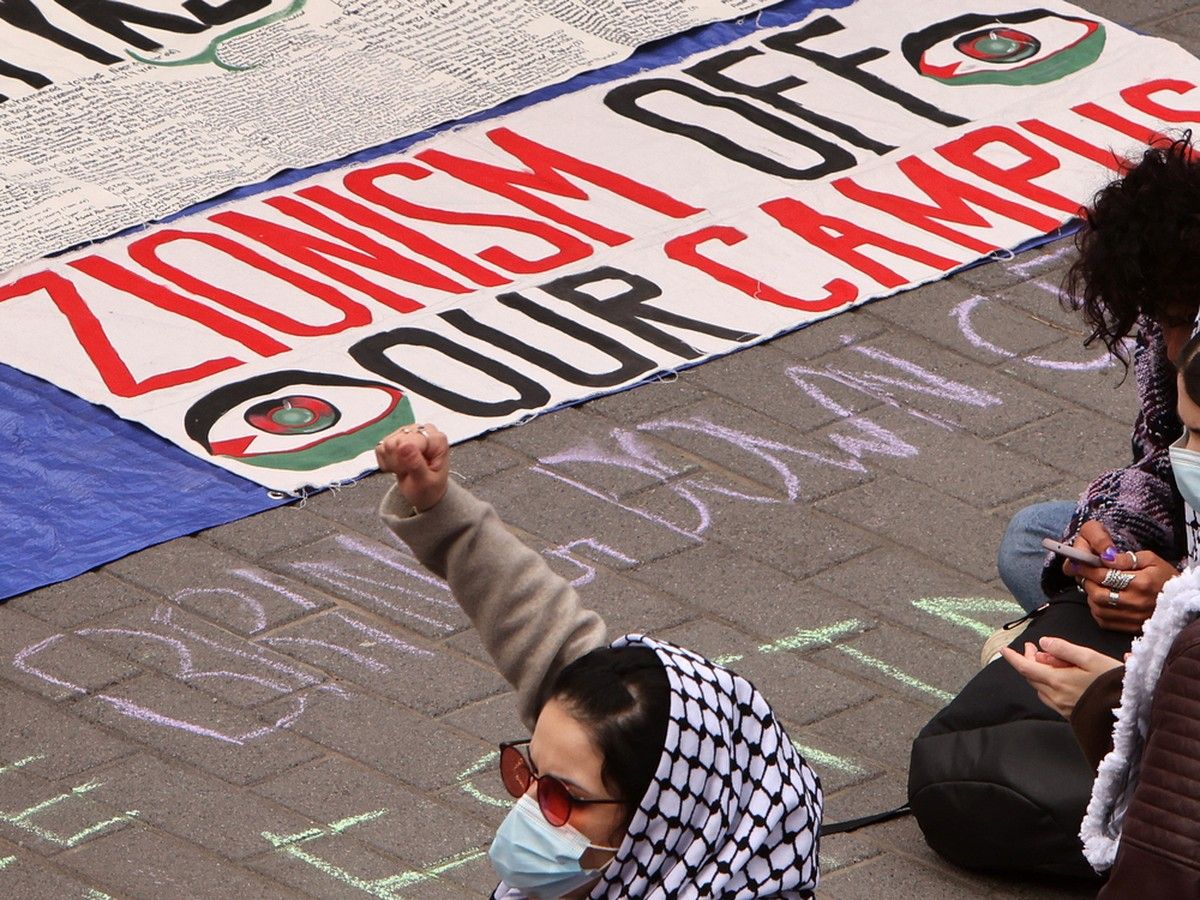
A Canadian, Jewish, post-secondary student reported being called a “ Zionist whore. ” Another reported being placed on a list of “ known Zionists. ” And yet another reported being dropped from research projects simply for saying they wished for the “safety and security of both Palestinians and Israelis.” Zionists have been described to Jewish students as “evil” and deserving to be killed. And all of this occurred on Canadian campuses.
In early August, the federal government released the Campus Antisemitism and Student Experiences (CASE) report . Produced by the Association for Canadian Studies and the Metropolis Institute, and commissioned by Canadian Heritage, the report documents shocking levels of antisemitism experienced by Jewish students on Canadian universities and colleges. Ninety-six per cent of the 900 Jewish post-secondary students surveyed either experienced or witnessed at least one antisemitic incident in the past year alone.
Just over a week after the report was released, several Jewish Canadian academics, who describe themselves as anti-Zionists, attacked the CASE report’s findings in a Globe and Mail op-ed, claiming that the report treats opposition to Zionism as evidence of antisemitism, disagreements as evidence of hatred and provides grounds for disciplining scholars for what they teach and for the policing of legitimate protests.
Their argument is both disingenuous and false.
The CASE report paints a disturbing picture of campus life for Jewish post-secondary students after October 7. Since that day, students in this survey reported having been subjected to hostility, intimidation, exclusion and abuse (not infrequently initiated by professors) because they are Jewish, Israeli or perceived to be Zionists. Some report having been spat on and/or described as child killers, white supremacists and racists. They report feeling pressured to denounce “genocide” and marginalized, as well as being excluded from academic or extracurricular activities and having been subjected to rhetoric that goes far beyond criticism of Israel.
The anti-Zionist professors deny the definition of anti-Zionism as an ideology that calls for the annihilation or erasure of Israel and its people — thereby missing the point. That is precisely how anti-Zionism so often manifests on campuses and is experienced Jewish students — not as some reasoned political, intellectual or even passionate argument, but as the basis for vilifying Jewish students.
These anti-Zionist academics also ignore the long and well-documented history of antisemitic abuse perpetrated under anti-Zionist slogans. From the Soviet Union to Poland, to Iraq, Iran, and other Middle Eastern states, Jews have experienced violence and persecution justified in the name of anti-Zionism. It’s notable that their abusers — particularly in the former Soviet Union — often insisted that they were just being anti-Zionist and not antisemitic. Antizionism is not a political debate like any other because it relies on disinformation and aims to dismantle the world’s only Jewish state.
These anti-Zionist faculty members claim that the CASE report improperly treats the assignment of pro-Palestinian readings or criticism of Israeli policy as troubling classroom antisemitism. Yet, they did not care to explain how professors teaching courses unrelated to the Middle East might think it was a good idea to assign a podcast arguing that Zionism was similar to Nazism, or spend weeks discussing Gaza and the creation of the State of Israel, repeatedly referring to it as a “Zionist political project.”
These academics also gave no explanation as to why a professor might remove course content simply because it had been developed by a Jewish Israeli doctoral student. Nor did they seem to have an answer for why professors might decide it was completely normal to refer to to Zionism is an evil ideology, or to say, “those f–king Israelis,” in class. And they were mum as to why and how a Holocaust denial website could end up as mandatory reading material.
That’s because there is no good explanation for any of these things.
When a professor tells a class that all Zionists should be killed, that Jews belong in Poland and need to go back there, or forces a student to find “positive connections” between the Black Lives Matter movement and Hamas, grades students on metrics such as signing pro-Palestinian petitions or attending related demonstrations, or gives a female student a 0 per cent grade in a women and gender studies course because she spoke up about sexual assaults committed on October 7, this is not about criticism of Israeli policy. This is about demonizing and marginalizing Jews inside and outside the classroom.
The anti-Zionist professors who criticize the report demonstrate no real interest in how antizionism is being weaponized, not only to attack Jewish students on campus, but also to inspire and incite others to do so. Contrary to their assertions, the CASE report does not erase a century of Jewish debate. It exposes how anti-Zionism stifles classroom debate.
In our opinion, these professors are enablers of pervasive antisemitism because they are in denial (at best) about the lived experiences of so many Jewish students on campuses across Canada. They re-victimize Jewish students by invalidating those experiences.
It was inevitable that anti-Zionist critics would deny the high levels of toxicity experienced by Jewish students at universities and colleges. Fortunately, the CASE report has shone a bright light on campus antisemitism. Now, what are governments and educational institutions going to do about it?
National Post
Pamela Walker, professor, Carleton University and co-president of the Network of Engaged Canadian Academics
Cary Kogan, professor, University of Ottawa and co-president of the Network of Engaged Canadian Academics
Deborah Lyons, former special envoy on Preserving Holocaust Remembrance and Combatting Antisemitism
Mark Sandler, chair, Alliance of Canadians Combatting Antisemitism
Alexa Barett-Taller, former Carleton University student and Springboard fellow
Izabella Tabarovsky, fellow, London Centre for the Study of Contemporary Antisemitism and research fellow Max and Tessie Zelikovitz Centre for Jewish Studies