LP_468x60
on-the-record-468x60-white

Police in Kingston, Ont. are ticketing drivers stopped at red lights for merely touching or holding their cellphones, based on evidence collected by drones.

Can police use a drone with a zoom lens to peer into the interior of vehicles stopped at red lights? Can police enter a home’s private driveway and look in the windows of vehicles? Can the government track the cellphone location data of millions of Canadians to track their movements? And can a private foreign company scour the internet collecting photos of Canadians for use in facial recognition technology that is sold to police?

These questions are not hypotheticals; they are real live issues in Canadian law. We are living in the mass surveillance era. But many Canadians do not have a thorough understanding of how far surveillance goes, or what the limits on it are, or whether our legal protections are adequate.

The

police in Kingston

, Ont., are ticketing drivers at red lights for merely touching or holding their cellphones based on evidence collected by a drone. The Supreme Court

recently heard

a case about police entering a private driveway and not just looking in a truck window, but opening the door and collecting evidence — all without a warrant. The Alberta Court of Kings Bench

just considered

a case involving the facial recognition technology of Clearview AI. During the COVID-19 pandemic, the Canadian government was tracking the cellphone location data of

33 million Canadians

. After the Trudeau government invoked the Emergencies Act, the government ordered the freezing of bank accounts of a police-compiled

“blacklist”

of demonstrators, which was distributed by the government to a variety of financial institutions and even lobby groups.

What these cases are demonstrating is that we have entered the era of mass surveillance, and Canada’s legal protections are inadequate.

First, Canada’s privacy legislation is outdated. Privacy Commissioner Philippe Dufresne has said we are at a “

pivotal time

” for privacy rights in Canada. Former Ontario Privacy Commissioner Dr. Ann Cavoukian has also

called for

updates to Canadian privacy laws, “so they apply to all data, including anonymized data.” Much has changed since the current federal privacy legislation was drafted in the early 2000s, but efforts to modernize this law died when Parliament was prorogued.

Second, when it comes to state intrusions, the concept of privacy may be inadequate. Section 8 of the Charter of Rights and Freedoms guarantees the right to be secure against unreasonable searches and seizures, and the Supreme Court has interpreted this right to mean the protection of a person’s “reasonable expectations of privacy” against state intrusions. The notion of “reasonable expectations of privacy” has become a mantra in Section 8 jurisprudence. But some academics have said that in the era of mass surveillance, this guiding principle is an inadequate gatekeeper.

In a lecture for the Canadian Constitution Foundation’s new

free course on privacy rights

, Osgoode Hall Law professor François Tanguay-Renaud proposes a thought experiment that reveals the inadequacy of “privacy” as an organizing principle. What if the police were recording people on the street, with drones following people and recording their movements as they went about their day, zooming in on their cellphones and recording their conversations? In such a scenario, where people are in plain view, privacy is an inadequate concept to limit what we all see intuitively as oppressive state conduct.

At one time, this hypothetical might have been considered far-fetched. Today it is eerily similar to the Kingston police drone scenario. In Kingston, police are using a drone to take aerial images peering into cars and zooming in on cellphones. Those drivers do have reasonable expectations of privacy inside their cars, but what would limit this police conduct if they surveilled citizens on sidewalks or parks, where they were in plain view without those privacy expectations? A principled line must be drawn between things done in plain sight that police can view and constant surveillance using enhanced technology. It may not be possible to draw that line on the basis of  the existence or not of “reasonable expectations of privacy.”

There are other values that could serve as guiding or informing principles for Section 8. There is nothing in the text of Section 8 that mandates the gatekeeper of the right be “reasonable expectations of privacy” rather than another interest, like dignity, liberty, security, anonymity, public confidence in the administration of justice, and many more. Indeed, American jurisprudence has been moving away from the concept of “reasonable expectations of privacy” as the sole guiding principle for their 4th Amendment.

To meet the challenges of the surveillance era, it is well past time for Parliament and the provincial legislatures to update privacy laws. But as recent police conduct shows, it’s time for our Section 8 jurisprudence to be revisited as well, to meet the emerging challenges of the surveillance state.

National Post

Christine Van Geyn is the litigation director for the Canadian Constitutional Foundation.

Canadians who want to learn more about their privacy rights in Canada can sign up for the Canadian Constitution Foundation’s free course at theCCF.ca/learn/


On Sunday the

New York Times Magazine

published

a feature about Canada’s legal regime for assisted suicide

, wrapping large volumes of reporting on law, ethics and medicine around the individual story of Paula Ritchie, an Ontario woman who sought and received “MAiD” after an unhappy life full of pain and misery.

Katie Engelhart’s story plays pretty fair with an explosive social issue that is of increasing global concern. She knows the

NYT

’s world audience is aware of Canada’s avant-garde experiment with the facilitation of medical suicide for patients who don’t have terminal illnesses, and she doesn’t stack the deck either way.

She’s not under any fanciful illusions about the quality of Canadian medicine or Canadian welfare, specifically describing how mere administrative mistakes can lead to intolerable suffering for which the Canadian state now provides a fatal exit. She acknowledges that there was nothing demonstrably wrong with Ritchie apart from mental illness and ill-specified “functional disorders”; there is some accounting of times she refused potentially helpful treatments out of sheer despair.

At the end of the story, as Ritchie is put to death like a sick pet with friends and family around her, one can’t help thinking she might be better off — and one can’t help wondering whether we are playing with fire. That very uncertainty is the whole problem with MAiD, of course. Because it is an experiment, we’re left trying to extrapolate the second-order social effects of a legal regime over which nobody has complete political control. (MAiD is, to say the least, not the only social problem of this nature.)

Canadian law doesn’t yet theoretically allow for MAiD for mental illness alone without some accompanying physical diagnosis. But a diagnosis is a label, and there is a myriad of labels available for those “functional disorders” and chronic-pain syndromes whether or not there is any observable biological signature. If you want desperately to die with a doctor’s help, as Ritchie did, you can probably find one who has an extreme ideological commitment to total patient autonomy, as Ritchie did, and get him to sign off, as Ritchie did.

I don’t know of any case where a doctor gave MAiD to anybody who didn’t have a clear, emphatically expressed desire to die. And, as Engelhart points out, there is not

yet

any apparent epidemic of “Track 2” assisted suicides not involving terminal or irresolvable physical illness. But her story hints uneasily that Canada may simply be turning euthanasia into just another medical specialty, or indeed turning some doctors into vending machines for lethal poisons. They’re being asked, in Track 2 cases, to approve and facilitate suicide, or to refuse to do so, after assessing a patient’s purely subjective suffering. One uneasy physician interviewee asks: “If you want to allow people to end their lives when they want to, then put suicide kits in hardware stores, right?”

Well, what’s the answer to that?

Both

sides of the MAiD argument seem to agree that physician expertise becomes useless in socially complicated Track 2 cases. Is the legal requirement for a health professional’s involvement thus just a ritual aspect of MAiD, a superstition left over from a less stoical age? The doctor who approved Ritchie’s application, Matt Wonnacott, tells Engelhart he “learned to stop” trying to apply medical criteria to MAiD cases and asks, “If you tell me that you’re suffering, who am I to question that?”

To which the only reasonable answer, obviously, is “You’re the guy with the keys to the poison cabinet.” We’re not told how he would answer the hardware-store question, but it wouldn’t be too surprising if he said, “Go right ahead.”

National Post


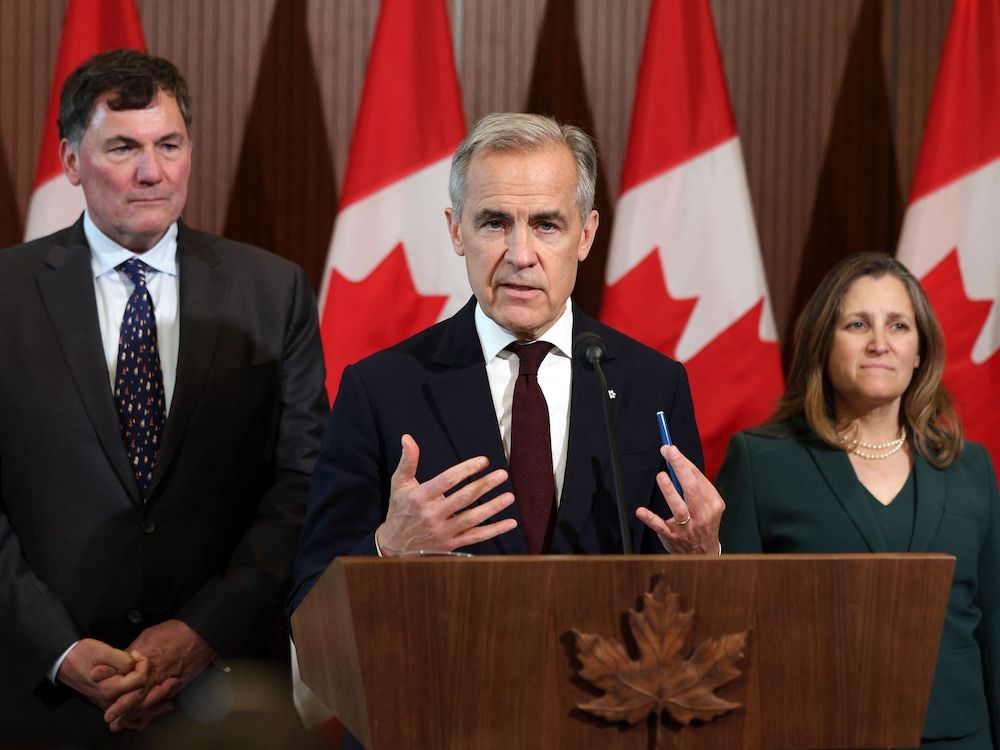
Canada's Prime Minister Mark Carney (C) speaks during a news conference, alongside President of the King's Privy Council Dominic LeBlanc (L) and Minister of Transport and Internal Trade Chrystia Freeland (R), on June 6, 2025. (Photo by DAVE CHAN/AFP via Getty Images)

Mark Carney isn’t interested in being prime minister of Canada. Sure, he may like the title, the presumed prestige that comes with it, as well as meetings with Donald Trump, but when it comes down to the authority the federal government possesses, he’d rather defer to the provinces. He doesn’t want to be the leader of the sovereign nation of Canada, he wants to be a project manager for B.C., Quebec and Ontario.

At a

news conference

Friday to discuss his One Canadian Economy legislation, Carney claimed it would streamline the approval of projects deemed in the “national interest,” and said it was a “bill that meets this hinge moment” with “urgency” and “determination.” The prime minister spoke of how “it’s become much too difficult to build in this country” and that the “federal government” will “identify and expedite nation building projects.”

Except by “urgency” and “determination” Carney means not a streamlined process, but another regulatory regime on top of all the others. And, crucially, when Carney talks about “nation building” and the “national interest,” he doesn’t mean anything that would be in Canada’s interests but would, instead, cede power to the provinces, giving them a veto over infrastructure projects.

When asked by a reporter about whether pipelines would be approved over objections from B.C. or Quebec, Carney responded as if Ottawa didn’t have the clear authority to do so. “No. Simply no, we must have a consensus of all the provinces and the Indigenous people,” he said. If that wasn’t clear, Carney added, “if a province doesn’t want it, it’s impossible.”

To drive home an apparent ignorance of Canada’s

constitution

, Carney also said, “It is not the choice of the federal government.”

However, this is incorrect. While the Liberals may choose to not exercise their constitutional powers, it is most definitely Ottawa’s “choice.” Section 92 (10) of the Constitution explicitly grants the federal government power over “Works and Undertakings connecting” a province “with any other or others of the Provinces, or extending beyond the Limits of the Province.” Ottawa also has authority over any projects “declared by the Parliament of Canada to be for the general Advantage of Canada or for the Advantage of Two or more of the Provinces,” even if such projects exist entirely within a single province.

What this means is that if Ottawa wants a pipeline that crosses provincial borders, it is entirely within its rights to approve it, even over the objection of provincial obstructionists, be they in B.C. or Quebec. It is a power that could not be more clear and it is one that has been backed up by the courts. In 2019, for example, the B.C. Court of Appeal ruled against the provincial government, which was seeking a reference on whether it had the power to put conditions on the Trans Mountain pipeline expansion, which exports heavy oil from Alberta, through, B.C. and to the West coast. The ruling

stated

 that this was “not within the authority of the Legislature.”

In siding with Ottawa, the court noted that the pipeline didn’t just affect B.C., meaning it was not simply a local matter, but rather a project that “affects the country as a whole, and falls to be regulated taking into account the interests of the country as a whole.” If such a case, where the “basic principle,” as the court put it, of the division of powers were to be litigated now, would Carney defend Ottawa’s own authority?

For the prime minister to say there “must be a consensus,” to give the provinces a veto is clearly political, and not rooted in any legal precedent. If the prime minister was indeed concerned with projects in the “national interest” intended for “nation building,” ceding such power to Victoria, Quebec City or Queen’s Park, is entirely counterproductive. If a pipeline, or another project was truly in the national interest, then the federal government should be prepared to approve it over the objections of any of the provinces.

Alas, Ottawa constantly meddles in provincial jurisdiction, whether in health care, or in the regulation of electricity, or the taxing of natural resources, but it refuses to assert its own powers.

Prime ministers, particularly Liberal ones, have always preferred the positive feedback loop they get from social spending programs. The sometimes complicated exercise of the federal government government’s own power turns them off. But if Canada is truly to become “one economy, not 13,” then this is a fear Carney would need to get over quickly, otherwise, what is the purpose of Ottawa?

National Post


Hamas fighters carry their guns in Nuseirat in the central Gaza Strip, as preparations take place for the release of three Israeli hostages as  part of the seventh hostage-prisoner swap on Feb. 22, 2025.

We are deeply disappointed by the

joint statement

, co-signed by Canada, France, and Britain on “the situation in Gaza and the West Bank.” This call rewards Hamas for the torture and murder of 1,200 innocent civilians on October 7 and the kidnapping of 250 others. We note that these are the same Western powers that bombed Raqqa and Mosul into rubble to eliminate ISIS, yet now invoke humanitarian concern to shield Hamas from the consequences of their own atrocities.

Hamas started this war, and Israel has every right to defend itself against terrorists. One wonders what Canadian authorities would do if these Hamas atrocities had targeted Canadian citizens on Canadian soil.

From the outset of the war, Hamas has hijacked international aid, diverting food, fuel, and medical supplies to sell on the black market. The proceeds—

estimated

at up to half a billion dollars — have effectively been a war subsidy, funding the recruitment and arming of more terrorists.

Under the Fourth Geneva Convention, aid restrictions are entirely lawful when there is a risk that the aid will be diverted to enemy combatants. Every truck that Hamas seizes is a reward for terrorism and an incentive to repeat their strategy. In spite of this, Israel ensured there was enough aid in Gaza to last months, with

25,000 aid trucks entering Gaza during the 42-day ceasefire

. Indeed deliveries of aid have re-started, and a new mechanism has been put in place to ensure that aid is distributed to the needy, rather than diverted and stolen by Hamas.

Meanwhile Hamas still holds

58 hostages

in inhumane conditions underground — starving, torturing, and sometimes murdering them.

The conflict in Gaza could end tomorrow if Hamas laid down its arms and released the hostages. This is the path to peace. Hamas has never accepted Israel’s right to exist. After Israel withdrew from Gaza in 2005, Hamas did not build a state; they built terror tunnels and stockpiled rockets, planning for October 7. To believe that a Palestinian state can be negotiated with a group that rejects the very existence of Israel is a dangerous and naïve fantasy.

Every ceasefire gives Hamas time to regroup and plan the next massacre. This is the unbearable dilemma Israel faces. Unless Hamas is defeated, this war will not end — it will merely pause, until the next October 7. If Western leaders enable this cycle, they will bear responsibility for the bloodshed to come — on both sides.

We are also concerned for the Jewish and Israeli people in Canada. Israel’s Ministry of Diaspora Affairs

upgraded its travel alert for Canada

to Level 2 due to rising threats against Israelis and Jews, following

multiple recent attacks

on Jewish institutions and a rise in hostile rhetoric. Israelis in Canada were urged to

avoid public displays of Jewish/Israeli identity

. Leaders of nations should be mindful of how their pubic statements (or lack thereof) might correlate with a rise in antisemitic attacks.

We are shaken by the recent murder of two young embassy staff in Washington DC by Elias Rodriguez who

yelled out

, “I did it for Palestine, I did it for Gaza.” We believe months of unfounded or libelous accusations and propaganda against Israel contributed to the conditions that led to their murder.

We declare our support for Israel’s right to defend itself, and we urge the government to demand Hamas release the hostages and commit to a peaceful future. We also urge the government to increase its efforts to protect the Jewish people of Canada.

Hon. Harry S. LaForme O.C & I.P.C., Mississaugas of the Credit First Nation, knowledge keeper

Dr. Sheree Trotter, director Indigenous Embassy Jerusalem

Hon. Alfred Ngaro, director Indigenous Embassy Jerusalem

Lynda Prince, envoy North America, Indigenous Embassy Jerusalem, former tribal (grand) chief carrier Sekani Nation

Harvey Yesno, former chief of Eabametoong First Nation (EFN) and former grand chief of Nishnawbe Aski Nation (NAN)

Reggie David Neeposh, former chief Oujé-Bougoumou Cree Nation, Northern Quebec

National Post


Conservative Leader Pierre Poilievre arrives on Parliament Hill in Ottawa on Friday, May 30, 2025. THE CANADIAN PRESS/Sean Kilpatrick

Canada’s federal Conservatives are stuck with a dilemma as they consider whether to do anything different in the next two years than they did in the last two.

At the centre of the dilemma are a host of riddles. As in, did they actually lose the last election? Sure, they didn’t win, but did they lose lose? Like, did Canadians actually reject them, or did something else happen that got in the way of the victory they anticipated?

If they did lose, what do they do about it? And if they didn’t lose lose, what do they do about that?

Depending on the answers to those questions is another of equal weight: do they head into the future with the same team of decision-makers who didn’t quite win if they maybe didn’t lose? And how do you answer that question when you don’t know what the future holds, given that one complaint against the current leader is that he didn’t respond effectively enough when the playing field changed?

As far as Pierre Poilievre is concerned, there’s nothing to decide. “We had the biggest vote count in our party’s history, the biggest increase in our party’s history, the biggest vote share since 1988 and we’re going to continue to work to get over the finish line,” he replied when asked. That same argument is on offer from other Conservatives keen on moving past the vote that left them once again in second place.

The “nothing to see here” case goes like this: In any previous election dating back 40 years the Tory results would have put them in power, likely with a majority. The fact this one didn’t was the result of unprecedented exterior factors, specifically, the timing of Justin Trudeau’s departure and the coinciding emergence of a U.S. president even his most fervent detractors didn’t foresee as being quite this nuts. Alarmed and unnerved, voters opted for continuity and incumbency over the very real practical policies they’d been firmly embracing until then.

It’s not a bad argument, but also not entirely convincing. In the Liberal bastion of greater Toronto, it sounds a lot like the local NHL team’s annual excuses for once again failing to deliver the goods. “Hey, at least we did better than our last collapse,” doesn’t quite cut it.

To its credit, the conservative universe isn’t ready to simply roll over and accept the excuses. In this the party shows itself once again to be more independent-minded than the rival Liberals, who — after refusing to give themselves the power to oust Justin Trudeau, and living  to regret the fact — made the same

decision

over his replacement. A majority of the caucus voted not to accept the rules of the Reform Act, meaning Prime Minister Mark Carney knows he can rule as he sees fit, safe in the knowledge the minions can’t get rid of him. Would any other party in the democratic world vote to remain minions?

Conservatives not only adopted the Reform rules, but are discussing whether Poilievre should face a leadership review. A decision could be made as early as this month, with a

review

to take place next spring. It’s possible they’ll reject the option, but it would be a mistake. The world a year from now may look a lot different than it does today. Given the level of international uncertainty and the daily madhouse in Washington, it would be a shock if it didn’t. Locking themselves into a recently-defeated leader when circumstances could easily demand an entirely different set of calculations would not be a show of confidence but an act of denial.

Poilievre has shown himself to possess certain definite gifts, but also a ready supply of flaws. He’s identified by defenders as a master communicator, certainly better at reaching ordinary Canadians than either Erin O’Toole or Andrew Scheer, his two most recent predecessors. The vote results show as much, particularly the

healthy

gains in Ontario and British Columbia at Liberal and NDP expense. He knows his mind, he speaks with conviction, he argues convincingly of the need for change.

He also alienates large numbers of people. His personality grates. He comes across as cocksure rather than leaderly. We’re told that Mark Carney “doesn’t suffer fools gladly” but thus far appears able to keep it from annoying the public. Poilievre, in contrast, can be openly rude and dismissive where everyone can see it, and quickly does thanks to social media. He’s a communicator who doesn’t get along with the communications business, who doesn’t let them on his plane, who pens off the people who one way or another will transmit their impressions to millions of Canadians.

He’s similarly weak at wooing allies he’d need if he ever got the chance to act on his agenda. He doesn’t talk to premiers he doesn’t like. He appears to remain committed to key strategist and enforcer Jenni Byrne, whose ability to make enemies is legendary and whose treatment of the Conservative caucus evokes thoughts of the Commanders’ approach to women in Margaret Atwood’s dystopian Gilead. Indeed, whether or not Byrne keeps her job will be a telling sign of whether Poilievre’s support for change includes change on his own behalf.

The presiding argument for retaining Poilievre as leader is that there’s no obvious alternative at the moment. That’s not a good place to be. An organization that seeks to govern the affairs of a serious country should be able to muster more than a single leadership option, and it should be any leader’s responsibility to see that there’s talent in the ranks.

Having failed to react successfully to changed circumstances in the latest election, Conservatives need time to better prepare for the next one. Poilievre’s performance over the next 10-12 months will be critical in assessing his suitability to lead those preparations. He should be given time to prove himself pending a formal review at a party gathering next spring. Requiring as much isn’t a knock on Poilievre but would reflect a party set on deciding its own future.

National Post


Government efficiency is what Elon Musk, left, desires, but it runs counter to the heart of Donald Trump's plans, writes Raymond J. de Souza.

WASHINGTON, D.C. — More or less on schedule, U.S. President Donald Trump and Elon Musk are headed for a steel cage match. The steel will be more expensive now due to tariffs, but spectacles don’t come cheap.

This past week’s Trump-Musk breakup could be dismissed as simply the latest episode of a professional-wrestling-reality-show presidency. The script is as old as baby-oiled wrestlers in the ring and as current as the Axe-body-sprayed young men in the audience.

Two great titans — The World’s Richest Man™ and The World’s Most Powerful Man™ — joined forces to form a fearsome tag-team. Call the alliance The World’s Most Manly Men™, with rotating mouthpiece managers in their corner, Joe Rogan, Tucker Carlson and the like.

The World’s Most Manly Men™ steamroller over weak opponents at first to establish their dominance. Trump-Musk dismantle overseas aid to the poor; Trump-Musk take down funding for Aids prevention and treatment in Africa. Next up, The World’s Most Manly Men™ grapple with stronger opponents, preferably effete and somehow suspect; Trump-Musk battle public broadcasting, then Columbia, then Harvard.

Eventually though, the new tag-team champions run into formidable opponents — the judiciary, the bond market, the American voter’s preference for big government without having to pay for it. Victory is no longer easy nor assured. Will The World’s Most Manly Men™ prevail?

The final step comes as surely as celebrities gather like moths around the pro-wrestling flame. The World’s Most Manly Men™ must turn on each other. The spittle-flecked air is filled with cries of ingratitude, betrayal and treachery. The ambush then comes. The allies turn on each other. A low blow is landed — Trump is a reckless spendthrift! A steel chair is used to devastating effect — Musk’s government subsidies will be cut off!

The erstwhile allies are headed for a showdown. Tickets are sold to the clash of the titans; The World’s Most Manly Men™ will fight each other in a cage match.

That may well suffice as an explanation for the latest melodrama here in Washington, the latest staging of circuses in the declining imperial capital. But it overlooks a deeper division at the heart of the Trump project, a division advertised as brazenly as the golden Trump brand on a failed casino or a skip-the-line visa. It was right there in the name: Department of Government Efficiency (DOGE).

Efficiency is what Elon Musk desires, but it runs counter to the heart of the Trump project. Efficiency is what has driven globalization, automation, information technology and open trade, where more efficient production enables cheaper goods and services. Efficiency is the altar at which Musk and the tech-bros worship. Efficiency is the AI future where goods are cheap and services may well be cheaper still; The World’s Most Richest Man™ takes his billions and employment shrinks dramatically.

It was thus a contradiction from the beginning that Trump would embrace efficiency in general, and this particular efficiency czar in particular.

The signs were there early on. Remember that DOGE originally was a dyad, with Musk accompanied by a sidekick, Vivek Ramaswamy, the bio-tech entrepreneur who had previously run for president before endorsing Trump.

Before the inauguration, Ramaswamy observed that America needs high-skilled foreign workers because an American culture “which celebrates the prom queen over the math olympiad champ, or the jock over the valedictorian, will not produce the best engineers.”

He urged Americans to study hard and work harder, to pursue efficiency and not entertainment. It was time for “more tutoring, fewer sleepovers. More weekend science competitions, fewer Saturday morning cartoons. More books, less TV. More creating, less ‘chillin’. More extracurriculars, less hanging out at the mall.”

Whatever Trumpism is, it is certainly not about working harder and less TV watching. Trump’s own trajectory has been from the world of business (efficiency) to the world of entertainment. Thus Ramaswamy’s call to get up off the couch did not go down well with the workers to whom Trump promised protection, not opportunity. Ramaswamy was dumped from DOGE before the inauguration. He had called too much attention to the demands that efficiency makes.

The Trump project is not that efficiency — creativity, productivity, innovation and trade — is inherently bad, but that it ought not be the only, or even primary, goal. As JD Vance put it during the campaign, “We believe that a million cheap, knockoff toasters aren’t worth the price of a single American manufacturing job.” Ramaswamy saluted the engineers who designed those processes, and Musk wants to install the toasters, built in entirely worker-free factories, in his cars.

The Vance argument is legitimate. Perhaps America would be better off with more expensive toasters — certainly the aluminum tariffs will see to that. Maybe it would be better if American companies could be less efficient, i.e., be able to survive with more expensive production and labour costs.

Economics is about trade-offs. Efficiency gains are real, but it is perfectly reasonable not to prefer efficiency (inexpensive toasters or cheap goods at Walmart), but protection for workers, towns, local cultures. If toasters cost three times as much, and beer in aluminum cans costs more, and groceries do too when cheap immigrant labour is driven out of agriculture — then that is the price to pay.

Trump appears to be willing for Americans to pay it. Musk never was. The steel cage match is to determine who Americans actually agree with.

National Post


A protestor holds a placard reading

The United States Federal Bureau of Investigation (FBI) is asking the public for tips on hospitals or practitioners who are performing “gender-affirming” surgeries on minors. It’s illegal, and it’s mutilation, says the FBI.

Is the FBI fibbing about the law? To an extent.

The bureau’s announcement follows President Donald Trump’s

Jan. 28 executive order

, “Protecting Children from Chemical and Surgical Mutilation,” which attempted to ban childhood medical transition by defunding any federally supported institution that carries out these procedures. The order was

challenged in court

, in an ongoing case called PFLAG v. Trump, and an injunction prevents its implementation.

This hasn’t stopped the FBI’s assistant director for public affairs,

Ben Williamson

, from calling such surgeries illegal — even if they technically are not. On Monday, after Axios published an

article

about the bureau’s interest in “gender-affirming surgeries,” Williamson responded on X, “Actually what we said was we would like tips on any hospitals or clinics who break the law and mutilate children under the guise of ‘gender affirming care.’”

The FBI made a similar

post on X

that same day: “Help the FBI protect children. As the Attorney General has made clear, we will protect our children and hold accountable those who mutilate them under the guise of gender-affirming care. Report tips of any hospitals, clinics, or practitioners performing these surgical procedures on children at 1-800-CALL-FBI or tips.fbi.gov.”

Critics, including the American Civil Liberties Union,

say the move is all for show

, and is not based on current or enforceable laws, despite the fact that many states currently have laws banning pediatric gender transition. These critics certainly have a strong argument — but it is entirely beside the point.

The FBI, with its callout for public tips, has taken an extrajudicial moral stance on the worst medical scandal of our time. It was an act of leadership and clarity. And it will be remembered as such in history books.

The federal law enforcement agency’s statement “may only be intended to scare medical practitioners away from offering those services,” as per critics who spoke

with CNN

. That’s a fair assessment. The FBI probably is doing just that — and it deserves commendation for it.

Swathes of persons within the American medical establishment are ignoring the overwhelming evidence on the harms of “gender-affirming” care. It is therefore an act of moral valour for the FBI to intimidate physicians and health-care providers from participating in what is now increasingly recognized as an ongoing — though petering — medical scandal.

This is the stark reality: children,

often gay or autistic

— and with limited capacity to consent — are being permanently sterilized and physically altered by major surgeries and cross-sex hormones. Forget the cutesy euphemisms about “top surgery” (double mastectomies) or “puberty blocking” (

possibly irreversible

chemical castration). Forget the lie that this “care” is a suicide-preventing intervention for youth who were “born in the wrong body” — two false claims.

There are times when something is so

egregiously

and

evidently

wrong that it warrants such action as the FBI’s intimidation. This is one of those times.

Medical scandals can carry on for years — decades, even — after whistleblowers come forward to expose harms. The history of the lobotomy proves this.

Eight years elapsed between the time that the American Medical Association, in 1941, publicly

rang alarm bells

about the harms of lobotomies, and the time that António Egas Moniz won a

Nobel Prize

in medicine for having invented the barbaric, and now thoroughly discredited, procedure. Thousands of Americans had received lobotomies by the 1960s.

As with lobotomies, it is also true that for “gender-affirming” care, some patients, and their families, claim that the treatment was a help, or a cure. And for some, that may be the case, even only partially.

Others, however, are psychologically invested in the notion that the “care” that harmed them, or their children, was not harmful at all — because any admission of harm, particularly for loving parents, would undoubtedly be painful. They will resist it at all costs. What parent would want to face up to having potentially sterilized their own child, based on flimsy or completely absent evidence? And then there are the providers, who likewise must face the music: that they have hurt the very persons they were tasked with caring for.

Many of these persons will continue to ignore the evidence before them, including the results of the

United Kingdom’s Cass Review

, and of the American health department’s

Review of Medical Interventions for Children and Adolescents with Gender Dysphoria

. And thus, this medical scandal could drag on for years to come. The FBI’s move is crucially needed help.

Gender affirming care for minors not only needs to end, but its most flagrant practitioners — who’ve willfully set aside the ethical standards of their professions by ignoring the countervailing evidence — should be brought to justice.

Whether the FBI will be able to prosecute these practitioners is questionable, and subject to the outcome of at least one federal court case. It could take untold years for justice to arrive. The U.S. has, however, taken the international lead in declaring that it will come. Leave the children alone. Ignore the evidence, and the truth, at your peril.

National Post


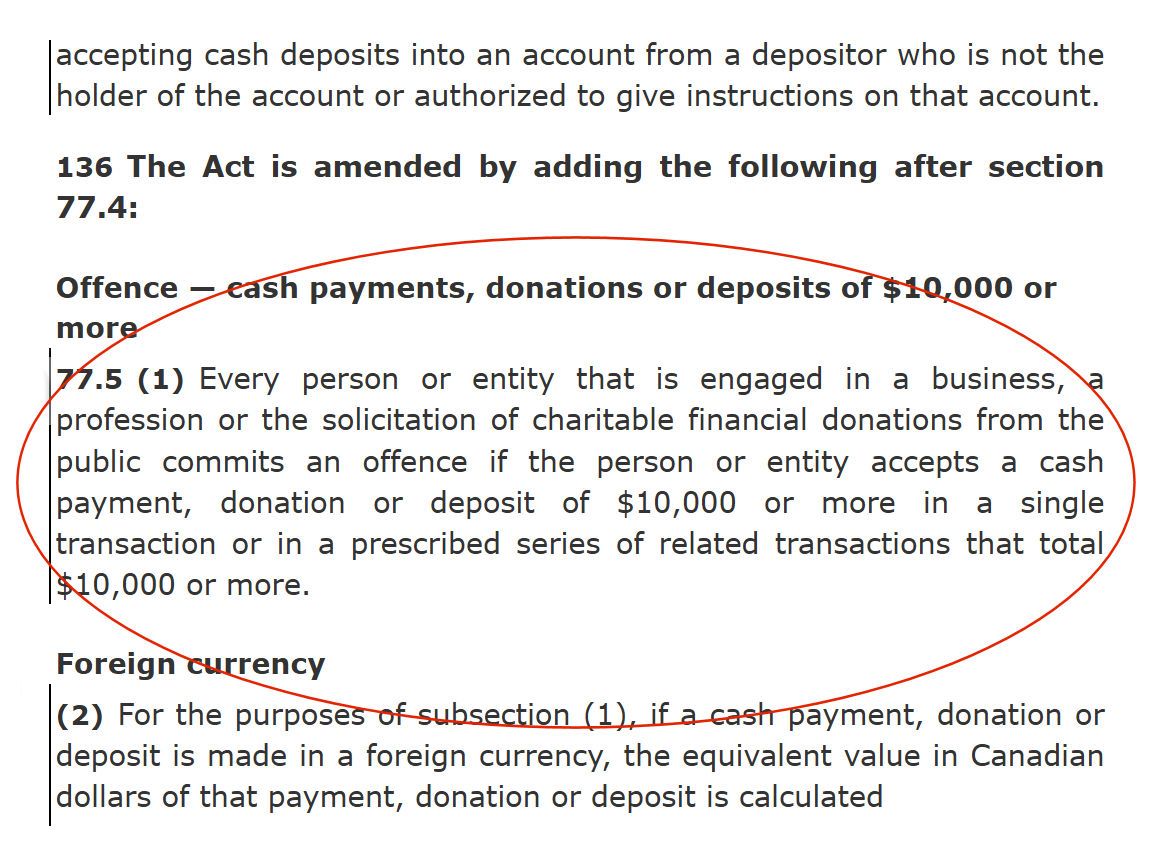
A highlighted section of Bill C-2 where it bans cash transactions over $10,000.

First Reading is a Canadian politics newsletter curated by the National Post’s own Tristin Hopper. To get an early version sent directly to your inbox, sign up here.

TOP STORY

The first piece of legislation tabled by the new Carney government is a bill framed as a means to tighten the “security of the border between Canada and the United States.”

“The Bill will … keep Canadians safe by ensuring law enforcement has the right tools to keep our borders secure, combat transnational organized crime, stop the flow of illegal fentanyl, and crack down on money laundering” read a backgrounder.

But within days of the text becoming public, analysts began to notice that Bill C-2’s 140 pages contained a number of provisions that went well beyond the usual scope of chasing down drug smugglers and gangsters. This includes a clause that technically outlaws paying for anything with more than $10,000 in cash.

Below, a quick summary of two of the most eyebrow-raising provisions contained within the “Strong Borders Act.”

Paying more than $10,000 in cash would become illegal

If Bill-2 passes as written, it would become illegal for any “business”, “profession” or charity to accept cash payments of more than $10,000.

The bill would do this via an amendment to The Proceeds of Crime and Terrorist Financing Act, legislation that was first made law in 2000. The amendment states that it would become an offence to accept “a cash payment, donation or deposit of $10,000 or more in a single transaction.”

It doesn’t matter if the $10,000 is paid to a licensed business for a legal product or service: The mere fact that the payment is in cash is what makes it illegal.

It also becomes illegal if “a prescribed series of related transactions” come to a total of more than $10,000. So, if you pay $2,000 cash to a contractor more than five times, that contractor will have officially violated The Proceeds of Crime and Terrorist Financing Act.

In

a statement

, the Justice Centre for Constitutional Freedoms conceded that it’s a rare thing for a Canadian to pay a five-figure bill in cash, but warned that once the precedent is set, it would be very easy for governments to reduce the “legal amount” of a cash transaction. “Restricting the use of cash is a dangerous step towards tyranny and totalitarianism,” it wrote.

“If we cherish our privacy, we need to defend our freedom to choose cash, in the amount of our choosing. This includes, for example, our right to pay $10,000 cash for a car, or to donate $10,000 (or more) to a charity.”

Another twist with the provision is that it only covers donations collected by an entity involved in “the solicitation of charitable financial donations.” So virtually all of the anti-Israel protests regularly blockading Canadian streets would be exempt, as they’re not organized by registered charities. If you want to hand $10,000 in cash to your local Globalize the Intifada vigil, The Proceeds of Crime and Terrorist Financing Act has no quarrel with you.

Police could force internet companies to surrender user data without a warrant

Midway through Bill C-2 is a host of new measures that the Conservative Opposition has referred to as “

snooping provisions

.” Speaking to the House of Commons, shadow immigration minister Michelle Rempel Garner said that when combined with the other internet controls being championed by the Liberals, they make for a “censorship Voltron” – Voltron being a reference to a giant cartoon robot comprised of other, smaller robots.

In short, Bill C-2 would allow law enforcement to force internet companies to turn over user data without a warrant. All they would need is “reasonable grounds to suspect” that an offence “has been or will be committed,” and then they’d be able to force internet service providers to reveal the names, locations and even “pseudonyms” of their customers.

The bill even contains the boilerplate text of what this would look like. An internet company would be served with an “Information Demand” informing them that since one of their users “has been or will be” committing a suspected offence they are “required to provide” any information asked of them.

“If you contravene this demand without lawful excuse, you may be subject to a fine,” it reads.

This power is not limited to issues of border security. It applies to “any” offence under “any” Act of Parliament. It’s also not limited to police; any “peace officer” or “public officer” can make an information demand. And that latter category is particularly broad. If you operate an authorized Canadian military museum

you’re technically a “public officer.”

In a lengthy analysis of Bill C-2, University of Ottawa internet policy expert Michael Geist noted that Canadian law enforcement has been trying for decades to obtain these kinds of powers over the internet — only to be repeatedly stymied by public pushback and even a 2014 Supreme Court decision ruling that Canadians had a “reasonable expectation of privacy” on the internet.

Wrote Geist, “Bill C-2 overreaches by including measures on internet subscriber data that have nothing to do with border safety or security but raise privacy and civil liberties concerns that are bound to spark opposition.”


IN OTHER NEWS

 Each passing week seems to yield dwindling evidence that the Carney government will be making good on its promise to restore some semblance of housing affordability to Canada. According to a new Angus Reid Institute poll, “making housing more affordable” is the one issue on which respondents, including Liberals, most suspected Carney would fail.

The saga of the throne speech vote has ended in the most unglamourous way possible. After the NDP announced that they would not vote in favour of the speech from the throne, the Liberals were suddenly faced with the possibility that they could potentially fall on a confidence vote less than two weeks into the 45th Parliament. Since the Liberals are heading up a minority, it would have been possible for the Bloc Québécois and the Conservatives to join with the NDP and bring down the government at literally the first opportunity. Instead,

the speech was approved “on division.”

This is when a motion passes without a vote because no dissent is registered in the House. So, faced with the option of either endorsing the Liberals or triggering an election, the Opposition opted to simply sit quietly in their seats until the issue went away without them having to do anything.

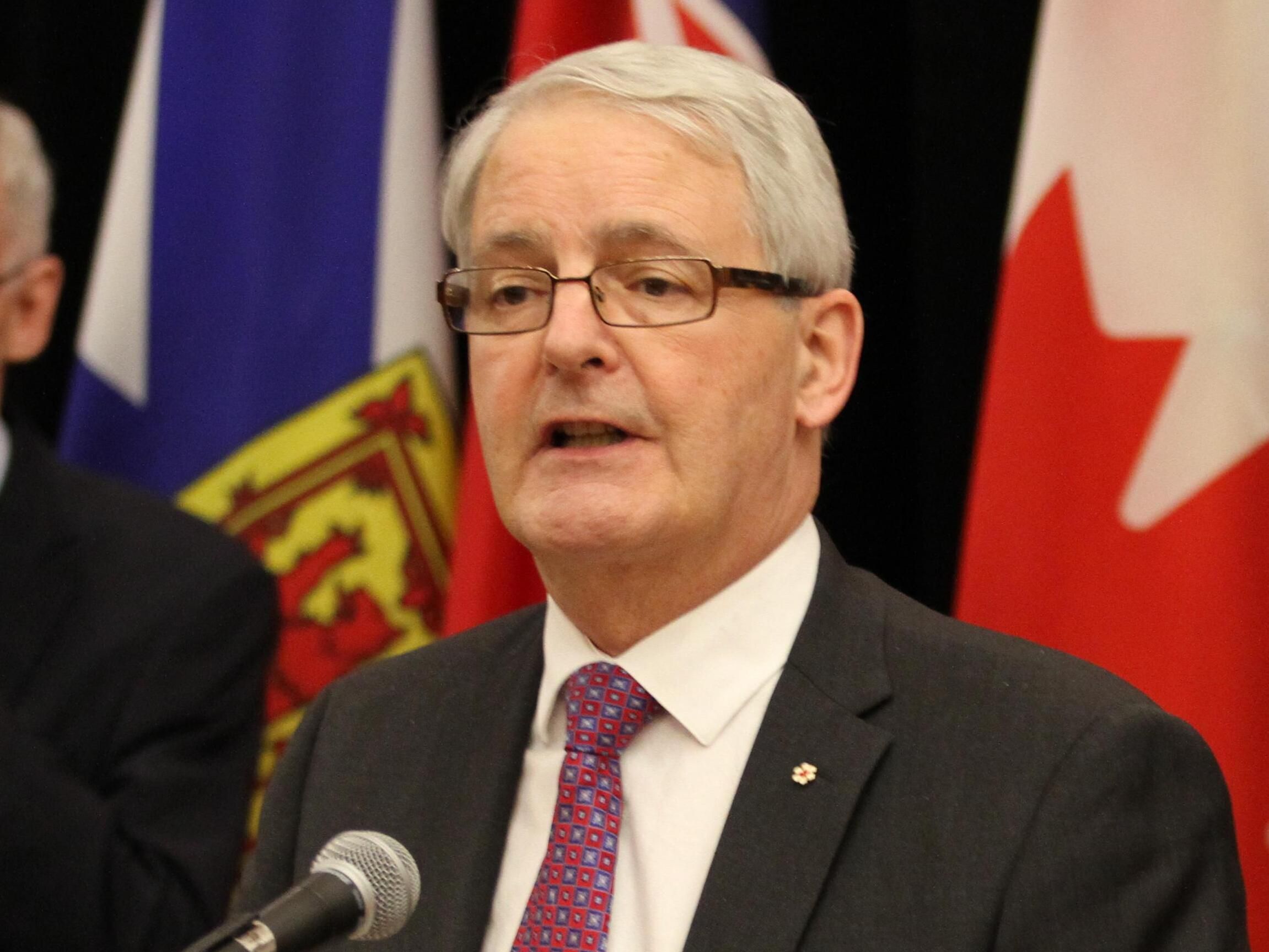
 Marc Garneau has died at age 76. He was not only the first Canadian in space, he was the extremely rare example of a Trudeau government cabinet minister who had real-world expertise in the area he was overseeing. While serving as transport minister in 2019, Garneau received international attention for his eloquent and haunting explanation of how two 737 MAX 8s crashed after malfunctioning software stole control of the aircraft from its flight crew.  The pilot “lost (the) fight with his software,” Garneau told reporters.

Get all of these insights and more into your inbox by signing up for the First Reading newsletter.


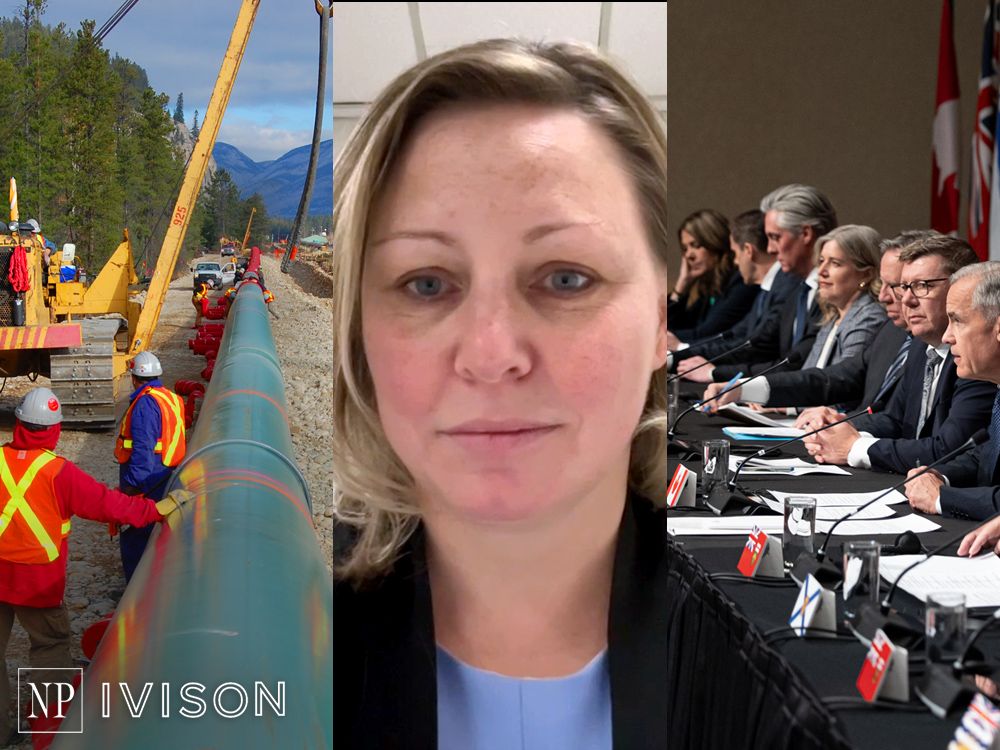
This week, John Ivison discussed the Carney government’s plans for nation-building projects with Dr. Heather Exner-Pirot, a senior advisor for the Business Council of Canada.

Ivison asked whether asking premiers to submit projects deemed to be in the national interest will mean we are at risk of pursuing white elephants that are not feasible or uneconomic.

“The tone has markedly improved from the last Liberal government, so there is some optimism,” she said. “There is a sense that the federal government will be a partner in building things, where, for a long time, we thought they were blocking our ability to build things. So it’s a great start but there’s only so long that you can have a honeymoon period before things have to happen. We actually have to see some action. And we know that Liberal governments are very good at rhetoric and not so great at implementation.”

She said her concern is that projects are being submitted by governments and then projects deemed “nation-building” are being selected by the federal government.

“The direction it’s going is a little concerning, in that they want to have a short list of nation-building projects and they will determine if it’s nation building and use the public purse to fund them in cases where the private sector will not step up.

“There may be a handful where that’s justified. There’s obviously a role for governments to build infrastructure. But the low-hanging fruit is obviously to improve our regulatory competitiveness. We have very restrictive, very burdensome regulatory processes. There are a lot of projects that proponents want to do on their own, without government help, if the regulation was better, if we had better tax competitiveness with our competitors. And so I will tolerate a handful of these nation building projects, if they make sense from a business side. But at the end of the day, we’re going to need to see the regulations improved and streamlined.”

Exner-Pirot said that Mark Carney’s goal of a two-year approval process is a “great target”

“(But) we should walk before we run. For some of these things, three years also look pretty good. Two years is certainly feasible if we have good processes and good relations with Indigenous partners. The Conservatives were talking about a six months (approval process) and that just didn’t seem feasible to me – that you would never be able to fulfill your duty to consult and accommodate in such a timeline. So two years is ambitious, but doable and we should reach for it.”

She pointed out that Canada has to be regulatory and tax competitive with jurisdictions like Texas.

“We would like to bring some of that capital back home. But at the end of the day, investors are going to make those decisions based on the return that they get. Let’s make sure that our tax system is competitive so that capital actually wants to choose Canada.

One sector where Exner-Pirot is extremely bullish is nuclear power generation using small modular nuclear reactors.

This is the one area where I just think: ‘Yes, this is a nation building project’. We should lead on SMRs. And there’s so many strategic reasons for Canada. One is that we have the uranium source. (We are) the world’s number two exporter and number two producer of uranium. We have phenomenal deposits in northern Saskatchewan and in Nunavut. We could dominate the supply chain and the technology. We are building the first SMR in the G7. It has taken some public money to get there. But being the first mover really does accord you some benefits as you try to sell these models in the future. So where can we go next? Nuclear really has the potential if you get the cost curve down. It’s a baseload clean energy that needs very little land and very little material inputs. In 100 years, do I think we’ll be doing mostly nuclear? Yes, I honestly do.”

On specific projects, Ivison asked if a bitumen pipeline should be a priority.

“(Alberta premier) Danielle Smith has said it, and my analysis suggests it’s absolutely true: There is nothing that will change the economic growth, the GDP, the productivity per capita in this country as much as a bitumen pipeline. We finally added Trans Mountain about a year ago. That’s at 90 per cent utilization right now in one year. Our producers filled it fast, so there’s clearly demand. We’re seeing most of that demand come from Asia, so there is strong demand in global markets for Canadian heavy oil. But it is concerning that we have added this pipeline and we’re already running out of egress. So there is an urgency from the producers that we need to start thinking about the next pipeline. And I don’t think we’re going to get Northern Gateway in two years. If everything went well, probably four years. And that’s why we have to start planning for (the next one) now,” she said.

Exner-Pirot said whichever pipeline plan comes forward will require the B.C. government to revisit its opposition to tanker traffic on the West Coast.

“I’m finding this hard to understand because B.C. has actually done some constructive and progressive things on the economic development side since Trump was inaugurated. (Premier Dave) Eby has almost been the most vocal about wanting the elbows up. He said in February that if we don’t sell Canadian oil and gas, they will just get it from places like Venezuela. I thought: ‘Wow, this guy has had a light bulb moment’. To hear (his support for the tanker ban) two and a half months later is quite disappointing. Now a lot of this is federal jurisdiction, so while we want the feds to get out of the way, (it is different) on inter-provincial pipelines, because that is clearly federal jurisdiction. We know from Trans Mountain when B.C., if you recall, said: ‘We will use every tool in the toolbox to stop this project’. And they did. But it wasn’t their right. The feds can overturn the oil tanker ban. That’s their jurisdiction. But what proponent really wants to step into a situation where a provincial government is going to use every tool in the toolbox to stop your project? It’s obviously not bullish for investment to have this kind of political disagreement on the ground.”

Ivison asked if the idea of a “grand bargain” between Alberta and Ottawa on decarbonizing bitumen before it is transported to the West Coast by pipeline is a viable option.

“It is feasible. The industry itself has proposed carbon capture and also using some solvents to reduce emissions. In the last 11 years, they have actually reduced carbon intensity emissions per barrel by 30 per cent. So they are doing the work. A lot of the carbon comes from natural gas input to heat the bitumen. That’s an expense. There’s every reason why they would rather not have to pay that kind of money.

“Right now, the oil sands, on a life cycle basis, is only about 1-3 per cent higher emissions than the global average barrel, the average crude. But if we did this carbon capture, if we did some of the solvent innovations that they’re using, it would actually be below the global average on a life cycle basis. So there is a grand bargain to be had. The industry itself has been advocating it. We’re very competitive on an economic basis. We want to be competitive on a carbon basis.

“What Danielle Smith is saying is: ‘Where’s the money going to come from to spend probably $20 billion on these (carbon capture) technologies? If you know you’re going to get another pipeline and you can increase your production and fill it with a million barrels a day, well, now there’s more revenue coming in and there’s a justification. (But) if all your profits have to be driven into carbon capture, you’re just not going to get any investment. All of this is cost, none of this is profit and they still have to have a certain level of return from the investors or the investors will just take off.”

Moving east across Canada,, Exner-Pirot has been skeptical about Arctic ports being commercially viable. She noted that the feds and the province of Manitoba have spent more than half a billion dollars on the port of Churchill and it’s still not attracting shippers and investors, while the Northwest Territories is trying to push the idea of an “Arctic Security Corridor” that runs between Alberta and Gray’s Bay in Nunavut, via Yellowknife. Both ports are impacted by a short shipping season because of sea ice.

“It’s a terrible idea for oil and a very bad idea for liquefied natural gas,” she said. “You will never get a return on your investment. We do want northern development. We do want those regions to prosper at a local level. (But) this is not the thing that’s going to grow our GDP. This is not the thing that’s going to help Canada diversify its exports away.

“A port in Churchill and a port in Gray’s Bay can be useful for helping local mining development happen. That’s important for jobs, for taxes, for royalties, for those communities’ economic health. So there’s a reason it’s a public good to provide some basic infrastructure, basic transportation access for the people that live there.

Critical minerals are a very different thing from oil. You can mine, you can produce all year and stockpile it, and then in that short shipping season you can ship it out. It’s not very expensive just to have it sitting there while the shipping season is closed.”

Exner-Pirot said the signs are positive that Canada will finally get its act together and overcome the barriers to economic development because the alternative is stagnation.

“If we return to our complacency after what we’ve seen and what we’ve gone through, then God help this country. The conversation right now, again, is focusing on a few projects. I’ll be tolerant of this, maybe for a handful of projects and for a handful of months. But (we must) improve our regulatory systems, especially at the federal level. That is where we need to see movement. You can’t bring in new people at the rate we bring in new people, and you can’t be dependent on China at the rate that we’re dependent on China. That cannot keep going on,” she said.

Get more deep-dive National Post political coverage and analysis in your inbox with the Political Hack newsletter, where Ottawa bureau chief Stuart Thomson and political analyst Tasha Kheiriddin get at what’s really going on behind the scenes on Parliament Hill every Wednesday and Friday, exclusively for subscribers. Sign up here.



A Canada Border Services Agency (CBSA) shoulder patch was photographed at the Calgary International Airport on Tuesday June 3, 2025.

Prime Minister Mark Carney’s first major piece of legislation certainly offers the appearance of change. Whether it will actually deliver, well, that’s less certain.

From afar, Bill C-2 seems to be a return to order. At 140 pages, it covers a lot of ground, proposing amendments to federal drug and immigration laws, as well as those covering the mail, the ocean and the chemicals that go into street drugs. Systemic and wide-ranging change seems to be the intent.

If passed, the bill would render any asylum claimant who files after being in Canada for a year

inadmissible

(this will apply to anyone who entered Canada after June 24, 2020), among other things.

The consequences for this would be dire for those who have been abusing the refugee system in their attempts to remain in the country. International students, for example, have skyrocketed as a source of asylum applications,

surpassing 20,000 last year

(six times the amount of claims they made in 2019), and a quick browse on YouTube yields

how-to guides

from abroad, showing just how popular this route has become. Many of their claims would die with the passing of this bill.

Bill C-2 would also 

allow

 cabinet to stop processing residency applications of foreigners, and target these measures to “certain foreign nationals” or to a specified “class of applications.”

Numerous other proposed changes would supposedly give the government more access to information, presumably to aid law enforcement in doing their jobs: immigration authorities will be able to

disclose

“personal information” in their possession to other government departments (provincial or federal) if the minister makes regulations allowing for it; Canada Post would be

permitted

to open letters if a certain threshold of suspicion is met, presumably to combat drug trafficking.

The sex offender registry, meanwhile, would be able to

track more information

about offenders and disclose it to more government bodies, while border agents would be empowered to disclose more information about sex offenders to other government bodies.

These new government powers would be welcome in Canada. Most people would likely respond positively if a minister were to use his or her power to restrict certain groups of foreign nationals: polled last fall by Angus Reid, a majority of Canadians

agreed

that there were too many temporary foreign workers in the country, so it follows that a smaller welcome mat would be applauded.

One wonders whether cabinet would go as far as setting immigration limits on source countries. Prior to former prime minister Justin Trudeau, new admits to Canada were decently diversified: in 2014 a

plurality

of permanent residents came from China, at 13 per cent, followed by India and the Philippines; China also

sent

the most international students (34 per cent) in 2013-14, followed by France, the United States, India and Saudia Arabia (which each comprised between eight and four per cent).

Now, India dominates the influx of foreigners to Canada, making up 27 per cent of new permanent residents

in 2022

, and 45 per cent of international students. It also comprises 22 per cent of temporary foreign workers. The downsides of this are wide-ranging, including the risk of cultural enclaves, as well as the

proliferation

of organized crime and exploitation thanks to the difficulty in tracing cross-border networks and investigating through language barriers. A country cap of, say 10 to 15 per cent — perhaps less, to make up for past years — wouldn’t solve everything, but it would help.

The government’s new open-minded approach to information sharing is another point of optimism — perhaps it could lead to better enforcement, and maybe, just maybe, greater ability for police to disclose the citizenship status of non-citizens charged with crimes. Canadians should have the right to know whether that

“Brampton man”
charged

with sexually assaulting a girl in a park was here by birthright, or was welcomed by an immigration system designed by politicians who are ultimately accountable to the public.

As for the regulation of street drugs, Bill C-2 would also tighten our lax rules on ingredients — also called precursor chemicals — which have made this country a convenient staging ground for illicit manufacturing. It’s about time.

Any optimism for this bill, however, can’t be felt without doubt. Any provision that allows cabinet to make rules on a general subject remains vulnerable to not being acted upon at all, which means we may never see source-country limits. And regardless of a few more proposed restrictions on asylum, Carney’s

overall immigration plan

is one that will largely maintain Trudeau-era intake numbers, leaving Canada an even more crowded place.

Also clouding the bill is a new regime for obtaining internet service provider information, which is loaded with a slew of

privacy-infringing

procedures, and its new border-security related powers

at sea,

whose purpose might be to simply count more of the coast guard’s budget towards our

NATO obligations

.

One gets the impression that Carney is following in the footsteps of his British counterpart, Labour Prime Minister Keir Starmer, who is now taking a supposed hatchet to

immigration

 in response to the population shock that’s been hitting the United Kingdom for at least a decade now. But there,

both

Reform and Conservative critics believe Starmer’s plan doesn’t match the scale of the problem.

In Canada, we seem to be in a similar spot. The left now admits that immigration needs limits, and those in charge are striking a tougher tone to match the concerns of the people. If deployed effectively, it could be a lot of help — but if Bill C-2 turns out to be a mostly aesthetic exercise, our ship is going to continue sinking.

National Post