
LP_468x60
on-the-record-468x60-white

A screenshot from an online video posted by the Edmonton Police Service that encourages citizens to report hate.

Last week I returned to Calgary from the United Kingdom fresh off an interview with the U.K. Free Speech Union where I discussed my new book on the future of cancel culture and free speech. One of the first local news stories I encountered upon my return featured Edmonton Police Service (EPS) facing criticism from Alberta Premier Danielle Smith and her government for the EPS’s recent campaign urging Edmontonians to report hate crimes as well as “hate incidents” to the police. Among the “hateful” things the EPS was asking Edmontonians to report were “offensive jokes,” a category since removed from the EPS’s statement.

Smith gave the EPS a public dressing-down, writing on X that “Free Speech is a foundational Alberta value.” She went on to say that Albertans “don’t believe in policing unpopular or religious-based statements,” noting that this is a slippery slope that other countries have gone down.

Of course, there were those who jumped to the EPS’s defence with the same old arguments we typically hear in these cases. Alberta’s Liberal-appointed Senator, Kris Wells, was one of the first out of the gate, posting furiously on X:

Freedom of Speech does not mean freedom to hate.

Hate speech is never free and should always be held to the highest consequences.

Don’t minimize. Educate. Hate has no place in Alberta or Canada.

Apart from Senator Wells’ hyperbolic diatribe showing up the poor caliber of those admitted to the Canadian Senate, it is helpful to understand how anti-hate rhetoric has allowed the EPS to confuse “hate incidents” with hate crimes, thereby undermining free speech for all Albertans.

Originally, the EPS reporting system did not include “hate incidents.” These were added to their online reporting portal for hate crimes in June 2023. That they decided, inappropriately in my view, to extend the reporting of hate crime to mere “incidents” that constitute free speech, is rather disturbing. But there are reasons why the EPS has ended up here.

First, our public discussion of free speech and “hate speech” involves a fundamental confusion as to the status of these two terms. As Smith stated, free speech is a foundational right in liberal democracies. The reason for this is that the notion of “free speech” places the emphasis on the noun “speech.”

In its most basic sense, speech is about discussion, argument, persuasion and reason. By putting the adjective “free” before “speech,” we publicly confirm that we believe in speech and seek to make it as extensive as possible, even when that speech offends or discomforts individuals or groups. We tend to limit it only when it explicitly leads to violence or is defamatory.

By contrast, when we use the phrase “hate speech,” we place the emphasis on the adjective “hate.” Unlike free speech, which is a foundational concept built around public engagement, “hate speech” is an aberration that has no interest in discussion, argument, persuasion or reason. With the phrase “hate speech” the adjective swallows the notion of speech, and in our rush to ban “hate speech” we recklessly undermine free speech as well.

As with Senator’s Wells’ heated assertions, lacking as they are in any sense of discussion or public debate, we have allowed the idea of “hate speech,” something we dislike, to become the foundational equivalent of the free speech we allegedly admire. This leads to the slippery slope mentioned by Smith. It is, unfortunately, a slope the EPS decided to slide down.

This brings me to my second point. The EPS explicitly cited “offensive jokes” in their list of “hate incidents.” This takes me back to the United Kingdom. In September 2025, London Metropolitan Police arrested comedian Graham Linehan at Heathrow Airport as he was returning from Arizona. His alleged crime was posts he made about trans individuals on X. On the basis of these satirical posts, the police accused him of “inciting violence.”

For their troubles, the London Metropolitan Police found themselves in the dock. Linehan brought a lawsuit against the police, supported by the U.K. Free Speech Union. Linehan won and received an initial apology from the London police in May, 2026, followed by a payment of £25,000 and a second apology.

The point is not only that the EPS is on shaky legal ground when it includes offensive jokes among its rambling list of “hate incidents.” Rather, the Linehan case reminds us that comedy and satire are among the most potent and indispensable forms of free speech. Historically, they have been used by the lone critic to mock the power of the establishment.

Finally, on a personal note, when I served briefly as chief of the Alberta Human Rights Commission in 2022, a case came before me in which I had to decide if a complaint should move to a hearing. The complaint involved the mother of a disabled woman who was challenging her banishment from municipal facilities on the basis of non-compliance with COVID restrictions. Typically, public health concerns take precedence in law, but in this case, I found that the complaint was credible and that the alleged good of public safety did not simply negate the rights of the individual. I ended my written decision stating: “While it is clearly important to ensure public health measures are upheld and public safety protected; these protections must be balanced with the right of individuals as secured by the Alberta Human Rights Act.”

If I were still chief of the Alberta Human Rights Commission today, I would have done the same. I would have written an open letter to the EPS reminding them that free speech is foundational to our liberal democracy, that hate speech must be criminal in order to be prosecuted and that human rights exist to promote the flourishing and freedom of the individual, not to protect the sensitivities of the baying mob or those in authority.

National Post

Collin May is a Calgary lawyer, former chief of the Alberta Human Rights Commission, and the recent author of: From Cancel Culture to Incarceration Culture: Prosecutorial Democracy and the Future of Cancellation.


A race at Woodbine Racetrack in Toronto. Going to the horse races was once the only way to attend a sporting event while putting some money on it, but now that can be done at any sporting event.

The Ontario government has recently finalized details of a $175-million boost to an industry that, such an investment suggests, it sees as a key driver of economic growth and jobs.

Artificial intelligence? Critical minerals?

Nope: horse racing.

The quaint pastime, for decades the only way to legally wager on sports in Ontario, has been struggling, now that it is very much not the only way to legally wager on sports in the province. Key metrics are down, and costs are up.

And so, the Doug Ford government has done what the Dalton McGuinty and Kathleen Wynne governments did before him: Handed over a giant sack of cash to the horse racing industry and tried to buy it some more time as it figures out how to stay relevant in a world where all that is needed to legally gamble on sports is an internet connection.

Ontario taxpayers are giving $35 million a year for the next five years, in addition to the up to $120-million annually that was already earmarked for the horse racing industry, to help it avoid collapse. The supplementary money has been in the works for months but was not formally approved until late June, after industry players agreed upon the distribution of the spoils.

It is a lot of money. That $35 million annual boost is more than the cost of one used Bombardier jet, the purchase of which sent the Ford government into a public-relations tailspin and caused the plane’s hasty resale. The cash injection also comes at a time when the province has cut post-secondary education grants, has chronic health-care funding problems, and is in negotiations with teachers unions over new contracts.

So how does horse racing, a niche industry if ever there was one, qualify for such an enthusiastic investment? The short answer is that it knows the right people. And it is very good at sounding the alarm.

Ontario’s financial backstopping of horse racing goes back to the late 1990s, when the introduction of legalized casino gambling in the Mike Harris era threw it into crisis. Threatened by flashy new competitors in the business of convincing the public to wager (and, more often than not, lose) money, the horse racing industry convinced the government of the day to share a portion of casino revenues with it.

Racetracks around the province, from smaller ones in places like Sarnia and the Kawarthas to the much larger one at Woodbine, promptly put slot machines on the premises and kept a slice of the proceeds. The Slots at Racetracks program was so successful that it was eventually pumping almost $350 million annually into the horse racing industry.

It was, in fact, too successful. The McGuinty government, facing a budget crunch in its waning days almost 15 years ago, abruptly cancelled the program, saying that the province could no longer afford to subsidize horse racing at such a scale. There was, not surprisingly, a political angle to the decision: most of Ontario’s 15 racetracks were in rural ridings that were not held by Liberals.

Faced with the potential collapse of the industry, which would have meant job losses and even the possible culling of thousands of horses, the Liberals backtracked, to a degree. A set proportion of slot machine money no longer went straight into horse racing, but there was transitional funding provided under a newly created Horse Improvement Program, which despite the name is not related to equine self-help.

That “transitional” money, more than $100 million annually at the time, has since become effectively permanent. The Ford government in 2019 signed off on a plan to direct more than $117 million each year to the horse racing industry, from OLG, the provincial lottery and gaming corporation, to Racing Ontario, an umbrella group.

That agreement has since been amended multiple times. The industry took a big hit during the stay-at-home days of the pandemic, then bounced back somewhat in the years since, but costs are said to have spiked due to inflation. Thus, the extra $175 million lifeline. That agreement says the government expects that the horse racing industry will have increased responsibility “to become self-governing and manage its business towards greater sustainability” — which is a polite way of saying it doesn’t want to hand over another giant pile of cash in five years.

But, how is that going? The financials for the industry, published by OLG, are a sea of red. At this time last year, the amount wagered on live racing was down almost 12 per cent from the year prior, and the number of tickets sold at tracks was off by more than 16 per cent. That only continued a trend, with wagers down more than five per cent and tickets sold down more than 22 per cent a year earlier. And that comes after the provincial auditor general found in a 2019 report that Ontario wagering on horse racing had dropped by 44 per cent since 2009. That report also said more than half the industry’s revenue was generated by government sources.

None of that should be surprising. If legalized casino gambling was once an existential threat to Ontario horse racing, then legal sports betting was an apocalypse. Where going to the ponies was once the only way to attend a sporting event while putting some money on it, now that can be done at any sporting event. Alternatively, an Ontario resident can bet on just about anything, at any time, using online platforms.

The industry’s defence of its subsidies, which is also the government’s justification for them, is that it supports more than 15,000 jobs and generates close to $2 billion in economic activity. And a lot of those jobs — trainers, breeders, groomers, farmers — are in rural areas where they would not be easily replaced if the racing industry shrank drastically.

But the whole idea of the government’s backstopping of the industry, for more than a decade now, was to provide a platform where it could become sustainable on its merits. The taxpayer supports were supposed to decrease over time, and instead they have gone in the other direction. Throwing more money at a problem and hoping it goes away isn’t what a government that insists it is concerned about wasteful spending would do.


Toronto Mayor Olivia Chow.

We’re well into summer in the city of Toronto. With camps, cottages and patios being the priority, it’s no surprise that the work of our city representatives fades into the background. I get that. I also wanted a carefree summer for myself and my young daughter.

But eleven days into July, gun violence erupted at Salsa on St. Clair , a street festival full of strollers and families. Two people died, and four others were injured. One attendee told a reporter that people trampled over each other trying to get out of the area.

And what did we get from Mayor Olivia Chow’s administration? A news conference. Deputy Chief Frank Barredo of the Toronto Police assured reporters that Toronto remains “one of the safest cities in the world.” Thoughts, condolences and a quick pivot back to business as usual.

I’m a mother, so let me to tell you what I actually see when I move through this city with my daughter.

Let’s start with the places built for children and families. The parks and playgrounds where my daughter is supposed to spend her childhood are too often filthy with litter, broken glass and garbage bins overflowing for days. When a city can’t keep a playground clean, what exactly is it managing well? These are the simplest, most visible services a municipal government delivers, and it’s failing.

Walk a little further and you’ll see people suffering from addiction and mental health issues left to survive alone on our streets. Every one of them is someone’s child. A mother somewhere lies awake at night wondering where her kid is sleeping. This city’s answer has been to let them deteriorate in public. Meanwhile, I try to explain why they’ve been left to languish in crisis to my daughter. That’s not compassion. We are failing those who are suffering.

Then there are the young people who did everything right and still can’t build a life here. They study, they work and still, they cannot afford a home in Toronto. Every parent I know is quietly making the same grim calculation of how our children will be able to live this city. What kind of city builds itself a future by pricing out its young people?

And what about safety on the transit system we rely on? A friend’s pre-teen daughter was harassed on a bus on her way home from school. The driver did nothing. She got off well before her stop, alone, because getting off the bus felt safer than staying on it. Sit with that: a young girl decided isolating herself was safer than a city vehicle with a city employee at the wheel. That’s one less kid on transit and one more family that’s stopped trusting the city around them.

Here’s what worries me even more than any single failure: the silence after each one. Under Mayor Chow, this has become the pattern. Something happens and the city grieves or grumbles for a news cycle. City Hall offers sympathy, perhaps deflects to other levels of government and moves on. No plan. No urgency. No one held to account. The message to parents is unmistakable: your safety is not a priority.

There’s a Toronto municipal election coming up on Oct. 26. If the summer pattern holds, and we stay checked out until Labour Day only to tune back in the week before the vote, we will sleepwalk right back into an Olivia Chow-led city council and four more years of sympathy without action.

We need to pay attention now. We need to ask questions now. Why can’t we keep parks and playground clean? What is the plan for the people slowly dying on our streets? Where will our kids live? Why doesn’t a young girl feel safe on a city bus?

I love this city. I am raising my daughter here by choice. I want her to grow up in the Toronto I did: where a summer street festival is the safest place in the world to be, where we don’t abandon our most vulnerable, where a girl can ride the bus home safely, and where a clean park is the bare minimum, not a luxury.

That Toronto is still possible. But it will not be delivered by an administration that answers failure with talking points, and it will not be chosen by a city that isn’t paying attention.

Enjoy your summer. But don’t sleep through it, because come October, what kind of city my child and yours grow up in gets decided, with or without you.

National Post

Kelly Aizicowitz is the executive director for A Better City Toronto, a former advisor to Premier Dalton McGuinty, and a mother raising a young daughter in Toronto.


Prime Minister Mark Carney tours the Roberts Bank Port in Tsawwassen, B.C., July 30, 2026.

Canadians surely don’t begrudge our elected leaders — including even the prime minister — some time off now and then.

A summer vacation, or at least some down time with family, is not something that would be controversial or of concern to most Canadian voters.

However, the when and where do matter. This prime minister, who has shown a surprising amount of political acumen for a rookie prime minister, has failed on both counts with his August Italian getaway.

According to the Prime Minister’s Office (PMO), Mark Carney is “on a reduced schedule in the week of Aug. 10,” and will be in Italy “for personal commitments until Aug. 17.”

Now, in fairness, it is a challenge for a head of government to schedule a vacation. As we’ve seen, crises can arise at any time and there’s no way to know in advance whether an expected quiet week will indeed remain as such.

For the prime minister, it’s always going to be a working vacation to some extent. As the PMO stresses, Carney “is in close contact with his team and officials on several priorities.”

Furthermore, it’s not as though the government grinds to a halt when the prime minister is on vacation. While Carney relaxes in beautiful Tuscany, Canada-U.S. Trade Minister Dominic LeBlanc has been in Washington, D.C. this week meeting with his U.S. counterpart ahead of next week’s tariff deadline.

That deadline of course, did not just suddenly appear out of nowhere this week. And that’s what’s so bizarre and tone-deaf about Carney’s decision here: it flies in the face of his government’s own messaging and framing around some key issues.

As Carney himself has stated, this is a pivotal moment for Canada and for Canada-U.S. relations, specifically. There has been a constant emphasis on just how high the stakes are for our country in navigating and meeting this challenge.

It was July 20 that U.S. President Donald Trump announced new tariffs targeting Canadian imports, which would take effect after 30 days. While Carney might have wished for a quieter summer, those hopes were dashed by Trump’s agenda and this latest curveball.

As a prime minister who has built a political brand as the leader to guide Canada through what he has called a “once-in-a-lifetime crisis,” it’s hard to understand why Carney would see any point within that 30-day window as down time, let alone the final week before the deadline.

On top of that, there’s the questionable optics of leaving the country for this vacation.

“This summer, we choose Canada!” is the proud declaration that greets visitors to the government website for the “Canada Strong Pass.” The pass, of course, was introduced by the Carney government last year in response to Canadians “uniting to find new ways to discover and celebrate our beautiful country.”

As ill-timed and ill-advised as it was to jet off just days before a key moment in Canada-U.S. trade talks, that’s compounded by the decision to very much not “choose Canada.”

It’s not just that Italian vacations are well out of the reach of most Canadian families, it’s the deliberate undermining of the message that Canadian destinations are worthy of attention and in need of support. It’s one thing to see that written on a government website, but it would have been far more powerful and meaningful to see the prime minister leading by example.

The “when” is still a problem here, but the PM and his team whiffed on an easy political win when it comes to the “where.”

Look, obviously Mark Carney was previously in a position where an impromptu summer Tuscan getaway was easy and simple. At some point in the future, he will be in such a position once again.

In the meantime, though, there is some degree of sacrifice that’s required in being the prime minister. That doesn’t mean completely sacrificing summer holidays or family time, but it does mean prioritizing the needs of the country and the responsibilities that come with the job — a job that Carney sought out, let’s not forget.

There is also a political risk this all creates for the prime minister if things go sideways next week or in the weeks ahead. There could be all sorts of factors at play in a scenario where the Canada-U.S. trade relationship erodes even further, but it would be fair to ask if the prime minister did all he could to prevent that.

It would be unfair, of course, to pin any such breakdown solely on this vacation, but it would only serve to reinforce the perception that maybe this wasn’t the wisest move,

In the meantime, Canadians can simply hope that the Italian sunshine refocuses and reenergizes the prime minister. As he has reminded us many times, the stakes are high for Canada in the coming weeks.

Rob Breakenridge is a Calgary-based podcaster and writer. He can be found at robbreakenridge.ca and reached at rob.breakenridge@gmail.com


A composite image of Mark Carney and Justin Trudeau.

On the prairies, progress is measured by simple, tangible work: whether the fence got mended, whether the crop came in and whether the next generation is better off than the last.

From that vantage point, watching Ottawa feels like looking into an ecosystem entirely obsessed with its own reflection. Pundits track every minor polling shift, dissecting Liberal policy moves, endlessly speculating about Conservative infighting and seem to care more about Washington than our own challenges. It makes for lively political theater in the capital, but it misses the fundamental question Canadians across the country are asking: Is Canada actually in better shape?

Enter Prime Minister Mark Carney. The Liberal political machine paints him as a steady managerial hand overseeing a fresh start. But Canadians shouldn’t confuse a polished wrapper with a new product. There is little question that Carney is the ultimate elite technocrat.

In contrast with Justin Trudeau, the difference appears stark. Under the former prime minister, the approach to economics often seemed reckless and unmoored from reality, whereas Carney brings central-banker polish to the forefront, but is life getting better for Canadians?

Thus far, despite many announcements and promises, Carney hasn’t offered real reform… just better public relations and someone who simply isn’t Justin Trudeau.

My friend, former Saskatchewan Premier Brad Wall, had subtle letters engraved above his cabinet room door asking a simple, timeless question: “Did you leave things better than you found them?”

This should be the baseline for anyone who holds public office. When Stephen Harper left government in 2015, Canada was defined by economic strength, rising productivity, deep business optimism, growing national wealth and a quiet, genuine patriotism. More than a decade of Liberal rule systematically eroded that foundation, burdening Canadians with record debt, stagnant living standards, less safe streets and unaffordability.

The danger facing our country now is the “Trudeau metric.” If Canadians allow the Liberals to define success as merely being slightly less disastrous than Justin Trudeau, our country is in deep trouble. Clearing a low bar created by years of policy failure isn’t governance; it’s a low-expectations trap, to the point where the prime minister isn’t even being held to his own self-imposed standards.

This government, and any future government or any political stripe, must be held to a far higher standard. We must judge the trajectory of our nation against the true potential of our country and whether we are leaving things measurably better than we found them. For the current prime minister, and his party that has held the helm for more than a decade, it’s a metric that is sobering.

Ottawa’s political commentators will keep chasing daily drama and polling bumps. But Canadians must reject the low bar. Canada was built on high ambition and we deserve a standard of governance that matches it.

National Post

Damien C. Kurek is the former Conservative Member of Parliament for Battle River—Crowfoot. He is currently a principal at Upstream Strategy Group and continues to farm in Alberta’s Special Areas.


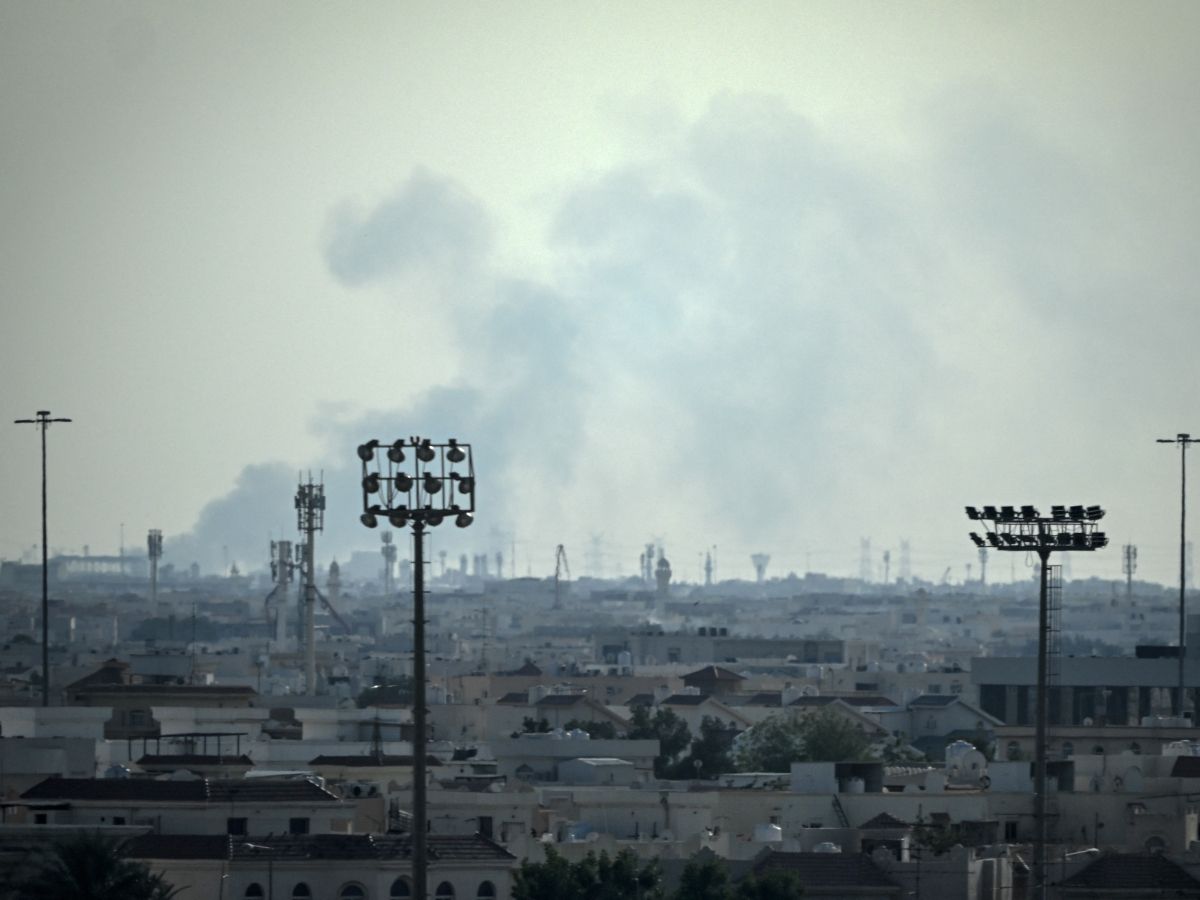
Smoke rises from an area in the direction of Al Udeid Air Base, which houses the Qatar Emiri Air Force and foreign forces including the U.S., in Doha on Feb. 28, following a reported Iranian strike.

Although Canada officially refused to join the United States’ springtime war against Iran, new information suggests that Canadian personnel indirectly assisted the campaign while embedded with American forces. This is nothing to be ashamed of. If anything, Ottawa’s support should have been more fulsome, consistent and overt.

When American bombs began to pummel the Islamic Republic of Iran in March, Prime Minister Mark Carney denounced the campaign as “inconsistent with international law,” and claimed that Canada was “not a party to those actions.”

However, Ottawa and Washington have a longstanding policy of exchanging service members to enhance allied cohesion and intelligence sharing. Through this integration, Canadian personnel have occasionally fought in conflicts that Ottawa is officially uninvolved with — most notably the 2003 Iraq War .

This spring, a handful of media reports suggested that some of these American-embedded Canadians might have been involved in the Iran war. A former senior Canadian general, Denis Thompson, even told the CBC that it was highly likely that some of these personnel helped plan airstrikes against the Islamic Republic.

In response, the Department of National Defence (DND) claimed that American-embedded Canadian service members had been assigned other duties that would keep them out of the conflict, despite otherwise remaining at their posts.

We now know that this statement, even if technically true, was somewhat misleading.

Late last month, the Government of Canada announced it would be awarding a Meritorious Service Cross to Col. David K. Turenne for his “extraordinary leadership and diplomatic skill as director of the Combined Air Operations Center during the Israel-Iran conflict.” He was specifically commended for “synchronizing multinational air operations and enabling the safe evacuation of 10,000 personnel from the Al Udeid Air Base, Doha, Qatar, June 2025.”

The medal, according to its official description, recognizes military deeds “performed in an outstandingly professional manner, according to a rare high standard that brings considerable benefit or great honour to the Canadian Forces.”

This is the first public acknowledgement of Turenne’s involvement in the Israel-Iran conflict, although few details of his service are known. When National Post requested more information on what he did to earn his medal, DND failed to provide it and claimed that an interview with him would not be feasible.

To be clear: while Turenne’s award confirms that he was involved in last year’s 12-Day War, no evidence suggests he was involved in this year’s expanded campaign against Iran. His actions do not appear to have contradicted Carney’s claim that American-embedded service members were kept out of the ongoing conflict.

Still, the award illustrates how Canadian talent helped set the stage for the current war, which, in turn, complicates Carney’s moral and political stance.

To understand why this is the case, one needs to understand the significance of the Combined Air Operations Center (CAOC), which Turenne directed from June to December of 2025.

The CAOC is the U.S. air force’s “nerve centre” in the Middle East. Originally established in Saudi Arabia during the Gulf War, in 2003 the centre was relocated to the Al Udeid Air Base in Qatar, where it stayed put for roughly two decades as an anchor of America’s regional power.

However, for some time, American military leaders have feared that the base, being located beside Iran, was highly vulnerable to the Islamic Republic’s ballistic missile strikes. So they started shifting operations to a base in South Carolina, gradually moving personnel there and operating the two locations in parallel.

These precautions proved prudent. Just before last year’s 12-Day War, the CAOC, under the directorship of Turenne, moved its personnel to South Carolina while maintaining regular operations. Al Udeid, meanwhile, was partially evacuated . When hostilities broke out, Iran launched 14 missiles at the base — one got through and inflicted minor damage , prompting a full evacuation of remaining personnel.

Having learned from this experience, the United States once again evacuated a significant portion of its personnel — including all of the CAOC — from Al Udeid Air Base in January. As predicted, the Iranians subsequently struck the base with ballistic missiles, severely damaging the CAOC’s facilities and rendering them inoperable. The attack had little effect on American co-ordination, though, thanks to the duplicate South Carolina location.

Taking all of this together, it’s clear that, even though Turenne was not directly involved in the join U.S. and Israeli strikes on Iran, his leadership helped set the stage for the campaign. Not only did he direct the United States’ most crucial “nerve centre” during the 12-Day War, his successful management of the 2025 Al Udeid evacuations likely provided invaluable lessons for this year’s campaign.

While some might want to compartmentalize these two waves of conflict, they are militarily, politically and morally inextricable from one another.

In this light, Carney’s denunciations of the war, and his emphasis on Canada’s non-involvement, ring hollow. Canada cannot publicly condemn the United States and Israel’s pre-emptive wars against Iran while quietly honouring a Canadian colonel for aiding their execution.

Rather than downplaying Turenne’s extraordinary work, the correct position for the Canadian government would have been to publicly laud him, and to use his story to show Canadians that crippling the Islamic Republic is the morally correct thing to do. There is no reason to be ashamed of our heroes, and no reason to be ashamed of any efforts to thwart the Islamic Republic.

National Post


Vienna Pedatella and her mother, Janene, who never misses an opportunity to express how proud she is of her daughter's grace and resilience. Used with permission.

Imagine your child is diagnosed with idiopathic scoliosis, a curved spine, just days after her thirteenth birthday. Over the next several months, she wears a brace religiously to see if it will correct the curve, but the bend just keeps getting worse. You watch helplessly as your daughter gives up on sports and becomes increasingly self-conscious about her appearance. You get on the waitlist for surgery, and you wait. And wait. And wait.

After two years, you can’t wait any longer. The curve is now so bad that it’s painful, causing lost sleep and threatening organs. Desperate for relief, you take your daughter to the United States to get the surgery. It’s available there right away. Within weeks, your daughter is cured. She’s back to normal just in time for her last year of high school. But you’re left with a life-altering $200,000 bill. Should the province pick up the tab?

We think so. That’s why we’re supporting Vienna Pedetella’s lawsuit against the province that failed to provide the surgery and denied funding to get the surgery abroad.

Canada controls the supply of health care like no other country in the western world, effectively banning private care while rationing the number of doctors, nurses and operating rooms. The stated purpose of this monopoly, outlined in the Canada Health Act, is to “provide reasonable access to health services without financial or other barriers.”

The results are less than ideal. While few of us end up with medical bills that could bankrupt us, we rank far behind the U.S. on access to care, and seventh out of 10 wealthy countries in overall performance. This is behind Australia, France, Netherlands, New Zealand, Sweden and the United Kingdom.

Timely access to pediatric scoliosis surgery is an example of how the system is failing us. The Conference Board of Canada reported in 2023 that four in 10 pediatric spinal surgeries were performed after the recommended clinical timeframe of six months. When waitlists get this long, they may violate Charter rights.

Section 7 of the Charter guarantees that “everyone has the right to life, liberty and security of the person and the right not to be deprived thereof except in accordance with the principles of fundamental justice.” Liberty has been recognized as protecting fundamental life choices including making medical decisions, but patients often don’t have meaningful access to those decisions in Canada. Life is protected from state-imposed increased risks in death. Security of the person, meanwhile, protects Canadians from physical or serious psychological suffering.

The Supreme Court recognized in the 2005 decision Chaoulli v. Quebec that when governments block patients from accessing care in a timely fashion, that can violate section 7. In that decision, even those judges who found that patients’ rights were not violated by Quebec’s laws agreed their rights would have been infringed upon had there not been a Quebec policy of sending patients abroad when Canada cannot provide care in time.

Yet, more than two decades after Chaoulli’s warning, patients across Canada continue to suffer on waiting lists while being denied out-of-country care, just like Vienna was. In her case, Alberta’s Out-of-Country Care Committee suggested she should just keep waiting for surgery after more than two years, rather than paying for the surgery in the U.S. and asking for reimbursement from the public system.

To Alberta’s credit, the province is already taking steps to improve efficiency, expand chartered surgical facilities, increase funding and allow dual practice so that surgeons who cannot find space to operate in public facilities will be able to take some patients privately. This strategy is a good start that should reduce the number of patients waiting in both the public and private systems, while attracting new doctors and nurses.

But all provinces, including Alberta, need to move faster. Patients simply cannot wait any longer. The deal Canadians made when they gave up autonomy over their health care was that the public system would be there when they needed it. No government in Canada has upheld their end of the deal. If provinces cannot provide surgeries on time within their borders, then they have a responsibility to pay to send patients abroad.

National Post

Josh Dehaas is interim litigation director with the Canadian Constitution Foundation, which is supporting the Pedetella’s lawsuit against the Out-of-Country Health Services Committee. Learn more at TheCCF.ca/kids-cant-afford-to-wait/.


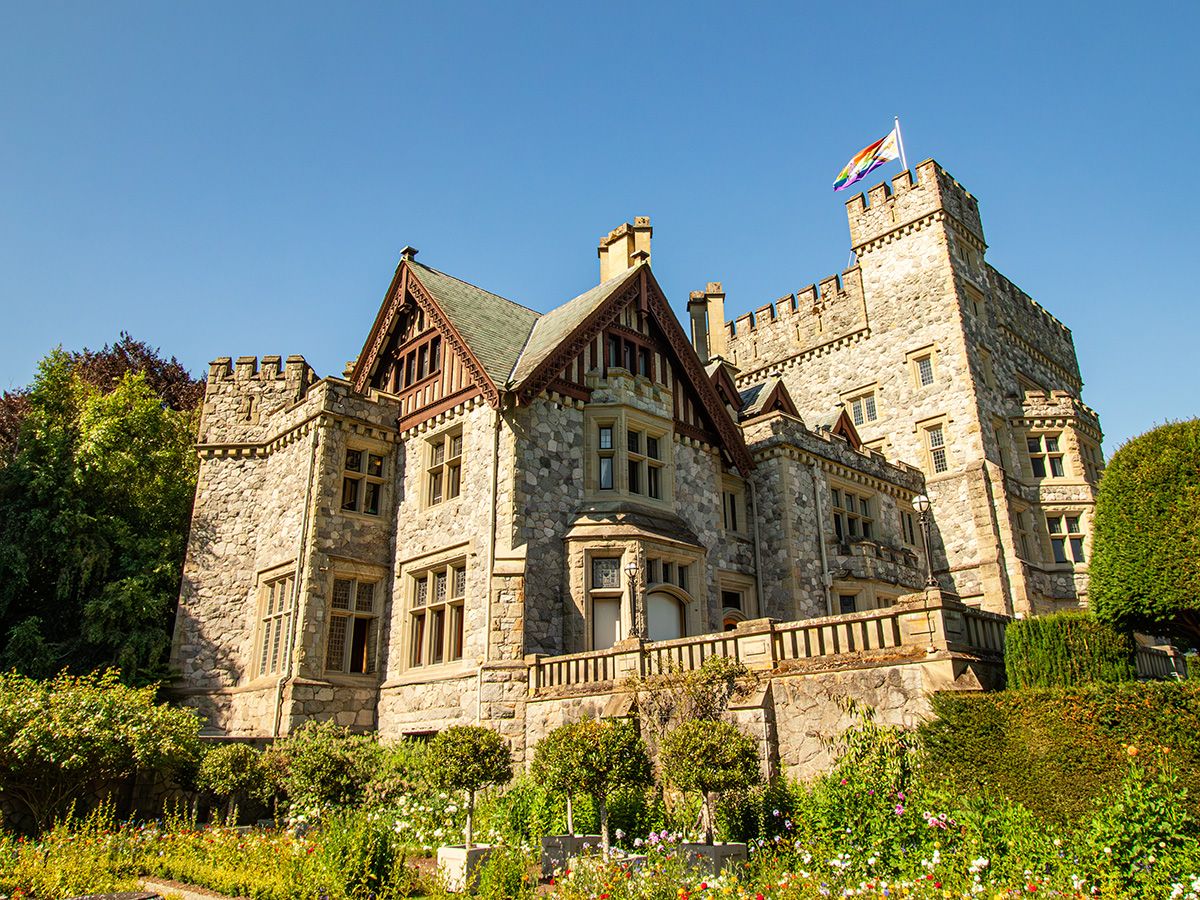
Hatle Castle in Colwood, B.C.

An internal B.C. document has revealed the extent of the province’s plans to cede more than 120,000 hectares of Crown land to First Nations control, including prominent landmarks around the provincial capital of Victoria.

The total proposed cessions are more than twice the size of the City of Toronto, or 300 times the size of Vancouver’s Stanley Park. What’s more, they would all become “treaty lands”; a special territorial designation that is not subject to local zoning controls.

In the case of Victoria, this means that some of the most prime development land in the city could become Indigenous-controlled properties exempted from local bylaws, approvals and building codes.

“Local government bylaws do not apply on treaty lands,” reads a May 2024 consultation paper published by the B.C. government.

That same document warns that the land transfers may “take some getting used to,” as they cover public lands that could end up sealed off from public access.

“Once those lands become treaty lands, there may be limited access or even no access for public use,” it reads.

The planned land cessions are included in the most recent edition of B.C.’s Public Accounts, published each year by the Ministry of Finance.

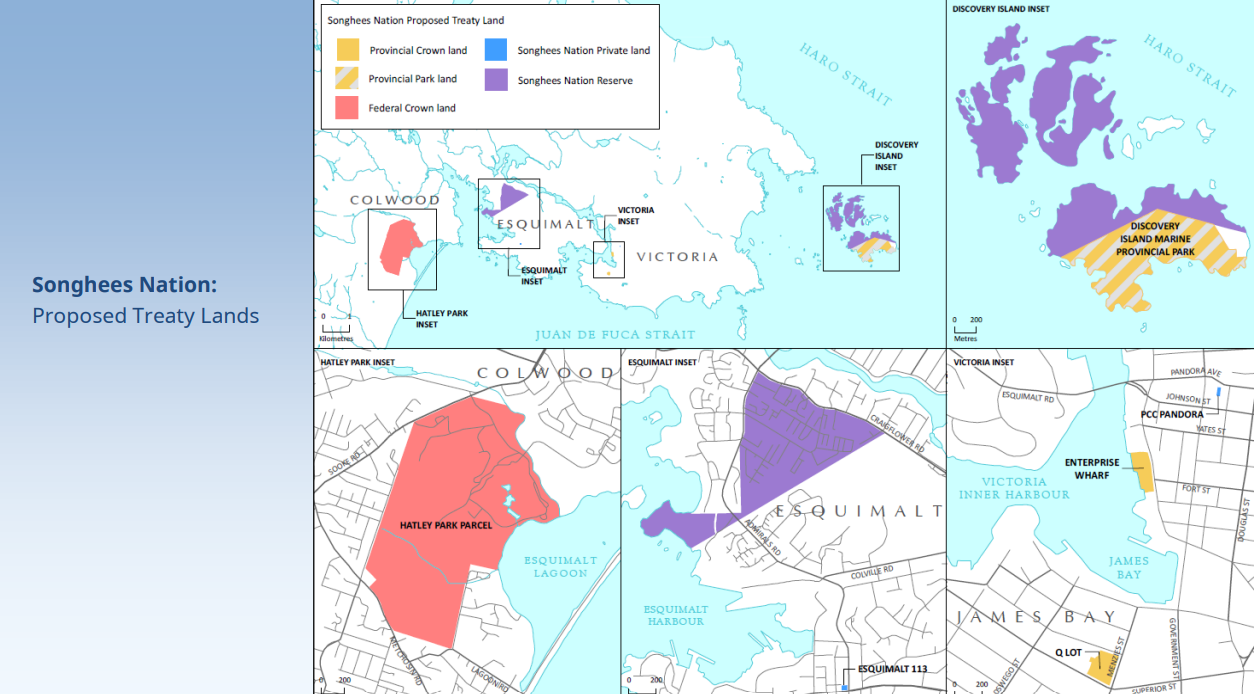
 Proposed Songhees land cessions as part of the Te’mexw Treaty Association negotiations.

The document itemizes 20 planned land transfers to First Nations as “contingent liabilities and contractural obligations.”

The proposed cessions are part of modern treaty negotiations that stretch back to the 1990s in some cases, but the Public Accounts show that the lands are now officially on the books as government liabilities.

One B.C. government outline on modern treaties, published in 2023, explained that one of their primary goals is to “return lands to First Nations.”

The largest of the itemized cessions is 35,290 hectares earmarked for the Kitselas First Nation and 45,789 hectares for the Kitsumkalum First Nation. Both are located near Terrace, B.C., and comprise a total membership of about 1,500 people.

In many of the transfers, First Nations stand to receive territory well beyond the size of their existing reserve lands. And, unlike reserve lands, these would effectively be held as fee-simple territories.

Among the most valuable cessions is the 1,916.7 hectares set aside for the Te’mexw Treaty Association, a coalition of five First Nations on Southern Vancouver Island.

One of the more notable properties within the Te’mexw package is Hatley Castle, the 1908 Colwood estate best known for its role in the X-Men film franchise.

Built by the Dunsmuir coal mining family, the property first entered public ownership in 1940, possibly as part of a Canadian contingency scheme to house the exiled royal family in case of a Nazi conquest of the U.K.

Under terms being negotiated by the B.C. government, it would become a fee-simple possession of the 600-member Songhees First Nation.

The Songhees would also take possession of two parcels of land in Downtown Victoria, including a parking lot across from the B.C. Parliament Buildings with an assessed value of $24.8 million, and a nearby waterfront parking lot assessed at $22.3 million .

As treaty lands, both parcels could be developed without city council oversight. A good analogue being the recently completed Sen̓áḵw development in Vancouver; a compound of skyscrapers comprising 6,000 rental units that was able to exceed the usual local controls on density due its being located on Songhees First Nation land.

In a statement reacting to the Public Accounts, the opposition B.C. Conservatives said that the itemized transfers are a small fraction of the total land cessions under consideration by the government of Premier David Eby, and that the final figure could be in excess of 9.6 million hectares – about 10 per cent of the total province.

“There will be nothing left of B.C. by the time the NDP are finished with their plan to giveaway land that rightfully belongs to the people of British Columbia,” wrote B.C. Conservative Leader Kerry-Lynne Findlay in a Monday social media post .

Ironically, B.C. First Nations governments are set to receive 120,000 hectares of fee-simple lands at the precise moment that the status of B.C.’s other fee-simple lands have been thrown into uncertainty.

Last year, the B.C. Supreme Court ruled in Cowichan Tribes v. Canada that Aboriginal title took precedent over all other land rights in B.C. Although the case is pending appeal, the immediate effect of the decision was to effectively transfer large swaths of privately owned land in Richmond, B.C., to the control of the Cowichan First Nation.

All the 120,000 hectares mentioned in the Public Accounts comprise Crown and other government-owned lands, and private property is not covered by any proposed modern treaty cessions.


Victor Montagliani, President of CONCACAF, looks on prior to the MLS match between Vancouver Whitecaps FC and Los Angeles Football Club at BC Place on Aug. 1, 2026 in Vancouver. This content is reserved for subscribers.
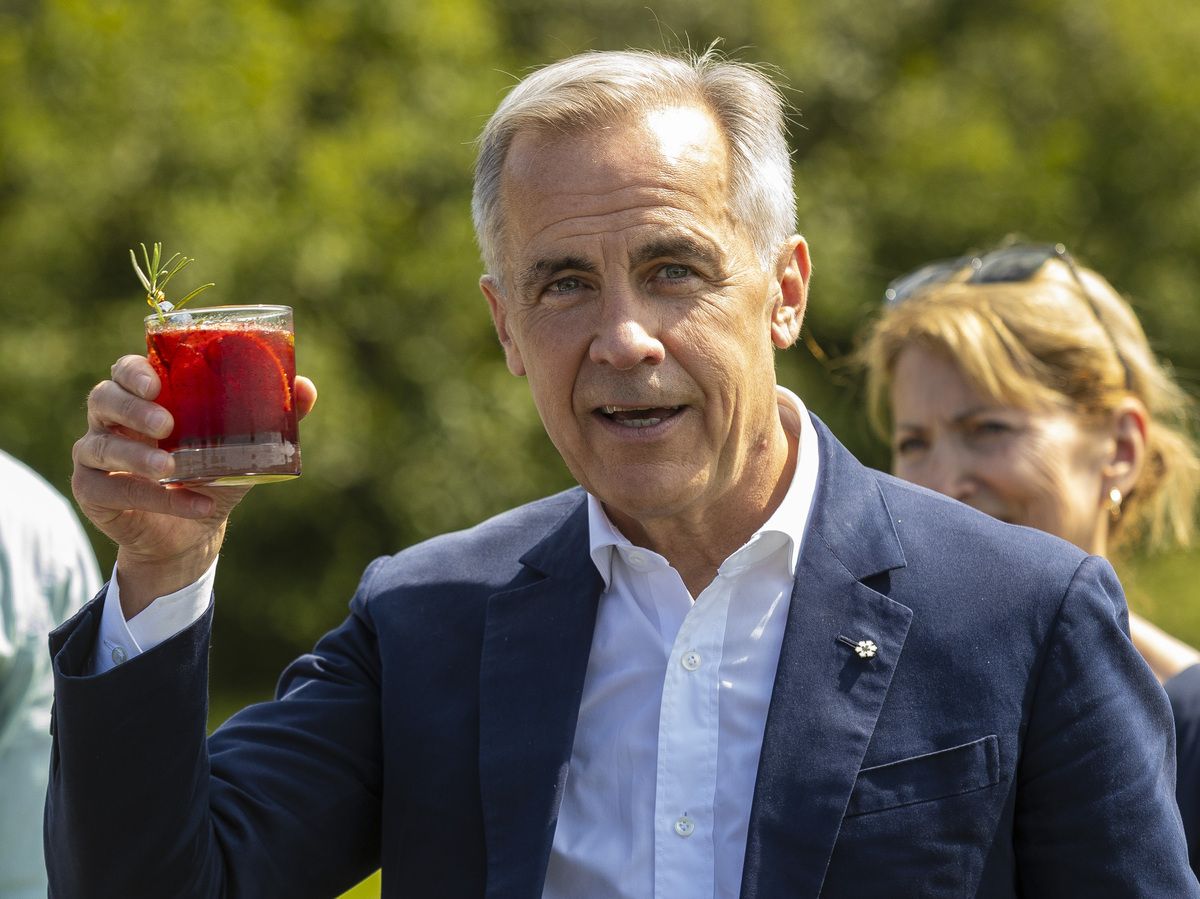


Prime Minister Mark Carney drinks a local beverage during a visit to a small fruit farm in Saguenay, Quebec, on Aug. 6, 2026. He's currently in Tuscany.

The Carneys are living their best vacation lives in Tuscany . And back home, some of us are again debating a prime minister’s vacation choices. Or not so much debating as, mostly, kvetching, in roughly equal parts about the vacation itself and about anyone who would be so gauche and unworldly as to question the vacation. “Lots of Canadians go to Caribbean all-inclusives, right? So why shouldn’t the PM go to Tuscany?”

Tellingly, that sort of absurd comparison — we’re all prime minister, really; Tuscany isn’t much different than that 2.5-star resort in Punta Cana you saw on the Air Transat package-vacations website — is the only card most “none of our business” people know how to play. “Oh, so you think the PM and his wife should dress in sackcloth, don crowns of thorns, and camp out on East Hastings?”

If you genuinely don’t care, that’s fine. We certainly have bigger fish to fry, and there’s only so much room in the national fryolator. But this is self-evidently our business, and no one should apologize for thinking so.

We pay for it, first of all. There’s no official hourly cost for getting one of the Challenger jets into the air, but various reports suggest it’sat least pushing $10,000 . (PMs using the jets on vacation, which we are constantlytold they mustbecause of security concerns , owe the treasury the commercial value of the equivalent economy-class tickets. That would be around $4,300 per passenger on Air Canada to and from Rome, last-minute in August, or around $2,700 on Air Transat.)

Secondly, the federal government regulates Canada’s sclerotic, despised airline industry, among other things forbidding foreign-carrier competition on domestic routes. The transport minister never has to put up with anything less than commercial business class. As long as ministers are in office they’ll never have to worry about “air-passenger rights,” which no doubt partly explains why Canadian air passengers enjoy far fewer rights (to compensation, rebooking on other airlines, hotel rooms, etc.) than Americans, Europeans or Brits.

That’s not because Air Canada and WestJet donate lavishly to political parties, which would be illegal. It’s just to keep all the toy soldiers in the Laurentian sandbox fat and happy in the bar at the Château Laurier: MPs, ministers and would-be ministers, lobbyists, strategists, consultants and unidentified appetizer-grazers. For that reason alone, we should insist the PM endure commercial air travel on personal business. And in economy.

I absolutely loathe the idea, often heard in Canada, that “G7 leaders can’t fly commercial.” It speaks to the hermetically sealed box inside which most Canadian political thinking occurs. And to my ears all it really means is, “I am someone who likes to pretend that Canada and its prime minister are much more important than they actually are.”

Keir Starmer flew commercial to Madeira for a family vacation in 2024. Boris Johnson flew commercial to Slovenia for his (latest) honeymoon in 2022, and later that year British Airways to the Dominican Republic, with wife and baby along (in economy). Theresa May flew commercial on her various hiking holidays in Switzerland and Italy. David Cameron’s vacations in office included flying low-cost carriers EasyJet, Ryanair and Vueling, two of which aren’t even British and none of which has ever heard of business class. (Indeed, Ryanair’s brilliantly funny social media team would mock the very idea.)

The United Kingdom has nuclear weapons: somewhere between 200 and 260 warheads . Ten Downing Street matters in a global crisis. Yet the British PM can spend a few hours aloft, completely incommunicado. (Ryanair’s social media team would probably mock the idea of inflight Wi-Fi as well.)

When a global crisis blows up, no one ever asks, “hold the phone, where’s the Canadian delegation?” The Canadian PM could be on the moon or 20,000 leagues under the sea, for all anyone would care. But no, no, he mustn’t ever fly commercial. The RCMP says so, and they are certainly a disinterested party.

British PMs are routinely criticized for not simply vacationing in Britain, of course, which is also very healthy. It’s hardly a job for life. Before Tony Blair and Margaret Thatcher, the last person to spend more than 10 years as prime minister in a single stretch retired 99 years ago. Once you’re done, you can go anywhere you like, no questions asked. Meanwhile your job comes with a splendid, secluded summer home you’ll never have access to again: Harrington Lake here in Canada, Chequers in Britain. Use it, maybe?

Indeed, I also loathe the idea that Canada somehow isn’t worth spending time in, in August no less. Canada sparkles in August, coast to coast to coast. Carney hasn’t spent all that much time here lately. Maybe use your private-jet privileges to refamiliarize yourself!

Among the biggest problems for normal folks, obviously, is the cost of summer-vacationing in Canada relative to abroad. As of this summer, Air Transat flies to Albania, where a decent hotel room is $20 and a donkey ride is $5, and you get to keep the donkey. I exaggerate. It’s a fascinating country, a bit odd, littered with the ruins of ancient empires, with great seafood, friendly and helpful locals. And like most of the Balkans, it’s cheaper than sausages.

Or I could fly my hypothetical Toronto family of four to and from Vancouver for five nights over Labour Day weekend, without any checked bags, for nearly $5,000. And then pay nearly $3,000 for one room at a Quality Inn. And then, I don’t know, I guess we just have cool ranch Doritos for dinner.

That’s a serious national-unity issue. It would be nice if our economist PM had some ideas about how we might address it, rather than a bottle of Brunello on the go on a picnic blanket under a cypress tree.

National Post
cselley@postmedia.com