


LP_468x60
on-the-record-468x60-white

FILE - Democratic mayoral candidate Zohran Mamdani arrives at House of Justice for National Action Network's Saturday action rally in Harlem, Saturday, June 28, 2025, in New York. (AP Photo/Yuki Iwamura, File)

American politics often seem to balance themselves out in the worst possible way. Even as the GOP

sheds its last vestiges of affection for limited government and free markets

, the opposition Democrats openly embrace bigotry and crazy economic nostrums. Case in point: the rise in New York City of Zohran Mamdani, an avowed socialist who flirts with antisemitism, to represent the Democratic Party in this year’s mayoral election.

The primary race in New York was a snapshot of the Democratic Party’s woes. Despite the presence of other candidates seeking the mayoral nomination, the race ultimately came down to two candidates: Mamdani and Andrew Cuomo, the disgraced former governor of New York.

Before resigning over

allegations of sexual harassment

, Cuomo, the 67-year-old son of another former governor, was best known for a “controversial directive that told nursing homes they couldn’t deny patients coming from hospitals admission based on a COVID-19 diagnosis,”

according

to StatNews. He then covered up the large number of ensuing deaths. He was the favoured candidate of the Democratic establishment and the early front-runner for the nomination.

Standing out from the pack of political hopefuls facing Cuomo was Zohran Mamdani, the 34-year-old son of an Oscar-nominated filmmaker and a Columbia University political science professor. Before being elected to the state legislature as a Democrat and a socialist, Mamdani tried his hand as a government employee and a rapper. His musical output included the song “Salaam,” which, as The Independent

put it

, “praised the ‘Holy Land Five’ — five men convicted in 2008 of donating over $12 million to Hamas.“

To say that New Yorkers are tired of Cuomo is a wild understatement. Like most Americans, New Yorkers are deeply sick of the old party establishment that rallied around Cuomo as well as the man himself. Yet, he was expected to walk away with the nomination and then cruise to victory in a largely one-party city.

But Mamdani sweetened the pot in the expensive metropolis with

promises

to freeze rent, make buses free, offer no-cost childcare, lower grocery prices with city-owned grocery stores, and use “public dollars” to build 200,000 apartments. He swears that he “knows exactly how to pay for it, too” with higher taxes on those making more than $1 million per year. Not explicitly part of his campaign, but

on the record

as his intention, is “the end goal of seizing the means of production.”

In the 2021 recording in which he advocated seizing the means of production, Mamdani endorsed BDS as an issue “that we firmly believe in.” The BDS movement — shorthand for “

Boycott, Divestment, and Sanctions”

— aims to economically pressure Israel into withdrawing from so-called “occupied territories” and allowing Palestinians to settle throughout Israel. At its extremes, BDS seeks to eliminate the world’s only Jewish-majority state. It’s inspired by the movement against South Africa’s old apartheid regime.

In his

formal response

as a New York State Assemblyman to Hamas’s bloody October 7 attack on Israel, Mamdani commented: “the path toward a just and lasting peace can only begin by ending the occupation and dismantling apartheid.” He also frequently accuses Israel of engaging in “

genocide

” in its response to Hamas and

refuses to condemn

calls to “globalize the intifada” which many view as targeting Jews outside Israel with attacks such as we’ve seen in

Boulder

,

Montreal

, and

Washington, D.C

.

New York Democrats ate this stuff up and, in an upset,

gave Mamdani their party’s nomination

.

In an

analysis of voting data

, Bloomberg found that — contrary to socialists’ claims of representing the working class — Mamdani’s votes were concentrated at the higher end of the income spectrum. He edged out Cuomo for the votes of those making more than $150 thousand per year and romped to victory among middle-class voters who earn between $50 thousand and $150 thousand per year. “The former governor, however, outperformed Mamdani in low-income neighborhoods by a 13-point margin.”

Cost of living is a major concern for New York City residents,

topping issues in polls

. The wealthy can insulate themselves from the problem and the poor have programs that ease their burdens. That leaves middle-income voters — especially renters — as the most anxious in a pricey city. “High costs of living are pushing middle-income families out of New York City,”

commented

the Bloomberg analysts.

That’s true, but socialist math doesn’t add up in any way that will lower the cost of living. A New York University Stern School of Business

annual survey

shows a net profit margin of 1.97 per cent for retail grocery stores. Mamdani’s city-owned grocery stores aren’t going to squeeze a lot of savings out of that — especially given the sad history of government-owned businesses, and

especially grocery stores

.

Mamdani doesn’t help his case when he bases his proposal for funding the grocery scheme on a misreading of the city’s books. Mamdani’s plan assumes the city is subsidizing private grocery stores with $140 million that he wants to divert to socialist markets. But as the Washington Examiner’s Timothy Carney

points out

, “Mamdani is counting the $140 million in private spending as government spending.”

Mamdani’s rent freeze also runs into math problems. New York City already

limits rent increases

for many units, and

its famous bureaucracy

puts barriers in the way of constructing more. A rent freeze would

further reduce incentives

to build housing — or even to maintain existing stock.

“It’s regulation on top of regulation, rather than addressing the root cause of housing undersupply and just making it easier to build housing of all types at all price points,” Emily Hamilton, director of the Urbanity Project at George Mason University’s Mercatus Center,

commented

.

Mamdani also forgets that the wealthy people he wants to tax the hardest are the most mobile. Put the screws to them and they can choose to keep their money in Florida —

already a popular destination

.

But all of that is for New Yorkers to consider as they decide who to put in the mayor’s office — and to confirm as the new face of the Democratic Party. A young-ish socialist who dislikes Israel and is iffy about his opinion of Jews in general is a dangerous bet in a country where

socialism remains unpopular

with the majority and

most Americans are concerned about antisemitism

.

Scandal-ridden incumbent Mayor Eric Adams remains on the ballot as an independent, as do Andrew Cuomo and former prosecutor Jim Walden. They’re joined by Republican Curtis Sliwa. But NYC is a Democratic town, and Zohran Mamdani is favoured to win.

National Post


In this courtroom sketch, flanked by defense attorneys Teny Geragos, left, and Brian Steel, right, Sean

There is little question that Diddy — the mono-monikered rapper and producer whose trial for sex crimes concluded in New York yesterday — is a violent and despicable man. One look, which is all any decent person can stomach, at the

2016 video of him assaulting his then-girlfriend

Cassie Ventura and Diddy’s innate odiousness becomes impossible to deny.

But the trial of Sean “Diddy” Combs wasn’t merely about determining whether the man was distasteful or deplorable — but whether he had broken the law. And which laws, exactly? A jury found him guilty on two lesser charges related to prostitution, but failed to convict him on the far more serious allegations of sex trafficking which could have sent Combs to prison for life. Instead,

say sentencing experts

, he will probably serve just a handful of years behind bars — possibly even less — most likely at some sort of minimum-security facility, much like convicted securities felon Martha Stewart more than two decades ago.

Of course, Diddy is no Martha Stewart, the goddess of expertly curated elevated living who has managed to remain relevant for nearly half a century through shrewd business moves, cleverly-calculated reinvention and sheer hard work.

Diddy, too, has been a master of reinvention, literally renaming himself — from Sean to Puffy to P. Diddy and finally just Diddy — as he aged out of conventional pop culture coolness. But this is where the similarities to Stewart end. As his trial so luridly detailed, every stage of Diddy’s public persona masked a parallel existence laden with the most extreme intersections of sex, drugs, money and often violence. Fueled by power and wealth — and the impunity both afford without measure — Diddy raped and beat, and bought libidinous satisfaction with craven disregard for compassion or consequence.

But again, we know all this — we’ve known it for years. After all, Diddy’s crime-adjacent rap sheet is decades long; remember the infamous New York City nightclub shooting during

his Jennifer Lopez-period back in 1999

. Lopez, then equally shrewd and famous, summarily dropped Diddy after the gun shots quieted — one of the few lucky enough to escape his orbit.

But as Diddy’s acquittal of the most severe charge illustrates, a lack of luck isn’t necessarily criminal. Particularly when so much of Diddy’s deviousness was known for so long — and by so many. The botched —

or at least bungled

— trial of Diddy confirms yet again that you can’t litigate morality and good behavior. Or in this case, a clear lack of both.

This was essentially what the #metoo movement tried to accomplish — a very public reckoning of often very private misdeeds. And as we saw this week in a Manhattan courtroom, yet again such efforts have failed. True, Harvey Weinstein — #metoo’s most-infamous predator — remains behind bars, as he should, for life. But nearly 20 years after it first entered the public consciousness, the Diddy trial could mark the end of #metoo, or at least its ability to manifest in the courtroom.

So much of the Diddy trial focused on the performer’s distinct sexual depravity — most notably those lotion-filled “freak-offs” described in nauseating ad nauseam. But this was a case

equally defined by a pathological consumption of drugs

. Indeed, as the proceedings revealed, Diddy had a constant supply of narcotics on hand: marijuana, ecstasy, Klonopin — which he fed to girlfriends like Cassie and their revolving door of hired and acquired paramours.

Drugs complicate, well, everything and they complicated the Diddy case even as they took a backseat to sex. So much of the proceedings — along with the roots of #metoo —

were wrapped up in consent

, and nothing warps consent more than days-long binges of narcotics. This helps explain why Combs was exonerated on the most serious charges of “sex trafficking” and racketeering conspiracy. His defense claimed the debauchery — the freak offs — were merely amped-up versions of old-fashioned swingerism, set — much like with Weinstein — against a backdrop of luxury yachts and five star hotels.

Despite observers who insist there

can never be consent when abuse is involved

, Diddy’s lawyers reiterated that consent was ever-present and implied. Folks freaked-off because they were being loved or paid — whether in cash or via career boost. Such combustible overlaps shadow many of the highest-profile #metoo-styled cases, which is why so few of them have resulted in actual jail time. Indeed, Weinstein is a rare movement outlier — imprisoned likely for life when men like Kevin Spacey, Matt Lauer and Charlie Rose merely languish behind the bars of ruinous disgrace and irrelevance.

Such a future is unlikely to await Diddy, who as the

New York Post

noted on Wednesday could

emerge from the trial as a “martyr.”

And why not (besides his clear cravenness)? In the near year since his arrest, article after article has appeared detailing some former friend, colleague, or interviewer recounting Diddy’s alleged sexism or

hypocrisy

or

penchant for violence

.

Yet besides Cassie, almost no one stepped forward. Many, as in many other #metoo cases, claimed fear — of his power, his proximity to guns and those who use them. Only Shyne, the Belize-born rapper who served nearly a decade in jail for that infamous 1999 nightclub shooting,

had the guts to speak out

. And perhaps only because he is now back in Belize serving as the Opposition Leader of its House of Representatives.

As they say on billboards across New York City’s subway system — “if you see something — say something.” But when it came to Sean “Diddy” Combs, almost no one said anything. For years, decades even. And the results speak for themselves: Diddy is likely to walk free, exonerated by a soft-on-crime New York City judicial system failing their soft-on-crime citizens.

Social justice movements like #metoo are rooted in accountability — particularly from the alleged perpetrators. But accountability also extends to those who remained silent — or stoned or paid — at the sidelines. Because without their willingness to also demand justice, the actual justice system can only go so far. As Diddy prepares for likely bail and, ultimately, release, his trial may not officially kill #metoo off. But its already dwindling momentum is unlikely to ever recover.

David Christopher Kaufman is a columnist and editor at the New York Post.

National Post


Mark Carney, Prime Minister of Canada, addresses the crowd during the Canada Day festivities in Ottawa in the nation’s capital on July 01, 2025.
Photo by Jean Levac/Ottawa Citizen

One funny thing about the “elbows up!” slogan of the New Canadian Nationalism is that in real life it’s pretty hard to hit yourself with your own elbow. But in the actual policy sphere, most of what we might do to put our elbows up against the United States involves self-harm or, at a minimum, self-denial.

On Sunday the Department of Finance issued a terse circular announcing that the Digital Services Tax announced in 2021 would not, as originally planned, begin to be collected on Monday. The DST (R.I.P.) was designed to exclusively target Canadian revenues of American “web giants” that provide online services, advertising, or streaming content.

As the Finance memo observes

, it is being dropped at the last minute in the hope of restarting negotiations with the U.S. on an updated version of continental free trade.

The idea of a DST was framed by the Trudeau government as a moral necessity of the 21st century: something had to be done about foreign vampires like Netflix and Google which had built businesses with millions of Canadian customers out of digital ether, but paid no tax in Canada. Everybody recognized, however, that much of the cost of the tax was bound to come out of the pockets of the customers rather than the vampires.

It’s inherently difficult to know how the tax incidence would have worked out, because the process of digital price discovery isn’t especially mature: some of these companies are still figuring out their own optimum, revenue-maximizing price points in plain sight. But from a selfish point of view, Canadian consumers, considered strictly as such, can only feel relief at the sudden abandonment of the DST.

Is this a craven surrender on the part of the post-Trudeau Liberals? Well, this is the problem with interpreting everything in brute terms of animalistic personal combat, isn’t it? The governments of the developed nations largely agree (perhaps against the interests of their own citizens) that there ought to be an international framework for digital-services taxation, and the OECD reached an agreement that nobody would run wild and introduce their own digital taxes until the issue could be sorted out collectively.

From that neoliberal-nerd point of view, Canada went rogue when it announced a homebrewed DST — one that would have had a nasty retroactive effect, that was designed specifically only to collect from large American companies with recognizable names, and that didn’t address double-taxation issues. And let’s recall that Joe Biden was still president when this happened.

It’s worth noting that this isn’t just a question of playing chess against Donald Trump. Canada was really forced to withdraw the DST by the terms of the Trump-designed One Big Beautiful Bill passed by the U.S. House of Representatives in May, and now before the Senate. The OBBB reflects the fact that there’s genuine bipartisan distaste in the U.S. toward the digital taxes hypothecated by Canada and already in effect in some other countries; it allows for 

tax-withholding countermeasures against countries that impose “unfair” taxes on U.S. digital companies

, countermeasures whose size could easily have dwarfed the relatively meagre revenues from the DST. In other words, if the government hadn’t pulled the plug on the DST, we might have quickly found out how a one-armed man does in a battle of elbows.

National Post


Union workers rally for David Huerta, the president of Service Employees International Union California, who was arrested during a Los Angeles protest, on Monday, June 9, 2025, in San Francisco. (AP Photo/Noah Berger)

The

recent riots

in Los Angeles, sparked by President Trump’s crackdown on undocumented immigrants, could be a harbinger to a new era of ethnic conflict not only in the U.S. but throughout the West, including Canada.

Many

leading countries for immigrants

, notably in the Middle East, may have higher percentages of international migrants, but many are only there temporarily. But in Canada, Australia, and the U.S. — where the foreign born

represent between 15 and 30 per cent of the total population

— most come to stay, with sometimes problematic results.

President Joe Biden changed immigration policies, allowing millions, some barely vetted, to enter at ever increasing rates, causing the number of undocumented immigrants

to soar past 11 million.

Until recently, former Canadian prime minister Justin Trudeau followed a similar liberalization that allowed large numbers of migrants, some coming as refugees, into the country

In both countries, the mass migration has deepened already serious class divides as many new migrants remain poor. In Canada,

one in five recent immigrants

now lives in poverty, with most suffering from “deep poverty” — an income below 75 per cent of the poverty line — compared to only

five per cent

of the whole population.

Such complexities are rarely part of the public discussion of immigration. In the U.S. legacy media spin on the crackdown focuses on

the abuses and often ham handed approach

used by the Trump administration in working class Latino communities. Stories of individual cases of respectable and upright families targeted by the crackdown predominate, stirring up ever more fear of a racist, even “fascist” crackdown on minorities.

In contrast, the MAGA view focuses on criminal migrants and radical demonstrators, some of whom have engaged in violence. The images of young protesters waving Mexican flags is offensive to many American citizens, even in California. For MAGA, the crackdown represents both a return to legality as well as a defence from hostile elements.

Both views largely ignore a more complex, and often contradictory reality. Historically, as immigrant advocates rightly claim, the migration of peoples have been critical to the economic health, and cultural dynamism, of countries such as the United States, Canada, Australia, the United Kingdom, and France.

Guest workers, for example, played a critical role in the revival of Europe’s economies, and steady immigration sparked growth in Canada, the U.S. and Australia. Yet as immigration levels have soared, the economic payoffs seem to be increasingly dubious, particularly when we put into account the changing structure of the labour market.

The reality is that immigrants are not only filling in for jobs with no workers, but are replacing native born workers who are increasingly on the sidelines. In much of Europe up to one

quarter to one-third

of the population under 30 is neither in school or working.

In the U.K.

one out of seven under 25 is on the economic sidelines, the highest level in a decade.

Much the same pattern is emerging in North America. In the

U.S., labour participation

has steadily dropped since 2000. More American men are now out of the workforce than in

a half century

. Canada too has a

declining labour participation

rate, which is now at the lowest level since 1997 .

These two phenomena — immigrant poverty and native non-participation — likely intersect. The immigrant’s presence at the lower end of the labour market does

tend to retard wage growth

, as noted by

a recent Congressional study

, and could discourage natives from work. This  may be a boon for professionals for cheaper waiters, busboys, gardeners, and nannies but not for working class people.

Early claims

that Trump’s crackdown has helped

reduce crime

and

lifted wages

for low-income workers should be treated with care, but could become persuasive, at least outside the media and academic establishment.

In addition to purely economic calculations, there is also a political one. The new wave of immigrants includes a radical element bringing the tensions of their country of origin to their new home. This can be seen in particular with the

rise of antisemitism

on college campuses and leading urban centres in the West. It is tragic to see once tolerant places, notably

Canada

, including my wife’s hometown of Montreal, into noxious hubs of ethnic and religious strife.

To be sure, the brutal tactics of Trump are less a solution than an incitement to greater discord. And

most Americans

, although

favourable

to control of the border and the arrest of criminal migrants, see his actions

as overreaching

. But western countries — the beacon for millions around the world — still need to reconsider and reform their migration policies for their own sake.

The first step is to get control of the border, which Trump has done and

Canada

seems to be attempting. Newcomers need to enter in a legal and vetted manner, in contrast to the insane border non-enforcement typical of the Biden years, but also in Canada under Trudeau.

Restrictions need to be judicious and reflective of economic reality. Even Trump’s people acknowledge that

in certain industries

, like

hospitality and agriculture

, removing the undocumented could cause major labour shortages. One suggestion may be reviving an improved version of the

old U.S. bracero program

where necessary workers can work, but keep their families, and permanent residences, in their home countries. Even

xenophobic Japan

now recruits such workers for its depopulated economy.

Long supportive of immigration, Canadians have become more skeptical, with most now agreeing that newcomers

drive down wages for Canadians

in places like fast food restaurants. But  as a whole they also

heartily support

the movement of skilled workers and appreciate the cultural contributions of newcomers.

Our societies instead  need to focus on attracting productive entrepreneurs and workers as opposed to, for example, inviting post-modernist academics, whose avocation seems to be undermining the West’s core value system.

Our countries do not need warm bodies of any kind, but specific people who can help build our economies, particularly in the competition with China and its authoritarian allies. As they have in the past, immigrants should be welcomed not as expiation for past “colonial” sins, but as contributors to building more resilient and prosperous societies.

Joel Kotkin is the RC Hobbs presidential fellow in urban futures at Chapman University and author, most recently, of The Coming of Neo-Feudalism: A Warning to the Middle Class.


Canadian Prime Minister Mark Carney tours military vehicles and meets with Canadian troops of the 4th Canadian Division as he attends a tour of the Fort York Armoury on June 9, 2025 in Toronto, Canada.

First Reading is a Canadian politics newsletter curated by the National Post’s own Tristin Hopper. To get an early version sent directly to your inbox, sign up here.

TOP STORY

With the federal government announcing new plans to triple Canadian defence spending, the military itself is saying the organization is so overwhelmed and dysfunctional that they won’t be able to meet even their current duties for at least another seven years.

This time last year, the Department of National Defence

was estimating

that by March 31, 2025, it would have 90 per cent of its forces “ready for operations in accordance with established targets.”

Now,

a new internal report

is estimating that they won’t be able to meet this benchmark until the more “realistic and achievable” date of 2032.

Part of the delay is due to the sudden influx of new defence spending, with the report stating that it will take time to manage the “significant improvements” now being ordered by Ottawa.

But DND also details how it continues to be burdened by personnel shortages, degraded equipment and a chronic inability to obtain new kit.

“There is a risk that DND/CAF will not have the right military personnel, in the right numbers, with the right competencies at the right place, and the right time,” reads a section outlining how the military may even fail to meet its new 2032 targets.

The shortages are most apparent when it comes to equipment. Right now, more than half of the military’s aircraft, ships and army vehicles are effectively out of commission.

The Canadian Armed Forces maintains annual statistics on what percentage of its various vehicle fleets are considered adequate to meet “training, readiness and operational requirements.” In the navy, air force and army, these figures are all at historic lows of 45.7 per cent, 48.9 per cent and 49 per cent, respectively.

The new report estimates that it will be years until this can be turned around. In the air force and army, it won’t be until 2032 that fleets will be “at least 70 per cent” functional. In the Royal Canadian Navy, meanwhile, the 2032 target is set slightly lower “at least 60 per cent.”

Although the navy is waiting on a “future fleet” of new destroyers, the first vessels aren’t scheduled to be completed until “the early 2030.” In the meantime, the navy will largely remain dependent on a fleet of aging frigates that

have been described

as “rapidly becoming combat ineffective.”

“The degradation in materiel readiness of the aging platforms within the existing fleet will present a significant challenge to maintaining … operational readiness,” reads the report.

The military’s bleak picture of its immediate future comes despite the fact that two of its most chronic shortcomings — funding and recruitment — have recently experienced some relief.

The government of Prime Minister Mark Carney

immediately promised

to boost military spending to two per cent of GDP, before raising that target to five per cent just last month.

For the current fiscal year, this means the military

will have $62.7 billion

in place of a previously budgeted $53.4 billion.

More Canadians are also opting for a military career. Earlier this year, the Canadian Armed Forces announced that it was

on track to meet its 2025 recruitment goal

of enrolling 6,496 new members. This follows three consecutive years of the military losing more members than it was gaining.

However, early results are indicating that all these new recruits are already overwhelming the military’s ability to handle them. An April 2025 report leaked to CBC stated that

as many as one tenth of new recruits

were quitting after being faced with waits of up to 200 days for training.

“There are insufficient trainers, equipment, training facilities and other supports to meet training targets effectively,” it read.

The military’s new departmental report also notes that the Department of National Defence is being stretched both by a demand to “address deteriorating global security” while increasingly being deployed for domestic disaster relief.

In 2010, the Canadian Armed Forces was deployed to perform relief for a natural disaster just once. In 2023, by contrast,

it happened eight times

.


IN OTHER NEWS

 As Canada continues to strive for a U.S. trade deal that will end the various tariffs laid against it by U.S. President Donald Trump, Vietnam has provided a somewhat disheartening example of where this could go. Despite securing a similar “deal” this week with the U.S., Vietnam is apparently still being subject to a permanent tariff rate of 20 per cent in exchange for allowing unfettered U.S. access to its own market.

Canada Day saw

another 83 people

added to the rolls of the Order of Canada. They include renowned harmonicist Mike Stevens, actor Ryan Reynolds and MMA fighter Georges St-Pierre. But

probably the most controversial entry is Bonnie Henry

, B.C.’s current Provincial Health Officer. B.C.’s main opposition party, the B.C. Conservatives, have been calling for her firing since 2023, accusing her of both 

overzealous adherence to COVID-19 strictures

 and of championing harm reduction measures that are “

promoting fentanyl use

.”

Get all of these insights and more into your inbox by signing up for the First Reading newsletter.


Charlotte Kates, a co-founder of Vancouver-based Samidoun, which has been declared a terrorist entity by the Canadian government, poses for a photo at the funeral of Hezbollah leader Hassan Nasrallah in Lebanon in February 2025.

By Ches W. Parsons and Sheryl Saperia

On Oct. 15, 2024, Canada finally added Samidoun to its list of terrorist entities under the Criminal Code. Many observers had long called for this important step, given the group’s well-documented ties to the Popular Front for the Liberation of Palestine (PFLP), a terrorist organization listed in Canada since 2003. The designation came only after mounting public pressure and disturbing events, including a Vancouver rally in which Samidoun-affiliated demonstrators chanted “Death to Canada” and burned our national flag.

Rather than signalling a firm stance against terrorism, the delayed listing highlighted Canada’s reluctance to act until the political cost of inaction became too high. To make matters worse, eight months later, Samidoun continues to enjoy the privileges of a federally registered non-profit.

As Sen. Leo Housakos

pointed out

last week, this contradiction undermines the very purpose of the terrorist designation process. How can a group be banned for terrorist activity while simultaneously maintaining legal status as a non-profit corporation under Canadian law? The answer lies in the fragmented structure of Canada’s counterterrorism and regulatory systems.

While terrorist listings are administered by Public Safety Canada under criminal law, non-profit status falls under Corporations Canada and the Canada Revenue Agency — separate bodies with distinct mandates, timelines, and evidentiary thresholds. A terrorist designation does not automatically trigger the revocation of a group’s corporate or non-profit status, as it should.

Far from being a bureaucratic technicality, this disconnect has real-world implications. It allows listed entities like Samidoun to continue to benefit from the legal protections and legitimacy of a registered non-profit, even as their assets are meant to be frozen and their activities shut down. The longer Samidoun retains its status, the more it casts doubt on Canada’s resolve — and capability — to enforce its own national security laws.

Samidoun has operated openly in Canada for years, despite credible concerns about its affiliations and activities. Political and bureaucratic reluctance kept it off the terrorist list until public outrage erupted. Even now, no charges have been announced in Canada against key figures like

Charlotte Kates

 or

Khaled Barakat

, despite their prominent roles in the organization.

As far back as 2016, Barakat publicly shared in a video interview: “I am here to express the views of the Popular Front for the Liberation of Palestine.” Israeli authorities have reported that he has been involved in establishing terrorist cells in the West Bank and abroad. His wife, Kates, publicly applauds Hamas as “heroic and brave” and proudly attended the funeral of slain Hezbollah leader Hassan Nasrallah in Beirut last year. None of this information is a secret to Canadian authorities.

In theory, terrorist designations should empower law enforcement to take clear actions. In practice, they appear to be used more for signalling than for systematically dismantling threats.

The issue is not a lack of legal authority. Canada has strong mechanisms on paper: designated groups cannot hold or use property, receive financial support or facilitate travel and recruitment. Banks are required to freeze their accounts.

There remain some gaps in the law. This includes the fact that membership in a terrorist group is not in itself illegal — nor is the glorification of terrorist violence (which is outlawed in the U.K.).

But in enforcing existing laws, the lack of integration between Public Safety, Corporations Canada and the CRA creates a loophole that delays meaningful enforcement. That delay erodes public confidence and gives dangerous individuals with room to manoeuvre.

It also renders the Justice for Victims of Terrorism Act even more essential legislation — as Canadian terror victims can turn to civil lawsuits to find justice when the authorities have failed to do so. Indeed, some Canadian family members of October 7 victims have filed a lawsuit against several defendants including Samidoun, Kates and Barakat.

Canada is not alone in recognizing the threat posed by Samidoun. The group has been banned in Germany and the Netherlands, as well as labelled a sham charity by U.S. authorities. Canada should be a leader in this space, not a laggard. We cannot afford for terrorist listings to be seen as symbolic gestures without real consequences.

It’s time for reform. The government should establish a streamlined process to ensure that once a group is listed as a terrorist entity, it triggers a whole-of-government response to sanction the organization. This includes ensuring its non-profit status is immediately reviewed and — where appropriate — revoked. Inter-agency co-ordination must be improved so that criminal law and administrative oversight are not operating in silos.

National security cannot be selectively applied. If we are serious about combating terrorism, we must ensure that our enforcement measures are not only robust in theory, but swift and seamless in practice.

Special to National Post

Ches W. Parsons is a retired Assistant Commissioner of the RCMP and its former Director General of National Security. Sheryl Saperia is CEO of Secure Canada, a non-profit dedicated to combating terrorism, extremism and related national security threats.


Canada Day festivities in Vancouver on Tuesday. People are no longer reluctant to fly the Canadian flag — but in truth, most people never were.

One of the stupidest arguments to emerge during Canada’s pandemic experience was the idea that by flying the Canadian flag, the Freedom Convoy types had ruined the Canadian flag for everyone else. And that Canadians, as a result, were hesitant to display the flag lest they be thought of as anti-vaxxers, COVID-deniers or outright Nazis.

It’s not true, and the idea was completely absurd. If you’re driving through, say, Vermont and see the stars and stripes flying on someone’s front lawn, do you assume they supported the Jan. 6, 2021 attack on the Capitol? When you see the St. George’s Cross waved at an English soccer game, do you assume the flag-waver supports the English Defence League? When you see the French tricolour do you instantly think of Marine Le Pen and the far-right Front National?

You don’t, because that would be stupid. People advancing causes that they feel to be of national importance tend to deploy national flags. Rarely are those causes universally supported. Few causes are.

At the time I ascribed the narrative mostly to COVID-induced hysteria. The Globe and Mail’s and Toronto Star’s comment pages always reflect a somewhat, shall we say, limited perspective on Canadian society. But the pandemic trapped opinion writers behind their keyboards and in their online echo chambers more than ever before. It was febrile. People across the political spectrum went just a bit nuts, and I don’t exclude myself.

But with the pandemic behind us, with the keyboard class mostly resigned-to-happy with how it went (better than America is all that really counts, right?) I was a bit surprised to see this narrative exhumed, dressed up in a Hawaiian shirt and dragged around town for Canada Day in triumph. The narrative: We have our flag back!

“The dissidents stole our flag,”

Gary Mason wrote in the Globe

. “They flew our flag from their trucks. They hung it over their encampments. By the end, many Canadians associated the red-and-white Maple Leaf with the so-called Freedom Convoy.

“For a long time after, whenever you saw a truck going down the street bearing a Canadian flag, you likely thought: Freedom Convoy lover,” wrote Mason. “Many of us were afraid to hang a flag outside our home on Canada Day for fear of being associated with the bunch who had occupied our capital and tried to bully our government.”

The flag “is no longer languishing on the extreme right to the exclusion of everyone else,”

Martin Regg Cohn wrote in the Star

. “The Maple Leaf has become a totem in a titanic struggle against tariffs and hegemony, aggression and subjugation. Canadians are rallying to the flag, which has become emblematic not of extremism but an existential struggle against external threats.”

“Canadians reclaim Maple Leaf flag amid Trump threats,”

was CTV’s Canada Day headline

. “Flying the flag is no longer raising the same sorts of suspicions that the person displaying it harbours sympathies for right-wing causes,” University of Guelph history professor Matthew Hayday told the network.

Without wishing to be impolite at this time of ant-Trump solidarity, this is unhinged. Normal people did not haul down their Canadian flags for fear of being seen as right-wing extremists (which not all Freedom Convoy participants were, of course, but culture wars need their caricatures).

The only poll I’m aware of on the subject

came from Counsel Public Affairs on the occasion of Canada Day 2022

, when flag angst should have been at its peak. It found that a not-so-whopping 14 per cent of Canadians would not be “proud to fly the Canadian flag,” while 76 per cent would be proud to.

Respondents who opposed the Freedom Convoy were actually

slightly prouder

to fly the flag than those who supported it: 78 per cent versus 76.

So the whole narrative is garbage. It’s not a real thing, except in the decadent, idle minds of the most precious Canadians who saw pushback against lockdowns as something akin to the fall of Rome. That poll showed that, even amidst a divisive crisis, the flag remained popular and a source of pride. It’s frankly disturbing to see such obvious nonsense hold sway in Canadian media, which are supposed to be anti-nonsense.

If we want to talk about divisive national symbols and how to fix them, we might do better to turn our attention to the Order of Canada. This week, Governor General Mary Simon

announced 83 appointments to and promotions within the order.

Seventeen of them were from Quebec; of those, 16 were from Montreal or the Montreal area. (One of them is Prime Minister Mark Carney’s chief of staff, Marc-André Blanchard, which isn’t a great look.) Forty of them were from Ontario; of those, seven were from somewhere other than the Toronto or Ottawa area.

That’s roughly 70 per cent of the appointments for roughly 60 per cent of the population — and we all know the sort of person who gets the order and the sort of person who doesn’t. Don Cherry, for example, is the sort who doesn’t. Henry Morgentaler is the sort who does. That’s more divisive than Canada’s quite excellent flag ever will be.

National Post

cselley@postmedia.com


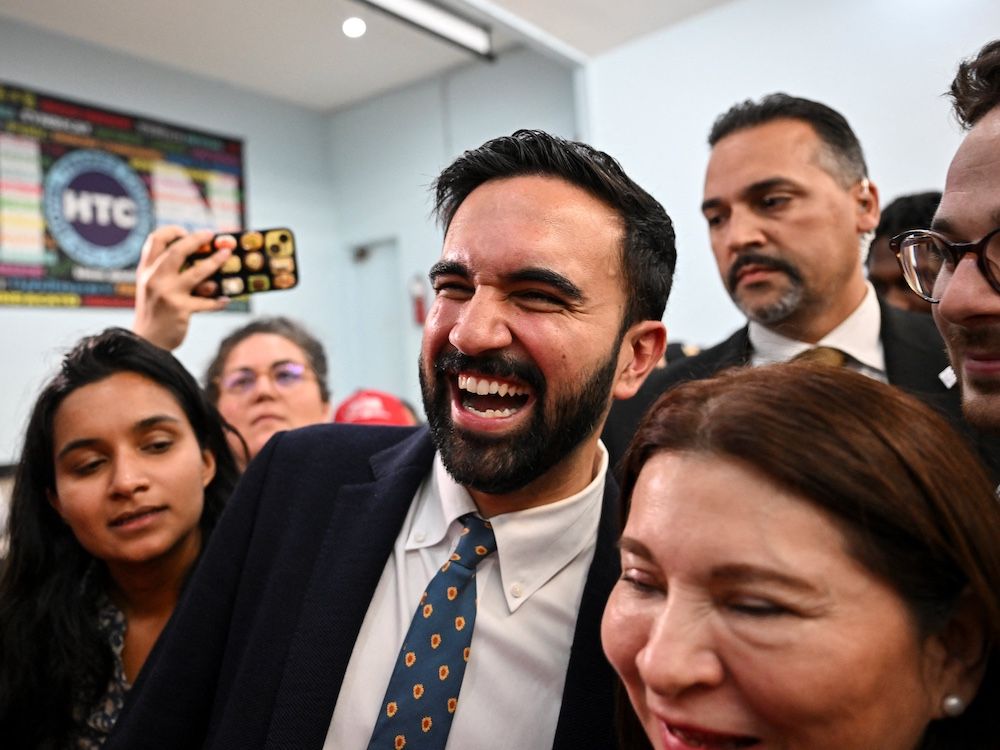
Zohran Mamdani, the Democratic candidate for the New York mayoralty, poses for a selfie with a supporter on July 2 in New York City.

It may not have garnered a lot of attention in Canada, but America’s largest city and global financial centre appears set on choosing its very own version of Justin Trudeau as its next mayor.

Zohran Mamdani is a man with a

brand

, a New Yorker with a remarkably similar look, sound and feel to Canada’s ex-prime minister. Handsome as all get-out, in a particularly boyish, non-threatening sort of way, he’s young, hip, well-coiffed and strategically-attired, his

wardrobe

carefully selected to suit the setting and deliver the message he’s chosen to project that day. Born in Uganda to a pair of glam

parents

— his father a professor of post-colonial studies, his mother an Oscar-nominated filmmaker — he fizzes with energy, has an excellent smile, is absolute murder at selfies.

At 33, Mamdani is made for magazine covers. He excites the young, is thoroughly left wing, thinks

billionaires

shouldn’t exist and promises a cornucopia of popular

goodies

for the city’s struggling middle- and working-classes should he be elected New York mayor as expected in November. Free buses. Frozen rents. City-owned grocery stores stocked with lower-priced offerings, paid for by higher corporate taxes and levies on the wealthy.

What could go wrong? Not much, as far as the coalition of youth, migrants and educated leftists who pushed Mamdani to a stunning victory in the Democratic mayoral primary — and thus the favourite in the fall election — are concerned. His meteoric rise to political stardom — a year ago he was a little-known member of the state assembly — carries broad echoes of the dramatic burst of popularity that carried Trudeau to the prime ministership in 2015. His meticulously calculated social media strategy, online presence, branding, logo, videos and even the wild colours of his campaign materials — dreamed up by a pair of Philadelphia designers — blew the competition away. It didn’t hurt that the “competition” came in the form of the stodgy, discredited, 67-year-old former governor Andrew

Cuomo

.

If anything should have been clear to Democrats following their disastrous presidential defeats of 2016 and 2024, it’s that chaining themselves to tattered scions of outdated family dynasties is anything but a formula for political triumph in the current state of U.S. politics. But no, after watching Hillary Clinton, Joe Biden and Kamala Harris crash and burn, establishment Democrats went ahead and bet their fate on Cuomo, son of another former governor, just four years after he

resigned

when investigators concluded he’d sexually harassed at least 11 women since being elected to the state’s highest office.

While Canadians may not see New York’s choice in mayors as particularly relevant, even with the city’s US$116-billion

budget

and a population bigger than all but two provinces, Mamdani’s rise signals that U.S. Democrats are nowhere near sorting out the dilemma of Donald Trump and the never-ending diet of disruption he represents well beyond U.S. borders.

Clinton, Biden and Cuomo were all dyed-in-the-wool representatives of a moderate, centrist, middle-of-the-road sort of politics that looks to be dead and buried among Republicans and increasingly feeble within America’s only other major party. A successful takeover of Democratic leadership by its more radical representatives would all but guarantee an escalation of today’s ruthless partisanship to levels hitherto unimagined.

Among mainstream Americans, and in dozens of foreign capitals, a hope has persisted that some day the Trump presidency would end, the spark of the MAGA movement would fade and the world could return to something resembling “normal.” But a headstrong and energized U.S. left bent on battle with the hardened forces of Trumpism would all but guarantee normality had nothing to do with the political future.

The Democratic establishment was in turmoil well

before

the Mamdani

surprise

came along. Former vice-president Harris’s loss to Trump in November left it in disarray, with no clear successor and no obvious plan. The New York Times reported its national committee was “in chaos … plagued by infighting and a drop in big donations.” The party is so busy battling within itself it had little energy to spare for Republicans.

The few signs of life have belonged to its most extreme elements. Firebrand Rep. Alexandria Ocasio-Cortez and Sen. Bernie Sanders have headlined a series of well-attended rallies targeting the rich and old guard. Mamdani, like Sanders, identifies himself as a democratic socialist, and

overcame

Cuomo’s once-healthy lead despite Cuomo’s overwhelming support among the party’s senior figures.

Current New York Governor Kathy Hochul, head of the state’s Democrat apparatus,

withheld

her endorsement and repeatedly mispronounced Mamdani’s name. Billionaire Michael Bloomberg, who ran for the presidential nomination as a Democrat, gave US$8.3 million in Cuomo’s support. City developers were said to be “gripped by hysteria” at Mamdani’s plan to freeze some rents, while Wall Street was reported as

seized

by

panic

at the

prospect

of a socialist running the city.

Given he would be the city’s first Muslim mayor, Mamdani faced predictable anti-Islam

attacks

and allegations of antisemitism. Though he

supports

the Palestinian movement and has harshly

criticized

Israel, accusing it of war crimes, he denies being antisemitic and received support from a number of Jewish leaders. That in itself reflects the fissures troubling Democrats as the party’s traditional sympathy for Israel comes under strain over its actions in Gaza.

Mamdani still has to win the election, but as the Democratic nominee in the heavily Democratic city he would need to suffer a monumental collapse to lose. Cuomo is keeping his

name

on the ballot even without official sanction. Current mayor Eric Adams is running again, but as an independent after his backing collapsed amid a series of scandals. The Republican candidate, Curtis Sliwa, is a radio talk-show host and paramilitary

enthusiast

who

twice

tried unsuccessfully to launch a citizen-based anti-crime

squad

in Toronto. Not much competition there.

It’s difficult to believe a detour into glitz, glamour and left-wing economics is the route to a better and more stable U.S. It certainly didn’t work for Canada, and there’s no sign that a quorum of Americans is open to socialist theorems that have failed again and again elsewhere. A credible opponent offering a menu of common decency, civility and shared purpose would seem a better antidote to Trumpist exhibitionism and greed. But America as yet doesn’t seem to have such a person, and New York isn’t America.

National Post


A Glock pistol. An Edmonton judge acquitted a man found with loaded Glock 9mm handgun, arguing the search was illegal. (Photo by JOE KLAMAR/AFP via Getty Images)

In Edmonton last month, a judge laid the groundwork to acquit a man who, while sporting clear hallmarks of drug dealing, was caught by police packing a loaded Glock. If you’re ever wondering why crime is on the rise in Canada, you can look straight to decisions like these by our courts.

This

recent example

comes to us from 30-year-old Haider Aftab Khan, who was recently acquitted of a pile of gun and drug charges. On June 11, he succeeded in convincing Justice Derek Jugnauth, a former criminal defence lawyer

appointed

by then-Prime Minister Justin Trudeau to the Alberta Court of King’s Bench, to exclude the gun and drug evidence from his trial. This collapsed the Crown’s case.

Khan had been pulled over in a Ford Explorer in the early hours of April 24, 2022. The vehicle had a license plate covering, an illegal addition that caught the attention of a pair of police on patrol. The officers ran the plate number and found the SUV was registered to a Calgary owner who was “subject to ‘a large paragraph’ of court ordered conditions related to weapons and violence.” They pulled Khan over, and both approached the car.

One officer approached the car asked Khan for his license, insurance and registration; Khan couldn’t find his license, however, and provided an expired insurance slip; frantic, he searched his car, then his phone. The officer followed Khan’s hands with his flashlight (this was around 1 a.m.) — and saw a blue pill bottle without a lid that “looked like it had the paper scratched off” under the radio dash. Inside the bottle, the officer testified, were two baggies: one with pills, another with white powder.

At that point, Khan was arrested for drug possession. He was then patted down by the other officer, who found a Glock 9mm handgun loaded with four bullets.

Officers then searched the SUV, finding 40 oxycodone tablets and a gram of cocaine in the pill bottle — the label that was worn, illegible in some places, but not torn — along with a box of 30 45-calibre rounds from the centre console.

Khan was charged with improper storage of a firearm, unauthorized possession of a firearm, unauthorized possession of a firearm in a vehicle, carrying a concealed weapon without authorization, and possession of a restricted firearm with ammunition (which carries a maximum sentence of 14 years). He was also slapped with two counts of drug possession.

When his day in court came along, Khan gave a different version of events — which the court didn’t buy. The SUV, he testified, was his cousin’s, and he had driven it to Edmonton to be worked on by a preferred mechanic; he’d been followed by three cruisers, not one; he had his phone recording during the traffic stop; he was dragged from his car, punched several times by the arresting officer, and then punched again several times by three other officers while handcuffed in the back of the cruiser; he’d sustained cuts to his face.

The pill bottle, Khan testified, wasn’t sitting under the radio in the front of the car — in fact, he claimed to have never seen it before.

The judge called BS: Khan’s story was “implausible” and “internally inconsistent.” No phone video was filed as evidence in his defence, the beat-down story didn’t make sense and no medical evidence supported the brutality allegations.

But on Khan’s side was the Charter — and Justice Jugnauth’s liberal reading of it.

To justify an arrest, an officer must have reasonable grounds to do so, supported by sufficient evidence that causes them to believe an offence has been committed.

The basis for Khan’s arrest was the pill bottle, which the officer believed had been tampered with. And, fair enough. Canadian police seize bottles with scratched labels in busts all the time. In

Sooke,

B.C., in

Grande Prairie,

Alta., in

Barrie,

Ont.,

London,

Ont., in

Corner Brook,

N.L. — to name a few cases. But it turned out the label in this case wasn’t scratched (though it was weathered), and its lidless quality with plastic sticking out the top

wasn’t enough

to satisfy the judge, who also thought the arresting officer didn’t have the training or experience to identify a suspicious bottle.

The cocaine baggie, in the judge’s view, was the only item that, if spotted, would have warranted a lawful arrest — but he didn’t believe that the officer could have seen it inside the bottle from his angle. No reasonable grounds were secured, which meant that all evidence stemming from the arrest — the gun, the drugs — was obtained illegally.

This wasn’t necessarily fatal to the case: judges have the option of allowing evidence borne from a Charter violation into trial if society’s interest in the prosecution is great enough. Heck, the Supreme Court of Canada

ruled in 2010

that unlawfully beating a non-compliant intoxicated driver to the point of breaking his ribs and puncturing a lung isn’t enough to get evidence tossed out.

However, Jugnauth found the police misconduct to be “serious,” and the breach of Khan’s rights to be on the extreme end of the state-intrusion spectrum. These factors were so heavy, in the judge’s view, they outweighed the

concealed loaded handgun

that posed an objective danger to society — and, in particular, the officers, had the traffic stop gone another way.

“Unlawfully carrying a loaded handgun on one’s person is an extremely serious offence that strikes at the heart of the community’s sense of security….

“In my view, society’s interest in bringing Mr. Khan to trial on the merits of this case strongly favours admitting the evidence. However, the strength of that pull is ameliorated to a degree by the importance of the public’s interest in knowing that citizens’ fundamental rights have meaning and the rule of law governs.”

And so, Jugnauth neutered the Crown’s case and acquitted Khan. The Alberta Crown Prosecution Service has not yet decided whether to appeal.

It’s not a major case, nor a bloody one, but it’s a decent demonstration of just how hard it is to manage public safety in Canada: even if a person is caught with a loaded gun strapped to the chest with illegal drugs semi-visible below the dash, that’s no guarantee they’ll be held to account for it.

We don’t need more gun bans targeting lawful owners — we need better judges.

National Post


Recently, I was a panellist at the Canadian Association of Journalists conference in Calgary. The session was titled, “Local Journalism in the Age of Cutbacks.” A great headline, sure, but that’s not why I was there. I was there to talk about our $8-billion class-action lawsuit against digital advertising giants Google and Facebook.

Alongside Sotos LLP, I launched a national class-action lawsuit in 2022. I’m the representative plaintiff in a case filed in the Federal Court of Canada on behalf of all Canadian newspaper publishers, big and small, independent and chain owned. We allege that Google and Facebook have engaged in anti-competitive practices in digital advertising and siphoned billions in ad revenue from Canadian journalism.

If we really want to talk about cutbacks, then let’s talk about what’s causing them. The bleed of advertising dollars away from Canadian newsrooms and straight into the pockets of two unregulated tech giants is the reason we are all hurting. We can’t stop the drain without getting to the root of the problem. That’s what this lawsuit is about.

Our case is one of the first of its kind in the world. Countries like Australia, the United Kingdom and the Netherlands have also picked up the cause, some with their own legal action, others with groundbreaking legislation forcing Big Tech to pay for journalism.

On that panel in Calgary, I listened to a lot of “woe is me.” Stories of shrinking newsrooms. Struggles to retain talent. Frustrations over government ad policy. It was the same old tune. The media in this country has become far too comfortable living with a victim mentality.

Well, I am nobody’s victim. I’m a fighter. And it’s time our industry remembered how to fight, too. What I didn’t hear on that stage was resolve. What I didn’t hear was fire. We’ve become so used to decline that we’ve forgotten how to push back and stand tall.

We forgot that newspapers aren’t just businesses. We’re institutions. We are the watchdogs. The check and balance. The public record. And somewhere along the way, we let Silicon Valley billionaires convince us we didn’t matter anymore.

Well, I haven’t forgotten. And I haven’t given up.

I run a small-town newspaper in Crowsnest Pass, Alta. I don’t have a national platform or a multimillion-dollar budget. But I have a spine, and I’m not afraid to use it. If a small community newspaper can step up and take on the giants, then so can every publisher in this country. Because if we don’t stand up for our work, our readers and our communities, who will?

Let me remind you: Canadians still believe in us. News Media Canada found that 81 per cent of Canadians read newspapers weekly, and 63 per cent trust newspaper advertising far more than ads on Facebook or Instagram. Even young readers are returning to trusted sources. So why are we acting like we’ve already lost?

This lawsuit isn’t just about money. It’s about restoring a fair playing field. It’s about holding the powerful accountable. It’s about saying “enough.”

If one local newspaper from a mountain town in southern Alberta can take on Google and Facebook, then maybe, just maybe, all of us can fight for Canadian culture and identity.

Under the leadership of its tenacious commissioner, Matthew Boswell, the Competition Bureau of Canada is doing its job and taking Google to court. It deserves our full support and all the resources it needs to protect Canadians from tech giants tilting the field in their favour.

I am a proud, independent, second-generation community newspaper publisher, a proud Conservative, a proud Albertan, but most of all I am a very proud Canadian. This pro-coal, pro-oil, pro-gas, pro-pipeline gal has been pleasantly surprised and impressed by Prime Minister Mark Carney’s willingness and determination to get stuff done and move our economy forward and unlock our promise and potential after a decade of dithering. He, and all of us, have the power to lead the world in this fight if we choose to do so.

Let Canada be the democratic beacon in an increasingly autocratic world by standing up to Big Tech giants and safeguarding local news and our digital sovereignty.

National Post

Lisa Sygutek is the publisher of the Crowsnest Pass Herald.