LP_468x60
on-the-record-468x60-white

Canada Day fireworks provide a spectacular backdrop for the Peace Tower on Parliament Hill in this file photo from 2018. The nation's future is bright, but only if Canadians commit to making it so, write Jeffrey Reynolds and Michel Maisonneuve.

By Jeffrey Reynolds and Michel Maisonneuve

Canada Day was somewhat different this year. There are wars raging in Europe and the Middle East, geopolitical fault lines emerging around the world, and turbulent leadership in western nations. We live an era of horrific violent conflict and subversive political warfare unfolding around the world and on our smartphones.

True, Canada sits in the geopolitical equivalent of Beverly Hills. But the comfortable illusion that Canada is shielded by oceans, alliances and politeness is long expired. At least, pollsters report a bit of a resurgence of Canadian patriotism.

We stand at another inflection point: choose to dither and decline or scale and soar. To soar is to have a bold vision for Canada — to be a great power in the world and contribute mightily to the upward march of civilization.

Great powers don’t just have large economies or powerful militaries. They shape world affairs. They protect their people, defend their values and project power. A great power is a nation capable of strategic action and sustained global influence across diplomatic, informational, military, economic, technological and cultural domains.

Canada has the bones of a great power. We are a pioneering people capable of doing incredible things together. We possess vast natural resources: critical minerals, freshwater, arable land and ethical energy. We are a founding member of NATO, the UN, the World Bank, and the OECD. We have an advanced economy, a highly educated population with two official languages, and a history of innovation in space, nuclear research, biomedical engineering and AI, among other things. Our geostrategic position — bordering the United States and with three oceanic frontiers — is the envy of the world. No country is better positioned to thrive in the 21st century.

But strength unused decays and power undeveloped fades. In our current condition, we are not a serious actor on the world stage. We are a resource-rich, idea-rich and values-rich virtue-signalling nation that has grown complacent. Over the past decade, we have grown soft: our adversaries know it and act with impunity against us.

Their combined strengths are not to be underestimated: China’s economy is the second largest in the world and commands a globally integrated manufacturing base. Its diplomatic strength throughout the Global South is unmatched. Its nuclear arsenal is growing as fast as its military power projection capability. Russia, though bloodied in Ukraine, remains a nuclear power and energy superstate and is producing military hardware exponentially faster than NATO nations. North Korea continues to expand its ballistic missile and nuclear weapons capability. And while the United States and Israel have diminished Iran’s capabilities over the past week, the mullahs still wield influence and maintain nuclear ambitions. Together, these adversaries are united not by shared values but by a shared adversary: the liberal West.

We are that West.

Our values — free markets, rule of law, individual liberty, democratic governance, advanced research and education, and human rights (FRIDAH) are not abstractions: they are targets. They must be defended with every element of national power — wherever, whenever, and however necessary.

Canada is vulnerable to political warfare via a lack of leadership, foreign interference, social media influencers and algorithms, corruption, elite capture, organized crime, lax police/immigration enforcement, and myopic government policy. A demoralized and underfunded military with shifting government support signals to citizens that Canada is not worth defending. U.S. President Donald Trump has driven the Canada-U.S. relationship to its lowest point in 200 years. Why? Because he understands something our political class does not: Canada has been unwilling to defend itself or advance its interests beyond the minimum required.

The road to greatness

We must flip the script of Canada and toss out the “post-national state” and “cultural mosaic” rhetoric epitomized by past governments. That mindset has had a surfactant effect on Canada, weakening our bonds to each other over the past decade. Greatness is only achievable when we are strong and united, and when we believe in our non-hyphenated uniqueness.

It is crucial that all Canadians be able to live, work, raise families and enjoy a good life throughout a Canada anchored in shared principles of liberty, community and meaningful enterprise. We must develop a confident national psyche with a strong sense of history, national purpose, territorial integrity, and shared destiny, taught in every school, celebrated in every region, and championed across every aspect of Canadian life — combined with an ironclad willingness to defend all of it.

In short, Canada must become the best version of itself: a Great Power Nation possessing the requisite mix of hard and soft power for the confident advancement of our national interest and the defence of western values.

Let’s start here:

First, rebuild our military. It’s one thing to make a big spending announcement, it’s another to spend the money wisely. Follow up the promises by the Carney government with actions. Make the Canadian Armed Forces a career young Canadians dream of. Grow the regular and reserve forces. Create cyber and space capabilities that rival any in NATO. Modernize procurement for innovation and rapid acquisition. Invest in Arctic sovereignty and power projection. And get a strategic deterrent capability that makes adversaries think twice about doing anything to us. Think: B-21 Raider with RCAF livery.

Second, purge foreign interference. Let’s have a full public inquiry on foreign interference at all levels of government — with teeth this time. Legislate lifetime bans on foreign funding in politics. Introduce criminal penalties for acting as an unregistered foreign agent. We must have institutions and leaders who advance our national interest, not that of an adversary.

Third, renew our institutions. The Charter must be defended and, eventually, finished. Media must be independent. Universities must be free from ideological capture. Restore merit, freedom of speech and equal citizenship and opportunity as guiding lights.

Fourth, develop national strategy that binds us together. Define our values and what is a Canadian. Drop inter-provincial barriers — unleash the free movement of goods, services, people and ideas across the country. Invest in northern infrastructure, energy corridors and advanced research. Reform immigration toward high-value integration into our society. Build space, quantum, AI and nuclear innovation hubs. Unleash natural resources and get them to tidewater.

Finally, promote leaders who understand the assignment. Nation building is tough, and it’s not taught in our schools. This includes an honest assessment of our history that emphasizes Canada’s triumphs, not just its failures. Nation-building is a rejection of provincial self-interest and a commitment to the national interest. We must have principled leaders who embrace — at the cellular level — that Canada is awesome, that its development must be nurtured prudently, and that mediocrity is not our inheritance.

Canada’s future is a choice

Canada’s path to greatness will be difficult, but building our nation has never been easy. We are the descendants of pioneers, rebels, builders and warriors. We carved a nation out of ice and wilderness that spans a continent. Our future is bright — but only if we commit to making it so.

Let this be the moment when we commit ourselves to becoming the great power we are destined to be. We owe it to each other, to our children, and to our allies.

Special to National Post

Jeffrey Reynolds is a non-resident Senior Fellow at the Atlantic Council. Michel Maisonneuve is a retired Lieutenant-General, senior fellow at the Frontier Centre for Public Policy and the author of “In Defence of Canada: Reflections of a Patriot” (2024).


A person standing on asphalt road with gender symbols of male, female, bigender and transgender. Concept of choice or gender confusion or dysphoria.

An Alberta judge has

temporarily blocked

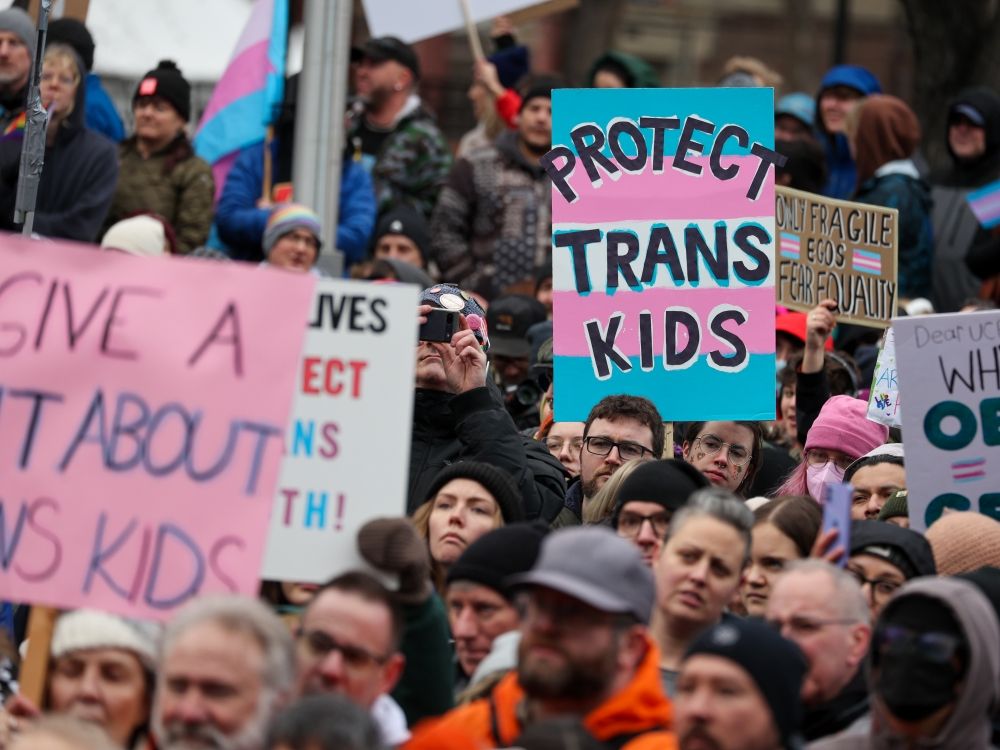
the province’s ban on puberty blockers and cross-sex hormones for minors, ruling that denying trans-identified youth these interventions would cause “irreparable harm.”

The injunction, issued on June 27, stems from a Charter

challenge

led by LGBT charity Egale Canada. But Justice Allison Kuntz — and the advocacy groups opposing the ban — have it exactly backwards: it’s the unproven interventions Alberta has restricted that have the potential to cause lasting harm — including

sterility

,

sexual dysfunction

, and impeded

psychosocial
development

.

Echoing the language of the Charter challenge, Justice Kuntz

cited several factors

she believed would cause “irreparable harm:” that the law would reinforce discrimination, inflict emotional harm, and lead to “permanent physical changes that don’t match their gender identity.” In other words, undergoing natural puberty would be harmful to these minors’ identities.

Yet, Alberta Premier Danielle Smith takes a different view. “The court had said that they think that there will be irreparable harm if the law goes ahead. I feel the reverse,”

said Smith

the day after the ruling. She made clear that her government intends to challenge the decision in the higher courts, expressing confidence that Alberta has “a very solid case.”

That means taking the matter before the Alberta Court of Appeal — and make no mistake: Smith’s confidence is well-founded.

Bill 26

is backed, not only by multiple

systematic evidence reviews

and independent

European investigations

, but is also bolstered by recent developments in the U.S. legal landscape — most notably the Supreme Court’s ruling in

United States v. Skrmetti

, which upheld Tennessee’s right to restrict these same interventions.

The Tennessee case was brought by a coalition of civil rights lawyers led by the American Civil Liberties Union (ACLU), who also argued that the state’s ban on puberty blockers and cross-sex hormones for minors would cause harm. But the U.S. Supreme Court wasn’t persuaded. It sided with Tennessee’s right to protect children from unproven, high-risk interventions — dealing a decisive blow to those who advocate for medicalizing adolescent transgender identities.

Like the Egale-led Charter challenge, the

ACLU’s case

relied on the claim that denying these drugs would cause irreversible physical and emotional harm — and increase the risk of suicide. But some of the U.S. Supreme Court Justices had done their homework. Citing the

UK’s Cass Report

, one directly challenged the ACLU’s most powerful rhetorical weapon: the “transition or suicide” narrative.

In a pivotal exchange during the December 2024 oral arguments, Justice Samuel Alito confronted ACLU attorney Chase Strangio with the fact that there is no reliable evidence that puberty blockers or cross-sex hormones reduce suicide risk in this population. Strangio was

forced to admit

that suicide among trans-identified youth is extremely rare — and that, therefore, the claim these interventions are lifesaving is unsupported.

And just like that, the medical justification for subjecting healthy adolescents to these interventions has vanished. There is no life-threatening emergency — only experimental drugs being offered to confused youth still exploring their identities and trying to find their place in the world.

With Skrmetti, the ACLU learned a hard lesson — one Egale may soon face: in court, activist rhetoric doesn’t cut it. Evidence matters. You can’t win by shouting slogans or crying “transphobia” when pressed. You can’t call a treatment “evidence-based” unless there is actually evidence to support it. Of course, Canada’s judicial system differs significantly from that of the United States. Charter rulings tend to allow more room for ideological interpretation — and a Canadian court is not bound to follow the same evidentiary reasoning as the U.S Supreme Court. But the Skrmetti ruling is sure to have boosted the confidence of Smith and her legal team as they plan to take this fight to the higher courts.

Like the ACLU’s challenge to Tennessee’s ban, the

Egale-led Charter challenge

rests on a strange and radical argument. It asks the court to treat the natural developmental stage of puberty as “harm,” and the denial of experimental drugs as a violation of Charter rights. Most striking is the Section 12 claim: that restricting access to blockers and hormones amounts to “cruel and unusual treatment” — a clause intended for criminal punishment, not medical regulation. Framing a protective measure as state-inflicted cruelty makes a mockery of the Charter’s purpose.

But more fundamentally, the challenge to Alberta’s ban ignores a

core ethical principle

in paediatric care: a “child’s right to an open future.” Adolescents are still developing — physically, cognitively, and emotionally. To offer them potentially

irreversible

medical interventions based on transient identities is not an act of compassion; it’s a form of foreclosure. True protection means safeguarding all the possible versions of the self that a young person has yet to discover — and shielding them from life-altering decisions they are not yet equipped to make.

In essence, the Egale-led Charter challenge isn’t about protecting rights; it’s about defending an indefensible medical experiment — one that treats

unproven drugs

as safe, evidence-based care and the natural course of puberty as a danger. When Alberta moves forward defending its law, the Court of Appeal will face a choice: follow the science-led shift seen across Europe — or give legal cover to a collapsing ideology. Justice Kuntz failed to see past the activist script. The real test now is whether Canada’s upper courts will have not only the clarity to recognize it — but also the courage to reject it.

Mia Hughes specializes in researching pediatric gender medicine, psychiatric epidemics, social contagion and the intersection of trans rights and women’s rights. She is the author of “The WPATH Files,” a senior fellow at the Macdonald-Laurier Institute, and director of Genspect Canada.

National Post


A woman walks past murals of Dr. Theresa Tam and Dr. Bonnie Henry on the side of a building in Vancouver in 2020.

The Order of Canada no longer means anything, if it ever meant anything at all.

On June 30, the supposedly prestigious Canadian honour was

awarded

to physicians Theresa Tam and Bonnie Henry, the former chief public health officer of Canada and the current provincial health officer of British Columbia, respectively.

With these two appointments, the Order of Canada should no longer be considered an honour; instead, it should be seen as a symbol of conformity, obedience and antipathy towards those of us who care about our collective rights and freedoms.

Both doctors became famous — in relative Canadian terms — for their public-health decrees issued during the COVID-19 pandemic. The Governor General’s

website explains

that, “Bonnie Henry has been using her expertise in public health and preventive medicine to safeguard the health of people in Canada and globally for decades. Notably, as provincial health officer, she led British Columbia’s response to the COVID-19 pandemic. She is also an author, scholar and University of British Columbia clinical associate professor.”

For her part, Tam was given the award because, “For decades, Theresa Tam has striven to advance global and national public health as a pediatric infectious disease specialist and public servant. Her tenure as Canada’s chief public health officer has been characterized by her commitment to health equity and highlighted by her leadership role in the country’s response to the COVID-19 pandemic.”

These explanations are blatant whitewashing. Any Canadian who lived through the pandemic will be familiar with the repeat controversies and scandals that plagued both public-health officers. They will be remembered, not for safeguarding life, but for cracking down on Canadians with harmful and coercive public-health policies, many of which were not supported by scientific evidence.

Henry clung to her illiberal and unnecessary vaccine mandate for health-care workers long after it was obvious that the vaccine was not stopping the spread of the virus. Many lost their jobs and the health-care system has yet to recover from the loss. Henry only rescinded the mandate in the lead-up to the 2024 provincial election, in what appeared to be a

politically motivated decision

intended to thwart the rise of B.C.’s Conservative party. It was despicable.

Henry, who’s part owner of a B.C.

winery

, also curiously issued 2021 orders to prohibit indoor dining for bars and restaurants — but

not for wineries

offering wine tasting sessions. Hmm.

Then there’s Tam. Her policies left such a sour note in Canadians’ mouths that police pre-emptively

placed security

around her home in the lead-up to the Freedom Convoy protests. She has been widely

condemned

for her support of

harmful

lockdown policies, for which Canadians are still suffering to this day.

Henry and Tam’s inductions into this Canadian hall of fame is more than enough proof of how politicized the Order of Canada has become. The Governor General is merely patting politically connected cronies on the back. But Canadians know the truth.

The Justice Centre for Constitutional Freedoms, a legal advocacy organization,

expressed anger

over the appointments on X: “Honouring Dr. Bonnie Henry and Dr. Theresa Tam the Order of Canada for their destructive and unscientific policies amounts to politicizing this Award. Given the questions about vaccine mandates, and other violations of Charter rights and freedoms, this is completely irresponsible.”

The Order of Canada has been around since 1967. In its 58 years, more than 8,500 people have been given the “honour,” an average of around 147 people a year.

To

be considered eligible

for an Order of Canada, one must be alive and not currently an elected official or sitting judge. That’s it. You don’t even have to be Canadian. The Governor General’s website explains that, “Living non-Canadians are also eligible if their contributions have brought benefit or honour to Canadians or to Canada.”

Henry and Tam have done neither. Many argue that they’ve done the opposite.

An Order of Canada can also be taken away. There is something dubious about an award that can be given and then taken, the honour of its bestowing vanished from the annals of a country’s history. A Nobel Prize, for instance,

cannot be revoked

. This is further evidence that the Order of Canada is not a serious award.

Not to mention that Don Cherry does not have one — what a farce.

The Governor General is handing out Orders of Canada like Costco hands out samples to its members. If you’re in the club, you can get one — just get in line and wait your turn.

National Post


U.S. President Donald Trump greets Prime Minister Mark Carney upon his arrival at the White House earlier this year.

First Reading is a Canadian politics newsletter curated by the National Post’s own Tristin Hopper. To get an early version sent directly to your inbox, sign up here.

TOP STORY

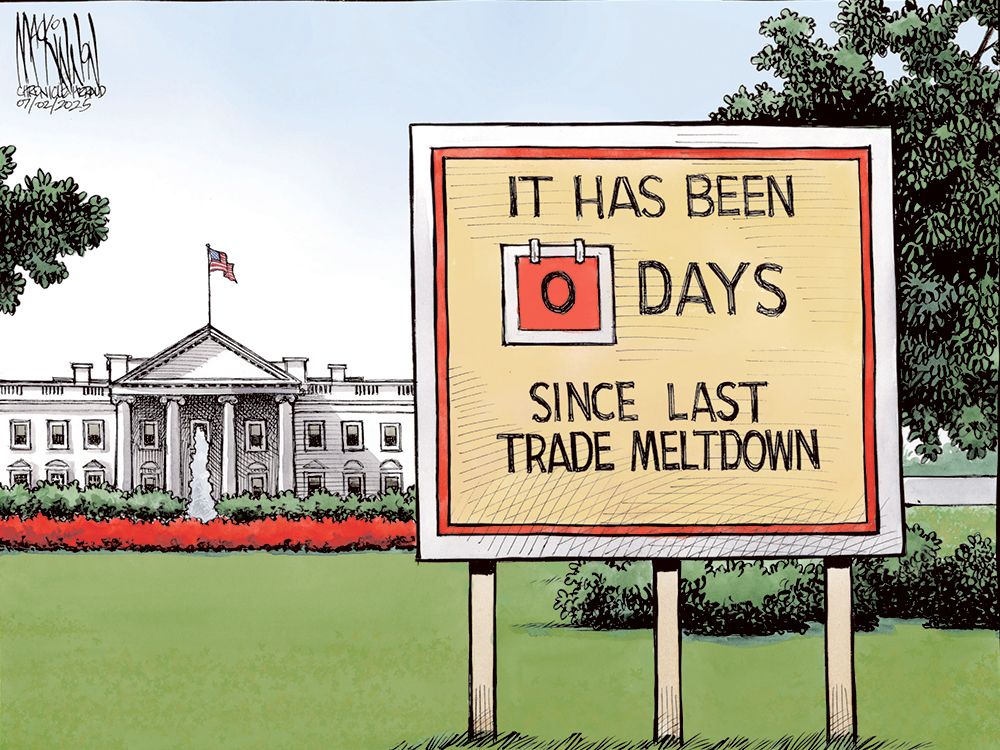
Prime Minister Mark Carney won the election in April thanks in part due to his promise to take a hard line with the United States. Carney declared during the campaign that Canada’s highly integrated “old relationship” with the U.S. was over. Polls showed at the time that among Liberal voters, their top motivation in voting for Carney was their idea that he would be an effective counterweight against U.S. President Donald Trump. One Ipsos poll from April 13 found that voters saw Conservative Leader Pierre Poilievre as likely to “roll over and accept whatever Trump wants,” while trusting Carney to be “a tough negotiator who would get the best deal for Canada.”

So it’s a little weird that Carney’s premiership has largely been marked by deference to Washington. Two months in, the Carney government has not materially opposed the U.S. agenda in any meaningful sense.

Below, a cursory record of how Carney’s “elbows up” strategy against U.S. President Donald Trump has actually played out.

Immediately rescinding legislation because of a Trump social media post

It’s certainly not unprecedented for Canada to acquiesce to a demand from the United States. The 2020 re-negotiation of NAFTA, for one, was marked by a series of Canadian concessions on everywhere from dairy quotas to

intellectual property rights

.

But Carney has overseen the first time in history that a Canadian government has seemingly promised to rescind House of Commons legislation just because the U.S. president complained about it in a social media post.

That would be the Digital Services Tax Act, which

was made law in Canada

last June following a “yea” House of Commons vote of 175 to 144. But it

only took a press release

for the Carney government to reverse all of that as a sop to Washington.

The spur was a Truth Social post by Trump, in which he said he was immediately suspending all Canadian trade negotiations because of the tax, which he called an “attack on our Country.”

Within two days, the Carney government unilaterally pledged to do what Trump wanted: Collection of the tax would stop immediately, and the Digital Services Tax Act would be repealed as soon as possible.

Here’s how White House Press Secretary Karoline Leavitt summed up the move in a recent press conference: “It’s very simple. Prime Minister Carney and Canada caved to President Trump and the United States of America.”

Carney’s flattery of Trump is unprecedented

Until recently, the most conspicuous example of a prime minister kissing up to the American leader was usually cited as the time in 1985 when Brian Mulroney 

publicly sang When Irish Eyes Are Smiling

 to then U.S. president Ronald Reagan. Justin Trudeau and Barack Obama were also known to praise one another, with Trudeau calling his U.S. counterpart “a man of both tremendous heart and tremendous intellect.”

But Carney takes the tactic to a whole new level. In the two times he’s personally met with Trump, he’s made a point of delivering an extended paean to the U.S. leader in front of news cameras. The most recent example came at the G7 summit in Alberta, where Carney wished Trump a happy birthday before declaring that the Canadian-hosted summit was “nothing without U.S. leadership, and your personal leadership.” In a May meeting at the White House, Carney called Trump a “transformational president” who was “securing the world.”

First bill tabled by Liberals was a package of U.S.-demanded border security measures

The first major piece of legislation tabled by the re-elected Liberal government was Bill C-2, the Strong Borders Act. The bill codified a package of border security measures

pledged to Trump in February

as part of an ultimately unsuccessful attempt to stave off a trade war.

This includes a promised crackdown on fentanyl trafficking, as well as tighter controls on immigration, particularly in the realm of fraudulent asylum claims.

There are good reasons for Canada to pass a border security bill, but the Liberals have been quite open about the fact that their newfound interest in border security has been a direct reaction to Trump.

In a House of Commons defence of Bill C-2, Liberal MP Kevin Lamoureux

said

, “members will recall that the criticism being levelled by the President of the United States toward Canada was about the issue of fentanyl, of our borders not being secure.”

The Americans are actually pretty satisfied with Canada’s turn on defence spending

Probably the most conspicuous anti-American policy turn taken by the Carney government has been its attempts to substitute Canada’s close relationship with the U.S. in favour of a close relationship with the European Union. This has been most notable in the realm of defence, with Carney pledging vast increases to Canadian military spending while

striking a new European military alliance

that will include Canadian participation in the ReArm Europe program.

Federal literature has made clear that

they’re doing this

to “diversify Canada’s defence partnerships beyond the United States,” but the tack is pretty much in line with what the United States has been begging Canada to do.

U.S. politicians of both major parties have long bemoaned Canada’s lacklustre contributions to the likes of both NATO and NORAD, with senior members of the Trump White House often citing low defence spending as

one of their main grievances

against Canada.

In fact, NATO’s recent decision to raise their military spending benchmark to five per cent of GDP (a move that Canada swiftly agreed to),

was hailed by Trump as a major victory for U.S. foreign policy

.

Carney swiftly dropped most of the Canadian counter-tariffs

During the federal election, Carney was quite forceful in outlining the need for “countermeasures” against U.S. tariffs. After Trump hit the Canadian auto sector with a round of tariffs in early April, Carney immediately retaliated with what he described as “purpose and force.”

“Canada has responded to the U.S. imposition of tariffs on Canadian goods by 

introducing a suite of countermeasures

 designed to compel the U.S. to remove the tariffs as soon as possible,” read a statement from the prime minister’s office at the time.

But almost as soon as the election was over, Carney unilaterally zeroed almost all of the counter-tariffs. Oxford Economics reported in May that any retaliatory Canadian trade measures were now “

nearly zero

,” even while key elements of the original U.S. tariffs remained.

IN OTHER NEWS

 It’s been precisely four years since the community of Lytton, B.C., was effectively flattened by a wildfire. So residents didn’t take kindly to the RCMP accidentally starting a large wildfire near the townsite this week. After a police trailer lost its wheel on Tuesday afternoon, the resulting sparks caused a blaze that quickly grew to 155 hectares in size.

By resigning his seat in order to give Conservative Leader Pierre Poilievre a path back into the House of Commons, Conservative MP Damien Kurek received much praise for the fact that he did so despite the fact that he was only a months away from qualifying for his gold-plated Parliamentary pension. But Kurek appears to have landed on his feet;

he was just hired

by the lobbying and public relations firm Upstream Strategy Group.

 Ukraine has received its first cash transfer from Canada as part of a new program to turn frozen Russian assets into monetary aid for Ukraine. Under the G7 Extraordinary Revenue Acceleration Loans program, G7 countries loan money to Ukraine  but then repay them using the proceeds from immobilized Russian assets. The above, posted on Canada Day, is from Anton Gerashchenko, an advisor to Ukraine’s interior minister.

Get all of these insights and more into your inbox by signing up for the First Reading newsletter.


Cows are milked at a dairy farm in Granby, Que., on Feb. 5.

Reviews and recommendations are unbiased and products are independently selected. Postmedia may earn an affiliate commission from purchases made through links on this page.

For a moment, it seemed all Canadians understood that, facing U.S. President Donald Trump’s tariff war, we had to make our economy as resilient and competitive as possible. As Martha Hall Findlay discusses with Brian Lilley, there was finally talk of ending Ottawa’s war on oil and gas, building infrastructure and boosting productivity. The government even yanked the aggravating digital services tax. But, explains Hall Findlay, a former Liberal MP, now director of the University of Calgary’s School of Public Policy, politicians just kneecapped nearly every Canadian exporter by exempting our globally detested dairy supply management system from trade talks … forever. Hall Findlay explains how this small cartel of millionaires works, why it’s so powerful and why it hurts not just consumers, but every other trade-exposed business. (Recorded July 4, 2025)


In this pool photograph distributed by the Russian state agency Sputnik, Russia's President Vladimir Putin chairs a Security Council meeting via a videoconference at the Novo-Ogaryovo state residence outside Moscow on July 4, 2025. (Photo by ALEXEY BABUSHKIN/POOL/AFP via Getty Images)

When Iran’s Foreign Minister Abbas Araghchi met with Vladimir Putin — just before a dozen or so Iranian ballistic missiles were half-heartedly aimed at the U.S. Al Udeid base in Qatar — he was surely looking for at least a little moral support.

He was to be disappointed.

Reuters

reported

that Iran was disappointed after the meeting: “Iran has not been impressed with Russia’s support so far,” Iranian sources told them, “and the country wants Putin to do more to back it against Israel and the United States.” Reuter’s Iranian sources “did not elaborate on what assistance Tehran wanted.”

Russia — previously considered to be a restraining factor on U.S. actions towards Iran — is seeing its influence in the region declining. China may be only too happy to replace it.

U.S. (and Israeli) planners surely noted Russian support for the Assad regime evaporating in its swift end in December 2024, sacrificing a precious warm-water port on the Mediterranean in the process.

Just prior to Assad’s fall, the

Iran-Israel skirmish of October 2024

also showed the parlous state of Iran’s air defences with Russian-supplied S-300 systems easily taken out by Israel’s “Operation Days of Repentance.”

Russian diplomatic and material support has proven ineffective, for Iran and previously Syria. Having been much sought after by Middle East customers, Russia now sees confidence ebb in the performance of its military hardware.

Prospective customers for new military systems are symbiotic with investment in research and development. One goes with the other, and once the R&D muscle atrophies due to a lack of buyers it’s hard to build back.

While it is long believed Russia had agreed to supply the newer, and theoretically superior, S-400 system to Iran, it has never been proven that they were delivered. The performance of the system has seen a mixed record in Ukraine, and Russian military overstretch now means it can’t afford to spare any air defence systems — especially since Ukraine’s devastating “

Operation Spiderweb

.”

Turkey must be pondering how useful its controversial 2017 acquisition of the S-400 system was.

Long-standing buyers like Pakistan have also gone elsewhere, mainly to China which has emerged as the

preeminent alternative

to Western-supplied systems. The superior performance of China’s J-10C jet in Pakistan’s recent hostilities with Indian-supplied French jets has been noted, with Iran now

reportedly

considering buying J-10Cs instead of Russian Su-35s.

Russia’s interests in the region, which go all the way back to the Soviets and Tsars, have seen it compete, cajole and sometimes even try to cuddle Islamic Iran and its preceding Pahlavi imperial rulers.

Stalin occupied Northern Iran during and after the Second World War. Then, shortly after the Islamic Revolution in 1979, the Soviet Leadership attempted to extend an olive branch to the new anti-U.S. regime, only to be swiftly rebuffed by Ayatollah Khomeini who took a dim view of the U.S.S.R.’s invasion of Afghanistan and Soviet atheism.

Putin’s Russia, horrified by its inability to counter U.S. actions in Iraq after the 2003 invasion realigned away from the West after 2007 and sought new partners in the region. Following the “Arab Spring” of 2011, Russia and Iran gradually moved closer, first in supporting their mutual Syrian proxy, and increasingly following Russia’s invasion of Ukraine in 2022.

Iran sensed both a useful foe-turned-ally against the common threat of the U.S., and a commercial opportunity in supplying thousands of Shahed drones. More recent technology transfer has seen the creation of a factory in the Alabuga special economic zone in Tatarstan to build

6,000 drones

by summer 2025. Iran has secured treasure — literally in the form of gold bars — amid much speculation about what else Russia is helping with, including its nuclear program.

But Russia’s retrenchment in the region since 2024 has shown it can only service one priority — its campaign in Ukraine.

Despite the photo opportunities and grand words, the reality of Iranian, Russian, and now Chinese relations is purely transactional. China buys around

90 per cent of Iran’s oil exports

. Russia likely hopes to usurp this to offset the bargain basement prices China has paid for Russian oil since 2022, and Russia has sensed an opportunity to try to restart negotiations on the Power of Siberia 2 gas pipeline to China.

President Trump has dismissed Russian diplomatic efforts in the Middle East

telling

Putin, “mediate your own (conflict)” in a tacit reference to Trump’s frustration over a lack of peace in Ukraine.

Given Arab unease with the U.S.’ actions in Iran, China may seek to pursue its commercial and strategic interests in the region as with its brokering of the 2023 rapprochement between Iran and Saudi.

China still plays catch up, given the scale of U.S. military assets and diplomatic heft, but many “

Asia First

” defence hawks like Elbridge Colby doubt a long-term presence in the Middle East now the U.S. is largely energy independent.

China, with

45

50

per cent of its crude oil carried on tankers down the Strait of Hormuz, is most certainly not.

While the U.S. debates its long-term presence in the region, the Russian bear declines. Both could be replaced by the Chinese Panda.

David Oliver is a geopolitical strategy expert and founder of Minerva Group. You can follow him on his Substack The Ultima Ratio.

Othón León is the managing director of the Canadian Centre for Strategic Studies.

National Post


Supporters of regime change in Iran rally in Los Angeles, Calif., on June 23, 2025. The Canadian government should platform the plight of the Iranian people and political prisoners and hold their persecutors accountable, write Irwin Cotler, Brandon Silver and Maryam Shafipour.

By Irwin Cotler, Brandon Silver and Maryam Shafipour

Under the cover of conflict, Iran has begun a new war against its own people. As the ceasefire is now taking hold, this mass repression will rapidly worsen if there is no accountability.

Already, the 

internet has been completely shut down

, arbitrary arrests and enforced disappearances are 

intensifying

, and

executions

 are the 

highest number ever recorded

.

The leaders of the human rights movement in Iran are

suffering

 in the notorious Evin prison. In a country that enforces 

gender apartheid

 and has the highest rates of 

child executions

 in the world, their campaigns for just causes like 

equality for women and against the death penalty

 have garnered them praise and respect from the Iranian public, and punitive reprisals from the regime.

As the leaders of Iranian civil society and the country’s greatest proponents of democracy and human rights, these political prisoners are the strongest hope for Iran’s future. Amidst the dangers of war, they have been

appealing

 for 

leniency

, pointing out the violations of both international and Iranian law in their abuse by the regime. Their pleas are being met with further repression from the regime in Tehran, and deafening silence from the international community.

So long as this crackdown goes unchallenged, the regime in Iran will continue its assault against the Iranian people and their most prominent voices for change. This intensifying attack on dissidents also undermines any hope for the reforms these heroes could lead to advance human rights, peace and stability in the region.

This renewed repression was no mere byproduct of wartime governance. It is now worsening as a calculated and ambitious strategy of the Ayatollah to enforce ideological and religious conformity, extinguish the flame of dissent ignited by the death of

Mahsa Amini and the “Woman, Life, Freedom” movement

, and consolidate authoritarian control. The regime’s agenda is made all the more urgent following the ceasefire.

The Supreme Leader’s Islamic Revolutionary Guards Corps (IRGC), a 

designated terrorist organization in Canada

, is at the centre of this campaign. The IRGC not only directs missile programs, but also oversees prisons,

monitors universities

, and suppresses civil society. To treat the IRGC merely as a regional security threat is to misunderstand its full function as the regime’s primary mechanism for maintaining power at the expense of the Iranian people’s freedom and dignity.

Canada commendably

leads

 the annual UN General Assembly statement on human rights in Iran, but has been notably absent in supporting the Iranian people now in their greatest time of need. Instead, Canada has become a 

safe haven for their oppressors

. Only 20 senior regime officials have been 

caught on Canadian soil and encouraged to depart or be deported

, despite 

reports

 of 

over 700 IRGC members operating in Canada

.

It would send a powerful message to the Iranian people if their abusers were prosecuted rather than protected in Canada. This should be pursued even if only as a matter of Canadian public safety, given their efforts to

carry out assassinations in Canada

and 

harass the grieving Canadian families of Flight PS752 victims

. IRGC members can be prosecuted under the Criminal Code for being members of a listed terrorist entity, and regime officials for their involvement in abuses under the War Crimes and Crimes Against Humanity Act.

Their presence in Canada is a unique opportunity to do so, and their many victims in Canada should be interviewed for evidence by the RCMP as part of a 

structural investigation

, as was done with Ukrainians and victims of ISIS.

Canada should also consider expanding targeted sanctions against the architects of repression in Iran, starting with Supreme Leader Ayatollah Khamenei.

At the very least, Prime Minister Mark Carney and the Canadian government can speak out for the people of Iran, and continue our traditional diplomatic role of convening our allies to do the same.

The regional war may have filled the headlines, but it is the regime’s new war against the Iranian people that will define its legacy — and our own. Our shared democratic values, and the vision of a brighter future for Iran and the region, are represented by the civil society leaders languishing in the dungeons of Tehran. And their tormentors represent grave threats to the human rights and security of both Iranians and Canadians.

As the Islamic Republic continues its crackdown, platforming the plight of the Iranian people and political prisoners — and holding their persecutors accountable — can be Canada’s greatest contribution to protecting our sovereignty from transnational repression and helping to build a more stable and peaceful Middle East.

Special to National Post

Irwin Cotler is a former Minister of Justice and Attorney General of Canada and longtime Parliamentarian. Brandon Silver is an international human rights lawyer and Director of Policy at the Raoul Wallenberg Centre for Human Rights, and has served as counsel to Iranian political prisoners. Maryam Shafipour is an Iranian human rights defender, and a former prisoner of conscience held in Evin prison.


The use of artificial intelligence is a cause for concern in courtrooms and classrooms.

One thing artificial intelligence will never replace is lawyers. It’s one thing to let ChatGPT screw up your term paper that you couldn’t be bothered to write; it’s another thing entirely to entrust your freedom or your livelihood to technology that is, to say the very least, unreliable.

Bless them, though, some lawyers have been trying — and getting busted. Turns out the technology has a hilarious habit of inventing jurisprudence — and this week, apparently for the first time, it fell to an appellate court to undo the damage.

Nobody went to prison, at least; it was a fairly arcane point of law made by the husband’s lawyer in a divorce proceeding in Georgia. But

the judgment makes for extraordinary reading

.

“Husband’s attorney … relies on four cases … two of which appear to be fictitious, possibly ‘hallucinations’ made up by (AI), and the other two have nothing to do with the proposition stated,” wrote Judge Jeffrey Watkins. “Undeterred by Wife’s argument that the order … is ‘void on its face’ because it relies on two non-existent cases, Husband cites to 11 additional cites in response that are either hallucinated or have nothing to do with the propositions for which they are cited.

“(The husband’s) brief further adds insult to injury by requesting ‘attorney’s fees on appeal’ and supports this ‘request’ with one of the new hallucinated cases.”

The punishment in that case for the useless lawyer: US$2,500 for a “frivolous motion penalty,” which Watkins noted was “the most the law allows.”

In 2023, Michael Cohen, Donald Trump’s disbarred personal lawyer and “fixer,”

argued for an early end to his court-supervised release

using multiple fake precedents. Cohen had found them himself using Google’s AI tool, and passed them on to his own lawyer, who didn’t bother checking them. (Well,

who wouldn’t trust Michael Cohen

?)

Earlier that year, a Manhattan judge

fined two lawyers US$5,000

each for submitting a legal brief full of fake opinions and citations, from real judges, coughed up by ChatGPT.

In May this year, a California judge

admonished two law firms for submitting fake AI-generated references

in a lawsuit against an insurance company.

“Directly put, Plaintiff’s use of AI affirmatively misled me,” Judge Michael Wilner wrote. “I read their brief, was persuaded (or at least intrigued) by the authorities that they cited, and looked up the decisions to learn more about them — only to find that they didn’t exist. That’s scary. … Strong deterrence is needed to make sure that attorneys don’t succumb to this easy shortcut.”

In that case, “strong deterrence” amounted to a US$31,000 fine.

Immediate disbarment seems much more appropriate to me for any lawyer caught faking precedent — AI-generated or otherwise — but ChatGPT tells me that’s unreasonable. Someday, though, presumably, this is going to lead to a truly disastrous outcome. That goes for every profession, not just the law.

I have a suspicion — or maybe it’s more of a hope — that in 25 years we’ll look back on the AI craze and chuckle at our own gullibility. It’s not that it’s useless; Google’s AI-generated search results are a hell of a lot more useful than its actual search engine, if only because Google seems intent on making its actual search engine non-functional. AI can provide interesting information and answers — but then, and this is critical,

you have to actually check that they’re accurate

.

That’s assuming, of course, that we still know how to think for ourselves in 25 years. The stories you hear out of the education world about students relying on AI for their work — and struggling in vain to perform without it — are downright dystopian.

Tales abound of students
using AI to generate entire essays

, and I often detect a tone of hopelessness among teachers and professors lamenting it. At the high-school level, I’ve heard stories of parents going to the wall to protect their kids who’ve been caught plagiarizing — and of teachers basically giving up the fight, because unlike traditional plagiarism, it can be difficult to prove conclusively that something is AI-generated. ChatGPT doesn’t always give the same answers to the same questions, which sounds to me more like a bug than a feature … unless you’re looking to plagiarize an essay, of course.

(I’m amused to see that Grammarly, the website that allowed an entire generation to opt out of learning how to write an English sentence,

now provides a service

that will flag AI-generated text. Pick a lane, fellas!)

The frustrating thing is, it’s not remotely difficult to detect AI-generated text qualitatively once you’re familiar with it. It is absolute trash, always, and immediately recognizable to anyone paying the slightest bit of attention: unrelentingly bland, often repetitive, punctuated by weird verbs and jarring turns of phrase. Teachers in particular, who will (hopefully!) know how a student

actually

writes, will take notice when that student submits something completely out of character.

“Beyond a reasonable doubt” shouldn’t be the standard for implementing academic sanctions. But if flagging AI plagiarism is too much too ask, there is a very easy solution: In-person, handwritten exams. Schools and individual teachers and professors are increasingly resorting to that — and finding that many of their students have no idea how to write, both structurally and in terms of penmanship.

I say “resorting” as if it’s some kind of burden. But of course, it’s the way things worked not very long ago at all. If we want to solve the problem — in the law, and at schools — we can.

National Post

cselley@postmedia.com


People shout slogans during an anti Israel protest in Istanbul, Turkey, Saturday, June 21, 2025. The board on the left reads in Turkish:

In March 2008,

revelations surfaced

of past anti-American and antisemitic rhetoric by Barack Obama’s longtime pastor and friend Rev. Jeremiah Wright, including Wright’s accusation that the U.S.’s own terrorism helped motivate al-Qaida’s 9/11 attack. Knowing his political credibility depended on it, Obama abruptly severed ties with Wright. Post-inauguration, Wright blamed “

them Jews

” for Obama’s continuing frostiness.

Seventeen years on, Zohran Mamdani, newly-elected Democratic contender for New York’s upcoming mayoralty race, appears to have (correctly) calculated that public

allyship

with an imam who lionizes Hamas, reviles Jews and Christians, and encourages anti-American pedagogy would not be a political liability in America’s most Jewish city.

Apart from smartphones spreading an oil slick of disinformation across Gen Z, strongly supportive of Mamdani, what explains such a momentous change in our political culture between the two campaigns?

Principally, the symbiotic merger of three already active ideological streams that swelled into an impassable river: multiculturalism (all cultures equally deserving of respect), Islamism (Islamization of the West is inevitable) and intersectionality (all oppressed identity groups must stand together against a common enemy of white imperialism).

Islam is a religion, not a race. Nevertheless, the merger allowed the Muslim Brotherhood —

Islamism’s C-suite in the West

— to

exploit

the ideological overlap to align Islamist claims for oppression with Black Lives Matter, bestowing “racialized” status on Muslims.

The crossover permitted Islamists to promulgate false notions that are widely accepted as true: that “brown” Palestinians are the world’s most oppressed people, that “white” Israel represents a uniquely evil form of colonialist oppression meriting violent elimination (“Globalize the Intifada”) and that Islamophobia — a trope

popularized in 1994 by a Runnymede Trust report

, but almost invariably associated with the Organization of Islamic Cooperation — is, allegedly, a far greater problem than the actual global scourge of Islamism-driven terrorism.

Since then, combatting an alleged “

Islamophobia industry

” has been a principal focus of all Muslim Brotherhood-affiliated advocacy groups, as well as some academics and political actors. Their campaign of “perception management” to ensure a reflexive, society-wide association between Muslims and victimhood has succeeded.

I plucked the strikingly apt trope “perception management” from journalist and Muslim Reformer Asra Nomani’s enlightening 2023

book

,

Woke Army: The Red-Green alliance that is destroying America’s freedom

. In it, Nomani argues that the partnership between the hard left (red) and Islamism (green) exploits America’s freedoms to wage disinformation and propaganda campaigns against critics of political Islam. Politicians and mainstream media learned over the years that it was easier, following news of jihadist violence, to acquiesce to the shibboleth that the “religion of peace” had been “hijacked” than to endure accusations of Islamophobia by insisting on more objective terms like “radical” or “political” Islam.

A former

Wall Street Journal

reporter, Indian-born Muslim Nomani was a friend and colleague of

Daniel Pearl

, the WSJ’s South Asia bureau chief who was kidnapped and publicly beheaded in 2002 by rabidly Judeophobic al-Qaida operatives. Pearl’s gruesome death galvanized Nomani to political activism as a Muslim “Reformer,” a Muslim who supports an interpretation of Islam that is compatible with human rights, gender equality, religious (or atheist) pluralism and secular governance.

Irritated by her criticism, Muslim Brothers’ machinations drew Nomani into a world of grief orchestrated by the Council on American-Islamic Relations (

CAIR

), nominally a “civil rights” organization but in Nomani’s account, “a front for an extremist form of Islam.” But she persevered, and

Woke Army

is, therefore, not only an enlightening exposé of the Muslim Brotherhood in America, but the absorbing story of Nomani’s personal near-martyrdom and eventual triumph.

To silence Nomani, CAIR foot soldiers cooked up a years-long character assassination campaign through “the deadly underbelly of cyber jihad” — specifically Loonwatch, a GoDaddy website that protected their users’ anonymity. Her foes there labelled her a “Zionist media whore” amongst other slurs, and accused her of being funded by Israel. In 2018, Nomani responded with a defamation suit that halted Loonwatch harassment and permitted her to subpoena internet service providers for the real identities of 48 “John Doe” anonymous stalkers, most of them outed in

Woke Army

.

The “perception management” campaign found low-hanging fruit in left-leaning political leaders. President Obama, who flinched at Black anti-Americanism and antisemitism, was eager to please on the equally phobic Islamist file. When CAIR issued a statement Nomani described as advocating for “separating the brutal actions of ISIS from the faith of Islam,” Obama obliged, she writes, with his government agencies giving in to pressure to scrub terms like “jihadist” and replace them with “extremist.”

Although Nomani’s research treats Islamism in the U.S., her themes map neatly onto Canada. Following the Islamism-driven 2013 Boston Marathon bombing, Justin Trudeau, asked to identify the bombing’s “root causes,” reflexively saw, heard, and spoke no Islamist evil,

responding

: “there is no question that this happened because of someone who feels completely excluded, someone who feels completely at war with innocence, at war with society.”

The

Muslim Reform Movement

, in which Nomani and Canada’s own heroic Raheel Raza play prominent roles, has been stalwart in its resistance to Islamist bullying, but their members are in a David-and-Goliath relationship with what Nomani describes as Muslim Brotherhood’s well-funded machine. They get worn down by what Nomani’s young son articulated as a “terrorism of the mind.”

It would help if politicians cold-shouldered Muslim Brotherhood-affiliated groups and instead elevated Muslim Reformers’ public status, seating them “above the salt,” so to speak. Active

pushback

against institutionalized Islamism is in motion in the U.S. But in Canada, alas, “perception management” rules at the desk where the buck on a threat to our cultural health is supposed to stop.

kaybarb@gmail.com

X:

@BarbaraRKay

National Post


The 250th anniversary of the 1775 Battle of Quebec this fall is a salutary occasion for Canadians to recall that the future existence of Canada as a continental country was in peril from the Americans then, and was preserved in part by toleration for the religious liberty of French Catholics, writes Fr. Raymond J. de Souza.

Our respective national days were a bit more complicated this year, with Canadians who usually extend good wishes to our American friends at their barbecues being a bit more reticent to do so. South of the border they began the countdown to the 250th anniversary of the Declaration of Independence in 2026.

As the various semiquincentennials of the 1770s roll around, it is good to remember the Canadian dimension of the American Revolution — and how our founding differed from theirs. The American founding threatened the very existence of what would become Canada. Perhaps the incumbent American president, should he be aware of it, looks back upon that fondly.

By the early 1770s, relations between London and the colonists in the future United States had deteriorated. The Seven Years’ War (1756-1763) was sometimes considered the first “world war” as it involved several major powers. Britain had triumphed over France at the Plains of Abraham (1759), but the war had impoverished the imperial exchequer. Having suffered many deaths, it was time for taxes. London’s tax and tariff policies stirred up resentment in America, leading to the Boston Tea Party in late 1773.

In 1774, London decided to tighten the screws in response, passing the “Coercive Acts.” The punitive measures regulated Boston harbour, limited the authority of Massachusetts, mandated some trials in Britain for alleged offences in America, and provided for the quartering of troops in private buildings. In the same legislative session, Parliament passed the Quebec Act, which enlarged the territory of Quebec into the Ohio territory and permitted linguistic, civil law and religious rights to the French Catholic majority.

The Americans decried all these as the “Intolerable Acts.” Opposition was galvanized and the first Continental Congress met later that year.

American high school history books (TikTok videos?) tell the story in part, namely that the Continental Congress articulated in 1774 the grievances against King George III — no taxation without representation, the right to trial by jury, etc …

What is usually left out in the telling is the objection to the Quebec Act, which The Declaration of Independence tells us was also considered intolerable for “establishing the Roman Catholic religion, in the province of Quebec, abolishing the equitable system of English laws, and erecting a tyranny there, to the great danger (from so total a dissimilarity of religion, law and government) of the neighboring British colonies, by the assistance of whose blood and treasure the said country was conquered from France.”

Having French Catholics with civil rights — more than Catholics had in Britain itself at the time! — was considered a “great danger” to the “neighbouring British colonies” — America. Popish contamination was creeping closer. Tyranny would soon follow.

It was not a matter only of heated rhetoric. The American Revolutionary War began in April 1775 at Lexington and Concord. Soon after George Washington was appointed first commander of the Continental Army, the founding of which in June 1775 was marked by the military parade in Washington last month.

Within months, Gen. Washington moved troops north to attack Quebec, partly motivated by the hope that French Canadiens might join the Americans and turn against the British, reversing the results of the “Battle of Quebec” 1759. Instead, French Catholics rejected an alliance with the anti-Catholic American revolutionaries, and the British prevailed that winter in the “Battle of Quebec” 1775.

The 250th anniversary of that battle this fall is a salutary occasion for Canadians to recall that the future existence of Canada as a continental country was in peril then, and was preserved in part by toleration for the religious liberty of French Catholics.

Undaunted by the loss of the Battle of Quebec 1775, the Americans continued to see Catholic liberty as a threat. While the Declaration of Independence of July 4, 1776 contains some of the noblest aspirations of the human spirit, it also includes a litany of grievances, namely “Abolishing the free System of English Laws in a neighboring Province, establishing therein an Arbitrary government, and enlarging its Boundaries so as to render it at once an example and fit instrument for introducing the same absolute rule into these Colonies.”

The “free system of English Laws” meant the discriminatory laws against Catholics in England and Ireland — restrictions on worship, owning property, standing for office, etc … The Catholic culture of Quebec was thus seen as a clear and present danger of tyranny — “absolute rule” — to the American colonies.

This story, with an ominous beginning, had a happier end. After the revolution, the new American government did not aggressively seek to restrict Catholic liberty, and the Bill of Rights guaranteed religious freedom.

Canadians are wise in these semiquintcentennial observances to recall the whole story, not just the parts favourable to the American telling. This fall, 250 years ago, American forces were marching northward to Canada. Had they succeeded, Confederation in 1867 would have looked much different, if being possible at all.

Canada’s very existence is, in significant part, due to the toleration offered by the Quebec Act against then intolerant American revolutionaries. While Canadians who know their history recall the Battle of Quebec 1759, the Battle of Quebec 1775 is often forgotten. This is a good year to correct that.

National Post