LP_468x60
on-the-record-468x60-white

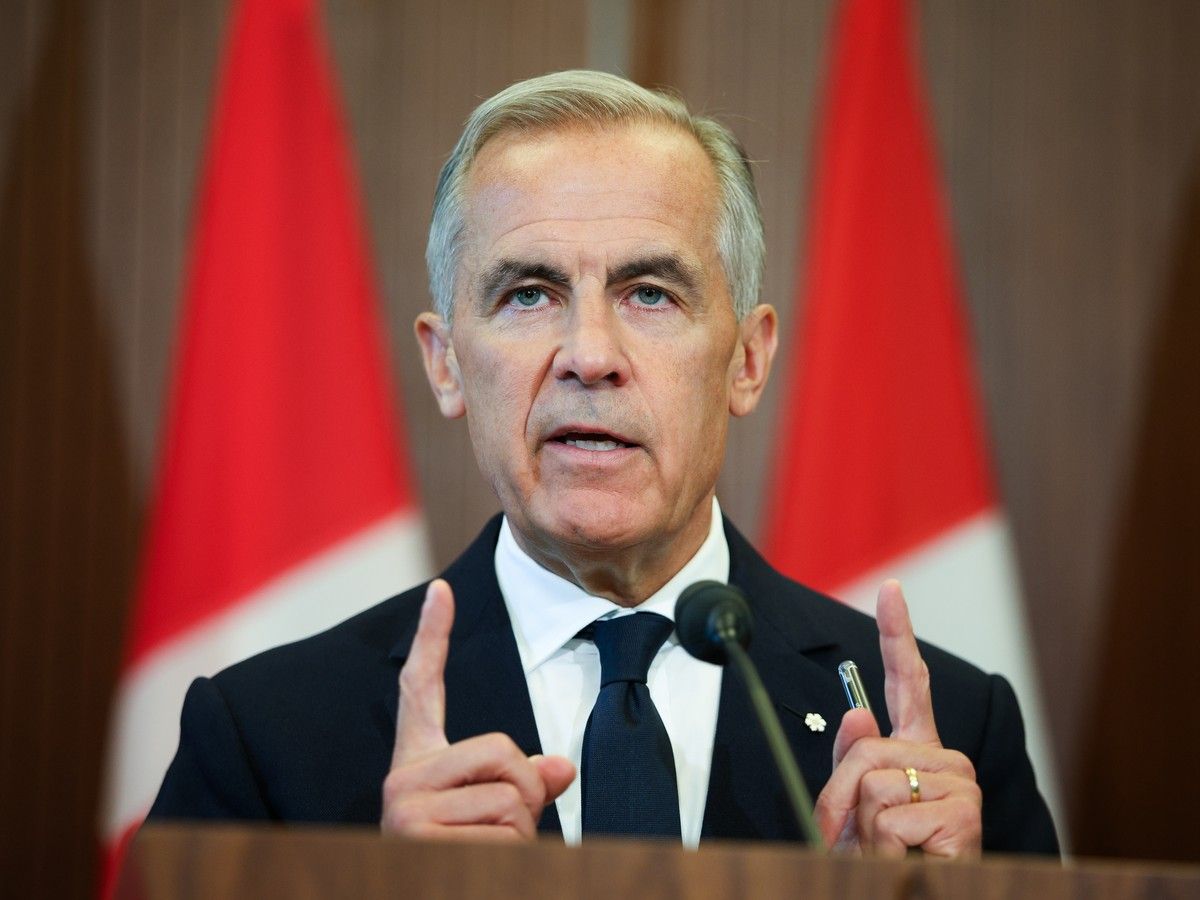
Letter writer David Green urges Prime Minister Mark Carney, left, and U.S. President Donald Trump to stop acting like two schoolboys

‘Bring this messy squabble over trade to an end’

Re: Trump wants trade — just not on terms anyone can decipher — Carson Jerema; and Canada wants free trade — only on its terms — Peter Navarro, both July 22

In the interests of freeing Canada and the U.S.A. to work together on solving critical global issues, both nations must quickly bring this messy squabble over trade to an end.

Let Canada and the U.S. both openly acknowledge that they need each other, that neither nation can operate efficiently saddled with unreasonable, ultimately destructive high tariffs and trade embargoes. Let each side tabulate the minimum set of reasonable trade rules that they need to make possible the efficient management of their affairs, note the trade rules where there is agreement, draw up a treaty framed around those agreements, sign it and get back to work running their respective country’s affairs.

Remembering the frequent spectacle of two kids duking it out in the school playground came to mind reading these two articles about the never ending tit-for-tat of the Canada-U.S. trade “negotiations.” The school teachers typically didn’t bother to intervene to stop the fights — nobody ever got hurt, we were very young, weighed very little and were friends again afterwards. But the thing was the fights usually just ended without the intervention of a referee, simply when the boys just agreed silently to call the pointless fisticuffs quits.

So who is the referee in these interminable thrusts and parries between the two nations of — adults? Why, it’s the electorates of course. In each of whom is vested the power of the vote. Unfortunately these two power brokers must wait for election time to render their decisions. But then again unfortunately, in Canada at least, our electorate has persistently exhibited an annoying habit of electing mediocre individuals to our nation’s highest office, resulting in a continuation of the same old childish, fruitless conduct.

As a super salesman, surely President Donald Trump has long ago learned the wisdom of the age-old dictum that a customer will come back for repeat business if both he and the seller always end up winners, i.e. each party gets what he wishes for, or close to it. If the seller tries to get a big win at the expense of the customer, he can say good bye to that customer.

But even if Canada is short-changed by Trump, as often seems a highly likely outcome, it will still need to do business with the U.S., albeit while harbouring deep resentment. Prime Minister Mark Carney then will be motivated to seek alternate trade partnerships, a quest he appears to be pursuing with potentially dubious actors.

This performance by two mature nations, each sitting on the other’s front doorstep, is rank childishness. The peoples of the two nations deserve better. At least the two school boys had the common sense to admit when their fisticuffs were pointless, and to quit.

David Green, Thornhill, Ont.


Freeland versus the ‘bully in chief’

Re: Freeland calls Trump ‘bully in chief’ in scathing rebuke: ‘Canada must fight back’ — Chris Knight, July 28

Chris Knight quotes Chrystia Freeland as saying that Donald Trump’s “Blame Canada” tactics remind her of “the pathetic human tendency to point fingers at someone — anyone — else for our own failings.”

That may be an instinct for some people, but Freeland should remember that as finance minister and deputy prime minister, she was an integral part of Justin Trudeau’s 10-year reign of economic failures that we, our children, grandchildren and great-grandchildren will be paying for, with no end in sight.

It’s not Trump’s fault that, had Freeland and Trudeau not squandered a great chance to develop our oil, minerals and other resources, we would not be in this weak financial situation today and would be in a better position to respond to the tariffs. Maybe she should look in the mirror instead of blaming other people.

Ed Lacelle, Gatineau, Que.


Fauci wise to plead the 5th

Re: Fauci invokes Fifth Amendment as Republicans go on attack at U.S. Senate COVID hearing — Aidan Williams, July 29

At a July 29 U.S. Senate committee hearing focused on the COVID-19 pandemic response, Republican members of the committee repeatedly tried to question Dr. Anthony Fauci, who has long been a target of the committee chair, Republican Sen. Rand Paul. Fauci answered questions by invoking the Fifth Amendment of the U.S. Constitution. The former chief medical adviser to the president even refused to answer a question about what day of the week it was.

Back in the 1950s, Republican Sen. Joseph McCarthy and his aides tried to catch “commies” the same way. It was learned by citizens who were questioned that even answering a question about their name could lead to other questions that they were obliged to answer. The technique was to ask a question that appeared innocent but led to a series of related questions that gradually become a trap.

The U.S. “justice system” is — as Conrad Black has observed — dangerous. Fauci is now being threatened with contempt charges. Fortunately he has an able lawyer.

Charles Hooker, East Garafraxa, Ont.


Good luck with government-run grocery stores!

Re: Toronto bungles transit, now wants to sell groceries — Matthew Lau, July 28

Toronto need only look to Newfoundland to see the joys of government-run food services. In 1995, Newfoundland’s Health Sciences Centre opened a Tim Hortons with a prediction of annual profits of up to $300,000, which would pay for seven nurses — or 11 support staff, or maybe even help pay for chemotherapy drugs for cancer patients. The doughnut shop was closed in 2012 amidst annual losses of $260,000.

“Let me tell you why (the hospital franchise loses money),” Vickie Kaminski, the health authority’s president and CEO, told reporters. “We charge you a buck-ninety-four for that large coffee, but we insist that the staff who are pouring the coffee are Eastern Health staff, and they get paid $28 an hour. No Tim Hortons pays that.”

Money that should have gone to patient care was instead used to subsidize coffee and muffins. Good luck, Toronto!

John P.A. Budreski, Whistler, B.C.


Don’t blame these boomers for Liberal government

Re: Boomers drunk on CBC are the source of Carney’s power — Amy Hamm, July 24

Regarding Amy Hamm’s column, in which she blames “out of touch” boomers for being responsible for keeping the “rotten” Liberal party in power, my husband and I are in our 70s and neither of us, nor have any of our friends, voted Liberal. We all think the Liberal party has ruined Canada. We all always vote Conservative, and I am insulted at being stereotyped!

J.M. Jung, North York, Ont.


Step up water bomber production

Re: France is desperate for more Canadair water bombers but the wait is long — Ty Ferguson, Agence France-Presse, July 28

The words “crisis” and “emergency” are tossed around with reckless abandon when it comes to climate policy. We have seen critical deadlines and catastrophic predictions come and go, yet the same voices continue to issue new warnings.

During the Second World War, Ford Motor Company’s Willow Run Bomber Plant in Belleville, Mich. (now a flight museum ) was producing a four-engine B-24 Liberator bomber every 63 minutes. The world faced an existential threat, and the industrial response was immediate, massive, and measurable.

Today, we are told that climate change represents an equivalent existential threat. Yet when it comes to manufacturing one of the major weapons in the fight against increasingly severe wildfires — Canadair water bombers — we produce only 10 planes per year.

If this is truly an emergency, why does the pace of production look anything but urgent? Either the threat does not warrant the language being used, or governments have failed to respond with the sense of urgency that the word “emergency” implies. In either case, the disconnect between the rhetoric and the action deserves an explanation.

Glen Leis, Aurora, Ont.


U.S. cutbacks related to food safety cause for concern

Re: Michigan reports first U.S. deaths related to cyclosporiasis outbreak — Rachel Roubein and Lena H. Sun, The Washington Post, Aug. 4

The unsolved origins of the cyclosporiasis infection that has afflicted Americans in 45 states since May highlights the risks Canadians face even now under CUSMA and will face to a higher degree if the U.S. is allowed to export foods to Canada in new trade agreements without new restrictions.

Donald Trump’s administration has reduced staffing at the U.S. Centers for Disease Control and Prevention (CDC) required to trace the sources of pathogens. In addition, it has suspended quality-control programs for food-testing labs, weakening food safety oversight; implemented budget cuts; and reversed or stalled steps on pesticide and environmental protection.

One would assume that trade negotiators would be cognizant of the dangers that have been created and ignored by Trump’s personnel and budget cuts. Still, Canada must insist that all foods imported from the U.S. meet Canadian food safety standards, as I am sure we do with all other importing countries.

Don J. MacWilliam, King, Ont.


Let consumers decide if they want to buy U.S. booze

Re: Of course we should not put U.S. booze back on shelves — Scott Stinson, July 23

Columnist Scott Stinson says we shouldn’t be putting American booze back on the shelves. I respectfully disagree.

I am tired of governments telling me what to do, what to buy, what not to buy, what I can eat, what I cannot eat, what to drive, where to live, where to take a vacation, where I can walk. And especially how to raise my children and what they should learn in school. If Ontario Premier Doug Ford and B.C. Premier David Eby want to try to convince me to forgo California wine and Kentucky bourbon, they can go ahead and make their best case. But try influence and logic instead of fiat and prohibitions.

How about letting Canadians decide for themselves what to do, what to say, and what to think? I bet that, with the right messaging, the vast majority of Canadians would, all by themselves, choose not to drink U.S. booze after all. That way, Donald Trump wouldn’t be able to blame our governments for the actions of ordinary Canadians. That’s an old-fashioned win-win right there.

Lloyd Vinish, Kelowna, B.C.


Naheed Nenshi bends a knee

Re: Naheed Nenshi bends the knee to Avi Lewis and the far left, Rob Breakenridge, July 20

Naheed Nenshi succumbed to political pressure to distance himself from the Jewish community and from Israel. Should Canadians blame him for this cowardly behaviour? Of course. However, what is equally shameful is the silence of other politicians regarding this incident. Nenshi’s letter of apology for circulating a photo of himself with the Israeli Ambassador was simply a reaffirmation that the rampant antisemitism across Canada is quietly, and sometimes not so quietly, supported by too many of our political leaders.

It is time for Canadians to support and vote for individuals with the courage and moral backbone to stand up to those who push against the core values of our country: honesty, tolerance and fairness (for each individual and each group); egalitarianism, mutual respect, and the rule of law.

Canada once prided itself on the success of multiculturalism. Weak-kneed politicians like Nenshi undermine that success. The majority of Canadians value a fair and democratic Canada. We must work together to ensure politicians like Nenshi and his ilk do not get re-elected. We deserve better.

Phyllis Levin, Toronto


EDITOR’S NOTE: Letters to the Editor will return on Sunday, Sept. 30


National Post and Financial Post welcome letters to the editor (250 words or fewer). Please include your name, address and daytime phone number. Email letters@nationalpost.com. Letters may be edited for length or clarity.


People at the Sturgeon County Centre in Morinville, Alta., protest Meta’s plans to build a $13-billion data centre north of Edmonton on Aug. 2.

There’s a good chance you came across this column after it was shared on social media or elsewhere online, which means reading these words relies on the processing power of data centres. But as dependent as we’ve become on dedicated information technology facilities to sustain our very virtual modern world, the proliferation of data centres has inspired a backlash. Some of it is plain Luddite resentment of technology, especially the bogeyman of artificial intelligence. And most of it is poorly informed, raising overblown worries about power and water consumption.

Data centre investors should certainly fund their projects without taxpayer subsidies. But the facilities are part of the future, even if opposing them is big political business across the partisan spectrum. Last month, U.S. Rep. Alexandria Ocasio-Cortez told a congressional committee: “Ask Peter Thiel, ask Elon Musk, ask Mark Zuckerberg if they want one of these data centres in their own backyard,” before detailing the alleged horrors of an xAI complex in Memphis.

It’s true, of course, that those tech giants, like most people, would probably prefer to not live next door to a data centre. Unmentioned by the New York socialist, though, is that most people would even more strongly oppose living in proximity to a chemical refinery, steel mill or pig farm. Many objections people raise to data centres apply to these types of facilities, as well. That, of course, is why most people choose to live away from industrial and commercial operations, even though factories and farms are necessary for our civilization.

Notably, Colossus, the Memphis data centre to which Ocasio-Cortez objects, is located on a pre-existing industrial site. “The Electrolux site seemed ideal to xAI: in an industrial zone, proximate to a power plant and a wastewater facility,” Time reported last year. And while the congresswoman frets about the complex’s “methane turbines,” those were installed so the facility can generate the electricity it needs without overburdening the grid — a common complaint about data centres.

Alanna Hnatiw, the mayor of Sturgeon County, a municipal district on the outskirts of Edmonton, raised similar concerns about noise, power and water usage, in response to a planned data centre in Alberta.

Those objections are typical. In a recent piece on the evolution of the opposition to data centres into “a new political movement,” Politico noted that the anger is, in part, “rooted in concerns about the millions of gallons of water per day data centres can draw or the vast amounts of electricity they require.” Opponents frequently worry that building new data centres will increase demand for electricity and raise prices for all users.

But that fear is misplaced. “There is no statistically significant correlation between the number of data centres in a state and its current electricity prices,” the Institute for Energy Research reported in March. “In fact, prices in the top 10 data centre states are virtually identical to the average across other states.”

Contrary to common concerns, the institute’s researchers found that, “Across all 50 states, states where electricity sales grew faster from 2015 to 2025 paid less, not more, for electricity.”

The Independent Institute’s Paige Lambermont believes this is because “spreading the fixed costs of the power grid across new entrants can help lower costs.” New data centres help pick up the substantial costs of power-grid infrastructure and fund maintenance, as well as increased power generation.

Concerns about water usage are similarly overblown, writes AI researcher Andy Masley. He points out that data centres require water, electricity or both for cooling servers. Closed-loop cooling systems return around 90-95 per cent of their water to the system for treatment but involve greater power consumption and complexity than older evaporative systems, according to the Florida Water & Pollution Control Operators Association. The right balance for any given facility depends on the availability of local resources.

While many skeptics claim the water consumption of individual data centres is equivalent to that of a small town, that’s not saying much. Looking at forecasts of water consumption in 2030, Masley estimates that, “The water all American data centres will consume onsite in 2030 is equivalent to … eight per cent of the water currently consumed by the U.S. golf industry” or “the water usage of 260 square miles of irrigated corn farms, equivalent to one per cent of America’s total irrigated corn.” That’s not to say that specific data centres can’t strain local resources, but the same can be said of any large-scale operation.

What helps make data centres a bigger flash-point than electric vehicle plants or chicken processors are separate but related worries about artificial intelligence. People look at data centres and think less about their accounting software and social media accounts than about fears of doom resulting from the rise of self-aware computers. Frankly, these fears echo the machine-smashing Luddites of the 19th century.

While she’s generally supportive of the economic boost expected from the planned Edmonton-area data centre, Mayor Hnatiw also voiced worries about “generative AI” using that processing capacity. Likewise, Politico quoted anti-data centre activists on the left and the right who fret over AI and tie their objections to the facilities to demands for regulation of artificial intelligence. A Democratic state lawmaker in Tennessee even cited the Luddites as a model.

George Mason University economist Tyler Cowen considers these fears misplaced and sees AI and the data centres they require as a potential net boon to human prosperity. He warns that if the U.S. or other governments restrict AI and data centres, “progress would continue with open source models in China, and eventually in other parts of the world as well.” Those areas that resist calls to regulate will gain the jobs, the technology and potentially (think China) access to the information running through data centres.

Which is to say that data centres aren’t problem-free, but their challenges are the same as those for any sort of intensive commercial activity. If you want a civilization, you embrace the trade-offs civilization requires and deal with the real — not imagined — problems that arise.

National Post


Two children look at the damage done to Nöam restaurant in a suspected arson attack, in Montreal on Aug. 1.

It is so damn obvious that it feels unnecessary to say it: the Jewish people have given so much to Canada.

Their names are on many of our leading institutions, some of our best-known literature, music and art, and on Nobel prizes. They are leaders of some of our most successful businesses. They are our doctors, our teachers, our lawyers. They are our friends and our family.

Canada owes much to its Jewish community who, in recent decades at least, found this country to be among the very best places to live a full and openly Jewish life.

And yet, all Canadians need to understand that the community’s future here is at risk. Many Jews say they are contemplating leaving, or have already left, because of the sudden and largely unchecked rise of antisemitism. How Canada responds will determine what kind of country this will be.

The perversion of public perceptions of the Israel-Hamas war sparked by the October 7 massacre, the deadliest day for Jews since the Holocaust, has echoed around the world, but few places have changed as much as some Canadian cities.

The stories are well-known: Jewish institutions and businesses have been firebombed and sprayed with bullets. People have been accosted in the street for being openly Jewish. Many Jews feel ostracized from their workplaces, especially if they work in academia.

“None of this has ameliorated the suffering of Gaza’s inhabitants or helped ‘free Palestine’ — whatever that means,” Torontonian Harry Khachatrian wrote in the Wall Street Journal this week in a story headlined, Canada Has An Antisemitism Problem.

“Yet politicians at every level keep responding with the same platitudes: ‘Antisemitism is vile and unacceptable.’ ‘Hate has no place in Canada.’ Apparently it does. Antisemitism has secured a comfortable suite at the Four Seasons.”

There is now a divide among Canadian Jews.

There is a growing and noisy cohort who are leaving Canada amid rising antisemitism, or considering doing so. The Canadian Press reported this week that a group out of Oklahoma called Tulsa Tomorrow is aiming to recruit Canadian Jews to the city, amid calls for the Trump administration to offer asylum to concerned Jewish-Canadians.

But there is another cohort that sees the same symptoms, and has decided to stay and fight.

This dichotomy was illustrated this week in an exchange between two prominent Jewish-Canadians. Gad Saad, a best-selling author and academic, wrote on social media that he left for the United States, in part because “Jew-hatred” in Montreal “is palpable, at the soccer field, on university campuses, in street protests.”

In response, Harley Finkelstein, the president of Shopify, Canada’s biggest tech company, acknowledged that his family had thought about leaving, but added: “We decided to stay because Jews do not secure a better future by abandoning it. We build it.”

A network of civil society groups have brought together non-Jews for the cause of building that future, Upstanders Canada and Allies For A Strong Canada among them. In June, dozens of senior business and political leaders who aren’t Jewish signed an open letter seeking stricter enforcement of anti-hate laws.

The letter, which appeared as an advertisement in newspapers including National Post, features a quote from Prime Minister Mark Carney’s speech to Jewish community leaders on June 1 at Holy Blossom Temple in Toronto: “It requires all of us to raise our voices in disgust and defiance when we see the ugly face of antisemitism.”

The business leaders’ call to action includes three recommendations for “our roadmaps forward,” which include a “zero tolerance for hate,” “consistent enforcement of anti-hate laws” and “discipline in public discourse.”

“Words from political leaders matter. This is not about restricting free speech,” the document reads. “No Canadian should be threatened, harassed or attacked because of their faith.”

All Canadians need to hold Mark Carney — and every political leader who has called out antisemitism and followed up with little else — accountable.

At Holy Blossom, Carney admitted that Canada is failing its Jewish community and launched the Advisory Council on Rights, Equality, and Inclusion, which he tasked with “addressing antisemitism.”

Some of the people Carney chose to run the council are not popular choices. This includes Omar Alghabra, former head of the Canadian Arab Federation — an organization that, after his tenure, advocated for Hezbollah and Hamas to be removed from Canada’s terrorist watch list.

The prime minister also said the council’s first order of business would be to “reassess the nature, scale and drivers of antisemitism in Canada,” even though the root causes of Jew-hate are, by now, well known. All this gave the impression that the advisory council was intended to do little more than create the appearance that the government is taking this issue seriously, when in fact very little is actually being done.

And indeed, two months after Carney’s big announcement, Jewish businesses are still being shot at and burnt to the ground, Jewish athletes are subjected to racial slurs and synagogues continue to be vandalized .

Carney and other political leaders need to get behind those who believe in Canada and start treating this as the national emergency that it is. This nation is already worse off for the people who have fled.

Pat Johnson of Upstanders Canada says: “We are not outnumbered. We are out-shouted.” The vast majority of Canadians who support their Jewish friends, family and neighbours need to shout louder, and to demand action.


Former British Prime Minister Winston Churchill

DEVÍN, Slovakia — The name lasted much longer than the reality. Which is perhaps not surprising given who did the naming.

It was 80 years ago that Winston Churchill gave his Iron Curtain speech in Fulton, Mo. — formally titled, “The Sinews of Peace.” The Iron Curtain itself would be torn down 43 years later. While the Berlin Wall was its archetypal symbol, there were other points of maximum opportunity — and mortal danger.

Devín, in western Slovakia, draws visitors today due to the impressive ruins of Devín Castle, which tower above the town. (Napoleon’s retreating armies tore it down in 1809.) During the Cold War, some came here for other reasons — to make a break for freedom, or to break those who desired to be free.

Some of the more important folds of the Iron Curtain fell here, at the confluence of the Morava River and the Danube. Cross either river from what was then Czechoslovakia and there was freedom in Austria. The border was thus heavily fortified, complete with communist police and their barbed wire and their dogs.

The Morava is perhaps 15 metres wide here, a short but perilous crossing. There is a monument now to the 400 people shot dead who tried to cross. It records that Queen Elizabeth II visited in 2008, honouring their memory.

Churchill was not yet Her Late Majesty’s first prime minister when he travelled to Missouri to speak in 1946. Indeed, he was not even Sir Winston. U.S. President Harry Truman made the trip from Washington, D.C., to his home state to fete Churchill, less than a year after Churchill lost the July 1945 election. Still leader of the Opposition, Churchill was nevertheless in valedictory mode, albeit prematurely.

“The president has told you that it is his wish, as I am sure it is yours, that I should have full liberty to give my true and faithful counsel in these anxious and baffling times,” Churchill began. “I shall certainly avail myself of this freedom, and feel the more right to do so because any private ambitions I may have cherished in my younger days have been satisfied beyond my wildest dreams.”

The old man still had dreams, in fact. He returned to the premiership in 1951, and the knighthood would follow in 1953. But he spoke in 1946 with remarkable clarity about threats to peace, permitting himself to observe that had those in power paid heed to his warnings about Nazi Germany in the 1930s, war might have been avoided altogether.

Less than a year before the Iron Curtain speech, Britain, Canada and the United States were allies of the Soviet Union in war.

“I have a strong admiration and regard for the valiant Russian people and for my wartime comrade, Marshal Stalin,” Churchill allowed, speaking of the need to “welcome Russia to her rightful place among the leading nations of the world.”

Nevertheless, Churchill felt obliged to “place before you certain facts about the present position in Europe.”

Communist tyranny was the new threat, and thus the lapidary phrase:

“From Stettin in the Baltic to Trieste in the Adriatic, an iron curtain has descended across the continent. Behind that line lie all the capitals of the ancient states of central and eastern Europe. Warsaw, Berlin, Prague, Vienna, Budapest, Belgrade, Bucharest and Sofia, all these famous cities and the populations around them lie in what I must call the Soviet sphere.”

Here in Devín, it is the inclusion of Vienna that resonates. Until 1955, when Austria was granted independence, Vienna was similar to Berlin, administered by the four allied powers, including the Soviet Union. In 1946, a Berlin-like future was a possibility, with perhaps a wall in Vienna, the city of the waltz.

The free world instead faced the enslaved nations along the Czechoslovakian-Austrian border, along the Morava and the Danube. From the heights of Devín Castle, it is possible to see both Bratislava, and the outskirts of Vienna in the distance. A scenic, tranquil, 45-minute catamaran ride separates them today; during the Cold War the waters were rife with suspicion and terror.

It ought to be possible to see with greater clarity here, from the heights, as clearly as Churchill did, “the two great dangers which menace the homes of the people: war and tyranny.”

Yet in Slovakia, the government prefers not to see the reality of the Russian threat, immediately to the peace and security of Ukraine, and more broadly to the peace and security of Europe.

Churchill warned in 1946 about the threat of aggressive Russian imperialism. It had survived the fall of the tsar and rise of the Bolsheviks. It has survived anew the fall of the Bolsheviks and the rise of a gangster state.

The line no longer runs between Austria and Slovakia, and Ukrainian courage these last years likely means that the line will remain far to the east. That courage is rooted in strategic wisdom and moral clarity. At the confluence of the Morava and Danube both were required for many years, and both prevailed in part because the warnings of Churchill, who had been ignored in the ’30s, were heeded in 1946.

National Post


Thousands turned out for the Nagar Kirtan Parade in northeast Calgary on Saturday, May 9, 2026 to mark Vaisekhi.

On Thursday morning, the Supreme Court of Canada delivered a little surprise package: it has agreed to entertain the Alberta government’s appeal of Wirring v. Law Society of Alberta, a 2025 decision in which the province’s appeal court struck down the requirement for prospective lawyers to take an oath of allegiance to the sovereign.

Prabjot Wirring, an Edmontonian, finished articling and thereby qualified for the Alberta bar in 2022. He claimed in court — creating some analytical complexity and confusion about his religious beliefs — that he wasn’t aware that practicing law in Alberta required him to swear allegiance to anybody or anything. He had no problem taking two other professional oaths that require lawyers to serve the public interest and treat their clients properly.

It was the particular concept of allegiance that gave him a problem of conscience, because Wirring is a baptized “Amritdhari” Sikh. This is a higher-level commitment to religious purity within the Sikh faith, a holy order that involves a special ceremony of consecration, and in Wirring’s view he is forbidden from taking any oath that could conflict with his Amritdhari status, such as pledging loyalty to an earthly prince. He could not be swayed by fancy metaphysical arguments that the oath is a promise to uphold a constitutional order, rather than a particular regime or a literal person. An Alberta chambers judge dismissed Wirring’s Charter challenge to the statutory allegiance oath, but the Alberta Court of Appeal upheld it in December 2025.

Wirring had, in the meantime, used a side door into eligibility for the Alberta legal profession. In the spring of 2023, the Alberta government passed a regulation that allowed members of other provinces’ legal bars to transfer their credentials directly. Wirring was able to join the bar of Saskatchewan, which has no requirement for an oath of allegiance, and simply transpose to Alberta without any further ado.

No doubt this will be a problem for Alberta when the Supreme Court re-does the good old Oakes test and tries to decide whether the province’s oath, and the problems it created for Wirring, have a bona fide justification. If the state willingly makes the allegiance oath escapable by a simple bureaucratic subterfuge, it probably cannot argue that the purpose of that oath has a super-compelling character.

On the other hand, this little affair is just one manifestation of a general and chronic problem with “religious freedom.” If Wirring’s private “religious” commitment has political implications, as it appears to, how far must the state go to accommodate those? A person might invent a religious faith with all sorts of behavioural requirements: we can imagine a Church of Effective Altruism whose adherents are obligated to steal money, perhaps from rich legal clients, and donate it all to shrimp welfare .

Does this suggest that tests of “religious freedom” are really just social tests of what religions are legitimate — which ones are worthy of state protection above and beyond those attaching to individual conscience? And does Wirring’s special inner-circle form of the Sikh religion attract the same legal deference that the ordinary one does?

Most of the other provinces have abandoned the explicit oath of constitutional allegiance for lawyers, or made that oath optional, although that’s kind of a funny thing to do with an oath if you think about it. My six or seven readers who are fellow atheist-monarchists ought to recognize that the “Wirring Question” is a legitimately hairy one. The oath of Canadian citizenship, like the oath in the statute governing Alberta lawyers, still requires a declaration of “true allegiance” to the King of Canada. Whenever that oath has been challenged in court, so far, it has been upheld on the grounds that this statement — while seeming to demand obedience to a living, breathing human being — is really just a symbolic commitment to the Constitution. (A republican, I suppose, can take such an oath in good conscience because it is a pledge to the King and his “successors,” who might not be monarchs at all.)

One must admit that this talk of “symbolism” doesn’t quite remove the oath of allegiance from the realm of religion; it perhaps displaces it into a realm best described as civil religion. Which hints that the real Wirring Question is whether a liberal-democratic state can legitimately impose idiosyncratic elements of civil religion on citizens and on accredited state servants such as lawyers.

Normally, being conscious of our law’s heritage, we would look to Britain, and more specifically England, for clues to an appropriate answer. Funnily enough, the U.K. abolished allegiance oaths for lawyers completely, by statute, in 1868; this was a victory for classical liberalism after centuries of struggle over various religio-political tests including the Oath of Supremacy and the Oath of Abjuration . Even more funnily, the 1868 law was itself motivated by a widespread religious sense among the Victorians that having a complicated political structure of multiple holy oaths was disgusting, and amounted to mockery of God.

Over the remainder of the 19th century, the great hero of world atheism, Charles Bradlaugh, fought successfully in England for the principle that oaths could be replaced by “affirmations,” allowing unbelievers a loophole into political life and all secular professions. This option is in fact available under the Alberta Legal Profession Act, and was given to Wirring, but the difference in wording between “swear” and “affirm” didn’t seem to assuage his religious feelings. The core problem seems to be the notion of “allegiance,” but at common law all citizens were understood to owe allegiance to the sovereign, as part of a reciprocal obligation, whether we like it or not. Maybe this is some of the meat left on the bone that the Supreme Court apparently hopes to gnaw; I don’t know that anyone expected them to give leave to an appeal of Wirring at all.

National Post


SEATTLE, WASHINGTON - JULY 28: Sophie Cunningham #8 of the Indiana Fever smiles after the win against the Seattle Storm at Climate Pledge Arena on July 28, 2026 in Seattle, Washington. (Photo by Soobum Im/Getty Images)

The Women’s National Basketball Association (WNBA) has never been more popular than it is right now. Somewhat regrettably, this sudden WNBA craze has less to do with basketball than it does with a fresh culture war icon: Sophie Cunningham.

It started when Cunningham, that gorgeous Amazonian blonde and player for Indiana Fever, cheekily pointed her finger at an opposing player — for 22 long seconds, while maintaining eye contact — after her teammate was fouled. It was the stuff memes are made of. And it was indeed an immediate meme; even U.S. President Donald Trump’s White House staff shared a version of it on X. The WNBA then forbade brands and licensed merchandising partners from monetizing “the point” in any fashion, due to a rule about not cashing in on player conflict.

For weeks, Cunningham’s pointer finger was all over the algorithms, reminiscent of another blonde bombshell, Sydney Sweeney, and the notorious “white supremacist” blue jeans ad . Like Sweeney, Cunningham was accused — sometimes peripherally, and sometimes directly — of profiting from her skin colour and heterosexuality. “Her whiteness sells. Her whiteness and straightness in a time of nationwide anti-blackness and homophobia sell even more,” Guardian columnist Howard Bryant wrote , without a lick of evidence, of Cunningham. “She bathes in it,” he wrote.

(Is Cunningham supposed to apologize for being white and heterosexual? How could she possibly please anyone who detests her for her skin colour or sexual orientation? It’s impossible to say.)

Little did the public know, Cunningham’s pointer finger was only a prelude to a larger controversy over the inclusion of males in women’s sports.

Cunningham has been talking about protecting the women’s category since at least 2022 . She first spoke out about swimmer Lia Thomas, a biological male who competed against women — and whose University of Pennsylvania swim records were rightfully expunged in 2025, following a lawsuit and deal with the U.S. Department of Education.

But the pointing incident, and a July 2026 ESPN feature article , convinced those with woke sensitivities that Cunningham was not just a devilish white woman, but also a bona fide “ transphobe .” In the ESPN piece, Cunningham made her position explicit. “I want to protect young girls in a locker room, or young girls in sport who shouldn’t have to go against biological men,” she said.

Cunningham has since refused to retract her statement or adjust her position in any way. “I said what I said; I think it’s kinda common sense” she told one sports reporter. The subsequent calls for her cancellation, or even expulsion from the WNBA, have been raucous — but not, however, as raucous as the legions of fans supporting Cunningham’s reality-based views on biology and fairness. It is a joy to witness.

Wherever her team, the Indiana Fever play, rallies to support Cunningham follow. Her newly-released Adidas shoes sold out — in men and women’s sizes — in less than a single day last month.

She has inspired others to make her point (figuratively): American pundit Clay Travis has offered US$10 million (C$14 million) to WNBA defending champion team, the Las Vegas Aces, if they play and beat a boy’s high school basketball team of Travis’ choice, seemingly to make the obvious point that men have biological advantages. (Whether they take up his offer or not, his objective was met.)

For her part, Cunningham has proven to be a reluctant culture warrior. She has expressed that she feels “sad” that any political controversy is overshadowing her sport. While the sentiment is understandable, Cunningham should avoid looking a gift horse in the mouth.

Like it or not, women’s sports were already politicized by the widespread inclusion of males, all the way to the Olympic level . Thousands of women and girls across the globe have lost sporting opportunities and awards to males who have no business competing against them. We have to fight back.

And Cunningham is a spectacular pugilist. She is not “politicizing” sport — at all — by defending the female category; she is, in fact, arguing for the depoliticization of sport. Sports are about bodies, not gender identities. It is a twisted and obfuscating lie to suggest that politics only entered the ring when women decided to fight back against the invasion of our sports.

I hope that Cunningham will come to embrace that she can be an icon for two reasons: her athletic talent and her enormous appeal as a defender of women’s sports. That’s nothing to feel sorry about.

National Post


U.S. President Donald Trump, second from right, salutes before boarding Marine One as he departs after a cabinet meeting at Camp David on July 31. This content is reserved for subscribers.


Jason Arday is a “working class Black man,” a petition from the Good Law Project notes, in a typically British class-war flourish. The petition calls the allegations against Arday “groundless.”

A disgraced black professor accused of being a fabulist, and the shaming of formerly world-renowned Cambridge University proves the toxic, divisive and destructive power of the much-loved progressive practice of diversity, equity and inclusion.

Jason Arday, once the darling of academia, resigned as a professor of sociology of education at Cambridge on Wednesday after a week of being pummeled in the press in an ever-increasing escalation of exposés.

Arday, who at 37 became the youngest ever black professor at Cambridge in 2023, was feted for overcoming immense hardship and poverty in his early life. Autism and global development delay meant he didn’t speak until he was 11 and was unable to read or write until he was 18.

But in late July, Arday faced plagiarism accusations after The Telegraph newspaper reported that 100 passages of his PhD were remarkably similar to another thesis published six years ago.

Doubts have also been raised about some of Arday’s previous claims including running 30 marathons in 35 days; running 600 miles on a treadmill in six days; raising £5 million ($9.4 million) for charity; being the target of knife-wielding intruders; being sent a pig’s head as a threat; playing snooker and soccer to a professional level and publishing a book called Being Young, Black and Male: Challenging the Dominant Discourse.

Of the plagiarism, Arday said his autism made him rely on mimicry to make sense of information and citation errors were the result of inadequate supervision. He has also defended his running records (although he said the 600 miles was actually run over 12 days), said the charity money was raised with others and claimed that reports of him having a professional sports career were the erroneous transcription of an interview he gave.

He told The Times newspaper that he was not a liar or fantasist and that he was subjected to a “dark arts” campaign at Cambridge that was “racially motivated” while also being a “lightning rod” for those who denounced diversity, equity and inclusion (DEI) practices.

John Moores University in Liverpool, where Arday was awarded his PhD, said it conducted a “confidential procedure” last year and cleared the professor after concerns were raised. Cambridge University originally told the Telegraph that Arday was the subject of a “vile campaign,” but on Wednesday it announced it was launching an investigation “following new information about Professor Arday’s academic qualifications and honorary appointments.”

There are lessons for Canada amidst this ugly and divisive scandal. One, is that hiring people based on DEI factors is not good for business and can be extremely harmful to reputations. And yet, our institutions and public sector are rife with this woke nonsense.

A prime example is the advert for a director of business planning put out by British Columbia’s Provincial Health Services Authority (PHSA).

Under qualifications, it says applicants must demonstrate “knowledge of the historic and ongoing impacts of settler colonialism on Indigenous Peoples in social and health contexts.” It goes on, “Additionally, it involves embedding Indigenous Cultural Safety and Humility, and an advanced expertise and unwavering dedication to engaging with diversity, centering equity, and advancing inclusion (DEI).”

Putting aside what it means to embed “Indigenous Cultural Safety and Humility,” why should a director of business planning, or anyone, have to pledge “unwavering dedication” to what amounts to a Marxist ideology?

The PHSA adds, “We invite applications and enquiries from all people, particularly those belonging to the historically, systemically, and/or persistently excluded groups identified under the B.C. Human Rights Code.”

The PHSA doesn’t appear to want the best or the brightest, but merely the ideologically aligned. It seems less concerned with whether a person has a sound financial background than they are a member of the DEI cult.

Another lesson in the Arday case is the power police are giving themselves to investigate complaints that aren’t even criminal.

London’s Metropolitan Police investigated a journalist for four months after a claim that he harassed Arday by emailing him questions about plagiarism. Police decided not to act, but told the journalist not to contact the professor because his mental health had been affected.

In a letter to the force, Toby Young, general secretary of the Free Speech Union, said, “None of this was any of the police’s business.”

Only recently, has the U.K. abandoned investigating non-hate crime incidents (NHCI) because officers were increasingly being used to police social media posts.

Unfortunately, Edmonton Police have now taken on the role of monitoring people’s language. In a social media post that has since been deleted, Edmonton Police urged people to anonymously report speech that “hurts” people.

The force has created an online snitch line and says, “All Hate Motivated Incidents filed using the Online Reporting System will be reviewed by Hate Crime Investigators.”

“Hate motivated” incidents are defined as non-criminal actions committed against a person or property motivated by hate bias or prejudice. The force gave examples including offensive jokes, name-calling and verbal insults.

As Toby Young would say, “None of this is any of the police’s business,” a point equally made by Alberta Premier Danielle Smith and Justice Minister Mike Ellis.

Smith posted on X, “In Alberta we believe in free speech. Full stop.”

And Ellis posted , “Alberta’s government does not condone hate speech or violence, but we believe law enforcement should be focused on stopping violent crime, not policing opinions or ‘hurt feelings.’”

The Arday case has made fools out of a lot of people. Edmonton Police and the PHSA should take note.

National Post


“I really felt like the Liberal Party had not reconciled enough with its past,” says Eric Lombardi, who is running for the leadership of the Ontario Liberal Party.

Near the end of an hour-long conversation at a downtown Toronto coffee shop, Eric Lombardi lets slip something that would raise the hackles of many of the people he needs to woo to become the next leader of the Ontario Liberals.

“There are many Conservatives for whom I am their favourite Liberal,” he says.

Lombardi, a 32-year-old engineer and housing advocate, has never been elected to public office. He’s never run for office before. But he’s running to lead the once-mighty Ontario Liberal Party as a classic outsider candidate, willing to criticize those that have gone before him instead of making his entire campaign about the evils of Doug Ford.

Over the course of our discussion, he mentions topics like merit-based hiring and restoring public order in downtowns that would at least raise some eyebrows in Liberal circles. But he says he thinks the party is ready for such honest talk.

After a third straight defeat to Ford’s Progressive Conservatives, Lombardi says, “I really felt like the Liberal Party had not reconciled enough with its past. We’re losing the foundation of liberal values in the small-L sense, and I think that there’s an appetite for change, something different. I think something a bit more serious. And I personally think that there’s a lot of conservatives in Ontario that are looking for an alternative to Ford as well.”

Born in Oakville and educated at the University of Waterloo, Lombardi worked in financial technology in Silicon Valley after graduation, and had first-hand experience with the lack of housing supply in that part of California. He moved back to Toronto after the pandemic, concerned that the same forces were being felt here.

Wanting to work for housing reform, “I found New York communists on the left, and really ineffective industry lobbying organizations on the right, and it was like, who’s actually making the economic, social, and cultural case for things we actually need to do?” Lombardi says. “Not like banning foreign buyers, but land-use reform, permitting reform, tax reform, municipal finance reform — all these things that are critical parts of why we have so dramatically failed on this issue.”

He started his own organization, More Neighbours Toronto, which led to some Liberal policy work and eventually the decision to try his own hand at politics. Of the leadership field, which includes former federal cabinet minister Navdeep Bains and current MPPs Lee Fairclough and Stephanie Bowman, “I didn’t personally feel like they were going to offer much different than Liberal politics of the last 20 years,” he says. “If I look at this race, everyone’s kind of doing the same kind of cautious, ‘comms up front, ideas behind’ approach to policies in politics that I think has really undermined our ability to talk about the things we need to (talk about).”

If there’s a defining feature of Lombardi’s campaign to this point, it’s that his is very much ideas-in-front. He has a detailed platform that runs to more than 100 pages, which has earned him criticism from party stalwarts who think he should be getting feedback from Liberal members before dictating his would-be policies.

But he says it’s about being transparent with those same people. “My path in this leadership race is not convincing every existing long-time Ontario Liberal to vote for me, but how do I put real things in writing that some people just really want to see happen? And that signals to them that there’s someone that cares about the issues that they do and is willing to champion them.”

And what are some of those issues?

“I believe that we need to have merit-based hiring practices in our public sector and public institutions because the recent trajectory has alienated a lot of people,” he says. “I believe in the role of competitive markets to drive wealth creation, and that we need to tax that efficiently and fairly to provide a level of human welfare befitting an organic society. I believe in the role of public order and the importance of that in creating public trust — and so when we don’t properly manage security, it’s not just about, for example, the dignity of people who are suffering on so many of the streets in our urban centres. It’s also about our ability to use and appreciate public spaces, regardless of what class or background that you come from.”

Cleaning up public spaces, of course, is the kind of thing Premier Ford would support, and his government is running television ads that say pretty much that. Which will make it interesting to see how the Ontario Liberals take to Lombardi as the leadership race begins in earnest. (The first debate is on Aug. 10; Liberals will choose their next leader in late November.) The contest has already chewed up one perceived outsider, as former MP Nate Erskine-Smith abandoned his leadership bid when he failed to win a byelection nomination in Scarborough. (He said provincial party staff were actively working against him.)

Lombardi says that he has largely felt welcomed by the party and party members, even if caucus endorsements have so far gone to Fairclough and Bowman, the sitting MPPs. As for criticism that he is not “Liberal” enough?

“I don’t take lessons in what liberalism is from the socialists who just want power,” he says. “Many of these voices who are criticizing me are criticizing me from a point of illiberalism, and what they don’t like about me is that I am actually offering liberal solutions to the challenges that we’re facing. So, to these kinds of critics, you don’t get to be the definers of what this party is.”

But can someone who is relatively new to party politics be the person to rebuild a party? Lombardi sees his outsider status as an asset: someone who isn’t used to doing politics in the traditional way. He points, for example, to the trend in which elected office turns otherwise successful, independent people into pliant vessels for the wishes of their leader.

“Then we see their MPP legislation is ‘Let’s celebrate the day of whatever’ and it’s completely demeaning to everyone involved,” he says.

Lombardi is far from alone in taking a close look at politics in this province, and country, and deciding that the system seems almost designed to fail. But not many choose to try to fix it themselves.

“We have an extremely incurious political class in this country,” he says. “I think we sometimes have a media that really fails to ask the next-level question, and we have a very good ordinary person who is basically unrepresented in most of the political discourse that we have today.”

He says he’s in the race to represent those ordinary people. The big question is how many of them will vote in the Ontario Liberal leadership campaign.

sstinson@postmedia.com


Mount Sinai Hospital in Toronto on Wednesday, May 27, 2026.

Kavita Algu, a former palliative care doctor at Toronto’s Mount Sinai Hospital, recently quit after a workplace investigator found her to be disruptive and unprofessional, which the Toronto Star would like you to believe is some kind of injustice. Judging from the Star’s own “investigation” and Algu’s activism, this couldn’t be further from the truth.

According to the Star’s investigation, Algu “was never told specifically what she did wrong.” She was just a physician who engaged in Palestinian advocacy and “ultimately felt she had no choice but to leave a career she had spent years building.”

The Star’s Shree Paradkar notes that Algu wasn’t a particularly experienced public speaker when she spoke at a Toronto rally in 2024, but that she “felt obligated to speak out about the destruction of a health-care system,” which apparently included suggesting that Israel was targeting staff and patients in hospitals and committing “genocide” against Palestinians.

Of course, this wasn’t the only time that Algu had made such accusations. Less than three months after Hamas’s October 7 attacks, Algu wrote an op-ed for Spring magazine, which refers to itself as “a magazine of socialist ideas in action,” arguing that health care in Gaza was being “specifically targeted including bombings of ambulances and hospitals and sniper attacks on medical professionals.” She then suggested that what was happening in Gaza was a “textbook case of genocide.”

Algu has made numerous posts on X that would cause most reasonable people — especially Jews working at a historically Jewish hospital that was founded because they could not get jobs and health-care services elsewhere due to antisemitism — to raise an eyebrow.

Responding to comments made by Foreign Minister Anita Anand in July 2025, Algu equated Hamas, a recognized terrorist group, with the Israeli government, writing on X: “You say ‘Hamas must release all hostages, lay down its arms and play no role in…governance’. Should Israeli government officials do the same? Some of whom are wanted by the (International Criminal Court)?”

Of course, there is no evidence that Israel is committing a “genocide” in Gaza and there has been no finding of such by any credibly international body. Moreover, the International Criminal Court prosecutor who issued those warrants for Israeli officials was forced to resign last month over a sexual-assault scandal and allegations that Qatar promised to “look after” him if he set his sights on Israeli Prime Minister Benjamin Netanyahu.

More recently, in response to a BBC News report in June, Algu wrote on X: “We all watched every single hospital and university in Gaza be bombed by Israel and the entire civilian population tortured and starved — while you have been telling us the slaughter is moral and just. Of course no one trusts most mainstream news.”

These claims are absolutely false, and the suggestion that Israel is purposely starving and torturing civilians is a blood libel. I can’t imagine why Jewish health-care workers would be concerned about working alongside Algu. It’s a complete mystery.

The Israel Defence Forces, in contrast with the terrorist group Hamas, are such vicious torturers that they drop leaflets, make phone calls, leave voicemails and send text messages warning civilians to evacuate areas. If genocide is what the Israelis are up to, they appear to be horrible at it.

As for the suggestion that Israel is purposely targeting the Gazan health-care system, Hamas uses underground tunnels, sometimes in hospitals, as well ambulances as cover for its terror operations. Even the New York Times, which is not known for being particularly Israel-friendly, concluded that Hamas had been using Al-Shifa hospital for weapons storage, living quarters and communications.

As for Algu’s complaint about the mainstream media, I wonder if she is bothered by the fact that Paradkar failed to mention that she is a board member of the Movement Media Hub (MMH) . The MMH describes itself as helping activists “harness the power of media,” and provides services such as “narrative and media strategy development,” press release “writing and distribution,” “social media campaign planning,” “content creation” “media coaching” and more.

The MMH boasts that it has “secured” more than 450 news segments and pieces, over 175 spokespeople, over 75 live broadcasts and more than 45 media engagements. And now, the Toronto Star and Paradkar can add themselves to that list.

Algu can also be seen in on online video reading a message from a member of Palestine Action — a proscribed terrorist organization in the United Kingdom — outside the British Consulate in Toronto. While reading the statement, Algu admits the prisoner whose words she’s about to recite was being held under the Terrorism Act.

Suffice to say, I imagine that Mount Sinai Hospital accepted Algu’s resignation while breathing a sigh of relief.

National Post