
LP_468x60
on-the-record-468x60-white

In a photograph from July 15, 1944, Capt. Robert Seaborn, Chaplain of the 1st Battalion, the Canadian Scottish Regiment, gives absolution to an unidentified soldier of the 3rd Canadian Infantry Division near Caen, France. Retired military chaplain Rav Sean Gorman writes that the Sailors and Marines he ministered to called on him for more than

‘Directive … privileges lack of belief over belief’

Re: Forcing religious neutrality on CAF chaplains robs troops of support — Brian Dijkema, Aug. 5

The latest directive for Canadian Armed Forces chaplains privileges lack of belief over belief, even though both are equally protected and affirmed under the Charter. As much as CAF is correctly concerned about language that excludes non-believers, language that suppresses believers and belief must also be of concern.

My colleagues on both sides of the border are deeply committed to the men and women we serve. We are also deeply committed to our personal theologies. Requiring chaplains to sacrifice one in order to serve the other forces weighing our military training against our theological training.

I have offered dozens of prayers at retirements, changes of command, memorial services, prayer breakfasts, and while underway. At every turn, I have been both a rabbi and a United States Navy chaplain. My commanders, my Sailors, and my Marines did not call me to deliver an innocuous spiritual reflection. They called me because of the connections we developed. They called me because I held to a spiritual grounding. They called me because I was “the Chaps.”

Rav Sean Gorman, Toronto, LCDR, CHC, USN (Retired)

P.S. In accordance with my training, prayers always began with “please join me in MY prayer.” It was my prayer, not the command’s prayer. That language gave people a way not to participate. It freed people not to say amen.


Flypast for U.S. ambassador was a mistake

Re: Canadian military says it didn’t initiate July 4 flypast — U.S. ambassador requested it — David Pugliese, Aug. 6

Having two Canadian F-18 fighter jets fly with two American F-35s over the U.S. Ambassador’s residence in Ottawa on the Fourth of July, after all the insults hurled at Canada by the U.S. administration and after the U.S. Ambassador to Canada’s frequent clumsy and ill-informed attempts at diplomacy, only reinforced that the United States can do whatever it wants in relation to Canada, but whenever there is protest on Canada’s part the “glass jaw” of America becomes clearly evident.

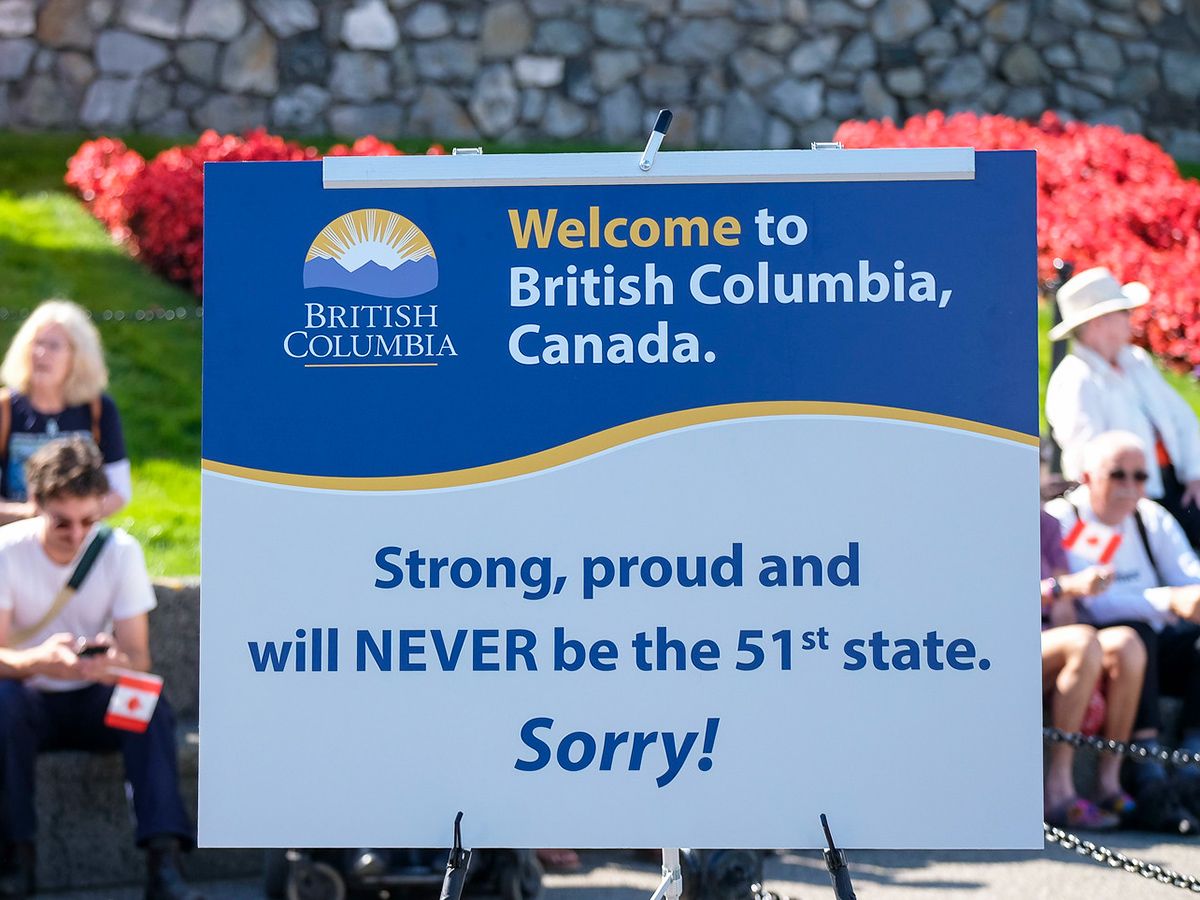
In this case the Canadian military should have respectfully denied the Ambassador’s request for the flypast. It wouldn’t have created an international incident, but it would have reinforced the idea that Canada is a sovereign state, not a 51st state, and that the U.S. must respect this instead of requesting an unnecessary air show at Canada’s diplomatic and military expense simply to show off America’s fancy aircraft in an attempt to persuade Canada to favour its jets and not someone else’s.

Douglas Cornish, Ottawa


Pollution knows no borders

Re: ‘You’ll find out about it’: Trump hints at Canada’s wildfire smoke punishment — Ellie Hutchings, Aug. 4

Canada’s wildfire season is heartbreaking, and I understand why Americans are frustrated when smoke crosses the border. It is disappointing, however, to see an issue that once united our countries in co-operation become another political talking point.

We absolutely need to continue investing in wildfire prevention, forest management and firefighting. At the same time, climate change and increasingly severe fire seasons have made this an extraordinary challenge that no single country can solve alone.

What concerns me is the tone of some of the criticism coming from the United States. For generations, the U.S. has consumed substantially more fossil fuels than Canada in absolute terms and has historically relied heavily on coal-fired power. Those emissions, like wildfire smoke, do not stop at the border. Canadians have lived with cross-border air pollution for decades, yet our response has generally been to work together, not to point fingers.

The reality is that both coal combustion and wildfires release pollutants with health consequences. (Coal ash even contains naturally occurring radioactive elements.) Rather than trading accusations, we should be investing together in cleaner energy, healthier forests, and stronger emergency response.

Canada and the United States have always been better neighbours when we tackle shared problems together. Let’s get back to that.

Matt Halliday, Haileybury, Ont.


U.S. government also supports dairy industry

Re: Canada’s dairy sector is built on what I warn every client against — Daryl Ching, July 16

Daryl Ching has obviously valid points in his op-ed about the way dairy supply management raises the costs to the consumer by reducing competition. However to imply that the U.S. dairy industry is a free market governed totally by supply and demand is a laugh.

Canada does interfere with a full free market in dairy by quotas that limit supply in order to support Canadian farmers. It does increase the cost of dairy in Canada over what U.S. consumers pay.

The U.S. government however uses other means to support its dairy industry. It sets minimum prices paid by manufacturers to producers, it insures farmers from rising feed prices, it buys surplus dairy products and gives them to institutions or warehouses them, it subsidizes insurance premiums, and it supports export. This contributes to oversupply and what is in essence income supports for farmers. American farmers therefore have surplus production with which they want to flood the Canadian market.

This is a time when Canadians are wary of U.S. governmental interference in international trade. It is a time when the U.S. slaps protectionist tariffs without regard to international agreements and perhaps out of spite or to gain geopolitical advantage. It is a time when commercial interests in the U.S. are not shy in buying influence in Washington to promote their own wealth accretion. Is this the right time to take chances on destroying essential local food production and relying on the U.S. to provide us with essential food items?

Morris Sosnovitch, Toronto


When did Carney lose confidence in Infantino?

Re: Carney says he no longer has confidence in Gianni Infantino’s ability to run FIFA — Agence France-Presse, Aug. 5

As someone who lost confidence in Gianni Infantino the moment I learned he was president of the corruption-riddled FIFA, I would like to know when Prime Minister Mark Carney lost confidence in the man.

Was it when he learned the extortionate prices that FIFA decided to charge for seats at this year’s World Cup? Was it when, following a call from President Donald Trump to President Infantino, FIFA suspended the automatic one-game red-card suspension meted out to Folarin Balogun? Or was it really only when Carney learned Infantino might be about to sell a valuable part of the FIFA franchise to relatives of Trump that our prime minister felt confident enough to declare his loss of trust?

Maybe Carney actually believes that the three-strikes-you’re-out rule applies in football federations, too?

Patrick Cowan, North York, Ont.


Not an Anand admirer

Re: Anita Anand’s misguided condemnation of Israel — Alan Baker, Aug. 6

I cannot decide if former Israeli ambassador Alan Baker was being kind or disingenuous when he suggested that Foreign Affairs Minister Anita Anand was “misinformed” on the subject of so-called “settler violence.”

Anita Anand is not misinformed. There is plenty of information about what really occurred but the truth, to paraphrase Al Gore, is “inconvenient” for Minister Anand.

Anyone who does a deeper dive into the headlines knows that the Israeli farmers had plenty of provocation from the Palestinians, ranging from poisoning their animals to setting fire to their crops. Of course, the Israelis should not retaliate as they have done and should face justice for their actions. However they are no more guilty of wrongdoing than the Palestinian provocateurs, but Anand seems content to give the Palestinians a free pass, saving her vitriol for those pesky Jews.

Justin Trudeau, the self-styled “feminist” prime minister, booted Jody Wilson-Raybould from her position as attorney general, followed by health minister Jane Philpott, because Wilson-Raybould refused to break the law and shield SNC Lavalin from the consequences of its actions. Philpott supported her and thus also became the object of Trudeau’s wrath.

I admire both of these women for speaking truth to power and for refusing to engage in actions they knew to be wrong, even if it cost them. Not so Anand. She (and her predecessor in foreign affairs, Mélanie Joly), remained silent. One can only deduce from this, that political ambition outweighed honour.

Some pundits have suggested that Anand is the worst foreign affairs minister in Canadian history. It is easy to see why.

E. Joan O’Callaghan, Toronto


Federal government bonuses undeserved

Re: Federal government handed out $201.5M in bonuses to execs despite half of targets missed — Ellie Hutchings, July 31

Thanks to Ellie Hutchings for her excellent report based on findings by the Canadian Taxpayers Federation (CTF). How is it possible that 88 per cent of government executives received a bonus in 2025 when only 54 per cent of departments met their performance targets in 2024-2025?

These payments were categorized as either a (1) “bilingual bonus allowance” for 6,902 employees, at a cost of $4 million; (2) “at risk pay” totalling $172 million for 9,173 employees, or a (3) “performance award” for 1,618 costing $24 million. It is also worth noting that Canada Post handed out $30.8 million in management bonuses in 2025, despite losing $ 1.6 billion that year.

Prime Minister Mark Carney is not yet living up to his billing. And it’s highly unlikely Canadians will see a balanced budget under this Liberal government. The next generation will pay!

Harry K. Hocquard, King, Ont.


Stop the hate

Re: Antisemitic terrorism is a national emergency. Carney needs to act like it — Tasha Kheiriddin, Aug. 4

It would be inconceivable, intolerable and, I would hope, illegal for a group of Winnipeggers to stand outside an Islamic community centre, school or mosque carrying signs and shouting slogans depicting Muslims as garbage, diseased, and deliberate killers of children. Yet, like clockwork, during every Folklorama — an annual early-August celebration of this city’s cultural diversity — a group positions itself outside the Israeli pavilion at Rady Jewish Community Centre and does exactly this towards Jews.

The location of these purported anti-Israel protests underscores a popular pretence where “anti-Zionism” is misleadingly used as a placeholder for Jew hatred. How are protests about Israeli government actions served by attempting to intimidate families attending a Jewish community centre?

When societies allow for the dehumanization and vilification of a group of people, targeted violence is an inevitable outcome. Recent murders of Jewish individuals in Washington D.C.; Boulder, Colo., Manchester, England; and Bondi Beach, Australia, and attacks on Jewish-owned businesses and places of worship in Toronto, Montreal, Vancouver and Winnipeg were not random events.

A dangerous culture of tolerance for hatred towards Jewish people has grown over the past three years. It has to stop.

Daniel Rothman, Winnipeg


EDITOR’S NOTE: Letters to the Editor will return on Sunday, Sept. 6


National Post and Financial Post welcome letters to the editor (250 words or fewer). Please include your name, address and daytime phone number. Email letters@nationalpost.com. Letters may be edited for length or clarity.


A statue of Egerton Ryerson is covered in paint, graffiti with shoes left at the base, at Ryerson University in downtown Toronto in 2021.

I recently took a walk around Victoria University on the University of Toronto campus with the school’s communications officer. She was going to show me the portrait of Egerton Ryerson, who was involved in founding the original Victoria College, which was later absorbed into the U of T. But we couldn’t find it.

It was somewhere in the E.J. Pratt Library, but two staffers we asked had no idea where. Eventually we discovered it on the wall at the end of a hallway. In the portrait, Ryerson is 39, the age at which he became principal of Victoria College. The portrait used to be in the foyer outside the principal’s office, but according to the sign next to it, it was taken down in 2021 for “security reasons” and later put up in the library.

Today, if you visit the school’s website and click on “History,” you won’t see any mention of Ryerson, despite his involvement in its founding. He’s better known for the connection to Ryerson University, now Toronto Metropolitan University (TMU).

Alas, his name was attached to that institution for 74 years and his statue stood there for 134 years before being toppled and beheaded by a mob on June 6, 2021. That was two weeks after the announcement of 215 graves of missing and murdered Indigenous children said to be found on the grounds of the former Indian residential school in Kamloops, B.C. In the five years since, not one grave has been confirmed.

Ryerson’s statue was targeted because he was labelled an architect of Indian residential schools. Ryerson is still paying the price.

He should be remembered for the huge mark he left on educational and cultural institutions. It’s no stretch to call him the father of public education in Canada.

In 1829, Ryerson became the founding editor of a newspaper called the Christian Guardian, and from his post, he established the publishing house later known as Ryerson Press, before it was sold to an American publisher.

In 1844, Ryerson was appointed chief superintendent of education for Upper Canada and set out to study educational programs in England, Europe and the United States. What constituted education here wasn’t close to what was happening in those jurisdictions; only half of our school-age children were even attending school. In 1846, Ryerson proposed reforms calling for improved teacher-student ratios, school management, teacher training and textbooks written by and for Canadians.

He wanted to make education a universal right.

The next year he founded the Toronto Normal School, which became the Ontario Institute for Studies in Education. What’s more, the Ontario Agricultural College at the University of Guelph and the Ontario College of Art and Design University in Toronto had their roots at that institution.

His trips abroad led to early collections of items that would evolve into museums and galleries, among them the Royal Ontario Museum.

Education. Culture. Publishing. The man was a pioneer in all these areas.

The “controversy” with Ryerson, who was widely considered progressive for his time, comes from a letter he wrote in 1847, in which he was asked for his thoughts on setting up training schools to educate Indigenous youth.

The letter suggested a model of voluntary schooling for students to learn how to use farming tools and equipment. The focus would be on agriculture. But that letter has since been taken out of context by activists determined to sully his name and label him the creator of Indian residential schools.

The campaign against Ryerson at Victoria University began in 2019, when it commissioned a report , which ultimately recommended that, “Ryerson’s name should no longer be used honorifically at Victoria University.” That resulted in the Ryerson House residence reverting back to its original name, First House.

Two months after his statue was torn down and beheaded at Ryerson University, the school’s “Standing Strong Task Force,” which was set up to investigate Ryerson’s legacy, issued a report making claims against him. Among them was that he was involved in setting up Indian residential schools and enabling separate schools for Black students. All this happened during the frenzy over the story about the graves at Kamloops.

In 2022, the university was renamed Toronto Metropolitan University as the man and his name became toxic, and has remained so, especially in the academic community. The residue persists at Victoria University to this day.

A number of prominent historians have criticized the campaign against Ryerson. Patrice Dutil, who still teaches at TMU, and Ronald Stagg, former head of history at the university, defended the man in the Dorchester Review in 2021.

“The movement against Ryerson belongs to a wider trend to indulge in rage against ‘white men’ who dominated Canada’s history,” they wrote. “But this case is special because Egerton Ryerson is patently innocent of the charges.”

When I interviewed Stagg for my book “SLEEPWOKING,” he said he was “horrified” when the statue of Ryerson came down and that all the talk about early residential schools being centres of assimilation, mandatory attendance and forced conversion to Christianity is “nonsense.” He said these early schools weren’t like the later federal government ones.

Another critic I interviewed is Lynn McDonald, former NDP member of Parliament, professor emerita at the University of Guelph and a fellow of the Royal Historical Society. She and Stagg co-founded a group called the Friends of Egerton Ryerson, in an attempt to clear his name after the turmoil about Ryerson went into high gear.

With regards to his treatment at the U of T’s Victoria University, McDonald and Stagg say the administration there has been remiss. Rhonda McEwen, the outgoing president of the school, was recently announced as the next president of the University of Victoria in British Columbia.

This prompted an interview with Steve Paikin, which was published in the Toronto Star last month. Paikin asked about the “controversy” involving Ryerson during her tenure. She mentioned the committee set up to study the matter and said the fullest story must be told — “the good, the bad and the ugly.” Only there is no “ugly” with Ryerson. None. And so, I asked her myself.

“We returned the portraits to campus while encouraging and supporting ongoing dialogue, research and critical engagement. This was the opposite of cancellation. The role of a university is to discover, investigate and disseminate knowledge; to foster learning and critical analysis rather than respond primarily to populist reactions,” McEwen wrote in an email to me on July 20.

Nevertheless, under McEwen’s predecessor, Victoria University issued two reports that refer to Ryerson’s “ troubling legacy ,” his support of segregated schools for Black students, that he “enabled a discriminatory model of education that caused real harm to Indigenous students and their communities” and that he played “an important role in the development of the residential school system.”

McDonald says McEwen is leaving her post without properly addressing what McDonald calls “the egregious errors and accusations” about Ryerson that were made during the tenure of her predecessor, William Robins, who commissioned both reports. In June, he was named interim president and vice-chancellor of Victoria University at U of T.

As for Stagg, a graduate of Victoria College himself, he met with McEwen a year and a half ago to persuade the college to change its tune about Ryerson. “The report got it wrong and she said she’d look into it,” said Stagg. “She didn’t.”

If you want to see the portrait at U of T’s Victoria University, find the library and go to the end of the hall. It hangs there unceremoniously.

National Post

Jerry Amernic is the author of “ Sleepwoking ,” a book about historical revisionism in Canada and all the fallout associated with it.


TOPSHOT - US model Emily Ratajkowski arrives for the 2024 Met Gala at the Metropolitan Museum of Art on May 6, 2024, in New York. The Gala raises money for the Metropolitan Museum of Art's Costume Institute. The Gala's 2024 theme is This content is reserved for subscribers.


U.S. President Donald Trump delivers remarks at the David S. Mack Center for Training and Intelligence on August 14, 2026 in Garden City, New York.

Canadians are awaiting a potential trade agreement with the Trump administration before the implementation of 50 per cent tariffs next week. The world is waiting for an agreement between Iran the Trump administration on the Strait of Hormuz.

Meanwhile there have been no shortage of recent agreements of significance. The Trump administration concluded a nuclear energy agreement with Saudi Arabia, opening the door to Saudi enrichment of uranium — a necessary, though not sufficient, step toward a nuclear weapons program. After careful overnight thought, U.S. President Donald Trump then effectively cancelled the agreement unless the Saudis joined the Abraham Accords.

The Saudis, for their part, took a pass on the Abraham Accords and surprised everyone last week with the Mecca Accords, a mutual defence pact with Turkey and Pakistan, employing language similar to NATO’s article 5 — an attack on one is considered an attack on all.

An interesting question arises. If in future Iran were to hit a Turkish catering truck in which Trump was hiding, would NATO and Pakistan both declare war on Iran given that Turkey is both a NATO and Mecca member?

The Mecca Accords were preceded last September when Saudi Arabia and Pakistan — which has nuclear weapons — concluded a mutual defence pact between just the two of them. The same month Trump, enraged by an Israeli assassination attempt on Hamas officials in Qatar, signed an executive order declaring that any attack on Qatar would be considered an attack on the United States — a NATO-like guarantee to a non-NATO country.

Trump also announced a peace plan for Gaza, promising Hamas disarmament and Israeli withdrawal. Prime Minister Benjamin Netanyahu took several days before rejecting that plan outright.

Agreements aplenty then, announced but not always honoured, awaiting the next agreement to be announced and maybe not honoured.

The world is watching that dynamic regarding Trump and Iran. The former announces an agreement, or a near-agreement, or a desire-for-an-agreement, and the latter insists that they will never be an agreement except on its extortionary terms.

The president huffs and puffs, exasperated that whilst commanding the far mightier military force, he cannot force Iran to capitulate. Meanwhile he takes cover in a catering truck as Iranian threats make not one, but two, Air Force One planes too dangerous to use. The metaphor is illustrative.

The reality is that Iran is willing to penalize itself — sanctions, blockades, bombing — in order to inflict damage on the United States, its Gulf neighbours and the world economy. A negotiation usually seeks to achieve something of a win-win, but Iran is content with a lose-lose; specifically a we-lose-more-as-long-as-you-lose-something.

Coupled with technology that allows a much weaker power to inflict meaningful disruption on a greater power — whether preventing ships from transiting Hormuz or the president abandoning his plane — it makes it difficult to make a lasting agreement.

In the Persian Gulf it is Iran that is willing to penalize itself, resulting in the absurd spectacle of one of the world’s most reviled regimes being able to hold hostage one of the world’s most crucial shipping routes. The lose-lose mentality is making the world more dangerous.

The lessons of Hormuz are not entirely unrelated to the lessons of the Gordie Howe bridge. There it was the Trump administration who took the shipping route hostage until Canada paid the ransom. There was no option for a win-win, as the Trump position opened with a lose-lose — the bridge does not open — and maintained a willingness to make American citizens and businesses lose until Canada agreed to lose too.

Canadian trade negotiators are feverishly working to get some kind of agreement ahead of the latest threatened tariff imposition. Good luck to them, but it is hard to see what kind of agreement would be worth making.

There can be no expectation that Trump will abide by any agreement he makes, as his trade aggression against Canada both violates the very free trade agreement he signed in 2018, and simple honest conduct — “fentanyl tariffs,” “forced labour tariffs.” As Europe, Israel, Saudi Arabia and Iran have discovered, no agreement means what it says if the president changes his mind.

More fundamentally, the entire tariff strategy is that Trump will make Americans pay in order to inflict pain on others. That’s what tariffs do. Smoke getting in American eyes? Raise taxes on Americans who import goods. Brazil puts a corrupt, autocratic former president in jail? Make Americans pay more for coffee. Americans like to buy Canadian goods because it makes their lives better, more comfortable and affordable? Make them pay!

How then to get to a win-win, which is the principal goal of trade negotiations, if the other party opens by gleefully inflicting losses on itself? Trade negotiations thus go from a gain-spreading exercise to a loss-reduction project. Perhaps Canada can reduce the losses suffered by our aluminum producers so that American consumers of beer cans and automobiles also suffer less. Perhaps our lumber producers can suffer less so that young American families don’t have to pay thousands more for their homes. Perhaps, but the very perversity of the negotiations reduces confidence in a good result.

The possibility for a Canadian-American trade deal remains better than for a American-Iranian deal. In the former case, at least one party can be trusted to keep its word.

National Post


Montreal police guard the Israeli Consulate during an anti-Israel protest in 2025.

There is today a corrosive indulgence within the Canadian Jewish community: the indulgence of fear.

Not fear itself. Fear is a rational response to real danger. Synagogues have been firebombed. Jewish schools have been attacked. Jewish businesses have been vandalized. Jews have been assaulted in our streets. No serious person denies that antisemitism has surged since Hamas’s October 7 massacre in Israel.

The indulgence lies elsewhere. It lies in the belief that every antisemitic incident must be treated as proof that Jewish life in Canada is finished; that every family that leaves becomes evidence of a national exodus; that every viral social media clip confirms that our cities are lost forever.

That constitutes a submission to the industry of fear. Like every industry, it has its incentives. Every alarming incident is amplified. Every setback becomes existential. Every outrage demands another declaration that Jews have no future here. It is emotionally satisfying, but it is profoundly wrong.

The greatest victory antisemites could hope for is not that Jews lose a political argument, but that Jews lose confidence in themselves.

History teaches that antisemitism has never disappeared. It also teaches something equally important: Jewish communities survive when they refuse to surrender to it.

In 2022, before October 7, B’nai Brith Canada recorded roughly 2,700 antisemitic incidents. The number was shocking. Yet we did not convince ourselves that Jewish life in Canada was over. We understood that hatred had to be fought, not endlessly advertised.

Today, too many people confuse awareness with effectiveness. They do not ask whether constantly magnifying every incident strengthens Jewish confidence or weakens it. It weakens it.

As I recently said in a public address, antisemitic graffiti on a bathroom stall does not deserve the same attention as a Hasidic Jew being beaten in a public park. Both are reprehensible. Both deserve condemnation. But they are not the same.

When every incident is treated as equally catastrophic, perspective disappears. So does strategy. And without strategy, fear becomes paralysis.

Montreal demonstrates precisely why this matters. For much of the past two years, Montreal deserved its reputation as the epicentre of antisemitic intimidation in Canada. Demonstrations shut down major intersections. Jewish neighbourhoods were targeted. The law was too often ignored while politicians searched for excuses.

Many concluded the city was finished. But they were wrong. Over the past year, Montreal has undergone one of the most remarkable turnarounds of any major Canadian city. Political leadership changed. Police enforcement has changed. There is evidence of more rapid and robust deployment in Montreal and suburbs as occurred at an anti-Israel protest in suburban Valleyfield this past May.

The Quebec government acted decisively by strengthening its secularism laws and making it clear that intimidation would not dictate public policy. This followed past moves to adopt the International Holocaust Remembrance Alliance’s working definition of antisemitism and open a representative office in Tel Aviv — in the middle of a crisis, no less.

Equally important, Jewish organizations and activist groups changed. Instead of merely documenting antisemitism, they challenged it. Instead of lamenting hostile university administrations, they took them to court. Instead of retreating from public life, they entered it.

Instead of speaking only to themselves, they built alliances with Italian, Greek, Filipino, Hindu, Armenian, Persian and numerous other communities. Instead of asking whether Montreal still belonged to Jews, they reminded Montreal that Jews always belonged to Montreal. The results speak for themselves.

It appears to me that the organized demonstrations that once attracted hundreds and sometimes thousands now struggle to gather a few dozen. Political support for extremist activism seems to have eroded. As a Montrealer, I can tell you that the atmosphere has changed dramatically.

That did not happen because Jews fled. It happened because Jews fought.

Which brings us to perhaps the most damaging myth now circulating: that Canada is witnessing a Jewish exodus. While there have been some high-profile cases of Jews leaving Canada, it is by no means an exodus.

Some families have understandably decided to leave. Every such decision deserves respect. No one should judge parents who make difficult choices for their children. But isolated departures do not constitute a national migration. Nor should they become the defining narrative of Canadian Jewry.

Communities are not preserved by counting those who leave. They are preserved by strengthening those who stay.

Our non-Jewish neighbours are watching us. They are asking themselves whether the Jewish community believes its own future is worth defending. People do not rally behind despair. They rally behind courage.

When we built broad intercultural coalitions in Montreal, leaders from every major community came forward. Not because we presented ourselves as victims awaiting rescue, but because we demonstrated determination. They saw resolve. They responded to resolve. That is how democratic alliances are built.

Antisemitism remains a profound challenge. No one should underestimate it. But neither should we exaggerate it beyond reality. A frightened community is easier to isolate than a confident one. A panicked community is easier to intimidate than an organized one. And a community convinced that defeat is inevitable has already surrendered the battle before it begins.

The future of Jewish life in Canada will not be decided by those who hate us. It will be decided by whether we choose fear or resolve. Montreal has already shown which choice works.

National Post

Beryl P. Wajsman is president of the Institute for Public Affairs of Montreal.


Supporters of Luigi Mangione leave after a pretrial hearing at New York State Supreme Court on August 11, 2026 in New York City.

Luigi Mangione, 28, who pleaded guilty Friday to federal U.S. charges of interstate stalking resulting in death, has been a public litmus test for the morality of the political left. Many have failed.

UnitedHealthcare CEO Brian Thompson was gunned down on a New York street in December 2024 — shot first in the back (how dastardly) by a masked Mangione, who only now admits to the heinous crime. “I shot Mr. Thompson in Manhattan and he died… I knew what I was doing,” Mangione said in court Friday. The plea, and not Mangione’s guilt, was the only surprise.

Yet men and women fawn over Mangione, penning letters to him in prison and even fundraising for his legal fees, while leftist media asks whether his “motivations were noble or evil,” and the intellectual class debates if this cold-blooded assassin is “reminiscent of historical folk heroes.” The legal fundraiser, which has raised more than US$1.5 million, says that Mangione “is being treated in an unprecedented and unfair fashion by a state acting out of cowardice and fear to make a spectacle of his case in an attempt to intimidate us all into submission to state and corporate power.”

Here’s an idea: don’t assassinate others if you want to retain your freedom.

Outside of the New York court today, a Mangione fan— an attractive young woman with a California uptalk accent — spoke on video to announce her unconditional support for the now admitted killer: “I’ve always said I support Luigi whether or not he did it,” she said. “This is about a movement. It is about Luigi but it’s also about the conversation he started.” Later, she referred to the murder as neither “wrong or right” but instead as “more of a revolutionary act of protest… the likes of which we haven’t seen since the civil rights era.” Have these people lost their minds?

Civil rights hero Rosa Parks did not shoot her bus driver in the back. If she had, she likely would have become a footnote in history. The tragic assassination of Martin Luther King Jr., by contrast, was committed by a violent racist. The heroes of the U.S. civil rights era were not gun-wielding murderers. They were nothing like Luigi Mangione.

Mangione’s sentencing hearing is set for Dec. 18. He is still facing state-level charges in New York, including for second-degree murder. But after pleading guilty to federal charges today, it’s possible that his trial will no longer go ahead. This is because New York has a “double jeopardy” law to prevent accused persons from being tried twice for the same crime.

Mangione’s lawyer, Karen Friedman Agnifilo, told the public today that her client will seek to have the murder charge dismissed. Ultimately, he could spend less time in prison as a result. It’s a move as calculated, and cowardly, as the murder of Thompson.

Brian Thompson, a husband and father, is dead. He was assassinated for political reasons. And still, America’s health-care system remains unchanged in the wake of this cruel killing. Mangione wrote the words “delay,” “deny” and “depose” on the bullets he used to kill Thompson, in reference to health care insurers denying patient claims. He has forever tainted those words — and any power they could have wielded as protest — with his inexcusable violence.

There is certainly an argument to be made about the “corporate greed” of U.S. health care insurers, but a bullet into the back of a stranger is not one of them. If you believe that it is, you are inviting a violent society in which the cost of health care will drop precipitously on your list of priorities.

Luigi Mangione is no hero.

National Post


Cyclists ride down the bike lanes on Royal York Road in Mimico, Toronto, Ontario on Friday, June 26, 2026.

The next time Doug Ford goes on one of his off-script rants about activist judges, he might want to include a qualifier.

Not all judges, that is.

The Ontario Court of Appeal delivered a big win for the Ontario Premier on Friday, overturning a lower court decision that had blocked the province’s plan to rip up bike lanes on three downtown Toronto streets.

The initial court decision found that removing bike lanes amounted to a violation of the right to personal safety found in the Charter of Rights and Freedoms, but the Appeal Court, in a 3-0 decision, comprehensively dismissed that idea.

Among the many flaws it found in the initial court ruling, the Court of Appeal said that the province’s bike-lane removal was “the sort of decision legislatures make routinely without attracting any concerns about the constitutionality of their actions.”

It also said that there is “no Charter right to bicycle lanes” and it gave this rather blunt declaration: “The bottom line is this: there is no constitutional obligation to regulate the use of roads in any particular manner — no constitutional obligation to build bicycle lanes or to retain any that have been built.”

The Ford government was pleased on Friday with its victory.

“Today’s court ruling is a victory for common sense and for respecting the appropriate division of roles between duly elected legislatures and the courts,” said a statement from Prabmeet Sarkaria, the provincial Minister of Transportation. “As the three justices unanimously ruled today, ‘it is illegitimate for courts to involve themselves in matters of legislative policy.’”

The Appeal Court actually went a little further than that, writing in its decision that the lower court ruling “(subverted) a fundamental principle of our democratic constitutional order: a legislature cannot bind its successors. Legislatures in the Westminster tradition are free to undo legislation by amending or repealing it as they see fit.”

But while, legally speaking, this was a blowout win for Ford and his governing Progressive Conservatives, there are perfectly reasonable questions to be raised over whether removing a handful of bike lanes will help achieve the Premier’s goal of improving gridlock, or even if the province should weigh in on a matter that is usually left to municipalities.

A moment for a caveat here: I support bike lanes. They help provide a safe, alternative means of transportation in areas that are increasingly jammed by vehicular traffic.

Cycle in places that have truly embraced them, as opposed to municipalities that paint a line on the side of the road and pat themselves on the back for their commitment to environmentalism, and you see how they can be transformative. Bike lanes, broadly speaking, are a net good.

But the place to stop Doug Ford from tearing up bike lanes was not in the courts, but at the ballot box. As the Appeal Court noted, provincial legislatures routinely pass laws that govern the use of the roads.

“The legislature is free to legislate to remove a bicycle lane from a road — indeed, it may remove a road entirely — without implicating the Charter,” the court found.

But now that Ford has his win over the judge that had blocked his bike-lane removals, and which had brought a public rebuke from the Premier, next comes the harder part of actually improving traffic flow in Toronto. Will the pending removal of bike lanes from Bloor Street, University Avenue and Yonge Street make any noticeable difference to the speed of traffic on those roads, or will more motor vehicles simply move into the space previously occupied by those lanes? (I am betting the latter.)

Ford has long been a pro-car politician, doing everything in his power to encourage people to drive — expanding highways, removing road tolls, dropping gas taxes and licence-plate fees — while never squaring that with the fact that all of those policies are naturally going to increase the number of cars and trucks on the road. Being pro-car is, from a policy sense, essentially the same as being pro-traffic.

But, again, that’s one for the voters, not the courts. Would it make more sense for the city of Toronto to determine whether, or where, it wants bike lanes on its streets? Sure. It seems like even more of a provincial overstep when its legislation prevents towns from installing bike lanes in places where vehicle traffic patterns aren’t even a concern. If a municipality wants to put a bike lane on Main Street to make it easier for residents to cycle to the market on weekends, why should Ford care?

But he does, and his party formed a majority government. Again. There are venues for the pro-bike forces to take that fight. But a court that invents a constitutional right to a bike lane isn’t the solution, either.

National Post

sstinson@postmedia.com


Minister responsible for Canada-U.S. Trade Dominic LeBlanc in Ottawa on Thursday, July 16, 2026. This content is reserved for subscribers.


Minister responsible for Canada-U.S. Trade Dominic LeBlanc in Ottawa on Thursday, July 16, 2026. This content is reserved for subscribers.


U.S. President Donald Trump

As U.S. President Donald Trump’s Wednesday tariff deadline looms, there are worrying signs that Canadian manufacturers are going to pack up and move south of the border. This is unsurprising for a country that imposes high costs on businesses and seems to have resigned itself to being Trump’s whipping boy.

Last month, KPMG Canada released the results of a survey of 275 Canadian manufacturers conducted in May, which found that 42 per cent of them have considered, or are currently considering, moving production south of the border. Eleven per cent said they’re thinking of moving their head offices to the United States.

A few weeks later, the Financial Post reported that Vancouver-based Interfor Corp., one of the world’s largest lumber producers, plans to “shift its corporate and functional support operations” from British Columbia to Georgia, largely due to Trump’s crippling 45 per cent tariffs on softwood lumber.

Coercing manufacturers to relocate production to the U.S. is, of course, exactly what Trump hoped to achieve. It also explains why the president has singled Canada out for disproportionate punishment: while the U.S. can’t compete with developing countries on labour costs and moving operations from Europe is a costly endeavour, Canada is situated right next door, has an economy that’s already highly integrated with the U.S. and has relatively high wages and an uncompetitive tax system.

If these weren’t reasons enough to put Canada in the crosshairs, Prime Minister Mark Carney has shown little willingness to stand up to the bully next door. A year ago, he unilaterally removed most of the counter-tariffs imposed on American goods by his predecessor, only maintaining duties on steel, aluminum and automobiles to protect Canadian industry from similar U.S. tariffs.

It’s now apparent that this was a tactical mistake: Carney’s gesture of goodwill lost Canada a strategic bargaining chip, while failing to buy trade peace. Now, the Trump administration is citing Ottawa’s reciprocal tariffs on autos, along with booze bans imposed by some provinces in response to Trump’s trade war, as part of its justification for imposing 50 per cent tariffs on US$20 billion (C$28 billion) worth of Canadian goods.

Whether that actually happens remains to be seen: the president gets called on his bluffs so often, the acronym TACO (Trump always chickens out) has entered the English lexicon. Except once in a while, he kidnaps the president of Venezuela, bombs Iran or imposes tariffs on the entire world, ensuring everyone must remain on their toes at all times.

Regardless, the message to Canada, as explained by White House trade advisor Peter Navarro in these pages last month, is crystal clear: we will whip you as much as we want, and if you try to fight back, we’ll punish you even harder.

This position makes sense, given that most countries have quietly acquiesced to Trump’s tariffs. But Canada stands apart from the pack because we’re America’s second-largest trading partner , behind Mexico and ahead of China, and have had a free-trade agreement in place since 1989 .

In his first term, Trump railed against NAFTA, calling it the “worst trade deal ever made,” and renegotiated it as the Canada-U.S. Mexico Agreement (CUSMA). The fact that he now intends to violate his own agreement by imposing crippling tariffs on many CUSMA-compliant goods does not inspire a lot of hope for any future settlement — the man likes making deals, just not keeping them.

With this latest trade threat, the White House is hoping we’ll scrap our longstanding yet self-destructive system of supply management, restock provincial liquor stores with American booze and drop our counter-tariffs on automobiles, all before sitting down to renegotiate CUSMA, which is clearly a nonstarter.

The flurry of trade negotiations in Washington suggests the federal Liberals are hoping to make some minor concessions to avoid the threatened sanctions and head into the CUSMA talks with our biggest bargaining chips in tact. Yet even if such a strategy succeeds, Canada will be left with a weaker hand — and the White House knows it.

The alternative strategy — and the only one that appears to work with Trump — is to up the ante. This is the tactic that’s been employed by China and Iran, the two countries that have arguably succeeded in getting the Trump administration to back down.

When Trump escalated his trade war with China last year, the Middle Kingdom didn’t roll over, but instead raised the stakes, continually increasing tariffs on American imports to a peak of 125 per cent. At this point, the White House caved, dropping tariffs to 30 per cent, from a high of 145 per cent.

Iran also refused to yield after being hit with punishing American and Israeli airstrikes. Instead of taking the off-ramp offered by the administration, it continued blocking the Strait of Hormuz, which appears to have succeeded, as Trump is no longer insisting Tehran put a stop to its nuclear program. The Iranian regime knows that both Trump and the American people have little appetite for war, and have exploited it to their full advantage.

Both countries are bad actors, and I’m by no means suggesting we should get in bed with them or emulate their tactics. But Canada does more trade with the U.S. than China — purchasing over US$333 billion worth of U.S. good last year alone — which means that any retaliatory measures we impose could have a big impact on the American economy. And with the midterm elections looming, now would be the time to make our move.

National Post
jkline@postmedia.com
Twitter.com/accessd