



ODESA, Ukraine — Ukrainian President Volodymyr Zelenskyy
his country’s anti-corruption infrastructure last week in a shameful power grab that has stained his domestic and
credibility. Yet, the mass protests that followed, which forced Zelenskyy to quickly
, illustrate that Ukrainian democracy remains resilient and that illiberal governance will not be tolerated by its citizens.
The scandal began on Tuesday morning, when an innocuous parliamentary bill (concerning the investigation of missing persons)
by a series of unexpected amendments. The new version of the bill — which passed by a vote of 263 to 13 — granted Ukraine’s Prosecutor General, a political appointee directly chosen by the president, considerable authority over Ukraine’s two main anti-corruption agencies.
These agencies — the National Anti-Corruption Bureau (NABU) and the Specialized Anti-Corruption Prosecutors Office (SAPO) — were established in the aftermath of Ukraine’s 2014 pro-western Euromaidan revolution, and have since been indispensable to the investigation and prosecution of corruption cases involving high-level public officials, including parliamentarians. Immunity from political interference has been integral to their operations, and, by extension, the international community’s trust in Ukraine’s overall anti-graft reforms.
Last Tuesday’s bill, though, granted the Prosecutor General — and, by extension, the President’s Office — the authority to shut down high-stakes investigations or reassign them to other law enforcement agencies that are directly controlled by the government. Furthermore, the Prosecutor General can now appoint or dismiss these agencies’ prosecutors; order the handover of uncovered evidence; and take over plea negotiations for charged individuals.
In other words: Zelenskyy put Ukraine’s most important anti-corruption institutions under his control, effectively immunizing his inner circle from investigation.
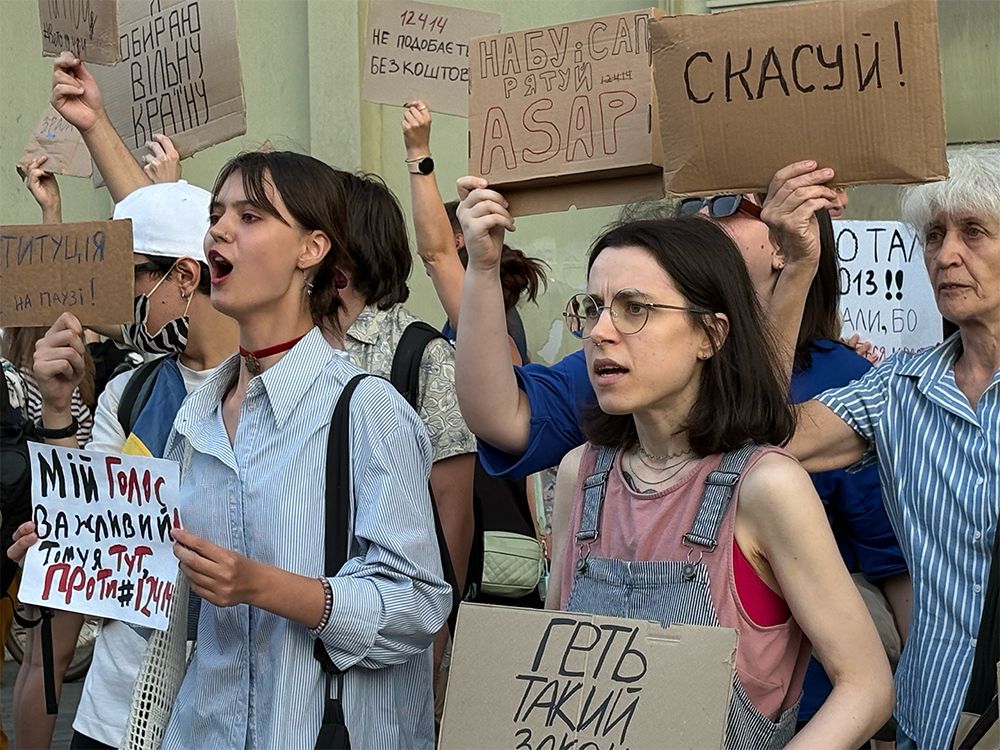
Many Ukrainians could not believe that such a law had been passed — especially as it had come out of nowhere, right before parliament’s summer recess. Protesters began
of Kyiv within hours, pleading with Zelenskyy to veto it. Yet, their hopes dimmed after media reports confirmed that the bill had actually originated from the president himself, and that parliamentarians had faced intense pressure to vote for it despite their deep reservations.
In a video address that evening, Zelenskyy claimed that SAPO and NABU had been infiltrated by “Russian influence” and that important corruption cases were being left to languish, which is why he wanted greater oversight. Yet most of Ukraine’s civil society actors — and seemingly the majority of the general public —
.
As Tuesday night wore on, the civil unrest in Kyiv swelled. Thousands gathered in front of the President’s Office, despite the ongoing risk of Russian missiles and drone strikes, to voice their displeasure, staying up late in violation of the nightly military curfew. Smaller protests broke out concurrently in
— such as Liviv, Kharkiv and Odesa — forming the largest wave of public demonstrations seen in Ukraine since Russia’s full-scale invasion.
Domestic critics argued that Zelenskyy had betrayed the values of the Euromaidan revolution, and
with that of former president Viktor Yanukovych, whose corruption and autocratic impulses had endangered Ukraine’s EU integration in the early 2010s. Similarly, European officials warned that hollowing out NABU and SAPO
its financial assistance and render EU membership impossible.
Some of the Ukrainians I spoke with in the past few days felt confused and betrayed. After all, Zelenskyy was elected on an anti-corruption platform in 2019 and, for the first few years of his presidency, was widely seen as effective in this respect. When Ukraine’s constitutional court
that nullified most of the country’s anti-corruption programs, for example, the then-rookie president pushed back and, instigating a constitutional crisis, had them reinstated at great political risk.
Others were less surprised, though, saying that Zelenskyy’s behaviour has recently grown
. Many of Ukraine’s anti-corruption activists, for example, seem to believe that last week’s reforms were retribution for NABU’s prosecution of Deputy Prime Minister Oleksii Chernyshov, a close ally and personal friend of Zelenskyy’s, who was named as a suspect last month in a major corruption scheme involving the construction sector.
Whatever Zelenskyy’s motives ultimately were, the withering public backlash evidently spooked him. Within two days,
that he had “heard what people are saying on social networks, to each other, on the streets,” and submitted a draft bill to preserve NABU and SAPO’s independence while mandating regular polygraph tests for agency employees with Russian relatives. “It’s very important that society speaks. I respect the opinion of society. I believe it is absolutely normal to react when people don’t want something or when they dislike something,” he said at
on Friday.
While some pro-Russian commentators — such as
far-right U.S. Congresswoman Marjorie Taylor Greene
— have exploited this week’s chaos to smear Ukraine, most citizens here have taken a more optimistic view. Many have said that
showcased the strength of the country’s democratic values and civil society actors; the spirit of the Euromaidan revolution has evidently not been forgotten. Some also pointed out that such civil disobedience is simply not possible in autocratic countries, such as Russia.
Last Thursday night, I attended a smaller demonstration in Odesa where protesters, wearing blue and yellow flags, held signs emphasizing Ukraine’s European destiny. “Cancel the law! Cancel the law!” they repeated. Their voices grew more fervent: “Ukraine is not Russia! Ukraine is not Russia! Ukraine is not Russia!”
National Post

